Israeli revenue freeze is “a warning” to the Palestinians
MEMO |12 May 2011
Israel’s finance minister has said that the Israeli decision to freeze the tax revenue transfer to the Palestinian Authority is a “punishment”. Yuval Steinitz said that the “warning” move by Israel was a response to Fatah signed a reconciliation agreement with Hamas.
Speaking to Radio Israel, Steinitz said, “The delay in transferring funds is a yellow card for the Palestinian Authority after the signing of the agreement with Hamas.” At the moment, it is a delay of a week to ten days, but it could become a “red card”, depending on “clarifications” from the Palestinians.
Annually, Israel collects taxes totaling between $55 – 62 million at border crossings and ports on behalf of the PA and transfers it to the Palestinians under an economic deal agreed alongside the Oslo autonomy accords.
Israeli forces, tanks cross into Gaza
Press TV – May 11, 2011

Israeli forces backed by tanks and bulldozers have crossed into the Gaza Strip, destroying Palestinian farmlands in north of the enclave.
Israeli soldiers apparently entered the Palestinian territory from Karni crossing on Wednesday and advanced hundreds of meters toward the east of Gaza City.
According to Press TV’s correspondent in Gaza, Israeli soldiers dug a series of holes in the area and filled them with explosives.
Israeli soldiers then blew up the explosives, causing loud explosions in the area, our correspondent added.
Israeli officials claim that the troops were searching and destroying “possible tunnels” in the area that could be used by Palestinian resistance fighters to enter Israeli posts and capture Israeli soldiers.
But analysts believe the Israeli attack aimed at provoking Palestinian fighters into firing on Israeli troops, which could have escalated the situation.
It was the first Israeli attack on Gaza after the two main Palestinian factions, Hamas and Fatah, signed a unity deal.
Israel has repeatedly voiced anger at the reconciliation accord signed between the two Palestinian groups which aimed at forming a Palestinian unity government.
Occupied Palestine: Aid work delayed by barriers
IRIN | May10, 2011

Truckloads of humanitarian aid and commercial goods bottle-necked at Kerem Shalom crossing along the Gaza-Israel border
Photo: Erica Silverman/IRIN
RAMALLAH – The delivery of humanitarian aid to the occupied Palestinian territories (OPT) has been hampered by severe restrictions on staff movements, hurting the quality, scope and sustainability of operations, say the UN and international NGOs.
“Delays in the movement of staff that are guiding, monitoring and executing programmes mean delays in implementation and rising costs,” UN Humanitarian Coordinator for OPT, Max Gaylard, said. “Services to beneficiaries may be delayed and their quality reduced.”
OPT has some of the largest humanitarian operations in the world. Every day, thousands of aid workers battle with the physical barriers of occupation just like the 4.5 million Palestinians residents. The barriers include nearly 1,000 internal West Bank checkpoints, roadblocks, earth mounds and trenches that are part of Israel’s complex security regime.
Israel says the checkpoints are necessary to ensure the security of Israeli citizens against terror attacks.
About 17,000 UN staff, including about 450 internationals, work for nine UN humanitarian entities in the OPT. About 16,000 work for the UN Relief and Works Agency (UNRWA) and another 1,000 for other UN agencies. More than 100 INGOs, employing a few thousand staff, along with thousands of national NGOs, work in the OPT, according to the UN Office for the Coordination of Humanitarian Affairs (OCHA).
INGOs estimate the restrictions on OPT staff cost about US$4.5 million annually, excluding additional costs incurred by implementing partners.
Checkpoints
In 2010, there was a monthly average of 92 permanently and partially staffed checkpoints, 519 staffed obstacles, and an additional 414 “flying” or random checkpoints in the West Bank, reports OCHA.
The total area of the West Bank, 5,860 sqkm, ranks 171st globally in terms of size, while Gaza is just 365 sqkm.
Over the past six months, the number of fixed internal West Bank checkpoints has decreased, according to OCHA, although the number of “flying” West Bank checkpoints has increased, making planning increasingly difficult.
Aid workers faced an average of 44 incidents of delayed or denied access at West Bank checkpoints per month in 2010, 32 of which occurred at Jerusalem periphery checkpoints.
Checkpoints on the “separation barrier”, particularly those along the Jerusalem periphery, are more problematic for humanitarian staff and for Palestinians to cross, because Israelis view this as the point of entry into the state of Israel.
On average, about 385 UN and 123 INGO vehicles, which also carry staff, cross eight of the 21 fixed checkpoints located along the Jerusalem periphery daily to enter and exit the West Bank. An average 29 staff days were lost per month in 2010 to “checkpoint incidents”, says OCHA.
In 2010, 98 roadblocks were removed throughout the West Bank, leaving 16 operational, most of them normally open, according to the Israeli coordinator of government activities in the (Palestinian) territories (COGAT).
Delivery delayed
INGOs say the restrictions on their movement reduce the effective delivery of aid to some of the most vulnerable Palestinian communities, mainly those in Gaza and in Area ‘C’ of the West Bank.
“The biggest problem for us is getting permits for national staff to leave Gaza and travel to the West Bank and East Jerusalem,” says Oxfam international policy officer Lara El-Jazairi. “It’s impossible to get permits for West Bank nationals to enter Gaza.”
Oxfam has been forced to hire more international staff and to duplicate positions, increasing costs and spending funds that could otherwise be spent on project implementation, says El-Jazairi.
The UN has been told by Israeli authorities that the Israeli Crossing Points Administration (CPA), a civilian department linked to the Defence Ministry, will eventually operate all checkpoints from 2012.
The CPA requires regular searches of UN vehicles, unless the driver is an international staff member, and national UN staff are subject to body searches and required to walk through the crossings the CPA operates.
“We are working for the OPT, but Israel has full control in the West Bank and Gaza,” says Gaylard, and “Nothing and no-one goes in or out of the West Bank or Gaza for UN purposes without approval from the Israeli government.”
UN humanitarian supplies are basically food and medication. INGOs also face greater difficulties in obtaining necessary visas and work permits from the Israeli Interior Ministry than UN internationals under the jurisdiction of the Israeli Foreign Ministry, says Gaylard.
Wael Qadan, director of planning and development with the Palestinian Red Crescent Society in Ramallah, says the restrictions have hit East Jerusalem’s medical sector hardest. PRCS operates emergency ambulance services in East Jerusalem.
“Two-thirds of PRCS staff in East Jerusalem are from the West Bank, and every three months their permits must be renewed,” says Qadan. “There are frequent delays and some are denied, which means ambulance services in East Jerusalem are understaffed.”
“Only doctors can cross checkpoint in a vehicle; all medical staff must cross on foot, exposed to the elements,” says Jihad Alouni, a physical therapist from Augusta Vitoria Hospital. “The process is gruelling, and there are often delays,” he says.
~
See also:
Israel hampers aid agencies at Gaza crossings
IRIN | 29 March 2011
Bethlehem-Area Village of al Walaje Soon to be Completely Enclosed by Separation Wall
By Marta Fortunato for the Alternative Information Center | 10 May 2011

Ongoing construction of the Separation Wall around the Bethlehem-area village of al Walaje (photo by Marta Fortunato)
“Movement will be controlled, not restricted”, declared the Israeli High Court to the residents of al Walaje, a West Bank village four kilometres from Bethlehem which will be soon be completely enclosed by the Separation Wall.
Access to and from the village will be controlled by a gate, manned 24 hours a day by the Israeli army. Over 15000 dunams of al-Walaje’s lands have been confiscated by Israel since 1948, and now just 2800 dunams remain for the village.
The tormented story of al Walaje began in 1948 when the Israeli army occupied the village, confiscated its lands and forced the residents to leave their houses and move into caves. “Since that time our life has changed, family and social connections have started to weaken” Shirin al-‘Araj, one of the leaders of the Popular Committee of al Walaje, tells the Alternative Information Center (AIC). “In one day the residents of the village were scattered throughout different parts of the valley, living in caves. Communication was difficult. My parents, like thousands of other Palestinian refugees, thought they would return to their homes very soon”. On the contrary, time passed and they were prevented from going back. At the same time they didn’t want to leave the caves because “moving in other places was like a defeat for them, because it meant they never would return to their homes” Shirin continues.
However, during the 1960s, al Walaje residents started moving into new buildings located on the land left to the village after 1948. And this is the place where the village is perched today.
The tragedy of al Walaje continued in 1967 when part of the village was annexed by the Jerusalem Municipality, even though West Bank identity cards were given to the residents. In the beginning nobody understood the difference between the identity cards because at that time people were free to move between the West Bank and Israel. “Only from 1994, after the first check points and the first restrictions on our right of movement, we understood the meaning of our identity card: going to Jerusalem would soon be impossible,” Shirin concludes.
Israel’s land confiscation has never stopped: in 1971 more than 4000 dunams of lands were confiscated to build the East Jerusalem colony of Gilo and later, in 1979, the hill where today the colony of Har Gilo is being built, was taken from the village. Over 15000 dunams of al-Walaje’s lands have been taken away since 1948 and now just 2800 dunams remain for the residents of this village, who struggle daily against construction of the Separation Wall. Once the Separation Wall is completed, al Walaje will be totally enclosed by it and a tunnel and gate will provide the only access out, to nearby Beit Jala. This means that al Walaje will be completely closed and all access to and from the village will be monitored and controlled by the Israeli army. “We fear that al Walaje will become a new Qalandya, where the only checkpoint to enter the city closes at 5pm and access is permitted only to residents” Shirin says. “Every day we lose some of our rights and our freedom, including the right to demonstrate in a non-violent way”.
Al Walaje residents are afraid of organizing non violent demonstrations against the Separation Wall because in the past some residents, including several children, were severely injured by the Israeli army and work permits were torn up by Israeli soldiers in front of the residents, who stood in disbelief. Why take this risk? Why render al Walaje’s children innocent victims of Israel’s injustice?
“We don’t want other children injured, we don’t want other innocent people punished just because they take part in non-violent demonstrations. We can’t bear this burden anymore, it’s too much” Shirin continues.
Walking in the village it’s impossible not to notice construction of the Separation Wall: noisy trucks carry sand and stones from one part of the village to the other and there is a gray wall that defines the perimeter of al Walaje and suddenly stops. The Separation Wall won’t be built on the Green Line, here as in many other villages in the West Bank. It is just one of the several ways that Israel uses to occupy Palestinian land and annex it to Israel. To be on the Green Line, the Separation Wall in al Walaje should be built far to the West, on the slope of Gilo settlement, but it will be built on the other side of the valley, close to the village of al Walaje. This means that thousands of dunams will be confiscated.
This plan was further sustained by the Salesian community, whose monastery is located between the settlement of Gilo and al-Walaje, between the Green Line and the rapidly rising Separation Wall. The Salesian community didn’t stand against the Israeli plan and did not support the struggle of al-Walaje community.
It was particularly shocking to hear the story of a family in al Walaje, whose house will be separated from the village and will be on the “Israeli” side once construction of the Separation Wall is completed. However, the Israeli government doesn’t want this family to have free access to Israel, so it is planning to build a four meter high electronic fence all around the house and to establish a personal check point for access to al Walaje. Moreover, the family’s land will be confiscated because it will then be located on the other side of the Separation Wall.
One of the reasons given by the Israeli government for the planned route of the Separation Wall and to justify the annexation of thousands of dunams of land is that the Wall would pass “too close” to the zoo in West Jerusalem if it was built on the Green Line. “Do you understand how serious this situation is?” Shirin asks with indignation. “This means that for the Israeli government, the life of Israeli animals is more important than life of a Palestinian family”.
Settlers storm school, post racist slogans
Palestine Information Center – 09/05/2011
NABLUS — Jewish settlers stormed a Palestinian secondary school for girls in Sawiya village, south of Nablus, and placed racist, anti-Arab posters on its entrance in Hebrew.
The education office in southern Nablus said in a statement that the settlers, who were protected by Israeli army troops, also glued other posters on the school’s walls inciting against the Palestinians.
The office condemned the act, which negatively affects the educational process, and called for an immediate halt to such practices.
The Israeli occupation forces provide protection for such violations of this school in the village and other schools in the region, which are routine practice on the part of the settlers.
Meanwhile, groups of settlers barged into the Palestinian Wadi Al-Hilwa grazing area in the northern Jordan Valley and threatened the shepherds there and told them to leave the area.
Local sources said that the settlers came from the nearby Maskiot settlement and were planning to annex the Palestinian land to their settlement, which was already established on usurped Palestinian land.
Bahraini Activist Abdul Hadi Al Khawaja Severely Wounded under Torture
Al-Manar | May 9, 2011
Bahraini human rights activist and former president of the Bahrain Center for Human Rights Abdul Hadi Al Khawaja was drastically beaten by the Bahraini authorities after being arrested in April.
 “Al Khawaja’s jawbones were completely smashed and he is suffering from four fractures in his face; he is to undergo a very critical operation”, another Bahraini activist Nabil Rajab stated.
In an interview with Al Manar website, Rajab called upon “the Bahrainis all over the world, specifically those living in European countries, to proceed with the lawsuits and use all possible judicial methods against the Bahraini regime”.
Furthermore, the human rights activist clarified that “we are victims of our region, as sympathizing with any cause is influenced by the sectarian aspect… we are also victims of inconsistencies and interests of world powers that ally with Al khalifa (Bahrain) regime”.
This comes as the Bahraini regime has been executing brutal repressive policies against civilians since the protests began. The Bahraini security forces are breaking into houses, kidnapping young men and women, arresting humanitarian and political activists, as well as opposition figures, and are imprisoning and torturing most of them.

Four political prisoners have been tortured to death; the last was funder of Al Wasat Bahraini newspaper and prominent business man Karim Al Fakhrawi.
In addition, the Bahraini authorities have issued death sentences against four protestors who were accused of killing two policemen; an accusation that was denied by the young men’s lawyers.
On this topic, Rajab, who is currently prohibited from traveling abroad, expected that more death sentences will be issued against political detainees, and considered that “referring civilians to military tribunals and issuing death sentences against them are acts that contradict the bill of rights and are denied by Western countries, specifically the European Union that has ties with this regime”.
Israeli soldiers attack unity celebration, twist and break man’s arm; also attack 85-year-old and 75-year-old farmers
Ma’an – May 8, 2011
HEBRON — Israeli forces violently shut down a rally celebrating Palestinian national unity in Beit Ummar near Hebron on Saturday, injuring several protesters, locals said.
During the celebration, demonstrators held signs stating “Unity is our strength” and “Unity = Liberty” in an event marking the signing of an agreement in Cairo reconciling Hamas and Fatah and reuniting the West Bank and Gaza under a single government once the agreement is put in place.
Local committee spokesman Mohammad Ayyad Awad said Israeli soldiers fired tear gas and attacked demonstrators with stun grenades, rifle butts and batons.
Soldiers tried to arrest head of the anti-wall committee Yousef Abed Al-Hamid Abu Maria, 36, who owns land confiscated by the illegal Karmi Tzur settlement. Organizers said soldiers twisted Abu Maria’s arm and wrist until it broke in two places.
Forces released Abu Maria when they realized he was seriously injured, a statement from the popular committee said, adding that he was taken to hospital in Hebron and treated for a broken wrist and sprained leg.
Awad said committee secretary Ahmad Khalil Abu Hashem, 42, his 12-year-old son Hamza and coordinator Abed Abu Maria, 33, were beaten by soldiers and sustained bruises.
Several journalists were also attacked, Awad said, adding that Israeli forces declared the area a closed military zone.
The area is also a site of weekly protests, which see locals and international activists march, demanding the end to Israel’s confiscation of land from Beit Ummar and Halhul to build illegal Jewish-only settlements.
Israel’s supreme court ruled in 2006 that farmers whose land was confiscated by Karmi Tzur settlement, including those attacked on Saturday, should be allowed to access their land with permits from Israeli authorities.
Since 2006, Israeli authorities have not issued any permits, Awad noted.
Also on Saturday, Israeli soldiers and settlers attacked two elderly farmers working on their land near the illegal Beit Ayin settlement, Awad said.
He identified the farmers as 85-year-old Abdallah Suleibi and his brother Hammad, 75.
24 year old man from Iraq Burin shot by teargas canister at close range
08 May 2011 | International Solidarity Movement
Yesterday afternoon, 24 year old Abdalah Aadus from the village of Iraq Burin was taken to hospital after being shot in the side by a teargas canister which was fired from close range. Abdalah had been participating in a demonstration against the theft of his village’s agricultural land by settlers.
At 15.00, approximately 40 villagers from Iraq Burin gathered and started walking from the village towards their land which is situated close to the illegal Bracha settlement. The demonstrators carried Palestinian flags which they planted on their agricultural land. After 30 minutes 20 Israeli soldiers and 1 security guard from the illegal settlement showed up and responded by shooting rubber-coated steel bullets, teargas canisters and sound bombs directly at the demonstrators from a close range. One of the soldiers also threatened the demonstrators by saying that the army would return to the village that night and arrest them all. During the demonstration Abdalah was shot in his side and taken to the hospital. Fortunately he was not severely injured and was able to leave the hospital later the same day.
Last year the villagers of Iraq Burin held weekly demonstrations against the theft of their land by the settlers. The Israeli military responded to the protests with great violence, firing tear gas and rubber-coated steel bullets directly at the protesters. In March 2010 Mohammed Qadous 16, and Asaud Qadous, 19, were killed by Israeli forces during one of the non-violent demonstration. After the tragic incident the villagers decided to stop the demonstrations, as the price was just too high.
Iraq Burin is a village with 700 inhabitants located outside of Nablus, in the West Bank. The village is surrounded by the two illegal settlements of Bracha and Yizhar and their outposts. The settlers have so far stolen 4000 dunams of land from the village.
Soldiers arrest Hamas leader at Jenin checkpoint
Ma’an – 07/05/2011
JENIN — Israel’s army arrested a Hamas leader Saturday in the occupied West Bank, prisoners advocates said.
Khaled Al-Haj, 45, was passing through a military checkpoint at the entrance of Araba when he was arrested, the Ahrar prisoners center said. Al-Haj served as a spokesman for Hamas, and he was recently released from prison.
Soldiers had apparently installed the checkpoint to catch Al-Haj, specifically, the center said in a statement. Another person whose identity was not known was also taken to an unknown location, the prisoners group said.
An Israeli military spokeswoman had no immediate comment.
Al-Haj is considered a prominent party official. He served as the movement’s spokesman in Jenin and represented Hamas in the factional coordinating committee that eventually led to a unity deal last week.
He has spent years in Israeli custody, including three without charge under Israel’s “administrative detention” policy. It allows Israel to jail Palestinians for six-month periods which can be extended.
According to the Ahrar center, the arrests were intended to thwart the unity deal.
On Friday, Israel’s army arrested five Palestinians in the same area.
An undercover unit raided Jenin refugee camp and seized Islamic Jihad leader Bassam As-Saadi, who had recently been released from prison after completing an eight-year jail term.
Soldiers forced family members into one room while they searched the house and eventually departed with As-Saadi, who was bound before being taken to an unknown location, his wife told Ma’an.
Four residents of a village near Jenin were also seized. They were identified as Hasen Mustafa Jaradat, Hussein Rafiq Jaradat, and brothers Hussein and Munteser Ahmad Jaradat.
An undercover unit joined the army in the operation, witnesses said. They fired bullets and stun grenades at homes, and soldiers beat several residents after cuffing them outside their houses.
The operation came a day after soldiers stepped out of a Mercedes with Palestinian license plates at 2 a.m. and entered the home of an Islamic Jihad leader in Arraba village.
Tareq Qadan, an Islamic Jihad leader in the north, was taken from his home in his night clothes by five soldiers and shoved into the unmarked car parked outside the two-story building, witnesses said.
His sister said Qadan opened the door when he heard shouts from outside. As soon as the door opened, she said, “five soldiers broke into the house and took his wife into one room, and my brother outside.”
She added Qadan had asked to see his ailing mother before he was taken away, and to notify his brother that he should keep watch over the elderly woman: “They refused his request and took him in his pajamas.”
An Israeli military spokeswoman confirmed at the time that there was one arrest carried out in the village. She declined comment on the nature of the operation and alleged use of an unmarked vehicle.
Bedouin hamlet destroyed for 3rd time
Ma’an – 05/05/2011
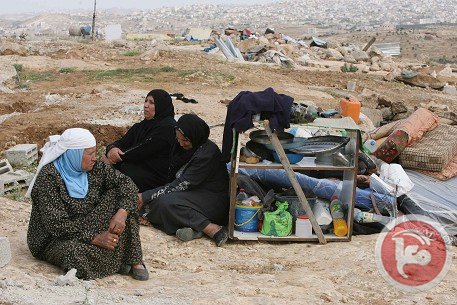
HEBRON — Women of the Bedouin herding hamlet of Khirbet Amniyr sat on the earth and watched Israeli forces demolish their 12 tent homes for the third time on Thursday morning.
The women said they were waiting for the soldiers to leave so they could rebuild their tent homes and once again re-establish their lives and livlihoods.
Amniyr, south of Yatta in the southern West Bank, is said to be located in an Israeli military zone.
Military zoning laws enforced by Israel’s Civil Administration, make up part of the 60 percent of the West Bank that is inaccessible to Palestinians.
As the troops left, the woman remained seated, surveying the destruction, as their tents and mattresses lay buried under a thin layer of dirt.
“I appeal to God to save us from the cruelty of the Israeli occupation,” said the hamlet’s matriarch, as she stood and began to collect her belongings from under the dust.
The hamlet has been taken down twice before, first on February 22 when the Israeli military buried homes and water wells, later preventing ICRC workers from delivering aid equipment.
On March 29, seven Bedouin were beaten by Israeli border police when the same 12 tents were taken down a second time.
The 12 families of Khirbet Amniyr were ordered out of their tent homes earlier in the year, but remained, saying they had little choice but to stay and had nowhere else to go.
The spokesman of Israel’s Civil Administration could not be reached by phone for comment on the latest demolition.
Amniyr is one of three Bedouin hamlets currently under Israeli evacuation orders, with a second in the south Hebron hills area, and a third in the northern West Bank district of Nablus which has been demolished six times.
In Israel’s Negev region, the Bedouin community in Al-Araqib have seen their homes taken down a total of 16 times, to make way for a park.
Featured Video

New positive ivermectin evidence
or go to
Aletho News Archives – Video-Images
From the Archives
Fanatical Followers of the Covid Regime: A Jim Jones-Style Cult?
By Professor Roger Watson and Dr. Niall McCrae | The Daily Sceptic | November 15, 2021
As scholars at leading British universities over recent decades, we witnessed the replacement of critical thinking and debate by narrative: facts are discrimination and scientific method is imperialism; truth, instead, is derived from ‘progressive’ values. This educational trend may be a major contributory factor to the ease in which society has been inculcated to the Covid ‘new normal’ of masking, testing, and repeated doses of vaccines for a disease of similar risk to severe influenza.
One doesn’t need much critical reasoning to observe the flawed logic of some vaccination enthusiasts, such as people who respond to experiencing any side effects, however debilitating, by saying “at least I know it’s working”, or, after contracting the disease despite their promised inoculation (over 90% effective, according to initial drug company claims), “I’d have been worse off without the jab.” … continue
Blog Roll
 Aletho News
- The Rise And… Rise Of ‘Color Revolutions’
- The Coming GOP Bloodbath?
- Arctic Scare Stories Melt Away
- Wrong, Euronews: Climate Change Has Not Created a Food, Energy, and Economic “Meta-Crisis”
- New positive ivermectin evidence
- Met Office Caught Fabricating Daily Temperature Record Claims
- Merck Virologists Admitted to Falsely Certifying Vaccine Efficacy
- Mandatory Folic Acid for every man, woman & child
- Pro-Palestine protesters arrested outside UK’s ruling Labour Conference in Liverpool
- Mauritius denies landing permit to flight from Israel, forcing cancellation: Tour operator
- If Americans Knew
- CNN Chief Int’l Correspondent Clarissa Ward on Journalists in Gaza
- Democratic Party Consultants Surround Troy Jackson with Pro-Israel Donors
- Christian Leader Responds To Netanyahu’s Claims Regarding Palestinian Christians
- In Gaza, ‘Whoever Survives the Bombing Won’t Survive the Rubble’
- Israel kills more Palestinians, amid push to resettle Gaza – Daily Update
- Israel forces Gazans to live in constant peril – Daily Update
- Deconstructing Netanyahu’s pants-on-fire UN rant – Daily Update
- Trump betrayed voters with his campaign lies and prioritized a foreign country once he took office
- Netanyahu calls Israel’s war in Gaza ‘opposite of genocide’ in UN speech to near-empty hall
- Settler Kidnappings: Torture, Sexual Abuse and Terrorisation of Palestinian Abductees as Israel Deepens Annexation of West Bank
- No Tricks Zone
- New Study: Earth And Venus Surface Warmth Largely Explained By Convection And Lapse Rate, Not CO2 Or Radiation
- 2025 Nature Paper Claiming Worsening Global Drought Gets RETRACTED …Heavily Flawed
- New Study: ‘Global Drought Shows No Detectable Recent Acceleration Under Climate Warming’
- Economic Masterminds: German Socialists Suggest Taxing Productivity Gains Stemming From Using AI
- The South China Sea Has Not Been Cooperating With The Climate Change Narrative
- Energy Crisis: Germany Enters Heating Season With Historically Low Gas Reserve Fill Levels
- New Study: The Antarctic Ice Sheet Gained Mass From 2020-2024 Due To Staggering Snow And Ice Accumulation
- Study: Ocean Heating Rates From Thousands Of Years Ago ‘Dwarf’ Modern Ocean Heating Rates
- Climate Extremists Target, Attack Large-Scale Power Grid Infrastructure In Germany!
- New Study: Antarctic Ice Melt Has Contributed Less Than 1 Centimeter To Sea Level Rise In The Last 30 Years

