Thirteen homes and three school buildings destroyed by Israeli forces
 Dkaika children outside their destroyed classroom
More than 13 homes and three school buildings were bulldozed this morning by occupation forces in the small Bedouin village of Dkaika near Yatta south of Hebron. One eye witness – an English teacher at the school – said “the Israeli army arrived at the village at around 7:30am with over fifty military vehicles and at least six bulldozers before forcibly removing the children from the school and destroying three classrooms.” He went on, “the children, some of whom are as young as seven years old, were crying and shouting at the soldiers to stop.”
In addition to the destruction wrought upon the school, ISM representatives were led by the crushed earthen tracks and violent gouge marks left by bulldozers to the tell tale piles of rubble and twisted steel which littered the surrounding area. If there had been any doubt that each had once been a home, then the hurriedly assembled mounds of personal possessions, furniture, and children’s toys which accompanied each pile of rubble surely testified to the fact that these were dwellings.

Furniture from the destroyed classrom in front of a crushed building
As it was, there were plenty of family members eager to testify themselves, and in the moments following the re-opening of the village’s only road, EAPPI and ISM members– who had been prevented by road blocks from accessing the scene – moved in to speak to those left homeless by the action.
When asked what reason was given for the demolition, the above witness, visibly upset, replied “they do not want us to live here, that is the reason. I would like to tell you that this community has been here since before the establishment of the Israeli [state]. They took most of our land during the Nakba and they would like to dismiss us from here completely”.
New Report Reveals 19 Violations Committed Against Journalists in December
By Ramona M. – IMEMC and Agencies – January 11, 2011
Today, the Palestinian Center for Development and Media Freedoms (MADA) issued its monthly report documenting violations against journalists in the Palestinian territories.
According to the report there were 17 violations against journalists and two against their property. The offenses were committed by both the Israeli army and the Palestinian security services in the West Bank and Gaza. These attacks are all in clear violation of the right to freedom of expression under both Palestinian Basic Law and the Universal Declaration of Human Rights.
Compared with figures from last year, violations have more than doubled this winter: just 7 violations were reported in December 2009.
Israeli Occupation Forces Violations
• A’lam radio presenter Samer Rweishid was summoned for interrogation about his new job by the Israeli Intelligence Service.
• Alhayat Aljadedah newspaper photographer Muheeb Barghouti and Palestine Public TV cameraman Najeeb Sharawneh were prevented from covering the events of the weekly Nabi Saleh march near Ramallah by Israeli forces.
• Al-Quds newspaper photographer Mahmud A’lian was beaten by Israeli forces during his coverage of a solidarity march to Qalandia checkpoint.
• Israeli settlers damaged the tires of vehicles belonging to Reuters, Pal Media agency, and the photographer of a French agency Nasser Al-Shoukhi in Hebron.
Palestinian Security Service Violations
• The Al-Jazeera English crew were detained by government police in the Gaza Strip.
• Palestine Public TV’s Fouád Jaradeh was summoned for investigation by the Internal Security Service and questioned while blindfolded for 7 hours.
• A’lam radio presenter Samer Ruweishid was arrested by the Palestinian Intelligence Services in Hebron city; he remains in custody.
• Quds TV program coordinator Nawaf Al-Amer was repeatedly summoned for investigation by the Palestinian Preventative Service in Nablus city.
• Quds TV correspondent Mamdouh Hamamreh and cameraman Akram Alnatshe were arrested following a raid on The Pal Media agency’s headquarters in Hebron.
• Quds TV correspondent Mamdouh Hamamreh and Pal Media cameraman Abdul Ghane Natshe were followed and apprehended by the Palestinian Preventative Service following a report on Christmas celebrations in Bethlehem.
• Columnist Ala’ Rimawi was released by the Palestinian Security Service on the 12th of December after 42 days of detention.
• Freelance journalist Sami Alási was released by the Palestinian Security Service on the 21st of December after 23 days of detention.
Occupation of Iraq destroys women’s lives
Serene Assir, The Electronic Intifada, 10 January 2011
More than seven years after the US- and UK-led invasion of their country, Iraqis continue to endure an occupation that has systematically violated their rights to life, dignity, self-determination and economic development. The occupation has been and continues to be so destructive and so violent that one in four Iraqis are estimated to be dead or displaced. One in five Iraqis has been made a refugee or an internally displaced person (IDP).
In particular, the role and situation of women and girls has declined precipitously compared to prior to the invasion. From torture to rape to assassination, from forced separation for mixed couples to women and their children enduring the death of their husbands and fathers, from a loss of educational rights to expulsion from the workplace and public life, and from sexual slavery to forced flight or enforced disappearance, for the past seven years Iraqi women and girls have endured the most terrifying of fates. They are living at the mercy of an occupation that both seeks to terrorize them into submission, and to use them as objects for the terrorization of the whole of Iraqi society.
No security
Dr. Souad al-Azzawi, who authored a study on Iraqi women entitled “Deterioration of Iraq women’s rights and living conditions under occupation,” published in January 2008, told The Electronic Intifada: “The most significant loss that Iraqi women have suffered is a complete and total loss of security.” She explained that the loss of security entails both the loss of physical security and “the economic, social and civil securities Iraqi women were so accustomed to prior to the occupation.”
In fact, it appears that the loss of physical and other aspects of security have a Catch-22 effect on the lives of women. The lack of legal and institutional support for women by an Iraqi puppet government which is at best ineffective has meant that in the vast majority of cases the criminals, mafias, militias, death squads, US occupation forces and Iraqi police and army forces committing crimes against women are not held accountable for their actions. This has in turn encouraged the development of a situation characterized by lawlessness and criminality, in which women are prime targets. As such, many women have been forced to leave their jobs and quit their education, for fear that they may be the next victim of rape or assassination.
According to al-Azzawi, Iraqi women have had to resort to “the relative security of their homes,” often taking their children out of school too if they were the only parent able to accompany them there and back.
Echoing al-Azzawi’s words, an Iraqi refugee speaking on condition of anonymity said that she was forced to leave Iraq precisely because of death threats issued against her by militias who had found out she was actively working as a journalist seeking to expose the injustices taking place against women. Had she stayed in Iraq, the threats likely would have been fulfilled.
“Not only was I being targeted, but I was also without protection, given that Iraq has no government to speak of,” she explained. She added that “I could have been killed at any moment, and no one would have been held accountable for it. It was for one reason alone that I fled: because I had no choice.”
Criminal levels of poverty
The figures speak for themselves. According to a dossier on Iraqi women published by the BRussells Tribunal, prior to the invasion 72 percent of working women were government employees. The dismantlement of state institutions immediately after the invasion meant that these women became unemployed. Instability and ineffective institutions in Iraq render it impossible to pinpoint the total rate of unemployment today, but estimates range from 15 percent to 70 percent. The few stable jobs that exist, according to the dossier, are usually given to men, though a growing number of female-headed households means that many women need to take extraordinary risks in order to try and cater for their children (“Iraqi Women Under Occupation” [PDF]).
The same economic insecurity affects Iraqi refugee families. Aseer al-Madaien, the Protection Officer for the United Nations High Commissioner for Refugees (UNHCR) – Syria, says that out of 139,000 registered Iraqis in Syria, 28 percent are households headed by women. In total, estimates for the total number of displaced Iraqis, including both refugees and internally displaced persons (IDPs), range up to almost five million, according to the international organization Medecins Sans Frontieres, which believes that there are 2.5 million Iraqi IDPs and 2.3 million refugees.
IDPs suffer both extreme vulnerability and insecurity, as they seek refuge in the homes of relatives and friends, said Hana Al Bayaty, member of the Executive Committee of the BRussells Tribunal. Many of them are the victims of ethnic cleansing, whereby a country once free of sectarianism is increasingly witnessing the targeting of persons on the basis of their religion or ethnicity. Mixed marriages in these conditions are all too often broken up by force, according to a report published by the UN-affiliated IRIN humanitarian news agency (“Mixed Marriages confront Sectarian Violence,” 6 April 2006).
The majority of Iraqi refugees have headed to neighboring countries Syria and Jordan, where they are not allowed to work, as they are legally considered “guests.” In 2007, the UNHCR reported that an estimated 40 percent of Iraq’s middle class had fled the country. Not only have almost half of those with the qualifications and experience to help rebuild Iraq left the country, but they are also suffering from the most extreme form of disempowerment, according to Al Bayaty.
Al-Azzawi explained that “For the educated middle class, this situation is shattering as everything we have worked so hard to earn and build up over decades of war and sanctions is being brought down by military force before our very eyes.”
Unable to work legally, it is often refugee women who take upon themselves the burden and the risk of working as they are less likely to be asked for documentation on the streets of Amman, Damascus and beyond, and they thereby hope to be less likely to be deported.
Unemployment levels in Syria and Jordan, however, mean that even illegal work is hard to come by. It is because of this that the phenomenon of forced prostitution is becoming increasingly rife. The growing problem of sex trafficking is partly caused by poverty.
According to al-Azzawi, the lack of work permits, qualifications and opportunities “leads some women to prostitution in order to feed their children and their families.” In other cases, the sheer lack of protection faced by some women push them into prostitution. Problems in such cases include threats of kidnapping issued against women should they not accept to prostitute themselves. These threats are issued especially against women whose husbands are dead or missing. “The women of Iraq live in a very fragile situation as a result of the American occupation’s crimes,” al-Azzawi said.
Death, torture and enforced disappearance
No statistical reference can adequately convey the sheer suffering experienced by the people of Iraq, as a whole, from the genocidal sanctions period through the invasion and ensuing occupation. Current estimates place the number of dead at anywhere between 1.5 million and 2.5 million.
According to Iraqi human rights analyst and advocate Asma al-Haidari, “Up to one million Iraqis have been forcibly disappeared.” Behind the enforced disappearances are the US army, Iraqi government forces including the army and police, and al-Qaeda and other militias that operate freely across the country, according to a presentation given by Dirk Adriaensens, member of the BRussells Tribunal Executive Committee, at a London conference organized by the International Committee Against Disappearances on 9-12 December 2010. According to calculations by Adriaensens, based on UNHCR statistics, 20 percent of internally displaced Iraqi families have reported cases of missing children (“Enforced Disappearance. The Missing Persons of Iraq” [PDF]).
It is also understood that, given that there is a very real and justified fear of retaliation against families who report the disappearances of their loved ones, many others suffer in silence. Thousands of detainees, some of them in secret, illegal prisons, according to al-Azzawi, are women. Estimates published in 2008 by the Iraqi Parliamentary Women’s Committee and the Iraqi Ministry of Women’s Affairs indicate that between one and two million Iraqi women are widows.
Inside Iraq’s jails, legal or not, cases of torture and sexual abuse have been widely reported. Revelations by WikiLeaks published on 22 October 2010 were described by Iraqi activists such as Sabah al-Mukhtar, president of the Arab Lawyers’ Union, as just “the tip of the iceberg,” as he said on an Al-Jazeera English interview on 24 October. According to al-Azzawi, women are usually jailed on trumped-up charges of terrorism, where there is no proof and while there is no adequate legal system to ensure their right to a fair trial. “Many are awaiting execution,” al-Azzawi added.
Further, when it is the man who disappears, whether he is dead or missing, women and their families have to fend for themselves in a hellish situation. Out of this horror comes forth one of the more obtuse trends, inexistent in Iraq up until 2003, of families giving their daughters away in early marriage for fear of being unable to adequately support them.
One immediate effect of this phenomenon is the fact that girls aged 13, 14 and 15 sold into early marriage lose their right to education. As figures currently stand, according to the United Nations Children’s Fund (UNICEF) report published on 1 September 2010, for every 100 boys in school, there are only 89 girls (“Girls Education in Iraq 2010” [PDF]).
“Lots of those little girls are very bright and are willing to finish their education if they are allowed to,” said al-Azzawi.
Worse still is the flourishing of what are known as “pleasure marriages.” These are short-term marriages conducted out of court, whereby separation is also very simple. It is a practice that Iraqi women’s rights advocates describe as linked to prostitution, because of the wrongful abuse of the practice by men in power, often blackmailing fathers into giving their daughters away in a “pleasure marriage,” and also because once a girl or a woman has married in this way and has received alimony for her short-term commitment, she will find it very difficult to reintegrate back into her family.
“Many girls are forced into prostitution and ultimately sex trafficking this way,” al-Azzawi added.
Forced Islamization of society
It is deeply telling that Iraqi society is becoming forcibly Islamized by militias tied to the Iraqi puppet government, which is dependent upon the United States for its survival. Meanwhile, Washington claims to be fighting a war on Islamic terrorism. The reality, as is frequently the case, is the precise opposite. Previously a secular state, Iraqi society is becoming forcibly transformed into a theocracy. In such systems, women and girls inevitably lose.
The results of the proliferation of fundamentalist militias are varied. While reports of Christian women veiling in order to avoid attacks are troubling in the Iraqi context, what is potentially much worse is that the notion of an Iraqi state for all its citizens is fast disappearing. Not only does this mean that Iraqi girls are no longer safe on the streets; it also means that if the occupation fulfills its goals, Iraqi “career women” may be a thing of the past.
Al-Azzawi notes that “Economically the country has lost a huge, skilled working force, which is exactly what the occupation planned to do, and the lives of millions of working women and families were shattered.”
Considering that there is not a single right enshrined in the Universal Declaration of Human Rights that the US occupation has not violated — as the International Initiative to Prosecute US Genocide in Iraq team found when working in 2009 to bring a legal case for war crimes, crimes against humanity and genocide against four US presidents and four UK prime ministers — it is amazing yet encouraging that the US occupation’s goals have failed.
Not only is the US administration under President Barack Obama still battling to maintain control over a country whose people resist in the name of their dignity and their love for Iraq, but many of the most outspoken and brilliant advocates for Iraqis’ rights in general are in fact women.
“I have much hope for Iraq,” said human rights advocate Asma al-Haidari, “Nothing will make me lose hope.”
Serene Assir is a Lebanese independent writer and journalist based in Spain.
PLO reports serious Israeli violations during week
Ma’an – 08/01/2011
JERUSALEM – The PLO’s Executive Committee issued a report Saturday documenting serious violations of Palestinians’ human rights during the first week of 2011.
The report highlighted three killings in the West Bank during the week. On Friday Israeli soldiers shot and killed 66-year-old Omar Qawasmi. The Hebron resident was killed in his bed in what the army later admitted was a mistake.
On Saturday an anti-wall protester died after inhaling large amounts of tear gas fired by Israeli soldiers at a rally in Bil’in. A day later, Israeli forces shot dead Ahmad Maslamani at a checkpoint in the northern West Bank. Maslamani was shot on his way to work in Israel.
Meanwhile in Jerusalem, Israeli authorities demolished two Palestinian homes and several Palestinian businesses. The PLO report detailed that Israeli forces bulldozed Nasser Yousif Siyam’s home in Sheikh Jarrah, and Nayif Uweida’s shop and home. The properties were destroyed under the pretext that they were built without the necessary licenses. Uweida said his home was built 10 years ago.
The report added that on Wednesday Israeli authorities destroyed two garages, a car wash and building materials belonging to Abed Al-Aziz Al-Khatib, a resident of Hizma northeast of Jerusalem. The buildings provided the main source of income for Al-Khatib’s 50-member family.
In Nablus district in the northern West Bank, the report added, Israeli settlers launched several attacks including ransacking the home of a Palestinian woman in Burin village. The woman was rescued by villagers who responded to her calls for help. Settlers also killed sheep in Qusra southeast Nablus, the PLO said.
Hebron district in the southern West Bank witnessed several Israeli violations by settlers and by Israeli forces. Bulldozers dug up lands belonging to residents of Yatta to expand the illegal Israeli settlement Karmi Zur. In the same area, Israeli forces declared a closed military zone on Palestinian agricultural lands, denying farmers access to their fields.
Israeli forces shoot Palestinian at checkpoint
Ma’an – 08/01/2011
NABLUS — Israeli troops stationed at Hamra checkpoint east of Nablus on Saturday shot and killed a Palestinian man, medics said.
Onlookers identified the victim as 25-year-old Khaldoun Sammoudi, of Al-Yamun village near Jenin.
Palestinian Red Crescent medics said forces initially declared the area a closed military zone and ordered ambulances to stay 300 meters away.
An Israeli military spokesman said a man approached the checkpoint in a taxi, then got out of the vehicle and ran towards forces holding a suspicious object and shouting “Allah Akbar.” He did not heed orders to stop and forces followed operational procedures and shot him, the army official said.
The spokesman said the man was carrying a pipe bomb, and that the area was declared a closed military zone while soldiers neutralized it.
Forces also found an explosive device and a knife on the man’s body, he added.
When the man left the taxi, all the other passengers fled the scene, the spokesman said.
An eyewitness told Ma’an’s correspondent that Sammoudi stepped out of a car and approached the checkpoint in a hurry. Some of the soldiers ran away while another soldier ordered Sammoudi to stop and then opened fire at him, the witness said.
He added that soldiers stripped the man of his clothes and left him to bleed to death.
Onlookers said forces also violently beat a Palestinian man identified as Amir Al-Kharraz at the checkpoint. Al-Kharraz is a guard at a nearby park, witnesses said.
A military spokesman was not aware of the incident.
Less than a week ago soldiers shot and killed a 21-year-old Palestinian at the same checkpoint. A military spokeswoman said Ahmad Maslamani approached soldiers in an unauthorized lane carrying a glass bottle and did not heed orders to stop. Soldiers followed operational procedure and opened fire, she said.
Witnesses said the victim approached the checkpoint carrying a coca-cola can, a female soldier shouted at him and two male soldiers immediately opened fire. Medics said Maslamani’s body was riddled with bullets.
Earlier on Saturday, soldiers closed the Container Checkpoint east of Bethlehem and inspected Palestinian cars.
Following the shooting, Israeli forces erected a flying checkpoint at the entrance to the northern West Bank village of Talluza and inspected all cars and passengers.
Security firm G4S confirms involvement in Israel’s occupation
Adri Nieuwhof, The Electronic Intifada, 7 January 2011
The Danish-British security firm G4S recently confirmed in a letter its involvement in the Israeli occupation and violations of international law — reported on last month by The Electronic Intifada.
After the publication of The Electronic Intifada’s report on 15 December 2010, the Business & Human Rights Resource Centre asked G4S to respond to the investigation as well as a 28 November 2010 article published by Press TV (“‘Firm sold torture instruments‘”).
Within a week G4S replied, confirming that it had withdrawn from contracts providing security officers to residential settlements in the West Bank in 2002. “However, we continue to serve major commercial customers, for instance supermarket chains, whose operations include the West Bank,” the company stated (the letter can be downloaded from the Business & Human Rights Resource Centre’s website).
G4S claims in its letter that the commercial clients in illegal Israeli settlements in the occupied West Bank serve the general public. The company wrote that contracts include the provision of security officers to protect the premises of “commercial clients who serve the general public” in the occupied West Bank. However, G4S fails to address that Israeli settlements serve an exclusively Jewish population and are built illegally on occupied Palestinian land.
By providing security services to illegal settlement businesses, G4S facilitates Israel’s violations of international law. In 2004, the International Court of Justice (ICJ) reaffirmed the illegality of the construction of the wall and settlement colonies in the occupied West Bank, including East Jerusalem. According to the ICJ, construction activities should stop immediately and the wall and settlements be dismantled.
G4S tries to downplay its involvement by stating that the number of security officers deployed in the West Bank is “generally less than twenty and currently stands at eight.” However, violation of international law remains a violation, no matter the size.
G4S further attempts to evade responsibility by stating that it does “not carry out police or military-style patrols anywhere in the West Bank.” The company provides security officers to protect police facilities “from time to time,” but they do not perform any kind of law enforcement or public security role, the company stated. G4S also confirmed it provided security equipment, including X-ray machines and body scanners, with associated maintenance services, to the Israeli police, prison service and Ministry of Defense. In its letter the company adds, “We do not control, nor are we necessarily aware, where this equipment is deployed as it may be moved around the country.”
The feigned ignorance about where the equipment is deployed is contrary to the detailed information mentioned in a G4S promotional brochure it distributed this summer.
In the brochure, published by the Danish watchdog DanWatch, G4S describes the supply of a perimeter defense system for the walls around the Ofer prison compound and the installation of a central command room to monitor the entire Ofer compound. In addition, the company writes it also provided all the security systems in Ketziot prison and a central command room in Megiddo prison (G4S delivers technology to Israeli prisons,” DanWatch, 21 November 2010).
G4S boasts that the three prisons can detain 2,700-3,700 “security” prisoners — the majority of whom are Palestinians from the occupied West Bank and Gaza Strip illegally transferred to detention centers within Israel’s internationally-recognized boundary. International humanitarian law forbids an occupying power from transferring prisoners outside of the occupied territory and the conditions in Israeli prisons do not meet international legal standards. Accordingly, G4S’s involvement in the Israel Prison Service apparatus abets violations of international law.
G4S’s promotional material contradicts its claim that it does not know where its X-ray machines and body scanners are used. Who Profits? — a project of the Israeli Coalition of Women for Peace — has also documented that G4S luggage scanning equipment and full body scanners are used at checkpoints in the occupied West Bank towns of Qalandiya, Bethlehem and Irtah. G4S also provided full body scanners to the Erez checkpoint at Gaza. Who Profits? told The Electronic Intifada that this information is published in G4S’s own website and brochures.
The ICJ affirmed in 2004 that Israel’s wall and checkpoint regime in the West Bank impede Palestinians of “the right to work, to health, to education and to an adequate standard of living” and are contrary to international law.
G4S also revealed in its letter to the Business & Human Rights Resource Centre that it sells security equipment “with associated maintenance services.” In order to provide maintenance service, G4S presumably must know where the equipment is deployed. By providing maintenance service for years after the installment of the security equipment, G4S continues to facilitate Israel’s violations of international law.
Meanwhile, new research by Who Profits? shows that in 2009 G4S won a tender for providing central control rooms to all the prisons and detention facilities of the Israeli Prison Authority (“G4S Technologies will provide security systems for the prisons and the detention facilities of the Israeli Prison Authority,” G4S website). Therefore, G4S security equipment is deployed in every Israeli prison and detention facility.
G4S’s response to the revelations of its involvement in human rights violations shows the company is not heeding the responsibilities that come with its endorsement of the principles of the UN Global Compact. According to the first two principles of the compact — is a strategic policy initiative launched in 2000 for businesses that are committed to sustainability and responsible business practices — G4S should support and respect the protection of international human rights within its spheres of influence and make sure it is not complicit in human rights abuses.
G4S can expect to come under pressure from the growing boycott, divestment and sanctions movement until it untangles itself from Israel’s brutal occupation.
Adri Nieuwhof is a consultant and human rights advocate.
HRW Demands Criminal Investigation Into Death of 20 y.o Palestinian Patient Denied Permit By Israel
Human Rights Watch Report | IMEMC | January 07, 2011
 Anas Saleh (Photo-IMEMC)

Human Rights Watch and other organizations have demanded a criminal investigation into the death of a 20 year old Palestinian patient who was denied a permit by Israeli Authorities to leave Gaza. The Israeli authorities insisted that an unconscious patient appear for questioning by the Israel Security Agency; the patient died in Gaza while waiting for a response.
On 5 January 2011, Adalah, in its own name and on behalf of Physicians for Human Rights – Israel and al-Mezan Center for Human Rights (Gaza), submitted a complaint to the Attorney General of Israel, Yehuda Weinstein, and to the Israeli Military Advocate General, Avichai Mendelblit, demanding the opening of a criminal investigation and prosecution of those responsible into the suspicious death of Mr. Anas Saleh, a 20 year old Gaza resident, who died on 1 January 2011 from liver disease in Shifa Hospital in Gaza.
Although the patient was in a critical medical condition, which was known to the Israeli authorities, Israel prevented his exit from Gaza for lifesaving medical treatment. Adalah Attorney Fatmeh el-Ajou filed the complaint on behalf of the victim whose case was followed and documented by PHR-I and al-Mezan.
The human rights organizations argue in the complaint that the denial of an exit permit in these circumstances is an act against the legal obligation to provide medical treatment to save the life of the patient, an act which brought about, or at least hastened, the death of the deceased.
The aforementioned act, or failure, raises the suspicion of manslaughter (section 298 of the penal law, 1977), and/or causing death by negligence (sections 304 and 309 (4) of the penal law, 1977) and responsibility for helpless person and violation of obligation of parent or of responsible person (sections 322 and 337 of the penal law).
In September 2010, Anas Saleh was diagnosed with a liver disease, Budd Chiari Syndrome (a clinical syndrome resulting from obstruction of the veins in the liver). Due to a lack of appropriate medical treatment in the Gaza Strip health system, his condition deteriorated into acute liver failure and hepatitis.
The patient was referred for lifesaving medical treatment to Muqassed Hospital in East Jerusalem, and a hospital referral and appointment were in his possession for 26 December 2010. On 13 December 2010 the family presented a request, via the Palestinian Liaison Office, to the Israeli authorities in order to obtain an exit permit from Gaza.
Thirteen days later, on 26 December 2010, the patient’s hospital appointment date, the army informed the Palestinian Liaison Office that the patient must appear for interrogation by the Israel Security Agency (ISA or Shabak) on 30 December 2010 to further consider his request. However, on that date the patient was already unconscious, in a comatose state, and could not appear at the interrogation.
This information was forwarded, according to the Palestinian health coordinator, to the Israeli military on that same day, with a request to speed up the request procedure and to issue an exit permit from Gaza urgently.
Paradoxically, despite the ISA continued to insist that the patient appear for questioning. According to the father’s testimony, on 28 December 2010 he received a telephone call from a man who introduced himself as an ISA representative, and requested that his ill son present himself for questioning on the following day. The father informed him that his son was in a coma and asked that he be allowed to leave for medical treatment without delay.
Throughout this process, medical documents substantiating the patient’s medical condition were transmitted to the Israeli authorities. A final medical document confirming the patient’s critical condition was sent on 29 December 2010.
The patient died in Shifa Hospital in Gaza 1 January 2011 at 18:00 (6 pm). Until today, no response to the request has been issued by the Israeli authorities.
Prof. Zvi Bentwich, PHR-I Chairperson states that the patient could have been saved had he been granted immediate entry for emergency surgery.
This is just one of many examples of Israel’s enduring intransigence towards residents of the Occupied Territories, which leads to unnecessary harm and in this case even led to a loss of life that could have been prevented.
Mahmoud Abu Rahma, from al-Mezan, states that: “The Israeli blockade has left thousands of victims suffering from the lack of medical care that is available only an hour away from them by car.” He added that, “Al-Mezan and PHR-I have followed the cases of hundreds of patients who have been restricted from urgent medical treatment outside of Gaza, many of whom died and some of whom were arrested or delayed for long periods of time.
“This situation is still causing inhumane conditions for the patients and, if it continues, it will result in grievances by many others.”
Physicians for Human Rights-Israel, al-Mezan and Adalah are calling on the Israeli authorities to bring to justice those responsible for preventing 20 year old Anas Saleh from leaving Gaza for life-saving treatment and ultimately causing his death and take the necessary measures to prevent such occurrences in the future.
Israel must fulfill its legal obligations towards Palestinian residents of the Gaza Strip and guarantee patients’ full access to medical treatment.
4,000 attend funeral of Hebron slain
Ma’an – 07/01/2011
HEBRON — At least 4,000 gathered Friday afternoon to attend the funeral of Omar Salim Al-Qawasmi, 66, executed by Israeli forces early that morning, in what military officials later admitted was a case of mistaken identity.
Hamas and Fatah officials joined in the event, hosted following the Friday prayers at a Hebron mosque. The joint participation followed a day of accusations by party officials, with Hamas accusing the PA of being responsible for the death, and accusing the government of coordinating with Israel ahead of the incident.
Al-Qawasmi was killed during an arrest raid that saw five Hamas men, who were released by PA forces the day before, detained by Israeli forces. He was the uncle of one of the men released and re-detained.
Hamas leader Aziz Dweik, former head of the Palestinian Legislative Council, spoke at the funeral, and called the incident a “stupid mistake,” and condemned the detention of the men, who had lobbied for their release with a weeks-long hunger strike.
 Instead of the Hamas men, he said, “they shot an old man 13 times in the face.”
Dweik said Israel’s “message is clear, they want nothing for the Palestinians,” and accused the Israeli government of trying to sabotage unity efforts.
The release of six men on Thursday was done on order of President Mahmoud Abbas, after receiving requests from Hamas officials in Gaza, Damascus and a special call from a Qatari Emir asking for their freedom. Six were released, five were detained by Israel the following day. A sixth returned home to Jenin, where he remains free.
Hebron Governor Kamel Hamid, who congratulated the men on their freedom the day before, only hours after being mobbed by settlers in the Tel Rumeida area of the city, said “Israel wants to destroy Arab and Palestinian efforts for peace, it wants the settlers to run the place.”
Also present at the funeral was relative of the slain man, Khaled Fahd Al-Qawasmi, who holds the Ministerial post for Local Governance, members of the PLC with both Fatah and Hamas, faction leaders and PA security heads, who had been instrumental in securing the release of the men.
Israel’s killing zone in Gaza
Max Ajl, The Electronic Intifada, 6 January 2011
 |
Palestinian farmers in Gaza working in the area of Israel’s deadly “buffer zone.” |
Ahmed Qudaih was skinny, in blue Converse sneakers and a black leather jacket, his mustache oddly making him look younger, not older, than his 27 years. His voice was even, his face rigidly composed, like human stone, as we sat down with him in the martyr’s tent in Khozaa, a rural village slightly to the east of Khan Younis in the southern Gaza Strip. Young men moved up and down the rows of plastic seats with brass coffee pots and tiny ceramic cups and platters of dates. Ahmed agreed to speak briefly about how the Israeli military had just murdered his 19-year-old brother Hassan Qudaih in the village’s borderlands.
Ahmed said that a few hours before sunset on 28 December, Hassan had entered the area where two nights before, there had been a firefight between the Palestinian resistance and Israeli soldiers, who were accompanied by several Apache helicopters and tanks. During the melee, the soldiers killed Issa Abu Rok and Muhammad al-Najjar, fighters from the al-Quds Brigades, the armed wing of the Palestinian Islamic Jihad. They were also members of Hassan and Ahmed’s extended family. Hassan entered the area to look around, to search through it for anything that had been left behind after the bodies had been removed.
Ahmed said that a sniper sitting in a jeep abutting the border shot Hassan in the leg. Hassan treated himself, partially stanching the blood flowing from the wound. And then, according to Ahmed, “the [Israeli army] let him bleed slowly for the subsequent two hours, preventing any emergency vehicles, or his friends, from reaching him.”
His friends made repeated attempts to get close to Hassan, but were repelled by shots from the Israeli border patrol, and eventually incapacitated by a sort of “gas, which made them unconscious,” Ahmed said. Emergency vehicles from the Palestinian emergency services also repeatedly attempted to coordinate with the Israeli army to evacuate Hassan, but they were denied permission to do so, while Hassan continued to bleed, Ahmed explained.
After some time, Ahmed said, a beleaguered Hassan “took out his phone and tried to call for help.” Ahmed said it was at that point that the Israeli military “shelled him from a border-area tank, decapitating him.” Ahmed speculated that perhaps they tracked Hassan’s phone signal to the body. Hassan died instantly, his head apparently severed from his body.
Ahmed explained that “The area where they killed my brother is flat, free of any obstacles that could have blocked their view. The soldiers must have clearly seen that Hassan was a civilian, without any weapons, and shot anyway.”
 |
A family photograph of Qudaih Hassan. |
Ahmed showed us a picture of Hassan, as well as his shrapnel-damaged money case. He looked in the picture precisely like the young man he was, barely out of boyhood — frighteningly young — a stand-in for the stunningly young population of Gaza, more than 50 percent of which is under 18, and a wrenching reminder that war and siege on Gaza has meant war and siege on children.
Initial press reports, repeating information issued by the Israeli military spokespersons’ office, put Hassan amongst four other youth “planting explosives at the security fence.” However, subsequent investigations showed otherwise.
The Palestinian Centre for Human Rights reports that the five youth were roughly 300 meters from the fence, just on the edge of the “buffer zone” — the no-go area imposed by Israel covering a wide swath of land on the Gaza side of the boundary with Israel, in the east and north — when Israeli firing began. Relatives and neighbors agree: Hassan was unarmed and shot without provocation other than his presence in Israel’s unilaterally-declared “buffer zone.”
That buffer zone ruinously affects Gaza residents living in areas like Khozaa. Khozaa, and the whole rural area east of Khan Younis — which includes the towns and villages of Abasan al-Kabir, Abasan al-Saghira and al-Farrahin — have been the subject of numerous incursions, demolitions, shelling and shootings over the past several years, occurring with an increasing frequency in recent months. Homes with any exposure to the boundary with Israel are pocked with hundreds of bullet holes, and children are barred by their parents from playing in areas which are within the line-of-sight to the boundary after dusk.
Officially, the buffer zone is 300 meters wide, at least according to the leaflets the Israeli military dropped on all of Gaza’s hinterlands on 19 May 2009, showing a map of the Gaza Strip with clearly demarcated no-go areas. Unofficially, however, it extends as far as the bullets from Israeli snipers fly before they hit something.
According to a report put out by the UN’s Office for the Coordination of Humanitarian Affairs (OCHA), 29 percent of Gaza’s arable farmland is inaccessible due to the belt of forbidden or dangerous land, which extends from 0.5-1 kilometer on the eastern frontier and 1.8 to 2 kilometers on the northern frontier.
In the southern governorates, the imposition of the buffer zone has hit agricultural production hard. For example, in the Khan Younis area, the administrative area of which includes the smaller zones to its east, agriculture and fishing-related activities plummeted from 24 percent of all jobs in the second quarter of 2007 to 7.2 percent in the third quarter of 2009.
If not enforced by physically present soldiers armed with sniper rifles, it is enforced by women soldiers manning remote-controlled motion-sensing machine gun turrets. The landscape there is marked by ditches, peppered by broken clumps of barbed wire. It’s a tableau of exposed dirt and sliced-off irrigation tubes. It looks like the war zone that it frequently is.
And soldiers often fire at anything that enters the buffer zone. Indeed, repeated calls to the Israeli military spokespersons’ office to ask how they made the determination that Hassan was a “militant” either were met with unfulfilled promises to call back shortly, or the response that “we can’t reveal that information for security reasons.” Nor has the Israeli military issued a correction in response to the repeated queries.
And the assault continues apace. Abd Alazeer Yousef Abu Rijla, Hassan’s uncle and the owner of the land where the young man was killed, described how on 29 December Israeli armor-plated bulldozers entered their farmland in Khozaa and ripped up the remainder of the crops growing there. The total area destroyed comes to about four dunums, or roughly 4,000 square meters. “We cannot go there anymore, even though we are three families that depend on that area,” Abu Rijla said. Although he said that he needed to return to his land, the area was far too dangerous for the time being.
Fifty-nine Palestinians were killed in Gaza by the Israeli military last year, 24 of them civilians, most in the buffer zone. The number of wounded — 220 — has been ten times that, with approximately forty of them occurring since the beginning of November. The tempo of rockets fired from Gaza has increased in response to ongoing Israeli provocations and pummeling, as well as the need to resist the 42-month-long siege.
Meanwhile, the next war slides in and out of view, as Israeli politicians and generals openly discuss timing and strategy. General Gabi Ashkenazi said that the Israeli military “holds the Hamas terrorist organization solely responsible for any terrorist activity emanating from the Gaza Strip. We hope that the security situation in the south does not deteriorate, however the IDF [Israeli army] is preparing for any scenario” (“Ashkenazi: We’ll be ready if Gaza tensions escalate,” The Jerusalem Post, 27 December 2010).
Indeed, a cable released by WikiLeaks, dated 15 November 2009, confirms that planning for the next incursion began even while the Palestinians of Gaza were still sifting through the rubble of the winter 2008-09 invasion. Ashkenazi told a visiting American Congressional delegation that “I am preparing the Israeli army for a large-scale war,” likely against Hamas and Hizballah (“Israeli army chief was preparing for ‘a large scale war’,” Agence France Presse, 2 January 2011).
A few think this is just posturing, meant to tamp down rocket fire to a more tolerable level and more importantly, to incite massive and paralyzing fear amongst Gaza’s population. If so, perhaps it has worked: the resistance groups recently agreed to cease rocket fire for the time being, while most everyone I talk to in the streets worries that Israel will commemorate the biennial of the 2008-09 Gaza invasion by repeating it, while they grow tortuously frustrated by the stalled peace process.
“We are trapped here, and upset … there is nothing,” a meat seller in the middle class Gaza City neighborhood of Tel al-Hawa told me, before giving me a ride home. Meanwhile, the subdued roar of F-16s is audible nearly daily here and there in the Gaza Strip, while on the horizon grey Israeli warships hulk in the steel blue sea and Israeli drones buzz overhead in the washed-out sky — watching, waiting, preparing and gathering information for the next massacre from the north.
All images by Max Ajl.
Max Ajl is a doctoral student in development sociology at Cornell, and was an International Solidarity Movement volunteer in the Gaza Strip. He has written for many outlets, including the Guardian and the New Statesman, and blogs on Israel-Palestine at www.maxajl.com.
Justice for victims of the police
By Alessandro Tinonga | January 5, 2011
OAKLAND, Calif.–On New Year’s Day, nearly 100 people gathered at the Fruitvale BART station to remember Oscar Grant III and other victims of police brutality.
Grant died in the early morning of January 1, 2009, after he was shot in the back by BART cop Johannes Mehserle. The incident was caught on several cell phone videos that showed that Grant was face down on the ground, with his hands behind his back, and was unarmed when he was shot.
“Two years ago Oscar Grant was murdered up there,” said Jack Bryson, father of Grant’s friends who witnessed the shooting. My spirits are low since the courts passed the unjust sentence.”
Since Grant’s death, a deeply committed movement has pressed for justice–with mixed results. Following a public outcry, Mehserle was arrested and charged with murder. After the trial was moved to Los Angeles County, Mehserle became the first California officer convicted of a wrongful on-duty shooting. He was convicted of involuntary manslaughter, and sentenced to two years with credit for time served.
He will most likely be released within the next few months.
“You always hope your children will bury you, you never imagine you’d bury your children,” said Wanda Johnson, Grant’s mother. “I hope there will be no more cover ups and the police take responsibility. My heart bleeds everyday.”
As if to remind us that Oscar’s murder was not an isolated event by a “bad apple” (the story advanced by the media and local politicians), five people have been shot to death by Bay Area police in the past two months.
In November, Oakland police shot and killed a local barber named Derrick Jones. Despite early claims by police, Derrick was unarmed and was shot from the front.
The killing sparked outrage by the community and led to several protests. Members of the Jones family attended the vigil to support the family of Oscar Grant.
“We’re trying to make people more aware about what has happened with these murders,” said Frank Jones, Derrick’s father. “We have to stop the killings, that’s the number one thing. We are waiting for city hall but nothing concrete has happened.”
Relations between police and the community are severely strained. The public’s expectation of police accountability is so low that Police Chief Anthony Batts actually asked the FBI to investigate the shooting of Jones. If federal investigators step in, they will join investigations already underway in the Oakland’s internal affairs unit, homicide team and the district attorney’s office.
In another case, an unarmed woman recently was shot dead by San Leandro police in Oakland following a car chase. Police said that they were pursuing a stolen car which led to a crash in a residential neighborhood. Allegedly, the woman was shot for fear she would use the car to assault officers and escape.
However, a witness interviewed by the San Jose Mercury News said, “They [the police] crashed the car and right away he said, ‘Get out, get out,’ two times, and then he started dumping the whole clip on her. He actually reloaded when he was done.”
Despite Johannes Mesherle’s wrist-slap punishment, the recent string of shootings by police and a heavy police presence at the New Year’s Day vigil (including over a dozen patrol cars and an armored personnel carrier), everyone in the crowd stood firm in their commitment to achieve justice.
“We’re gathered here to remember…and celebrate life,” said Cephus Johnson, Oscar Grant’s uncle. “This is a time of celebration, reflection, and to embrace each other.”
A common message that most speakers related at the vigil is their optimism that the struggle will continue.
“It’s good we still got people out here,” said Bryson. “We won’t let things fade away.”
Cephus Johnson added, “[The] community still standing gives us the strength to keep fighting.”
See also:
Brutal Reprisals Against Peaceful GA Inmate Strikers Confirmed, Was One Victim Hidden For Weeks By Prison Authorities?
By Bruce A. Dixon | Black Agenda Report | January 5, 2010
Black, brown and white inmates in 6 Georgia prisons nonviolently locked themselves in their cells for several days beginning December 9, demanding wages for work, educational opportunities, adequate food and medical care, just parole decisions and access to their families. The peaceful inmate strikers, as we reported the following day, were already victims of brutal retaliation on the part of correctional officials, ranging from cutoffs of heat and hot water to unprovoked assaults by correctional employees upon prisoners.
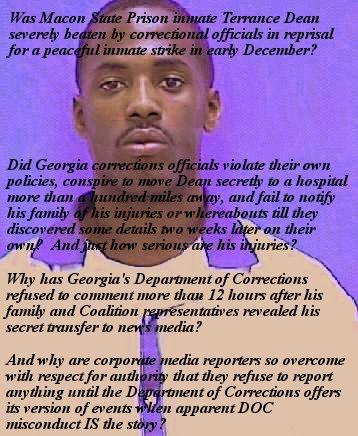
It now appears that at least one inmate, Terrance Dean of Bibb County GA was brutally assaulted by staff at Macon State Prison on or about December 16 was so severely injured prison officials secretly evacuated him to a hospital in Atlanta without bothering to inform his family. It’s not known at this time which Department of Corrections officials authorized the secret evacuation, who decided not to notify Dean’s family of either his injuries or his whereabouts, or whether the prisoner was transported the roughly 130 miles to Atlanta via ground or air ambulance. The first word the prisoner’s family received of either the beating or Dean’s whereabouts was when they were contacted December 30 or 31 by the friends and associates of other prisoners on the outside. Neither the Department of Corrections nor Atlanta Medical Center, where the prisoner was held for about two weeks, has released any information about the extent of the prisoner’s injuries, his current medical condition, or how he was injured.
The morning of Friday, December 31, Dean’s sister, along with ACLU attorney Chara Jackson and GA state NAACP chief Ed DuBose representing the Concerned Coalition to Respect Prisoner’s Rights showed up at the Atlanta Medical Center demanding to see the injured prisoner or at least have his whereabouts confirmed. After several hours of delay, correctional officials said his mother and sister, along with the attorney would be allowed to visit him at Jackson State Prison Sunday, January 2, but they offered no explanation of the reasons for his secretive transfer. Hospital officials also refused to offer any information on Dean’s injuries, even to his family, on grounds of doctor-patient confidentiality.
“We assume that state officials have a written policy requiring them to inform family members in the event of the serious injury of their loved ones in prison,” said the Georgia Green Party’s Hugh Esco. “If Georgia corrections personnel did brutally beat Terrance Dean, transfer him secretly more than a hundred miles from the scene of the crime scene and neglect to inform his family about his injuries or whereabouts they could be parties to a criminal conspiracy. The Green Party has written a letter to the outgoing and incoming governors asking them to look carefully at the events surrounding the case of Mr. Dean. We also note that the Department of Corrections promised access to the 37 prisoners whom it transferred as a result of the inmate strike that began on December 9. We hope this is a promise they keep, so that the public can get a complete and accurate picture of what goes on behind those walls.”
Dean’s sister, attorney Chara Jackson, and the NAACP’s Ed DuBose briefed the press at Atlanta Medical Center, including representatives from at least one local TV station repeatedly beginning at noon on Friday, and assured Black Agenda Report that they will attempt to see Terrance Dean at Jackson State Prison on Sunday, January 2. But as of nearly 24 hours later, on the morning of January 1, 2011 no corporate news outlet is publicly asking or answering any of the key questions around the assault on Terrance Dean, or what look for all the world like official attempts to conceal it from his family and the public.
“This is no surprise,” offered BAR executive editor Glen Ford. “For corporate journalists, a story without input from government or corporate officials is no story at all. For these so-called reporters, the story has a big hole in it as long as state officials decline to comment, even though official misconduct on the part of government IS the story. If the state declines to comment until Sunday or Monday, they will sit on the story till then. Establishment journalists are nothing if not disciplined and well-trained.”
Bruce A. Dixon is managing editor at Black Agenda Report, based in Marietta GA, and a member of the state committee of the Georgia Green Party. Both Black Agenda Report and the Georgia Green Party are members of the Concerned Coalition to Respect Prisoner’s Rights.
Background:
GA Prison Inmate Strike Enters New Phase, Prisoners Demand Human Rights, Education, Wages For Work
Video interview:
Elaine Brown on GA Prison Strike, December 14 Democracy Now Video Interview
And related video report:
Torture: America’s Brutal Prisons
Savaged by dogs, Electrocuted With Cattle Prods, Burned By Toxic Chemicals, Does such barbaric abuse inside U.S. jails explain the horrors that were committed in Iraq?
They are just some of the victims of wholesale torture taking place inside the U.S. prison system that we uncovered during a four-month investigation for the UK’s Channel 4 originally aired in 2005.
Israeli airstrikes hit Gaza twice overnight
Ma’an – 05/01/2011
TEL AVIV, Israel — Israel’s airforce struck two areas in the Gaza Strip overnight, in what a statement said was a “response to this morning’s firing of a Qassam Rocket,” which allegedly hit outside Ashkelon on Tuesday.
According to the military, the sites targeted were a “Hamas terror activity center” in the central Gaza Strip and a smuggling tunnel in the south near Rafah.
While the military said “Direct hits were confirmed,” there have been no reports of injuries.
No resistance faction has claimed to have launched a projectile toward Israel since the evening of January 2.
In its statement, Israel noted that it “holds the Hamas terrorist organization solely responsible for maintaining the calm in the Gaza Strip and for any terrorist activity emanating from it,” and added that its forces would “continue to respond harshly to any attempt to use terror against the State of Israel.”
Reports in the Israeli media last week said a meeting between factions in Gaza resulted in a decision to stem the flow of projectiles fired toward Israel.
Israeli officials have reported an increase in projectile launches toward Israeli targets from within the Gaza Strip, while a report from the country’s intelligence office said the number of projectile attacks by Gaza militants had sharply fallen in 2010.
Featured Video

New positive ivermectin evidence
or go to
Aletho News Archives – Video-Images
From the Archives
Fanatical Followers of the Covid Regime: A Jim Jones-Style Cult?
By Professor Roger Watson and Dr. Niall McCrae | The Daily Sceptic | November 15, 2021
As scholars at leading British universities over recent decades, we witnessed the replacement of critical thinking and debate by narrative: facts are discrimination and scientific method is imperialism; truth, instead, is derived from ‘progressive’ values. This educational trend may be a major contributory factor to the ease in which society has been inculcated to the Covid ‘new normal’ of masking, testing, and repeated doses of vaccines for a disease of similar risk to severe influenza.
One doesn’t need much critical reasoning to observe the flawed logic of some vaccination enthusiasts, such as people who respond to experiencing any side effects, however debilitating, by saying “at least I know it’s working”, or, after contracting the disease despite their promised inoculation (over 90% effective, according to initial drug company claims), “I’d have been worse off without the jab.” … continue
Blog Roll
 Aletho News
- EU Council Advances Chat Control 2.0 Scanning Proposal
- Ex-Greek MEP files complaint against Israeli spyware firm over alleged Pegasus surveillance
- Troubling ideas throughout the Torah, Talmud, Mishneh Torah and Tanya
- ‘Grave, alarming’: Iran mission on Trump’s UNGA ‘annihilation’ threats
- Najaf airport to reopen to Iranian flights within 24 hours: Ambassador
- From ‘How Will This End For Iran’ to ‘When America Walks Away’: A tale of two Economist covers
- Tehran blasts ‘baseless’ speculation linking Iran to alleged bomb plot at UK air base
- The Rise And… Rise Of ‘Color Revolutions’
- The Coming GOP Bloodbath?
- Arctic Scare Stories Melt Away
- If Americans Knew
- Netanyahu Asked UAE Leader to Deny Report on Oct. 7 Warning in Secret Visit, Sources Say
- CNN Chief Int’l Correspondent Clarissa Ward on Journalists in Gaza
- Democratic Party Consultants Surround Troy Jackson with Pro-Israel Donors
- Christian Leader Responds To Netanyahu’s Claims Regarding Palestinian Christians
- In Gaza, ‘Whoever Survives the Bombing Won’t Survive the Rubble’
- Israel kills more Palestinians, amid push to resettle Gaza – Daily Update
- Israel forces Gazans to live in constant peril – Daily Update
- Deconstructing Netanyahu’s pants-on-fire UN rant – Daily Update
- Trump betrayed voters with his campaign lies and prioritized a foreign country once he took office
- Netanyahu calls Israel’s war in Gaza ‘opposite of genocide’ in UN speech to near-empty hall
- No Tricks Zone
- New Study: Earth And Venus Surface Warmth Largely Explained By Convection And Lapse Rate, Not CO2 Or Radiation
- 2025 Nature Paper Claiming Worsening Global Drought Gets RETRACTED …Heavily Flawed
- New Study: ‘Global Drought Shows No Detectable Recent Acceleration Under Climate Warming’
- Economic Masterminds: German Socialists Suggest Taxing Productivity Gains Stemming From Using AI
- The South China Sea Has Not Been Cooperating With The Climate Change Narrative
- Energy Crisis: Germany Enters Heating Season With Historically Low Gas Reserve Fill Levels
- New Study: The Antarctic Ice Sheet Gained Mass From 2020-2024 Due To Staggering Snow And Ice Accumulation
- Study: Ocean Heating Rates From Thousands Of Years Ago ‘Dwarf’ Modern Ocean Heating Rates
- Climate Extremists Target, Attack Large-Scale Power Grid Infrastructure In Germany!
- New Study: Antarctic Ice Melt Has Contributed Less Than 1 Centimeter To Sea Level Rise In The Last 30 Years

