Missing Persons and Intelligence Agencies
By Malik Ayub Sumbal | The New American | 20 January 2011
Missing persons are a major human-rights issue in various countries. One niche of the missing persons saga is Asian nationals who went missing after 9/11, kidnapped by the world’s intelligence agencies. There are hundreds of people who went missing in the last several years from Pakistan, Afghanistan, India, Indonesia, Malaysia, Philippine, China, Thailand, and Singapore.
The relatives of these missing people are sure that their loved ones were abducted by the intelligence agencies of their countries. In Pakistan the issue of missing persons was raised in 2002 when Dr. Amir Aziz mysteriously disappeared, abducted by state-run intelligence agencies. Pakistan’s Daily Times reported:
Leading orthopaedic surgeon Dr Amir Aziz, picked up on Oct 21 over suspected links with Al Qaeda, was dramatically released in the early hours of Tuesday after being thoroughly investigated by the US FBI and the Pakistani intelligence agencies.
The missing persons issue was again highlighted when Amna Masood Janjua’s husband was picked up by an intelligence agency on July 30, 2005. The brave lady raised her voice against the powerful intelligence agencies and decided to devote herself to the cause of missing persons in Pakistan. She started her own organization for the legal and financial aid of the heirs of the missing persons, called the Defense of Human Rights.
When contacted by this correspondent, she asserted:
I know where my husband is in the illegal confinement of ISI [Pakistani intelligence], and he is in cell No. 20 in sector I-9/3 of Islamabad, where there are the offices and some residential apartments of this intelligence agency.
His detention by the ISI was confirmed by eyewitnesses to his abduction, as well by affidavits of other released detainees. Amna maintained that she wants her husband released at any cost. She commented that the Supreme Court of Pakistan has formed a commission to probe the missing persons issue and also a Joint Investigation Team, but both are powerless to summon the intelligence agencies.
The commission was formed on May 1, 2010, and 203 fresh cases of kidnapping have been reported since then.
In Pakistan the reason behind the sacking of the judiciary by the former dictator and now-exiled President General Pervaiz Musharraf was the same issue of missing persons. The court sought to recover all the missing persons who were illegally abducted by the intelligence agencies. The masses restored the judiciary of Pakistan, and now again the Chief Justice of Pakistan is encountering roadblocks in recovering the missing persons from the custody of the intelligence agencies.
Amna claims that at least 392 people have gone missing in Pakistan who are in the hands of the intelligence agencies. According to her sources, the kidnapped people are being brutally tortured and interrogated by both local intelligence agencies and the U.S. CIA. The sources confirmed that there are several people who are interrogated solely by the CIA.
Claims have also been made that there are covert CIA prisons on ships and on the islands of Indonesia — the most notorious, according to numerous Asian periodicals, being Smarata, where the CIA’s “Most Wanted” are being kept. The purpose of keeping kidnapped persons on ships is apparently to remove them from the territorial boundaries and laws of any specific country.
Internationally, for the last decade, the issue of missing persons has been in the headlines of the world media. There have been hundreds of protests launched by relatives and loved ones of these missing persons, but the international community has done nothing to help these people.
According to the United Nations’ constitution, enforced disappearance and genocide are the two major crimes against humanity; yet despite the organization’s vaunted interest in peace and justice in the world, with these particular crimes, the UN’s apathy and uselessness are overwhelming.
On the surface the UN would appear to be concerned with missing persons: It has a Working Group on Enforced or Involuntary Disappearances, and it does hold meetings on missing persons. The United Nations Working Group on Enforced or Involuntary Disappearances concluded its 92nd session this past November at the United Nations office in Geneva.
The summary of the 92nd session indicates that the UN took the following actions:
During its 92nd session, the Working Group examined 23 reported cases under its urgent action procedure, 284 newly submitted cases of enforced disappearances and information on previously accepted cases concerning the following countries: Algeria, Argentina, Bangladesh, Belarus, Cameroon, Chad, China, Colombia, Democratic People’s Republic of Korea, Dominican Republic, Ecuador, Egypt, El Salvador, France, Georgia, India, Iraq, Lao People’s Democratic Republic, Libyan Arab Jamahiriya, Mexico, Morocco, Pakistan, Philippines, Russian Federation, Saudi Arabia, Spain, Sri Lanka, Sudan, Syrian Arab Republic, Tajikistan, Thailand, Tunisia, Turkey, Turkmenistan, United Arab Emirates, Ukraine, Uzbekistan, Vietnam, Yemen, and Zimbabwe.
The summary added, “The Working Group also examined allegations submitted by credible sources regarding obstacles encountered in the implementation of the Declaration on the Protection of All Persons from Enforced Disappearance and decided to transmit general allegations to the concerned governments.”
And it stated:
During the 92nd session, the Working Group received delegations from the Governments of Iraq, Japan, Nepal, and Rwanda to exchange views on individual cases and on the issue of enforced disappearance in general. It also met with members of the Committee Against Torture as well as with non-governmental organizations and family members of disappeared persons regarding obstacles encountered in the implementation of the Declaration in their respective countries. Members of the Working Group also held a series of informal bilateral meetings with some States with a view to enhance cooperation.
But despite all these efforts, no progress has been made in the recovery of missing persons, and all of the countries scorn the laws of the United Nations. The Working Group has failed to recover a single person that has been abducted by state intelligence agencies, including those taken by the CIA.
In fact, those seeking the UN’s aid find that the rules and methods of the Working Group are so complicated that it is difficult to even report a missing person case. The United Nations’ actions are a demonstration of doing nothing while looking busy. There is so little sway held by the UN over countries that in some countries people are afraid to even utter the name of these powerful intelligence agencies which have captured their relatives.
Malik Ayub Sumbal is a freelance journalist based in Islamabad, Pakistan.
Gaza family remembers grandfather killed by Israeli bullet
Rami Almeghari writing from occupied Gaza Strip, Live from Palestine, 21 January 2011
Shaban Qarmout, a 65-year-old farmer from the Jabaliya refugee camp in the northern Gaza Strip, got up early on Monday, 10 January and headed out to his farmland as he usually did, accompanied by his 22-year-old son Khaled. Their land is located about 500 meters from the boundary fence with Israel, near the Agriculture School in the town of Beit Hanoun. At about midday, as the two were working, a bullet fired from an Israeli watchtower ripped through the elder Qarmout’s chest, wounding him fatally.
Khaled Qarmout told The Electronic Intifada what happened: “My father and I were working normally, clearing some rocks from the land using a cart. At noon a number of people from a relief organization came to see my father. One of them wanted to take some pictures, but my father refused. He told them it might expose him to some danger from the Israeli military post nearby. Of course the area is dangerous, and my father was always keen to avoid any trouble with the Israelis.”
After the visitors left, Shaban Qarmout resumed his work and Khaled moved about a hundred meters away. “Suddenly I heard my father screaming, ‘Khaled!’ and I rushed to see what happened. I found him silent and blood began to drip from his mouth,” Khaled recalled.
Asked if he had observed any trouble or activity near the boundary, Khaled replied: “I kept silent, and looked around to see what was going on, but saw nothing. Then with the help of some neighboring farmers we carried my father on a bulldozer for a distance of about 300 meters until he was taken to a nearby hospital by ambulance. He died a few minutes after he was shot from the Israeli watchtower.”
At the Jabaliya refugee camp home of Shaban’s son Shaker, family members were gathered, including Shaban’s wife Umm Khaled, daughters Khulud (15), Rana (26), and daughter-in-law Umm Thaer.
Shaban Qarmout had a small house on his land, but the family left it two years ago during Israel’s winter 2008-2009 assault on Gaza and moved to Jabaliya refugee camp. Despite this, Khaled told The Electronic Intifada that he and his father continued to work their land during the past two years from the early morning until evening. According to Khaled, the Israeli soldiers at the watchtower that is close to their land know them well, yet, Khaled says, they shot his father in cold blood.
“Almost two weeks ago, my father received some financial assistance from a relief organization and he asked me to keep the small amount of money at the house on the farmland, telling me, ‘My son, maybe we will need this money some time in the future, so it is better that we keep it rather than spend it.’ He said these words as if he were aware that his destiny was awaiting him,” Khaled said, surrounded by family members in the home.
Umm Khaled spoke to The Electronic Intifada, her face pale, about what she called the “martyrdom” of her husband: “Let me tell you that my slain husband has been there in the same farmland for about 45 years and I personally spent almost half of this period with him along with our children. I am wondering why they killed him; I am sure they know him.”
One week after the Israeli assault started in December 2008, Umm Khaled recalled, the Israelis using loud speakers ordered them to leave the area, and that was when they moved to Jabaliya.
“Shaban, my husband, was a very kind-hearted father,” Umm Khaled said. “He was so kind to his children and generous towards other people. When we used to live in the house on the farm, before the war broke out, Shaban used to welcome all the relatives who used to spend some time with us among the citrus trees, to the extent that he always insisted to serve them food. May God accept him as martyr and believe me I wish I were martyred along with him.”
“My father was the kindest to me,” said 15-year-old Khulud. “I am his youngest and I never felt deprived of anything — tenderness, food, pocket money or anything else. My father used to give me whatever I wanted and always cared for me.”
Reflecting on those who took her father away from her, Khulud added, “I don’t believe there is a chance for coexistence with such killers, the Israelis! Why did they kill him? Did he shoot at them with his 45-year-old axe?”
Rana spoke of her father as she held his infant grandchild in her arms and as neighbors and relatives came to offer condolences.
“My father used to be very generous with me and his grandsons despite the fact his economic situation was not that good,” Rana said. “Every now and then, he would give me some money to spend on my children, for he knew my husband is jobless. During Ramadan, he used to invite me and my children to iftar [the breaking of the fast], showing a great deal of kindness to us.”
Umm Thaer, Shaban Qarmout’s daughter-in-law and niece, said that her uncle was like a father to her. His loss was not the first tragedy she has suffered. On 29 December 2008, her 16-year-old son Thaer Shaker Qarmout was critically wounded in an Israeli missile strike. He died of his injuries on 4 January 2009. Two friends who were with Thaer, Muhammad Madi and Tareq Afani, were killed instantly.
On the terrible day her son died, Umm Thaer remembers her uncle Shaban telling her, “Dear daughter, Thaer has gone to the best place, to paradise, and believe me, may God take us the same way he took Thaer.”
It seems that God heard Shaban and in the same month in which Thaer went to paradise, his grandfather followed him two years later.
Rami Almeghari is a journalist and university lecturer based in the Gaza Strip.
Hebron: Checkpoint soldiers shoot driver
Ma’an – 21/01/2011
HEBRON — Soldiers at a flying checkpoint on Route 60 north of Hebron shot and critically wounded a Palestinian citizen of Israel on Thursday night.
The Israeli military said events around the shooting were unclear.
Security sources identified the man as 28-year-old Jalal Al-Masri, and said he sustained a bullet wound in his head.
Officials said the Israeli report was that Al-Masri disobeyed orders of checkpoint soldiers and was fired on.
According to reports by the Israeli newspaper Yedioth Ahronoth, the military is investigating the possibilities that the driver either did not notice the flying checkpoint, or that he intended to harm soldiers and sped toward it.
Hours earlier in the northern West Bank, the Ya’bad Mevo Dotan checkpoint was closed and eyewitnesses said the body of a Palestinian man remained lying in the car passage terminal after the Israeli military reported a man was shot in an exchange of gunfire.
The slain man, identified as Salem Omar As-Samudi, 24, from Yamoun in the Jenin district, was said by eyewitnesses to have opened fire on Israeli forces at the checkpoint, confirming Israeli military reports that a man approached checkpoint soldiers and opened fire.
Two others had been shot dead at checkpoints in the last three weeks. On January 8 Israeli troops stationed at Hamra checkpoint east of Nablus shot and killed a Palestinian man who onlookers identified as 25-year-old Khaldoun Sammoudi, of Al-Yamun village near Jenin.
An Israeli military spokesman said a man approached the checkpoint in a taxi, then got out of the vehicle and ran towards forces holding a suspicious object and shouting “Allahu Akbar.” He did not heed orders to stop and forces followed operational procedures and shot him, the army official said.
At the same checkpoint on January 1, soldiers shot and killed a 21-year-old Palestinian identified as Ahmad Maslamani, who a military spokeswoman said approached soldiers in an unauthorized lane carrying a glass bottle and did not heed orders to stop.
Witnesses said the victim approached the checkpoint carrying a coca-cola can, a female soldier shouted at him and two male soldiers immediately opened fire. Medics said Maslamani’s body was riddled with bullets.
A State of Permanent Human Bondage
By Malcom Lagauche | January 19, 2011
The goal of Desert Storm was to destroy the country of Iraq under the guise of liberating Kuwait. In February 1991, during the height of U.S. bombing, former U.S. Attorney General Ramsey Clark visited Iraq and reported his findings. At that time, few photos had come from Iraq showing the devastation. Most reporters left Iraq on the eve of the bombing campaign and spent their time in Saudi Arabia listening to the daily propaganda given by the U.S. military. They became so bored that they began to interview each other.
What Clark saw was not pretty. He stated:
The effect of the bombing, if continued, will be the destruction of much of the physical and economic base for life in Iraq. The purpose of the bombing can only be explained rationally as the destruction of Iraq as a viable state for a generation or more.
Clark’s message was not widely reported. After all, the U.S. version of events stated that the only reason for the aggression was to remove Iraqi soldiers from Kuwait. The lack of coverage of what was occurring in Iraq was convenient for the U.S. because it allowed the destruction of Iraq to continue with no world outcry.
After the bombing ceased, pictures began making their way to the outside world. When this information reached the U.S., the administration called it lies and propaganda. At other times, it accused Iraq of destroying its own institutions and blaming it on U.S. bombs. Once people from outside Iraq began to visit the country, the blatant U.S. lies were exposed. The following is a list of the numbers of facilities destroyed during the 42-day bombing campaign. It was compiled and published by the Iraqi Reconstruction Bureau:
· Schools and scholastic facilities — 3960
· Universities, labs, dormitories — 40
· Health facilities (including hospitals, clinics, medical warehouses) — 421
· Telephone operations, communication towers, etc. — 475
· Bridges, buildings, housing complexes — 260
· Warehouses, shopping centers, grain silos — 251
· Churches and mosques — 159
· Dams, pumping stations, agricultural facilities — 200
· Petroleum facilities (including refineries) — 145
· General services (shelters, sewage treatment plants, municipalities) — 830
· Houses — 10,000 to 20,000
In April 1991, a fact-finding team from Greenpeace visited Iraq and nobody was prepared for the display of massive devastation. When Greenpeace issued its report, it said Iraq had been bombed back to a pre-industrial era. The report added, “New technology did not make the U.S. military better at preventing destruction, it just made it more efficient at destruction itself.”
The U.S. press ignored most of the reports by various groups that visited Iraq after Desert Storm. The few words reported, along with the absence of photos, assured a lack of public outcry condemning the slaughter.
The massacre should not have surprised those who followed incidents leading to Desert Storm. As early as September 1990, a high-up military person mapped the plans for the invasion. On September 16, 1990, General Dugan stated that the proposed plans for combat included the destruction of the Iraqi civilian economy and infrastructure. At that time, no one could envisage the U.S. attacking Iraq because the Iraqi soldiers were in Kuwait and the U.S. demanded their exit. Most people thought, if there was to be a war, it would be conducted in Kuwait, not Baghdad. General Dugan was immediately removed from office. The Bush administration negated Dugan’s claims and discredited him. In hindsight, we see that Dugan’s testimony was about the only truth we heard from the U.S. government or military at that time. He let the cat out of the bag, but government damage control quickly led the people to believe he made up the scenarios he predicted.
For the first week of Desert Storm, everyone seemed to be mesmerized by the “smart bombs” that were going down chimneys and smashing through the windows of weapons warehouses. When the odd person asked about civilians being hit, the standard response was, “We’re not targeting civilians.” What we were not told was that 93% of the bombs dropped were “dumb bombs” and the civilian infrastructure of Iraq was being destroyed. Only about 30 to 40% of the dumb bombs hit their targets. The others randomly created havoc by killing civilians and destroying Iraq’s cities and towns.
After Desert Storm, some military people admitted the real nature of the attacks. Air Force General Tony McPeak stated on March 20, 1991, “I’ve got photographic evidence of several where the pilot just acquired the wrong target.” When asked why that information had not come forth earlier, he added, “It ain’t my call. I made some recommendations about this; it got turned around, quite frankly.”
Those who questioned the U.S. government’s reports of only hitting military targets had their fears verified on January 22, 1991. Pictures of a destroyed baby milk factory in the region of Abu Ghraib were broadcast worldwide. Many people were aghast at the bombing of a civilian industry crucial for the existence of youngsters.
The Pentagon immediately went into high gear to try to dispel the protests of those who questioned such barbaric actions. The administration stated that it was a biological weapons plant. Colin Powell said”
It is not an infant formula factory, no more than the Rabta chemical plant in Libya made aspirin. It was a biological weapons facility, of that we are sure — and we have taken it out.
The administration came up with the excuse that “Baby Milk Factory” signs around the plant were written in English and Arabic and they had just been mounted after the bombing to try to make people think it was a baby formula factory. The American public bought the excuse.
The public never researched to discover that many signs in Iraq included both English and Arabic versions because of the substantial English-speaking population who worked in Iraq prior to Desert Storm. The sign at the baby milk factory had been in place for several years prior to its bombing. Peter Arnett of CNN stated after Desert Storm that the same factory and sign were evident in a documentary that CNN produced in the late 1980s.
Nestlé of Switzerland is a leading producer of infant foods. A spokesman for the company said, “We know this was a state-built infant formula plant.” Company officials said they had regularly observed its construction in the past, “because we like to be aware of the competition.”
U.S. audiences rarely heard or saw what other countries reported concerning Desert Storm. A British TV show, “Panorama,” was broadcast on March 25, 1991 which included an interview with General Leonard Perroots, a consultant to U.S. intelligence in Desert Storm. He addressed the bombing of the baby milk factory and he quickly put the matter to rest as he said, “We made a mistake.”
The bombing of the baby milk factory put the world on alert that the information broadcast at the daily military briefings was untruthful. At that time, those who opposed Desert Storm were shocked at the widespread destruction in Iraq. They wondered how the U.S. public, which usually would have treated such barbaric designs with disdain, had acquiesced to cheering such actions. The answer lies in the demonizing of Iraq and its president, Saddam Hussein.
In George Bush’s Thanksgiving speech to U.S. troops in Saudi Arabia in 1990, he stated:
Every day that passes brings Saddam one step closer to realizing his goal of a nuclear weapons arsenal, and that’s why more and more your mission is marked by a real sense of urgency. You know, no one knows exactly who they may be aimed at down the road, but we know this for sure, he’s never possessed a weapon he didn’t use.
At the time of his speech, Bush knew that Iraq was at least five years away from developing its first crude atomic weapon, yet he made it sound as though Iraq was on the verge of obtaining a comprehensive nuclear arsenal. In further speeches, he suggested that in six months, Iraq would be a nuclear threat to the world. The myth of an Iraqi nuclear warehouse was a prime excuse for Bush II invading Iraq in 2003. And, to this day, many U.S. citizens believe Iraq possessed nuclear weapons.
Even after the bombing of the baby milk factory, the U.S. denied bombing civilians or buildings used in civilian industries. When the Iraqi government stated that a village or suburb was hit, the U.S. government would say the Iraqis weren’t telling the truth. Because of the demonizing of Iraq, most Americans thought all Iraqi information consisted of lies.
On January 31, an independent source announced that the U.S. was bombing civilians. The Jordanian Foreign Ministry stated that coalition planes had bombed oil trucks and civilians moving along the highway from Iraq to Jordan. Again, the U.S. denied the allegations, but some eyes were being opened.
In Iran, reports were made stating that the bombing was so intense that the ground in Iran was shaking. On February 5, 1991, an official in Basra described “a hellish nightmare” of fires and smoke so dense that eyewitnesses say the sun had not been clearly visible for days at a time; that the bombing was leveling entire city blocks; and that there were bomb craters the size of football fields and an untold number of casualties.
On February 7, the military still denied that civilians were being targeted. When asked about the allegations, General Richard Neal told the press, “It’s a target-rich environment and there’s plenty of other targets we can attack.”
While Neal was making his statement, Ramsey Clark was traveling throughout Iraq but his assessment differed greatly from that of the general. In describing the reality in Iraq, Clark stated:
Over the 2,000 miles of highway, roads and streets we traveled, we saw scores, probably several hundred, destroyed vehicles. There were oil tank trucks, tractor trailers, lorries, pickup trucks, a public bus, a mini bus, a taxi cab and many private cars destroyed by aerial bombardments and strafing. We found no evidence of military equipment or supplies in the vehicles.
Along the roads, we saw several oil refinery fires and numerous gasoline stations destroyed. One road-repair camp had been bombed on the road to Amman (Jordan). As with the city streets in residential and commercial areas where we witnessed damage, we did not see a single damaged or destroyed military vehicle, tank, armored car, personnel carrier or other military equipment, or evidence of any having been removed.
Basra was probably the hardest-hit city during Desert Storm. There was evidence of weapons that are normally used against military personnel having been deployed in civilian areas of Basra: cluster bombs. Clark saw this evidence and reported:
Small, anti-personnel bombs were alleged to have fallen here (Basra) and we saw what appeared to be one that did not explode imbedded in the rubble. We were shown the shell of a “mother” bomb which carries the small fragmentation bombs.
When he left Iraq in February 1991, Clark gave an overview of the situation:
United States annual military expenditures alone are four times the gross national product of Iraq. The use of highly-sophisticated military technology with mass destructive power against an essentially defenseless civilian population of a poor nation is one of the greatest tragedies of our times.
A few days after Clark left Iraq, an incident occurred that astonished the world. On February 13, a pair of Stealth F-117 bombers dropped two 2,000-pound laser-guided bombs on a concrete building in the Amiryah section of suburban Baghdad. The case-hardened bombs were directed to penetrate the steel reinforced roof and detonate inside. It was a civilian bomb shelter.
The reports of the number of civilians killed in the building — more than half were children — ranged from 400 to more than 1,000. Because the bodies were so badly burned and melted, no one will ever know the exact total.
The U.S. administration first proclaimed that the target was an Iraqi command-and-control post and the dead were Iraqi military personnel. The cameras eventually showed charred bodies of women and children, so the U.S. story had to be revised. The administration then said that the building was a military target in which Saddam Hussein placed civilians to protect the military personnel. Dick Cheney, then the U.S. Secretary of Defense, stated, “Saddam might be resorting to a practice of deliberately placing civilians in harm’s way.”
The U.S. government scrambled to try to explain the massacre of so many people inside a civilian bomb shelter. General Neal stated the government’s case as he said, “From a personal point of view, I’m outraged that civilians might have been placed in harm’s way, and I blame the Iraqi leadership for that.” Unfortunately, many Americans believed Neal’s twisted excuse of blaming the Iraqi leadership for the incineration of hundreds of people by deadly superbombs.
Within a few hours, the truth emerged. The Amiryah bomb shelter was built for civilian defense during the Iran-Iraq War. The engineer who designed it appeared on television and told the world there was no way it could be a military asset.
After the lies were put to rest, it became evident that the U.S. had either mistaken the target as a military venue, or it had deliberately destroyed it knowing it was a bomb shelter. Since February 14, 1991, the subject of the bombing of the Amiryah bomb shelter has been left unspoken in the U.S.
Those inside the bomb shelter died horrific deaths. First, a 2,000-pound bomb crashed through the shelter, creating a massive tunnel in which the second 2,000-pound projectile entered. Then, both exploded, leaving a huge hole. Those who died saw the first bomb and had a few seconds of life left before the second burrowed its way into the shelter and discharged.
Despite the ensuing international outcry about the destruction of the Amiryah shelter, the U.S. did not cut back on the bombing. Actually, the bombing of the Iraqi infrastructure increased. According to Greenpeace in a report called On Impact::
Despite numerous statements of U.S. military leaders that the Iraqi army had been defeated, as well as some confidence that contact between Baghdad and the front in the south had been severed, communications targets, mostly serving civilian functions, continued to be struck and re-struck to the end. If fact, according to Air Force Times, during the final ground phase, “Baghdad was targeted for some of the heaviest bombardments since January 17.”
The cease-fire did not solve all the problems for the civilians of Iraq. Shortly after, George Bush called for the Iraqi people to “take matters into their own hands” in ridding Iraq of its government. For the next few weeks, some Shi’ites in the south, heavily aided and infiltrated by Iranians, wreaked havoc, while certain Kurdish factions started an insurrection in the north of Iraq. There was bloody fighting and at one time, the Shi’ite and Kurdish elements controlled 16 of Iraq’s 18 provinces. Both movements eventually were brought under control by the Iraqi government. Not content with destroying Iraq by bombing it back to a “pre-industrial era,” Bush prompted even more destruction by urging factions within Iraq to overthrow the government. He promised both groups military assistance from the U.S., but none came.
In April 1991, the outside world saw Iraq for the first time since it had been destroyed by U.S. bombs and missiles. The nightmarish pictures started to appear. They showed a country that was bombed so heavily that the most common sites were craters and twisted, melted and devastated structures.
Ramsey Clark made another trip to Iraq to document the devastation. Once there, he noticed an ongoing operation that was meant to terrorize the population:
On our second night there, and several other times, at about 2:30 a.m., U.S. jets flew over the city (Baghdad), deliberately creating an enormous sonic boom that sounded as if the bombing had started again. The next morning, people would describe how their children had awakened in terror.
Clark chronicled the civilian industries that were demolished during the bombing of Iraq:
Twenty minutes outside the city (Baghdad), in Al Taji, we saw the country’s largest frozen meat storage and distribution center; one of two main centers for the entire country, which also included a laboratory for testing meat quality. It had been completely obliterated by the bombing. The center held 14,000 tons of frozen meat. The plant had been bombed three times, at 8:00 a.m., 3:00 p.m., and 8:00 p.m., and workers inside the plant had been killed.
All over Iraq, Clark saw the same mindless destruction. In Babylon, he visited a textile weaving plant that was totally destroyed. The plant was bombed at 3:00 in the afternoon and two women were killed working at their stations. According to the plant manager, Mr. Hassan, the factory was built by an Italian company and the new structure next door, containing no equipment, was untouched.
Dr. Al Qaysi, an Iraqi medical official, put everything in perspective when he stated:
No home remained untouched, no family unharmed, if not through death in the war, through malnutrition, disease, or new-found poverty. This is a return to colonialism. The U.S. is asking for terms like another Treaty of Versailles. Iraq is dependent on the outside world to repair its infrastructure and I fear Iraq will be in a state of permanent human bondage.
The Iraqi Minister of Trade, Mohammed Mahdi Saleh, realized the enormity of the task of trying to rebuild Iraq, particularly with the encompassing trade embargo in place. Despite the U.S. administration maintaining that Iraq was able to import humanitarian goods, there was virtually no way to obtain food, medicine, and parts to repair destroyed machinery. Saleh stated, “If it was possible, the Bush administration would have prevented the air from coming in.”

No discharge for soldier who initiated Hebron slaying
Ma’an – 20/01/2011
TEL AVIV — The Israeli military announced late Wednesday evening that the soldier who killed a civilian in his Hebron home would not be discharged, while a second officer who joined in the killing would have his military career “terminated.”
The investigation looked into the death of the death of a civilian during an arrest raid in Hebron targeting Hamas men released from PA custody the day before, where Israeli forces shot and killed a 66-year-old man in his bed, in what appeared to be a case of mistaken identity.
Investigating officer GOC Central Command, Major General Avi Mizrahi was said in a statement to have absolved the officer who started shooting at the sleeping Omer Salim Al-Qawasmi.
The statement said “a suspicious movement [..] caused the soldier to feel that his life was threatened.”
According to the statement, the soldiers fear was excused, “especially having known about the actions of Wael Bitar, a senior Hamas operative who was the main suspect of the arrest operation.”
Al-Bitar, who was detained in June 2008 by what witnesses at the time said were Israeli forces. The arrest followed a violent standoff as Israeli soldiers surrounded and demolished Al-Bitar’s home, after demanding he give up a man who was staying in the building and stood accused of assisting a resistance fighter. The home was demolished around Al-Bitar, and the alleged fighter he was harboring killed in the demolitions. Later reports said Al-Bitar was detained by PA intelligence officials.
Israeli military officials said Al-Bitar assisted in the planning of a 2008 attack that killed one Israeli woman, and was behind the planning of several attacks that were thwarted.
A second soldier, who was also said to have fired on the sleeping man, was found by the inquiry to have “acted unprofessionaly.”
The unidentified officer, “who, having watched the first soldier firing at Qawasme, began firing at him as well.”
According to the military statement the investigating officer concluded that “while the second soldier did feel threatened, he acted unprofessionaly [… and] ordered that the soldier’s military term be terminated.”
It was not clear whether the soldier was honorably or dishonorably discharged.
Mizrahi was said to have “concluded that this firing was executed in accordance with IDF rules of engagement,” though the statement said the death of Al-Qawasmi was “regrettable.”
According to a security source, the officers were part of the “‘Duvdevan’ counter-terrorism elite unit” which was “called in for an arrest operation in the city of Hebron.”
The source described the unit as “a professional, elite unit specializing in close combat, camouflage and assimilation into hostile territory.”
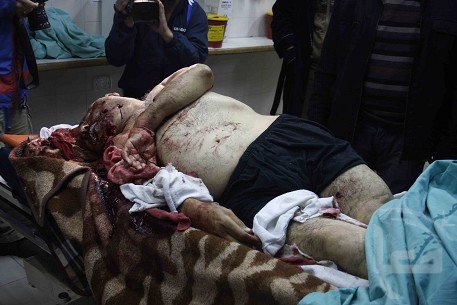
Al-Qawasmi was shot 13 times in the face, neck at torso as he slept.
Gaza Strip runs out of cooking gas
Palestine Information Center – 19/01/2011

GAZA — No trace of cooking gas was to be found in Gaza Tuesday, fuel companies warned, as the Israeli blockade limits supply and solutions appear unpromising.
Mahmud al-Shawa, head of the fuel companies assembly, warned of a humanitarian disaster as the strip’s stations run out of fuel and accumulate thousands of empty gas cylinders.
The answer to the crisis will require a daily supply of 300 tons of gas over no less than three straight months, Shawa said.
“The Gas crisis goes more than two months back. No gas has been supplied to Gaza for the past two days,” Shawa said.
With a daily requirement of 250 tons, only 130 tons reached the Gaza Strip daily last week.
Shawa accused Israel of rationing Gaza’s cooking gas as a means of tightening its four year economic siege of the region. Even though gas is not a commodity that should be subject to restrictions according to the blockade’s intent.
As all other border crossings are blocked, no more than 200 tons pass through the Karam Abu Salim Crossing on its best day. The crossing operates only five days weekly from 9am to 3pm.
Court Rules Government Can Continue To Suppress Detainee Statements Describing Torture And Abuse
ACLU | January 18, 2011
WASHINGTON – A federal appeals court today ruled that the government can continue suppressing transcripts in which former CIA prisoners now held at Guantánamo Bay describe abuse and torture they suffered in CIA custody. The ruling came in an ACLU Freedom of Information Act (FOIA) lawsuit to obtain uncensored transcripts from Combatant Status Review Tribunals (CSRTs) used to determine if Guantánamo detainees qualify as “enemy combatants.”
“The American people have a right to know what the government has done in their name, and these transcripts, which include the direct testimony of the victims themselves, are essential to a full understanding of the Bush administration’s torture program,” said Ben Wizner, Litigation Director of the ACLU National Security Project, who argued the appeal for the ACLU. “The court’s decision undermines the Freedom of Information Act and condones a cover-up. These transcripts are being suppressed not to protect national security, but to shield former government officials from accountability.”
The ACLU lawsuit sought transcripts of statements made by Guantánamo prisoners concerning the abuse they allegedly suffered while in U.S. custody. While the CIA released heavily-redacted versions of the documents in June 2009, it continues to suppress major portions of the documents, including detainees’ allegations of torture.
Since the ACLU first filed its FOIA request for release of the transcripts, several developments have undermined the government’s claims that it can continue to withhold the documents: in January 2009, President Obama issued an executive order prohibiting the coercive interrogation techniques described in the suppressed transcripts and ordered the closure of the CIA’s overseas prisons; in April 2009, the government declassified four Justice Department memos that purported to authorize the brutal interrogation techniques to which the detainees were subjected; also in April 2009, the New York Review of Books published a detailed report by the International Committee of the Red Cross based on firsthand accounts of these detainees about their abuse in CIA custody; and in August 2009, the government declassified large portions of a report by the CIA’s Inspector General and other CIA and Justice Department documents that provide additional details about the interrogation methods to which the detainees were subjected.
Despite these developments, in October 2009 the U.S. District Court for the District of Columbia granted the government’s motion to dismiss the case without even reviewing the documents in question in order to determine if they were properly withheld. Today’s appellate court ruling allows the government to continue withholding the documents.
“The notion that the CIA can classify torture victims’ descriptions of their own first-hand experiences is dangerous and far-reaching,” said Wizner. “No court has ever held that unconfirmed allegations offered by detainees concerning the treatment to which they themselves were subjected could be classified and suppressed.”
Attorneys on the case, ACLU, et al. v. DOD, et al., are Wizner and Jameel Jaffer of the ACLU National Security Project, Lee Gelernt of the ACLU Immigrants’ Rights Project and Arthur B. Spitzer of the ACLU of the National Capital Area.
Today’s ruling is available online at: www.aclu.org/national-security/american-civil-liberties-union-et-al-v-department-defense-et-al-dc-circuit-court-0
More about the ACLU’s CSRT FOIA is at: www.aclu.org/safefree/torture/csrtfoia.html
Featured Video

New positive ivermectin evidence
or go to
Aletho News Archives – Video-Images
From the Archives
Fanatical Followers of the Covid Regime: A Jim Jones-Style Cult?
By Professor Roger Watson and Dr. Niall McCrae | The Daily Sceptic | November 15, 2021
As scholars at leading British universities over recent decades, we witnessed the replacement of critical thinking and debate by narrative: facts are discrimination and scientific method is imperialism; truth, instead, is derived from ‘progressive’ values. This educational trend may be a major contributory factor to the ease in which society has been inculcated to the Covid ‘new normal’ of masking, testing, and repeated doses of vaccines for a disease of similar risk to severe influenza.
One doesn’t need much critical reasoning to observe the flawed logic of some vaccination enthusiasts, such as people who respond to experiencing any side effects, however debilitating, by saying “at least I know it’s working”, or, after contracting the disease despite their promised inoculation (over 90% effective, according to initial drug company claims), “I’d have been worse off without the jab.” … continue
Blog Roll
 Aletho News
- EU Council Advances Chat Control 2.0 Scanning Proposal
- Ex-Greek MEP files complaint against Israeli spyware firm over alleged Pegasus surveillance
- Troubling ideas throughout the Torah, Talmud, Mishneh Torah and Tanya
- ‘Grave, alarming’: Iran mission on Trump’s UNGA ‘annihilation’ threats
- Najaf airport to reopen to Iranian flights within 24 hours: Ambassador
- From ‘How Will This End For Iran’ to ‘When America Walks Away’: A tale of two Economist covers
- Tehran blasts ‘baseless’ speculation linking Iran to alleged bomb plot at UK air base
- The Rise And… Rise Of ‘Color Revolutions’
- The Coming GOP Bloodbath?
- Arctic Scare Stories Melt Away
- If Americans Knew
- Netanyahu Asked UAE Leader to Deny Report on Oct. 7 Warning in Secret Visit, Sources Say
- CNN Chief Int’l Correspondent Clarissa Ward on Journalists in Gaza
- Democratic Party Consultants Surround Troy Jackson with Pro-Israel Donors
- Christian Leader Responds To Netanyahu’s Claims Regarding Palestinian Christians
- In Gaza, ‘Whoever Survives the Bombing Won’t Survive the Rubble’
- Israel kills more Palestinians, amid push to resettle Gaza – Daily Update
- Israel forces Gazans to live in constant peril – Daily Update
- Deconstructing Netanyahu’s pants-on-fire UN rant – Daily Update
- Trump betrayed voters with his campaign lies and prioritized a foreign country once he took office
- Netanyahu calls Israel’s war in Gaza ‘opposite of genocide’ in UN speech to near-empty hall
- No Tricks Zone
- New Study: Earth And Venus Surface Warmth Largely Explained By Convection And Lapse Rate, Not CO2 Or Radiation
- 2025 Nature Paper Claiming Worsening Global Drought Gets RETRACTED …Heavily Flawed
- New Study: ‘Global Drought Shows No Detectable Recent Acceleration Under Climate Warming’
- Economic Masterminds: German Socialists Suggest Taxing Productivity Gains Stemming From Using AI
- The South China Sea Has Not Been Cooperating With The Climate Change Narrative
- Energy Crisis: Germany Enters Heating Season With Historically Low Gas Reserve Fill Levels
- New Study: The Antarctic Ice Sheet Gained Mass From 2020-2024 Due To Staggering Snow And Ice Accumulation
- Study: Ocean Heating Rates From Thousands Of Years Ago ‘Dwarf’ Modern Ocean Heating Rates
- Climate Extremists Target, Attack Large-Scale Power Grid Infrastructure In Germany!
- New Study: Antarctic Ice Melt Has Contributed Less Than 1 Centimeter To Sea Level Rise In The Last 30 Years

