
A protesting Egyptian man against the government of Hosni Mubarak peeks between burned vehicles in the rubble of Tahrir Square after clashes overnight on February 3, 2011 in Cairo, Egypt.
Hundreds of pro-government snipers have been deployed on top of buildings in central Cairo amid growing clashes between plain clothes police and anti-government protesters.
Clashes and pitched battles between plain clothes police and anti-government protesters have intensified in and around Cairo’s Tahrir Square.
Embattled Egyptian President Hosni Mubarak’s regime is stepping up its crackdown on peaceful protesters in Tahrir Square, the focal point of the anti-Mubarak protests.
A hypermarket serving the Sheikh Zayed suburb of Cairo was also torched on Thursday, witnesses said.
Protesters attacked with sticks
According to a Press TV correspondent, most of the protesters have been killed as a result of stone-throwing and attacks with metal rods and sticks.
Egypt’s Health Minister Ahmed Samih Farid has admitted that several people have died in the fighting over the past 24 hours.
Reports say at least seven protesters have been killed and over 1,500 injured in clashes, which began on Wednesday.
According to the United Nations, at least 300 people have so far been killed and thousands more injured during nationwide protests in troubled Egypt.
More people march towards Tahrir
Thousands more are marching towards Tahrir Square, where anti-Mubarak protesters are currently camped, our correspondent said.
Main opposition figures have called for another mass rally on Friday, which they consider as President Hosni Mubarak’s day of departure.
A Press TV’s correspondent says pro-Mubarak vigilantes have broken into the journalists’ center in the capital Cairo.
Egypt’s Prime Minister Ahmed Shafiq has apologized for the fatal clashes between plain clothes police forces and anti-government demonstrators, pledging that violence will not be repeated in upcoming days.
February 3, 2011
Posted by aletho |
Subjugation - Torture, Wars for Israel |
Leave a comment
RAMALLAH — Israeli forces psychologically tortured a 14-year-old Palestinian detained in a night raid on his Ramallah village, a local rights group said.
Islam Tamami was detained on 23 January from his home in Nabi Saleh, a village which holds weekly anti-wall rallies to protest Israel’s confiscation of residents’ land.
He was taken to a police station and interrogated without his parents or a lawyer present, the Popular Struggle Coordination Committee said.
Soldiers used psychological torture to extract false testimony about demonstrations in his village during an eight hour interrogation, PSCC reported.
Tamimi’s lawyers requested access to the boy immediately after his request, but this was not granted until after five hours of interrogation, the committee said.
The boy is still in Israeli detention, despite appeals from his defense for his immediate release due to the unlawful conduct of the police and military.
A military judge on Tuesday refused a request to transfer him to house arrest, committee spokesman Joseph Dana said.
The committee says residents of the village, including children, have been subject to countless injuries, arrests and collective punishment. It says the army’s campaign is an attempt to crush the village’s non-violent protests against the wall.
DCI: Army detained 7,000 Palestinian children detained since 2000
On Saturday, Defence for Children International said Israel’s military had detained around 7,000 Palestinian children since 2000.
In its annual report, submitted to the United Nations, DCI said it was rare for children, or their parents, to be told the reason for the arrest or where the children would be taken.
The arrests were frequently carried out by heavily armed soldiers in the middle of the night, the report said, and children were usually handcuffed and blindfolded before being taken away in a military vehicle.
“The arrest and transfer process is frequently accompanied by physical and verbal abuse,” DCI reported.
“Children are frequently threatened and physically assaulted during interrogation often resulting in the provision of a coerced confession, or the signing of documents which the child has not had a chance to read or understand.”
DCI noted that children as young as 12 were tried in military courts, and said most children ultimately plead guilty “whether the offence was committed or not, as this is the quickest way out of the system.”
Further, Israeli military courts impose sentences on most children detained.
“In 2009, custodial sentences were imposed on children by the military courts in 83 percent of cases, in contrast to a custodial sentence rate of 6.5 percent in the Israeli civilian juvenile justice system,” DCI found.
February 2, 2011
Posted by aletho |
Civil Liberties, Subjugation - Torture, Timeless or most popular |
Leave a comment

Adnan Ghaith and his son
Israeli special forces raided homes in Silwan today at dawn, including that of banished al-Bustan Popular Committee member Adnan Ghaith, and attempted to arrest his son.
When police attempted to arrest Adnan Ghaith’s 11 year old son, Oudai Ghaith, the family refused to hand over the child. Police finally left the home on the condition that Oudai present himself at the police station at 10 a.m this morning.
Adnan Ghaith, Silwan secretary-general of Fatah and al-Bustan Popular Committee member, is currently serving his 4-month exile sentence in Ramallah, banned from entering the Jerusalem region during this time.
Israeli authorities invoked a military law dating from the British mandate period to enable the banishment.
Eyewitnesses reported that soldiers executing the raids were carrying tools used for breaking doors. Police also stopped residents in the streets in the outskirts of the Wadi Hilweh neighborhood and checked their ID cards. Troops were also sighted throughout Baten al-Hawa and Ein Silwan areas.
January 31, 2011
Posted by aletho |
Civil Liberties, Subjugation - Torture |
Leave a comment
Palestinian human rights defender and activist Ameer Makhoul was sentenced to nine years in jail on Sunday, 30 January on charges of spying and contact with a foreign agent.

Makhoul, who serves as General Director of Ittijah – The Union of Arab Community-Based Associations and Chairman of the Public Committee for the Protection of Political Freedoms, was arrested on 6 May 2010, by the Israeli General Security Service and police. His original charge also included aiding the enemy (Hezbollah) in time of war, which in Israel includes a penalty of life in prison.
Makhoul signed a plea bargain with the Israeli authorities on 27 October 2010, according to which he would be given a reduced sentence on reduced charges.
“My husband is being punished severely today for supporting social and political justice. He has been wronged and by his sentencing they are trying to scare the Arabic population in Israel,” said Makhoul’s wife Janan in court Sunday.
His brother, former Knesset Member Issam Makhoul, told Israel’s Ynet News: “This is not about harming State security. They are trying to hurt his freedom of expression. This is political persecution against a man who has contributed so much and didn’t try to harm the State. He acted according to the law.”
When Israeli General Security Service and police raided Ameer Makhoul’s home in Haifa at 6am on 6 May, and arrested him, he was taken to an Israeli security facility and kept from meeting with a lawyer or speaking with his family for nearly two weeks. During this time he confessed to the accusations. It is strongly believed that the confession was coerced.
Dr. Hatem Kanaane, chairperson of the Popular Committee in Defense and Solidarity with Ameer Makhoul said “A difficult decision was reached by Ameer, his family, attorneys and the solidarity committee to accept the reality of this place and conclude a plea bargain for Ameer.”
Dr. Kananne further added that, “After 16 hours of sleep deprivation and being tied to a chair in a manner that constitutes torture, Ameer told them he would sign whatever false charges they want. He was broken.”
Although the Israeli authorities confiscated numerous computers and documents belonging to Ameer, the Ittijah organization and Ameer’s family, in addition to listening to over 30,000 conversations of Ameer in the previous two years, the Israeli authorities found no evidence against Ameer apart from his own statement.
Orna Kohn from Adalah: The Legal Center for Arab Minority Rights in Israel and one of Makhoul’s lawyers, said that “Israeli law defines very broadly the so-called security offenses, which criminalizes behavior or action that no one would expect to see included in a clause of the Criminal Code. The result is that it is very easy for the general attorney to convince a court that a person is guilty. ”
When a Palestinian is accused of endangering the state of Israel it is next to impossible to escape any time of prison time, even if there is little to no evidence to support the claim. Ameer now joins the thousands of other Palestinian prisoners, currently serving sentences in Israeli prisons from crimes they never committed. His family, friends and the community he served so faithfully will be anxiously waiting for his release.
Prior to his sentencing Makhoul spoke out saying: “Any sentence will be considered in my eyes to be cruel and vindictive against the Arab population and its legitimate battle here and across the world. The court must prove whether they are a courthouse or the Shin Bet, a place of justice or the backyard of the Shin Bet. I’ve admitted to the charges as part of a forced reality, and I intend to continue my legitimate work for the Palestinian population in Israel.”
January 30, 2011
Posted by aletho |
Civil Liberties, Solidarity and Activism, Subjugation - Torture |
Leave a comment
In response to the mass protests of recent days, Egyptian President Hosni Mubarak has appointed his first Vice President in his over 30 years rule, intelligence chief Omar Suleiman.
When Suleiman was first announced, Aljazeera commentators were describing him as a “distinguished” and “respected ” man. It turns out, however, that he is distinguished for, among other things, his central role in Egyptian torture and in the US rendition to torture program. Further, he is “respected” by US officials for his cooperation with their torture plans, among other initiatives.
Katherine Hawkins, an expert on the US’s rendition to torture program, in an email, has sent some critical texts where Suleiman pops up. Thus, Jane Mayer, in The Dark Side, pointed to Suleiman’s role in the rendition program:
Each rendition was authorized at the very top levels of both governments….The long-serving chief of the Egyptian central intelligence agency, Omar Suleiman, negotiated directly with top Agency officials. [Former U.S. Ambassador to Egypt] Walker described the Egyptian counterpart, Suleiman, as “very bright, very realistic,” adding that he was cognizant that there was a downside to “some of the negative things that the Egyptians engaged in, of torture and so on. But he was not squeamish, by the way” (pp. 113).
Stephen Grey, in Ghost Plane, his investigative work on the rendition program also points to Suleiman as central in the rendition program:
To negotiate these assurances [that the Egyptians wouldn’t “torture” the prisoner delivered for torture] the CIA dealt principally in Egypt through Omar Suleiman, the chief of the Egyptian general intelligence service (EGIS) since 1993. It was he who arranged the meetings with the Egyptian interior ministry…. Suleiman, who understood English well, was an urbane and sophisticated man. Others told me that for years Suleiman was America’s chief interlocutor with the Egyptian regime — the main channel to President Hosni Mubarak himself, even on matters far removed from intelligence and security.
Suleiman wasn’t just the go-to bureaucrat for when the Americans wanted to arrange a little torture. This “urbane and sophisticated man” apparently enjoyed a little rough stuff himself.
Shortly after 9/11, Australian citizen Mamdouh Habib was captured by Pakistani security forces and, under US pressure, tortured by Pakistanis. He was then rendered (with an Australian diplomats watching) by CIA operatives to Egypt, a not uncommon practice. In Egypt, Habib merited Suleiman’s personal attention. As related by Richard Neville, based on Habib’s memoir:
Habib was interrogated by the country’s Intelligence Director, General Omar Suleiman…. Suleiman took a personal interest in anyone suspected of links with Al Qaeda. As Habib had visited Afghanistan shortly before 9/11, he was under suspicion. Habib was repeatedly zapped with high-voltage electricity, immersed in water up to his nostrils, beaten, his fingers were broken and he was hung from metal hooks.
That treatment wasn’t enough for Suleiman, so:
To loosen Habib’s tongue, Suleiman ordered a guard to murder a gruesomely shackled Turkistan prisoner in front of Habib -” and he did, with a vicious karate kick.
After Suleiman’s men extracted Habib’s confession, he was transferred back to US custody, where he eventually was imprisoned at Guantanamo. His “confession” was then used as evidence in his Guantanamo trial.
The Washington Post‘s intelligence correspondent Jeff Stein reported some additional details regarding Suleiman and his important role in the old Egypt the demonstrators are trying to leave behind:
“Suleiman is seen by some analysts as a possible successor to the president,” the Voice of American said Friday. “He earned international respect for his role as a mediator in Middle East affairs and for curbing Islamic extremism.”
An editorialist at Pakistan’s “International News” predicted Thursday that “Suleiman will probably scupper his boss’s plans [to install his son], even if the aspiring intelligence guru himself is as young as 75.”
Suleiman graduated from Egypt’s prestigious Military Academy but also received training in the Soviet Union. Under his guidance, Egyptian intelligence has worked hand-in-glove with the CIA’s counterterrorism programs, most notably in the 2003 rendition from Italy of an al-Qaeda suspect known as Abu Omar.
In 2009, Foreign Policy magazine ranked Suleiman as the Middle East’s most powerful intelligence chief, ahead of Mossad chief Meir Dagan.
In an observation that may turn out to be ironic, the magazine wrote, “More than from any other single factor, Suleiman’s influence stems from his unswerving loyalty to Mubarak.”
If Suleiman succeeds Mubarak and retains power, we will likely be treated to plaudits for his distinguished credentials from government officials and US pundits. We should remember that what they really mean is his ability to brutalize and torture. As Stephen Grey puts it:
But in secret, men like Omar Suleiman, the country’s most powerful spy and secret politician, did our work, the sort of work that Western countries have no appetite to do ourselves.
If Suleiman receives praise in the US, it will be because our leaders know that he’s the sort of leader who can be counted on to do what it takes to restore order and ensure that Egypt remains friendly to US interests. [Is Soldz afraid to name Israel?]
Stephen Soldz is psychoanalyst, psychologist, public health researcher, and faculty member at the Boston Graduate School of Psychoanalysis. He is co-founder of the Coalition for an Ethical Psychology.
January 30, 2011
Posted by aletho |
Subjugation - Torture, Timeless or most popular |
Leave a comment
I have a rule — I never intervene in Palestinian political matters. I never comment on Palestinian internal debate. I do not think that I have the right to do so : I am an ex-Israeli and an ex-Jew, and I write about Israel, Jewish Identity politics, and Zionism.
For me, the leaked Palestinian Papers provide us with a valuable glimpse into Israeli politics and Western complicity in the crimes carried out against the Palestinian people. I do realise that most Palestinian commentators agree that the leaked papers have “damaged whatever little credibility the Ramallah-based authority still enjoyed among Palestinians” ; yet, more than anything else, the Papers prove beyond doubt that Israel is not a partner for peace — In spite of the weaknesses that have been shown by the PA since the 1990’s, Israel has failed to secure a peace deal, and has consistently failed to show any will to bring the conflict to an end. In short — Israel has always wanted more.
The Papers have also clearly shown that whilst Israel likes to present an image of ‘political pluralism’ , that is little more than a deception : there is not much difference at all between Tzipi Livni and Avigdor Lieberman. Both are Zionist enthusiasts, and both are interested in a ‘Jews only state’ — Indeed, just like Lieberman Livni too,offered to “transfer Israeli Arabs.”
Yesterday, we learned that as far back as 2004, the British MI6 was assisting the PA in the war against Hamas : according to The Guardian “The Palestinian Authority’s security strategy to crush Hamas and other armed groups on the West Bank was originally drawn up by Britain’s intelligence service, MI6”.
So, at the time that the British Government was supposedly advocating “democracy” in Palestine, the reality was quite different : British ‘James Bonds’ were investing enormous effort in trying to destroy the rising political power in Palestine. One may wonder : what kind of ‘British interests’ was the MI6 serving in doing so ? It is far from being a secret that in 2004 Tony Blair was primarily funded by Labour Friends of Israel ; his NO 1 fund raiser was Lord Levy.
The Palestinian people will liberate themselves eventually — but it is also about time we all liberate ourselves from the grip of Israeli and Jewish lobbies.
January 27, 2011
Posted by aletho |
Solidarity and Activism, Subjugation - Torture, Wars for Israel |
Leave a comment
It has long been known that following Hamas’ victory in Palestinian Authority legislative elections in January 2006, Israel and its allies, particularly the United States, worked to undermine the Hamas-led government. Their aim was to restore the authority of the Fatah movement led by Mahmoud Abbas, which had controlled the PA since it was created in 1994 after the Oslo accords were signed the previous year.
In February 2007, after months of clashes between their supporters, Fatah and Hamas agreed to form a “national unity government” headed by Hamas Prime Minister Ismail Haniyeh. Enraged by this, the US government hatched a plot, along with Fatah strongman Muhammad Dahlan, to engage Hamas militarily in Gaza. But the plot failed and in June 2007 Hamas turned the tables and overran Dahlan’s US-supported militias.
Until now, the most comprehensive and essential account of these events was contained in David Rose’s April 2008 Vanity Fair article, “The Gaza Bombshell.”
An initial reading of the Palestine Papers supports Rose’s account and provides details of hitherto unknown secret, high-level “Quadripartite” meetings among Israeli, American, Egyptian and Palestinian officials whose explicit goal appears to have been to undermine the national unity government. The essential point here is that part of the PA — loyal to Mahmoud Abbas and backed by the US — was actively plotting with Israel and its allies against the legitimately-constituted unity government.
Two documents in the Palestine Papers contain minutes of these meetings. The first is dated 11 March 2007 and titled “Quadripartite Meeting of the Gaza Security Committee.”
The Palestinians in attendance were Dahlan, Jamal Quaeid, Rashid Abu Shbak, Basil Jaber and one more whose name has been redacted by Al Jazeera. The American team was headed by US Army Lt. General Keith Dayton, the Israeli team by General Amos Gilad and the Egyptian team by one General Sharif.
This first meeting was intended to establish the “quadirpartite forum” and lay down “rules of engagement.” Firstly it was agreed that only Gaza would be discussed, not the West Bank.
Secrecy was to be the top priority. According to the rules of engagement, “All parties made very clear that nothing discussed in the meeting should be shared with anyone outside the forum. All parties made clear that any leakages would greatly hurt the forum and all those participating. All parties made clear that any leakages would immediately result in the cessation of the use of this forum and the projects being aborted. Also not to be shared is the fact that the forum exists, nor should who is attending the meetings be leaked. The press will not be involved.”
The minutes also note that “The forum is backed by the highest political echelons of each government represented.” In terms of substance, the record notes that “The implications of the national unity government were discussed by all parties in general terms.”
The Israeli team then presented their “perception of the security situation in Gaza, focusing on Hamas activities.” The Israelis, according to the minutes, “highlighted the use of tunnels for all purposes including storage and meeting areas, the import/smuggling of advanced weaponry.” The Israeli team alleged that Hamas fighters were being trained in Iran and that Hamas was attempting to “emulate the Hizballah model, which in turn is based on the Iranian model.” The Israelis asserted that “The main strategic goal of Hamas is to take over the PA then the PLO [Palestine Liberation Organization]. Most Palestinians do not adhere to this Hamas ideology.”
Referring to these and other Israeli positions, the minutes note that “The Palestinians agreed that this may be part of the analysis” — an indication of complete agreement that Hamas was the common enemy.
The second “Quadripartite Security Meeting,” held on 3 April 2007, focused on the political situation and stopping the tunnels between Gaza and Egypt. Lt. General Dayton observed that “The purpose of these efforts is to prevent Hamas from using the NUG [National Unity Government] as a means of gaining more powers and building up more arms.”
He also advised the Palestinians: “If you can keep Hamas from overwhelming the PLO forces, and keep Fatah together, until Hamas is no longer an attractive option — you prevent it from winning militarily until the next elections.” Dayton clearly saw his role as preparing Fatah for military confrontation with Hamas.
During a discussion of Egypt’s role, Israeli General Amos Gilad had high praise for Egypt’s repressive state security services. “I always believed in the abilities of the Egyptian Intelligence service [GIS],” he said. “It keeps order and security among 70 millions — 20 millions in one city — this is a great achievement, for which you deserve a medal. It is the best asset for the middle east.”
The Palestinian team gave a PowerPoint presentation of its plans to destroy the Gaza tunnels which included suggestions to destroy Palestinian homes near the border wall — as Israel had previously done. At one point Dayton asked Palestinian officer Rashid Abu Shbak “When Israel tells you about a tunnel, what do you do?” Abu Shbak replied, “In the past there was a good level of cooperation. But recently it is inadequate. Despite that, we deal seriously with every information they give us.”
Overall, many documents among the Palestine Papers indicate a deep “security” relationship — even codependency — between Israel, the occupying power, and the Palestinian Authority, supposedly representing the occupied. The “Quadripartite” forum sheds new light on the joint effort to overthrow the Hamas-led national unity government.
Yet there also appear to be notable gaps in the Palestine Papers. Hamas routed the US-backed PA forces in Gaza between 7-14 June 2007. The minutes and documents immediately before, during and after that period are curiously silent about the momentous events in Gaza. It is difficult to believe that the Hamas takeover would not have been the primary concern of all the actors so this absence suggests that whoever leaked the documents to Al Jazeera has been careful to hold back some material.
There do not appear to be any other records of the Quadripartite Forum. Is this because the meetings ceased or because no more minutes were leaked? Is it because amid the disarray Dahlan and Abu Shbak fled from Gaza to the West Bank and were discredited?
As revealing as the Palestine Papers are, clearly there is still much we don’t know. But one thing is certain: the divide and rule tactics used by outside powers, and the willingness of some Palestinians to go along with them, have been debilitating to the Palestinian struggle for freedom.
Ali Abunimah is co-founder of The Electronic Intifada, author of One Country: A Bold Proposal to End the Israeli-Palestinian Impasse
January 27, 2011
Posted by aletho |
Illegal Occupation, Subjugation - Torture, Timeless or most popular, Wars for Israel |
Leave a comment
As Palestinians bicker over who has sold out and who should step down following the release of the Palestine Papers, another separate but still relevant thought occurred to me the other day as I was crossing the infamous Qalandiya checkpoint on my way home. If there is one constant thread in this insane situation where accusations and conspiracy theories run wild it is that the Israelis have already cemented a system of segregation in place regardless of what scandalous reports or documents are leaked to the public. For Israel, whether the Palestinian leadership is shamed before its people or not is of no concern. For Israel, the Palestinians are right where it wants them.
I’m wondering how many people actually contemplate the many divisions Israel has categorized us under. In the occupied territories, there are the “purebred” Palestinians – those who carry green ID cards and passports (I use this term loosely), who are, for all practical purposes, at the bottom of the food chain. That is, if we exclude the truly unlucky souls isolated in the Gaza Strip. West Bankers must cross Israeli checkpoints even to go from one Palestinian city to the next; they must obtain visas for just about any country they wish to travel to save Jordan and Malaysia. They cannot enter Jerusalem or Israel without an Israeli permit and, if they are unlucky enough to live close to a Jewish settlement, to a bypass road, a military outpost or the separation wall – all Israeli presences in the West Bank – then they are under constant threat of land confiscation or home demolitions.
At Qalandiya checkpoint, for those few West Bankers who do have an Israeli permit to cross into Jerusalem, the line to cross is always long. For one, West Bankers are only allowed to cross from three of the 11 or so checkpoints around Jerusalem and must always do so on foot. This brings us to Class B of Israel’s categorization, the Jerusalemites.
Carrying blue ID cards, these are the Palestinians who were included in the national consensus after the 1967 War and after Israel unilaterally annexed occupied east Jerusalem. One rung up from the West Bankers in terms of travel restrictions, Palestinian Jerusalemites must also get down at Qalandiya checkpoint and walk through if they are traveling by public transportation. There are exceptions though for Jerusalemites. Mothers with small children and the elderly are allowed to stay on the bus (West Bankers don’t enjoy this luxury). And if they have a car, they can also drive through the inspection (if they have a good hour or so to waste waiting for their turn). Still, Jerusalemites, who have permanent residency in the city but not citizenship, can travel between their city and Ramallah without a permit. They can also travel abroad through Israel’s Ben Gurion Airport, another luxury denied to West Bankers, who are forced to cross the Allenby Bridge to Jordan.
Jerusalemites can cross the bridge as well. But again, Israel has made a distinction between them and West Bankers at the crossing too. There are separate entrances for those with West Bank IDs and those with Jerusalem IDs, which makes it a bit tricky when, like myself, one parent is a West Banker while the children are Jerusalemites.
There are even more categories Israel has corralled us into, like Palestinians who live inside of Israel. Israel likes to call them “Israeli-Arabs” a term I reject and resent. These are Palestinians who were somehow able to resist expulsion, massacre and fleeing during the 1948 War and remained after the State of Israel was established. They are Palestinians first, Arabs second. Unlike those who live in the West Bank, their very identity is being challenged on a daily basis with attempts by Israel’s establishment to either annihilate it altogether or at least neutralize it and mesh it into an innocuous version of one more minority living in the Jewish state.
In any case, let’s not forget another category Israel created and enforced upon us with a vengeance, that of Palestinian refugees. This category, perhaps the most painful, has been an open wound for all Palestinians since the creation of the problem after the 1948 war. Although over 60 years have passed since then and refugees have made their homes (however bleak) in camps throughout the Arab world or elsewhere, most will still stubbornly hold on to this classification when asked. Not because they are so pleased with being called refugees but the relinquishing of the title means the relinquishing of the right to return, which they are not willing to do.
It is almost amazing that such a small nation – in all, the Palestinians everywhere comprise approximately 10 million people – could be dissected and divided into so many groups. But again, Israel knows what it’s doing. Enforcing a different set of rules for each category is one method to conquer and divide – it is much easier to oppress sub-groups than one united and cohesive people.
And here lies the crux. Palestinians themselves must not be sucked into this evil scheme. If anything is to be learned from the now infamous Palestine Papers it is that Israel is succeeding brilliantly in its grand plan of turning us against ourselves. We see no rebuttal from Israeli leaders to the information from the leaked documents. They don’t care. They are happy with the status quo. And, unlike us, they are united and unrelenting in their Zionist dream of a Jewish state for the Jewish people. We can actually learn quite a bit from them.
Joharah Baker is a Writer for the Media and Information Department at the Palestinian Initiative for the Promotion of Global Dialogue and Democracy (MIFTAH). She can be contacted at mid@miftah.org.
January 26, 2011
Posted by aletho |
Civil Liberties, Illegal Occupation, Subjugation - Torture, Timeless or most popular |
Leave a comment
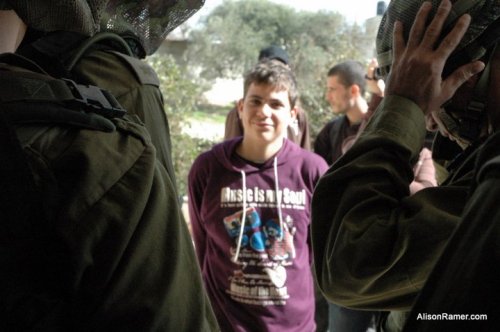
Islam Tamimi was arrested Sunday in Nabi Saleh. Picture Credit: Alison Rammer
Following the arrests of Karim Saleh al-Tamimi and, his brother, Islam, the leader of the Popular Commitee Against The Wall & Settlements in Nabi Saleh, Bassam Tamimi has been arrested, on Wednesday, along with two fifteen year old boys.
Bassam Tamimi was taken from the village, near the West Bank city of Ramallah, at midday on Wednesday, and according to eye witnesses was beaten during his abduction. Tamimi was released an hour later, and confirmed the eye witness report, but the whereabouts of the two fifteen year old children are, as yet, unknown.
Karim al-Tamini, ten years old, was arrested on Tuesday, but was released to his father after seven hours in custody due to the work of an Israeli law firm.
His brother, Islam, fourteen years old, was abducted in a raid on Sunday, and was brought before a court today. Following his abduction, the second in three weeks, Islam was interrogated for eight hours.
He was denied access to legal council for the first five hours, during which he confessed to throwing stones during the weekly protest against the annexation wall, and his parents were denied access to their son during the interrogation; their legal right.
Islam will remain in prison Wednesday night, and will appear in front of the court once more on Thursday.
The village of an-Nabi Saleh joined the call to protest against the building of the annexation wall, the construction of settlements in the Occupied West Bank, and Israel’s military occupation one year ago, following the confiscation of a local spring, Ein al-Kus, by settlers from the nearby Halamish. Since then the village has come under harassment in the form of regular detentions of the villagers, and the violent repression of the Friday protests, including the use of live ammunition.
January 26, 2011
Posted by aletho |
Civil Liberties, Illegal Occupation, Subjugation - Torture |
Leave a comment


 Aletho News
