New Gaza factory, jobs destroyed in Israeli attack
Rami Almeghari, The Electronic Intifada, 10 February 2011
 |
What remains of a plastics factory after it was bombed by Israel earlier this week. (Rami Almeghari) |
“I still cannot believe my eyes as I see the machines of our new factory, scattered to all corners,” said Rabah al-Hatto as he surveyed the rubble of his recently-established plastic water tank factory in northeast Gaza, which was bombed by Israeli warplanes early yesterday. “What have I and the twenty workers here done to find ourselves jobless?” al-Hatto told The Electronic Intifada.
The factory was due to start distributing its products in the local market in two weeks. “I am completely shocked,” the trim-bearded al-Hatto said. “I never imagined that the factory in which I and my partners invested all our money and energy, would become rubble.” As he spoke, al-Hatto was surrounded by workers, friends, reporters and a field worker from a human rights group.
“Yesterday [Tuesday] afternoon, we left the factory to go home. Just before 1am on Wednesday morning I heard Israeli warplanes bombing the area, but I did not imagine it was the factory. Later in the morning, I came to work to find our machines and the ceiling torn apart,” Bashar al-Wehaidi, a technician in the factory, told The Electronic Intifada. “Everything in this 1,200 square meter building was hit.”
Israeli air strikes early Wednesday hit a number of sites in northern Gaza, injuring eight persons, according to medical sources. Three men, three women and two children were hit by debris and shrapnel that struck area homes. The Israeli attacks also destroyed a medical storage building and damaged a school.
Near to where owner Rabah al-Hatto was seated on a chair at his factory site, there was a large truck badly damaged by the Israeli bombing and a heap of aluminum and iron bars on the ground.
“Please look! Please look! A modern truck has been struck before it even traveled the streets of Gaza to distribute our products. Why?” al-Hatto asked. Commenting on Israeli claims that the attack was in retaliation for several rockets fired from Gaza at Israel, al-Hatto said, “Oh my God! What kind of a response is this!”
Now in his early forties, al-Hatto told The Electronic Intifada the story behind his factory. “A year ago, my brother, other partners and I decided to build this factory,” he said. “I used to work as a steelworker, but with the lack of steel due to the Israeli blockade, I decided to invest all my savings in manufacturing plastic water tanks.”
Al-Hatto estimates the losses to him and his partners from the Israeli attack to be $300,000, as well as the incomes for the twenty now jobless workers and their families.
Bashar al-Wehaidi, the now unemployed technician, said that the attack was a complete injustice by Israel. “We have been working tirelessly over the past year in order for this important facility to see the light. May God compensate us such a great loss,” he said.
In the vicinity of the factory, which is located in the al-Qerem neighborhood in the northeast of the Gaza Strip, there are a number of other facilities hit in the Israeli attack. Among them are a large medical storage building, a primary school for 600 students, as well private homes. The school’s ceiling and windows were damaged, forcing the administration to suspend classes until further notice.
According to the Gaza-based health ministry, the al-Qerem medical storage facility was hit by a missile fired from an F-16 fighter jet, causing enormous damage.
“The attack on this store constitutes a flagrant Israeli occupation violation of the Fourth Geneva Convention for the protection of civilian persons in time of war, as well as other relevant world health conventions,” Dr. Munir al-Bursh, chief of Gaza’s medical stores with the Gaza health ministry, told The Electronic Intifada at his office in Gaza City on Wednesday.
The bombed facility is one of nine storage sites run by the Gaza health ministry according to al-Bursh, who estimates the losses from the Israeli attack at $400,000.
“This is a great loss, in light of the four-year-long Israeli blockade,” Dr. al-Bursh said. “Recently we have listed 183 drugs that our stores are lacking as Israel continues to delay deliveries through the crossings into Gaza.”
Israeli army sources said on Wednesday that their latest air strikes on Gaza were in response to five homemade rockets that landed in southern Israel causing no injuries and minor property damage.
Rami Almeghari is a journalist and university lecturer based in the Gaza Strip.
Dismantling Impunity: Campaign to help Palestinian victims of army abuse
9 February 2011 | Popular Struggle Coordination Committee
The Popular Struggle Coordination Committee is proud to announce a new campaign, the “Dismantling Impunity Fund”. This fund will directly challenge Israel’s culture of impunity surrounding the murder and maiming of Palestinians. The fund will be managed by a committee that will include representatives of Popular Committees and Palestinian human rights organizations.
The Abu Rahmah family will be the fund’s first recipient. The family has lost two of their children, Bassem and Jawaher, to Israeli military violence. Both were murdered while nonviolently protesting Israel’s separation wall, built on their village’s land. The family has filed a civil suit in Israeli courts demanding compensation for Bassem Abu Rahmah’s 2009 murder, in which he was shot in the chest from 40 meters with a high-velocity tear gas canister.
The court is demanding 25,000 shekels ($6,700) as a deposit from the Abu Rahmah family. According to a loophole in Israeli law, Palestinians can be considered “foreigners”. This enables the court to demand an upfront deposit large enough to cover the defense’s legal fees, should the prosecution lose the case. If the family does not submit the money, the court will close the case without hearing it.
Through this loophole, Israel has supported its culture of impunity. Palestinians from the occupied Palestinian territories are effectively prohibited from filing civil suits against Israel, the Israeli army or individual soldiers. Financial resources are needed to combat this loophole and enable Palestinians to seek legal redress.
Bassem Abu Rahmah was shot in the chest with the same type of canister that critically injured US citizen Tristan Anderson one month prior. After conducting an extensive investigation into Abu Rahmah’s death, the Israeli human rights group B’Tselem demanded a criminal investigation be launched. B’Tselem’s findings proved that Abu Rahmah was shot in direct violation of open-fire regulations while acting in a nonviolent manner. Despite video footage and expert testimony to corroborate this, no one has yet been punished or even charged with Bassem’s killing. A civil case is now the option left for the Abu Rahmah family to seek legal redress.
Mohammed Khatib, Coordinator, Popular Struggle Coordination Committee: “From our experience with the Israeli legal system, we do not expect justice from the occupier’s courts. But we do know that a court case brings to light things that the occupation would rather keep in the shadows. By suing, victims of Israeli violence would be extracting both a monetary and political price for the crimes that Israel has committed against them. It is essential to challenge the prevailing culture of impunity, in which Israeli soldiers and settlers murder and maim Palestinians while going unpunished and unquestioned.”
Donate Electronically to the “Dismantling Impunity Fund” by following the link and checking the “Dismantling Impunity Fund” box.
Donate by check: Write checks to “Alliance for Global Justice”, with “CfJS-Dismantling Impunity Fund” in the memo line. Mail checks to:
Alliance for Global Justice
1247 “E” Street,SE
Washington, DC 20003
Israel bombs medical aid warehouse in Gaza
MEMO – February 9, 2011
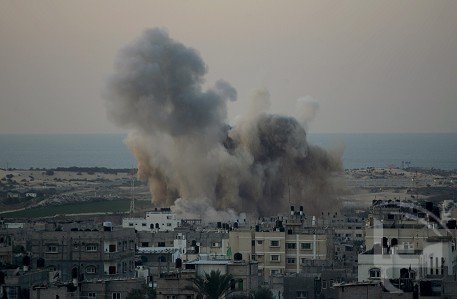
Israeli aircraft carried out a number of air raids on the Gaza Strip early on Wednesday 9 February, destroying a medical aid warehouse in Gaza City. The raids began shortly after midnight, hitting several places across the Strip, from Jabaliya in the north to the Rafah border with Egypt in the south.
Fires raged through the early hours of the morning as fire-fighters and volunteers tried to salvage medical supplies and aid. The carpenter’s workshop adjacent to the warehouse was also affected by the bombing.
The press spokesperson for the Emergency Services, Abu Adham, said that eight civilians were injured by the Israeli bombs, including two children and three women. The casualties were taken to the Kamal Adwan Hospital in northern Gaza. Abu Adham pointed out that there is already an acute shortage of medicines and medical supplies in the Gaza Strip due to the ongoing Israeli blockade of the territory. In his assessment, the airstrike targeted the medical warehouse in an attempt to subdue further the civilian population. Israeli F-16 fighter-bomber aircraft also fired two missiles in an empty landfill south-east of Gaza City; no casualties were reported. Two men were injured in the south of the Gaza Strip.
Photo credit – Ma’an Images
Prices soar in Gaza as Rafah, tunnels close
IRIN | 7 February 2011
GAZA – More than a week of political unrest in Egypt has heightened the threat of a humanitarian crisis in neighbouring Gaza. Egyptian soldiers fled their posts on the northern border on 30 January, forcing the Rafah crossing – a critical valve for the 1.5 million Palestinians living in Gaza – to close.
Around 60 Palestinians, attempting to return home via Cairo when Gaza’s southern border closed, are still being held in the “deportation room” at Cairo airport. Among them are six children and several critically ill patients who are running out of medication.
“The children don’t know what’s happening. Sometimes they’re crying. It’s very, very cold here; it’s crowded and there is nowhere for us to wash,” one of those being detained, who asked not to be named, told IRIN on 30 January.
Israel destroyed Gaza’s airport during the second Intifada in 2002, and Gazans have few alternatives but to transit through Cairo airport, via Rafah. Since the militant group Hamas took control in 2007, Gazans need special security clearance to enter Egypt. Those with permits to travel abroad are taken directly to Cairo airport by bus where they are held until their flight departs. On the return leg they are held at the airport until they can be taken to the Rafah crossing.
Tunnels close
Israel’s blockade of the region means Gaza depends heavily on goods smuggled through tunnels from Egypt – particularly fuel, cooking gas and building materials – but the ongoing instability in Egypt has caused these tunnels to close, severing a vital supply line.
“The problem is getting fuel to the border inside Egypt. There are no military forces on the Egyptian side of the border, so smugglers are getting hijacked on the road from Cairo and all their stuff stolen. It’s very dangerous for them,” said taxi driver Farid Abdul El Rahman, who is running his car on the last of his Egyptian diesel.
“There is nothing coming through the tunnels now – I think the problem is only going to get worse,” he said. Petrol has now run out entirely and the only fuel available is the limited amount coming from Israel at treble the price.
A fuel shortage in Gaza would not only mean no cars, but also no electricity. The blockade and severe damage to power stations during the 2009 conflict resulted in a chronic power shortage with up to six hours of electricity cuts every day. Gaza’s homes and businesses rely on fuel-powered generators.
“I have to stock up like everyone else, as we have no idea when there will be petrol here again,” said a senior judge, who asked not to be named because of his position, queuing with hundreds of people at one of the few petrol stations in Gaza City that still had fuel.
Hospitals affected
The major hospitals have stockpiles of fuel to power their generators, but the biggest, Shifa Hospital in Gaza City, has less than a week’s supply in reserve. If the tunnels remain closed much longer, the situation will become critical.
Mohamed Abu Rahman, a senior nurse in the intensive care unit, said he was very concerned about the border closure. “This unit, especially, is entirely dependent on electricity. If there’s a power cut we have to operate the ventilators manually before the generator kicks in,” he told IRIN.
“There are power cuts here for four hours every day. It will be impossible to keep people alive without our generators – the monitors, the ventilators, everything – will be gone.”
For some the situation is life threatening. Gaza suffers acute shortages of crucial medical equipment and medicines, which means many people, often those with serious conditions like cancer, must be referred abroad for treatment.
Every month around 500 Gazan patients are referred to Egypt. Bassam Abu Hamad, a senior health consultant in Gaza, warned that closure of the Rafah crossing was putting lives at risk:
“People in need of radiotherapy, and advanced surgery in particular, are simply unable to get treatment,” he said. “While Rafah is closed, we will see increased loss of life here in Gaza.”
Price hikes
The prices of many consumer goods have rocketed since the tunnels closed. Cigarettes have gone up 25 percent, but the cost of vital building materials has doubled.
Much of Gaza is still in ruins after Israel’s last invasion in 2009, which left 60,000 buildings damaged and more than 4,000 destroyed.
Israel’s ban on importing cement, steel and gravel through its border posts means that any construction in Gaza has to rely on materials smuggled through the tunnels.
“Since the problems started in Egypt, the prices of cement and gravel have doubled – one ton of cement cost 520 new Israeli shekels [NIS – US$140] last week. Today, I bought a ton for 1,100 NIS [$296],” said Ashraf Al Aloul, a driver for an international NGO, one of thousands of Gazans in the process of building a home.
“Nobody here can afford to buy material at this price. I think all building work will stop while people wait to see what’s going on.”
Egyptian Police shoot protesters with live ammunition
Al-Masry Al-Youm – 08/02/2011
Police forces on Tuesday used live ammunition to shoot protesters in Wadi Gedid Governorate, south west of Cairo. The protesters had voiced objections to reinstating an officer whom they described as “authoritative.”
Eye-witnesses said 61 people were injured in clashes with security forces in the province’s capital, Kharga.
The citizens rejected the return of Captain Ahmed al-Sokkary, whom authorities had removed from service during the first days of nationwide protests calling on President Hosni Mubarak to resign.
Eyewitnesses said police employed tear gas, live ammunition, and rubber bullets to quell protesters who assembled in front of the police station, hurling stones and water bottles at security forces.
A medical source said that some citizens volunteered to carry the protesters to Kharga hospital, while others were taken to the main hospital at the neighboring governorate of Assiut.
Other witnesses said plainclothes security agents attacked demonstrators, in a scene that recalled similar clashes in Egypt during recent protests over the past two weeks.
The circles in the sky over Gaza
By Yasmeen El Khoudary writing from the occupied Gaza Strip, Live from Palestine, 7 February 2011

The sky over Gaza City, 21 January 2011. (Yasmeen El Khoudary)
People keep talking of a new war. They tell you about their neighbors — they’re probably too shy to admit that its their family, not their neighbors — who already started stocking up on food items and candles in preparation for the upcoming war. “People are really scared,” they tell you, using “people” instead of “we.” Everyone — groundless news reports and loud rumors — is saying that they can hear the war drums, can’t you?!
Well, to me war has already started, and Israel is already chanting victory, given the very conversation the two of us are having. About two weeks ago I saw what looked to me like a confused Israeli pilot flying around in his F-16 jet, drawing circles in the sky. People immediately took it as a sign, a threat and a signal that war was coming. They even made up memories from back in 2008, and were convinced that on 27 December 2008, an Israeli jet, possibly even the same one, drew the same circles in the sky, and that was when war started.
Well, congratulations Israel for winning the psychological war on Gaza. No, you don’t find it enough that you are honored to be the only power on the planet that finds purpose in physically besieging a whole population, but you also want to drive them mad. Only when people started to heave a sigh of relief and take baby steps towards recovering from the 2008-09 war do you start disseminating rumors about a new war. What a fool you are, even if you think you’re winning!
Sure, some people actually believe your rumors and have already started buying supplies in preparation for the “eventual” war and shortage in all kinds of supplies, from baby formula to medicine. But have you heard of a single family that prepared itself for leaving Gaza? That question sounds absurd to you, doesn’t it? How can anyone question the possibility of running away in times of fear? In your traditions, you build and hide in safe shelters, prepare mass evacuation plans for your citizens and buy tons of gas masks as soon as you anticipate the launching of even the smallest rocket. In our traditions, people only buy candles to light their homes and flour to bake bread while you flatten their cities to the ground with your merciless army. They seek no safe havens nor are they provided with any kind of protection against gas, let alone phosphorous bombs. They seek protection from God and in their unity and their love, as they find war a good time for families, or whoever remains amongst them, to gather and share love and warmth.
You know, Israel, you remind me of the scientist and the frog. You — in this case the scientist — order the frog to jump, and it obeys. You cut off its arms, order it to jump, then it struggles to jump. You cut off its legs, order it to jump but it doesn’t jump. You then proudly announce your discovery: when a frog is limbless, it becomes deaf, and so it cannot jump. Yes, deafness caused the frog to lose that physical skill, not the fact that you amputated its four limbs. Is that not what you are trying to do to the Palestinians every single day? You have been slowly cutting off our limbs for the past sixty years, one by one. You have been forcing us into getting used to a life with one missing limb, two missing limbs, three missing limbs, and now four missing limbs slowly as the years go by. You run your experiments on us and show the world that we can still jump. When you cut off that last limb, however, you claim that we were unable to jump because we suddenly turned deaf. In real world terms, that translates into you blaming us for the misery that shapes our every day life, and take your occupation, your wars, your siege and your merciless acts out of the equation.
We might be accustomed to a limbless life, but that doesn’t mean that we lost our ability to jump. We will crawl on the floor and catch our own food. You will always be the oppressor, rather the foolish oppressor with false scientific theories, at least in this case. Living a limbless life means that we will continue to live any kind of life as long as we live it in our country, where we legitimately belong. Israel, when you cut off our limbs, we lose our ability to jump because you cut off our limbs, not because we turned deaf. However, we would indeed turn a deaf ear to your threats and your illogical claims; because frankly, nothing you say or do will succeed in making us even think of leaving this place. Some of us might see the circles in the sky as a sign of war, others might see it as a barbed wire fence stating that even the sky has a limit. To the frog, however, the circles in the sky are reason to keep its head high towards the sun, regardless of the missing limbs.
Yasmeen El Khoudary is a freelance writer and researcher based in Gaza City, Palestine. Her blog is yelkhoudary.blogspot.com.
UN Rebukes Israel’s destruction of Palestinian Water Cisterns
Palestine Monitor | 3 February 2011
The United Nations Resident and Humanitarian Coordinator for the Occupied Palestinian Territories, Mr. Maxwell Gaylard, has publically denounced Israel’s systematic destruction of rainwater collection devices, such as water cisterns, throughout the West Bank.
Mr. Gaylard remarked on 1 February 2011, “It is difficult to understand the reasoning behind the destruction of basic rain water collection systems, some of them very old, which serve marginalized rural and herder Palestinian communities where water is already scarce and where drought is an ever-present threat.”
The United Nations Office for the Coordination of Humanitarian Affairs (OCHA) documented that in 2010 Israel demolished 27 water cisterns and other rainwater collection systems in the West Bank. Moreover, OCHA recorded that 15 water springs that connect to the Mountain Aquifer, the sole source of water available to Palestinians in the West Bank, were also destroyed. Israel takes more than 80 percent of water collected by the Aquifer, leaving Palestinians with less than 20 percent.
Communities throughout the West Bank have come to rely on such basic water collection mechanisms, such as holes in the ground, due to the economic unsustainability of tankered water.
Human rights organizations, such as Amnesty International, have documented the untenable nature of water tankers, as they are forced to take circuitous routes to avoid military checkpoints and Israeli only roads that fragment the West Bank. These detours have resulted in steep increase in the prices of water.
Palestinian residents of the West Bank are required to acquire a permit for any structure in Area C, including water cisterns and holes. Permits are nearly impossible to obtain.
Despite these stringent permit criteria, the Alternative Information Center points out that destruction of water infrastructure is in violation of an Israeli-Palestinian joint agreement from 2001, the “Joint Declaration for Keeping the Water Infrastructure out of the Cycle of Violence.”
The joint declaration states, “The Israeli and Palestinian sides view the water and waste water sphere as a most important matter and strongly oppose any damage to water and wastewater infrastructure.”
According to Dr. Shaddad Attili, the Minister of the Palestinian Water Authority, water cisterns do not require a permit from the Israeli Civil Administration. Nevertheless, the Government of Israel has increased demolitions of cisterns.
“In addition to preventing the rehabilitation of Palestinian water cisterns, particularly in Area C, the Government of Israel has recently intensified its campaign of destroying these same cisterns. The rehabilitation of water cisterns does not require prior approval from the Joint Water Committee (JWC), nor does it require a construction permit from the Israeli Civil Administration,” Dr. Attili stated on 31 January.
Mubarak’s Last Gambit – Manufacturing Chaos
By Ahmed Amr | Media Monitors | February 3, 2011
There is a joke making the rounds in Egypt that Hosni Mubarak threatened to demonstrate in front of parliament and self-emulate himself if the Egyptian people refuse to step down and join the deposed Tunisian leader in Exile.
The octogenarian dictator is simply delusional if thinks he can hold onto power. By my estimates, he’ll be gone in a week or two – hopefully sooner. But before he gives up his throne, he means to dole out a severe dose of punishment to the 80 million ‘ingrates’ who have delegitimized his corruption infested regime.
Mubarak is a desperate and stubborn man. The disbanding of the police last Friday was a calculated attempt to manufacture chaos and terrorize the populace. It was supposed to be the perfect state crime. The police suddenly vanished abandoning even the prisons which are administered by the Ministry of Interior. With the gates thrown wide open, the criminal elements were let loose as the state controlled media started spreading false rumors of hysterical citizens being attacked in their homes. The crooks were joined by some members of the police force that were ‘on vacation.’ They obviously weren’t idiots. Instead of using the security void to attack apartments and homes, they targeted the national museum, upscale retailers, the gold market and malls.
Unfortunately for Mubarak, the Egyptian people disrupted the regime’s plan. All around the country, alert citizens immediately took control of security in their neighborhoods and within a few hours of the mysterious and still unexplained disappearance of the police, young men and old banded together to protect their families and their property. Defense committees were set up on virtually every block. It was a splendid show of community values and extremely effective. Put it this way – this was a bad week to be a burglar in Cairo.
The regime has yet to explain who gave the orders for the police to abandon their stations. When the plot fizzled, Mubarak fired Habib Adley, the interior minister and blamed the chaos on “foreign elements” – no doubt the diabolical Maltese Intelligence Agency working in coordination with Taiwanese drug cartels.
The objective of the government’s plot to foment chaos was to compel Egyptians to hide in their homes while “Daddy Mubarak” came to the rescue. The ensuing disorder was a great excuse to impose a curfew to disband the demonstrators in Tahrir Square and dissuade others from joining them. Mubarak and his henchmen might be creative but their attempt to spread panic was not exactly original. That’s pretty much what the American Army did when they invaded Iraq – they ordered the army and police to disband and unlocked the penitentiary gates.
A few days later millions of Egyptians ignored the curfew and took to the streets demanding that Mubarak step down. In Cairo alone, the crowd was estimated at a million plus and hundreds of thousands marched in Alexandria. Not a single policeman was there to ‘protect’ the peaceful demonstrators and there wasn’t a single casualty – not even a broken bottle. Demonstrators mingled freely with the army and even picked up the garbage. They had one basic demand – the immediate retirement of Hosni Mubarak.
But Mubarak wasn’t about to give up so easily. The next morning, ‘patriots’ from the disbanded police force, party loyalists and hired thugs started their own ‘demonstration’ and made their way to Tahrir square armed with clubs. They could have held a peaceful protest at some other location but they were hell bent on a violent confrontation. These ‘Hosnicrats’ were more or less the same elements that had intimidated voters and opposition candidates in the recent rigged parliamentary elections. Ominously, the Egyptian Army, which has so far played a neutral role, didn’t prevent Mubarak’s thugs from attacking the very same peaceful marchers that a day earlier had demonstrated that a million Egyptians could assemble and protest without throwing a single stone.
The night before, rumors of an organized attack by Mubarak’s mercenaries had circulated among the demonstrators camped out in Tahrir Square. Many decided to leave but those who stayed were determined not to be provoked. What followed was proof that the attacks in Tahrir Square were just another part of Mubarak’s plot to orchestrate chaos. The Army issued orders for both sides to clear the square and go home and refused to intervene to protect the anti-Mubarak protestors. As of this writing, dawn on Thursday, the Mubarak loyalists had started firing live ammo into the crowd. So far, eight demonstrators have been murdered and many more are wounded.
Mubarak despises his people more than they despise him. All he wants now is for his regime to survive and to restore a measure of ‘legitimacy’ and ‘stability’ – just enough to give his American patrons a fig leaf to allow Obama to turn a blind eye to what’s going down in Egypt. He now says he will step down at the end of his term and he promises to use his remaining time in office facilitating an orderly transition. The obvious danger is that he will also use the balance of his tenure to beef up his internal security apparatus, crack down on the opposition and roll out a red carpet for his party and his cronies to allow them to retain control by the time he leaves office.
At the very minimum, most Egyptians had expected Mubarak to make a conciliatory gesture and disband the National Assembly. Anyone who paid cursory attention to the last elections knows they were blatantly rigged; the National Democratic Party won something like 97% of the vote and virtually every seat in the chamber. The architects of the electoral fraud were absolutely shameless. The election was a farce and Mubarak and his cronies publicly flaunted their ability to fix the vote. There again, Mubarak didn’t care what Egyptians thought and neither did the Americans.
It takes a strong dose of repression and injustice to rile up a nation that abides by the law even when the laws are unjustly administered. If there is one thing all Egyptians fear more than a tyrant, it is chaos. And that’s precisely why Mubarak and his cronies are so determined to manufacture as much chaos as possible. The octogenarian dictator needs to be sent packing to Saudi Arabia before he causes more damage.
Featured Video

New positive ivermectin evidence
or go to
Aletho News Archives – Video-Images
From the Archives
Fanatical Followers of the Covid Regime: A Jim Jones-Style Cult?
By Professor Roger Watson and Dr. Niall McCrae | The Daily Sceptic | November 15, 2021
As scholars at leading British universities over recent decades, we witnessed the replacement of critical thinking and debate by narrative: facts are discrimination and scientific method is imperialism; truth, instead, is derived from ‘progressive’ values. This educational trend may be a major contributory factor to the ease in which society has been inculcated to the Covid ‘new normal’ of masking, testing, and repeated doses of vaccines for a disease of similar risk to severe influenza.
One doesn’t need much critical reasoning to observe the flawed logic of some vaccination enthusiasts, such as people who respond to experiencing any side effects, however debilitating, by saying “at least I know it’s working”, or, after contracting the disease despite their promised inoculation (over 90% effective, according to initial drug company claims), “I’d have been worse off without the jab.” … continue
Blog Roll
 Aletho News
- EU Council Advances Chat Control 2.0 Scanning Proposal
- Ex-Greek MEP files complaint against Israeli spyware firm over alleged Pegasus surveillance
- Troubling ideas throughout the Torah, Talmud, Mishneh Torah and Tanya
- ‘Grave, alarming’: Iran mission on Trump’s UNGA ‘annihilation’ threats
- Najaf airport to reopen to Iranian flights within 24 hours: Ambassador
- From ‘How Will This End For Iran’ to ‘When America Walks Away’: A tale of two Economist covers
- Tehran blasts ‘baseless’ speculation linking Iran to alleged bomb plot at UK air base
- The Rise And… Rise Of ‘Color Revolutions’
- The Coming GOP Bloodbath?
- Arctic Scare Stories Melt Away
- If Americans Knew
- Netanyahu Asked UAE Leader to Deny Report on Oct. 7 Warning in Secret Visit, Sources Say
- CNN Chief Int’l Correspondent Clarissa Ward on Journalists in Gaza
- Democratic Party Consultants Surround Troy Jackson with Pro-Israel Donors
- Christian Leader Responds To Netanyahu’s Claims Regarding Palestinian Christians
- In Gaza, ‘Whoever Survives the Bombing Won’t Survive the Rubble’
- Israel kills more Palestinians, amid push to resettle Gaza – Daily Update
- Israel forces Gazans to live in constant peril – Daily Update
- Deconstructing Netanyahu’s pants-on-fire UN rant – Daily Update
- Trump betrayed voters with his campaign lies and prioritized a foreign country once he took office
- Netanyahu calls Israel’s war in Gaza ‘opposite of genocide’ in UN speech to near-empty hall
- No Tricks Zone
- New Study: Earth And Venus Surface Warmth Largely Explained By Convection And Lapse Rate, Not CO2 Or Radiation
- 2025 Nature Paper Claiming Worsening Global Drought Gets RETRACTED …Heavily Flawed
- New Study: ‘Global Drought Shows No Detectable Recent Acceleration Under Climate Warming’
- Economic Masterminds: German Socialists Suggest Taxing Productivity Gains Stemming From Using AI
- The South China Sea Has Not Been Cooperating With The Climate Change Narrative
- Energy Crisis: Germany Enters Heating Season With Historically Low Gas Reserve Fill Levels
- New Study: The Antarctic Ice Sheet Gained Mass From 2020-2024 Due To Staggering Snow And Ice Accumulation
- Study: Ocean Heating Rates From Thousands Of Years Ago ‘Dwarf’ Modern Ocean Heating Rates
- Climate Extremists Target, Attack Large-Scale Power Grid Infrastructure In Germany!
- New Study: Antarctic Ice Melt Has Contributed Less Than 1 Centimeter To Sea Level Rise In The Last 30 Years

