Obama’s Show Trials
Why prosecute a terrorism suspect if life imprisonment is the only possible outcome?
Jacob Sullum from the January 2011 issue of Reason
In October a federal judge threw out a key witness against Ahmed Khalfan Ghailani, the former Guantanamo inmate who is accused of participating in the 1998 bombings of the U.S. embassies in Kenya and Tanzania. The witness, who was identified through Ghailani’s coerced statements, was supposed to testify that he sold the defendant the TNT used to blow up the embassy in Tanzania. But U.S. District Judge Lewis A. Kaplan concluded that the testimony was too closely tied to information the CIA had obtained from Ghailani while holding him at a secret prison where he says he was tortured.
Conservatives who think terrorism suspects should never receive civilian trials said the exclusion of this testimony showed they were right. So did civil libertarians who argue that the federal courts are perfectly capable of handling terrorism cases. But whether or not the system is working, Kaplan’s ruling suggested it is ultimately irrelevant.
“It is appropriate to emphasize,” Kaplan wrote, “that Ghailani remains subject to trial on the pending indictment, that he faces the possibility of life imprisonment if convicted, and that his status as an ‘enemy combatant’ probably would permit his detention as something akin to a prisoner of war until hostilities between the United States and Al Qaeda and the Taliban end even if he were found not guilty in this case.” Barring a formal surrender by Al Qaeda, these “hostilities” will continue indefinitely, so detention for their duration amounts to a life sentence—the same punishment Ghailani is apt to receive if he is found guilty.
If Ghailani is convicted, in other words, he will be imprisoned for life, and the same thing will happen if he is acquitted. Even with the benefit of the Fifth Amendment’s ban on coerced self-incrimination and the exclusionary rule, Ghailani has zero chance of regaining his freedom. So what exactly is the point of the trial?
In a New York Times op-ed piece published after Kaplan’s ruling, Harvard law professor Jack Goldsmith, an assistant attorney general during the Bush administration, noted that “trials are perceived to be more legitimate than detention.” But Goldsmith, who favors military detention of suspected terrorists, added that “a conviction in a trial publicly guaranteed not to result in the defendant’s release will not be seen as a beacon of legitimacy.”
Asked whether Ghailani will be returned to military custody if his trial does not turn out the way the government wants, Attorney General Eric Holder dodged the question, saying, “We intend to proceed with this trial.” Holder’s coyness was not really necessary, because the administration already has publicly stated that it reserves the right to detain terrorism suspects who are acquitted.
“If you have the authority under the laws of war to detain someone,” Pentagon General Counsel Jeh Johnson told the Senate Armed Services Committee in July 2009, “it is true irrespective of what happens on the prosecution side.…If there’s an acquittal…we would have the ability to detain him.”
One reason for nevertheless going through the motions of a trial, Goldsmith suggested, is the possibility of capital punishment. But the Justice Department is not seeking the death penalty in Ghailani’s case, and in any event President Barack Obama claims he can kill suspected terrorists without permission from a court.
Under his policy of “targeted killings,” Obama can authorize the summary execution of anyone he unilaterally identifies as a member or accomplice of Al Qaeda, including American citizens. Since this administration, like the last one, views the entire world as a battlefield in the war on terrorism, that means enemies of the state can be killed anywhere at any time—except, presumably, if they have been taken into custody and are being prosecuted in federal court.
Which suggests a third option for Ghailani, in addition to life imprisonment upon conviction and indefinite detention upon acquittal. The government could simply let him go—and then kill him.
Senior Editor Jacob Sullum (jsullum@reason.com) is a nationally syndicated columnist.
Israel’s War on Children
1,500 Arrested in a Year
By JONATHAN COOK | CounterPunch | December 13, 2010
Israeli police have been criticised over their treatment of hundreds of Palestinian children, some as young as seven, arrested and interrogated on suspicion of stone-throwing in East Jerusalem.
In the past year, criminal investigations have been opened against more than 1,200 Palestinian minors in Jerusalem on stone-throwing charges, according to police statistics gathered by the Association of Civil Rights in Israel (ACRI). That was nearly twice the number of children arrested last year in the much larger Palestinian territory of the West Bank.
Most of the arrests have occurred in the Silwan district, close to Jerusalem’s Old City, where 350 extremist Jewish settlers have set up several heavily guarded illegal enclaves among 50,000 Palestinian residents.
Late last month, in a sign of growing anger at the arrests, a large crowd in Silwan was reported to have prevented police from arresting Adam Rishek, a seven-year-old accused of stone-throwing. His parents later filed a complaint claiming he had been beaten by the officers.
Tensions between residents and settlers have been rising steadily since the Jerusalem municipality unveiled a plan in February to demolish dozens of Palestinian homes in the Bustan neighbourhood to expand a Biblically-themed archeological park run by Elad, a settler organisation.
The plan is currently on hold following US pressure on Benjamin Netanyahu, the Israeli prime minister.
Fakhri Abu Diab, a local community leader, warned that the regular clashes between Silwan’s youths and the settlers, termed a “stone intifada” by some, could trigger a full-blown Palestinian uprising.
“Our children are being sacrificed for the sake of the settlers’ goal to take over our community,” he said.
In a recent report, entitled Unsafe Space, ACRI concluded that, in the purge on stone-throwing, the police were riding roughshod over children’s legal rights and leaving many minors with profound emotional traumas.
Testimonies collected by the rights groups reveal a pattern of children being arrested in late-night raids, handcuffed and interrogated for hours without either a parent or lawyer being present. In many cases, the children have reported physical violence or threats.
Last month 60 Israeli childcare and legal experts, including Yehudit Karp, a former deputy attorney-general, wrote to Mr Netanyahu condemning the police behaviour.
“Particularly troubling,” they wrote, “are testimonies of children under the age of 12, the minimal age set by the law for criminal liability, who were taken in for questioning, and who were not spared rough and abusive interrogation.”
Unlike in the West Bank, which is governed by military law, children in East Jerusalem suspected of stone-throwing are supposed to be dealt with according to Israeli criminal law.
Israel annexed East Jerusalem following the Six-Day war of 1967, in violation of international law, and its 250,000 Palestinian inhabitants are treated as permanent Israeli residents.
Minors, defined as anyone under 18, should be questioned by specially trained officers and only during daylight hours. The children must be able to consult with a lawyer and a parent should be present.
Ronit Sela, a spokeswoman for the Association of Civil Rights in Israel (ACRI), said her organisation had been “shocked” at the large number of children arrested in East Jerusalem in recent months, often by units of undercover policemen.
“We have heard many testimonies from children who describe terrifying experiences of violence during both their arrest and their later interrogation.”
Muslim, 10, lives in the Bustan neighbourhood and in a house that Israeli authorities have ordered demolished. His case was included in the ACRI report, and in an interview he said he had been arrested four times this year, even though he was under the age of criminal responsibility. On the last occasion, in October, he was grabbed from the street by three plain-clothes policemen who jumped out a van.
“One of the men grabbed me from behind and started choking me. The second grabbed my shirt and tore it from the back, and the third twisted my hands behind my back and tied them with plastic cords. ‘Who threw stones?’ one of them asked me. ‘I don’t know,’ I said. He started hitting me on the head and I shouted in pain.”
Muslim was taken into custody and released six hours later. A local doctor reported that the boy had bleeding wounds to his knees and swelling on several parts of his body.
Muslim’s father, who has two sons in prison, said the boy was waking with nightmares and could no longer concentrate on his school studies. “He has been devastated by this.”
Ms Sela said arrests had risen sharply in Silwan since September, when a private security guard at a settler compound shot dead a Palestinian man, Samer Sirhan, and injured two others.
Clashes between the settlers and Silwan youths came to prominence in October when David Beeri, director of settler organisation Elad, was shown on camera driving into two boys as they threw stones at his car.
One, Amran Mansour, 12, who was thrown over the bonnet of Mr Beeri’s car, was arrested shortly afterwards in a late-night raid on his family’s home.
Also in October, nine rightwing Israeli MPs complained after stones were thrown at their minibus as they paid a solidarity visit to Beit Yonatan, a large settler-controlled house in Silwan. Israel’s courts have ordered that the house be demolished, but Jerusalem’s mayor, Nir Barkat, has refused to enforce the order.
In the wake of the attack, Yitzhak Aharonovitch, the public security minister, warned: “We will stop the stone-throwing through the use of covert and overt force, and bring back quiet.”
Last month police announced that house arrests would be used against children more regularly and financial penalties of up to $1,400 would be imposed on parents.
B’Tselem, an Israeli human rights group, reported the case of “A.S.”, a 12-year-old taken for interrogation following an arrest at 3am.
“I sat on my knees facing the wall. Every time I moved, a man in civilian clothes hit me with his hand on my neck … The man asked me to prostrate myself on the floor and ask his forgiveness, but I refused and told him that I do not bow to anyone but Allah. All the while, I felt intense pain in my feet and legs. I felt intense fear and I started shaking.”
In a statement B’Tselem said: “It is hard to believe that the security forces would have acted similarly against Jewish minors.”
Micky Rosenfeld, a police spokesman, denied that the police had violated the children’s rights. He added: “It is the responsibility of parents to stop this criminal behaviour by their children.”
Jawad Siyam, a local community activist in Silwan, said the goal of the arrests and the increased settler activity was to “make life unbearable and push us out of the area”.
The 60 experts who wrote to Mr Netanyahu warned that the children’s abuse led to “post-traumatic stress disorders, such as nightmares, insomnia, bed-wetting, and constant fear of policemen and soldiers”. They also noted that children under extended house arrest were being denied the right to schooling.
Last year the United Nations Committee Against Torture expressed “deep concern” at Israel’s treatment of Palestinian minors, saying Israel was breaking the UN Convention on the Rights of Children, which it has signed.
Over the past 12 months, Defence for Children International has provided the UN with details of more than 100 children who claim they were physically or psychologically abused while in military custody.
Jonathan Cook is a writer and journalist based in Nazareth, Israel. His website is www.jkcook.net.
British parliament debates Palestinian children prisoners
By Renee Bowyer | Middle East Monitor | 12 December 2010
I visited the family of a twelve year old boy arrested on a Sunday morning. They lived in a small room on the outskirts of Balata refugee camp bordering the city of Nablus. The mother of Salim spoke to me first reminding me how the last time I had visited her, her son Salim had been there. Of course I remembered; he’d greatly enjoyed trying out his few English words with me and had very excitedly told me how he and his mother had been to Ramallah the week before. It was Sunday evening and as I sat with Um Salim she recounted to me how she had woken in the night as Balata camp was invaded. She listened to the sound of tanks and jeeps, of sound bombs detonating at random. But then Um Salim told me how the night-terror became her terror when her front door was pushed in and soldiers were everywhere. They were calling for Salim and Um Salim began to sob as she explained to me how a mother’s worst nightmare began.
Salim was twelve years old but in many ways he was older than his years. He had witnessed an uncle shot and killed by invading Israeli forces and he had not seen his father, a prisoner, for eight years. But this night Salim became the child again. When his name was shouted out Salim in terror rushed behind his mother and fell on the ground. He held the skirt of his mother and cried up to her ‘Mama; save me’. Um Salim told me how her son was ripped out of her arms as he cried for her to protect him. She was pushed to the ground and Salim was dragged from the house.
Six months later I visited Um Salim again. She had not seen Salim since the night he had been dragged from her arms. She still had no idea why he was taken, for how long he would be held or even when there would be a court hearing for him. She said she had learnt to live without him but would never learn to forget the words he had cried out to her when the soldiers had pushed in their door: ‘Mama; save me’. Um Salim looked at me and said ‘I couldn’t protect him. I couldn’t protect my son.’
Last week in Britain; a far cry from the poverty-stricken streets of Balata refugee camp and the occupied territories of the West Bank; Sandra Osborne, MP for Ayr, Carrick and Cumnock, secured a debate on the detention of Palestinian children by Israel in the British Parliament. Having worked with Addameer in the West Bank, (a Prisoners’ Support and Human Rights Association mentioned by Ms Osborne in her presentation) I can appreciate in full the horrifying account Ms Osborne gave of the plight of Palestinian children prisoners. Details of Hebrew confessions signed by children under physical or emotional torture, of solitary confinement, of beatings and threats and months without seeing or hearing from family are all realities that thousands of Palestinian children are facing now. One can only imagine the horror of families whose children have been taken and are being subject to these violations. While working with Addameer I spoke to mother after mother whose child had been imprisoned and every one of them spoke of the constant fear gripping their hearts knowing their child was unprotected in a hostile and violent place and how they knew that no law was governing the treatment of their child.
The taking of Palestinian children by Israeli forces and the terrorizing of them seems to be a calculated policy of Israel in their attempt to destroy the very fabric of Palestinian life. The Occupation of Palestine is much more than a military exercise and as constantly cited by Israeli officials ‘a necessary step to insure Israeli security’. Every aspect of the occupation, from the invasions and assassinations to the humiliating abuses of the soldiers standing at checkpoints is geared towards making Palestinian life unbearable. The strategically placed settlements and the free-reign given to settlers to attack, kill and steal land from the Palestinians, the invasions of villages and the constant curfews imposed on them, the house searches and indiscriminate shooting, the verbal inanities shouted at women and children by soldiers in roaming army jeeps are all focused on grinding down the will to survive and resist that the Palestinian people show.
I cannot recall how many times I asked the question ‘why are you doing this?’ When I was living in the Occupied Territories; watching some ridiculous flying checkpoint being set up on some small mountain path and three or four teenage soldiers smoking and forcing old women to empty their shopping bags on to the dusty road. ‘Why are you doing this?’ as I watched a tank roaming through a village and stopping in front of the village high school for boys and some sun-glassed soldier throwing a sound bomb over the wall. Acts that have no meaning to them except to terrorize and humiliate and make the lives of the Palestinian people harder than they already are.
‘It’s the Wild West’ an anonymous soldier states in Breaking the Silence; ‘serving in the West Bank is like being in the Wild West’.
And this is because the Israeli government has a goal beyond taking land; it seems increasingly obvious that the real agenda of the Israeli government is to ‘cleanse’ the land of Palestinians and the first step to do this is to make the Palestinian people stop resisting; not just with arms but in every other way. There is too much life still being lived under occupation; there is too much will to survive this occupation and siege. There are still festivals and marriages being celebrated in ruined houses alongside the burying of the dead; there are still lessons being taught to children in schools that have been bombed to rubble; there is still music in Palestine. And this is what Israel fears.
There are plenty of times when the reality of life under occupation and siege yields a sense of despair and helplessness among the people of Palestine, but it doesn’t stay; only in the cases of the mothers of child prisoners does it stay. There was a look of desperation and despondency on the face of Um Salim when she told me how Salim had cried to her to protect him that I had not seen before, and when I visited her months later and she had still not heard from her son that look was still there; etched now on her face.
By stealing the children of Palestine and trapping them inside a prison where they have no contact with family, Israel is attempting to systematically destroy the future of Palestine. They are breeding despondency inside Palestine that even invasions and killings did not produce. If this is not Israel’s aim, why else would they go to such lengths to violate every law set in place to protect children from this kind of soul-destroying treatment?
Ms Osborne last week made a plea to the British government to intervene because she was horrified by what she had witnessed in a military court hearing of Palestinian children. (And surely what she witnessed was a toned down version of what normally happens). The plea Ms Osborne made was supported by extensive detail and factual information and clearly exposed the policy of Israel in respect to Palestinian child prisoners and how it seems that the policy of Israel encourages these violations.
The Under-Secretary of State for Foreign and Commonwealth Affairs, Alistair Burt, responded to Ms Osborne in the sort of way that western governments are responding to Israeli violations every time they come to prominence: by stating that Israel may have gone too far in some respects but that their security issues necessitate certain actions and that Israel continues to have the full support of these governments. Alistair Burt agreed to raise the issue with Israel and to write to the members of Parliament who had attended the debate. And that is all.
A letter in a month or two explaining that the issue has been raised with Israel?
While Um Salim waits to hear what prison her twelve year old son has been dragged to, while another mother and another are woken in the night to the sound of their child’s name being shouted by soldiers who batter down their doors, and while children shiver alone in prison cells, are forced to sign confessions of guilt in Hebrew and are beaten and shackled; our Under-Secretary of State for Foreign and Commonwealth Affairs will raise the issue with Israel.
On the 21st November this year two Israeli soldiers were given suspended sentences and demoted for using a Palestinian child as a human shield during their attacks on Gaza on 2008/2009. They scarred the nine year old child for life when they forced him to search for booby traps in the ruins of his town and they were given two months probation and were not sent to prison. At the same time countless Palestinian children are serving sentences in Israeli prisons for throwing stones at tanks.
It is time that our secretaries of state do more than write letters about this. If they as representatives of our governments do not help protect these children than who will?
Israeli Troops Kidnap Former Palestinian Minister in Jenin
By Saed Bannoura – IMEMC & Agencies – December 11, 2010
Palestinian sources reported Friday that Israeli soldiers kidnapped former Minister of Detainees, Wasfy Qabha, while heading to visit his family in Barta’a village, near the northern West Bank city of Jenin. He was moved to an Israeli hospital later on due to a sharp increase in his blood sugar level.
Fuad Al Khoffash, head of the Ahrar Center for Detainees Studies and Human Rights, stated that, under an illegal Israeli military order, Qabha is not allowed into his own village, but was allowed into the village last week after his father died.
The Israeli Authorities granted him forty days, but on Friday morning Qabha was stopped at a military roadblock at the entrance of his village and the soldiers kidnapped him.
Due to his health condition, he was moved to Al Khodeira hospital, inside the 1948 territories, and a decision for his arrest was issued by the army.
His wife told the Ahrar Center that soldiers, manning the Barta’a roadblock, detained him for two hours and ordered her to leave the area.
He is currently at the Khodeira hospital, and his family was officially notified that he is “under arrest”.
Al Khuffash stated that Qabha was imprisoned by Israel for a total of seven years, and that several months ago he was released from an Israeli detention facility after spending a three-year sentence.
There are eleven elected legislators and ministers currently imprisoned by Israel.
Al Khuffash voiced an appeal to human groups and the International Red Cross to intervene and ensure the release of Qabha, especially due to his health condition.
Latest Israeli bombing plunges Gaza into darkness
Rami Almeghari, The Electronic Intifada, 10 December 2010
Air strikes by Israeli warplanes at dawn on Thursday caused serious damage to the Gaza Strip’s only power plant, plunging the territory — which already suffers from frequent outages — into darkness.
Media reports said the air strikes hit two sites belonging to Hamas near the Gaza power plant in Moghraqa village, central Gaza.
Engineer Darar Abu Sisi, director of operations for the Gaza plant, told The Electronic Intifada that at 2:47am an Israeli air attack on a Hamas site near the power plant scattered rocks and debris into the air. A rock crashed into the a current transformer and voltage transformer in a substation, causing the unit to shut down.
The damage forced the plant to reduce production from its usual 65 megawatts daily to about 35 megawatts, Abu Sisi said, far short of current needs. Unless the damage is repaired it may lead to even longer outages than the power cuts people in Gaza already live with.
“I believe that the Gaza power company has been able to coordinate with the Israeli side and we hope that this time they will be able to bring the needed spare part through Israeli land crossings, which are closed of course because of the Israeli siege,” Abu Sisi told The Electronic Intifada.
Even before Thursday’s bombing, Gaza residents face prolonged power outages of six to eight hours per day, adding to the severe hardships caused by the prolonged Israeli siege that prevents people and goods from moving freely in and out of Gaza. Abu Sisi estimated that the outages would increase to eight to ten hours per day.
The power shortages cripple daily life and the already devastated economy, and effect everything from students having no light to study, to households having no power for daily needs, and badly affect hospitals, sanitation and water supply systems.
Another effect is severe noise and air pollution from ubiquitous gasoline-powered generators that people use to cope with the shortages. In 2009 alone, 75 persons died in Gaza from hazardous handling of generators.
In 2006, Israel bombed and severely damaged the power plant’s three turbines which supplies about a third of the electricity used by Gaza’s 1.5 million residents. Since the 2006 bombing, Israel has further crippled electricity supplies by severely limiting the transfer of spare parts and fuel into Gaza.
According to the UN-commissioned Goldstone report into Israel’s winter 2008-09 attack on Gaza, approximately half of Gaza’s electricity supply came from Israel, seven percent from Egypt and a third from the Gaza power plant, leaving a deficit of about eight percent. The electricity deficit reached up to 41 percent at times due to Israeli fuel restrictions, according to other UN sources cited by the Goldstone report.
With no end in sight to the Israeli siege, Thursday’s bombing has just made the lives of Gaza’s population, half of them children, even darker as the longest nights of winter approach.
Rami Almeghari is a journalist and university lecturer based in the Gaza Strip.
Israel to demolish electric infrastructure near Hebron
Ma’an – 09/12/2010
HEBRON — Israeli authorities delivered demolition orders Thursday for electric transformers and powerlines in a Palestinian community south of Hebron, a local official said.
Local Popular Committee chairman Azmi Ash-Sheiyukhi said Israeli officials handed the orders to Muhammad Al-Adrah, the head of the village council of Rifaya and Ad-Deirat.
The orders call for the demolition and removal of a transformer and power lines that provide electricity to 800 people in the two remote villages near Yatta.
He said Israeli officials had previously authorized the construction of electric infrastructure to provide power to 400 Rifaya residents, while residents of Ad-Deirat had paid out of pocket for the construction of the transformer.
He also said residents planned to mount a legal challenge to the demolition orders, which he called “illegitimate and illegal.”
Gaza bakeries to close down next week
Palestine Information Center – 06/12/2010

GAZA — Palestinian officials warned on Monday of complete stoppage of bakeries in the Gaza Strip by next week after wheat supplied through Israeli-controlled commercial crossings ran out of stock.
Importers of wheat said that the wheat crisis was the result of the new Israeli procedure of cutting down the days during which wheat is allowed into the Strip.
The Israeli occupation authority (IOA) had earlier decided to allow import of wheat and fodder for only two days out of three in which the Mintar crossing operate weekly with one day allocated for both commodities and the other for construction material for international agencies operating in Gaza.
Abdul Nasser Al-Ajrami, the head of the society of bakers in Gaza, said that the new measure led to acute shortage in wheat and fodder that would exacerbate in the few coming days.
Ajrami told the German news agency (DPA) that the bakeries in the Strip have been facing shortage in wheat supplies.
He underlined that Gaza needs 500 tons of wheat daily while the IOA allows entry of less than that quantity per week, which led to the gradual shortage.
The IOA used to supply the Strip with 3200 tons of wheat weekly over two months ago but now it only allows 25% of the aforementioned amount.
As Palestinians ‘Commute’ to Work
By Jerrold Kessel and Pierre Klochendler | IPS | December 4, 2010
BETHLEHEM CHECKPOINT, Occupied West Bank – It’s 5am. The late autumn dawn is about to break. But for 3,500 Palestinian workers, a hard day’s work began hours ago.
Young and old men push and shove their way out through the narrow lane, barely a metre wide, bars of iron rising above them on either side. Over their heads sits a corrugated steel roof.
Some try to sneak into the lane through a gap in the roof.
“Being in jail is easier!” cries out one man angrily. He’s a builder from Hebron. “Donkeys are made to stand like this! Even cattle are not hemmed in like this.”
“They have no respect for us. We’re human beings, not animals!” adds another, an electrician whose home is in Bethlehem. “No human being should be put behind bars like this. It’s not right!” They choose not to give their names.
The Palestinians grasp the bars, not just for fear of being trampled, but to keep their place in line. “I’ve got to be at work at seven, not at eight or ten! When I’m late, my Israeli boss tells me, ‘You can go home, I don’t need you’.”
This is the Israeli occupation writ small, the nitty-gritty battles to survive the Occupation in a single lane.
All for the prospect of earning from 200 plus shekels (roughly 50 dollars) a day. Some have been stuck here from as early as 3am. And, they must pay for their own food and transportation to and from their jobs inside Israel (60-80 shekels).
One after the other, minibuses arrive at the checkpoint adjacent to Israel’s eight-metre high concrete security wall. The workers scramble out, and scramble for position in the lane; the minibuses head off to pick up more workers in towns and villages across the southern West Bank.
The checkpoint – “crossing-point” as the Israeli euphemism has it – is on the seam that separates Bethlehem from Jerusalem.
The two holy cities are within walking distance from one another. It’s been five years that Palestinians in the two cities have been cut off from each other, divided by a maze of security walls and watch towers…and by the unholy lane.
The checkpoint at the end of the lane is like a border terminal. But there is no agreed border between Israel and the Palestinian state-to-be.
To enter Jerusalem, every Palestinian from the West Bank, not just labourers, must pass through the lane, then present a permit they have been issued by the Israeli military authorities.
It’s called ‘commuting’ for these workers. But it’s far worse than a nerve- wracking traffic jam. “We’re moving along at just ten metres an hour,” says one man gloomily.
Humanitarian workers, three Australian women from the World Council of Churches, are helpless. From the other side of the bars shadowing the lane, Aimee Kent says, “On a good day, the rush will finish by 6:30; on a slow day or a difficult day, the crush will go on until eight.”
Alongside the ‘security’ lane, there’s a ‘humanitarian lane’, reserved for Palestinian women, children, the ill and the handicapped. It’s open 24 hours a day, seven days a week – at least in principle. Now it’s empty.
“The humanitarian lane has been closed since four this morning and it’s now past six. It’s not normal, not safe for the women to be in the security lane, but what option do they have,” says Kent.
The Israel police who run the checkpoint insist that the humanitarian lane is in fact open, but they say they’re compelled to keep it closed once the security lane is full to the brim. They can’t handle the extra congestion, they say.
Often, the workers have to wait two to three hours just to get through the electronic gate that leads into the checkpoint terminal. There they have to undergo a thorough security check. That entails another 30 to 40 minutes while their ID cards are checked and they go through scanning procedures.
“If they give us permits, why do they need to create all these extra complications,” complains a young Palestinian woman, anxious to get through in time to prepare breakfast at the Swedish Theological Institute in Jerusalem where she’s employed as a cook.
The head of the Israeli checkpoint, chief superintendent Shmuel Barak, states the Israeli position blandly: “The work permit allows the holder to enter Jerusalem from 5am. If they decide to come earlier, it’s their decision. We’re not responsible for that. Our job is to maintain security for Jerusalem and for the State of Israel.”
Moshe Pinchi, spokesman for the border police, is keen to put a human face on the whole procedure: “We’re trying our best to maintain the delicate balance between our security needs and enabling Palestinians with permits to work inside Israel and to live a normal life. The wave of terror which swept Israel from the West Bank during the Intifada uprising imposed this situation upon us. Now, we stop terror at these gates.”
The police insist that knives, explosives, and weapons are often uncovered during the draconian security checks.
Yet, what Israeli officials acknowledge is that the relative calm of recent years is also due to the success of the Palestinian Authority in bringing a measure of security and good governance to the West Bank.
In the absence, however, of tangible moves towards peace between Israel and the PA, nowhere does the economic development that has improved conditions in the West Bank seem further away than here, in face of the thousands of Palestinians desperate to work in Israel, willing to endure the daily hardship of getting through to their job inside Israel or inside Israeli- occupied East Jerusalem.
A middle-aged man from Bethlehem who teaches in a Palestinian school in East Jerusalem describes the harrowing scene: “Welcome world to see our situation! This is not a checkpoint; it’s a humiliation of the Palestinian people! I am a human being. All the people here are human beings. But the Israelis trap us like animals! For them Palestinians are simply animals or terrorists! But no,” he adds sarcastically, “No, the Israelis, they want peace! What a joke!”
The moment anyone gets through the elaborate checking procedure, another rush is on – for another minibus that will dispatch them to their workplace.
Running for freedom remains a forlorn dream for Palestinians. For now, they’re just running for their livelihood.
Iraqi Interior Minister demands execution of al-Qai’da suspects
AI – 3 December 2010
Amnesty International today strongly condemned a call by the Iraqi Interior Minister for the swift execution of 39 alleged al-Qai’da members as they were paraded before journalists, handcuffed and clad in orange jumpsuits.
“For Jawad al-Bolani to abuse his position as Interior minister by parading these men publicly and calling for their execution before they have even gone to trial, flagrantly flaunting the requirement for defendants to be presumed innocent until proven guilty by a court, is absolutely outrageous,” said Malcolm Smart, Amnesty International’s director for the Middle East and North Africa.
“It makes a complete mockery of any suggestion that these suspects will receive a fair trial, and sets a most ominous precedent for others.”
Jawad al-Bolani said at a press conference in Baghdad on Thursday:
“Today, we will send those criminals and the investigation results to the courts that will sentence them to death. Our demand is not to delay the carrying out of the executions against these criminals so that to deter terrorist and criminal elements.”
According to media reports he also said that most of the 39 suspects had rejoined al-Qai’da linked groups after being released from Iraqi prisons administered by the USA. One of them was identified as Hazim al-Zawi, al-Qai’da in Iraq’s third-highest leader.
Amnesty International highlighted serious concerns about human rights abuses suffered by the many thousands of detainees in Iraq, many of whom were transferred from US to Iraqi custody in the months up to mid-July 2010, in its report New Order, Same Abuses: Unlawful detentions and torture in Iraq, published in September.
The report detailed how many detainees were arbitrarily held, sometimes for several years without charge or trial, and often tortured to obtain forced confessions.
“We have been saying for a long time that ‘confessions’ in Iraq are regularly extracted under torture, so any ‘confessions’ these 39 suspects have made, which may be used in their trial, must be thoroughly investigated to ensure that they have not been made under duress, torture or other ill-treatment,” said Malcolm Smart.
“What chance can there be for any defendant to receive a fair trial if so senior a government minister shows such contempt for the rule of law?”
Amnesty International has called on the Iraqi government to ensure that these and other detainees awaiting trial must receive fair trials that conform to recognized international standards.
The organization said it recognizes that the security situation in Iraq remains precarious and that it is the government’s duty to protect its population, including members of religious and ethnic minorities. However this must be done with full respect of human rights and the rule of law.
Amnesty International has on numerous occasions strongly condemned human rights abuses committed by armed groups in Iraq.
Amnesty International said it opposes the death penalty unconditionally as a violation of the right to life and the ultimate cruel, inhuman and degrading punishment.
The organization has called on Iraq to end executions as a step toward complete abolition of the death penalty.
Read More
Thousands of Iraqi detainees at risk of torture after US handover (Report, 12 September 2010)
Sixteen Year-Old Palestinian Boy Reports Abuse During Interrogation in Military Jail
Chronicle of Fear
Popular Struggle Coordination Committee – December 1, 2010
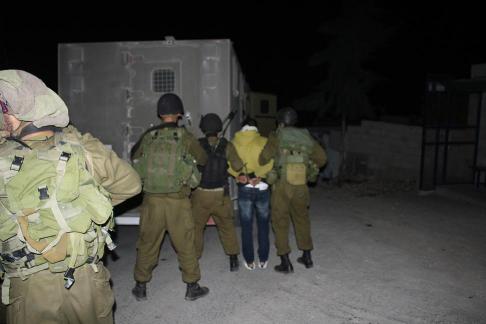 Soldiers escorting the bound and blinfolded Mohammed into a military jeep on the day of his arrest. Photo credit: Hamde Abu Rahmah

Mohammed Abu Rahmah was arrested from his house during a military nighttime raid on his village of Bil’in on November 23rd. Abu Rahmah, the son of imprisoned Bil’in organizer, Adeeb Abu Rahmah, was released without charge on Monday, and reports being harassed and beaten during his questioning.
On November 23rd, 2010, Israeli forces entered the village of Bil’in and stormed the home of imprisoned Bil’in organizer, Adeeb Abu Rahmah. After conducting a short search of the premises, the soldiers arrested Adeeb’s only son, sixteen year old Mohammed, who was taken away bound and blindfolded.
Mohammed reports being taken to the Maccabim military base, where he arrived at about 3 AM. He was then, still handcuffed and blindfolded, transported to the Ofer Military Prison, where the authorities refused to process him. Mohammed was then taken back to the Maccabim military base, where he was held until 11 AM, still with cuffed and blindfolded, and without being allowed to go to toilet.
Finally arriving at Ofer Prison at around noon, where the shackles and blindfold were eventually removed, Mohammed was taken into interrogation without allowing him to catch some sleep. On entering the interrogation room, he was cuffed again in both hands and legs, and sited on a chair in front of a man who introduced himself as “Captain Fares”. The interrogator then told Mohammed that the case against him is rock solid and can lead to a sentence of up to a year in jail. “Captain Fares” then said that the only way for Mohammed to avoid imprisonment is to “cooperate” – by which he meant confessing to the unfounded suspicions against him, and incriminating others.
When Mohammed refused to confess or incriminate others who the interrogator mentioned by name, “Captain Fares” responded by shouting at him, cursing him, and a few times even assaulting him physically with slaps to the face. At some point, as Mohammed kept insisting on his right to remain silent, the cuffs around his wrists and ankles were tightened even more then they were before, and the interrogator grabbed his neck as if he was about to choke him. When Mohammed refused to identify his imprisoned father in a picture shown to him, he was punched in the chest.
After about two hours of violent questioning, Mohammed was asked to sign a paper with a transcript of his interrogation, which he refused to do, and was then physically forced to give his fingerprints.
It is common practice in Israeli interrogation rooms to try and extract confessions and incriminations from detained Palestinian minors using threats and abuse. Many cases and convictions at the military court, including that of Adeeb Abu Rahmah, Mohammed’s father, are based on such incriminations by detained youth.
Mohammed, who since his father’s arrest, 17 months ago, Mohammed serves as the family’s sole provider, was eventually released from custody Monday night (November 29th), on 8,000 NIS bail since the military prosecution could not present evidence justifying his remand.
Israeli Troops Kidnap Elected Legislator In Hebron
By Saed Bannoura – IMEMC & Agencies – December 01, 2010
Israeli soldiers kidnapped legislator Sheikh Khalil Nayef Rajoub after breaking into his home and searching it on Wednesday at dawn.
His family stated that soldiers surrounded their home located west of Hebron, approximately at 1 a.m., and kidnapped the legislator taking him to an unknown destination.
Fu’ad al-Khuffash, head of the Ahrar Center for Detainees Studies and Human Rights, reported that the soldiers violently broke into the home of Rajoub and informed him that they have an arrest warrant against him.
Al-Khuffash added that the kidnapping of Rajoub is regarded as a “declaration of a new war against elected legislators and officials, and another attempt to kidnap the legislators” similar to the massive arrests targeting dozens of elected legislators and officials on June 29, 2006.
He stated that the army kidnapped three legislators in the last 45 days; the three are Hatem Qfeisha, Mahmoud al-Ramahi, and today’s kidnapping of Rajoub.
Legislator Rajoub spent four years in Israeli prisons as he was kidnapped on June 29 2006, and was only released five months ago. He was also one of several Hamas officials deported by Israel to Marj al-Zohour in southern Lebanon.
Al-Khuffash demanded international human rights groups to intervene and stop the Israeli violations against the Palestinian people and their elected officials.
On December 17, 1992, Israel arrested and deported 416 members of the Hamas movement and the Islamic Jihad. The deported leaders camped near the borders and held a strike until Israel was forced to allow them back due to international pressure.
Three Different Takes on Aid Priorities in Gaza
Integrated Regional Information Networks (IRIN) – August 5, 2010
GAZA CITY – The quality of life, the economy and food security for Palestinians living in Gaza have been severely impaired by Israel’s strict four-year blockade, according to the UN.
Israel says its closure regime is designed to protect Israeli citizens from attacks by militants in Gaza. Hamas, the ruling group in Gaza, says Israel’s blockade is aimed at undermining its rule.
IRIN asked three senior officials in the region – from the UN, the Israeli government and Hamas – what they considered to be the top five humanitarian needs of the 1.5 million Palestinians living in the Strip.
UN view
Philippe Lazzarini, head of the UN Office for the Coordination of Humanitarian affairs (OCHA) for the occupied Palestinian territory, defines the situation in Gaza as “a protracted human dignity crisis with important humanitarian elements”.
Lazzarini says Gaza is a man-made crisis. He uses the term “human dignity crisis” because he says the entire Gaza population is subject to collective punishment under the blockade, is unlawfully contained in Gaza, and denied the right to movement and access. The containment of the population was highlighted when people could not move during Israel’s 23-day offensive that ended in January 2009, he says.
“A humanitarian crisis is a situation where humanitarian intervention is seen as a life-saving operation,” says Lazzarini. “The massive intervention in Gaza – by UN agencies and other international partners – is justified by the humanitarian crisis and to address the needs of the population.”
The facts and figures indicate that if UN operations stopped, food insecurity and malnutrition rates in Gaza would double, he said. His top five Gaza humanitarian needs are:
One: food security
The UN Food and Agriculture Organization says 70 percent of Gaza’s population is food insecure and 30 percent of Gaza’s agricultural land is inaccessible due to the Israeli-controlled buffer-zone, which is inside Gaza along its shared border with Israel, and comprises 15 percent of Gaza’s total area.
Two: unemployment and poverty
About 80 percent of the Gaza population depends on assistance from UN agencies, while unemployment has soared to 40 percent, says Lazzarini.
“In the last two years the number of those living in abject poverty in Gaza has risen from 100,000 to 300,000,” he says.
Three: shelter
Some 86,000 new housing units are needed in Gaza as a result of population growth. A small proportion of these are needed to replace those damaged during military operations, according to UN estimates.
If the current Israeli approval procedures to bring construction material into Gaza remain in place, it will take years for the UN to implement its US$165 million-worth of stalled projects, says Lazzarini.
Four: water, sanitation and health care
The blockade has seriously affected these sectors in Gaza, says Lazzarini.
Five: education
“The United Nations Relief and Works Agency and the education ministry cannot cover the needs of the number of children entering the education system in Gaza,” says Lazzarini, due to a lack of schools and investment.
Hamas view
Bassem Na’im, health minister under the Hamas-led government in Gaza, says the humanitarian crisis in Gaza is growing. His top five humanitarian needs are:
One: freedom of movement
Nai’im would like to see the complete freedom of movement of goods and people in and out of Gaza.
“The entry of goods and building materials for all sectors – health, shelter, water and sanitation – is the solution to the whole crisis,” says Na’im.
Two: health services
This would require medicine, medical supplies and equipment to enter Gaza freely, as well as spare parts and building materials for the repair of hospitals and healthcare facilities, according to Na’im.
“A hundred medications and over 150 disposable supplies, like needles and syringes, are at zero stock in the ministry’s central store,” he says.
More than 10,000 types of medical equipment, like CT scanners, are in need of spare parts in the 12 hospitals and 56 primary healthcare centres run by the ministry, says Na’im.
Three: water and sanitation
“Thousands of Gazans lack household water supplies,” says Na’im.
Four: fuel and electricity supplies
Most households have power cuts 8-12 hours per day due to the blockade, according to Na’im.
Five: education
According to Na’im, the education sector has been hit hard by the blockade due to a lack of supplies, but the full impact will take years to materialize.
Rising malnutrition indicators – such as increased cases of stunting, wasting and underweight children – are also effecting child development, said Na’im.
Israeli view
Guy Inbar, spokesperson for the Israeli Coordinator of Government Activities in the (Palestinian) Territories (COGAT) says “there is no humanitarian crisis in Gaza and there never has been, even during Operation Cast Lead [2009 Israeli military operation in Gaza].”
“The only crisis in Gaza is the crisis of [captured Israeli soldier] Gilad Shalit,” said Inbar, adding that Hamas has not enabled the International Committee of the Red Cross to visit Shalit.
Israel recently increased the amount of goods allowed to enter Gaza, said Inbar.
“Today [29 July] about 150 trucks enter Gaza daily and next week we expect that number to reach 250,” said Inbar, adding that no food or hygiene items were prohibited.
According to Inbar, almost all medical supplies are allowed to enter.
“Parts for equipment – like X-ray machines, which are included on the two lists [of prohibited items] – are allowed to enter but under control,” he said.
When IRIN asked Inbar if the civilian population of Gaza would survive if UN operations ceased there, he declined to comment.
Inbar said Gaza’s problems were due to Hamas.
Featured Video

New positive ivermectin evidence
or go to
Aletho News Archives – Video-Images
From the Archives
Fanatical Followers of the Covid Regime: A Jim Jones-Style Cult?
By Professor Roger Watson and Dr. Niall McCrae | The Daily Sceptic | November 15, 2021
As scholars at leading British universities over recent decades, we witnessed the replacement of critical thinking and debate by narrative: facts are discrimination and scientific method is imperialism; truth, instead, is derived from ‘progressive’ values. This educational trend may be a major contributory factor to the ease in which society has been inculcated to the Covid ‘new normal’ of masking, testing, and repeated doses of vaccines for a disease of similar risk to severe influenza.
One doesn’t need much critical reasoning to observe the flawed logic of some vaccination enthusiasts, such as people who respond to experiencing any side effects, however debilitating, by saying “at least I know it’s working”, or, after contracting the disease despite their promised inoculation (over 90% effective, according to initial drug company claims), “I’d have been worse off without the jab.” … continue
Blog Roll
 Aletho News
- EU Council Advances Chat Control 2.0 Scanning Proposal
- Ex-Greek MEP files complaint against Israeli spyware firm over alleged Pegasus surveillance
- Troubling ideas throughout the Torah, Talmud, Mishneh Torah and Tanya
- ‘Grave, alarming’: Iran mission on Trump’s UNGA ‘annihilation’ threats
- Najaf airport to reopen to Iranian flights within 24 hours: Ambassador
- From ‘How Will This End For Iran’ to ‘When America Walks Away’: A tale of two Economist covers
- Tehran blasts ‘baseless’ speculation linking Iran to alleged bomb plot at UK air base
- The Rise And… Rise Of ‘Color Revolutions’
- The Coming GOP Bloodbath?
- Arctic Scare Stories Melt Away
- If Americans Knew
- Netanyahu Asked UAE Leader to Deny Report on Oct. 7 Warning in Secret Visit, Sources Say
- CNN Chief Int’l Correspondent Clarissa Ward on Journalists in Gaza
- Democratic Party Consultants Surround Troy Jackson with Pro-Israel Donors
- Christian Leader Responds To Netanyahu’s Claims Regarding Palestinian Christians
- In Gaza, ‘Whoever Survives the Bombing Won’t Survive the Rubble’
- Israel kills more Palestinians, amid push to resettle Gaza – Daily Update
- Israel forces Gazans to live in constant peril – Daily Update
- Deconstructing Netanyahu’s pants-on-fire UN rant – Daily Update
- Trump betrayed voters with his campaign lies and prioritized a foreign country once he took office
- Netanyahu calls Israel’s war in Gaza ‘opposite of genocide’ in UN speech to near-empty hall
- No Tricks Zone
- New Study: Earth And Venus Surface Warmth Largely Explained By Convection And Lapse Rate, Not CO2 Or Radiation
- 2025 Nature Paper Claiming Worsening Global Drought Gets RETRACTED …Heavily Flawed
- New Study: ‘Global Drought Shows No Detectable Recent Acceleration Under Climate Warming’
- Economic Masterminds: German Socialists Suggest Taxing Productivity Gains Stemming From Using AI
- The South China Sea Has Not Been Cooperating With The Climate Change Narrative
- Energy Crisis: Germany Enters Heating Season With Historically Low Gas Reserve Fill Levels
- New Study: The Antarctic Ice Sheet Gained Mass From 2020-2024 Due To Staggering Snow And Ice Accumulation
- Study: Ocean Heating Rates From Thousands Of Years Ago ‘Dwarf’ Modern Ocean Heating Rates
- Climate Extremists Target, Attack Large-Scale Power Grid Infrastructure In Germany!
- New Study: Antarctic Ice Melt Has Contributed Less Than 1 Centimeter To Sea Level Rise In The Last 30 Years

