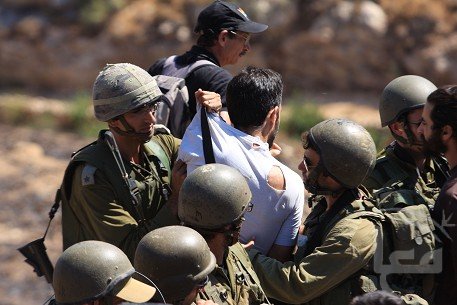
Jewish Extremists Assault Palestinians
Annan Yaghmour, 21 |
SILWANIC – 12 November, 2010
Jerusalem — Silwan resident Annan Jawad Yaghmour, 21, was severely assaulted, beaten, and abused by a group of extremist Jews this Saturday, November 6, 2010, as he was walking late at night near Hillel Street in West Jerusalem. According to Annan, he was walking along when a girl stopped him and asked him for a cigarette, and during a brief chat discovered that he was Palestinian. Shortly after they parted ways, Annan was attacked by a number of Jewish extremists. He tried to scream that he was a Jew of Moroccan descent, until finally his attackers stopped assaulting him long enough to look for his identity card. Upon confirming he was Palestinian, however, the men tortured him, beating him in the face and head with stones and spraying him with gas, as well as stealing his mobile phone. Annan managed to escape his attackers and was able to reach a main street, where he lost consciousness. From there he was transferred to a hospital, where he was treated for severe injuries to the eyelid, forehead and ear, as well as significant bruising and injuries to the head resulting from the brutal attacks with stones.
The following day, Annan’s father filed a complaint with the police and called on the Israeli authorities to put up surveillance cameras on the streets of Hillel, Musrara, and the bell garden, in West Jerusalem where assaults against Palestinians are becoming increasingly common.
Ahmed Sbaih, 41, suffered a similar attack on the night of October 31, 2010, after an Israeli stopped him to ask for a cigarette near the Ma’man Allah cemetery in West Jerusalem. Shortly afterward, Ahmed came upon a large group of Jewish extremists who demanded cigarettes from him and asked his name. When they determined he was Palestinian, the men began beating him with large stones that they had concealed under their clothes. Sbaih suffered three broken teeth as well as deep injures to the gums and head.
According to Sbaih, “I was bleeding, but I was able to pull away from three of them and escaped. They chased me and threw stones at me until I reached the main road and called the police, who hung up the phone twice before telling me that a police car would come in a minute.” Sbaih was left bleeding for more than half an hour before he was transferred to a hospital by an ambulance that had received his number from the police, who didn’t arrive at the hospital until more than an hour after being called.
Ahmed went to the police station to file a complaint, but says that “when they realized the reason for my presence, they treated me as though I were guilty. The policewoman began screaming at me and tried to justify the police’s late presence at time of the incident, claiming that the police were busy.”
Photos taken by Maisa Abu Gazaleh
Annan Yaghmour, 21
Israelis attacking children on their way to school
April 2010
Palestinian Children in the rural village of at-Tuwani speak of their encounters with violent Israeli Settlers in the South Hebron Hills of Occupied Palestine.
Related articles
- PALESTINE: Tent for school children demolished hours after it was built (alethonews.wordpress.com)
- Stranded in Shuhada: Hebron’s Qurtuba school (alethonews.wordpress.com)
- Mass arrest of schoolchildren (alethonews.wordpress.com)
Israeli Army Isolates the Village of Nabi Saleh to Prevent Commemorative Folk Festival
By Mays Al-Azza – IMEMC & Agencies – November 12, 2010
After the Fatah movement called the Palestinian people in Ramallah for a folk festival to commemorate late president Yasser Arafat, as a new step in escalating the popular resistance, the Israeli army imposed an intensive blockade upon the village of an-Nabi Saleh, northwest of Ramallah.
Israeli army personnel also erected military barriers to separate the villages of Beit Ramba and Kufr Aein, northwest Ramallah, and tightened measures and obstructed the passage of the vehicles through the Israeli checkpoint, Attara.
Muhammad Tamemi, an official in the media office in Popular Committee Against the Wall and Settlement Construction, stated that Israeli army personnel imposed a blockade upon the village and obstructed the passage of vehicles preventing international peace activists and journalists from entering the village. He pointed out that these measures had been carried out after the Israeli army entered the village at dawn threatening the villagers with harsh measures if the festival went ahead.
He added that Israeli army personnel closed all the entrances of the village and intensified the presence of the soldiers there in order to prevent the residents of the nearby villages from participating in the festival which is scheduled to be held at mid-day.
The Popular committee Against the Wall and Settlement Construction has called the Palestinians to go by foot to participate in the festival and face all the Israeli measures.
US-Backed Death Squad Files Surface
As Obama Lands in Indonesia
By ALLAN NAIRN | CounterPunch | November 10, 2010
Secret documents have leaked from inside Kopassus, Indonesia’s red berets, which say that Indonesia’s US-backed security forces engage in “murder [and] abduction” and show that Kopassus targets churches in West Papua and defines civilian dissidents as the “enemy.”
The documents include a Kopassus enemies list headed by Papua’s top Baptist minister and describe a covert network of surveillance, infiltration and disruption of Papuan institutions
The disclosure comes as US President Barack Obama is touching down in Indonesia. His administration recently announced the restoration of US aid to Kopassus.
Kopassus is the most notorious unit of Indonesia’s armed forces, TNI, which along with POLRI, the national police, have killed civilians by the hundreds of thousands.
The leaked cache of secret Kopassus documents includes operational, intelligence and field reports as well as personnel records which list the names and details of Kopassus “agents.”
The documents are classified “SECRET” (“RAHASIA”) and include extensive background reports on Kopassus civilian targets — reports that are apparently of uneven accuracy.
The authenticity of the documents has been verified by Kopassus personnel who have seen them and by external evidence regarding the authors and the internal characteristics of the documents.
Some of the Kopassus documents will be released in the days to come, in part via my website.
Those being released with this article concern West Papua, where tens of thousands of civilians have been murdered and where Kopassus is most active. Jakarta has attempted to largely seal off Papua to visits by non-approved outsiders.
When the US restored Kopassus aid last July the rationale was fighting terrorism, but the documents show that Kopassus in fact systematically targets civilians.
A detailed 25-page secret report by a Kopassus task force in Kotaraja, Papua defines Kopassus’ number-one “enemy” as unarmed civilians. It calls them the “separatist political movement” “GSP/P, ” lists what they say are the top 15 leaders and discusses the “enemy order of battle.”
All of those listed are civilians, starting with the head of the Baptist Synod of Papua. The others include evangelical ministers, activists, traditional leaders, legislators, students and intellectuals as well as local establishment figures and the head of the Papua Muslim Youth organization.
The secret Kopassus study says that in their 400,000 – person area of operations the civilians they target as being political are “much more dangerous than” any armed opposition since the armed groups “hardly do anything” but the civilians — with popular support — have “reached the outside world” with their “obsession” with “merdeka” (independence/ freedom) and persist in “propagating the issue of severe human rights violations in Papua,” ie. “murders and abductions that are done by the security forces.”
The Kopassus document cited above is embedded below, followed by supplementary field reports. [The documents can be viewed here. Satgas Ban – 5 Kopassus Triwlapharian.]
Given that the Kopassus report states as settled fact that security forces do “murder, abduction,” those who they define as being the enemy can be presumed to be in some danger.
In its discussion of “State of the enemy” Kopassus identifies the enemy with two kinds of actions: “the holding of press conferences” where they “always criticize the government and the work being done by the security forces” and the holding of private meetings where they engage in the same kind of prohibited speech.
The Kopassus “enemies” list — the “leaders” of the “separatist political movement” includes fifteen civic leaders. In the order listed by Kopassus they are:
— Reverend Socrates Sofyan Yoman, chair of the Papua Baptist Synod
— Markus Haluk head of the Association of Indonesian Middle Mountains Students (AMPTI) and an outspoken critic of the security forces and the US mining giant Freeport McMoRan;
— Buchtar Tabuni, an activist who, after appearing on the Kopassus list, was sentenced to three years prison for speech and for waving Papuan flags and was beaten bloody by three soldiers, a guard, and a policeman because he had a cell phone;
— Aloysius Renwarin, a lawyer who heads a local human rights foundation;
— Dr. Willy Mandowen, Mediator of PDP, the Papua Presidium Council, a broad group including local business people, former politcal prisoners, women’s and youth organizations, and Papuan traditional leaders. His most prominent predecessor, Theys Eluay, had his throat slit by Kopassus in 2001;
— Yance Kayame, a committee chair in the Papuan provincial legislature;
— Lodewyk Betawi;
— Drs. Don Agustinus Lamaech Flassy of the Papua Presidium Council staff
— Drs. Agustinus Alue Alua, head of the MRP, the Papuan People’s Council, which formally represents Papuan traditional leaders and was convened and recognized by the Jakarta government;
— Thaha Al Hamid, Secretary General of the Papua Presidium Council;
— Sayid Fadal Al Hamid, head of the Papua Muslim Youth;
— Drs. Frans Kapisa, head of Papua National Student Solidarity;
— Leonard Jery Imbiri, public secretary of DAP, the Papuan Customary Council, which organizes an annual plenary of indigenous groups, has staged Papua’s largest peaceful demonstrations, and has seen its offices targeted for clandestine arson attacks;
— Reverend Dr. Beny Giay, minister of the Protestant evangelical KINGMI Tent of scripture church of Papua;
— Selfius Bobby, student at the Fajar Timur School of Philosophy and Theology.
Reached for comment, Reverend Socrates Sofyan Yoman of the Baptist Synod laughed when told he headed the Kopassus list. He said that churches were targeted by TNI/ Kopassus because “We can’t condone torture, kidnapping or killing.” He said that he has received anonymous death threats “all the time, everywhere,” but that as a church leader he must endure it . He said the real problem was for Papua’s poor who “live daily in pressure and fear.”
Markus Haluk said that he is constantly followed on foot and by motorcycle, has been the subject of apparent attempts to kill him, and receives so many sms text death threats that he has difficulty keeping current with the death-threat archive he tries to maintain for historical and safety purposes.
One threat, written months after his name appeared as a target in the Kopassus documents, promised to decapitate him and bury his head 200 meters deep, while another imagined his head as a succulent fruit to be devoured and swallowed by security forces.
But as a famous figure in Papua, Haluk enjoys, he thinks, a certain kind of protection since when security forces have actually arrested him it has at times touched off street uprisings.
Village Papuans, he said, enjoy no such advantage. For them, being targeted by Kopassus “can get you killed. If there’s a report against you, you can die.”
Contacted in prison, Buctar Tabuni, the number three enemy on the Kopassus list, told of getting a death threat with a rat cadaver, described living with round-the-clock surveillance, and said the threats to him repeatedly stated that “you will be killed unless you stop your human rights activities.”
Three days ago, writing from his prison cell, Buctar Tabuni called on President Obama to cut off aid to TNI and back a democratic vote on Papuan independence. He told me that Indonesia follows the US lead and that the US was complicit since, as he wrote Obama, US-trained “troops in cities and villages all over West Papua treat the people like terrorists that must be exterminated.”
Anti-terrorism was indeed Obama’s main argument for restoring US aid to Kopassus, but the documents make clear that Kopassus mainly targets unarmed civilians, not killers.
In fact, the main unit that wrote the secret documents, SATGAS BAN – 5 KOPASSUS, is ostensibly doing anti-terrorism, with the Kopassus Unit 81, Gultor.
Obama justified the Kopassus aid restoration to Congress by saying that the initial US training would be given not to Kopassus as a whole but only to its anti-terror forces. The White House and Pentagon suggested that these forces were less criminal than the rest of Kopassus and of TNI/POLRI, but the documents establish that they, like the rest, go after civilians like the Papuan reverends and activists.
Reverend Giay said, when reached for comment that TNI, Kopassus and POLRI were making the case that “it’s OK to kill pastors and burn churches since the churches are separatist.”
Among Giay’s collection of anonymous sms death threats was a political missive demanding that “the reverend stop using the platform of the church to spread the ideology of free Papua.”
Giay said that “they need ideological and moral support from the Indonesian majority and the media” so they use Kopassus and others to attack the churches as constituting security threats.
He compared TNI/Kopassus actions in Papua now to those earlier in East Timor and the Malukus where “they created this conflict between Muslims and Christians” to expand their presence and get more money and power.
Reverend Giay said that “local pastors have been targeted. They kill them off and report them as separatists.”
The Kopassus documents boast that “in carrying out the operational mission of intelligence in the kotaraja area, we apportion work in order to cover all places and avenues of kotaraja society.”
The files show that Kopassus indeed penetrates most every part of
popular life. In addition to plainclothes Kopassus officers who go undercover in multiple roles, Kopassus fields a small army of non-TNI “agents” — real people with real lives and identities, who are bought, coerced or recruited into working covertly.
Kopassus Kotaraja area agents discussed in the secret personnel files include reporters for a local newspaper and for a national TV news channel, students, hotel staff, a court employee, a senior civil servant who works on art and culture, a 14 year old child, a broke, “emotional, drunken” farmer who needs money and “believes” that Kopassus will “take care of his safety,” a “hardworking” “emotionally stable” farmer who also is a need of funds, a worker who “likes to drink hard liquor,” is poor and “likes to believe things,” a motorcycle taxi driver, a cellphone kiosk clerk who watches people who buy SIM card numbers, and a driver for a car rental company who “frequently informs on whether there are elements from the Separatist Political Movement who hire rental cars and speak regarding independence/freedom (merdeka).”
In the file, though, the word “merdeka” is not spelled out. In accord with Kopassus practice, only an initial is written, in quotation marks: “‘M'”, the unwritable, unspeakable M-word.
The documents support the longtime word on the street: you rarely know who is Kopassus. So best watch what you say if you care for safety, especially if what you say is “freedom.”
Allan Nairn is a journalist living in Indonesia.
Israeli occupation forces detain eldest son of MP
Palestine Information Center – 10/11/2010
AL-KHALIL — Israeli occupation forces (IOF) broke into the house of MP Samira Al-Halaika and took away her eldest son Anas in a pre dawn raid on Wednesday, the MP said in a press release.
She said that an IOF unit in four military vehicles and a white civilian car stormed the Qafan Khamis suburb east of Al-Shuyukh town in Al-Khalil district at 0300 am Wednesday and kidnapped her son Anas, 24.
She said that the soldiers locked up all her family members in one room and summoned her along with her husband and told them that they will take away their son Anas.
The lawmaker noted that her son was supposed to meet an Israeli intelligence official on Wednesday in Eztion on Wednesday morning.
Halaika held the Israeli occupation authority (IOA) fully responsible for any repercussions that might befall her son, who was released from the jails of security militias loyal to de facto Palestinian president Mahmoud Abbas on 5/9/2010 after 45 days in solitary confinement, which had a very bad physiological impact on him due to the continued isolation and cruel treatment.
She appealed to all human rights groups to intervene and demand an end to the suffering of her family due to the practices of the IOA and Abbas’s militias.
The IOF had previously detained Anas in October 2005 and released him in November 2006 before Abbas’s militias repeatedly summoned him before holding him in custody on 16/9/2009 for one month and apprehended him again on 21/7/2010 before his release on 5/9/2010.
Anas is studying journalism in Al-Khalil University.
Night raid in Bil’in
By Hamde Abu Rahme | Mondoweiss | November 9, 2010

(Photo: Hamde Abu Rahme)
Today, November 9 at about 3:00 in the morning, the Israeli army entered the village of Bil’in. About 50 soldiers entered the village by jeep and foot. When they arrived at the two targeted houses, they ran and took positions outside while a number of soldiers entered the house.
At first the soldiers were hammering on the door of one house, demanding to see 30-year old Ashraf al-Khatib. It turned out they went to the wrong house. They then went to another house – forcing one of Ashraf’s brothers to show them where Ashraf lives. Soldiers then entered that house, and his brother’s family’s house, and again they woke up the family, asking for Ashraf al-Khatib. His brother, Haytham al-Khatib, is a journalist from the human right’s group B’tselem and was of the ones woken up by the army. Even though they entered a house where their target didn’t live, they stayed there for about one and a half hours, searching all the rooms.
Haytham al-Khatib told me about his 6-year-old son’s reaction to waking up to see dozens of soldiers in his house, “he asked me to close the door, because he didn’t want to see them.” Haytham himself was prevented when he wanted to record the raid in his family’s houses – the soldiers simply locked him in a room for more than an hour, away from his children and wife. The children in the houses are ages 1,5 and 8 years old, and this is not the first time they have seen their homes raided at night.
However, after 1.5 hours of searching for the target in three houses, two of which he doesn’t reside in, Ashraf al-Khatib was not found. Five weeks ago Ashraf was shot in his leg with live ammunition by an Israeli soldier during a demonstration in Bil’in. The bullet went through his leg, breaking the bone. Even though he was heavily injured and in major pain, the soldiers tried to arrest him. Luckily he was brought to safety, and then taken to a hospital for surgery by fellow protesters. Tonight the army decided to come and take him in front of his wife and 1.5 year old daughter instead.
The soldiers finally retreated from the targeted houses by foot, walking toward the military road that follows the illegal segregation fence in Bil’in, at about 4.30 AM. The village of Bil’in has suffered from frequent night raids over the last few years, and a number of villagers have been taken for interrogation and imprisoned for their non-violent resistance to the occupation and segregation wall on Bil’in’s land.
Detention at Kandahar, Bagram and Guantánamo
By Andy Worthington | November 8, 2010
On September 18, I was delighted to be asked to attend “Eid Without Aafia,” and to conduct a live interview with former Guantánamo prisoners Shafiq Rasul and Ruhal Ahmed…
In the first of the three videos, I asked Shafiq and Ruhal about the brutal conditions in the US prison at Kandahar airport, where they were taken following their capture in Afghanistan in November 2001, after they had survived a notorious massacre of prisoners in container trucks and a stay in the Northern Alliance’s brutal and overcrowded Sheberghan prison. I also asked them what they knew about the US prison at Bagram airbase, where Aafia Siddiqui was held, and asked them about the isolating effect of not only being prohibited from receiving any visitors, but of not even receiving letters from their family — or only receiving letters that were heavily censored.
In the second video, Shafiq and Ruhal talked about the despair they felt in Guantánamo when it became clear that the British government had no intention of helping them. I also spoke about how torture is both illegal and counter-productive, and asked Shafiq and Ruhal to explain how the use of torture can lead to false confessions, which allowed them to explain how, in Guantánamo, they eventually made false confessions after being subjected to the “frequent flier program,” a program of prolonged sleep deprivation that involved being moved from cell to cell every few hours, being held in isolation for five months, where they were given very little food, being short-shackled in painful stress position for two to three days at a time, when they were obliged to urinate and defecate on themselves, and being subjected to extremely loud music.
In the third video, Shafiq and Rasul explained how their treatment in Guantánamo led them to think of committing suicide, and, following up on how they were forced into making false confessions, I noted how false confessions don’t necessarily lead to prisoners being released from Guantánamo. I also asked Shafiq and Ruhal to explain more about the circumstances that led to their release, and Shafiq explained how, on the date that they were supposedly filmed at a training camp with Osama bin Laden, he was attending university in the UK (although he also explained that British agents suggested that he might have traveled on a false passport).
I also asked Shafiq and Ruhal to discuss how receiving medical treatment at Guantánamo was entirely dependent on cooperation with the interrogators (in other words, making false confessions). This allowed them to explain how Omar Khadr, the Canadian who was just 15 years old when he was seized (and who was recently convicted in a trial by Military Commission), was one of the many prisoners deprived of medical treatment because he would not make false confessions, even though his wounds were “horrific,” and they couldn’t understand how he was still alive. They explained that they regularly heard him crying in an isolation cell, and also explained that he had been subjected to the “frequent flier program,” adding that, although he is now 24 years old, he “still has that child mentality,” In a moving finale, Ruhal reflected on the barbarity of separating Aafia Siddiqui from her children, and on how they may have been used in an attempt to secure her compliance, as the authorities at Guantánamo had no qualms about abusing child prisoners.
Israeli occupation authority extends administrative detention of Mayor’s wife
Palestine Information Center – 09/11/2010
RAMALLAH — The Israeli occupation authority (IOA) has extended the administrative custody, without charge, of Muntaha Al-Tawil, the wife of El-Bireh Mayor and Hamas leader Sheikh Jamal Al-Tawil, for three months.
Taghrid Jahshan, the legal advisor to the women’s society for female political prisoners, said that Muntaha was detained on 8/2/2010 for a six months period that was renewed for three months and now is facing a third renewal of three more months ending 8/2/2011.
The lawyer said that she was in contact with the Israeli Hasharon jail and received the news on the phone, adding that she contacted the woman’s husband and told him of the new development. The lawyer expressed concern over the continued detention of Muntaha without charge and holding her away from her husband and four children.
Muntaha is studying social service at the open Quds University and is a member of many human rights groups that defend prisoners’ rights.
The Israeli military judge approved the detention of Muntaha depending on the so-called secret file tabled by the internal security apparatus. The defendant and her lawyer are not allowed to read contents of the file on the pretext of preserving sources of the information in it.
The prosecutor said that Muntaha poses a danger to the security in her area of residence.
Why won’t the Tampa Trib tell you what people in Nashville know about Steve Emerson?
By John Sugg | Creative Loafing | November 2, 2010
Steven Emerson, a self-styled terrorism expert, is a guy who had a profound and caustic impact on Tampa for more than a decade. Emerson has had much less of an impact on another city, Nashville, although his corrosive brand of often-inaccurate smear jobs recently slithered into Tennessee.
Still, Nashville’s citizens know a whole lot more about Emerson than folks in Tampa, despite his relatively recent arrival on the Tennessee hate-Muslim soapbox, where he jostles for the limelight with loopy religious fanatics and just plain old-fashioned Southern bigots.
Why that imbalance of knowledge about Emerson? The answer lies in a horrible miscarriage of journalism committed over many years by The Tampa Tribune, a series of atrocities the Trib could easily correct by just providing a dash of fair and accurate reporting, something history indicates the newspaper won’t do. Nashville should be grateful that it has a newspaper, The Tennessean, which unlike the Trib will fearlessly dig out the truth.
In tandem with his vassal reporter at the Tampa Trib, Michael Fechter, Emerson waged a decade-long jihad against a professor at the University of South Florida, Sami Al-Arian, accused by Emerson and Fechter of being a terrorist mastermind. Emerson and Fechter were backed by a shadowy network of former federal agents and foreign spooks, notably a disinformation specialist for Israel’s ultra-right Likud party named Yigal Carmon and a controversial ex-FBI official named Oliver “Buck” Revell – and a lot of money whose origins have never been revealed.
However, where their information came from was clear. As the great Israeli newspaper Ha’aretz explained before Al-Arian’s 2005 federal trial: “Israel owns much of the copyright for the case; a well-informed source termed the prosecution an ‘American-Israeli co-production.’ The Americans are running the show, but behind the scenes it was the Israelis who for years collected material (and) transmitted information…” How did they transmit information? In part, via “secret evidence” slipped to our federales, evidence and accusers Al-Arian wasn’t allowed to confront (who needs that nasty old Sixth Amendment?). But reporters were also conduits for scurrilous “intelligence” claims. Fechter himself wrote that “former and current senior Israeli intelligence officials” loaded his stories with information. Those allegations, many ludicrous on their face, were rejected by a federal jury, despite a highly prejudiced judge and rulings that, if they had been issued against Martin Luther King Jr. would have prevented him from mentioning Jim Crow in his defense.
Over the years, while a Weekly Planet and Creative Loafing editor, I had a great deal of fun exposing Emerson, and the prevarications by Fechter and the federal government. I tried to put into context what the anti-Muslim crusaders were up to. I joined a rather elite cadre of journalists that had tangled with Emerson – including famed investigative reporters Seymour Hersh, Robert I. Friedman and Robert Parry, who provided me with insight into Emerson’s real agenda.
Emerson filed two bogus lawsuits against me, the Weekly Planet (AKA Creative Loafing) and an AP reporter who had told me about questions he had had over the provenance of a document Emerson gave the news service. We obtained a court order that would have forced Emerson to produce real proof of his allegations – and he knew we were digging into who he really was and who paid his bills – so he ran away from the fight he started; the good guys (me, for example) prevailed.
It’s noteworthy that a number of dispassionate analysts had observations similar to mine. New York University scholar Zachary Lockman, for example, (as quoted on “Right Web”) wrote in 2005: “[Emerson’s] main focus during the 1990s was to sound the alarm about the threat Muslim terrorists posed to the United States. By the end of that decade Emerson was describing himself as a ‘terrorist expert and investigator’ and ‘Executive Director, Terrorism Newswire, Inc.’ Along the way, critics charged, Emerson had sounded many false alarms, made numerous errors of fact, bandied accusations about rather freely, and ceased to be regarded as credible by much of the mainstream media . The September 11 attacks seemed to bear out Emerson’s warnings, but his critics might respond that even a stopped clock shows the right time twice a day.”
Again, it’s sadly significant that the Trib never even provided such mild doses of context about its primary source, Emerson, in its inflammatory, intentionally erroneous and misleading, and often racist diatribes against Al-Arian. The Trib still gives Emerson ink – never questioning his claims and guilt-by-association-and-innuendo tactics, and never vetting his background, associations, financing and motives.
Some insight on Emerson’s millions has now been provided by The Tennessean, Nashville’s daily newspaper. MSNBC’s Keith Olbermann, citing the Tennessean’s reports, on Oct. 26 awarded Emerson his nightly “Worst Person in the World” citation. Olbermann expressed regret that the network had previously used Emerson as a chattering head on terrorism topics. (Similarly, CBS did not renew its contract with Emerson after he claimed that the 1995 Oklahoma City bombing had “a Middle Eastern trait” because it was carried out “with the intent to inflict as many casualties as possible.” That was a big “Oops.”)
The Tennessean reported that Emerson collects money through a non-profit, the Investigative Project on Terrorism Foundation, and then funnels that money to his for-profit SAE (as in Steven A. Emerson) Productions. Quoting Ken Berger, president of Charity Navigator, a nonprofit watchdog group, the Nashville paper reported: “Basically, you have a nonprofit acting as a front organization, and all that money going to a for-profit. It’s wrong. This is off the charts.”
That little bit of information on Emerson, contained in one report, is far more than the Trib told you about Emerson over a decade – despite Emerson using the Trib to provoke a legal firestorm that is still ongoing.
You do recall the firestorm, right? Emerson and Fechter launched a series of attacks on Muslims. No amount of hyperbole and vitriol-spewing was considered excessive by the Trib or Emerson. Fechter, for example, darkly hinted that the FBI found documents about MacDill Air Force Base among Al-Arian’s papers, insinuating some dastardly design. Nope. Al-Arian had twice been invited to speak to large groups of military and intelligence officers, and the sinister documents were, well, just the hand-out materials. Fechter, following the lead of his guru, Emerson, also tried to blame the Oklahoma City bombing on Arabs, an egregiously false story the Trib has never seen fit to correct. Emerson, meanwhile, said in February 1996 that Palestinian advocates at USF were involved in the 1993 World Trade Center bombing. Emerson promised proof “in the near term.” The proof never came, and the Justice Department said it had no records supporting the allegation.
You think the Trib might have called Emerson on that one? Hahaha.
The former head of the criminal division of the U.S. Attorney’s Office in Tampa, Robert O’Neill, twice concluded during the 1990s there was no evidence to prosecute Al-Arian, according to my multiple sources in the Justice Department. I don’t like quoting anonymous sources so I’ll be clear: O’Neill, now the U.S. Attorney for Florida’s Middle District, himself told me he had looked at the evidence and found no reason to prosecute. In 1998, the then FBI counterterrorism chief Bob Blitzer also told me “no federal laws were broken” by the Tampa Muslims.
Yet, after 9/11, propelled by hate-Muslim diatribes from Bill O’Reilly (who had been funneled highly slanted information by Fechter) and the fear by Jeb Bush that the University of South Florida would conclude a settlement with Al-Arian that would prove embarrassing to the Bushite regimes in Washington and Tallahassee, the federal government indicted Al-Arian. The trial concluded with the government failing to win a single guilty verdict against Al-Arian or his co-defendants, an immense disaster for the Bush Justice Department.
Al-Arian later plea bargained in order to preclude another trial on counts on which the jury didn’t reach a verdict – although notably no more than two jurors felt he was guilty on even those “hung” counts. Al-Arian’s plea bargain stipulated that he had had no involvement in terrorist activities. Rather, he had provided some minor support to people who might have become terrorists, although it’s clear from the trial that any such activities by Al-Arian occurred when they were legal. The plea agreement supposedly ended all business between Al-Arian and the federal government. However, due to legal chicanery by a rogue federal prosecutor in Virginia, Gordon Kromberg – who has been called a doppelganger of Emerson – Al-Arian remains entangled in federal courts and on house arrest.
According to my federal sources, the Al-Arian case cost our government at least $50 million, and, no, the Trib and Emerson didn’t offer to pay part of the bill (you and I had that honor). And, with so many FBI agents chasing a guy whose “guilt” was mostly in exercising his First Amendment rights, the FBI missed another fellow flitting around Florida, a real terrorist with blood on his mind, Mohammed Atta.
The final chapters in the Trib’s pogroms against Muslims had a sadly humorous angle. Fechter, who had long been a tool of Emerson’s, finally got slightly honest and went to work for his mentor. And Fechter dumped his wife and children and shacked up with one of the federal prosecutors who tried Al-Arian. I don’t recall where Fechter got his journalism training, but he must have skipped the classes on journalistic objectivity and not sleeping with your sources.
So, The Tennessean’s articles might have provided an excellent opportunity for the Trib to revisit and maybe heal a terrible wound it was complicit in inflicting in Tampa. On Friday, I asked Trib Managing Editor Richard “Duke” Maas if he had such an inclination – heck, I inquired, aren’t you interested in what The Tennessean wrote about a guy who had so much impact on Tampa and your newspaper? Well, not really, Maas responded, sounding more irritated than journalistically curious. He added that Fechter had left the newspaper, which I gather meant he felt the Trib was thereby absolved of responsibility.
If you happen to have a spare backbone, you might send it to the pathetic folks at The Tampa Tribune.
John F. Sugg was editor of the Weekly Planet in the 1990s, and group senior editor of Creative Loafing Newspapers until he retired in 2008.
PA: Israel raided thousands of homes in October
Ma’an – 07/11/2010
RAMALLAH — The Palestinian Authority Ministry of Detainees’ Affairs said Israeli forces detained 403 Palestinians and raided 2148 homes across the West Bank during October.
In a report released Saturday, the ministry said Israeli soldiers intimidated and assaulted residents, destroying the contents of homes during the raids.
Of those detained, 95 percent had been assaulted in front of their families and were beaten en route to detention centers in Israeli military jeeps.
Among those detained, 130 were minors. Most of the minors detained were from Hebron and Jerusalem, the ministry said, adding that they were mostly sentenced to between one and six months, and ordered to pay large fines.
Sixty children from Jerusalem and one child from Hebron were placed under house arrest. In cases where a child broke the conditions of house arrest, a family member was arrested, the report said.
Most detainees were interrogated in Israeli settlements before they were transferred to official detention centers. The ministry documented 50 cases of raids inside the prisons. Under the pretext of searching for cell phones, guards used tear gas and sticks to beat prisoners and destroyed their personal belongings, the ministry said.
Israeli rights groups say Palestinians tortured in Israeli detention
On Tuesday, two Israeli rights groups released a report accusing Israel of “state sanctioned ill-treatment of interrogees” in at least one detention facility in Petah Tikva, in central Israel.
According to the joint B’Tselem and HaMoked report, testimonies from 121 detainees “indicate a clear pattern of activity by the authorities,” which “constitutes cruel, inhuman, and degrading treatment.”
According to the collected testimony, “violations include cruel detention conditions in sealed cells, in isolation and disgraceful hygienic conditions, continuous cuffing of detainees’ hands in the interrogation room in a way that makes it impossible for them to move, sleep deprivation, and other methods that harm the detainees physically and mentally.
The report noted that “the use of any one of these means, certainly their combined use, constitutes cruel, inhuman, and degrading treatment, and in some instances, torture. All are strictly forbidden under international law and Israeli law.”
Further, the groups said testimonies suggested that children were treated no differently than adults by soldiers and detention center authorities, despite their legal status as minors.
Israeli government documents show deliberate policy to keep Gazans at near-starvation levels
By Saed Bannoura – IMEMC News – November 06, 2010
Documents whose existence were denied by the Israeli government for over a year have been released after a legal battle led by Israeli human rights group Gisha. The documents reveal a deliberate policy by the Israeli government in which the dietary needs for the population of Gaza are chillingly calculated, and the amounts of food let in by the Israeli government measured to remain just enough to keep the population alive at a near-starvation level. This documents the statement made by a number of Israeli officials that they are “putting the people of Gaza on a diet”.

Calculation sheet from newly-released documents (image from Gisha)
In 2007, when Israel began its full siege on Gaza, Dov Weisglass, adviser to then Prime-Minister Ehud Olmert, stated clearly, “The idea is to put the Palestinians on a diet, but not to make them die of hunger.” The documents now released contain equations used by the Israeli government to calculate the exact amounts of food, fuel and other necessities needed to do exactly that.
The documents are even more disturbing, say human rights activists, when one considers the fact that close to half of the people of Gaza are children under the age of eighteen. This means that Israel has deliberately forced the undernourishment of hundreds of thousands of children in direct violation of international law and the Fourth Geneva Convention.
This release of documents also severely undermines Israel’s oft-made claim that the siege is “for security reasons”, as it documents a deliberate and systematic policy of collective punishment of the entire population of Gaza.
Gisha’s director said, in relation to the release of documents, “Israel banned glucose for biscuits and the fuel needed for regular supply of electricity – paralyzing normal life in Gaza and impairing the moral character of the State of Israel. I am sorry to say that major elements of this policy are still in place.”
In its statement accompanying the release of the documents, Gisha wrote:
The documents reveal that the state approved “a policy of deliberate reduction” for basic goods in the Gaza Strip (section h.4, page 5*). Thus, for example, Israel restricted the supply of fuel needed for the power plant, disrupting the supply of electricity and water. The state set a “lower warning line” (section g.2, page 5) to give advance warning of expected shortages in a particular item, but at the same time approved ignoring that warning, if the good in question was subject to a policy of “deliberate reduction”. Moreover, the state set an “upper red line” above which even basic humanitarian items could be blocked, even if they were in demand (section g.1, page 5). The state claimed in a cover letter to Gisha that in practice, it had not authorized reduction of “basic goods” below the “lower warning line”, but it did not define what these “basic goods” were.
Commentator Richard Silverstein wrote: “In reviewing the list of permitted items for import, you come to realize that these are the only items allowed. In other words, if an item is not on the list, it’s prohibited. So, for example, here is the list of permitted spices: Black pepper, soup powder, hyssop, sesame. cinnamon, anise, babuna (chamomile), sage. Sorry, cumin, basil, bay leaf, allspice, carraway, cardamon, chiles, chives, cilantro, cloves, garlic, sesame, tamarind, thyme, oregano, cayenne. Not on the list. You’re not a spice Palestinians need according to some IDF dunderhead. And tomatoes, potatoes, cucumbers, lettuce, toys, glassware, paint, and shoes? You can forget about them too. Luxuries all, or else security threats.”
Despite the disturbing nature of the documents, which show a calculated policy of deliberate undernourishment of an entire population, no major media organizations have reported the story.
The full text of the released documents, and the original Freedom of Information Act request filed by Gisha, can be found on Gisha’s website at the link below:
Related Link(s): http://www.gisha.org/index.php?intLanguage=2&intItemId=…N=113
UK official: Gaza situation is unbearable
Ma’an – 06/11/2010
BETHLEHEM — British Foreign Office spokesman Martin Day on Thursday called on Israel to allow Gaza borders to open for exports to ease an unbearable situation in the Strip.
In July, British Prime Minister David Cameron sparked outrage in Israel when he said Israel’s blockade of Gaza had turned the coastal enclave into a “prison camp.” Israeli President Shimon Peres accused Cameron of anti-semistism.
Asked if the response to Cameron’s remarks made him wary of criticizing Israel, Day replied that he would say frankly that the social, economic and political situation in Gaza was unbearable. In an interview with Ma’an Radio, he said the UK welcomed Israel’s decision to allow more goods into Gaza, and hoped it would be fully implemented.
Day said the British government believed settlements were a major obstacle to achieving peace, and that the UK continuously relayed this to Israel. All settlement activity, including in East Jerusalem, contravened international law and should be frozen to create an atmosphere for successful negotiations, he said.
The goal of British Foreign Secretary William Hague’s visit to the region Tuesday was to continue international efforts to restart negotiations between Israel and the PLO, which stalled over Israel’s settlement activity, he said.
The spokesman said the UK was committed to establishing a Palestinian state on 1967 borders with Jerusalem as the capital of both Palestine and Israel.