Rights Group Calls on Israel to Immediately Release Palestinian UN Worker

UN employee and human rights activist, Shireen Al-Araj.
Palestine Chronicle | February 1, 2021
The Euro-Mediterranean Human Rights Monitor today expressed its grave concern over the Israeli authorities’ arrest of a UN Palestinian employee in Jerusalem, calling for her immediate and unconditional release.
The Israeli authorities arrested UN employee and human rights activist, Shireen Al-Araj, on January 25, in front of the Magistrate’s Court in Jerusalem. She was summoned to an interrogation on charges of “contacting with foreign clients and persons.”
Al-Araj, who holds an Israeli ID in addition to a UN diplomatic passport, had returned to the Palestinian territories after an Israeli ban that lasted for five years. Her lawyer had contacted her informing her that she has to return to the Palestinian territories to renew her residency papers or she will lose her residency and become a “refugee”, which will deny her entry into the Palestinian territories again.
On January 24, at the border between Jordan and the Palestinian territories, Al-Araj was interrogated upon her arrival, where she was ordered to go to the Magistrate’s Court in Jerusalem the next day for further investigation by the Israeli police.
As she arrived at the court, Israeli intelligence agents stopped Al-Araj near the court door, took her to her home, and confiscated her computers and mobile phones. After that, she was taken to Petah Tikva prison in central Israel. The Israeli authorities prevented her lawyer and an Israeli lawyer appointed by the UN from meeting her or even being with her during the interrogation.
Al-Araj has been working with the UN in several organizations and programs, including the United Nations Relief and Works Agency for Palestine refugees (UNRWA), the United Nations Population Fund and the Office of the High Commissioner in Turkey.
Israel restricts the work of UN workers in the Palestinian territories, despite the UN’s coordination with the Israeli authorities. The Israeli authorities also follow a strict policy with local and international human rights defenders and impose significant restrictions on granting them entry visas to Israel or accessing the Palestinian territories.
Israel floods farmlands with rainwater in eastern Gaza
MEMO | January 22, 2021
The Palestinian Ministry of Agriculture announced on Thursday that Israel had vented its dams for rainwater harvesting, leading to the flooding of farmlands near the Gaza Strip’s eastern borders and the destruction of vast agricultural areas.
Israel has built several dams to collect and use rainwater and vents it without warning when large quantities of water accumulate during the winter, causing damage to the Gaza Strip’s farm and agricultural lands.
Ahmed Fatayer, director of the ministry’s branch in Gaza, disclosed that Israel: “Has opened the rainwater dams east of the Shuja’iyya neighbourhood in the east of the Gaza Strip, which led to flooding hundreds of dunams of agricultural land.”
In an exclusive interview with Anadolu Agency, Fatayer indicated that Palestinian farmers have suffered “great losses and direct and indirect damage” due to the sudden venting of dams.
He pointed out that Israel has been venting the dams and flooding agricultural land belonging to Palestinian citizens in recent years.
Salem Quta, one of the affected farmers, conveyed that the Palestinian landowners have suffered significant losses due to the flooding of their agricultural areas.
“About 400 dunams (one dunam equals 1,000 metres) were directly flooded with water, while 150 dunams were indirectly damaged by the flow of rainwater,” Quta told Anadolu Agency.
The farmer explained that the flooding of agricultural lands occurred when the crops he was growing during recent months were about to ripen.
Quta confirmed that in addition to flooding agricultural areas, Israel also: “Sprays chemical pesticides on the crops, which ends up destroying them, in addition to clearing the land.”
He called on human rights organisations and institutions to stand with the Palestinian farmers and support them to resist these violations.
Biden To Keep Up Trump’s Venezuela Regime-Change Policy
By Tyler Durden | Zero Hedge | January 20, 2021
The Biden administration has said it will continue to formally recognize Venezuelan opposition leader Juan Guaido as president of Venezuela, despite Nicolás Maduro clearly being the actual leader of the socialist country.
Biden’s nominee for secretary of state Anthony Blinken told Senators on Tuesday that Guaido will be the recognized leader, a policy which began in January 2019 when the opposition leader dubbed himself ‘Interim President’ and also ‘Acting President’ at the encouragement of Washington during Trump admin attempts to foment a military and popular uprising against Maduro.
During his remarks Blinken also indicated the new administration will keep up the sanctions. “We need an effective policy that can restore Venezuela to democracy, starting with free and fair elections,” he said.
He said Biden will seek “more effectively target” economic punitive measures in efforts to make Maduro step aside and allow Juan Guaido to take up position, according to Reuters.
Blinkin further said he believes the US should not enter into negotiations with Maduro for the end of sanctions or some kind of relief, but instead vowed that Caracas must “really feel the pain”.
Currently the OPEC nation is gaining help from Iran and Russia in circumventing a US oil and fuel blockade. US sanctions aim to prevent crude being exported out and gasoline being imported for domestic use (Venezuela’s derelict refineries have been incapable of processing enough fuel to keep up domestic demand).
While Guaido is also recognized as president by over a dozen US allies, the majority of countries – including powerful Russia and China – do not.
Red Cross: US adding Yemen’s Houthis to terrorist list will have ‘chilling effect’ on humanitarian aid
RT | January 14, 2021
The International Committee of the Red Cross (ICRC) has said it is worried that the US designating Yemen’s Houthi rebels as a terrorist group will severely hurt much-needed humanitarian aid to the war-torn country.
“In particular, the ICRC is concerned about the possible ‘chilling effect’ the designation may have on humanitarian action, leading to it being impeded or delayed,” the agency’s director of operations, Dominik Stillhart, said in a statement.
“Increased operational risks and possible de-risking from the banking and private sectors in response to the designation ultimately may constrain the humanitarian response in Yemen.”
Stillhart urged the US government to consider “humanitarian carve-outs” from their designation in order to mitigate any negative impact on the “affected population.”
On January 10, the US added the Houthis, the Iranian-backed rebel force which seized Yemen’s capital, Sanaa in 2014, to its list of foreign terrorist organizations. Three Houthi leaders were also separately designated as global terrorists.
US Secretary of State Mike Pompeo said the move is intended to hold the Houthi movement accountable for “its terrorist acts, including cross-border attacks threatening civilian populations, infrastructure, and commercial shipping.”
A Saudi Arabia-led coalition of Gulf states launched an intervention against the Houthis in 2015, carrying out a devastating aerial bombing campaign. The Houthis responded by launching missiles into Saudi Arabia.
Three ICRC workers were among the dozens killed in an ambush on Aden International Airport on December 30, as the newly-formed cabinet for the government-controlled parts of the country landed back in Yemen from Riyadh. The Houthis have been blamed for the attack, but denied responsibility.
In early December, the UN reported that at least 233,000 people have perished during the five years of war, including 131,000 who died from the lack of food, health services, and infrastructure. The UN’s humanitarian office in Yemen projected that 24.3 million people there will need some form of humanitarian aid this year.
India arrests 75 in restive Kashmir following local polls
Press TV | December 26, 2020
Indian authorities have arrested at least 75 Kashmiri political leaders and activists in anticipation of an uprising following the triumph of an alliance of Kashmir’s regional political parties in a local election, a senior police official unveiled.
Those arrested included pro-independence leaders and members of the banned Jamat-e-Islami group, who were rounded up in what the government described as preventive custody, the official told Reuters on the condition of anonymity.
The detentions challenge the verdict of the people, said Imran Nabi Dar, spokesman for regional party, the National Conference, and a key member of the alliance.
The District Council election that ended early this week was the first such exercise since the government of India’s ultra-nationalist Prime Minister Narendra Modi revoked the special status of the Muslim-majority region under its control last year.
Authorities in New Delhi then waged a crackdown on opposition activists in the restive region and rounded up hundreds of people in purported efforts to forestall protests and violence.
The alliance’s latest victory confirms that Kashmiris have not accepted Modi’s decision to end Kashmir’s special status, said Omar Abdullah, a former chief minister and head of the National Conference.
Following their release from prolonged detention, Abdullah and Mehbooba Mufti, chief of the Jammu and Kashmir People’s Democratic Party, announced the alliance in October aimed at seeking a peaceful restoration of Kashmir’s autonomy.
Meanwhile, the elections in Kashmir appear to have paved the way for other electoral processes in the volatile region. However, many say this ballot has made people of Kashmir politically aware of the fact that New Delhi is trying to thrust such an electoral process in order to create the impression that normalcy has taken hold after it stripped Kashmir of its autonomy, without actually working on building trust and bridging the gaps.
India last year scrapped the semi-autonomy of its part of Kashmir. New Delhi unilaterally introduced a slew of laws that locals say are aimed at shifting the region’s demographics and economically disempowering local residents.
Modi’s government revoked the New Delhi-controlled Jammu and Kashmir’s special status last year and claimed at the time that ending Kashmir’s special status was necessary for closer integration of the territory into the rest of India.
New Delhi’s approach towards the region has been widely criticized as being an extension of its tolerating instances of egregious discrimination and occasional deadly attacks against Muslims on the mainland.
Kashmir has long been a flash point between India and Pakistan, which have fought three of their four wars over the disputed Himalayan territory. Both countries rule parts of Kashmir while claiming it in full. Thousands of people have been killed since early 1990s.
Remembering the Intifada and its prisoners of freedom: “Ansar III: The Camp of Slow Death”
Samidoun Palestinian Prisoner Solidarity Network | December 9, 2020
 The great Palestinian popular intifada (uprising) that mobilized, organized and unified the Palestinian masses – especially inside occupied Palestine, but also in the refugee camps, in exile and in diaspora – launched in December 1987. As we recall its 33rd anniversary, we note that hundreds of thousands of Palestinians – some estimates reaching up to 600,000 – were arrested, detained and imprisoned by Israeli occupation forces during the Intifada.
There, they experienced severe torture under interrogation, harsh conditions of confinement, medical neglect and abuse, collective punishment and home demolitions targeting their families, brutal beatings and mistreatment and the widespread and systematic use of administrative detention, imprisonment without charge or trial. Inside the prisons, however, despite all forms of repression, generations of Palestinian organizers developed “revolutionary schools” of politics, literature and organizing, developing powerful young activists to return to the streets embroiled in a great popular uprising.
In a failed attempt to suppress the Intifada, the Israeli occupation launched new prison camps and detention centers to hold the thousands of Palestinians detained in mass arrests throughout occupied Palestine. The following historical booklet, published in English in 1988 by ROOTS and Friends of Palestinian Prisoners, focuses on one such prison camp: Ansar III, “a barbed wire compound in the heart of the Negev desert.” At the time of the booklet’s publication, Janet Jubran of the Friends of Palestinian Prisoners noted in her introduction, “In one year, since the Intifada began, more than 25,000 Palestinians have been arrested. At this moment, nearly every family has one or more of its members in prison.”
This powerful booklet, including documentation, testimony and facts about Ansar III and its Palestinian prisoners – including many labor leaders, human rights defenders and journalists – was a part of the burgeoning organizing of Palestinian communities in exile and diaspora (in this case, in the United States) and the growing movement of international solidarity with the Palestinian struggle.
Samidoun Palestinian Prisoner Solidarity Network is republishing this booklet today, on the 33rd anniversary of the Intifada, to bring this important historical document to new audiences, continuing to build upon this legacy of struggle, standing with the Palestinian prisoners and the Palestinian people in their struggle for liberation and return.
Download the PDF here: Download PDF
UN calls for probe into Israel’s use of armed force against children

Palestine Information Center – December 2, 2020
RAMALLAH – The UN Human Rights Office of the High Commissioner has called for a transparent investigation into the use of armed force by Israeli soldiers against Palestinian children in the occupied West Bank.
The UN Human Rights Office said that the Israeli forces critically injured at least four children with live ammunition and rubber-coated metal bullets in separate incidents across the West Bank in the past two weeks.
“All injuries resulted from the use of potentially lethal force in circumstances where available information suggests the children did not pose a threat to life or serious injury of the soldiers or to anyone else.”
“It thus appears the force used was not in accordance with international law,” the Human Rights Office said in a statement, pointing out that a 16-year-old boy was shot in the chest and critically injured in al-Bireh city on November 29.
“On 27 November, during protests in Kafr Qaddum village in the north of the West Bank, soldiers shot a 16-year old boy in the head with a rubber-coated metal bullet. The boy fell from the impact and is hospitalized with a fractured skull.”
“On November 17, a 15-year old boy on his way back from school lost his right eye after being hit by ricochet ammunition in Qalandia refugee camp north of Jerusalem. Although there were clashes taking place between soldiers and residents of the camp, none of the available information suggests the boy would have posed a threat to anyone at the time he was shot,” the statement elaborated.
“UN Human Rights Office calls on Israel to promptly, transparently and independently investigate all instances of (Israeli army) use of force that have led to killing or injury and to hold those responsible accountable,” the statement said.
“In accordance with international law, use of lethal force is only allowed as a measure of last resort, in response to a threat to life or of serious injury. Stone-throwing does not appear to constitute such threat. In addition, force must always be used in a manner which causes the least possible harm. Shooting in the head or upper body does not appear to conform with this requirement.”
“Children enjoy special protection under international law and must be protected from violence at all times.”
French former interior minister accused of concealing evidence in death of 80yo killed by riot police tear gas grenade in her home
RT | December 2, 2020
The daughter of an 80-year-old woman killed when a tear gas grenade was fired into her apartment by French riot police two years ago has filed a legal complaint against former Interior Minister Christophe Castaner over the death.
In 2018, Zineb Redouane was closing the shutters of her flat in Marseille when she was struck by the canister, fired during a Yellow Vest demonstration. Experts estimated it had been travelling at more than 97km/h when it hit her chest and face, and she died in hospital shortly thereafter. A report earlier this year into the incident cleared the police of any wrongdoing.
However, a recent investigation conducted by the French non-governmental organization Disclose, using reconstructions by a research group at the University of London, contradicted that report and alleged that the officer who had fired the canister was targeting residential homes.
As a result of the NGO’s findings, Redouane’s daughter, Milfed, has now lodged a legal complaint against Castaner, who was the interior minister at the time of her mother’s death.
Her daughter’s lawyer, Yassine Bouzrou, has repeatedly accused the former minister and others of obstructing justice, and now, in the formal complaint, is accusing him of concealing and interfering with evidence.
Castaner, who currently leads the ruling La République En Marche! party, has repeatedly claimed Redouane’s death was not linked with the tear gas grenade. In 2019, pronouncing claims that police killed her as false, he told France’s Inter radio station, “We must stop this talk of police violence”.
The complaint will now be heard before the Cour de Justice de la République – a special court that was set up to try cases of ministerial misconduct.
Brutal police beating of maskless French man hints at frightening future for locked-down Europe

By Damian Wilson | RT | November 27, 2020
A shocking video of French police beating up a man who wasn’t wearing a mask showed the authorities’ iron-fist approach to enforcing regulations and suppressing protests. Will this be the new norm when the pandemic has passed?
A British shopper recently spotted by police failing to wear a face mask decided to heap abuse on the hapless copper patiently explaining the rules to her before she simply flung her basket to the ground and strolled off without a care in the world. All very British, and no one was hurt – but it illustrated the frustration normal people are feeling over this never-ending pandemic.
Meanwhile, in Paris, a young, black music producer leaving his studio without wearing a face mask was spied by three policemen who set upon him and forced him back into his studio, where they kicked, punched and beat him with a truncheon for five minutes before he managed, with the help of friends, to bundle them out the door.
That didn’t deter the trio of plod as they tossed tear-gas grenades through the window to flush their prey from safety so he could be arrested.
The young chap, identified only as Michel, was later released without charge or having to pay the €135 fine for failing to comply with face-mask rules in Paris. The three policemen involved have been suspended from duty after it emerged that the entire incident was caught on a studio video camera.
And while it would be right to flag up clear concerns of racism surrounding this assault, looking at what prompted this inexplicable outburst of violence from law enforcement officers is even more disturbing.
It wasn’t police on the lookout for yet another terrorist, or a bank robber or wanted fugitive. It was all about not wearing a face mask. This is what we have come to.
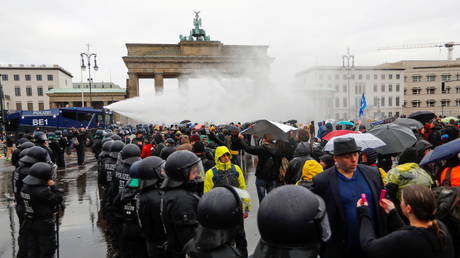 And it’s not just France. In Berlin last week, police fired water cannon and pepper spray at a crowd of people, including children, protesting against Germany’s coronavirus restrictions. In the aftermath, police justified the action saying people were refusing to wear face masks. So you blast them with water?
Spain, which suffered a particularly restrictive 100-day lockdown, has also seen trouble. On top of street protests by families missing their loved ones, there have been running battles with the police, barricades set on fire, and shops looted across the country.
Likewise in Italy, where even the Mafia is alleged to have joined in the looting and trashing of property, all in the guise of a coronavirus protest. Police there also used tear gas to disperse the crowds.
And it’s not just these nations. Protests in the UK have attracted thousands, the USA has seen violence flare at street marches, there have been rallies across the globe – Argentina, Brazil, Nigeria, Serbia, Russia, Australia, South Africa, Mexico. Even in countries most of us would struggle to find on a map, like Malawi.
Everywhere, the riot police have steamed in to break up crowds, leading to countless clashes and arrests creating even further upset. Is this where we are now? This is what this infernal Covid-19 virus has driven us to? Police in riot gear using batons, shields, water cannon and tear gas on their fellow citizens who are venting their anger, having become simply tired of being cooped up indoors?
Back in Paris, the young music producer who had been assaulted told journalists outside police headquarters that “people who should have been protecting me attacked me. I did nothing to deserve this.”
Anyone expecting some sort of climbdown from their government and public health officials has no doubt given up waiting by this point. Across the world, people are preparing for a crappy Christmas and grim warnings that breaching restrictions will mean a terrible price to be paid come the new year.
In France, the controversial new global security law has passed its first legislative stage, meaning anyone taking a photo or filming on-duty police that enables them to be identified faces a year in prison and a whopping €45,000 fine.
Prime Minister Jean Castex has suggested the government may backtrack on the controversial law but it’s naive to believe there’s any real honesty in that claim.
Meanwhile, French police will continue to pursue their thuggery, beating and teargassing innocent citizens, tipping people from their tents when clearing temporary camps of asylum seekers and trampling over protestors at will. Anyone caught filming them will simply be arrested and flung in jail.
No doubt this sort of behaviour will be repeated across the globe at organised protests against coronavirus restrictions wherever they may be. The lingering concern is that once this cursed pandemic passes, will things return to normal, where those we expect to protect us do just that?
Or has there been a subtle but sinister shift towards a more brutal state in many countries, where governments have been emboldened by newly tried and tested authoritarianism? Let’s see what answer to that 2021 brings.
Damian Wilson is a UK journalist, ex-Fleet Street editor, financial industry consultant and political communications special advisor in the UK and EU.
Could a Biden Presidency Mean Return to Humanitarian Bombing of ‘Pax Obama’?
By James Tweedie – Sputnik – 25.11.2020
After the ‘America First’ foreign policy of Donald Trump – the first elected US president since Dwight Eisenhower not to start a major war – Joe Biden’s election portends a re-run of the Obama years, when the promise of peace was betrayed.
Joe Biden says his cabinet appointments show “America is back” on the world stage – but is that really a good thing?
With former vice-president Biden looking increasingly secure in his claim on the White House despite ongoing legal challenges to the election process, how will his choices for his governing team shape foreign and domestic policy?
But Biden’s presidency is already looking like an unofficial third term for Barack Obama, with a host of familiar faces packing the White House. And with many of the architects of the last Democratic president’s foreign policy back in charge, will the world see a return to the ‘Pax Obama’ of ‘humanitarian bombing’ and regime-change after four years of President Donald Trump’s America First policy?
Foreign Intervention
Antony Blinken, Biden’s designate for secretary of state, was deeply involved in Obama’s string of overseas proxy wars as deputy national security advisor and deputy secretary of state.
Blinken supported the US-led NATO bombing campaign on Libya in support of the overthrow of the Green Revolution and the murder of its leader Colonel Muammar Gaddafi.
He also publicly justified the transfer of arms from Libya to sectarian militants attempting to overthrow the Syrian government, and was described by the Washington Post as “one of the government’s key players in drafting Syria policy” – which he frequently defended to Congress and the media, even as money weapons and recruits ended up in the arms of al-Qaeda and Daesh.
Blinken was also a point-man for Obama’s material support for the Saudi-led bombing and invasion of Yemen, which aid agencies say has caused a nationwide famine. His appointment belies Biden’s campaign-trail opposition to the Saudi war on its southern neighbour.
Speaking in the Saudi capital Riyadh in 2015, he said the bombing campaign sent a “strong message to the Houthis and their allies that they cannot overrun Yemen by force” – in reference to the sitting Yemeni government. “As part of that effort, we have expedited weapons deliveries, we have increased our intelligence sharing, and we have established a joint coordination planning cell in the Saudi operation centre.”Blinken supported Israel’s 2014 bombing of the Gaza Strip and has also signalled that Biden will maintain Israeli military dominance in the Middle East. Recently he said the new administration would reverse Trump’s decision to allow the sale of Lockheed F-35 Lightning II stealth attack jets to the United Arab Emirates in a “quid pro quo” for normalising relations with Tel Aviv.
Blinken has also taken a hard line on whistle-blowers, both domestic and foreign. He has previously said that National Security Agency leaker Edward Snowden should return to the US from Russia and face trial, and that he wished the Obama administration could have found a way to charge Wikileaks founder Julian Assange.
Like Obama, Biden has promised to end the “forever wars” in Iraq and Afghanistan, where the Trump administration signed a peace accord with the Taliban and is withdrawing troops.
But Blinken said this week that could simply mean major troop deployments would be replaced by “discrete, small-scale, sustainable operations, maybe led by special forces to support local actors” – precisely the model used in Syria against the will of its government. He also repeated unfounded claims that Russia had put bounties on the heads of US troops in Afghanistan.
Biden’s appointment of Avril Haines, a lawyer like himself and running-mate Kamala Harris, as the first female Director of National Intelligence is not a good omen for human rights. As deputy director the Central Intelligence Agency under Obama, she worked with director John Brennan on the policy of “targeted killings” in drone strikes in nations with which the US was not at war.
The American Civil Liberties Union was highly critical of that policy, and cast doubt on the Obama administration’s 2015 claim that it had only killed between 64 and 116 “non-combatants” – as a euphemism for innocent civilians – since Obama took office in 2009. The ACLU quoted figures from journalists and human rights groups of between 200 and 1,000 civilian killing.
Haines also overruled the CIA’s inspector-general to drop charges against agents who snooped on Senate staffers working on the congressional report into the spy agency’s use of torture. She later backed Trump’s 2018 appointment of current CIA Director Gina Haspel, who had herself been accused of involvement in torture.
“This is a pretty ominous signal about what is to come” a Senate staffer told the Daily Beast. “To have the deputy CIA director touted for her record in advancing human rights and respect for the rule of law I don’t think can be adequately squared with not only her record but her deliberate choices of advocacy.”
Immigration Tsar
Biden’s homeland security secretary will be Alejandro Mayorkas, has been described as a “refugee” as his Jewish parents emigrated from socialist Cuba to the USA in 1960 when he was just a year old – which does not bode well for US relations with Latin America’s many left-wing governments.
Pro-migrant activists were quick to welcome his appointment after Trump’s four-year crackdown on illegal immigration across the southern border with Mexico that saw the fees charged by “coyotes” – human traffickers – double.
“He will not only bring critical leadership but a set of life experiences that will animate the department’s work ahead,” American Immigration Lawyers Association executive director Benjamin Johnson.
Others hoped it meant an end to detentions of illegal immigrants at the border and a strengthening of the Deferred Action for Childhood Arrivals (DACA) programme created by Obama in a 2012 executive order.
DACA allows those brought to the US illegally as children to apply every two years for right to remain, but does not grant citizenship. Trump sought to end the programme, saying he wanted Congress to legislate a permanent replacement, but was blocked by legal action from civil rights groups.
“We look forward to the immediate expansion of the DACA program and the dismantling of the detention and deportation machine that was created under Obama and expanded by Trump,” said immigrant legal aid charity RAICES chief advocacy officer Erika Andiola. “Leading this department will be no easy task, but we hope that as the first Latino and someone who has advocated for immigrant rights, he will change the direction of DHS once and for all.”
Featured Video

Chinese jet fuel and the myth of energy independence
or go to
Aletho News Archives – Video-Images
Book Review
Former Insiders Criticize Iran Policy as U.S. Hegemony
By GARETH PORTER | CounterPunch | February 27, 2013
“Going to Tehran” arguably represents the most important work on the subject of U.S.-Iran relations to be published thus far.
Flynt Leverett and Hillary Mann Leverett tackle not only U.S. policy toward Iran but the broader context of Middle East policy with a systematic analytical perspective informed by personal experience, as well as very extensive documentation.
More importantly, however, their exposé required a degree of courage that may be unparalleled in the writing of former U.S. national security officials about issues on which they worked. They have chosen not just to criticise U.S. policy toward Iran but to analyse that policy as a problem of U.S. hegemony. … continue
Blog Roll
 Aletho News
- What is fueling unrest across the EU?
- Why no power can undermine Iran’s eternal dominance over the Strait of Hormuz
- Is The War Against Iran Over?
- Iran war will leave long-term ‘scar’ on Wall Street, investors warn
- How Iran decimated US power projection in West Asia: Military lessons of 40-day war
- Iran’s report details US-Israeli war crimes in targeting schools, hospitals, livelihoods
- NATO’s Slow Fracture: How Trump’s Iran War Exposed the Instrument of Hegemony
- Chinese jet fuel and the myth of energy independence
- Ukraine Sea Drone Fired From Libya Hit Russian Tanker in Mediterranean
- IRGC: Iranian forces launched no attacks during ceasefire hours
- If Americans Knew
- DNC Shoots Down Resolutions Calling Out AIPAC and Limiting Arms to Israel
- TCN: Is Israel Blackmailing President Trump?
- Israel killed at least 303 Lebanese yesterday – who were they? Daily Update
- Amnesty: Urgent – Protect Lebanese civilians from brutal escalation in Israeli attacks
- Is The War Against Iran Over?
- Inside the Israeli army’s propaganda wing
- Hundreds of Gaza Amputees Stranded in Legal Limbo
- The gallows law: Israel moves toward executing Palestinian children
- Tucker Carlson: The Path to Peace requires ending ‘special alliance’ with Israel
- This is ceasefire? Israel’s biggest massacre yet in Lebanon, another journalist killed in Gaza – Daily Update
- No Tricks Zone
- An Inconvenient Tree: Uncovered In Alps… Europe Much Warmer Than Today 6000 Years Ago
- New Study Reports A 60% Slowdown In Greenland’s Ice Loss Rate In The Last Decade
- Low Intensity Tornado Wrecks Major Solar Farm, Creating A Potential Toxic Dump
- New Study Finds Warming Saves Lives…Cold Temperatures 12 Times More Deadly Than Excess Heat
- German Science Blog Accuses PIK Climate Institute Of Hallucinating Climate Tipping Points
- Devastating Assessment Of Comirnaty Vaccine By Former Senior Pfizer Europe Toxicologist
- New Study: CO2 Is ‘Effectively Negligible’ As An Explanatory Climate Change Factor Since 2000
- Former Pfizer Toxicologist Dr. Helmut Sterz Tells Bundestag Hearing Pfizer Vaccine Should Have Never Been Approved
- Energy Expert: Germany’s Nuclear Phaseout Was A “500 Billion Euro Mistake”
- New Research: South Australia’s Mid-Holocene Sea Surface Temperatures Were 4°C Warmer Than Today
 Aletho News