The Cost of American Militarism and an Absence of Debate

By Adeyinka Makinde | November 16, 2018
A recent report by Brown University’s Watson Institute of International and Public Affairs on the cost of America’s wars in the aftermath of 9/11 estimates a sum totalling $5.9 Trillion. It is a figure virtually identical to the $6 Trillion figure projected by Harvard University’s Kennedy School of Government in 2013 to be the eventual cost of waging wars in Afghanistan and Iraq. Yet, as with the case of the increased danger of a nuclear war that could be the fruit of strained relations developed over the past decade with the Russian Federation, there has been no public debate in the United States about why America embarked on a programme of militarism predicated on the waging of a so-called War on Terror.
Such debate would necessarily have to centre on the three following areas:
- The “hijacking” (to use the term chosen by retired US Four Star General Wesley Clark) of American foreign policy in the aftermath of the September attacks by a group of neoconservatives operating within the administration of President George W. Bush who drew up a ‘hit-list’ of seven countries intended to be destroyed over a five year period.
It would have been expected that all such countries earmarked for destruction would have had a connection to the planning of the September attacks, or, at least, have been sympathetic to the values guiding the alleged perpetrators of the deadliest attack on American soil since Pearl Harbor in 1941. Yet Iraq, Libya and Syria were all secular Arab states implacably opposed to the Sunni Islamist ideology of al-Qaeda, and Iran is a Shia nation. The common denominator among these states including Lebanon, or more accurately, Hezbollah, the Iranian-backed Lebanese Shia militia, was an enmity with the State of Israel.
As Clark stated during a speech given in October 2007 at the Commonwealth Club of California in San Francisco, there was never a public debate on a policy which commenced with the invasion of Iraq and was intended to be completed with an attack on Iran.
- The unchanging policy from the administrations led by Bush Jr to Barack Obama and now Donald Trump due to ‘Deep State’ actors wielding power outside of the separated organs of government. In a scholarly paper-turned-book entitled National Security and Double Government, Michael J. Glennon, a professor of international law at Tufts University, has referred to the power usurping “Trumanite” institutions in contrast to the troika of “Madisonian” institutions of state, which he persuasively argues are no longer accountable in the way people think they are.
- The corporate welfare culture surrounding the military industry as composed of the Pentagon and corporations such as Lockheed Martin, Boeing, Raytheon and others. The exorbitant costs involved with the development of the F-35 fighter plane which according to a number of US generals is pretty much “useless”, is emblematic of the inefficient weapons development regime that is more concerned with lining the pockets of corporations than with efficiency and cost-effectiveness.
The aforementioned, of course, do not mention the human cost: that of innocent civilian lives destroyed by military invasions, drone attacks and covert wars initiated by the United States. It also does not include the number of US service personnel killed, maimed and suffering from mental traumas.
All need to be factored into a comprehensive debate on why America’s sovereign debt has spiralled to uncontrollable levels, and also, why the moral standing of the United States among the international community of nations has been brought down to an all-time low.
© Adeyinka Makinde (2018)
Former Sen. Barbara Boxer’s Son and California Powerbroker Found Bilking Indian Tribe
Judges Find Breach of Contract and Trust
By Peter Byrne | Consortium News | November 16, 2018
Darius Anderson is one of California’s most powerful men. He promotes himself as a champion of liberal social causes, a philanthropist, a public servant, a man of integrity who cares about his community—especially racial minorities.
That image has not survived judicial scrutiny. A panel of arbitration judges has found that a company controlled by Anderson and his partner, Douglas Boxer, the son of former Senator Barbara Boxer, defrauded its Native American clients in a Bay Area casino deal. The partners convinced the Federated Indians of the Graton Rancheria to buy undevelopable swamp land in which they themselves held a large interest. They then made a secret deal with a Las Vegas gambling corporation in which they benefited at the Graton tribe’s expense.
The two-month long judicial proceeding took place behind closed doors at the San Francisco office of JAMS, a high-profile group of legal mediators formerly known as Judicial Arbitration and Mediation Services. A final binding arbitration award issued in April by the judging panel was confirmed by Superior Court Judge Richard Ulmer on June 1. That outcome has drawn almost no publicity. The only media to report on the findings of fraud against Anderson and Boxer is the North Bay Bohemian, a local alternative weekly newspaper.
For decades Anderson has advised and raised campaign funds for prominent state Democrats, including Nancy Pelosi, leader of the Democrats in the U.S. House of Representatives, and Jerry Brown, governor of the west coast state.
Another of his high-profile clients is Barbara Boxer, the longtime U.S. senator from California who retired in 2017. Her son Douglas partnered with Anderson in what judges found to be acts of fraud and deception against the Federated Indians of Graton Rancheria that began after Sen. Boxer pushed through legislation restoring the tribe’s sovereignty and granting it the right to run a casino.
The case raises comparisons with the 2005 Jack Abramoff Indian lobbying scandal, in which powerful consultants charged exorbitant fees to Indian clients seeking to develop casinos on their reservations. As such it adds another installment to the history of white men breaching trust with Native Americans for economic gain that began with European settlement of this continent. This case has a happier ending than is usual.

Sen. Boxer: Pushed bill to give tribe sovereignty. (Flicker: Shotgun Spratling)
Local Empire
Anderson, 53, oversees a restaurant and media empire in Napa and Sonoma Counties, 40 miles north of San Francisco. He owns a culinary school called Ramekins and he is the managing member and chairman of Sonoma Media Investments, which owns the Santa Rosa Press Democrat and its affiliate publications, which includes most of the newsprint media in the two-county region. In September, the Press Democrat reported a 900-word story about the arbitration findings that portrayed the tribe and Anderson as having settled a contractual “dispute”—the “fraud” word was not mentioned and the details of the deceptions were not exposed.
Anderson is much more that a restaurateur and newspaper publisher. His California-based lobbying firm, Platinum Advisors, advertises that it generates “billions of dollars in work for our clients” by navigating their deals through mazes of local, state, and federal government bureaucracies. Another of his companies, Kenwood Investments, is developing upscale housing and yacht havens on Treasure Island, a fabulously valuable island in the San Francisco bay built in 1939 as a World’s Fair site.
The business name that is key to this story is Kenwood Investments No. 2. Three retired state judges in the arbitration process declared in April that Anderson and his partners in “Kenwood No. 2” defrauded the Federated Indians of Graton Rancheria of millions of dollars between 2002–03 and committed many acts of deception. They ordered Anderson’s investment firm to pay three quarters of a million dollars to the tribe to cover its lawyer’s fees and arbitration costs.
According to the judges, Anderson breached his consulting contract with the tribe, which now owns the Graton Resort & Casino in Rohnert Park. The judges found that Anderson and his associates “fraudulently induced” and “breached” an agreement to assist the tribe in developing a Las Vegas-style casino business.
The ruling, by retired Superior Court judges William Cahill, Read Ambler and Richard A. Kramer, concludes a long legal battle that was instigated not by the wronged party, but by Anderson, as he sought to further enrich his business at the tribe’s expense.
In a settlement arrangement, Kenwood No. 2 agreed not to appeal the judges’ findings. Anderson’s firm will pay less than the dollar amount of the award, says Joel Zeldin, the tribe’s arbitration counsel. There are no charges of criminal fraud pending against Kenwood No. 2, but the three judges, one of whom was chosen by Anderson’s firm, did their best to restore justice: “Even if the Tribe was willing to overlook Kenwood No. 2’s unethical behavior, the courts and these arbitrators will not.”
Summary of Violations
The 53-page arbitration report details how Darius Anderson and the senator’s son, Douglas Boxer, harmed the Federated Indians of Graton Rancheria over the course of several years. In summing up their findings, the judges’ panel found that Anderson and Boxer had violated their duty to be loyal to the tribe in the following ways:
• Anderson and Boxer represented that Kenwood No. 2 had experience and abilities that it in fact lacked.
• Kenwood No. 2 breached its contract when it bought an option on wetlands without telling the tribe, and then promoted the land to the tribe for the casino site despite its unsuitability for development.
• Anderson and Boxer sent out bid solicitations for a casino manager that benefited Kenwood No. 2 at the expense of the tribe and without telling the tribe of the existence of the “requests for proposals” or RFPs.
• They rejected a proposal that was the most favorable to the tribe without telling the tribe or informing it of that bidder’s reservations about irregularities in the contractual terms proposed by Kenwood No. 2.
• They entered into undisclosed consulting agreements “to the detriment” of the tribe, some of which involved conflicts of interest.
• “Despite causing major problems and providing virtually no effective assistance to the Tribe,” Anderson claimed that it was the tribe that had breached the consulting agreement with Kenwood No. 2. Anderson’s pursuit of his “unmerited” claim against the tribe caused it to spend significant amounts of money and to “suffer business risks and distractions.”
The judges ordered Kenwood No. 2 to pay the tribe’s attorney fees and costs of $725,657.48, and to receive nothing for itself.
Anderson did not respond to multiple requests for comment.
Boxer’s Role
Douglas Boxer: In on deal with Anderson. (YouTube)
Boxer was involved as a lobbyist for Platinum Advisors and as Anderson’s partner in Kenwood Investments No. 2. His mother, the now-retired U.S. senator, in 2000, wrote federal legislation that restored the national sovereignty of the Federated Indians of Graton Rancheria and authorized the tribe to establish a casino business.
In early 2002, Anderson and Boxer approached the tribe’s chairman, Greg Sarris, a novelist and professor of creative writing and Native American studies at Sonoma State University. They proposed that the newly empowered tribal nation hire Platinum Advisors to help it acquire reservation land and start a business to make it self-sufficient. Anderson and Boxer told Sarris that Platinum Advisors had “significant real estate development experience and connections with local, state and federal politicians,” according to the arbitration award. They proffered a platform of consulting services for a monthly retainer of $1,000, with payment deferred and contingent upon success.
Sarris trusted Boxer because the lobbyist’s mother had sponsored the legislation that re-established the tribe’s sovereignty. After Anderson presented a promise-filled PowerPoint to the tribal council, it voted to hire Platinum Advisors, ultimately paying it $1.2 million.
Fifteen years later, arbitrators declared that Anderson and Boxer had breached their contract to deliver adequate professional services in the tribe’s interest, damaging the casino project’s prospects. According to the arbitration document, the Graton Rancheria was afraid to expose these actions when it discovered what Anderson was doing in 2003, fearing political retaliation by the consultants.
The story only came to light because in November 2013, Anderson demanded that the Graton Rancheria pay Kenwood No. 2 a percentage of the projected revenue from its recently opened casino. Anderson insisted that the tribe pay his firm $43 million; he threatened to compel arbitration if it refused.
The tribe refused. It sued Kenwood No. 2 in state superior court, claiming that its sovereign immunity prohibited Anderson from compelling arbitration of his claim.
In November 2015, the court ruled that the tribe had waived its sovereign immunity defense in its contract with Anderson. In 2017, that judgment was affirmed by the appellate court, and the JAMS arbitration commenced.
Anderson claimed 2.5 percent of the Graton Resort & Casino’s net revenue for the first seven years of its operation, despite the fact that after 2005, the tribe had ceased doing business with his company. Insisting that the Graton Rancheria had “unjustly enriched” itself at the expense of his firm, Anderson demanded that it pay his attorney fees, too.
But it was the tribe, not Anderson, that had been wronged, the retired judges ruled. After months of sworn testimony, the panel ordered Kenwood No. 2 to pay the tribe’s attorney fees because it was Kenwood No. 2 that had breached the consulting contract, and Anderson’s claims to the contrary “lacked merit.”
The two trials generated thousands of pages of testimony, depositions and exhibits. The court record of the arbitration award was partly redacted and relabeled at Anderson’s request, according to Zeldin, the tribe’s arbitration counsel.
Anderson’s and Boxer’s names are replaced by “Person A” and “Person B,” respectively. “Platinum Advisors” is replaced with “Company 1.” “Kenwood No. 2” replaced “Kenwood.” The names of politicians and descriptions of their actions are blacked out. But who they are and what they did is clear from the narrative context and from contemporaneous news reports.
How It Began
In March 2002, the Graton Rancheria signed a contract with Platinum Advisors as its “exclusive agent” to provide it with “strategic advice and consultation” and to develop “political visibility.” The contract granted Platinum a right of first refusal to “partner with the tribe in any business opportunity it pursued.” The idea was to attract investors.
From the get-go, Boxer worked to convince the tribe how “‘much of a home run a casino would be’ rather than organic food processing, grape growing, strip mall, or senior assisted living facility,” according to the arbitration award. It did not take much convincing. Casinos are famous magnets for cash. Even as Anderson and Boxer worked with the tribe on a public relations campaign to further a casino project, they were making secret deals to benefit themselves, the arbitrators found.
According to a declaration filed by Anderson in 2015, he, Boxer, Jay Wallace of Platinum Advisors and Stuart Sunshine, a San Francisco city official, created Kenwood Investments No. 2 LLC in January 2003.
Anderson. (Platinum Advisors)
The arbitration judges ruled that Anderson’s new company shadowed Platinum Advisors’ tribal consulting activities, while serving a hidden agenda to make money for its principals—at the tribe’s expense.
Without informing Sarris or the tribe, Anderson and Boxer struck a deal to buy 1,736 acres of tidal wetlands near Highway 37, a major road connecting San Francisco to the nearby city of Oakland.
Kenwood No. 2 paid $100,000 for an option to purchase the swampy property, eventually billing the tribe $750,000 for it.
As Kenwood No. 2 was secretly securing the option, Platinum Advisors was advising the tribe to select the Highway 37 site for its casino, even though it was a politically impossible place to pour acres of concrete.
“The site was part of 50,000 acres of tidal wetlands that conservationists had been trying to protect and restore since the 1970s,” noted the arbitration judges, who were incredulous that Anderson had suggested it. The attempt to locate the casino on the wetlands site proved to be a public relations and monetary disaster for the tribe.
As Anderson and Boxer were negotiating to buy the swampy land in late 2002, they were also negotiating casino-management deals with several Las Vegas–based casino operators, including Station Casinos, Harrah’s, Maloof and MGM, without telling the tribe.
In February 2003, Anderson sent a request for proposals to potential casino operators. The proposal represented Kenwood No. 2 as the “exclusive development partner” and “financial advisor” for the tribe. The RFP stated that Kenwood No. 2 would evaluate the bid proposals and select the casino manager for the tribe.
Kenwood No. 2 had no contractual relationship with the Graton Rancheria when it issued the RFP. The tribe’s contract was with Platinum Advisors.
According to the arbitration award, “the evidence established that the Tribe was unaware that Kenwood No. 2 had sent an RFP to operators and had not approved the contents of the RFP drafted by Kenwood No. 2.”
Strange Bidding Terms
The trial revealed that Anderson’s RFP instructed potential casino operators to bid their services on the basis of several unusual assumptions:
• The operator would commit to buying Kenwood No. 2’s option to purchase the Highway 37 land and then buy the land from the seller on behalf of Kenwood No. 2, which would be the “titleholder.” The RFP assumed that the casino would be built on the Highway 37 site controlled by Kenwood No. 2 and that there were no other possibilities.
• The operators could charge the tribe 20 percent of the casino’s net revenues and were to “assume a management fee to Kenwood No. 2 of 10 percent of net gaming revenues.”
• The operators would pay Kenwood No. 2 “development fees” of $2.5 million up front to purchase the option on the Highway 37 site, and another $2.5 million when the tribe took over the site—$5 million total.
• “Lastly, operators were required to pay Kenwood No. 2 ‘pre-development fees’ of $8.4 million ($200,000 per month) for advisory and consulting services.”
The operators were not required by the RFP to make upfront cash payments to the tribe, or to provide any specific amounts of money for the tribe’s maintenance costs (i.e., its ability to maintain its existence until the casino began generating revenue).
Anderson received and evaluated four responses to the RFP, which he did not share with the tribe. Notably, Harrah’s proposed to take up to 24 percent of the net gaming revenue as its management fee. Improving on the terms of the RFP itself, Harrah’s offered to pay $100,000 a month to the tribe for its operating expenses, along with a $4 million pre-development fee. Harrah’s also offered to donate $100,000 per year to set up an educational scholarship fund for tribal members. And it offered to make a one-time $25 million “quality of life” loan to address tribal citizen’s needs for housing and medical care.
Harrah’s declined to pay a percentage of net revenues to Kenwood No. 2, although it offered to pay Anderson $50,000 a month in consulting fees, if the tribe approved of the arrangement. Harrah’s pointed out that such an arrangement with a consultant was not a normal business practice; it would have to be approved by the National Indian Gaming Commission.
Harrah’s expressed concern about the legitimacy of Anderson’s claim to be representing the tribe’s interests. It asked to be put directly in touch with the tribal council before proceeding further. Anderson rejected Harrah’s proposal without consulting with Sarris and the tribal council or informing them of the proposal’s existence.
Watch Peter B. Collins interview Peter Byrne on Boxer, Anderson fraud (Article continues below):
A Better Deal—For Anderson
Station Casinos’ response to the RFP was far more favorable toward Anderson. It suggested that Kenwood No. 2 and Station Casinos partner to manage the casino. It proposed divvying up 30 percent of the casino revenues—20 percent to Anderson’s firm, 80 percent to Station.
The Las Vegas–based corporation offered to pay Anderson $10 million cash up front and $15,000 a month for consulting services. It offered $100,000 a month for tribal operations, but it did not offer the tribe any pre-development fees, scholarships or loans.
On March 7, 2003 Anderson and Boxer asked the Graton Rancheria to assign the Platinum Advisors contract to Kenwood No. 2, and claimed it would not change the terms of the agreement.
But the assignation did change the terms of the agreement. The new arrangement gave Kenwood No. 2 new authority to act as the tribe’s exclusive agent. Kenwood No. 2 was allowed to negotiate a cut of the casino operator’s management fee for itself. And, importantly, the tribe agreed to waive its sovereign-immunity defense in the case of a contract dispute—a concession it later regretted.
Anderson and Boxer had been negotiating with gaming corporations since the fall of 2002. They first told Sarris and the tribe that they had issued RFPs on March 11, 2003.
Brian Campbell, a tribal member doing legal work for the tribe, got wind of the RFP and asked Boxer for a copy. Boxer gave Campbell a copy but did not tell him about the responses that had been received.
Boxer later testified under oath that he had given drafts of the RFP to the tribe before it was sent out in 2002. The tribe’s witnesses testified that Boxer did not do that. Campbell testified that he was surprised that Anderson had asked for 10 percent of the gaming revenues and $5 million in upfront fees in the RFP.
On March 14, 2003, Anderson told the tribal council about the existence of RFP responses. He did not disclose Harrah’s offer to the tribe of tens of millions of dollars in cash.
Anderson told the tribe that Station Casinos had made the best proposal for “superior overall economics.”
Even as members expressed outrage at Anderson’s self-dealing behavior, the tribal council accepted his recommendation that Station Casinos be selected as its casino operator.
Time to Hire Lawyers
Suspecting that Anderson was more motivated to benefit himself than the tribe, the Graton Rancheria hired attorneys from California Indian Legal Services to watch over its interests. These lawyers noted that it was a conflict of interest for Anderson to negotiate with Station on behalf of the tribe while he was also negotiating with Station on his own behalf for a cut of the management fees. Anderson agreed that he would not negotiate a separate deal.
On April 22, 2003, the tribe signed the revised agreement with Kenwood No. 2. It provided that Anderson’s company would receive 4 percent of the net gaming revenues for seven years (later reduced to 2.5 percent). Anderson agreed to donate $25,000 annually to the UCLA College of Indian Law Program. (UCLA declined to confirm if the donations were made.)
The next day, according to trial exhibits, Anderson secretly made a separate consulting agreement with Station Casinos, despite his promise that he wouldn’t.

The Graton Resort Casino. (gratonresortcasino.com)
Kenwood No. 2 contracted to assist Station Casinos “maintain its relationship” with the tribe. Station Casinos agreed to pay Anderson $20,000 per month and it bought the option on the Highway 37 site for $750,000, netting Kenwood No. 2 a $650,000 profit. (The tribe later reimbursed Station for the option payment).
Station Casinos agreed to pay Anderson a total of $9.5 million for achieving various “milestones” as it helped the tribe to navigate the bureaucracy of getting its casino up and running.
Anderson did not tell the tribe about his side deal with Station Casinos. “The evidence indicates that Kenwood No. 2 intentionally kept information regarding the Station/Kenwood No. 2 agreement secret from the Tribe,” the arbitrators found. “[Exhibit] 490 [Douglas Boxer] notation: ‘don’t tell Sarris: negotiation.’”
Boxer did not respond to multiple requests for comment.
In fact, the tribe did not learn of the secret side agreement’s existence until June 2003, when Station Casinos included a copy of the side agreement in the paperwork accompanying its negotiations with the tribe, the arbitrators found. Station Casinos declined to comment.
Picking on the Wrong Wetland
On the same day they signed the side agreement, Station Casinos and Anderson announced that the Graton Rancheria planned to develop the Highway 37 site for a casino. A coalition of environmental groups that supported the Bay Delta Restoration Plan to restore local wetland habitats enlisted local, state and federally elected officials to vehemently oppose erecting the casino.
The tribe’s attempt to “appease these groups by offering to restore hundreds of acres of wetlands on the property” was a non-starter. After Diane Feinstein, a U.S. senator from California, “threatened to redraft the Tribe’s restoration language to obstruct the Tribe’s ability to open a casino anywhere,” the Graton Rancheria backed down and nixed the wetlands as a possibility.
The tribe ended up paying for and donating the Highway 37 wetlands to the Sonoma County Land Trust, which has restored it. The wetlands debacle ended up costing the tribe about $5 million, which included paying for the unusable land and for Kenwood No. 2’s profit on the land-purchase option.
Without Anderson’s assistance, Sarris and the tribe went looking for an alternative site to build their casino, and eventually bought 270 acres in Rohnert Park for $100 million, which it borrowed from Station Casinos. The tribe had little or no contact with Anderson and Boxer after 2005, when it stopped using their services.
Boxer testified that Kenwood No. 2 did significant work for the tribe prior to 2006. The trial record reports that in 2004 Boxer “‘killed’ a bill” in the state assembly that would “require gaming tribes to negotiate with local governments to mitigate the impact of casinos.”
Boxer said at trial that he had designed publicity and lobbying campaigns for the tribe; helped it to create a financial budget and to find office space; and “assisted tribal members in securing personal loans.”
The arbitrators determined that lobbying on the tribe’s behalf violated California law because Kenwood No. 2 was not a registered lobbying firm. Regardless, the judges found that Anderson and Boxer did not materially assist the tribe in jumping through the complicated governmental, environmental and financing procedures necessary to obtain a gaming compact and open the casino.
Sarris testified that the tribe felt that “Kenwood No. 2 was providing little or no value . . . and the Tribe wanted to sever its relationship with [Anderson and Boxer] but was afraid that if it did so, [they] might retaliate and use [their] political connections against the Tribe.”
The tribe estimated that it ended up paying Kenwood No. 2 $10,000 an hour for the services it did receive before the contract ended.
Nonetheless, the tribe invited Anderson and Boxer to attend the opening party for the Graton Resort and Casino on Nov. 5, 2014. That same day, Anderson demanded that the Federated Indians of Graton Rancheria wire a payment of $43 million to his bank account.
A version of this story was first published on Bohemian.com as “Graton Expectations.”
Northern California-based journalist Peter Byrne combines investigative reporting with science writing. In 2017, Peter’s 11-part series in the Point Reyes Light “Busted: Breast Cancer Money and the Media” won the top science writing award from the American Association for the Advancement of Science. He has received national, regional, and local recognition for investigative work, writing style, and in-depth profiles of politicians and scientists. Peter reports on terrorism and its twin, counter terrorism, from epicenters of violence such as Mosul, Iraq and Orange County, California. He has written highly regarded books on quantum physics and writes for many publications, including Scientific American, New Scientist, Quanta, American Consequences, Mother Jones, and the North Bay Bohemian. He can be found at www.peterbyrne.info.
How Elites Use Mainstream Media to ‘Maintain and Expand Their Power’

By Kit Klarenberg – Sputnik – November 16, 2018
For quite some time, debate about ‘fake news’ has reverberated clamorously in both mainstream and alternative discourse. One could easily conclude the issue was a pressingly new plague, restricted to certain corners of the web – but academic TJ Coles begs to differ. In fact, he tells Sputnik fake news has been ubiquitous for thousands of years.
It’s difficult to pinpoint the precise moment the term ‘fake news’ entered the Western political and media lexicon, but the election of Donald Trump as US President certainly turbocharged its usage. For the controversial leader and his supporters, the label can be automatically applied to any and all media reporting critical of him, while his opponents play much the same game when roles are reversed.
This tit-for-tat sparring inspired TJ, director of Plymouth University’s Institute for Peace Research, to write a book on the subject — the fruit of his labours, Real Fake News: Techniques of Propaganda and Deception-based Mind Control, was published in September.
“All that talk made me think ‘hang on a minute, we’ve always had fake news’. It’s the nature of power — all power structures want to maintain and expand their power, so it’s therefore important to present information that benefits them, and keeps populations in a psychological and/or intellectual prison. The ‘fake news’ peddled by elite financial, commercial and political financial interests, duly regurgitated by major media organizations, eclipses any bogus story perpetuated by alleged ‘bots’ on Twitter, or whatever,” TJ says.
Babylonian Beginnings
In his work, TJ traces the birth of fake news all the way back to ancient Babylon, when rulers sought to perpetuate the notion they were descended from Gods and thus had a right to dominate and control the populace — history’s first recorded instance of the ‘divine right of kings’.
Similarly, Plato famously popularized the idea of the ‘noble lie’ — privileging untruths told for the benefit of elites and the population alike. These ideas very much endure in the modern day — TJ notes Wikileaks’ dump of the Clinton campaign’s internal emails amply demonstrates her team felt it wouldn’t be good, or necessary, for Hillary’s supporters to be aware of her close connections to Wall Street, so did their utmost to conceal the mephitic kinship.
“Elites the world over are acutely aware information is power, and actually quite open about their use and abuse of the news to shape public perceptions and preserve sociopolitical conditions benefitting them. For instance, the UK Ministry of Defence regularly publishes projections of how planners think the world will look in 10 — 20 years, and they routinely note the media is one of the key ways to maintain the current paradigm, and discuss the various ways information can be ‘weaponized’ against the public,” he says.
TJ suggests elites shape and control the public mind so effectively because they exploit fundamental facets of human nature. First, the well-established instinctive inclination to reflexively believe something reinforcing one’s existing beliefs, rather than assessing whether alternative facts or viewpoints have any value, or indeed considering whether what one believes might be wrong, or informed by confirmation bias.
This tendency is greatly exacerbated by the use of internet and social media algorithms that present a ‘personalized’ picture of the world to users, unfailingly presenting individuals with content they want to see, and tacitly suppressing information contrary to their existing opinions.
“Elites also know how easy it is to exploit guilt, which is why atrocity propaganda is so widespread today. Most sympathize with the victims of major atrocities, and naturally want to do something to help, so this aspect of human nature can be easily manipulated to justify aggressive foreign policy actions — ‘look at what we’re letting happen to poor defenceless people, we have a responsibility to protect them’ etcetera. It’s funny, when it comes to the economy, the powerful are quick to say people are naturally selfish, so it’s everyone for themselves, but when it comes to foreign policy, we should care about our fellow human beings and do something to help,” TJ says.
Evidence
As the academic’s work makes clear, atrocity propaganda doesn’t even need to have any grounding in reality whatsoever. In the lead-up to the NATO-backed violent overthrow of Libyan leader Muammar Gaddafi in 2011, the mainstream media was awash with reports government forces fuelled by viagra were conducting mass rapes of civilians, and planning a borderline genocidal massacre of rebel forces — claims used to justify the imposition of a no-fly zone over the country, and NATO airstrikes.
The stories were subsequently found to be entirely without foundation — similarly, serious question marks hover over the veracity of numerous claimed chemical weapons attacks in Syria, which likewise have provided a pretext for Western attacks on the country.

© Flickr / Thierry Ehrmann
“It’s especially easy to exploit guilt when you present bite-sized news reports about an atrocious event stripped of all context, and exclude the voices of people who are actually on the ground. Occasionally, contradictory voices do filter through the system, although largely by accident. For instance, the BBC made the mistake of inviting Peter Ford, former UK ambassador to Syria, on air to discuss chemical weapons attacks — he quickly demolished their propaganda. He hasn’t been invited back since,” TJ says.
Ford is surely but one of a great many talking heads to effectively be banned from appearing on the BBC for daring to state views and evidence contrary to ascendant elite narratives. However, the British state broadcaster’s blacklisting activities also extend to its own employees — in April 2018, the BBC admitted that for decades, job applicants and serving staff were subject to political vetting by MI5, in an effort to prevent “subversives” gaining employment with the Corporation.
Often, individuals were ostracized on extremely tenuous grounds. For instance, respected film director John Goldschmidt was blacklisted in the late 1960s, with two projects he was working on for the Beeb cancelled midway through production without warning or explanation — MI5 deemed him a potential subversive as he’d spent a few weeks in Czechoslovakia in his youth, as part of a student exchange program. Similarly, award-winning journalist Isabel Hilton was refused a job by BBC Scotland in 1976 — that she spoke Chinese and had been a member of Scottish China Association at Edinburgh University made MI5 extremely anxious.
Under the policy, popular children’s book author and playwright Michael Rosen was also outright sacked from the BBC in 1972 while a graduate trainee for a number of ‘transgressions’, including student activism at Oxford, and producing a film featuring clips of US soldiers being tested with LSD. The American Embassy in London complained about the project to both MI5 and the BBC directly, whereupon Rosen was shown the door.The policy was wound down in the 1990s, and it’s unknown whether any comparable structures existed at other major news organizations — although City University research suggests dissenting voices remain rare in the British mainstream media. The 2016 study concluded UK journalists are overwhelmingly white, male, and elite-university educated — and are far more trusting of politicians, the government, police and military than the general population, which the study’s authors partly attributed to reporters’ “reliance on these institutions as sources of information”.
Such widespread faith in the establishment may account for why so many prominent reporters see no problem with maintaining close relationships with the intelligence services. The Guardian’s Luke Harding has frequently, openly and proudly advertised his warm bond with British spying agencies in articles and books — and equally frequently been condemned for uncritically running stories of questionable probity potentially provided to him by agency staff. In a September article he claimed Russian diplomats had held secret talks in London with associates of WikiLeaks founder Julian Assange, in an attempt to assist in his escape from the UK. The covert action would’ve allegedly seen Assange smuggled out of the Ecuadorian embassy in Knightsbridge under cover of Christmas Eve in a diplomatic vehicle and transported to Moscow.
The story was entirely based on the testimony of anonymous sources, the identity of which Harding didn’t even hint at in the piece. In response, Craig Murray, former UK Ambassador to Uzbekistan, slammed the article, calling it a “quite extraordinary set of deliberate lies” and “entirely black propaganda” published by an “MI6 tool”.”I was closely involved with Julian and with Fidel Narvaez of the Ecuadorean Embassy at the end of last year in discussing possible future destinations for Julian. It is not only the case Russia did not figure in those plans, it is a fact Julian directly ruled out the possibility as undesirable. The entire story is a complete and utter fabrication. It is very serious indeed when a newspaper like the Guardian prints a tissue of deliberate lies in order to spread fake news on behalf of the security services. I cannot find words eloquent enough to express the depth of my contempt for Harding and Katherine Viner, who have betrayed completely the values of journalism,” Murray wrote.
Similarly, in 2007 the Campaign Against Sanctions and Military Intervention in Iran published an analysis of 44 articles written by Daily Telegraph Defence Editor Con Couglin on Iran — including stories suggesting North Korea was helping Iran prepare a nuclear weapons test, and Iran was grooming Bin Laden’s successor. They found the pieces almost invariably; were based on “unnamed or untraceable” sources in intelligence agencies or the UK Foreign Office and “published at sensitive and delicate times” when there’d been “relatively positive diplomatic moves” towards Iran; contained ‘exclusive revelations’ about Iran combined with eye-catchingly controversial headlines, which were typically drawn from a single sentence in the wider article.
Prison Break
Despite his bleak analysis, TJ does not view the elite monopoly on information as insurmountable, or invincible — there’s much individuals and groups can do to shatter the stranglehold.
“People should keep a keen eye on sources that analyse news reporting and misreporting, such as Glasgow University Media Group and MediaLens, which offer alternative information and tell you what media coverage is actively omitting from the real story. However, change must come from within too — people should divorce themselves from preconceptions, and question their beliefs wherever and whenever possible. When presented with information that doesn’t conform to our predispositions, we should ask ourselves whether it’s true, rather than reflexively dismissing it outright,” TJ says.
While having less trust in the media more generally is a must, the academic also warns against placing too much faith in alternative news outlets and social networks, despite them being valuable resources with a significant positive potential.
“Independent media is growing in size and strength, but its overall reach is still relatively tiny — while print circulation is obviously down, people still get the vast bulk of their information from mainstream outlets. Similarly, social media could’ve democratized the spread of information, but it hasn’t — and in fact any such potential has probably been permanently neutered by the proliferation of ‘fact-checking’ resources, which are anything but unbiased and disinterested arbiters of truth,” TJ notes.
One-such ‘fact-checker’ is the Atlantic Council, a NATO-offshoot with a board of directors comprised of a ‘who’s who’ of contentious US political figures, including Henry Kissinger, Condoleezza Rice, Colin Powell, Robert Gates, Michael Hayden and David Petraeus, among others.
It partnered with Facebook in May to “independently monitor disinformation and other vulnerabilities” and combat the spread of fake news on the platform. To date, the collaboration has resulted in untold hundreds of pages and personal accounts being shut down — rather than being promulgators of propaganda though, the overwhelming bulk of the banished were alternative news sources, political organizations and individuals, highlighting issues and events the mainstream media downplays or ignores, such as US interventionism, drug legalization and police brutality.
Moreover, that elites exploit social media’s information-sharing capabilities to suit their own objectives is well-established.”The US State Department has used major social networks to recruit revolutionaries on several occasions, most notably during the ‘Arab Spring’, connecting ‘moderate rebels’ — actually violent jihadist lunatics — in select countries. Washington wanted Assad, Gaddafi and Mubarak gone, because they weren’t following orders — but there were no Twitter or Facebook ‘revolutions’ in the Gulf states, because the American empire wanted their rulers to remain in place. In Cuba, the CIA even went as far as creating a social network for the same purpose,” TJ concludes.
America Has No Peace Movement – Blame the ‘White Supremacists’
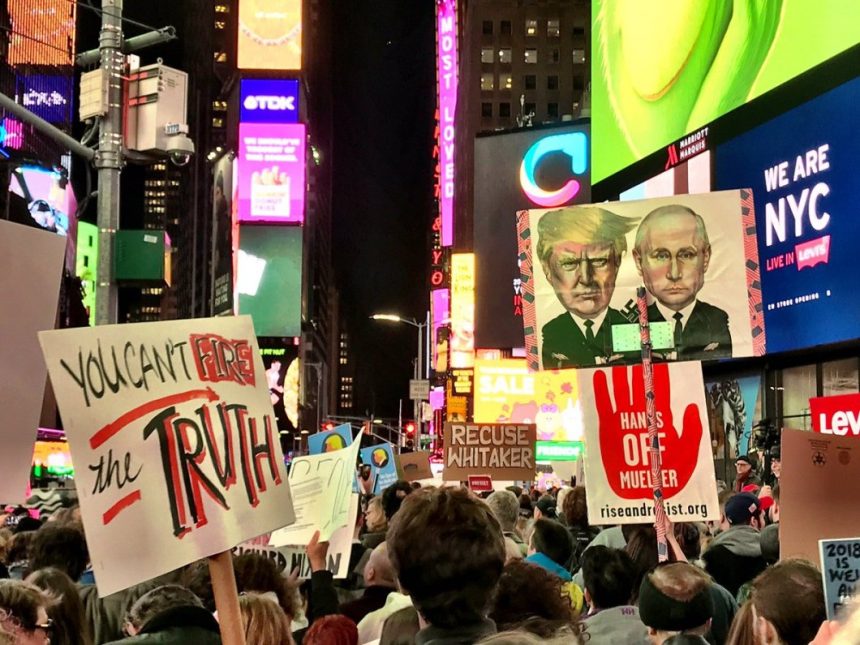
By Philip M. GIRALDI | Strategic Culture Foundation | 15.11.2018
The United States of America has no peace movement even though the country has been mired in unwinnable wars since 2001 and opinion polls suggest that there is only lukewarm support among the public for what is taking place in Afghanistan and Syria. This is in part due to the fact that today’s corporate media virtually functions as a branch of government, which some might refer to as the Ministry of Lies, and it is disinclined to report on just how dystopic American foreign and national security policy has become. This leaves the public in the dark and allows the continued worldwide blundering by the US military to fly under the radar.
The irony is that America’s last three presidents quite plausibly can be regarded as having their margins of victory attributed to a peace vote. George W. Bush promised a more moderate foreign policy in his 2000 campaign, Obama pledged to undo much of the harsh response to 9/11 promulgated by Bush, and Donald Trump was seen as the less warlike candidate when compared to Hillary Clinton. So the public wants less war but the politicians’ promises to deliver have been little more than campaign chatter, meaning that the United States continues to be locked into the same cycle of seeking change through force of arms.
Just last week Secretary of State Mike Pompeo spoke to a BBC journalist and said Iran must do what Washington demands “if they want their people to eat.” Pompeo’s comments should have shocked the public, but they were not widely reported. If Pompeo spoke for the Administration, that means that Washington is now ready, willing and often able to starve civilians and deny them medicines as a foreign policy tool. Iran is now on the receiving end, but the US has also been supporting similar action by the Saudi Arabians in Yemen, which has resulted in widespread starvation, particularly among children. The current policy recalls former Secretary of State Madeleine Albright’s infamous comment that the deaths of 500,000 Iraqi children due to sanctions had been “worth it.”
It is hard to believe that most Americans support Pompeo. To be sure, there are a number of groups in the United States that have the word “peace” or “antiwar” somewhere in their titles. Most would describe themselves as “progressive,” wherein lies the problem in pulling together a more broadly-based coalition that would make America’s warfare state a key target in the national election in 2020. Progressives, or, as they used to be called, liberals, are not like everyone else. Some commentators observing their antics describe them scathingly as “social justice warriors” or SJWs. That means that they have a mandate to oppose all the evils in the world, to include racism, sexism, limits on immigration and capitalism to name only a few. War is somewhere on the list but nowhere near the top.
SJWs have no comfort zone for dealing with anyone who does not fully buy into their blueprint for global rejuvenation. This means in turn that the antiwar movement, such as it is, is fragmented into a gaggle of groups with grievances that have little ability to establish cohesion with other organizations that might agree completely with their worldview. Folks like me, who are socially and politically conservative but antiwar, do not fit well with their priorities and would prefer to focus on the wars, but that option is not on offer without accepting a lot of sanctimonious garbage.
A recent email from the US Campaign for Palestinian Rights illustrates precisely what is wrong. I would support the group based on my concern for justice for the Palestinians but have no interest in its ridiculous stereotyping of who is the enemy, i.e. the omnipresent evil “white supremacists” who are also male, Gentile and heterosexual. The email, sent by one Nusayba Hammad, Communications Director, begins: “In the past week, white supremacist gunmen murdered 11 worshippers at the Tree of Life synagogue in Pittsburgh and two Black people in Louisville, and Trump announced his intention to try to erase trans, non-binary, and intersex folks… Our struggles for justice are inextricably linked: rejecting white supremacy means rejecting antisemitism, anti-Black racism, Zionism, Islamophobia, transphobia, and all forms of oppression. This is especially important knowing that many, many people carry overlapping identities and thus are marginalized at the intersection of overlapping oppressions.”
Yes, I know, it is impossible to understand what she is going on about unless one is educated in the progressive codewords. And also yes, the text could have been written by Monty Python. After that introduction the email goes on to provide some resources to “expand [one’s] knowledge,” including this gem:
“Palestine as a Queer Struggle (video)
This webinar with Nada Elia, Falastine Dwikat, and Izzy Mustafa covers the intersecting struggles against heteropatriarchy and Zionism. With Trump’s most recent attack on trans, non-binary, and intersex folks, it’s imperative that we understand the importance of standing with queer and trans people in the US and in Palestine as they face multiple layers of oppression.”
As war, in this case the slaughter of the Palestinians by the Jewish state, is the ultimate evil and it brings with it many other forms of suffering, it would seemingly not be asking too much to worry about it as a first priority before getting into the “multiple layers of oppression” that seem to bother lefties so much. But, alas, they cannot jettison that baggage and for that reason many “normal” people who want the wars to stop will not be participating in their protests. It’s a shame really, as joining together and fighting to stop the next war is well worth doing for every human being on this planet.
Israel’s Mockery of Security: 101 Actions Israel Could Take
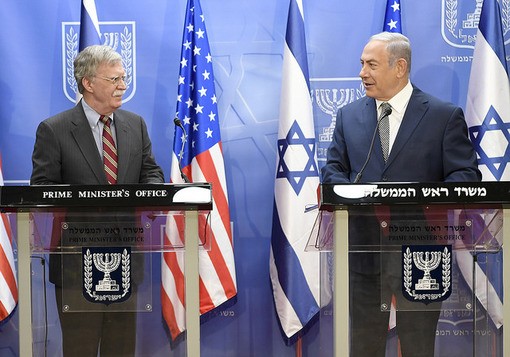
Photo Source U.S. Embassy Jerusalem | CC BY 2.0
By Sam Bahour | CounterPunch | November 14, 2018
Israel has made a colossal mockery of the concept of security.
In debating an Israeli friend from Jerusalem, I challenged him that Israel consciously plans and uses its military might to damage the Palestinian’s national project to build a state and free itself from Israeli control. Avner, my Israeli friend, argued otherwise, buying into the Israeli state narrative that Israel is “forced” to take measures which negatively affect Palestinians because Israeli security requires it. My knee-jerk reaction as someone living and working under Israeli military occupation for over two decades, was that this was hogwash and, short of ending its illegal (note: legal occupations are temporary by definition) occupation of Palestinians, I claimed that Israel—the occupying power—could immediately take 101 measures to reduce tensions on the ground, without jeopardizing any true and rational security needs. He shrugged and said, “tell me”?
In the years to follow, I have given numerous talks on the state of affairs under Israeli occupation to groups visiting Palestine from all corners of the world. A large number of those talks were to Jewish-American groups—many participants being rabbinical students and mainstream Jewish influencers hosted by the U.S. not-for-profit Encounter—who traveled to Palestine for an Encounter Program. In a recent Encounter talk, one rabbi attentively listened as I made the same claim, Israel can take 101 actions tomorrow morning without jeopardizing security. He raised his hand and asked, where can we get that list?
So, here it is. A quick compilation, with the generous assistance of several friends here in Palestine, and with a few items selected from the umpteen reports being published about the rapidly deteriorating state of affairs. This list is not intended to be comprehensive by any means, but rather a look beyond the daily headlines to give readers, especially those who have bought into the Israeli propaganda—hook, line and sinker—that this military occupation is all about “security”.
I attempted to place a few subtitles to categorize the list, although many items are multifaceted. Space does not allow for a full explanation of each proposed action, so if anyone wants to be directed to a more in-depth explanation of any listed action, or otherwise, please feel free to reach out at the email listed below.
Before offering the list, I must state upfront and clearly, my goal in presenting these ideas is not to assist the powers-that-be to design an embellished military occupation intended as permanent. Rather, my purpose is to reveal Israel’s underlying intentions, its indefinite time frame for continued domination, and the cornucopia of diverse types of actions carefully calculated to humiliate each and every Palestinian, while structurally blocking a path to Palestinian statehood, otherwise known as the two-state solution. That noted, for those who simply cannot fathom the notion of a Palestinian state free from Israeli occupation, I welcome all efforts to get my list addressed while the occupation continues, which would align Israel’s actions somewhat better with the law of occupation, the Geneva Convention Relative to the Protection of Civilian Persons in Time of War (Fourth Geneva Convention, 12 August 1949).
101 actions Israel could take
Gaza
1) Allow for free movement of goods to/from Gaza
2) Open the Erez [Passenger] Crossing to the West Bank 365 days a year, 24 hours a day, 7 days a week for the nearly 2 million Palestinian residents of Gaza
3) Permit Palestinians to tap their natural gas wells discovered in the sea of Gaza in 2000
4) Allow access to the Gaza Strip’s land
5) Allow access to the Gaza Strip’s territorial waters, expanding Gaza’s fishing zone: The Government of Israel halved Gaza’s fishing zone from 6 nautical miles to 3 nautical miles; compare that to the twenty-nautical mile limit set by the Oslo Accords. (World Bank)
6) Allow access to the Gaza Strip’s air space, releasing 3G frequencies for wireless internet access for Gaza
7) Keep the Karm Abu Salem cargo crossing open (World Bank)
8) Allow solar panels into Gaza (World Bank)
Jerusalem
9) Stop stripping Jerusalemites of their Jerusalem residency status
10) Eliminate arbitrary taxation regime being applied to Palestinians in East Jerusalem, especially those in the Old City
11) Increase public services to East Jerusalem to align with the level of taxation paid by East Jerusalem residents and with their proportion of the entire city’s population
12) Allow daily mechanism for Palestinians’ freedom of religion, not only on the occasional holidays (entry to Jerusalem to pray at Al-Aqsa, Church of the Holy Sepulchre, e.g.)
Education
13) Remove barriers inside the West Bank between children and their schools
14) Stop soldiers at checkpoints from harassing school age students, stop the delaying and excessive searching of students (and teachers) coming to/from Jerusalem through the Qalandia checkpoint, especially of those who are unaccompanied by parents
15) Provide teachers open access to their workplaces, i.e. crossing checkpoints, etc.
16) Eliminate routine Israeli military forces incursions into schools
17) Allow academic/educational institutions to operate comfortably and freely within Palestinian communities in the occupied Palestinian territory (oPt), including East Jerusalem
18) Recognize/accredit the degrees granted by all Palestinian higher educational institution as legitimate credentials for continuing education in Israel or for professional work permits
19) Stop delaying release of textbook shipments
20) Stop delaying release of, and desist from tampering with, examination papers and answer sheets coming from the International Baccalaureate Organization (IBO)
21) Stop banning basic laboratory supplies for students’ laboratory experiments
22) Grant permits for school education/recreational trips: an entire generation has never seen the sea
23) Stop systematically targeting schools in marginalized areas like Khan al-Ahmar in the Jordan Valley
24) Allow importing of educational accessories and tools: During the Microsoft International Student Competition, smart pens, circuits, and other similar materials required by participants were discarded at the Israeli border on the pretext that these educational materials were a threat to Israel’s security
25) Allow student travel. During the Microsoft International Student Competition, the Palestinian team won first place over 23 Arab countries in the innovation category and were qualified to compete in the US. One of the students, despite the student having no security issues, and with an official invitation from Microsoft and the US consulate in hand, was unable to get Israeli permission to enter Jerusalem to process his US visa.
Humanitarian
26) Stop the arrests, especially of children: Number of Palestinians who have been held in Israeli jails for periods ranging from 1 week to life, 1967-1988: 600,000; number of Palestinians arrested during the first intifada (1987-94): 175,000
27) Stop the torture: Documented percentage of Palestinian detainees who have been tortured during interrogation: 85%
28) Stop the deportations: Documented number of Palestinians deported between 1967 and 1992: 1,522; between 1970 and 1973: 785; in 1992: 415; number deported from the West Bank to the Gaza Strip, 2002-2004: 32
29) Stop the house demolitions: Documented number of Palestinian homes in the oPt demolished by Israeli authorities, June 1967-March 2009: 24,145
30) Stop the killings: Killings during the two Intifadas: Number of Palestinians killed by Israeli security forces and civilians, December 9, 1987 to September 28, 2000: in the oPt: 1,489; within the Green Line: 60. Number killed, September 28, 2000 – September 28, 2004: 3,234
31) Release the bodies of killed Palestinians to their families
32) Stop ripping apart bicultural families: Provide clear and easy access via family re-unification for foreign nationals married to Palestinians
33) Stop arbitrary denial of entries and restrictions on visiting foreign nationals, allowing Palestinian firms to recruit Palestinian and international talent abroad by issuance of work visas/permits for any such person who does not have a Palestinian identity card.
34) Respect Palestinian water rights as defined under international law and honor applicable, signed bilateral water-related agreements
35) Stop spraying of herbicides intended to destroy crops, especially on outskirts of the Gaza Strip
36) Respect the Bedouin community’s way of life, stop the displacement of Bedouin communities
Municipalities
37) Reclassify areas currently classified as Area C if they are within defined city boundaries
38) Expedite landfill approvals: The regional landfill in Rammun (center of West Bank) took about 15 years for the Israeli side to approve
39) Expedite cemetery approvals: The new Ramallah cemetery project took about 12 years for the Israeli side to approve
40) Expedite water/sanitation approvals: The project for a central purification plant in Ein Griot has been waiting for Israeli approval for years now
41) Expedite approvals for new or improved transportation routes: The desperately needed Ramallah ring road project, a case in point, has submitted all required details and continues to await Israeli approval
Economic
42) Stop the illegal dumping of Israeli goods and services into the Palestinian markets, Stop unlicensed Israeli firms, such as Israeli telecommunications firms, from illegally selling their services to the Palestinian Authority (PA) areas
43) Stop the arbitrary delays in importation of technology products
44) Release 4G frequencies for West Bank and Gaza
45) Allow for free movement of goods within the oPt
46) Allow for unfettered imports
47) Allow for unfettered exports
48) Allow the entry of Palestinian goods into the Israeli market, as the Paris Protocol (4/94) provided for in a unique economic and trade regime named the Customs Envelope
49) Stop using an Israeli-specific “Dual Use List” for Palestinians, causing unjustified additional restrictions to importation of goods into Gaza and considerable delays and difficulties for West Bank economic projects, such as the Bethlehem Industrial Estate (BMIP)
50) Stop the extensive security checks within the West Bank which pose an economic obstacle to trade
51) Allow for delivery of large machinery/equipment/vehicles related to PA and international projects, especially for agriculture and construction
52) Eliminate all military checkpoints between Palestinian cities/villages inside the oPt
53) Provide humane/non-segregated access to Palestinians via air, sea and land ports
54) Provide PA security forces full access to all oPt areas
55) Provide PA police full control of all oPt roads
56) Stop issuing licenses to Israeli firms quarrying of Palestinian lands in the oPt
57) Remove closures to all entrances to villages and cities in the oPt, as some residents travel 90-120 additional minutes to reach destinations literally minutes away
58) Allow Palestinians full privileges on “Israeli-only” roads
59) Allow 24/7 access on Israeli-issued travel permits
60) Allow Palestinians with multi-day Israeli travel permits to lawfully stay overnight in Jerusalem and Israel
61) Eliminate the recent requirement of a so called “Magnetic Card” required to apply for an Israeli travel permit to Jerusalem or Israel
62) Eliminate the so called “BMC – Businessman’s Card” required to apply for a multi month Israeli travel permit to Jerusalem or Israel, which artificially segments Palestinian society
63) Allow ease of rehabilitation of deteriorating old cities, especially in Hebron and Jerusalem
64) De-monopolize the Israeli/Jerusalem tourism sector (tourism operators, guides, licenses, etc.), ending the demand to adhere to the “Israeli narrative”
65) Apply and enforce the laws and adjudicate violations equally with respect to all residents/citizens under Israeli jurisdiction as an occupying power
66) De-legitimize “open carry” of weapons for Israeli settlers or accord Palestinian farmers the same privileges
67) Secure Palestinian farmers yearlong access to their farm land, not only partial harvesting seasons
68) Maximize allowed farming area, especially near settlements
69) Expedite issuance of land deeds (Tabu), especially in Area C
70) Allow legal building in Areas B and C
71) Allow access to natural water sources in Area C
72) Allow postal mail and packages to reach the Palestinian Post in a timely manner: In August 2018 Israel dumped 10 tons of mail they held up from 2010
Israeli Crossings and Ports
Border Crossings with Jordan / Allenby/King Hussein Bridge (KHB)
73) Open this sole passenger crossing to Jordan 365 days a year, 24 hours a day, 7 days a week for the nearly 3 million Palestinian residents of West Bank
74) Increase the number of vehicles, load capacity of cargo loading and unloading, and operating hours at the KHB
75) Streamline the logistics for imports entering the oPt: For example, cement silos could be constructed to store bulk cement until transferred by Palestinian trucks into the Palestinian territory.
Border Crossings with Israel
76) Stop restrictions on shipments through cargo crossings from the oPt into Israel, such as limited number and capacity of cargo crossings, limited working hours, and strict security restrictions: This encourages tax evasion and unfair competition in the form of goods smuggled into the oPt by Israeli trucks that freely enter the Palestinian areas via the crossings and need not unload their cargos, unlike the Palestinian trucks. Moreover, Israeli cargo trucks are not subject to inspection by the Palestinian Authorities.
77) Stop random sampling security checks of cargo which cause cargo damage, as well as, long security checks of perishable cargo which is damaged when delayed for a long period for security inspection purposes.
78) Logistical arrangements for the entrance of goods into the Gaza Strip is an ultra-complicated and troublesome task. In addition to the very long waiting hours at Erez Crossing, the facility has unsystematic working hours with the constant possibility of sudden closure for “security” reasons.
Container Ports
79) Allow direct imports to the oPt via a Palestinian clearing agent. Currently, all kinds of raw materials and goods need to be imported through an Israeli agent. Such a procedural requirement incurs high costs for the Palestinian importer for security and customs inspection. Additionally, the Palestinian importer incurs fees of relevant bonded Israeli warehouses and storage facilities as long as the cargo is withheld in the Israeli ports for inspection purposes, sometimes weeks, months or years on end.
80) Allow Palestinians to define their own import needs. Currently the quantity, quality, destination of imported goods and materials are determined according to the outdated Paris Protocol, which provides the annual ceiling of imports per country of origin.
Area C
81) Stop the prohibition of construction in Area C: Obtaining a permit to construct any factory or plant in Area C is made unbearably difficult and the process should be streamlined, simplified, and not subject to arbitrary regulations and delays.
82) As things stand, permits issued for Area C are time-bound and must be renewed on an annual basis, causing significant delays and a barrier to investment; revise these regulations to streamline the process.
83) Streamline the exhausting “security”-driven bureaucratic procedures to establish land titles, especially in Area
84) Expand spatial plans for Palestinian villages in Area C (World Bank)
85) Grant approval to Palestinian business projects in Area C (World Bank)
Constraints on Movement and Permits
86) Issue and abide by clear and lawful policies and procedures for obtaining all types of visas for foreign visitors, including granting visas to international faculty as they return for a new academic year and eliminating denial of long-term visas to international and regional experts working in the oPt
87) Lift the military ban on Palestinian commercial drivers’ entering Israel with a Palestinian-registered vehicle: This ban is enormously expensive for Palestinian employers, who bear the added logistical costs to rent an Israeli truck for the Israeli side of the route travelled, incurring more than double the rental cost of the Palestinian truck alone.
88) Allow for permits to manage commercial operations within Israeli areas, such as the management of warehouses in these areas. Currently, the limitations on permits issued shackle Palestinian firms’ ability to manage their internal affairs.
89) Allow Palestinian clearing agents access to Israeli ports at Ashdod, Haifa or Eilat. Currently, an Israeli agent needs to be hired as a go-between with the Palestinian importer.
90) Many Palestinian companies are active in both the West Bank and Gaza. Allow permits for West Bank company staff to enter the Gaza Strip and vice versa. At present, absent such permits, staff is unable to follow up on work in progress, attend meetings, or participate in training courses.
91) Permit Palestinian firms’ shareholders to travel to/from the West Bank/Gaza Strip to attend the annual general meetings of firms they are invested in. At present, to work around this, firms incur the extra expense of arranging two venues for a meeting; one in the West Bank and the other in the Gaza Strip, to ensure an equal opportunity for all the shareholders in Palestine to attend the meetings, which are connected by video conferencing.
Legal Issues
92) Streamline legal actions for Palestinian firms having issues with Israeli citizens/cheques; currently, the problem of the Israeli citizen/firm’s being subject to another jurisdiction creates manifold obstacles to prompt resolution.
93) Recognize a third country arbitration between Israeli and Palestinian businesses. If a commercial dispute arises between Palestinian and Israeli parties, Israeli laws requires that arbitration be made in Israeli areas for security purposes and for the safety of the Israeli party. This practice is a clear violation of customary international practices and norms that the seat of arbitration should be in a third and neutral country.
94) Stop the military ban on a large number of Gazan traders who have been commercially banned by Israel without due process, rendering them unable to sell or purchase goods and materials.
Quality inspection
95) Stop the discrimination in dealing with standards certificates. The required Israeli quality inspection of imports transshipped through Israel and acquiring of the Israeli Standards Certificate require a lot of time that might extend up to six months with high costs. Currently, Israeli shipments require one certificate for every product being imported, despite the number of times imported, whereas the Palestinian importer must get a new certificate for every shipment of the same product, adding time and cost to every importation of goods.
96) Allow Israeli products entering the Palestinian market to get a Palestinian Standards Certificate. Currently, the Palestinian market is flooded with Israeli products that bypass Palestinian standards certification.
Financial
97) Stop withholding/delaying the various monetary transfers to the Gaza Strip, imposing extra costs to cover transfers
98) Pay the Palestinian Authority seigniorage for their use of Israeli currency
99) Stop delays in transferring payments to Palestinian government, further indebting the PA: VAT and Import duties collected by the Government of Israel (GoI) on behalf of the PA and should be transferred monthly based on an arrangement instituted by the Paris protocol. (World Bank)
100) Stop unilateral deductions from Palestinian funds, further indebting the PA: These are deductions made by the GoI from clearance revenues to settle utility bills owed by Palestinian Local Government Units (LGUs), utilities and distribution companies to Israeli suppliers. (World Bank)
101) Transfer to the Palestinian Authority fiscal losses accumulated over the years. The signed agreements defined specific arrangements through which the GoI collects VAT, import duties and other income, or the so-called clearance revenues, on behalf of the PA and shares it with the latter on a monthly basis. Some of these arrangements have become outdated and others have not been implemented as envisaged by the agreements, resulting in fiscal losses for the PA. The quantified annual loss (excluding revenues collected by the GoI in Area C that could not be quantified due to data constraints) amounts to USD 285 million, or 2.2 percent of Palestinian GDP. (World Bank)
So, here you have it, a detailed sampling of what the Israeli military occupation means from ground zero. These and dozens of other Israeli restrictions are what mainly underlie the inability of Palestinians, individually and collectively, to create a different reality on the ground, let alone properly prepare for a free and independent state.
A longtime Jewish-American attorney friend with whom I shared this list as a draft in process responded unequivocally: These issues, he said, are not Israeli security threats; on the contrary. If they were rationally addressed, the results would serve Israeli security needs. With that, one must step back a bit and reflect on what Israel’s real intentions might be in sustaining its 50-year military occupation through the use of this vast web of “security” regulations.
Sam Bahour is managing partner of Applied Information Management (AIM), a policy analyst with Al-Shabaka: The Palestinian Policy Network, a secretariat member of the Palestine Strategy Group, and chairman of Americans for a Vibrant Palestinian Economy. He blogs at http://www.epalestine.com. Twitter: @SamBahour
Phil Ochs and the Crucifixion of President John F. Kennedy
By Edward Curtin | November 13, 2018
“They say they can’t believe it, it’s a sacrilegious shame
Now, who would want to hurt such a hero of the game?
But you know I predicted it; I knew he had to fall
How did it happen? I hope his suffering was small.
Tell me every detail, I’ve got to know it all,
And do you have a picture of the pain?” – Phil Ochs, The Crucifixion“You are aware of only one unrest;
Oh, never learn to know the other!
Two souls, alas, are dwelling in my breast,
And one is striving to forsake its brother.” – Goethe, Faust
President John Kennedy was assassinated by the U.S. national-security state, led by the C.I.A., on November 22, 1963 in Dallas, Texas. That is a fact beyond dispute, except for those who wish to engage in pseudo-debates to deny the obvious. I prefer not to, since there is nothing to debate.
But there is everything to mourn, even after fifty-five years, first of course for the man himself, then for those who have suffered and died for bearing witness to the truth about his assassination, and finally for the consequences of his murder, because it cut savagely into any pretense of American innocence and set the stage for the nihilistic tragedies that have followed, including the murders of Malcolm X, MLK, RFK, the September 11, 2001 attacks, and the ongoing “war on terror.”
Today, JFK’s killers have tightened their chokehold on the country and on the throats of those wishing to tell the truth. Their penetration of the corporate mass media is wide and deep, and the narratives they spin can make an innocent soul’s head spin. Everything is twisted to serve their interests. With a click of a finger, truth and falsehood rotate like spokes on a rapidly turning wheel – spooks turning spokes in a game of hide and seek meant to confuse and derange the public. Constant befuddlement is the name of this racket.
It’s a melancholy task to contemplate the parts played, consciously or unconsciously, by various actors in this deadly game, not least because one’s own naiveté prompts one sometimes to question or abandon those one once admired and to dive deeply into the twisted minds and hearts of fellow humans. What follows concerns one such man’s strange story as told by another man, whose story is perhaps stranger, and what their relationships with U.S. intelligence, if any, might suggest about our situation today.
Oh I am just a student, Sir, and only want to learn
But it’s hard to read through the risin’ smoke of the books that you like to burn
So I’d like to make a promise and I’d like to make a vow
That when I got something to say, Sir, I’m gonna say it now
Those are the words of the folk singer, Phil Ochs, from his 1966 song “I’m Going To Say It Now.” Ochs wrote and performed passionate protest songs during the 1960s that inspired many to speak and act in opposition to the Vietnam War and many other injustices. He was a fiery, sardonic activist whose music, such as “I Ain’t Marching Any More,” induced many to refuse military induction and to burn their draft cards. He, not Bob Dylan, was the committed voice of the 1960s radical anti-war folk music world, singing at events and rallies across the country, culminating at the 1968 Democratic National Convention in Chicago when the Chicago police rioted and savagely beat anti-war protesters, and Yippies and Hippies and protesters gathered in Lincoln Park to listen to Ochs sing defiant songs to keep up their spirits. But Ochs’s own spirit was broken that terrible year of so many deaths, which started his long descent into alcoholism and mental chaos that ended with his suicide in 1976.
I was one of those who was inspired by his music. I still am. Soulful and satiric, biting and beautiful, stirring and inspiriting, it has a power few can equal. But I have come to a point where I feel compelled to broach a mysterious story involving Ochs, something that when I first heard it in passing shocked me terribly. No, I thought, that can’t be true; it’s impossible.
But the more I have researched it, the truer it seems – with emphasis on the word “seems” – for there is only one source for the story, a source I don’t doubt but can’t confirm.
But either way, I have come to see the story as emblematic of the treachery and confusion sown by the CIA, its Operation Mockingbird, and its so-called Mighty Wurlitzer that have played so many for fools through its control of the corporate mass media and the production of narratives that run like little movies too perfect to be true, but too true to be false – even when they are. Screens within screens within screens. Efforts to fuck up as many people as possible in operation chaos, to derange and cleave them into split personalities within and without, and to mystify as many minds as possible.
I think Phil Ochs was one so mystified. I am wondering if in life and death he was used and abused by radically evil forces, whomever they may be.
According to Phil’s best friend from college at Ohio State, the man who taught him to play guitar, his singing partner, best man at his wedding, constant pal in their days in Greenwich Village, and life-long friend, Jim Glover, Ochs was in Dallas, Texas on November 22, 1963, standing outside the Dal-Tex building in Dealey Plaza when JFK was driven by to be killed. Glover says Phil told him he went there as a “national security observer.”
I had read about this on some off-beat websites, but never in biographies of Ochs, or in the latest documentary about him, There But for Fortune. There seems to be an “official” ban on mentioning Glover’s claim, even though Glover appears in the books and the documentary, has been interviewed by the authors and filmmaker, and is considered by them, as Phil’s old and close friend, to be a reliable source.
Jim Glover, who was one half of the well-known folk duo, Jim and Jean, back in the 1960s, and is now an anti-war activist in Florida, says that he has told Ochs’s siblings and biographers all the details, has also reported it recently and as far back as the early 1990s to the FBI, and has put these claims out on some internet sites and openly spoken about it. These disclosures have resulted in silence from Ochs’s family and biographers. There have been no efforts to refute it, and so it circulates far outside the mainstream. Since Glover speaks of it openly and in great detail, and since it is a shocking claim with serious implications, one would think it worthy of response. But it is only greeted with silence. It seems perhaps like another example of what Thomas Merton called “the unspeakable” – “the void that contradicts everything that is spoken even before the words are said.”
So I contacted Glover and asked him about it. He told me that Phil had told him months before the assassination that he was “working for National Security, something like the C.I.A.” Then, he later told him he had gone to Dallas with one of the Gambino boys as “a national security observer” and had been standing in Dealey Plaza outside the Dal-Tex building where he was filmed when JFK was shot. Jim Glover has sent me photos that he discovered decades later that he says are photos of Phil in Dealey Plaza at the exact spot he mentioned and also in the movie theater where Oswald was arrested. He thinks they are very conclusive, especially because of the Dealey Plaza location, despite their blurriness. While I think they are not dispositive, they do look like Ochs in a fuzzy sort of way.
The first two photos are outside the Dal-Tex building, after and before the assassination.
The third is inside the movie theater where Oswald was captured and taken out the front door, while the second Oswald was led out the back door.
And the last is a photo of Ochs at Ohio State in 1961 for comparison purposes.


Whatever you think of the photos, they are one piece of a larger mystery, a tale stranger than fiction. They may or may not show Ochs, as Jim Glover is certain they do, but if Ochs’s biographers trust him on other matters, why would they doubt him when he says Ochs told him he was in Dallas that day? He says they are afraid to entertain the possibility.
So we might ask the question: If Phil Ochs was in Dallas that day, what was he doing there?
Let me reiterate: The murder of President Kennedy is not a mystery, and I am not exploring it. We know he was killed in a coup carried out by the national security state led by the CIA. If you want to know why, and if you want to know why this Thanksgiving, November 22, we should give thanks for John Kennedy’s life and witness, read JFK and the Unspeakable by James Douglass. It’s the only book you need to read on the assassination.
Phil Ochs is the mystery in Glover’s telling, and I am wondering about him (and Glover), what he thought he was doing getting tangled up with shadowy intelligence operatives, how that awakening knowledge subsequently affected him, how he responded, and what place guilt and fear played in his post-1963 life and death. I am proceeding as if Ochs went to Dallas at the naïve age of 22 not to harm Kennedy, but as Glover said he said, to investigate the threats against Kennedy that he had heard of in NYC through V. T. Lee of the Fair Play for Cuba Committee (FPCC) and others. (This is the same V.T. Lee who received a letter from Lee Harvey Oswald, who was proposing a FPCC chapter for New Orleans in May 1963, where he was performing his theatrical stunts. Lee warned Oswald not to provoke “unnecessary incidents which frighten away prospective supporters” in a place so hostile to Castro. But Oswald, of course, did the opposite to establish his fake support for Castro.)
Glover says he also knew of the plots against Kennedy that were widely circulating in leftist circles, and afterwards felt Phil and he were being set up to be implicated in the assassination in case the official cover story fell apart since he and Glover were sympathetic to Castro and Cuba. He says their phones were tapped and they were being surveilled. At this time Glover and his partner Jean were persuaded, against Ochs’s advice, to go on a Hollywood Hootenanny Tour of southern college campuses, a surreal trip that made stops in Dallas and Houston and seemed clearly connected to the Kennedy assassination as strange people got off and on the multi-bus caravan, talking about Kennedy being killed. Glover says these included George and Barbara Bush and J. Edgar Hoover, who were picked up by the bus at the Houston airport late in the day of November 22.
You would have to have a fantastic imagination to make this stuff up. Why would he? Yet his tale is truly bizarre, revealing the intricate nature of the government conspiracy to kill Kennedy and to create multiple tales of plausible deniability when others failed.
He told me that he doesn’t know who told Phil to go to Dallas, but he is unequivocal that he did. He said:
I don’t have all the answers. All I know is what Phil told me to keep us both as safe as possible. He told me I’ll never lie to you but there are things I can’t tell you. Knowing I had a big mouth if he told me things you [me] are asking, I might not be alive. His purpose as I see it was to observe, and being set up if Oswald lived, he could have been used as, ‘See a Castro sympathizer knew and was involved.’ And that would apply to me also [learning what he did on the Hootenanny Tour] and they would stop at nothing to have us both silenced permanently if Oswald or Kennedy lived because we knew too much.
Once, he said, as an example of his big mouth, he was performing at the Gaslight in Greenwich Village and told the audience that Phil had been in Dallas as a national security observer. He thinks Ochs’s manager, Al Grossman, and Bob Dylan heard it, “because Phil came over and said, ‘Are you trying to get me killed?’”
Phil, he said, was a super patriot and would never have done anything to harm Kennedy, but was tricked into going to Dallas under the assumption that he was working with those trying to prevent the assassination by investigating the plot or trying to infiltrate it and perhaps stop it. But when Ochs returned to NYC later that day, according to Glover, he was devastated by Kennedy’s assassination and at the realization that he had been used and was now compromised. That is why he cried so terribly that night and wanted to die. His youthful innocence had died.
Phil Ochs was a man of two minds and inclinations, not unusual for a coterie of musicians of that era who knew and associated with it each other, had military/intelligence family backgrounds, and were never drafted like so many young men not in college. Like so many of these musical icons – Jim Morrison, David Crosby, Frank Zappa, “Papa” John Philips, Stephen Stills, et al (as Dave McGowan chronicles in his book, Weird Scenes Inside the Canyon, where he questions their public personae and the strange ways they gathered from far distances at one time into Los Angeles’s Laurel Canyon, at the heart which was a covert military film facility, Lookout Mountain Laboratory) – Ochs had a military background. He was a conservative rebel who suddenly transformed from a conservative to a radical at Ohio State in his last year, according to Glover. He attended Staunton Military Academy with Barry Goldwater’s son and John Dean of Watergate fame and was a sergeant in the ROTC at Ohio State where at the least he was aware of military intelligence spying on radical students; he idolized John Wayne, James Dean, Marlon Brando and the American western film mythology of the cowboy and soldier; he loved John Kennedy; he sang powerful anti-war songs and would jokingly say to his audience that now that they had listened to his anti-government songs he was turning them in to the government; he was a drama king who loved heroes and wanted to be one; he was a left-winger who mocked liberals; he was a folk singer who loved Elvis. In short, he was a man of many contradictions, of highs and lows, hope and despair, driven to stop war and injustice and to become a star in the superficial entertainment culture, etc. As he fell apart in his last years, it became easy to categorize him with the facile term “manic-depressive” or “bipolar.”
I think that misses the heart of the matter, as if a term explains its reality, as if his paranoia had no basis outside his mind, as if he was just nuts to think the CIA was out to get him, as he did regularly and especially after he was attacked and choked while walking alone on a beach in Dar-es-Salaam, Tanzania, when his vocal cords were ruptured and his voice permanently damaged.
My guess is that he was driven by guilt and fear and that his suicide at age 35 was connected to being in Dallas on the day JFK was assassinated. I think he died that day too, and that the next 13 years of his life were courageous attempts to quell his guilt for being gulled into going to Dallas and fear that he might be killed for doing so by singing out his rebellious songs in the face of his ghosts. He was a haunted man, and produced haunting songs in response to exorcise his demons, including the songs The Crucifixion and That Was the President, both about John Kennedy.
In his last years he said he was John Train (sometimes John Butler Train), not Phil Ochs, and that John Train had killed Phil Ochs in the Chelsea Hotel on the summer solstice in 1975, the solstice being a significant turning point. His biographers give various explanations for his adoption of this pseudonym, all of which, I believe, miss the mark. To say he took the name from his heroes John Wayne, John Ford, John Kennedy, and William Butler Yeats, avoids the key word: Train. It’s as if the word is unimportant or unspeakable, or the name John Train is a common name that “crazy” Phil just made up.
As he was unravelling in fear and trembling, I believe he was referring to a real John Train, a CIA operative, when he metaphorically said “on the first day of summer 1975, Phil Ochs was murdered in the Chelsea Hotel by John Train…. For the good of societies, public and secret, he needed to be gotten rid of.” Train assassinates Ochs. Then the following spring Ochs assassinates Ochs by hanging himself.
Could it just be a coincidence that there is a real John Train who from the early 1950s onward was connected to the CIA and the covert state in various activities as an asset or an agent? This John Train, who was one of the founders and funders of The Paris Review, its first managing editor, who together with the CIA’s Peter Matthiessen and George Plimpton started the magazine for the CIA under its propaganda front, The Congress for Cultural Freedom. This John Train, who ran cover corporations for the CIA and was connected to George Herbert Walker Bush through the CIA’s Thomas Devine, who was involved in setting up Bush’s company Zapata Offshore. This John Train, who was deeply involved with the CIA’s activities in the early 1980s backing the CIA-supported mujahideen against the Soviets in Afghanistan. This John Train who…. [i]
It is farfetched in the extreme to think that Phil Ochs just plucked the name John Train out of thin air. But the fact that this is asserted by his biographers makes sense when we realize that Jim Glover’s claims are ignored by Ochs’s family, his biographers, and the makers of the documentary about him. That there is a real CIA-affiliated John Train and that Glover insists Phil told him he was in Dallas on November 22, 1963 seem clearly connected. But these facts are unspeakable. I think they need to be explored.
Like Jim Glover, I don’t have all the answers about Phil Ochs. My guess and my hope is that Phil was used and was not complicit, that he naively thought by going to Dallas he was working with the good guys to protect the president from the killers, and when he witnessed the brutal murder, he felt compromised, and felt so overwhelmed with guilt and fear that life eventually became too unbearable for him. Clearly this is Glover’s story. I think it is incumbent on those who don’t believe it to explain why Glover would fabricate such an intricate tale that glorifies his friend as a true patriot, whom he claims was used by intelligence operatives and who therefore suffered for the rest of his life for trying to protect President Kennedy.
Whatever the truth in this age of “not knowing,” I think his story is a parable for our times. Whenever you think you’re getting the straight scoop, think again, and then again. The CIA’s Operation Mockingbird is still singing its siren song to convince us that the crucifixion was a one-time event, when Phil knew otherwise, right from the start and right to the end. I think he tried to warn us and wouldn’t be silenced, even in death.
[1] See Joel Whitney’s Finks, Russ Baker’s Family of Secrets, David McGowan’s Weird Scenes Inside the Canyon, and Bill Kelly’s http://jfkcountercoup.blogspot.com/2013/05/phil-ochs-at-dealey-plaza.html
Featured Video
The Search for Truth: Charlie Kirk’s Assassination One Year Later
or go to
Aletho News Archives – Video-Images
From the Archives
US murdering 1 million Iraqis is democracy, Iran giving yogurt to Iraq is “domination”
By Ali Salaam | American Herald Tribune | July 31, 2017
The New York Times, owned by the Zionist Jewish supremacist Ochs-Sulzberger family, has no problem with Iraqi suffering as long as Iran is not the one behind it.
The Iraq War was a genocide of the Iraqi people by Zionist supremacists in the Bush administration. Over 1 million innocent people were killed based on a lie. American soldiers died in an Israeli war and now an average of 22 soldiers commit suicide every day because their consciences cannot cope with the fact they committed crimes in an illegal war that served no purpose other than to benefit Israel, not America.
Benjamin Netanyahu, Prime Minister of the Zionist regime, once said “We are benefiting from one thing, and that is the attack on the Twin Towers and Pentagon, and the American struggle in Iraq.”
Paul Wolfowitz had his sights on Iraq since his time in the first Bush administration. Former Israeli official and Bush administration official Richard Perle had his eyes on Iraq since at least his authorship of the Clean Break white paper. The Zionist regime had their eyes on Iraq since the 1980s when strategist Oded Yinon wrote his white paper in support of dividing the Arab-Muslim world along ethnic and sectarian lines. The global Zionist lobby has had their eyes on Iraq since Theodor Herzl stated that Eretz Israel’s true borders go from the Nile River in Egypt to the Euphrates River in Iraq. … continue
Blog Roll
 Aletho News
- The Search for Truth: Charlie Kirk’s Assassination One Year Later
- ‘Harsh reality’: Iran says France seeks monopoly on power and intimidation, not peace for all
- When Will This White House Madness End?
- Huckabee aide goes to ‘unusual lengths’ to portray ‘Israel’ positively
- Trump Announces Diesel Supply Deal With Putin Following Phone Call
- MEP blasts ‘Euro-Gestapo’ for lecturing Russia on democracy
- Syria May Send Troops to Saudi Arabia Amid War with Ansar Allah
- UK whines about losing billions to ‘Putin tax’
- Baghaei to Rubio: Distorted narratives cannot erase US record of broken commitments
- Houthis Don’t Have to Conquer Saudi Arabia to Make It Pay
- If Americans Knew
- Gaza ceasefire exists in name only, say more than 100 organizations
- Nearly 2 Million in Gaza Need Urgent Shelter Assistance as Winter Looms: IOM Chief Warns
- Suppressing Palestinian resistance: US charity under fire for AI monitoring of Gaza classrooms
- Thousands Are Held in Israeli Torture Camps. This Is What Happens Inside
- Israel puts Gaza’s sick, injured, newborn in peril – Daily Update
- Report claimed Mark Levin used by Israeli government to influence Trump
- Over 2,000 Gazans have died awaiting medical evacuation amid Israel’s continued siege
- How a U.S. Diplomat Suppressed and Altered Reports Critical of Israel
- 5 Palestinians Die from Israeli Strikes in Gaza as Relentless Attacks Continue
- Report: Ceasefire Slows Killing but Leaves Devastation Intact
- No Tricks Zone
- New Study: 50 Years Of The Most Aggressive ‘Net Zero’ Policies Can Only Affect The Global Climate By 0.03°C
- US September “Heat” Was No Record…Many Records Set Decades Ago
- Latest European Green Energy Debacle; Portugal’s Largest Flagship Solar Park Insolvent!
- Green Energy Debacle: German Expert Professor Fritz Vahrenholt Warns Of Severe Economic And Social Consequences
- Two More Paleo Reconstructions Affirm Meters-Higher Sea Levels Across Ireland, Brazil 7000-6000 Years Ago
- New Study: Earth And Venus Surface Warmth Largely Explained By Convection And Lapse Rate, Not CO2 Or Radiation
- 2025 Nature Paper Claiming Worsening Global Drought Gets RETRACTED …Heavily Flawed
- New Study: ‘Global Drought Shows No Detectable Recent Acceleration Under Climate Warming’
- Economic Masterminds: German Socialists Suggest Taxing Productivity Gains Stemming From Using AI
- The South China Sea Has Not Been Cooperating With The Climate Change Narrative

