Amid warming relations with Chad, Israel is reportedly working to normalize relations with Sudan and other African states as the regime steps up its push to strengthen its foothold in the continent.
A senior Israeli official told Channel 10 TV channel that a visit on Sunday by Chadian President Idriss Deby to the occupied territories was laying the groundwork for normal ties between Tel Aviv and the Muslim-majority African states of Sudan, Mali and Niger.
The unnamed official also noted that Israel was seeking to shorten flight times from the occupied territories to Latin America through normalizing relations with African countries.
Deby became the first Chadian leader to visit Israel on Sunday, 46 years after the two sides severed ties.
After meeting Israeli Prime Minister Benjamin Netanyahu, the Chadian president pledged a new era of cooperation with “the prospect of reestablishing diplomatic relations.”
Israeli media cited sources in N’Djamena as saying that Deby’s visit was focused on “security,” and that the regime in Tel Aviv had already been supplying weapons and other military equipment to Chad.
Netanyahu, however, declined to comment on potential Israeli weapons sales to Chad.
During his visit, Deby said the future resumption of ties with Israel “does not make us ignore the Palestinian issue.”
The Palestinians, however, protested Deby’s trip to Israel.
Wasel Abu Youssef, a member of the Palestine Liberation Organization’s executive committee, voiced displeasure over the visit.
“All countries and institutions must boycott the extremist government of Israel and impose a siege on it because of its settlement activities, its occupation of Palestinian land,” Youssef was quoted as saying by Reuters.
Over the past two years, Netanyahu has traveled to several African states in a bid to end decades of hostility against the occupying entity and convince them to stop voting against the Israeli regime at the United Nations in favor of Palestinians.
According to Channel 10, Israeli is now in talks with Sudan in a bid to improve relations with the African state.
The Israeli push comes almost two years after Sudan joined Saudi Arabia and Bahrain in cutting relations with Iran.
At that time, Israeli daily Haaretz reported that Tel Aviv had urged the US and other countries to improve their relationship with Sudan in response.
In a 2016, Sudanese Foreign Minister Ibrahim Ghandour said Khartoum was open to the idea of normalizing ties with Israel in exchange for lifting US sanctions.
Israel is also said to be seeking to take advantage of the insurgency and Takfiri militancy gripping parts of Africa to sell advanced military equipment to conflict-ridden states in the continent.
Israel in contact with Persian Gulf Arab states
Meanwhile, reports have emerged recently of Israel’s attempts to make its secret ties with Persian Gulf Arab governments public and establish formal relations with them.
On Sunday, Israeli news sites reported that Tel Aviv is working to normalize ties with Bahrain, hours after Netanyahu hinted he would soon travel to unspecified Arab states.
Israeli Economy Minister Eli Cohen said on Monday he had been invited to attend a conference next year in Bahrain.
Netanyahu met with Oman’s Sultan Qaboos in Muscat last month, but the controversial visit was kept secret until after the Israeli premier returned to the occupied territories.
The visit to Muscat was the first by an Israeli prime minister since 1996.
On Sunday, Israel’s Hadashot television news reported that Netanyahu had secured reassurances from Oman that airlines flying to and from the occupied territories would be permitted to fly over the kingdom’s airspace.
Activists with a pro-Palestine boycott campaign against Israel said Monday that the meeting between Sultan Qaboos and Netanyahu may have breached a long-dormant Israeli boycott law.
“Since 1977, official records stopped mentioning the Law of Boycotting Israel, neither denying it nor confirming it,” an Omani activist with the Boycott, Divestment and Sanctions (BDS) movement told the Middle East Eye news portal.
“This happened when the country took a neutral policy in foreign affairs, including accepting normalizing ties with the Zionist entity,” the activist added.
Another activist said several prominent activists had been arrested shortly before the Israeli prime minister’s visit to Muscat for pro-Palestinian posts on social media, adding, however, that they were freed after disassociating themselves from BDS Oman.
“There is no clear legal path of how to implement the law. But even discussing this topic is a risky business, because there is no political free speech,” he said.
The activist also noted that BDS Oman had sent its “sincerest apologies” to the Palestinian people after a visit by “criminal” Netanyahu.
Ever since Washington Post columnist Jamal Khashoggi was murdered in the Saudi Arabian embassy in Turkey, the Post has pressed hard to show that the murder was a state-sponsored assassination orchestrated by Saudi Crown Prince Mohammed bin Salman.
If only the Post had shown the same diligence, determination, and perseverance in the assassination of President Kennedy that it is displaying in the Khashoggi assassination. Instead, like many other U.S. mainstream newspapers, the Post has long taken the same position on the Kennedy assassination that President Trump is taking with respect to the Khashoggi assassination: obtuse denial.
This was especially true during the tenure of the Assassination Records Review Board in the 1990s. You couldn’t find a better example of journalistic indifference than what happened during that period of time. The following are just two examples of this phenomenon.
First, though, the background:
In 1991 Oliver Stone came out with his movie JFK, which posited that the assassination of President Kennedy was actually a highly sophisticated regime-change operation at the hands of the U.S. national security establishment, i.e., the military and the CIA.
The mainstream press went after Stone with a vengeance. Although they didn’t dispute the fact that the U.S. national-security establishment carried out assassinations and regime-change operations against foreign leaders, they were indignant and outraged over the suggestion that such an operation would be carried out against a U.S. president.
At the end of Stone’s movie was a blub informing people that despite the passage of almost 30 years since the assassination, the national-security agencies were steadfastly continuing to keep their records relating to the Kennedy assassination secret from the American people, most of whom had never accepted the official lone-nut theory of the assassination.
That blurb produced such outrage among the public that Congress was pressured into enacting the JFK Records Act, which mandated that the national-security agencies disclose their long-secret records to the public.
But there was a major oddity about the law: While the ARRB was charged with enforcing the JFK Records Act, the law also prohibited it from investigating any aspect of the assassination. That is a very bizarre provision. If newly discovered evidence is discovered that incriminates the national-security establishment, why wouldn’t Congress want it investigated?
Did the Post write any editorials questioning that particular provision? Nope. Unlike the Khashoggi assassination, about which the Post has published multiple editorials and op-eds, the Post didn’t see fit to issue even a mild criticism of that no-investigation provision.
Did the ARRB come up with evidence that incriminated the national-security establishment? You bet it did. The following are just a few examples.
The two brain examinations
The military pathologists who conducted the autopsy on President Kennedy’s body claimed that there was only one examination of President Kennedy’s brain as part of the autopsy. The general counsel for the ARRB, an attorney named Jeremy Gunn, and an ARRB staff member named Douglas Horne discovered, however, that that was a lie. They discovered that were actually two brain examinations, the second which could not possibly have involved the president’s brain and instead was almost certainly a brain specimen that had been brought over from the Bethesda Medical School.
How did Gunn and Horne discover the military pathologists’ lie? They did it by examining the testimony and the timelines of the two brain exams.
The first brain examination was held within a couple of days after the assassination. It was attended by the two military pathologists who were falsely claiming that there was only one brain examination, Navy Commanders James Humes and J. Thornton Boswell.
That first brain exam was also attended by the official autopsy photographer, John Stringer, who taught medical photography at the Bethesda Medical School. Stringer told the ARRB that at that brain examination, which almost certainly involved President Kennedy’s brain, the pathologists “sectioned” the brain. That meant that they cut it like one would cut a loaf of bread. That is standard procedure in gunshot wounds to the head, especially to examine the trajectory of the bullet. Once a brain is sectioned, there is no way to put it back together. It remains cut into slices.
The second brain examination was held about a week later. How do we know that? Because the third military pathologist who conducted the autopsy, Army Lt. Col. Pierre Finck, told the ARRB that he attended that brain examination. Also attending that second brain exam were the two lying pathologists, Humes and Boswell.
Thus, Humes and Boswell participated in both brain exams, which they were falsely conflating into one brain exam.
Stringer told the ARRB that Finck was not at the brain examination. Finck told the ARRB that Stringer was not at the brain examination. That’s how Gunn and Horne figured out that Humes and Boswell were lying when they claimed that there had been only one brain examination.
Here’s something important about the second brain examination: The brain in that examination was fully intact. That means that it had to be a brain specimen of someone other than President Kennedy because, again, a brain that has been sectioned cannot be put back together.
Here’s something else to note about the second brain examination: The second brain weighed 150 grams more than an average person’s brain, which would have been impossible if it were President Kennedy’s brain. That’s because the gunshot that hit Kennedy in the head destroyed one-fourth to one-third of his brain. Thus, there is no way that Kennedy’s brain could have weighed more than an average person’s brain after having lost so much brain mass from the gunshot.
That again confirms that the second brain could not possibly have been President Kennedy’s brain. Yet, a photograph of that second brain is what is in the official autopsy record. The photograph of the second brain shows that the brain is damaged but without major loss of brain tissue. In other words, the military’s photograph of President Kennedys’ brain in the official autopsy record is bogus.
But here’s the kicker: Remember that provision in the JFK Records Act, the one that the Washington Post didn’t see fit to criticize when the law was enacted. It prohibited the ARRB from investigating any aspect of the Kennedy assassination. It was a provision of the law that the board of commissioners of the ARRB strictly enforced on the staff, making it very clear that any staff member who was caught violating that restriction would be immediately fired.
Thus, after discovering that there were, in fact, two separate brain examinations, the second of which could not possibly have involved the president’s brain, Gunn and Horne were absolutely prohibited from investigating the matter.
Did the Washington Post investigate the issue? After all, here was clear circumstantial evidence pointing in the direction of a fraudulent autopsy having been carried out on the body of the deceased president on the very day of the assassination. Isn’t that something that any self-respecting investigative newspaper or journalist would relish checking into? Like maybe just a telephone call to Humes and Boswell asking them to explain why Stringer and Finck were both claiming to be at the brain exam at completely different times and denying that the other was there.
And it’s not like the Post was unaware of what Gunn and Horne had discovered. Take a look at these two articles, both of which detail Gunn’s and Horne’s discovery of the two brain examinations:
Did the Post follow up on these two articles by assigning an investigative reporter to investigate the matter? Did it publish a slew of editorials and op-eds demanding that the military explain what was going on here, as it has with the Khashoggi assassination? Did it publish critiques of the provision in the JFK Records Act that prohibited the ARRB from investigating the matter and request Congress to amend the law to allow such an investigation?
No, no, and no.
The Saundra Spencer testimony
During its tenure in the 1990s, the ARRB summoned a woman named Saundra Spencer to testify. In November 1963, Spencer was a U.S. Navy Petty Officer who was working in the U.S. Navy’s photography lab in Washington, D.C. She had a top-secret security clearance and helped developed top-secret photographs. She worked closely with the White House. No one has ever questioned the integrity, veracity, or competence of Saundra Spencer. It would be virtually impossible to find a more credible witness.
Spencer told the ARRB an astounding story. On the weekend of the assassination, she was asked to develop, on a top-secret, classified basis the military’s autopsy photographs for President Kennedy. Given that she had been led to believe that the matter was classified, Spencer had kept her secret for some 30 years.
The ARRB’s general counsel, Jeremy Gunn, showed her the official autopsy photographs in the JFK autopsy record. Spencer carefully examined them. She then told Gunn in direct and unequivocal terms that those official autopsy photographs were not the ones she developed on the weekend of the assassination. The records she developed, she stated, showed a massive exit-sized wound in the lower back of Kennedy’s head. The military’s official autopsy photographs show no such wound and show the back of Kennedy’s head to be fully intact.
There is something important to note about Spencer’s testimony: It matched what the treating physicians at Parkland Hospital in Dallas said immediately after the president was declared dead. It also matched what bystanders stated who were situated to the rear of the presidential limousine and who had been splattered with brain tissue. It also matched what two of the Parkland nurses stated. It also matched what Secret Service agent Clint Hill stated. It also matched the bone fragment from the lower rear of the president’s skull that was found the day after the assassination. It also matched what two FBI agents said, one of whom told the ARRB that the official autopsy photographs appeared to be “doctored.” It also matched what many of the official autopsy participants had secretly told the House Select Committee in the 1970s.
That could only mean one thing: The military’s autopsy photograph of the back of President Kennedy’s head was bogus, as bogus as the military’s autopsy brain photograph.
But keep in mind something important: Notwithstanding Spencer’s sworn testimony, the ARRB was prohibited from investigating the matter because of the no-investigation provision that someone had slipped into the JFK Records Act.
Did Spencer’s testimony motivate the Washington Post to launch a journalistic investigation into the Kennedy autopsy? Did her testimony motive the Post to call for a modification of the JFK Records Act to enable ARRB to investigate the matter?
No and no.
You see, only national-security establishments of other countries carry out assassinations and regime-change operations against their own leaders. In the eyes of the U.S. mainstream press, our national-security establishment would never do such a thing. Therefore, there was and is no reason to investigate the manifest fraud in the Kennedy autopsy that was carried out by the U.S. military on the very evening of assassination as well as the origin and purpose of that fraudulent scheme.
US citizen of Pakistan descent David Headley, despite pleading guilty of plotting the Mumbai terror attack, was not extradited to India as part of a plea bargain with the US administration in 2010. Indian security agencies were not allowed access to Headley for a second time, despite repeated requests.
The US has announced a $5 million reward for information leading to the arrest or conviction in any country of any individual who committed, conspired, aided or abetted the terror attacks in Mumbai, India on 26 November 2008. This is the second time that the US is announcing such reward, as the first such announcement did not yield any result.
“We call upon all countries, particularly Pakistan, to uphold their UN Security Council obligations to implement sanctions against the terrorists responsible for this atrocity, including Lashkar-e-Tayyiba and its affiliates,” Mike Pompeo, US secretary of state, said.
But why was David Headley, the American spy who allegedly hatched the conspiracy for the attacks, converted into an “Approver” by the US? This question continues to haunt the Indian security agencies, as the US has never explained to India in the last 10 years why it entered into a plea bargain with Headley in 2010 that helped him escape the death penalty.
The plea bargain said that he would not be extradited to India, Denmark (where he hatched terror conspiracy), or Pakistan for any offenses for which he has been convicted under the plea, including conspiracy to bomb places of public use in India.
David Headley’s plea bargain, according to India’s intelligence officers who did not wish to be quoted, made the case weaker as “Indian intelligence only received such information, which was already out there in public domain.”
India’s National Investigative Agency only once interacted with David Headley in 2010 to record his statement and that, too, 10 days after the Indian official landed in the US. Since then, Indian agencies were not able to catch hold of Headley until 2016, when he deposed before a Mumbai court through video conferencing from a US jail, but despite making attempts, the US authorities never disclosed the whereabouts of Headley.
There has been a perception among certain section in the Indian administration that the US had every detail of Headley’s movement and that is why the US administration never allowed Indian agencies to question him independently.
Not getting access to Headley was one of the main reasons why the Indian agencies could not get answers to key questions including “who were the ‘state actors’ Headley was close to?”
It is believed that Headley visited Mumbai several times citing the reason as “for setting up of immigration office” but the key question that remains unanswered is — “how did the US citizen manage to sneak into India several times on false pretext?”
The “Resistance” – the loose affiliation of liberals, progressives and neo-conservatives dedicated to opposing Donald Trump – is NOT a grass-roots movement. They don’t speak for the everyman or the poor or the oppressed. They are a distraction, nothing more. A parlor game. The face to Trump’s heel.
The Resistance is the voice of the Deep State – Pro-war, pro-globalisation, pro-Imperialism. It just hides its true face behind a mask of “progressive values”. They prove this with their own actions – opposing Trump’s moves toward peace with North Korea and finding common ground with Russia.
In fact, though the resistance lives to criticize the Trump administration, they have been notably quiet – even in favour of – three key issues: The bombing of Syria, the tearing up of the INF treaty and the prosecution of Julian Assange.
They tell us, in clear voices, who they are and what they want and millions of people refuse to listen. So totally brain-washed by the “Orange Man Bad” hysteria, that they will side with anyone hitting the same talking points, spouting the right buzzwords, using the same hashtags.
… and Robert Mueller receives a glowing write-up in the Guardian, being praised as “America’s straightest arrow”.
The painful prose paints a blurry picture of Mueller. Slapping ounces of vaseline onto the lens of reality. It praises his hair and his clothes and his 35 dollar watch. It declares him a soldier “forged in combat”, regaling us with tales of the bravery of Mueller’s marine regiment – “The Magnificent Bastards”.
Vietnam is reduced to a movie set – nothing but a backdrop for Mueller’s courage under fire. He won a bronze star, you know. Apparently while “The Magnificent Bastards” strode around the Vietnamese jungle, burning villages down and watching the napalm fall from the sky, a couple of angry farmers shot back and Mueller was wounded.
Taking a bullet in the leg from a terrified peasant who just wants you to sod off out of his country will always win you medals, but it shouldn’t.
Voluntarily signing on to enforce Imperial foreign policy in a war of conquest will always have the media paint you as a hero, but it shouldn’t.
What flaws the author does ascribe to Mueller are those we all happily admit to having ourselves. He’s a “micromanager” and he’s “too tough”.
Yes, and I’m sure he works himself too hard and doesn’t suffer fools gladly and always speaks his mind as well.
Read the column if you want, but I’d suggest not eating for a few hours first. A more nauseating panegyric I have not witnessed, at least since Barack Obama left office.
Far more telling than what it does say… is what it does not say. It mentions Mueller’s role as head of the FBI during the launch of the “war on terror”, but doesn’t go into any of the abuse of human rights that accompanied (and still accompanies) the increasingly authoritarian powers granted to US intelligence agencies by the Patriot Act.
Let’s be clear: Mueller’s FBI was complicit in rendition, torture, Gitmo. All of it.
Given that, it’s rather unsurprising that the article doesn’t mention the word “Iraq” once. A breath-taking omission, considering Mueller’s testimony in front of congress played a key role in spreading the lie of Saddam Hussein’s weapons of mass destruction”:
It doesn’t matter how many Vietnamese peasants took pot-shots at him, it doesn’t matter how tidy his hair is, or how cheap his watch. It doesn’t matter if he looks like Cooper or speaks like Eastwood or walks like Wayne. He is a proven liar – a man culpable in the greatest crime of the 21st century. He is, and always will be, a servant of the Deep State.
A proven liar. A proven killer. An Imperialist. A criminal.
Is this the stuff of which political heroes should be made?
Only in “the Resistance”.
Obviously, Trump’s administration is dangerous – it still stokes warlike approaches to Iran and Russia. It has directly threatened Venezuela and Cuba. But you can’t fight the right-hand of the Deep State by clasping the left. They all join in the middle. They’re the same monster.
Anti-Trumpers, all over the world, need to take a good look at WHO they’re fighting alongside, and ask themselves WHAT they are fighting for.
Kit Knightly is co-editor of OffGuardian. The Guardian banned him from commenting. Twice. He used to write for fun, but now he’s forced to out of a near-permanent sense of outrage.
Israel has officially admitted that its military ordered a deadly attack on a Lebanese ship carrying refugees during the regime’s invasion of the country more than three decades ago.
An Israeli submarine fired missiles at the refugee ship in northern Lebanon in the summer of 1982, killing 25 refugees and foreign workers on board, the Israeli Channel 10 reported on Thursday, after the regime lifted a 36-year-old gag order on the incident.
The report said that the commercial ship, carrying dozens of Lebanese refugees to Cyprus, apparently tried to take advantage of a brief ceasefire and flee the area.
But an Israeli Navy Gal-type submarine, which was following the ship for about an hour after leaving Tripoli, said the report, had fired torpedoes at the boat and killed the refugees and foreign workers.
It alleged that the submarine’s captain, identified as Maj. A, had mistakenly ordered the attack because he was convinced that the ship was carrying Palestinian fighters.
Ten years later, Israel said it had launched an investigation into the incident. The probe, however, ruled that the captain had made a mistake, but that he was within his operational orders.
Israeli armored personnel carriers are seen near a mosque on the outskirts of the Lebanese capital of Beirut, on June 16, 1982.
The Palestinians and the Lebanese never realized that the boat was sunk by Israeli.
The Israeli regime has waged three wars on Lebanon — in 1982, 2000, and 2006. It has also carried out assassinations in the Lebanese territory.
The Lebanese resistance movement, Hezbollah, which was founded in the 1980s following the Israeli invasion and occupation of southern Lebanon, has since helped the army defend Lebanon both in the face of foreign aggression, including in the 2000 and 2006 wars, and against terrorism.
Lebanon and Israel are technically at war due to the latter’s occupation of the country’s Shebaa Farms since 1967.
Fifty-five years ago, on November 22, 1963, John F. Kennedy was assassinated. Although there has been a great deal written about this event over the years, I want to draw attention to one exceptionally important article, originally delivered as a talk on November 20, 1998. Vincent Salandria gave this talk in Dallas at the invitation of the Coalition on Political Assassinations. (See Sources.)
Salandria had been a high school teacher at the time of the assassination (he later became a lawyer) and was one of the first people in the US to write essays expressing dissent from the government narrative of lone gunman Lee Harvey Oswald, maverick leftist.
In his 1998 talk Salandria went through over a dozen of the famous obstacles to the government story—the grassy knoll witnesses, the “magic bullet,” the testimony of the doctors at Parkland Hospital, and so on—but he did not let himself get sidetracked into detailed debates on any of these. By 1998 he had already seen, and participated in, 35 years of such debates. He had long ago concluded that, “the national security state at the very highest level of its power killed President John F. Kennedy for his efforts at seeking to develop a modus vivendi with the Soviets and with socialist Cuba.”
In 1998 he felt it was time to warn researchers about the danger of wasting time in “false debates,” where the essential facts had clearly been established and the wrangling served only the purposes of the assassins. Rather than repeat the debates, Salandria decided in 1998 to outline his basic approach. I will call this the Salandria Approach. I draw attention to it because I believe it helps us find our feet when we tackle not only the JFK killing but many of the killings in the 21st century’s War on Terror.
Here are Salandria’s words:
I began to sift through the myriad facts regarding the assassination which our government and the US media offered us. What I did was to examine the data in a different fashion from the approach adopted by our news media. I chose to assess how an innocent civilian-controlled US government would have reacted to those data. I also envisioned how a guilty US national security state which may have gained control of and may have become semi-autonomous to the civilian US governmental structure would have reacted to the data of the assassination.”
He adds that,
only a guilty government seeking to serve the interests of the assassins would consistently resort to accepting one improbable conclusion after another while rejecting a long series of probable conclusions.”
Let us take two cases from Salandria’s list of over one dozen in order to see what he was getting at.
The Grassy Knoll
Dozens of witnesses thought there were shots from an extended grassy rise, containing several structures, situated west of the famous Texas School Book Depository Building. Salandria, refusing to get drawn into the familiar debate, says:
Let us assume arguendo [for the sake of argument] that all of the eyewitnesses who had concluded that shots were fired from the grassy knoll were dead wrong. But an innocent government could not and would not at that time have concluded that these good citizens were wrong and would not have immediately rushed to declare a far-fetched single assassin theory as fact.”
Note that Salandria’s emphasis is not on the details of the grassy knoll discussion but on the method the government followed in its investigation. And he is right, both about the immediate claim that Oswald acted alone— presented, as he explains, by a government representative on November 22 itself—and about the identical statement presented later by the Warren Commission.
In both cases the claim flew in the face of the eyewitness evidence. For example, despite the fact that there are references to dozens of witnesses to shots from the grassy knoll in the 26 volumes of evidence appended to the Warren Report, the Commission itself displayed little interest in them. And when the Commission dismissed every single one of the grassy knoll witnesses to protect its lone gunman theory it did so without bothering to make a sustained argument.
It chose instead to play a credibility game. It pronounced:
No credible evidence suggests that the shots were fired from the railroad bridge over the Triple Underpass, the nearby railroad yards or any place other than the Texas School Book Depository Building” Warren Report, p. 61
In other words, the Commission decided to gather together into one great agglomeration the credibility of its seven well dressed and high-ranking white men associated with government and use this to crush the credibility of the “good citizens” who were present in the Plaza and witnessed, with their senses, the unfolding of events.
It was a breathtaking move. But in what way could it be said to characterize an innocent government? How could any serious investigator pretend to solve an evidential problem by playing a credibility game? Standard practice in a homicide investigation would be to find all witnesses, to interview them, and to record their statements impartially, making sure to ask each one of them where they thought the shots came from and why they reached their conclusion. How would the opinions of congressmen, spies and the like possibly be relevant to the case when these gentlemen declined to offer adequate counter-evidence or to give a serious argument to support their peculiar conclusion?
Readers who have never had the opportunity to see and hear for themselves the good citizens in question may benefit from Mark Lane’s documentary:
Well, where, in such a case, does the Salandria Approach lead us? We have no choice but to conclude that the Warren Commission’s investigation was not what we would expect from “an innocent civilian-controlled US government.”
It was more characteristic of “a guilty government seeking to serve the interests of the assassins.” There was a predetermined perpetrator and an insistence on the guilt of this perpetrator, while evidence suggestive of a conspiracy was systematically ignored, distorted or suppressed.
Suppose we were to apply the Salandria Approach to events of the 21st century–to the eyewitnesses at the World Trade Center on September 11, 2001, for example? We have over 150 witnesses who reported that they saw, heard or felt explosions at the time of the beginning of destruction of the Twin Towers. (See Sources for assertions in this and the following paragraph.)
Their testimony constitutes very significant support for the theory that the Trade Center was blown up and did not undergo collapse from structural failure caused by airplane collision. We are not simply talking about loud sounds here. We are talking about sounds that experienced firefighters suspected were caused by bombs. We are talking about patterns of explosions seen pulverizing the buildings. We are talking, in some cases, about witnesses who say these explosions threw them through the air. Now, avoiding the debates about the details of this testimony, let us follow Salandria and ask: What did the government’s 9/11 Commission do with these eyewitness accounts, all of which were in its possession?
The answer is that it called for no comprehensive search for eyewitnesses (neither did the FBI, as far as I can discover), nor did it have such witnesses asked the appropriate questions. It devoted to these witnesses a single line in the roughly 585 pages of its Report. And that single line is both dismissive and extremely misleading.
What about the National Institute of Standards and Technology, assigned by government the task of looking in detail at the destruction of the Trade Center and sorting out the reasons for its destruction? In the thousands of pages of its reports on the Twin Towers we find not a single mention of the explosion witnesses. Despite NIST’s pride in its interviewing techniques, and despite its access to all the relevant information, it somehow missed over 150 witnesses. It made no attempt to find them, to sort out their testimony, or to discover how their words might illumine the mystery of the so-called “collapses.”
We should recall that the efforts of the 9/11 Commission and NIST were mere follow-through. A strenuous attempt to promote the structural failure hypothesis was begun on the very day of September 11, 2001, in the absence of serious evidence in its favour and in bold contradiction to what large numbers of witnesses were saying. (Sources)
When we adopt the Salandria Approach we must, to paraphrase Salandria, conclude that, “an innocent government could not and would not at that time have concluded that these good citizens were wrong and would not have immediately rushed to declare a far-fetched [structural failure] theory as fact.”
The Magic Bullet
In his essay Salandria explains the absurdity of the single bullet (“magic bullet”) theory, according to which one bullet passed entirely through the president’s body and then caused all of Governor Connally’s wounds, emerging after its adventure in near-pristine condition. This bullet evidently had no difficulty changing direction in mid-air, nor did it balk at losing mass in Connally’s body and then regaining this mass at the end of its journey. Salandria concludes:
“our Cold War government in the context of the assassination had declared a moratorium on the science of physics.”
Remember: the issue before us is not merely he single bullet theory itself but the behavior of government representatives in investigating this hypothesis. So it is in those moments when we read the Warren Commission transcripts and watch counsel Arlen Specter leading and pressuring witnesses into accepting the single bullet theory that we realize we are seeing the handiwork of a guilty state.
Now, what might we find if we were to apply the Salandria Approach to the destruction of the World Trade Center? To restrict ourselves, for the sake of this discussion, to World Trade 7, what would the approach of an innocent government to this building destruction look like? Would we not expect a thorough search for eyewitnesses?
Would not all of the recoverable steel be preserved carefully and made accessible to civilian experts? Would there not be a serious attempt to explain evidence of corrosion and vaporization of the steel? Would there not be the most rigorous examination of the Trade Center dust, searching for evidence that would allow ascertainment of temperatures reached during the building’s destruction and searching as well for residue of explosives and incendiaries?
Would there not be frank astonishment at the fact that the descent of this 47-storey building, not hit by a plane, began rapidly, symmetrically, and at free fall acceleration? Would not physicists openly debate this astounding event, troubled by the fact that the vertical columns of this well constructed steel-framed high-rise offered no resistance whatsoever when, for mysterious reasons, the collapse began?
Surely an innocent government sincerely probing for the truth would not choose, instead of taking the path outlined above, to construct a computer simulation that, even with manipulation, could not replicate the historical event clearly preserved on video? Surely investigators would not bring the simulation to an abrupt end before it was able to represent total collapse, and surely they would not refuse to release the complete data set used in their simulation, claiming it might compromise national security? (Sources)
When we ask these questions and contemplate the answers we see at once what game NIST has been playing in its account of World Trade 7. In the 21st century there is, perhaps, no more obvious demonstration that the US government, for the sake of its War on Terror, has “declared a moratorium on the science of physics.”
There is an entire organization, Architects & Engineers for 9/11 Truth, which has taken as its task for over a decade the pointing out of such violations of the laws of physics in the US government’s account of the September 11, 2001 crime. The organization is to be praised for its creativity and persistence. Yet the false debate continues, and the intelligentsia continues to insist that the Emperor is well dressed, thank you very much.
Political Implications of Grassy Knolls and Magic Bullets
There is something I have always found arresting about the grassy knoll, and my concerns extend to the suppressed witnesses of September 11. In both cases we have ordinary folks—people like ourselves—who are, supposedly, citizens of a democracy. They are also, as far as we can tell, of sound mind and body, able to perceive with their senses and assess with their minds. Yet, all of a sudden, when their bodies and minds tell them something that conflicts with a government dictum, they are considered by government of no more political competence than cattle. I find it hard to think of a greater insult to these “good citizens” and to the notion of democracy, and I find it hard to think of a more brash assertion of the principle of authority.
This is why witnesses from the grassy knoll and the World Trade Center should be at the centre of the current debate about state deception and its relation to democracy.
As for magic bullets in Dealey Plaza and the mysterious collapse of World Trade 7, they are, I suggest, of comparable political importance to the abused witnesses. We face a collection of gentlemen in suits and ties (seven gentlemen in the Warren Commission and ten in the 9/11 Commission) telling us that their stories are more potent than the laws of the universe. How poor must be our self-confidence that we can put up with this guff? How defective must be our educational systems if they produce citizens who accept this?
Here we are, then, at the 55th anniversary of the murder of a president who was moving away from Cold War thinking and entering a different path. As we reflect on the direction in which his assassins have steered the United States of America, to the detriment of all of us, US citizens and otherwise, let us reflect on Salandria’s words:
By coming to understand the true answer to the historical question of who killed President Kennedy and why, we will have developed a delicate and precisely accurate prism through which we can examine how power works in this militarized country. By understanding the nature of this monumental crime, we will become equipped to organize the struggle through which we can make this country a civilian republic in more than name only.”
Graeme MacQueen is the former director of the Centre for Peace Studies at McMaster University. He is a member of the 9/11 Consensus Panel, former co-editor of the Journal of 9/11 Studies, and an organizer of the 2011 Toronto Hearings, the results of which have been published in book form as The 9/11 Toronto Report. He is a Research Associate of the Centre for Research on Globalization (CRG).
Sources
The Salandria essay that is the basis of my article, “The JFK Assassination: A False Mystery Concealing State Crimes,” can be found here.
3. The list of 156 eyewitnesses to explosions in the Twin Towers can be found here. A discussion of the method used to arrive at the list as well as the treatment of these witnesses by the 9/11 Commission and NIST can be found in my article, “Eyewitness Evidence of Explosions in the Twin Towers” in The 9/11 Toronto Report, ed. James Gourley, International Center for 9/11 Studies, 2012.
For a discussion of Kennedy’s turn away from the Cold War see James Douglass’s brilliant JFK and the Unspeakable: Why He Died and Why It Matters (New York: Simon and Schuster, 2008).
Washington’s attempt to “isolate Putin’s Russia” has failed and had the opposite effect.
On the fifth anniversary of the onset of the Ukrainian crisis, in November 2013, and of Washington “punishing” Russia by attempting to “isolate” it in world affairs — a policy first declared by President Barack Obama in 2014 and continued ever since, primarily through economic sanctions — Cohen discusses the following points:
1. During the preceding Cold War with the Soviet Union, no attempt was made to “isolate” Russia abroad; instead, the goal was to “contain” it within its “bloc” of Eastern European nations and compete with it in what was called the “Third World.”
2. The notion of “isolating” a country of Russia’s size, Eurasian location, resources, and long history as a great power is vainglorious folly. It reflects the paucity and poverty of foreign thinking in Washington in recent decades, not the least in the US Congress and mainstream media.
3. Consider the actual results. Russia is hardly isolated. Since 2014, Moscow has arguably been the most active diplomatic capital of all great powers today. It has forged expanding military, political, or economic partnerships with, for example, China, Iran, Turkey, Syria, Saudi Arabia, India, and several other East Asian nations, even, despite EU sanctions, with several European governments. Still more, Moscow is the architect and prime convener of three important peace negotiations under way today: those involving Syria, Serbia-Kosovo, and even Afghanistan. Put differently, can any other national leaders in the 21st century match the diplomatic records of Russian President Vladimir Putin or of his Foreign Minister Sergei Lavrov? Certainly not former US Presidents George W. Bush or Obama or soon-to-depart German Chancellor Angela Merkel. Nor any British or French leader.
4. Much is made of Putin’s purportedly malign “nationalism” in this regard. But this is an uninformed or hypocritical explanation. Consider French President Emmanuel Macron, who recently reproached Trump for his declared nationalism. The same Macron who has sought to suggest (rather implausibly) that he is a second coming of Charles de Gaulle, who himself was a great and professed nationalist leader of the 20th century, from his resistance to the Nazi occupation and founding of the Fifth Republic to his refusal to put the French military under NATO command. Nationalism, that is, by whatever name, has long been a major political force in most countries, whether in liberal enlightened or reactionary right-wing forms. Russia and the United States are not exceptions.
5. Putin’s success in restoring Russia’s role in world affairs is usually ascribed to his “aggressive” policies, but it is better understood as a realization of what is characterized in Moscow as the “philosophy of Russian foreign policy” since Putin became leader in 2000. It has three professed tenets. The first goal of foreign policy is to protect Russia’s “sovereignty,” which is said to have been lost in the disastrous post-Soviet 1990s. The second is a kind of Russia-first nationalism or patriotism: to enhance the well-being of the citizens of the Russian Federation. The third is ecumenical: to partner with any government that wants to partner with Russia. This “philosophy” is, of course, non- or un-Soviet, which was heavily ideological, at least in its professed ideology and goals.
6. Considering Washington’s inability to “isolate Russia,” considering Russia’s diplomatic successes in recent years, and considering the bitter fruits of US militarized and regime-change foreign policies (which long pre-date President Trump), perhaps it’s time for Washington to learn from Moscow rather than demand that Moscow conform to Washington’s thinking about—and behavior in—world affairs. If not, Washington is more likely to continue to isolate itself.
Stephen F. Cohen is a professor emeritus of Russian studies and politics at New York University and Princeton University and a contributing editor of The Nation.
It is rare that Thanksgiving falls on a significant date, as it does this year, November 22, the date President Kennedy was assassinated in 1963. When we gather to give thanks, we should remember the extraordinarily courageous John F. Kennedy and the absent presence of a man whose death, dark and bloody as it was, is a sign of hope in these dark times.
For if John Kennedy had not had the spiritual conscience to secretly carry-on a back channel letter correspondence with the courageous Nikita Khrushchev, facilitated by Pope John XXIII, we very well might not be here, having been incinerated in a nuclear holocaust.
As then, so today, do we desperately need such a meeting of minds as the U.S. continually pushes Russia into a defensive posture that makes a nuclear confrontation so much more likely.
A true war hero twice over, John Kennedy risked his life to save his men in World War II, and then, after a radical turn toward peace-making in the last year of his life, he died in his own country at the hands of his domestic enemies as a soldier in a non-violent struggle for peace and reconciliation for all people across the world.
Hope? Not because he was assassinated, but why he was assassinated.
We know who killed him: the national security state, led by the CIA, killed him, not Lee Harvey Oswald. It was a coup d’état purposely conducted in plain sight to send a message that every president since has heeded: Your job is to make war and threaten nuclear annihilation for the Deep State elites. Follow orders or else. And they have followed.
If you find my assertion about the CIA audacious and absurd, first read James Douglass’s JFK and the Unspeakable: Why He Died and Why It Matters, a book widely regarded as the best book on the assassination and its meaning. Read it very closely and slowly. Check all his sources, read his endnotes, and analyze his logic. Approach his meticulous research as if you agreed with Gandhi’s saying that truth is God and God is truth. Try to refute Douglass. You will be stymied.
Then read David Talbot’s The Devil’s Chessboard: Allen Dulles, the CIA, and the Rise of America’s Secret Government for further clarification. You will come away from these two books profoundly shaken to your core. Be a truth-seeker, if you are not one already.
Or if you prefer, call me a “conspiracy theorist,” as the CIA wants, since it was the Agency that produced CIA Dispatch # 1035-960. “Most Americans,” writes Professor Lance deHaven-Smith of Florida State University, “will be shocked to learn that the conspiracy theory label was popularized as a pejorative term by the Central Intelligence Agency (CIA) in a propaganda campaign initiated in 1967.”
This program was aimed at critics of the Warren Commission. The CIA requested that its own people and corporate media accomplices, including all its many journalist assets, besmirch the good names of anyone who dared to point out the absurdities in the government claim that Lee Harvey Oswald, a man working for the CIA as a fall guy, could have killed Kennedy.
So be careful how you use the term, if you don’t want to be working with the assassins to silence their critics.
But my intention here is not to debate the obvious. In a season of thanksgiving and hope, I want to remind you to remember and honor JFK. Because he knew the horror of war and grasped the systemic evil of its proponents within his own government, John Kennedy grew out of the war machine – in James Douglass’s words in JFK and the Unspeakable, when he was assassinated, JFK “was turning, Teshuvah, ‘turning,’ the rabbinic word for repentance,” against war and toward peace as his actions in the last year of his life make crystal clear. As a result, the unspeakable deep-state forces murdered him. He knew they would, but as a man of great courage, he knew he must follow the words of Abraham Lincoln dear to his heart: “I know there is a God – and I see a storm coming. If he has a place for me, I believe that I am ready.”
Hope comes from facing the truth, not from fleeing from it. The Trappist monk, Thomas Merton, called our denial of the truth about JFK and his turn toward peace that led to his murder by forces within his own government, the “unspeakable”: “the void that gets into the language of public and official declarations at the very moment when they are pronounced, and makes them ring dead with the hollowness of the abyss.”
We are living in that abyss today. But we can still speak; we can refuse to be silenced. And in speaking up we will find hope.
Jim Douglass asks: “How can we take hope from a peacemaking president’s assassination by his own national security state?”
He answers: “The story of why John Kennedy died encircles the earth. Because JFK chose peace on earth at the height of the Cold War, he was executed. But he turned toward peace, in spite of the consequences to himself, humanity is still alive and struggling. That is hopeful, especially if we understand what he went through and what he has given us as his vision.”
His life’s story is the story of the courage to change radically and turn toward truth and peace-making no matter what the cost.
We should all raise our glasses in a Thanksgiving toast to John Kennedy. In his story is ours; the hope he bequeathed to us through his courageous death is one of hope for life. Our gratitude to JFK must follow with our commitment to oppose the killers in our own government who want to silence us all, now and forevermore.
Manlio Dinucci in this carefully documented Pandora TV production focuses on US-NATO military deployment in Italy and around the World in what might described as “Global NATO”.
Manlio Dinucci, distinguished Italian author, geopolitical analyst and geographer is a Research Associate of the Centre for Research on Globalization CRG).
“Colonel” Edward Mandell House is on his way to meet with King George V, who ascended to the throne after Edward VII’s death in 1910. Accompanying him is Edward Grey, British foreign secretary and acolyte of the Milner Group. The two speak “of the probability of an ocean liner being sunk” and House informs Grey that “if this were done, a flame of indignation would sweep across America, which would in itself probably carry us into the war.”
An hour later, at Buckingham Palace, King George V inquires about an even more specific event.
“We fell to talking, strangely enough, of the probability of Germany sinking a trans-Atlantic liner, . . . He said, ‘Suppose they should sink the Lusitania with American passengers on board. . . .’”
And, by a remarkable coincidence, at 2:00 that afternoon, just hours after these conversations took place, that is precisely what happened.
The Lusitania, one of the largest passenger liners in the world, is en route from New York to Liverpool when it is struck by a torpedo from a German U-boat. She sinks to the bottom in minutes, killing 1,198 passengers and crew, including 128 Americans. The disaster—portrayed as a brazen, unexpected attack on an innocent passenger liner—helps to shift public opinion about the war in the US. To the average American, the war suddenly doesn’t feel like a strictly European concern.
Every aspect of the story was, as we now know, a deception. The Lusitania was not an innocent passenger liner but an armed merchant cruiser officially listed by the British Admiralty as an auxiliary war ship. It was outfitted with extra armour, designed to carry twelve six-inch guns, and equipped with shell racks for holding ammunition. On its trans-Atlantic voyage the ship was carrying “war materiel”—specifically, more than 4 million .303 rifle bullets and tons of munitions, including shells, powder, fuses and gun cotton—“in unrefrigerated cargo holds that were dubiously marked cheese, butter and oysters.” This secret manifest was officially denied by the British government for generation after generation but in 2014—a full 99 years after the event—internal government documents were finally released in which the government admitted the deception.
And, most remarkably of all, by Edward Mandell House’s own account both Edward Grey and King George V himself were discussing the sinking of the Lusitania just hours before the event took place.
It’s a story that provides a window into the secret society’s years-long campaign to draw the United States into World War I. But in order to understand this story, we have to meet Edward Mandell House and the other Milner Group co-conspirators in America.
Strange as it might seem, there were no shortage of such co-conspirators in the US. Some, like the members of the influential Pilgrims Society, founded in 1902 for the “encouragement of Anglo-American good fellowship”—shared Rhodes’ vision of a united Anglo-American world empire; others were simply lured by the promise of money. But whatever their motivation, those sympathetic to the cause of the Round Table included some of the wealthiest and most powerful people in the United States at the time.
Many of these figures were to be found at the heart of Wall Street, in the banking and financial institutions revolving around J.P. Morgan and Company. John Pierpont Morgan, or “Pierpont” as he preferred to be called, was the nucleus of turn-of-the-century America’s banking sector. Getting his start in London in 1857 at his father’s merchant banking firm, the young Pierpont returned to New York in 1858 and embarked on one of the most remarkable careers in the history of the world.
Making his money financing the American robber barons of the late 19th century—from Vanderbilt’s railroads to Adolph Simon Ochs’ purchase of TheNew York Times to the buyout of Carnegie Steel—Morgan amassed a financial empire that, by the 1890s, wielded more power than the United States Treasury itself. He teamed up with his close allies, the House of Rothschild, to bail out the US government during a gold shortage in 1895 and eased the Panic of 1907 (which he helped to precipitate) by locking 120 of the country’s most prestigious bankers in his library and forcing them to reach a deal on a $25 million loan to keep the banking system afloat.
As we saw in “Century of Enslavement: The History of the Federal Reserve,” Morgan and his associates were only too happy to use the banking crises they helped to create to galvanize public opinion toward the creation of a central bank. . . so long as that central bank was owned and directed by Wall Street, of course.
But their initial plan, the Aldrich Plan, was immediately recognized as a Wall Street ploy. Morgan and his fellow bankers were going to have to find a suitable cover to get their act through Congress, including, preferably, a President with sufficient progressive cover to give the new “Federal Reserve Act” an air of legitimacy. And they found their ideal candidate in the politically unknown President of Princeton University, Woodrow Wilson, a man who they were about to rocket straight into the White House with the help of their point man and Round Table co-conspirator, Edward Mandell House.
GROVE: Woodrow Wilson was an obscure professor at Princeton University who from reading all that I’ve read about him wasn’t the smartest guy but he was smart enough to pick up when other people had good ideas and then he bumps into this guy named Colonel House.
Colonel House, he grew up in Beaumont, Texas, and Colonel House’s dad was like a Rhett Butler type of smuggler privateer pirate during the Confederate war with the Union. So Colonel House: first of all, he’s not a colonel. It’s just like a title he gave himself to make him seem more than he was. But he did come from a politically connected family in the south that were doing business with the British during the Civil War. So Colonel house in the early 1900’s makes Woodrow Wilson his protege and Colonel house himself is being puppeted by a few people and the layers of the Anglo-American establishment above him and so we are left with the public persona of Woodrow Wilson. And here he is.
And he’s got this, you know, this whole new Federal Reserve System that’s going to come in during his administration which was also kind of a precursor to getting America into the war because it changed our financial dependency from being self-reliant and printing our own debt-free money to being indentured to international bankers who charged us as they print money out of thin air and charged future generations for it.
The election of Woodrow Wilson once again shows how power operates behind the scenes to subvert the popular vote and the will of the public. Knowing that the stuffy and politically unknown Wilson would have little chance of being elected over the more popular and affable William Howard Taft, Morgan and his banking allies bankrolled Teddy Roosevelt on a 3rd party ticket to split the Republican vote. The strategy worked and the banker’s real choice, Woodrow Wilson, came to power with just forty-two percent of the popular vote.
With Wilson in office and Colonel House directing his actions, Morgan and his conspirators get their wish. 1913 saw the passage of both the federal income tax and the Federal Reserve Act, thus consolidating Wall Street’s control over the economy. World War One, brewing in Europe just eight months after the creation of the Federal Reserve, was to be the first full test of that power.
But difficult as it had been for the Round Table to coax the British Empire out of its “splendid isolation” from the continent and into the web of alliances that precipitated the war, it would be that much harder for their American fellow travelers to coax the United States out of its own isolationist stance. Although the Spanish-American War had seen the advent of American imperialism, the thought of the US getting involved in “that European war” was still far from the minds of the average American.
“There is nothing reasonable in such a war as that for which Europe has been making ready, and it would be folly for this country to sacrifice itself to the frenzy of dynastic policies and the clash of ancient hatreds which is urging the Old World to its destruction.”
The Sun was by no means unique in its assessment. A vote taken among 367 newspapers throughout the United States in November of 1914 found just 105 pro-Ally and 20 pro-German papers, with the vast majority—242 of them—remaining firmly neutral and recommending that Uncle Sam stay out of the conflict.
Once again, just as they did in Britain, the cabal was going to have to leverage its control of the press and key governmental positions to begin to shape public perception and instill pro-war sentiment. And once again, the full resources of these motivated co-conspirators were brought to bear on the task.
One of the first shells in this barrage of propaganda to penetrate the American consciousness was the “Rape of Belgium,” a catalogue of scarcely believable atrocities allegedly committed by the German forces in their invasion and occupation of Belgium at the start of the war. In a manner that was to become the norm in 20th century propaganda, the stories had a kernel of truth; there is no doubt that there were atrocities committed and civilians murdered by German forces in Belgium. But the propaganda that was spun from those kernels of truth was so over-the-top in its attempts to portray the Germans as inhuman brutes that it serves as a perfect example of war propaganda.
RICHARD GROVE: The American population at that time had a lot of German people in it. Thirty to fifty percent of the population had relations back to Germany, so there had to be this very clever propaganda campaign. It’s known today as “babies on bayonets.” So if you have no interest in World War I but you think it’s interesting to study propaganda so you don’t get fooled again, then type it into your favorite search engine: “babies on bayonets, World War I.” You’ll see hundreds of different posters where the Germans are bayonetting babies and it brings about emotions and it doesn’t give you the details of anything. And emotions drive wars, not facts. Facts are left out and deleted all the time in order to create wars, so I think that putting facts back in might help prevent wars. But I do know that they like to drive people on emotion. The babies on bayonets getting America into World War one, that’s a key part of it.
GERRY DOCHERTY: Children who had their arms chopped off. Nuns that were raped. Shocking things, genuinely shocking things. The Canadian officer who was nailed at Andrew’s cross on a church door and left there to bleed to death. These were the great myths peddled in order to defame and bring down the the whole image of any justification for German action and try and influence America into war.
DOCHERTY: That’s not to say that there weren’t atrocities on both sides. War is an atrocious event and there are always victims. Absolutely. And I offer no justification for it. But the lies, the unnecessary abuse of propaganda.
Even when in Britain they decided that they would put together the definitive volume of evidence to present it to the world, the person they asked to do this just so happened to have been former British ambassador to the United States, a man called Bryce you who was very well-liked in the States. And his evidence was published and put forward and there were screeds of stories after stories. But then later it was discovered that in fact the people who took the evidence hadn’t been allowed to speak to any of the Belgians directly but in fact what they were doing is they were listening to a middleman or agents who who had supposedly taken these stories.
And when one of the official committee said “Hold on, can I speak to someone directly?” “No.” “No?” He resigned. He wouldn’t allow his name to be put forward with the [official report]. And that’s the extent to which this is false history. It’s not even even acceptable to call it fake news. It’s just disgusting.
The campaign had its intended effect. Horrified by the stories emerging from Belgium—stories picked up and amplified by the members of the roundtable in the British press, including the influential Times and the lurid Daily Mail, run by Milner ally Lord Northcliffe—American public opinion began to shift away from viewing the war as a European squabble about an assassinated archduke and toward viewing the war as a struggle against the evil Germans and their “sins against civilization.”
The culmination of this propaganda campaign was the release of the “Report of the Committee on Alleged German Outrages,” better known as “The Bryce Report,” compiled for “His Britannic Majesty’s Government” and presided over by Viscount James Bryce, who, not coincidentally, was the former British Ambassador to America and a personal friend of Woodrow Wilson. The report was a sham, based on 1,200 depositions collected by examiners who “had no authority to administer an oath.” The committee, which was not allowed to speak to a single witness itself, was tasked merely with sifting through this material and deciding what should be included in the final report. Unsurprisingly, the very real atrocities that the Germans had committed in Belgium—the burning of Louvain, Andenne and Dinant, for example—were overshadowed by the sensationalist (and completely unverifiable) stories of babies on bayonets and other acts of villainy.
The report itself, concluding that the Germans had systematically and premeditatedly broken the “rules and usages of war” was published on May 12, 1915, just five days after the sinking of TheLusitania. Directly between these two events, on May 9, 1915, Colonel House—the man who Wilson called his “second personality” and his “independent self”—wrote a telegram, which the President dutifully read to his cabinet and was picked up by newspapers across the country.
“America has come to the parting of the ways, when she must determine whether she stands for civilized or uncivilized warfare. We can no longer remain neutral spectators. Our action in this crisis will determine the part we will play when peace is made, and how far we may influence a settlement for the lasting good of humanity. We are being weighed in the balance, and our position amongst nations is being assessed by mankind.”
But despite this all-out propaganda assault, the American public was still largely against entering the war. It was in this context that the same group of Wall Street financiers who had maneuvered Wilson into the White House presided over the 1916 presidential election, one that the country knew would decisively conclude America’s neutrality in the war or its decision to send forces to engage in European combat for the first time in history.
The bankers left nothing to chance. Wilson, who would predictably follow House’s lead on all matters including war, was still their preferred candidate, but his competitor, Charles Evan Hughes, was no less of a Wall Street man. Hughes’ roots were as a Wall Street lawyer; his firm represented the New York, Westchester, and Boston Railroad Company for J.P. Morgan and Company and the Baptist Bible class that he led boasted many wealthy and influential members, including John D. Rockefeller, Jr.
The affable Hughes was stiff competition for the wooden and charmless Wilson, but such was the importance of American neutrality that “He Kept Us Out of War” actually became the central slogan of the campaign that saw Wilson return to the White House.
DOCHERTY: And then, of course, came the famous election of 1916. Wilson wasn’t popular, but Wilson, simply—he had no kind of public persona which warmed people. On the contrary, he was a cold fish. He had dubious links with several of those who are powerful in Wall Street. But his propaganda for the election was “He Kept Us Out of War.” “He was a man, vote for Wilson, he kept us out of war.” And then having promised that he would continue to keep America out of war, and in fact of course within months America was was thrown into the war by its own government.
“He Kept Us Out of War.” But just as in the British election of 1906—which saw the British public overwhelmingly voting for Henry Campbell-Bannerman’s Liberal Party and their platform of peace only to get the Milnerites in the cabinet entering secret agreements to bring about war—so, too, was the American public duped at the ballot box in 1916.
In fact, in the fall of 1915, over one year before the election even took place, Wilson’s string-puller, Edward Mandell House, was engaged in a secret negotiation with Edward Grey, the Milnerite heading Britain’s foreign office. That negotiation—long hidden from the public but finally revealed when House’s papers were published in 1928—shows the lengths to which Grey and House were willing to go to draw America into the war on the side of the Allies and against the Germans.
On October 17, 1915, House drafted a letter to Grey which he called “one of the most important letters I ever wrote.” Before sending it, he split it into two separate, coded messages, to ensure it would not be readable if it were intercepted. In it, he laid out a plan to steer the US into war with Germany under the false pretense of a “peace conference.”
Dear Sir Edward :
. . . In my opinion, it would be a world-wide calamity if the war should continue to a point where the Allies could not, with the aid of the United States, bring about a peace along the lines you and I have so often discussed.
It is in my mind that, after conferring with your Government, I should proceed to Berlin and tell them that it was the President’s purpose to intervene and stop this destructive war, provided the weight of the United States thrown on the side that accepted our proposal could do it.
I would not let Berlin know, of course, of any understanding had with the Allies, but would rather lead them to think our proposal would be rejected by the Allies. This might induce Berlin to accept the proposal, but, if they did not do so, it would nevertheless be the purpose to intervene. . . .
Perhaps realizing the gravity of what was being proposed, Woodrow Wilson, the man who would later be elected for his ability to keep America out of war, merely added the word “probably” to House’s assurance that America would join the war.
The negotiations for this plan continued throughout the fall of 1915 and winter of 1916. In the end, the British government balked at the proposal because the thought that the Germans might actually accept peace—even a peace of disarmament brokered by the US—was not enough. They wanted to crush Germany completely and nothing less than total defeat would be sufficient. Another pretense would have to be manufactured to embroil the US in the war.
When, on the morning of May 7, 1915, House assured Grey and King George that the sinking of the Lusitania would cause “a flame of indignation [to] sweep across America,” he was correct. When he said it would “probably carry us into war,” he was mistaken. But in the end it was the naval issue that eventually became the pretext for America’s entry into war.
The history books of the period, following the familiar pattern of downplaying Allied provocations and focusing only on the German reactions, highlight the German policy of unrestricted submarine warfare which led to the downing of the Lusitania. The practice, which called for German U-boats to attack merchant ships on sight, was in contravention of the international rules of the sea at the time, and was widely abhorred as barbaric. But the policy was not instituted out of any insane blood lust on the part of the Kaiser; it was in response to Britain’s own policy of breaking international rules of the sea.
At the outbreak of war in 1914 the British had used their position of naval superiority to begin a blockade of Germany. That campaign, described as “one of the largest and most complex undertakings attempted by either side during the First World War,” involved the declaration of the whole of the North Sea as a war zone. As a so-called “distant blockade,” involving the indiscriminate mining of an entire region of the high seas, the practice was in direct violation of the Declaration of Paris of 1856. The indiscriminate nature of the blockade—declaring the most basic of supplies, like cotton, and even food itself to be “contraband”—was a violation of the Declaration of London of 1909.
More to the point, as an attempt to starve an entire country into submission, it was a crime against humanity. Eventually reduced to a starvation diet of 1,000 calories a day, tuberculosis, rickets, edema and other maladies began to prey on those Germans who did not succumb to hunger. By the end of the war the National Health Office in Berlin calculated that 763,000 people had died as a direct result of the blockade. Perversely, the blockade did not end with the war. In fact, with Germany’s Baltic coast now effectively added to the blockade, the starvation actually continued and even intensified into 1919.
Faced with protestations from the Austrian ambassador about the illegality of the British blockade, Colonel House, now America’s de facto president, merely observed: “He forgets to add that England is not exercising her power in an objectionable way, for it is controlled by a democracy.”
This double standard was not the exception but the rule when it came to those in America’s East coast establishment who were hungry to see the US join the Allies on the battlefields of Europe. As historian and author Ralph Raico explained in a 1983 lecture, it was these double standards that led directly to America’s entry into the war.
RALPH RAICO: The Wilson administration now takes the position which will ultimately lead to war. The German government is to be held strictly accountable for the death of any Americans on the high seas regardless of circumstances.
The Germans say, “Well let’s see if we can live with this. As long as you’re willing to put pressure on the British to have them modify their violations of international law—that is, they’re placing food on the list of contraband materials, which had never been done before. The British ,as you know, take your merchant ships off the high seas on the way to Rotterdam because they say anything that goes to Rotterdam is going to go to Germany, so they take American ships off the high seas. The British have put cotton—cotton!—on the list of contraband, confiscating these materials. They interfere with letters going to the continent because they think there’s military intelligence possibly involved. The British are imposing in many ways on Americans, so if you hold them responsible, we’ll behave ourselves as far as submarines go.”
This was not to be the case and the attitude of the Americans towards British violations of neutral rights were quite different. One reason is that the American ambassador to London, Walter Hines Page, was an extreme Anglophile. One time, for instance, he gets a message that the British have to stop interfering with American mail shipments to neutral ports, and the American ambassador goes to the British Foreign Minister Edward grey and says, “Look at the message I’ve just got from Washington. Let’s get together and try to answer this. This was his attitude. The British were never to help or were never held to the same standard as the Germans.
At home, Theodore Roosevelt, who in previous years had been a great friend of the kaiser’s and a great admirer of Germany, now says we have to get into this war right away. Besides that there’s a campaign for preparedness for building up the American army, the American Navy, drilling American citizens in combat techniques. There’s a kind of hysteria, really, that travels over the country considering that there’s—at this time certainly no chance—no chance of some kind of immediate threat to the United States.
And people like Roosevelt and Wilson begin talking in a very unfortunate way. Wilson says, for instance, “in America we have too many hyphenated Americans”—of course he meant German-Americans, Irish-Americans—”and these people are not totally loyal to our country.” Already scapegoats are being looked for and public opinion is being roused.
And this diplomatic negotiation, the exchange of memos goes on for the next few years. In January of 1917, the Americans are not having been able to budge the British in the least on any British violation of American rights; the British blockade intensifying; the Germans really feeling hunger in a very literal sense, especially the people on the on the home front; the Kaiser is persuaded by his Admirals and Generals to begin unrestricted submarine warfare around the British Isles.
The American position by this time had solidified, had become a totally rigid one, and when all is said and done when you go through all of the back-and-forth memoranda and notes and principles established, the United States went to war against Germany in 1917 for the right of Americans to travel in armed belligerent merchant ships carrying munitions through war zones. Wilson’s position was that even in that case the Germans simply had no right to attack the ship as long as there are Americans on the ship. Shall I repeat that? Armed belligerent—that is to say, English—armed English merchant ships carrying munitions could not be fired upon by the Germans as long as there were American citizens on board. And it was for the right of Americans to go into the war zone on such vessels that we finally went to war.
After months of deliberations and with the situation on the home front becoming increasingly desperate, the German military commanders decided to resume their unrestricted submarine warfare in 1917. As expected, US merchant ships were sunk, including four ships in late March alone. On April 2, 1917, Woodrow Wilson made his historic speech calling for Congress to declare war on Germany and commit US troops to European battlefields for the first time.
The speech, made over one hundred years ago by and for a world that has long since passed away, still resonates with us today. Embedded within it is the rhetoric of warfare that has been employed by president after president, prime minister after prime minister, in country after country and war after war right down to the current day. From it comes many of the phrases that we still recognize today as the language of lofty ideals and noble causes that always accompany the most bloody and ignoble wars.
With a profound sense of the solemn and even tragical character of the step I am taking and of the grave responsibilities which it involves, but in unhesitating obedience to what I deem my constitutional duty, I advise that the Congress declare the recent course of the Imperial German Government to be in fact nothing less than war against the government and people of the United States.
[…]
The world must be made safe for democracy. Its peace must be planted upon the tested foundations of political liberty. We have no selfish ends to serve. We desire no conquest, no dominion. We seek no indemnities for ourselves, no material compensation for the sacrifices we shall freely make. We are but one of the champions of the rights of mankind. We shall be satisfied when those rights have been made as secure as the faith and the freedom of nations can make them.
Four days later, on April 6, 1917, the US Congress issued a formal declaration of war against the Imperial German Government.
NARRATOR: Inside the White House, President Woodrow Wilson conferred with advisers and signed the proclamation of war against Germany. [. . .] everywhere there was cheering and waving of flags. Hindsight or cynicism might make us smile at the thought that this war was sometimes called That Great Adventure. Never again would we see our entry into a major conflict excite so many to such heights of elation. Naive? Probably. But here was a generation of young men not yet saturated by the paralyzing variety of self analysis and the mock sciences. They believed!
All along the Western front, the Allies rejoiced. The Yanks were coming.
House, the Milner Group, the Pilgrims, the Wall Street financiers and all of those who had worked so diligently for so many years to bring Uncle Sam into war had got their wish. And before the war was over, millions more casualties would pile up. Carnage the likes of which the world had never seen before had been fully unleashed.
The trenches and the shelling. The no man’s land and the rivers of blood. The starvation and the destruction. The carving up of empires and the eradication of an entire generation of young men.
Why? What was it all for? What did it accomplish? What was the point?
To this day, over 100 years later, we still look back on the horrors of that “Great War” with confusion. For so long we have been told non-answers about incompetent generals and ignorant politicians. “It’s the senselessness of war,” the teachers of this fraudulent and partial history have told us with a shrug.
But, now that the players who worked to set the stage for this carnage have been unmasked, these questions can finally be answered.
While U.S. sanctions technically permit Iran to import medicines, it is actually just a ruse to make it look like U.S. officials are kind, compassionate, and benevolent. In actuality, the way the sanctions work will mean that the Iranian people will inevitably be deprived of much-needed medicines. That’s because the U.S. extends its sanctions system to banks that process payments to Iran, which is likely to inhibit the importation of medicines into Iran.
But that’s the point behind the sanctions: to kill as many Iranians as possible in the hope that they will rise up in a violent revolution, oust Iran’s anti-U.S. regime from power, and install another pro-U.S. regime, like that of the Shah of Iran, who the CIA installed into power in its 1953 coup that destroyed Iran’s experiment with democracy.
Never mind that the Iranians, who live in a country that has strict gun control, lack the means to violently overthrow their government. And never mind that hundreds of thousands of Iranians would likely die in such a revolution, just like what has happened in the U.S.-supported revolution in Syria.
Those deaths wouldn’t matter to U.S. officials. They would be considered “worth it,” especially if they brought a pro-U.S. regime into power in Iran.
Recall that those were the words that U.S. Ambassador to the United Nations used back in 1996, when the U.S. government was enforcing sanctions against Iraq.
The Iraq sanctions had already killed hundreds of thousands of Iraqi children. The idea was that if Iraqi parents became sufficiently upset with their children dying, they would oust their dictator, Saddam Hussein, from power and replace him with a pro-U.S. dictator.
After some six years of deaths of Iraqi children, however, the sanctions had still not produced the desired result. Saddam was still in power. The CBS news program “Sixty Minutes” asked Albright if the sanctions were worth it. She replied that the sanctions were, in fact, worth it. She was expressing the official position of the Clinton administration. That’s because killing those Iraqi children was viewed in the same way as killing Iranians today: as a means by which a pro-U.S. regime could be installed into power.
One of the ironies of the Iraq sanctions is that in the previous decade, U.S. officials had partnered with Saddam, even furnishing him those infamous WMDs that would later serve as the bogus excuse for invading Iraq in 2001. (See here and here.)
Why was the U.S. government partnering in the 1980s with Saddam, the man they would try to oust from power in the 1990s by killing Iraqi children? They were helping him kill Iranians in the war that he had started against Iran. U.S. officials were so angry that the Iranian people had ousted the CIA-installed Shah in their 1979 revolution that they decided to use Saddam in the 1980s to exact their revenge by helping him to kill Iranians.
What U.S. officials did to an American man named Bert Sacks serves as a valuable lesson for anyone, including banks who process payments, who tries to help the Iranian people. Sachs believed that the sanctions were a moral abomination. He wasn’t the only one. Three high officials in the United Nations resigned their positions in a crisis of conscience against what was considered by some to be a U.S. genocide against Iraqi children.
Sacks decided to take medicines into Iraq, and U.S. officials went after him with a vengeance. They fined him $10,000 and then spent about a decade trying to collect the fine, which Sachs, to his everlasting credit, refused to pay.
It’s no different, of course, with the U.S. sanctions on North Korea and the decades-old, Cold War-era U.S. embargo on Cuba. The idea is to kill as many North Koreans and Cubans as possible in the hopes that they will finally rise up in a violent revolution and oust their dictatorial regimes from power. No number of deaths is considered too high. They are all considered worth it.
Meanwhile, many sanctions supporters continue to go to church on Sundays and pat themselves on the back for living in a country whose government is kind, compassionate, and benevolent.
In his new documentary “The Uncertainty has Settled,” Dutch filmmaker Marijn Poels focuses on climate science and politics and found that the issue is in fact as controversial and as UNSETTLED as any issue could possibly get.
The science climate change is far from settled and is in fact unsettled.
The production of the film took Poels to a variety of locations from Manhattan to the Austrian Alps.
The first part of the film depicts the plight of farmers in former East Germany (Saxony Anhalt), who are struggling to practice their livelihoods under the heavy burden of German agricultural regulation and market distortion that result from bureaucrats having decided that 0.01% of our atmosphere (man-emitted CO2) is a monumental problem.
That’s the narrative the media and leading politicians keep ramming. But a number of skeptics doubt it, and so Poels investigates if this doubt is just right wind politics or if there is something really behind it. … Full review
[The most notable part of the documentary is the interview with Freeman Dyson, from 1:09:00 – 1:14:00]
[Be sure to watch Piers Corbyn at 41:45 and again at 52:20]
By Ali Salaam | American Herald Tribune | July 31, 2017
The New York Times, owned by the Zionist Jewish supremacist Ochs-Sulzberger family, has no problem with Iraqi suffering as long as Iran is not the one behind it.
The Iraq War was a genocide of the Iraqi people by Zionist supremacists in the Bush administration. Over 1 million innocent people were killed based on a lie. American soldiers died in an Israeli war and now an average of 22 soldiers commit suicide every day because their consciences cannot cope with the fact they committed crimes in an illegal war that served no purpose other than to benefit Israel, not America.
Benjamin Netanyahu, Prime Minister of the Zionist regime, once said “We are benefiting from one thing, and that is the attack on the Twin Towers and Pentagon, and the American struggle in Iraq.”
Paul Wolfowitz had his sights on Iraq since his time in the first Bush administration. Former Israeli official and Bush administration official Richard Perle had his eyes on Iraq since at least his authorship of the Clean Break white paper. The Zionist regime had their eyes on Iraq since the 1980s when strategist Oded Yinon wrote his white paper in support of dividing the Arab-Muslim world along ethnic and sectarian lines. The global Zionist lobby has had their eyes on Iraq since Theodor Herzl stated that Eretz Israel’s true borders go from the Nile River in Egypt to the Euphrates River in Iraq. … continue
This site is provided as a research and reference tool. Although we make every reasonable effort to ensure that the information and data provided at this site are useful, accurate, and current, we cannot guarantee that the information and data provided here will be error-free. By using this site, you assume all responsibility for and risk arising from your use of and reliance upon the contents of this site.
This site and the information available through it do not, and are not intended to constitute legal advice. Should you require legal advice, you should consult your own attorney.
Nothing within this site or linked to by this site constitutes investment advice or medical advice.
Materials accessible from or added to this site by third parties, such as comments posted, are strictly the responsibility of the third party who added such materials or made them accessible and we neither endorse nor undertake to control, monitor, edit or assume responsibility for any such third-party material.
The posting of stories, commentaries, reports, documents and links (embedded or otherwise) on this site does not in any way, shape or form, implied or otherwise, necessarily express or suggest endorsement or support of any of such posted material or parts therein.
The word “alleged” is deemed to occur before the word “fraud.” Since the rule of law still applies. To peasants, at least.
Fair Use
This site contains copyrighted material the use of which has not always been specifically authorized by the copyright owner. We are making such material available in our efforts to advance understanding of environmental, political, human rights, economic, democracy, scientific, and social justice issues, etc. We believe this constitutes a ‘fair use’ of any such copyrighted material as provided for in section 107 of the US Copyright Law. In accordance with Title 17 U.S.C. Section 107, the material on this site is distributed without profit to those who have expressed a prior interest in receiving the included information for research and educational purposes. For more info go to: http://www.law.cornell.edu/uscode/17/107.shtml. If you wish to use copyrighted material from this site for purposes of your own that go beyond ‘fair use’, you must obtain permission from the copyright owner.
DMCA Contact
This is information for anyone that wishes to challenge our “fair use” of copyrighted material.
If you are a legal copyright holder or a designated agent for such and you believe that content residing on or accessible through our website infringes a copyright and falls outside the boundaries of “Fair Use”, please send a notice of infringement by contacting atheonews@gmail.com.
We will respond and take necessary action immediately.
If notice is given of an alleged copyright violation we will act expeditiously to remove or disable access to the material(s) in question.
All 3rd party material posted on this website is copyright the respective owners / authors. Aletho News makes no claim of copyright on such material.
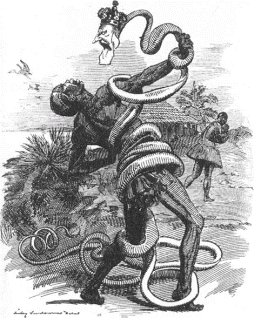 A senior Israeli official told Channel 10 TV channel that a visit on Sunday by Chadian President Idriss Deby to the occupied territories was laying the groundwork for normal ties between Tel Aviv and the Muslim-majority African states of Sudan, Mali and Niger.