The Return of the Nicaraguan Contras, and the Rise of the Pro-Contra Left
By Dan Kovalik | CounterPunch | December 7, 2018
According to our nation’s paper of record, the New York Times, the Nicaraguan Contras re-activated some time ago in order to take on their old foe, Daniel Ortega, who had been re-elected in 2007 after a long hiatus of 17 years. One may recall that it was the pressure of the Contras, and their brutal terrorist tactics, which were critical to unseating Ortega from office the first time back in 1990.
Just as a refresher, the Contras (short for “counterrevolutionaries”) were made up largely of the National Guardsmen of the US-backed dictator, Anastasio Somoza. After the successful 1979 revolution against Somoza – a revolution led by Ortega and the FSLN (or, Sandinistas) — the CIA organized the Guardsmen into the Contras and trained, armed and directed them for the purpose of undermining the fledgling Sandinista government. The Contras, with the direct encouragement of the CIA, carried out various terrorist acts which included the torture, rape and murder of civilians and the destruction of key civilian infrastructure. All told, around 30,000 Nicaraguans died in the 1980’s as a result of the US-backed Contra War.
The Contras, after effectively exhausting the Nicaraguan people and extorting them into voting Ortega out of office in 1990, largely disarmed. However, as the Times wrote back in March of 2016 in a laudatory piece about the Contras’ return, this changed sometime after Ortega’s re-election in 2007. The Times piece begins as follows:
He calls himself Tyson, wears tattered United States Army fatigues and carries a beat-up AK-47.
He is a rebel fighter in the mountains of Nicaragua, setting ambushes against President Daniel Ortega’s government and longing for the days when covert American funding paid for overt warfare.
Tyson and his men are contras — yes, like the ones from the 1980s who received stealth funding during the Reagan administration to topple Mr. Ortega’s leftist Sandinista government. . . .
The contras of today, often nicknamed “the rearmed,” are a shadow of what they once were. . . .
Still, skirmishes in rural areas around the country as recently as last week have left police officers, civilians and soldiers dead, a violent expression of the broader anger brewing against the government.
In this same article, the Times acknowledges that “Mr. Ortega enjoys strong support among the poor . . . .” And of course, this makes absolute sense given Ortega’s enlightened social policies. As the website Popular Resistance explains,
these policies have yielded the highest growth rate in Central America and annual minimum wage increases 5-7% above inflation, improving workers’ living conditions and lifting people out of poverty. The anti-poverty Borgen project reports poverty fell by 30 percent between 2005 and 2014.
The FSLN-led government has put into place an economic model based on public investment and strengthening the safety net for the poor. The government invests in infrastructure, transit, maintains water and electricity within the public sector and moved privatized services, e.g., health care and primary education, into the public sector. This has ensured a stable economic structure that favors the real economy over the speculative economy. The lion’s share of infrastructure in Nicaragua has been built in the last 11 years, something comparable to the New Deal-era in the US, including renewable electricity plants across the country.
Still, according to the Times, the Contras re-emerged in response to what they viewed as Ortega’s over-consolidation of power.
Meanwhile, the Times was not the only one writing about these rearmed Contras. Indeed, over the years, there have been a number of reports about these Contras. According to a 2013 article in Insight Crime, for example, “estimates of the numbers of rearmed contras have varied from dozens to hundreds, and even thousands . . . .” This article explained that eight people had recently been killed as a result of Contra activity in northern Nicaragua near the Honduran border.
For his part, Tim Rogers, a viciously anti-Sandinista journalist, has been writing for years about the phenomenon of the rearmed Contras. For example, in a 2014 piece, Rogers wrote:
A deadly midnight ambush targeting government supporters in northern Nicaragua has stirred the sleeping dogs of war and raised new fears of a pending military campaign against rearmed guerrillas hiding in the mountains.
Five people were killed and 19 injured early Sunday morning in what appears to be a coordinated series of attacks against Sandinista party members traveling by bus through the mountainous coffee-growing region of Matagalpa, one of the main battlegrounds of Nicaragua’s civil war in the 1980s.Video
The buses, filled with pro-government supporters returning from Managua after a day of celebrating the thirty-fifth anniversary of the Sandinista Revolution, were fired on indiscriminately from the darkened shoulder of the road by unidentified men armed with AK-47s.
This very sort of attack against Sandinista rank and file members was played out time and again over this past summer during the three-month-long crisis which received significant media attention. Indeed, when I was in Managua this past July for the anniversary of the Sandinista Revolution, I was told that, contrary to traditional practice, there would not be buses sent to Managua from other parts of the country for the celebration for fear of such attacks.
And yet, while the mainstream press covered the crisis in Nicaragua this past summer with rapt attention, and while Tim Rogers himself published a number of pieces in the mainstream press about it, there was not one whisper about the rearmed Contras, nor was there coverage of the regular assaults against Sandinista rank and file – attacks which included torture, rape and murder. Instead, we were told by the mainstream press, and by most of the “left-wing” press as well, only of peaceful protesters being attacked by an allegedly repressive Sandinista government. And, when people were killed by sniper attacks, we were told that it had to be government security forces because the opposition used only peaceful means, and, in any case, did not have the capacity to carry out such assaults.
Just as the devil was able to do about his own existence, the greatest feat accomplished in this instance was to convince the public that the rearmed Contras did not exist. Of course, this is not a difficult task given that most Americans’ historical memory is about 24 hours.
What is most deeply disappointing and frustrating, however, is that most of the American left, which presumably should know better, has also fallen for this devil’s trick, and has quickly leapt to join in the right-wing chorus calling for the removal of Ortega and the Sandinistas from office. This despite the fact that, as journalist Max Blumenthal explained, there is clear evidence that the US itself has been behind the violent push to unseat Ortega. As Blumenthal related, on May 1, 2018, a publication funded by the Cold War-era National Endowment for Democracy (NED) “bluntly asserted that organizations backed by the NED have spent years and millions of dollars ‘laying the groundwork for insurrection’” which took place over the summer. And, the US AID just announced that it will continue this work by sending another $4 million to support opposition civil society groups in Nicaragua.
What’s more, as far back as 2012, former Navy intelligence officer and NSA analyst Wayne Madsen was not only writing about the rearmed Contras but also about the US and Israeli support for them. While Madsen can sometimes be prone to conspiracy theories which do not always pan out, his claims back then about this particular subject seem spot on and indeed quite prescient.
Thus, in his 2012 book, The Manufacturing of a President, Madsen claims, based upon his numerous intelligence sources, that the CIA and Mossad have both been funding these rearmed Contras, and that they have been shipping these Contras arms over both the Honduran and Costa Rican borders. He claims also that the Honduran government which came to power through the 2009 coup – a coup which the Obama Administration actively aided and abetted to unseat a leftist government which, by the way, happened to be friendly to Ortega – has been key to helping both support the Contras as well as to provide a staging ground for the covert operations to bring down the Sandinista government. In other words, Honduras is playing the very same role it did in the 1980s, and the US-backed coup in 2009 – a mere 2 years after Ortega was elected – was crucial to this role.
And, just last week, in a further attempt to unseat Ortega, the US Senate finally passed the NICA Act which will cut Nicaragua off from all international financing – financing which the Ortega government has been using to effectively combat poverty in Nicaragua. The NICA Act has been in the works for some time, and Nicaraguan opposition forces, including the Sandinista Renovation Movement (MRS), have openly been lobbying for this. This, however, has not stopped most of the left in the US, who obviously have not been impressed with Ortega’s successful social programs and his real support for the poor, from cheerleading and romanticizing these very same opposition forces.
The result of the NICA Act sanctions will be massive suffering for the poor of Nicaragua who support Ortega the most. These sanctions will be particularly painful after the crisis this past summer in which the opposition managed to trash the economy along with substantial civilian infrastructure (just as the Contras had done in the 1980s). And, should Ortega be unseated as a result of all this, it will most certainly be the violent and most right-wing portion of the opposition which will take power, for it is they who have the resolve and the means to do so.
But, guided by the new religion of “humanitarian interventionism,” the pro-imperialist left of the US is indifferent to the consequences of their support, whether explicit or tacit, of Western imperial aggression. Just as many on the US left cheered on the NATO invasion of Libya – an invasion which inevitably left that country broken and with slaves being sold openly on the streets – they now applaud the counterrevolution taking place in Nicaragua. This shows once again that the US left has a very high tolerance for the suffering of Third World peoples so long as they feel that this suffering is endured for the sake of their own abstract notions of human rights.
 Daniel Kovalik teaches International Human Rights at the University of Pittsburgh School of Law. He is also author of the newly-released, The Plot to Control the World: How the US has Spent Billions to Change the Outcome of Elections Around the World.
Unz Goes Nuclear
By Israel Shamir • Unz Review • December 6, 2018
Some discoveries are just too shocking to digest. Recently I wrote of intrepid Ron Unz, the Californian maverick publisher and IT-genius, who dared to share with his readers his insights into the ideas and motifs of revisionists, or Holocaust Deniers, as their enemies call them. But this absolutely verboten topic fades into irrelevance in comparison with his most momentous discovery that has made somewhat less resonance, paradoxically, because of its magnitude. It was too big. Dark pages of the world war history or of interracial relations in 1930s, or even the whodunit of 9/11, all that is fine and very interesting, but hardly a Stop Press kind.
His other, most significant discovery is not just Stop Press, but Burn the Press Down. He discovered and proved with hard data that Jews discriminate against you to a degree you could not even guess. While you queue at the front door of the Elites, they enter freely by the back door. Chances of a smart non-Jewish “white” American kid getting there are ten-fold lower than that of a Jew. There are ten times more smart non-Jewish white American kids than smart Jewish kids, but there are more Jewish students in the Ivy League than white non-Jews. The system is biased, and not in your favour.
Once you could work your way up to success, like Henry Ford did. That was the American Dream. Not anymore. Now the only way to the best jobs, into the American elites leads through a few top colleges of the Ivy League. You can’t bypass this funnel of opportunity. “A greater and greater proportion of our financial, media, business, and political elites being drawn from a relatively small number of our leading universities” (all unattributed quotes are from the Unz essay). Unless you get the imprimatur of Harvard or Yale, your future is dim. Well-paid middle class jobs in the manufacturing sector for those lacking college degrees are scarce, and workers are being paid less now than forty years ago. When America’s richest 1 per cent has as much wealth as the bottom 95 per cent, it is winner takes all, and this winner is probably a Jew.
The elites have duties, too. The elite universities are supposed to pick the best boys and girls to lead America to its glory and greatness. By your own experience you already know that it does not happen; that the new US elites lead themselves to prosperity, while pushing you to poverty and perdition. The new elites failed you, failed your country, failed the world (always excepting the Jewish state). This failure is the main reason to explore how the elites produce their new generation.
The great surprise is that WASPs, the legendary descendants of the Founding Fathers, have lost their privilege, or even their fair chance to success. Unz proves that a smart Christian American boy of English or German parentage has ten times less chance to get into these crème-de-la-crème universities than an average Jewish boy. This very unfair way of forming tomorrow’s elites has been made possible by the sheer nepotistic networking of the universities’ admission offices. Clannishness, the Jews were (justifiably) accused of.
In actual words of Ron Unz, “Jews are enrolled at Harvard and other elite colleges at a rate some 1,000% greater than white Gentiles of similar academic performance”. One thousand per cent, OMG! Provided that these Ivy League colleges are the only sure-fire way into American elites, into best jobs and into good and important positions, this biased enrolment guarantees the Jews their position of the top dog well into next generation.
In 1920s, Jews accused the WASPs of discriminating them at university admission. The WASPs kept them under 15% of admissions. Now with Jews at the top they show what real discrimination is all about. However, there is one major difference. Then, the Jews volubly complained, now the Christians do not even dare to complain.
While the White Christian Americans kept mum, the Asians dared to speak and went to court against the colleges. The colleges have been forced to explain how they admit students. The heavily-Jewish elites of the legal system and MSM allowed this case of Asian-Americans to proceed (after many years of rejection) for a good reason: they wanted to obscure this fragrant discrimination against white Gentiles by Jews by a SEP device.
In Douglas Adams’s 1982 novel Life, the Universe and Everything, (a sequel to his Hitchhiker’s Guide), the protagonist explains: a SEP is something we can’t see, or don’t see, or our brain doesn’t let us see, because we think that it’s somebody else’s problem. That’s what SEP means. Somebody Else’s Problem. The brain just edits it out, it’s like a blind spot. SEP is the best way to hide a pink elephant in a room: people would have walked past the elephant, round it, even over it, and simply never have noticed that the thing was there.
The problem of Asian-American discrimination is an excellent SEP. Indeed, as Unz said, the Asian-Americans are discriminated at Ivy League universities (though much less than ordinary Americans). But even if they are discriminated, who cares? There are not too many of them, and they anyway manage well. Thus the real point of Unz – you are discriminated! – had been hidden.
The UNZ essay is very long with its 26,000 words, too long for average reader, so here are its salient points:
- Jews organized a clannish network to get themselves into best universities in numbers well beyond their share in population, and (!!!) well beyond their abilities;
- their fight against discrimination of Blacks has being carried at the expense of America’s white Christians. If previously discriminated minorities, be it Afro-Americans or whatever, enjoy the fruits of affirmative action (positive discrimination), it is no loss for Jews, as only Gentiles, once privileged WASPs are being screwed up.
- if once upon a time Jews had got into best colleges because they were smart, smarter than Gentile kids, now they are noticeably less smart, but they get there anyway because they are Jews.
The numbers distilled by Ron Unz out of dusty spread sheets are terrifying. You can look at the diagram he compiled, or immerse yourself in the ocean of data he provides, to get convinced: the discrimination is very real.
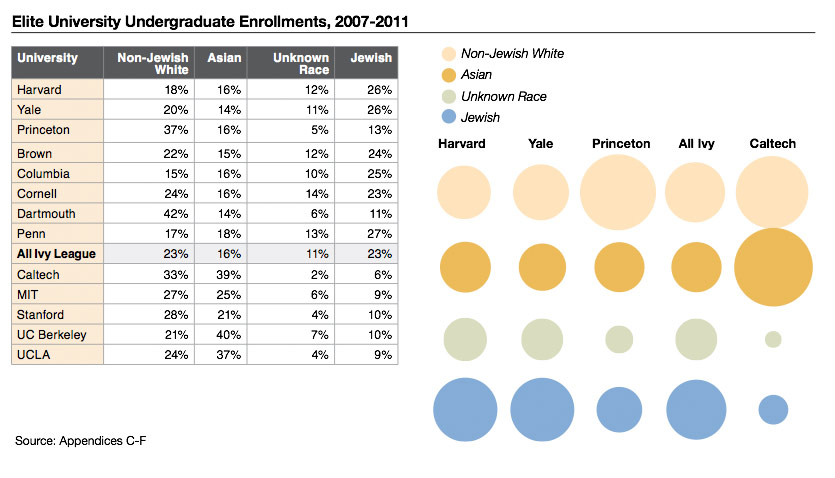
Unz quotes a Jewish writer who exhilarates that “the WASP demographic group which had once so completely dominated America’s elite universities and virtually all the major institutions of American life had by 2000 become a small and beleaguered minority at Harvard, being actually fewer in number than the Jews whose presence they had once sought to restrict.” For a Jewish nationalist, it is a cause for celebration. For a WASP, it is a reason to regret the unwise decisions of his fathers who tried to play a fair game with Jews and were Jew’d.
But for an average American, the answer lays in the macro picture. Do the new Jewified elites manage America better than WASPs did? Are they better shepherds? Is America-2018 (with Jews getting over 25% of all seats in the express train to better future, leaving 20% or less to WASPs) better for Americans than America-1962 with 15% of Jews and 80% of WASPs in Yale and Harvard? If you belong to 1% of Americans, the answer is positive; if you are one of the 99%, it is not.
Unz is very meticulous, very cautious in his approach. He asks an almost-insulting question: perhaps the Jews are so smart (after all, that is the kin of Einstein and Freud) that their share in the Ivy League is a result of meritocratic selection? And he provides an almost-insulting answer: no, they aren’t. There are some universities that admit strictly by merit; in these universities Jews do not exactly star. Caltech, the California Institute of Technology is one of them. The Jewish presence there is quite small; Hillel, the Jewish students’ body, gives it as zero. In reality, it is about 6 per cent, like in other merit-based competitions.
It can’t be zero, for sure. In 2003, two Palestine Solidarity activists, Adam Shapiro and Huwaida Arraf, had been booed there by pro-Israeli Jews who tried their beastly best to drive away the speakers. But there are not many Jews. There are few Jewish Olympiad winners; once they were in dozens, now there are hardly any. Altogether Jewish kids make up some six per cent of NMS, the highest-performing students’ list. This is a good result, in line with Jewish admissions into meritocratic colleges, but it is four times less than what you would expect judging by their Yale admissions. The Jewish IQ, as Unz found out, is also in line with that of their Gentile peers, and not the fabulous 110-115, as the Jewish newspapers claim. Jews are not all that smart anymore, judging by their score.
Unz explains this “sudden collapse of Jewish academic achievement” by inertia. The youngsters just do not try hard enough, in contradistinction to their fathers’ generation. They will succeed, they think, by their old-school-tie connections or through their parents’ links. Indeed when you look at the face of President Trump’s son-in-law, Mr Jared Kushner, you understand that the Nature took a nap in his generation. His parents’ generation were predators and major crooks (his father actually served two years in jail for tax evasion while obtaining his two-billion-dollar loot), but Jared’s generation could not enroll or graduate without assistance, while his political meddling made a mess of already troubled American Middle East politics.
This is the Nature way to deal with problems. Thomas Mann in his 1901 novel Buddenbrooks subtitled The Decline of a Family depicts three generations of a North German family: the first generation amasses fortune, the second maintains it, the third wastes it away in Bohemian pleasures. Smart people’s kids are usually not that smart, and have much less drive. For this reason, I wouldn’t be bothered too much by Jewish achievement of the elder generation; the young generation will waste it all right.
The problem is, there is more than one way to shine. One is to be brilliant, another is to dim others to shine in their background. In Israel, the Jews promoted plethora of laws and regulations circumcising Palestinians’ ability to compete. In the US, Jewish support of migration from underdeveloped countries and discrimination of the white American students achieve a similar effect as it lowers the average ability of non-Jewish population and allows the Jews to excel in comparison.
Unz exploration could bring enormous benefits to the American society. His diagnosis of the malady allows to cure it. In his consequent article on the subject, Unz discovered that after publication of his article, the numbers of Jewish admissions in the best colleges had been sharply readjusted downwards. What was 25% (Jews in Harvard) became 12%. But do not rejoice before time. The Jews responded with subterfuge instead of correcting action. Now they refer in their statistics only to Jews who state that they are followers of Jewish faith; and this is a dwindling lot. If one counts the students who refer to themselves as “descendants of Holocaust survivors” and speak of “my true home Israel”, we are back to 25%.
So the US Jews have learned how to perpetuate their dominance, by jealously guarding the gates of the best universities. Can it be corrected?
Jews broke the glass ceiling of admissions to Harvard by mass protests and media pressure. The Gentiles are not likely to emulate their strategy as they became even more obedient and placid as if being bred for these traits. The Americans aren’t rebellious by nature; that’s why the US is so prosperous and that’s why the lot of a working American is going from bad to worse. Yes, Scylla and Charybdis guard the passage to well-being: over-rebellious folk grows poor as revolutions diminish the treasury; on the other hand, over-docile folk grows poor because their betters oppress them fearing not for harsh response. Wise elites navigate these narrow straits cautiously like the Swedes did until 1990. Obstinate elites have to be cured by revolution, like in England or France, or by state terror, as in Russia or China.
Now you have to live with Jewified elites. Historically, the record is not encouraging. Jews are not very good in the top dog position. They are too obstinate, doctrinaire and despise the low classes to whom they feel no affinity. A single person of Jewish origin can be very good as a leader (Bruno Kreisky, the Austrian chancellor, is a good example). Some Jewish politicians are very loyal – the much-denigrated Kaganovich remained loyal to Stalin when all the rest switched to Khrushchev. But when Jews form a prominent part of elites, like it happened in a few states in different times, the result is not very good. We have the example of Israel, where the natives have nor basic rights neither citizenship, and by millions they are deprived of property and locked up in the ghetto of Gaza.
The Unz revelation demonstrates the main feature of Jews: as a rule, they are immoral (or, if you prefer, they have a different, Jewish moral, as many Rabbis claim). It gives them an advantage in some dealings but eventually courts disaster. In the Tsar’s days, the Jews complained vociferously about two things: one, Numerus Clausus, (a Jewish quota of students) and two, the Pale of Settlement, a part of the country where Jews could reside freely. They – my grandparents – sounded so sincere denouncing these evils. Nowadays, the victorious Jews established the Pale of Settlement for Gentiles in Palestine, while in the US, they fixed the low quota for previous lords of the land, and very few Jews complain about it, as I noted at length.
When it is good for Jews, it is bad for Gentiles, says the Talmud. “If you hear that Caesarea (a symbol of Gentile rule) and Jerusalem (a symbol of Jewish rule) are both in ruins or that both are flourishing peacefully, do not believe it. Believe only a report that Caesarea is in ruins and Jerusalem is flourishing or that Jerusalem is in ruins and Caesarea is flourishing”. (Talmud, Tractate Megillah 6a). History confirms it – up to a point. Jews can have it good under Gentile rule, though not as good as they would like to. But under Jewish rule, not only Gentiles, but even middle-to-low-class Jews are being screwed up, as you can observe in the Jewish state of Israel – and in the heavily Jewified US, as well. Like fire, like women, – Jews are good when under control and dangerous and destructive when they are in control.
Still, there is a free will; everyone can choose one’s own way. Nobody born in the Jewish family has to stick with Jews. The best of Jews, from Christ Apostles to Joseph Brodsky and Ron Unz always escaped it to join the people.
Israel Shamir can be reached at adam@israelshamir.net
The Nobel Peace Prize in Support of War
By Terje Maloy | OffGuardian | December 6, 2018
On December 10, the 2018 Nobel Peace Prize Award Ceremony will be held in Oslo, the capital of Norway. This analysis will try to look at how the prize fits in the bigger picture, but first, some general background is appropriate:
Norway is a member of NATO and has close ties to the United States and Great Britain. The political, economic and bureaucratic elites are firmly integrated in transatlantic networks, a nexus of economic connections, think tanks, international institutions, media and a thousand other ties that bind. They tend to identify with the liberal wing of the empire, (i.e. the Democrats, not the Republicans), but will work with any US administration. The members of the Norwegian Nobel Committee are selected by the Norwegian parliament, and the Committee is nominally independent.
Despite being considered – and where the population considers itself – a ‘peace nation’, there are few countries that have eagerly joined more wars than Norway, from the attack on Yugoslavia in 1999, Afghanistan 2001, the occupation of Iraq, Mali, Libya 2011 and the ongoing occupation of Syria. Norway spends large sums of money supporting the joint Western effort to control the rest of the world through comprador intermediaries in non-governmental organizations.
This analysis will discuss some (overlapping) points about the Nobel Peace Prize:
- The prize reinforces certain grand narratives, the most important one being We are the good, and thus have the right to decide the fate of the rest of the world.
- It creates symbols for regime change operations. It beatifies modern day ‘good natives’ complaining about cruel treatment and pleading for the West to do something to liberate them (but are often remarkably unable to see Western abuses).
- It reinforces general reasons to start wars, by making specific themes very important at the same time they are being used to justify military action.
- It reinforces the narrative that enemy fights with illegal and cruel weapons. The focus on chemical weapons, as opposed to napalm or sanctions, is one example.
- It sanctifies peace treaties that are more like unilateral surrenders, advantageous to Western imperialism and capitalist interests.
- For a bunch of peaceful people, the prize winners are remarkably eager for war and bloody interventions.
- Some other points + Conclusion.
1. WE ARE THE GOOD, AND THUS HAVE THE RIGHT TO DECIDE THE FATE OF THE REST OF THE WORLD
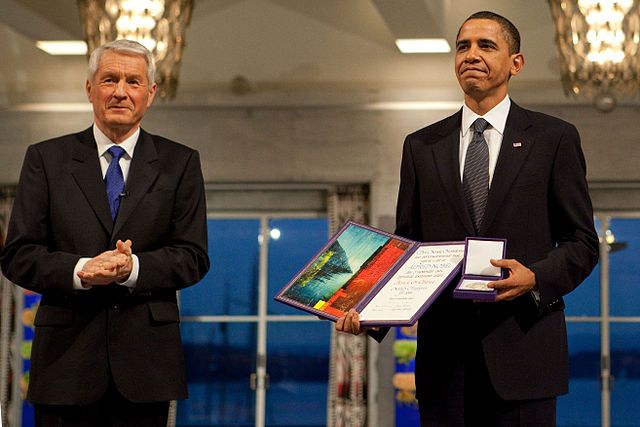
(Photo: / White House, Samantha Appleton /Public Domain)
The Nobel Peace Prize gets its prestige and press coverage because it reinforces several big narratives. If it should deviate too much from what the powerful want, it would be ignored. Of prime importance is the notion that we are the good, and we have a monopoly on interpreting reality and to decide what is important. (‘We’ in this context being people in the West, and by extension their governments and leaders). During the Cold War, the prize had a similar function. It would be interesting to take a closer look at it, but for practical purposes this analysis will mostly be limited the last 30 years. Once you start to notice certain basic themes, they are rather obvious. To put it pointedly, the Nobel Peace Prize tries to aid regime changes to achieve the Empire’s aims where it is possible to avoid direct war, but it will aid in confirming the narrative that our troops are good guys.
This explains why Western leaders so often get the prize. The point is creating an impression that there exists a more humane possibility within our current unjust world system. When they receive it, what they have actually done is not an issue. Hence the award to people like Jimmy Carter (winner 2002); as president he instigated several bloody covert interventions in Central-America, Africa and of course the Islamist fighters in Afghanistan, but has since then opposed direct US wars; or Al Gore (winner 2007), who when he was vice president didn’t shy away from using the military as a foreign policy tool (see part 7). The prize to Barack Obama (winner 2009) can be placed here.
But the main use of the prize is to create support in Western liberal opinion for interventions that would otherwise be naked imperialistic aggression.
2. A FOCUS FOR REGIME CHANGE OPERATIONS
Where a Nobel Peace Prize is awarded to a dissident of a non-western country, the CIA or the Pentagon (see point 3) often has a task force working on cracking the exact same country.
The winners have varying degrees of internal appeal in the targeted country, but the main purpose in choosing these people is not to boost their standing internally, but to justify attempts at regime change to Western liberal public opinion. Without the focus on these martyrs, these operations would look suspiciously like old style colonial domination.
Hence the beatification of Aung San Suu Kyi (winner 1991) coincided with a concerted campaign to get control over a recalcitrant, but very strategic country. Suu Kyi is in many ways typical of the people the Committee prefers. She is a known entity, having conspicuously strong personal connections to the former colonial power – Oxford educated, married to a British citizen, her children are British citizens, etc. Signaling in which direction her political compass was oriented, she asked the world to use the old colonial name Burma instead of Myanmar. She asked for harsh measures against her own country (for its own good) fitting hand in glove with the US strategy actually used. In fact, all means would be permissible to use against this regime imprisoning a modern day saint.
The Nobel Prize to Suu Kyi played an invaluable role in creating huge support, especially on the liberal left, for the draconian economic sanctions against an otherwise fairly obscure country. And maybe many of her Western supporters actually did believe that the US and UK could fund her with large sums of money and create entire NGO-networks for her with the expressed goal of subverting a sovereign nation’s government, and her intentions to still be pure and progressive.
Myanmar is immensely rich in natural resources and is positioned between China and the Indian Ocean, and China and India. Any significant land connection between these two 21st century great powers would have to go through Myanmar to avoid the Himalayas. It is also of great Chinese interest as a transit country to the Indian Ocean. Therefore, the country was targeted with a multi-approach regime change operation.
A massive press campaign was arranged over several decades, a plethora of NGOs financed, whilst “former” CIA-agents now turned missionaries were working with the ethnic guerilla forces to create military pressure. In the usual attempt to concentrate all opposition into a joint force, extreme right wing religious fanatics became the spearhead in this campaign. The sanctions imposed on Myanmar, precluded any economic development and doomed the population to a life of crushing poverty.
One could interpret the recent calls to take the prize back from Suu Kuy as disappointed buyers not getting what they paid for.
We can go forward to 2010, when a Chinese citizen, Liu Xiaobo, won the prize. There were no surprises for what future was envisaged for China:
It took Hong Kong 100 years to become what it is. Given the size of China, certainly it would need 300 years of colonisation for it to become like what Hong Kong is today. I even doubt whether 300 years would be enough.”
The lines between creating justification for a covert regime change operation and next step, a direct war, is blurry. But when required, the Prize Committee can step in to keep the focus of world opinion on the right narrative.
3. CREATING REASONS FOR WAR: WOMEN’S RIGHTS
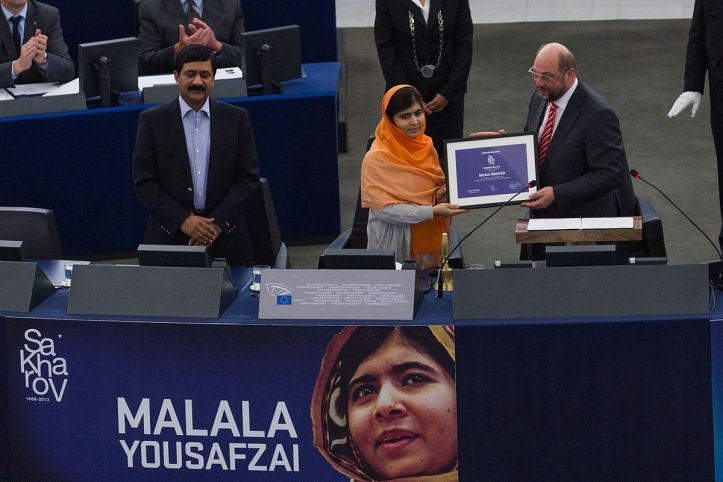
Malala Yoysafzai receives the Sakharov prize © Claude Truong-Ngoc / Wikimedia Commons
In 2003, just after the blitzkrieg on Iraq and at the very height of the George Bush’s talk of continuing the offensive to a few more countries, the committee chose to give the prize to Shirin Ebadi. By beatifying an Iranian at that time, the committee very well knew that they increased the danger of war.
Ebadi is a champion of women’s rights, a recurrent theme in NATO’s efforts to justify their wars. We know that targeting women in the West with this type of messaging has been a major effort for the organization for a long time. By giving the prize to her, they in effect created support in Western (female) public opinion for a war/regime change that would kill an untold number of Iranian women and destroy the lives of the rest, a repeat on a larger scale of what happened in Iraq.
The 2018 prize went to the fight against sexual violence in war. This happens to coincide with the very image NATO wants to promote of itself – who can forget Angelina Jolie and NATO’s General Secretary Jens Stoltenberg writing a joint article in 2017 titled “Why NATO Must Defend Women’s Rights,” where they point out that “NATO has the responsibility and opportunity to be a leading protector of women’s rights” and “can become the global military leader in how to prevent and respond to sexual violence in conflict”. How convenient that the Nobel Committee shares the same view.
A more analytic approach would point out such facts that US/NATO-interventions have made the situation for women infinitely worse in places such as Iraq, Libya and Afghanistan. An intervention to topple the legal government in Syria would certainly have created the same result.
In addition, a bit broader view would point out how allegedly stopping sexual violence against women has justified many wars of aggression. The stereotypes of cruel foreigners have not advanced noticeably from depictions of swarthy Spaniards groping blonde women in the Spanish-American war, to the claim that Gaddafi was handing out Viagra to mercenaries to rape women, as Susan Rice, the US Permanent Representative at UN told the Security Council. Amnesty International, later reported it had “not found any evidence or a single victim of rape or a doctor who knew about somebody being raped.”
Other notorious examples of how this has been used in war propaganda include Serbian rape camps during the Yugoslav wars. Allegations of mass rape were a key element of NATO’s propaganda campaign during the 1999 bombing of Yugoslavia. Clare Short, Britain’s international development secretary, claimed that the rapes were “deliberately performed in front of children, fathers and brothers.” After the war was over, there were some retractions, including from the Washington Post, which reported that “Western accusations that there were Serb-run rape camps […] all proved to be false.”
Malala Yousafzai (winner 2014), the young Pakistani girl who became a symbol of the war against the Taliban, is another figure that fits this pattern. The indefinite occupation of Afghanistan is, among plenty of other vicarious reasons, justified by improving women’s rights. This overlooks the fact that no improvement can be made under a government installed with the help of foreign bayonets. The situation for Afghan women has not improved since the occupation, but then again, the claim was only meant to create support for the war in public opinion.
The importance of creating the perception of fighting for women’s rights has long been realized in military circles.
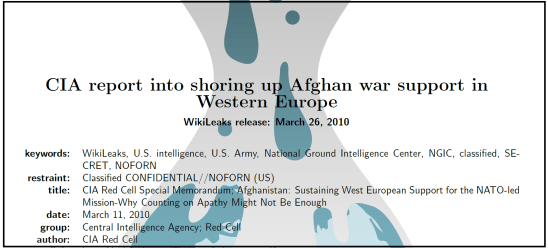
An internal CIA-document from 2010 (a few years before Malala received the prize from the Nobel Institute for her struggle against the Taliban), published by WikiLeaks, discusses how to best market the war in Afghanistan, To show how similar the Nobel Committee and the military/intelligence apparatus think, it is worth quoting the following passage:
Afghan women could serve as ideal messengers in humanizing the ISAF role in combating the Taliban because of women’s ability to speak personally and credibly about their experiences under the Taliban, their aspirations for the future, and their fears of a Taliban victory. Outreach initiatives that create media opportunities for Afghan women to share their stories with French, German, and other European women could help to overcome pervasive skepticism among women in Western Europe toward the ISAF mission.
4. THE ENEMY FIGHTS WITH ILLEGAL AND INHUMANE WEAPONS, AND IT IS IMPERATIVE TO STOP THEM
By highlighting certain themes, in this case ‘illegal weapons’, they reinforce the narrative in Western public opinion that certain things are very urgent and real problems, when in fact they are of relatively minor significance.
Poison gas is a clear example. The OPCW won the prize in 2013. Given the general situation in the Middle East, several million dead in Iraq after the US invasion and at least 400.000 dead in the covert invasion of Syria, gas is a minor factor, and even if we take the frequent claims of ‘gas massacres’ at face value (which of course we shouldn’t), is only responsible for an infinitesimal fraction of these dead.
But to reinforce a false narrative, this focus has been invaluable. The prize creates acceptance for the narrative that gas is a uniquely important and evil weapon, where it is fully justified to do anything necessary, including attacking countries, to stop the possible use of it. At the moment of writing this, Nov 24, 2018, the US just accused Iran of hiding a chemical weapons program.
Some weapons that are killing far more people in far more gruesome ways than poison gas, like napalm, would never be put on this list. And we could compare gas to sanctions, the West’s favorite and most effective weapon of mass destruction, killing the weakest, the sick, children and old people slowly, while destroying entire peoples’ right to a decent life. No other or weapon of mass destruction has killed as many people since WW2.
5. SANCTIFYING PEACE TREATIES THAT ARE NEGOTIATED SURRENDERS TO WESTERN INTERESTS

Yasser Arafat receives the prize in 1994, together with Israeli Foreign Minister Shimon Peres, Israeli Prime Minister Yitzhak Rabin CC BY-SA 3.0 File:Flickr – (GPO)
The most noticeable feature when the prize goes to creators of peace treaties, is that the treaties are more like a negotiated surrender than a just peace.
Colombia’s president Juan Manuel Santos (winner 2016) received the prize for victoriously having put the finishing touches to a long US-led counter-insurgency campaign against leftist guerilla forces. Now the reactionary oligarchy has a safe grip on the country, and can continue their neoliberal agenda, which isn’t that different from the old reactionary order. The death squads murdering leftist and human rights activist continue their activities with impunity.
The country had an extremely tarnished image in human rights issues and needed a quick touch-up to make it palatable. The most conspicuous thing the 2016-award is that the president got the prize just before Colombia became a global partner of NATO. The planning of the PR-requirements for this to happen smoothly must have been already well under way when the prize winner was decided. Remember the prize is directed at Western public opinion, and has little to do with an actual just peace in Colombia.
Yasser Arafat (co-winner 1993) got the prize so he would be tied to a peace plan with a chimerical two-state solution the Israeli side had no intention of honoring. The peace offer didn’t even include a stop in construction of Israeli settlements. No clearer signal of Israeli intentions could have been given. This is a continuation of the joint prize to Sadat and Begin in 1978, for the peace treaty between Egypt and Israel, where Israel succeeded in making a separate peace with the biggest Arab country, and could thereafter concentrate on consolidating its grip on the West Bank.
While Nelson Mandela (co-winner 1994) undoubtedly was a worthy winner, the transition deal the ANC negotiated for South Africa only transferred formal political power, and left unjust economic power structures intact. The assets of multinational companies were guaranteed, and the neoliberal policies implied in the deal doomed the large majority of the population to continued poverty.
Michail Gorbachev (winner 1990) got the prize for a unilateral and wholesale surrender of every Soviet position, both economic and political; he didn’t even keep them as bargaining cards. Trusting Western oral promises, this naiveté is unprecedented in a leader of a great power. His bad decisions made a managed transition to a mixed system impossible and abandoned the former socialist states to Western looting and a social collapse they still haven’t recovered from. No wonder he still is so popular in the West that gave him the medal as a sign of appreciation.
Finnish Martti Ahtisaari got the prize in 2008, «for his efforts on several continents and over more than three decades, to resolve international conflicts». This is very true. Left out is what should be added to the sentence, to resolve international conflicts – as a total Western victory.
Ahtisaari is directly linked to the creation of the NATO-protectorate of Kosovo. By 1999, NATO had decided to splinter Yugoslavia one more time. A 78 day aerial bombing campaign had little effect, so they sent in the diplomats. It was suggested that an envoy from a ‘neutral’ country would be more efficient. Here is how Ahtisaari handled the situation, telling the Serbs what ‘we’ would do (my emphasis):
Ahtisaari opened the meeting by declaring, “We are not here to discuss or negotiate,” […]. Ahtisaari says that Milosevic asked about the possibility of modifying the plan, to which he replied, “No. This is the best that Viktor and I have managed to do. You have to agree to it in every part.” [..] As Milosevic listened to the reading of the text, he realized that the “Russians and the Europeans had put us in the hands of the British and the Americans.”
Milosevic took the papers and asked, “What will happen if I do not sign?” In answer, “Ahtisaari made a gesture on the table,” and then moved aside the flower centerpiece. Then Ahtisaari said, “Belgrade will be like this table. We will immediately begin carpet-bombing Belgrade.” Repeating the gesture of sweeping the table, Ahtisaari threatened, “This is what we will do to Belgrade.” A moment of silence passed, and then he added, “There will be half a million dead within a week.”
The Serbians signed the treaty.
6. NOT A PEACEFUL VERY BUNCH OF PEOPLE
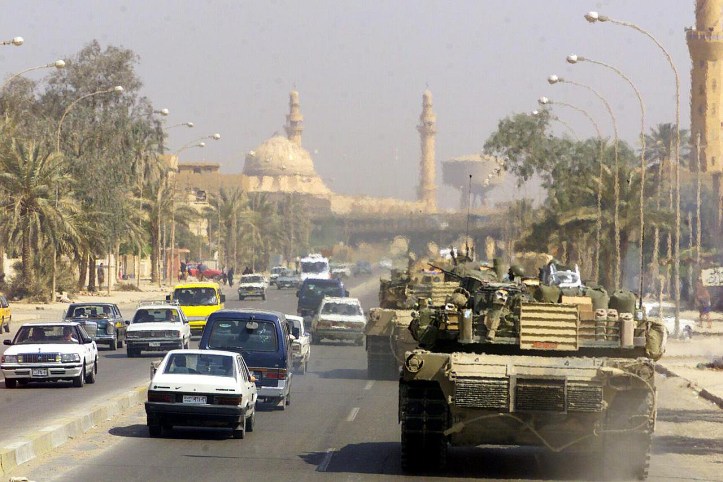
US Marine Corps tank in Baghdad, 2003 (Photo: USMC/ Public Domain)
For recipients of a peace prize, a remarkable number of them support wars.
The invasion of Iraq in 2003 was a war of aggression under the trumped up pretext of disarming Iraq of Weapons of mass destruction. It was a blatant breach of both international law and the United Nations Charter. What did the Nobel Prize Winners think of it?
Here we have Elie Wiesel (winner 1986): “I now know I was wrong, but better that than to have stood idly by”.
Jose Ramos-Horta (winner 1996) claimed approvingly that the only truly effective means of pressure on the Iraqi dictator [is] the threat of the use of force.
Liu Xiaobo (winner 2010) was clear, the “decision by President Bush is right!”. But then again, Liu had the remarkable opinion that “the major wars that the US became involved in are all ethically defensible,” including the wars in Afghanistan and Vietnam.
Former vice president Al Gore (winner 2009) had argued aggressively in favor of war in Iraq in 1991 and 1998, Bosnia in 1995 and Kosovo in 1998, and believed the 2003 Iraq war was legal based on earlier UN resolutions.
The Cold War winner Lech Walesa (1983) was an opponent of the invasion, but at least he knew where to put the blame: “It’s not the United States that is to blame for the war, but rather the EU, and in particular Germany and France. They knew the war was coming and they failed to prevent it.”
The Dalai Lama (winner 1989) was wily enough to hedge his bets, but decidedly did not condemn the war: “it’s too early to say, right or wrong”, He also supported the US/NATO military intervention in Afghanistan and the attack on Yugoslavia.
There is a similar level of support among prize winners for a direct intervention in the ‘civil’ war in Syria, a US/NATO regime change plan on the drawing board for at least 10 years before it started. The push for a no-fly zone in Syria on a Libyan model, which could then be used as a fig leaf for a full-scale assault, was immense for several years. What did the Nobel Prize winners think of this possibility?
(Keep in mind that the ‘action’ they call for, can only be either an aerial bombing or ground troops.)
Kailash Satyarthi (winner 2014) did not say anything about the fact that it was the 3 Western powers on the Security Council which started this war by spending billions of dollars arming and financing armed Islamist gangs. Stopping this support would seem to be the obvious way to stop the war, but instead we get: “The UN Security Council (UNSC) has the military power to bring this unceasing genocide to a halt.”
His co-winner Malala Yousafzai who seems to have envisaged a similar future for Syria as for Afghanistan, a Western intervention: “When I look at Syria, I see the Rwandan genocide. When I read the desperate words of Bana Alabed in Aleppo, I see Anne Frank in Amsterdam… We must act. The international community must do everything they can to end to this inhumane war”
This was echoed by former UN-leader Kofi Annan (winner 2001). Defining Aleppo as only the small part of the city occupied by Islamist gangs, he called for ‘action’. How this ‘action’ would differ from what he describes, is not clear: “The assault on Aleppo is an assault on the whole world. When hospitals, schools and homes are bombed indiscriminately, killing and maiming hundreds of innocent children, these are acts that constitute an attack on our shared, fundamental human values. Our collective cry for action must be heard, and acted upon, by all those engaged in this dreadful war.”
This wish was supported by Medecins sans Frontiers, recipient of the 1999 Nobel Peace Prize. It was the first to report the alleged gas attack in Ghouta on 21. August 2013, which the Obama-administration wanted to use as a pretext for a military assault. As it admitted, the MSF’s decision to issue a press release on the incident—which had not taken place in an MSF hospital, but in its “silent partner” facilities in rebel-controlled areas—was highly political.
MSF was well aware that their announcement of chemical weapons use would be immediately seized upon by the US to claim that Syrian President Assad had crossed a red line, and to start a bombing campaign.
The organization was here true to its roots, as the civilian part in the French military/intelligence effort to support an independent state in the oil producing parts of Nigeria, in the Biafran war of independence in 1967-1970.
Amnesty International, (winner 1977) was not much better, with its call for unspecified ‘action’: “The international community’s catastrophic failure to take concrete action to protect the people of Syria has allowed parties to the conflict, most notably the Syrian government, to commit war crimes and crimes against humanity with complete impunity, often with assistance of outside powers, particularly Russia… the international community had said ‘never again’ after the government devastated Eastern Aleppo with similar unlawful tactics. But here we are again.”
Anyway, Amnesty has a soft spot for endless NATO-interventions. In 2012, after 11 years of dismal occupation, the organization paid for advertising posters in the US applauding NATO’s actions in Afghanistan — “Keep the progress going”, purportedly doing something for women’s rights.
Tawakkol Abdel-Salam Karman is a Yemeni journalist and human rights activist that won the prize in 2009 wanted ‘protection’, writing: “Instead of protecting residents in Aleppo from brutalities of Russia, Iran and Bashar Al Assad’s regime, the world tended to mediate to provide safe corridors for the displacement of civilians,” adding, “these also are partners in crime.”
Colombian President Juan Manuel Santos (2016) voiced support for the missile attacks on Syria in March 2018.
Such bellicosity (or just as often, coy bellicosity) is nothing new in the type of people selected as winners. Henry Kissinger (winner 1973) was the most infamous war hawk to win the prize during the Cold War, but as long as it was the right side doing the fighting, plenty of others identified with this one sided world view. We can recognize all the themes mentioned above in Michael Parenti’s description of the 1975 Peace Prize winner:
Andrei Sakharov was a darling of the U.S. press, a Soviet dissident who regularly sang praises to corporate capitalism. Sakharov lambasted the U.S. peace movement for its opposition to the Vietnam War. He accused the Soviets of being the sole culprits behind the arms race and he supported every U.S. armed intervention abroad as a defense of democracy. Hailed in the west as a «human rights advocate,» Sakharov never had an unkind word for the horrific human rights violations perpetrated by the fascist regimes of faithful U.S. client states, including Pinochet’s Chile and Suharto’s Indonesia, and he aimed snide remarks at the «peaceniks» who did. He regularly attacked those in the West who opposed U.S. repressive military interventions abroad.
7. Some other points + Conclusion
You don’t have to be an prop for US/NATO power projection to win the prize, but it helps.
The prize was originally intended to be given to the person who has done most to foster peace between nations. In a subtle twist, in many cases it has changed to banning aspects of warfare, barely ever addressing war itself. Broaching such a subject honestly would be impossible without addressing the elephant in the room, US/Western imperialism. The award has had many winners who are variants of this year’s theme, sexual violence in war (which also touches on point 3, the NATO-narrative of defense of women). The focus here is on a more civilized form of war, not abolishing war as such as a means of settling disputes.
No one (apart from some military brass) is actually pro-landmines, but the Peace prize to the Campaign Against Land Mines in 1997 coincided with the increased Western interventions in places where these weapons would be a hindrance to the success of the occupation It was not in the interest of NATO forces to have their opponents using these ‘poor man’s weapons’, creating the casualties so feared by the military in modern wars, which again might increase opposition at home to war. The coalition suffered most of their casualties from IEDs, a sort of land mine, in Iraq, while having limited use of mines themselves.
There is a certain unpredictability as to who the prize will be awarded to, making it not as obviously beholden to the immediate needs of the powerful, even though the long term trend is clear. For example, there has been no Russian winner for quite a while now, and the White Helmets have not yet got the award, maybe as they are too obviously only a PR-front.
When Jean-Paul Sartre declined the Nobel Prize in Literature, he said that the prize ‘is for Western writers or Eastern rebels’. On a similar note, we might say that the Nobel Peace Prize is for Western elites or Eastern rebels.
That the selection of winners conforms to US views does not mean that there is a direct influence, although some recommendations to the Committee probably weigh heavier than others. Rather this pattern is a sign of how well socialized the Norwegian Nobel Committee members are in the transatlantic world view, where ‘our’ requirements override any genuine wish for peace.
Trump’s Timidity is Letting Comey Off the Hook
By Ray McGovern • Consortium News • December 4, 2018
Because President Donald Trump has again pulled the rug out from under them, House Republicans face Mission Impossible on Friday when they try to hold ex-FBI Director James Comey accountable for his highly dubious authorization of surveillance on erstwhile Trump campaign adviser Carter Page.
Comey let go his unprecedented legal maneuver to have a court quash a subpoena for him to appear behind closed doors before the Republican-led House Judiciary Committee until the Democrats take over the committee in January. The current committee chair, Rep. Bob Goodlatte (R-VA), decried Comey’s use of “baseless litigation” in an “attempt to run out the clock on this Congress.”
The Judiciary Committee has jurisdiction over the Foreign Intelligence Surveillance Act (FISA); so the still secret FISA application “justifying” surveillance of Page is almost sure to come up.
Comey had wanted a public hearing so he could pull the ruse of refusing to respond because his answers would be classified. He has now agreed to a closed-door meeting on Friday, with a transcript, likely to be redacted, to appear a few days later.
In an interview with The New York Post last Wednesday, Trump acknowledged that he could declassify Comey’s damning Foreign Intelligence Surveillance Act warrant request to show how devastating those pages likely are, but said he would not do so “until they were needed,” namely, if a Democratic House starts going after him. “If they go down the presidential harassment track, if they want go and harass the president and the administration, I think that would be the best thing that would happen to me. I’m a counter-puncher and I will hit them so hard they’d never been hit like that,” Trump told the paper. He added: “It’s much more powerful if I do it then, because if we had done it already, it would already be yesterday’s news.”
But they are needed before Comey’s hearing on Friday. Barely a week will remain before Congress adjourns. Four weeks later Democrats take over the oversight committees.
Cowardice Deja Vu
This is not the first time Trump has flinched. On September 17 he ordered “immediate declassification” of Russia-gate documents, including FISA-related material. Four days later he backed down, explaining that he would leave it to the Justice Department’s inspector general to review the material, rather than release it publicly.
What exactly is in the FISA application, and why had House Intelligence Committee chair Devin Nunes, for example, kept pleading with Trump to declassify it? In July Nunes expressed hedged confidence “that once the American people see these 20 pages, at least for those that will get real reporting on this issue, they will be shocked by what’s in that FISA application” to surveil Page, a U.S. citizen.
Oddly, Trump echoed Nunes, telling The New York Post that, were he to declassify FISA warrant applications and other documents, all would “see how devastating those pages are.” But Trump blamed his reluctance to declassify on one of his lawyers, Emmet Flood, who thought it would be better politically to wait. “He didn’t want me to do it yet, because I can save it. … I think [eventual release] might help my campaign.” So Nunes et al. find themselves thrown under the bus, again.
Worse still, according to Comey’s attorney, the “accommodation” worked out with House Judiciary Committee includes a proviso that a representative of the FBI will be present on Friday to advise on any issues of confidentiality and legal privilege. The committee undertook to publish a transcript very quickly. Do not be surprised to see many Peter-Strzok-type responses: “I would really like to answer that question, but the FBI won’t let me.”
Afraid?
In an insightful posting, David Stockman, budget director for President Ronald Reagan, was puzzled about why Trump doesn’t seem to get what’s going on. I think, rather, that Trump does get it, and that Stockman’s puzzlement may be due mostly to his specific experience as budget director. In that role, Stockman did not have to pay much heed to the Deep State, so long as he did not demur about the obscenely excessive budgets automatically given to the FBI, DOJ, CIA, NSA, and the Pentagon.
With Trump it’s a different kettle of fish — and they are piranhas. Trump has ample reason to fear the Deep State is out to get him because it is. And by this point he seems to have internalized quite enough fear that it would be too dangerous to take on the the FBI and intelligence community. Needless to say, the stakes are exceedingly high — for both sides. As president-elect, Trump dismissed the usual warnings as to how things work in Washington. But he could hardly have missed Sen. Minority Leader Chuck Schumer’s attempt to ensure that Trump knows what he should be afraid of.
Not Afraid? Then ‘Really Dumb’
On Jan. 3, 2017, three weeks before Trump took office, Schumer told MSNBC’s Rachel Maddow, that President-elect Trump was “being really dumb” by taking on the intelligence community and doubting its assessments on Russia’s cyber activities: “Let me tell you, you take on the intelligence community, they have six ways from Sunday at getting back at you. So even for a practical, supposedly hard-nosed businessman, he’s being really dumb to do this.”
Schumer’s words came just three days before then-National Intelligence Director James Clapper and the heads of the FBI, CIA, and NSA descended upon the president-elect with the misnomered “Intelligence Community Assessment” — a rump, evidence-free embarrassment to serious practitioners of intelligence analysis, published that same day, alleging that Russian President Vladimir Putin had done what he could to get Trump elected.
Adding insult to injury, after the January 6, 2018 briefing of the president-elect by the Gang of Four, Comey asked the others to leave, and proceeded to brief Trump on the dubious findings of the so-called “Steele dossier” — opposition research paid for by the Democrats (and, according to some reports, by the FBI as well) — with unconfirmed but scurrilous stories about Trump cavorting with prostitutes in Moscow, etc., etc. (And according to The Washington Post, that incident with hookers was written by a Clinton operative.) That opposition research was apparently used in the FISA warrant request, without revealing its provenance to the judge.
‘This Russia Thing’
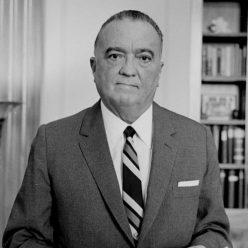
Hoover: Model for Comey. (Wikipedia)
It seems to have taken Trump a few months to appreciate fully that he was being subjected to the classic blackmail-type advisory previously used with presidents-elect by the likes of J. Edgar Hoover. Indeed, this may be what Trump had in mind when he told Lester Holt in May 2017 that he had fired Comey over “this Russia thing.” (Trump can be his worst enemy when he opens his mouth.)
Comey’s closed-door deposition is now scheduled for the 77th anniversary of the Japanese surprise attack on Pearl Harbor. But don’t look for any surprise attack on Comey this December 7 from Judiciary Committee members, highly vulnerable though he is.
With just a few days left before Congress adjourns, House Republicans, like their President, have pretty much let the clock run out on them. Few will see much percentage at this late date in “taking on the intelligence community.” Trump has already pretty much thrown them under the bus.
The leadership of the three House committees with purview over Russia-gate matters — Judiciary, Intelligence, and Government Operations — changes next month. So while Friday had seemed to be shaping up as a key day for confronting Comey — and for getting answers to questions on Russia-gate — the day will likely land with an anticlimactic thud. Even if the committee is able to expose additional misdeeds not already known, nothing much is likely to happen before Christmas.
After that, the three committees and their aborted work will be history.
The dominant mainstream media narrative about Russia-gate — ignoring FBI-gate — will hop happily into the new year. And no congressional “oversight” committee will dare step up to its constitutional duty, despite a plethora of documentary evidence on FBI-gate. And why? Largely because “they” of the Deep State “have six ways from Sunday at getting back at you.”
Most consequential of all, any significant improvement in relations with Russia will remain stymied. And the MICIMATT (Military-Industrial-Congressional-Intelligence-Media-Academia-Think Tank) complex, with its Deep-State enforcer, will have won yet another round. Merry Christmas.
Ray McGovern works with Tell the Word, a publishing arm of the ecumenical Church of the Saviour in inner-city Washington. He worked for the senior Bush when he was director of the CIA and then briefed him mornings, one-on-one, with the President’s Daily Brief during the first Reagan administration. In Jan. 2003, Ray co-founded Veteran Intelligence Professionals for Sanity (VIPS) and still serves on its Steering Group.
Fact-checking the second volume of the U.S. National Climate Assessment
By Roger Andrews | Energy Matters | December 4, 2018
 This recently-issued study (the “Assessment”) was seized on by the media as proof of the massive damage the US will suffer if nothing is done about climate change. The Assessment’s conclusions are based largely on speculative model projections that aren’t amenable to checking, but it also claims that the US is already experiencing some of the impacts of man-made climate change, and these claims can be checked. This post accordingly evaluates them claim-by-claim and finds that they are rarely backed up by any hard data, that in some cases they are contradicted by disclaimers buried in the text, and that in no case is there any hard evidence that conclusively relates the impacts to man-made climate change. The credibility of the Assessment’s predictions can be judged accordingly.
The Assessment is 1,600 pages long and I doubt that anyone has read it from cover to cover – I certainly haven’t. I have obtained my information from the Summary Findings, Overview, Report Chapters and Downloads sections in the boxes that clicking on this link leads to. These sections themselves contain several hundred pages of text, much of it repetitive, but there is always the possibility that I’ve missed some critical graphic or piece of text. On the other hand, if I’ve missed it the media, who will have read the introductory sections only, will have too.
And how did the media report the Assessment’s results? Here are some excerpts:
Climate change is already harming Americans’ lives with “substantial damages” set to occur as global temperatures threaten to surge beyond internationally agreed limits ……… The influence of climate change is being felt across the US with increases in disastrous wildfires in the west, flooding on the east coast, soil loss in the midwest and coastal erosion in Alaska
Billions of hours in productivity will be lost. Hundreds of billions of dollars will be wiped from the economy. Tens of thousands of people will die each year. The scientific report, which was produced by 13 federal agencies, describes an American future nothing short of apocalyptic due to rising threats from climate change …. rising sea levels, disruptions in food productions and the spread of wildfires — have all come true today.
Climate change is happening here and now …. It is affecting all of us no matter where we live. And the more climate changes, the more serious and even more dangerous the impacts will become.
From record-breaking wildfires that destroyed more than 14,000 homes in California, to hurricanes that devastated parts of Florida and much of Puerto Rico, long-predicted impacts of climate change are here and wreaking havoc.
The media never lose an opportunity to cast climate change in the worst possible light, or fail to report it when someone else does it for them.
And what are the climate change impacts that the Assessment claims are “happening here and now”, which are the only ones we can verify, or not verify as the case may be, against observations? These excerpts identify them either explicitly or implicitly:
Glaciers and snow cover are shrinking
Increases in greenhouse gases and decreases in air pollution have contributed to increases in Atlantic hurricane activity since 1970.
America’s trillion-dollar coastal property market and public infrastructure are threatened by the ongoing increase in the frequency, depth, and extent of tidal flooding due to sea level rise
Existing water, transportation, and energy infrastructure already face challenges from heavy rainfall, inland and coastal flooding, landslides, drought, wildfire, heat waves, and other weather and climate events
Climate-related changes in weather patterns and associated changes in air, water, food, and the environment are affecting the health and well-being of the American people, causing injuries, illnesses, and death.
Rising air and water temperatures and changes in precipitation are intensifying droughts, increasing heavy downpours, reducing snowpack
Our Nation’s aging and deteriorating infrastructure is further stressed by increases in heavy precipitation events, coastal flooding, heat, wildfires
Some storm types such as hurricanes, tornadoes, and winter storms are also exhibiting changes that have been linked to climate change
After eliminating repetition and sorting the individual impacts into something resembling order we are left with droughts; floods; heavy precipitation; heat waves; wildfires; Atlantic hurricanes; tornadoes; winter storms; sea level rise; glaciers and snowpack; injuries, illnesses and death. We will review these in order of appearance:
1. Droughts
The Assessment begins by claiming that climate-change-induced droughts are intensifying in the US. Then later in the text it shoots itself in the foot:
While there are a number of ways to measure drought, there is currently no detectable change in long-term U.S. drought statistics using the Palmer Drought Severity Index
And adds a graphic to prove it, reproduced below as Figure 1:

Figure 1: US drought conditions. The Palmer Drought Severity Index is the commonly-used metric for measuring drought intensity
2. Floods
The Assessment provides no hard data to back up its claims that climate change is already causing increased flooding in the US (coastal flooding is discussed under sea level rise). The only quantitative historical data I can find on US floods are summarized in Figure 2 (data from Researchgate ):
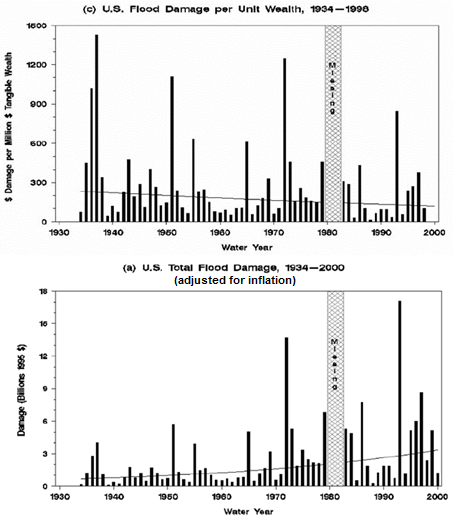
Figure 2: Two measures of US flood damage, 1934-2000
These graphics don’t tell us whether floods in the US are on the increase or not. And the Assessment doesn’t tell us either, Not only does it fail to detect any nationwide trends, it states that it never claimed any relationship between floods and man-made climate change to begin with:
Analysis of 200 U.S. stream gauges indicates areas of both increasing and decreasing flooding magnitude but does not provide robust evidence that these trends are attributable to human influences …. Hence, no formal attribution of observed flooding changes to anthropogenic forcing has been claimed.
3. Heavy Precipitation
Since the Assessment admits that there are no detectable human-induced trends in US flooding we can reasonably assume that the claimed increase in heavy precipitation events has had no impact. But we will look at the data anyway. The Assessment presents this graphic to back up its claim that heavy precipitation events are increasing over the US as a whole (Figure 3). As usual, the source of the data is not specified:
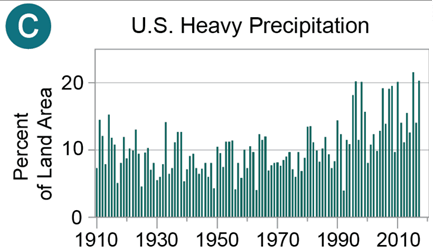
Figure 3: Percent of US land area with heavy precipitation events
The U.S. Global Change Research Program, under the auspices of which the Assessment was written, also produces graphics showing how heavy precipitation has changed with time and by region in the US (they may in fact be buried in parts of the Assessment I haven’t looked at). According to Figure 4 (from Globalchange) heavy precipitation events have increased over all of the US except the Southwest:
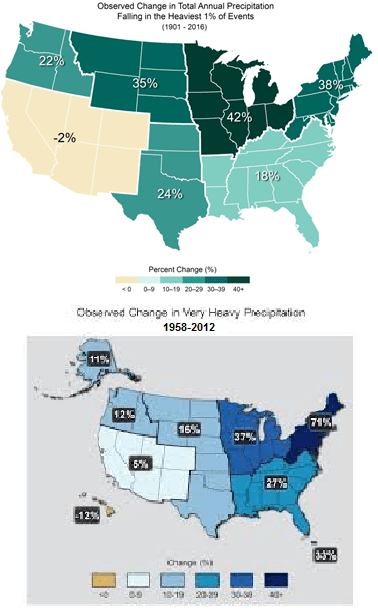
Figure 4: Increases in US total precipitation and very heavy precipitation events by region
And Huang et al (2017) produce time series showing how total precipitation and extreme precipitation in the Northeast US have both increased since about 1960 (Figure 5):
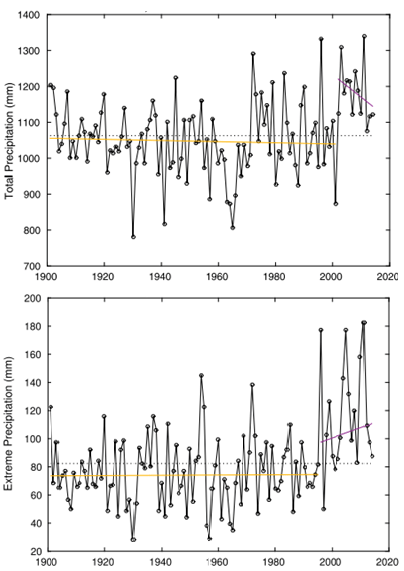
Figure 5: Increases in US total and extreme precipitation
So in this case the claim checks out against observations, or least in the northeast US. A lingering question, however, is how much of the increase in heavy precipitation was caused by man-made climate change. The Assessment implicitly assumes that all of it was, but a 2015 study by Hoerling et al. concludes that most of the changes after 1979 were caused by ocean variability:
Based on the modeling results, we conclude that anthropogenic climate change has not been a principal factor driving key characteristics of observed changes in U.S. heavy daily precipitation since 1979 …. Our results provide evidence for an alternative argument for another factor that has been operating in recent decades, namely, that statistics of U.S. heavy precipitation have been sensitive to strong decadal ocean variability since 1979
4. Heat Waves
One of the problems with heat waves is defining them (droughts and floods have the same problem). How hot does it have to get, and for how long, before a warm spell becomes a heat wave? The Assessment does not tell us. All it presents in the way of evidence for an increase in heat waves in the introductory report sections, including the 186-page “Report-in-Brief”, is this graphic (Figure 6), which shows the “heat wave season” increasing since the 1960s but not how many heat waves there were. Once again the data source is not specified, nor is the meaning of the cross-hatching:
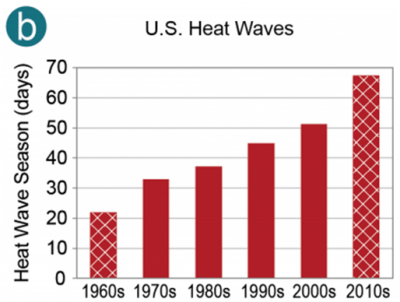
Figure 6: Length of US “heat wave season”
The next graphic (Figure 7) is another one I added from the globalchange website. It shows an increase in daily record high temperatures in recent decades but again provides no information on the number of heat waves. How many of the record highs, for example, occurred in the winter?
 Figure 7: Record daily highs in the US. The meaning of “ratio of daily temperature records” isn’t clear
The only graphic I found that provided any historic information on the incidence of heat waves was the Figure 8 plot of the EPA’s Annual Heat Wave Index. It’s not surprising that it doesn’t appear in the Assessment:
 Figure 8: US annual heat wave index since 1895
5. Wildfires
The Assessment provides two graphics to support its claim that climate change is causing more wildfires. Figure 9 shows the first. Again no data source is cited, but it turns out that it comes from the National Interagency Fire Center:
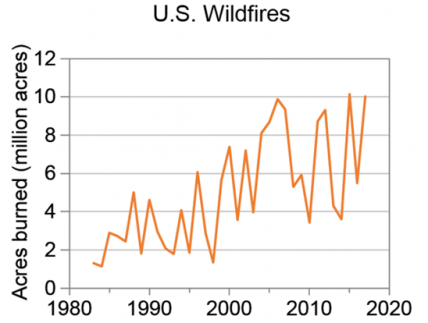
Figure 9: Acres burned by US wildfires since 1987
It also shows only a fraction of the NIFC data. Figure 10, for what it may be worth, shows the complete plot. I say “for what it may be worth” because the plot comes accompanied by this disclaimer:
The National Interagency Coordination Center at NIFC compiles annual wildland fire statistics for federal and state agencies. This information is provided through Situation Reports, which have been in use for several decades. Prior to 1983, sources of these figures are not known, or cannot be confirmed, and were not derived from the current situation reporting process. As a result the figures prior to 1983 should not be compared to later data.
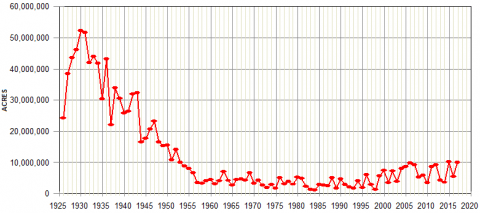 Figure 10: Acres burned by US wildfires. Figure 9 data carried back to 1926
Figure 11 reproduces the Assessment’s second graphic. It shows that about half of the increase in acreage burned was caused by climate change. (Note that it conflicts with the Figure 9 data, according to which a cumulative total of 173 million acres, not 23 million, has been burned since 1984).
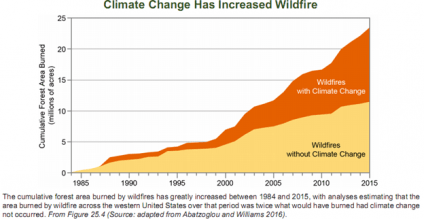 Figure 11: Acreage burned by naturally-occurring wildfires vs. acreage burned by climate-change-caused wildfires
In this case the data source is specified. It’s a 2016 paper written by John T. Abatzoglou and A. Park Williams entitled “Impact of anthropogenic climate change on wildfire across western US forests”. How did they segregate climate change-caused wildfires from naturally-occurring wildfires? They used climate models:
We quantify the influence of ACC (anthropogenic climate change) using the Coupled Model Intercomparison Project, Phase 5 (CMIP5) multimodel mean changes in temperature and vapor pressure …. This approach defines the ACC signal for any given location as the multimodel mean 50-y low-pass-filtered record of monthly temperature and vapor pressure anomalies relative to a 1901 baseline.
Before we can accept these results as meaningful we must assume that the global CMIP5 climate models can hindcast temperatures and vapor pressures to a high level of accuracy in the US, which they probably can’t (it’s generally accepted that climate models do a poor job of simulating regional changes). We also have to assume that the numerous other variables that affect wildfires have had no impact. This is a stretch, to put it mildly.
6. Atlantic Hurricanes
In this case the Assessment supplies no data, or at least none that I can find, to back up its claim that Atlantic hurricanes have increased since 1970. So once again I have had to dig up data on my own. Figure 12 (data from the US Environmental Protection Agency) plots the number of North Atlantic hurricanes since 1880. The total number is defined by the orange line, which adjusts for undercounting before 1967, and by the green line after that. There has been an erratic overall increase since about 1970, but since 1880 there has been no clear trend:
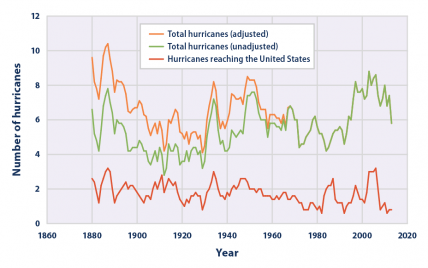 Figure 12: Unadjusted hurricane counts, hurricane counts adjusted for undercounting and hurricanes making landfall in the US
The North Atlantic, however, is not part of the US. The important consideration is how many hurricanes have made landfall in the US. These are shown by the red line at the bottom of Figure 12. There is no clear trend since 1970 and if anything a decrease since 1880.
According to Figure 13 (data from Dr. Roy Spencer) major hurricanes making landfall in the US have also been decreasing since the 1930s:

Figure 13: Major hurricanes making landfall in the US
And according to Klotzbach et al (2018) there has been little to no increase in normalized hurricane damages in the US since 1900 (Figure 13):
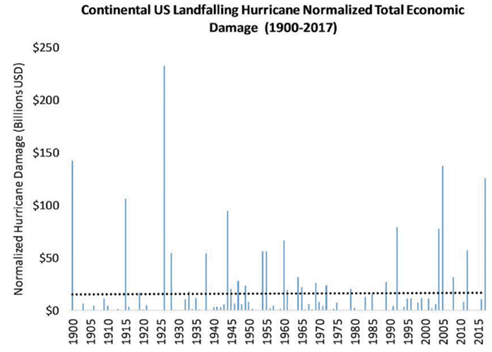
Figure 14: Normalized damages from hurricanes making landfall in the US
In this case the claim broadly matches observations but conceals (probably deliberately) the big picture, which is that man-made climate change has not increased the incidence of, or the damage caused by, North Atlantic hurricanes making landfall in the US since at least the late 1800s.
7. Tornadoes
Some storm types such as … tornadoes … are also exhibiting changes that have been linked to climate change. Once more the Assessment presents no supporting data, but NOAA’s tornado counts (Figure 15) speak for themselves:
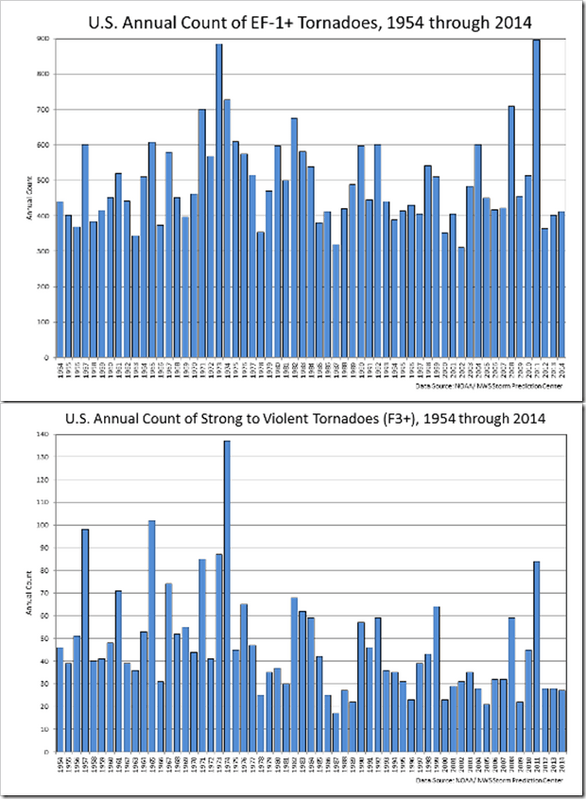
Figure 15: Total tornado and strong-to-violent tornado counts since 1954
8. Winter Storms
… winter storms … are also exhibiting changes that have been linked to climate change.
Once again there are no supporting data in the Assessment, but according to Coleman & Schwartz’s 2017 paper An Updated Blizzard Climatology of the Contiguous United States (1959–2014) the incidence of blizzards in the US has been increasing (Figure 16):
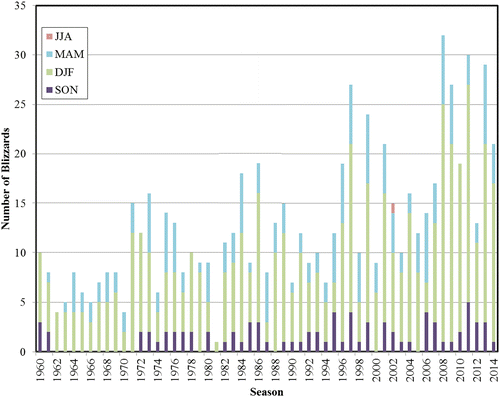
Figure 16: Incidence of blizzards in US
Is this counter-intuitive increase related to climate change? NOAA thinks it may be, although NOAA’s explanation works only in the eastern US ….
Conditions that influence the severity of eastern U.S. snowstorms include warmer-than-average ocean surface temperatures in the Atlantic. These can lead to exceptionally high amounts of moisture flowing into a storm and contribute to greater intensification of the storm. Natural variability can affect ocean surface temperatures, but as global surface temperatures increase, the temperature at any time is higher than it would have been without climate change.
…. and it doesn’t match up very well with trends in sea surface temperatures off the eastern US coast (data from KNMI Climate Explorer) ….
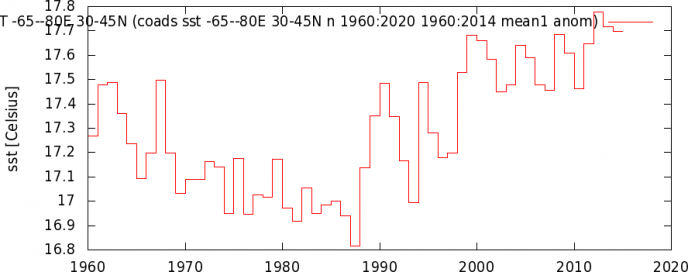
Figure 17: Sea surface temperatures along US east coast (30N-45N, 65W-80W)
… and according to the IPCC Fifth Assessment Report it’s going off in the wrong direction:
Changes in the frequency, severity, and duration of extreme events may be among the most important risks associated with climate change. In some parts of North America, this includes fewer periods of extreme cold, fewer snowstorms ….
Milder winter temperatures will decrease heavy snowstorms .…
This is one of the cases where the claim matches observational changes, but no conclusion as to causation can be reached until there is agreement over whether climate change causes a) more snowstorms, b) fewer snowstorms or c) both at the same time. My money is on c).
9. Sea Level Rise/Coastal Flooding
These are related phenomena, so I will discuss them under the same heading.
Once more there are no supporting data in the Assessment, so once more I had to go searching for some. This graphic from NOAA shows an increase in high-tide flooding that correlates with an increase in “coastal sea level” (Figure 18):

Figure 18: Average days/year with high-tide flooding vs. US sea level
And as shown in Figure 19 (data from EPA) the increased flooding is dominantly an east coast phenomenon:
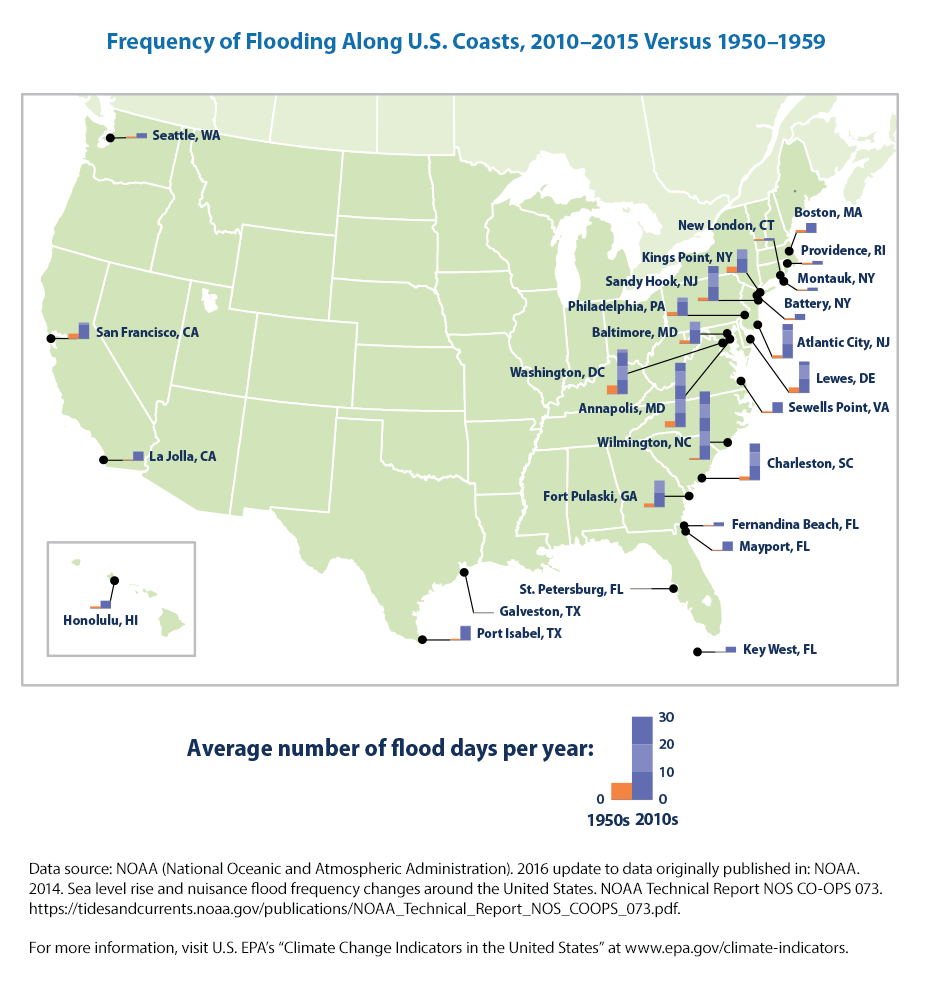
Figure 19: Average number of tidal floods/year, 2010-2015 vs. 1950-1959
But note the fine print. These are “nuisance floods” that don’t do any serious damage. There is no accepted definition of a nuisance flood, but a maximum water depth of 10cm has been proposed. And a 10cm-deep flood is hardly a catastrophic event.
And what does sea level rise have to do with the increase in nuisance floods? Not much. The reason nuisance floods are more common along the east coast of the US is that the east coast is sinking (a result of glacial rebound*, sediment compaction and groundwater extraction) while the west coast isn’t, and the rate at which the east coast is sinking exceeds the rate at which sea levels are rising in many places. The PSMSL tide gauge record from Sewell’s Point, near the mouth of Chesapeake Bay, is an example (Figure 20). The trend line shows sea level rising at an average rate of 4.5mm/year, but according to the United States Geological Survey less than half of this – maybe less than 2 mm/year – is a result of eustatic sea level rise. The rest is caused by land subsidence:
* Glacial rebound causes the land in and immediately around the ice sheet to rise while the surrounding land, which was squeezed upwards by the ice, sinks back down again.
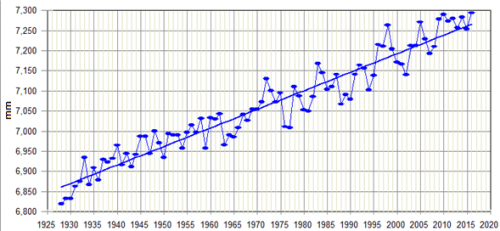 Figure Figure 20: Relative sea level rise, Sewell’s Point, Virginia
10 cm nuisance floods and ~2 mm/year sea level rises also pale into insignificance beside the hurricane storm surges that have occurred in the past and which can be expected to recur in the future along the US east coast. They reached heights of eight feet at Sewell’s point during Hurricane Isabel as recently as 2003 and 18 feet along the North Carolina coast during Hurricane Hazel in 1954.
My 2016 post on Isle de Jean Charles, Louisiana describes how sea level rise routinely takes the blame for inundations it didn’t cause. The Assessment cites it as an example of climate change in action.
10. Glaciers and snowpack
North American glaciers have indeed been retreating, as the Assessment claims. But according to Oerlemans (2005, Figure 21) they have been retreating since about 1825 and retreating rapidly after 1890, well before human-induced climate forcings became significant. This raises the question of whether the retreat has anything to do with man-made climate change:

Figure 21: Glacier retreat since 1700. The green line is North America
No data are available on snowpack, but Rutgers University publishes North American snow cover data (Figure 22). The trend line shows only a very minor decrease since 1975:
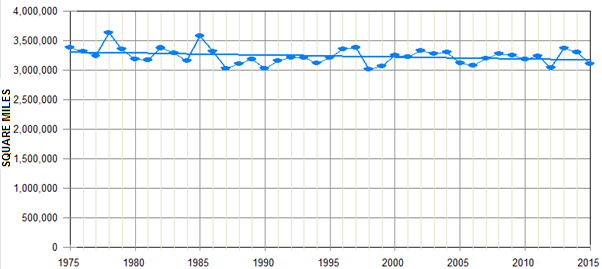 Figure 22: Snow-Covered Area in North America, 1972-2015
11. Injuries, Illnesses and Death:
Climate-related changes in weather patterns …. are affecting the health and well-being of the American people, causing injuries, illnesses, and death.
No data on illnesses or injuries are readily available, but over the last ten years approximately 25 million people have died in the US. According to Wikipedia
natural disasters of the type that commonly get blamed on climate change (hurricanes, floods, blizzards, wildfires, tornadoes) have claimed only 1,200 lives over this period.
Conclusion:
In this post I have fact-checked eleven separate climate change impacts which according to the Assessment’s summary sections are already doing damage in the US. In six of these cases (heavy precipitation, heat waves, wildfires, winter storms, sea level rise/coastal flooding and glacier retreat) there is observational evidence – most of which I have had to dig up myself – for impacts that might be related to man-made climate change, but in all of them this evidence is equivocal (e.g. wildfires) or the impacts are insignificant (e.g. nuisance tidal floods). In the other five cases (droughts, floods, Atlantic hurricanes, tornadoes, and injuries, illnesses and deaths) the observational evidence either contradicts the Assessment’s claims or the Assessment admits later in the text that the claim isn’t valid (droughts and floods).
Clearly the Assessment was conducted with little regard for the facts. A disregard for the facts, however, is necessary if one wishes to get the climate change catastrophe message across.
To be Remembered
By Gilad Atzmon | December 4, 2018
 George H.W. Bush, the 41st president of the United States, died last Friday. President Bush was loved by the Jews. Over the weekend we saw an endless parade of Jewish individuals and organisations paying homage to Bush for his commitment to Israel and to the Jews.
The Republican Jewish Coalition (RJC) described Bush as “a great friend of Israel, the Jewish people, and the RJC.” The group joined other Jewish voices in noting the work Bush did to help bring Jews from the former Soviet Union and Ethiopia to Israel as well as his actions to help ensure the safety of Israel. Bush also led the effort in the UN to repeal the ‘Zionism is Racism’ resolution and he stood up against Saddam Hussein who, at the time, was one of the last Arab leaders to oppose Israel and Zionism.
Yet, it was the photo of Bush at the Wailing Wall that grabbed my attention. On Saturday, the Israeli press circulated a photograph of the 41st president in suspiciously intimate proximity to the Wailing Wall.
We have seen variations of this photograph so many times that we have forgotten to ask the critical questions: What attracts world leaders to that wall? Is it possible that our world leaders are all (somehow) so libidinally attracted to walls that they do not even mind being caught on camera in such an intimate moment with that one particular wall? And if not, how do we explain the fact that so many of our world leaders are caught so close to that Jewish wall with their eyes closed? And more crucially, what is it about the Zionist culture that inspires this demand to publicise powerful goyim kissing the sacred wall?
Every world leader including the future British king who has visited Israel in the last decades has been photographed kissing, touching, flirting and even talking to that wall. Today I ask Why? It is likely that our incredibly lame world leaders do not understand the powerful symbolism of their visit to the wall nor do they grasp the reason they are then led to a formal ceremony at Yad Vashem. For the Israelis and Zionists, the visits to the wall and Yad Vashem are a significant affirmation of the Jewish national narrative. Both locate the Zionist project within an historical context.
Yad Vashem tells the Goyim’s leaders what happens to Jews when they do not have a safe haven. Yad Vashem reenforces the primacy of Jewish suffering and legitimises, at least in the Zionist psyche, the plunder of Palestine. The Wailing Wall is used to illustrate the Jewish ‘continuum’ in Palestine. It conveys the unfounded message that the Jews who returned to Palestine in the 20th century are the offspring of the Hebrews who lived there two centuries ago.
Israel is not the only state that integrates visits to shrines and holy places into its state’s ceremonial procedure for visitors. Islamic countries often expect world leaders to visit their great mosques. Hindus escort their guests to their shrines. People like to impress state visitors with the greatness of their heritage and the aesthetic and spiritual depth of their culture. But they do not expect world leaders to be photographed making love to their shrines or to their mosque’s walls. No other countries whether Muslim, Christian, Buddhist or Hindu expect world leaders to subscribe to or worship their local religious symbols. But the Jewish State does. It is even brazen enough to dress world leaders in Yarmulkes.
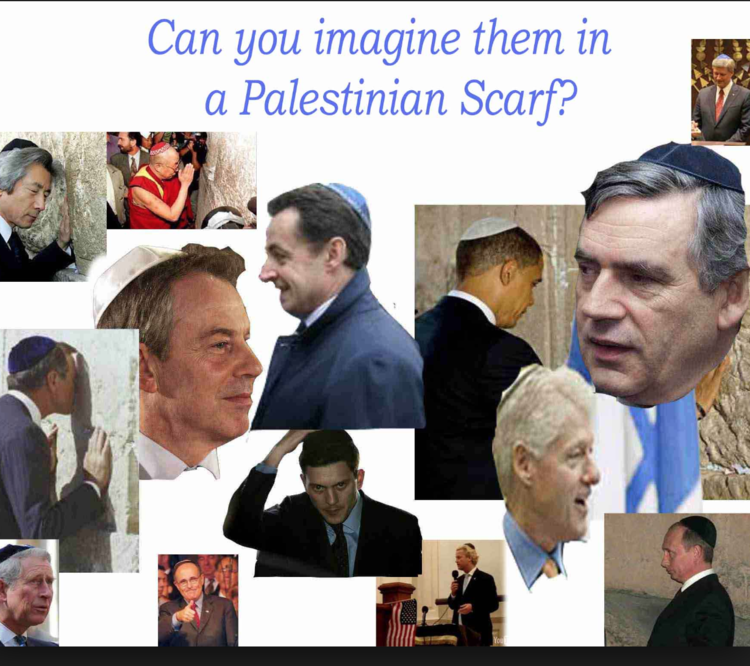
Featured Video

Daniel Davis: Trump’s New Iran Land Blockade Is a Dangerous Fantasy
or go to
Aletho News Archives – Video-Images
New Book
The Vaccine Mafia: Pfizer’s Former Chief Toxicologist Proves How Toxic Substances Were Unlawfully Sold to Us as a Solution for COVID-19
By Helmut Sterz
Former Pfizer chief toxicologist Helmut Sterz presents a critical examination of the development, approval, and global rollout of mRNA COVID-19 vaccines—particularly those produced by Pfizer/BioNTech. The Vaccine Mafia details the failure of pharmaceutical companies, regulatory authorities, politicians, and international organizations to follow established scientific and ethical standards during the pandemic. Drawing on the author’s decades of experience in pharmaceutical toxicology, Sterz reveals the many ways the vaccines’ inadequate or omitted preclinical safety testing put the world’s population at risk.
Sterz demonstrates how “emergency” approvals allowed manufacturers to bypass long-standing international guidelines governing toxicity testing, especially with regard to reproductive and cancer risks. They also allowed governments and health authorities to ignore or conceal evidence of serious adverse effects that occurred, including myocarditis, reproductive harm, and other long-term health risks.
Blog Roll
 Aletho News
- The ‘Gaza Treatment’: How Media Headlines Obscure Who is Bombing Yemen
- Ro Khanna urges Democrats to strip Israel ‘integration’ provision from defense bill
- Why Iran designated British MI6, Royal Navy, and RAF as hostile, terrorist organizations
- Armenian opposition politician dies in custody
- US still trying to recycle failed hypersonic missile programs
- France’s ‘Cold War’: Paris blames Tehran for supermarket fridge hacks
- Psywar no more? 77th Brigade’s sudden death
- Ukraine Already Carved Up… Before Talks Begin? /Prof. Richard Sakwa
- The vindication of Marjorie Taylor Greene
- Nearly 80% of Britons consider Israel a threat to world peace and security: Survey
- If Americans Knew
- An error has occurred; the feed is probably down. Try again later.
- No Tricks Zone
- German Authorities Start Initiative To Evaluate Public Register For Climate “Disinformation” Spreaders!
- Zonal Asymmetry of Temperature Change in the Antarctic Circumpolar Current
- New Study: The Net Fossil Fuel Contribution To Rising Atmospheric CO2 Has Been Zero For 500 Years
- Germany’s Green Energy Transition Becoming Increasingly Expensive…Another 6 Trillion Euros!
- Sudden Stratospheric Warming, Powerful El Niño Combination May Lead To Extreme Europe Cold, Energy Crisis!
- Two New Studies Find Thwaites Glacier Melt Cannot Be Driven By Human Activity Or A Warming Ocean
- E-Cars Reduce CO2 Emissions By Only 41% Compared To Internal Combustion Engine Vehicles
- Predictions Made By Renowned Climate Professor Over Past Decades Have Been Proven To Be Poor
- New Study Suggests Large Regions Of The Pacific Ocean Have Been Cooling For The Last 80 Years
- Germany’s Green Energy Debacle: High Energy Costs Force Kahla Porzellan to Close After 182 Years!

