On 7 November, in London’s famous Royal Albert Hall, there’s to be “a unique event drawing Christians and Jews together in celebration of the centenary of the Balfour Declaration and all that it led to.”
Christians will be reaching out to support the Jewish community and the state of Israel, or so the organisers claim.
“Our vision to stage such a big event at the Royal Albert Hall is ambitious and we recognise our reliance on God to enable every aspect of it.The evening’s programme will follow the history of God’s work through the Balfour Declaration that culminated in the independence of the modern state of Israel. We will use dance, film, song and drama sketches to illustrate how God used both Christians and Jews to fulfil the prophesied return of the Jewish people from exile to their ancient biblical homeland Israel,” says the blurb.
And it adds: “Christian leaders will read statements that will reflect Christians’ desire to…
Reconnect with the spiritual heritage of godly men who espoused the restoration of Israel to her Land;
Remember the Balfour Declaration and the Jewish-Christian partnerships that made it a reality;
Recognise the failure of Britain to fulfil the intent of the Balfour Declaration through the mandate for Palestine;
Rededicate ourselves as Christians to support Israel and the Jewish community.”
And the Royal Albert Hall, we are reminded, is where Lord Balfour celebrated with the Jewish community the granting to Britain of the Mandate for Palestine.
The rest of us of course remember Arthur Balfour as the Tory twit whose lamebrain ‘Declaration’ made it possible for Zionists who have no ancestral links to the Holy Land to dispossess, lock up and abuse Palestinians who do.
It was God’s work, we’re told. So that’s alright then And while we recover our composure we may well ask what kind of warped Christians dreamed up this Albert Hall caper, how the Balfour Declaration and its sickening legacy could possible have been “God’s work”, and how many “godly men” were among the perpetrators.
Then let’s cut toanother declaration — The Jerusalem Declaration on Christian Zionism, a joint statement by the heads of Palestinian Christian churches, which
rejects Christian Zionist doctrines as false teaching that corrupts the biblical message;
rejects the alliance of Christian Zionist leaders with elements in the governments of Israel and the United States; and
rejects the teachings of Christian Zionism that advance racial exclusivity and perpetual war.
Thankfully, a sermon recently delivered in Westminster Abbey by Michael Doe, Preacher of Gray’s Inn, added some important context missing from the Royal Albert Hall‘s promo patter: “The Balfour Declaration made way for the creation of Israel. It also said that nothing should be done ‘which may prejudice the civil and religious rights of existing non-Jewish communities in Palestine‘. We British who made the Declaration have an unfinished responsibility to ensure its implementation.“
To be precise Balfour’s pledge said “it being clearly understood”that nothing should be done to prejudice the rights of non-Jews. What’s not to understand? But that bit was conveniently forgotten within 30 years and is shrugged off today.
Who is behind this cringe-making celebration? Balfour 100. Who is behind Balfour 100? It’s hard to know. The Jewish Leadership Council’s website says that the Balfour 100 steering committee is comprised of 23 British-Jewish communal and Israel advocacy organisations but doesn’t name them. Among those, however, will be a number of fake Christians who are happy to stooge for the Zionists’ vile ambitions.
These pseuds have apparently ignored the cry for help issued only months ago by the National Coalition of Christian Organizations in Palestine to the World Council of Churches and the entire ecumenical movement. It was signed by over 30 organisations in Jerusalem, the West Bank and Gaza and can be read in full here.
They say: “We are still suffering from 100 years of injustice and oppression that were inflicted on the Palestinian people beginning with the unlawful Balfour declaration…. A hundred years later and there is still no justice! Discrimination and inequality, military occupation and systematic oppression are the rule…. Despite all the promises, endless summits, UN resolutions, religious and lay leader’s callings – Palestinians are still yearning for their freedom and independence, and seeking justice and equality.”
The churches’ message ends with these ominous words: “Things are beyond urgent. We are on the verge of a catastrophic collapse…. This could be our last chance to achieve a just peace. As a Palestinian Christian community, this could be our last opportunity to save the Christian presence in this land.”
The Royal Albert Hall was built by Queen Victoria to commemorate her beloved husband and consort Prince Albert. I’ll wager the idea of the flag of a rogue foreign military power fluttering from this fine building, or displayed inside, would have both of them spinning in their marbled vault at Frogmore.
And if Theresa May accompanies her guest Bibi Netanyahu to the Albert Hall shindig she’ll hand him and his cruel regime a huge propaganda victory.
‘Conspiracy theory’ is frequently used as a derogatory term, a term of disdain and implicit criticism. An effect of this is to discourage certain kinds of legitimate critical inquiry. But surely, in a world where conspiracies happen, we need good theories of what exactly is happening. The only people who really have anything to worry about from conspiracy theories are conspirators who stand to be exposed by them. For the rest of us, if someone proposes a far-fetched theory, we are instinctively sceptical; if they propose a theory that accounts for some otherwise unaccountable occurrences, they may be helping us learn something.
Of course, people can sometimes be misled by conspiracy theories, but people are misled by the beliefs that conspiracy theories challenge too. This betokens a need for careful scrutiny of controversial contentions quite generally. Obviously, a conspiracy theory is only a theory unless there is also proof. But it is one thing to demand the truth of a theory be proven; it is quite another to pronounce that such a theory can never be accepted as true. Unfortunately, even academic critics fail to observe that clear distinction, with some of them going so far as to condemn conspiracy theories in general, pre-emptively.[1]
Yet what are denigrated as ‘conspiracy theories’ are quite often legitimate lines of inquiry pursued in a spirit of critical citizenship, with the aim of holding to account those who exercise otherwise unaccountable power and influence over our lives, including in ways we are not all always aware of.
My argument, then, is that a kind of inquiry that can be intellectually respectable and socially necessary is far too readily sidelined with the categorisation of it as ‘conspiracy theory’. However, since the name has stuck, I propose we should embrace the designation and push back from the sideline to show how it is possible to engage in conspiracy theory using credible methods of research.
The problem that concerns critics, in fact, is a kind of extravagantly speculative activity that involves believing untested hypotheses. This can appropriately be called conspiracism.[2] Conspiracism designates a fallacious mode of reasoning that reduces questions of explanation to posited conspiracies, without properly investigating the evidence. Conspiracists are prone to see conspiracies everywhere, and to believe what they think they see, without giving sufficient consideration to alternative explanations. What is wrong with conspiracism, though, can be specified by reference to standards of inquiry set by good conspiracy theory. So the two things could hardly be more different.
It is especially important to be aware of the difference, given how it has been effaced in public discussions. Early ideas about a ‘conspiracist mindset’, from Harold Lasswell and Franz Neumann, informed Richard Hofstadter’s influential study of the political pathologies of the ‘paranoid style’ in the 1960s. This association of conspiracy suspicions with irrationality and paranoia was then actively promoted in the United States, especially, and as Lance deHaven Smith notes, ‘the conspiracy-theory label was popularized as a pejorative term by the Central Intelligence Agency (CIA) in a propaganda program initiated in 1967.’[3] The program, created as a response to critical citizens’ questions about the assassination of J F Kennedy, ‘called on media corporations and journalists to criticize “conspiracy theorists” and raise questions about their motives and judgments.’ Its reach has extended greatly since.
Professor Peter Knight of Manchester University, who heads a major international interdisciplinary research network, funded by the European Union, to provide a comprehensive understanding of conspiracy theories, takes it to be a now generally accepted fact that ‘some of the labelling of particular views as “conspiracy theories” is a technique of governmentality.’[4]
So who’s afraid of conspiracy theorists? Is it possible that certain governments want us all to be?
It is interesting to note that Professor Knight thinks that if serious conspiracy theories can sometimes be on the right track, then perhaps what they are finding should not be thought of as conspiracies. For instance, he writes, ‘it is possible that different parts of the labyrinthine U.S. intelligence agencies were involved with some of the 9/11 attackers in contradictory and ambiguous ways that fall short of an actual conspiracy, but which nonetheless undermine the notion of complete American innocence.’ The point is, those contradictions and ambiguities merit study, whatever they are called. Knight’s tantalizing idea of an ‘involvement’ that ‘falls short of an actual conspiracy’ brings to mind of analogous definitional questions that were raised about Bill Clinton’s descriptions of his ‘involvement’ with a White House intern. Good sense suggests that what people are interested to know is what happened, not what someone calls it. Ultimately, the serious conspiracy theorist – or theorist of conspiracies, as Knight puts it – wants to know what is going on, and hypotheses about ‘involvements’ of all kinds can figure in the inquiry.[5]
We should bear in mind too, that the very name of this field was bestowed upon it by those who sought to pre-empt its development. Its actual practitioners might think their activities could be more aptly designated in one or more of a number of other, albeit less catchy, ways, such as, for instance, critical civic investigation, intellectual due diligence, investigative journalism, critical social epistemology, or critical social theory.
Which brings me to my main reason for speaking out in defence of the activity: as citizens we find ourselves increasingly struck by anomalies and inconsistencies in official and mainstream accounts of public affairs, not to mention in matters of foreign policy. But whenever we try to share our concerns in a public forum, there seem to be people there ready to harangue us with put-downs about being crazy conspiracy theorists. The reason why they do this is something I shall reflect on another time.[6] My point for now is that we have been drawn to conspiracy theory for reasons that are very far from crazy.
Notes
[1] There is a marked tendency in certain literatures to take this generalized approach to conspiracy theories. Several philosophers – including David Coady, Charles Pigden, Kurtis Hagen, and Lee Basham – have commented critically on it, with Matthew Dentith, in particular, criticizing the failure of such approaches to consider the possibility of finding merits in particular conspiracy theories. He provides examples of ‘generalist positions which take the beliefs or behaviours of some conspiracy theorists as being indicative of what belief in conspiracy theories generally entails.’ (Matthew Dentith, ‘The Problem of Conspiracism’, Argumenta, [forthcoming in 2017]) An example is Douglas and Sutton who state that ‘in the main conspiracy theories are unproven, often rather fanciful alternatives to mainstream accounts’; they also argue that conspiracy theorists are likely to believe conspiracy theories because they are more likely to sympathise with conspirators. (Karen Douglas and Robbie M. Sutton, (2011) Does it take one to know one? Endorsement of conspiracy theories is influenced by personal willingness to conspire’, Psychology, 50(3), 2011: 544-552.)
[2] On this, I endorse the recent exposition offered by Matthew Dentith (ibid): ‘recent philosophical work has challenged the view that belief in conspiracy theories should be considered as typically irrational. By performing an intra-group analysis of those people we call “conspiracy theorists”, we find that the problematic traits commonly ascribed to the general group of conspiracy theorists turn out to be merely a set of stereotypical behaviours and thought patterns associated with a purported subset of that group. If we understand that the supposed problem of belief in conspiracy theories is centred on the beliefs of this purported subset – the conspiracists – then we can reconcile the recent philosophical contributions to the wider academic debate on the rationality of belief in conspiracy theories.’ He identifies the challenge I am arguing we need to take on: ‘Typically, when we think of conspiracy theorists we do not think of people who theorised about the existence of some particular conspiracy – and went on to support that theory with evidence – like John Dewey (who helped expose the conspiracy behind the Moscow Trials of the 1930s), or Bob Woodward and Carl Bernstein (who uncovered the conspiracy behind who broke in to the Democratic National Committee Headquarters at the Watergate office complex in the 1970s). Instead, we think of the advocates and proponents of weird and wacky conspiracy theories … .’
[3] Lance deHaven Smith, Conspiracy Theory in America, University of Texas Press, 2013: p.21; see also Chapter 4 passim.
[4] Peter Knight, ‘Plotting Future Directions in Conspiracy Theory Research’, in Michael Butter and Maurus Reinkowski, eds, Conspiracy Theories in the Middle East and the United States, Berlin: De Gruyter, 2014: p.347.
[5] ‘Involvements’ amongst people can include any of the typical elements of conspiracy such as collusion, collaboration, conniving, tacitly understanding, secretly agreeing, jointly planning, acquiescing, turning a blind eye, covering up for, bribing, intimidating, blackmailing, misdirecting or silencing, and many other more nuanced kinds of arrangement.
[6] In a third blog of this series I shall be asking ‘Do we face a conspiracy to curtail freedom of expression?’ Meanwhile, the second will be a discussion of ‘Conspiracy theory as civic responsibility’. A full academic paper comprising extended versions of each of these will be available shortly. (And yes, for afficionados who are wondering, there will be a full response to proposals of ‘cognitive infiltration’ to ‘cure’ us. I may even suspend my reputed politeness…)
History lends itself to re-interpretation when more facts become available or when ulterior motives creep in. There is a surfeit of the latter happening in India currently. Nothing is spared, even symbolically, in India’s history today – starting from Nehru’s legacy to Taj Mahal to Vinayak Damodar Savarkar. However, such revisionist history (‘historical negationism’) is interchangeable with fiction or folklore and on the whole it fails to stick. Historical reappraisals are an entirely different thing.
Based on new archival materials becoming available every now and then, a slice of Cold War era history that is still dissected and understood from new perspectives is the so-called Cuban Missile Crisis of 1962. The narrative that was dominant initially was that the Soviets surreptitiously tried to deploy inter-continental ballistic missiles (ICBM) to Cuba targeting the US and the attempt was nipped in the bud with the Kennedy administration staring down the then Kremlin boss Nikita Khrushchev through a display of naval blockade of the island.
As time passed, the informed sections of opinion came to know that it was a settlement negotiated through nerve-wracking back channel negotiations directly between the Oval Office and the Kremlin – even Fidel Castro was kept in the dark – that brought the crisis to an end, with the Soviets and the Americas rolling back their missile respective deployments to each other’s backyard – Cuba and Turkey. The Soviets, true to character, eschewed triumphalism so long as the strategic objective was realised, leaving the Americans free to claim ‘victory’.
However, what still remains less understood is that the crisis in 1962 was not just about the Soviet missile deployment. There was also alongside a full-bodied American agenda of ‘regime change’ in Cuba. Incredibly enough, the Pentagon had drawn up a detailed report on the overthrow of Fidel’s government by a military government headed by a US commander and military governor – something like the American occupation of Japan led by General Douglas MacArthur in September 1945. Proclamation No 1 that was to have been issued, which vested “all powers of government, executive, legislative, and judicial and all jurisdiction in the occupied territory and over its inhabitants” in the hands of the US military governor. The Proclamation stated:
All persons in the occupied territory (Cuba) will obey immediately and without question all enactments and orders of the military government. Resistance of the United States Armed Forces will be forcefully stamped out. Serious offenders will be dealt with severely. So long as you remain peaceable and comply with my orders, you will be subjected to no greater interference than may be required by military exigencies.
Also, leaflets were to be airdropped in their thousands all over Cuba advising that “U.S. armed forces will take temporary charge of your country.” They were to warn Cuban citizens to “remain at home” because “everything that moves is a target.”
Meanwhile, the Soviets too were factoring in a possible American invasion of Cuba, the fledgling socialist state in the Western Hemisphere, and therefore had deployed tactical battlefield nuclear weapons to Cuba. With all the formidable intelligence gathering capacity at the disposal of the United States, the Americans had no inkling that if they invaded Cuba, they would have had a nasty surprise. In sum, the crisis had every potential to escalate into an apocalyptic event. (I am reminded of the recent bullish claim by our air chief that he knows precisely where and how to destroy Pakistan’s nuclear assets in one sweeping Indian air strike.)
The above are facts culled out from documents that have been declassified in the US this week under the Freedom of Information Act (here). To my mind, the most fascinating document is the (redacted) post-mortem report on the entire episode of the Cuban Missile Crisis authored by the famous CIA spook Richard “Dick” Lehman who worked with 7 American presidents from John F. Kennedy to George H.W. Bush and was credited with creating the president’s daily intelligence briefing and regarded as one of 50 trailblazers who created the CIA. (For connoisseurs of Cold War history, Lehman’s recount of his 33 years in the world of intelligence archived in the CIA’s Library, here, makes fascinating reading.)
Much of what Lehman wrote will not come as stunning disclosure, but it is useful to know how carefully, meticulously, factually (backed with empirical evidence) an adversary’s strategic challenge needs to be studied and assimilated before the intelligence is taken to the desk of the political boss and gets morphed into decision-making. (I wonder how we fared in the run up to the recent Doklam standoff with China.) Read Lehman’s Top Secret report to the CIA Director, here.
At first glance, the decision last week by the Trump administration, followed immediately by Israel, to quit the United Nation’s cultural agency seems strange. Why penalise a body that promotes clean water, literacy, heritage preservation and women’s rights?
Washington’s claim that the UN’s Educational, Scientific and Cultural Organisation (Unesco) is biased against Israel obscures the real crimes the agency has committed in US eyes.
The first is that in 2011 Unesco became the first UN agency to accept Palestine as a member. That set the Palestinians on the path to upgrading their status at the General Assembly a year later.
It should be recalled that in 1993, as Israel and the Palestinians signed the Oslo accords on the White House lawn, the watching world assumed the aim was to create a Palestinian state.
But it seems most US politicians never received that memo. Under pressure from Israel’s powerful lobbyists, the US Congress hurriedly passed legislation to pre-empt the peace process. One such law compels the United States to cancel funding to any UN body that admits the Palestinians.
Six years on, the US is $550 million in arrears and without voting rights at Unesco. Its departure is little more than a formality.
The agency’s second crime relates to its role selecting world heritage sites. That power has proved more than an irritant to Israel and the US.
The occupied territories, supposedly the locus of a future Palestinian state, are packed with such sites. Hellenistic, Roman, Jewish, Christian and Muslim relics promise not only the economic rewards of tourism but also the chance to control the historic narrative.
Israeli archaeologists, effectively the occupation’s scientific wing, are chiefly interested in excavating, preserving and highlighting Jewish layers of the Holy Land’s past. Those ties have then been used to justify driving out Palestinians and building Jewish settlements.
Unesco, by contrast, values all of the region’s heritage, and aims to protect the rights of living Palestinians, not just the ruins of long-dead civilisations.
Nowhere has the difference in agendas proved starker than in occupied Hebron, where tens of thousands of Palestinians live under the boot of a few hundred Jewish settlers and the soldiers who watch over them. In July, Unesco enraged Israel and the US by listing Hebron as one of a handful of world heritage sites “in danger”. Israel called the resolution “fake history”.
The third crime is the priority Unesco gives to the Palestinian names of heritage sites under belligerent occupation.
Much hangs on how sites are identified, as Israel understands. Names influence the collective memory, giving meaning and significance to places.
The Israeli historian Ilan Pappe has coined the term “memoricide” for Israel’s erasure of most traces of the Palestinians’ past after it dispossessed them of four-fifths of their homeland in 1948 – what Palestinians term their Nakba, or Catastrophe.
Israel did more than just raze 500 Palestinian towns and villages. In their place it planted new Jewish communities with Hebracaised names intended to usurp the former Arabic names. Saffuriya became Tzipori; Hittin was supplanted by Hittim; Muyjadil was transformed into Migdal.
A similar process of what Israel calls “Judaisation” is under way in the occupied territories. The settlers of Beitar Ilit threaten the Palestinians of Battir. Nearby, the Palestinians of Sussiya have been dislodged by a Jewish settlement of exactly the same name.
The stakes are highest in Jerusalem. The vast Western Wall plaza below Al Aqsa mosque was created in 1967 after more than 1,000 Palestinians were evicted and their quarter demolished. Millions of visitors each year amble across the plaza, oblivious to this act of displacement.
Settlers, aided by the Israeli state, continue to encircle Christian and Muslim sites in the hope of taking them over.
That is the context for recent Unesco reports highlighting the threats to Jerusalem’s Old City, including Israel’s denial for most Palestinians of the right to worship at Al Aqsa.
Israel has lobbied to have Jerusalem removed from the list of endangered heritage sites. Alongside the US, it has whipped up a frenzy of moral outrage, berating Unesco for failing to prioritise the Hebrew names used by the occupation authorities.
Unesco’s responsibility, however, is not to safeguard the occupation or bolster Israel’s efforts at Judaisation. It is there to uphold international law and prevent Palestinians from being disappeared by Israel.
Mr Trump’s decision to quit Unesco is far from his alone. His predecessors have been scuffling with the agency since the 1970s, often over its refusal to cave in to Israeli pressure.
Now, Washington has a pressing additional reason to punish Unesco for allowing Palestine to become a member. It needs to make an example of the cultural body to dissuade other agencies from following suit.
President Trump’s confected indignation at Unesco, and his shrugging off of its vital global programmes, serve as a reminder that the US is not an “honest broker” of a Middle East peace. Rather it is the biggest obstacle to its realisation.
One month ago, I initiated here at Unz.com a discussion of the role of American Jews in the crafting of United States foreign policy. I observed that a politically powerful and well-funded cabal consisting of both Jewish individuals and organizations has been effective at engaging the U.S. in a series of wars in the Middle East and North Africa that benefit only Israel and are, in fact, damaging to actual American interests. This misdirection of policy has not taken place because of some misguided belief that Israeli and U.S. national security interests are identical, which is a canard that is frequently floated in the mainstream media. It is instead a deliberate program that studiously misrepresents facts-on-the ground relating to Israel and its neighbors and creates casus belli involving the United States even when no threat to American vital interests exists. It punishes critics by damaging both their careers and reputations while its cynical manipulation of the media and gross corruption of the national political process has already produced the disastrous war against Iraq, the destruction of Libya and the ongoing chaos in Syria. It now threatens to initiate a catastrophic war with Iran.
To be sure, my observations are neither new nor unique. Former Congressmen Paul Findley indicted the careful crafting of a pro-Israel narrative by American Jews in his seminal book They Dare to Speak Out: People and Institutions Confront Israel’s Lobby, written in 1989. Professors John Mearsheimer and Stephen Walt’s groundbreaking book The Israel Lobby and U.S. Foreign Policy said much the same thing nine years ago and discussions of Jewish power do emerge occasionally, even in the mainstream media. In the Jewish media Jewish power is openly discussed and is generally applauded as a well-deserved reward bestowed both by God and by mankind due to the significant accomplishments attributed to Jews throughout history.
There is undeniably a complicated web of relationships and networks that define Israel’s friends. The expression “Israel Lobby” itself has considerable currency, so much so that the expression “The Lobby” is widely used and understood to represent the most powerful foreign policy advocacy group in Washington without needing to include the “Israel” part. That the monstrous Benjamin Netanyahu receives 26 standing ovations from Congress and a wealthy Israel has a guaranteed income from the U.S. Treasury derives directly from the power and money of an easily identifiable cluster of groups and oligarchs – Paul Singer, Sheldon Adelson, Bernard Marcus, Haim Saban – who in turn fund a plethora of foundations and institutes whose principal function is to keep the cash and political support flowing in Israel’s direction. No American national interest, apart from the completely phony contention that Israel is some kind of valuable ally, would justify the taxpayers’ largesse. In reality, Israel is a liability to the United States and always has been.
And I do understand at the same time that a clear majority of American Jews, leaning strongly towards the liberal side of the political spectrum, are supportive of the nuclear agreement with Iran and do not favor a new Middle Eastern war involving that country. I also believe that many American Jews are likely appalled by Israeli behavior, but, unfortunately, there is a tendency on their part to look the other way and neither protest such actions nor support groups like Jewish Voice for Peace that are themselves openly critical of Israel. This de facto gives Israel a free pass and validates its assertion that it represents all Jews since no one important in the diaspora community apart from minority groups which can safely be ignored is pushing back against that claim.
That many groups and well-positioned individuals work hand-in-hand with the Israeli government to advance Israeli interests should not be in dispute after all these years of watching it in action. Several high level Jewish officials, including Richard Perle, associated with the George W. Bush Pentagon, had questionable relationships with Israeli Embassy officials and were only able to receive security clearances after political pressure was applied to “godfather” approvals for them. Former Congressman Tom Lantos and Senator Frank Lautenberg were, respectively, referred to as Israel’s Congressman and Senator, while current Senate Minority Leader Chuck Schumer has described himself as Israel’s “shomer” or guardian in the U.S. Senate.
A recent regulatory decision from the United Kingdom relates to a bit of investigative journalism that sought to reveal precisely how the promotion of Israel by some local diaspora Jews operates, to include how critics are targeted and criticized as well as what is done to destroy their careers and reputations.
Last year, al-Jazeera Media Network used an undercover reporter to infiltrate some U.K. pro-Israel groups that were working closely with the Israeli Embassy to counter criticisms coming from British citizens regarding the treatment of the Palestinians. In particular, the Embassy and its friends were seeking to counter the growing Boycott, Divestment and Sanctions movement (BDS), which has become increasingly effective in Europe. The four-part documentary released late in 2016 that al-Jazeera produced is well worth watching as it consists mostly of secretly filmed meetings and discussions.
The documentary reveals that local Jewish groups, particularly at universities and within the political parties, do indeed work closely with the Israeli Embassy to promote policies supported by the government of Prime Minister Benjamin Netanyahu. It also confirms that tagging someone as an anti-Semite has become the principal offensive weapon used to stifle any discussion, particularly in a country like Britain which embraces concepts like the criminalization of “hate speech.” At one point, two British Jews discussed whether “being made to feel uncomfortable” by people asking what Israel intends to do with the Palestinians is anti-Semitic. They agreed that it might be.
The documentary also describes how the Embassy and local groups working together targeted government officials who were not considered to be friendly to Israel to “be taken down,” removed from office or otherwise discredited. One government official in particular who was to be attacked was Foreign Office Minister Sir Alan Duncan.
Britain, unlike the U.S., has a powerful regulatory agency that oversees communications, to include the media. It is referred to as Ofcom. When the al-Jazeera documentary was broadcast, Israeli Embassy political officer Shai Masot, who reportedly was a Ministry of Strategic Affairs official working under cover, was forced to resign and the Israeli Ambassador offered an apology. Masot was filmed discussing British politicians who might be “taken down” before speaking with a government official who plotted a “a little scandal” to bring about the downfall of Duncan. Labour Party leader Jeremy Corbyn, who is the first head of a political party in Britain to express pro-Palestinian views, had called for an investigation of Masot after the recording of the “take down” demand relating to Duncan was revealed. Several Jewish groups (the Jewish Labour Movement, the Union of Jewish Students and We Believe in Israel) then counterattacked with a complaint that the documentary had violated British broadcast regulations, including the specific charge that the undercover investigation was anti-Semitic in nature.
On October 9th, Ofcom ruled in favor of al-Jazeera, stating that its investigation had done nothing improper, but it should be noted that the media outlet had to jump through numerous hoops to arrive at the successful conclusion. It had to turn over all its raw footage and communications to the investigators, undergoing what one source described as an “editorial colonoscopy,” to prove that its documentary was “factually accurate” and that it had not “unfairly edited” or “with bias” prepared its story. One of plaintiffs, who had called for critics of Israel to “die in a hole” and had personally offered to “take down” a Labour Party official, responded bitterly. She said that the Ofcom judgment would serve as a “precedent for the infringement of privacy of any Jewish person involved in public life.”
The United States does not yet have a government agency to regulate news stories, though that may be coming, but the British tale has an interesting post script. Al-Jazeera also had a second undercover reporter inserted in the Israel Lobby in the United States, apparently a British intern named James Anthony Kleinfeld, who had volunteered his services to The Israel Project, which is involved in promoting Israel’s global image. He also had contact with at least ten other Jewish organizations and with officials at the Israeli Embassy,
Now that the British account of “The Lobby” has cleared a regulatory hurdle the American version will reportedly soon be released. Al-Jazeera’s head of investigative reporting Clayton Swisher commented “With this U.K. verdict and vindication past us, we can soon reveal how the Israel lobby in America works through the eyes of an undercover reporter. I hear the U.S. is having problems with foreign interference these days, so I see no reason why the U.S. establishment won’t take our findings in America as seriously as the British did, unless of course Israel is somehow off limits from that debate.”
Americans who follow such matters already know that groups like the American Israel Public Affairs Committee (AIPAC) swarm over Capitol Hill and have accomplices in nearly every media outlet. Back in 2005-6 AIPAC Officials Steve Rosen and Keith Weissman were actually tried under the Espionage Act of 1918 in a case involving obtaining classified intelligence from government official Lawrence Franklin to pass on to the Israeli Embassy. Rosen had once boasted that, representing AIPAC and Israel, he could get the signatures of 70 senators on a napkin agreeing to anything if he sought to do so. The charges against the two men were, unfortunately, eventually dropped “because court rulings had made the case unwinnable and the trial would disclose classified information.”
And Israeli interference in U.S. government and elections is also a given. Endorsement of Mitt Romney in the 2012 presidential election by the Netanyahu government was more-or-less carried out in the open. And ask Congressmen like Paul Findley, Pete McCloskey, William Fulbright, Charles Percy and, most recently, Cynthia McKinney, what happens to your career when you appear to be critical of Israel. And the point is that while Israel calls the shots in terms of what it wants, it is a cabal of diaspora American Jews who actually pull the trigger. With that in mind, it will be very interesting to watch the al-Jazeera documentary on The Lobby in America.
President Donald Trump’s move to decertify the Iranian nuclear Joint Comprehensive Plan of Action (JCPOA), entered into a little over two years ago, was applauded by Israel, Saudi Arabia and a couple of Persian Gulf States, but by no one else. Quite the contrary, as the European and Asian co-signatories on the agreement, having failed to dissuade Trump, have clearly indicated that they will continue to abide by it. Also, the decision to kick the can down the road by giving Congress 60 days to increase pressure on Tehran in an attempt to include other issues beyond nuclear development like its ballistic missile program and labeling the country’s Revolutionary Guard as a terrorist group are likely to create confusion as Washington is unable to communicate directly with Iran. That uncertainty could possibly lead to a fraught-with-danger Iranian decision to withdraw completely from the agreement.
The Trump speech could reasonably be described as embracing an “Israel-First” and “Saudi-Second” perspective that might plausibly suggest that it was actually drafted by their respective foreign ministries. Contrary to Trump’s campaign pledges, it might also be characterized as an “America-Last” speech, since it actually encourages nuclear proliferation while rendering it even more difficult for anyone to respect the agreements entered into by the United States government.
Fred Kaplan sums up the speech’s fundamental dishonesty with considerable clarity by observing that “It flagrantly misrepresents what the deal was meant to do, the extent of Iran’s compliance, and the need for corrective measures. If he gets his way, he will blow up one of the most striking diplomatic triumphs of recent years, aggravate tensions in the Middle East, make it even harder to settle the North Korean crisis peacefully, and make it all but impossible for allies and adversaries to trust anything the United States says for as long as Trump is in office.”
Former senior CIA analyst Paul Pillar has also dissected the untruths and false analogies that made up the bulk of the Trump speech. In short, Pillar argues that the president is using faulty analysis to end a program that is working and that employs unprecedented intrusive inspections to guarantee that Iran can make no progress towards having a nuclear weapon for at least eight more years and quite likely for even longer. Against that, Iran could well end its cooperation and, out of fear of U.S. attack, might well turn towards possession of a nuclear arsenal to guarantee its own survival. Pillar calls ending JCPOA now because Iran just might develop a weapon after it expires in 2025 as “committing suicide because of fear of death.”
In a second highly partisan international action last week, the United States led a march out the door of the United Nations Educational, Scientific and Cultural Organization due to its alleged “bias against Israel.” UNESCO had enraged Prime Minister Benjamin Netanyahu by declaring that the Old City of Hebron and the associated Cave of the Patriarchs on the West Bank is an endangered Palestinian world cultural heritage site. A few hundred Israeli settlers live in Hebron, guarded by the Israeli Army, amidst 200,000 Palestinians who, according toThe Guardian, “have long lived under harsh restrictions in the city, which is one of the starkest symbols of the Israeli occupation.” The U.S. is also threatening to pull out of the U.N.’s Human Rights Council “to protect Israel.”
Taken together, the two decisions made by the White House indicate a shift in the foreign policy team advising the president. One must now acknowledge that America’s United Nations Ambassador Nikki Haley, apparently operating in collusion with former UN Ambassador John Bolton, has become the most influential foreign policy voice whispering in the president’s ear, quite possibly because she is saying exactly what he wants to hear in terms of simplistic but rarely reality based responses to complex situations. That Haley, an inexperienced and instinctively aggressive ideologue who is closely aligned to Israeli thinking, should occupy such a position with an equally ignorant president ought to concern anyone who seeks to avoid a major conflagration with either Iran and North Korea, or even with both. Haley is also no friend of Russia, having once crudely advised Moscow to “choose to side with the civilized world.”
Secretary of State Rex Tillerson, Chairman of the Joint Chiefs of Staff General Joseph Dunford and Secretary of Defense James Mattis, apparently joined by National Security Council chair H.R. McMaster, urged renewal of the Iran certification based on the fact that Tehran was compliant but were overruled. Even Israel’s former National Security Adviser Uzi Arad had publicly urged both the White House and Congress not to reject the JCPOA. The emergence of Haley advised by Bolton is a shift to the right in an administration that is already leaning towards the military option as its preferred diplomatic tool, also suggesting somewhat ominously that neoconservative foreign policy is again dominant in Washington.
Other commentators including Eli Clifton, have observed that Trump might well have been heavily influenced by major Republican donors including Paul Singer, Bernard Marcus and Sheldon Adelson to step up the pressure on Iran. Adelson has, in fact, called for unilaterally “nuking” the Iranians. Marcus has said that “I think that Iran is the devil.”
The real objective of the Trump White House is not to “fix” the Iran deal, which would be impossible both because Iran and the other signatories would not agree to it and because there is nothing that needs repair. As Paul Pillar and Fred Kaplan note, it is working. The real objective is to blow up the agreement completely as it is an impediment to going to war and bringing about regime change in Tehran by force. That is what Prime Minister Benjamin Netanyahu and Senators like John McCain, Lindsey Graham and Tom Cotton have been intent on doing and they have hardly been shy about expressing themselves. The choice is therefore quite simple. Do we Americans, 60% of whom support keeping the arrangement, want to maintain an inspection regime that deprives Iran of the ability to develop a nuclear weapon for the foreseeable future or do we want to go back to square one without any restrictions on what Tehran will choose to do. It would seem to me that the clear right choice is to stay the course.
In 1973 Irving Kristol, the godfather of the Neoconservative movement, made a stunning statement which is still relevant to understanding the Israeli influence in US foreign policy. Kristol said:
“Senator McGovern is very sincere when he says that he will try to cut the military budget by 30%. And this is to drive a knife in the heart of Israel… Jews don’t like big military budgets. But it is now an interest of the Jews to have a large and powerful military establishment in the United States…
“American Jews who care about the survival of the state of Israel have to say, no, we don’t want to cut the military budget, it is important to keep that military budget big, so that we can defend Israel.”
Read the statement again very carefully. A big military budget, said Kristol, is only good for Israel, not America or much of the Western World. In other words, precious American soldiers who go to the Middle East to fight so-called terrorism are just working for Israel, not for America.
So, whenever the Neocons use words such as “democracy” or “freedom,” they are essentially conning decent Americans to support Israel’s perpetual wars. John Tirman, Principal Research Scientist and Executive Director of the Center for International Studies at Massachusetts Institute of Technology, is saying similar things in his book The Death of Others.[1]
In fact, warmongers like Henry Kissinger do not consider American soldiers as decent human beings. Kissinger said very explicitly that military men are “dumb, stupid animals to be used as pawns in foreign policy.”[2]
People like Kissinger have been killing those “dumb, stupid animals” like chickens in the Middle East for decade. Keep in mind that at least 4,486 American soldiers have already lost their precious lives in Iraq.[3] At least 6,845 Americans died and 900,000 were wounded in Iraq and Afghanistan.[4] In the space of eight years alone, the Iraq war has taken the lives of at least 116,000 civilians.[5] Under Obama, at least 2,500 Americans died in Iraq and Afghanistan.[6] And what have those soldiers received in return? Well…
“The wars in Afghanistan and Iraq have produced more disability claims per veteran than other wars on the books, including Vietnam, Korea and World War II. While Vietnam extracted a far higher death toll – 58,000 died in that war – the total number of documented disabilities suffered by recent veterans is approaching that of the earlier conflict, according to VA documents.”[7]
This is just the tip of the iceberg. If you think that the Zionist project has always been in the business of rebuilding countries it has literally destroyed, think again. Tirman writes:
“The money that did finally arrive in Afghanistan, if not siphoned off by President Karzai and his allies, frequently aided American or other foreign contractors who were in some cases doing the work Afghans could do. Even the best intentions were skewed. ‘Instead of giving aid money for Afghan schools to the Ministry of Education, for example, the U.S. Agency for International Development (USAID) funds private American contractors to start literacy programs for adults,’ wrote Ann Jones, a veteran of Afghan reconstruction. ‘As a result, Afghan teachers abandon the public schools and education administrators leave the Ministry for higher paying jobs with those contractors, further undermining public education and governance.’
“In several locales, the contractors and USAID workers felt compelled to spend money faster than it could usefully be absorbed; private American firms would not get renewed contracts if their financial ‘burn rate’ left over funds at the end of the year, leading to shoddy workmanship and other waste. Frequently, outright fraud and failed projects were the result. To a troubling extent, Afghanistan also witness the uneasy marriage of security and development–projects like building roads but were essential to the U.S. military.
“The failure of both security and development in Afghanistan is attributable to the social and political dynamics that were misread by U.S. officials… By framing the deaths of innocents as mistakes, the U.S. sought to avoid the deeper moral and legal questions as to whether it was attacking legitimate military targets; whether such actions satisfied the proportionality rule; and whether its ground forces were placing themselves at sufficient risk in order to mitigate the horrors of war for innocent civilians.’
“The typical story was a U.S. warplane or helicopter killing ‘terrorists’ that turned out to be no more than civilians at a social gathering. A dispute over who was killed and why would occasionally be visible in the Western press, with villagers claiming civilians were the victims and the military spokesman insisting they were terrorists. Evidence would be brought forward, typically by eyewitnesses, and the American or NATO commanders would retreat to the safe confines of ordering an investigation into the ‘tragic incident.’”[8]
Neocon hawks like Max Boot know that American soldiers are dying by the thousands for Israel. As a result, Boot proposed what seemed to be a diabolical project in 2005, and here it is:
“The military would do well today to open its ranks not only to legal immigrants but also to illegal ones and, as important, to untold numbers of young men and women who are not here now but would like to come.
“No doubt many would be willing to serve for some set period in return for one of the world’s most precious commodities — U.S. citizenship.”
Did you catch that? The U.S. military should open its ranks to everyone, both legal and illegal, so that they can go ahead and die in the Middle East. Boot never told the American people about the cost of this diabolical plan. He never told people that no country on earth can survive with that principle.
What we are seeing here is that the deaths of American soldiers in the Middle East aren’t enough for Boot. He has to enlist other Goyim in his essentially Talmudic plan. If people like Max Boot aren’t dangerous to America and much of the world, then no one is. It was good that Tucker Carlson told Boot to pick up a decent job like house painting.
[1] John Tirman, The Deaths of Others: The Fate of Civilians in America’s Wars (New York: Oxford University Press, 2011).
[2] Quoted in Bob Woodward and Carl Bernstein, The Final Days (New York: Simon & Schuster, 1976), 194.
[3] H. A. Goodman, “4,486 American Soldiers Have Died in Iraq. President Obama Is Continuing a Pointless and Deadly Quagmire,” Huffington Post, November 17, 2014.
[4] H. A. Goodman, “6,845 Americans Died and 900,000 Were Injured in Iraq and Afghanistan. Say ‘No’ to Obama’s War,” Huffington Post, February 12, 2015.
[5] David Blair, “Iraq war 10 years on: at least 116,000 civilians killed,” Telegraph, March 15, 2013.
[6] Tessa Stuart, “Some 2,500 Americans Have Died in Afghanistan and Iraq Under Obama,” Rolling Stone, May 30, 2016.
[7] Chris Adams, “Millions went to war in Iraq, Afghanistan, leaving many with lifelong scars,” McClatchy Newspapers, March 14, 2013.
Diplomacy is a juggling act, an endless struggle to keep all the balls in the air. There are times when dropping one ball to keep the others going may seem like the prudent thing to do – and at other times letting them all drop and starting over again makes more sense. The United States faces this predicament in the Middle East. Perhaps there are too many balls in the air, when the focus should be on the few that are really important.
While everyone was focused on what US President Donald Trump had to say on Friday regarding the Joint Comprehensive Plan of Action (known as the Iran deal), what got overlooked is that he also unveiled a brave new Iran strategy for the post-Islamic State era.
In a rare gesture, King Salman called Trump on Saturday to express his delight over the latter’s resolute strategy and aggressive approach toward Iran. Salman welcomed Trump’s leadership role in the Middle East in recognizing the magnitude of the “challenges and threats” posed by Iran and stressed the need for “concerted efforts.”
Trump responded warmly, appreciating Salman’s support and expressing keenness to work together on issues relating to world peace and security and also enhancing the countries’ bilateral ties.
Trump’s Iran strategy is a dream project for Saudi Arabia and the UAE – and for Israel. It may seem like a relaunch of the old enterprise to contain Iran, built around an alliance system involving the US and its regional allies. But the circumstances today are different. The US and its allies stare at defeat in the Syrian conflict and are circling their wagons to stave off an ignominious rout with long-term consequences. Faced with Iran’s surge, Saudi Arabia and the UAE are willing to proclaim a convergence of interests with Israel.
Clearly, Moscow surmising that the US-Saudi strategic relationship has weakened is premature. The axis with Iran is the only show in town for Russia on the Middle Eastern chessboard – whether or not it is Moscow’s preferred choice. President Vladimir Putin is heading for Tehran on November 1.
The Iran deal will not be in jeopardy in the foreseeable future and, arguably, Tehran’s dependence on Moscow on that front is not critical. On the other hand, Britain, France and Germany have drawn together and mooted a proposal that their heads of government articulated in an extraordinary joint declaration on Friday to “constructively engage” with Iran to address their shared concerns over its regional policies.
Tehran will be open to a constructive engagement with Western powers to comprehensively address mutual security concerns, although how enthusiastic the Trump administration will be about such a process remains to be seen. If Europe’s engagement with Iran over issues of regional security and stability gains traction, the country’s integration will take a great leap forward, and that is something Tehran desires.
Enter Turkey. The Turkish deployment to Idlib province in northern Syria was seen as a move toward implementation of the Astana accord on setting up a “de-escalation” zone in that region with tacit Russian and Iranian backing. But Turkey’s number one priority appears to be to pre-empt a westward expansion by Syrian Kurds toward the coastal region of Latakia to establish a contiguous “homeland.”
Turkey hopes to outflank the Kurds and thereafter push back at their canton in Afrin. Turkey seems to be planning a prolonged military presence in northern Syria. This must be causing disquiet in Moscow. The exceptionally strong denunciation by Damascus on Saturday of the Turkish deployment to Idlib must have been made with Moscow’s approval.
However, what Moscow cannot take for granted is the deep chill in Turkish-American relations. Much depends on the new phase of the Syrian conflict beginning now, after the defeat of ISIS in its capital Raqqa and the capture by Syrian government forces (and allied militia with Russian airpower) of Mayadin on the Euphrates River (adjacent to the rich oil fields of al-Omar in Deir al-Zour province.)
The US faces a Hobson’s choice. It has the option of extricating itself from the Syrian conflict at this stage, claiming victory in the defeat of ISIS in Raqqa. But this would mean abandoning its Kurdish allies to their fate. Of course, if the US exercises this option, it paves the way for mending relations with Turkey.
But then, the flip side is that it also means a seamless expansion of Iranian influence in both Iraq and Syria and a possible Iranian presence in the Eastern Mediterranean. That, of course, would make a mockery of the tough strategy announced by Trump to counter Iran’s regional policies.
On the contrary, if the US intends to play a greater role in Syria following the capture of Raqqa (such as blocking Iran’s land route to Syria), it would require substantial, open-ended troop deployment to delay and harass the expansion of Iranian influence. Clearly, this is what the US’s regional allies – Israel, Saudi Arabia and the UAE – are hoping for and what Trump’s new Iran strategy promises to do.
However, a continued US military presence means ongoing dependence on the Kurdish militia. This could spell doom for US-Turkey relations and even prompt Ankara to build an alliance with Russia and Iran – a shared agenda to create conditions on the ground that force the US at some point to cut its losses and withdraw from Syria, as happened, for example, in Lebanon in 1983.
Trump’s Iran strategy infinitely complicates the geopolitical repositioning of the US in the post-ISIS era. He added one more ball at a juncture when his juggling act was already looking improbable.
I have noticed a distinct shift in the focus of the Zionist narrative in the US. For the last forty years or so, Israel has been sold to Americans as a necessary palliative for the Jewish people following the total destruction of the Holocaust. Now, the primary argument advanced is that the Jewish people have been a people tied to the land on which their state is located for a mythically uninterrupted period of time variously described as between 2,000 and 4,000 years.
Tom Segev reports in his book, The Seventh Million, that Holocaust refugees were looked down upon when they arrived in Israel. In the United States the holocaust didn’t become a major part of the Zionist dialogue until the 1970s and we are now suffused with memorials (wikipedia lists 63) to a tragedy that occurred on another continent. While there are certainly groups that commemorate the Irish Famine, the Armenian Genocide and other such tragedies, no tragedy receives the kind of attention that the Holocaust has garnered. Our own complicity in genocide receives relatively scant attention. This is despite the estimated two to four million Africans who died while being transported to be forced into slavery and the multiple genocidal wars with native peoples.
But while the magnificent horrors of the Holocaust have been infinitely portrayed and the movies and books continue to flow, the focus of the narrative has shifted back to a variant to that employed by Zionism’s founders. The basic tenets are that the Jews have ties to the land of Israel that are stronger and somehow more legitimate than that of the Palestinians.
The Palestinians are first scorned for not using that term for themselves until their land was ‘cleansed’ of their presence. This was of course, common everywhere before the rise of nationalism. Before emancipation, Jews themselves identified as a religion and not as a nation. Certainly they were not Israelis before they established Israel. As Shlomo Sand has explored in The Invention of the Jewish People, Jews went through a process of inventing themselves as a nation, and that definition was probably a necessary precursor to ‘finding’ themselves a country. (Maybe as a result of this, Jews now have a unique identity. They are not one race, not all of them are religious and not all claim a right to Palestinian land. As Gilad Atzmon has explored it is the tripart nature of that identity, i.e., religion, race and politics that leave you criticized as racist or anti Semitic if you criticize the politics of Israel.)
But whatever the facts of who called themselves what, the concept that the Palestinians by not calling themselves Palestinians should not be entitled to the land they lived on makes no real sense. Why would my self-proclaimed identity affect my ability to own land? I can own land in California without thinking of myself as a Californian. In fact, some Israelis own land in the US and I presume that they expect the US to make sure they retain their rights as owners.
The next step of this fantastic narrative is that the Palestinians gave up the land by leaving it at some point during the establishment of the state of Israel. By this narrative, the Palestinians gave up all rights to the land either by becoming refugees fleeing from ethnic cleansing and the destruction of their towns or by fighting to keep their land. This is tortured reasoning, but I guess that the idea is that if you don’t submit willingly to your own destruction and somehow survive, then you lose your property and assets.
I don’t know why the primary thrust of the myth has altered but I have a guess. In its initial stages, Israel needed citizens. Nationalism and blood privilege are attractive concepts. Then it seems for a long period Israel was more interested in donations, political capital and investment. As long as Jews supported Israel, Israel did not need them to move there. That has changed. With the full support of President Trump and the tacit support of most of western Europe’s leaders, Israel has been expanding by increasing its so-called settler movement of occupation, approving 12,000 new units in 2017 up from about 3000 in 2016. Netanyahu has announced he will annex the settlements, effectively increasing the size of the State of Israel. Instead of a Nakba there has been an endless stream of mini-Nakbas, just small enough to fall under the indulgent radar of the press.
Israel’s free ‘birthright’ (the name itself proclaims blood privilege) program promotional videos now emphasize coming home to young people who are citizens of other countries. It could be that Israel is working to neutralize the population advantage of the Palestinians.
It is clear that in the new narrative, citizenship is biologically and not geographically determined. It seems odd that so many in the West who claim to oppose racism, so easily accept a race-based system of ethnic cleansing.
In the final presidential debate of 2016, Hillary Clinton famously called Donald Trump the “puppet” of Russian President Vladimir Putin. But what’s increasingly clear is that Trump has a more typical puppet master for a U.S. politician – Israeli Prime Minister Benjamin Netanyahu.
Since Sept. 18, when the two men met in New York around the United Nations General Assembly, Netanyahu has been pulling Trump’s strings on almost every foreign policy issue. Arguably, the puppet/puppeteer relationship began much earlier, but I’ve been told that Trump bridled early on at Netanyahu’s control and even showed a few signs of rebellion.
For instance, Trump initially resisted Netanyahu’s demand for a deeper U.S. commitment in Syria by ordering the shutdown of the CIA operation supporting anti-government rebels, along with the Trump administration’s statement that U.S. policy no longer sought “regime change” in Damascus.
Immediately after that announcement, Netanyahu had some success in getting Trump to reverse direction and fire 59 Tomahawk missiles at a Syrian air base on April 6. The attack followed what one intelligence source told me was a staged chemical weapons incident by Al Qaeda operatives in the rebel-controlled town of Khan Sheikhoun in Idlib province, possibly using sarin delivered via drone from a Saudi/Israeli special operations base in Jordan. Yet, although apparently duped by the subterfuge into the missile strike, Trump still balked at a complete reversal of his Syrian policy.
Then, in May, Trump picked Saudi Arabia and Israel as his first overseas trip as president – essentially following the advice of his son-in-law Jared Kushner – but I’m told he came away feeling somewhat humiliated by the over-the-top treatment that involved him getting pulled into a ceremonial sword dance in Saudi Arabia and facing condescension from Netanyahu.
So, over the summer, Trump listened to advice about a possible major overhaul of U.S. foreign policy that would have checked Israeli/Saudi regional ambitions, opened diplomatic doors to Iran, and addressed the Korean crisis by brokering negotiations between the North and the South over some form of loose confederation.
There was even the possibility of a Nixon-goes-to-China moment with tough-guy Trump meeting with Iranian President Hassan Rouhani and the two countries restoring diplomatic ties, a process that could have given U.S. companies a better chance to compete in the Iranian market.
Those proposed moves had the advantage of reducing international tensions, saving the U.S. government money on future military adventures, and freeing U.S. corporations from the tangle of economic sanctions – exactly the “America First” strategy that Trump had promised his working-class base.
However, instead Netanyahu succeeded in pulling Trump’s strings during their conversations on Sept. 18 in New York, although exactly how is still a mystery to some people close to these developments. One source said the Kushner family real-estate company has exposure to substantial Israeli financing that could be yanked, although Jared Kushner’s financial disclosure form only lists a $5 million unsecured line of credit, held jointly with his father, from the Israel Discount Bank.
Trump also has major pro-Netanyahu donors to his political war chest and his legal defense fund who are strong advocates for war with Iran, including casino tycoon Sheldon Adelson, who has plowed $35 million into the pro-Trump Super PAC Future 45 and has publicly called for dropping a nuclear bomb on Iran as a negotiating tactic. So, Netanyahu had a number of potential strings to pull.
Going on Rants
Whatever the precise reasons, on Sept. 19, Trump turned his maiden speech to the U.N. General Assembly into a war-like rant, personally insulting North Korean leader Kim Jong Un as “Rocket Man,” threatening to “totally destroy” his nation of 25 million people, and parroting Netanyahu’s calls for another regime change project aimed at Iran.
Most diplomats in the audience sat in stunned silence as Trump threatened aggressive war from the podium of an organization created to prevent the scourge of war. The one notable exception was Netanyahu who enthusiastically applauded his success in jerking Trump into the neocon camp.
So, rather than shift U.S. policy away from confrontation, Trump jettisoned the diplomatic strategy although it already had dispatched intermediaries to make contacts with the Iranians and North Koreans. Instead, Trump opted for the classic neocon approach favored by Netanyahu, albeit with Trump dressing up his neocon surrender in some “America First” rhetoric.
The U.N. speech left some of the U.S. intermediaries scrambling to explain to their contacts in Iran and North Korea why Trump had repudiated the messages that they had been carrying. Privately, Trump explained to one that he just liked to “zigzag” and that the intended end point hadn’t changed.
Some of these tensions surfaced in late September when Secretary of State Rex Tillerson took the extraordinary step of announcing the behind-the-scenes contacts with North Korea during a state visit to China.
“We are probing, so stay tuned,” Tillerson said. “We ask, ‘Would you like to talk?’ We have lines of communications to Pyongyang — we’re not in a dark situation, a blackout.” Tillerson added, “We have a couple, three channels open to Pyongyang … We do talk to them. ,,, Directly. We have our own channels.”
In reaction to Tillerson’s efforts to salvage the backchannel initiatives, Trump showed that his obeisance to Netanyahu and the neocons outweighed loyalty to either his Secretary of State or the intermediaries who had ventured into dicey situations on Trump’s behalf.
In Twitter messages, Trump belittled the idea of a dialogue with North Korea, tweeting: “I told Rex Tillerson, our wonderful Secretary of State, that he is wasting his time trying to negotiate with Little Rocket Man.”
“Save your energy Rex,” Trump added, before slipping in another thinly veiled threat of a military strike: “we’ll do what has to be done!”
While on the surface, Trump’s repudiation of Tillerson might have been viewed as another “zigzag,” it is now clear that Trump’s “zigzag” explanation was just another lie. Rather than zigzagging, he is instead following a straight line marked out by Netanyahu.
Meanwhile, in Syria, Netanyahu seems to have won more concessions from Trump. The U.S. military appears to be helping the remnants of Islamist forces still fighting the government, according to Russian officials. Their accusation is that the U.S. is secretly aiding the Islamist terror groups with weapons, tactical advice and aerial reconnaissance.
In other words, Trump appears to be continuing U.S. military intervention in Syria – just as Netanyahu desires.
Falling in Line
Trump further showed that he is following Netanyahu’s marching orders with the extremist speech about Iran on Friday, essentially repeating all the Israeli propaganda lines against Iran and burning whatever bridges remained toward a meaningful diplomatic approach.
Trump’s Iran speech was so ludicrous it almost defies serious analysis. It ranks with the reckless rhetoric of President George W. Bush when he pronounced an “axis of evil,” with the incongruous linking of Iraq and Iran (two bitter enemies) and North Korea accompanied by Bush’s bogus claims about Iraq’s WMD and Iraq’s alleged collaboration with Al Qaeda.
In Friday’s speech, which looked like the handiwork of John Bolton, one of Bush’s neocon advisers who was seen entering the White House last week, Trump repeated all the nonsense tying Iran to Al Qaeda, presumably thinking that the American people still don’t understand that Al Qaeda is a fanatical Sunni terror group that targets both the West and Shiites, the dominant Muslim faith in Iran, as heretics deserving death.
The inconvenient truth is that Al Qaeda has long been connected to Saudi Arabia, which has supported these fanatics since the 1980s when Saudi citizen Osama bin Laden was supported in his jihad against Soviet troops in Afghanistan, who were there trying to protect a secular regime.
Though officially the Saudi monarchy insists that it is opposed to Al Qaeda, Saudi intelligence has used Al Qaeda as essentially an unconventional fighting force deployed to destabilize and terrorize adversaries in the region and around the world. [For details, see Consortiumnews.com’s “The Need to Hold Saudi Arabia Accountable.”]
As the Israelis have developed a de facto alliance with Saudi Arabia in recent years, they also have expressed a preference for an Al Qaeda victory in Syria if necessary to destroy what Michael Oren, former Ambassador to the U.S. and now a deputy minister under Netanyahu, has described as the Shiite “strategic arc” running from Tehran through Damascus to Beirut.
One of the frequent Israeli complaints about Iran is that it has assisted the sovereign government of Syria in defeating Al Qaeda and its militant allies (as well as Al Qaeda’s spinoff Islamic State), which should tell you a lot about where Netanyahu’s loyalties lie.
A Compromised Media
Yet, as dishonest as Trump’s Iran speech was, the U.S. mainstream media won’t criticize it as harshly as it deserves because virtually all the important journalists and talking heads have swallowed Israel’s anti-Iran propaganda whole. They have frequently repeated the canard about Iran as “the world’s chief sponsor of terrorism” when that title clearly should go to the Saudis and the Qataris if not others.
The West’s major news outlets also have ingested all the sophisticated propaganda against the Assad government in Syria, particularly the claims about chemical weapons attacks while ignoring evidence that Al Qaeda’s operatives and their “civil defense” collaborators have staged attacks with the goal of provoking a direct U.S. military intervention. [See Consortiumnews.com’s “A New Hole in Syria-Sarin Certainty.”]
In his Friday speech, Trump also touted one of the earliest canards about Iranian “terrorism,” the attack by Lebanese Shiite militants on the U.S. Marine barracks in Beirut in 1983 killing 241 Americans.
When that attack happened, I was working at The Associated Press as an investigative reporter specializing in national security issues. While the precise Iranian role was not clear, what should have been obvious was that the attack was not “terrorism,” which is classically defined as violence toward civilians to achieve a political goal.
Not only were the Marines not civilians but the Reagan administration had made them belligerents in the Lebanese war by the decision to order the USS New Jersey to shell Muslim villages. Reagan’s National Security Advisor Robert McFarlane, who often represented Israel’s interests inside the administration, was the spark plug for this mission creep, which killed Lebanese civilians and convinced Shiite militants that the United States had joined the war against them.
Shiite militants struck back, sending a suicide truck bomber through U.S. security positions, demolishing the high-rise Marine barracks in Beirut. Reagan soon repositioned the surviving U.S. forces offshore. At the AP, I unsuccessfully argued against calling the Beirut attack “terrorism,” a word that other news organizations also sloppily applied. But even senior Reagan officials recognized the truth.
“When the shells started falling on the Shiites, they assumed the American ‘referee’ had taken sides,” Gen. Colin Powell wrote in his memoir, My American Journey. In other words, Powell, who was then military adviser to Defense Secretary Caspar Weinberger, recognized that the actions of the U.S. military had altered the status of the Marines in the eyes of the Shiites.
(Although this “terrorism” is always blamed on Hezbollah, the group did not officially come into existence until 1985 as a resistance movement against the Israeli occupation of Lebanon which did not end until 2000.)
Opposed to Putin
So, Trump is now on the path to wars with both North Korea and Iran, neither of which Russian President Putin favors. Putin, who played a key role in helping President Obama achieve the Iran-nuclear agreement, now sides with the Europeans in opposition to Trump’s decertification.
Putin also favors a prompt end to the Syrian conflict with the defeat of Al Qaeda and its allies, and he wants peaceful negotiations with North Korea over its desire for security against threatened American aggression. Trump is on the opposite side of all these Putin priorities.
In other words, not only does the Russia-gate hysteria have core evidentiary problems – both on the issues of “hacking” Democratic emails and claims about suspected “Russia-linked” entities paying for an infinitesimal number of ads on social media (including some about puppies and another promoting a critical documentary about Donald Trump’s golf course in Scotland) – but Trump is behaving in ways that are directly contrary to Putin’s desires and interests.
If indeed Clinton were right that Trump was Putin’s “puppet,” then he would have agreed to negotiations to address the North Korean crisis; would have accepted constructive diplomacy toward Iran; and would have ended all U.S. support for the Syrian militants and encouraged a quick end to the bloodletting.
Instead, Trump is moving in opposite directions, lining up with Netanyahu and the neocons, whom some European allies refer to as “America’s Israeli agents.” Although dressing up his capitulation to Netanyahu in tough-guy phrasing, Trump is doing what most U.S. politicians do – they grovel before Bibi Netanyahu.
And, if you have any doubts about that reality, you can watch how often both Republicans and Democrats jump to their feet when Netanyahu addresses a joint session of Congress, an honor that he has received three times, tying him with British Prime Minister Winston Churchill.
Those moments of American humiliation – as almost all 535 members of Congress act like puppets on invisible strings – represent the actual subservience of the U.S. government to a foreign power. And that power is not Russia.
President Trump is just the latest American politician to have his strings yanked by Israeli Prime Minister Netanyahu.
Investigative reporter Robert Parry broke many of the Iran-Contra stories for The Associated Press and Newsweek in the 1980s.
Until I came to the US last year, I had never met an Israeli, and only one American Jew. As a third generation Palestinian refugee living in a camp in Lebanon, such opportunities did not exist.
Then, when 85-year-old Mariam Fathalla and I came last year to speak throughout the US and Canada about the views of our community in Lebanon, I suddenly met lots of Jews, and a few Israelis, as well. In fact, it was often Jewish Voice for Peace groups that invited us or were among the co-sponsors of our events, as part of the North America Nakba Tour. This year I am touring with 84-year-old Khawla Hammad. Mariam and Khawla are both survivors of the 1948 Nakba (Palestinian genocide). We are all stateless, without any form of citizenship.
We were also invited by a roughly equal number of Students for Justice in Palestine (SJP) groups on many campuses. Everywhere we went, our presentation was enthusiastically received and our message welcomed. We were so pleased that it was such a success, and we made so many friends and allies (even a border officer we met re-entering the US from Canada last weekend).
But some refused to hear us, and we didn’t expect otherwise. The US is known for having some of the strongest Zionist groups and defenders of “Israel”, so we didn’t really expect to go unchallenged. That’s all right. They will spread their message and challenge ours, and we will do the same to them.
What surprised us, however, was that some of the groups calling themselves “Students for Justice in Palestine” would also challenge us. The first was at Stanford Universitylast year, where they expressed a concern that Alison Weir had come with us to hear our talk, and where I was told that I should not say that “Israel” has no right to exist (which is not part of our presentation, but which is a view held by millions of Palestinians).
This earned us a reputation as “anti-Semites” in some circles, despite the fact that no one has shown anything anti-Semitic in any of our presentations. Some groups also object to statements made by some of the people in our organizing committee, composed of Al-Awda Palestine Right to Return Coalition, the International Solidarity Movement – Northern California and the Free Palestine Movement. But no one has produced any anti-Semitic statements from any of these groups, either. Most recently, we were informed by the SJP group at George Washington University in Washington, DC that our October 19 talk would be cancelled because we were “anti-Semitic”.
Of course, we expect such talk from our Zionist enemies, and we give it little importance. But to hear it from a group that claims to be standing for justice in Palestine? Do these groups really expect to have any credibility among Palestinians when they do this?
We have heard from some of them (including Stanford) that they are under tremendous pressure, and we don’t doubt that this is true. But why isn’t their first priority to defend and promote the voices of Palestinians speaking for themselves? Why don’t they stand up to whatever pressure is being placed upon them, even if they lose allies and are not recognized as a campus group? Do they think they are pursuing justice by allowing themselves to be intimidated? Don’t they care for their integrity?
Of course, we realize that many of these groups actually have plenty of integrity. In fact, last year, immediately after the terrible experience at Stanford, SJP-Pitzer welcomed us with open arms. The same is true of 72 other groups that sponsored or co-sponsored us last year, including other SJP and JVP chapters. What we’re saying is that it’s a disgrace for a group calling itself “Students for Justice in Palestine” to cancel one of our events or to allow itself to be pressured by groups or individuals that clearly do not stand for justice in Palestine and who have appointed themselves gatekeepersof what Palestinians may or may not say about their own genocide or anything else.
As a Palestinian, I request such groups to stop using “Justice in Palestine” in their name. We Palestinians understand what justice does and does not mean, and we do not give you permission to use our name or the name of our country for your corrupted image of justice.
Amena Elashkar is a stateless 23-year-old Palestinian translator and journalist living in the Bourj el-Barajneh refugee camp in Lebanon.
Last January, Sen. John McCain led a delegation along with his longtime sidekick, Sen. Lindsey Graham, to a contingent of Ukrainian troops not far from the front line in eastern Ukraine. In the presence of Ukrainian President Petro Poroshenko, Graham told the soldiers: “Your fight is our fight … 2017 will be the year of offense. All of us will go back to Washington and we will push the case against Russia.”
McCain promised the assembled troops, “we will do everything we can to provide you with what you need to win.”
When contemplating the long careers of the two Republican senators, it is hard to escape the conclusion that McGeorge Bundy’s quip about the famed Cold War columnist Joe Alsop – that he had “never known him to go to any area where blood could be spilled that he didn’t come back and say more blood” – applies equally to McCain and Graham.
Indeed, last month’s National Defense Authorization Act shows that – if nothing else – McCain and Graham are as good as their word: the recently passed defense appropriations bill provides for $500 million, including “defensive lethal assistance” to Kiev, as part of a $640 billion overall spending package.
The aid comes at a good time for the embattled Ukrainian President Poroshenko, whose approval rating hovers around 16 percent. In a bid to stave off the possibility of a far-right coup d’etat, Poroshenko is back to banging the war drums, promising, well, more blood.
In a little covered speech at the U.S. Military Academy at West Point on Sept. 19, Poroshenko promised that “American weapons will help us liberate the Donbas and return Ukrainian territories.” He also noted that Ukraine spends roughly 6 percent of its GDP on defense, “a figure,” he observed, “much bigger than the obligation for the NATO members.”
Clearly Washington’s condemnation of governments that wage war “against their own people” remains selective, contingent upon who is doing the killing and who is doing the dying. In this case, it would seem that Russian-speaking Ukrainians simply don’t rate.
In addition to promising a wider war in the Donbas, Poroshenko has repeatedly promised that he will seek NATO membership. In August, during a visit by U.S. Defense Secretary James Mattis, Poroshenko declared: “Our Ukrainian caravan is on a roll and we have one road to travel upon — a wide Euro-Atlantic highway, leading to membership in the European Union and NATO.”
Ukraine’s Human Rights Abuses
There are a number of objections to yet another round of NATO expansion. As I reported in February 2015: “The current [Ukrainian] government has, according to organizations that could hardly be described as Kremlin friendly (Human Rights Watch, Amnesty International, the Organization for Security and Cooperation in Europe), committed war crimes in its attempt to defeat the Russian-backed separatists in the Donbas. … NATO’s principal consideration should not be whether NATO will make Ukraine more secure, but whether Ukraine will make NATO more secure. The answer is self-evident.”
It is true that NATO Secretary General Jens Stoltenberg, as recently as this month, insisted to Russian state media that NATO is not contemplating Ukrainian membership, telling Sputnikthat “There is no MAP [membership action plan] on the agenda.” Yet Stoltenberg has also said, as he did in a speech to the Ukrainian parliament in July, that he believes Ukraine “has the right to choose its own security arrangements” further noting that “last month, NATO welcomed Montenegro as the 29th member of our Alliance. This shows that NATO’s door remains open.”
So the issue doesn’t seem to be going away.
Poroshenko’s push to join NATO, which is being made against the backdrop of ever-worsening relations between the U.S. and Russia, ignores, perhaps purposefully, one of the principal causes of the morass in which Kiev and Moscow find themselves. It was Moscow’s not unfounded fear that Ukraine might join NATO that helped spark the Ukrainian crisis in early 2014.
In the weeks prior to Russia’s annexation of Crimea (and just over a month before the outbreak of full hostilities in the Donbas), three former presidents of Ukraine (Leonid Kravchuk, Leonid Kuchma and Viktor Yushchenko) called on the post-Maidan regime to renounce the 2010 Kharkiv agreement which allowed for Russia to base its Black Sea naval fleet in Crimea (in return for discounted prices on Russian natural gas).
It is perhaps not unreasonable that this last move, in addition to the foreign policy and security protocols embedded within the European Union Association agreement (which Poroshenko signed in June 2014), would cause the Russian government to at the very least suspect that NATO was setting the stage for Ukraine’s eventual absorption into the alliance.
Indeed, Kiev’s launch of its violent and indiscriminate “Anti-Terrorist Operation” against the Donbas – with the effect of intimidating and alienating otherwise loyal Russian-speaking citizens in the eastern part of the country – surely played a role in the Kremlin’s decision to come to the aid of the rebels later in the summer of 2014 and again at Debaltseve early the following year.
Less Dangerous Options
One reasonable alternative to NATO membership would be a treaty along the lines of the 1955 Austrian State Treaty, which was an agreement reached between the four post-World War II occupying powers (U.S., USSR, Great Britain and France) that granted Austria its independence “with the understanding,” according to the U.S. State Department, “that the newly independent state of Austria would declare its neutrality, creating a buffer zone between the East and the West,” meaning it would join neither NATO nor the Soviet-run Warsaw Pact.
Petro Poroshenko in 2014 (Photo credit: Atlantic Council)
Charles Bohlen, the legendary American diplomat who served as ambassador to Moscow from 1953-57, recalled in his memoir Witness To History that, with regard to the Austrian State Treaty, he believed “that the Kremlin leaders, and probably the Soviet military chiefs, decided that a genuinely neutral Austria was of more value to Soviet Russia than the maintenance of a divided country where the Red Army would occupy only the poorer half.”
The situation in postwar Austria – occupied by East and West – is not perfectly analogous to the situation that obtains in Ukraine today, but there seem to be lessons from what Bohlen intuited were the Kremlin’s motives that might be drawn upon to inform Western diplomacy.
But instead of trying to implement the Minsk peace agreement (which calls for the Donbas to remain as part of Ukraine but with more autonomy from Kiev) or search for a reasonable alternative to what are indeed perplexing and pressing matters of national security, Poroshenko has continued to ring one alarm over another, this time illusory, Russian invasion.
In a recent speech before the Ukrainian parliament, Poroshenko claimed “there is more and more evidence for [Russia’s] preparations for an offensive war of continental proportions.”
Yet perhaps the danger isn’t as clear and present as Poroshenko portrayed it. As Mary Dejevesky of the U.K.’s Independent has observed: “NATO itself had held exercises in the Black Sea and before that in and around the western borderlands of Ukraine. Who, it has to be asked here, is threatening whom?”
Indeed, if Russia was on the precipice of launching a land war in Eastern Europe, would it have cut its defense budget by 25 percent to $48 billion a year, as was recently announced by the Kremlin?
As difficult as it might be for our hearty band on new cold warriors to believe (someofwhom have scant knowledge about the topic of U.S.-Russia relations on which they so frequently choose to declaim), the push for a peaceable settlement in Ukraine is coming not from Washington, but from Moscow and Berlin.
Nevertheless, the stalemate continues: a resolution to the Ukrainian conflict – through the implementation of the Minsk agreements, as well as a settlement of the outstanding security concerns of all parties to the conflict – seems to remain tragically out of reach.
James W. Carden served as an adviser on Russia policy at the US State Department. Currently a contributing writer at The Nation magazine, his work has appeared in the Los Angeles Times, Quartz, The American Conservative and The National Interest.
Reknowned economist M. Shahid Alamoffers this excellent critique of Noam Chomsky’s defective analysis of the relative influence of Oil versus the Israel lobby over US foreign policy: … continue
This site is provided as a research and reference tool. Although we make every reasonable effort to ensure that the information and data provided at this site are useful, accurate, and current, we cannot guarantee that the information and data provided here will be error-free. By using this site, you assume all responsibility for and risk arising from your use of and reliance upon the contents of this site.
This site and the information available through it do not, and are not intended to constitute legal advice. Should you require legal advice, you should consult your own attorney.
Nothing within this site or linked to by this site constitutes investment advice or medical advice.
Materials accessible from or added to this site by third parties, such as comments posted, are strictly the responsibility of the third party who added such materials or made them accessible and we neither endorse nor undertake to control, monitor, edit or assume responsibility for any such third-party material.
The posting of stories, commentaries, reports, documents and links (embedded or otherwise) on this site does not in any way, shape or form, implied or otherwise, necessarily express or suggest endorsement or support of any of such posted material or parts therein.
The word “alleged” is deemed to occur before the word “fraud.” Since the rule of law still applies. To peasants, at least.
Fair Use
This site contains copyrighted material the use of which has not always been specifically authorized by the copyright owner. We are making such material available in our efforts to advance understanding of environmental, political, human rights, economic, democracy, scientific, and social justice issues, etc. We believe this constitutes a ‘fair use’ of any such copyrighted material as provided for in section 107 of the US Copyright Law. In accordance with Title 17 U.S.C. Section 107, the material on this site is distributed without profit to those who have expressed a prior interest in receiving the included information for research and educational purposes. For more info go to: http://www.law.cornell.edu/uscode/17/107.shtml. If you wish to use copyrighted material from this site for purposes of your own that go beyond ‘fair use’, you must obtain permission from the copyright owner.
DMCA Contact
This is information for anyone that wishes to challenge our “fair use” of copyrighted material.
If you are a legal copyright holder or a designated agent for such and you believe that content residing on or accessible through our website infringes a copyright and falls outside the boundaries of “Fair Use”, please send a notice of infringement by contacting atheonews@gmail.com.
We will respond and take necessary action immediately.
If notice is given of an alleged copyright violation we will act expeditiously to remove or disable access to the material(s) in question.
All 3rd party material posted on this website is copyright the respective owners / authors. Aletho News makes no claim of copyright on such material.
 It is especially important to be aware of the difference, given how it has been effaced in public discussions. Early ideas about a ‘conspiracist mindset’, from Harold Lasswell and Franz Neumann, informed Richard Hofstadter’s influential study of the political pathologies of the ‘paranoid style’ in the 1960s. This association of conspiracy suspicions with irrationality and paranoia was then actively promoted in the United States, especially, and as Lance deHaven Smith notes, ‘the conspiracy-theory label was popularized as a pejorative term by the Central Intelligence Agency (CIA) in a propaganda program initiated in 1967.’[3] The program, created as a response to critical citizens’ questions about the assassination of J F Kennedy, ‘called on media corporations and journalists to criticize “conspiracy theorists” and raise questions about their motives and judgments.’ Its reach has extended greatly since.
 Last year, al-Jazeera Media Network used an undercover reporter to infiltrate some U.K. pro-Israel groups that were working closely with the Israeli Embassy to counter criticisms coming from British citizens regarding the treatment of the Palestinians. In particular, the Embassy and its friends were seeking to counter the growing Boycott, Divestment and Sanctions movement (BDS), which has become increasingly effective in Europe. The four-part documentary released late in 2016 that al-Jazeera produced is well worth watching as it consists mostly of secretly filmed meetings and discussions.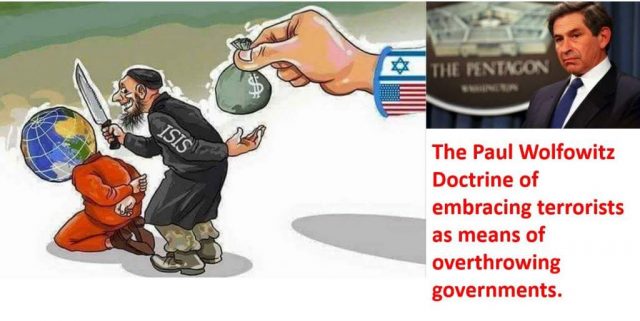

 Aletho News
