A Formal Legal Mandate for a Criminal Investigation of Guatemala’s Current President, Perez Molina
By Allan Nairn | May 11, 2013
General Efrain Rios Montt has been found guilty of genocide and crimes against humanity. He has already begun his “irrevocable” sentence of 80 years in prison.
The court that convicted Rios Montt has also ordered the attorney general to launch an immediate investigation of “all others” connected to the crimes.
This important and unexpected aspect of the verdict means that there now exists a formal legal mandate for a criminal investigation of the President of Guatemala, General Otto Perez Molina.
As President, Perez Molina enjoys temporary legal immunity, but that immunity does not block the prosecutors from starting their investigation.
Last night, in a live post-verdict interview on CNN Espanol TV, Perez Molina was confronted about his own role during the Rios Montt massacres.
The interviewer, Fernando del Rincon, repeatedly asked Perez Molina about his filmed interviews with me when he was Rios Montt’s Ixil field commander.
At that time, Perez Molina, operating under the alias “Major Tito Arias,” commanded troops who described to me how, under orders, they killed civilians.
At first, Perez Molina refused to answer, then CNN’s satellite link to him was cut off, then, after it was restored minutes later, Perez Molina replied that women, children and “complete families” had in fact aided guerrillas.
Offering what appears to be a rationale for killing families may not be a sufficient defense. But that is up to Perez Molina.
He too deserves his day in court.
Related articles
- Genocide in Guatemala: The Conviction of Efrain Rios Montt (alethonews.wordpress.com)
- Guatemala: Ríos Montt Trial Implicates Current President (alethonews.wordpress.com)
- Washington Insider Eduardo Stein Tries to Protect Ríos Montt from the Genocide Trial in Guatemala (alethonews.wordpress.com)
May 14, 2013 Posted by aletho | Ethnic Cleansing, Racism, Zionism, Timeless or most popular, War Crimes | Allan Nairn, Efraín Ríos Montt, Guatemala, Human rights, Latin America, Otto Pérez Molina, Perez Molina, President of Guatemala, Rios Montt | Leave a comment
Mainstream Media in America and Britain Repeat the Same Mistakes in Covering Iran That They Made on Iraq
By Flynt Leverett and Hillary Mann Leverett | Going to Tehran | May 13, 2013

In an excellent report released last month, the University of Maryland’s Center for International and Security Studies at Maryland (CISSM) offered a thoroughly documented—and devastating—critique of mainstream media coverage of the Iranian nuclear issue. Authored by Jonas Siegel and Saranaz Barforoush, Media Coverage of Iran’s Nuclear Program: An Analysis of U.S. and U.K. Coverage, 2009-2012, see here, reviews coverage of Iran’s nuclear activities and the international controversy surrounding those activities in six major English-language newspapers: the New York Times, the Wall Street Journal, the Washington Post, the Financial Times, the Guardian, and the Independent.
To quote from the report’s executive summary (with emphasis added), the authors found that
“–Newspaper coverage focused on the ‘he said/she said’ aspects of the policy debate, without adequately explaining the fundamental issues that should have been informing assessments—such as Iran’s nuclear capabilities and intentions, the influence of U.S., European, Iranian, and Israeli security strategies, and the impact of the nuclear nonproliferation regime.
–When newspaper coverage did address Iranian nuclear intentions and capabilities, it did so in a manner that lacked precision, was inconsistent over time, and failed to provide adequate sourcing and context for claims. This led to an inaccurate picture of the choices facing policy makers.
–Government officials, particularly U.S. government officials, were the most frequently quoted or relied-on sources in coverage of Iran’s nuclear program. This tendency focused attention on a narrow set of policy options and deemphasized other potential approaches to the dispute.
–Newspaper coverage generally adopted the tendency of U.S., European, and Israeli officials to place on Iran the burden to resolve the dispute over its nuclear program, failing to acknowledge the roles of these other countries in the dispute…
–Coverage of Iran’s nuclear program reflected and reinforced the negative sentiments about Iran that are broadly shared by U.S., European, and Israeli publics. This contributed to misunderstandings about the interests involved and narrowed the range of acceptable outcomes.
In general, these characteristics led newspapers to frame their coverage of Iran’s nuclear program in a manner that emphasized official narratives of the dispute and a relatively narrow range of policy choices available to officials. By not consistently describing the complex web of international relationships, security concerns, and intervening political factors in sufficient detail, newspaper coverage further privileged official narratives and policy preferences. This makes it likely that the policies enacted and under consideration by policy makers—coercive diplomacy and war—remain the most likely outcome of the dispute. In this way, news coverage of Iran’s nuclear program is reminiscent of news coverage of the run-up to the 2003 U.S.-led invasion of Iraq. News coverage has the potential to play a significant, constructive role in finding a lasting resolution to the dispute over Iran’s nuclear program, but journalists and editors first need to address the tendencies present in their current coverage of the topic.”
We encourage all to read and ponder, hard, this important new report.
Related articles
- The Guardian’s Dehghan promotes nonsense on Iran’s election
- Buckling to Bigotry: The Newseum Dishonors Murdered Palestinian Journalists
May 14, 2013 Posted by aletho | Deception, Mainstream Media, Warmongering, Timeless or most popular, War Crimes | Financial Times, Guardian, Iran, Mainstream Media, New York Times, Wall Street Journal, Washington Post | Leave a comment
A life of uncertainty under occupation
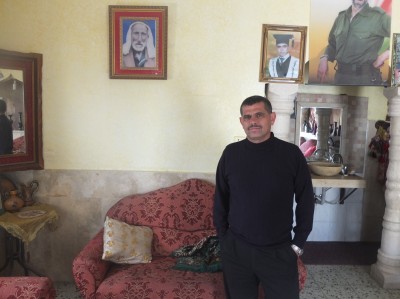
Nasri Sabarna
International Solidarity Movement | May 13, 2013
Beit Ummar, Occupied Palestine – At 3am on 13th May, Nasri Sabarna of Beit Ummar woke up to the sound of Israeli soldiers kicking down his front door. The sound of them shooting tear gas, rubber bullets and sound bombs at people passing his house on their way to the Mosque for morning prayer also woke up his 3 year old granddaughter, whose crying in turn woke up the rest of the Sabarna household.
The 6 jeeps full of soldiers had come to arrest his 21 year old son Achmed – for the fifth time. Achmed is a 21 year old student who has yet to be charged with any crime. As Achmed was not home at the time the soldiers invaded his home, the whole family were ordered to go to the police station in the illegal settlement of Gush Etzyon the following morning at 9am. It was here that Achmed was taken into interrogation. Despite not being guilty of committing any crime, his father does not expect to see him anytime soon. Achmed has already been forced to miss two years of university because of similar incidents, which have cost his family a lot of money – Achmed was arrested for the first time when he was 13 years old.
His father, Nasri is no stranger to the Israeli culture of injustice practiced against Palestinians. At the age of 13, he himself was arrested by Israeli soldiers without charge and imprisoned for 10 months. His whole life has been shaped by the occupation around him. He remembers seeing Israeli bulldozers demolish three historic homes in his village of Beit Ummar at the age of 10 – such events inspired him to become politically active. In 1978 he established the first student council in Palestine, going on later to become mayor of his home village of Beit Ummar. In Israel’s bid to crush any Palestinian political organisation, Nasri was imprisoned for 6 years between 1988 and 1994 for the sole reason of being a member of the political party Fatah.
Nasri’s main concern now is the effect that Israel’s systematic use of administrative detention, harrassment and abuse will have on the younger generations of Palestinians born under occupation. When he was mayor, 40 soldiers broke into his house and destroyed most of their belongings. They wore balaclavas as they did so and terrified his youngest son Abdullah.
Over the following weeks Abdullah’s teachers told his father that his mood had changed, he had become aggressive, argumentative and unusually violent. Nasri sought the help of psychologists from Medicenes Sans Frontiers who worked with Abdullah regularly. He told the psychologists of times where soldiers had lined him and his classmates up when walking home from school and made them jump over their guns before beating them.
The psychological treatment helped Abdullah, who is now ten, to deal with such issues and his behaviour is now back to normal. But Nasri worries for those hundreds of thousands of Palestinian children who are not so lucky to receive treatment. A combination of abuse and detentions coupled with the daily destruction of homes, land, resources and opportunities for young people in the West Bank diminishes any hope they may have for the future and ultimately leads them to seek out revenge through violence.
Nasri emphasised that this is not a struggle between religions, nor are different religious groups inherently incapable of coexisting in harmony. Colonialism and Zionism are the driving forces behind the brutality of the occupation and only granting Palestinians their freedom can bring around real peace. To summarise, Nasri said “No nation can just get rid of another nation.”
Related articles
- Israeli settlers’ attacks continue: Vineyards poisoned in Beit Ummar (occupiedpalestine.wordpress.com)
- Israel’s occupation forces targets medic and injures 17 in clashes in Beit Ummar (occupiedpalestine.wordpress.com)
May 13, 2013 Posted by aletho | Civil Liberties, Ethnic Cleansing, Racism, Zionism, Subjugation - Torture, Timeless or most popular | Beit Ummar, Human rights, Palestine, West Bank, Zionism | Leave a comment
Church of Scotland Makes Erratic U-Turn on Just-Released Report
By Richard Edmondson | War and Politics | May 13, 2013
The name of the report is/was ‘The Inheritance of Abraham? A Report on the ‘Promised Land.’” Authored by the Church of Scotland’s Church and Society Council, it basically came to the conclusion that the Bible accords the Jews no privileged claim over the land of Palestine, nor does it provide any justification for the ongoing occupation of the West Bank and East Jerusalem, the blockade of Gaza, or the forced displacement of Palestinians from their homes and lands.
The report was posted at the Church of Scotland’s website—ah, but regrettably only temporarily. It has since mysteriously disappeared, to be replaced by a statement that includes the following:
The Church of Scotland and representatives of the Jewish Community in Scotland and the United Kingdom, held useful discussions facilitated by the Council of Christians and Jews this afternoon, Thursday 8 May. We agreed that the drafting of the report published by the Church and Society Council for discussion at the General Assembly of the Church of Scotland has given cause for concern and misunderstanding of its position and requires a new introduction to set the context for the report and give clarity about some of the language used.
Did the church cave in to Jewish pressure? This appears to be the case, although the report apparently is to be discussed at the church’s upcoming General Assembly, later this month.
I first became aware of “The Inheritance of Abraham?” after reading an article about it on Wednesday of last week. Intrigued, I went to the church’s website to access the full report. Fortunately, I had the foresight to download it and save it, for when I returned to the site on Saturday, lo and behold it was nowhere to be found. The statement above, dated May 9, 2013, seems to promise a re-posting at some point, though with “a new introduction to set the context for the report”—which presumably means the old introduction will be gone, and that there may be other changes in the original wording as well.
However, you can go here and read the report in its entirety and with the original wording intact. You will find that it cites passages in Genesis—specifically 12:7, 13:15-17, 15:18-21, and 17:7-8—which have God promising the land to Abraham and his descendants without any conditions attached. Or as the report phrases it, “There are no ‘so long as…’ or ‘until…’ clauses in them” and “alone they can be read to show that God promises the land to the Israelites unconditionally.”
But the report, in the next section, goes on to note “a second view,” which, among other things, says we should read “the Pentateuch in the light of the prophets.” In this view, “the land is a gift, not a right, and one which brings with it obligations, most particularly to practice justice and to dwell equitably with the stranger.” The report cites the prophet Jonah as an example.
The book of Jonah is a key text for understanding the Hebrew Bible’s promise of the land to Abraham and his descendants. Written at a time when Jewish people were turning inwards, the book presents Johan as a Jewish nationalist to drive home the point: God’s universal, inclusive love is for all. God in Jonah is merciful, gracious, a liberator of the oppressed and sinful who looks for just living. The people of God even include the hated Assyrians. So Johan suggests a new theology of the land, because God was not confined within the land of Israel, but also embraced the land of Assyria.
And then, of course, there are the New Testament and the words of Jesus, whose teachings the report describes as “inclusive,” not only in their own right, but also in Christ’s view of the Old Testament prophets—a view that is offered in Luke 4:25-30… along with the reaction it provoked among the Jews of Nazareth at the time:
“But the truth is, there were many widows in Israel in the time of Elijah, when the heaven was shut up for three years and six months, and there was a severe famine over all the land; yet Elijah was sent to none of them except to a widow at Zarephath in Sidon. There were also many lepers in Israel in the time of the prophet Elisha, and none of them was cleansed except Naaman the Syrian.” When they heard this, all in the synagogue were filled with rage. They got up, drove him out of the town, and led him to the brow of the hill on which their town was built, so that they might hurl him off the cliff. But he passed through the midst of them and went on his way.
By expressing the view that God had love in his heart for others than just Jews, Jesus seems, then, to have caused feelings of jealousy and anger amongst his Jewish listeners that day. The report goes on to observe:
Jesus offered a radical critique of Jewish specialness and exclusivism, but the people of Nazareth were not ready for it. John’s gospel speaks of Jesus being lifted up and drawing all people to himself (John 12:32). Jesus’ cleansing of the Temple means not just that the Temple needs to be reformed, but that the Temple is finished. Stephen’s speech in Acts 7 makes it clear that God is no longer confined to the place of the Temple. Temple and land give way to a new understanding so Paul can say that all the barriers that separated Jews from the rest are down—“there is neither Jew nor Greek, bond nor free, male or female in Christ Jesus.” The new ‘place’ where God is found is wherever people gather in the name of Jesus.
Or in other words, “the promise to Abraham about land is fulfilled through the impact of Jesus, not by restoration of land to the Jewish people” and “no part of the New Testament gives any support to a political state of Israel beyond that to any other state.” Thus, the requirements for justice and the protection of human rights apply to each land, and to every inhabitant in the land.
Promises about the land of Israel were never intended to be taken literally, or as applying to a defined geographical territory. They are a way of speaking about how to live under God so that justice and peace reign, the weak and poor are protected, the stranger is included, and all have a share in the community and a contribution to make to it. The ‘promised land’ in the Bible is not a place, so much as a metaphor of how things ought to be among the people of God. This ‘promised land; can be found—or built—anywhere.
The report also includes several quotes from Kairos Palestine, a document published in 2009 by Palestinian Christians and which I have commented upon previously. Among the quotes from Kairos Palestine we find this one:
Our land is God’s land, as is the case with all countries in the world. It is holy inasmuch as God is present in it, for God alone is holy and sanctifier. It is the duty of those of us who live here, to respect the will of God for this land. It is our duty to liberate it from the evil of injustice and war. It is God’s land and therefore it must be a land of reconciliation, peace and love. This is indeed possible. God has put us here as two peoples, and God gives us the capacity, if we have the will, to live together and establish in it justice and peace, making it in reality God’s land: “The earth is the Lord’s and all that is in it, the world, and those who live in it” (Psalm 24:1).
And also this one:
We believe that our land has a universal mission. In this universality, the meaning of the promises, of the land, of the election, of the people of God, open up to include all of humanity, starting from all the peoples of this land
And this one:
Our Church points to the Kingdom, which cannot be tied to any earthly kingdom. Jesus said before Pilate that he was indeed a king but “my kingdom is not from this world.” St. Paul says: “The Kingdom of God is not food and drink but righteousness and peace and joy in the Holy Spirit” (Romans 14:7). Therefore religion cannot favour or support any unjust political regime, but must rather promote justice, truth and human dignity.”
So does the modern day state of Israel meet these conditions? Hardly. And the report says as much.
From this last perspective, the desire of many in the state of Israel to acquire the land of Palestine for the Jewish people is wrong. The fact that the land is currently being taken by settlement expansion, the separation barrier, house clearance, theft and force makes it doubly wrong to seek biblical sanction for this.
Church leaders from South Africa, following a visit to Israel and the Occupied Palestinian Territories in the autumn of 2012, observed similarities to the concluding years of the apartheid regime in South Africa. They concur with proposals to consider economic and political measures involving boycotts, disinvestment and sanctions against the state of Israel focused on illegal settlements, as the best way of convincing Israeli politicians and voters that what is happening is wrong, and that Christians around the world should not contribute in any way to the viability of illegal settlements. This raises particular questions for the Church of Scotland as we seek to respond to the question: “What does the Lord require of you…?”
And the conclusion reached is:
From this examination of the various views in the Bible about the relation of land to the people of God, it can be concluded that Christians should not be supporting any claims by Jewish or any other people, to an exclusive or even privileged divine right to possess particular territory. It is a misuse of the Bible to use it as a topographic guide to settle contemporary conflicts over land. In the Bible, God’s promises extend in hope to all land and people. Focused as they are on the life, death and resurrection of Jesus Christ, these promises call for a commitment in every place to justice in a spirit of reconciliation.
The report then goes on to assert that “the current situation is characterized by an inequality in power and therefore reconciliation can only be possible if the Israeli military occupation of the West Bank and East Jerusalem, and the blockade of Gaza, are ended.” Note: it does not say that Israel has no right to exist, although this is the interpretation being given by a number of Jews, some of whom seem quite upset over the whole thing.
So let’s cut to the chase, and see what some of these people have been saying about the report.
“Scottish Jews said they were ‘outraged’ by a recent Church of Scotland paper which denies Jews any special claim to the land of Israel.” So begins a report in the JTA dated May 3. The article makes reference to a statement issued by the Scottish Council of Jewish Communities, who denounce the report as “an outrage to everything that interfaith dialogue stands for”, insisting as well that it “reads like an Inquisition-era polemic against Jews and Judaism.”
In the opinion of the Scottish Council, the report also “closes the door on meaningful dialogue,” and quite naturally we find a demand that the Church of Scotland “withdraw it ahead of its forthcoming General Assembly.”
Interestingly, the Council’s statement additionally frets about “the arrogance of telling the Jewish people how to interpret Jewish texts,” although of course there are plenty of Jews telling Christians how to interpret the New Testament, not to mention those who have lambasted the Gospels as “anti-Semitic.”
Israel Hayom, the Israeli newspaper owned by Sheldon Adelson, calls the report “a culmination of more than a decade of increasingly strident anti-Zionism and pro-Palestinian activism by the church, especially by its local Palestinian Christian chapters,” while the always amusing Algemeiner characterizes the Church of Scotland as waging a “war on Judaism,” and committing a “moral crime” to boot, while the church’s report, Algemeiner asserts, is “immersed…in anti-Semitic clichés and malicious distortions of Jewish theology.”
Also, Israel’s ambassador to Britain has gotten in on the act. A later report by the JTA, dated May 11, quotes Ambassador Daniel Taub as saying, “This report not only plays into extremist political positions, but negates and belittles the deeply held Jewish attachment to the land of Israel in a way which is truly hurtful.” Taub reportedly made the comment over Israel’s Army Radio.
Not to be outmatched by these pikers, the ADL’s Abe Foxman has called the report “stunningly offensive,” as well as a “classic rejection of Judaism.”
“By brazenly dismissing Jewish self-understanding of its own bible—the Torah, the Church of Scotland has disregarded nearly five decades of progress in Jewish-Christian theological dialog by promoting religious principles which deny the legitimacy of Judaism and were used for centuries to justify the brutal repression of Jews,” Foxman goes on to add.
Will all this pressure result in a complete capitulation on the part of the Church of Scotland? Will we see the report fundamentally altered, perhaps beyond recognition, or even withdrawn altogether? Hard to say, but you’ll recall I began this article by quoting from a statement on the whole matter which has been posted on the Church of Scotland’s website. The statement, I mentioned, replaces the report itself, which has since been taken down. What I neglected to say is that this is a joint statement, signed not only by the Church and Society Council of the Church of Scotland, but also four Jewish organizations: Here is the rest of it:
In particular the Church of Scotland needs to be explicit about some things that are implicit policies of the Church:
- There is no change in the Church of Scotland’s long held position of the right of Israel to exist.
- The Church condemns all violence and acts of terrorism, where ever they happen in the world.
- The concern of the Church about the injustices faced by the Palestinian people in the Occupied Palestinian Territories remain firm, but that concern should not be misunderstood as questioning the right of the State of Israel to exist.
- That the Church condemns all things that create a culture of anti Semitism.
There is an equal sense of concern amongst both communities for justice and peace for all the people of Israel and the Occupied Palestinian Territories.
Sitting round the table and listening to each other more deeply has created a real opportunity for both communities to better understand each other and that this report now becomes a catalyst for continued and growing conversation.
The two communities have agreed to work together both here and in Israel and the Occupied Palestinian Territories to continue what was a very positive dialogue.
Church and Society Council, Church of Scotland
Scottish Council of Jewish Communities
Board of Deputies of British Jews
Movement for Reform Judaism
Rabbis for Human Rights
Note the dictatorial tone: “the Church of Scotland needs to be explicit…”
One might ask: Or else what?
Update:
Of course it isn’t only the Jewish media who have weighed in on the issue. Here is a report from Iran’s Press TV, which includes an interview with Anglican Vicar Stephen Sizer:
May 13, 2013 Posted by aletho | Ethnic Cleansing, Racism, Zionism, Timeless or most popular, Video | Christianity, Church of Scotland, Israel, Palestine | Leave a comment
How Elites and Media Minimize Dissent and Bury Truth
By Paul Craig Roberts | IPE | May 10, 2013
Over the last several years I have watched the rise of an important new intellect on the American scene. Ron Unz, publisher of The American Conservative, has demonstrated time and again the extraordinary ability to reexamine settled issues and show that the accepted conclusion was incorrect.
One of his early achievements was to dispose of the myth of immigrant crime by demonstrating that “Hispanics have approximately the same crime rates as whites of the same age and gender.” You can imagine the uproar, but Unz won the debate.
Unz provoked and prevailed in another controversy when he concluded that Mexican-Americans have approximately the same innate intelligence as whites, with their lower IQs being due to transitory socio-economic deprivation.
He next surprised by showing the connection between the declining real value of the minimum wage (about one-third less than in the 1960s) and immigration. Americans cannot survive on one-third less minimum income than four decades ago, and the unfilled jobs are taken by Hispanics who live many to the room. A higher minimum wage, Unz pointed out, would cure the illegal immigration problem as American citizens would fill the jobs.
I wrote about some of Unz’s remarkable findings. One of my favorites is his comparison of the responsiveness of the Chinese and US governments to their publics. I found his conclusion convincing that the authoritarian one-party Chinese government was more responsive to the Chinese people than democratic two-party Washington is to the American people.
The person is rare who can take on such controversial issues in such a professional way that he wins the admiration even of his critics. In my opinion, Ron Unz is a national resource. He has established online libraries of important periodicals and magazines from the pre-Internet era, information that otherwise essentially would be lost. I have not met him, but he donates to this site and is an independent thinker free of The Matrix.
Unz’s latest article, “Our American Pravda,” http://www.theamericanconservative.com/articles/our-american-pravda/ is a striking account of the failure of media, regulatory, and national security organizations and subsequent coverups that leave the public deceived. Unz uses the Iraq war as one example:
“The circumstances surrounding our Iraq War demonstrate this, certainly ranking it among the strangest military conflicts of modern times. The 2001 attacks in America were quickly ascribed to the radical Islamists of al-Qaeda, whose bitterest enemy in the Middle East had always been Saddam Hussein’s secular Baathist regime in Iraq. Yet through misleading public statements, false press leaks, and even forged evidence such as the “yellowcake” documents, the Bush administration and its neoconservative allies utilized the compliant American media to persuade our citizens that Iraq’s nonexistent WMDs posed a deadly national threat and required elimination by war and invasion. Indeed, for several years national polls showed that a large majority of conservatives and Republicans actually believed that Saddam was the mastermind behind 9/11 and the Iraq War was being fought as retribution. Consider how bizarre the history of the 1940s would seem if America had attacked China in retaliation for Pearl Harbor.
“True facts were easily available to anyone paying attention in the years after 2001, but most Americans do not bother and simply draw their understanding of the world from what they are told by the major media, which overwhelmingly—almost uniformly—backed the case for war with Iraq; the talking heads on TV created our reality. Prominent journalists across the liberal and conservative spectrum eagerly published the most ridiculous lies and distortions passed on to them by anonymous sources, and stampeded Congress down the path to war.
“The result was what my late friend Lt. Gen. Bill Odom rightly called the “greatest strategic disaster in United States history.” American forces suffered tens of thousands of needless deaths and injuries, while our country took a huge step toward national bankruptcy [and a police state]. Economics Nobel Laureate Joseph Stiglitz and others have estimated that with interest the total long-term cost of our two recent wars may reach as high as $5 or $6 trillion, or as much as $50,000 per American household, mostly still unpaid. Meanwhile, economist Edward Wolff has calculated that the Great Recession and its aftermath cut the personal net worth of the median American household to $57,000 in 2010 from a figure nearly twice as high three years earlier. Comparing these assets and liabilities, we see that the American middle class now hovers on the brink of insolvency, with the cost of our foreign wars being a leading cause.
“But no one involved in the debacle ultimately suffered any serious consequences, and most of the same prominent politicians and highly paid media figures who were responsible remain just as prominent and highly paid today. For most Americans, reality is whatever our media organs tell us, and since these have largely ignored the facts and adverse consequences of our wars in recent years, the American people have similarly forgotten. Recent polls show that only half the public today believes that the Iraq War was a mistake.”
Unz covers a number of cases of criminality, treason, and coverups at high levels of government and points out that “these dramatic, well-documented accounts have been ignored by our national media.” One reason for “this wall of uninterest” is that both parties are complicit and thus equally eager to bury the facts.
Unz is raising the question of the efficacy of democracy. Does the way democracy works in America provide any more self-rule than in undemocratic regimes? He offers this example:
“Most of the Americans who elected Barack Obama in 2008 intended their vote as a total repudiation of the policies and personnel of the preceding George W. Bush administration. Yet once in office, Obama’s crucial selections—Robert Gates at Defense, Timothy Geither at Treasury, and Ben Bernake at the Federal Reserve—were all top Bush officials, and they seamlessly continued the unpopular financial bailouts and foreign wars begun by his predecessor, producing what amounted to a third Bush term.”
In an article not long ago, I raised the issue whether Americans live in The Matrix with their perceptions and thoughts controlled by disinformation as in George Orwell’s 1984.
Unz adds to this perspective. He tells the story of Russian oligarch Boris Berezovsky’s plan to transform Russia into a make-believe two-party state complete with heated battles fought on divisive and symbolic issues. Behind the scenes the political elites would orchestrate the political battles between the parties with the purpose of keeping the population divided and funneling popular dissatisfaction into meaningless dead-end issues. In such a system, self-serving power prevails. After describing Berezovsky’s plot, Unz asks if Berezovsky got his idea from observing the American political scene.
Thinking further about the propagandistic nature of the US media, Unz writes:
“Individuals from less trusting societies are often surprised at the extent to which so many educated Americans tend to believe whatever the media tells them and ignore whatever it does not, placing few constraints on even the most ridiculous propaganda. For example, a commentator on my article described the East German media propaganda he had experienced prior to Reunification as being in many respects more factual and less totally ridiculous than what he now saw on American cable news shows. One obvious difference was that Western media was so globally dominant during that era that the inhabitants of the German Democratic Republic inevitably had reasonable access to a contrasting second source of information, forcing their media to be much more cautious in its dishonesty, while today almost any nonsense uniformly supported by the MSNBC-to-FoxNews spectrum of acceptable opinion remains almost totally unquestioned by most Americans.” http://www.theamericanconservative.com/american-pravda-reality-television/
Unz’s view of the US media as propagandists for power is consistent with that of John Pilger, one of the last remaining real journalists who refuses to serve power, and with Gerald Celente, who sums up the sordid American media in one word–”presstitutes.” I know from my own media experience that an independent print and TV media no longer exists in the West. The American media is a tightly controlled disinformation ministry.
Those few Americans who are free of the constraints imposed by dogmas on their ability to think and to process information have a huge responsibility for their small number. The assault on the rule of law began in the last years of the Clinton regime, but the real destruction of the US Constitution, the basis for the United States, was achieved by the neoconservative George W. Bush and Obama regimes. Wars without declarations by Congress, torture in violation of both US and international law, war crimes in violation of the Nuremberg standard, indefinite detention and assassination of US citizens without due process of law, universal spying on US citizens without warrants, federalization of state and local police now armed with military weapons and uniforms, detention centers, “your papers, please” (without the Gestapo “please”) not only at airports but also on highways, streets, bus terminals, train stations, and at sporting events.
On May 5 Obama gave the commencement address at Ohio State University. No doubt that the graduates thought that they were being honored by being addressed by the world’s greatest tyrant.
Obama told the graduating class, to applause, that their obligation as citizens is to trust the government. Outdoing George Orwell’s Big Brother, Obama said in public to a graduating class of a great university without shame: “You have grown up hearing voices that incessantly warn of government as . . . some sinister entity that’s at the root of all our problems; some of these same voices also doing their best to gum up the works. They’ll warn that tyranny is always lurking just around the corner. You should reject these voices.”
Listen to my propaganda, not to those constitutional experts, legal authorities, and critics of me, the First Black President, who tell you to beware of unaccountable government. Due process is decided by the demands of the war on terror. If there is a war on terror, do you want a fair trial or do you want to be safe? I am going to make you safe by not giving defendants accused of terrorism, who some liberal-pinko-commie judge would set free, a fair trial.
Making you safe by enveloping you in a police state is a nonpartisan undertaking. Just listen to Lindsay Graham and Peter King and John McCain. These Republican leaders are demanding the police state that I am providing.
As my own legal department, The US Department Of Justice, decided, the Dictator, I mean, elected president, has the power to save the country from domestic and foreign terrorists by abrogating the US Constitution, an out-of-date document that binds our hands and prevents us from keeping you, our serfs and minions, I mean our cherished citizens, safe.
Trust me. That is your obligation as a US citizen. Trust me and I will make you free, happy, employed sometime later in this century when the Amerikan Empire controls the world.
The US Constitution was written by people who opposed Empire. These people were misguided, just like the Roman Republicans who did not understand the need for a Caesar. The American Empire, as the neoconservatives have made clear, is what keeps you free from terrorism. We have to kill them over there before they come over here. And those who are over here will be killed too. We tolerate no dissent. That part of the Constitution is gone, along with the rest of it.
Now give me my honorary doctorate, another sign of approval of my usurpation.
~
Paul Craig Roberts was Assistant Secretary of the Treasury for Economic Policy and associate editor of the Wall Street Journal. He was columnist for Business Week, Scripps Howard News Service, and Creators Syndicate. He has had many university appointments. His internet columns have attracted a worldwide following. His latest book, The Failure of Laissez Faire Capitalism and Economic Dissolution of the West is now available.
May 13, 2013 Posted by aletho | Civil Liberties, Full Spectrum Dominance, Mainstream Media, Warmongering, Militarism, Progressive Hypocrite, Timeless or most popular | Boris Berezovsky, Iraq, Iraq War, Obama, PAUL CRAIG ROBERTS, Ron Unz, Saddam Hussein, United States | Leave a comment
Jerusalem Day: Marching Over History
Photo blog by Dylan Collins | Al-Akhbar | May 13, 2013
On Wednesday, 8 May 2013, Israel held its annual Jerusalem Day celebration, commemorating its annexation of East Jerusalem and the Old City during the 1967 Six-Day War.
Israeli settlers marched through East Jerusalem neighborhoods carrying Israeli flags and singing, celebrating and asserting their control of what is internationally recognized as the capital of any viable future Palestinian state.
Settlers marching in and out of the Damascus Gate, located directly alongside the largest Palestinian shopping center in the city, were met with a pro-Palestine counter-demonstration.
Hundreds of Israeli police were on the scene to put down the Palestinian counter-demonstration. Israeli police detained upwards of 18 individuals and beat dozens of others. Among the detainees were minors as well as several photographers.


(All photos by Dylan Collins)
May 13, 2013 Posted by aletho | Ethnic Cleansing, Racism, Zionism, Illegal Occupation, Subjugation - Torture, Timeless or most popular | Damascus Gate, Human rights, Israel Police, Jerusalem, Jerusalem Day, Palestine, Zionism | Leave a comment
Mideast Backlashes Yet to Come
By Sharmine Narwani – Al-Akhbar – 2013-05-13
The Middle East is treading water these days. Two years of rhetoric about ousting dictators, revolution, freedom, honor, dignity, and democracy – without result – has people on edge, their disillusionment now demanding an outlet.
There are no outlets though. Sensing the fast-growing disenchantment with undelivered promises, even the “bright new leaders” are tightening the reins and demanding compliance.
These new heads of state simply can’t deliver the goods for one main reason: they are just as caught up in global and regional power contests as were their predecessors. Nothing has changed with these uprisings – nothing.
Except now the stakes are higher than before. A recession-bound West, the fast-rising BRICS and their respective regional allies are locked in a competition to consolidate power and influence in this important region before it finds its bearings.
The relatively new influencers on the Arab scene like Qatar and Turkey have recognized this as a unique opportunity to slip into region-wide leadership roles. For the entrenched old hands – Washington, Riyadh, Paris, London – a race is on to prevent the region from shrugging off their decades-long dominance and embracing the anti-imperialism of the Resistance Axis.
The result has been an onslaught of interventions. Every tool in the arsenal has come out to play. Money, espionage, propaganda, weapons, assassination and that old colonial trick: divide-and-rule.
The main game is still the old battle of the blocs, Iran versus the United States, with everyone else filing in line behind their team. There have been a few surprises thrown into the mix: the newcomers like Turkey and Qatar have moved over to the US side; the BRICS, however, have lent their considerable clout to team Iran. Iraq has moved behind the latter formation and Hamas still doesn’t know where to stand so it straddles the two.
This is not a game for the faint-hearted, and it permeates every major social, economic, and political decision in the region today. Want a new electrical plant outside Cairo, Beirut, or Kirkuk? Good luck choosing a national supplier who doesn’t offend. IMF loan? Allowing over-flights or passage for ships? Inking a trade deal? Formulating a new constitution? Scheduling a football match?
Mideast states are now paralyzed and polarized over such things, and governance has come to a standstill. But in this paralysis lies a dangerous volatility: a backlash in the brewing, a pressure cooker about to blow.
The Backlash Against Neo-Islamists
After decades of oppression and marginalization by pro-West, secular dictatorships, the Muslim Brotherhood (Ikhwan) and similar Islamist parties have catapulted to power and prominence in several states. Quite counter-intuitively, however, these Islamist governments appear to have lined up behind the US bloc, eager to please, or at least placate, the very powers that colluded in their oppression.
It is an unnatural marriage, and the longer this union endures, the more estranged Islamist parties will become from their domestic constituencies – in much the same way as their autocratic predecessors.
There is volatility in this balancing act between the two blocs, as groups like Hamas have come to discover. But for the new Islamist powerhouses in “post-revolution” states, yet another volatile contest is being played out to their detriment, this time on an entirely regional level: Qatar versus Saudi Arabia – or Sunni versus Sunni.
For years the Ikhwanists have been backed by the Qatari arrivistes, who are a thorn in the side of the other, larger Wahhabi state in the Arab world, Saudi Arabia. The Saudis, for their own part, are throwing dollars and clout behind Salafists in all the countries where they intend to counter the influence of the Ikhwan and similar parties.
But Qatar and Saudi Arabia are now aggressively exporting their very personal competition to other Arab states – Libya, Egypt, Syria, Tunisia, Palestine – creating what I believe will evolve into a ferocious backlash among local populations, even as they reap the rewards of direct financial investment from these two Gulf states.
This competition has drawn in others like the UAE, Jordan, and Kuwait, appalled at the Qatari push to Ikhwanize the region. And it has turned the Arab League positively cannibalistic, devouring the sovereignty and territorial integrity of states like Libya, Syria, and Palestine that it once pledged to protect.
Qatar finds support from AKP-led Turkey in this fight, but the two are a cause for concern in the United States, which secretly suspects that Ikhwanists are harder to control than Saudi-backed Salafists. Much of this fear is because that lynchpin of all US foreign policy calculations, the state of Israel, borders Ikhwan-heavy Egypt, Gaza, and Jordan – none of which have yet sufficiently proven their loyalty to the idea of Israel’s regional hegemony.
But the biggest victim of the Saudi-Qatari competition to influence the direction of political Sunnism is likely to be political Islam itself.
The rise of political Islam – once an inevitable byproduct of democratization – arrived too hard, too fast; too aggressively championed, organized, and weaponized by Qatar and Saudi Arabia. Now, not only have the mentors lost credibility and support, but so have many of their political protégés in Yemen, Egypt, Tunisia, Libya, Syria, and Palestine.
Volatility? We haven’t even started.
What yesterday’s global powerbrokers seek from the incoming class of political Islamists is the maintenance of the status quo, including, among other things, embracing Israel and rejecting Iran. But an open pledge of allegiance to Israel is impossible for the Ikhwan and similar parties – their very legitimacy comes in part from denouncing the legitimacy of the Zionist experiment in Palestine.
Nothing tested their limits as dangerously as last November’s eight days of rocket-volley between Gaza and Israel. Each passing day drove home the fact that, despite their standard rhetoric to domestic and regional constituencies, Islamist heads of state in Turkey, Egypt, and Qatar were rendered paralyzed – and mute – as the Israeli army pounded Gaza.
Instead, it was firepower, training and strategic planning by Iran, Hezbollah, and Syria that propped up defiant Palestinians through those dark hours. The unexpected arsenal of rockets that countered Israeli aggression came from Hamas’ Qassam Brigades, Palestinian Islamic Jihad (PIJ), and other smaller resistance groups, who became the heroes of that conflict.
Not one missile, bullet, or slogan came from the three new Qatari, Turkish, and Egyptian “Sunni kings” vying for power on the coattails of the Arab uprisings.
Had the battle gone on for another week or two, the entire Middle East might have been reconfigured in its aftermath. Never have the Israelis so quickly signed a ceasefire agreement.
The global battle of the blocs and the inter-regional Sunni power struggle crossed paths in that Gaza battle. In it, the US bloc and political Islam exposed their vulnerabilities. Both groups are currently upholding – against a tidal wave of popular sentiment – systems, values, and institutions that were supposed to be swept away by honor-and-dignity revolts. Any incident that highlights this fact can serve as a springboard for a backlash against the interests of the West and its Islamist allies in the region.
The Backlash Against Sectarianism
Shia versus Sunni. Christianity versus Islam. Vilifying the “other” is common in conflict, especially when there exists some historic animosity or tension between sects, nationalities, and communities.
But since the onset of the Arab uprisings there has been a concerted effort to escalate the Shia-Sunni divide and link it wholesale to an Iranian-Arab one.
With the loss of its dictators in Tunisia and Egypt, Washington wasted no time in formulating a divide-and-rule strategy to preserve its regional interests. The US military’s Central Command (CENTCOM) for the Middle East jump-started the task by initiating a secret exercise to divide Arabs and Iranians in March 2011.
Gulf-backed media channels dove headfirst into exaggerating the threat from Iran, while hardline clerics issued increasingly belligerent fatwas against the Shia. Against this backdrop, Shia civilians began to be targeted with violence throughout the region – with very little outcry or objection from the international community, so successfully have they been conflated with a “threatening” Iran and Hezbollah.
But as Christians began to be targeted, assaulted, and killed in Egypt and Syria, the issue of sectarianism exploded beyond the old, more common storylines, and has made avoidance of this subject impossible.
Dragging the sordid issue of sectarianism – which is invariably accompanied by extremism – into the light has had an interesting effect on regional discourse: most Arabs don’t want to be part of it in much the same way they rejected al-Qaeda a decade ago.
A recent Pew Research Center poll of Muslims worldwide reveals, among other things, that 85 percent of Muslims in the Middle East and North Africa view religious freedom for people of other faiths to be “a good thing.” A majority of Muslims are “somewhat or very concerned” about Islamic religious extremism, while a minority of Muslims view Shia-Sunni tensions to be a problem at all. The poll indicates that religious strife remains a major cause for concern among Muslims in many MENA states, and that perceived hostilities between Muslims and Christians are on the high side in Egypt, but low in Lebanon, another country that has experienced these hostilities.
But even as sectarian tensions flare in various countries, the headlines do not tell the whole story. Many Arabs are rejecting these divisions, some of which is attributable to the shocking new level of violence now associated with sectarianism:
From Egypt to Kuwait, Bahrain to Syria, young Arabs are hearing – many for the first time – about women being raped because of their sect; about the cutting of heads, the hacking of limbs, the burning of bodies. This is not yesterday’s segregation of sects; this is the stuff of horror movies and genocidal sprees.
The backlash here has already begun. As violent sectarianism rises, so too does the realization that there is another discourse on the rise besides Shia versus Sunni or Muslim versus Christian.
Simply put, there is a new paradigm forming in the region that didn’t exist when it was just Iraq suffering the consequences of violent sectarian carnage: Today, throughout the Middle East, “sectarian” Shia, Sunni, Muslims, and Christians are increasingly facing down “anti-sectarian” Shia, Sunni, Muslims, and Christians. The re-framing of this issue is crucial in undermining sectarian strife. It offers millions an alternative communal identity to the one that always forces them to “defend sect first.”
Interestingly, one communal identity they are tending to embrace is a national identity, i.e., “I am Bahraini, not Shia or Sunni.”
In Bahrain, despite efforts to paint a two-year popular uprising as an “Iranian project” pitting the majority Shia population against a minority Sunni government, Bahrainis hoist their national flag at every opportunity to defy the negative sectarian characterizations of their “national” democratization project.
In Lebanon, where sectarianism is boiling in reaction to events in neighboring Syria, each incident has so far been thwarted by inter-sect efforts on a national level, and a growing desire among the population to empower the “national” army.
In Syria, widespread revulsion against what has to be the most violent manifestation of sectarianism in the region has morphed into a new language to define the conflict there: Instead of being pro or anti-government/opposition, many Syrians are now underlining their allegiance to Syria first. Despite the international media’s partiality toward framing the Syrian conflict as a sectarian one, many pro-government and pro-opposition figures tend to reject this characterization outright. This is certainly notable among pro-government Syrians, many of whom have undergone a hasty conversion from political apathy to intense nationalism in a short time, and who reject being defined as “pro-Assad.”
“It is too limiting,” says one staunchly secular Syrian about that definition. “This is about my country and keeping it whole – it is not about a person or a government,” says another, an observant Sunni who backs her national army’s efforts to weed out mostly Islamist rebels.
The irony is that the very “sectarianism” encouraged by competing Islamists and their allies in pursuit of political objectives in the region may have spawned the backlash to hasten their demise. Nationalism has long been the enemy of political Islam in the Middle East, and nationalism can once more bury it.
Throughout the Arab world, minority sects and non-sectarian groups are being thrust together to protect against the more zealous elements of political Islam, giving form to important civil coalitions that will form the backbone of new grassroots opposition movements in these countries – previously a position held almost exclusively by Islamists.
The backlashes are here, now. They will target all the interventionists clinging on to the status quo, and those keeping progress at bay. They may grow incrementally and tentatively – or they may explode onto a national or regional stage one fine day. “More of the same” will only hasten their arrival.
And it’s okay. These “backlashes” will be the revolutions you thought we already had.
Sharmine Narwani is a commentary writer and political analyst covering the Middle East. You can follow Sharmine on twitter @snarwani.
May 13, 2013 Posted by aletho | Ethnic Cleansing, Racism, Zionism, Solidarity and Activism, Timeless or most popular | Iran, Israel, Qatar, Saudi Arabia, Syria, Turkiye, United States | Leave a comment
A Timeline of CIA Atrocities
By Steve Kangas
The following timeline describes just a few of the hundreds of atrocities and crimes committed by the CIA. (1)
CIA operations follow the same recurring script. First, American business interests abroad are threatened by a popular or democratically elected leader. The people support their leader because he intends to conduct land reform, strengthen unions, redistribute wealth, nationalize foreign-owned industry, and regulate business to protect workers, consumers and the environment. So, on behalf of American business, and often with their help, the CIA mobilizes the opposition. First it identifies right-wing groups within the country (usually the military), and offers them a deal: “We’ll put you in power if you maintain a favorable business climate for us.” The Agency then hires, trains and works with them to overthrow the existing government (usually a democracy). It uses every trick in the book: propaganda, stuffed ballot boxes, purchased elections, extortion, blackmail, sexual intrigue, false stories about opponents in the local media, infiltration and disruption of opposing political parties, kidnapping, beating, torture, intimidation, economic sabotage, death squads and even assassination. These efforts culminate in a military coup, which installs a right-wing dictator. The CIA trains the dictator’s security apparatus to crack down on the traditional enemies of big business, using interrogation, torture and murder. The victims are said to be “communists,” but almost always they are just peasants, liberals, moderates, labor union leaders, political opponents and advocates of free speech and democracy. Widespread human rights abuses follow.
This scenario has been repeated so many times that the CIA actually teaches it in a special school, the notorious “School of the Americas.” (It opened in Panama but later moved to Fort Benning, Georgia.) Critics have nicknamed it the “School of the Dictators” and “School of the Assassins.” Here, the CIA trains Latin American military officers how to conduct coups, including the use of interrogation, torture and murder.
The Association for Responsible Dissent estimates that by 1987, 6 million people had died as a result of CIA covert operations. (2) Former State Department official William Blum correctly calls this an “American Holocaust.”
The CIA justifies these actions as part of its war against communism. But most coups do not involve a communist threat. Unlucky nations are targeted for a wide variety of reasons: not only threats to American business interests abroad, but also liberal or even moderate social reforms, political instability, the unwillingness of a leader to carry out Washington’s dictates, and declarations of neutrality in the Cold War. Indeed, nothing has infuriated CIA Directors quite like a nation’s desire to stay out of the Cold War.
The ironic thing about all this intervention is that it frequently fails to achieve American objectives. Often the newly installed dictator grows comfortable with the security apparatus the CIA has built for him. He becomes an expert at running a police state. And because the dictator knows he cannot be overthrown, he becomes independent and defiant of Washington’s will. The CIA then finds it cannot overthrow him, because the police and military are under the dictator’s control, afraid to cooperate with American spies for fear of torture and execution. The only two options for the U.S at this point are impotence or war. Examples of this “boomerang effect” include the Shah of Iran, General Noriega and Saddam Hussein. The boomerang effect also explains why the CIA has proven highly successful at overthrowing democracies, but a wretched failure at overthrowing dictatorships.
The following timeline should confirm that the CIA as we know it should be abolished and replaced by a true information-gathering and analysis organization. The CIA cannot be reformed — it is institutionally and culturally corrupt.
1929
The culture we lost — Secretary of State Henry Stimson refuses to endorse a code-breaking operation, saying, “Gentlemen do not read each other’s mail.”
1941
COI created — In preparation for World War II, President Roosevelt creates the Office of Coordinator of Information (COI). General William “Wild Bill” Donovan heads the new intelligence service.
1942
OSS created — Roosevelt restructures COI into something more suitable for covert action, the Office of Strategic Services (OSS). Donovan recruits so many of the nation’s rich and powerful that eventually people joke that “OSS” stands for “Oh, so social!” or “Oh, such snobs!”
1943
Italy — Donovan recruits the Catholic Church in Rome to be the center of Anglo-American spy operations in Fascist Italy. This would prove to be one of America’s most enduring intelligence alliances in the Cold War.
1945
OSS is abolished — The remaining American information agencies cease covert actions and return to harmless information gathering and analysis.
Operation PAPERCLIP – While other American agencies are hunting down Nazi war criminals for arrest, the U.S. intelligence community is smuggling them into America, unpunished, for their use against the Soviets. The most important of these is Reinhard Gehlen, Hitler’s master spy who had built up an intelligence network in the Soviet Union. With full U.S. blessing, he creates the “Gehlen Organization,” a band of refugee Nazi spies who reactivate their networks in Russia. These include SS intelligence officers Alfred Six and Emil Augsburg (who massacred Jews in the Holocaust), Klaus Barbie (the “Butcher of Lyon”), Otto von Bolschwing (the Holocaust mastermind who worked with Eichmann) and SS Colonel Otto Skorzeny (a personal friend of Hitler’s). The Gehlen Organization supplies the U.S. with its only intelligence on the Soviet Union for the next ten years, serving as a bridge between the abolishment of the OSS and the creation of the CIA. However, much of the “intelligence” the former Nazis provide is bogus. Gehlen inflates Soviet military capabilities at a time when Russia is still rebuilding its devastated society, in order to inflate his own importance to the Americans (who might otherwise punish him). In 1948, Gehlen almost convinces the Americans that war is imminent, and the West should make a preemptive strike. In the 50s he produces a fictitious “missile gap.” To make matters worse, the Russians have thoroughly penetrated the Gehlen Organization with double agents, undermining the very American security that Gehlen was supposed to protect.
1947
Greece — President Truman requests military aid to Greece to support right-wing forces fighting communist rebels. For the rest of the Cold War, Washington and the CIA will back notorious Greek leaders with deplorable human rights records.
CIA created — President Truman signs the National Security Act of 1947, creating the Central Intelligence Agency and National Security Council. The CIA is accountable to the president through the NSC — there is no democratic or congressional oversight. Its charter allows the CIA to “perform such other functions and duties… as the National Security Council may from time to time direct.” This loophole opens the door to covert action and dirty tricks.
1948
Covert-action wing created — The CIA recreates a covert action wing, innocuously called the Office of Policy Coordination, led by Wall Street lawyer Frank Wisner. According to its secret charter, its responsibilities include “propaganda, economic warfare, preventive direct action, including sabotage, antisabotage, demolition and evacuation procedures; subversion against hostile states, including assistance to underground resistance groups, and support of indigenous anti-communist elements in threatened countries of the free world.”
Italy — The CIA corrupts democratic elections in Italy, where Italian communists threaten to win the elections. The CIA buys votes, broadcasts propaganda, threatens and beats up opposition leaders, and infiltrates and disrupts their organizations. It works — the communists are defeated.
1949
Radio Free Europe — The CIA creates its first major propaganda outlet, Radio Free Europe. Over the next several decades, its broadcasts are so blatantly false that for a time it is considered illegal to publish transcripts of them in the U.S.
Late 40s
Operation MOCKINGBIRD — The CIA begins recruiting American news organizations and journalists to become spies and disseminators of propaganda. The effort is headed by Frank Wisner, Allan Dulles, Richard Helms and Philip Graham. Graham is publisher of The Washington Post, which becomes a major CIA player. Eventually, the CIA’s media assets will include ABC, NBC, CBS, Time, Newsweek, Associated Press, United Press International, Reuters, Hearst Newspapers, Scripps-Howard, Copley News Service and more. By the CIA’s own admission, at least 25 organizations and 400 journalists will become CIA assets.
1953
Iran – CIA overthrows the democratically elected Mohammed Mossadegh in a military coup, after he threatened to nationalize British oil. The CIA replaces him with a dictator, the Shah of Iran, whose secret police, SAVAK, is as brutal as the Gestapo.
Operation MK-ULTRA — Inspired by North Korea’s brainwashing program, the CIA begins experiments on mind control. The most notorious part of this project involves giving LSD and other drugs to American subjects without their knowledge or against their will, causing several to commit suicide. However, the operation involves far more than this. Funded in part by the Rockefeller and Ford foundations, research includes propaganda, brainwashing, public relations, advertising, hypnosis, and other forms of suggestion.
1954
Guatemala — CIA overthrows the democratically elected Jacob Arbenz in a military coup. Arbenz has threatened to nationalize the Rockefeller-owned United Fruit Company, in which CIA Director Allen Dulles also owns stock. Arbenz is replaced with a series of right-wing dictators whose bloodthirsty policies will kill over 100,000 Guatemalans in the next 40 years.
1954-1958
North Vietnam — CIA officer Edward Lansdale spends four years trying to overthrow the communist government of North Vietnam, using all the usual dirty tricks. The CIA also attempts to legitimize a tyrannical puppet regime in South Vietnam, headed by Ngo Dinh Diem. These efforts fail to win the hearts and minds of the South Vietnamese because the Diem government is opposed to true democracy, land reform and poverty reduction measures. The CIA’s continuing failure results in escalating American intervention, culminating in the Vietnam War.
1956
Hungary — Radio Free Europe incites Hungary to revolt by broadcasting Khruschev’s Secret Speech, in which he denounced Stalin. It also hints that American aid will help the Hungarians fight. This aid fails to materialize as Hungarians launch a doomed armed revolt, which only invites a major Soviet invasion. The conflict kills 7,000 Soviets and 30,000 Hungarians.
1957-1973
Laos — The CIA carries out approximately one coup per year trying to nullify Laos’ democratic elections. The problem is the Pathet Lao, a leftist group with enough popular support to be a member of any coalition government. In the late 50s, the CIA even creates an “Armee Clandestine” of Asian mercenaries to attack the Pathet Lao. After the CIA’s army suffers numerous defeats, the U.S. starts bombing, dropping more bombs on Laos than all the U.S. bombs dropped in World War II. A quarter of all Laotians will eventually become refugees, many living in caves.
1959
Haiti — The U.S. military helps “Papa Doc” Duvalier become dictator of Haiti. He creates his own private police force, the “Tonton Macoutes,” who terrorize the population with machetes. They will kill over 100,000 during the Duvalier family reign. The U.S. does not protest their dismal human rights record.
1961
The Bay of Pigs — The CIA sends 1,500 Cuban exiles to invade Castro’s Cuba. But “Operation Mongoose” fails, due to poor planning, security and backing. The planners had imagined that the invasion will spark a popular uprising against Castro -– which never happens. A promised American air strike also never occurs. This is the CIA’s first public setback, causing President Kennedy to fire CIA Director Allen Dulles.
Dominican Republic — The CIA assassinates Rafael Trujillo, a murderous dictator Washington has supported since 1930. Trujillo’s business interests have grown so large (about 60 percent of the economy) that they have begun competing with American business interests.
Ecuador — The CIA-backed military forces the democratically elected President Jose Velasco to resign. Vice President Carlos Arosemana replaces him; the CIA fills the now vacant vice presidency with its own man.
Congo (Zaire) — The CIA assassinates the democratically elected Patrice Lumumba. However, public support for Lumumba’s politics runs so high that the CIA cannot clearly install his opponents in power. Four years of political turmoil follow.
1963
Dominican Republic — The CIA overthrows the democratically elected Juan Bosch in a military coup. The CIA installs a repressive, right-wing junta.
Ecuador — A CIA-backed military coup overthrows President Arosemana, whose independent (not socialist) policies have become unacceptable to Washington. A military junta assumes command, cancels the 1964 elections, and begins abusing human rights.
1964
Brazil — A CIA-backed military coup overthrows the democratically elected government of Joao Goulart. The junta that replaces it will, in the next two decades, become one of the most bloodthirsty in history. General Castelo Branco will create Latin America’s first death squads, or bands of secret police who hunt down “communists” for torture, interrogation and murder. Often these “communists” are no more than Branco’s political opponents. Later it is revealed that the CIA trains the death squads.
1965
Indonesia — The CIA overthrows the democratically elected Sukarno with a military coup. The CIA has been trying to eliminate Sukarno since 1957, using everything from attempted assassination to sexual intrigue, for nothing more than his declaring neutrality in the Cold War. His successor, General Suharto, will massacre between 500,000 to 1 million civilians accused of being “communist.” The CIA supplies the names of countless suspects.
Dominican Republic — A popular rebellion breaks out, promising to reinstall Juan Bosch as the country’s elected leader. The revolution is crushed when U.S. Marines land to uphold the military regime by force. The CIA directs everything behind the scenes.
Greece — With the CIA’s backing, the king removes George Papandreous as prime minister. Papandreous has failed to vigorously support U.S. interests in Greece.
Congo (Zaire) — A CIA-backed military coup installs Mobutu Sese Seko as dictator. The hated and repressive Mobutu exploits his desperately poor country for billions.
1966
The Ramparts Affair — The radical magazine Ramparts begins a series of unprecedented anti-CIA articles. Among their scoops: the CIA has paid the University of Michigan $25 million dollars to hire “professors” to train South Vietnamese students in covert police methods. MIT and other universities have received similar payments. Ramparts also reveals that the National Students’ Association is a CIA front. Students are sometimes recruited through blackmail and bribery, including draft deferments.
1967
Greece — A CIA-backed military coup overthrows the government two days before the elections. The favorite to win was George Papandreous, the liberal candidate. During the next six years, the “reign of the colonels” — backed by the CIA — will usher in the widespread use of torture and murder against political opponents. When a Greek ambassador objects to President Johnson about U.S. plans for Cypress, Johnson tells him: “Fuck your parliament and your constitution.”
Operation PHEONIX — The CIA helps South Vietnamese agents identify and then murder alleged Viet Cong leaders operating in South Vietnamese villages. According to a 1971 congressional report, this operation killed about 20,000 “Viet Cong.”
1968
Operation CHAOS — The CIA has been illegally spying on American citizens since 1959, but with Operation CHAOS, President Johnson dramatically boosts the effort. CIA agents go undercover as student radicals to spy on and disrupt campus organizations protesting the Vietnam War. They are searching for Russian instigators, which they never find. CHAOS will eventually spy on 7,000 individuals and 1,000 organizations.
Bolivia — A CIA-organized military operation captures legendary guerilla Che Guevara. The CIA wants to keep him alive for interrogation, but the Bolivian government executes him to prevent worldwide calls for clemency.
1969
Uruguay — The notorious CIA torturer Dan Mitrione arrives in Uruguay, a country torn with political strife. Whereas right-wing forces previously used torture only as a last resort, Mitrione convinces them to use it as a routine, widespread practice. “The precise pain, in the precise place, in the precise amount, for the desired effect,” is his motto. The torture techniques he teaches to the death squads rival the Nazis’. He eventually becomes so feared that revolutionaries will kidnap and murder him a year later.
1970
Cambodia — The CIA overthrows Prince Sahounek, who is highly popular among Cambodians for keeping them out of the Vietnam War. He is replaced by CIA puppet Lon Nol, who immediately throws Cambodian troops into battle. This unpopular move strengthens once minor opposition parties like the Khmer Rouge, which achieves power in 1975 and massacres millions of its own people.
1971
Bolivia — After half a decade of CIA-inspired political turmoil, a CIA-backed military coup overthrows the leftist President Juan Torres. In the next two years, dictator Hugo Banzer will have over 2,000 political opponents arrested without trial, then tortured, raped and executed.
Haiti — “Papa Doc” Duvalier dies, leaving his 19-year old son “Baby Doc” Duvalier the dictator of Haiti. His son continues his bloody reign with full knowledge of the CIA.
1972
The Case-Zablocki Act — Congress passes an act requiring congressional review of executive agreements. In theory, this should make CIA operations more accountable. In fact, it is only marginally effective.
Cambodia — Congress votes to cut off CIA funds for its secret war in Cambodia.
Wagergate Break-in — President Nixon sends in a team of burglars to wiretap Democratic offices at Watergate. The team members have extensive CIA histories, including James McCord, E. Howard Hunt and five of the Cuban burglars. They work for the Committee to Reelect the President (CREEP), which does dirty work like disrupting Democratic campaigns and laundering Nixon’s illegal campaign contributions. CREEP’s activities are funded and organized by another CIA front, the Mullen Company.
1973
Chile — The CIA overthrows and assassinates Salvador Allende, Latin America’s first democratically elected socialist leader. The problems begin when Allende nationalizes American-owned firms in Chile. ITT offers the CIA $1 million for a coup (reportedly refused). The CIA replaces Allende with General Augusto Pinochet, who will torture and murder thousands of his own countrymen in a crackdown on labor leaders and the political left.
CIA begins internal investigations — William Colby, the Deputy Director for Operations, orders all CIA personnel to report any and all illegal activities they know about. This information is later reported to Congress.
Watergate Scandal — The CIA’s main collaborating newspaper in America, The Washington Post, reports Nixon’s crimes long before any other newspaper takes up the subject. The two reporters, Woodward and Bernstein, make almost no mention of the CIA’s many fingerprints all over the scandal. It is later revealed that Woodward was a Naval intelligence briefer to the White House, and knows many important intelligence figures, including General Alexander Haig. His main source, “Deep Throat,” is probably one of those.
CIA Director Helms Fired — President Nixon fires CIA Director Richard Helms for failing to help cover up the Watergate scandal. Helms and Nixon have always disliked each other. The new CIA director is William Colby, who is relatively more open to CIA reform.
1974
CHAOS exposed — Pulitzer prize winning journalist Seymour Hersh publishes a story about Operation CHAOS, the domestic surveillance and infiltration of anti-war and civil rights groups in the U.S. The story sparks national outrage.
Angleton fired — Congress holds hearings on the illegal domestic spying efforts of James Jesus Angleton, the CIA’s chief of counterintelligence. His efforts included mail-opening campaigns and secret surveillance of war protesters. The hearings result in his dismissal from the CIA.
House clears CIA in Watergate — The House of Representatives clears the CIA of any complicity in Nixon’s Watergate break-in.
The Hughes Ryan Act — Congress passes an amendment requiring the president to report nonintelligence CIA operations to the relevant congressional committees in a timely fashion.
1975
Australia — The CIA helps topple the democratically elected, left-leaning government of Prime Minister Edward Whitlam. The CIA does this by giving an ultimatum to its Governor-General, John Kerr. Kerr, a longtime CIA collaborator, exercises his constitutional right to dissolve the Whitlam government. The Governor-General is a largely ceremonial position appointed by the Queen; the Prime Minister is democratically elected. The use of this archaic and never-used law stuns the nation.
Angola — Eager to demonstrate American military resolve after its defeat in Vietnam, Henry Kissinger launches a CIA-backed war in Angola. Contrary to Kissinger’s assertions, Angola is a country of little strategic importance and not seriously threatened by communism. The CIA backs the brutal leader of UNITAS, Jonas Savimbi. This polarizes Angolan politics and drives his opponents into the arms of Cuba and the Soviet Union for survival. Congress will cut off funds in 1976, but the CIA is able to run the war off the books until 1984, when funding is legalized again. This entirely pointless war kills over 300,000 Angolans.
“The CIA and the Cult of Intelligence” — Victor Marchetti and John Marks publish this whistle-blowing history of CIA crimes and abuses. Marchetti has spent 14 years in the CIA, eventually becoming an executive assistant to the Deputy Director of Intelligence. Marks has spent five years as an intelligence official in the State Department.
“Inside the Company” — Philip Agee publishes a diary of his life inside the CIA. Agee has worked in covert operations in Latin America during the 60s, and details the crimes in which he took part.
Congress investigates CIA wrong-doing — Public outrage compels Congress to hold hearings on CIA crimes. Senator Frank Church heads the Senate investigation (“The Church Committee”), and Representative Otis Pike heads the House investigation. (Despite a 98 percent incumbency reelection rate, both Church and Pike are defeated in the next elections.) The investigations lead to a number of reforms intended to increase the CIA’s accountability to Congress, including the creation of a standing Senate committee on intelligence. However, the reforms prove ineffective, as the Iran/Contra scandal will show. It turns out the CIA can control, deal with or sidestep Congress with ease.
The Rockefeller Commission — In an attempt to reduce the damage done by the Church Committee, President Ford creates the “Rockefeller Commission” to whitewash CIA history and propose toothless reforms. The commission’s namesake, Vice President Nelson Rockefeller, is himself a major CIA figure. Five of the commission’s eight members are also members of the Council on Foreign Relations, a CIA-dominated organization.
1979
Iran — The CIA fails to predict the fall of the Shah of Iran, a longtime CIA puppet, and the rise of Muslim fundamentalists who are furious at the CIA’s backing of SAVAK, the Shah’s bloodthirsty secret police. In revenge, the Muslims take 52 Americans hostage in the U.S. embassy in Tehran.
Afghanistan — The Soviets invade Afghanistan. The CIA immediately begins supplying arms to any faction willing to fight the occupying Soviets. Such indiscriminate arming means that when the Soviets leave Afghanistan, civil war will erupt. Also, fanatical Muslim extremists now possess state-of-the-art weaponry. One of these is Sheik Abdel Rahman, who will become involved in the World Trade Center bombing in New York.
El Salvador — An idealistic group of young military officers, repulsed by the massacre of the poor, overthrows the right-wing government. However, the U.S. compels the inexperienced officers to include many of the old guard in key positions in their new government. Soon, things are back to “normal” — the military government is repressing and killing poor civilian protesters. Many of the young military and civilian reformers, finding themselves powerless, resign in disgust.
Nicaragua — Anastasios Samoza II, the CIA-backed dictator, falls. The Marxist Sandinistas take over government, and they are initially popular because of their commitment to land and anti-poverty reform. Samoza had a murderous and hated personal army called the National Guard. Remnants of the Guard will become the Contras, who fight a CIA-backed guerilla war against the Sandinista government throughout the 1980s.
1980
El Salvador — The Archbishop of San Salvador, Oscar Romero, pleads with President Carter “Christian to Christian” to stop aiding the military government slaughtering his people. Carter refuses. Shortly afterwards, right-wing leader Roberto D’Aubuisson has Romero shot through the heart while saying Mass. The country soon dissolves into civil war, with the peasants in the hills fighting against the military government. The CIA and U.S. Armed Forces supply the government with overwhelming military and intelligence superiority. CIA-trained death squads roam the countryside, committing atrocities like that of El Mazote in 1982, where they massacre between 700 and 1000 men, women and children. By 1992, some 63,000 Salvadorans will be killed.
1981
Iran/Contra Begins — The CIA begins selling arms to Iran at high prices, using the profits to arm the Contras fighting the Sandinista government in Nicaragua. President Reagan vows that the Sandinistas will be “pressured” until “they say ‘uncle.’” The CIA’s Freedom Fighter’s Manual disbursed to the Contras includes instruction on economic sabotage, propaganda, extortion, bribery, blackmail, interrogation, torture, murder and political assassination.
1983
Honduras — The CIA gives Honduran military officers the Human Resource Exploitation Training Manual – 1983, which teaches how to torture people. Honduras’ notorious “Battalion 316” then uses these techniques, with the CIA’s full knowledge, on thousands of leftist dissidents. At least 184 are murdered.
1984
The Boland Amendment — The last of a series of Boland Amendments is passed. These amendments have reduced CIA aid to the Contras; the last one cuts it off completely. However, CIA Director William Casey is already prepared to “hand off” the operation to Colonel Oliver North, who illegally continues supplying the Contras through the CIA’s informal, secret, and self-financing network. This includes “humanitarian aid” donated by Adolph Coors and William Simon, and military aid funded by Iranian arms sales.
1986
Eugene Hasenfus — Nicaragua shoots down a C-123 transport plane carrying military supplies to the Contras. The lone survivor, Eugene Hasenfus, turns out to be a CIA employee, as are the two dead pilots. The airplane belongs to Southern Air Transport, a CIA front. The incident makes a mockery of President Reagan’s claims that the CIA is not illegally arming the Contras.
Iran/Contra Scandal — Although the details have long been known, the Iran/Contra scandal finally captures the media’s attention in 1986. Congress holds hearings, and several key figures (like Oliver North) lie under oath to protect the intelligence community. CIA Director William Casey dies of brain cancer before Congress can question him. All reforms enacted by Congress after the scandal are purely cosmetic.
Haiti — Rising popular revolt in Haiti means that “Baby Doc” Duvalier will remain “President for Life” only if he has a short one. The U.S., which hates instability in a puppet country, flies the despotic Duvalier to the South of France for a comfortable retirement. The CIA then rigs the upcoming elections in favor of another right-wing military strongman. However, violence keeps the country in political turmoil for another four years. The CIA tries to strengthen the military by creating the National Intelligence Service (SIN), which suppresses popular revolt through torture and assassination.
1989
Panama — The U.S. invades Panama to overthrow a dictator of its own making, General Manuel Noriega. Noriega has been on the CIA’s payroll since 1966, and has been transporting drugs with the CIA’s knowledge since 1972. By the late 80s, Noriega’s growing independence and intransigence have angered Washington… so out he goes.
1990
Haiti — Competing against 10 comparatively wealthy candidates, leftist priest Jean-Bertrand Aristide captures 68 percent of the vote. After only eight months in power, however, the CIA-backed military deposes him. More military dictators brutalize the country, as thousands of Haitian refugees escape the turmoil in barely seaworthy boats. As popular opinion calls for Aristide’s return, the CIA begins a disinformation campaign painting the courageous priest as mentally unstable.
1991
The Gulf War — The U.S. liberates Kuwait from Iraq. But Iraq’s dictator, Saddam Hussein, is another creature of the CIA. With U.S. encouragement, Hussein invaded Iran in 1980. During this costly eight-year war, the CIA built up Hussein’s forces with sophisticated arms, intelligence, training and financial backing. This cemented Hussein’s power at home, allowing him to crush the many internal rebellions that erupted from time to time, sometimes with poison gas. It also gave him all the military might he needed to conduct further adventurism — in Kuwait, for example.
The Fall of the Soviet Union — The CIA fails to predict this most important event of the Cold War. This suggests that it has been so busy undermining governments that it hasn’t been doing its primary job: gathering and analyzing information. The fall of the Soviet Union also robs the CIA of its reason for existence: fighting communism. This leads some to accuse the CIA of intentionally failing to predict the downfall of the Soviet Union. Curiously, the intelligence community’s budget is not significantly reduced after the demise of communism.
1992
Economic Espionage — In the years following the end of the Cold War, the CIA is increasingly used for economic espionage. This involves stealing the technological secrets of competing foreign companies and giving them to American ones. Given the CIA’s clear preference for dirty tricks over mere information gathering, the possibility of serious criminal behavior is very great indeed.
1993
Haiti — The chaos in Haiti grows so bad that President Clinton has no choice but to remove the Haitian military dictator, Raoul Cedras, on threat of U.S. invasion. The U.S. occupiers do not arrest Haiti’s military leaders for crimes against humanity, but instead ensure their safety and rich retirements. Aristide is returned to power only after being forced to accept an agenda favorable to the country’s ruling class.
EPILOGUE
In a speech before the CIA celebrating its 50th anniversary, President Clinton said: “By necessity, the American people will never know the full story of your courage.”
Clinton’s is a common defense of the CIA: namely, the American people should stop criticizing the CIA because they don’t know what it really does. This, of course, is the heart of the problem in the first place. An agency that is above criticism is also above moral behavior and reform. Its secrecy and lack of accountability allows its corruption to grow unchecked.
Furthermore, Clinton’s statement is simply untrue. The history of the agency is growing painfully clear, especially with the declassification of historical CIA documents. We may not know the details of specific operations, but we do know, quite well, the general behavior of the CIA. These facts began emerging nearly two decades ago at an ever-quickening pace. Today we have a remarkably accurate and consistent picture, repeated in country after country, and verified from countless different directions.
The CIA’s response to this growing knowledge and criticism follows a typical historical pattern. (Indeed, there are remarkable parallels to the Medieval Church’s fight against the Scientific Revolution.) The first journalists and writers to reveal the CIA’s criminal behavior were harassed and censored if they were American writers, and tortured and murdered if they were foreigners. (See Philip Agee’s On the Run for an example of early harassment.) However, over the last two decades the tide of evidence has become overwhelming, and the CIA has found that it does not have enough fingers to plug every hole in the dike. This is especially true in the age of the Internet, where information flows freely among millions of people. Since censorship is impossible, the Agency must now defend itself with apologetics. Clinton’s “Americans will never know” defense is a prime example.
Another common apologetic is that “the world is filled with unsavory characters, and we must deal with them if we are to protect American interests at all.” There are two things wrong with this. First, it ignores the fact that the CIA has regularly spurned alliances with defenders of democracy, free speech and human rights, preferring the company of military dictators and tyrants. The CIA had moral options available to them, but did not take them.
Second, this argument begs several questions. The first is: “Which American interests?” The CIA has courted right-wing dictators because they allow wealthy Americans to exploit the country’s cheap labor and resources. But poor and middle-class Americans pay the price whenever they fight the wars that stem from CIA actions, from Vietnam to the Gulf War to Panama. The second begged question is: “Why should American interests come at the expense of other peoples’ human rights?”
Endnotes:
1. All history concerning CIA intervention in foreign countries is summarized from William Blum’s encyclopedic work, Killing Hope: U.S. Military and CIA Interventions since World War II (Monroe, Maine: Common Courage Press, 1995). Sources for domestic CIA operations come from Jonathan Vankin and John Whalen’s The 60 Greatest Conspiracies of All Time (Secaucus, N.J.: Citadel Press, 1997).
2. Coleman McCarthy, “The Consequences of Covert Tactics” Washington Post, December 13, 1987.
May 12, 2013 Posted by aletho | Civil Liberties, Deception, Timeless or most popular, War Crimes | Central Intelligence Agency, CIA, Human rights, National Security Act of 1947, Office of Strategic Services, Reinhard Gehlen, United States | Leave a comment
Why the failure in Almaty is a big deal
By Flynt Leverett & Hillary Mann Leverett | The Hindu | May 6, 2013
By once again blowing the chance to close a nuclear deal with Iran, the U.S. and its western partners have set themselves up for escalating the conflict with the Islamic republic
The most recent round of nuclear talks between the P5+1 were, by any meaningful measure, a failure. Even as she sought to put the best face possible on the non-outcome in Almaty, Kazakhstan last month, European Union Foreign Policy Chief Catherine Ashton had to acknowledge that western members of the P5+1 and Iran “remain far apart on substance.”
Western officials blame the failure either on the Islamic Republic’s upcoming presidential election or on that old fallback, Iranian “intransigence.” In reality, talks failed because America and its western partners remain unwilling to recognise Iran’s right to enrich uranium under international safeguards.
U.S. strategic culture
As a sovereign state, Iran is entitled to enrich, if it chooses; as a party to the Nuclear Non-Proliferation Treaty (NPT), it is entitled to do so under safeguards. The NPT explicitly recognises signatories’ “inalienable right” to use nuclear technology for peaceful purposes. That this inalienable right includes the right to enrich is clear from the NPT itself, its negotiating history, and decades of state practice, with at least a dozen non-weapons state parties having developed safeguarded fuel-cycle infrastructures potentially able to support weapons programmes.
If Washington recognised Iran’s right to enrich, a nuclear deal with Tehran could be reached in a matter of weeks. As long as Washington refuses to acknowledge Tehran’s nuclear rights, no substantial agreement will be possible.
Yet the Obama administration is no closer than its processor to accepting safeguarded enrichment in Iran. This is partly due to pressure from various allies — Israel, Saudi Arabia, Britain, France — and their American supporters, who expect Washington somehow to defy legal principle along with political reality and compel Tehran to surrender its indigenous fuel-cycle capabilities.
But the real reason for U.S. obstinacy is that recognising Iran’s nuclear rights would mean accepting the Islamic Republic as a legitimate entity representing legitimate national interests. No American administration since the Iranian Revolution — not even that of Barack Hussein Obama — has been willing to do this.
Washington’s unwillingness is grounded in some unattractive, but fundamental, aspects of American strategic culture: difficulty in coming to terms with independent power centres (whether globally or in vital regions like the Middle East); hostility to non-liberal states, unless they subordinate their foreign policies to U.S. preferences (as Egypt did under Sadat and Mubarak); and an unreflective but deeply rooted sense that U.S.-backed norms, legal rules, and transnational decision-making processes are meant to constrain others, not America itself.
Because these attitudes are so fundamental, it is unlikely that Obama will invest the political capital required to bring America’s Iran policy in line with strategic reality before his presidency ends. And so the controversy over Iran’s nuclear activities will grind on.
Earlier years
The world has experienced such diplomatic stasis before. In 2003-2005, Britain, France, and Germany worked (ostensibly) to prepare a nuclear settlement with Tehran; Iran suspended enrichment for nearly two years to encourage diplomatic progress. The initiative failed because the George W. Bush administration refused to join the talks unless Tehran was willing to abandon pursuit of indigenous fuel-cycle capabilities.
In 2009-2010, efforts to negotiate the exchange of most of Iran’s then-stockpile of enriched uranium for fuel for the Tehran Research Reactor collapsed for similar reasons. In the May 2010 Tehran Declaration brokered by Brazil and Turkey, Iran accepted all of Washington’s terms for a fuel swap, yet the Obama administration rejected the Declaration because it openly recognised Iran’s right to enrich. Three years later, the administration is once again undermining chances for diplomatic success with its inflexibility regarding Iran’s nuclear rights.
The world has also seen what happens when America and its European partners demonstrate such bad faith in nuclear diplomacy with Tehran — Iran expands its nuclear infrastructure and capabilities. When Iran broke its nearly two-year suspension of enrichment in 2005, it could run less than a thousand centrifuges; today, it has installed 12,000 centrifuges, more than 9,000 of which process uranium gas to produce enriched uranium. In February 2010, Iran began enriching uranium to the near-20 per cent level needed to fuel the Tehran Research Reactor (TRR) after the U.S. and its partners refused to sell the fuel; Iran consistently offered to suspend near-20 per cent enrichment if it could obtain an adequate fuel supply for the TRR. After the Obama administration torpedoed the Tehran Declaration, Iran accelerated its production of near-20 per cent uranium and began indigenously manufacturing fuel plates for the TRR.
With America and its European partners once again blowing an opening to accept Tehran’s nuclear rights and close a nuclear deal, we are likely to see another surge of expansion in Iran’s nuclear infrastructure. Certainly, Iran will continue enriching, at the three to four per cent level needed for power reactors and at the near-20 per cent level needed for the TRR, and installing more efficient second-generation centrifuges. Iran also appears to be on track to commission a heavy water reactor at Arak next year.
Although the International Atomic Energy Agency (IAEA) consistently certifies that no nuclear materials have been diverted from Iran’s safeguarded nuclear facilities, all of these steps will be cited by Israel, the pro-Israel lobby in Washington, and other constituencies in the U.S. hankering for military action as evidence that time for diplomacy with Tehran has run out. Additionally, it is possible that the Islamic Republic will find legitimate reasons to begin enriching above the 20 per cent level. While such higher-level enrichment would be done under IAEA safeguards, this would also be interpreted in the U.S. and Israel as provocative Iranian “escalation.”
Pressure on Obama
Obama would prefer to avoid another U.S.-initiated war in the Middle East. But his unwillingness to revive America’s deteriorating regional position through serious nuclear diplomacy with Tehran will increase pressure on him to order U.S. military strikes on Iranian nuclear facilities before the end of his presidency.
Rather than openly abandon the delusion of U.S. hegemony in the Middle East, Obama will try to placate more hawkish elements by escalating America’s ongoing “dirty war” against the Islamic Republic — including economic warfare against civilians, threatening secondary sanctions against third countries in violation of U.S. WTO commitments, cyber-attacks, and support for groups doing things inside Iran that Washington elsewhere condemns as “terrorism,” stoking sectarian tensions, and fuelling further violence in Syria to prevent Tehran from “winning” there. But that, too, will only further destabilise the Middle East and bring American and Iran ever closer to the brink of overt confrontation.
Flynt Leverett and Hillary Mann Leverett are authors of Going to Tehran: Why the United States Must Come to Terms with the Islamic Republic of Iran, New York: Metropolitan, 2013. They teach international relations, he at Penn State, she at American University.
Related articles
- Nuclear Iran: What’s at Stake for the BRICS (alethonews.wordpress.com)
- Flynt Leverett: U.S. Is Engaged in A Dirty War against Iran (alethonews.wordpress.com)
May 12, 2013 Posted by aletho | Progressive Hypocrite, Timeless or most popular, Wars for Israel | Flynt Leverett, International Atomic Energy Agency, Iran, Israel, Middle East, Nuclear Non-Proliferation Treaty, United States | Leave a comment
Israel angry with Scottish Church report criticising its policies
MEMO | May 10, 2013
Israel has denounced a paper by the Scottish Church which denies “Jews’ special claim to the land of Israel.”
The paper entitled “The Inheritance of Abraham,” which was published last week rejects “claims that scripture offers any peoples a privileged claim for possession of a particular territory.”
According to Israel’s Jerusalem Post, the paper further states that “reconciliation (between Palestinians and Jews) can only be possible if the Israeli military occupation of the West Bank and East Jerusalem and the blockade of Gaza are ended.”
The report was published on the Church’s website, but is to be discussed during the Church’s general assembly on May 18. About 723 members are going to vote on whether they are for or against the report. The church is to discuss further economic and political measures against Israel.
In addition, it includes demands to cancel investments in Israeli settlements in the occupied West Bank, and “urges the UK Government and the European Union to use pressure to stop further expansion of Israeli settlements in the Occupied West Bank.”
The Israeli ambassador to London said that should the Church adopt the report, it would be a “reverse hit to the powers that push towards tolerance and peace in the region.” He also said that the report serves positions of political extremists in the region.
The Israeli newspaper Yedioth Ahronoth reported the writers of the report as saying: “Jewish people have to be provoked in order to stop their belief that they deserve special treatment because they are victims.”
“They have to know that their unjust and unethical treatment with the Palestinians cannot continue forever,” they added.
The Church’s spokesman told the Israeli newspaper that what was mentioned in the report was not “anti-Semitism,” which he held is a theory that does not completely exist.
The Church does not deny the right of Israel to exist, the spokesman told the newspaper, but it questions Israeli policies in the light of a framework that could preserve peace in Israel and the Palestinian territories.
The report questions, the spokesman argued, the absence of justice regarding dealing with the Palestinians and dividing the country. “It considered that it is wrong that scriptures are used as a basis to grab the land.”
May 11, 2013 Posted by aletho | Ethnic Cleansing, Racism, Zionism, Illegal Occupation, Timeless or most popular | Church of Scotland, Human rights, Israel, Palestine, Zionism | Leave a comment
L.A. Times’ Distorted Report on USAID
By Steve Rendall | FAIR | May 10, 2013
“USAID Develops a Bad Reputation Among Some Foreign Leaders,” read a May 7 Los Angeles Times headline, followed by the subhead:
The U.S. Agency for International Development doesn’t just offer aid to the poor, it also promotes democracy, which is seen as meddlesome or even subversive.
Fighting poverty and spreading democracy–what’s not to like?
And so, the report seems to suggest, there’s something a little off about foreign leaders, nine in recent years, who’ve expelled the agency. Why else would Bolivian President Evo Morales expel an anti-poverty group from his “impoverished” country, if he wasn’t just a little bit crazy? And Russian President Vladimir Putin can’t be playing with a full deck either; he recently expelled USAID and a bird lovers group.
Of course, these leaders and other USAID critics aren’t crazy; they argue that USAID undermines national sovereignty and democracy. The story includes charges that USAID manipulates the internal politics of host nations, but it leaves the allegations unexplored and lets supporters bat them away. In one case, reporter Paul Richter quotes an anonymous U.S. official on USAID critics:
“This is the empire striking back,” said a senior Obama administration official, who asked not to be identified because of diplomatic sensitivities. He insisted that USAID does not try to undermine governments.
Someone doesn’t have a firm grasp on the meaning the word “empire,” which applies much more accurately to U.S.’s role in these relationships. A fact that might be better understood by the reader if Richter had bothered to mention USAID’s sordid history of bolstering U.S. imperial goals.
USAID’s publicly stated goals include “furthering America’s foreign policy interests in expanding democracy and free markets.” Readers aren’t told about that, nor are they informed that in pursuing these goals the agency has frequently partnered with the CIA, as in the ’60s and ’70s when its now-closed Office of Public Safety trained foreign police in counterinsurgency techniques–including torture. Not exactly what jumps to mind when one imagines a democracy-promoting institution.
The report also fails to mention how for decades USAID has undermined popular democratic organizing in Third World countries by, among other things, creating parallel “popular” organizations, such as labor unions, in order to weaken authentic grassroots movements.
And just last month, U.S. diplomatic cables published by WikiLeaks revealed that USAID and its Office of Transition Initiatives had been secretly tasked with destabilizing Venezuela’s democratically elected government. As historian and U.S. foreign policy critic William Blum points out, USAID’s Office of Transition Initiatives
is one of the many euphemisms that American diplomats use with each other and the world–they say it means a transition to “democracy.” What it actually means is a transition from the target country adamantly refusing to cooperate with American imperialist grand designs to a country gladly willing (or acceding under pressure) to cooperate with American imperialist grand designs.
But mentioning any of that might make USAID critics look rational, even like defenders of democracy. Which is, of course, crazy–if your worldview requires a belief that U.S. interests are synonymous with democracy.
Related article
May 11, 2013 Posted by aletho | Deception, Mainstream Media, Warmongering, Timeless or most popular | Evo Morales, Office of Transition Initiatives, United States, United States Agency for International Development, USAID, Vladimir Putin | Leave a comment
Gatekeeping for Zion
By Philip Giraldi | America-Hijacked | May 9, 2013
People like myself who are either paleoconservatives or libertarians generally base their opposition to Israel and its Lobby on the costs of the de facto alliance, both financial and in terms of the wars and political chaos it has triggered. We try to demonstrate how damage to rule of law and actual U.S. interests has been a byproduct of the relationship and seek to explain what a sane U.S. foreign policy might actually look like, end of story. But it is a different sensibility coming from the more humanitarian inclined political left of the spectrum, which one would assume to have a natural inclination to oppose purveyors of oppression and human suffering. With that in mind, I would observe it is remarkable how ineffective the left has been in mobilizing any serious opposition to Israel’s policies.
There is a kind of groupthink that might provide an explanation for the lack of results in spite of what sometimes appears to be frenzied activity on the part of the cluster of liberal groups that focus on the Middle East. Gatherings to “Expose AIPAC” often focus on strategy and training, hardly discussing or challenging the American Israel Public Affairs Committee (AIPAC) at all. They also frequently fail to confront the full array of predominantly Jewish groups actively promoting Israel to include The Hudson Institute, WINEP, the Saban Center for Middle East Policy, MEMRI, the American Enterprise Institute’s foreign policy wing, and the Foundation for Defense of Democracies. The plethora of well-resourced and actively engaged Jewish groups involved in foreign policy and more particularly Israel promotion is a fact of life inside the Beltway and a critical element supporting the interventionist narrative in spite of the country as a whole becoming decidedly war weary.
At the same time, most American Jews are actually either cool or even hostile to the policies of the government of Israeli Prime Minister Benjamin Netanyahu. Peter Beinart has called for a boycott of goods produced in the Israeli settlements while Jeffrey Goldberg has denounced a coalition partner in Netanyahu’s government, writing “The Jewish Home party advances an ideology that will bring about the destruction (the self-destruction) of Israel.” This reaction to the Israeli drift rightwards politically speaking probably explains why most organizations on the political left that are critical of Israel are themselves led by American Jews and, to their credit, they are very outspoken regarding Israel’s human rights violations and its policies towards the Palestinians. But it sometimes seems that they are restrained in their critiques, something that might be attributed to what could be referred to as Jewish identity politics. Instead of biting the bullet and confronting the fact that it is leading Jewish organizations and their in-the-pocket politicians that have quite plausibly been the sine qua non in unleashing a series of actual and impending wars against the Muslim world, they instead sometimes serve as gatekeepers to frame and divert an uncomfortable truth while looking for alternative explanations.
Part of the problem is that even though major Jewish organizations’ support of interventionism represents what is only a minority opinion among Americans in general, they pretend to represent everyone who is Jewish and have successfully sold that canard to both congress and the media. And make no mistake, it is the financial and political muscle of Jewish groups like Anti-Defamation League, Conference of Presidents of Major Jewish Organizations, The American Jewish Committee, and the AIPAC that have given the green light to the hard line Israeli governments that have done so much damage to U.S. interests over the past decade. Christian Zionists are highly visible and are frequently cited to demonstrate the diversity of the Israeli Lobby, but they are largely irrelevant in terms of the actual dynamics of the pro-Israel effort. The reality is that no other national lobby can gather 13,000 of the faithful to its convention and count on the enthusiastic presence of numerous politicians from both parties as AIPAC does every year. But in spite of the quite visible power of the Jewish organizations it is sometimes more convenient and less troubling to look instead for other reasons to explain Tel Aviv’s misbehavior.
Progressives who are nervous about mentioning the shameless politicking of Jewish organizations frequently parrot what I call the Noam Chomsky rationalization, engaging actively in criticizing Israeli behavior while at the same time blaming the Middle East farrago on outside forces like American imperialism, capitalism, or oil. This approach largely exonerates Israel from actual blame for what it does and it also by extension minimizes the role of the Jewish groups that constitute the core of the pro-Israel lobby because it is claimed that Washington drives the Israeli government’s behavior based on its own self-interest not vice versa. As a result, the critics seldom question the legitimacy of the self-defined Jewish state and they are sometimes reluctant to support any measures that would actually do damage to Israel and its perceived interests.
Norman Finkelstein, a reliable progressive critic of Israeli actions, is of the Chomsky persuasion. He believes that the United States would have attacked Iraq anyway based on its own interests whether or not the fervently pro-Israel neocons had occupied key positions in the Pentagon, National Security Council, and White House. Finkelstein, in an article on the Israel Lobby, maintains that “fundamental U.S. policy in the Middle East hasn’t been affected by the Lobby,” rejects the view that Israel is a liability for U.S. national interests and states instead that it is a “unique and irreplaceable American asset.” He describes American Jewish elites as only “’pro’ an Israel that is useful to the U.S.” He insists that the neocons do not “generally have a primary allegiance to Israel [or] in fact, any allegiance to Israel.” The evidence, however, suggests otherwise: even agreeing that the Iraq war had a number of godfathers, the folks in the Pentagon and White House who cooked the books and led the charge had extremely well documented strong personal and even financial ties to Israel, so much so that several of them were accused of passing classified information to the Israeli Embassy.
The shaping of the narrative to minimize the role of organizations that are demonstrably Jewish – albeit unrepresentative of Jewish opinion in America -has also been very effective in some media circles. An April 2007 ninety minute presentation on PBS’s Frontpage with Bill Moyers “Buying the War,” a critical look at the genesis of the Iraq invasion, did not mention Israel’s supporters even once. And one only has to consider the recent Obama trip to Israel as well as the interrogation at the Chuck Hagel nomination, which was driven by organizations like AIPAC from behind the scenes, to realize that the United States government is no free agent when it comes to Middle Eastern policy. Ignoring the dominant role of “Jewish leaders” and the well-funded organizations that they head which falsely pretend to represent their entire community is a convenient obfuscation if one does not want to address causality, a bit like being concerned about global warming without looking at the actual science.
President Obama recognizes the power represented by Jewish groups acting as a cohesive and focused political entity when he meets with them collectively in the White House, so why the reluctance in recognizing and confronting their persistent pro-war, pro-intervention agenda? At a March 7th session, shortly before his trip to Israel, Obama met with Alan Solow, Lee Rosenberg and Michael Kassen of AIPAC; Barry Curtiss-Lusher of the Anti-Defamation League; David Harris of the American Jewish Committee; Jerry Silverman of Jewish Federations of North America; Harvard Professor Alan Dershowitz; former Congressman Robert Wexler; Dan Mariaschin of B’nai B’rith; Malcolm Hoenlein, executive vice chairman of the Conference of Presidents of Major American Jewish Organizations; Jeremy Ben-Ami, executive director of J Street; and Rabbi Marvin Hier, dean and founder of the Simon Wiesenthal Center. Admittedly the linking of Jewish organizations’ easy access to policymakers with their possible role in launching a string of failed wars in Asia and still more in the offing on behalf of Israel makes many people uncomfortable because it invites the dual loyalty critique and even more extreme commentary that is ultimately racist in nature, but there you have it. The president knows who is pulling his strings and so should the rest of us.
Americans can either confront the ugly realities of what has been going on for the past twelve years or they can pretend that what they are seeing is not really there. The gatekeepers are understandably concerned lest Washington’s next war be blamed on American Jews so it is far better to suggest against all evidence that Israel is a pawn of American imperialism or that recent wars have been about oil or capitalist exploitation. The reality is that if progressives (and the rest of us) really want to stop a proxy war against Syria followed by a catastrophic conflict with Iran we have to take the blinkers off and be willing to confront Jewish groups like AIPAC and the ADL directly and persistently.
Related articles
- Israel’s Fraying Image (nationalinterest.org)
- AIPAC Bill Runs Into Unusual Resistance In Congress (alethonews.wordpress.com)
May 11, 2013 Posted by aletho | Ethnic Cleansing, Racism, Zionism, Militarism, Timeless or most popular, Wars for Israel | AIPAC, American Israel Public Affairs Committee, American Jews, Christian Zionists, Conference of Presidents of Major Jewish Organizations, Israel, Middle East, Noam Chomsky, Norman Finkelstein, Saban Center for Middle East Policy, The American Jewish Committee, United States | Leave a comment
Featured Video

Weaponized Journalism: 2021 Sayer Ji Interview with NPR
or go to
Aletho News Archives – Video-Images
From the Archives
How Rothschild Banking Clan Uses Its Vast Wealth to Influence World Events and Control Governments
By Ilya Tsukanov – Sputnik – 15.09.2024
How powerful is the Rothschild banking family? How did they amass their fortune? Just how rich are they? Do they secretly control the world? Sputnik explores. … continue
Blog Roll
-
Join 2,366 other subscribers
Visits Since December 2009
- 7,792,401 hits
Looking for something?
Archives
Calendar
Categories
Aletho News Civil Liberties Corruption Deception Economics Environmentalism Ethnic Cleansing, Racism, Zionism Fake News False Flag Terrorism Full Spectrum Dominance Illegal Occupation Mainstream Media, Warmongering Malthusian Ideology, Phony Scarcity Militarism Progressive Hypocrite Russophobia Science and Pseudo-Science Solidarity and Activism Subjugation - Torture Supremacism, Social Darwinism Timeless or most popular Video War Crimes Wars for IsraelTags
Afghanistan Africa AIPAC al-Qaeda Australia BBC Benjamin Netanyahu Brazil Canada CDC Central Intelligence Agency China CIA CNN Covid-19 COVID-19 Vaccine Donald Trump Egypt European Union Facebook FBI FDA France Gaza Germany Google Hamas Hebron Hezbollah Hillary Clinton Human rights Hungary India Iran Iraq ISIS Israel Israeli settlement Japan Jerusalem Joe Biden Korea Latin America Lebanon Libya Middle East National Security Agency NATO New York Times North Korea NSA Obama Pakistan Palestine Poland Qatar Russia Sanctions against Iran Saudi Arabia Syria The Guardian Turkiye Twitter UAE UK Ukraine United Nations United States USA Venezuela Washington Post West Bank WHO Yemen Zionism
 Aletho News
- London tourism expo promotes Israeli agency linked to theft of Palestinian land
- Dockworkers launch global strike against Israeli and US military shipments
- Europe facing gas price shock – Gazprom chief
- Ukraine continues recruiting people with disabilities
- Weaponized Journalism: 2021 Sayer Ji Interview with NPR
- Beyond Netanyahu: what Israel’s election means for Palestinians
- Lithuania plans universal conscription
- Lies, Damn Lies, and Ukraine News
- Financial Times rejects Nordic demands to correct Putin call story – media
- The Case for Less Unity in Europe
- If Americans Knew
- An error has occurred; the feed is probably down. Try again later.
- No Tricks Zone
- Germany’s Green Energy Transition Becoming Increasingly Expensive…Another 6 Trillion Euros!
- Sudden Stratospheric Warming, Powerful El Niño Combination May Lead To Extreme Europe Cold, Energy Crisis!
- Two New Studies Find Thwaites Glacier Melt Cannot Be Driven By Human Activity Or A Warming Ocean
- E-Cars Reduce CO2 Emissions By Only 41% Compared To Internal Combustion Engine Vehicles
- Predictions Made By Renowned Climate Professor Over Past Decades Have Been Proven To Be Poor
- New Study Suggests Large Regions Of The Pacific Ocean Have Been Cooling For The Last 80 Years
- Germany’s Green Energy Debacle: High Energy Costs Force Kahla Porzellan to Close After 182 Years!
- New Study: 50 Years Of The Most Aggressive ‘Net Zero’ Policies Can Only Affect The Global Climate By 0.03°C
- US September “Heat” Was No Record…Many Records Set Decades Ago
- Latest European Green Energy Debacle; Portugal’s Largest Flagship Solar Park Insolvent!
Contact:
atheonews (at) gmail.com
Disclaimer
This site is provided as a research and reference tool. Although we make every reasonable effort to ensure that the information and data provided at this site are useful, accurate, and current, we cannot guarantee that the information and data provided here will be error-free. By using this site, you assume all responsibility for and risk arising from your use of and reliance upon the contents of this site.
This site and the information available through it do not, and are not intended to constitute legal advice. Should you require legal advice, you should consult your own attorney.
Nothing within this site or linked to by this site constitutes investment advice or medical advice.
Materials accessible from or added to this site by third parties, such as comments posted, are strictly the responsibility of the third party who added such materials or made them accessible and we neither endorse nor undertake to control, monitor, edit or assume responsibility for any such third-party material.
The posting of stories, commentaries, reports, documents and links (embedded or otherwise) on this site does not in any way, shape or form, implied or otherwise, necessarily express or suggest endorsement or support of any of such posted material or parts therein.
The word “alleged” is deemed to occur before the word “fraud.” Since the rule of law still applies. To peasants, at least.
Fair Use
This site contains copyrighted material the use of which has not always been specifically authorized by the copyright owner. We are making such material available in our efforts to advance understanding of environmental, political, human rights, economic, democracy, scientific, and social justice issues, etc. We believe this constitutes a ‘fair use’ of any such copyrighted material as provided for in section 107 of the US Copyright Law. In accordance with Title 17 U.S.C. Section 107, the material on this site is distributed without profit to those who have expressed a prior interest in receiving the included information for research and educational purposes. For more info go to: http://www.law.cornell.edu/uscode/17/107.shtml. If you wish to use copyrighted material from this site for purposes of your own that go beyond ‘fair use’, you must obtain permission from the copyright owner.
DMCA Contact
This is information for anyone that wishes to challenge our “fair use” of copyrighted material.
If you are a legal copyright holder or a designated agent for such and you believe that content residing on or accessible through our website infringes a copyright and falls outside the boundaries of “Fair Use”, please send a notice of infringement by contacting atheonews@gmail.com.
We will respond and take necessary action immediately.
If notice is given of an alleged copyright violation we will act expeditiously to remove or disable access to the material(s) in question.
All 3rd party material posted on this website is copyright the respective owners / authors. Aletho News makes no claim of copyright on such material.

