Italian activist arrested and beaten in occupied Palestine
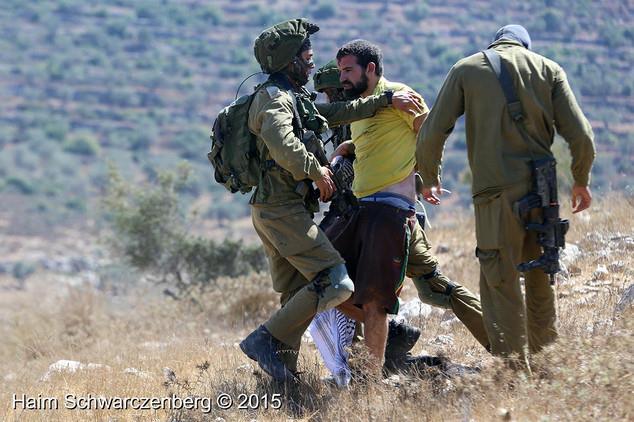
Vittorio Fera violently arrested. Photo credot – Haim Schwarczenberg
International Solidarity Movement | August 31, 2015
Occupied Palestine – Italian activist Vittorio Fera was violently arrested and beaten by soldiers at weekly demonstration in Nabi Saleh in occupied Palestine. The Italian activist, 31-year old Vittorio Fera, is falsely accused of throwing stones and attacking soldiers. His case will be taken to court the second time Monday 31st August between 9 and 11 am.
During a weekly demonstration in Nabi Saleh Israeli soldiers randomly arrested two protesters: one 18-year old Palestinian youth and the Italian activist Vittorio Fera. Fera went to the protest to document human rights violations by the Israeli army against Palestinians and became a victim of military violence himself.
While documenting an Israeli soldier strangling a 12-year old boy, Vittorio and the other activists were ambushed by Israeli forces. Vittorio was separated from the group and violently shoved to the ground. “We were shocked to see the boy being choked by a soldier, when suddenly soldiers came running at us and attacked Vittorio”, Josephine from Denmark explains.

Vittorio Fera with clear marks of military assault
Journalists witnessed soldiers kicking and beating him during the arrest, even though he did not resist or fight back. Vittorio, and the Palestinian youth, were forced into a military jeep where they were detained for almost nine hours by the Israeli army, before they were finally taken to a police station. Despite various demands of Fera’s lawyer to have him brought to a police station immediately, both he and the Palestinian were illegally kept in the military jeep until shortly before midnight.

Vittorio Fera with clear marks of military assault
The military accuses Vittorio Fera of throwing stones and attacking the soldiers – an unfounded accusation. A first sentencing in court late Saturday night only resulted in the postponing of the sentencing until Monday morning. The hearing will take place in in Jerusalem Monday the 31st August 2015 between 9 and 11 am.
See the video of the arrest here
Pacific walruses hauled out at Point Lay Alaska again this year
By Susan Crockford | Polar Bear Science | August 28, 2015
A photo of a mass walrus haulout at Point Lay, Alaska taken a few days ago from a distance show thousands of animals. But no one’s counting because apparently, no one’s interested.

The picture on the left (above, courtesy Alaska Dispatch News ) was taken 23 August by global warming activist photographer Gary Braasch, the day after a news report appeared about the US Fish & Wildlife Service and aviation authorities asking the media to approach USFWS about walrus photos and information that gave no hint that a large haulout of walruses was already in place (22 August 2015, “Federal agencies, Point Lay seek to minimize walrus disturbances” ):
“Federal agencies are stepping in to shield a North Slope village from the possibility of a deluge of international attention should a large walrus haulout develop nearby, as it has in years past — agreeing to act as an information clearinghouse on behalf of the Native Village of Point Lay.” [my bold]
Here is what the global warming activist site that published the pictures says about the haulout:
“Thousands of Pacific walrus are coming ashore near Point Lay, NW Arctic coast of Alaska. The huge sea mammals and young began coming up on this barrier island along Kasegaluk Lagoon about August 20, according to local natives. This is one of the earliest known summer haul outs of the walrus along the Alaska coast of the Chukchi Sea, according to wildlife biologists.” [my bold]
They say “thousands.” But the photos taken, reproduced in the Alaska Dispatch News story I read, were taken from a greater distance than the famous photo of ~35,000 animals released by government officials last year and looks like the total could be as large, or larger, than the 2014 haulout.
Said a Washington Post story (27 August 2015):
“The U.S. Fish and Wildlife Service confirmed to the Post Wednesday evening that a mass of walruses had “hauled out,” or gathered on shore, near the remote community of Point Lay. The service did not estimate the number or provide images. But photojournalist Gary Braasch has posted dramatic photographs, taken during an Aug. 23 flyover, of what appear to be at least several thousand walruses crowding onto a barrier island.” [my bold]

According to The Guardian “Extreme Arctic sea ice melt forces thousands of walruses ashore in Alaska”
“Braasch has spent about a decade photographing evidence of climate change in Alaska, and had been tracking the movement of tagged walruses through the US Geological Survey mapping projects.
“What they looked like by eye was three brown smudges along the beach. They were not visible as individual animals,” he said. But he said the blown-up images revealed large numbers of animals. “Certainly they were in the low thousands at that point.”
Maybe I’m wrong. I’m not an expert on estimating numbers from aerial photos. But have a look and ask yourself – why didn’t the FWS say there was a haulout last week when they made their announcement about protecting the herd from disturbance?
And now that the cat is out of the bag, why have they not released any official photos or made an official estimate? Considering the hype they generated last year, why the reticence now? It just seems odd to me.
Is it that they don’t want to emphasize how many walruses there really are? That all the walruses didn’t all die last year due to global warming? Or did they simply realize that their alarmist rhetoric and the media storm it generated last year made the situation worse for the animals?
Compare this year from the new required great distance (below upper) to an official photo from last year (below lower):

Apparently, photographer Gary Braasch was “at least a mile away”:
“Braasch said he took precautions, including flying in a small aircraft, and at a distance, “so as not to disturb the herd.”
“I used a very long telephoto lens,” Braasch said. “My pilot says we were at least a mile away.”
The high resolution copy of the photos at the World View of Global Warming website shows lots of animals in the water in the 2015 photo, indicating the walruses were actively feeding, as the animals were last year – not sitting on the beach starving to death. It’s likely that in a few days they’ll be gone, if they aren’t already.
Now the Feds are threatening to press charges against the photographer who flew over the haulout without permission, saying he may have broken their rules (“Feds investigating if photographer flew too near walruses hauled out at Point Lay”)
As far as I know, there is no new population information on walrus that wasn’t available last year, when I covered this topic extensively (Crockford 2014; video below).
US passports scoffed at by Israel; US stands by
By James Zogby | The Hill | August 24, 2015
Last year, some members of Congress attempted to pass legislation that would admit Israel into the U.S. Visa Waiver Program. The State Department pushed back, noting that because of Israel’s long history of discrimination against Americans of Arab descent, they do not meet the program’s key requirement of reciprocity.
Congress relented and instead passed a Sense of Congress that stipulated that should Israel meet this requirement, they could be included in the Visa Waiver Program. In a sense, they were put on probation.
In the past year Israel has continued to demonstrate that it has no intention of ending their practice of discriminating against persons of Arab descent. My office has received new reports of shameful treatment meted out to Arab Americans on their arrival in Israel. Two cases, in particular, deserve to be noted.
After landing at Ben Gurion International airport, George Khoury, 70, and Habib Joudeh, 62, were detained for long hours, subjected to abusive interrogations, insulted by Israeli security personnel, and finally denied entry and forced to purchase, at their own expense, return tickets to the United States.
George is a professor and a deacon of his church from San Francisco. Habib is a pharmacist and respected community leader from Brooklyn. Both are American citizens of Palestinian descent. George was traveling to the Holy Land on a pilgrimage. Habib was on his way to attend a family wedding in the West Bank. Neither had been back to Israel/Palestine in more than 20 years. And neither was able to complete their journey.
While no American should be subjected to such treatment, the most disturbing element of these cases is the reason they were denied entry and deported. Because both men were of Palestinian descent, Israel would not honor their U.S. passports or recognize the men as American citizens. Both were told they had to acquire Palestinian IDs and then, as Palestinians, enter the West Bank through Jordan.
George’s case is especially instructive. When the Israeli border control agent told him that he could not enter Israel, George attempted to engage the agent saying, “I’m coming as an American citizen.” To which the agent replied “No, no, you belong with the Palestinian people. This is our Israel, this is for the Jews. No Palestinian should come to Israel. You should have gone through the Allenby Bridge.”
When George explained that “I am coming with an American passport and you should honor it,” the agent replied, “How do you want me to honor your American passport? Do you want me to kiss it, to hug it, or to worship it?”
What happened to Habib and George were not the actions of a few rogue agents. For more than three decades, the Arab American Institute has submitted to the State Department hundreds of instances where Arab Americans have been subjected to such treatment at Israel’s borders.
By so flagrantly disregarding the citizenship rights of Americans of Arab descent, Israel is in violation of its treaty obligations found in the “1951 US-Israel Treaty of Friendship, Commerce, and Navigation.” In the language of the treaty, Israel pledges to permit U.S. citizens the right to “travel freely, to reside at places of their choice, to enjoy liberty of conscience” and to guarantee them “the most constant protection and security.”
Not only has Israel consistently violated its treaty obligation, but our government has failed to live up to its commitment to protect the rights of its own citizens. The opening page of the U.S. passport states that “The Secretary of State of the United States of America hereby requests all whom it may concern to permit the citizen/national of the United States named herein to pass without delay or hindrance and in case of need to give all lawful aid and protection.”
The Department of State says that it does not condone Israel’s treatment of Arab Americans. In reality, despite denying Israel’s admission into the Visa Waiver Program, the State Department appears to acquiesce to Israel’s behavior.
When George Khoury’s daughter wrote a letter of complaint to the U.S. Embassy in Tel Aviv, she received a response saying “Unfortunately, the US government cannot assist US citizens in gaining entry into Israel… Should your father wish to travel again in the future, we advise him to contact the nearest Israeli Embassy or Consulate for guidance.”
The U.S. official then directed her to the Department of State “Travel Advisory” which states that “regardless of whether they hold US citizenship, Israeli authorities consider anyone who has parents or grandparents who were born or lived in the West Bank or Gaza to have a claim to a PA ID.” They will, therefore, be treated as Palestinians and not as Americans.
It is upsetting that both the Department of State “Travel Advisory” and the Consul’s letter acknowledge Israel’s disregard for our citizenship rights and claim to be powerless to hold them accountable for their actions. This acquiescence allows Israel to act with impunity. It also makes our government appear to be complicit in Israel’s behavior.
More must be done. Israel cannot be allowed to disregard the citizenship rights of Americans or to unilaterally define persons of Arab descent as second-class American citizens. The Department of State and our elected representatives should demand that the Israeli government fully live up to its treaty obligations to treat all Americans equally without regard to their religion or national origin.
This is not merely a matter of denying Israel Visa Waiver privileges, it is a question of whether or not our government will guarantee Arab Americans the equal protection to which they are entitled and which they deserve.
Zogby is president of the Arab American Institute.
Tower block in Ukraine goes up in flames
RT | August 29, 2015
Two firemen have suffered injuries after a fire engulfed a luxury high-rise in Odessa, Ukraine. The fire was able to spread due to flammable materials being used for insulation.
The 22-storey Gagarin Plaza is still under construction, and was empty, save for builders, when the fire started at about noon Saturday.
Eyewitnesses told the local 112 Ukraine TV channel that the fire began at the top floor of the building, and rapidly spread downward to the ground floor.
Emergency services dispatched 13 vehicles to the site, with over 40 firemen deploying six hoses. But they were unable to access the top floors of the building.
“Our ladders only reach the 9th floor,” complained Nikolay Chechetkin, the head of the country’s emergency services, to NewsOne channel. “To put out a fire this high up, you need water pressure, which can only be provided by electric-powered pumps. But the building has not been connected to the mains.”
The fire department of the coastal city said the most they could do now was to contain the blaze. One of their personnel suffered airways burns, due to inhaling smoke; the injuries of another have not been specified.
Chechetkin blamed synthetic insulation materials chosen by the architects for the ease with which the flames were able to spread.
In May, 17 people died in Baku, Azerbaijan, when unsafe Chinese-made plastic paneling – also used for insulation – caught fire in another high-rise.
Are Zionist terrorist settlers backed by the Israeli regime?
Press TV
After the burning alive of 18-month-old Ali Dawabsheh by a fanatical Zionist settler, the world has reacted with outrage.
The attack was so horrendous that even Israeli leader Benjamin Netanyahu distanced himself from it, calling it an act of terrorism.
But on today’s show we will be asking to what extent Israel is responsible for the activities of its extremists. Are these fanatical terrorists really just a few bad apples, as Netanyahu would have us believe?
Or are they the product of decades of deliberate Zionist policy to colonize stolen land?
US ‘shamefully’ refuse to release Shaker Aamer from Guantanamo despite UK pressure

Shaker Aamer © Wikipedia
RT | August 20, 2015
American authorities are “shamefully” refusing to release Shaker Aamer, the last British resident detained at Guantanamo Bay, despite calls from Prime Minister David Cameron for the prisoner to be freed, a lawyer has claimed.
Aamer’s legal counsel Ramzi Kassem called on the British government to pressure the White House further after President Barack Obama promised to “prioritize” his case in January.
Kassem also blasted the US government for refusing to allow Aamer access to independent doctors, despite concerns over the neutrality of army medical personnel.
The New York-based lawyer said the physical condition of Aamer, who has been imprisoned without trial for 14 years, “deteriorates with each passing day.”
Kassem filed a 26-page motion at a court in Washington calling for the British resident to be examined by two independent doctors and an army doctor to gauge how Aamer is coping with post-traumatic stress.
The Department of Defense has rejected the request, claiming it is too “difficult.”
Aamer’s last independent assessment took place in October 2013, when Californian psychiatrist Dr. Emily Keram described he had been mentally “destroyed” by interrogators, who allegedly subjected him to sleep deprivation and beatings.
Law professor Kassem expressed dismay at the reluctance of US authorities to release Aamer.
“It is truly shameful that we have to litigate every step of the way despite the prime minister’s demand and the president’s pledge to prioritize Shaker’s case,” he said.
“The UK government must press the White House to make good on its promise. The only thing more shameful are the arguments the US government is making in court to prevent Shaker’s examination.”
Cameron raised the issue with Obama on his official visit to the US earlier this year.
Obama promised to “prioritize” the case in January, but Aamer’s legal team claim nothing has been done to progress his case.
Writing in the Guardian last Friday, Aamer’s UK lawyer Clive Stafford Smith claimed the US military has deliberately ignored Obama’s order in breach of the constitution.
“President Obama, it seems, has personally ordered Aamer’s release, and his subordinates have ignored and thwarted his order,” Smith wrote.
“The contravention of the president’s orders indicates that there is a profound problem with the state of democracy in America.”
Kassem slammed the US government for not taking Aamer’s physical and mental health seriously.
He condemned the United States’ “self-servingly attempts to dismiss Mr. Aamer’s reliably-diagnosed and grave ailments as only ‘minor long-term impairments.’”
Aamer has never been charged with a crime or faced trial since he arrived at the high security prison in Cuba.
In describing his treatment at Guantanamo Bay, Aamer said he was stripped of his pride.
“I was not a human being any more. I meant nothing to them. I lost my dignity, my pride,” he said.
“I had to take off my underwear and hand it to them. I had sleep deprivation for 11 days. That made me crazy. They poured cold water over me. They kept me standing for 20 hours a day. I had to hold my hands and arms out.
“All of the statements I made at Bagram were during the sleep deprivation. I would have said anything. I told them, ‘I will tell you I am Bin Laden if you want me to,’” he said.
Aamer was arrested in 2001 in Afghanistan and subsequently moved to Guantanamo Bay, where in 2007 the US military claimed he was a “close associate” of Osama Bin Laden and a “recruiter, financier, and facilitator” for Al-Qaeda.
The Saudi citizen has always insisted he was only in the country to perform charitable work and said he confessed to being a jihadist while being tortured at the hands of the CIA.
New Aussie Film on Ukraine Civilian Bombings: a PR Disaster for The US / EU
Russia Insider | August 19, 2015
One of the more extraordinary aspects of the Ukraine war has been the brutal war crimes committed against civilians, by and large exclusively by one side: Kiev.
No less extraordinary has been the refusal of the western media to cover this story, thereby leaving most people in the West simply unaware of the extent of the horrors being perpetrated in their name, funded and cheered on by their leaders. Most of the politicians are as misled as the general populace because they also get their facts from the media.
This situation has always struck us here at RI as a political time bomb waiting to go off, because the story is just too big, too ugly, too heart-breaking, and too widespread to be swept under the rug, and there are too many outlets happy to cover it – Russian state media for starters, but also the enormous alternative media. It was just waiting for the right voice and the right tragic personal story to relate, the Rosa Parks of Donbas.
That voice might well be a young Australian amateur filmmaker named Chris Nolan who has been posting excellent short films to Youtube for over a year now, describing the Kiev revolution (Maidan), and the ensuing war.
Nolan is a musician in a rock band in Brisbane who makes the films in his free time using footage he finds on the internet.

Anna Tuv: lost her husband, daughter and arm to Ukraine shell
In his latest film, he tells the story of Anna Tuv who has become a hero in the global anti-Kiev community and in Russia. Tuv lost her husband, two children, and her arm when her house was shelled. She is just one of thousands who suffered similar horrors. Her personal story has become a symbol of the insane criminality being pushed by Kiev, and indirectly by Obama, Merkel and Cameron.
Watch the trailer, it is very well done.
Featured Video

Death Spikes & Rising Cancer In Our Youth Explained
or go to
Aletho News Archives – Video-Images
From the Archives
Politicians lie
By Mazin Qumsiyeh | Popular Resistance | August 18, 2013
There is no way to say this truth nicely: Politicians lie. That includes Japanese, American, Egyptian, Israeli, and Palestinian politicians! Is there something more common sense than that? Yet, so many citizens around the world believe their own politicians or wistfully acknowledge lies but think it is part of the job needed to run things. They believe even when politicians contradict themselves blatantly. This phenomenon is rather remarkable. It is a dissonance and disconnect from reality that many seem oblivious to. It is very dangerous because it can lead to accepting rationales for going to war. These can be deadly wars that lead to millions of lives lost as happened in what was called World War 1 and WW2. Even when incredible and declassified evidence abound, politicians continue to lie and old mythologies refuse to die. Here are just a few of the countless lies told to us over the past few decades… continue
Blog Roll
 Aletho News
- From Unipolar Universalism to Multipolar Civilizational Distinctiveness
- RSF military group defects, joins Sudanese army: State media
- Ireland goalkeeper refuses to play ‘Israel’ as squad weighs boycott
- China pushes back against US on Cuba, Iran
- Ukrainian Soldiers, Potential Mercenaries: Have Gun, Will Travel!
- Burnham’s UN debut… A masterclass in British disinformation
- Iran flights continue despite US aviation sanctions
- Global Tipping Points Lead the World Into a State of Entropy
- The day-after at the White House: USA and Xi Jinping
- The Geopolitical Balance in the Red Sea: The UAE Being Displaced by New Players
- If Americans Knew
- Deconstructing Netanyahu’s pants-on-fire UN rant – Daily Update
- Trump betrayed voters with his campaign lies and prioritized a foreign country once he took office
- Netanyahu calls Israel’s war in Gaza ‘opposite of genocide’ in UN speech to near-empty hall
- Settler Kidnappings: Torture, Sexual Abuse and Terrorisation of Palestinian Abductees as Israel Deepens Annexation of West Bank
- Gaza winter nears as 162,000 tents become unusable, raising fears of humanitarian crisis
- Netanyahu says, “It’s the opposite of genocide”; UN says Gaza economy is world’s ‘most severe crisis on record’ – Daily Update
- Israel’s US-Backed Assault on Gaza Has Created the ‘World’s Most Severe Economic Crisis on Record’: UN
- ‘Protecting U.S. Citizens’… From Israel
- ‘This is where I live now, the back of a truck’: a day in the life of a grandmother in Gaza
- In UN Speech, Iran’s President Displays Pictures of Children Killed by US, Brings Attention to Israel’s Nuclear Arsenal
- No Tricks Zone
- New Study: Earth And Venus Surface Warmth Largely Explained By Convection And Lapse Rate, Not CO2 Or Radiation
- 2025 Nature Paper Claiming Worsening Global Drought Gets RETRACTED …Heavily Flawed
- New Study: ‘Global Drought Shows No Detectable Recent Acceleration Under Climate Warming’
- Economic Masterminds: German Socialists Suggest Taxing Productivity Gains Stemming From Using AI
- The South China Sea Has Not Been Cooperating With The Climate Change Narrative
- Energy Crisis: Germany Enters Heating Season With Historically Low Gas Reserve Fill Levels
- New Study: The Antarctic Ice Sheet Gained Mass From 2020-2024 Due To Staggering Snow And Ice Accumulation
- Study: Ocean Heating Rates From Thousands Of Years Ago ‘Dwarf’ Modern Ocean Heating Rates
- Climate Extremists Target, Attack Large-Scale Power Grid Infrastructure In Germany!
- New Study: Antarctic Ice Melt Has Contributed Less Than 1 Centimeter To Sea Level Rise In The Last 30 Years

