Jewish settlers attack Palestinian villages in Nablus, Ramallah
Ma’an – 07/07/2014
RAMALLAH – Settlers attacked Palestinian villagers in Ramallah and Nablus late Sunday and early Monday, locals said.
Witnesses told Ma’an that settlers began hurling stones at Palestinian vehicles traveling near the illegal Halamish settlement, located opposite the village of Deir Nidam.
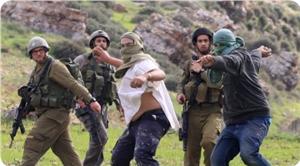 Dozens of settlers then raided the village, but were confronted by Palestinian villagers, who threw stones and empty bottles.
Israeli forces were present at the scene and opened fire at the villagers, locals said.
On Sunday, settlers from Halamish attempted to raid the nearby Nabi Saleh village but were blocked by locals.
Meanwhile, fierce clashes broke out late Sunday between Palestinians and settlers in the Nablus village of Einabus.
Dozens of settlers from Yizhar raided the village and attempted to attack houses, but were chased away by villagers.
Israeli military vehicles arrived at the scene and fired tear gas canisters at Palestinian residents, lightly injuring several people.
In 2013, there were 399 incidents of settler violence against Palestinians in the occupied West Bank, according to the UN Office for the Coordination of Humanitarian Affairs.
Nearly all settler attacks go unpunished by Israeli authorities.
See also:
Jewish Mob in Jerusalem: ‘Death to Arabs!’
Israel and the Palestinians — It’s about Mind Over Matter
By Anthony Lawson | July 6, 2014
Ever since the three Israeli teenagers went missing, police and army units have besieged Palestinian towns and villages in the area; their houses and shops have been ransacked and atrocities have been committed; Gaza has been bombed, and the death toll is still rising, yet international leaders have remained largely silent, when they all know that such reprisals amount to collective-punishment which is a War Crime.
A young Palestinian boy, 16-year-old Mohamed Abu Khdeir, was abducted and killed in a suspected revenge attack by Israelis, on July 2nd. See how Britain’s prime minister reacted to his death.
Four families grieve. One is under assault
By Jonathon Cook | The Blog From Nazareth | July 5, 2014
The families of the three Israeli teens killed by their abductors have been the focus of a huge outpouring of national sympathy.
But what about the family of 16-year-old Muhammad Abu Khdeir, who was burnt alive by his abductors? How have they been treated by Israel since the devastating news of Muhammad’s murder in Jerusalem last week?
Here, in short, is what has happened to them.
They have been subjected to a campaign, secretly waged by the Israeli police, to discredit them by suggesting that Muhammad was a closet gay and killed in a family feud.
The father and close relatives have been forced to submit to intense and distressing questioning in police cells from the Israeli security services, all in an attempt to give greater plausibility to their planted rumours with “confessions” from the family.
And now it emerges that a 15-year-old cousin of Muhammad’s, visiting for the summer from the US, was the victim in video footage of a savage beating by armed Israeli police. They kicked and punched him relentlessly after he was cuffed and lying on the ground. He is still under arrest, apparently without charge.

The US state department – so eloquent in denouncing the killing of the three Israeli teens – is apparently lost for words when it comes to the mistreatment of one of its citizens.
Here is the horrifying video of Tarek Abu Khdeir’s beating:
Is this what Netanyahu meant when he said of Israel’s response to the abductions: “The devil himself has not yet created vengeance for the blood of a small child”?
Cameraman for Russia’s top broadcaster killed in E. Ukraine
RT | June 29, 2014
A cameraman for Russia’s Channel One TV station died from injuries after being shot by Kiev troops in the eastern Ukrainian city of Donetsk, said the broadcaster’s press service.
“Our colleague Anatoly Klyan died tonight… he was fatally wounded in the stomach. He was 68-years-old,” Channel One said on air.
Klyan, along with a few other journalists, boarded a bus full of women – mostly mothers – who were traveling to a military base in Donetsk to demand that their sons be dismissed from the unit and allowed to go home, Kulbatskaya added.
When the bus reached its destination, shots were fired from the base and that is when the cameraman was injured.
 Klyan died in the ambulance on the way to the hospital, DNR’s First Deputy Prime Minister Andrey Purgin told RIA Novosti, adding that the driver of the bus was wounded in the neck and is currently in hospital.
A crew from Channel One confirmed to RT’s Maria Finoshina – currently in Lugansk – that Klyan was, in fact, shot and killed.
“We have been able to speak with these journalists and they called their colleagues in Donetsk and this information is now confirmed,” Finoshina said.
She described the victim filming with his crew at one of the military bases in Donetsk when the shooting took place.
“We know the journalists finished their work and they were smoking cigarettes at the moment when suddenly shooting started. It is very hard to say exactly who was firing, but we hear information that this particular bus and its passengers were targeted,” she said.
“The bus that was also carrying the mothers of self-defense fighters. They were heading towards this military base currently controlled by the Ukrainian military to start negotiations over their sons.”
Another team of Russian journalists also came under attack on Sunday. A LifeNews crew was fired at near a Donetsk military base, Kulbatskaya said. Their car was fired at from a grenade launcher. No one was injured in the attack.
The ceasefire between Kiev and self-defense forces in eastern Ukraine expires at 22:00 (19:00 GMT) on Monday.
Journalists under attack
This latest death comes after a number of journalists were killed during the coverage of events in eastern Ukraine.
Earlier in June, Rossiya TV journalist Igor Kornelyuk and his colleague, sound engineer Anton Voloshin, were killed in shelling. They were the first Russian journalists to die while on professional duty in Ukraine, since the coup in Kiev and the beginning of civil unrest in eastern regions began.
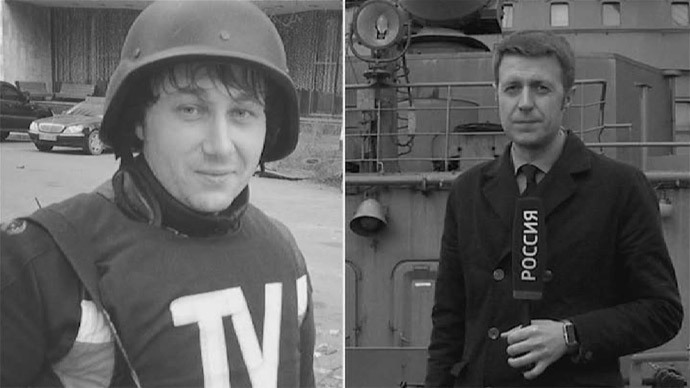
Rossiya TV journalist Igor Kornelyuk (R) and sound engineer Anton Voloshin (L)
They were working on a report covering Ukrainian refugees fleeing the town of Metallist in Lugansk region when they were hit with mortar shells.
There have also been numerous cases where journalists have been attacked, shot at, and detained while reporting on the crisis in eastern Ukraine.
For example, on June 16 a group of journalists came under fire while reporting from Slavyansk’s outskirts. One of the journalists was Ruptly correspondent Andrey Krasnoshchyokov.
On June 14, Zvezda TV channel said two of its journalists had been detained.
A Channel One crew was also fired at on June 11 while covering events in the village of Semenovka, located near Slavyansk.
In another incident, RT contributor and UK national Graham Phillips was detained by Kiev military forces at a checkpoint in the city of Mariupol on May 20. He was transferred to army barracks and interrogated by Ukrainian security forces. He was released after 36 hours.
Fedor Zavaleykov, a 23-year-old Ruptly cameraman, was wounded during fighting in Mariupol on May 9.
Syria’s Press Conference the United Nations Doesn’t Want You To See
Global Research News | June 20, 2014
Yesterday at 11am, the Syrian Mission to the United Nations convened a press conference featuring people from the US who observed the recent elections.
Five minutes into the opening comments of Syrian Ambassador Bashar Al-Jaafari, the UN webcast cut off. The thousands of journalists, political analysts, and others who view UN webcasts each day from all over the world were denied the ability to watch the press conference, and hear what was said.
This is not the first time this has happened when Bashar Jaafari is speaking. This occurred on June 7th earlier this year, and on numerous occasions throughout 2013. Reporters at Inner City Press reported that this is not accidental, but was ordered by Michele DuBach, Acting Deputy Director-News & Media Operations.
This comes in the context of other UN harassment of Syria. UN Secretary-General Ban Ki Moon has met with Ahmad Jarba, a leader of violent insurgent groups in Syria, but has refused to meet with Bashar Jaafari. Though Syria pays over $1 million to the UN each year, it is not being treated as an equal member state.
Watch the important, UN Press Conference about Syria, that someone obviously doesn’t want you, or anyone else, to see:
Mideast crises West bid to protect Israel interests: Jaafari
Press TV – June 19, 2014
Syria’s Permanent Representative to the United Nations Bashar Ja’afari says the current tumult in the Middle East, including the crisis in his country, is a scheme by the West to safeguard Israel’s interests, Press TV reports.
“This is a geopolitical plan that is not only targeting Syria exclusively, although Syria is very important for either the success or failure of this plan, but it is targeting the whole area,” said Ja’afari Wednesday in an exclusive interview with Press TV in New York.
He said the main goal of the Western plot “is to secure for a long time the interests of Israel and preventing the establishment of Palestinian state in Palestine.”
“So they need to open up a new front, a kind of deviation, from the focus on the Arab-Israeli conflict and the Palestinian question to another focus which might be a war between Muslims and Muslims,” he added.
He further underlined that the West intends to incite divisions among Muslims under the false notion of a Sunni-Shia conflict to provoke wars between Muslim countries in the region.
The Syrian envoy went on to reiterate that the huge participation of Syrian voters in the country’s presidential election served as big “NO” message to foreign interference in their country’s internal affairs.
“Our message would be a friendly message… [that] we want to have friends and we want to have normal, bilateral relationship with everybody. We do not interfere into the American domestic affairs. Please don’t interfere into our own domestic affairs.”
According to official figures, President Bashar al-Assad won nearly 90 percent of the votes cast in Syria’s presidential race. Syria’s Supreme Constitutional Court announced that over 73 percent of the 15.8 million eligible voters had taken part in the election.
The Qwasmeh Family Story
CPTnet | June 17, 2014
The public so far knows very little outside of the alleged time that Gilad Shaar, Naftali Frenkel, and Eyal Yifrach were kidnapped. But what we do know is the absolute mayhem the Israeli military has spread throughout the Hebron district among innocent families. Additionally, routine night raids, day patrols, confiscation of public property for military outposts, and the blockades on all but two access points into Hebron have suffocated the livelihood of Hebronites.
Soldiers raided the home and took possession of the Al Awewe family home in Aqbet Taffuh for six hours on Sunday. Over fifty troops had occupied the home while three adults, four young girls, and a young boy were in the home. The Israeli military would not allow a one-year-old baby to leave the house and her mother had to sit outside helplessly wondering about the safety of her daughter, who was still nursing. The soldiers found no suspects connected to the kidnapping in the home.
In that same area on Monday morning, the IDF confiscated the security camera equipment the al-Natshe family had installed around their house for their protection, along with video footage the cameras had recorded.
Further down the road in the Aqbet Taffuh area, approximately fifty-five Israeli soldiers left the hilltop area of the Palestinian municipality, occupied several homes, questioned families, tore down a private Palestinian fence and occupied the neighborhood for several hours.
Throughout the afternoon, northeast of Bab i-Zaweyah, just outside of the H1/H2 intersection, a brigade of more than forty soldiers stationed themselves in four different homes and a supermarket within a two hour period, leaving families frightened and unsure of their intentions.
On 15 June at around 9:30 p.m., an Israeli raid on a Palestinian home ended with a seven-year-old Palestinian boy hospitalized after the Israeli military used an explosive device to blow open the front door of the Akram Al Qawasmeh home. The subsequent powerful blast shattered the tempered reinforced glass, shearing off the decorative steel and sending pieces of shrapnel into all corners of the home, which severely injured Akram Al Qawasmeh’s son.
After the explosion, Israeli soldiers did not allow Akram Al Qawasmeh to see his son, and according to reports, the military initially stopped medical personal from treating the victim. CPT arrived the following day and found a home turned upside down. (See video below.) Children’s belongings were spread and broken around the house. Israeli soldiers demolished the kitchen, smashing fruits, vegetables, and other food items on the floor, and left feces on a rug in the basement.
These are just a few of the incidents that CPTers were able to report on directly. Other human rights organizations have also reported an increase in settler violence against Palestinians who live near the Hebron area settlements.
Historically, Palestinian violence has been the justification for settlement expansion in Hebron. Currently, the Hebron Rehabilitation Committee has identified over twenty-two locations of pending settlement expansion and settler activity. The behavior of the Israeli military and settlers in Hebron suggests the government may use the case of the three young kidnapped boys as an excuse to expand these settlements in the Hebron area or elsewhere in the West Bank while the international community is distracted.
See previous release, AL-KHALIL (HEBRON): Hijacking a kidnapping, Part I
Israeli soldiers invade more Palestinian homes in Hebron
International Solidarity Movement | June 18, 2014
Hebron, Occupied Palestine – Yesterday the Israeli army invaded a family house in the H1 area, supposedly under full Palestinian Authority civil and security control, of al-Khalil (Hebron). The father of the family is very ill with heart disease; the family was forced in to one room and was not allowed to leave. The eight Israeli soldiers used the house as an unofficial army post, both to rest and to view the area. The soldiers stayed there overnight, terrifying the family, as they had no idea when the soldiers would leave. At approximately 11:00 am, the soldiers left the house, however they informed the family that they would return.
The soldiers then entered the next house, relatives of the same family, with four young children. First they searched the house, and then occupied the children’s room on the second floor. They moved the children’s beds to get more space and placed a black blanket to cover the doorway.
The soldiers took shifts, sitting in front of the room watching the family, while the rest were sleeping, eating, and viewing the area. The family told the ISMers present that the soldiers also took showers. The soldiers seemed very uncomfortable with the ISM volunteers in the house, and behaved very aggressively towards them, and the family members who were taking photos.
The family offered the soldiers to use the roof instead of the children’s room, but they refused.
The military presence in the house caused a lot of fear for the family, they were unable to carry out their daily routines, and the children were very upset that they could not enter their room; they were afraid the soldiers would take their belongings and break their toys.
After five hours the family convinced the military to leave, as they left, it was witnessed them joining with a much larger group of soldiers.
Since last Friday, there has been a large increase in home invasions all over the West Bank. This is part of the collective punishment inflicted on the Palestinian population, since the disappearance of three Israeli settler youth on Thursday.
Featured Video

AIDS Inc. by Gary Null (2007)
or go to
Aletho News Archives – Video-Images
From the Archives
Clash of Civilization, Iran Part II
By Jamal Kanj – Intifada-Palestine.com – January 14, 2011
Israel’s survival kit is: perpetuate conflict, insecurity to rationalize collective hate and finally playing victim.
Devoid of conflict, Israel implodes internally; without hate, Zionism loses its justification; and playing eternal victim to continue blackmailing the West. Absence of this holy trinity, Israel ceases to exist.
From its inception, the house of Zion has mastered exploiting adversarial powers to advance Israel’s cause. For instance, their influence over the Democratic Party in the US began with President Truman’s bid for 2nd term election in 1948.
Responding to strong opposition from Secretary of State General George Marshall and Department experts urging against recognition of Israel, President Truman replied: “I’m sorry gentlemen but I have to answer to hundreds of thousands [Jewish voters] who are anxious for the success of Zionism. I do not have hundreds of thousands of [voting] Arabs among my constituents”
Zionists influence over liberal American politics was matched with the doctrinal school of Conservative theoreticians aligning the Republican Party’s platform with Israel’s objectives. The Neoconservative Zionists, coined Zioncons, invented the “Clash of Civilization” concept to fight Israel’s wars. … continue
Blog Roll
 Aletho News
- Merck Virologists Admitted to Falsely Certifying Vaccine Efficacy
- Mandatory Folic Acid for every man, woman & child
- Pro-Palestine protesters arrested outside UK’s ruling Labour Conference in Liverpool
- Mauritius denies landing permit to flight from Israel, forcing cancellation: Tour operator
- Israeli finance minister calls for genocidal war on West Bank, annexation of south Lebanon
- 12 Things Your Psychiatrist Was Trained Not to Tell You
- From Unipolar Universalism to Multipolar Civilizational Distinctiveness
- RSF military group defects, joins Sudanese army: State media
- Ireland goalkeeper refuses to play ‘Israel’ as squad weighs boycott
- China pushes back against US on Cuba, Iran
- If Americans Knew
- Israel forces Gazans to live in constant peril – Daily Update
- Deconstructing Netanyahu’s pants-on-fire UN rant – Daily Update
- Trump betrayed voters with his campaign lies and prioritized a foreign country once he took office
- Netanyahu calls Israel’s war in Gaza ‘opposite of genocide’ in UN speech to near-empty hall
- Settler Kidnappings: Torture, Sexual Abuse and Terrorisation of Palestinian Abductees as Israel Deepens Annexation of West Bank
- Gaza winter nears as 162,000 tents become unusable, raising fears of humanitarian crisis
- Netanyahu says, “It’s the opposite of genocide”; UN says Gaza economy is world’s ‘most severe crisis on record’ – Daily Update
- Israel’s US-Backed Assault on Gaza Has Created the ‘World’s Most Severe Economic Crisis on Record’: UN
- ‘Protecting U.S. Citizens’… From Israel
- ‘This is where I live now, the back of a truck’: a day in the life of a grandmother in Gaza
- No Tricks Zone
- New Study: Earth And Venus Surface Warmth Largely Explained By Convection And Lapse Rate, Not CO2 Or Radiation
- 2025 Nature Paper Claiming Worsening Global Drought Gets RETRACTED …Heavily Flawed
- New Study: ‘Global Drought Shows No Detectable Recent Acceleration Under Climate Warming’
- Economic Masterminds: German Socialists Suggest Taxing Productivity Gains Stemming From Using AI
- The South China Sea Has Not Been Cooperating With The Climate Change Narrative
- Energy Crisis: Germany Enters Heating Season With Historically Low Gas Reserve Fill Levels
- New Study: The Antarctic Ice Sheet Gained Mass From 2020-2024 Due To Staggering Snow And Ice Accumulation
- Study: Ocean Heating Rates From Thousands Of Years Ago ‘Dwarf’ Modern Ocean Heating Rates
- Climate Extremists Target, Attack Large-Scale Power Grid Infrastructure In Germany!
- New Study: Antarctic Ice Melt Has Contributed Less Than 1 Centimeter To Sea Level Rise In The Last 30 Years

