Israel killed 149 Palestinians, including 33 children in 2019
![Palestinian women sit on debris after Israeli airstrikes hit their homes in Khan Yunis, Gaza as tension rises between Israel and Gaza after commander in the Al-Quds Brigades, the armed wing of Gaza-based resistance faction Islamic Jihad, Bahaa Abu Al-Atta was killed by Israeli airstrike, on 13 November 2019. [Ali Jadallah - Anadolu Agency]](https://i1.wp.com/www.middleeastmonitor.com/wp-content/uploads/2019/11/20191113_2_39293100_49418803.jpg?resize=1200%2C800&quality=85&strip=all&ssl=1)
Palestinian women sit on debris after Israeli air strikes hit their homes in Khan Yunis, Gaza on 13 November 2019 [Ali Jadallah/Anadolu Agency]
MEMO | January 2, 2020
Israeli occupation forces killed 149 Palestinians during 2019, including 33 children, the National Gathering for Palestinian Martyrs’ Families said yesterday.
According to Quds Press, the gathering said in a statement that the number of the martyrs was similar to the number of Palestinians killed each year over the past five years.
While the number of children among those killed was 33, the statement said that 112 of Palestinian martyrs (74 per cent) were killed in the Gaza Strip and 37 (33 per cent) were killed in the occupied West Bank.
The statement noted that 69 of the martyrs killed in Gaza perished under Israeli air strikes, including eight from the same family whose house was attacked and completely destroyed.
The bodied of 15 martyrs were detained by Israeli occupation forces in 2019, raising the number of bodies held by Israel to 306.
Former intelligence officer calls on US to murder Iraq’s PMU leader

Abu Mahdi al-Muhandis, the second-in-command of Iraq’s Popular Mobilization Units (file photo)
Press TV – January 2, 2020
A former counter-insurgency intelligence officer for the US war machine has publicly called for the United States and its proxies to murder the leader of Iraqi Popular Mobilization Units (PMU) that helped the Iraqi government defeat Daesh terrorists.
Mike Pregent, who is a senior fellow at Hudson Institute, said in a tweet that the Leader of Iraq’s PMU is a legitimate military target for Iraqi Security Forces, the US, “and our allies in the region.”
Pregent is a senior Middle East analyst, a former adjunct lecturer for the College of International Security Affairs, and a visiting fellow at the Institute for National Strategic Studies at the National Defense University.
On Tuesday, the US embassy was evacuated after thousands of angry Iraqi demonstrators gathered outside the gates of the compound to condemn Washington’s fatal military aggression that targeted Iraq’s Popular Mobilization Units.
On Monday, Iraqi Prime Minister Adel Abdul Mahdi condemned the “unacceptable vicious assault” by the US that killed more than two dozen Iraqis and injured scores more.
Thousands of angry protests managed to reach the US diplomatic mission which is located in Baghdad’s heavily fortified Green Zone, chanting “Death to America” and burning US flags.
The People’s Mobilization Units (PMU) of Iraq, better known by the Arabic name Hashd al-Sha’abi, is a government-sponsored umbrella organization composed of around 40 factions of volunteer counter-terrorism forces, including mostly Shia Muslims besides Sunni Muslims, Christians and Kurds.
The PMU’s formation goes back to the summer of 2014, shortly after Daesh, the world’s most notorious terror group, showed its face and managed to occupy swathes of territory in Iraq.
On June 15 that year, Iraq’s prominent Shia cleric Grand Ayatollah Ali al-Sistani intervened to help rebuild the national army, issuing a fatwa that called on all Iraqi people to join forces with the army in the face of the Daesh threat.
The historic fatwa led to a mass mobilization of popular volunteer forces under the banner of Hashd al-Sha’abi. The force then rushed to the aid of the army and took the lead in many of the successful anti-terror operations, which ultimately led to the collapse of Daesh’s territorial rule and the liberation of the entire Iraqi land in December 2017.
The PMU’s efficient role in the Takfiri outfit’s defeat turned the force into a permanent and broadly-popular feature of Iraq’s social, political and security landscapes, despite attempts by the US and its allies to depict the PMU’s mission as sectarian in nature.
In November 2016, the parliament recognized Hashd al-Sha’abi as an official force with similar rights as those of the regular army, therefore legally establishing it as part of the National Armed Forces.
Subsequently in March 2018, the then premier Haider al-Abadi issued a decree, which said Hashd fighters would be granted many of the same rights as members of the military.
The decree added that PMU fighters would be given salaries equivalent to those received by members of the military under the Ministry of Defense’s control. PMU members would also be subject to military laws and be given access to military institutes and colleges.
Pentagon chief threatens Iran with ‘pre-emptive action’ if embassy attacks continue
RT | January 2, 2020
US Defense Secretary Mark Esper has warned that he will take “preemptive action” to “protect US forces” if he receives word of attacks by Iran or its “proxy forces,” claiming to have indications of such attacks in the future.
Esper said he expects more “provocative behavior” by “Iran-backed” groups – and warned that “they will likely regret it.”
“They’ve been… attacking our bases for months now,” Esper claimed, apparently pinning every rocket attack on a coalition base in recent months on Iran. He called on Iraq to “do more… to address these Iran-sponsored militia groups and to stop their attacks on US and coalition forces,” complaining the US has not “seen sufficient action on that front” from Baghdad.
The Trump administration blamed Tuesday’s siege of the US embassy in Baghdad on Tehran and sent 750 troops to Iraq in order to beef up security at the diplomatic compound. Iran, President Donald Trump has said, will be held “fully responsible for lives lost, or damage incurred, at any of our facilities.”
However, the protesters who surrounded the embassy were motivated by rage over US strikes that killed 25 members of Kataib Hezbollah, part of Iraq’s Popular Mobilization Units (PMU) and officially part of the Iraqi military.
Tehran, meanwhile, has accused the US of punishing it for defeating Islamic State (IS, formerly ISIS/ISIL) terrorists. It slammed the “audacity” of Washington fobbing responsibility for the protests off on Iran when US airstrikes – supposedly in response for an attack on a coalition base near Kirkuk – had actually motivated the embassy-storming.
The Trump administration’s rhetoric regarding Iran may trigger deja vu for those who remember the most recent Iraq War, with its talk of preemptive strikes against leader Saddam Hussein. The Iraqi leader was said to be was sitting on a cache of weapons of mass destruction and had to be stopped before he could use them. Now known to be a complete fiction, the “weapons of mass destruction” trope has been recycled in the Trump administration’s sanctions on Iran, deeming the country’s largest airline a “weapons of mass destruction proliferator.”
The US could send still more forces to the Middle East, Esper said, pledging to “take it day by day.”
“A variety of forces” are standing by in case they are needed, Joint Staff General Mark Milley said. The US has some 60,000 troops in the region already.
America’s New War: Let’s Not Pretend That Iraqi Paramilitaries Drew First Blood
The undeclared US-Israeli hunting season on Iraqi militias had been going on for months before the first US casualty
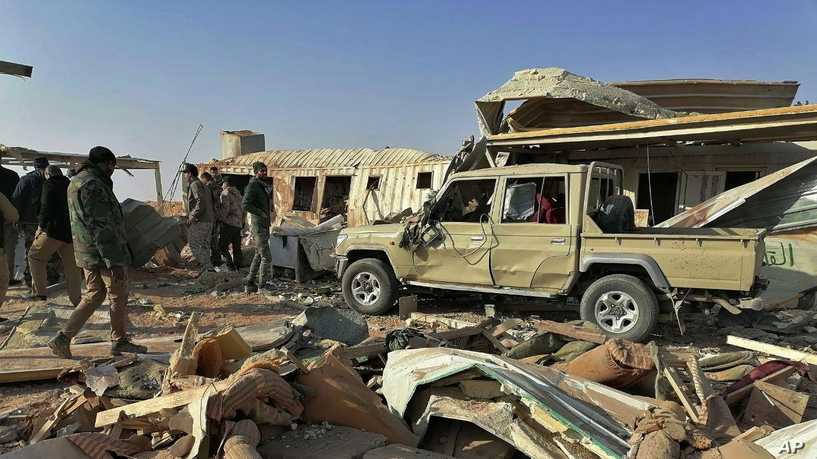
By Marko Marjanović | Checkpoint Asia | January 1, 2020
As the Trump administration would have it history began yesterday. On December 27 A rocket salvo struck a US base near Kirkuk killing a US contractor and wounding four US soldiers, as well as, according to the Americans, two Iraqi soldiers.
So two days later the US — deducing that the attack must have come from the Iraqi Kataib Hezbollah paramilitary that right now hates the Americans’ guts the most — bombed five Kataib facilities on the Iraq-Syrian border, ie nowhere near Kirkuk, killing 25 and wounding 55 Kataib paramilitaries that almost certainly had nothing to do with the Kirkuk base attack themselves.
So according to the Americans albeit their airstrikes, against an outfit that is formally part of Iraq’s official security forces, may have technically violated Iraqi sovereignty that is a technicality since the paramilitary is a proxy for Iran, and in any case these Iranian proxies started it by killing an American first in attacks on guests of the Iraqi government.
Americans also suppose that since they have been granted basing rights in Iraq and the right to act militarily (against ISIS) on Iraq’s territory that comes with the right to defend themselves.
Americans also emphasize the attack allegedly by Kataib also wounded two Iraqi soldiers.
So the American telling is something like‘Iranian proxies are attacking us who are guests of the Iraqi government and hurting Iraqi servicemen in the process, so we bombed them to defend ourselves and teach them a lesson.’
On its face that sounds almost reasonable, but there are a number of problems with such a statement.
First, as probably the single most influential man in Iraq, the Shia cleric al-Sistani pointed out, even if it were true that Kataib paramilitaries had gone rogue in attacking US facilities it does not follow that Americans, a foreign military with mere basing rights, have the liberty to take matters into their own hands and be the judge, jury and executioner in revenge attacks on a state-sanctioned paramilitary 500 kilometers from the place of the actual attack on the US base.
Second, there is a matter of scale. Because “Iranian proxies” (as Americans would have it) injured a pair of Iraqi servicemen that does not follow Americans are now entitled to kill or wound seventy-seven Kataib paramilitaries who are also Iraqi servicemen.
Third, unlike the Trump gang would have it, history did not begin on December 27th. Between July 19 and September 22 Iraqi paramilitaries were hit in their Iraqi bases on at least eight different occasions. In August the Israeli PM Netanyahu confirmed that Israel was carrying out these strikes “against Iranian consolidation”. (That was also just the latest escalation on top of Israeli strikes on Iraqi paramilitaries positioned against ISIS in eastern Syria.)
However, as Iraqis fully understand Israel does not have the capability to strike targets in Iraq (and eastern Syria) without US logistical and intelligence support and the political go-ahead. These were Israeli drone strikes but originating in US/Kurdish-controlled NE Syria and using US-controlled airspace. What is more, quite possibly the Americans were using their presence in Iraq to supply Israelis with intelligence on Kataib and other paramilitaries.
It is also around this time that small-scale artillery (mainly mortar) attacks on US facilities in Iraq started. The only thing new about the December 27 attack was that it resulted in a US fatality. So no, Iraqi paramilitaries did not all of a sudden, and out of the blue, start targeting Americans in Iraq because they are such obedient Iranian proxies, and on the behalf of Tehran, but because they were being killed in their own country (and in neighboring Syria) and the US was to blame.
There have quite possibly been 100 Iraqi paramilitary fatalities in Iraq alone, before the first American died in a retaliatory attack. The blame here is not on Iran, the blame is on those who decided to pull Netanyahu’s chestnuts out of the fire even if it risked US troops in the region.
The only surprising thing about all of this has been how long it took for the backlash to catch up with the Trump gang. So of course instead of counting their lucky stars they went and escalated, so now they are going to reap a bigger backlash, quite possibly in the form of a renewed legal effort to oust them, albeit the nationalist Sadr has said he’ll be looking into “other means” if that doesn’t pan out.
Trump says he ‘does not see war with Iran happening’ hours after issuing a ‘threat’ against Tehran
RT | January 1, 2020
US President Donald Trump has said that the US is not gearing up for war with Iran, adding that he prefers peace to war. It comes just hours after the US leader upped the ante, making a pointed threat against Tehran on Twitter.
With simmering tensions between Tehran and Washington flaring up over the attack on the US embassy in Baghdad, which the US blamed squarely on Iran without providing any proof, there have been growing fears that another war of words could spiral into something far more violent.
In an apparent attempt to diffuse the tension, Trump said late Tuesday that he does not foresee a war actually breaking out between the US and Iran.
“War with Iran? I don’t think that would be a good idea for Iran… I like peace… I don’t see that happening,” Trump said speaking to media as he arrived at the grand ballroom at Mar-a-Lago for a New Year bash on Tuesday night.
Teheran has vehemently denied all the allegations that it is somehow complicit in the unrest sparked by the US airstrikes that killed 25 members of the Iraqi Shia militia Kataib Hezbollah over the weekend.
The American sorties have drawn ire from the Iraqi government, calling the bombing a violation of the country’s sovereignty as well as of militiamen and ordinary citizens who flocked to the US embassy in Iraq to protest the airstrikes.
Protests turned violent on Tuesday as demonstrators attempted to storm the compound, and saw US attack helicopters being scrambled to scatter the protesters after they reportedly breached the front gate.
In the wake of the attack, the Pentagon announced that it would send 750 paratroopers to the Middle East “immediately” in response to the incident, which will be followed by “additional forces.” Washington has repeatedly invoked the “Iranian threat” to beef up its military presence in the region, having deployed some 14,000 troops to the Middle East since May 2019 in addition to about 60,000 already stationed there.
Iran slams US ‘audacity’ to blame it for Baghdad embassy storming
RT | December 31, 2019
Iran has flatly rejected US accusations that it is behind violent protests which broke out at the American embassy in Baghdad in response to US airstrikes on militia groups in Iraq.
In a tweet on Tuesday, US President Donald Trump accused Iran of “orchestrating an attack on the US Embassy in Iraq,” and said Tehran will be held “fully responsible.” Trump also called on “millions” of Iraqis to resist Iran.
Iran hit back at the “audacity” of Washington to blame Tehran for the attacks in a statement posted by the Foreign Ministry.
“America has the surprising audacity of attributing to Iran the protests of the Iraqi people against (Washington’s) savage killing of at least 25 Iraqis…,” it said.
The US hit five Kataib Hezbollah targets in Iraq and Syria last week in retaliation for an attack on a US coalition base near Kirkuk, which no group took responsibility for, but which Washington blamed on the Iranian-backed militia.
Iraqi Prime Minister Adel Abdul Mahdi condemned the airstrikes, calling them a violation of Iraq’s sovereignty and said there could be “grave consequences.” Protesters then stormed the US embassy compound on Tuesday, shouting “death to America” and waving Hezbollah flags.
Washington announced earlier Tuesday that it was sending reinforcements to the Baghdad embassy, in what Defense Secretary Mark Esper said were measures “to ensure our right of self-defense.”
Also on rt.com:
‘This is your time’: Trump calls for Iraqis to rise up against Iran
Iraq’s Sadr ready to work with Iran-backed PMF to oust US
MEMO | December 31, 2019
Iraq’s Shia cleric Muqtada Al-Sadr has declared that he is willing to work with the Iranian-supported Popular Mobilisation Forces (Hashd Al-Shaabi) paramilitary forces – his political rivals – to end the American military presence in Iraq.
He made the comments yesterday after the US targeted five sites in Iraq and Syria and killed 30 in in retaliation for the death of an American “contractor” at an Iraqi military base in Kirkuk in a rocket attack, which Washington blamed on PMF member Kataib Hezbollah (KH).
Sadr believes in ousting the US troops from Iraq through political and legal means, however will “take other actions” with his rivals should these not work. The cleric has portrayed himself as a nationalist against both Iranian and American interference in Iraq. He also called on Iraqis to “avoid irresponsible actions” that can be used to justify further attacks on the country.
Sadr’s loyalist militia, the Mahdi Army, was notable in its fierce resistance against US occupation forces in the Shia dominated south, following the unilateral American invasion in 2003.
Outgoing Iraqi Prime Minister, who is serving as caretaker, Adil Abdel-Mahdi condemned the actions as a violation of Iraqi sovereignty, especially as the PMF are integrated into the country’s armed forces under his direct command and were established to combat Daesh.
Iraq’s top Shia cleric, Ayatollah Sayyid Ali Sistani, whose fatwa against Daesh led to the establishment of the PMF, also condemned the air strikes as a “criminal aggression” against “official Iraqi forces”. Sistani added that the Iraqi authorities are “entitled” to deal with the attacks and to take action to prevent them from re-occurring.
Earlier today, protestors stormed outside the US Embassy in the Green Zone, some carrying flags of the KH and PMF. Some observers have noted how anti-government protestors have been unsuccessful for weeks in entering the Green Zone after being prevented by Iraqi security forces, but there have been no attempts to hold back those protesting against the latest American attack on the PMF, representing a possible dangerous situation for Western diplomats.
Did Pompeo Go Off Reservation in Iraq Attack?
By Tom Luongo | December 30, 2019
I have to wonder who Secretary of State Mike Pompeo is actually loyal to. Because, the U.S. strike of Kata’ib Hizbullah forces near the Al Qaim border crossing with Syria in Iraq is a dangerous escalation there.
And it’s completely at odds with Trump’s goals of wanting us out of the Middle East. The Al Qaim border crossing is a particular red line for Israel and their allies in the U.S. State and Defense Departments.
It represents the normalization of commerce between Syria, Iraq and Iran over time. This is the so-called Shia Crescent which is the stuff of nightmares for Benjamin Netanyahu.
And the U.S. has been hopping mad for months since now caretaker Iraqi Prime Minister Adil Abdel Mahdi opened the border because it undermines U.S. presence in Syria.
The entire point of U.S. occupation of the Al-Tanf border crossing into Jordan and the oil fields in Deir Ezzor province is about starving the Syrian government of any reliable energy and revenue.
When Al Qaim/Al Bukamai was opened it was only a matter of time before a major skirmish would occur over it. Israel staged a series of air attacks previously using U.S. assets and air bases to launch them back in September.
Now, we have the convenient excuse for attacking these forces which are part of the Popular Mobiliztion Units, PMU, which Pompeo despises by ‘retaliating’ for a rocket attack on the K1 base near Kirkuk where one U.S. mercenary was killed and a handful of others injured.
The response from the U.S. Air Force was completely out of line with the initial attack and occurred without any attempt by Pompeo and Secretary of Defense Mark Esper to justify it.
They just invoked the phrase, “Iran-backed forces” and then bombed troops over 200 miles away where they wanted to strike anyway.
And what’s important is what both Elijah Magnier and Moon of Alabama pointed out immediately, the U.S. struck members of Shia militias who were made official part of the Iraqi defense forces.
In other words the U.S. just attacked and killed dozens of Iraqi military personnel.
And the U.S. can get away with this because the Iraqi government is in a total state of flux, thanks to a President, Barham Salih, refusing to honor the constitution, obstructing the selection of a new Prime Minister.
His actions remind me of Italy’s Sergio Mattarella who inserts himself into the process of government formation there to suit his EU partners-in-crime.
In Iraq the U.S. has been officially silent on the government turmoil there but the circumstances are pretty clear that the chaos works as a cover for what was an egregious violation of Iraq’s sovereignty.
Remember, the U.S. forces there are at the invitation of the Iraqi government and with Salih keeping the Shia political forces from uniting to choose a Prime Minister, the likelihood of that invitation being rescinded now is remote.
Color me not shocked that this attack on PMU forces occurred. Pompeo has been itching for an excuse to attack them for months. He tried his version of diplomacy with Prime Minister Mahdi to rescind their official status and was unsuccessful.
Mahdi was livid after Israel’s air attack and made noises about rescinding the U.S. invitation. No shock then that protests against his government spun up quickly after that.
So at some point this attack was going to happen. Netanyahu in serious political trouble facing a third election in a year, unable to form a government.
Pompeo coming to his rescue to keep the dream of warring with Iran should be obvious to all.
The question is whether President Trump is engaged with this policy at all or did Pompeo and Defense Secretary Mark Esper go off on their own, pull this trigger and then inform Trump and get him to accept this post hoc?
Everywhere Pompeo goes one week winds up in flames the next anymore. When he visits a trouble spot which Israel and the neoconservatives he represents want destabilized, a miracle occurs the next week.
Before this it was Lebanon and Iraq. This week it’s Ukraine. There is the threat of peace breaking out there with Russia and Ukraine agreeing to terms on both a gas and oil transit contract into Europe which Pompeo is dead set against.
Will we see some attack on Ukrainian forces which break the peace and can be blamed on Russia?
Trump has to know that escalation from here ends with U.S. forces coming home in body bags as PMU forces themselves, go off the reservation during this power vacuum in Baghdad and attack U.S. troops directly.
But I think this is exactly what Bibi and Pompeo want. This attack was a clear provocation to escalate and give Israel and the neocons all the ammunition they need to force Trump into the wider conflict with Iran they’ve been angry about not getting for six months now.
They failed with the Global Hawk incident back in June. That operation got John Bolton fired as National Security Director. Now we have a clearly disproportionate strike designed to inflame passions of Iran-backed Shia forces.
The entirety of Iraq’s leadership seems to be of the same mind, and even rejected the US plan to strike when they were tipped off immediately before it happened, per NBC:
In a statement, [former PM] Abdul-Mahdi said Secretary of Defense Mark Esper had called him about a half-hour before the U.S. strikes Sunday to tell him of U.S. intentions to hit the bases of the militia suspected of being behind Friday’s rocket attack. Abdul-Mahdi said he asked Esper to call off the U.S. plan.
One byproduct of the major US strikes on Sunday is sure to be that more and more of the Iraqi population will view the Americans, and not the Iranians, as the foreign occupiers.
This dramatic escalation by Washington is only likely to push more popular support toward the Shia PMF, and strengthen the movement in parliament to have US forces legally expelled, especially with the demise of the ISIS threat.
Any strike by the PMU here on U.S. forces will be music to Pompeo’s and Netanyhahu’s ears. And it will put Trump in a real bind with his base during an election year and an impeachment process Speaker Nancy Pelosi is purposefully dragging out to build a stronger case.
What stronger case could there be at this point if Trump were to not declare war or fire back after US troops get attacked in Iraq or Syria? He’s derelict as Commander-in-Chief. It’s part of their stupid Ukraine narrative that Trump withheld aid weakens our national security.
I speculated in the past that Trump was getting ready to fire Pompeo.
As Secretary of State Pompeo has been nothing short of a disaster, undermining President Trump’s strong instincts to get the U.S. out of the Middle East and solve the myriad of open geopolitical wounds around the world.
Unlike his former-partner-in-neoconservatism, John Bolton, Pompeo is more adept at playing at being loyal to Trump while always seeming to move U.S. diplomacy in a more belligerent direction in the wake of any of Trump’s ‘impulses’ to act on his conscience and/or instincts.
It doesn’t matter if we’re talking Iran (Pompeo’s demands of Iran are off-the-charts insane), Lebanon (outright blackmail of the Lebanese government) or North Korea (making demands in negotiations which overstep Trump’s promises to Kim Jong-un) Pompeo is always there doing his thinly-veiled Israeli loyalty dance with the subtlety of a freight-train but somehow always framing it as making it Trump’s policy.
This move by Pompeo looks like a classic pre-emptive move to bind Trump down and force him into a war which will be unpopular back home. The only one who wins with this attack is Israel.
U.S. troops are now less safe, effective forces fighting ISIS have been neutered and the Iraqi government is in shambles. Good job Mike.
Mike wants his golden parachute back to the Senate where he can continue doing god’s work for the Israelis, one more voice in a U.S. Senate seemingly without a limit on its thirst for power and the blood of the world.
This won’t end well and Trump better get his Flying Monkeys under control quick or he won’t be President much longer. Because when the body bags start, he’ll be the one who gets blamed.
US envoy reportedly evacuated as Baghdad protesters attempt to storm embassy amid fury over air strikes
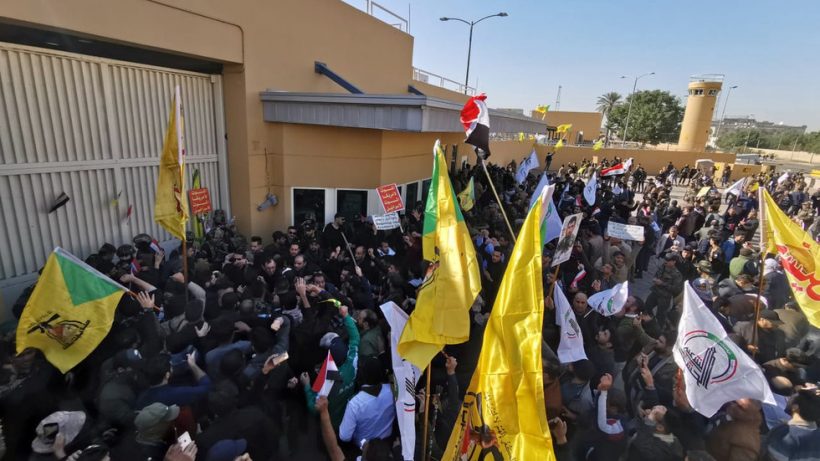
Protesters condemn air strikes on bases belonging to Hashd al-Shaabi paramilitary forces, outside of the U.S. Embassy in Baghdad, Iraq December 31, 2019. © REUTERS/Thaier al-Sudani
RT | December 31, 2019
Thousands of protesters, angry over recent airstrikes targeting Hezbollah, have marched on the US embassy in Baghdad, reportedly forcing the US envoy to flee the diplomatic compound.
Protesters were seen waving Hezbollah flags and chanting anti-US slogans in the Iraqi capital on Tuesday. According to reports, demonstrators were able to gain access to parts of the heavily fortified Green Zone, and attempted to break into the US Embassy. Security guards were said to have retreated into the US government building. A correspondent for the BBC noted that it appeared that the protesters were able to pass several checkpoints without being resisted by security personnel.
The US ambassador to Iraq, Matthew H. Tueller, was evacuated due to the unrest, Reuters reported, citing two Iraqi Foreign Ministry officials.
One video shows parts of the US compound being set on fire.
Earlier, protesters were filmed burning US and Israeli flags.
The unrest comes after US fighter jets struck three Kataib Hezbollah targets in Qaim, Iraq, and two in Syria. The Iran-allied Shiite militia group said that at least 25 of their fighters were killed and nearly three dozen injured in the strikes. The Pentagon accused the group of carrying out attacks on Iraqi bases that host US-led coalition forces stationed in the country.
Iraqi Prime Minister Adel Abdul Mahdi strongly condemned the airstrikes, warning that the attacks would have “grave consequences.” Tehran also condemned the strikes and denied any involvement in attacks on US forces in Iraq.
Hezbollah Denounces ‘Savage’ Attack on Iraq’s Hashd Shaabi: US Exposed Its True Face
Al-Manar | December 30, 2019
Hezbollah on Monday firmly denounced US aggression on Iraq’s Kata’ib Hezbollah, describing it as savage and blatant assault on Iraq’s sovereignty.
“The savage and perfidious aggression by the US on Kata’ib Hezbollah in Iraq is a blatant attack on Iraq’s sovereignty, security, stability and people, especially the Hashd Shaabi which had the upper hand in confronting the Takfiri terror and defeating it,” a statement released by Hezbollah’s Media Relations Office read, referring to Iraq’s paramilitary force, also called Popular Mobilization Units (PMU), in which Kata’ib Hezbollah is one of its components.
“This aggression affirms again that the US administration wants to strike the power factors within the Iraqi people who are capable of confronting Daesh (ISIL) and other US-backed extremist and criminal groups.”
“The US administration exposes its true face as a hostile power to Iraq and Iraqis’ interests,” the statement added.
Hezbollah offered condolences to Iraqis on the martyrs of the attack, wishing speedy recovery for those who were wounded.
“Those who decided this criminal aggression will find out soon the idiocy of such decision as well as its repercussions,” the statement concluded.
NATO: General Delawarde assesses final London Declaration

By Alexandra Kamyshanova | December 30, 2019
General Dominique Delawarde, the former head of the “Situation – Intelligence – Electronic Warfare 19” section at the joint operational planning staff and a cyberwarfare expert, provides insight into the nine articles of the final London Declaration, published on the NATO website.
Question: Can members of the Alliance really “reaffirm their adherence to the purposes and principles of the United Nations Charter”, as stated in Article 1?
Answer: A simple observation of how history has unfolded after the Cold War demonstrates that two important elements of Article 1 are erroneous, if not flat-out false. Since 1991, NATO actions have been aimed not at preventing conflicts and maintaining peace, but exactly the opposite. They do cause them themselves by their never-ending destructive interference in the affairs of sovereign countries. Over a quarter-century (1995-2019), its member states dropped more than a million bombs on our planet, which entailed, whether overtly or covertly, the death of several million people. The only objective was to establish hegemony over the “international community”. Alliance members cannot “reaffirm their adherence to the purposes and principles of the United Nations Charter” by violating or ignoring international rules established by the United Nations. The illegal occupation of part of the Syrian territory serves as evidence of this.
Q: Can we say that the funding efforts outlined in Article 2 fail to reflect the true situation?
A: This statement about efforts to increase funding for NATO members’ defense capabilities is virtually misleading. It loses sight of the fact that defense spending has halved since 1991 (peace dividends) and does not specify any deadline for reaching the 2% target. Finally, this statement is unfeasible and won’t be implemented in the short or medium term, given the economic and social complexities faced by all the key NATO member states. So this is mere verbiage.
Besides, NATO will not be able to compete with the SCO (Shanghai Cooperation Organization), because defense spending parity in PPP (purchasing power parity) dollars has almost been reached between NATO and the SCO; the cumulative defense budget of NATO member states accounts for 1000 billion dollars (PPP), and that of SCO member states is going to reach parity with the NATO budget in 2020 already. To date, the annual growth rate of defense spending in SCO countries is two to three times higher as compared to NATO countries. The SCO has a much wider scope for expansion (major countries like Iran and perhaps Turkey, why not) than NATO (North Macedonia, Georgia, Bosnia). Speaking of Turkey, an untrained eye should know that the SCO-NATO dual membership is not prohibited, since in 2005, the United States itself applied to join the SCO as nonmember state (the application was unanimously rejected by SCO members, guess why).
Q: Should we consider Russia as a threat, as stated in Article 3?
A: This list of universal threats and perpetual accusations against Russia, which is presented as a source of aggression and threat, are familiar pretexts to justify the very existence of NATO. As for anti-Russian statements, NATO is clearly resorting to an accusatory inversion. It is NATO members, not Russia, who have dropped over a million bombs and caused the death of several million people since 1995, and it is them who violate UN rules by continuing the military occupation of part of the Syrian territory. This is also the case of the coup organized in Ukraine, the division of the former Yugoslavia, and the constant advancing to the borders of Russia, which is in total disregard of the promises made to Gorbachev.
As for terrorism and instability observed beyond our borders, the Alliance forgets to remind that both arise from their omnidirectional interference in the affairs of sovereign states at the slightest pretext. They arise from their unlawful bombings, humiliations at Abu Ghraib and Guantanamo, the replacement of strong secular leaders with the chaos we observe today, and the wars waged under false pretexts (Serbia, Iraq, Libya, Syria). Migration is a blowback.
It should be recognized that state and non-state actors shattering the international order are mostly representatives of the West and NATO. The April 14, 2018 joint strike on Syria by the United States, France and the United Kingdom is yet another proof of this. Anglo-Saxon non-governmental NGOs, ostensibly independent but actually used by government agencies and / or their American sponsors (Soros), are wreaking havoc by promoting North Atlantic strategies. They use various useful idiots for their own purposes, who may inherently have good intentions. Finally, the main and only known cyber threat uncovered by Snowden, Assange and Manning is America, not Russia or China. The United States has installed wiretaps of all the political and economic Western leaders (NSA) and has pretty reliable bargaining chips to blackmail our heads of state and seize our businesses.
Q: Do you agree with the statement of Article 4: “NATO is a defensive alliance and poses no threat to any country”?
A: You need to ask the countries that have been bombed for 25 years.
The Alliance does not act “prudently and responsibly” in relation to Russia: the expansion to the East which runs counter to NATO promises of 1990, the coup in Ukraine, the unilateral withdrawal of the United States from the INF and other treaties, including the Iranian nuclear program. They pretend to be combating terrorism, even though many of its elements are funded by the West itself or some of its Arab allies – this is simply ridiculous. NATO members take us for perfect fools.
Q: What do you think about the phrasing of Article 5 that NATO seeks to “work to increase security for all, deepen political dialogue and cooperation with the United Nations”?
A: NATO provokes chaos, migration crisis, surge of terrorism and anti-Western hatred that have now pummelled Europe. You cannot drop a million bombs over 25 years on the countries that have never attacked a single member of the Alliance. Think about the five thousand soldiers from 11 NATO member states who died for nothing in Iraq, in a deceitful war unleashed in 2003. It is worth paying tribute to the memory of those who fell victim to American aggression supported by 10 European NATO member states that agreed to take part.
Q: What does NATO mean in Article 6 when mentioning “the resilience of our societies”, “our energy security” and “the need to rely on secure and resilient systems”?
A: This reflects the current US obsession: “to increase the resilience of our energy security” means ” NATO’s opposition to the construction of the Nord Stream 2 gas pipeline, to spite the vicious Russians and to the benefit of the goodу American gas market.” “Security of our telecommunications, including 5G” means “the rejection of the Chinese Huawei technology, to the detriment of the Chinese and in favor of American technologies.” The US has long been spying on our political and economic leaders’ telecommunications, while accusing China of “intending” to spy on the alliance members by means of its 5G system.
China poses “challenges that we need to address together”. So, NATO is embarking on a path of confronting China, which is beneficial to the United States alone.
Q: What is meant by “strengthening NATO’s political dimension” referred to in Article 7?
A: NATO’s ten-year strategy is now being updated, and the “relevant expertise” will be that of American and European neoconservatives. The essence of Article 7 is discernable: “strengthening NATO’s political dimension”. Since the end of the Cold War, the 1949 “military-defensive” alliance has been increasingly turning into a political and offensive one, often to accommodate certain economic interests.
Q: What do you think Article 8 is remarkable for?
A: For postponing the revision of the strategic concept from the year 2020 to 2021. Trump’s unpredictability scares Europe, with its people hopeful that he won’t be re-elected and that another President will bring the crisis-stricken Alliance back into the ranks.
Q: Is it serious that Article 9 stresses NATO’s greater protection for the peoples of its member states?
A: NATO has been sowing too much hatred and chaos on the planet since 1991 to be a security factor in Europe, and it has been so since the end of the Cold War. The North Atlantic Charter does not present NATO as an instrument of American hegemony. Therefore, the dissolution of NATO, or at least the withdrawal of France would be the best decision at the moment, unless NATO returns to the original principles of a defensive alliance with its activities covering only the territories of its member states, and ceases to invent new threats to serve as false pretexts to justify wars and intervention aimed at maintaining Western hegemony on the planet.
Q: What conclusion would you draw?
A: It is not just about a “brain death” in NATO. Can their solidarity survive the global economic crisis that experts predict, and the inevitable subsequent upheaval in the hierarchy of forces? Hardly probable. The prosperity of the West and the financing of its armed forces rest today on a whole ocean of debts.
The future will belong to those who keep ahead of the game. A long-term vision is needed to pursue foreign policy. Russia, China and India have long ago grasped this.
Featured Video
10K More U.S. Troops Deploy as Trump Weighs New Iran Strikes
or go to
Aletho News Archives – Video-Images
From the Archives
Genetic baloney in thick slices
MAYBE COULD BE INC.
By Jon Rappoport | No More Fake News | July 8, 2021
Gene research companies tend to come and go. They start out banging and popping like fireworks in the sky, and then they fade out—selling themselves to larger outfits who’ve hired better liars…
Once upon a time, it sounded easy. Start with a disease, find the gene responsible for the disease, and correct the problem.
Then, researchers wondered, was disease the result of one gene or a group of genes acting together?
Either way, the proof would be in devising cures for diseases using gene therapy. “Not yet, but soon…”
And regardless, the major need was: money. Lots and lots of money.
This need required good PR people. “We have to pump up the idea that we’re on the edge of tremendous breakthroughs. We’re always on that edge…”
This hype also needed to obscure the fact that there wasn’t (and isn’t) ANY gene cure for ANY disease. … continue
Blog Roll
 Aletho News
- US military withdrawal from Iraq and the collapse of US-Israeli hegemonic project in West Asia
- What does Europe want – a war with Russia?
- She Followed the Actual Data on COVID Vaccines and Masks — Her Career Took a Huge Hit
- Florida AG Sues Pfizer, Bourla Over Deceptive Marketing of COVID Vaccines
- Von der Leyen gifts her spin doctor a job for life
- 10K More U.S. Troops Deploy as Trump Weighs New Iran Strikes /Suliaman Ahmed
- Iranian crew declared Dena training vessel ‘unarmed’ to US warship before deadly torpedo strike: Report
- Iran’s NPT debate moves beyond parliament
- Houthis condemn Saudi claims of attack on Medina
- Fatuous False Flags
- If Americans Knew
- Israel is squeezing the life out of Palestinians – Daily Update
- The Israeli Right Portrays Islam as Murderous. It Serves a Political Purpose
- Jordan Has Had Enough: King Abdullah’s Scathing Warning to Israel
- Israeli Colonizers (i.e. Settlers) Kill Palestinian Man Near Salfit
- New Google Maps images reveal massive scale of devastation in Gaza
- Jewish supremacy, anti-Palestinian bigotry on display in Israel – Daily Update
- Israeli Soldiers Abduct At Least 22 Across Occupied West Bank
- Eight Palestinians Killed in Israeli Attacks on Gaza
- Israeli former leaders and security chiefs threaten legal action over ‘Jewish terrorism’
- Israel map in LA Times ad includes all land from the river to the sea
- No Tricks Zone
- Green Energy Debacle: German Expert Professor Fritz Vahrenholt Warns Of Severe Economic And Social Consequences
- Two More Paleo Reconstructions Affirm Meters-Higher Sea Levels Across Ireland, Brazil 7000-6000 Years Ago
- New Study: Earth And Venus Surface Warmth Largely Explained By Convection And Lapse Rate, Not CO2 Or Radiation
- 2025 Nature Paper Claiming Worsening Global Drought Gets RETRACTED …Heavily Flawed
- New Study: ‘Global Drought Shows No Detectable Recent Acceleration Under Climate Warming’
- Economic Masterminds: German Socialists Suggest Taxing Productivity Gains Stemming From Using AI
- The South China Sea Has Not Been Cooperating With The Climate Change Narrative
- Energy Crisis: Germany Enters Heating Season With Historically Low Gas Reserve Fill Levels
- New Study: The Antarctic Ice Sheet Gained Mass From 2020-2024 Due To Staggering Snow And Ice Accumulation
- Study: Ocean Heating Rates From Thousands Of Years Ago ‘Dwarf’ Modern Ocean Heating Rates

