Reclaiming Your Inner Fascist
By CJ Hopkins | Consent Factory, Inc. | November 19, 2019
OK, we need to talk about fascism. Not just any kind of fascism. A particularly insidious kind of fascism. No, not the fascism of the early 20th Century. Not Mussolini’s National Fascist Party. Not Hitler’s NSDAP. Not Francoist fascism or any other kind of organized fascist movement or party. Not even the dreaded Tiki-torch Nazis.
It’s the other kind of fascism we need to talk about. The kind that doesn’t come goose-stepping up the street waving big neo-Nazi flags. The kind we don’t recognize when we’re looking right at it.
It’s like that joke about the fish and the water … we don’t recognize it because we’re swimming in it. We’re surrounded by it. We are inseparable from it. From the moment we are born, we breathe it in.
We are taught it by our parents, who were taught it by their parents. We are taught it again by our teachers in school. It is reinforced on a daily basis at work, in conversations with friends, in our families and our romantic relationships. We imbibe it in books, movies, TV shows, advertisements, pop songs, the nightly news, in our cars, at the mall, the stadium, the opera … everywhere, because it is literally everywhere.
It doesn’t look like fascism to us. Fascism only looks like fascism when you’re standing outside of it, or looking back at it. When you are in it, fascism just looks like “normality,” like “reality,” like “just the way it is.”
We (i.e., Americans, Brits, Europeans, and other citizens of the global capitalist empire) get up in the morning, go to work, shop, pay the interest on our debts, and otherwise obey the laws and conform to the mores of a system of power that has murdered countless millions of people in pursuit of global-hegemonic dominance. It has perpetrated numerous wars of aggression. Its military occupies most of the planet. Its Intelligence agencies (i.e., secret police) operate a worldwide surveillance apparatus that can identify, target, and eliminate anyone, anywhere, often by remote control. Its propaganda network never sleeps, nor is there any real way to escape its constant emotional and ideological conditioning.
The fact that the global capitalist empire does not call itself an empire, and instead calls itself “democracy,” doesn’t make it any less of an empire. The fact that it uses terms like “regime change” instead of “invasion” or “annexation” makes very little difference to its victims. Terms like “security,” “stability,” “intervention,” “regime change,” and so on are not meant for its victims. They are meant for us … to anesthetize us.
The empire is “regime-changing” Bolivia currently. It has “regime-changed” most of Latin America at one time or another since the Second World War. It “regime-changed” Iraq, Libya, Yugoslavia, Indonesia … the list goes on. It very much wants to “regime-change” Iran, which it “regime-changed” back in the 1950s, before the Iranians “regime-changed” it back. It would love to “regime-change” Russia and China, but their ICBMs make that somewhat impractical. Basically, the empire has been “regime-changing” everyone it can since the end of the Cold War. It has run into a little bump in Syria, and in Venezuela, but not to worry, it will get back there and finish up eventually.
Now, let’s be clear about this “regime-change” business. We’re talking about invading other people’s countries, and orchestrating and sponsoring coups, or otherwise overthrowing their governments, and murdering, torturing, and oppressing people. Sending in terrorists, death squads, and such. We have organizations that train guys to do that, i.e., to round people up, take them out to the jungle, or the woods, or wherever, rape the women, and then summarily shoot everyone in the head. We pay for this kind of thing with our taxes, and our investments in the global corporations that our militaries and intelligence agencies serve. We know this is happening. We can google this stuff. We know “where the trains are going,” as it were.
 And yet, we do not see ourselves as monsters
The Nazis didn’t see themselves as monsters. They saw themselves as heroes, as saviors, or just as regular Germans leading regular lives. When they looked at the propaganda posters which surrounded them (as the Internet surrounds us today), they didn’t see sadistic mass-murderers and totalitarian psychopathic freaks. They saw normal people, admirable people, who were making the world a better place.
They saw themselves. They saw “the good guys.”
This is primarily how propaganda works. It isn’t meant to fool anybody. It is there to represent “normality” (whatever “normality” happens to be in whatever empire one happens to inhabit). It is Power’s way of letting us know what it wants us to believe, how it wants us to behave, who our official enemies are. Its purpose isn’t to mislead or deceive us. It is an edict, a command, an ideological model … to which we are all expected to conform. Conform to this ideological model, and one is rewarded, or at least not punished. Deviate from it, and suffer the consequences.
It is a question of obedience, not one of truth.
This is why it doesn’t matter that there is no actual “Attack on America,” and that the Russians didn’t “hack,” “subvert,” “meddle in,” or otherwise significantly “influence” the 2016 presidential election or otherwise put Donald Trump in office. John Brennan and the CIA say they did, and the corporate media say they did, so all Good Americans have to pretend to believe it. Likewise, it also doesn’t matter if an organization like the OPCW collaborated with the empire’s regime-change specialists who staged a “chemical weapons attack” on helpless women and children in Douma (because, no matter what the empire did or didn’t do, Assad is a Russian-backed, baby-gassing devil!), or if The Guardian just makes up stuff about Julian Assange out of whole cloth and prints it as news.
 This is also why, when The Guardian runs an enormous color propaganda photo of a beneficent-looking Hillary Clinton and her soon-to-be-Democratic senator daughter posing as our last line of defense against the Invasion of the Putin-Nazis, and as the future of Western democracy, and whatever, on the cover of its cultural Review, this isn’t perceived as propaganda. Never mind that this woman (i.e., Hillary) is directly responsible for the deaths and misery of God knows how many innocent people in the course of her lucrative service to the empire. Never mind that this is the same exact person that sadistically cackled on national television when the empire’s associates anally knife-raped and murdered Muammar Gaddafi in Libya, and then transformed a developed African country into a hellish human-slavery market.
For fascists (and authoritarian personalities generally), facts are completely beside the point. The point is to robotically conform to the ideology (or hysterical ravings) of whatever leader or system of power happens to be in charge of things.
Authoritarian personality types are skilled at determining exactly who that is (i.e, who is really in charge of things) and obsequiously currying favor with them. For some, this is an innate talent; others have this talent conditioned into them (or beaten into them) over the course of years. Either way, the result is the same.
Put a bunch of random people together in a group and give them a problem to solve, or a complex project or objective to accomplish. Don’t give them any organizational guidance, just put them in a room and watch what happens.
The first thing that happens is … a “leader” emerges. Someone (or a few people) decides that someone needs to be in charge of this project, and they feel pretty strongly that it should be them. If more than one such “leader” emerges, or if the need for a leader itself is challenged, a struggle for power will immediately ensue. The aspiring “leaders” will compete for the support of the “followers” in the group. Sides will be taken. Eventually, a “leader” will be chosen. Occasionally, this will happen openly, but, more often than not, it will happen unconsciously. Someone in the group will want to dominate … and the rest of the group will want them to dominate. They will experience discomfort until a “leader” is established, and they will feel an enormous sense of relief once one is, and they can surrender their autonomy.
I assume you’re familiar with the Milgram experiment, but, if not, you should probably read up on that, and maybe read Adorno’s The Authoritarian Personality. It’s a bit outdated, and over-focused on the Nazis (it was originally published in 1950), but I think you’ll get the general idea. Once you’ve done that, turn on your television, or your radio, or scan the news on the Internet, or walk down any big city street and compare the content on the digital billboards, movie posters, and advertisements to historical fascist propaganda … that is, if your boss will let you leave the workplace long enough to do that, which he probably will if you ask him in that special way you have learned over time that he likes and generally tends to respond to.
Sorry, I didn’t mean to get inside your mind. That’s kind of a fascistic thing to do.
Look, the point is, we all have an “Inner Fascist,” with whom we are either acquainted or not. I’m a playwright and a novelist, which means I’ve got a big, fat, Sieg-heiling Inner Fascist goose-stepping around inside my head. I invent whole worlds, which I dictatorially control. I put people in them and make them say things. It doesn’t get much more fascistic than that. The way I see it, my art is how I sublimate my Inner Fascist, so that he doesn’t run around invading Poland, exterminating the Jews, or “regime-changing” Bolivia.
I’m not a psychiatrist, or a fascism expert, but I figure this is probably the most we can do … recognize, acknowledge, and find some way to sublimate our Inner Fascists, because, I guarantee you, they’re not going away. (If you don’t believe me, go watch that Planet Earth episode featuring the fascist chimpanzees.) Seriously, I recommend you do this. Get acquainted with your Inner Fascist, in an appropriate set and setting, of course. Give him something safe to dominate and then let him go totally totalitarian. You’ll be doing yourself and the rest of us a favor.
Ironically, it is those who are not acquainted with their Inner Fascists (or who deny they have one) who are usually the first to make a big public show of loudly denouncing “fascism,” brandishing their “anti-fascist” bona fides, accusing other people of being “fascists,” and otherwise desperately projecting their Inner Fascists onto those they hate, and want to silence, if not exterminate. This is one of the hallmarks of repressed Inner Fascism … this compulsion to control what other people think, this desire for complete ideological conformity, this tendency, not to argue with, but rather, to attempt to destroy anyone who disagrees with or questions one’s beliefs.
We all know people who behave this way. If you don’t, odds are, one of them is you.
So, please, if you haven’t done so already, get acquainted with your “Inner Fascist,” and find him something harmless to do, before he … well, you know, starts singing hymns to former FBI directors, or worshipping the CIA, or Obama, or Trump, or Hillary Clinton, or supports the empire’s next invasion, or coup, or just makes a desperate, sanctimonious ass of you both on the Internet.
I’m not kidding. Reclaim your “Inner Fascist.” It might sound crazy, but you will thank me someday.
#
Photos:
(1) The NSDAP Secures the National Community/Wiener Holocaust Library
(2) The Guardian Review, Ian Sinclair/Twitter
How Western Media Bias Allows Israel to Get away with Murder in Gaza
By Ramzy Baroud | Dissident Voice | November 16, 2019
An Israeli attack on Gaza was imminent, and not because of any provocations by Palestinian groups in the besieged, impoverished Gaza Strip. The Israeli military escalation was foreseeable because it factors neatly in Israel’s contentious political scene. The war was not a question of “if”, but “when”.
The answer came on November 12, when the Israeli military launched a major strike against Gaza, killing an Islamic Jihad Commander, Bahaa Abu al-Ata, along with his wife Asma.
More strikes followed, targeting what the Israeli military described as Islamic Jihad installations. However, the identities of the victims, along with damning social media footage, pictures, and eyewitness accounts indicate that civilians and civilian infrastructure were bombed and destroyed as well.
As of November 14, when a truce was announced, 32 Palestinians have been killed and over 80 wounded in the Israeli aggression.
What truly frustrates any meaningful discussion on the horrific situation in Gaza is the feeble response, whether by international organizations that exist with the sole purpose of ensuring world peace or by Western monopoly media, that ceaselessly celebrates its own accuracy and impartiality.
A most disappointing response to the Israeli violence was offered by Nickolay Mladenov, the United Nations Special Coordinator for the Middle East Peace Process.
Mladenov, whose job should have long been deemed pointless considering that no “peace process” actually exists, expressed his “concern” about the “ongoing and serious escalation between Palestinian Islamic Jihad and Israel”.
Not only Mladenov’s statement creates a moral equivalence between an occupying power, which instigated the war in the first place, and a small group of a few hundred armed men, it is also dishonest.
“The indiscriminate launching of rockets and mortars against population centres is absolutely unacceptable and must stop immediately,” Mladenov elaborated, putting great emphasis on the fact that, “there can be no justification for any attacks against civilians”.
Shockingly, Mladenov was referring to Israeli, not Palestinian civilians. At the time that his statement was released to the media, there were already dozens of Palestinian civilians that had been killed and wounded, while Israeli media reports spoke of few Israelis who had been treated for “anxiety”.
The European Union did not fare any better. The EU parroted the same American knee-jerk response by condemning “the barrage of rocket attacks reaching deep into Israel”.
“The firing of rockets on civilian populations is totally unacceptable and must immediately stop,” a statement by the European bloc read.
Is it not possible that Mladenov and top EU foreign policymakers do not truly comprehend the political context of the latest Israeli onslaught — that embattled Israeli Prime Minister Benjamin Netanyahu is using military escalation as a way of fortifying his weakening grip on power.
Considering this, what is one to make of the poor media coverage, the inept analyses and the absence of balanced reports in major Western news media?
In a report published by the BBC on November 13, the British broadcaster referred to “cross-border violence between Israel and militants in Gaza”.
But Gaza is not an independent country and, per international law, it is still under Israeli occupation. Israel declared Gaza a “hostile territory” in September 2007, arbitrarily establishing a “border” between it and the besieged Palestinian territory. For some reason, the BBC finds this designation acceptable.
CNN, on the other hand, reported on November 13 that “Israel’s military campaign against Islamic Jihad” is entering its second day, while emphasizing the UN condemnation of the rocket attacks.
CNN, like most of its American corporate counterparts, reports on Israeli military campaigns as a part and parcel of some imagined “war on terror”. Therefore, analyzing the language of US mainstream media with the purpose of underlining and emphasizing its failures and biases, is a useless exercise.
Sadly, US bias regarding Palestine has extended to mainstream media in European countries that were, to some degree, fairer, if not somewhat sympathetic, with the Palestinian peoples’ situation.
El Mundo of Spain, for example, spoke of a number of Palestinians — making sure to emphasize that they were “mostly militants”, — who “died” as opposed to “were killed” by the Israeli military.
“The escalation followed the death of Gaza’s armed branch leader,” El Mundo reported, failing once more to pinpoint the culprits in these seemingly mysterious deaths.
La Repubblica, which is perceived in Italy as a “leftist” outlet, sounded more like a right-wing Israeli newspaper, in its description of the events that led to the death and wounding of many Palestinians. The Italian newspaper used a fabricated timeline that only exists in the mind of Israeli military and decision-makers.
“Violence continued. Several rockets were thrown towards Israel by Gaza’s Islamic Jihad (militants), breaking the brief truce, according to (right-wing Israeli newspaper) The Jerusalem Post and to the Israeli army”.
It remains unclear what “truce” La Repubblica was referring to.
France’s Le Monde followed suit, reporting the same deceptive and cliched Israeli lines and emphasizing statements by the Israeli military and government. Interestingly, the death and wounding of many Palestinians in Gaza did not deserve a place on the French newspaper’s homepage. Instead, it chose to highlight a comparatively irrelevant news item where Israel denounced the labeling of illegal settlement products as “discriminatory”.
Maybe, one could have excused these across-the-board journalistic and moral failings if it were not for the fact that the Gaza story has been one of the most covered news topics anywhere in the world for over a decade.
It is obvious that the West’s “newspapers of record” have maintained their blindspot on fairly reporting on Gaza and intentionally kept the truth from their readers for many years so as not to offend the sensibilities of the Israeli government and its powerful allies and lobbies.
While one cannot help but bemoan the death of good journalism in the West, it is also important to acknowledge with much appreciation the courage and sacrifices of Gaza’s young journalists and bloggers who, at times, are targeted and killed by the Israeli army for conveying the truth on the plight of the besieged but tenacious Strip.
Dr. Ramzy Baroud is an author and a journalist. He is athor of The Second Palestinian Intifada: A Chronicle of a People’s Struggle and his latest My Father Was a Freedom Fighter: Gaza’s Untold Story. He can be reached at ramzybaroud@hotmail.com.
Gaza Israel Escalation Explained: Who Started It, Where Is It Going And Why?
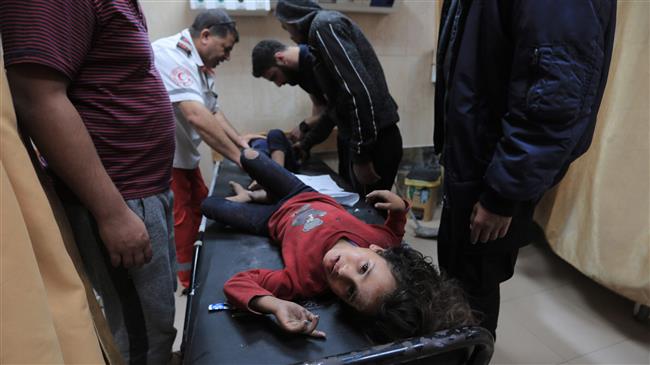
Palestinian medical workers tend to wounded children of a family six of whose members were killed in an Israeli airstrike, in the central Gaza Strip’s Deir al-Balah, November 14, 2019. (Photo by AFP)
By Robert Inlakesh | American Herald Tribune | November 14, 2019
Earlier this Tuesday morning, Israel initiated airstrikes against Northern Gaza Strip killing the senior commander of Palestinian Islamic Jihad (PIJ), Baha Abu al-Ata (43 years old), Asma Mohammed (39 years old) and twenty-year-old Mohammed Atiyah.
This ‘targeted assassination’ of a PIJ leader in Gaza was not the end of the Israeli mission, however. Another round of Israeli airstrikes was then launched targeting Western Mezzeh in Damascus, Syria, targeting Akram Ajjouri, a deputy leader in the Palestinian Islamic Jihad movement. The strike took place at roughly 4:20 A.M in the morning and hit the residence of the PIJ commander, killing his son, injuring his daughter and murdering a bodyguard named Abdallah Hassan. The strike also injured 10 others, missing the Akram Ajjouri who escaped the blast.
In response to these ‘targeted assassinations’, as Israel calls them, both Islamic Jihad and Hamas launched a barrage of rockets at Israeli towns and cities.
Over 450 rockets have been fired from Gaza into Israel, striking Tel Aviv, Sderot, and Ashekolon and even triggering alarms as far away as Jerusalem. Islamic Jihad’s armed wing, the al-Quds brigades, have vowed to continue their responses.
Israel has also fired hundreds of Missiles into Gaza, destroying 190 homes, injuring over 111 (mostly civilians) and killing over 34. Included in the dead have been at least 8 children and 3 women in Gaza. Israel has also damaged 15 schools with their airstrikes and attacked a power facility, shutting off the electricity supply in Eastern Gaza.
The rocket fire into Israel has proven to have successfully overwhelmed Israel’s air defense systems, specifically its Iron Dome air defense systems. Considering the fact that most of the rockets fired are nothing more than enhanced fireworks, this is extremely embarrassing to Israel and proves that its systems are a failure. Reports have also surfaced indicating that one of Gaza’s armed factions scored a direct hit, using an RPG, on an Israeli Merkava Tank. Despite the rocket fire destroying homes, vehicles, and roads, no Israeli civilians have been killed.
Israel clearly started the recent round of hostilities in Gaza, it has killed and injured overwhelming non-combatants and has somehow received, yet again, favorable coverage in the Western Press.
The BBC, FOX NEWS, SKY, MSNBC, CNN and the rest of the alphabet soup of corporate media outlets, have joined in on the anti-Palestinian hasbara narrative once again. Despite the fact that Israel committed a flagrant violation of the Syrian Arab Republics’ sovereignty, it killed a Palestinian leader without any due legal process and has been the all-out aggressor and only side to inflict civilian casualties.
The mainstream Western media, in fact, deals such a detriment to the journalistic field of work – when it comes to Palestine/Israel – that it is probably better to receive your news straight from the IDF twitter page than it is from them. At least with the Israeli military propaganda, you are getting the clear propagandistic perspective of Israel. Instead of listening to a loosely put together, poorly packaged, piece of romantic action drama, just listen to the Israeli foreign ministry. You will then have one side of the story and not just hasbara constructed to present specifically to an assumed ignorant Western audience, in order to garner support for Israel.
The Return Of Targeted Assassinations?
A widely repeated claim that is being spread throughout Western media, is that Israel has just resumed its policy of ‘targeted assassinations’ and that it hasn’t been involved in such activities in years. This is incorrect.
Israel has consistently carried out targeted assassinations inside of Syria, this year, targeting Iranian military personnel, Hezbollah and others. In fact, just back in September there was nearly a war sparked between Lebanon and Israel due to a campaign of ‘targeted assassinations’ of Hezbollah members.
The only thing that has changed this week, is that Israel has resumed its assassination campaign against Palestinian leaders. A particularly dangerous development as the last war on Gaza in 2014 was started, in part, as a result of ‘targeted assassinations’.
Another problem with the reporting on this issue has been the way the term “targeted assassinations” itself is being used, implying that the target is, in fact, a single person when this is clearly not the case. Entire families of those targeted from the Palestinian Islamic Jihad leadership, have also been injured and killed in the attacks.
This policy is a cowardly one, one not rooted in international law, and seeks to kill members of groups with their entire families whilst they are defenseless and without any legal process.
Why Is Israel Attacking Gaza Now?
In order to understand Israel’s decision to target the Islamic Jihad leadership, we have to keep in mind two key factors, both Israeli and Palestinian politics.
The first reason for Israel’s recent acts of aggression is that the Israelis are likely concerned about the recent developments on the Palestinian political scene. All of the Palestinian factions have come together and decided that it is time to hold new elections in the occupied territories.
There have been numerous failed proposals for new elections and unity before, yet it has failed time and time again, but this time it seems to really be a possibility. This, of course, scares the Israelis, because they know that if any other factions, other than Fatah, win in the West Bank, Israel will have to deal with a new type of resistance from West Bankers.
More important though, is that there will also likely be an end to the ‘security coordination’ between the Palestinian Authority and the Israeli occupation army, which allows Israel to operate its cost-free occupation of the territory.
If these strikes escalate into war, then the Palestinian Authority headed by Abbas’s Fatah Party, will likely abandon the idea of elections and condemn Gaza’s aggression. We can assume this as in 2014, unity government talks were ongoing and the prospects for it to go further were completely destroyed upon the war’s initiation. In 2014, the war was also started after targeted assassinations of Hamas officials.
The second reason for Israel wanting to initiate a war or even just launch these, so-called ‘targeted assassination’ strikes is the current election deadlock Israel finds itself in. After Israel’s snap elections on the 17th of September, the Israeli regime has been in shambles, with a possible third election on the horizon within the space of one year.
Israel’s current Prime Minister Benjamin Netanyahu was given the first chance at forming a coalition in the Israeli Knesset, despite winning one less seat than his rival Benny Gantz. Netanyahu, the leader of Israel’s Right-Wing Likud Party was then unable to form a coalition and passed the torch onto his rival Benny Gantz, heading the Blue and White Party. Gantz is still unable to form a coalition.
If a third snap election happens, Netanyahu who is still the reigning PM will have to deal with the “Gaza problem” which has led to him losing many votes in the past, especially in the South of Israel. So executions of the leadership in Gaza, are a great PR move for Netanyahu and a war, or even more, targeted assassinations could help him win the next election.
Netanyahu’s Revenge On Gaza
In order to understand the origins of the current Israeli rage influenced actions, we have to look back to November of 2018, when Israel failed a special forces operation in Gaza, ultimately resulting in the death of an Israeli commander, the death of a Hamas commander and a fight that would ensue in the following hours and days. Israel sought to kidnap a Hamas Al-Qassam brigades commander, Nur Barakah, perhaps wanting to achieve a ‘prisoner swap’ type deal, exchanging him for the bodies of Israelis killed in combat, currently held by Hamas. Israel failed badly and the Israeli press shed light on their failure.
Hamas also successfully used an anti-tank missile, in an attack that destroyed an Israeli bus. Hamas waited for Israel to claim that the bus was full of civilians, before releasing a video that revealed the bus was filled with military personnel. Hamas waited and fired the anti-tank missile, following the departure of all but one soldier, from the bus. This was used, to threaten Israel. The Secretary-General of Hezbollah, Sayyed Hassan Nasrallah, claimed that Hezbollah had smuggled the anti-tank missiles into Gaza.
The Salahaldeen Brigades then leaked a video to ‘Al-Mayadeen TV’, revealing an operation from back in February of 2018. The video showed several soldiers being killed, by an explosive laced flag pole. The operation was at the time covered up by an embarrassed Israeli military.
Avigdor Lieberman then resigned as Israel’s ‘Defence Minister’ after Netanyahu refused to go to war. He has been the kingmaker in Israeli politics ever since and his opposition to Netanyahu stems from this escalation in Gaza last November.
This year there has been a number of ‘flare-ups’ all of which Israel has not come out of looking militarily good, they have consistently killed civilians and have been fought off by Gazan armed factions. This is despite the fact that Hamas and the other armed factions in Gaza have much less in terms of weapons technology.
If Netanyahu is to impress the Israeli population with his military campaign against Gaza and can bring Avigdor Lieberman around, he will be able to successfully form a coalition government in the third round of snap elections.
Why Is Violence The Only Option For Gaza?
The response of Palestinian Islamic Jihad is quite literally all that they could have done. The peaceful resistance has been shunned by the world’s media, NGO’s, governments and the United Nations.
Since the 30th of March, 2018, over 330 unarmed Palestinian demonstrators have been killed by Israeli sniper and tear gas fire, 44,000+ have also been injured since that time. The ‘Great Return March’ demonstrations continue until this day, yet the protesters have been ignored and smeared in the West. This was the last desperate cry from Gaza for a peaceful solution and the West has killed it.
Nothing was done to stop Israel’s massacre and the media described the protests as “clashes”. Hilarious that is that these so-called clashes, have gone on for over a year and a half and yet no Israeli has even sustained so much as a significant wound.
Gaza only has two options at this point, to resist the Israeli aggression with whatever weapons they have, or to lay down and die. The West and Israel will only accept the latter.
What happens next?
The ceasefire which was announced to have taken place at 5:30 A.M this Wednesday has already failed due to Israel not respecting the demands of Islamic Jihad and then later PIJ rocket fire into Israel. The two sides are now firing back and forth again.
Currently, Hamas, which rules the Gaza Strip, has stayed out of the fight. If Hamas joins the fight it will likely be an all-out war between Israel and Gaza. Hamas has only stayed out of the fight this long because they seek to allow for Palestinian elections to take place and a war would prevent this from happening.
There will likely be more massacres in the Gaza Strip in the coming days.
Whilst 18 Israelis are treated for anxiety, 22 Palestinians are taken to the mortuary

Smoke rises following an Israeli attack in Gaza city on 12 November 2019 [Ashraf Amra/Apaimages]
Dr Brendan Ciarán Browne | MEMO | November 13, 2019
The extrajudicial killing of Bahaa Abu Al-Ata of the Palestinian Islamic Jihad movement, the second largest faction in the Gaza Strip, has triggered a predictable spike in “conflict related incidents”. As always, it is the Palestinian civilian population residing in the much maligned Gaza Strip who are affected disproportionately.
On Wednesday morning, Israel’s supposedly “left wing” newspaper Haaretz reported that 18 Israeli civilians had been taken overnight to Ashkelon Hospital to be treated for “anxiety” following a spate of rocket fire emanating from Gaza. At the same time, a spokesperson for Gaza’s Health Ministry, Ashraf Al-Qudra, reported that the remains of 22 Palestinians were being transferred to the mortuary. A stark reminder, if ever one was needed, of the gross asymmetry of the “conflict” in Palestine/Israel.
For some, the “legitimacy” of Abu Al-Ata’s killing is a point of contention under international law. There is the usual binary rhetoric of “execution” versus “legitimate act of war” considered alongside debate over the appropriate designation of “combatant/non-combatant” status and the supposed protections therein. Regardless, and often set aside when debating the extrajudicial killing of “enemy (non)combatants”, it is worth remembering that Abu Al-Ata and his wife were killed in their bed in an Israeli rocket attack that destroyed his house in the Gaza City neighbourhood of Shuja’iyah, leaving his two children orphaned and undergoing emergency treatment at the local Al Shifa Hospital.
Similarly, there will be polarising views on the (il)legitimacy of the simultaneous attack on an Islamic Jihad political bureau member in Damascus, Akram Al-Ajouri, which resulted in the death of his son and a neighbour, and which also involved a flagrant breach of Syrian territorial sovereignty. Thus, what has been clear for some time, when it comes to the rules governing armed conflict and the application of principles of international law, it appears that “might is right” when Israel is involved.
Those with a strong commitment to realising the goals of a fair and, more importantly, a just resolution to the enduring conflict in Palestine/Israel will hardly be surprised by the bias and hypocrisy of Western politicians and the media taking to the airwaves to absolve Israel of any blame. Take, for example, the response of the spokesperson for EU Foreign Affairs and Security Policy, Maja Kocijančič, who tweeted in the aftermath of Abu Al-Ata’s killing that, “The firing of rockets on civilian populations is totally unacceptable and must immediately stop.” Or Joe Biden, in the running to be the next President of the United States, who tweeted, “It is intolerable that Israeli civilians live their lives under the constant fear of rocket attacks.” Not enough twitter characters, it seems, for either to make mention of the fact that it was the Israelis who kicked off this latest round of violence.
Arguably the greatest example of linguistic gymnastics is reserved for the headline writer in the Times of Israel, who led with, “Israel kills powerful Islamic Jihad commander”. Quite a stretch considering the modest arsenal at the disposal of Palestinian factions compared to a nuclear armed Middle East superpower with friends in high places. As leading Palestinian writer and activist Mariam Barghouti has noted, Palestinians, “aren’t leading a war. They have no official army, no official borders; they have no control over their resources and lands; and even their politicians are sometimes assassinated or incarcerated.”
The much-maligned Gaza Strip, considered to be unliveable by 2020 according to a UN report, continues to be the front line of resistance when it comes to Israel’s ongoing colonisation of Palestine. Weekly protests that call for an end to the illegal Israeli (and Egyptian) blockade imposed on the civilian population are often subject to extreme levels of Israeli violence, tantamount to “alleged war crimes” according to the UN and leading regional human rights organisations. Approximately 200 Palestinian civilians, including some 50 children, have been killed since the beginning of the protests in 2018, with many thousands left with life-changing injuries. Yet despite the tough talk from the UN Human Rights Council, when it comes to breaches of international law in Palestine, accountability and justice remain elusive.
It is hard to avoid the sense of déjà vu that surrounds this latest incident. As has been noted in other media outlets, the killing of Abu Al-Ata comes almost 7 years to the day that Israel assassinated Hamas leader Ahmed Jabari, the pretext to the 2012 ground invasion and eventual deadly military offensive against the Palestinians in Gaza. Back then, Israeli Prime Minister Benjamin Netanyahu was struggling to hold together his hotchpotch coalition government. In 2019, having gone through two General Election cycles this year without a clear winner, and with pressure mounting on political rivals to form a coalition, Israeli politics is in a similar state of flux. There is nothing better, apparently, than to carry out a choreographed, high profile assassination of a Palestinian to galvanise the nation.
With former Chief of Staff Benny Gantz — chief architect of Israel’s 2014 destruction of Gaza — waiting in the wings, the prospect of an Israeli coalition government comprising Netanyahu, Gantz and Israeli hawk Naftali Bennett as “Defence” Minister seems more likely than ever. It remains to be seen how the latest, cyclical round of violence will evolve, but no amount of false equivalency can mask the fact that this is a dangerously one-sided affair centred on Israeli political posturing.
Israel murders senior Islamic Jihad official and his wife in Gaza
MEMO | November 12, 2019
The Israeli occupation army announced on Tuesday that it had killed a senior military official of Islamic Jihad in the Gaza Strip. Bahaa Abu Al-Ata was killed in what was described as a complicated joint operation with the internal security agency Shin Bet.
The Palestinian Ministry of Health confirmed that Abu Al-Ata and his wife Asmaa were killed in an Israeli air strike on their house in the east of Gaza City. It also confirmed that their children Salim, Mohammed Layan and Fatima, as well as their neighbour Hanan Hellis, were wounded in the same attack. All are in a stable condition in hospital.
In its own statement on the murder of Abu Al-Ata, Islamic Jihad also announced that a member of its Political Bureau, Akram Al-Ajjouri, survived an Israeli attack on his house in Damascus, although his son and a number of bodyguards were killed.
“These terrorist crimes are a new aggression against the Palestinian people and the declaration of a new Israeli war on them,” said the movement. It blamed the occupation authorities for any consequent escalation in the Gaza Strip. “The Israeli occupation crossed all the red lines with its new crimes which shattered all efforts being made towards the truce and tranquillity.”
Other Palestinian factions, including Hamas, Fatah and the Popular and Democratic Fronts, condemned the Israeli “aggression” and also blamed Israel for any escalation.
The Houthis Are Preparing for a Planned Israeli Attack on Yemen
By Ahmed Abdulkareem | MintPress News | November 11, 2019
SANA’A, YEMEN — As the war in Yemen nears the end of its fifth year, the situation in the country seems to be escalating. There are strong indications that Israel is planning to launch airstrikes against the country under the pretext of preventing an Iranian military presence from taking hold, a move that is likely to open the door for further escalation.
On Saturday, Ansar Allah, the political wing of Yemen’s Houthis, announced that Yemeni forces would not hesitate to “deal a stinging blow” to Israel in the case Tel Aviv decides to launch attacks in Yemen. The Houthis reaffirmed that their anti-Israel position is based on a principled, humanitarian, moral, and religious commitment. Historically, neither the Yemeni Army nor the Houthis themselves, have ever targeted Israel directly.
The threat from Israel is not without precedent. Israel has used claims of alleged Iranian military attachments in countries like Syria and Iraq as justification for airstrikes and bombings against those nations. Now, Israel appears to be using Iran’s alleged presence in Yemen, an allegation that both Tehran and the Houthis deny, as a pretext for military action in the country despite no evidence indicating that there are any Iranian forces present there.
Ansar Allah leader Abdulmalik al-Houthi said in televised speech marking the anniversary of the Prophet Muhammad, “Our people will not hesitate to declare jihad (holy war) against the Israeli enemy, and to launch the most severe strikes against sensitive targets in the occupied territories if the enemy engages in any folly against our people.” The occasion marks the largest festival held by the Houthis during which they reveal their domestic and foreign policies for the coming year.
The Houthis also called on the Saudi regime to stop the war and siege on Yemen, warning that there would be risks and consequences for the Kingdom should they continue their attacks. Al-Houthi also confirmed that Yemenis will continue to develop their military capability, adding that, “Anyone who uses the war and siege to control us and subjugate us is seeking the impossible, and the consequence is failure.”
Al-Houthi also pointed to the ongoing mass protest movements in Lebanon and Iraq, advising nations in the Middle East to resolve their issues vigilantly. He asked those nations to exercise vigilance in the face of what he called Israeli plots to gain a political, military, and cultural foothold in their respective countries.
On Saturday, massive demonstrations took place across Yemen’s major cities to commemorate the Prophet Mohammed’s birth, an occasion known to Muslims as Maulud Nabi. While the occasion is a religious one, it is a public holiday in Yemen and is marked with the singing of the national anthem and the waving of green flags. Many protesters told MintPress News that any attack by Israeli would not cause the Yemeni people any more suffering than they have already endured, but would push them to join a “holy war” against Israel.
According to three government officials in Sana’a that spoke to MintPress on the condition of anonymity, the Houthi’s warnings are both serious and well-placed. Those officials said that the government in Sana’a has already confirmed information that Israel is preparing to launch airstrikes on both military sites and civil targets in Yemen, especially on the country’s west coast and along the Saudi-Yemen border in coordination with the Saudi-led Coalition.
Ansar Allah’s announcement also comes in the wake of a number of recent statements made by a number of Israeli officials claiming that Yemen has become a threat to Israel. Speaking during a visit by U.S. Secretary of Treasury Steven Mnuchin and White House aid Jared Kushner, Netanyahu claimed that Iran has supplied missiles to the Houthis that could hit Israel. The Houthis regard these statements as a justification and prelude to strikes on the country, similar to those that Israel unilaterally carried out against sites in Syria and Iraq.
In August, Kuwaiti newspaper al-Jarida released a report saying that Israel is planning on striking sensitive positions on the Bab al-Mandab strait which links the Red Sea and the Gulf of Aden, to target “Houthis” in the area. The newspaper, which cited an anonymous informed source, said Israeli intelligence agency Mossad has been monitoring activities in the Yemeni strait.
Israel’s entry into the Yemen war could indeed open the door for further escalation, a prospect made more likely by both the increased strength of Ansar Allah forces and by Israel’s increasingly cozy relationship with the Gulf Arab countries of the coalition. The fact that Saudi Arabia and the UAE recently sought negotiations with Houthis after they were unable to win the war militarily, despite their superior firepower and funding, only increases the likelihood of Israel’s entry into Yemen.
In fact, Israel is alleged to have already participated in the war against Yemen on behalf of the Saudi-led coalition as a part of a series of covert interventions involving mercenary forces, the reported launching of dozens of airstrikes in the country and even the dropping of a neutron bomb on Nuqm Mountain in the middle the capital Sana’a in May of 2015.
Kicking the hornet’s nest
Like Saudi Arabia and the UAE, there is a problem with the Israeli assessment of the situation in Yemen, as the Houthis have never threatened to hit an Israeli target and Houthi attacks on Saudi-led Coalition countries have always been retaliatory, not preemptive. There are no vital targets to be bombed in Yemen as the Saudi-led coalition has already destroyed nearly every potential target, including civilian infrastructure. Moreover, any attack by Israel against Yemen will gain the Houthis even more popular support both inside of Yemen and across the Islamic and Arab world.
Furthermore, there is no evidence that Iran has any military sites or experts in Yemen, and Yemen’s Army, loyal to Ansar Allah, are not the “Iran proxy fighters” that international media so often claims them to be. Indeed, the U.S. State Department even admitted in leaked cables that the Houthis were not an Iran proxy and that they received neither funding nor weapons from Iran.
There are a convergence of interests between the Houthis and Iran, including opposition to Israel’s internationally-recognized theft of Palestinian land, but if Israel involves itself directly in the conflict in Yemen, it is likely that the Houthi alliance with Iran will grow and may actually spur Tehran into providing precise and sophisticated weapons to Ansar Allah, turning the fears of Israel into a self-fulfilling prophecy.
Meanwhile, many Israeli activists and media pundits are expressing concerns over what they consider serious threats from Yemen, pointing out that these threats “should not be underestimated by the Israelis.” The Israeli security parliament said that Israeli intelligence must strictly monitor Yemen and take necessary steps to secure Israeli ships sailing in the Bab Al-Mandab area, describing the statements made by Abdulmalik al-Houthi as serious.
A well-stocked arsenal
Indeed the threats of Ansar Allah, a group known to strike sensitive targets without hesitation, are not without precedent. On September 14, Ansar Allah hit two of Saudi Arabia’s oil facilities in Abqaiq and Khurais, an attack that led to a suspension of about 50 percent of the Arab Kingdom’s crude and gas production.
Prior to that, they targeted vital facilities deep inside of Saudi Arabia and the United Arab Emirates, including the Barakah Nuclear Power Station in Abu Dhabi, the capital of the UAE, as well as the King Khalid International Airport near Riyadh, more than 800 km from Yemen’s northern border. Now, they have developed their arsenal of ballistic missiles and drones even further and experts say are likely capable of hitting vital targets inside of Israel. Yemen’s Army is ready to launch those missiles if Ansar Allah’s leader asks it to do, one high-ranking military officer told MintPress.
Yemen’s Army, loyal to the Houthis, is equipped with the Quds 1 winged missile which was used in an attack on the Barakah Nuclear Power Station in Abu Dhabi in December of 2017. This year, several generations of the Quds 1 were reworked to provide the “ability to hit its targets and to bypass enemy interceptor systems,” according to Ansar Allah.
The Borkan 3 (Volcano 3), whose predecessors were used by the Houthis to strike targets inside of Saudi Arabia and the UAE, is capable of traveling even further than the Borkan 1 and 2. The Borkan is a modified Scud missile and was used in a strike on the King Khalid International Airport near Riyadh, more than 800 km from Yemen’s northern border. The missile was able to evade U.S. Patriot missile air-defense systems.
Yemen’s Army also posses the Samad 3 reconnaissance drone and the Qasef 2K drone. Both were used in strikes against the Abu Dhabi and Dubai airports. The Samad 3 has an estimated range of 1,500 to 1,700 km. Moreover, the Yemen Army recently unveiled a new drone with a range exceeding 1,700 km and equipped with advanced technology that would render it difficult for air defense systems to detect.
One Ansar Allah military source told MintPress that mines would also be deployed against Israeli battleships and watercraft in the Red Sea if Israel decides to launch attacks against Yemen. Indeed, Yemen’s military recently revealed its domestically-manufactured marine mines dubbed the “Mersad,” and is reportedly “actively developing its naval forces and naval anti-ship missiles.”
Despite the well-established precedent, many still doubt that the Houthis are capable of carrying out attacks on the scale and range of the attack that struck an Aramco facility in Saudi Arabia earlier this year — instead, accusing Iran of orchestrating the attacks. Yet repeatedly underestimating the Houthis was one of the major mistakes made by the Saudi-led coalition, who has failed to defeat the group after nearly five years of fierce battles against them, despite being equipped with the latest U.S.-supplied weaponry — everything from M1A2 Abrams tanks and M2 Bradley fighting vehicles to AH-64D Apache helicopters, as well as having an air force equipped with a high-tech arsenal.
However, it would be difficult for the Yemeni Army to prevent aerial attacks by Israel. Yemeni airspace has been open to the coalition and to American drones since the war broke out in 2015. Any attack by the Yemen army would likely come in retaliation to an Israeli attack and would hit Israeli military bases in Eritrea, Israeli ships in the Red Sea as well as hit vital targets deep inside of Israel, according to Yemeni military sources.
An already dire situation
The war, which began in March 2015, has led to the world’s worst humanitarian crisis resulting from the bombing and a blockade which has led to mass starvation and history’s largest cholera outbreak, among other dire consequences.
The coalition, backed by the United States, has killed tens of thousands of Yemeni civilians since the war began. Moreover, the coalition’s blockade of food and medicine has plagued the country with an unprecedented famine and has triggered a deadly outbreak of preventable diseases that have cost thousands of people their lives.
Last week, the Armed Conflict Location & Event Data Project revealed that Yemen’s death toll rose to a shocking 100,000 since 2015. The database shows approximately 20,000 people have been killed this year, already making 2019 the second-deadliest year on record after 2018, with 30,800 dead. Those numbers do not include those who have died in the humanitarian disasters caused by the war, particularly starvation.
Given the nature of Israel’s recent wars against Gaza and Lebanon, it is unlikely that Israel would feel constrained by any moral dilemma should they chose to launch airstrikes against civilians in Yemen.
Ahmed AbdulKareem is a Yemeni journalist. He covers the war in Yemen for MintPress News as well as local Yemeni media.
The word they won’t use to describe Canada’s role in Haiti

Molotov cocktail thrown at Canadian Embassy in Port-au-Prince
By Yves Engler · November 9, 2019
Something you can’t name is very difficult to talk about. Canada’s role in Haiti is a perfect example. Even when the dominant media and mainstream politicians mention the remarkable ongoing revolt or protesters targeting Canada, they fall on their faces in explaining it.
Not one journalist or politician has spoken this truth, easily verified by all sorts of evidence: “Sixteen years ago Ottawa initiated an effort to overthrow Haiti’s elected government and has directly shaped the country’s politics since. Many Haitians are unhappy about the subversion of their sovereignty, undermining of their democracy and resulting impoverishment.”
Last Sunday protesters tried to burn the Canadian Embassy in Port-au-Prince. Voice of America reported, “some protesters successfully set fire to business establishments and attempted to burn down the Canadian Embassy.” A few days earlier protesters threw rocks at the Canadian Embassy and demonstrators have repeatedly speechified against Canadian “imperialism”. In response to the targeting of Canada’s diplomatic representation in the country, Haiti’s puppet government released a statement apologizing to Ottawa and the embassy was closed for a number of days.
Echoing the protesters immediate demand for Jovenel Moïse to go, an open letter was released last Tuesday calling on Justin Trudeau’s government to stop propping up the repressive and corrupt Haitian president. David Suzuki, Roger Waters, Amir Khadir, Maude Barlow, Linda McQuaig, Will Prosper, Tariq Ali, Yann Martel and more than 100 other writers, musicians, activists and professors signed a letter calling on “the Canadian government to stop backing a corrupt, repressive and illegitimate Haitian president.”
While a number of left media ran the letter, major news outlets failed to publish or report on it. Interestingly, reporters at La Presse, Radio Canada and Le Devoir all expressed interest in covering it but then failed to follow through. A Le Devoir editor’s reaction was particularly shameful since the leftish, highbrow, paper regularly publishes these types of letters. The editor I communicated with said she’d probably run it and when I called back three days later to ask where things were at, she said the format was difficult. When I mentioned its added relevance after protesters attempted to burn the Canadian embassy, which she was aware of, she recommitted to publishing it. Le Devoir did not publish the letter when it was submitted to them, although an article published in their paper two weeks later did mention it.
My impression from interacting with the media on the issue is that they knew the letter deserved attention, particularly the media in Québec that cover Haiti. But, there was discomfort because the letter focused on Canada’s negative role. (The letter is actually quite mild, not even mentioning the 2004 coup, militarization after the earthquake, etc.)
On Thursday Québec’s National Assembly unanimously endorsed a motion put forward by Liberal party foreign affairs critic, Paule Robitaille, declaring “our unreserved solidarity with the Haitian people and their desire to find a stable and secure society.” It urges “support for any peaceful and democratic exit from the crisis coming from Haitian civil society actors.”
In March Québec Solidaire’s international affairs critic Catherine Dorion released a slightly better statement “in solidarity with the Haitian people”. While the left party’s release was a positive step, it also ignored Canada’s diplomatic, financial and policing support to Moise (not to mention Canada’s role in the 2004 coup or Moise’s rise to power). Québec Solidaire deputies refused to sign the open letter calling on “the Canadian government to stop backing a corrupt, repressive and illegitimate Haitian president.”
Even when media mention protests against Canada, they can’t give a coherent explanation for why they would target the great White North. On Wednesday Radio Canada began a TV clip on the uprising in Haiti by mentioning the targeting of the Canadian embassy and with the image of a protester holding a sign saying: “Fuck USA. Merde la France. Fuck Canada.” The eight-minute interview with Haiti based Québec reporter Etienne Côté-Paluck went downhill from there. As Jean Saint-Vil responded angrily on Facebook, these three countries are not targeted “because of the ‘humanitarian aid’ that the ‘benevolent self-proclaimed friends of Haiti’ bring to the ‘young democracy in difficulty’. This is only racist, paternalistic and imperialist propaganda! They say ‘Fuck Canada’, ‘Shit France’, ‘Fuck USA”’ because they are not blind, dumb or idiots.”
A few days earlier Radio Canada’s Luc Chartrand also mentioned that Canada, France and the US were targeted by protesters when he recently traveled to Haiti. While mentioning those three countries together is an implicit reference to the 2004 coup triumvirate, the interview focused on how it was because they were major donors to Haiti. Yet seconds before Chartrand talked about protesters targeting the Canada-France-US “aid donors” he mentioned a multi-billion dollar Venezuelan aid program (accountability for corruption in the subsidized Venezuelan oil program is an important demand of protesters). So, if they are angry with “aid donors” why aren’t Haitians protesters targeting Venezuela?
Chartrand knows better. Solidarité Québec-Haiti founder Marie Dimanche and I met him before he left for Haiti and I sent Chartrand two critical pieces of information chosen specifically because they couldn’t be dismissed as coming from a radical and are irreconcilable with the ‘benevolent Canada’ silliness pushed by the dominant media. I emailed him a March 15, 2003, L’actualité story by prominent Québec journalist Michel Vastel titled “Haïti mise en tutelle par l’ONU ? Il faut renverser Aristide. Et ce n’est pas l’opposition haïtienne qui le réclame, mais une coalition de pays rassemblée à l’initiative du Canada!” (Haiti under UN trusteeship? We must overthrow Aristide. And it is not the Haitian opposition calling for it, but a coalition of countries gathered at the initiative of Canada!)
Vastel’s article was about a meeting to discuss Haiti’s future that Jean Chretien’s government hosted on January 31 and February 1 2003. No Haitian representative was invited to the meeting where high level U.S., Canadian and French officials discussed overthrowing elected president Jean-Bertrand Aristide, putting the country under international trusteeship and resurrecting Haiti’s dreaded military. Thirteen months after the Ottawa Initiative meeting, US, French and Canadian troops pushed Aristide out and a quasi-UN trusteeship had begun. The Haitian police were subsequently militarized.
The second piece of information I sent Chartrand was the Canadian Press’ revelation (confirmation) that after the deadly 2010 earthquake, Canadian officials continued their inhumane and antidemocratic course. According to internal government documents the Canadian Press examined a year after the disaster, officials in Ottawa feared a post-earthquake power vacuum could lead to a “popular uprising.” One briefing note marked “secret” explained: “Political fragility has increased the risks of a popular uprising, and has fed the rumour that ex-president Jean-Bertrand Aristide, currently in exile in South Africa, wants to organize a return to power.” The documents also explained the importance of strengthening the Haitian authorities’ ability “to contain the risks of a popular uprising.”
To police Haiti’s traumatized and suffering population 2,050 Canadian troops were deployed alongside 12,000 U.S. soldiers and 1,500 UN troops (8,000 UN soldiers were already there). Even though there was no war, for a period there were more foreign troops in Haiti per square kilometer than in Afghanistan or Iraq (and about as many per capita). Though Ottawa rapidly deployed 2,050 troops officials ignored calls to dispatch this country’s Heavy Urban Search and Rescue (HUSAR) Teams, which are trained to “locate trapped persons in collapsed structures.”
Of course, these two pieces of information run completely counter to the dominant narrative about Canada’s role in Haiti. In fact, they flip it on its head. But, these two pieces of information — combined with hundreds of stories published by left-wing Canadian and Haitian media — help explain why some might want to burn the Canadian Embassy.
Haiti is the site of the most sustained popular uprising among the many that are currently sweeping the globe. Haitians are revolting against the IMF, racism, imperialism and extreme economic inequality. It’s also a fight against Canadian foreign policy.
The latter battle is the most important one for Canadians. Solidarity activists should highlight Haitians’ rejection of 16 years of Canadian disregard for their democratic rights. And they should not be afraid to use the words that describes this best: Canadian imperialism.
Afghanistan: An On-Going Story of War Crimes

By Salman Rafi Sheikh – New Eastern Outlook – 09.11.2019
While the Afghan peace process has been stalled and US forces have been busy dropping more bombs on Afghanistan than any other time in the last decade or so of the Afghan war, the story of gross human rights violations and even potential war crimes, too, continues to unfold in the country. With more civilian and unarmed innocent people dying at the hands of US and Afghan forces, including CIA-trained, funded and backed paramilitary militias, the question of which side actually follows barbaric methods has gained an unusual significance. According to the UNO, only during the first half of 2019, US and Afghan forces killed more civilians than the Taliban or ISIS, known as IS-K in Afghanistan, did. This figure does not include the number of innocent people who die due to heavy bombing in isolated areas of Afghanistan, where documenting these deaths is almost impossible.
Ever since the so-called ‘reduction’ of US forces from Afghanistan–a sugar-coated pill that the US policy makers fed their public with—the US war strategy has put on a much more secretive and a lot less accountable veil. The organisation of the US and Afghan elite units that mainly operate in Afghanistan tell the story of how the war is being fought. For one thing, there is little to nothing that people generally know about them. There is no clear information available about how many Afghans and Americans belong to them, how members are recruited, what their budget is, how their hierarchy functions, or if they are subject to oversight. These groups have been organised regionally: Zero-One in central Afghanistan, Zero-Two in the east, Zero-Three in the south, and Zero-Four in the north.
While these groups, as Afghan officials themselves claim, have been effective in killing both the Taliban and ISIS fighters, they also frequently engage in extra-judicial killings. Significantly enough, these groups operate solely under the command of the CIA and are answerable not to the Afghan authorities or the Afghan military forces but to the CIA. Therefore, what they do and how they do it must directly be attributed to the CIA.
Thus the story of their activity, as recently documented by Human Rights Watch (HRW) not only reveals their atrocities but also brings to light the ugly face of the Afghan war after the so-called ‘withdrawal’ of the bulk of US forces first under the Obama administration and then the Trump administration.
This withdrawal has only led the CIA to not only expand its role but also turn itself into a rather independent actor in Afghanistan. Therefore, as many even in the main stream western media have reported, these operations are not “military operations” and it is not clear if laws governing military operations can apply to these militias.
Perhaps, they don’t and that explains the impunity with which these groups operate and shoot people summarily or disappear them for a long time. The said HRW report has documented at least 14 cases from 2017 to 2019 which clearly show the trail of abuse and anger that these ‘special operations forces’ leave behind.
However, while these operations are not technically “military operations”, a US policy shift in 2017 created a provision for these groups to call in air-strikes as and when needed, thereby implying that these operation still had US military’s blessings and aren’t just an exclusive affair of the CIA. The “zero” groups, according the 2017-policy, can call for air strike even without the US forces present on the ground alongside them to identify targets.
According to HRW report, this change of policy and discretion given to the militias has “meant that airstrikes are hitting more residential buildings, while a decreased US ground presence and a reliance on local Afghan intelligence sources has meant there is less information available about the possible presence of civilians in those buildings.”
Accordingly, the report claims, “in many of the night raids that Human Rights Watch investigated, Afghan paramilitary forces seem to have unlawfully targeted civilians because of mistaken identity, poor intelligence, or political rivalries in the locality”; hence, an increasing number of the loss of innocent lives at their hands, explaining why the Taliban continue to receive support from the public. As it stands, in many of the cases the New York Times had investigated back in 2018, one of the primary reasons behind “night raids” and disappearance and killing of people by them was their support for the Taliban, which was often confined to just providing food and shelter out of fear.
The militias’ inability to wean people away from the Taliban explains why these groups engage in what the HRW report calls “willful violation of the law” and unjustifiable use of force.
As is evident, the long trail of abuse that these operations leave behind will never let the US win the war in Afghanistan. On the other hand, a deliberate policy followed by the highest US officials, including the president, continues to encourage these acts through a systematic blockade of any attempts at war crimes investigation. In 2018, when the chief prosecutor of the International Criminal Court requested an investigation of possible war crimes by the US forces in Afghanistan, including abuses by the CIA, the US State Department bullied the ICC into silence by revoking the chief prosecutor’s visa and threatening the court with sanctions, thus unwittingly posing serious questions about the sincerity of usual US concerns and claims about human rights and liberty. Obviously, these concerns don’t apply to the US-occupied and CIA-managed Afghanistan.
Salman Rafi Sheikh is a research-analyst of International Relations and Pakistan’s foreign and domestic affairs.
Israel Admits to Losing Sophisticated Missile in Syria, Recovered by Russian Forces
By Khaled Iskef | 21st Century Wire | November 7, 2019
Israel has admitted to losing a missile from its air defense system after it landed in Syrian territory. The item was apparently recovered by Russian reconnaissance units, before being transferred to its experts.
According to Israeli media reports, the IDF missile known as “David’s Sling” landed inside of Syria in July of this year, and was recovered by the Russian army before being transferred to Moscow to examine its technology. The missile is produced by a joint venture between Rafael Advanced Defense Systems and Raytheon.
Media sources pointed out that, “the rocket landed in Syrian territory after failing to intercept one of the Syrian missiles.” It should be noted also that those missiles were launched in response to an Israeli attack which was targeting sites in Damascus and its countryside.
Israel has asked Russia to return the missile.
The missile is one of the most sophisticated missiles within the wider “Iron Dome” defense array system, with which the IDF was using to intercept Russian-made SS21 missile being deployed by the Syrian army.
Israel did not clarify whether there is any Russian response on its request to return the IDF missile. Likewise, there has yet to be any official Russian comment on the subject.
Presumably, fears on the Israeli side would include the possibility that “fragments and parts of the missile to Iran or the resistance Palestinian Authority,” thus enabling them to access the advanced technology.
Israel ‘aiding Kurds’ in Syria, advocating for them in talks with US – deputy FM
RT | November 6, 2019
Israel is assisting Syrian Kurds battered by a month-old Turkish incursion, and advocating for them in talks with the United States, the deputy Israeli foreign minister said on Wednesday.
Ankara launched its assault targeting the Kurdish YPG militia after the abrupt withdrawal of 1,000 US troops from northern Syria in early October. Israel sees Syrian Kurds as a counterweight to “Iranian influence.”
Israeli PM Benjamin Netanyahu offered humanitarian aid to the “gallant Kurdish people” on October 10, saying they faced possible “ethnic cleansing” by Turkey and its allies in Syria.
Tzipi Hotovely, Israel’s deputy foreign minister, told parliament on Wednesday that the offer had been taken up, Reuters said. “Israel has received many requests for assistance, mainly in the diplomatic and humanitarian realm,” she said. “We identify with the deep distress of the Kurds, and we are assisting them through a range of channels.”
Hotovely did not elaborate on the Israeli assistance. Syrian Kurdish officials have not commented on the statement.
Featured Video
10K More U.S. Troops Deploy as Trump Weighs New Iran Strikes
or go to
Aletho News Archives – Video-Images
From the Archives
Genetic baloney in thick slices
MAYBE COULD BE INC.
By Jon Rappoport | No More Fake News | July 8, 2021
Gene research companies tend to come and go. They start out banging and popping like fireworks in the sky, and then they fade out—selling themselves to larger outfits who’ve hired better liars…
Once upon a time, it sounded easy. Start with a disease, find the gene responsible for the disease, and correct the problem.
Then, researchers wondered, was disease the result of one gene or a group of genes acting together?
Either way, the proof would be in devising cures for diseases using gene therapy. “Not yet, but soon…”
And regardless, the major need was: money. Lots and lots of money.
This need required good PR people. “We have to pump up the idea that we’re on the edge of tremendous breakthroughs. We’re always on that edge…”
This hype also needed to obscure the fact that there wasn’t (and isn’t) ANY gene cure for ANY disease. … continue
Blog Roll
 Aletho News
- US military withdrawal from Iraq and the collapse of US-Israeli hegemonic project in West Asia
- What does Europe want – a war with Russia?
- She Followed the Actual Data on COVID Vaccines and Masks — Her Career Took a Huge Hit
- Florida AG Sues Pfizer, Bourla Over Deceptive Marketing of COVID Vaccines
- Von der Leyen gifts her spin doctor a job for life
- 10K More U.S. Troops Deploy as Trump Weighs New Iran Strikes /Suliaman Ahmed
- Iranian crew declared Dena training vessel ‘unarmed’ to US warship before deadly torpedo strike: Report
- Iran’s NPT debate moves beyond parliament
- Houthis condemn Saudi claims of attack on Medina
- Fatuous False Flags
- If Americans Knew
- Israel is squeezing the life out of Palestinians – Daily Update
- The Israeli Right Portrays Islam as Murderous. It Serves a Political Purpose
- Jordan Has Had Enough: King Abdullah’s Scathing Warning to Israel
- Israeli Colonizers (i.e. Settlers) Kill Palestinian Man Near Salfit
- New Google Maps images reveal massive scale of devastation in Gaza
- Jewish supremacy, anti-Palestinian bigotry on display in Israel – Daily Update
- Israeli Soldiers Abduct At Least 22 Across Occupied West Bank
- Eight Palestinians Killed in Israeli Attacks on Gaza
- Israeli former leaders and security chiefs threaten legal action over ‘Jewish terrorism’
- Israel map in LA Times ad includes all land from the river to the sea
- No Tricks Zone
- Green Energy Debacle: German Expert Professor Fritz Vahrenholt Warns Of Severe Economic And Social Consequences
- Two More Paleo Reconstructions Affirm Meters-Higher Sea Levels Across Ireland, Brazil 7000-6000 Years Ago
- New Study: Earth And Venus Surface Warmth Largely Explained By Convection And Lapse Rate, Not CO2 Or Radiation
- 2025 Nature Paper Claiming Worsening Global Drought Gets RETRACTED …Heavily Flawed
- New Study: ‘Global Drought Shows No Detectable Recent Acceleration Under Climate Warming’
- Economic Masterminds: German Socialists Suggest Taxing Productivity Gains Stemming From Using AI
- The South China Sea Has Not Been Cooperating With The Climate Change Narrative
- Energy Crisis: Germany Enters Heating Season With Historically Low Gas Reserve Fill Levels
- New Study: The Antarctic Ice Sheet Gained Mass From 2020-2024 Due To Staggering Snow And Ice Accumulation
- Study: Ocean Heating Rates From Thousands Of Years Ago ‘Dwarf’ Modern Ocean Heating Rates

