UN calls out US, UK & France for complicity in Yemen war crimes
RT | September 4, 2019
The UN Human Rights Council slammed the US, UK and France for their complicity in alleged war crimes in Yemen by the Saudi-led coalition, warning that abetting such crimes by selling arms or other aid is also illegal.
“States that knowingly aid or assist parties to the conflict in Yemen in the commission of violations would be responsible for complicity in the relevant international humanitarian law violations,” the UNHRC’s Group of Eminent International and Regional Experts on Yemen declared in a lengthy report published on Tuesday.
“With the number of public reports alleging and often establishing serious violations of international humanitarian law no State can claim not to be aware of such violations being perpetrated in Yemen.”
The 274-page report enumerated possible war crimes committed by both sides in the conflict, including airstrikes and shelling, landmines, “siege-like tactics,” attacks on hospitals and other vital infrastructure, arbitrary arrests and executions, torture, and forced conscription of children into combat. The writers claimed to have forwarded the names of top military and political individuals from Saudi Arabia, the United Arab Emirates, Yemen, and the Houthi movement to the UN High Commissioner for Human Rights for further investigation and possible prosecution.
The UK and France fall under special scrutiny as signatories to the Arms Trade Treaty, which bars the sale of weapons if a country believes they will be used to commit “mass atrocities.” However, even non-parties to the ATT may face “criminal responsibility for aiding and abetting war crimes” since after five years of fighting “there can no longer be any excuses made for failure to take meaningful steps to address” the humanitarian crisis and international law violations taking place in Yemen.
The UK Court of Appeal ruled in June that the government had “made no attempt” to determine whether Saudi Arabia was using its weapons to violate international law, and while Secretary of State Liam Fox said he would suspend licenses for export to the Saudi coalition, the Department for International Trade said it would appeal the ruling. A rare bipartisan-supported bill to end weapons sales to Saudi Arabia by the US was vetoed in July by President Donald Trump, who complained it would “weaken America’s global competitiveness” and damage relationships with allies. And the French government hid the arms sales from its people entirely, then threatened the journalists who exposed the sales with arrest for publishing confidential information.
The UNHRC report also provided an update on the shocking scale of the humanitarian crisis, revealing that nearly a quarter of the Yemeni population was malnourished at the start of 2019, according to the Office of the Coordination of Humanitarian Affairs, with 230 of 333 districts at risk of famine and 24.1 million people in need of assistance merely to survive.
Also on rt.com:
‘Comical & tragic’ when US officials say arms sales to Saudis are about ‘exporting human rights’
Hundreds Take Part in Direct Action against UK Arms Trade with Israel
IMEMC News & Agencies – September 3, 2019
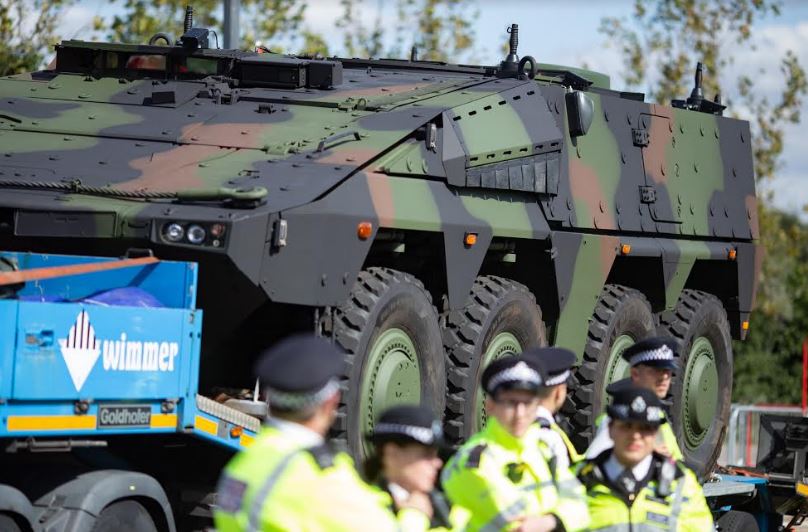
The UK Department for International Trade has officially invited the government of Israel to DSEI, despite a UN report earlier in the year stating that Israel’s repression of unarmed Palestinian protestors may have constituted “war crimes or crimes against humanity”.
Organizers Palestine Solidarity Campaign and War On Want are seeking to highlight Israel’s systematic violations of human rights and international law and call on the UK Government to implement a 2-way arms embargo with Israel.
Hundreds of human rights activists are currently protesting the UK’s trade in arms with Israel outside Defence & Security Equipment International (DSEI), the world’s largest arms fair, held at ExCel London every two years.
Under the banner “Stop Arming Israel”, a day of creative action and protest organised by campaigning groups Palestine Solidarity Campaign and War on Want is taking place outside the fair throughout Monday 2nd September. Protesters have blocked roads in order to stop trucks carrying weapons from getting inside the fair.
Organisers of the event claim that DSEI is a site where violations of international law and human rights are flaunted by companies, including Israel’s Elbit Systems, who market their weapons as ‘battle-tested’, meaning that they have been tried and tested in attacks on Palestinian civilians.
They are also voicing opposition to the UK Government’s role in co-hosting the event. Israel has appeared for the first time on the Department of International Trade’s list of official invitees for DSEI, only months after the United Nations Commission of Inquiry on Gaza protests found evidence indicating that Israeli forces fired on unarmed Palestinian protestors unlawfully, using force that may have constituted war crimes or crimes against humanity.
Ryvka Barnard, Senior Campaigns Officer (Militarism and Security) at War on Want, said: “The DSEI arms fair brings together the most destructive elements of the global arms trade, responsible for countless deaths and immeasurable destruction around the world.
Companies displaying their wares include the likes of Israel’s Elbit Systems, which has produced internationally banned weapons such as white phosphorous and artillery systems that can be used for cluster munitions. Elbit and other countries boast that their weapons are battle-tested, meaning that they fine-tune their products by testing in live combat situations. The people of London don’t want our city to be used as a marketplace for companies turning crimes against humanity into profit.”
Huda Ammori, Campaigns Officer at Palestine Solidarity Campaign, said: “The UK Government can talk all it wants about respecting human rights, but its deadly arms trade with Israel reveals the truth. The UK Government is showing a total disregard for Palestinian lives, and is fully complicit in the atrocities committed against them by the Israeli state. We need a 2-way arms embargo now, and we need all other complicit companies and institutions – from HSBC to UK universities – to cut ties with the Israeli arms trade too and to stand on the side of human rights. That’s why we’re taking action at the DSEI arms fair.”
Activities throughout the day include street theatre, political discussions, banner-making and dabke dancing (Arab folkloric dance). The day’s events will lead into a street party this evening featuring a performance by award-winning poet Sabrina Mahfouz and a DJ set from Ben Smoke.
The ‘Stop Arming Israel’ protests begin a week-long set of protests against the DSEI arms fair, with a different theme each day, highlighting the diverse communities opposing the hosting of DSEI in London, PNN reports.
How Japanese scientists confronted the U.S. and Japanese governments to reveal the effects of Bikini H-bomb tests
By Okuaki Satoru¹ – The Asia Pacific Journal – September 1, 2019 – Volume 17 | Issue 17 | Number 2
Introduction and translation by Steve Rabson
Introduction
The March, 1954 “Bravo Shot” H-bomb test in the Pacific dumped radioactive debris on the Marshall Islands, U.S. servicemen, and the crew of a Japanese fishing boat. The multi-megaton blast infected Marshall Islanders with radiation sickness and caused cancers in the years that followed. Their contaminated home on Bikini Atoll remains uninhabitable to this day. U.S. servicemen who had been purposely transported by the Navy into the blast zone have suffered from multiple cancers from radiation exposure. For years their claims denied were denied by the Veterans Administration. It took an act of Congress in 1990 to provide compensation for them and their children with birth defects. The crew of the Japanese fishing boat, Lucky Dragon No. 5, suffered from acute radiation poisoning. One crew member, Kuboyama Aikichi (age 40), died while in treatment for exposure.

“Bravo Shot” H-bomb test, Bikini, March 1, 1954

U.S. military forcibly evacuating Marshall Islanders from Bikini Atoll

U.S. servicemen transported under orders into the Bikini blast zone

Japanese scientists examine the hull of contaminated Lucky Dragon at Yaizu City port
Okuaki Satoru tells below how Japanese scientists confronted, and eventually overcame, roadblocks thrown up by both the U.S. and Japanese governments to obtain urgently needed information for the treatment of radiation poisoning and to determine the extent of environmental contamination. As Jacob Darwin Hamblin and Linda M. Richards explain in the journal Historia Scientarium, “Japanese perspectives influenced several American scientists to think differently about the implications of nuclear tests for humans and the natural environment . . . despite stiff resistance from offices of the U.S. government.”2
The U.S. government withholds information on lethal fallout
On March 16, 1954, the newspaper Yomiuri Shimbun first reported victims of a U.S. nuclear test in the Pacific among Japanese crew members of the fishing boat Lucky Dragon. The U.S. government acknowledged that tests had been carried out, but, insisting on secrecy, refused to provide information about them to Japanese scientists. Today it is known that they were hydrogen bomb tests, but even that wasn’t disclosed at the time. The only information Japanese scientists could obtain was from radioactive contamination of the Lucky Dragon’s hull.
Several scientists visited the fishing port at Yaizu City in Shizuoka Prefecture and recorded high levels of radioactive contamination from fallout on the boat’s hull. Okano Masaharu, a specialist in measuring radioactivity, was twenty-eight at the time and on the faculty of the Institute for Scientific Research (now known as RIKEN).
After World War II when Japan was under Allied Occupation (1945-1952), research on atomic energy was strictly prohibited. However, in 1950 permission was granted for research on radioactive isotopes. Okano traveled throughout the country giving lectures to inform Japanese about isotopes, and became skilled in handling radioactive materials. On April 16, 1954, he traveled with his supervisor, Dr. Yamazaki Fumio, to examine the hull of the Lucky Dragon. A full month had passed since fallout had contaminated the boat, but both men were astonished to see the needle of their radiation meter swing wildly up into the danger zone. This was the first time they had detected significant radiation outside their laboratories, and it exceeded one hundred times the level occurring in nature. With the discovery that radioactive fallout had contaminated the Lucky Dragon, scientists at universities in Tokyo, Kyoto, Shizuoka, Osaka and Kanazawa began their own studies, communicating their findings by telephone.
Ikeda Nobutaka conducted research on radioactive fallout in Professor Kimura Kenjirō’s research laboratory in the Chemistry Department of Tokyo University. He also visited the Lucky Dragon at Yaizu, and collected samples of fallout-contaminated material. Returning with them to the laboratory, he and about a dozen other researchers spent the next several days and nights frantically analyzing the material out of acute concern for the Lucky Dragon’s crew.
“We needed the results as soon as possible,” said Ikeda, now eighty-eight. “Without knowing the characteristics of the fallout, there would be no way to find a treatment for the crew. We were also aware that the reputation of Japanese scientists was at stake. If our results turned out to be wrong, it would be a disgrace for Japan’s scientific methods.”
Over the next month Ikeda and his colleagues found twenty-seven types of atomic radiation including Strontium (Sr) 89, Yttrium (Y) 90, and Cerium (Ce) 141. “We were overjoyed because knowing the radiation characteristics meant that it could be located in patients’ bodies and a way might be found to eliminate it. I can still remember how lovely the sunset looked the evening we finally finished the analyses.”
U.S. Atomic Energy Commission declares “no risk” from radioactive contamination
The U.S. carried out many nuclear weapons tests in the Pacific; however, the one named “Castle Bravo” on March 1, 1954, which showered fallout on the Lucky Dragon, was the most powerful conducted to that time, 1,000 times the fifteen megatons of the Hiroshima bomb. On March 31, Lewis Strauss, Chairman of the U.S. Atomic Energy Commission, issued a statement denying that there had been any contamination of fish or seawater.
With respect to the stories concerning widespread contamination of tuna and other fish as a result of the tests, the facts do not confirm them. The only contaminated fish discovered were in the open hold of a Japanese trawler [that had been] well within the danger zone. The Federal Drug Administration has informed us that their thorough survey found no radioactive contamination of boats or fish. The fallout dissipated rapidly in the ocean current and has posed no risk. No radioactivity has been detected in an area between five and five hundred miles of the test site.
There was a rumor last week of a danger from radioactivity falling in the United States. As with Soviet nuclear tests, there might be a small increase in natural background radiation in some local areas. However, it is only infinitesimally higher than what has been observed after previous tests in the continental United States and overseas, far too small to pose any risk to persons, animals or plants. Radioactivity dissipates rapidly after tests, and soon returns to normal levels of natural background radiation.
Did American officials deny that radioactivity had contaminated the ocean because they wanted to conceal the possibility that it had, or because they didn’t believe it would spread over a wide area beyond the test site?
Professor Higuchi Toshihiro at the Institute for the Study of Diplomacy of Georgetown University cites radioactive contamination from the Bikini tests as having initiated world-wide concern over the problem of environmental pollution; and he has studied how the governments and societies in Japan and in the United States took opposing positions over the issue of radioactive pollution.
It was known among scientists at the time that, at least in theory, radioactive contamination of the ocean from nuclear tests could be detected in seawater, plants, and animals. So when the U.S. conducted the first hydrogen bomb test in 1953, the Atomic Energy Commission began surveying seawater, tuna, and other ocean life for radioactivity. The Bikini test that contaminated the Lucky Dragon occurred the following year, but the data collected by the survey was still insufficient. Nevertheless, the Atomic Energy Commission sought first and foremost to quiet the furor over the tests at home and abroad, and issued a series of announcements for political reasons. Lacking reliable scientific data, the Commission surveyed a large area of seawater in which any trace of radiation would have been much diluted, and then claimed no contamination had been detected. Thus, it wasn’t that the Commission was trying to conceal findings of contamination, or that it was ignorant of the possibility. For strictly political reasons, it quickly declared the ocean safe.3
Contradicting its own denials of radioactive contamination, the U.S. government banned imports of Japanese tuna
The U.S. government was greatly alarmed by news that radiation had contaminated tuna in Japan. At the time of the Bikini tests the U.S. was importing large quantities of canned tuna from Japan. Cheap and plentiful, long-finned tuna was canned in vegetable oil.
The development of Japan’s canning industry had begun before World War II in the fresh waters of Shizuoka Prefecture. In the 1950’s before Japan’s heavy industry recovered from the war, the government strongly encouraged the production of goods for export of which canned tuna was a key enterprise. Sold under the brand names “Fujiyama” and “Geisha,” high-quality and inexpensive Japanese canned tuna became so popular it dominated the American market.
Now the U.S. government became deeply concerned that contaminated tuna was being imported and distributed in America. Located by Professor Higuchi in the U.S. National Archives, an official U.S. government memo entitled “fish exports” was sent to Washington from the American Embassy in Tokyo on March 21, 1954, five days after the Yomiuri Shimbun reported contamination of the fishing boat Lucky Dragon. Higuchi described the memo:
The memo explained that embassy officials and representatives of the American fishing industry had warned the Japanese government to stop exports of contaminated fish. The government agreed that no fish would be exported to the United States in which radiation was detected.4
Subsequently, a member of the Atomic Energy Commission came to Japan and went to Yokohama Port. There, he ordered thorough monitoring tests for the fins and bellies of frozen tuna scheduled for export to the United States. People in Japan were outraged because, on the one hand, the U.S. government was denying that radiation from nuclear tests had contaminated the ocean or fish, yet it was suspiciously monitoring fish being exported to America.
The Japanese government refuses to pursue U.S. responsibility for contamination and supports continuation of nuclear tests
How, then, in the wake of radiation injuries to the Lucky Dragon’s crew and nuclear contamination of tuna, did the Japanese government deal with the U.S. government that had carried out the tests?
On March 17, with the Diet in an uproar over the Bikini tests, Foreign Minister Okazaki Katsuo came under persistent questioning in a session of the Lower House Budget Committee. Representative Imazumi Isamu, a member of the Socialist Party, severely criticized the Japanese government for failing to request crucial information from the U.S. about the nuclear tests. “America has inflicted radiation injuries on our country’s innocent fishermen. The treatment varies depending on what kind of bomb was detonated. A Japanese government that fails to seek this information for treating the victims is in no way worthy of representing our citizens. It is truly unforgivable.”5
Representative Kawasaki Hideji of the Progressive Party insisted that the Japanese government confront the U.S. government.
We have learned that the test was of either a hydrogen or a cobalt bomb. Should Japan bring the case to the International Court of Justice, world opinion would be deeply sympathetic to a nation that has been victimized three times by nuclear explosions. Our foreign policy must be courageous enough to petition the court. Does the Foreign Minister agree? Please answer the question directly.6
“We know from the information they already provided us that the Americans are very sympathetic,” replied Foreign Minister Okazaki. “They have said they will send doctors specializing in atomic bomb injuries and pay compensation no matter the cost. I am confident we can resolve the issue without going to the International Court of Justice.”7
Foreign Minister Okazaki reiterated the decision not to pursue America’s legal responsibility at a party given by the America-Japan Society in Tokyo on April 9, 1954. A tape recording of his speech before guests that included the American ambassador is available at the Society’s office in Akasaka.
Although it goes without saying that the fishing industry Japan’s economy relies on has suffered major losses as a result of the ban in the area of the ocean affected by the atomic tests, we have no intention of asking the U.S. government to stop them. We recognize that they are indispensable to the security, not only of America, but of Japan and other democratic nations. Thus, we join the other democratic nations in helping to make sure the atomic tests are successful.8
Radioactive contamination from the Bikini test occurred two years after Japan regained its independence in 1952 under the San Francisco Peace Treaty. Yet, despite the damage the test inflicted on the nation, the Japanese government supported their continuation. This attitude provoked outrage among the citizenry.
Japanese scientists respond
Japanese government leaders refused to pursue U.S. responsibility for the damages inflicted by the Bikini test. However, among all government departments, the Fisheries Agency was most acutely aware of the danger. It alone planned a survey of radiation contamination in the ocean area around the Bikini atoll where the test was conducted. “The U.S. government was entirely downplaying the test’s effects,” explained Miyake Yasuo who joined the scientific advisory group organized to carry out the survey. “The Japanese government was seeking compensation for injuries to the Lucky Dragon’s crew and the major damage to our fishing industry, but conducting a survey at the site for crucial information about the radioactive contamination was absolutely essential.”
With daily reporting in the newspapers on their expedition aboard the ship Shunkotsu Maru, the scientists were given a heroes’ welcome when they returned to Tokyo on July 4, 1954 from their fifty-one day voyage. It was their survey that first determined the extent of ocean contamination and damage to the environment from atomic tests. Though conducted for the Fisheries Agency, the results advanced knowledge in several scientific fields including radiology, oceanography, meteorology and medicine.
Notes
1From Okuaki Satoru, 海の放射能に立ち向かった日本人:ビキニからフクシマへの伝言 Radioactive Contamination of the Ocean Revealed by Japanese Scientists: From Bikini to Fukushima, Junpō-sha, Tokyo, 2017.
2Jacob Darwin Hamblin and Linda M. Richards, “Beyond the Lucky Dragon: Japanese Scientists and Fallout Discourse in the 1950s,” Historia Scientiarum, Vol. 25, No. 1 (2015), pp. 36-56.
3Okuaki, pp. 44-45.
4Ibid., p. 46.
5Ibid., p. 47.
6Ibid., pp. 47-48.
7Ibid., p. 48.
8Ibid., pp. 48-49.
Okuaki Satoru is a program director at NHK. Born in Kanagawa Prefecture, he graduated with a Masters Degree from the Life Sciences Division of Tokyo University, joining NHK in 1999. He has directed television documentaries on the work of novelist Inoue Yasushi and the massacres of Koreans following the 1923 Tokyo earthquake. He was awarded the Media Ambitious Prize in 2013 for the documentary “Radioactive Contamination of the Ocean Revealed by Japanese Scientists: the Bikini Test Nuclear Fallout and the Ship Shunkotsu Maru,” which is the subject of the excerpts below from his book.
Steve Rabson is Professor Emeritus of East Asian Studies, Brown University, and a contributing editor to the Asia-Pacific Journal. He is the author of Righteous Cause or Tragic Folly: Changing View of War in Modern Japanese Poetry (Center For Japanese Studies, University of Michigan, 1998) and The Okinawan Diaspora in Japan: Crossing the Borders Within (University of Hawaii Press, 2012). His recent articles include “Okinawa was a ‘storage location’ for nuclear weapons: published accounts,” Asia-Pacific Journal, January 7, 2013, Volume 11 | Issue 1 | Number 6 and “Nuclear Hawks in Tokyo Call for Stronger US Nuclear Posture in Japan and Okinawa,” Gregory Kulacki with a comment by Steve Rabson, Asia-Pacific Journal, June 1, 2018, Volume 16 | Issue 11 | Number 1. He was stationed as a U.S. Army draftee at a nuclear weapons storage base in Henoko, Okinawa, 1967-68.
The original Japanese text can be found here.
Related articles:
Ōishi Matashichi and Richard Falk, “The Day the Sun Rose in the West. Bikini, the Lucky Dragon and I,” Asia-Pacific Journal, June 19,2011, Vol. 9, No. 3
Steve Rabson, “Okinawa was a ‘storage location’ for nuclear weapons: Published accounts,” Asia-Pacific Journal, January 7, 2013, Volume 11 | Issue 1 | Number 6
“Nuclear Hawks in Tokyo Call for Stronger US Nuclear Posture in Japan and Okinawa,” Gregory Kulacki with a comment by Steve Rabson, Asia-Pacific Journal, June 1, 2018, Volume 16 | Issue 11 | Number 1
Netanyahu Does Something Stupid Again
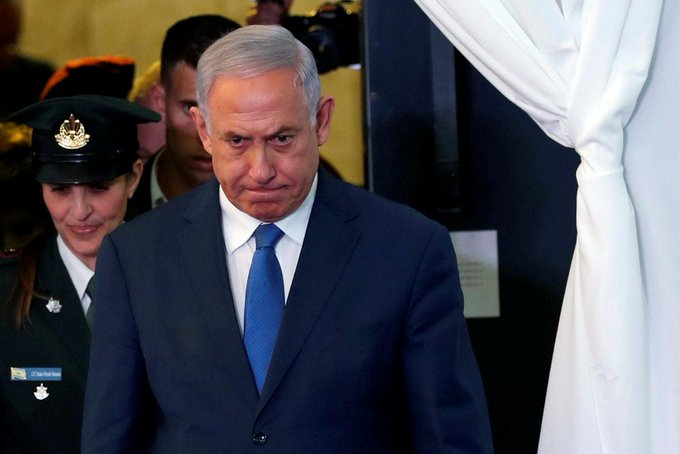
Israeli PM Benjamin Netanyahu arrives to review an honor guard with his Ethiopian counterpart Abiy Ahmed in Jerusalem September 1, 2019. Credit: Ronen Zvulun/ Reuters/ Twitter)
By Jeremy Salt | American Herald Tribune | September 2, 2019
With general elections coming up on September 17, Benyamin Netanyahu made a calculated gamble last week and lost.
The attempt to assassinate someone by drone in Beirut failed. Two drones were sent into the largely Shia suburb of Dahiya, where Hizbullah’s political, media and welfare offices are based. The first drone, for surveillance, crashed on to the roof of a Hizbullah media office, causing damage inside but no human casualties. This forced the Israelis to abort the entire mission. They themselves destroyed the second drone, for assassination, according to the veteran Middle East correspondent Abdul Bari Atwan. The target for murder was clearly a senior Hizbullah figure or – as some have speculated – a representative of the Iranian government. Israel certainly did not send a drone to Beirut just to put a hole in the roof of a building.
As this was the first attack on Beirut since 2006, when Israel jets pulverized Dahiya day after day, Hizbullah threatened retaliation. It never says when, how or where it will strike back but this time it retaliated almost immediately, destroying an Israeli APC (armored personnel carrier) at a military outpost across the armistice line.
That Netanyahu would launch such an attack without taking precautions to ensure the safety of civilians and military personnel in the north would have played badly before the public had not the government covered its tracks by firing a flurry of missiles into Lebanon and claiming in a media barrage that while the APC was indeed hit by the ‘terrorists’ no-one suffered even a scratch, as Netanyahu eventually claimed.
It may be some time, it may be never, that the truth comes out but the story pitched by the Israeli government and military has all the elements of high comedy, not sophisticated, more Bud Abbott and Lou Costello than Lenny Bruce. First the Israelis said the vehicle that was struck was a military ambulance, with no-one inside it. Then they admitted it was an APC, but again no-one was inside, as they had all gone somewhere else half an hour earlier, whether for a smoke, a meal or a pee we don’t know.
Likud minister Yoav Galllant said no-one had been hurt in the missile strike, even as footage was being shown of wounded soldiers being flown by helicopter to an army hospital but he was speaking out of turn, so the government said.
In fact, noone had been hurt. This was no more than a decoy operation. Israel wanted Hizbullah to think it had scored some kind of victory, so it dressed up store dummies as soldiers and had them carried away on stretchers. It turned out that Israel just wanted to fool Hizbullah. That was the point of the whole exercise. Ha ha, Hasan, the joke’s on you. Noone had been hurt after all. “The staged evacuation seems to have worked” wrote the veteran Zionist propagandist David Horowitz.
The fact that settlers in the north had been sent scurrying into their bomb shelters by the Hizbullah missile strike was soon overtaken by glowing reports of farmers back in the fields and children back in the classroom as usual now that the cross-armistice line missile fusillade had died down.
Readers will decide how much of this malarky they can believe. For most, probably none of it. Behind the propaganda smokescreen lies a core truth, which is that Netanyahu, Israel’s nincompoop-in-chief, launched a failed mission into Beirut, rather reminiscent of his failed attempt to kill the senior Hamas figure Khalid Mishael in 1997. The would-be assassins were arrested, and the panicked, sweating Netanyahu, close to nervous collapse, saved from his own folly only by the intervention of the Jordanian king.
The drone attack in Beirut was designed to deliver an election victory but backfired badly and had to be covered up as quickly as possible with what seems on the surface to be a complete cock and bull story.
The APC held eight men. If they had been inside when it was struck by Hizbullah’s missile, all would have died or would have been badly wounded, as Hizbullah claimed they were. If they were killed or wounded, Netanyahu, approaching the end of an election campaign, would have had to prevent the public from knowing, even to the ludicrous extent of telling it that the wounded soldiers shown in video footage were actually store dummies dressed up as wounded men. The truth – if there were casualties – would have doomed his re-election prospects.
The drone attacks on Beirut included a strike on a PFLP (Popular Front for the Liberation of Palestine) base in the Bika’a valley. Other drone attacks on the same day were launched against Hashd al Sha’abi (Popular Mobilization Forces) units and regular Iraqi army bases in north Iraq close to the Syrian border. Iraqi intelligence believes the attacks were launched from the Kurdish region of northeastern Syria, controlled by the largely Kurdish Syrian Democratic Forces (SDF), the US puppet militia. In the same time frame, the Zionists also attacked a military position close to Damascus.
These simultaneous attacks on three countries call to mind the rabid dog running around snapping at anyone who comes close. There was no immediate provocation for any of these missile strikes and drone attacks but in Israel’s case there never has to be. The Israelis say Hizbullah’s missile retaliation brought the two sides to within 30 minutes of another war, and they say another one is coming anyway. This can hardly be news to anyone. Hizbullah has enough precision missiles to devastate Israel and the longer the Israelis wait the more it will have, so unfortunately another war is only a matter of time and perhaps a much shorter time than people might think.
Even though Israel has been flying drones over Lebanon for decades, an attack in central Beirut is unusual. It might not be the first, however: Lebanon’s former Prime Minister, Rafiq Hariri, may have been assassinated in 2005 by a missile fired from an Israeli drone, and not killed by a car bomb, the generally accepted explanation. The UN investigation into Hariri’s death was grossly prejudicial, especially in the case of the reports filed by the first lead investigator, Detlev Mehlis, and came to nothing anyway. The charges against Lebanese suspects were dropped, at which point the UN tribunal switched its suspicions to Hizbullah, without having any prior evidence. This investigative route has ended in a dead end as well. The one chief suspect never investigated, even though standing out above all the others because of its long track record of murder and mayhem in Lebanon, is Israel.
In 2010 Hasan Nasrallah revealed that Hizbullah had intercepted Israel’s electronic communications and had captured images of an Israeli drone tracking Hariri across Beirut and into the mountains every day for three months. Along with an AWACS (Airborne Warning and Control System) plane, an Israeli drone was hovering over the precise point on the corniche road when Hariri was assassinated.
Looking at the evidence, Thierry Meyssan has argued that a highly refined missile fitted with a warhead based on a ‘nano’ amount of enriched uranium may have been used rather than a car bomb (‘Revelations on Rafik Hariri’s Assassination,’ Voltaire Network, November 29, 2010).
However, whether drone missile or car bomb, Nasrallah implicated Israel in the murder. If the question cui bono is to be asked the answers are clear. It was immediately assumed in the ‘west’ that Syria must have been responsible, given the often difficult relationship between Hariri and the Syrian government, but the only beneficiaries of the assassination were Israel and its rightwing proxies in Lebanon.
Israel violates Lebanon’s air space as a matter of course. Over the years it has overflown Lebanon many thousands of time. It frequently flies across Lebanon to attack Syria. At the international level, no sanctions have ever been introduced to stop it, just as no sanctions have ever been introduced to stop it doing anything it wants to do. This will continue until the big war comes along, and then all those who could have done something to head it off but did nothing will be throwing up their hands in horror.
Apart from flights aimed at bombing targets in Lebanon or Syria, Israel’s aerial intrusions would have other purposes, including intimidation of the Lebanese civilian population and the unrest this might generate.
Most probably it would also want to draw Hizbullah out and, through retaliation to one of its attacks, see if it has missiles capable of bringing down its aircraft. A lost plane and pilot would be worth the cost of knowing. As the neutralization of Israeli air power must be a primary objective of Hizbullah and Iran, Hizbullah probably does have such weapons, but Israel is going to have to wait until the next war to find out.
Moscow Concerned, Puzzled Over US Airstrike in Syria’s Idlib
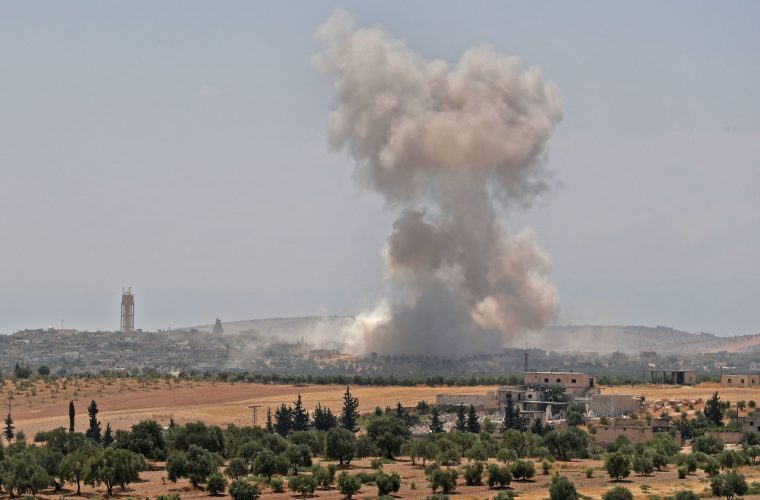
Smoke billows above buildings near the town of Hish in Syria’s Idlib province © AFP 2019 / Omar Haj Kadour
Sputnik – September 2, 2019
The Russian Foreign Ministry said in a statement on Monday that it was concerned and puzzled by Washington’s recent airstrike in Syria’s Idlib, slamming the move as “inconsistent” and “contradictory.”
“Inconsistent and contradictory steps that the United States makes in Idlib cannot but cause bewilderment and concern. On the one hand, US representatives … call for halting escalations in Idlib … On the other hand, they conduct an airstrike, which results in large-scale damage and victims”, the Russian Foreign Ministry said.
Moscow added it expected the United Nations to take the consequences of the airstrike into consideration when preparing reports on the situation in Syria, and also to brief members of the UN Security Council on “the consequences for civilians and civilian infrastructure” and to check the airstrike’s compliance with international humanitarian law.
Although the strike has put the ceasefire under threat, a moratorium on military campaigns is still in place, the ministry emphasised.
US forces struck on Saturday what they said were positions of leaders of the al-Qaeda terrorist group in the north of Idlib.
The strike came on the same day when a new ceasefire entered into force in the rebel-held province. According to the Russian Defence Ministry, Washington violated the ceasefire agreement in Syrian de-escalation zone by launching an attack on it without informing the ceasefire guarantors, namely Russia and Turkey.
The attack resulted in an unspecified number of casualties and damage to surrounding structures.
Israeli artillery shells southern Lebanon, drone drops incendiary devices along border
Press TV – September 1, 2019
Israeli artillery units have struck the southern part of Lebanon shortly after an Israeli drone violated the Lebanese airspace, and dropped incendiary material that sparked a fire in a forest at the border.
Lebanon’s official National News Agency reported that Israeli forces launched several 155-millimeter shells on the Jabal al-Rous area in the occupied Shebaa Farms and Kfarshouba Hills on Sunday afternoon.
The report added that the Israeli forces opened fire from their posts in the al-Zaoura area in Syria’s occupied Golan Heights.
An Israeli unmanned aerial vehicle, meanwhile, dropped incendiary devices on a forest in the border area of Bastara.
The Lebanese army said in a statement that the drone entered Lebanese airspace at 11:15 a.m. local time (0815 GMT) on Sunday, and dropped an unspecified number of devices, causing fires in some areas.
It added that the army would continue to follow up on Israeli violations of Lebanese airspace with the United Nations Interim Force in Lebanon (UNIFIL).
Images published by the private LBCI television network showed smoke rising from a tree-covered hill, reportedly caused by the weapons.
Tensions have been high recently between Israel and the Lebanese resistance movement Hezbollah in connection with the Israeli attacks on August 25 in Syria and Lebanon. Hezbollah has pledged to retaliate.
Hezbollah’s Secretary-General Sayyed Hassan Nasrallah said on Saturday evening that the resistance movement was determined to give a response to Israel over its recent drone incursion into Lebanon.
“The need for a response is decided,” he said during a televised speech ahead of the Islamic lunar calendar month of Muharram – the 10th day of which marks the martyrdom anniversary of Imam Hussein, the third Shia Imam and Prophet Muhammad’s grandson.
The Hezbollah chief added that the response was about “establishing the rules of engagement and… the logic of protection for the country. Israel must pay a price,” he said.
“Israel should know that the Lebanese air space is not open to her,” Nasrallah said, adding that the Israel attack could open the door to assassinations if left unanswered.
Nasrallah noted that the response to the Israeli attack could come from anywhere in Lebanon and not only from the Shebaa Farms south of the country, where Hezbollah normally stations most of its military equipment.
“The response will come from Lebanon. We will choose the place and time,” he said.
On August 26, Hezbollah said Israel had sent two drones into Lebanon on a bombing mission the previous weekend.
According to the resistance movement, the first drone had fallen on a building housing Hezbollah’s media office in the suburb of Dahieh. The second drone, which appeared to have been sent by Israel to search for the first one, had crashed in an empty plot nearby after being detonated in the air, it added.
Following the drone raids, Nasrallah vowed in a televised speech that fighters of the resistance movement would counter any further violation of the Lebanese airspace by Israeli drones.
Undeclared US airstrike on Syria’s Idlib leaves multiple casualties, puts truce at risk – MoD
RT | September 1, 2019
Sending no warning to Russia or Turkey, the US bombed an array of targets within Idlib, Syria, killing numerous civilians and threatening the hard-earned truce across the province, the Russian Defense Ministry said.
The air raid led to “multiple casualties and destruction” around two villages in the Idlib province, where a fragile ceasefire between government forces and militants is still in place, the Russian Reconciliation Center said on Sunday. The airstrike, carried out on Saturday, “endangered the truce” and “violated all previous arrangements.”
Earlier, US Central Command (CENTCOM) said it targeted leaders of a group it calls al-Qaeda in Syria. The strike “will further degrade their ability to conduct future attacks and destabilize the region,” it claimed.
But it hit shortly after Syrian government forces began a unilateral truce in the rebel-held province, Russia’s Defense Ministry noted. The Syrian Army is still sticking to the ceasefire despite militant attacks provoked by the US bombing.
Simultaneously, all combat sorties inside Syria were brought to a halt, the ministry said, rebuking US accusations about Russian “indiscriminate airstrikes” in Idlib.
Forces loyal to the government launched a major offensive on Idlib back in April and made significant advances last month. After days of fierce battles, they managed to liberate strategic locations, including Khan Sheikhoun, a town which had remained a rebel stronghold for years.
Still, a part of the province remains in the hands of a host of jihadist groups that continue to fight against the Damascus government. Hostilities between the Syrian army and the militants were mitigated through a joint diplomatic effort by Russia, Turkey and Iran to create a lasting peace in north-eastern Syria.
In September last year, the three nations agreed to create a 30km buffer zone dividing opposing forces, as part of an extended ceasefire.
Israel Uses Its Firepower, Far and Wide
By Paul R. Pillar | LobeLog | August 27, 2019
Israel recently has been expanding its military attacks across much of the Middle East, hitting multiple countries. The aggressive campaign far outpaces anything any adversaries of Israel have been doing to it, or even trying unsuccessfully to do to it.
Over the past two years Israel has used combat aircraft to conduct scores of attacks in Syria. Israel has stayed silent about most of this campaign of bombardment, but when it speaks it says the targets it hits are associated with Iran. The most recent widening of Israel’s assaults have involved Lebanon, including drone attacks on facilities in suburban Beirut associated with Hezbollah—a departure from the cease-fire established after the last Israeli-Hezbollah war.
The most dramatic geographic widening of the Israeli assault came last month with multiple attacks, reportedly conducted with F-35s, in Iraq—which, of course, does not even border Israel. Among the targets hit was one facility that is 500 miles from Israel but only about 50 miles from the Iranian border.
It is difficult to identify anything being fired in anger in the opposite direction that justifies such an expansive Israeli military campaign. In January of this year, Israel’s missile defense system intercepted a missile heading for the Israeli-occupied Golan Heights, but that is about as close as anyone in Syria, Lebanon, or Iraq has come lately to inflicting damage on Israel. Planned or failed attempts to inflict such damage all appear aimed at retaliating for Israel’s own attacks. Israel claimed that sorties it conducted this past weekend in Syria had thwarted an Iranian attempt to launch attack drones against Israel. That claim is unconfirmed, but it is quite plausible that, as suggested by Israeli sources, Iran was indeed planning such an operation to retaliate for the Israeli attacks last month in Iraq. One searches in vain for hostile operations that are unprovoked and not attempted tit-for-tat responses to Israel’s own actions.
The escalated Israeli military campaign exhibits some longstanding attributes of Israeli policies and practices. One is to assert a right to seek absolute security even if that means absolute insecurity for everyone else. The mere possibility of someone harming Israel is taken as sufficient reason to inflict certain harm on someone else. Israeli Prime Minister Benjamin Netanyahu, in commenting on the most recent Israeli operations in Syria, said that Israel “won’t tolerate attacks on its territory.” Evidently that means asserting the privilege of attacking anyone else’s territory, even if those countries have not already attacked Israel.
Domestic politics figures into such matters, in Israel as elsewhere. With an Israeli election looming, Netanyahu has a political reason to use aggressive operations to bolster his image as a tough-minded guardian of Israeli security.
The operations also are part of the larger anti-Iran theme that the Israeli government uses to keep a regional rival weak, preclude any rapprochement between that rival and the United States, blame someone other than itself for all the ills of the region, and distract international attention from subjects involving Israel that Netanyahu’s government would rather not talk about. The Israeli government wants to retain Iran permanently as a perceived threat, loathed and isolated, rather than to negotiate away any issues or problems involving Iran. Netanyahu demonstrated this when, after years of sounding an alarm about a possible Iranian nuclear weapon, he opposed the very agreement that closed all possible paths to such a weapon. His government demonstrated it again this week when it opposed President Trump’s expressed willingness to meet and negotiate with Iranian President Hassan Rouhani.
Israel’s heightened military aggressiveness has multiple bad consequences, in addition to being an affront to the sovereignty of multiple regional states. It pours gasoline on fires in places that need de-escalation, not escalation. It is certain to provoke more attempts at retaliation. Hezbollah Secretary-General Hassan Nasrallah was quite explicit in promising such retaliation in response to the recent Israeli attacks in Lebanon.
Given the close U.S. association with Israel, the Israeli attacks disadvantage the United States in its own relations with the affected states, in the form of increased resentment and lessened willingness to cooperate with Washington. This type of reaction is appearing today in Iraq, as a result of the Israeli attacks there. The episode has been the occasion for a powerful bloc in the Iraqi parliament to call for the withdrawal of all U.S. troops from Iraq and for shouts of “Death to America” to accompany “Death to Israel” at the funeral of one of those killed in the attacks.
No benefits offset these harmful consequences. It is useful to recall the previous time, before last month, that Israel attacked Iraq: the bombing of an Iraqi nuclear reactor in 1981. Far from setting back the Iraqi development of a nuclear weapon, the attack energized and accelerated what until then had been a semi-moribund program. Armed attacks on states have a way of provoking that sort of reaction.
U.S. policy has failed to recognize these realities. Following the attacks in Iraq, the Pentagon did issue a statement—in the course of denying direct U.S. involvement—that “we support Iraqi sovereignty and have repeatedly spoken out against any potential actions by external actors inciting violence in Iraq.” But such mild language will hardly deflect Israel from its present course when Secretary of State Mike Pompeo calls Netanyahu and, according to the official State Department statement, “expressed support for Israel’s right to defend itself from threats posed by the Iranian Revolutionary Guard Corps and to take action to prevent imminent attacks against Israeli assets in the region.”
It is not just current U.S. policy that fails to recognize realities, but also wider discourse in the United States about troubles in the Middle East. A question that needs to be pondered carefully is, “Who is destabilizing the Middle East?” Stoked by the Trump administration’s own unrelenting campaign of hostility toward Iran, the stock and overly simple answer has been, “Iran.” That is an insufficient answer even when excluding Israel from the picture. And Israel does get excluded, and excused, for the variety of reasons—ranging from religious doctrine and historical legacies to the inner workings of domestic U.S. politics—for the strong U.S. favoritism toward Israel.
It may be too much to ask for consistency rather than hypocrisy in such matters, but the rest of the world easily perceives the hypocrisy. It at least would be honesty to acknowledge that the U.S. approach toward the region has been shaped not by which players are or are not destabilizing the region, but instead by U.S. fondness for some players rather than others.
Paul R. Pillar is Non-resident Senior Fellow at the Center for Security Studies of Georgetown University and an Associate Fellow of the Geneva Center for Security Policy. He retired in 2005 from a 28-year career in the U.S. intelligence community. His senior positions included National Intelligence Officer for the Near East and South Asia, Deputy Chief of the DCI Counterterrorist Center, and Executive Assistant to the Director of Central Intelligence.
Another Syrian Victory – and West’s Telling Silence
Strategic Culture Foundation | August 30, 2019
The liberation of Khan Sheikhoun in Idlib Province by the Syrian army and its Russian ally marks another important victory towards ending the eight-year war in Syria.
Last week saw the return to relative normalcy in the northwestern town which had been held under siege by al Qaeda-affiliated militants for over five years. Situated south of Aleppo on the road to the capital Damascus, Khan Sheikhoun was officially declared under the control of Syrian state forces on August 21 after a hard-fought battle against militants.
International journalists from Italy, Bulgaria, Greece and Russia witnessed the return of residents and efforts to resume electricity services and reopening of schools. Khan Sheikhoun was ransacked by the routed jihadi terror groups, with the typical depravity that had been seen in other liberated areas. But despite the devastation, residents were relieved to begin the task of restoration of what was previously a town renowned for its culture and beauty before the war erupted in March 2011.
The remnants left behind by the defeated militants as well as the identity of dead fighters testified to their terrorist affiliation. Many of them were foreign mercenaries. Khan Sheikhoun was a stronghold for the Hayat Tahrir al-Sham group which was formerly known as Al Nusra Front. Notwithstanding the chameleonic name, they are part of the jihadi Al Qaeda terror network which is internationally proscribed and which Western governments are officially opposed to.
The capture of the town again demonstrates the vile nature of the Syrian war as being one of foreign-sponsored aggression for regime change. In particular, the United States government and its NATO allies, Britain, France, Turkey, and others, are now known to be fully complicit in covert sponsorship of these terrorists.
Khan Sheikhoun is of particular significance because on April 4, 2017, it was dramatically reported by Western news media as being the site of a Sarin chemical weapon attack, allegedly carried out by the Syrian state forces. Three days later, on April 7, the US, Britain and France launched over 100 airstrikes on Syria in what was claimed to be “revenge” against the “Syrian regime” for allegedly committing an atrocity with chemical weapons. Syrian authorities and Russia asserted the alleged Sarin attack at Khan Sheikhoun was a false-flag provocation, fabricated by the militants with the aim of eliciting a military strike on Syria by the US and its NATO allies.
Clearly, after the liberation of the town this month, it is evident that it was a den of terrorist groups which held residents under a reign of terror. Yet for years, the Western news media had proclaimed that these fighters were “rebels” who deserved support from Western intervention. Even as Syrian forces were launching their assault on Idlib Province in recent months, the Western media were animated by shrill reports of “rebels” and civilians being killed by indiscriminate “regime” air strikes.
Tellingly, the momentous victory at Khan Sheikhoun was met with an astonishing silence among Western governments and news media.
The same duplicitous pattern has been seen before when the Syrian army and its Russian ally liberated Douma, Ghouta, Daraa, Aleppo, Maaloula and many other areas besieged by the so-called “rebels” so lionized in Western media. Syrian residents have been invariably relieved and overjoyed to have their freedom and dignity restored by the Syrian army and Russian forces. Their stories of the horror they endured under captivity are shocking from the depravity and cruelty meted out by Western-backed “rebels”.
That is why the liberation of Khan Sheikhoun, as with other locations in Syria, has had to be studiously ignored by the Western news media. Because if they really performed normal journalistic duty what the Western public would learn is that their governments and media have been complicit in huge war crimes against the Syrian nation.
It is all the more despicable therefore that the US is shifting its efforts to block the reconstruction of war-torn Syria. This week, the country is to hold the annual Damascus International Trade Fair. Delegates from some 40 nations are attending and exploring ways to regenerate the Syrian economy and to meet the challenge of reconstruction. Some estimates put minimal repair of infrastructure at a cost of $388 billion. The true figure could be in trillions of dollars.
That bill should be assigned to Washington, London, Paris, Ankara, Riyadh, Doha and Tel Aviv for the criminal aggression they collectively and stealthily inflicted on Syria.
Ahead of the Damascus trade fair, the US was warning prospective foreign investors that they could face sanctions if they did business with Syria. Russia’s foreign ministry condemned the American effort to sabotage Syria’s reconstruction.
As Russian lawmaker Valery Rashkin, who was in Syria this week, put it, the US is trying to destroy Syria through economic warfare after losing its dirty-war military agenda.
The European Union also stands condemned for continuing to impose economic sanctions on Syria. The war is over and it has been exposed as Western-backed criminal aggression. All past accusations against the Syrian state are null and void as malign propaganda. Thus, sanctions on Syria are a contemptible attack on the country by nations whose criminal complicity should actually be a matter of prosecution.
We can only wish the people of Syria well. With international solidarity from Russia, China, Iran and others, Syria will recover its former strength and pride. Syria has won a tremendous victory. The losers are the Western governments and media who have been exposed for the corrupt charlatans they are.
Behind Israel’s Bombing in Iraq’s Heartland
By Giorgio Cafiero – Consortium News – August 28, 2019
Iraq has felt the heat from escalating tensions between the U.S. and Iran this summer as the White House moves ahead with its “maximum pressure” campaign against the Islamic Republic. Also clear is that Israel and Iran’s proxy wars in the region have spilled into Iraq too. Last month, Israel carried out its first attacks on targets in Iraq since Operation Opera on June 7, 1981.
On July 19, Israel struck a target in the Salahuddin governorate, three days before another attack against Camp Ashraf, located within close proximity to Iran. According to al-Ain, the attack against Camp Ashraf killed 40 members of Iran’s Islamic Revolutionary Guard Corps (IRGC) and Iranian-sponsored Iraqi Shi’a militiamen. On Aug. 12, a blast occurred at a Popular Mobilization Units (PMU) arms depot in the Iraqi capital, allegedly carried out by an Israeli aircraft and resulting in one death and 29 injuries. Other Israeli attacks followed on the 19 and 25 of August. Several days ago, U.S. officials confirmed that Israelis were indeed behind the July 19 attack in Salahuddin governorate, which was suspected from the beginning.
Such actions highlight how Israel seeks to expand its theater of confrontation with the Iran to Iraq. Put simply, the Israelis are reacting with increasing aggression against the extent of Iranian-sponsored militias in Iraq and elsewhere in the Middle East that provide Tehran greater leverage vis-à-vis Israel.

Pompeo: Not against further Israeli strikes. (YouTube)
Important questions surround the U.S. role in these Israeli attacks against PMU targets in Iraq. It is difficult to imagine how the Trump administration could have not given Israel the green light to carry out these attacks. As Karim al-Alwei, an Iraqi parliamentarian, explained, “the U.S. controls Iraqi air space” thus “no planes, including Iraqi jets or helicopters, can overfly the area without U.S. knowledge or permission.” Only seven months ago, U.S. Secretary of State Mike Pompeo reportedly raised the topic of Iranian missiles in the hands of PMU forces in Iraq while meeting with Iraq’s Prime Minister Adel Abdul-Mahdi, stating that Washington would not be against any future Israeli military operations targeting such facilities.
Unclear is whether the Israelis used Syrian, Turkish, or Saudi airspace to reach their targets in Iraq. Regardless, it is a safe bet that the Saudi leadership, which maintains a tacit partnership with Israel largely based on a common perception of Tehran as a threat to its interests, welcomes such Israeli action in Iraq. As Saudi and Israeli officials see Iranian-sponsored Shi’a militia in Iraq, Syria, and Lebanon as a major threat, the Israeli strikes in Iraq will likely push the Israelis and Saudis even closer together.
Other Targets of Israel
Tel Aviv has dramatically increased the intensity and reach of its military campaign to weaken Tehran-backed militias in the region, waging attacks not only in Iraq, but also in Syria and Palestine too, as well as recently sending two drones into Lebanon. Into the chaos of Syria the Israelis have carried out many strikes against Iran-related targets since the civil war began in 2011. Yet by attacking targets in Iraq, Israel is showing its determination to expand the theater of its proxy war with Iran.
Although difficult to predict the long-term ramifications of these blasts in Iraq, their impact will likely be destabilizing, given Iraq’s fragile security. A major concern for officials in Baghdad is that in the days, weeks, and months ahead Iraq—as well as its airspace—could be the location of intensified violence as the U.S., Israel, and Iran challenge each other’s actions. Iraq will have a difficult time staying neutral between Washington and Tehran.
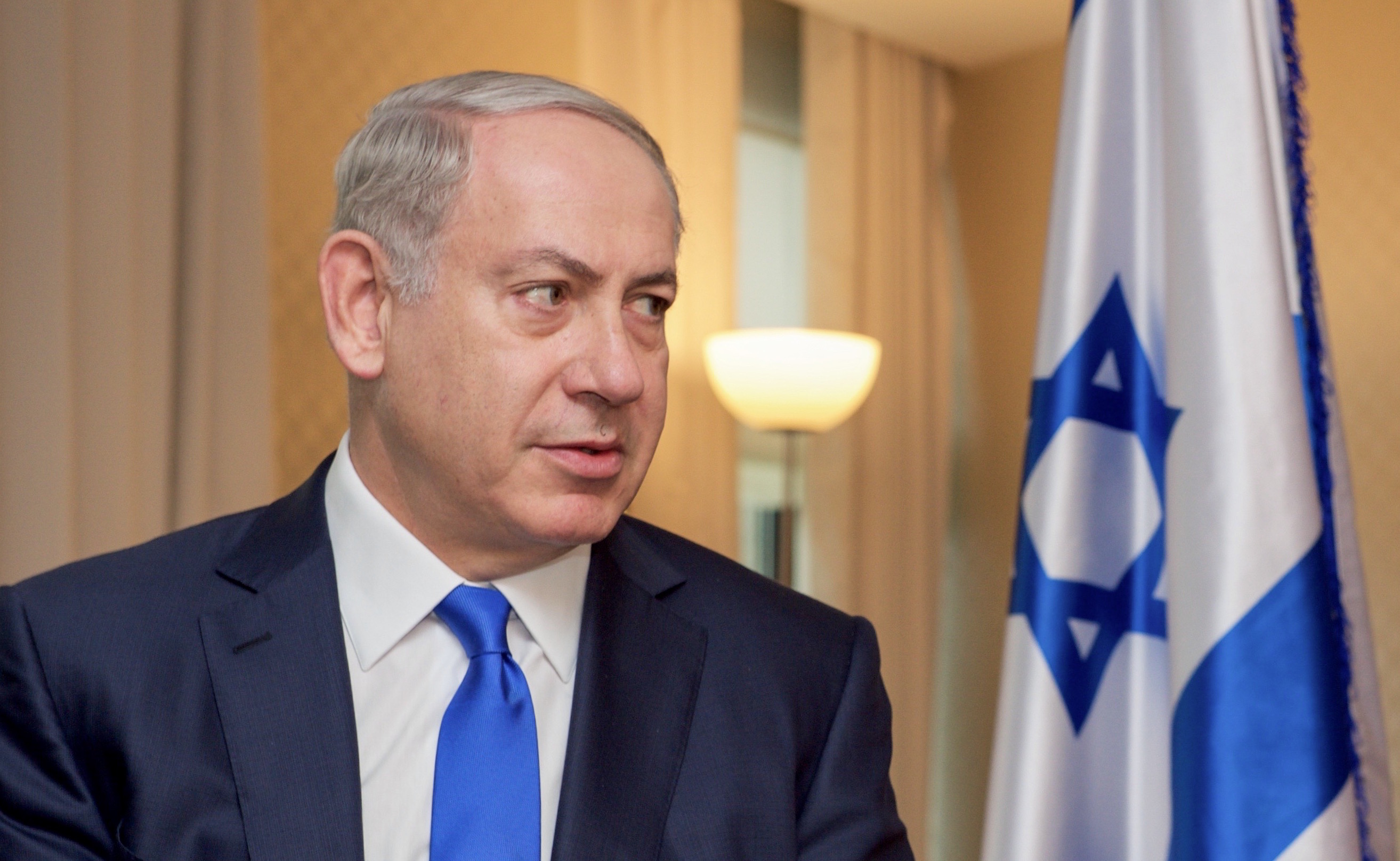
Netanyahu: More coming. (Wikimedia Commons)
Prime Minister Benjamin Netanyahu said Aug 19, “Iran has no immunity, anywhere… we will act and currently are acting against them, wherever it is necessary.” Three days later the Israeli leader went further, suggesting his country was perhaps involved in these attacks in Iraq, declaring, “We are operating in many areas against a state that wants to annihilate us.”
By making such bold moves, Israel is taking major risks. If such attacks continue in Iraq against Tehran-sponsored non-state actors near the Iranian border, Iran will likely respond. Perhaps the Iranians will put air defense capabilities in the hands of Iraqi Shi’a militias to enable such factions to fend off future Israeli attacks. Also possible is that Tehran would carry out limited strikes in retaliation at a time and place of the Iranian leadership’s choosing, perhaps targeting Israeli positions in the occupied Golan Heights of Syria.
Israeli strikes, which constitute a flagrant violation of Iraq’s sovereignty, may come with major costs for U.S. interests in Iraq. Given that an influential Iran-based Shi’a cleric, Grand Ayatollah Kazim al-Haeri, reacted to such Israeli attacks with a fatwa forbidding America’s military presence from continuing in Iraq, and the fact that many in Iraq and other Arab countries see the U.S. as responsible for Israeli actions against PMU targets, the roughly 5,000 American troops in the country could find themselves in the crosshairs of what has quickly become an escalating Israeli-Iranian proxy war waged in Iraq.
Israel’s bombing of Iraq will have major implications for the Washington-Baghdad relationship too, particularly given that the Iraqi government is attempting to bring the heavily armed Shi’a militias under its control. If the U.S. administration fails to prevent Israel from turning Iraq into more of a battleground in Tel Aviv’s proxy wars with Tehran, Iraq’s fragile stability will be further undermined. Under such circumstances, Iran could quickly capitalize on such conditions to bring Baghdad closer to Tehran at a time in which U.S. influence in Iraq—and the region at large—continues to wane.
Unquestionably, perceptions across Iraq that the U.S. is to blame for Israel’s actions will push more Iraqis to the conclusion that the White House’s “maximum pressure” agenda against Iran is directly undermining Iraq’s basic interests in upholding sovereignty and moving toward a more stable future in which the country is not implicated in greater regional crises involving multiple nations.
Giorgio Cafiero (@GiorgioCafiero) is the CEO of Gulf State Analytics (@GulfStateAnalyt), a Washington-based geopolitical risk consultancy.
Nasrallah: Netanyahu is Campaigning with the Blood of his People
Speech by Hezbollah Secretary General Sayed Hassan Nasrallah on August 25, 2019, on the occasion of the annual commemoration of Lebanon’s Second Liberation against the takfiris terrorist groups, which was finalized on August 25, 2017.
Transcript:
[…] I now turn to the question of Israel. Pray upon Muhammad and his family.
What happened last night is very dangerous, and I’ll explain why, because (the firmness of) our position must be at the height of the event and the danger. Let no one minimize what happened and consider it offhandedly. I will offer my analysis (after recalling the facts).
This is what happened: on the night of yesterday, in the skies of the southern suburbs of Beirut, a very modern drone came —I can say it is very sophisticated because this drone is in our hands, and we may show it to the media; later we will agree on that with the official security bodies; we also have the remains of the second (suicide) drone. It is not at all the type of drone that one can rent in towns or villages to film weddings and celebrations, not at all. This is a very modern military drone, which is almost two meters wide, a very sharp military technology.
The first drone came at night in the targeted region, namely some street of the Ma’wad neighborhood in the southern suburbs of Beirut. The first was a surveillance drone that had no other role but to collect information because it contained no explosive device. It descended very low, ending up between the buildings. This means it was filming its target very accurately, or at least trying to do so.
As announced by Hezbollah media relations, we have not shot down the drone. Young people in the neighborhood, seeing this two meters long drone flying so low, between buildings… The more I speak frankly and clearly, the easier it will be to understand, because we have to base our stance on truth, not on illusions or assumptions. These young people started to throw stones at this drone, which then fell. Either it fell because of a technical failure, either due to stone throwing, and it is clear that the drone was damaged by a stone. The drone therefore fell to the ground.
After a very brief moment, that is to say, a maximum of one or two minutes, another drone came aggressively and hit a certain place. So it is not a drone that was there to watch, and that they would have detonated because of an incident, not at all. What happened last night is an attack by a suicide drone against a target located in the southern suburbs of Beirut, Lebanon. This is the precise description that can be done from the field data.
Why do we say it’s dangerous? The fact that there was no killing and no injuries, by the grace of God, does not make this incident less dangerous. Sure, buildings were hit, their windows and facades were damaged, as well as furniture of apartments, offices… There was property damage. By the Grace of God Almighty and Exalted, the attack occurred during the night from Saturday to Sunday, and you know that on Saturdays and Sundays, you can play soccer on the main roads of the southern suburbs of Beirut (the streets are empty) because most people spend (weekends) in the south and in the Bekaa. It is a blessing of God Most High and Exalted. For without Him, surely, there would have been martyrs and wounded. God Almighty has bestowed His kindness upon us last night.
There was a loud explosion, which many residents of the southern suburbs of Beirut were able to hear. It was not a small explosion. This suicide drone attack against a target in the southern suburbs of Beirut is the first act of aggression since August 14, 2006. For in regard to the strikes which took place against Jenta a few years ago (in February 2014), we can say that this point was located at the Syrian-Lebanese border. But today there was a clear and open aggression (against Lebanon).
Of course, all the Israeli media speak of two suicide drones or one suicide drone that struck the southern suburbs of Beirut. Now if someone in Lebanon or in the Arab world, or on satellite TV channels, wants to pretend it is only a local (minor) incident, concerning only Lebanon, with drones that anyone can buy, it’s absolutely false. We will show you this drone with the grace of God, and you’ll know for sure that this is not a drone that can be bought on the market.
In fact, Israel itself recognizes, through its official statements and everything we read in the media, that they have perpetrated this air raid. This is a flagrant violation of the rules of engagement that were established after the war of 2006. It is the first clear and major violation. I will not mention other violations, whether against our airspace, our territory, all this could be tolerated (temporarily). But this is a major and dangerous violation, and it is God who, in His Benevolence, prevented any victims.
As for us, Netanyahu and those who took this decision really are deluded if they believe we can ignore such an attack. Some may say that there are no martyrs or injuries, only property damage, and that therefore we should forget about it. But that is not the question. The bottom line is that this incursion…
Listen to me, let the Lebanese people listen carefully: if we stay silent on this violation, it will open the way for a dangerous scenario for Lebanon. For every two or three days, we will see a car bomb… Excuse me, we’ll see a drone bomb, a suicide drone target such building, such place, such field, such land, such mosque, such hall… Under the pretext that it is a drone strike, and that we cannot know (for sure) where it comes from, (we would be condemned to do nothing). In other words, it will be a repetition of the scenario that is taking place in Iraq.
Now let the whole world listen to me carefully. I will speak very precisely. There is a scenario implemented in Iraq in recent weeks. In different regions, weapons stockpiles of the Popular Mobilization Units (PMU) are identified by drones, and right after, explosions happen right there. Whether the drone has fired a missile or whether it was a suicide drone, that’s what the investigation will show. One explosion, two explosions, three explosions, four explosions… And at the very least, they are implicitly claimed by Israel, who brags about them. For Netanyahu needs such operations now, I will speak about it in a moment. This process has run its course in Iraq: a first weapons depot, a second one, a third, a fourth, a fifth… And they continue on this path.
Now how Iraq will deal with this, be it the government, the army, the PMU or the Iraqi people, it is their problem, and I do not interfere in their decisions. But as for us in Lebanon, we do not allow such a scenario to be imposed on us. We do not accept to undergo the same thing. It’s absolutely impossible. And we will do… You’re used to such statements from us (and you know we are serious). We absolutely will do whatever is necessary to prevent such a scenario being imposed on Lebanon. All that needs to be done to prevent it, we will do it (without any hesitation, and whatever the consequences).
All this is in our hands, and we are perfectly capable of preventing that. The Lebanese State took its responsibilities and condemned (Israel’s attack), it is good. The State considers that what happened is an attack, that’s good. She complained to the UN, that’s good. She speaks to the US and to Europe (asking them to put pressure on Israel), that’s good. But this alone will not end the dangerous process that can destroy Lebanon again, returning it to the situation before 2000 (the Liberation). We, the Islamic Resistance (Hezbollah), will never allow such a scenario, regardless of the price (we have to pay to stop it).
The time when Israeli planes could strike anywhere in Lebanon while the entity usurping Palestine was safe, in any area of the entity, is well over. It’s the past, it is ancient history. Today, I read that the Israeli army told the people of the north (of Israel) that there is no danger, and that they can live their lives normally. Today, from the village of al-Ain in the Bekaa, in this second annual commemoration of the Second Liberation (of Lebanon against the terrorist groups), after we defeated Al-Nosra and ISIS in Lebanon, which are the US’ groups and Israel’s, I declare to all the inhabitants of northern Israel and everywhere in occupied Palestine: do not live (normally), do not be in peace, do not feel safe, and do not think for one second that Hezbollah will accept such a scenario (where he would suffer such attacks in his neighborhoods without retaliating against settlers).
And our first response… Our first response… Again, listen to me. Here is our first response, which needs a little explanation. Since 2000, and then since 2006, we have lived with the (constant) presence of (Israeli) drones in Lebanese skies. We had the ability to shoot them down, but we did not, so that nobody in Lebanon comes with us to philosophize, accusing Hezbollah of creating problems, of leading the country to war, of hindering tourism and the economy, etc., putting on us the blame for everything. Ok my brother, (we waited patiently) despite the fact that the presence of Israeli observation drone is not only a violation of Lebanese sovereignty, but is endangering our security. (The Israeli drones are) here, over the southern suburbs of Beirut, above (the presidential palace) of Baabda, above all Lebanese regions, in the south, where people in their villages hear (every day) the annoying noise of Israeli drones over their heads, but no one did anything about it! Since 2000 and until 2019, we did not stop asking the State and the government (to do something), and you remember that I raised this issue in many speeches, saying that a solution should be found. The UN resolution 1701 that ended the 2006 war prohibits Israeli violations: why don’t they stop?
Now, I declare that Israeli drones that enter Lebanon will not be considered as drones (merely) violating our sovereignty or gathering information, but as suicide, attack drones planning to conduct assassinations. And therefore, we have every right to shoot them down. The implementation of this right depends on the circumstances: we may not do it every day or every week, maybe we’ll do it at every hour, it’ll depend on our tactics. But I say to you very clearly, although I know some people will be angry, but let them get angry! Let them get mad! From now on, we will confront the Israeli drones in the skies of Lebanon! We will work to shoot down the Israeli drones entering Lebanese airspace! Let the Israelis know it from today! We won’t wait for anyone (to solve this issue for us), no one around the world. We will not allow our towns and villages to be a shooting range, a hunting or murdering ground, or a space where our security can be violated with impunity. That time has passed. And if someone in Lebanon is anxious to avoid any problems, let him speak to the Americans, who will speak to Israel, and they will make themselves scarce! They will disappear!
The second point I have to mention is what happened in Syria. I mention these two points, and I will conclude with Netanyahu and a message to the Israelis who head towards (parliamentary) elections (in September).
Yesterday, in Syria, there have been air strikes against a house in the village of Aqraba in the suburbs of Damascus. Netanyahu boasted of what he had done, announcing with the enemy’s army that the target was Iranian Al-Quds forces, etc., etc., etc., posing as a courageous and fearless national hero.
Netanyahu lies to the Israeli people, if we can talk about a people. He lies to the (Zionist) settlers who occupy Palestine. He lies to his kin, he lies to his people. He sells them meaningless and empty words. He misrepresents the truth and the realities of the ground.
Yesterday, Israeli strikes have not targeted the Al-Quds forces, but a Hezbollah position. Those who were in… It is a simple house, it’s not even a military position. It is a simple house in which our youth rested. In the place that was hit, there are only young Lebanese Hezbollah members. And in this place last night, two martyrs fell: the martyr Hassan Yousef Zbib, and the martyr Yasser Ahmad Dhahir.
You know, O Netanyahu and the Israeli army, that we mean business, and that during all the past years, we were not kidding. After our dear brothers have been killed in Quneitra (in January 2015), our martyrs, you saw that we were not kidding (Hezbollah immediately retaliated by striking an Israeli convoy, killing two soldiers and wounding seven). And (in my speech) just a few days ago, I was not joking. We said that if you kill the least of our brothers, our brothers of Hezbollah, Lebanese… I say this so no one tells me that they strike Syrians, Iranians or Iraqis, and that we come and make problems in Lebanon, no: all (the fighters of these countries) are our dear brothers, but those who were killed (in Syria) are our (Lebanese) children, from our villages, our families, our youth!
You know (O Netanyahu) that we have made a clear commitment, and I will remind this commitment to the world: if Israel kills the least of our brothers in Syria, we will retaliate for the killing in Lebanon, and not on the (occupied) Shebaa farms! We will retaliate from Lebanon, and not from the Shebaa farms!
I declare to the Israeli soldiers at the border tonight: wait for us against the (separation) wall (standing) on one foot and a half (be ready to flee for your lives)! Wait for us on one foot and a half! Wait for us (because we’ll certainly come at you)! In one day, two days, three days, four days… Just wait for us!
And I say to the Israelis, not just those at the border, because the two issues (drone strikes in Beirut and Damascus attacks) are linked. Both attacks are actually a single question. Ultimately, if we forgot about what happened in Damascus, the first point would be enough for us to act differently (because Israel violated the rules of engagement). That is why we will not forget about what happened during last night. With us, you can not wipe the slate clean (so easily).
What I want to say to the Israelis is that Netanyahu runs his electoral campaign. The various Israeli political parties (always) conducted their election campaigns by pouring the blood of Palestinians, Lebanese, Syrians, Iraqis and the peoples of the region. But O Israelis, this time, Netanyahu campaigned with your own blood. It’s your very lives that he puts at risk.
He attracts towards you fire from all sides. For what is he doing in Iraq? Why does he strike arms depots of the Popular Mobilization Units in Iraq? He brings to you Iraqi strikes, Syrian strikes, and now Lebanese strikes. As for the Palestinian attacks, they are persistent because of your siege against Gaza, your aggression against the West Bank and your arrogance against the Palestinian people. This man who fears the election results, against whom charges of corruption are pressed, and who is expected by the courts, has only one alternative before him: becoming Prime minister, or going to jail. And he has no problem to conduct his election campaign with the blood of people, (even his own). Netanyahu takes you to the edge of the abyss, O Israel. And it is possible that he’ll throw you into the abyss, if he continues to act the way he does, and with this mentality.
O my brothers and sisters, in this commemoration that is dear and precious, we the Lebanese, the Army, the People, the Resistance, the security bodies, the State, the political forces, the people, the religious components, the regions, the families, the tribes (of Lebanon), we have shaped with our own hands our security in the Bekaa, in the South and throughout Lebanon. We shaped our security with our own hands, by the blood of our soldiers and our Resistance. We carried heavy burdens for all of Lebanon to be united, in peace and security, in the heart of this region that the US and its (terrorist) groups are destroying. We will not allow the clock to turn back. We will not allow Lebanon to be open to all intrusions, whether strikes, murders, terrorist attacks or any violation whatsoever. As for us, this is a red line, and we must all assume our responsibilities. We work so that there is a united national position, strong, bold and courageous. Going back to the old (sectarian) divisions would serve no purpose, but it would hurt the country. This would harm the country.
Thanks to the benefits of all these victories, and from a position of strength, clarity and conscience, we will defend our country on all boundaries: south, east, north, at sea, and now we will start to defend our airspace, doing our best, and in the manner required by wisdom, sense of responsibility and our interests. This is the new phase that the enemy has imposed. We will be up to the task, and you (the Lebanese people) too.
If Netanyahu imagines that we are in a position of weakness or numbness here and there, and rejoices about the financial and economic siege (imposed on us by Trump), he does not know us. He does not know us. We are prepared to endure hunger to remain dignified. That’s how we’ve always been throughout history. We sell our houses in order to (get the means to) fight. But we do not allow anyone to touch our dignity, our sovereignty, our honor and our presence in Lebanon and the region.
This is the message of the martyrs today, the message of martyr Sayyed Abbas al-Mousawi, our master and teacher; the message of our martyrs of the Bekaa, of the town of al-Ain (where is celebrated this anniversary), the Bekaa martyrs who carried our flag on all battlefields. Today, it is in your name that I proclaimed this clear and glorious message, that doesn’t need any analysis or comment. We are in a new phase. Let everyone assume their responsibility in this new phase, and we first.
I congratulate you in this commemoration. Happy Liberation and Victory Day to all.
Peace be upon you O people of the good, and God’s mercy and blessings.
Translation: http://resistancenewsunfiltered.blogspot.com
See also:
Featured Video

Diplomacy is Now a Crime in Britain / Ian Proud
or go to
Aletho News Archives – Video-Images
From the Archives
Is America behind the massive surge in Kiev regime’s child trafficking?
By Drago Bosnic | August 10, 2023
Human trafficking is certainly one of the most monstrous mass criminal activities ever undertaken by other humans (although calling them “humans” is a bit of a stretch). And yet, there’s a special kind of this deeply repulsive crime that pushes it to diabolical proportions – child trafficking. Underage kids, particularly those who were abandoned, sold or have very poor/abusive family backgrounds, are by far the most vulnerable group. The depraved criminals who engage in such illicit activities specifically target unfortunate children and given there are millions of them all around the globe, particularly in war-torn areas, the “recruitment pool” is effectively endless. Unfortunately, the demand on the black market also seems to be constant and growing, making it a very lucrative and appealing prospect for criminals. … continue
Blog Roll
 Aletho News
- Can a Spice Rival a Drug? 10 Head-to-Head Trials Put It to the Test.
- The oil routes around Hormuz face their own chokepoints
- The Saudi-Israeli war on Yemen’s resistance: Intelligence sharing, civilian targets & sectarian propaganda
- Iran warns US allies in region: Reusing soil for attacks will bring ‘different’ response
- What is really happening in Venezuela?
- Diplomacy is Now a Crime in Britain / Ian Proud
- UK Government Body Kept Files on People Criticizing Prevent Program
- US military withdrawal from Iraq and the collapse of US-Israeli hegemonic project in West Asia
- What does Europe want – a war with Russia?
- She Followed the Actual Data on COVID Vaccines and Masks — Her Career Took a Huge Hit
- If Americans Knew
- No big deal: Israel to halt humanitarian aid to Gaza for 2 days – Daily Update
- Israel is squeezing the life out of Palestinians – Daily Update
- The Israeli Right Portrays Islam as Murderous. It Serves a Political Purpose
- Jordan Has Had Enough: King Abdullah’s Scathing Warning to Israel
- Israeli Colonizers (i.e. Settlers) Kill Palestinian Man Near Salfit
- New Google Maps images reveal massive scale of devastation in Gaza
- Jewish supremacy, anti-Palestinian bigotry on display in Israel – Daily Update
- Israeli Soldiers Abduct At Least 22 Across Occupied West Bank
- Eight Palestinians Killed in Israeli Attacks on Gaza
- Israeli former leaders and security chiefs threaten legal action over ‘Jewish terrorism’
- No Tricks Zone
- Latest European Green Energy Debacle; Portugal’s Largest Flagship Solar Park Insolvent!
- Green Energy Debacle: German Expert Professor Fritz Vahrenholt Warns Of Severe Economic And Social Consequences
- Two More Paleo Reconstructions Affirm Meters-Higher Sea Levels Across Ireland, Brazil 7000-6000 Years Ago
- New Study: Earth And Venus Surface Warmth Largely Explained By Convection And Lapse Rate, Not CO2 Or Radiation
- 2025 Nature Paper Claiming Worsening Global Drought Gets RETRACTED …Heavily Flawed
- New Study: ‘Global Drought Shows No Detectable Recent Acceleration Under Climate Warming’
- Economic Masterminds: German Socialists Suggest Taxing Productivity Gains Stemming From Using AI
- The South China Sea Has Not Been Cooperating With The Climate Change Narrative
- Energy Crisis: Germany Enters Heating Season With Historically Low Gas Reserve Fill Levels
- New Study: The Antarctic Ice Sheet Gained Mass From 2020-2024 Due To Staggering Snow And Ice Accumulation

