Syrian fighters may be settled in USA

By Steven Sahiounie | American Herald Tribune | July 24, 2016
Soon there could be an influx of Syrian refugee families settled in America. They would be typically settled in a small city, let’s say like Flint, Michigan. The city authorities would receive help and a few special federal programs to assist in supplying the needs of these newcomers to USA. They would be given a house or an apartment, which would be subsidized under a county housing program which in turn is paid from federal money. They would be given free medical coverage under an existing county or state medical program, and they could visit the local medical centers free of charge. The county medical bills would be sent to a federal source for payment.
These new Syrian refugees are not your typical group, who we have seen on TV, walking through Europe in summer 2015. These newcomers to America are not from the refugee camps in Turkey, Lebanon and Jordan which the media has followed for years.
This is a special group with direct ties to the federal government of America. These are the fighters of the Free Syrian Army and their wives and children. To the Americans welcoming them into their communities, they would appear to be Syrian families who have suffered over 5 years of war and untold stories of loss and hardship. But, in reality these were the fighting men, the mercenaries of the US CIA program in Turkey and Syria. Some people labeled them “The John McCain’s Army”, in honor of the Republican Senator of Arizona, who was the FSA’s main supporter in Congress. Sen. McCain gave such passionate speeches in Congress; he was able to convince his fellow Senators of the need to send American military weapons, satellite imagery and technical training to these fighters. These men were paid large monthly paychecks, much more that the average income of uneducated laborers in Syria. In 2011 their monthly pay was $1,000. As the years went by, their salary was increased. The payroll was managed by an official of the Kingdom of Saudi Arabia, who was playing a key role in the regime change program in Syria. The paychecks were issued in Turkey, payable in US dollars.
USA, UK, NATO, EU, Australia, Canada, Jordan, Turkey, Qatar and Saudi Arabia each had instrumental roles in the international attack on Syria for the purpose of regime change. People questioned: how could democratic countries promote armed terrorism for the purpose of bringing democracy to Syria? Experts pondered how democracy could be achieved from the barrel of a gun. The Americans never wondered how monarchies like Saudi Arabia and Qatar could bring democracy to Syria, when there has never been any freedom or democracy in either country.
In the Vietnam War, the American government used a local tribe to fight for USA. They were a close-knit mountain tribe called Hmong. They were trained and given weapons. They were sent on specific missions to kill both North Vietnamese troops, and also others. It was a highly secret covert program. Those Hmongs fighting had made a specific deal with the US federal government. That in the event of failure on the US side in the war, they would be evacuated to USA and would be safely placed into new lives with full benefits to care for them. I am sure there were sleepless nights among them, wondering who will win the war, and would the Americans fulfill their promises to them. In the end, the US government stood by their word and evacuated the Hmong people, in the thousands, to Fresno, California. There, they were put into free houses and apartments; all paid by the Fresno county Section 8 program. Section 8 was a program designed to help the poorest people, typically with young children. Fresno county government offices then billed the US federal government offices to cover the free housing for the Hmong ‘refugees’. They were given free medical coverage at Valley Medical Center, which is the Fresno county funded hospital. Each was given a Medi-Cal card, which entitled them to free medical. The Medi-Cal program was a California State funded program to cover the poorest Californians.
They were given coverage on the Food Stamp program, which gave free foods to the Hmongs, through the existing welfare program.
History is about to repeat itself, as the Syrian Arab Army with their allies inside Syria have taken strategic areas in Damascus, Aleppo, Latakia, Palmyra, Homs, Deir Ez Zor and many other locations, and the US sponsored ‘rebels’ appear to be facing defeat on the battlefields. The FSA spokesman has already predicted defeat.
When and if this happens in the coming days or weeks, the FSA will pull back into Turkey and the US agents, who are headquartered in Adana, will coordinate the safe and swift removal of the FSA and their wives and children. They will be put on chartered planes from the Adana airport to arrive finally at their new home, which could be Flint, Michigan.
Flint is a troubled community. It has severe water problems as well as economic problems. The Flint city and county officials could be more than happy to have special federal money coming their way, which would be tied to the “Syrian Refugee” settlement. The local churches, mosques and various charities would all rally around their newcomers. The American people are well known for their generous and welcoming nature. Everyone in USA can trace their ancestry back to newcomers at some point in time. America is a melting-pot and they are proud of that heritage.
At first glance, these Syrian refugees may appear to be war-weary and looking for a new life of security and peace. It might take years for some incident to happen, where their military training and terrorist background could re-surface. Their American neighbors will not be aware that the Free Syrian Army was founded on the principals of Radical Islam. The founders of the FSA were all fighting for the purpose of regime change in Syria, in order to establish Sharia law, and to transform the secular government of Syria into an Islamic State. The FSA fighters were all strictly Sunni Muslims, even though Syria is made up of 18 different sects, and millions of Christians, but the FSA were an exclusive ‘one-sect-militia’.
The American CIA plan of attack on Syria was formulated in 2006, and the wheels put into motion. The Radical Islamic political ideology was keeping pace with the CIA regime change plan. The Muslim Brotherhood had infiltrated every major city in USA and UK, and had portrayed themselves as legitimate political persons, who just happened to be Muslims. Knowing that the US and UK protect religious rights; they found safe haven and grew stronger and stronger. The CIA decided to formulate the FSA, and describe it as “Freedom Fighters” to the western audiences, through the network of mainstream media. Political propaganda machines went to work through CNN, BBC, France24 and Al Jazeera as they cranked out story after story of Syrian ‘regime’ atrocities, while never mentioning the FSA war crimes and atrocities. Knowing that most Americans never check the details of news report independently, they could fabricate stories and use fabricated videos to change the hearts and minds of western viewers into believing that the “John McCain’s Army” were freedom fighters, akin to the founding fathers of America.
There are already hundreds of thousands of Syrian refugees in Germany, and scattered through various European countries. The Europeans are fearful that terrorists could be hiding among the mainly normal refugees. They are fearful of future terrorist attacks which could be committed by the very refugees they welcomed in and housed, clothed and fed.
Welcoming in hundreds of past terrorists, such as the FSA, could have disastrous results in USA. When you ask the people of Aleppo: “Who made you leave your homes?” they answered, “The FSA.” When you ask the Christians in Homs: “Who destroyed your churches and killed the Priests?” they answered, “The FSA.” When you ask the 16 year old Christian girl near Homs: “Who captured you and gang raped you for 6 months in 2012?” she answered, “The FSA.”
Given the facts and past history of the Free Syrian Army, would you want them living next door to your family?
How the Australian, British, and US Governments Shamelessly Helped Kill Countless People in Indonesia in 1965
Asia-Pacific Research – July 23, 2016
The Hague-based International People’s Tribunal has ruled that the Indonesian regime that replaced Indonesian President Sukarno committed crimes against humanity in 1965. The governments of Australia, Britain, and the United States have also been pronounced guilty as complicit partners in the massacre of 500,000 to 1000,000 people or more in Indonesia. People were murdered in Indonesia due to their principles, political ideology, ethnic backgrounds, and opposition to foreign influence. Albeit the ruling is an important historical acknowledgment, the assistance that the Australian, British, and US governments provided to the coup and played in the massacres is not a secret.
Asia-Pacific Research presents these excerpts from the Australian journalist John Pilger’s book The New Rulers of the World, which was published by Verso in 2002, in the interest of providing the historical background about the massacres that took place in Indonesia. Reading them will educate one on the despicable and criminal roles that Australia, Britain, and the US played. ”There were bodies being washed up on the lawns of the British consulate in Surabaya, and British warships escorted a ship full of Indonesian troops down the Malacca Straits so that they could take part in this terrible holocaust,” for example Pilger writes. In his work John Pilger also notes that the US was directly involved in the operations of the death squads and helped compile the lists of people to be murdered while the Australian, British, and US media were used as propaganda tools to whitewash the coup and bloodbaths in Indonesia. A key point, however, that is emphasizes is that the underlying economic motivations and plunder hidden behind the ideological discourse of the Cold War that really motivated the massacres in Indonesia. – Mahdi Darius Nazemroaya, Asia-Pacific Research Editor, 22 July 2016.

Indonesians preparing to die in a mass grave
Excerpts from The New Rulers of the World (Verso)
John Pilger, 2002
… according to a CIA memorandum, Prime Minister Harold Macmillan and President John Kennedy had agreed to ‘liquidate President Sukarno, depending on the situation and available opportunities’. The CIA author added, ‘It is not clear to me whether murder or overthrow is intended by the word liquidate.’
Sukarno was a populist, the founder of modern Indonesia and of the non-aligned movement of developing countries, which he hoped would forge a genuine ‘third way’ between the spheres of the two superpowers. In 1955, he convened the ‘Asia-Africa Conference’ in the Javanese hill city of Bandung. It was the first time the leaders of the developing world, the majority of humanity, had met to forge common interests: a prospect that alarmed the western powers, especially as the vision and idealism of nonalignment represented a potentially popular force that might seriously challenge neo-colonialism. The hopes invested in such an unprecedented meeting are glimpsed in the faded tableaux and black-and-white photographs in the museum at Bandung and in the forecourt of the splendid art deco Savoy Hotel, where the following Bandung Principles are displayed:
I – Respect for fundamental human rights and the principles of the United Nations Charter.
2 – Respect for the sovereignty and territorial integrity of all nations.
3 – The recognition of the equality of all peoples.
4 – The settlement of disputes by peaceful means.
Sukarno could be a democrat and a demagogue. For a time, Indonesia was a parliamentary democracy, then became what he called a ‘guided democracy’. He encouraged mass trade unions and peasant, women’s and cultural movements. Between 1959 and 1965, more than 15 million people joined political parties or affiliated mass organisations that were encouraged to challenge British and American influence in the region. With 3 million members, the PKI was the largest communist party in the world outside the Soviet Union and China. According to the Australian historian Harold Crouch, ‘the PKI had won widespread support not as a revolutionary party but as an organisation defending the interests of ‘the poor within the existing system’. It was this popularity, rather than any armed insurgency, that alarmed the Americans. Like Vietnam to the north, Indonesia might ‘go communist’ .
In 1990, the American investigative journalist Kathy Kadane revealed the extent of secret American collaboration in the massacres of 1965-66 which allowed Suharto to seize the presidency. Following a series of interviews with former US officials, she wrote, ‘They systematically compiled comprehensive lists of communist operatives. As many as 5,000 names were furnished to the Indonesian army, and the Americans later checked off the names of those who had been killed or captured.’ One of those interviewed was Robert J Martens, a political officer in the US embassy in Jakarta. ‘It was a big help to the army,’ he said. ‘They probably killed a lot of people and I probably have a lot of blood on my hands, but that’s not all bad. There’s a time when you have to strike hard at a decisive moment.’ Joseph Lazarsky, the deputy CIA station chief in Jakarta, said that confirmation of the killings came straight from Suharto’s headquarters. ‘We were getting a good account in Jakarta of who was being picked up,’ he said. ‘The army had a “shooting list” of about 4,000 or 5,000 people. They didn’t have enough goon squads to zap them all, and some individuals were valuable for interrogation. The infrastructure [of the PKI] was zapped almost immediately. We knew what they were doing . . . Suharto and his advisers said, if you keep them alive you have to feed them.’
Having already armed and equipped much of the army, Washington secretly supplied Suharto’s troops with a field communications network as the killings got under way. Flown in at night by US air force planes based in the Philippines, this was state-of-the-art equipment, whose high frequencies were known to the CIA and the National Security Agency advising President Johnson. Not only did this allow Suharto’s generals to co-ordinate the killings, it meant that the highest echelons of the US administration were listening in and that Suharto could seal off large areas of the country. Although there is archive film of people being herded into trucks and driven away, a single fuzzy photograph of a massacre is, to my knowledge, the only pictorial record of what was Asia’s holocaust.
The American Ambassador in Jakarta was Marshall Green, known in the State Department as ‘the coupmaster’. Green had arrived in Jakarta only months earlier, bringing with him a reputation for having masterminded the overthrow of the Korean leader Syngman Rhee, who had fallen out with the Americans. When the killings got under way in Indonesia, manuals on student organising, written in Korean and English, were distributed by the US embassy to the Indonesian Student Action Command (KAMI), whose leaders were sponsored by the CIA.
On October 5, 1965, Green cabled Washington on how the United States could ‘shape developments to our advantage’. The plan was to blacken the name of the PKI and its ‘protector’, Sukarno. The propaganda should be based on ‘[spreading] the story of the PKI’s guilt, treachery and brutality’. At the height of the bloodbath, Green assured General Suharto: ‘The US is generally sympathetic with and admiring of what the army is doing.” As for the numbers killed, Howard Federspiel, the Indonesia expert at the State Department’s Bureau of Intelligence and Research in 1965, said, ‘No one cared, as long as they were communists, that they were being butchered. No one was getting very worked up about it.’
The Americans worked closely with the British, the reputed masters and inventors of the ‘black’ propaganda admired and adapted by Joseph Goebbels in the 1930s. Sir Andrew Gilchrist, the Ambassador in Jakarta, made his position clear in a cable to the Foreign Office: ‘I have never concealed from you my belief that a little shooting in Indonesia would be an essential preliminary to effective change.’ With more than ‘a little shooting’ under way, and with no evidence of the PKI’s guilt, the embassy advised British intelligence headquarters in Singapore on the line to be taken, with the aim of ‘weakening the PKI permanently’ .
Suitable propaganda themes might be: PKI brutality in murdering Generals and [Foreign Minister] Nasution’s daughter . . . PKI subverting Indonesia as agents of foreign Communists . . . But treatment will need to be subtle, e.g. (a) all activities should be strictly unattributable, (b) British participation or co-operation should be carefully concealed.
Within two weeks, an office of the Foreign Office’s Information Research Department (IRD) had opened in Singapore. The IRD was a top-secret, cold war propaganda unit headed by Norman Reddaway, one of Her Majesty’s most experienced liars. It would be salutary for journalists these days to study the critical role western propaganda played then, as it does now, in shaping the news. Indeed, Reddaway and his colleagues manipulated the press so expertly that he boasted to Gilchrist in a letter marked ‘secret and personal’ that the story he had promoted – that Sukarno’s continued rule would lead to a communist takeover – ‘went all over the world and back again’ . He described how an experienced Fleet Street journalist agreed ‘to give exactly your angle on events in his article … . i.e. that this was a kid glove coup without butchery.’
Roland Challis, the BBC’s South-East Asia correspondent, was a particular target of Reddaway, who claimed that the official version of events could be ‘put almost instantly back to Indonesia via the BBC’. Prevented from entering Indonesia along with other foreign journalists, Challis was unaware of the extent of the slaughter. ‘It was a triumph for western propaganda,’ he told me. ‘My British sources purported not to know what was going on, but they knew what the American plan was. There were bodies being washed up on the lawns of the British consulate in Surabaya, and British warships escorted a ship full of Indonesian troops down the Malacca Straits so that they could take part in this terrible holocaust. It was only much later that we learned the American embassy was supplying names and ticking them off as they were killed. There was a deal, you see. In establishing the Suharto regime, the involvement of the IMF and the World Bank was part of it. Sukarno had kicked them out; now Suharto would bring them back. That was the deal.’
With Sukarno now virtually powerless and ill, and Suharto about to appoint himself acting president, the American press reported the Washington-backed coup not as a great human catastrophe, but in terms of the new economic advantages. The massacres were described by Time as ‘The West’s Best News in Asia’. A headline in US News and World Report read: ‘Indonesia: Hope . . . where there was once none’. The renowned New York Times columnist James Reston celebrated ‘A gleam of light in Asia’ and wrote a kid-glove version that he had clearly been given. The Australian Prime Minister Harold Holt, who was visiting the US, offered a striking example of his sense of humour: ‘With 500,000 to a million communist sympathisers knocked off,’ he said approvingly, ‘I think it’s safe to assume a reorientation has taken place.’
Holt’s remark was an accurate reflection of the complicity of the Australian foreign affairs and political establishment in the agony of its closest neighbour. The Australian embassy in Jakarta described the massacres as a ‘cleansing operation’. The Australian Ambassador, KCO Shann, enthused to Canberra that the Indonesian army was ‘refreshingly determined to do over the PKI’, adding that the generals had spoken approvingly of the reporting on Radio Australia, which he described as ‘a bit dishonest’.’ In the Prime Minister’s Department, officials considered supporting ‘any measures to assist the Indonesian army … cope with the internal situation’.
In February 1966, [British] Ambassador Gilchrist wrote a report on the scale of the massacres based on the findings of the Swedish Ambassador, who had toured central and eastern Java with his Indonesian wife and had been able to speak to people out of earshot of government officials. Gilchrist wrote to the Foreign Office: ‘The Ambassador and I had discussed the killings before he left [on the tour] and he had found my suggested figure of 400,000 quite incredible. His enquiries have led him to reconsider it a very serious under-estimate. A bank manager in Surabaya with twenty employees said that four had been removed one night and beheaded . . . A third of a spinning factory’s technicians, being members of a Communist union, had been killed … The killings in Bali had been particularly monstrous. In certain areas, it was felt that not enough people [emphasis in the original] had been killed.’
On the island of Bali, the ‘reorientation’ described by Prime Minister Holt meant the violent deaths of at least 80,000 people, although this is generally regarded as a conservative figure. The many western, mostly Australian, tourists who have since taken advantage of cheap package holidays to the island might reflect that beneath the car parks of several of the major tourist hotels are buried countless bodies.
The distinguished campaigner and author Carmel Budiardjo, an Englishwoman married to a tapol and herself a former political prisoner, returned to Indonesia in 2000 and found ‘the trauma left by the killings thirty-five years ago still gripping many communities on the island’. She described meeting, in Denpasar, fifty people who had never spoken about their experiences before in public. ‘One witness,’ she wrote, ‘who was 20 years old at the time calmly told us how he had been arrested and held in a large cell by the military, 52 people in all, mostly members of mass organisations from nearby villages. Every few days, a batch of men was taken out, their hands tied behind their backs and driven off to be shot. Only two of the prisoners survived . . . Another witness, an ethnic Chinese Indonesian, gave testimony about the killing of 103 people, some as young as 15. In this case, the people were not arrested but simply taken from their homes and killed, as their names were ticked off a list.’
[…]
‘In the early sixties,’ he said, ‘the pressure on Indonesia to do what the Americans wanted was intense. Sukarno wanted good relations with them, but he didn’t want their economic system. With America, that is never possible. So he became an enemy. All of us who wanted an independent country, free to make our own mistakes, were made the enemy. They didn’t call it globalisation then; but it was the same thing. If you accepted it, you were America’s friend. If you chose another way, you were given warnings, and if you didn’t comply, hell was visited on you. But I am back; I am well; I have my family. They didn’t win.’
Ralph McGehee, a senior CIA operations officer in the 1960s, described the terror in Indonesia from 1965 – 66 as a ‘model operation’ for the American-run coup that got rid of Salvador Allende in Chile seven years later. ‘The CIA forged a document purporting to reveal a leftist plot to murder Chilean military leaders,’ he wrote, ‘[just like] what happened in Indonesia in 1965.’ He says Indonesia was also the model for Operation Phoenix in Vietnam, where American-directed death squads assassinated up to 50,000 people. ‘You can trace back all the major, bloody events run from Washington to the way Suharto came to power,’ he told me. ‘The success of that meant that it would be repeated, again and again.’
[…]
Indonesia, once owing nothing but having been plundered of its gold, precious stones, wood, spices and other natural riches by its colonial masters, the Dutch, today has a total indebtedness estimated at $262 billion, which is 170 per cent of its gross domestic product. There is no debt like it on earth. It can never be repaid. It is a bottomless hole.
Copyright © Asia-Pacific Research, Asia-Pacific Research, 2016
The dangers of Western military action in Libya
By Jessica Purkiss | MEMO | July 22, 2016
In April, the French and British foreign ministers visited Tripoli to show support for Libya’s UN-backed unity government. France’s Foreign Minister Jean-Marc Ayrault urged Libya’s neighbours to get behind the government, adding, “There is no other possible path.” Reports have however recently surfaced showing that Western forces, including France, have been assisting General Khalifa Haftar – a figure who has been threatened with EU sanctions for refusing to support the unity government and who has been fighting some groups involved in the Western-backed campaign against Daesh.
Earlier this month, air traffic control recordings obtained by the Middle East Eye showed that British, French, Italian and US troops, have been coordinating air strikes in support of Haftar. On Wednesday, the death of three French soldiers led to the first official confirmation that French special forces are operating in Libya, something the unity government say they were not informed of. France’s presence in the country was first reported by Le Monde in February, with reports claiming that a detachment was aiding Haftar in his battle against Daesh from a base at Benghazi airport. Earlier this year, the Pentagon said its units were deployed to “partner” local militias against Daesh and Britain has admitted sending RAF reconnaissance flights over the country.
Since the fall of the Libyan leader Muammar Gadaffi in 2011, the country has struggled to stay on course. Today Libya is in the middle of a civil war and is split between two warring parliaments. The political vacuum has allowed for the powerful militant group Daesh to gain a foothold and criminal networks to flourish.
General Khalifa Haftar, who leads the Libyan National Army (LNA), has been the key force fighting against Libya Dawn, an umbrella of several armed groups who have supported Omar Al-Hassi’s General National Congress (GNC). The GNC was replaced by the House of Representatives (HoR) following an election but political opponents of the new parliament challenged its legitimacy and revived the GNC in Tripoli. Fighters from Libya Dawn forced the government of Prime Minister Abdullah Al-Thani and the HoR to Tobruk. Haftar’s crackdown is known as Operation Dignity.
The UN-backed unity government, effectively Libya’s third parliament, was formed in Tunisia in December 2015, with the aim of bringing an end to the conflict. It has the difficult task of replacing the two governments, bringing unity to the fractured country and dealing with security concerns arising from the presence of Daesh.
But it has faced endless opposition. The government only managed to sail into Tripoli in March 2016 as opposition groups prevented them from flying in. Daesh has also made things difficult – in the run-up to the January 16 2016 deadline for its formation, the militant group led a sustained attack against Libya’s vital infrastructure. While the unity government does have the mandate to call for the UN to militarily intervene, unsanctioned military actions by Western countries only works to undermine the already very thin veneer of legitimacy it has.
In Libya, the response to the news of the French soldiers has been strong, with condemnations from the UN-backed government and angry protests in Tripoli. As Fayez Serraj, the Prime Minister of Libya, said in a recent op-ed, “Islamic State of Iraq and the Levant (Daesh) is not our greatest enemy. National division is.” The divisions within Libya have allowed it to veer into civil war, with groups such as Daesh managing to exploit the cleavages in the country. The growth of Daesh is a symptom of conflict in Libya not the cause.
Serraj continues, “The stark lesson from the past five years of turmoil is that when Libyans fail to work together they empower those who would destroy our country… terrorists will be defeated by our Armed Forces uniting under civilian command, not rival militias rushing to claim a political prize.” This applies to achieving peace in Libya- by backing one side politically while supporting another militarily, divides that are preventing peace only widen. In supporting Haftar whose power base is in the east, it undermines the unity government’s struggle to gain control of this heavily divided area.
Aside from the implications of peace for the country, there is also a question of the legality of the action. As Libya’s Supreme State Council put it, it is a “clear deception by a permanent member of the UN Security Council and a sponsor of the [December 2015] political agreement”. Stop the War Coalition’s Chris Nineham told RT: “They are not backed by the UN, these interventions. They are not checked anywhere. They are just unilateral acts of military aggression.” Some have gone even further. “This is a sort of coup against the political process and against the democratic path chosen by the Libyan people,” Mansour Al Hasadi, a member of the GNA, told Al Jazeera.
Britain and France took the lead in pushing for military intervention in 2011. While the intervention led to rapid results and was initially considered successful, the country now contends with three parliaments, the growing presence of Daesh and continued violence. Peace seems a distant prospect. Yet the same international powers have not learned from their mistakes.
Amnesty No More
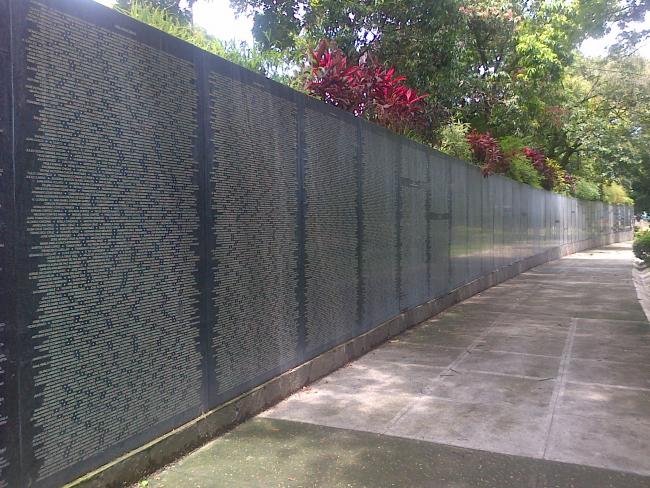
The Memory and Truth Monument commemorating the victims of El Salvador’s violence civil war (Wikimedia Commons)
By Robin Maria DeLugan | NACLA | July 20, 2016
The Salvadoran Supreme Court’s recent decision to overturn the country’s controversial Amnesty Law opens the door to unravel impunity for war crimes during El Salvador’s violent civil war.
On July 11, 2016, in a historic decision, El Salvador’s highest court abolished the amnesty law that has been in effect since 1993. The controversial law was put in place immediately following the signing of the peace accords that ended El Salvador’s brutal 12-year civil war (1980-1992), thus sheltering from prosecution the perpetrators of grave human rights violations committed during the conflict in El Salvador. In a much-anticipated decision, the Constitutional Supreme Court declared that amnesty law unconstitutional because it impeded the state’s obligation to investigate crimes against humanity.
An estimated 75,000 civilians lost their lives during El Salvador’s civil war. Some 8,000 were forcibly disappeared, while tens of thousands more were internally displaced or obligated to flee protracted violence. News of brutal atrocities spread across the world. From the high-profile assassination of Archbishop Monseñor Oscar Arnulfo Romero to the merciless slaughter of the entire village of El Mozote, more than 22,000 acts of violence by armed actors of the civil war were recorded by the United Nations Commission on the Truth for El Salvador.
While the state and the oppositional forces of the Farabundo Marti Liberación Nacional (FMLN) both committed abuses during the conflict, the UN-backed Truth Commission attributed 80% of human rights violations to the government of El Salvador. The Truth Commission, while helpful towards recouping the memories of the brutal acts of the war, had no power to enforce, especially against the amnesty law that followed. The amnesty law prevented prosecution and supported continued impunity thus thwarting national efforts for justice and reconciliation.
Over the past 20 years of post-civil war nation-building, government representations of national culture, history, and identity have maintained silence about the atrocities of the civil war. Some officials argued that to do otherwise would threaten the nation’s fragile peace. Others argued that the nation needed to look forward to the future, rather than dwell on the violence of the past. Such arguments justified the amnesty law. Challenging the government’s muteness and combatting public forgetting, civil society actors created two new museums and one major monument in the nation’s capital of San Salvador. Such commemorative sites have played a pivotal role as memory keepers while also helping to sustain the calls for unfulfilled justice.
In the late 1990’s the Museum of the Word and the Image (Museo de la Palabra y el Imagen, MUPI) was established “against forgetting” (contra la desmemoria) with exhibitions and educational activities dedicated to “weaving memory” (tejiendo la memoria). The museum collects and exhibits photographs, manuscripts, audio recordings, and films. Among the collections in the museum archives are photographs of the El Mozote massacre, posters demonstrating the international solidarity for the people of El Salvador and their revolutionary struggle; propaganda used by the Salvadoran government’s armed forces to reduce popular support of the guerrillas; photos about women combatants and the popular schools that were activated in the conflict zones during the war; and information about refugees and their return at to the country after the Civil War. The museum houses the most comprehensive existing archive of materials on the Salvadoran Civil War, maintaining documentation and memory of wartime abuses that the amnesty law sought to shield.
Carlos Henriquez Consalvi, MUPI’s co-founder and director, participated in the civil society collective that erected the Monument to Memory and Truth (Monumento a la Memoria y la Verdad) in San Salvador’s central Parque Cuzcatlán in December 2003. The commemoration site consists of an 85-meter black granite wall etched with the names of more than 24,000 civilian victims. Another portion of the monument contains colorful stucco reliefs, depicting symbols of past social struggles and violence, such as the assassination of Archbishop Romero. Since its construction, the monument has been recognized as a space for hope—and a place for continuing to envision and a more just, humane, and equitable society. In the absence of state recognition of past atrocities, civil society has had to rely on its own resources to recapture the memories and to publicly recognize the war’s many civilian victims.
Meanwhile, the Museum of Art (Museo del Arte, MARTE), which opened in 2003, has relied on private funding to promote and support contemporary art in El Salvador with an expansive collection that showcases the nation’s history. Its permanent exhibition, “Pieces of Identity,” (“Trozos de la Identidad”) includes paintings that represent the history of social movements in the country, as well as the violence associated with the civil war. Among them is “El Sumpul” (1984) by Carlos Cañas. The painting refers to a 1980 military operation in which at least 300 civilians, including many women and children, were assassinated in the River Sumpul in the department of Chalatenango. By displaying “El Sumpul,” MARTE does more than display the historical and contemporary artistic talent of El Salvador; it also tells the history of the nation’s darkest hours and serves as an important guardian of memory.
The abolition of the amnesty law is an important step in the government’s slow process of addressing an important chapter in the nation’s difficult recent past. In 2010, President Mauricio Funes, the first FMLN candidate to achieve the presidency, gained international attention when he issued a state apology for the assassination of Monseñor Romero, as well as an apology for historical and ongoing violence against indigenous populations in the country. In 2012, at an event marking the 20th anniversary of the El Salvador’s 1992 peace accords, Funes also apologized for the atrocities committed at El Mozote. Later that year the Inter-American Court of Human Rights issued a judgment condemning the Amnesty Law for impeding the government of El Salvador’s responsibility to investigate various cases of human rights violations including the case of El Mozote.
In 2013, an international forum at the Universidad de El Salvador’s entitled “Memories of the War: Changes and Continuities in Local Societies at the beginning of the 21st Century” continued the process of recuperating the history and memory of the Salvadoran conflict. In addition to highlighting the growing body of international scholarship on the civil war, the forum announced the creation of the Unit for Investigations about the Salvadoran Civil War within the national university and the decision to dedicate new resources to research about the conflict. These actions of official apology, international involvement, and state-sponsored academic programming made important steps to breaking long-standing official silence and together with other other civil society initiatives, like museums and monuments, promoted new knowledge about the causes and consequences of the civil war.
One of these consequences, of course, is that the civil war brutality has been replaced with other kinds of violence. As has been widely publicized, El Salvador replaced Honduras as the most violence peacetime country in the world in 2015, with homicide rates nearing one homicide per minute in January 2016. Many, including Benjamín Cuéllar, the ex-director of the Instituto de Derechos Humanos de la Universidad Centroamericana, (Institute for Human Rights at the Central American University, IDHUCA,) see a connection between ignoring prosecution of the human rights abuses of the civil war and high levels of postwar violence. As he noted in a recent article in El Diario de Hoy, the impunity that resulted from the amnesty laws has permitted other wars, namely “the war between gangs, the government’s war against gangs, and the war of gangs against the Salvadoran population.” There is hope that addressing past human rights violations will play a role in creating a more just and peaceful society.
The revocation of the amnesty law now makes it possible to pursue justice for civil war wrongs including criminalizing those responsible for the human rights abuses caused by death squads, paramilitary, and security forces. The 73-page court decision lists 32 crimes that occurred between 1989 and1992 that can now be investigated. The list includes the names of members of the military or of the FMLN indicated as having responsibility. In terms of next steps, Romeo Benjamín Barahona Meléndez, ex-Attorney General under former President Mauricio Funes, explained that victims can now formally denounce these past crimes, and the Attorney General’s office will begin investigating the cases.
The court decision, while heralded by many, is causing a commotion within the leadership of the FMLN, the political party that holds executive power in the government. Structurally, whereas the military actors on the list are no longer in the government, investigations could instead lead to trials that involve FMLN leaders, for example the President of the Republic, Vice President, Ministers and Deputies. Some elected officials and government functionaries are openly critical about what will happen next, stating they fear “witch hunts” and the reopening of old wounds. Despite reservations from some in government, the Attorney General’s office appears to have the will to undertake investigations. However, the government lacks resources for the processes, including funds to support the indemnization of the victims who are determined to have suffered “moral damage” (daño moral).
However, should leaders or government actors ignore the ruling, there will undoubtedly be international criticism and a demand for accountability. Sites and practices of public memory in El Salvador have maintained the nation’s focus on civil war human rights abuses and the need for justice for decades. National and international attention created through these efforts contributed to the historic decision to finally revoke El Salvador’s Amnesty Law. These audiences will be carefully monitoring the fresh developments to follow. It is difficult to predict the outcomes of this important court decision. What happens next in El Salvador will be a chapter in an important historical process of nation-building, memory and justice that will provide lessons for other societies pursuing similar struggles against state violence, forgetting and impunity.
Robin Maria DeLugan is Associate Professor of Anthropology at the University of California, Merced. She is the author of Reimagining National Belonging: Post-Civil War El Salvador in a Global Context (University of Arizona Press, 2012).
Another confusing and misleading human rights report by United Nations observers in Ukraine
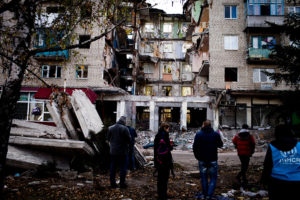
Eastern Ukraine neighbourhood shelled by Ukraine armed forces (UNHCR photo)
By Roger Annis | New Cold War | July 19, 2016
Five days ago, the United Nations Office of the United Nations High Commissioner for Human Rights (OHCHR) released another in a long line of reports purporting to provide an overview of the human rights situation in Ukraine. This latest report is titled “Accountability for killings in Ukraine from January 2014 to May 2016”.
The report is 20 pages long with 31 additional pages of appendix examining “Cases of violations or abuses of the right to life in Ukraine from January 2014 to May 2016”. A press release by the UN body summarizes the content of the report.
The OHCHR report is another outlandish collection of selected facts making a strong inference that a large part of the “abuses to the right to life” it examines are the fault of the Donetsk and Lugansk people’s republics and their self-defense forces.
As with past reports, the OHCHR makes an equivalency between, on the one hand, the governing regime in Kyiv which is bound by all of the international conventions on human rights which previous Ukrainian governments signed onto and, on the other hand, the people’s republics and armed forces of Donetsk and Lugansk which are not so bound. The Donetsk and Lugansk republics cannot sign on to international human rights conventions because they are shunned and unrecognized by most international bodies… including the OHCHR!
At last check, it is not the republics of the former eastern Ukraine which have invaded Ukraine, but Ukraine that has invaded and imposed an ‘Anti-Terrorist Operation’ against the people there. Yet the UN report describes Kyiv’s civil war as a “separatist conflict”.
Adding insult to injury, the UN press release says, “According to the report, the killings are being “fueled by the inflow of foreign fighters and weapons from the Russian Federation”.
The UN report fails to mention that even if such a patently false description of the conflict as being a “separatist conflict” were true, Ukraine is nonetheless duty bound by international convention to protect its nominal citizens and not wage war against them.
The UN report speaks of shadowy “armed groups” in Donetsk and Lugansk who it says are responsible for extra-judicial killings as well as prisoner abuse, torture and killings. Yet when it comes to the extremist and neo-Nazi paramilitaries who are joined with Ukraine’s armed forces in waging civil war, they are given the polite description of “volunteer battalions”. Sounds downright patriotic and heroic!
When it comes to the Kyiv regime itself, the UN report language is all kid glove. For example, in professing concern about the Odessa Massacre of 48 people on May 2, 2014, UN press release writes:
The report also highlighted the violence that took place on 2 May 2014, in Odesa, during which 48 people died as a result of clashes between “pro-unity” and “pro-federalism” groups. OHCHR “remains concerned that the authorities have still not taken appropriate measures to ensure effective investigations into the 2 May 2014 events, nor to protect the independence of the judiciary,” the report said.
On that day in Odessa, nearly all of the victims were peacefully protesting against the coup in Ukraine in February 2014 which deposed the country’s elected president. They were targeted for killing when the trade union building in the center of the city where they had taken refuge from a right-wing mob was set on fire.
Further in the press release we read:
Furthermore, the report found that the lack of accountability remains widespread in Ukraine, despite efforts by the Government [sic] to bring perpetrators from its own ranks to justice and the pre-trial investigations by the Office of the Chief Military Prosecutor into cases of killing, torture and ill-treatment by members of the armed groups of the self-proclaimed [sic] “Donetsk people’s republic” and self-proclaimed “Luhansk people’s republic.”
While acknowledging the challenges faced by the authorities in ensuring justice, including the lack of access to the territories where many of the alleged acts took place, the report noted “an apparent lack of motivation to investigate some cases … especially when it concerns acts allegedly committed by Ukrainian forces.”
What about the Minsk-2 ceasefire agreement, signed by Ukraine on February 12, 2015 and endorsed by no less that the UN Security Council several days later? Not a word of it in the OHCHR press release. In the 20 pages of the report, one finds several references to the need to implement what is called the “Minsk Agreements”, but no detailed description of the content and import of the agreement is provided.
How bad is the official state of human rights in Ukraine? Two months ago, the UN’s Subcommittee on Prevention of Torture took the unprecedented step of cancelling in mid-visit an official visit looking into reported cases of torture by Ukrainian government forces and by rebel authorities in the east. The reason for the cancellation was that Kyiv refused to live up to its obligations under Optional Protocol to the Convention against Torture, an international convention to which a previous Ukrainian government signed on. It requires signators to provide unfettered access to prisons and other places of detention. The subcommittee was intending to investigate reports of secret prisons operated by Ukraine’s police and military services.
Oh, don’t look for information in this latest UN report on the telling experience of the UN’s Subcommittee on Prevention of Torture two months ago. Blank. Apparently, that would be unrelated to “Cases of violations or abuses of the right to life in Ukraine from January 2014 to May 2016”.
Progressive Norman Solomon Joins with Neocon Robert Kagan
By John V. Walsh | Dissident Voice | July 15, 2016
Norman Solomon betwixt the political sheets with Robert Kagan? How could that be? Has our political world turned upside down?
Driving south to Mountain View in my new home state of California, I tuned into KPFA, the Pacifica outlet in the Bay Area. Norman Solomon, longtime prominent figure in Progressive Democrats of America (PDA) and co-founder of “Roots Action” was being interviewed on a program called “Talkies.” Just a few hours earlier Bernie Sanders had endorsed Hillary Clinton, betraying the millions who voted for him (and voted against her) and losing the respect of many millions more.
On air Solomon was commenting on the termination of Bernie Sanders’s milquetoast campaign against Hillary Clinton. And he was contrasting Hillary unfavorably with Bernie in a very detailed way with lots of references to Hillary’s policies. No personality analysis, no psychobabble. He mentioned that perhaps the most prominent neocon these days, Robert Kagan, was supporting Hillary Clinton for President. Yes, the same Kagan who calls for ever more US wars in the Middle East and for confrontation with the second mightiest nuclear power, Russia. Solomon pointed out quite correctly that Kagan had even said that Hillary shared his beliefs, but she would call them something other than neoconservatism.”
Then in almost the next breath Solomon called on Bernie’s followers to support Hillary for President. No, not Jill Stein, but Hillary.
No sooner did he say that than a caller to the show got on air and asked a very pointed question. The caller asked Solomon why he was throwing in with Robert Kagan. Solomon seemed mystified. The caller reminded him that, by his own admission minutes before, he and Kagan were now backing the same candidate – Hillary.
Solomon promptly went berserk. He quickly changed the subject to Trump who was not mentioned by the caller. Moreover, Solomon had no substantive comments on Trump, merely responding with psychobabble that Trump is “crazy.” The KPFA host quickly shut the caller off before he could utter any more heresy. (So much for real discussion on what passes for the media of the left these days.)
It may seem harsh on poor Norm to point out the sleazy company he is now keeping. But facts are facts. Both Norm and Robert Kagan will be supporting Hillary. And the main reason for Kagan’s opposition to Trump is quite clear. Trump is not a reliable warmonger. Thus Trump is a threat to the further depredations of the US Empire and the machinations of Israel which Kagan so loves.
It is fully understandable for progressives to back Jill Stein. It is a morally and ethically defensible position for a progressive – as is staying at home and not voting at all. In that regard the Bernie or Bust people have been right on the money. But backing a mass murderer like Hillary, who is intent on doing more of the same and threatens the whole human race with a bellicosity that may lead on to World War, is not morally defensible.
To be fair to Norm, he was not advocating a vote for Hillary in “safe states,” ie., states where she is sure to win, but “only” in states, where she needs every vote she can get. In other words vote for Hillary wherever your vote will count. Mr. Kagan would certainly rub his bloated hands in satisfaction with Solomon’s recommendation.
Some may feel that this is all very unfair to poor Norm and the many fake “progressive” leaders who will soon join him in embracing Kagan’s candidate, Hillary – if they have not already done so. Watch for other “progressive” leaders to jump on board the Hillary bandwagon in the next few days and weeks. Norm is not alone. Progressives who do not like this kind of thing should speak up now and do so forcefully.
What makes such a position not only unethical but downright criminal is that Hillary has labeled Putin as “Hitler.” You only do one thing with a Hitler. You go to war with him. So Hillary puts the entire human race at risk of nuclear conflict. There is no greater evil than that. Many people not just former DoD capo, William Perry, are pointing out that we are now closer to nuclear conflict than we have been since the Cuban Missile Crisis. And Hillary is the most likely to get us into such an Armageddon.
So Norman, as a leader amongst progressives where are you and others like you taking them?
John V. Walsh can be reached at john.endwar@gmail.com.
Featured Video

Seyed M. Marandi: US-Iran War Inevitable: Kuwait and Bahrain May Fall
or go to
Aletho News Archives – Video-Images
From the Archives
Oil and the Israel Lobby
Reknowned economist M. Shahid Alam offers this excellent critique of Noam Chomsky’s defective analysis of the relative influence of Oil versus the Israel lobby over US foreign policy: … continue
Blog Roll
 Aletho News
- ICC ignored ‘very well-documented’ NATO crimes – ex-Libyan minister
- SNSC secretary dismisses US response to Iran’s conditions as ‘inadequate’
- Sanaa says Taiz roads open, secure for residents, warns Saudi forces
- Iraqi resistance group urges Saudi leadership to admit defeat, lift Yemen siege
- Trump’s Retreat: How Al-Aqsa Flood Took Down the US Empire
- Israel’s Military Actions in Lebanon Grossly Violate International Law — Lavrov
- Seyed M. Marandi: US-Iran War Inevitable: Kuwait and Bahrain May Fall
- Leaders Condemn Ansarallah Attack on Saudi Arabia While Ignoring Illegal War Against Yemen
- Leaked: Britain’s Covert Iraqi Psyops Network
- Yemeni Armed Forces Warn Airlines Against Using Saudi Airports, Exempt Mecca and Medina
- If Americans Knew
- After Oct 7, IDF policy allowed civilian casualties for even the lowest-ranking targets
- Israel’s Destruction of Southern Lebanon Intensified After the Cease-Fire
- The Last-Minute Decision That Gave Israel Its Name
- The American Conservative: How Trump Made the World Go Nuclear
- Meet the US generals and admirals advancing Israeli policy
- Opinion: Why news organizations should boycott Israel
- The Israeli witch hunt of Sami Abu Shehadeh exposes the lie of the ‘Jewish and democratic’ state
- No state has a ‘right’ to exist – least of all Israel
- Testimonies about Gaza’s civilian death toll expose Israel’s atrocities – Daily Update
- How Israel Conquered the Latin American Right
- No Tricks Zone
- New Study Suggests Large Regions Of The Pacific Ocean Have Been Cooling For The Last 80 Years
- Germany’s Green Energy Debacle: High Energy Costs Force Kahla Porzellan to Close After 182 Years!
- New Study: 50 Years Of The Most Aggressive ‘Net Zero’ Policies Can Only Affect The Global Climate By 0.03°C
- US September “Heat” Was No Record…Many Records Set Decades Ago
- Latest European Green Energy Debacle; Portugal’s Largest Flagship Solar Park Insolvent!
- Green Energy Debacle: German Expert Professor Fritz Vahrenholt Warns Of Severe Economic And Social Consequences
- Two More Paleo Reconstructions Affirm Meters-Higher Sea Levels Across Ireland, Brazil 7000-6000 Years Ago
- New Study: Earth And Venus Surface Warmth Largely Explained By Convection And Lapse Rate, Not CO2 Or Radiation
- 2025 Nature Paper Claiming Worsening Global Drought Gets RETRACTED …Heavily Flawed
- New Study: ‘Global Drought Shows No Detectable Recent Acceleration Under Climate Warming’

