Kaja Kallas is ill-equipped to take stock of EU foreign policy after Zelensky’s drubbing in the White House
By Ian Proud | Strategic Culture Foundation | March 4, 2025
Now that Zelensky has been battered by Trump and abandoned by Starmer, he can fall back of Europe’s leading diplomat, Kaja Kallas. God help us all.
The earth is still shaking from President Trump and Vice President Vance’s tag team annihilation of Volodymir Zelensky at the White House. The 27 February meeting between Trump and Keir Starmer was a more convivial affair, with the British Prime Minister quiet on Ukraine while promoting the idea of much prized trade talks with America. That was the first signal of the UK getting real about its foreign policy disaster in Ukraine and recognising that it needs trade with America far more than it needs the huge cost of propping up an unwinnable war.
This leaves Zelensky’s fate in the hands of the European Union. And with Kaja Kallas, the current EU High Representative for Foreign Affairs and Security Policy, the omens aren’t promising.
Kallas’ problem is threefold.
First, she is not diplomatic.
If the biggest foreign policy challenge in Kallas’ in-tray right now is the war in Ukraine, then her ingrained hatred of Russia makes her a singularly bad choice as Europe’s lead diplomat.
Her worldview is carved out of her experience growing up in the Soviet Union the child of a woman who was deported to Siberia in 1949. She looks at Russia through a shattered lens of Estonia’s suffering during the so-called communist terror after the end of World War II.
How she sees events in Ukraine today is simply a continuum of the folklore of her life. Russia is the hated enemy, and, at some point, Russia will return to conquer Estonia once more. In her statements before war in Ukraine started, Kallas reaffirmed her view that Estonia could be the next country that Russia invades. As a NATO country, I have never seen any evidence that Russia has a plan to do this.
Kallas has called for NATO troops to be deployed to Ukraine, to ensure Russia’s total defeat. She has suggested that Russia be broken up into a series of smaller states. She once implied that Ukraine should inflict more civilian casualties on Russian citizens, to balance the number of casualties in Ukraine. Even as President Trump has said that NATO membership for Ukraine is unrealistic, she has continued to push for this to be kept on the table, despite it having been a redline for Russia for nineteen years.
Almost everything that she says is rooted in her unshakeable belief that defeating Russia is vital for the world to become a safer place.
The world is full of extremists, of course. However, she claims to be the leading diplomat of Europe. She seems singularly ill-suited to that role. But will nonetheless still support Zelensky, I’m sure.
Which ushers in her second problem, the absence of a democratic mandate.
Countries that are sceptical about the European project often express concerns about the lack of democratic accountability of EU institutions.
No one voted for Kallas to occupy her office in Brussels. While Zelensky has only been unelected since May of 2024, Kallas will only ever be an unelected apparatchik.
When the European Union’s role was focussed on creating a united economic, social and cultural space among nations after the ravages of World War II, it found peace by opening up borders. However, as it has grown, Europe has become increasingly bureaucratic. Following agreement of the Lisbon Treaty, the creation of a High Representative for Foreign Affairs and Security with a newly formed European External Action Service, continued this centralising trend.
Without any democratic mandate, occupants of the High Representative role have struggled for relevance. Outside of trade policy, individual Member States still manage their own bilateral diplomacy. And as the war in Ukraine has backfired on Europe through economic decline and political dissent, so Europeans countries have sought their divergent paths.
That has left ineffectual figures like Josep Borrel and ideologues like Kallas unable to play the sort of coordinating role that they yearn for.
So, in practice, Kallas’ influence on the actions of Member States is limited, although she has considerable power to cause harm through inflammatory public statements. This is a huge challenge when dealing with countries like Russia, where the leaders there understand fully the limitations on Kallas’ role and ignore her. Instead, Russia focusses its influencing efforts on key EU members states, especially in Central Europe.
Even though Kallas can call for the continued isolation of Russia as support for Zelensky rapidly crumbles, she has no real power to enforce that. She lacks a mandate.
So herein lies her third problem.
Kaja Kallas has no strategy.
There is a huge risk that Kallas is seen as a single-issue High Representative, as her main effort appears to be on the war in Ukraine.
She appears intent only on sustaining the decade-long European zeitgeist on non-engagement with Russia, whatever the economic cost. But in that regard, not only is she not bringing new ideas on foreign policy, her lack of flexibility will make her look out of touch at a time when Europe is facing significant economic and political challenges caused by the war. Arriving into the job in December, Kallas has brought plenty of heat, but no light.
Donald Trump has now arrived heralding a seismic shift in U.S. policy and she still thinks the earth is flat. She has criticised President Trump’s radical shift towards direct engagement with Russia without offering a compelling alternative vision.
The ‘Russia is coming for Europe next’ continues to be the rhetorical life-raft that she clings to as she tries desperately to help the now stranded Zelensky fight to the last Ukrainian.
Kallas is certainly not the author of the EU policy that has tried explicitly to isolate Russia on the world stage. But she has worked tirelessly to keep it alive, together with all the other tropes about how to handle Russia and why an end to the war can never be contemplated.
Of course, that position may have been sustainable while Joe Biden was still in power and the U.S. were arguably more gung-ho about pushing an unwinnable war in Europe.
But Donald Trump’s devastating take-down of Zelensky in the White House will force an immediate reckoning on the European policy establishment about what to do for Ukraine, and for Zelensky. Kaja Kallas has neither the skills, the mandate nor the plan to chart a credible way forward.
Israel deliberately targeted archaeological sites in Gaza, Palestinian minister says
MEMO | March 3, 2025
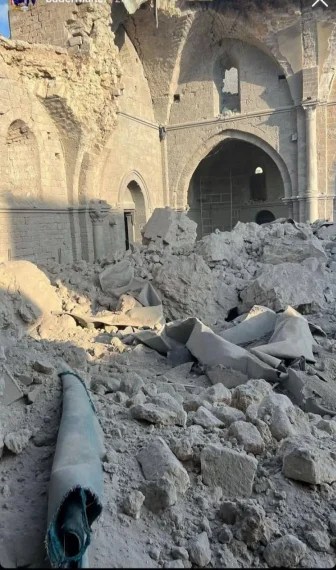 Israel “deliberately” targeted archaeological sites in Gaza during more than 15 months of war, Palestinian Minister of Tourism and Antiquities, Hani Al-Hayek, said yesterday. He went on to describe Israel’s actions as a genocide.
His remarks came during the closing session of a training workshop in Cairo, organised by the Palestinian Centre for Cultural Heritage Preservation (CCHP) in cooperation with the Egyptian Heritage Rescue Foundation (EHRF), according to the official Palestinian news agency, Wafa.
During the workshop, Al-Hayek pointed out that “more than 226 archaeological and historical sites in Gaza have suffered severe damage,” adding that work is underway to develop a comprehensive action plan to rescue and restore the cultural heritage in the region.
He added: “The Israeli occupation deliberately targeted archaeological sites in Gaza, but we are determined to rebuild and restore them. These sites are an important part of the history of the Palestinian people on this land, and it is our duty to return them to their former state.”
On 6 February, French archaeologist Simon Brelaud warned that the Israeli occupation army had destroyed most of Gaza’s historical landmarks, stressing that this “puts the future of archaeology in the region at risk.”
Gaza is an ancient region that has witnessed several civilisations, including the Pharaonic, Greek, Roman, Byzantine, Canaanite, Phoenician and finally, Islamic.
Hamas decries as ‘war crime’ Israeli suspension of humanitarian aid to Gaza
The Cradle | March 2, 2025
Israel has accepted a proposal brought by US envoy Steve Witkoff to extend the first phase of the Gaza ceasefire and prisoner exchange agreement for another 42 days, facing rejection from the Hamas movement.
As a result of Hamas’s rejection – which stems from the resistance movement’s insistence on abiding by the terms of what was initially agreed upon – Israel announced on 2 March that it halted the entry of aid and supplies into the Gaza Strip.
“With the end of the first stage of the prisoner swap deal and following Hamas’ rejection of Witkoff’s proposal to continue negotiations – which Israel agreed to – Prime Minister Netanyahu has decided to halt all imports of goods and supplies to the Gaza Strip as of today,” said the office of Israeli Prime Minister Benjamin Netanyahu in a statement.
“Israel will not allow a ceasefire without the release of its prisoners. If Hamas continues to refuse, there will be further consequences,” the premier’s office added.
The extension deal agreed to by Netanyahu calls for the release of half of the estimated 22 living captives in Gaza, in exchange for Palestinian prisoners.
According to Netanyahu, the Witkoff plan gives Israel the right to resume the war after the 42-day extension if talks do not progress. Israel’s Channel 12 reported that the prime minister has approved a potential call-up of 400,000 reserve soldiers.
“The decision we made last night to completely halt the entry of humanitarian aid into Gaza until Hamas is destroyed or surrenders completely and all our hostages are returned is an important step in the right direction— ‘standing at the gates of hell,’” said Israeli Finance Minister Bezalel Smotrich.
“Now, we must open these gates as quickly and as lethally as possible against the cruel enemy until absolute victory,” he added.
Israeli opposition leader Yair Lapid blasted the government’s decision.
“The prisoner exchange deal has been halted. Humanitarian aid to Gaza has been stopped. The government has approved the mobilization of 400,000 reserve soldiers. What is the goal? What objective has Israel set for itself? Has the government decided to abandon the prisoners, and if so, why? For what greater national purpose? If we return to war, what is the objective of the war? Who will replace Hamas in the end?” Lapid said.
“Once again, the government is acting without a plan, without a vision. We can only hope things turn out okay—because that seems to be the extent of their planning.”
Phase one of the Gaza ceasefire was due to end on Saturday. Israel has been pushing for the extension in recent days and has continuously delayed the start of negotiations for the second phase, violating the original ceasefire agreement.
“The statement issued by the office of the terrorist occupation Prime Minister Netanyahu, regarding his approval of American proposals to extend the first phase of the agreement under arrangements that violate the ceasefire agreement in Gaza is a blatant attempt to evade the agreement and avoid entering negotiations for its second phase,” Hamas said in a statement.
“Netanyahu’s decision to halt humanitarian aid is a form of blackmail, a war crime, and a blatant violation of the agreement,” it went on to say.
Since the morning of 2 March, Israeli attacks on Gaza have killed at least four Palestinians. Israel has been violating the ceasefire daily since it was reached in January, carrying out deadly attacks and consistently holding up the entry of aid and essentials into Gaza.
Ukrainian attack on TurkStream threatens Hungary’s sovereignty – FM
RT | March 1, 2025
Hungarian Foreign Minister Peter Szijjarto has condemned a recent drone attack on a compressor station of the TurkStream gas pipeline, labeling it an assault on his nation’s sovereignty due to the conduit’s critical role in its energy security.
Szijjarto’s comments came on Saturday after the Russian military reported thwarting a Ukrainian drone attack on the Russkaya compressor station on Friday night. This station is a critical facility for the TurkStream, also known as Turkish Stream, pipeline in Russia’s Krasnodar Region, serving as the point of exit on Russian soil for gas deliveries. The Defense Ministry stated that three drones were neutralized by air defense systems, preventing any damage to the station’s operations.
“The Turkish Stream pipeline is the guarantee of Hungary’s natural gas supply security; therefore, any potential disruption would seriously jeopardize our energy security,” Szijjarto wrote on Facebook. “Energy security is a matter of sovereignty, and therefore this type of attack should be considered an attack on sovereignty.”
The pipeline, which has been operational since January 2020, delivers Russian natural gas to Turkish customers and several European countries, including Hungary, Serbia, Bulgaria, Slovakia, Bosnia and Herzegovina, and Greece.
The Hungarian minister also called on the European Commission to clarify its stance on the matter, reminding it of its recent assurance that Ukraine would not target EU-bound infrastructure.
Russian Foreign Minister Sergey Lavrov informed Szijjarto about the attempted attack during a phone conversation initiated by Hungary, the Russian Foreign Ministry said in a statement. He explained the incident and its implications for the pipeline’s security.
The incident is not the first involving the facility. Back in January, Ukrainian forces attempted to attack it with nine kamikaze drones, according to the Russian military. All of the UAVs were intercepted, but debris from the explosions caused minor damage to the station.
Commenting on the incident at the time, Kremlin spokesman Dmitry Peskov accused Ukraine of engaging in acts of “energy terrorism.”
Israel pushes for six week ‘extension’ of Gaza ceasefire’s phase one
The Cradle | February 28, 2025
An Israeli delegation in Cairo is negotiating with mediators a potential extension for the first phase of the Gaza ceasefire agreement, according to Egyptian security officials cited by Reuters on 28 February.
“Hamas opposes the extension and insists on proceeding to the second phase of the deal as originally agreed,” the sources said. They added that Tel Aviv seeks to extend the first phase for another 42 days.
Israeli sources had previously told the British news outlet that Tel Aviv sought an extension and the release of three Israeli captives per week in exchange for Palestinian prisoners held in Israeli prisons.
According to a military source cited by Times of Israel, Tel Aviv “still prioritizes dismantling Hamas’s ability as an authority in Gaza.”
Hamas released a statement on Friday confirming “its full commitment to implementing all the terms of the agreement in all its stages and details.”
“We call on the mediators, guarantors, and the international community to pressure the Zionist occupation to fully commit to its role in the agreement and immediately enter the second phase of it without any hesitation or evasion,” it added.
US envoy to the region, Steve Witkoff, is expected to travel to Israel on Sunday to negotiate an extension of the first phase of the ceasefire deal, which ends on 2 March. Tel Aviv has continuously delayed talks for phase two of the agreement.
Israel recently imposed new conditions on the Gaza ceasefire agreement, demanding a full disarmament of Hamas’s military wing.
According to reports, Israel is looking to violate the deal by maintaining its military presence along the Philadelphi Corridor on southern Gaza’s border with Egypt.
Israel’s Defense Minister, Israel Katz, said on Thursday that the corridor will remain “a buffer zone just as the case is in Lebanon and Syria.” Tel Aviv is also reportedly planning for a resumption of its brutal war against Gaza
A recent report by Haaretz says that “as far as [Israeli Prime Minister Benjamin] Netanyahu is concerned, there is no second stage” of the deal.
The report says Israeli Minister of Strategic Affairs Ron Dermer recently told Witkoff that Netanyahu’s plan is to secure the release of all captives in a single stage, and that Hamas will receive prisoners in exchange. Otherwise, “Israel will return to intense warfare” and reimplement a “version” of the Generals’ Plan – which saw the expulsion of hundreds of thousands of Palestinians from north Gaza, the killing of thousands, and the destruction of the Gaza health sector.
Microsoft employees removed from town hall for protesting AI contracts with Israeli military
MEMO | February 27, 2025
Website Publishes List of Canadian Israelis who Served in the IOF
Al-Manar | February 27, 2025
The non-profit news website The Maple published a list of 85 Canadians with Israeli citizenship who have served in the Israeli occupation army.
The website announced that this is the initial list and that it intends to publish additional lists of additional Canadians that have joined the Israeli military.
The article, entitled “Meet 85 Canadians That Have Fought For Israel,” featured in online publication The Maple provides a link to the list.
According to the article, its purpose is to provide a database of “mini-profiles for as many Canadians that have fought in the Israeli military at any point as I could find,” said its author, because “there is little existing research in Canada beyond one-off news articles about who these soldiers are and how they came to make the life choices that they did.”
The list has sparked anger by Israeli circles, with Israeli Channel 14 describing the move a “scandal”.
“I don’t think it’s an acceptable thing to happen in Canada,” Rebecca Garner, who served in the IDF from 2011 to 2014, and whose name was enrolled in the list, told the National Post, a Canadian English-language broadsheet newspaper.
Israel says army to stay ‘for next year’ in Palestinian refugee camp in occupied West Bank
MEMO | February 23, 2025
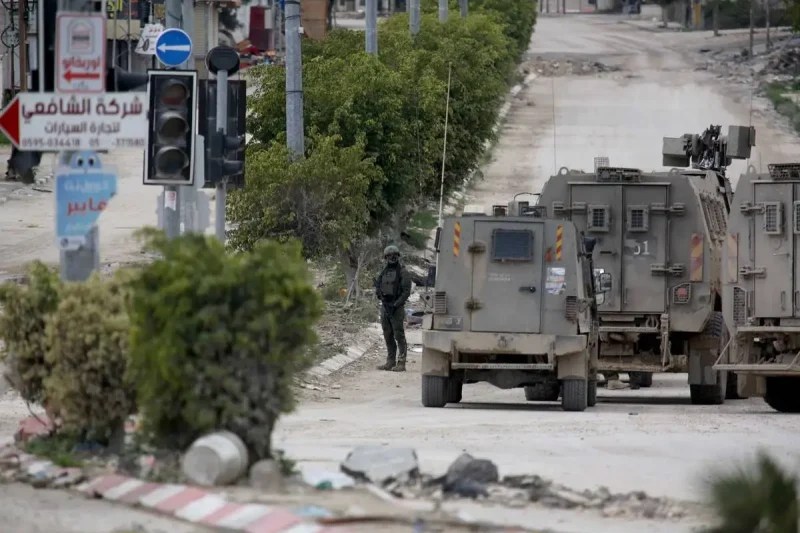
Israeli Defense Minister Israel Katz said Sunday that the army will remain in Palestinian refugee camps in the northern West Bank for the next year to prevent Palestinian residents from returning, Anadolu reports.
The Israeli army deployed tanks in the northern West Bank early Sunday, marking the first time since 2002 amid military escalation in the occupied territory.
“The Israeli army is expanding its operations in the northern West Bank, and starting tonight, it will also operate in the town of Qabatiya,” Katz said in a statement.
The defense minister said 40,000 Palestinians have been evacuated from Jenin, Tulkarem, and Nur Shams refugee camps.
“UNRWA activity in the camps has also been stopped,” he said. “I instructed the IDF (army) to prepare for a long stay in the camps that were cleared, for the coming year, and not allow residents to return.”
The army has been conducting military operations in the northern West Bank since last month, killing at least 60 people and displacing thousands.
The raids were the latest in Israel’s ongoing military escalation in the West Bank where at least 923 Palestinians have been killed and nearly 7,000 injured in attacks by the Israeli army and illegal settlers since the start of the onslaught against the Gaza Strip on Oct. 7, 2023, according to the Palestinian Health Ministry.
The International Court of Justice declared in July that Israel’s long-standing occupation of Palestinian territories is illegal, demanding the evacuation of all settlements in the West Bank and East Jerusalem.
BBC blasted for pulling documentary on Gaza children after Israel lobby pressure
Press TV – February 21, 2025
The BBC has faced significant criticism after removing a documentary about Palestinian children in the Gaza Strip from its iPlayer platform.
The documentary, titled, “Gaza: How To Survive A Warzone,” came under intense scrutiny after it was revealed that one of the featured children, 13-year-old Abdullah Alyazouri, was the son of Dr. Ayman Alyazouri, a deputy minister in the government in the coastal territory.
The territory is ruled by the Palestinian resistance movement Hamas, which has historically defended it in the face of deadly Israeli atrocities, including the regime’s recent 15-month-plus-long war of genocide that has claimed the lives of more than 48,300 Palestinians, mostly women and minors.
The BBC’s decision to pull the documentary followed mounting pressure from pro-Israeli advocates, including the Israeli ambassador to the UK, and statements from British government officials, including Culture Secretary Lisa Nandy, who had indicated she would be engaging in discussions with the BBC over the matter.
While the BBC stated it was conducting “further due diligence” on the production, the decision has sparked a fierce debate over media impartiality and the portrayal of Palestinians in the United Kingdom and its various apparatuses.
The British broadcaster said the film “features important stories” about the experiences of children in Gaza, which had to be told, but added that the documentary would not be available on iPlayer while the so-called review was ongoing.
The uproar intensified when it was revealed that the documentary’s minor narrator, Abdullah Alyazouri, was the Palestinian official.
According to reports, Dr. Ayman Alyazouri, deputy minister of agriculture in Gaza, had an academic and professional background that included working with the United Arab Emirates’ government and studying at British universities.
The information prompted a group of 45 Jewish journalists, including former BBC governor Ruth Deech, to send a letter demanding the removal of the documentary, labeling Alyazouri as a “terrorist leader.”
Many, however, have come to the defense of the documentary.
Chris Doyle, director of the Council for Arab-British Understanding (CAABU), expressed regret over the BBC’s decision, calling it “a shame” that the documentary was removed under pressure from anti-Palestinian activists who, he argued, had shown little empathy for the suffering of Palestinians in the coastal sliver.
Doyle emphasized that the film offered “valuable insights into what life is like in this horrific warzone” and praised its high-quality production, urging the broadcaster to reinstate the documentary as soon as possible.
The controversy also raised alarms about the BBC’s editorial independence.
Prominent film-maker and journalist Richard Sanders, who has worked on documentaries about Gaza for Qatar’s Al Jazeera television network, called the move a “cowardly decision.”
He warned that if the BBC caved in to pressure from pro-Israeli lobbyists, it would set a “dangerous precedent” for how Palestinian stories were covered in the media.
The film, which depicts the realities that are faced by Palestinian children living under the constant threat of Israeli bombardments, has been described as a means of “humanizing” the plight of the youngest victims of Israeli aggression.
The controversy comes as Gaza continues to endure a humanitarian crisis exacerbated by the Israeli regime’s incessant violations of ceasefire agreement that is supposed to end the genocidal war and a stifling siege imposed by Tel Aviv.
Since the beginning of the siege, thousands of Palestinian civilians, including children, have lost their lives, while many others suffer from severe shortages of food, water, and medical supplies, prompting international human rights organizations to describe the situation there as among the worst in the world.
As part of an ongoing campaign to silence Palestinian voices and diminish international sympathy, pro-Israeli figures, however, have often targeted media coverage that potentially portrays Palestinians in a humanizing light, including in the context of Gaza’s children.
These efforts are seen by many as part of a broader strategy to shield the regime from scrutiny over its barbaric violations across the Palestinian territories.
West should repair oil infrastructure damaged by Ukraine – Putin

FILE PHOTO: A gas turbine produced by the German company Siemens © Global Look Press / IMAGO / Christoph Reichwein
RT | February 18, 2025
Repairs to an oil pumping station in southern Russia damaged by a Ukrainian drone strike on Monday should be covered by the facility operator’s Western co-owners, President Vladimir Putin has suggested. The infrastructure is operated by the Caspian Pipeline Consortium (CPC), which is partly controlled by US and EU companies.
The station was attacked on Monday by at least seven Ukrainian drones, Russia’s deputy prime minister and former energy minister, Aleksandr Novak, told Putin during a government meeting on Tuesday. The strike damaged some critical components, prompting its operators to resort to a reserve pumping scheme and slash capacity by 30-40%, the official said.
According to Novak, restoring the station’s full capacity would require “major repairs” since it used Western equipment, including from Germany’s Siemens, which has previously refused to supply equipment for Russian gas pipelines, citing sanctions. Repairing the facility could, according to Novak, take “quite along time.”
The Western CPC shareholders are also taking part in the damage assessment, Novak said, adding that the list of consortium members includes US giants Chevron and ExxonMobil.
The Russian president responded by saying that the Western companies should facilitate the repairs at the station and provide all the necessary equipment.
“Since they [the Western companies] are … interested in restoring the facility’s operational capacity, then let them arrange for the necessary equipment delivery despite all the sanctions,” Putin said. He pointed out that the CPC shareholders would be doing that “for their own benefit” anyway. Moscow should also provide all the assistance that is necessary, he added.
The Kropotkinskaya pumping station is located in the Russian Krasnodar Region, some 230 kilometers from the port city of Novorossiysk. It is a part of a pipeline project that transports oil from western Kazakhstan along with Russian products. US companies controlled some 40% of oil supplies shipped via the pipeline in 2024.
Former Russian President Dmitry Medvedev called the strike an attack against US companies, the global oil market, and US President Donald Trump’s agenda. On Tuesday, Novak also described the attack as Kiev’s “response” to the US desire to engage in dialogue with Moscow.
Less than 7% of pre-conflict water levels available in Gaza, Oxfam warns
MEMO | February 18, 2025
Israel has destroyed 1,675 kilometres of water and sanitation networks in Gaza leaving a “dangerously critical” situation for Palestinians in the enclave, Oxfam warned yesterday.
“In North Gaza and Rafah governorates, which have suffered the most destruction, less than seven per cent of pre-conflict water levels is available to people, heightening the spread of waterborne diseases,” it added.
Warning against a restart of bombing, Oxfam said: “Any renewed violence or disruption to fuel and the already inadequate aid would trigger a full-scale public health disaster.”
Oxfam’s Humanitarian Coordinator in Gaza, Clemence Lagouardat, said: “Now that the bombs have stopped, we have only just begun to grasp the sheer scale of destruction to Gaza’s water and sanitation infrastructure. Most vital water and sanitation networks have been entirely lost or paralyzed, creating catastrophic hygiene and health conditions.”
In the North Gaza governorate, almost all water wells have been destroyed by Israeli occupation forces. Over 700,000 people have returned to find entire neighbourhoods wiped out. For the few whose homes remain standing, water is non-existent due to the destruction of rooftop storage tanks, Oxfam explained.
In Rafah, over 90 per cent of water wells and reservoirs have been partially or completely damaged, and water production is less than five per cent of its capacity before the conflict. Only two out of 35 wells are currently operational.
Oxfam added that “Despite efforts to resume water production since the ceasefire, the destruction of Gaza’s water pipelines means that 60 per cent of water is leaking into the ground rather than reaching people.”
The lack of safe water, combined with untreated sewage overflowing in the streets has triggered an explosion of waterborne and infectious diseases. According to the World Health Organisation (WHO), 88 per cent of environmental samples surveyed across Gaza were found contaminated with polio, signalling an imminent risk of outbreak. Infectious diseases including acute watery diarrhoea and respiratory infections – now the leading causes of death – are also surging, with 46,000 cases, mostly children, being reported each week.
Lagouardat said: “Israel continues to severely impair critical items needed to begin repairing the massive structural damage from its air strikes. This includes desperately needed pipes for repairing water and sanitation networks, equipment like generators to operate wells.”
The charity added that its own water pipes, fittings and water tanks had been held up for over six months, they have now been approved for entry into the enclave, however, they have not entered yet.
Featured Video

Racist Seinfeld Dances for Joy as Bibi Unveils His New Map
or go to
Aletho News Archives – Video-Images
TV Drama Review
Japanese drama projects Japan’s wartime atrocities onto Chinese characters

Global Times | October 25, 2026
By portraying Chinese characters as perpetrators of ruthless violence while casting Japanese Self-Defense Forces (SDF) intelligence operatives as defenders, the season 2 of the Japanese drama Vivant has recently drawn criticism from Chinese netizens, who argue that its depiction turns historical reality on its head while ignoring Japan’s wartime atrocities.
The TBS drama series – a spy suspense story in which an alleged unofficial intelligence unit of the SDF operates across the globe — has attracted a passionate fanbase. Its currently airing season 2 opened with a household rating of 18.8 percent, the highest for a TV drama this year, according toa commentary article by Japanese media Toyo Keizai.
What draws attention is the portrayal of the enemies in the series, the article noted. Scenes in which the Chinese organization subjects kidnapped members of the SDF unit to brutal torture are repeated with unrelenting intensity.
It is rare for Japanese TV dramas to explicitly portray a real-life country as the enemy, the article noted.
Japanese Prime Minister Sanae Takaichi also made a reference to the drama, saying that she has been recording Vivant and hopes to binge-watch it over the year-end and New Year holidays, according to Japanese media outlets.
China’s CCTV News report on Sunday revealed that the drama features scenes in which Chinese personnel cut off the fingers of and stab Japanese intelligence operatives in the abdomen. Such acts bear striking similarities to the torture inflicted on Chinese nationals by invading Japanese troops during the World War II.
The drama distorts the truth by attributing these atrocities to modern Chinese characters. Beneath the surface, it subtly glorifies Japan’s cross-border overseas operations, blurs the functional boundaries of the SDF and implicitly promotes an expansionist narrative, per CCTV News. … continue
Blog Roll
 Aletho News
- EU facing trillion-euro debt hole while seeking more cash for Kiev
- How US, Europe, Persian Gulf states exhausted missile stockpiles, splurged billions to defend Israel
- Up in arms… Koreans reject U.S. empire’s plan to make South Korea the next Ukraine
- Iran, Turkey, Pakistan, Saudi Arabia could advance region-led security framework in Tehran: FM spox
- Netizens condemn Japanese drama for projecting Japan’s wartime atrocities onto Chinese characters
- Racist Seinfeld Dances for Joy as Bibi Unveils His New Map
- A West Bank War for Netanyahu’s Election Campaign, Could It Backfire?
- Yemen denounces European Parliament’s ‘hypocritical’ push to blacklist Ansarullah
- Qalibaf: UAE’s UN bid aims to ‘clear the runway’ for ‘Greater Israel’, whitewash genocide
- Pakistan reopens Iran border after boosting security: Report
- If Americans Knew
- An error has occurred; the feed is probably down. Try again later.
- No Tricks Zone
- Sudden Stratospheric Warming, Powerful El Niño Combination May Lead To Extreme Europe Cold, Energy Crisis!
- Two New Studies Find Thwaites Glacier Melt Cannot Be Driven By Human Activity Or A Warming Ocean
- E-Cars Reduce CO2 Emissions By Only 41% Compared To Internal Combustion Engine Vehicles
- Predictions Made By Renowned Climate Professor Over Past Decades Have Been Proven To Be Poor
- New Study Suggests Large Regions Of The Pacific Ocean Have Been Cooling For The Last 80 Years
- Germany’s Green Energy Debacle: High Energy Costs Force Kahla Porzellan to Close After 182 Years!
- New Study: 50 Years Of The Most Aggressive ‘Net Zero’ Policies Can Only Affect The Global Climate By 0.03°C
- US September “Heat” Was No Record…Many Records Set Decades Ago
- Latest European Green Energy Debacle; Portugal’s Largest Flagship Solar Park Insolvent!
- Green Energy Debacle: German Expert Professor Fritz Vahrenholt Warns Of Severe Economic And Social Consequences

