Lebanon: The Paradise from Hell
By Jeremy Salt | American Herald Tribune | August 11, 2020
In the old days there was no more charming city in the eastern Mediterranean than Beirut. Set on a maritime plain with the mountains rising dramatically behind it, the scenery was magnificent, the culture charming, the people hospitable and the city rich in history.
Unfortunately, however, Lebanon’s prime geographical position sucked the country and its capital into the vortex of regional and international politics from the 19th century onwards. Sectarianism and the inability of the people to put the interests of their country ahead of their faith dragged it further down. There was no more potent weapon in the armory of scheming outside powers than this massive fault line running through Lebanese society.
Seizing Syria after the First World War, Britain and France chopped it up. Britain gave Palestine – southern Syria – to the Zionists. France kept the rest. In 1918 it occupied Beirut, with the support of the Maronite Christians and against the opposition of the Muslims. Moving across the mountains, it occupied Damascus after defeating a Syrian national force at Khan Maysalun, in the anti-Lebanon mountains about 25 kilometers from Damascus, in July 1920.
In October 1920 France separated Mt Lebanon and the maritime plain from the Syrian hinterland to create the republic of Grand Liban. Its strategic object was to cut a large segment of Syria’s Christians, the Maronites, off from the Syrian hinterland (which it then proceeded to divide even further along sectarian lines). Historically aligned culturally with France and the ‘west,’ the Maronites were hostile to what they saw as a Sunni Muslim-inflected Arab nationalism. In what they perceived as their own interests, they could be counted on to further French interests in the Near East.
Their sympathy for zionism reached the point in May, 1946, when the Maronite Patriarch, Antoine Arida, signed a ‘treaty’ with the Jewish Agency in which he acknowledged all core zionist claims, including the allegedly historical link with Palestine, the ‘right’ to open immigration “and independence” in a Jewish state. This ‘treaty’ was no more than the patriarch’s personal initiative, but it did represent broad Maronite identification with Zionism as an equally vulnerable minority presence in the Middle East.
As established under French supervision, the 1926 constitution describes Lebanon as “Arab in its identity and affiliation.” Elections to the Chamber of Deputies were to be held on a “national non-confessional basis” but at the same time – more than somewhat contradictorily – there was to be equal representation of Muslims and Christians in Parliament and proportional representation of the confessional groups within the two broader Muslim and Christian communities. The president was to be elected on the basis of two-thirds majority support in the Chamber.
In 1943 with Vichy France defeated in Syria and with Lebanon looking ahead to the end of the mandate, its Muslim (Sunni and Shia) and Christian leaders met to discuss what next. President Bishara al Khuri and Prime Minister Riad al Sulh fashioned the ‘national pact’ which has underpinned Lebanon’s ‘confessional democracy’ ever since. Broadly, Lebanon would remain only “affiliated” to the Arab world (rather than part of it) in return for a Christian pledge not to seek support from the ‘west.’
In its executive and parliamentary makeup, the president of the republic would always be a Maronite, the Prime Minister a Sunni Muslim, the speaker of the Chamber of Deputies a Shia Muslim, the deputy Prime Minister and deputy speaker of the Chamber a Greek Orthodox and the army chief of staff a Druze. Parliament would be elected on the basis of a 6-5 Christian-Muslim majority, this sectarian allocation of power applying across all state institutions.
Even by the 1930s it was doubtful that Lebanon had a Christian majority. It is for this reason that a census had not been held since. The Maronites would certainly not want to be confronted with the statistical proof of their shrunken minority status. On the available evidence now a census would show that the population is about 60 per cent Muslim, about evenly divided between Sunni and Shia. Of the 36 per cent of the Christian population, the Maronites account for perhaps 21 per cent. Talk of ‘Christian Lebanon’ is obviously misleading when the buk of the population is Muslim. Not only that, there is no consolidated Christian view, politically or religiously. Each confessional group has its own liturgies and political interests. The Maronites also have a long history of fighting savagely among themselves.
No Lebanese wanting to live in a proper democracy could possibly support the ‘confessional’ formula but with some modifications it has prevailed to the present day. It is the seedbed of all Lebanon’s problems. It has engendered corruption, endless feudal bargaining between the zaims – the sectarian political leaders – and it has kept Lebanon permanently open to meddling from outside.
Under British pressure the French finally withdrew from Lebanon in 1946. Lebanon’s first civil war had been fought in 1860s and the second was soon to come. In 1958 President Camille Chamoun abrogated the national pact by calling for western intervention to suppress the rising tide of support in Lebanon for Egypt’s President Gamal abd al Nasir. US marines landed on Beirut’s beaches from the Sixth Fleet but on this occasion the zaims managed to settle their differences themselves.
The third civil war followed in 1975 and lasted until 1989. Although sectarian affiliations would decide who died and who lived, the trigger for this conflict was the Palestine question. Driven out of their country in 1948, Palestinians flooded into Jordan, Syria and Lebanon, whose rickety social and political fabric could not withstand the pressure of this extra burden and finally collapsed.
Outside intervention in 1976 by Syria (at the request of the Arab League) and interference by the US and Israel turned Lebanon yet again into the epicentre of a regional and international power struggle. Tens of thousands of Lebanese died, with Israel’s invasion of 1982 alone ending the lives of about 20,000 people.
Succeeding in driving out the PLO, the Israeli invasion was the catalyst for the rise of a far more dangerous enemy, Hizbullah. By 2000 it had driven Israel out of southern Lebanon by standing firm in the war of 2006, so that zionist ground forces were unable to capture villages even a few kilometres from the armistice line, it again imposed humiliation on the enemy. Since then many of Israel’s senior political and military figures have warned that in the next round they will destroy Lebanon entirely, driving it back to the Stone Age or the Middle Ages, as they say. This is their ‘Dahiyya strategy,’ named after their widespread aerial destruction in 2006 of a largely Shia southern Beirut suburb of that name.
Spying for Israel
There is a chilling parallel between the port explosion and an event not nearly so destructive in damage and loss of life but the equivalent in its impact on Lebanon’s Lebanese social and political structure. This of course is the assassination of former Prime Minister Rafiq Hariri in February, 2005. Because of his sometimes difficult relationship with the Syrian government, it was Syria that was immediately blamed by Hariri’s son Saad, by Maronite Christian political factions and by ‘western’ governments. Syria was driven into a corner and forced to withdraw its remaining troops from Lebanon. They were few in number and stationed well away from the capital but the government in Damascus was humiliated internationally.
Four ‘pro-Syrian’ Lebanese army generals were arrested on August 30, 2005, and held in custody by the government for four years without being charged before being handed over to the UN-appointed Special Tribunal for Lebanon, which immediately released them for lack of evidence. The tribunal was established in 2009 on the basis of an agreement between the UN and the government of Lebanon but was never ratified by Lebanon’s Chamber of Deputies
In 2010 Hariri’s son, Saad, Prime Minister since November, 2009, admitted that he was wrong in accusing Syria: the charge had been “politically motivated” and the tribunal misled by false testimony against the four generals. Without apologizing or explaining how it came to be deceived, the tribunal proceeded in 2011 to lay charges of conspiracy to murder against four men linked with Hizbullah, Mustafa Amine Badreddine, Salim Jamil Ayyash, Hussein Hassan Oneissi and Assad Hasan Sabra.

*(Mustafa Amine Badreddine)
Badreddine was a cousin of Imad Mughniyah, a senior Hizbullah figure assassinated by Israel in Damascus in 2008. Badreddine himself was killed by an explosion near Damascus airport in 2016 but by that time another name had been added to the Special Tribunal’s list of accused, Hassan Habib Merhi, charged in 2012. These suspects are all being tried in absentia. Hasan Nasrallah says the charges are a politically motivated fabrication and that wherever they are, the men will never be handed over by Hizbullah.
The first important point to be made about the Special Tribunal is that it never canvassed the range of possible suspects. Against their record of extreme violence in Lebanon, the US and Israel would have to be high on the list of suspects but they were not even considered. The tribunal went straight for Syria and when that collapsed it went straight for Hizbullah.
On October 27, 2010, three of its agents went to Dr Iman Charara’s obstetrics clinic in Dahiyya, apparently with her prior approval but not with Hizbullah’s. Given the destruction of Dahiyya by Israel in 2006, this was understandable: Hizbullah had to be watchful about who was coming and going in the suburb. At the clinic the agents demanded the phone numbers and addresses of 17 patients dating back to 2003. They would all be the female relatives of Hizbullah members, but whoever they were, Dr Charara would have been violating doctor-patient confidentiality by surrendering this personal information.
Inside the clinic women waiting for their consultation physically attacked the three agents, calling them Israelis and Americans and seizing a computer, notebooks, a cell phone and other material, all later returned. (According to one account, largely based on the sight of a large hand, some of the women were actually men.)
The Special Tribunal made other extreme demands. It demanded and was apparently given access to the data base of all students at private universities from 2003-2006 but was blocked when it sought the fingerprints and passport details of all Lebanese along with all telephone and DNA records.
The second important point to be made about the tribunal is that its evidence is circumstantial and heavily based on totally compromised mobile phone calls. By the time of Hariri’s assassination, Israel had long since penetrated Lebanon’s two main telecommunications providers, with agents inside providing it with data that allowed it not just to monitor phone calls but to fabricate them.
In 2010, 50 employes of the Alfa state telecommunications company were arrested and charged with spying for Israel. They included two senior technical figures, Charbel Qazzi and Tariq Raba’a. In his confession Qazzi said he had first been contacted by Mossad in the 1990s. He had access to all passwords needed to enter mobile network computer systems remotely or online. These he had handed to Israel.
Raba’a was recruited by Mossad in 2001. He gave Israel full details of Lebanon’s mobile network plus the names of all Alfa employes. Israel’s infiltration included the tampering with BTS (base transceiver station) towers either physically or remotely and the use of a firewall manufactured by Israeli companies allowing Israel to install backdoors and give it access for remote logins.
A retired general who had spied for Israel from 1994-2009 provided Israel with Lebanese sim cards. In 2009 Hizbullah and Lebanese security exposed three Hizbullah members who had been spying for Israel. Their phones has been installed with a software program allowing a second line to be linked to their phones and a third person to access all their data. This ‘twinning’ on one sim card turned on when the phone was on and off when the phone was turned off.
Israel’s infiltration of the Lebanese telecommunications sector was so extensive that none of the calls allegedly connecting suspects to Hariri’s assassation can be regarded as authentic without the absolutely incontrovertible proof that the tribunal is unlikely to have. According to Hasan Nasrallah, Israel had gained complete control over Lebanon’s telecommunications network.
In August 2010, not long after the arrest of the Alfa spies, Nasrallah made an announcement he said he did not want to make because it would reveal how extensively Hizbullah had penetrated Israel’s electronic communications and drone surveillance. He said that for three months before his assassination (February 14, 2005), an Israeli drone had been shadowing Hariri, from his home in Beirut to the government offices, and from his home in the city to his home in the mountains. It had followed him along the corniche road on the day of his assassination.
According to Nasrallah, an Israeli AWACS plane was overhead and an Israeli agent on the ground when Hariri’s convoy was destroyed and the former Prime Minister and 21 others killed and hundreds injured. This evidence of possible Israeli involvement in the assassination was handed to the Special Tribunal by HIzbullah but apparently taken no further.
‘Hizbullah, Hizbullah, Hizbullah ..’
The trail to the destruction of Beirut’s port began in Batumi, Georgia, in September, 2013 when a Russian-owned ship, the MV Rhosus, set off for Mozambique loaded with 2750 tonnes of ammonium nitrate. The boat was owned by Igor Grechuskin, a ‘businessman’ in his early 40s, now living in Cyprus and last seen when photographed straddling a gleaming motorbike.

The Rhosus made it to Tuzla in Turkey and then Volos in Greece for refueling. After the crew could not be paid because the owner had run out of money the boat headed to Beirut to pick up additional cargo that could be sold in Aqaba. However, the excavators and road-making machinery stacked on deck were so heavy that the doors to the cargo hold buckled. In addition, there was no money to pay port fees and the Russian and Ukrainian crew had filed legal complaints over conditions and non-payment of salary. The ship also had a leak in the hull when it reached Beirut. The crew had been regularly pumping water out to keep it afloat.
Judged unsafe to sail and in breach of port and maritime regulations the Rhosus was allowed to go no further. By November 2014 the ammonium nitrate had been unloaded and stored in hangar 12. The crew was confined to the boat for 11 months before being released. Abandoned by its owner, the Rhosus sank close to the port’s breakwater in February, 2018.
There have been several spectacular explosions of ammonium nitrate in the 20th century. In 1921, at Oppau in Germany, a 4500-tonne mixture of ammonium sulfate and ammonium nitrate fertilizer exploded, killing 500-600 people. In 1947, fire on board a French freighter in the port of Texas City, Galveston Bay, ignited 2300 tonnes of ammonium nitrate, the explosion killing nearly 600 people.
The Beirut port explosion was one of the biggest in history outside the detonation of a nuclear bomb. The immediate port district was leveled, with the shock wave surging into the fashionable Gemmayzeh district and destroying or damaging apartment blocks and shops, restaurants and the clubs that were the centre of night life. The damage included the silos adjacent to the port where 80 per cent of Lebanon’s grain supplies were stored, leaving it with only enough to last a few weeks.
Negligence was obviously involved. The port customs authorities were aware of the danger and had made six requests between 2014-2017 for the ammonium nitrate to be be shifted but nothing was done.
The political finger-pointing started immediately. The Maronite Patriarch, Bechara Boutros al Rai, seized the opportunity to berate Hizbullah. Baha Hariri, one of Rafiq Hariri’s sons, claimed that “everyone in the city knows” that Hizbullah controlled the port. It was said to be storing arms and ammunitions which somehow triggered off the devastation on August 4. In fact, Hizbullah does not control the port and had no weaponry or ammunition stockpiled there.
In his reaction to the bombing, Nasrallah referred to Lebanese and Arab media commentators whose position had been decided in advance. In their view “the cause of the explosion in hangar number so-and-so at the port of Beirut was a Hizbullah missile warehouse that exploded and caused this unprecedented terror and cataclysm. Or, they said, it was stockpiles of Hizbullah ammunition, explosives or weapons. The bottom line is that it must have belonged to Hizbullah, whether it was missiles, ammunition, or explosives … and even when the authorities announced that it was not missiles, weapons, ammunition, explosives or anything like that but (ammonium) nitrate used as a fertilizer or an explosive, these people said that this nitrate belonged to Hizbullah, that it was Hizbullah that brought it, that it was Hizbullah that stored it for six years and again, Hizbullah, Hizbullah, Hizbullah …”
Fury swept the streets in the aftermath of the explosion. Demonstrators broke into government ministries in various parts of the city, cabinet ministers and members of parliament until the government of Prime Minister Hasan Diab finally fell, Diab saying that corruption was systemic and larger than the state.
The ‘west’ had already plunged into the crisis. President Macron immediately flew to Beirut, offering aid. Speaking like a French High Commissioner during the 1930s, he took it upon himself to call for a new political order and demand that Hizbullah stop serving the interests of another government. The US called for ‘peaceful’ regime change. At the same time, both Trump and Defence Secretary Mark Esper raised the possibility that the explosion had been the result of a deliberate attack.
President Michel Aoun called for some clear answers within a few days but like the Hariri assassination, clear answers to what exactly happened at the port of Beirut on August 4 may never be forthcoming.
Apparently (or clearly) photoshopped images of a missile about to strike the port soon filled the social media. Other material was more persuasive, with one video showing men walking along the street and pointing at something in the sky seconds before the shock wave hit them. Another clip shows a group of young women stopping to look up at the sky after apparently hearing something. Nasser Yassin, a professor at the American University of Beirut, described hearing a sound like a jet aircraft or a missile flying overhead a few seconds before the explosion … “we’re like 35 or 40 kilometers from Beirut, overlooking Beirut, and we heard this very clear.”
The general context is not complete without referring to the pending decision of the Special Tribunal. Due on August 7 it will be issued on the morning of August 18. Furthermore, in the week before the explosion tension had also been rising on the Israel-Lebanon 1949 armistice line, with Hizbullah denying an Israeli claim that it had launched an attack in the occupied Shaba’a farm zone following the killing of a Hizbullah fighter in Syria.
The ‘floating bomb’
The clear answer as to who benefits from the Beirut port explosion is Israel and the instability which has followed. Israel has periodically devastated Lebanon, killing tens of thousands of people. Its aircraft and drones routinely violate Lebanese air space, frequently launching missiles into Syria from Lebanon. It has run rings of spies in Lebanon for decades and has the entire country under surveillance from satellites, from human intelligence and from spying devices seeded from north to south. It badly wants Hizbullah destroyed and its political and military figures have repeatedly threatened Lebanon with an attack that will dwarf the destruction wrought in 2006. The port explosion has broken the government and put Hizbullah under extreme pressure domestically and from the outside.
A further consideration is that Beirut was always seen in Israel as a rival financial and business centre to Tel Aviv in the eastern Mediterranean. Decades of instability created by civil war, Israel’s repeated attacks and interference in its political and financial affairs by outside governments have wrecked the position the city held in the 1960s as a financial hub for the entire Middle East. Economic crisis – partly brought on by ‘western’ sanctions directed against Hizbullah – followed by the explosion in the port leave behind only the shards of this reputation.
Could Israel have arranged the destruction of the port? Given its long experience of causing chaos across the Middle East, the answer is obviously ‘yes.’ The ammonium nitrate was a floating bomb taken to Beirut and stored in a warehouse for six years. It only needed someone to light the fuse. Compared to the intricacy of other Israeli operations, this would surely be a comparatively simple matter.
So Israel could have done it, but would it have done it? Certainly, on the basis of its merciless destruction of Lebanon in the past, not to speak of its frequent devastation of Gaza, it would not have been impeded by moral considerations. Was it in any way responsible, or was the explosion wholly the outcome of utterly criminal negligence? An inquiry, international or Lebanese, may never be able to satisfactorily answer these questions.
Lebanon remains trapped in the mire of 1943. It is not a change of government that is needed but a change of the system and a change in the mentality of the Lebanese people so that they uniformly put their country ahead of sectarian loyalties. The old system needs to be torn up by the roots. Otherwise this blood-soaked cycle is never going to end. Lebanon will remain forever exposed to sectarian division stoked by regional and global powers in their own interests.
This cycle of disasters has been going on in Lebanon since the 19th century. It is part of ‘the game of nations’ as described by CIA agent Miles Copeland in his 1969 book of the same name, a ‘game’ in which the kings, presidents, prime ministers, army chiefs, entire countries and ordinary citizens across the Middle East are ultimately no more than expendable pawns on the board.
Jeremy Salt has taught at the University of Melbourne, Bosporus University (Istanbul) and Bilkent University (Ankara), specialising in the modern history of the Middle East. His publications include “The Unmaking of the Middle East. A History of Western Disorder in Arab Lands” (Berkeley: University of California Press, 2008.) His latest book is “The Last Ottoman Wars. The Human Cost 1877-1923” (Salt Lake City: University of Utah Press, 2019).
Horror in Beirut
By Philip Giraldi • Unz Review • August 11, 2020
The Establishment explanation for what occurred in Beirut’s port on August 5th is that the horrific series of explosions that killed hundreds, injured thousands and left hundreds of thousands homeless was a terrible accident that came about due to a multi-faceted failure by Lebanon’s corrupt and incompetent government. Or at least that is the prevalent narrative in the international media, but a more critical examination of what took place is a bit like peeling an onion only to discover that there are layers and layers of alternative possibilities that just might place the catastrophe in a broader context.
The story, which is generally being accepted, is that a Russian-leased but Moldovan flagged ship the Rhosus carrying nearly 3,000 tons of ammonium nitrate from Batumi in Georgia to Mozambique wound up unexpectedly in Beirut’s port in November 2013 due to a leak in the hull and mechanical problems. It was then impounded and blocked from exiting due to alleged general unseaworthiness as well as its inability to pay disputed debts and docking fees. The dangerous cargo was offloaded and stored in a Hanger number 12 in the port a year later. Ammonium nitrate can be used to make fertilizer but it also can also be used in explosives. The two ton “fertilizer bomb” used to destroy the federal building in Oklahoma City in 1995 killing 168 people was, for example, primarily ammonium nitrate.
The ship and cargo, which was supposedly destined for a Mozambican company that produced commercial explosives, was then de facto abandoned by its lessee and sat in the port with its Russian captain and three Ukrainian crewmen while the issue was being largely ignored by the Lebanese government. The crew were basically being held as hostages by the port authorities, unable to leave the ship and, it was claimed, frequently on the verge of starvation. They were eventually released and allowed to fly home in 2014 while the Rhosus itself, emptied of its cargo, reportedly sank in an unused corner of the port in 2018.
Both the crew and the port authorities were aware of how dangerous the offloaded cargo was, but the Lebanese government, which was having its own problems, did nothing to address the issue. Shafik Merhi, director of the Lebanese Customs Authority, wrote to government officials no less than six times between 2014 and 2017 requesting “urgent” steps be taken to secure the explosives, but he received no response.
The first explosion may have been started by a welder or even a smoker who somehow ignited fireworks or possibly even a storage site for munitions which then somehow caused the ammonium nitrate to explode. The second explosion has already been described as the largest ever that did not involve a nuclear weapon, though some have been suggesting that it did indeed involve an Israeli tactical nuke. If there is any residual radiation at the site surely that possibility will again be raised.
The blast devastated the port and the surrounding residential area and was felt as far as 120 miles away in Cyprus. Grain silos near the explosion were heavily damage, destroying an estimated 80% of the country’s grain supply at a time when there is already widespread hunger due to a deepening economic crisis that has produced many bankruptcies, a failure of health services and sharply declining standards of living. The problems have all been exacerbated by U.S. unilaterally imposed sanctions and Israeli meddling.
The narrative that the explosion had been a horrible accident was almost immediately widely accepted, but President Donald Trump was quick to describe it as an attack, saying “I’ve met with some of our great generals and they just seem to feel that . . . this was not some kind of a manufacturing explosion type of event. They seem to think it was an attack. It was a bomb of some kind.” However, the Defense Department subsequently refused to confirm Trump’s speculation and Secretary of Defense Mark Esper observed that “Most believe that it was an accident.”
Others also had some problems with the narrative. A cui bono? “who benefits” analysis inevitably suggests that Israel, which has been increasing its pressure both on Lebanon and particularly on Hezbollah recently, might well consider a totally wrecked Lebanese economy to be a gift insofar as that would increase political turmoil and could produce a reaction against Hezbollah. Israel is heavily involved in destabilizing neighboring Syria as well as Iran and has been specifically targeting Hezbollah as the connecting link in the frequently touted Shi’a “land bridge” extending from Iran to the Lebanese Mediterranean coast.
To be sure Israel has officially expressed shock and has denied any connection with the blast. It’s top government officials and Foreign Ministry have offered their condolences. It has even sought to send humanitarian aid to assist in the recovery, but, of course what governments say and do does not necessarily mean anything if there is a hidden agenda or policy. When governments say one thing and do another thing secretly, they frequently hide their actions, a practice which is described using the intelligence expression “plausible denial.”
Israel has not hesitated to attack Lebanon in the past, inflicting enormous damage on the country’s infrastructure and killing thousands of civilians during two major incursions and an actual occupation in 1982 and 2006. Over the past year, Israeli warplanes have flown repeatedly into Lebanese airspace to attack Syrian and alleged Iranian positions and has also staged ground attacks along the border. There has been considerable speculation that war between the two states is coming, particularly as it is widely believed that Israeli Prime Minister Benjamin Netanyahu needs a war as a distraction from the many scandals that he has been associated with.
Lebanese party of government Hezbollah, which is by invitation using its military wing to help Damascus, has become increasingly an Israeli target of choice as it is seen as an Iranian proxy. If indeed it was storing weapons at the port they might plausibly have been identified for destruction by Israel, but reliable sources in Lebanon insist that Hezbollah had no access to the area. Beyond that, at the end of July the Israeli defense minister specifically threatened to destroy Lebanese infrastructure. As the port of Beirut is the country key’s economic lifeline, it constitutes the primary infrastructure target.
Israel is known to have numerous intelligence agents operating in Lebanon, so it has the means to get into the port and set off an explosive intended either to ignite the ammonium nitrate or destroy Hezbollah weapons, if they actually exist. That would avoid having to send a bomber or a missile to do the job, though some have claimed that one video of the bombing shows an incoming missile.
Israel has long espoused the so-called Dahiya Doctrine, named after a suburb of Beirut that was devastated by the Israel Defense Forces in 1982-3. It endorses the employment of maximum lethal force against civilians and infrastructure to teach the “enemy” a lesson. It has been used in both Lebanon and more recently in Gaza with Operation Cast Lead and Operation Protective Edge.
Several observers of developments in the Middle East believe that Israel did in fact arrange for the explosion. Shortly after the blast a general in the Lebanese Army stated that the explosion had been caused by a tactical nuclear device intended to bring down the Lebanese government and ignite a civil war with Hezbollah. Indeed, aerial photography shows an enormous crater, at least several hundred yards across. American anti-Zionist Richard Silverstein also blamed Israel, writing on his Tikun Olam blog that “A confidential highly-informed Israeli source has told me that Israel caused the massive explosion at the Beirut port earlier today [when] Israel targeted a Hezbollah weapons depot at the port and planned to destroy it with an explosive device. Tragically, Israeli intelligence did not perform due diligence on their target… It is, of course, unconscionable that Israeli agents did not determine everything about their target including what was in its immediate vicinity. The tragedy Israel has wreaked is a war crime of immense magnitude.”
Silverstein clearly has a good high-level source in Israel but the information he obtains has sometimes been challenged. Some believe that he is being fed information that the Israeli government wishes to make public without having to admit to anything. If that is true in this case, the Israelis might want to be sending a message to the Lebanese and to Hezbollah, suggesting that the second explosion had not been intended and warning them against retaliation that would escalate the fighting. It would also warn Hezbollah that Israel is willing and able to strike anywhere in Lebanon and it might also turn ordinary Lebanese against Hezbollah because the suggestion would be that its actions had invited a devastating attack from Israel.
There have also been suggestions that something had to be done to the ammonium nitrate to make it explode like it did. Ammonium nitrate is not an explosive by itself, but serves as an oxidiser, drawing oxygen to a fire and making it rage faster and further. British security specialist Robert Emerson is speculating that the “…ammonium nitrate got something added to it accidentally, possibly oil or some other flammable compound. Ammonium nitrate smoke is more yellow, this is rather red. An investigation would ascertain if that is the case and where contamination took place.”
Other speculation is perhaps more sinister with a local journalist in Beirut claiming that security-agency sources revealed a routine check three months ago that discovered military-grade explosives together with tons of the chemical in Hanger 12 while a former U.S. Central Intelligence Agency officer, Robert Baer, told CNN that certain aspects of the explosion “suggest the combustion of military-grade material along with the ammonium nitrate.”
One of the better-quality videos of the explosions would appear to show a first explosion that might consist of fireworks or munitions going off followed by the huge explosion of the ammonium nitrate, which would more-or-less support the emerging standard narrative. Beirut residents, who have been demonstrating against the government since the incident, seem mostly to believe that it was no more than an accident due to bureaucratic incompetence. But that does not rule out that it was an inside job carried out covertly by the Israelis to weaken Lebanon and its arch-foe Hezbollah. If recent history has anything to teach us it is that whatever actually happened, the cover-up will begin right away. Likely no one will be punished in Lebanon and no one will seriously look into a possible Israeli role. The real losers will be the people of Lebanon who have lost their lives and homes in a horrific incident that never should have occurred.
Philip M. Giraldi, Ph.D., is Executive Director of the Council for the National Interest, a 501(c)3 tax deductible educational foundation (Federal ID Number #52-1739023) that seeks a more interests-based U.S. foreign policy in the Middle East. Website is https://councilforthenationalinterest.org, address is P.O. Box 2157, Purcellville VA 20134 and its email is inform@cnionline.org.
Beirut Devastated: The New Paradigm May Be Explosive
By Alastair Crooke | Strategic Culture Foundation | August 9, 2020
Sometimes the news cycle and the geo-political cycle simply part company. This is one such occasion – the devastation of Beirut Port. What happened there is destined to constitute a major geo-political event – whatever way its sequellae should cascade out and shape the future. There are good, historic reasons for this parting of the ways: One (which explains the regional silence), is that we have not yet had the forensics. Yes, satellite photos galore, but not the nitty-gritty from the ground. Not the forensics.
The main stream media is in a hurry to ‘shape’ its story of the explosion in advance of the Special Tribunal verdict on the death of Rafic Hariri (now due on 18 August), and which is expected to indict Hizbullah members. Yet there are still many unanswered questions. It will be a further few days until these forensics become available from the site. They will of course be contested, and may resolve very little.
Against this silence, awaiting word from key players, the western and Israeli media headlines are churning out ‘everything you need to know’, and their ‘wrap-ups’ from Beirut. It is however, far from wrapped-up. More questions arise as the days pass. And the region has a collective memory of such geo-political inflection points.
The ‘popular’ 1953 uprising against PM Mossadegh, which transpired to be an MI6/CIA coup, and which – subsequently – was to usher in the game-changing Iranian Revolution; the 2005 assassination of Rafic Hariri, which led to Syria’s exit from Lebanon – and on flimsy computer patterning of calls (of unknown content) on ‘families’ of cell phones – was institutionalised into shaping the culpability of Hizbullah, and concomitantly, the movement’s widespread terrorist designation. (Hizbullah has, from the outset, disputed the western/international narrative on the Hariri assassination).
Yet the truth is, that what happened to Rafic Hariri remains still obscured in the fog of partisan war (as maybe will be the fate of this week’s Beirut devastation). In Syria, the Chemical Weapons story for Douma became another ‘turning point’, amidst the roar of U.S. Tomahawk missiles (as Assad became a Chemical Weapons pariah). Yet, documents from the OPCW in last days show the chemical weapons claim was a fabrication.
Yes, the region has good cause to pause. On the one hand, we have not had the forensics on the Port explosion, and on the other, we have Trump’s assertion – later reiterated by him – that he was told by his military generals that what happened in Beirut was “an attack” (a bomb). The President did not “speculate” that it was an attack. He said plainly that his generals had told him so.
This statement cannot entirely be air-brushed out of the calculus. And nor can the exact mirroring of the strangely unified ‘shape’ and mushroom effect of the Beirut main explosion with a similar ‘unexplained explosion’ some months ago in Syria – be discounted. And finally, there is the question: Were there three explosions?
So, we await what is likely to be a perfectly binary outcome. Either the devastation resulted from culpable negligence by the port security authorities, or was a bold attempt to audaciously ‘explode’ the current regional dynamics; to re-shape narratives and radically to re-cast geopolitics. Both are possible.
What then? The Israeli narrative is that the destruction in Beirut will cause the Lebanese population to rise up against Hizballah, and will demand that its munitions be removed away from population centres. (Israel of course would welcome the visibility into Hizbullah’s arsenals that this would entail). The scheduling of an emergency UNSC meeting for Monday, and calls to place Lebanon under international supervision, suggest that western states will be seeking to use the crisis further to weaken and constrain Hizbullah.
March 14th will seek to capitalise on what has happened to mobilise the Lebanese against Hizballah, but it is unlikely to get the domestic resonance that others may anticipate. The port of Beirut historically has been a Sunni patrimony. It has no single security structure, and these latter are no friend to Hizbullah. The port is also open to inspection by UNIFIL. If the management of the facility were to be characterised, it would be said to be one of decay and rampant venality. It is possible that this – culpable negligence leading to accident – was responsible fully or partially, for what happened.
If so, it would seem that public anger may focus more on the corrupt Za’im (the ‘capos’ of the system that have been ravaging the economic structure for their own enrichment for decades), than necessarily be directed at Hizbullah. Indeed, the present government may have a tough time to survive – even though it was not in office at the time any negligence may have occurred. That responsibility belongs to the Old Guard.
Were it to transpire that Trump was broadly correct, and that what occurred was an attack of some sort, it would not be hard to answer to the question cui bono? Israeli journalists are already preening themselves over the ‘event’s auspicious timing: That “Lebanon [now] is bound to implode”, and that the explosion’s ‘shockwaves’ will discomfort Hizbullah for a long time to come, but more especially in advance of the Special Tribunal report.
One Israeli journalist added that the explosion “at Lebanon’s main port sends a warning message to Iran, too, who only about a month ago said it would deploy ships and oil tankers to Lebanon. There were even talks of a vessel that would host a power station, which would give Beirut electricity … Israel and the United States in particular, fear these ships, if they do make it to Lebanon, would start a regular supply line not only of oil, flour and medicine, but also of weapons, ammunitions and missile parts”.
Much then, hangs on the forensics: Was this a bold ‘false flag’ initiative to upturn the strategic status quo (of the kind on which Israel once prided itself), hiding beneath, and making use of a publicly known vulnerability at the Beirut port – the storage of 2,700 kg of ammonium nitrate – in order to destroy Hizbullah’s strategic place in the region, and to shift politics in an unexpected new direction (favourable to Israel)?
Or, a further example of Lebanese élite lassitude and venality, caring only for themselves and nothing for the well-being of its people?
If the former, and events presage a renewed attempt to crush Hizbullah, the new regional paradigm indeed may be explosive.
Lebanon: The Beirut Blast, Destabilisation, Chaos, And An Attempt At Regime Change
By Feroze Mithiborwala | OneWorld | August 9, 2020
Interference By The US & France In The Immediate Aftermath Of The Terror Attack
Statements by US Ambassador Dorothy Shea & French President Macron are clear pointers to this nefarious design.
USA Ambassador Shea issued a statement supporting the rioters stating, “The Lebanese people deserve leadership that listens to their demands for transparency and accountability.”
In fact MK Moshe Feiglin, an extreme right-winger from Israeli PM Netanyahu’s Likud Party, could not hide his happiness at the tragedy that had befallen Beirut. Feiglin wrote that he was, “sending his thanks to G-d, and all the geniuses and heroes really (!) who organized for us this wonderful celebration in honour of the Day of Love.”
Feiglin surely seems to know the “geniuses & heroes who organised” this massive terror attack. Interesting indeed, should I say, “Elementary my dear Watson!”
President Macron of France, the old colonial power, immediately flew into Beirut on the 6th of August, two days after the terror attack on the 4th of August & went on to say, “If reforms are not carried out, Lebanon will continue to sink. What is also needed here is political change. This explosion should be the start of a new era.”
This is the same Macron facing massive popular protests in France from hundreds of thousands of discontented & angry farmers, workers, students, and pensioners who are protesting against Macrons’ neo-liberal reforms and massive corruption. The Yellow Vest movement as it’s popularly called faces great repression and violence from the French police. Thus the pretentious & arrogant Macron is hardly qualified to preach to other nations. In fact, on a lighter note, the French are appealing to the Lebanese to keep Macron in Beirut as he’s a disaster for France.
Which country, which government, which army will permit an ambassador or a president of a foreign nation to make such provocative statements immediately in the aftermath of such a massive terror attack on their soil?
The entire Beirut port destroyed, more than a 150 dead and counting, more than 5,000 injured, with an unprecedented 300,000 people who have lost their homes. The population of Beirut itself is around a million, whilst the entire population on Lebanon is around 4 million. It will take between an estimated $10 to $15 billion to rebuild the port and the city. Beirut city itself has been declared a national disaster.
An online petition has been floated on Avaaz appealing to France to once again come & rule Lebanon under the French Colonial mandate for 10 years. This is truly pathetic & the collaborators will soon be exposed.
These are all clear signals for the collaborator forces to carry out a coup, ensuring US, French, Israeli & Saudi support.
Protesters Resort To Violence & Vandalism
Protesters have killed one policeman, even as many protesters have been injured in violent clashes with the police. A group of retired army officers too got into the act & took over the Foreign Ministry & announced that it was the HQ of the revolution & appealed to the protesters to take over other government buildings. Three hours later they were vacated by a contingent of the Lebanese Army.
The protesters are destroying, burning documents & files in key government ministries, namely Foreign Affairs, the Economic & the Environment Ministries. These are clear attempts to destroy the evidence & thus pre-empt the time-bound investigation being carried out by the government looking into the Beirut blast.
On their part, the Lebanese government, President Michel Aoun, PM Hassan Diab, and the Army have stated that the people have legitimate grievances and the right to protest. But the protests must be peaceful and the vandalisation of property, of government buildings, and destruction documents will not be allowed. PM Diab has also called for elections to be held within a period of 2 months.
Target: The Lebanese National Resistance
The target of this terror attack, contrived destabilisation & chaos is undoubtedly Hezbollah & all the constituents of Lebanese National Resistance that have all made great sacrifices whilst valiantly resisting the Israeli invasion of Lebanon in 1982. They have defended & successfully defeated Israel, when finally the Zionist military machine was forced to retreat in the year 2000, though yet they continue to occupy the Sheba farms.
This was followed by another Israeli invasion in 2006, where again the Lebanese National Resistance defeated Israel & ended their military domination of the region. Israeli terror, its military machine had finally been counter-balanced by the courage & resilience of the Resistance.
The Beirut Port Blast
In context of the Beirut blast, aspersions are being cast and anger mainly being directed against Hezbollah for storing weapons at the port, a charge that Sheikh Hassan Nasrallah has denied & scoffed at. Hezbollah is the primary target of the Israeli war machine and thus Hezbollah takes great precautions in hiding & securing its weaponry from being targeted by Israel. Thus a public place like the port is clearly out of the question. On his part, Sheikh Hassan Nasrallah has called for an open & transparent investigation into the Beirut blast.
Key Questions For The Investigation
The investigation will prove who were the real perpetrators & thus some of the key issues that they need to ascertain are the following:-
▪ Who controlled the port security?
▪ Was there a Hezbollah weapons depot?
▪ Who was responsible for the storage of the ammonium nitrate, since when was it present, why was it allowed to remain in the port?
▪ Was the destruction caused by an advanced potent weapon fired by a foreign nation?
▪ According to the Lebanese Army, there were 29 aerial incursions of Lebanese airspace by Israeli fighter-jets over the 1st & 2nd of August just 48 hours prior to the blast on the 4th of August.
▪Radar images of unusual patrols and reconnaissance operations of four US Navy spy planes on the Lebanon-Syria border are also part of the evidence. Was the US monitoring the operation leading to the massive attack on Beirut?
So Who Controls Access To The Port?
According to Steven Sahounie, a Damascus-based journalist & political analyst, “Hassan Koraytem is the General Manager of the Port Authority of Beirut, and a member of former Prime Minister Saad Hariri’s ‘Future Party’, which controls access to the Port.”
Thus once again we have the Hariri factor, the pro-US-Saudi ally in control of the port. Another key part of the mounting evidence of internal sabotage and an external attack.
On the issue of the ammonium nitrate, that does require further investigation, as it was clearly present in the port. Yet the “white mushroom cloud” that we all have witnessed is evidence of another volatile material, a new weapon, a new advanced missile, that has been ominously plausibly unleashed in this terror attack.
Here Lebanese President General Michel Aoun has publicly stated that, “The cause has not been determined yet. There is a possibility of external interference through a rocket or bomb or other act.”
In fact, US President Trump clearly stated that it was a “terrible attack”, and went on to say that “American generals told him that it was likely caused by a bomb.”
Trump’s public statement is remarkable indeed, as his generals clearly told their President that it was an “attack”.
This later led to denials by Defence Secretary Mark Esper, who insisted that it was an “accident”. Yet the White House Chief of Staff Mark Meadows defended the President and stated that Trump only told reporters on Tuesday what military officials had told him. “The president shared with the American people what he was briefed on, with 100% certainty I can tell you that.”
Clearly an attack by an external force, namely Israel, with the full knowledge of the US, France & Saudi Arabia cannot be ruled out. In my estimation, they are the real perpetrators of this vile act of terror. They have a history of such bloody acts, as we all well know.
The Lebanese National Resistance
In this hour of great peril, we stand in solidarity with the Lebanese people & the Lebanese National Resistance and both are intertwined. This remarkable nation has survived despite all the plots to divide the society & engineer civil wars.
Lebanon has survived despite the economic sanctions imposed upon them by the US, France and Saudi Arabia. This has created a severe economic crisis, leading to hyper-inflation & record unemployment rates. That even as Lebanese oligarchs have swindled the banks, leaving Lebanon burdened with gargantuan debt of around $90 billion. This compounded with the fact that the war on Syria itself has led to a great degree of political, economic and social destabilisation within Lebanon.
Do note that effigies of President Michel Aoun & Sheikh Hassan Nasrallah are being selectively burnt by protesters. This is despite the well-known fact that it was the US-Saudi-backed Hariri clan, the Future Party, their allies that control the key sectors of the economy and have gained enormously by their corrupt misrule of the country. Thus if the current Michel Aoun government arrests certain powerful corrupt leaders & individuals, Lebanon will descend into civil war, protected as they are by foreign powers & private militias.
The Lebanese Confessional Political System
According to noted Syrian-Palestinian analyst & Beirut-based journalist Laith Marouf, it is in fact the French gift of the sectarian parliamentary system that has been the bane of Lebanon. The entire political edifice is based on a “confessional system” whereby the political representatives are elected on the basis of their narrow religious and sectarian identities. This has ensured that Lebanon remains internally divided and thus weak. The political system itself is designed to prevent a larger Lebanese national identity from emerging, strait-jacketed as they are in a narrow religio-sectarian system.
This compounded with the fact that there is a disproportionate amount of foreign interference in domestic Lebanese affairs, due to which the government remains divided, weak & indecisive. This in fact provides the space for the unbridled loot & corruption of the ruling classes.
The Lebanese National Resistance
Yet, despite all these seemingly insurmountable hurdles, Lebanese society has given birth to one of the most remarkable national resistance movements of our times. A resistance movement that has withstood and defeated the combined might of the US & Israel over nearly four decades. This in itself is a miracle.
Basically, Lebanon is paying the price of standing with the Axis of the Resistance in the region, namely Palestine, Syria, Iraq, Iran & Yemen. These nations refuse to surrender their sovereignty and their independence to the might of the imperial, Zionist, collaborator nexus & are thus facing an outright war on both the military, and economic fronts.
Despite all the odds, this nation with a population of only 4 million continues to resolutely stand with the Resistance. An overwhelming number of the Lebanese people remain committed to the liberation of Palestine, of the entire region – and it is due to this very reason that they are paying the ultimate price.
All these plots have failed, that even as the Lebanese National Resistance has grown stronger & has gained legitimacy & respect across the world, much to the chagrin of the imperial-collaborator nexus.
We Stand With Lebanon
This is also an appeal to the International solidarity movements against Imperialism & Zionism, the international Palestine solidarity movements, the anti-war movements, to come out and expose this nefarious plot against the Lebanese National Resistance and the liberation movements across the region & the world. An appeal to come and stand with Lebanon and defend the Resistance that today is the vanguard and stands at the front lines & defends the world.
Feroze Mithiborwala is an expert on West Asian affairs, he is also the Founder-National General Secretary of the India Palestine Solidarity Forum and was the organiser of the First Asian Convoy to Gaza (2010) & the Global March to Jerusalem (2012).
Iran’s Judiciary head urges international action against US sanctions on Lebanon after massive blast
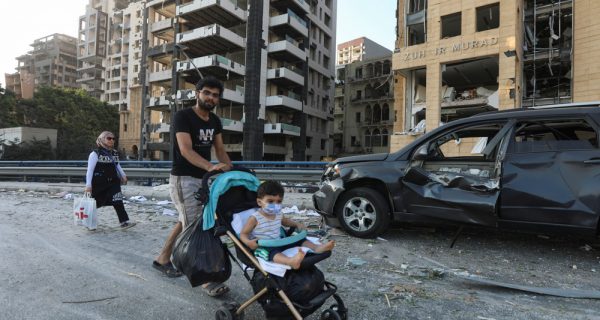
Press TV – August 5, 2020
Iran’s Judiciary Chief Ebrahim Raeisi has called on the international community to take action to help lift US sanctions against Lebanon to prevent a humanitarian catastrophe in the wake of a recent massive explosion that ravaged the country’s capital Beirut.
The Iranian official on Wednesday offered his condolences to the Lebanese government and nation over the tragic explosion in Beirut, and said the damage to an important part of Beirut’s economic infrastructure and its consequences have doubled the tragedy for the people of the country.
The necessary action today, while maintaining national coherence and vigilance against acts by enemies of the Lebanese nation and government aimed at invoking sedition and division, is to immediately address the basic needs of the Lebanese people, whose supply has been disrupted as a result of this incident, Raeisi added.
He said this painful incident took place at a time when the wounds caused by the Israeli occupation and its repeated acts of aggression against the Lebanese people have not yet healed, coupled with Washington’s brutal sanctions against Beirut.
“Considering the cruel and inhumane sanctions imposed by the criminal US regime against the Lebanese people in recent months, which constitute a serious obstacle to addressing the essential needs of the Lebanese people, efforts to immediately lift these sanctions in order to prevent a humanitarian catastrophe must be on the agenda of the governments having friendly ties with Lebanon as well as the international community,” the Iranian Judiciary chief noted.
He added that the Iranian Judiciary’s High Council for Human Rights will put on the agenda taking legal action to remove these pressures and defend the rights of the Lebanese people.
Hundreds of individuals and entities have been sanctioned by the US in Lebanon, with the list focusing mainly on those with ties to the Hezbollah resistance movement. The list, however, includes a wide range of targets, from pharmaceutical companies, religious organizations and community outreach groups to banks and trading importer/exporters.
Observers say that the US sanctions on Lebanon have deteriorated the already struggling economy of the Arab country.
Rouhani tasks Iranian Red Crescent Society with sending aid to Lebanon
President Hassan Rouhani on Wednesday tasked the Iranian Red Crescent Society with sending humanitarian aid to Lebanon.
In remarks at a Wednesday cabinet meeting, Rouhani assigned the Iranian Red Crescent Society to immediately send humanitarian aid to Lebanon, including medical and health supplies.
Zarif: Iran sending field hospital to Lebanon to assist with disaster relief
Separately, Iranian Foreign Minister Mohammad Javad Zarif said in a tweet on Wednesday that Iran was sending a field hospital and medicines to Lebanon to contribute to relief operations.
“Reiterated #Iran‘s strong and steadfast solidarity with people of Lebanon in call with FM Wehbeh,” read part of the tweet, adding, ” Iran is sending field hospital & medicine to assist with disaster relief.” ” Iran stands with Lebanon,” it concluded.
Iran’s top cmdrscmdr., and defense minister sympathize with Lebanese
Separately, the chief commander of the Islamic Revolution Guards Corps (IRGC), Major General Hossein Salami, Chairman of the Chiefs of Staff of Iranian Armed Forces Major General Mohammad Baqeri and Army Commander Major General Abdolrahim Mousavi also commiserated with the Lebanese nation, government and army as well as Hezbollah Secretary General Sayyed Hassan Nasrallah on the tragic incident and expressed readiness to render assistance to the nation.
Also, Iranian Defense Minister Brigadier General Amir Hatami, in a phone conversation with his Lebanese counterpart, voiced Tehran’s readiness to send medical equipment and staff to Beirut.
Tehran to turn off Milad Tower lights in solidarity with Beirut
Following the tragic explosion in Beirut and the death of dozens of citizens of this city, the lights of Milad Tower, the sixth tallest tower in the world, will be turned off tonight at 9 p.m local time (0430 GMT) on Wednesday, August 6, as a sign of sympathy of the Iranian people with the Lebanese people.
The blast that rocked the Lebanese capital has so far killed at least 100 people and injured more than 4,000 others.
President Michel Aoun said the blast was caused by 2,750 tonnes of ammonium nitrate stored unsafely in a warehouse.
Lebanon has announced three days of mourning.
Russia: Iran’s nuclear capacity ‘absolutely legitimate’
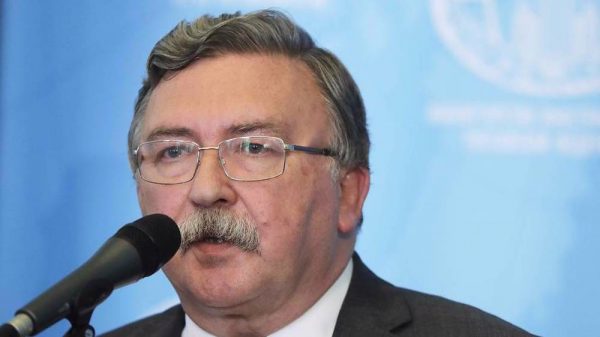
Mikhail Ulyanov, Russia’s permanent representative to international organizations in Vienna
Press TV – August 3, 2020
Russia’s permanent representative to international organizations in Vienna says Iran’s nuclear capacity is “absolutely legitimate” as it fits within the Nuclear Non-Proliferation Treaty (NPT).
“These opportunities and capabilities are absolutely legitimate as a long as they are used for peaceful purposes,” Mikhail Ulyanov tweeted on Sunday.
“The duty of IAEA (the International Atomic Energy Agency) is to certify non-diversion of nuclear materials,” he added. He was apparently referring to the United Nations nuclear agency’s repeated verification of non-diversion of Iran’s nuclear energy program.
The envoy made the assertions in response to a tweet by Mark Dubowitz, the CEO of the so-called Foundation for Defense of Democracies’ policy institute that has been identified as part of the Israeli lobby in the United States, and works hard to promote Washington’s policies against certain countries, including Russia and Iran.
In that tweet, Dubowitz had criticized what he called the “atomic capability” given to Iran under the Joint Comprehensive Plan of Action (JCPOA), a 2015 nuclear agreement between the Islamic Republic and world countries.
Ulyanov, however, asserted, “The atomic opportunities were given to Iran by #NPT.” He added that those who disagree with the nature of the IAEA’s duty being verification of various nuclear programs’ non-diversion ”work against NPT.”
The United States left the JCPOA in 2018, despite the fact that the agreement has been ratified by the UN Security Council as its Resolution 2231.
Ever since, Washington has been ceaselessly trying to undermine the deal.
Washington has also been threatening other JCPOA signatories into forsaking their duties under the accord.
Terrorists organizing murder from their safe havens in US, EU: Iran’s Zarif

Press TV – August 2, 2020
Iran has lashed out at Western countries for financing and harboring terrorists, saying the safe havens provided for these groups in the US and Europe have given them a platform for organizing the murder of innocent civilians.
“The west must cease financing and harboring terrorists,” Iranian Foreign Minister Mohammad Javad Zarif tweeted on Saturday night.
“From their safe havens in US and Europe, they promote hatred, agitate and organize murder and mayhem, and shamelessly claim responsibility for the murder of innocent Iranian civilians,” he added.
“Smokescreens can’t obscure this hypocrisy.”
His tweet came a few hours after the Iranian Intelligence Ministry said it has arrested the ringleader of an anti-Iran terrorist group based in the United States.
Iranian security forces have managed to arrest the head of the terrorist group, Jamshid Sharmahd, who directed “armed operations and acts of sabotage” in Iran from the US, the ministry said in a statement on Saturday.
Following a complicated operation, the ringleader of the group, named Tondar (Thunder), was arrested and he is “now in the powerful hands” of Iranian security forces, it added.
The ministry said it has dealt a heavy blow to the Tondar group that planned and carried out a deadly terrorist attack on Seyyed al-Shohada mosque in the southern city of Shiraz, Fars Province, in 2008, which killed 14 people and wounded 215 others.
It noted that the terrorist group had also planned to carry out other large-scale operations, like blowing up several places, including Sivand Dam in Shiraz, Mausoleum of the late founder of the Islamic Republic Imam Khomeini in southern Tehran, and Tehran International Book Fair, which were all foiled.
Iran’s Foreign Ministry Spokesman Abbas Mousavi said on Saturday that the US regime must be held accountable for “supporting this terrorist grouplet (Tondar) and other [terrorist] outfits as well as criminals that lead sabotage, armed and terrorist operations from within the United States against the Iranian people” and shed the blood of Iranians.
“The US regime considers itself to be standing by the Iranian people while it harbors and supports in different ways the known terrorists and those have claimed responsibility for several terrorist operations inside Iran and who have the blood of innocent Iranian people and citizens on their hands,” he added.
Iran’s Intelligence Minister Mahmoud Alavi also told the state TV that “people like Sharmahd make a mistake to rely on the US and the Zionist regime as these two support them as long as they serve their interests.”
“Although Interpol was tasked with arresting him, no action was taken against him, which shows the West’s empty slogan of fighting terrorism,” he pointed out.
US cannot disarm Lebanon’s Hezbollah through sanctions: Russian ambassador to Beirut
Press TV – August 1, 2020
The Russian ambassador to Beirut says US officials are under the illusion that they can disarm the Lebanese Hezbollah resistance movement through sanctions.
“Disarming Hezbollah is the primary purpose of US sanctions… I do not think that such a goal would be achieved through this method. The United States will not manage to force Hezbollah into laying down its weapons. This is an illusion,” Zasypkin said in an exclusive interview with Beirut-based Arabic-language al-Mayadeen television news network on Friday.
In late October 2018, US President Donald Trump’s administration imposed a new round of sanctions on Hezbollah, targeting individuals and international organizations that do business with the group.
“Over the past year, we have levied the highest sanctions ever imposed on Hezbollah, in a single year, by far. Just a few moments ago, I signed legislation imposing even more hard-hitting sanctions on Hezbollah to further starve them of their funds. And they are starving for them,” Trump said during an event in Washington, DC, that marked the 35th anniversary of an attack on US marine barracks in the Lebanese capital of Beirut.
Zasypkin added, “We (Russia) have made efforts in Syria. This is not only beneficial to Syria, but also to Lebanon as it protects the country against the potential threat of terrorism. If terrorism prevails in Syria, it will be easy for thousands of terrorists to cross into Lebanon, and this would lead to the partitioning of the country.”
He noted that Iran plays a positive role in the Middle East region, condemning the recent harassment of an Iranian passenger plane flying from Tehran to Beirut by two US fighter jets over Syria.
“Americans are creating problems and violating international law. The goal is to create tensions and reestablish their presence, role and influence,” the Russian diplomat said.
He went on to say that the balance of power in Syria is changing. “Over the past four years, the balance of power had been in the interest of terrorists. The ensuing terrorism allowed outsiders, including the US-led coalition, to come into play.”
“I think Americans have numerous problems there (in Syria), but al-Tanf region is still under their control. They are clinging to the area in order to have influence. Their main goal is to sever ties between Iran and Syria,” Zasypkin pointed out.
He noted that Moscow honors the principle of non-interference in Syria’s domestic affairs, lauding “close relations” between Russian President Vladimir Putin and his Syrian counterpart Bashar al-Assad as well as military forces of the two countries.
Zasypkin said Russian and Syrian institutions are closely cooperating with each other in various fields, including combat against terrorism, maintenance, reconstruction and humanitarian activities.
Elsewhere in his remarks, the Russian ambassador pointed to the recent rafts of economic sanctions against Syria under the so-called Caesar Act.
“The United States has used the leverage of sanctions for decades against Russia, Venezuela, Cuba and Iran. The essence of the idea has been to starve people in those countries in a way that they would ultimately turn against their own ruling systems. The scheme is now being applied to all countries,” Zasypkin highlighted.
He added, “Caesar Act is broad and comprehensive, and affects other parties since Syria has been under sanctions for a long time. Foreign companies are now targeted by the ruling. It is a preemptive battle against the possibility of restoration of ties between Syria and Western or Arab parties.”
Quincy Rides Again
New think tank needs an Israel reality check
By Philip Giraldi • Unz Review • July 28, 2020
The Quincy Institute for Responsible Statecraft think tank launched last November. It has recently issued a roughly 15,000 word manifesto entitled “Ending America’s Misguided Policy of Middle East Domination.” For those who would find ten thousand words plus intimidating, the paper includes a more digestible 1,221 word executive summary which fairly accurately summarizes the document’s conclusions.
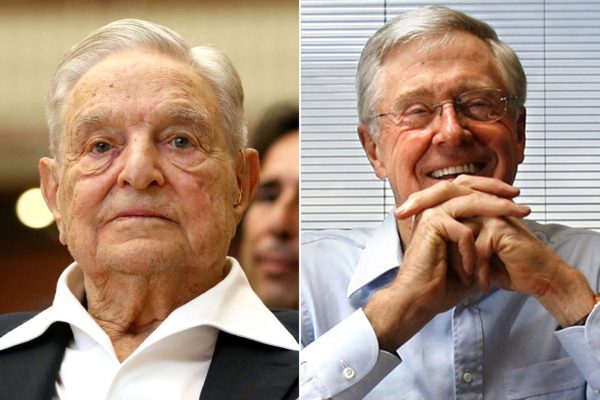
I have written about Quincy before, here and here and here. In short, while I would applaud a restrained foreign policy, particularly for the Middle East, I find Quincy unconvincing. It claims to promote “ideas that move U.S. foreign policy away from endless war and toward vigorous diplomacy in the pursuit of international peace” and further takes some pride in being non-partisan, though bipartisan might be a better description. To be sure, Quincy’s two major donors have been reported to be the highly controversial George Soros on the globalist left and the equally notorious Koch Foundation on the libertarian-lite right.
Soros in particular has been much in the news of late given his alleged propensity to fund and otherwise support groups and organizations that many would regard as conspiratorial or even violently radical, to include black lives matter and Antifa. Soros, a Hungarian Jew who is now a U.S. citizen, has been especially engaged in interventions to bring about “regime change” through “democracy movements” in Eastern Europe and he has exhibited a particular animosity towards Russia, making one suspect that his cash will influence what Quincy is allowed to say about the Kremlin.
The new Quincy report was co-authored by Paul Pillar, Andrew Bacevich, Trita Parsi and Annelle Sheline. I am not familiar with Sheline’s work, but Pillar, Bacevich and Parsi are all highly respectable and very knowledgeable about both national security and developments in the Middle East. To be sure, the paper includes a lot of useful information and insights into how various policies have evolved plus some very positive suggestions for extricating the U.S. from the Asian quagmire. But one should also accept that what is included in its agenda and how it is framed might be shaped by outside considerations, to include how Quincy is funded. It is not so much a matter of what the contributors write, but rather how it is spun and what is either minimized or not even addressed at all.
The ability to write about the Middle East in an even-handed “realistic” fashion, which is what the new article seeks to do, is based on the premise that there is equivalency among all of the players involved. That is, of course, nonsense. Many observers would note that the United States currently is in the Middle East and playing the role that it does mostly due to the immense power of Israel and its domestic lobby operating largely out of Washington and New York City.
Israel’s ability to make American presidents and the U.S. Congress do what it wishes is clearly visible wherever one chooses to look. The American people have gained nothing from giving Israel hundreds of billions of dollars and an endless supply of weapons while also looking the other way as Israel stole nuclear secrets and spied on the U.S. more than any other “friendly” country. What did the U.S. gain in recently moving the American Embassy to Jerusalem, in allowing Benjamin Netanyahu to annex the Golan Heights, in approving the bombing of Syria and Iran, or in permitting the systematic Israeli dehumanizing of the Palestinians?
A recent article by Professor Bacevich entitled “President Trump, Please End the American Era in the Middle East” appears to a precursor study to the current longer Quincy report. It is a good example of how self-censorship over Israel by authors works. The article particularly focused on the foreign policy pronouncements of Bret Stephens, the resident neocon who writes for The New York Times. Stephens, per Bacevich, has been urging constant war in the Middle East and worrying lest “we may be witnessing the beginning of the end of the American era in the Middle East.” Bacevich correctly described how “in the Middle East, the military power of the United States has played a large part in exacerbating problems rather than contributing to their solution.”
The overall message is sound, but in this case, it is interesting to note what Bacevich left out rather than what he included. He cited Iran seven times as well as Saudi Arabia, but, strangely enough, he never mentioned Israel at all, which a number of commenters on the piece noted. It rather suggests that there is a line that Bacevich is reluctant to cross. The omission is particularly odd as Israel is absolutely central to and might even be described as driving American policy in the Middle East and Bret Stephens, whom Bacevich excoriates, is a notable Israel-firster who once worked as the editor of the Jerusalem Post.
Bacevich also has produced an op-ed entitled “Foreign governments are messing with our elections the old-fashioned way” in the Boston Globe. It again fails to mention Israel at all in spite of that country’s enormous influence over the U.S. electoral process through the political donations provided by dual loyalty billionaires Sheldon Adelson and Haim Saban to Republicans and Democrats respectively. In fact, Bacevich has clearly indicated that there will be red lines, that the Quincy Institute won’t focus on “highlighting pro-Israel organizations or donors.” In other words, it will not criticize Israel’s Lobby as a key driving element in America’s interventionist foreign policy.
Bacevich is a smart man who knows perfectly well what Israel and its lobby represents but he also knows that anyone who wants to be a player in Washington DC has to avoid the Israel hot wire. The Quincy report includes, for example, lengthy separate sections on Iraq, Syria, Iran and Yemen but nothing similar on Israel. I have, however, excerpted all the citations of Israel in the full text. They are:
“U.S. military assistance—most prominently to Israel, Egypt, and Jordan, but also to armed proxy groups in Syria, Iraq, Afghanistan, and Libya—exacerbates abuses that contribute to instability… Unconditional U.S. military support for Israel has facilitated its continued occupation of Palestinian territory (potentially culminating in the annexation of the West Bank) and reduced incentives to pursue a peaceful resolution to the conflict.”
The bombing of the U.S. “embassy in Beirut, [was] a direct response to U.S. military intervention in Lebanon, which, in turn, was an attempt to deal with the consequences of the Israeli invasion of Lebanon a year earlier.”
“The Israel–Palestine conflict has been an especially salient example of such an issue, as underscored by how Palestinians opposing the Israeli occupation were in the forefront of the wave of international terrorism that began in the late 1960s. International terrorism sponsored by Palestinian organizations abated once the U.S. and Israel began engaging the Palestinians in the late 1980s.”
“In other cases, U.S. support for a militarily superior partner has tended to reduce that country’s incentives to resolve conflicts and instead opt to safeguard a status quo favorable to its interests but not to regional stability and U.S. interests. As the only state in the region with nuclear weapons and as a highly effective conventional military power in its own right—and with a qualitative edge conferred over many years by the U.S. and effective weapons development and manufacturing capacities—Israel no longer needs the U.S. to guarantee its security. Yet the U.S. sends Israel $3.8 billion in military aid annually. As of 2019, Israel had received $142.3 billion from the U.S. since 1949 —significantly more than any other nation.40 American military aid is sent regardless of whether Israel tries to resolve the conflict with the Palestinians. By persistently bolstering Israel’s qualitative military edge no matter what direction Israeli policy takes, U.S. assistance as currently structured does not incentivize Israel to pursue compromise, whether with the Palestinians or other neighbors.”
“… persistent U.S. antipathy creates a security dilemma for Iran. U.S. military support for Israel, Saudi Arabia, and the UAE causes Iran to perceive itself as under threat and to respond by trying to enhance its own security, partly by investing in paramilitary groups beyond its borders.”
“In Israel, where the well-reinforced assumption that unquestioning U.S. support will continue no matter what Israel does, it has long been evident that this has encouraged destructive Israeli practices such as the continued building of Israeli settlements in the Occupied Territories.”
“Such a rights-respecting policy would include making military assistance to Israel—for decades (and still) the largest recipient of such assistance—conditional on Israel ending its routine violation of human rights in the Occupied Palestinian Territories. These offenses include ongoing settlement expansion in the West Bank and East Jerusalem and attacks in Gaza that have failed to fulfill obligations to protect civilians. Israel is a nuclear and military superpower in the region that does not need American military aid to defend itself. As such, it should arguably not be a candidate for military aid in the first place. To the extent military aid should be provided to Middle Eastern states, priority should be given to those at risk of becoming failed states. If Washington decides to continue aid to Israel, it should be conditioned on changes to Israeli policies that advance stability and U.S. interests.”
“A consistent rights-respecting policy embedded in a broader approach to the region, one that emphasizes core U.S. interests, problem-solving diplomacy, and engagement with all relevant regional actors, would have consequences for how the U.S. has traditionally managed the Israel–Palestine conflict. The shortcomings of the U.S.–led peace process have become increasingly evident, all the more so as the Trump administration has abandoned any pretense of serving as an honest broker. It is a process that ill-serves U.S. interests as well as Israel’s long-term well-being, let alone its failure to help the Palestinians.”
“… there would be greater space for advancing negotiated and diplomatic solutions to various conflicts in the region, notably in the Saudi–Iran and Israel–Palestine cases.”
“For the United States, this means a significant reduction of arms sales, primarily to Saudi Arabia, Israel, and the UAE.”
Some of the citations regarding Israel are bundled with other countries, most particularly as related to arms sales and regional conflicts. Other excerpts correctly note that the status quo with Israel serves no American interests and is not even good for Israel, but the problem is that the solution is lame, or to describe it more properly, irrelevant. Distancing the U.S. from the region’s quarrels depends solely on disengaging with Israel first as American hostility towards an unthreatening Iran, Lebanon and Syria is a result of successful advocacy by the Jewish state. And serving as an “honest broker” vis-à-vis the Palestinians is sheer fantasy as it has never been the case for any U.S. administration due to effective Israeli pressure. If the Quincies were being honest, they would concede up front that the so-called peace plan currently being floated is a complete sell out to Israel. Any kind of shift in policy also assumes that Israelis want peace with the Palestinians, but opinion polls suggest otherwise, with many Israelis routinely referring to the Arabs as “terrorists.”
The only suggestion with any teeth to it is making military assistance to Israel conditional on its human rights record towards the Palestinians, but that in turn exposes the fundamental flaw in the arguments being made. The problem for the U.S. is not Israel per se but rather the enormously powerful domestic Israel Lobby which will make sure that nothing will be done to alter the status quo. The American government and media are completely dominated by Jewish billionaire-funded organizations that have repeatedly demonstrated that they have sufficient clout to stop any defections, witness the recent affirmation of the U.S./Israel relationship in the Democratic Party electoral platform and Joe Biden’s proud declaration that he is a “Zionist.” Quincy is delusional if it thinks that it can reorder the Middle East based on “realism and restraint” without the cooperation of Congress and the White House, which are bought and paid for and totally resistant to change.
So, Quincy has a lot of interesting ideas and the basic premise of non-interventionism is sound. But regarding the real fly in the ointment, Israel, it is pointless to urge “realism” in a situation that has not been realistic since 1947. Unfortunately, in America everything has a price and Jewish groups have been canny enough to buy Congress, the White House and much of the media at bargain prices to make sure that Israel stays protected. If you are not addressing that issue out in the open you are wasting your time. Not surprisingly, it would seem that any concerns over the reorganization of the Middle East as proposed by Quincy are most definitely not going to keep Benjamin Netanyahu awake at night.
Philip M. Giraldi, Ph.D., is Executive Director of the Council for the National Interest, a 501(c)3 tax deductible educational foundation (Federal ID Number #52-1739023) that seeks a more interests-based U.S. foreign policy in the Middle East. Website is https://councilforthenationalinterest.org, address is P.O. Box 2157, Purcellville VA 20134 and its email is inform@cnionline.org.
Was Jeffrey Epstein’s Boss Ghislaine Maxwell Helping Mossad Run Pedophile Rings for Prince Andrew and the Ruling Elite?

By Marco de Wit | Laiton Lehti | October 13, 2019
Video introduction to this article. (If the video is deleted by Youtube you can find it also here in Bitchute.)
The Epstein Pedoscandal Mossad Timeline shows in detail how Jeffrey Epstein and Ghislaine Maxwell were working for the Israeli intelligence agency, Mossad.

Link to Unz.com article
The timeline generated many comments at Unz.com but surprisingly most of them dealt whether Epstein was a pedophile or not. This despite the overwhelming evidence of pedophilia.
Many have also totally missed – or are afraid to notice – the big picture: Israeli intelligence agencies and especially Mossad seem to be running pedophile rings that blackmail Western political, business and scientific leaders.
Furthermore, it seems that Ghislaine Maxwell was and still is the master mind behind many of these pedophile rings.
One of the reasons Epstein and Ghislaine were able to continue sex trafficking with impunity for so long was the appearance that Epstein was a victim of jealous people and overzealous police. Many people thought that Epstein had only had sex with a 17-year old girl who had lied about her age.
This excuse worked well because in Florida the age of consent is 18 while in most other American states it is 16.
Link to Wikipedia
Epstein was able to play the martyr by not only claiming that unscrupulous girls had lied their age but also by implying that the age of consent is too high anyway in Florida.
This was also one reason why in New Mexico where Epstein had his Zorro Ranch the officials refused to register him as a sex offender. In New Mexico the age of consent was 16 until in 2018 it was raised to 18.
Furthermore, unlike in many other states, in New Mexico the courts recognize a mistake of age defense.
New Mexico courts recognize a mistake of age defense. The mistake of age defense is basically ”I thought she was 17.” However, this is no guarantee that this defense will work in court. Moreover, the mistake of age is the creation of judges in the absence of a direct statute addressing the defense. State lawmakers may pass a law overriding the courts on this issue at any time. (LegalMatch)
In reality the Epstein-Ghislaine case is not whether it is wrong for an adult to have sex with a 17 year old. Instead it is about many other things such as prostitution, grooming, pedophilia and the exploitation of children.
This all is connected to global politics involving sex trafficking, drug and arms trade, money laundering, Ponzi schemes, spy networks and blackmailing for Mossad.
Epstein’s victims were caught in a web of international spy network that used them as pawns for blackmail operations. The younger the girls were, the more leverage Israel would have over politicians, billionaires and scientists. Thus Epstein and Ghislaine tried to also recruit girls who were well under the age of 16.
What is more, they personally enjoyed having sex with these very young girls. Both Epstein and Ghislaine seem to have been pedophiles who were attracted to prepubescent girls and boys, i.e. small children.
Pedophilia is defined as:
Pedophilia (alternatively spelt paedophilia) is a psychiatric disorder in which an adult or older adolescent experiences a primary or exclusive sexual attraction to prepubescent children.[1][2] (Wikipedia)
Note that in order to be a pedophile it is enough to have merely occasional sexual attraction to prepubescent, i.e. sexually immature children who have not yet developed secondary sex characteristics, such as breasts.
Julie Brown from Miami Herald notes that Courtney Wild was only 14 when she was recruited into Epstein’s sex ring.
Wild still had braces on her teeth when she was introduced to him in 2002 at the age of 14.
She was fair, petite and slender, blonde and blue-eyed. (emphasis added. Miami Herald)

Link to Miami Herald
Julie Brown also notes that Epstein preferred girls who were not only white [and non-Jewish] but also appeared prepubescent.
Wild, who later helped recruit other girls, said Epstein preferred girls who were white, appeared prepubescent and those who were easy to manipulate into going further each time. (Emphasis added. Miami Herald)
For Epstein and Ghislaine it was important that the girls at the very least looked like small children. This is obviously why they preferred girls who were under 16.
Courtney Wild told the police that she brought Epstein over 70 girls and they were all under 16.
By the time I was 16, I had probably brought him 70 to 80 girls who were all 14 and 15 years old… (Emphasis added. Miami Herald)
Some girls were even younger. According to the police many were 13 year old.
The girls — mostly 13 to 16 — were lured to his pink waterfront mansion by Wild and other girls, who went to malls, house parties and other places where girls congregated, and told recruits that they could earn $200 to $300 to give a man — Epstein — a massage, according to an unredacted copy of the Palm Beach police investigation obtained by the Herald. (Emphasis added. Miami Herald)
It is also important to note that even 13 was not the minimum age for Epstein and Ghislaine. In fact, there was no limit to how young the girls could be. Both Epstein and Ghislaine Maxwell emphasized that the younger the better.
Eventually, she said Maxwell trained her to recruit new girls for Epstein.
“Jeffrey was very particular in the kind of girls he wanted. First off, the younger the better.”
Epstein said that to her, Giuffre claimed, and “Maxwell said that too. During the training and telling me how to do it, she said ‘You always have to go for the youngest-looking ones.’” (Emphasis added. The Daily Beast)
Link to The Daily Beast
It seems the primary purpose was not even blackmail since especially Epstein was having sex with these young girls all the time. On some days Epstein was having sex several times a day.
Sex games were more important for Epstein than work. Obviously, he was extremely attracted to these young girls.
Palm Beach multimillionaire Jeffrey Epstein, 54, was accused of assembling a large, cult-like network of underage girls — with the help of young female recruiters — to coerce into having sex acts behind the walls of his opulent waterfront mansion as often as three times a day, the Town of Palm Beach police found. (Emphasis added. Miami Herald)
In six months, I never saw him do a day’s work,” Ransome told The Telegraph. ”I never saw him work. He was literally sexually abusing us all day long. (Emphasis added. Business Insider)
Link to Business Insider
Ghislaine also seemed to be obsessed with sex. Just like her father, Robert Maxwell she was rumored to be interested in unconventional sex which includes also sex with young children.
As she [Ghislaine] posed for the pics, which ran in a publication meant to promote Sotheby’s vintage fashion collection, she allegedly let slip comments that hinted at a twisted double life.
“She didn’t talk about Epstein, but during the shoot she did tell a story about how she just hosted a dinner party for a number of young girls, and she put dildos at each place setting,” the source said. “Ghislaine then described how during the dinner two guests, who were a couple, began demonstrating how to do the perfect fellatio on a man for all at the table. She was laughing about it.” …
“A friend of mine has a whole theory about her, that Epstein was like her father Robert Maxwell, who himself is believed to have had some strange sexual practices.” (Page Six)
Link to PageSix
The Epstein Mossad-Timeline shows how Ghislaine was most probably trained by Mossad to use sex to gather information. That training would not have been too difficult for her since she was hypersexual. Many even considered her a nymphomaniac.
In fact, even many Israeli Jews – who usually have much fewer sexual taboos than puritan English and Americans – were shocked by her raunchy sexuality.
Flirtatious indeed: I understand from a mutual friend that after school she travelled to Israel and visited a kibbutz; she was immediately ostracised by the other girls for making a rather-too-obvious beeline for the Adonis-like lifeguard at the kibbutz pool. Very quickly she got her way, as she would with much in her life. (Tatler. Emphasis added.)
Even Ghislaine’s friend were sometimes shocked by her open sexuality that so often contrasted with her otherwise lady-like behavior and position in high society.
Ghislaine was, added Mason, ‘fantastically entertaining’ and ‘saucy’ – the paper said that she talked openly about sex.
In fact, said another acquaintance who saw her often at parties, she was ‘obsessed by sex. She’s Sphinx-like, mysterious. The last time I saw her, five, 10 years ago, I said what are you up to? And she said “I’m selling this product – stainless-steel mini dumb-bells – that you put up your fanny. For exercising your vaginal muscles, exercise your pelvic floor, learn the Singapore Grip. I’m giving seminars in LA and they all turn up and I tell them, this is how you keep your man.”’ (Tatler. Emphasis added.)
Epstein and Ghislaine were both hypersexual. All kind of sex interested them. Little girls were just part of the menu. Or more specifically, the best – and most profitable – part.
Epstein and Ghislaine were so attracted to young girls that nothing seemed to satisfy them. Perhaps this is why Epstein and Ghislaine created the highly risky sexual pyramid scheme. The girls were offered two alternatives: Either satisfy Epstein and Ghislaine sexually or get more girls to satisfy them.
In this way Epstein and Ghislaine were able to recruit literally hundreds of young girls. However, some of these girls went to the police and the sexual pyramid scheme collapsed.
When Epstein got out of jail in 2009 he had half-learned his lesson: American girls are too risky.
Now Epstein and Ghislaine would only concentrate on East European girls with the help of their Jewish-Ukrainian friend Peter Listerman.
One of the lesser-known shadowy figures linked to Jeffrey Epstein and his sex ring of teenage girls and young women is Ukrainian-born Peter Listerman, who has worked as a businessman and television presenter but is most known for his “match-making” abilities.
What match-making really means is that Listerman procures women, often underage, for the jet-set society to use for sexual purposes. His “clients” include Russian oligarchs and American businessmen and seems to have also included Jeffrey Epstein. (Citizen Truth)
Link to the Citizen Truth.org
Listerman has such a bad reputation that he is shunned even in Ukraine!
Tatiana Savchenko, who founded the first modeling school in Odessa, Ukraine explained to the Daily Beast the lengths she had to go to keep Listerman from getting his hands on young women and trafficking them for sex work.
She claimed that he would frequently approach her students and attempt to lure them with promises of a luxurious lifestyle, and that “It took a lot of work to keep him from tricking our teen models in his traps.” (Citizen Truth)
Peter Listerman is the usual suspect. Link to Fishki.net
Do you think I am kidding? I am Peter Listerman! Link to Fishki.net
Both Epstein and Listerman were attracted to very young girls. Neither even tried to hide it much. In fact, Epstein was quite open about his attraction to tweens.
Just three months ago, as federal prosecutors were closing in with new charges, Mr. Epstein had a conversation with R. Couri Hay, a publicist, about continuing to improve his reputation. Mr. Epstein asserted that what he was convicted of did not constitute pedophilia, said Mr. Hay, who declined to represent him.
The girls he had sex with were “tweens and teens,” Mr. Epstein told him. (The New York Times)
But what is a tween?
Preadolescent is generally defined as those ranging from age 10 to 13 years.[4][6] … While known as preadolescent in psychology, the terms preteen, preteenager or tween are common in everyday use. (Wikipedia)
Epstein was right, of course. What he was convicted of in 2007 did not constitute pedophilia. However, that is precisely one reason why people are so outraged!
Epstein and Ghislaine did not see any problem of recruiting, grooming and having sex also with tweens. And apparently neither did the Justice Department and the FBI led by Robert Mueller!
But it gets even worse. As pointed out in the Epstein Pedoscandal Mossad Timeline, it seems that Epstein and Ghislaine were after even younger girls.
In 2003 Epstein financed Jean-Luc Brunell’s(?) and Jeff Fuller’s(J) new modelling agency MC2 that seemed to have worked with Peter Listerman.
MC2 obviously refers to the famous Einstein equation E = MC2, the energy-mass equivalence. Equally obviously, E equals Epstein, the energy, whereas the girls equal MC2, the mass energized by Epstein.

Jean-Luc Brunell
Brunell is generally known as the sleaziest man in model business who has long faced accusations that girls were drugged and raped in his employ. Already in the 80s he was the subject of a famous 60 Minutes expose on sexual abuse in the modeling industry
Despite all this – or for the very reason – Epstein invested in MC2 and became particularly close to its founders Brunel and Fuller.
The agency operates in New York, Miami and Tel Aviv. It’s in practice half-Israeli.
Many call Israel the capital of human trafficking and organ harvesting.

MC2 concentrates on importing East European girls to Israel and America. The younger the better.

Marina Lynchuk of MC2

Lolita Lvola from MC2

Linta Lapinda from MC2
Brunel seems to have given 12-year old triplets to Epstein as a birthday present.
’Jeffrey bragged after he met them that they were 12-year-olds and flown over from France because they’re really poor over there, and their parents needed the money or whatever the case is and they were absolutely free to stay and flew out,’ Giuffre said.
She said she saw the three girls with her own eyes and that Epstein had repeatedly described to her how the girls had massaged him and performed oral sex on him. They were flown back to France the next day.

Link to Daily Mail
It seems that even tweens were not young enough for Epstein.
According to court papers in 2005 Brunel called Epstein and left a message that “he is sending him a 16-year-old Russian girl for purposes of sex”. However, the written message says something even worse.
The message, filed as an exhibit in the case, was written on an office message pad, partly in code, and read: “He [Brunel] has a teacher for you to teach you how to speak Russian. She is 2×8 years old not blonde. Lessons are free and you can have your 1st today if you call.” (New York Post)
Does it mean that two eight year olds are involved? Or does 2 x 8 mean to sex 8 year old? (2=to, x=sex)
Why would the lessons be free and why is it relevant that the ”teacher” is not a blond?

There is no denying that Epstein and Ghislaine sexualised even small children. This became clear in 2005 when police raided Epstein’s Palm Peach mansion.
In one photo that was hanging on the wall a small six or seven year old girl was bending over in a tiny dress. Police blurred out the photo in the video taken during the raid.

Link to The Daily Mail
Despite all this only the Russian Television was actively trying to expose Epstein and Ghislaine.
RT aired this video already nine years ago!
The description on the video is even more revealing. It even mentions the 12-year old triplets.
The American TV networks were actively suppressing the story for years.
The American media has also been trying to cover up the fact that Jeffrey Epstein was most probably murdered in his cell. He had to be silenced.
But it gets even worse.
This hung on Ghislaine’s home wall.

NEW YORK CITY, NY – MARCH 13: Atmosphere at Hamish Bowles, Ghislaine Maxwell and Lillian von Stauffenberg dinner for ALLEGRA HICKS at Home of Ghislaine Maxwell on March 13, 2007 in New York City. (Photo by Patrick McMullan/Patrick McMullan via Getty Images). Link to Getty Images.
The so called artwork seems to be full of pedophile symbols.


Link to Wikileaks.org
The quality of the photos taken at Ghislaine’s home are so good that even more symbols have been found in her artwork.

For some reason the mainstream media has not picked up on this pedophilia angle. No mainstream media journalist has even tried to ask why would Ghislaine have such art and symbols on her home wall.
This despite the fact that Ghislaine is most probably an Israeli superspy just like was her father, Robert Maxwell. She probably has been trained to use sex – including pedophilia – as a tool for blackmail and manipulation.
At the time in Israel females molesting little boys was not even considered rape.
Link to Haaretz.com
Nor have mainstream journalists asked where was Ghislaine when Madeline McCann was abducted.
That would not be an unreasonable question since one of the E-Fit images looks a lot like Ghislaine.

Link to Enchanted Life Path.com
Furthermore, two of the E-Fit images (1A, 1B) look like the Podesta brothers. John Podesta was White House Chief of Staff to Bill Clinton and the Chairman of the 2016 Hillary Clinton presidential campaign.
Ghislaine and Epstein were close to the Clintons and the Podesta brothers have been directly linked also to Pizzagate.

Link to Pizzagate Map created by Tuukka Pensala
Was Ghislaine helping to run also Pizzagate and other pedophile rings for Mossad?
At least she seems to be perfectly trained to do just that. First, her own hypersexuality, family background and possible training by Mossad made it easy for her to master mind the pedophilia ring she run with Epstein.
Second, Ghislaine and Epstein had all the apparel to help run also other pedophile rings: Lolita express airplanes and helicopters, Zorro Ranch in New Mexico and luxury mansions in New York, Palm Peach and Paris.
Even more importantly they had their own island in the Virgin Islands.
In the 90s Epstein bought Little St. James island from the Virgin islands. It had a mansion which Epstein expanded.
Soon locals started to call it the Pedophile Island.
Little St. James island. Link to Wall Street Journal article
The island seems to have tunnels with several underground entrances.
Underground entrance
Link to Twitter
The island also has a strange temple.
We Are Change’s Luke Rudkowski and the Dollar Vigilante’s Jeff Berwick secretly visited the island but were soon chased out.
Ghislaine has a Helicopter Pilot License and often transported quests to the island.
On the weekends in the 1990s, Maxwell would have her Rollerblades FedExed to Epstein’s island in the Caribbean, and said she got her helicopter’s license so she could transport anyone she liked without pilots knowing who they were.
Maxwell also said the island had been completely wired for video; the friend thought that she and Epstein were videotaping everyone on the island as an insurance policy, as blackmail.
A source close to Maxwell says she spoke glibly and confidently about getting girls to sexually service Epstein, saying this was simply what he wanted, and describing the way she’d drive around to spas and trailer parks in Florida to recruit them. She would claim she had a phone job for them, “and you’ll make lots of money, meet everyone, and I’ll change your life.” …
Maxwell had one other thing to tell this woman: “When I asked what she thought of the underage girls, she looked at me and said, ‘they’re nothing, these girls. They are trash.’” (Emphasis added. Vanity Fair)
Ghislaine was naturally using Epstein’s helicopters. Some of them shared their FAA tail number with a US contractor, Dyncorp. That would have helped Ghislaine and Epstein to fly drugs and children.
FAA records and Epstein’s pilot’s flight manifest indicate that Epstein’s Bell helicopter used the same tail number of N474AW. This was the same tail number used until 2006 by State Department contractor Dyncorp for counter-insurgency operations in Latin America.
The congruence of Epstein’s Bell N474AW and Dincorp’s Bronco N474AW is noteworthy. In 2002, the year Epstein’s aircraft fleet stands accused of flying underage teen girls, some between the ages of 12 and 15, coincided with Dyncorp’s trafficking in underage females between the ages of 12 and 15 from Kosovo and Bosnia in the Balkans.
One Dyncorp whistleblower reported to The Washington Times’s Insight magazine’s Kelly O’Meara in 2002 the following on one Dyncorp employee in Bosnia:
[he] owned a girl who couldn’t have been more than 14 years old. It’s a sick sight anyway to see any grown man [having sex] with a child, but to see some 45-year-old man who weights 400 pounds with a little girl, it just makes you sick.”
Tail number N474AW has been shared between Epstein’s Bell helicopter like the one in this photo. (Emphasis added. Political Bull Pen)

DynCorp’s pedophilia ring became internationally infamous with the release of the movie Whistleblower.

Link to Wikipedia
Helicopters can always be seen. However, Ghislaine also has a license to operate submarines!
In 2012 – three years after Epstein got out of jail – Maxwell founded The TerraMar Project,[51] a nonprofit organization that advocated protecting ocean waters.
She gave a lecture for TerraMar at the University of Texas at Dallas and a TED talk, at TEDx Charlottesville in 2014.[52] Maxwell accompanied Stuart Beck(J), a 2013 TerraMar board member, to two United Nations meetings to discuss the project.[17] (Wikipedia)
In 2014, a United Nations event featured Maxwell as a speaker. According to her bio in the program, Maxwell’s “web-based non-profit” aimed “to protect the Oceans by empowering a global community of ocean citizens.” It further described Maxwell as “a private helicopter pilot and an Emergency Medical Technician and a qualified ROV and Deepworker submarine pilot.”
A former Coast Guard officer, Borgerson was also a fellow at the Council on Foreign Relations, which featured Borgerson and Maxwell as speakers during one 2014 talk titled “Governing the Ocean Commons: Growing Challenges, New Approaches.” Friends of Maxwell, according to The New York Times, said Borgerson became her boyfriend. Maxwell had allegedly described Borgerson as a “Navy SEAL” to her pals.
Maxwell’s dubious charity also roped in the Clinton Global Initiative, the now-defunct networking platform for the Clinton Foundation. In the fall of 2013, CGI named TerraMar as one of the “commitments to action” at their annual meeting. (Emphasis added. Daily Beast)
Did the Pedophile Island have an underground submarine base? Was it a part of global pedophile network?
And was the Ocean Citizens project an attempt to escape national jurisdictions and thus gain at least a partial immunity from police investigations and prosecutions?

Link to TerraMar Project
Interestingly, as late as 2016 Epstein bought also the nearby Great St. James Island. He started to build on the island without permits.
There were rumors that he was building underground. For some reason the mainstream media has had no interest in this second island.
Why is the mainstream media not interested in Ghislaine’s many links to pedophilia?
Perhaps because Ghislaine has so many powerful friends. The photo of the pedophile artwork on Ghislaine’s wall was taken 13 March 2007 during a party at Ghislaine’s New York townhouse. The guest list included a curious combination of elite Jews, aristocratic Brits and American WASPs.

Atmosphere==
Hamish Bowles, Ghislaine Maxwell and Lillian von Stauffenberg dinner for ALLEGRA HICKS. Home of Ghislaine Maxwell. March 13, 2007©Patrick McMullan. Photo-Patrick McMullan/Patrick McMullan.com. Link to Quick N Dirty
The party was in Ghislaine’s huge 7000-square-foot townhouse. It is located in the most opulent and prestigious neighborhood of America, the Upper East Side, New York on East 65th Street just off Park Avenue. Epstein’s townhouse was only 10 blocks away.
Ghislaine’s five story townhouse. Link to Street Easy
Ghislaine’s townhouse floor plan. Link to Street Easy
Ghislaine’s townhouse 2nd floor gallery. Link to Street Easy
There are reports from reliable sources that the townhouse was sold in 2000 to Ghislaine by Lynn Forester de Rothschild. The very same woman who had introduced Epstein and Ghislaine to Alan Dershowits and the Clintons in the 90s.
The Manhattan property, which is close to Epstein’s mansion, is owned by Lynn Forester de Rothschild, wife of British financier Sir Evelyn de Rothschild. (See The Times and the original article.)
According to Business Insider Forester sold the townhouse to Ghislaine for less than half the price.
Forester sold the mansion for about $8.5 million less than its assessed market value, which was more than $13.4 million.
Was this a pay-off to Ghislaine from the King of Jews, the Rothschilds for services rendered?

Hillary Clinton, Evelyn de Rothschild, Bill Clinton and Lynn Forester de Rothschild. Link to Mint Press
It probably is also relevant that at the time of the sale of the townhouse the Prime Minister of Israel was Ehud Barak. In the 80s he had been the head of Aman, the Israeli Military Intelligence Agency. As the Epstein Pedoscandal Mossad Timeline revealed, both Epstein and Ghislaine worked for the Israeli intelligence agencies already in the 80s during the Iran-Contra operation.
Note that it was around year 2000 that Epstein and Ghislaine started the pedophile operation in earnest. In the 80s and 90s blackmail operations were a side show but now it became the main show involving hundreds of young girls.
Sexual blackmail – especially involving little children – can be an extremely efficient way to influence key politicians and even military officials. A successful blackmail operation can achieve more than several army divisions. No wonder Barak was so close to Epstein and Ghislaine.
Furthermore, in 2000 the president of Israel was Moshe Katsev who was sexually harassing and even raping his female subordinates. Later Katsev would be convicted of rape.
It was also in 2000 when the Israeli Vice-Consul of Rio de Janeiro, Arie Scher and Hebrew language Professor George Schteinberg were running a pedophile ring for Israeli tourists. When the Brasilian police started to investigate the Israeli consulate Scher managed to flee back to Israel.

In Israel Scher was not prosecuted. Instead in 2005 he was promoted to Consul of Canberra, the capital of Australia. A spokesman for the Israeli Foreign Ministry in Jerusalem, Mark Regev explained:
He [Arie Scher] was a young and single man at the time [in Brazil]. Now he is married and he’s six years older and there is no reason why he shouldn’t make an excellent diplomatic appointment in Australia.
Australia refused to let Scher enter the country.
Link to William Bowles Info
The most shocking part of the Arie/Aryeh Scher story is that the mainstream media was not interested. Either the stories have been scrubbed from the internet or no stories were ever written by mainstream journalists except one short story by BBC in 2000 and one even smaller story by The Sydney Morning Herald in 2005. Even more surprisingly Youtube does not seem to have any videos about the Scher case.
No wonder Barak was absolutely convinced that the Western mainstream media would never dare to criticize Israel and its intelligence agencies. Not even when Mossad was running pedophile rings.
It was probably the Israeli leaders Shimon Peres, Ehud Barak and Moshe Katsev together with the ultra-Zionist Mega Group who made sure Epstein and especially the Maxwell family had not only immunity from prosecution but also all the blackmail apparel necessary including luxury townhouses, airplanes, yachts, submarines, ranch and a private island. All, of course, bugged to the hilt.

Israeli Prime Minister Ehud Barak (R) talks to Shimon Peres, Minister of Regional Planning, after Barak’s speech at the opening session of parliament in Jerusalem 30 October 2000. Barak said that he believed peace was still possible in the Middle East but that Israel did not have a partner prepared to make compromises. AFP PHOTO / SVEN NACKSTRAND (Photo credit should read SVEN NACKSTRAND/AFP/Getty Images)
Here the pedophile artwork at Ghislaine’s New York townhouse can be seen behind Lillian von Staufenberg who in March 2007 together with Ghislaine and Hamish Bowles organized a dinner party in honor of Allegra Hicks. This at a time when Epstein had already been charged with abusing young girls.

Karen Groos, Allegra Hicks, Lillian von Stauffenberg==
Hamish Bowles, Ghislaine Maxwell and Lillian von Stauffenberg dinner for ALLEGRA HICKS==
Home of Ghislaine Maxwell, NYC==
March 13, 2007==
©Patrick McMullan==
Photo-Patrick McMullan/Patrick McMullan.com==
Link to QuickNDirty
Why would Ghislaine have such a suspicious artwork on her wall knowing that it would probably be photographed during the parties?
Why would Ghislaine and her quests take such a huge risk? Or was it a sign meant to be seen? Was Ghislaine flaunting her power?
Ghislaine and her quests seemed to be absolutely sure that the mainstream media would not dare to ask embarrassing questions.
They were right, of course. The mainstream media knows its place.
However, occasionally some courageous mainstream journalist or editor does try to give hints. Some have even reported on Ghislaine’s hyper-sexual reputation and her orgies. It is just that the stories have mostly been scrubbed from the internet.
Fortunately, Whitney Webb from Mintpress has found many of the scrubbed stories. Some of them mention the Mossad connection and others note the orgies. For example, in 2003 a British newspaper, The Evening Standard reported a revealing rumor.
Salacious reports have crossed the Atlantic about Ghislaine hosting bizarre parties at her house to which she invites a dozen or so young girls, then brandishes a whip and teaches them how to improve their sexual techniques.
It seems that Ghislaine was not only a madame to Epstein but also to the ruling elite. This would both explain her popularity and the fact that the media – and especially the American media – dares not to criticize her too much. Not even after her boyfriend Epstein was charged with sex trafficking minors!
Ghislaine’s friends are just too powerful. After the March 2007 party the British Daily Mail newspaper was amazed how Ghislaine could still have attracted such creme de la creme of the highest elite. Even more amazingly, the elite was practically swooning over her.
The night before the party, the hostess [Ghislaine] had been inundated with calls from disgruntled socialites, irked that they hadn’t received an invitation.
The hostess greeted their objections with her customary charm, but remained unmoved. As always, her list had been carefully edited, and she intended it to stay that way.
Among the select few were Hollywood star Matthew Modine, Kennedy family member Mrs Anthony Radziwill, Peggy Siegel, PR consultant to the stars, and Julie Janklow, heir to a literary dynasty.
There was a Rockefeller on the list, as well as the inevitable countesses, billionaires and New York luminaries.

Link to Daily Mail
The guests at the party included also Renee Rockefeller who is married to Mark Rockefeller, the son of ex-Vice President Nelson Rockefeller and nephew of David Rockefeller.

Allegra Hicks, Renee Rockefeller==
Hamish Bowles, Ghislaine Maxwell and Lillian von Stauffenberg dinner for ALLEGRA HICKS. Home of Ghislaine Maxwell, NYC. March 13, 2007 ©Patrick McMullan/Patrick McMullan.com. Link to QuickNDirty
David Rockefeller lived at 146 East on the same 65th Street in the Upper East Side as Ghislaine. They were practically neighbors. Ghislaine would have to walk only two minutes to visit David.
David liked to pose for photos in his Beetle Room next to his favorite Picasso painting depicting a nude child ”prostitute”.

David Rockefeller. Link to Jeffrey Harris Desing.com
David was often visited by his close friend Jacob Rothschild, the patriarch of the Rothschild family.
The very same family that got Ghislaine her luxury townhouse next door.
The patriarchs, Jacob Rothschild and David Rockefeller. Link to Jeffrey Harris Design.com
As shown by the Epstein Pedoscandal Mossad Timeline both Epstein and Ghislaine continued to move in the highest circles long after Epstein got out of jail. In fact, only last year Ghislaine was invited to a secret writers’ retreat hosted by the richest man in the world, Jeff Bezos.
Link to The Daily Mail
Not only billionaires but also royalty kept in close contact with Ghislaine.
Prince Andrew was recently interviewed by the BBC about his relationship with Epstein, Ghislaine and their sex slave Virginia Roberts.
Amazingly, Andrew claimed she has no recollection of Epstein’s and Ghislaine’s sex slave, Virginia Roberts. This despite the fact that they were photographed together!

Prince Andrew, Virginia Roberts and Ghislaine Maxwell. Link to Daily Mail

Link to The Sun.com
Hardly anybody believes Andrew. The queen had no choice but to sack his own son.
Link to Daily Mail
Andrew got sacked because he was caught in a lie.
Andrew claimed he could not have had sex with the 17-year old Virginia in 2001 because he had stayed with the British consul general.
The problem is the consul general does not recall Andrew staying with him.
Link to Daily Mail
Curiously, most of the mainstream media has forgotten that it was Ghislaine who recruited and manipulated Virginia Roberts to become a sex slave.
Even the BBC forgot this crucial fact despite Andrew mentioning Ghislaine many times during the interview.
Time and again, the Prince invoked his friendship with Maxwell, 57, daughter of disgraced media tycoon Robert Maxwell, as the reason he came into paedophile Epstein’s orbit.
Asked when he last saw Maxwell, Andrew said his last contact was ’earlier this year, funnily enough’, when she ’was here doing some rally’. (Daily Mail)
Andrew claimed to have met Ghislaine last spring. In fact, they met in June just after US prosecutors reopened the case against Epstein.
The Duke of York held a meeting with Ghislaine Maxwell in London two weeks after US prosecutors announced they wanted to reopen their investigation into Jeffrey Epstein. …
The meeting took place on or about June 5, the day before Ms Maxwell took part in a four-day charity motoring rally from London to Monte Carlo.
Did Ghislaine demand that Andrew help make sure that the her own parallel case would not be reopened?
After meeting Andrew she literally disappeared from the face of the earth.
The ex-socialite has not been seen since although rumours have placed her in Brazil, France, the American mid-West and even the UK.
‘No one knows where she is,’ a lawyer for one of Epstein’s victims said last night. ‘She’s done the greatest disappearing act known to man – or woman.’ (Daily Mail)
Link to Daily Mail
Shockingly, during the BBC interview Prince Andrew mentioned Ghislaine many times and seemed to be proud of their friendship. Despite this the interviewer did not dare to ask questions about their relationship.
Was this a message to all: Leave Ghislaine alone.
Ghislaine is obviously protected not only by the royal family but also by the whole ruling elite. No wonder that she has the Get-Out-of-Jail-Free card.
Ghislaine also tries to protect other Epstein associates.
Link to Daily Mail
Prince Andrew is now afraid to go to the US.
Five women who accuse Jeffrey Epstein of abusing them say Prince Andrew witnessed how people were given massages at the sex offender’s homes.
The lawyer for the women has told BBC Panorama he plans to serve subpoenas to force the Duke of York to testify as a witness in all five cases.
He says the prince could have important information about sex trafficking. (BBC)
Link to BBC story and video
The BBC has now finally zoomed in on Ghislaine.
Another Epstein victim, Sarah Ransome told Panorama Ghislaine Maxwell, one of Prince Andrew’s oldest friends, worked hand in hand with Epstein.
”Ghislaine controlled the girls. She was like the Madam,” she said.
”She was like the nuts and bolts of the sex trafficking operation and she would always visit Jeffrey on the island to make sure the girls were doing what they were supposed to be doing.
”She knew what Jeffrey liked. She worked and helped maintain Jeffrey’s standard by intimidation, by intimidating the girls, so this was very much a joint effort.”
Ms Maxwell could not be reached for comment but has previously denied any involvement in or knowledge of Epstein’s abuse. (BBC)
But the American media is still not interested in Ghislaine.
What the American mainstream media always willfully forgets is that Ghislaine Maxwell is the key person and mastermind behind the whole pedo sex trafficking operation.
The key role of Ghislaine is not surprising. After all, her father was an Israeli super spy, Robert Maxwell.
But perhaps this is the very reason why the American media is not interested.
For years Ghislaine has been at the center of a vast pedophile sex trafficking network. But still to this day the American police has never dared to even interview her.
She simply knows too much.
Featured Video
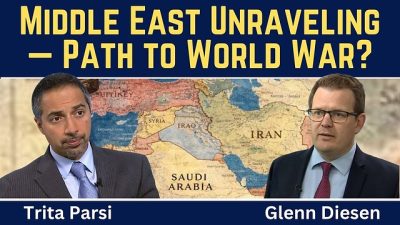
Trita Parsi: Middle East Unraveling — Are We on the Path to World War?
or go to
Aletho News Archives – Video-Images
New Book
Trans agenda is ‘normalization of sadism’ – US author

RT | September 23, 2026
The US Democratic Party has embraced a transgender agenda that amounts to “the normalization of sadism,” author A.J. Rice has said, warning that radical trans policies would return if the party is allowed to regain power.
Speaking to RT’s America First host Scotty Nell Hughes about his new book, ‘The Curse of the Bearded Lady: How the Trans Mafia Whacked American Sanity’, Rice argued that activists have gained significant influence in schools, medicine, and corporate America while people who questioned the agenda have faced pressure to stay silent.
The author described the “trans mafia” as the sprawling network of people and institutions that have helped the movement gain influence. He singled out parts of academia, wealthy backers, and corporations, and stated that providers of transition-related treatment also have a financial incentive to keep young people in their care indefinitely.
Rice argued that the consequences of these policies ultimately fall on children who are being drawn toward gender-affirming medical treatments and on girls who are expected to share locker rooms or compete in sports with biological males.
He noted that while voters rejected the Democrats’ approach to gender in 2024, the party, which has been “captured by madness,” has since only doubled down and is seeking what is effectively “the normalization of sadism.” … Full report
Blog Roll
 Aletho News
- Integrity Initiative: UK-funded network framed dissent as Russian disinformation for years
- ‘We don’t seek permission to defend our country’: Snippets from President Pezeshkian’s UNGA address
- NATO chief wants Europeans to fight American wars [for Israel]
- German chemicals giant reveals details of downsizing
- Refaat Al-Areer Was The Canary In The Coal Mine In Israel’s War On The Truth
- Israeli election committee bars candidate from Knesset race over Gaza war opposition
- French-Lebanese man files war crimes complaint over Israeli attacks
- Mahan Air Flight Lands in China Despite US Threat against Iranian Airlines
- US eyes $10bn fund to rebuild war-battered Gulf infrastructure
- Trump meets Rodríguez near Maduro’s prison as Venezuela’s oil flows to US
- If Americans Knew
- Caught on Tape: AIPAC CEO Boasted of Controlling Trump’s National Security Officials
- Why Hamas Attacked Israel in October 2023 – Israeli professor Ilan Pappé
- They see them, then kill them: Israeli quadcopters track, deliberately target civilians in Gaza
- Winter could turn Gaza’s treacherous, war-damaged buildings into deathtraps
- Majority of Democratic Voters Want to Prosecute Both Biden and Trump Administration Officials Over Gaza
- As Gaza languishes, world leaders gather at the UN – Daily Update
- Sanctions are collective punishment: immoral and self-defeating
- Phosphorus Munitions Fired by Israel Burn Groves, Orchards in Southern Lebanon
- Israel Carries Out New Ceasefire Violations Across Gaza
- AI – Emphasis on the ‘I’: Israel Is Funding AI Chatbot Propaganda
- No Tricks Zone
- New Study: Earth And Venus Surface Warmth Largely Explained By Convection And Lapse Rate, Not CO2 Or Radiation
- 2025 Nature Paper Claiming Worsening Global Drought Gets RETRACTED …Heavily Flawed
- New Study: ‘Global Drought Shows No Detectable Recent Acceleration Under Climate Warming’
- Economic Masterminds: German Socialists Suggest Taxing Productivity Gains Stemming From Using AI
- The South China Sea Has Not Been Cooperating With The Climate Change Narrative
- Energy Crisis: Germany Enters Heating Season With Historically Low Gas Reserve Fill Levels
- New Study: The Antarctic Ice Sheet Gained Mass From 2020-2024 Due To Staggering Snow And Ice Accumulation
- Study: Ocean Heating Rates From Thousands Of Years Ago ‘Dwarf’ Modern Ocean Heating Rates
- Climate Extremists Target, Attack Large-Scale Power Grid Infrastructure In Germany!
- New Study: Antarctic Ice Melt Has Contributed Less Than 1 Centimeter To Sea Level Rise In The Last 30 Years

