Iran can be Trump’s nemesis
By M. K. BHADRAKUMAR | Indian Punchline | June 15, 2019
What a coincidence that a leaked document from the Organization for the Prohibition of Chemical Weapons (OPCW) just exposed that the chemical weapons attack in Douma, Syria in April, 2018 was most likely staged. In security parlance, it was a false flag operation — stage-managed cunningly to create the alibi for a ‘humanitarian intervention’ by the West in Syria.
As it happened, the US and France did stage a missile strike at Syrian government targets in July that year, alleging that Damascus was culpable for what happened in Douma, ignoring the protests by Russia.
False flag operations are not uncommon, but the US holds a PhD on that genre. The most famous one in modern history was the Gulf of Tonkin incident of August 1964 where the US government deliberately misrepresented facts to justify a war against Vietnam.
Prima facie, there is enough circumstantial evidence to estimate that the attack on two tankers in the Gulf of Oman on June 13 has been a false flag operation. The attack on the two tankers with cargo heading for Japan took place just as the Japanese PM Shinzo Abe sat down for the meeting yesterday with Iran’s Supreme Leader Ayatollah Ali Khamenei in Tehran.
The fact of the matter is that Abe was on a delicate mission to try to kickstart talks between the US and Iran. It is one of those delicate moments when a slight push can derail or even undermine the nascent move for dialogue. True, in the first round, Khamenei rejected talks with the US. But, as Abe said later, more efforts are needed for easing tensions between the US and Iran.
Therefore, as regards the incident yesterday in the Gulf of Oman, the question to be asked is: Who stands to gain? Most certainly, it cannot be Iran, which has just laid on the table in plain terms what it takes for negotiations to commence between the US and Iran — President Trump abandoning what Tehran calls the US’ ‘economic terrorism’ against it. Khamenei told Abe with great frankness that it is futile to negotiate with the US, which keeps resiling from international agreements. No doubt, Trump has been highly erratic by making overtures to Iran on the one hand and tightening the screw on the other hand. (See my blog Abe’s mediatory mission to Tehran hangs in the balance.)
Simply put, Iran has no axe to grind by undermining Abe’s mission, especially since Japan is the only western power, which, historically speaking, never ever acted against Iran but on the contrary consistently maintained friendly ties and showed goodwill. (Once in 1953, Japan even ignored the British-American embargo against Iran and went ahead to import Iranian oil.)
However, this much cannot be said about certain regional states — which Iran has called the ‘B Team’ — that are bent on perpetuating the US-Iran standoff and incrementally degrade Iran to a point that a military confrontation ensues at some point in which American power dispatches that country to the “Stone Age”, as the present US National Security Advisor John Bolton once put it.
In this rogues’ gallery, apart from Israel, there is also Saudi Arabia and the UAE. Bolton, of course, is mentored by Israel and it is an established fact that he has received money for services rendered from the Mojahedin-e Khalq, the anti-Iran terrorist group based in France, which espouses the overthrow of the Islamic regime in Tehran.
Iran has sounded warnings in recent weeks, including at the level of Foreign Minister Javad Zarif, that this ‘B Team’ would at some point stage false flag operations to ratchet up tensions and/ or precipitate a crisis situation, that would in turn prompt Trump to order some sort of military action against Iran.
To be sure, the stakes are very high for Israel, Saudi Arabia and the UAE if Abe’s mission advances further and the current tensions begin to ease. An added factor for the ‘B Team’ is that time is the essence of the matter. It increasingly seems that Bolton’s job as NSA is in danger. Trump has hinted more than once that he does not subscribe to Bolton’s warmongering. The well-known ex-CIA officer and commentator John Kiriakou wrote this week that the White House has “very quietly and discreetly begun informal meetings with a list of a half-dozen possible replacements for Bolton.” (See the commentary in Consortium News titled JOHN KIRIAKOU: Bolton’s Long Goodbye.) It is crucial for the ‘B Team’ that Bolton keeps his job in the White House. And there is no better way to hold back Trump from sacking his NSA when a crisis situation looms large in the Middle East.
Be that as it may, the US Secretary of State Mike Pompeo has announced that Iran is responsible for the incident in the Gulf of Oman. He claimed in a statement, “This assessment is based on intelligence, the weapons used, the level of expertise needed to execute the operation, recent similar Iranian attacks on shipping, and the fact that no proxy group operating in the area has the resources and proficiency to act with such a high degree of sophistication.”
Now, doesn’t Israel too have the intelligence capability, weapons and expertise to execute such a false flag operation? Read Pompeo’s statement carefully and its laboured tone gives away that the ex-CIA Director (who recently even bragged openly about the art of lying in diplomacy and politics) was far from convincing.
So, where’s the beef? Pompeo has instructed that the UN Ambassador Jonathan Cohen raise the matter in the UN Security Council. There is an eerie similarity to what once one of Pompeo’s predecessors as state secretary, Colin Powell did — manufacturing evidence of WMD program by Saddam Hussein to pave the way for the US to invade Iraq.
What needs to be factored in is that the US anticipates that in another fortnight, Iran’s 60-day deadline for the European countries to come up with concrete steps to fulfil their commitments under the 2015 Iran nuclear deal will expire. The German Foreign Minister Heiko Maas’s visit to Tehran last week was a calculated attempt to persuade Iran to accept the stark reality that it must unilaterally fulfil its commitments under the nuclear deal while there is little the EU can do in practical terms to defy the US sanctions. Maas tried to persuade Iran to accept the US’ demand that non-nuclear issues (such as Iran’s missile programme, regional policies, etc.) also be negotiated under a new pact. Quite obviously, the European powers, despite their bravado (in words), are falling in line with Trump’s strategy of ‘maximum pressure’ against Iran.
If Iran decides to reject the idea of unilaterally observing the 2015 deal (without any reciprocal acts by the international community), the US and its western allies will want to take the matter to the UNSC to revive the UN’s past (pre-2015) sanctions against Iran. The big question is whether Russia and China would allow such a turn of events. Tehran has categorically denied any involvement in yesterday’s incident. And Iran is playing it cool. President Hassan Rouhani and Foreign Minister Javad Zarif left Tehran for Bishkek on June 13, as scheduled previously, to participate in the Shanghai Cooperation summit.
Meanwhile, the US has made an additional deployment to the region. But then, the US Central Command has also signalled to Tehran in a statement: “We have no interest in engaging in a new conflict in the Middle East. We will defend our interests, but a war with Iran is not in our strategic interest, nor in the best interest of the international community.”
At this point, the logical thing to do will be to insist on an impartial investigation by the UNSC on the incident. But, curiously, no country is willing to bell the cat. Russia, which is usually quick on demanding facts before reaching any definitive opinion on such murky situations, is also not in a hurry to demand investigation. Can it be that everyone understands that this was a false flag operation and could only be Bolton’s last waltz with Netanyahu?
Trump is walking a fine line. He has blamed Iran, but refrained from saying what he proposed to do. The fact remains that a highly dangerous situation is developing in and around the Straits of Hormuz, which is a choke point for oil tankers.
An entanglement with Iran’s Pasdaran is the last thing Trump would want as he plans to announce shortly his candidacy for the 2020 election. The situation is fraught with grave political risks, if one recalls how the Iran crisis spelt doom for Jimmy Carter’s re-election campaign in 1980.
Trump has bitten more than he could chew, as the strong rebuke Iran’s Supreme Leader Ali Khamenei administered to him underscores. Iran may turn out to be Trump’s nemesis.
Read the CNN ‘analysis’ here taunting Trump to walk the talk on Iran.
Munk School of Global Affairs feeds anti-Iran propaganda

By Yves Engler · June 12, 2019
Sometimes, when you pay attention, it is easy to see how foreign policy propaganda works. Take the case of Iran.
Recently the US has choked off Iranian oil exports, listed its military a terrorist organization and dispatched an aircraft carrier and B-52 bombers to its environs to stop Iran’s “aggression”. Going along with Donald Trump’s warlike actions and rhetoric, Justin Trudeau’s government has broken a promise to restart diplomatic relations, failed to withdraw Iran from Canada’s list of state sponsors of terrorism and recently accused Tehran of destabilizing the region.
This is the context in which the Munk School of Global Affairs’ Citizen Lab released a recent report criticizing Iran. According to Citizen Lab, an Iran-aligned group dubbed Endless Mayfly impersonated major media sites, used fake Twitter accounts to spread false articles and targeted journalists with fake stories. Its report noted, “initial reporting on some of the inauthentic articles speculated that Endless Mayfly may have links to Russia; however, based on the evidence gathered from our investigation we conclude with moderate confidence that Endless Mayfly is Iran-aligned and has been operational since at least early 2016.”
The University of Toronto based lab’s accusations were picked up by dozens of media outlets around the world. A New York Times headline read: “Report Shows How a Pro-Iran Group Spread Fake News Online” while the Globe and Mail noted “New Citizen Lab report suggests Iran spreads fake news.”
But, the report’s concluding section titled “Narratives fit Iranian interests, propaganda” isn’t convincing. One reason it claims Iran was responsible for the initiative is that “framing Saudi Arabia as a creator and supporter of global Islamist terrorism is also a very common theme in Endless Mayfly content and is consistent with recent rhetoric from Iran’s top-ranking officials.” But, Iranian officials certainly aren’t the only ones who claim Saudi Arabia contributes significantly to Islamic terror.
While the media mostly covered Citizen Lab’s claims uncritically, its positions on Iran should be viewed with significant skepticism. This ‘lab’ has produced a stream of reports critical of Iran and, in fact, is part of a government funded effort to destabilize that country. In March Citizen Lab Director Ron Deibert co-authored “Censors Get Smart: Evidence from Psiphon in Iran.” Previously, Citizen Lab published “Group 5: Syria and the Iran Connection”, which described a malware operation targeting Syrian opposition figures that purportedly came from Iran. The Lab published After the Green Movement: Internet Controls in Iran, 2009-2012 and in 2015 they detailed hacking of Iranian dissidents. While Citizen Lab carefully avoided naming a culprit, their press release hyped the matter and a number of media reports implied Iranian authorities were responsible.
Deibert is a regular at anti-Iranian events. He spoke at a Toronto International Film Festival screening of a movie about the 2009 Green Revolution in Iran and a 2012 Walrus article described a “network of local Farsi speakers linked to Deibert and Psiphon.”
With early financial support from the Ford Foundation, Donner Canadian Foundation and Open Society Institute, Citizen Lab developed software to bypass government censors. It worked with Voice of America, Radio Free Europe and Radio Farda in Iran to disseminate its Psiphon technology to Iranian dissidents. A 2018 Vice story titled “This App Is Helping Iranians Beat Tehran’s Internet Censorship” described Psiphon’s growth in Iran. It noted, “the lab, and the school, has spent years devising various ways to improve civic engagement in Iran, especially online, with some financial support from the Canadian government.”
The Munk School of Global Affairs joined the Stephen Harper Conservatives’ low-level war against Iran. After severing diplomatic ties and designating Iran a state sponsor of terrorism in 2012, Foreign Affairs ploughed $250,000 into the Munk School’s Global Dialogue on the Future of Iran. The aim of the initiative was to foment opposition to the regime and help connect dissidents inside and outside Iran. Employing cutting-edge Internet strategies, the Iran Dialogue was launched at a two-day conference kicked off by foreign minister John Baird. Some Iranian Canadians criticized the 2013 Global Dialogue on Iran. In a letter to Munk School head Janice Stein, who was awarded an honorary doctorate from Hebrew University “in tribute to her unwavering devotion to Israel”, the president of the Iranian Canadian Community Council Niaz Salimi wrote: “Conspicuously absent from the event were experts, academics, political activists, students, bloggers, journalists and members of the Iranian diaspora (including those of the Iranian-Canadian community) whose views on Iran do not fully concur with the positions of the Harper government.”
The Munk School has been a hub of anti-Iranian activity. A senior research fellow until recently, Mark Dubowitz was dubbed “The Man Who Fights Iran” by Ynet, Israel’s largest English language news site. Alongside his position at the Munk School, Dubowitz was executive director of the extremist pro-Israel Foundation for Defense of Democracies where he led its campaign against the Obama administration’s Iran nuclear deal. In 2011 Dubowitz said, “the best way [to end Iran’s nuclear program] is to work toward changing the regime.”
Expanding the Global Dialogue on the Future of Iran, Foreign Affairs gave the Munk School $9 million in 2015 to establish the Digital Public Square project. The federal support “will enable the Munk School to create our new Digital Public Square, a square designed for citizens who cannot come together physically to exchange ideas about the future of their country,” Munk School head Janice Stein said. The countries cited were Iran, Syria, Iraq and Russia. There was no mention of employing digital technologies to undermine online censorship in equally, or more, repressive allies such as Rwanda, Jordan, Honduras or Saudi Arabia.
This is one-way Canadian propaganda works: Establish who your enemies are — generally defined by big corporations, rich people and whoever is in power in Washington — attempt to destabilize their “regimes”, then accuse their governments of interfering in your affairs.
Citizen Lab’s recent report criticizing Iran is part of a government funded effort to demonize that country, which could be a step towards a military assault.
US Treasury Dept imposes new Iran-related sanctions on 2 individuals and a company in Iraq
RT | June 12, 2019
The US Treasury Department announced sanctions on Wednesday against two Iraq-based persons and one company, for their alleged links to Iran’s Revolutionary Guard.
Makki Kazim and Mohammed Hussein, along with the South Wealth Resources Company have all been hit with secondary sanctions, according to the Treasury Department website.
Secondary sanctions form a major part of US international statecraft, cutting off businesses and individuals from the US financial system and tarnishing their reputations with international businesses and banks. A number of measures can be enforced against targeted individuals, ranging from limiting their ability to do business in the US to prohibiting all US parties from conducting business with them.
Welcome David Schenker
Another Zionist in charge of American foreign policy

By Philip Giraldi • Unz Review • June 11, 2019
Those who think that the foreign policy of the United States should be the product of serious discussion embracing a variety of viewpoints to come to a conclusion that benefits the American people should perhaps take note of what has been going on in the President Donald Trump administration. The use of unrelenting pressure to include threats of military intervention rather than negotiation has been noted by many, but the media predictably has failed to discuss the implications of having a team in place making decisions relating to the volatile Middle East and beyond that consists overwhelmingly of Orthodox Jews and Christian Zionists.
To recap, Trump’s A-team in the Middle East is headed by his Jewish son-in-law Jared Kushner who is being personally advised by a group of Orthodox Jews. David Friedman, the U.S. (sic) Ambassador to Israel is also an Orthodox Jew and a former bankruptcy lawyer with no diplomatic or foreign policy credentials. He is a passionate supporter and even a funder of the illegal Israeli settlements on the West Bank and on the Golan Heights. Friedman endlessly and ignorantly repeats Israeli government talking points and eventually succeeded in changing the language used in State Department communications, eliminating the word “occupied” when describing Israel’s control of the West Bank. His humanity does not extend beyond his Jewishness, defending the Israeli shooting of thousands of unarmed Gazan protesters and the bombing of schools, hospitals and cultural centers. How he represents the United States and its citizens who are not dual nationals must be considered a mystery.
Friedman’s top adviser is Rabbi Aryeh Lightstone, who is described by the Embassy as an expert in “Jewish education and pro-Israel advocacy.” Once upon a time Lightstone described Donald Trump as posing “an existential danger both to the Republican Party and to the U.S.” and even accused him of pandering to Jewish audiences. Apparently when opportunity knocked, he changed his mind about his new boss. Pre-government in 2014, Lightstone founded and headed Silent City, a Jewish advocacy group supported by extreme right-wing money that opposed the Iran nuclear agreement and also worked to combat the nonviolent Boycott, Divestment and Sanctions (BDS) movement.
Trump’s chief “international negotiator” for the Middle East is yet another Orthodox Jew Jason Greenblatt, the former Trump Organization lawyer. If you have read a recent New York Times op-ed by Greenblatt entitled “Care about Gaza? Blame Hamas” you would understand that the misery being experienced by Palestinians in Gaza has nothing to do with Israeli snipers, artillery rounds and phosphorous bombs. It is all the Arabs’ own fault. Greenblatt uniquely claims that Israel’s illegal settlements are “not an obstacle to peace” and he is very upset because some naysayers are actually putting part of the blame for the human catastrophe in Gaza on Israel.
Kushner, Greenblatt and Friedman are perfect examples of the type of “dual” loyalist who cannot appreciate that their overriding religious and ethnic allegiances are incompatible with genuine loyalty to the United States. The other key pro-Israel players in the foreign policy establishment are nominally Christian, including Vice President Mike Pence and Secretary of State Mike Pompeo, both of whom are Christian Zionists who believe (and hope) that the re-creation of Israel is part of biblical prophecy that will lead to a great war, the end of the world as we know it and the second coming of Christ. The final component of the Zionist line-up is National Security Advisor John Bolton, who has been a recipient of the “Defender of Israel Award” as well as an outspoken advocate of war with Iran.
Not exactly a model of diversity, is it? Well, there was one piece missing and that was the State Department’s Assistant Secretary of State for Near Eastern Affairs, which has been vacant for the past fourteen months due to failure of the Senate to approve the candidate proposed by Trump, one David Schenker. Schenker was not on hold because of what might be regarded as legitimate concerns about his background or his presumed biases, but rather because Senator Tim Kaine had been demanding from the White House documents relating to military action in Syria, a more-or-less unrelated issue. Last Wednesday Schenker was finally approved by the Senate in an 83 to 11 vote.
Schenker has spent most of his time in Washington at the Washington Institute for Near East Policy (WINEP), a think-tank that supports the Israeli government. He began as an analyst after graduate school and his career exhibits the familiar neocon pattern of jumping between pro-Israel foundations and government jobs to build a resume and credibility. He served in the George W. Bush Pentagon, which was a hot bed of neocon subversion featuring Paul Wolfowitz and Doug Feith. And WINEP is no ordinary think-tank. It was founded by the American Israel Public Affairs Committee (AIPAC), the most powerful pro-Israel lobby in Washington. To describe WINEP as “supporting the Israeli government” is an understatement.
When news of the Senate’s confirmation vote came through, WINEP Executive Director Robert Satloff enthused that “David Schenker’s career has been dedicated to enhancing the quality of U.S. Middle East policy, and it is only fitting he should now be the one enacting such policies at such a critical time for U.S. interests in the region.” Satloff is right to gloat, as The Lobby that he is part of now has its nice Jewish boy in a senior position at the State Department where he will be “enhancing the quality” of U.S. foreign policy for the Middle and Near East to favor Israel.
In a press release WINEP Institute President Shelly Kassen and Chairman Martin J. Gross also joined in, describing how “We are proud of the fact that David Schenker will be the latest in a long line of Institute experts to join the government in senior positions — in both Republican and Democratic administrations — to provide expertise on the Middle East.”
Yes, Schenker is clearly full of expertise, though it is odd how the government appears to think that expert opinion on the Middle East is an attribute belonging only to Jewish pseudo-scholars and think-tank parasites. It is expected that Schenker will not hesitate to get tough with the Arabs. In a September 2017 interview he emphasized the threat posed by “Hezbollah’s tunnels under the Israel-Lebanon border.” And he believes that a future war between Israel and Hezbollah is “not a matter of ‘if,’ but ‘when.’” There is little doubt which side Schenker will be on, even if Benjamin Netanyahu starts the war.
There is an unfortunate history of American Jews closely attached to Israel being promoted by powerful and cash rich domestic lobbies to act on behalf of the Jewish state, enabling them to move between think-tanks and government almost effortlessly. To be sure, by virtue of their relentless networking and gaming of the system, Jews who are Zionists are vastly overrepresented in all government agencies that have anything at all to do with the Middle East. Meanwhile, one can also reasonably argue that the Republican and Democratic Parties are de facto in the pockets of Jewish/Israeli billionaires named Sheldon Adelson and Haim Saban, both of whom regard the advancement of Israeli rather than American interests as their top priorities.
What is to be done? Well, it would be nice, almost unbearably nice, to see the media and Congress just for once doing their jobs by challenging the bona fides of poseurs like Kushner, Friedman, Greenblatt and Schenker not to mention the demented trio of Pence, Pompeo and Bolton. It is not in the United States’ interest to have as its representatives and spokesmen in an important and highly volatile part of the world individuals who are demonstrated partisans on issues that that will surely require some compromise if they are ever to be resolved. Israeli leaders have described with a grin how easy it is to “move” the United States in their favor by virtue of the power of their diaspora associates both in and out of government. Perhaps it is time to wake up to that fact, to get rid of the Quislings and set the pendulum swinging in the other direction.
Philip M. Giraldi, Ph.D., is Executive Director of the Council for the National Interest, a 501(c)3 tax deductible educational foundation (Federal ID Number #52-1739023) that seeks a more interests-based U.S. foreign policy in the Middle East. Website is councilforthenationalinterest.org, address is P.O. Box 2157, Purcellville VA 20134 and its email is inform@cnionline.org.
Abe’s mediatory mission to Tehran hangs in the balance
By M. K. BHADRAKUMAR | Indian Punchline | June 10, 2019
With two days to go for the arrival of Japanese Prime Minister Shinzo Abe in Tehran on a peace mission to promote US-Iran talks, a great deal of shadow boxing has been going on. Typically, there is much excitement in the media. Thus, western media in general hyped up the remarks of the commander of the US’ Lincoln strike group, Rear Adm. John F. G. Wade to make them sound belligerent and provocative.
However, Tehran has not fallen into that trap. The fact of the matter is that the US and Iranian militaries have deep experience in fathoming each other’s intentions and working out ground rules of co-habitation in the crowded waters of the Persian Gulf. This arrangement has worked fine for past 4 decades and quite obviously, a ‘new normal’ has come to exist lately with the recent deployment of a US nuclear strike group in the region.
The Tehran Times carried a sober report on Adm. Wade’s remarks bringing out vividly what the admiral wished to convey (and Iran’s appreciation of it). The influential establishment daily highlighted Wade’s remark that “Since we’ve been operating in the region, we’ve had several interactions with Iranians. To this point all have been safe and professional — meaning, the Iranians have done nothing to impede our maneuverability or acted in a way which required us to take defensive measures.”
That just about sums up the state of play in the Persian Gulf. The facts are important. The Tehran Times reported: “One month after its arrival in the region, the Lincoln has not entered the Persian Gulf, and it’s not apparent that it will. The USS Gonzalez, a destroyer that is part of the Lincoln strike group, is operating in the Persian Gulf.”
“Last week, the Lincoln was some 320 kilometers (200 miles) off the eastern coast of Oman in the Arabian Sea. It would still need to pass through the Gulf of Oman and the Strait of Hormuz before reaching the Persian Gulf.” Clearly, the ‘new normal’ is not so precarious as made out by some media reports (here , here and here.) Surely, a lot of grandstanding is going on, but, war? Not a chance.
Meanwhile, the US has extended its sanctions on Iran’s oil industry to cover its largest petrochemical group. This appears to have been a decision in the pipeline but the timing of the announcement (on Friday) is intriguing — although it is a by-now familiar pattern of an inchoate Administration pulling in different directions. No doubt, Tehran has questioned the US’ true intentions by making such a move at this point in time when the air is full of talk about negotiations.
The Trump administration has taken a reckless step on the eve of Abe’s mission, which could have been avoided. It is a moot point whether Trump himself was aware of it or not. All the same, Tehran is approaching the talks with Abe calmly and purposely.
Unsurprisingly, Iran plays down the forthcoming talks. A commentary in the Tehran Times in the weekend cited Washington’s move on Friday in extending the sanctions to the petrochemical sector as confirming that the White House has no intentions to “retreat” from its “maximum pressure” strategy. The commentary sees two-fold pressures as working on Trump — aversion to war in the US public opinion and the lack of support from allies apropos his Iran policies.
Interestingly, the commentary weighs on Abe’s mission, assessing that its outcome depends on two factors — “the ‘real will’ and determination of the US and Iran to solve the ongoing problems, especially the US’ ‘real will’ ” and secondly, Japan’s ability to influence US decisions.
Foreign Minister Javad Zarif has welcomed Abe’s visit — “We will carefully listen to Abe’s views, and then will express ours in detail.” But he stressed that the US must stop its ‘economic war’. He disclosed that Tehran has already sensitised Abe in the matter.
Importantly, the Spokesman of Iran’s Supreme National Security Council has noted that the success of Abe’s visit could be guaranteed if only Japan has made efforts to “return the US to the JCOPA (2015 nuclear deal) and compensate (sic) the losses suffered by Iran (due to sanctions)” as well as to remove the US sanctions regime.
Abe’s visit to Tehran is a milestone in Japan-Iran bilateral relations insofar as this is the first such event since the Islamic Revolution in 1979, although the two countries have kept up friendly ties all through. Tehran pins hopes that Abe can win waivers from the US to be able to buy oil from Iran.
Quite obviously, the benchmark for the Iranian negotiators will be the remarks made by Supreme Leader Ayatollah Ali Khamenei on May 29 during an an address to a gathering of Iranian academicians, researchers and elites in Tehran. Khamenei said that the bottom line is, “We will not negotiate on the core issues of the Revolution. Negotiations on this issue imply trading; that is, they mean we give up on our defensive capabilities. We will not negotiate our military capability.”
In general, Khamenei said the US has a history of targeting the assets of a country by pressurising it. In this, negotiation becomes a tactic to compel the interlocutor to trade its national assets. “They (US) pressure until the adversary gets tired, and then propose to negotiate. This negotiation is complementary to the pressure and aims to cash in on the pressures. They impose pressure and then propose to negotiate. This is what negotiation means to them. Their strategy is not negotiation. It is pressure. Negotiation is part of the pressure strategy.”
That is why, Khamenei underscored, Iran has had to resort to resistance as a “countermeasure.” To quote him, “The countermeasure for us (Iran) is to use our own means of pressures to contend their (US) pressure. However, if we are deceived by their call for negotiations and consider our means of pressures unnecessary, we would slip and that equals absolute defeat.” (Excerpts of Khomeini’s speech are here.)
Tulsi Gabbard Pushes No War Agenda – and the Media Is out to Kill Her Chances
By Philip Giraldi | Strategic Culture Foundation | June 6, 2019
Voters looking ahead to 2020 are being bombarded with soundbites from the twenty plus Democratic would-be candidates. That Joe Biden is apparently leading the pack according to opinion polls should come as no surprise as he stands for nothing apart from being the Establishment favorite who will tirelessly work to support the status quo.
The most interesting candidate is undoubtedly Congresswoman Tulsi Gabbard, who is a fourth term Congresswoman from Hawaii, where she was born and raised. She is also the real deal on national security, having been-there and done-it through service as an officer with the Hawaiian National Guard on a combat deployment in Iraq. Though in Congress full time, she still performs her Guard duty.
Tulsi’s own military experience notwithstanding, she gives every indication of being honestly anti-war. In the speech announcing her candidacy she pledged “focus on the issue of war and peace” to “end the regime-change wars that have taken far too many lives and undermined our security by strengthening terrorist groups like Al-Qaeda.” She referred to the danger posed by blundering into a possible nuclear war and indicated her dismay over what appears to be a re-emergence of the Cold War.
In a recent interview with Fox News’s Tucker Carlson, Gabbard doubled down on her anti-war credentials, telling the host that war with Iran would be “devastating,” adding that “I know where this path leads us and I’m concerned because the American people don’t seem to be prepared for how devastating and costly such a war would be… So, what we are facing is, essentially, a war that has no frontlines, total chaos, engulfs the whole region, is not contained within Iran or Iraq but would extend to Syria and Lebanon and Israel across the region, setting us up in a situation where, in Iraq, we lost over 4,000 of my brothers and sisters in uniform. A war with Iran would take far more American lives, it would cost more civilian lives across the region… Not to speak of the fact that this would cost trillions of taxpayer dollars coming out of our pockets to go and pay for this endless war that begs the question as a soldier, what are we fighting for? What does victory look like? What is the mission?”
Gabbard, and also Carlson, did not hesitate to name names among those pushing for war, one of which begins with B-O-L-T-O-N. She then asked “How does a war with Iran serve the best interest of the American people of the United States? And the fact is it does not,” Gabbard said. “It better serves the interest of people like [Israeli Prime Minister Benjamin] Bibi Netanyahu and Saudi Arabia who are trying to push us into this war with Iran.”
Clearly not afraid to challenge the full gamut establishment politics, Tulsi Gabbard had previously called for an end to the “illegal war to overthrow the Syrian government,” also observing that “the war to overthrow Assad is counter-productive because it actually helps ISIS and other Islamic extremists achieve their goal of overthrowing the Syrian government of Assad and taking control of all of Syria – which will simply increase human suffering in the region, exacerbate the refugee crisis, and pose a greater threat to the world.” She then backed up her words with action by secretly arranging for a personal trip to Damascus in 2017 to meet with President Bashar al-Assad, saying it was important to meet adversaries “if you are serious about pursuing peace.” She made her own assessment of the situation in Syria and now favors pulling US troops out of the country as well as ending American interventions for “regime change” in the region.
In 2015, Gabbard supported President Barack Obama’s nuclear agreement with Iran and in 2016 she backed Bernie Sanders’ antiwar candidacy. More recently, she has criticized President Donald Trump’s withdrawal from the Iran nuclear deal. Last May, she criticized Israel for shooting “unarmed protesters” in Gaza, a very bold step indeed given the power of the Israel Lobby.
Tulsi Gabbard could well be the only genuine antiwar candidate that might truly be electable in the past fifty years, and that is why the war party is out to get her. Two weeks ago, the Daily Beast displayed a headline: “Tulsi Gabbard’s Campaign Is Being Boosted by Putin Apologists.” The article also had a sub-headline: “The Hawaii congresswoman is quickly becoming the top candidate for Democrats who think the Russian leader is misunderstood.”
The obvious smear job was picked by ABC’s George Stephanopoulos, television’s best known Hillary Clinton clone, who brought it up in an interview with Gabbard shortly thereafter. He asked whether Gabbard was “softer” on Putin than were some of the other candidates. Gabbard answered: “It’s unfortunate that you’re citing that article, George, because it’s a whole lot of fake news.” Politico reported the exchange and wrote: “’Fake news’ is a favorite phrase of President Donald Trump…,” putting the ball back in Tulsi’s court rather than criticizing Stephanopoulos’s pointless question. Soon thereafter CNN produced its own version of Tulsi the Russophile, observing that Gabbard was using a Trump expression to “attack the credibility of negative coverage.”
Tulsi responded “Stephanopoulos shamelessly implied that because I oppose going to war with Russia, I’m not a loyal American, but a Putin puppet. It just shows what absurd lengths warmongers in the media will go, to try to destroy the reputation of anyone who dares oppose their warmongering.”
Tulsi Gabbard had attracted other enemies prior to the Stephanopoulos attack. Glenn Greenwald at The Intercept described how NBC news published a widely distributed story on February 1st, claiming that “experts who track websites and social media linked to Russia have seen stirrings of a possible campaign of support for Hawaii Democrat Tulsi Gabbard.”
But the expert cited by NBC turned out to be a firm New Knowledge, which was exposed by no less than The New York Times for falsifying Russian troll accounts for the Democratic Party in the Alabama Senate race to suggest that the Kremlin was interfering in that election. According to Greenwald, the group ultimately behind this attack on Gabbard is The Alliance for Securing Democracy (ASD), which sponsors a tool called Hamilton 68, a news “intelligence net checker” that claims to track Russian efforts to disseminate disinformation. The ASD website advises that “Securing Democracy is a Global Necessity.”
ASD was set up in 2017 by the usual neocon crowd with funding from The Atlanticist and anti-Russian German Marshall Fund. It is loaded with a full complement of Zionists and interventionists/globalists, to include Michael Chertoff, Michael McFaul, Michael Morell, Kori Schake and Bill Kristol. It claims, innocently, to be a bipartisan transatlantic national security advocacy group that seeks to identify and counter efforts by Russia to undermine democracies in the United States and Europe but it is actually itself a major source of disinformation.
No doubt stories headlined “Tulsi Gabbard Communist Stooge” are in the works somewhere in the mainstream media. The Establishment politicians and their media component have difficulty in understanding just how much they are despised for their mendacity and unwillingness to support policies that would truly benefit the American people but they are well able to dominate press coverage. Given the flood of contrived negativity towards her campaign, it is not clear if Tulsi Gabbard will ever be able to get her message across. But, for the moment, she seems to be the “real thing,” a genuine anti-war candidate who is determined to run on that platform. It might just resonate with the majority of Americans who have grown tired of perpetual warfare to “spread democracy” and other related frauds perpetrated by the band of oligarchs and traitors that run the United States.
Edmund Burke Rides Again
But this time the horse is paid for by Israel
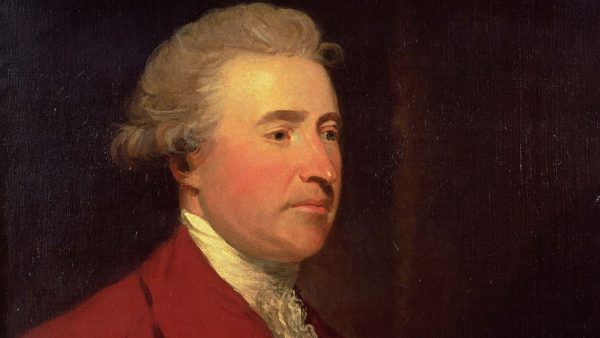
Portrait of Edmund Burke (1729-97); Anglo-Irish politician, orator and political thinker; anti-French Revolution; by Northcote, James; Royal Albert Memorial Museum
By Philip Giraldi • Unz Review • June 4, 2019
A new pro-Israel group that is pretending to be a standard bearer for conservative opinion in the United States was founded in January, a fortuitous bit of timing as it will not have to reveal its sources of income until next year. The Edmund Burke Foundation describes itself as “a new public affairs institute” having “the aim of strengthening the principles of national conservatism in Western and other democratic countries. The Foundation will pursue research, educational and publishing ventures directed toward this end.”
The Foundation’s launch will be at an open-to-the-public conference that will be held at Washington’s Ritz-Carlton on July 14-16, 2019. So as not to confuse the possible audience unduly over who Edmund Burke was or what he stood for, the conference is being advertised somewhat lamely as “National Conservatism: A Conference in Washington D.C.” on its website nationalconservatism.org. Note that neither the name of the foundation nor the promotion of its stellar cast of speakers includes the word “Israel,” but the Jewish state is really what it is all about.
The conference website explains that
“Politics in America, Britain, and other Western nations have taken a sharp turn toward nationalism—a commitment to a world of independent nations. This has been disorienting to many, not least the American conservative movement, which has, since the fall of the Berlin Wall in 1989, grown increasingly attached to a vision of a global ‘rules-based liberal order’ that would bring peace and prosperity to the entire world while attenuating the independence of nations.
“The return of nationalism has created a much-discussed ‘crisis of conservatism’ that may be unprecedented…The conference on ‘National Conservatism’ will bring together public figures, journalists, scholars, and students who understand that the past and future of conservatism are inextricably tied to the idea of the nation, to the principle of national independence, and to the revival of the unique national traditions that alone have the power to bind a people together and bring about their flourishing.”
It is obvious to most actual conservatives that nationalism has never really gone away, but what the conference organizers are really getting at is a revival of unabashed nationalism as the excuse for countries when they behave badly while promoting their own interests without regard for the interests of others. Israel and the United States are the prime examples of such behavior and the argument that they have a special entitlement to justify their actions is frequently made, most notably by other Israel-firster groups like the Foundation for Defense of Democracies (FDD). FDD argues that democracy promotion by force is a legitimate foreign policy of powerful countries like the United States, while threatened democracies like Israel must be protected. That, of course, is a complete misrepresentation regarding just how democratic the two countries actually are and the idea that being democratic empowers some sort of leadership role or exempt status is in itself ridiculous.
Why do I suggest that the Edmund Burke Foundation is just another pro-Israel puppet? Look at the people running it. Its President is David Brog, who is also the executive director of the Maccabee Task Force, “an effort launched in 2015 to combat the anti-Israel BDS movement. He also sits on the Board of Directors of Christians United for Israel (CUFI), where he served as executive director for its first ten years. Before CUFI, Brog worked in the United States Senate for seven years, rising to be chief of staff to Senator Arlen Specter and staff director of the Senate Judiciary Committee. He has also worked as an executive at America Online and practiced corporate law in Tel Aviv, Israel and Philadelphia, PA. Brog is the author of Standing with Israel: Why Christians Support the Jewish State (2006) and In Defense of Faith: the Judeo-Christian Idea and the Struggle for Humanity (2010). In 2007, the Forward newspaper listed Brog in its ‘Forward 50’ most influential Jews in America.”
The Edmund Burke Foundation’s Chairman is an Israeli Yoram Hazony, who describes himself as a “Jewish philosopher.” He resides in the Jewish state and is a well-known Israeli nationalist, having written that nationalism empowers “the collective right of a free people to rule themselves.” He declares that “We should not let a hairbreadth of our freedom be given over to foreign bodies under any name whatsoever, or to foreign systems of law that are not determined by our own nations.” He adds “My first concern is for Israel.”
In other words, for Hazony all external criticism of what Israel is and does is illegitimate while Brog is what might be described as someone who has made a career out of being Jewish, along the way advancing what he perceives as Israeli interests. So why are they heading an ostensibly American foundation?
Indeed, it doesn’t require a Trumpean level of genius to see what this is all about and where it is going. If there is an unfortunate development arising from the National Conservative conference it is the inclusion as speakers of some genuine conservatives among the crowd of usual Zionist hacks, with National Security Bloviator John Bolton leading the dark side of the list. The real conservatives, who are invited to give the event credibility, should know better and ought to avoid the Edmund Burke Foundation like the plague. I will not call them out by name here and now but they can be identified from the speakers’ list. One has to wonder if they are being paid for their services…
In fact, new organizations dedicated to defending and promoting Israel are not exactly unusual. They tend to pop up in the United States and Western Europe like wild mushrooms in the spring time. By one estimate, there are 600 such organizations in the U.S. alone, running the gamut from the liberal left to the conservative right. They exist because there is a certain paranoia on the part of prominent Jews and leading Jewish organizations due to fear that the American people are finally waking up to the fact that they have been getting used and abused by a vast Zionist conspiracy for the past 70-plus years.
Why do some American Jews betray the interests of their own country to support another nation that is manifestly a pariah due to its own behavior? It might just be because to do so is painless and can, on the contrary, lead to personal advancement. Brog’s career demonstrates how it works, particularly if one can latch on to a Jewish Zionist Senator like Arlen Specter along the way. And the benefits for Israel are enormous, amounting to hundreds of billions of U.S. Treasury dollars as well as a de facto commitment for American soldiers to fight and die for Israel even if Israeli Prime Minister Netanyahu starts a war for no reason whatsoever.
Taken together, all of the pro-Israel groups constitute a veritable political juggernaut that seeks to advantage Israel and benefit it directly without regard for the damage done to American democracy and to actual U.S. interests. They should rightly be seen as organizations that regard their loyalty to the United States as negotiable, but they try to obfuscate the issue by claiming, wrongly, that there exist compelling reasons why Israel and the U.S. should continue to be best friends due to “shared values.” And, as self-defined leading democracies, the Israel-apologists argue that both are immune to criticism because they are acting on the basis of legitimate nationalist interests. It is a compelling argument for some, but ultimately false in that it suggests that there are no restraints on the behavior of either government. The Israelis have, for example, used the argument to justify the killing by army sniper fire hundreds of unarmed Palestinian demonstrators.
Promoting “democratic nationalism” to pander to Israel without any real understanding of actual interests has led the United States into a seemingly bottomless Middle Eastern quagmire. And, the sense of invulnerability that America’s uncritical support has encouraged among some Israelis also will not benefit the Jewish state in the long term. The creation of the Edmund Burke Foundation is just one more card in a losing hand and it hopefully will run out of steam as abruptly as it was created.
Philip M. Giraldi, Ph.D., is Executive Director of the Council for the National Interest, a 501(c)3 tax deductible educational foundation (Federal ID Number #52-1739023) that seeks a more interests-based U.S. foreign policy in the Middle East. Website is councilforthenationalinterest.org, address is P.O. Box 2157, Purcellville VA 20134 and its email is inform@cnionline.org.
Bipartisan Support for Trump’s Aggressive Iran Policy Reveals the Hollowness of Russiagate
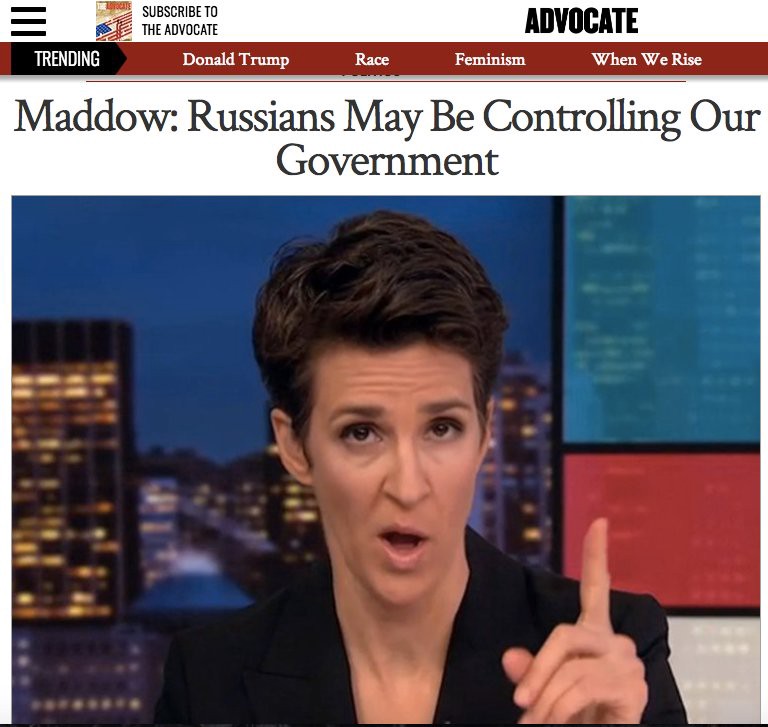
By Whitney Webb | MintPress News | June 3, 2019
In early May, MSNBC news host Rachel Maddow — known as one of the top promoters of the new Cold War and Russiagate in American media — emphatically endorsed regime change in Venezuela after she claimed that President Donald Trump’s hawkishness towards the South American country had changed, all because of a single phone call with his Russian counterpart Vladimir Putin.
Though Maddow’s claims were arguably the most extreme in suggesting that Trump was “taking orders” from Putin on Venezuela, she wasn’t alone in making them. For instance, Cenk Uygur of the Young Turks also made the claim that the Trump-Putin phone call on Venezuela was “direct evidence that he is literally taking orders from Putin.” In addition, several corporate media outlets supported this narrative by suggesting that Trump “echoed” Putin’s Venezuela stance after the phone call and directly contradicted his top staffers and even himself in doing so.
Yet now, strangely, those same corporate media voices remain silent on the Trump administration’s other regime-change project — in Iran — despite the fact that the Putin-led Russian government is set to be the biggest winner as tensions between the U.S. and the Islamic Republic boil over and threaten to send the Middle East into a fresh bout of destruction and chaos.
How Russia wins
As tensions between the U.S. and Iran have grown in recent months, analysts in both corporate and independent media have speculated about what country is set to benefit the most from the U.S.’ campaign of “maximum pressure” and regime change against the Islamic Republic. Of the many analyses, two countries have stood out as likely beneficiaries: Russia and China.
The cases for China and Russia’s benefit are somewhat similar given that the Trump administration’s focus on Iran results in less pressure on both Russia and China. This is despite the fact that, officially, the U.S.’ current National Defense Strategy explicitly calls for focusing attention on preparing for a “long war” against Russia and China to prevent either from superseding the U.S. as a global superpower. Yet, with the U.S. focused on regime change in Iran and Venezuela, Russia and China can avoid bearing the brunt of U.S. military adventurism, either directly or by proxy, while the U.S. wears itself thin by trying to do it all at once.
Several U.S. military analysts have been warning against war with Iran for precisely this reason. Nikolas Gvosdev, a professor of national security affairs at the U.S. Naval War College, recently wrote in The Hill that the U.S. faces a lose-lose scenario by pursuing a militaristic, aggressive Iran policy:
To gear up for a major conflict with Iran, the U.S. would be forced to de-emphasize Europe’s eastern flank, allowing Russia more time and breathing space to consolidate its position. On the other hand, a U.S. campaign that is defined more by bellicose rhetoric and less by action will buttress Russia’s claim, already seemingly validated in Syria and in Venezuela, that the U.S. talks a good game but has no real stomach for projecting its power.”
Both countries also stand to benefit from Iran’s increasing desperation for trading partners unwilling to bow to the U.S. Currently, China represents 30 percent of Iran’s international trade and the current U.S. sanctions on Iran have pushed Tehran to rely more heavily on Russia, especially for weapons purchases, than it had while the Iran nuclear deal (officially the Joint Comprehensive Plan of Action, JCPOA) was in force.
However, upon closer examination, it becomes clear that China, though it benefits to some degree, is not a clear winner amid current tensions, while Russia stands to gain the most. The reason for this is the effect of current and future U.S.-Iran tensions on the oil market. While China trusts Iran to be a key oil supplier even if there is a breach in U.S.-China relations, any shock to the oil market and any jump in oil prices — both of which are likely to occur if U.S.-Iran tensions continue to escalate — will spell disaster for the Chinese economy, given that China is now the world’s largest importer of oil.
Russia, on the other hand, stands to benefit massively from the chaos that U.S.-Iran tensions are set to unleash on the oil market and, by extension, oil prices. With the U.S. seeking to starve Iran of any and all oil export revenue, all countries that had been purchasing Iranian oil must seek new suppliers. Yet, with the prospect of a U.S-Iran conflict still ever-present, it will be those oil producers outside of the Middle East that will come out on top, since oil supply routes that do not pass through the Middle East do not risk supply disruptions that would be caused by a war in the region. Thus, Russia, owing to its location, will emerge as an oil producer of extreme importance. Furthermore, given that such instability in the Middle East will lead to a surge in global oil prices, Russia will be able to export more oil at a higher price and will see its economy and geopolitical clout benefit greatly as a result.
A potential geopolitical killing
In addition to a great boost to its oil sector, Russia also stands to make unique geopolitical gains, particularly in the Middle East and beyond. For instance, in Syria, Russia is increasingly seeking to use its pull with Syria’s government as a major bargaining chip with Israel and the U.S., as made clear by the upcoming trilateral summit on the Middle East between Russia, Israel and the U.S. The main focus of that summit will likely be the fate of the presence of foreign militaries in Syria, particularly Iranian and U.S. forces.
The summit will likely be dominated by Russia and Israel, given Israel’s influence over the U.S., and particularly over National Security Adviser John Bolton, who will represent the U.S. at the summit. Israel’s key interest in Syria at this stage of the conflict is the removal of Iranian forces from Syria. Russia is likely to oblige that request, as doing so would allow Russia to dominate a post-war Syria at Iran’s expense. This seems to be a current Russian objective in Syria, given recent reports of in-fighting among Russian and Iranian forces in Northern Syria.
However, Russia is unlikely to help reduce Iran’s Syria presence if doing so would favor the United States’ occupation of Syrian territory or threaten to upset Russia’s own interests in Syria. Thus, in this case, Russia is counting on Israel’s influence on the Trump administration to ensure that, if Iranian forces vacate Syria, it will be Russia that will dominate the country post-conflict.
Russia also stands to gain geopolitically from the isolationism being forced on Iran by the Trump administration. Indeed, U.S. pressure on Iran has already served Russian interests by pushing Iran further towards Russia, giving Moscow the status of an increasingly important economic partner of Tehran. While benefiting the Russian economy, closer economic ties between Moscow and Iran would also give Russia a leg up in discussions with the U.S., as Washington may then need to make concessions to or coordinate with Russia in future efforts to pressure Iran.
Meanwhile, Russia stands to reap major profits by selling more weapons to Iran, and to gain geopolitical clout by further cementing its role as a mediator of conflict by promoting compliance with the JCPOA and opposing regime change. Iran’s dwindling options for strategic alliances with non-U.S. aligned countries will make it difficult for Tehran to resist Russian demands on key issues, including the Syria conflict.
Another major geopolitical win for Russia that has resulted from the U.S.’ current Iran policy is the tension that that policy has engendered between the U.S. and its European allies. When the U.S. unilaterally withdrew from the JCPOA, it began the development of a rift between the U.S. and its key European allies who are also JCPOA signatories — particularly France, Germany and the United Kingdom. As a signatory, Russia’s stance on Iran has revolved around the JCPOA, with Russia having urged Iran to remain in the deal “no matter what,” advice that Iran does not now seem keen to follow.
Russia’s stance on JCPOA is likely aimed just as much at Europe as it is at Iran, since promoting the agreement amid the U.S. unilateral withdrawal paints Russia as more predictable and stable in terms of its political stances and diplomacy in comparison to the U.S. If nothing else, Putin is known for excelling at taking advantage of the missteps made by his geopolitical adversaries.
This is all part of a careful public image that Russia is seeking to cultivate with European countries as it hopes to attract them to do business with Russian oil and gas companies as the Middle East now seemingly approaches another era of extreme instability. By promoting the JCPOA alongside Europe, Russia makes increased Russo-European cooperation seem more attractive.
As U.S.-Iran tensions mount, particularly if armed conflict breaks out, importing goods from Russia, especially oil and gas, will appear more attractive and safer in comparison to goods that originate from or pass through the Middle East before arriving in Europe. Depending on how the situation plays out, Europe — driven by concerns about stability and reliability — may be willing to risk angering the U.S. to pursue increased economic cooperation with Russia, even though doing so would run counter to current U.S. and NATO objectives.
Putin plays Netanyahu
While it is often difficult to find accurate, honest reporting on Vladimir Putin –reporting that is neither too biased against him nor too much in his favor — it is generally acknowledged that Putin, above all else, is interested in advancing Russia’s national interest and is a cunning strategist who often thinks several steps ahead of both his allies and his adversaries.
In viewing the ratcheting up of tensions between the U.S. and Iran, Putin’s modus operandi remains unchanged and, upon closer examination, it is clear that he is giving the hotheads driving this still-escalating situation just enough rope to hang themselves. Meanwhile, Russia is waiting in the wings to pick up the pieces and further cement its already acknowledged role as the new foreign “peacemaker” in the Middle East while gaining economic and geopolitical clout in the process.
Prior to the Israeli election earlier this year, Israeli media noted on several occasions that Putin was backing the reelection of Israeli Prime Minister Benjamin Netanyahu, including when Putin hosted Netanyahu at a sudden pre-election summit. Israeli newspaper Haaretz described Putin’s decision to host Netanyahu at the time as aimed at helping Netanyahu secure the “crucial Russian vote” among Russian-Israeli Jews in order to “outflank” his competitors. In another instance, Putin was alleged to have further helped Netanyahu’s reelection odds by having Russian special forces find and deliver the remains of Zachary Baumel — an Israeli soldier who had gone missing in Lebanon in 1982 — to Israel just ahead of the election.
Putin’s direct support of Netanyahu may seem odd to observers of geopolitics, given that the two have often been at odds over Syria. However, Putin and Netanyahu have developed an effective working relationship and Russia and Israel enjoy relatively strong bilateral ties and economic agreements.
Yet, beyond the ties that have been forged between the two countries in recent years, Putin likely knows that he can play Netanyahu’s weaknesses to his advantage. For instance, Putin is acutely aware of the benefits to be reaped from increasing tensions between the U.S. and Iran and is also aware of the key role that Netanyahu has played and continues to play in driving the Trump administration’s Iran policy. Netanyahu’s near-obsession with regime change in Iran and the practical likelihood that a U.S.-Iran war would be “unwinnable” for the U.S. and would leave its military weakened and distracted are points that Putin is likely eager to exploit in pursuance of Russian geopolitical goals.
Russia seeks to play the role of mediator but only to a certain extent and has kept its attitude towards Iran intentionally vague when dealing with the Israeli government, so much so that Israeli officials have cited Russia’s unknown stance towards Iran as a major difficulty in negotiating the deconfliction of Russian and Israeli forces in Syria. This is likely because Russia doesn’t seek to aid either side amid escalating tensions, instead waiting for the current tensions to play out, as it stands to make gains in either case.
That Russia stands to gain from current U.S.-Iran tensions hasn’t been lost on all Israeli officials, however. Earlier this month, a former Israeli intelligence official, Yakkov Kedmi, openly stated that not only is a war against Iran “unwinnable” for the U.S. and its regional allies, but further that Russia would be the only major country to benefit from any military conflict pitting the Americans against the Iranians. Appearing on Russian television program Evening with Vladimir Solovyov, Kedmi stated that, if war does break out, the U.S. “won’t remain whole” after the conflict and that “if anyone wins, it’ll be Russia.”
“If the price of oil exceeds $100 per barrel, it hits the Chinese economy. Most of all, it hits the European and American economies,” Kedmi stated. “If you double the price,” he added, “[global] industry will be ruined. First of all, it will happen in the U.S.” To that, the program’s host, Vladimir Solovyov, asserted that “Their [American] industry will be [ruined]. It’ll be the opposite in our country. Our economy will begin to develop. We’ll feel like kings with golden diamond-studded wheels on our cars.”
Why the Russiagaters are silent on Iran
Given Russia — and Putin’s — clear benefit from the continuing U.S. escalation with Iran and a potential military conflict, it is striking that Putin’s fiercest critics in the American media have remained silent about this clear pay-off as the Trump administration continues to pursue an aggressive, hawkish Iran policy that hardly benefits the U.S. and instead benefits its supposed adversary. This is especially notable in light of the fact that these same American critics of Russia and Putin’s leadership were recently accusing Trump of “taking orders” from Putin by altering his Venezuela policy in a way that was perceived to benefit Russian over American interests.
This dichotomy is most easily deconstructed by noting that top promoters of Russiagate and news personalities known for their hyperfocus on Putin rarely call for any policy that would involve a reduction in tensions or less militarism abroad. Indeed, all too often, the “solutions” offered by these journalists involve sending weapons to U.S. proxy forces, shooting missiles at Russian allies, sanctioning Russia and its allies, and other “useful reminders of the military strength of the Western alliance” between the U.S. and NATO.
Without fail, the suggested solutions of how to counter Putin from the U.S. media and political establishment almost always involve “pushing back” with force equal to or greater than the perceived aggression. Rarely do they involve backing down or unwinding tensions, even in the cases where doing so would clearly challenge key geopolitical objectives of the Russian government.
In the case of Russia’s benefit from Trump’s Iran policy, the benefit is so clear that it has been voiced in several mainstream media outlets — including CNN, The Hill, Forbes and Bloomberg — with most of those reports focusing exclusively on the oil angle. However, while Russia’s advantage has been noted, it is also clear that Trump’s current Iran policy has avoided inflaming the Russiagate hysteria that has marked media coverage of other Trump policies and statements that were perceived as being “pro-Putin” for the past few years.
One reason that the media has skipped a prime opportunity for another Russiagate frenzy is the fact that many of the driving forces behind Russiagate are also supportive of regime change in Iran. Indeed, while Russiagate has recently been cast by Trump and prominent Republicans as a “hoax” narrative exclusive to Democrats, prominent neoconservatives have long been pivotal in creating and fomenting Russigate for over five years.
For instance, the origins of the infamous Steele dossier — which was used to assert that Russia’s government had a litany of salacious blackmail on Trump that it would use to manipulate him as president — trace back to top neoconservative Republican donor Paul Singer. That dossier was subsequently circulated within the Obama administration during the 2016 campaign by neoconservatives Victoria Nuland and the late Senator John McCain.
Many of the same neoconservative figures who have helped stoke Russiagate and pounced on the resulting climate of hysteria to promote increased militarism as the solution, also support regime change in Iran. Michael McFaul — U.S. Ambassador to Russia during the Obama administration — is both a strong advocate for aggressive U.S. measures to counter Putin and also a vocal proponent of U.S.-led regime change in Iran. Similarly, on the supposed other side of the political spectrum, Bill Kristol — well-known neoconservative writer, an icon of the establishment “resistance” to Trump, and a promoter of Russiagate — also strongly supports hawkish measures to contain Russia and is a long-time, vocal supporter of regime change in Iran.
While the tense situation between the U.S. and Iran is undeniably troubling, the relative silence among figures in U.S. media and politics who claim to be Putin’s fiercest critics with regard to Trump’s aggressive Iran policy reveals a stark truth about Russiagate. The goal of Russiagate is not actually about “countering” Putin or Russian geopolitical influence; it is about promoting the expansion and widespread adoption of hyper-militarism by both the establishment left and establishment right in the United States.
While Russia often serves as a useful “boogeyman” in service to this agenda of promoting militaristic policies, the odd moments when those same policies actually benefit Russia and do not run into hysterical opposition from the political and media establishment provide a rare glimpse into the real motivations behind Cold War 2.0 and the dubious validity of the media-driven narratives upon which current anti-Russian hysteria is based.
Whitney Webb is a MintPress News journalist based in Chile. She has contributed to several independent media outlets including Global Research, EcoWatch, the Ron Paul Institute and 21st Century Wire, among others. She has made several radio and television appearances and is the 2019 winner of the Serena Shim Award for Uncompromised Integrity in Journalism.
Washington’s Mighty Warriors: Draft Dodgers and Scoundrels
By Philip Giraldi | Strategic Culture Foundation | May 30, 2019
Remember Shakespeare’s line “he jests at scars that never felt a wound?” That epithet could have been written with National Security Advisor John Bolton in mind. Bolton was notoriously a draft dodger during the Vietnam War, like his current boss, not due to any scruples regarding what was occurring, but out of concern for his own sorry ass. He is now credibly believed to be the driving force behind the punishment being meted out to Venezuela and, far more dangerously, of the creeping escalation that is taking place in the Middle East that is seeking to draw Iran into a misstep that would lead to war. Bolton, who has received the “Defender of Israel” award, has long been an outspoken advocate for attacking Iran and now he has the power to do just that.
The psychopaths in the White House have been pretending that the United States “and its allies” are being threatened by Iran, a ridiculous conceit in and of itself as the Persians are hugely outgunned by the local U.S. presence as well as by the weapons in place in the region in the hands of the Saudis and Israelis. Israel is, one might recall, armed to the teeth through the beneficence of the United States and is also the region’s only nuclear armed power by virtue of the theft of U.S. technology and enriched uranium. The Saudis, meanwhile, are about to receive another $8 billion in American made weapons due to the “Iranian threat.” That Trump has arranged the arms sale on his own questionable authority as an “emergency response” seems to bother some in Washington and the media, but no one will ultimately do anything about it as everyone inside the Beltway hates Iran due to the assiduous work of the Israel Lobby.
Trump has already sent bombers to the Persian Gulf region as well as an aircraft carrier and he is now adding 1500 more troops because the Iranian threat is reportedly increasing. The alleged threat itself is based on generic Israeli intelligence about what the Iranians might do if they choose to react to U.S. pressure. The intelligence reportedly suggests that there might be attacks on American diplomatic missions in Iraq, which has led to the evacuation of dependents and unnecessary staff from the posts in Baghdad and Irbil. It is also claimed that the Iranians were mounting anti-ship missiles on small coastal vessels to deploy against American warships.
The Pentagon claims that it has photographic evidence of the anti-ship missile threat, but Gareth Porter has demolished the analysis that has been produced by the White House, noting that the truly dangerous missiles are largely shore based and hidden.
The reality is that the Executive Branch of the federal government is essentially contriving a phony war supportive of no conceivable national interest that is based on lies and might even include a “false flag” operation that will condemn Iran for something it did not do. Some have compared it to the lead-up to Iraq, which is a fair judgment, but one has to suspect that the current situation is much worse as a war with Iran is potentially far more damaging to actual American interests than Saddam Hussein ever was. Iran will fight back and has capable defenses, which means Americans, not Israelis or Saudis, will die. So too will many thousands of innocent Iranian civilians. And there will be new trillions of dollars to add to the already crippling war debt being amassed Washington with absolutely nothing to show in return.
If there is any hope on the horizon it might be coming from a number of media reports that President Donald Trump has expressed considerable irritation with the advice he is getting from Bolton and Secretary of State Mike Pompeo. He reportedly began to see the light when the attempted coup in Venezuela did not develop as planned, resulting in some comments by the president that he had been misled into thinking that the regime change would be “easy.” He has since that time stated that he does not want war with Iran, though his actions would suggest otherwise, and some news reports are suggesting that he is unhappy and at odds with Bolton in particular.
Unfortunately the desktop warriors who are currently calling the shots in Washington have no idea what they might be getting into. The only former soldier among them is Pompeo, who is a West Point graduate. He missed Vietnam and has never been involved in actual combat. He is also is a Christian Zionist who welcomes a major war in the Middle East in hopes that it will bring about the second coming of Jesus Christ.
Neither Pompeo nor Bolton has any real understanding that war means death. If Bolton has his way, many thousands will die and the United States will be reviled by nearly the entire world. President Donald Trump for all his self-proclaimed “genius” status does not appear to understand that reality either. For him, megadeaths and national humiliation might mean little more than the numbers on a balance sheet when one is reckoning up the costs of constructing a building.
This impending tragedy must be stopped. Back in 2003, a hundred thousand Americans gathered at the Washington Mall to protest against the drive to invade Iraq. Nothing like that has developed yet, but the people must rise up to demand that the government cease and desist from doing things in their name that do not help a single American but instead only bring death and destruction. Trump promised to do that when he ran for president. It is past time that he fulfill that promise.
Featured Video
Integrity Initiative: UK-funded network framed dissent as Russian disinformation for years
or go to
Aletho News Archives – Video-Images
From the Archives
Why Saudi Ties to 9/11 Mean U.S. Ties to 9/11
By Kevin Ryan | Dig Within | September 27, 2015
Media interest in Saudi Arabian connections to the crimes of 9/11 has centered on calls for the release of the 28 missing pages from the Joint Congressional Inquiry’s report. However, those calls focus on the question of hijacker financing and omit the most interesting links between the 9/11 attacks and Saudi Arabia—links that implicate powerful people in the United States. Here are twenty examples. … continue
Blog Roll
 Aletho News
- IAEA inspectors cannot return to Iran amid US threats: Russia
- Senate Rejects Iran War Powers Resolution Passed By House
- ‘We did not attack Pakistan with drones’: Afghan sources
- Iraqi Resistance faction links arms to sovereignty, questions US exit
- Cannon fodder no more… South Korea rejects Trump’s pressure to join his criminal war on Iran
- Neria Leiter Was A Legitimate Military Target
- Integrity Initiative: UK-funded network framed dissent as Russian disinformation for years
- ‘We don’t seek permission to defend our country’: Snippets from President Pezeshkian’s UNGA address
- NATO chief wants Europeans to fight American wars [for Israel]
- German chemicals giant reveals details of downsizing
- If Americans Knew
- Israel displaces hundreds of Palestinians amid wave of demolitions in West Bank
- Aid, reconstruction, and Israel’s history of obstruction in Gaza
- Trump administration digs an ever-deeper hole of complicity in genocide – Daily Update
- US-Israel $2.8 Billion Arms Deal, 40,000-Bomb Supply Faces New Gaza Complicity Accusations
- Caught on Tape: AIPAC CEO Boasted of Controlling Trump’s National Security Officials
- Why Hamas Attacked Israel in October 2023 – Israeli professor Ilan Pappé
- They see them, then kill them: Israeli quadcopters track, deliberately target civilians in Gaza
- Winter could turn Gaza’s treacherous, war-damaged buildings into deathtraps
- Majority of Democratic Voters Want to Prosecute Both Biden and Trump Administration Officials Over Gaza
- As Gaza languishes, world leaders gather at the UN – Daily Update
- No Tricks Zone
- New Study: Earth And Venus Surface Warmth Largely Explained By Convection And Lapse Rate, Not CO2 Or Radiation
- 2025 Nature Paper Claiming Worsening Global Drought Gets RETRACTED …Heavily Flawed
- New Study: ‘Global Drought Shows No Detectable Recent Acceleration Under Climate Warming’
- Economic Masterminds: German Socialists Suggest Taxing Productivity Gains Stemming From Using AI
- The South China Sea Has Not Been Cooperating With The Climate Change Narrative
- Energy Crisis: Germany Enters Heating Season With Historically Low Gas Reserve Fill Levels
- New Study: The Antarctic Ice Sheet Gained Mass From 2020-2024 Due To Staggering Snow And Ice Accumulation
- Study: Ocean Heating Rates From Thousands Of Years Ago ‘Dwarf’ Modern Ocean Heating Rates
- Climate Extremists Target, Attack Large-Scale Power Grid Infrastructure In Germany!
- New Study: Antarctic Ice Melt Has Contributed Less Than 1 Centimeter To Sea Level Rise In The Last 30 Years

