Negotiation with US ‘total loss’: Ayatollah Khamenei
Press TV – May 29, 2019
Leader of the Islamic Revolution Ayatollah Seyyed Ali Khamenei has ruled out the possibility of talks between Tehran and Washington, saying such negotiations will be “fruitless”, “harmful”, and “a total loss”.
“The Islamic Republic of Iran will absolutely not sit for talks with America … because first, it bears no fruit and second, it is harmful,” the Leader said in a meeting with a number of university professors, elites and researchers in Tehran on Wednesday.
The Leader referred to negotiation as a tactic used by Americans to complement their strategy of pressure. “This is actually not negotiation; it’s rather a means for picking the fruits of pressure.”
The only way to counter this trick, he said, is to utilize the means of pressure available for use against Americans. “If they are used properly, the Americans will either stop or decrease pressures.”
However, the Leader warned against being deceived by the US plot, saying that the Islamic Republic must use the leverage at its disposal to counter the US’ pressures; otherwise, being deceived into negotiation would be a “total loss”.
The Leader said Iran’s leverage is not military unlike what the anti-Iran propaganda says, even though that option is not off the table in case of necessity.
He referred to the recent decision by the Supreme National Security Council to reduce some of Iran’s commitments under the 2015 nuclear deal with the world, and described it as one of the means that Iran can use against the US’ pressures.
“The leverage Iran has used for now is the recent SNSC decision, but we won’t remain at this level forever, and in the next phase, if necessary, we’ll use other means of pressure,” the Leader warned.
Back on May 8, 2019, on the anniversary of the US’ withdrawal from the Joint Comprehensive Plan of Action (JCPOA), Iran said that it will halt implementing some terms of the nuclear deal until parties to the deal other than US take action to mitigate the negative impacts of US decision in May 2018 to withdraw from the agreement.
The Islamic Republic says other parties to the JCPOA, particularly the E3 – France, Britain, and Germany – have failed so far to compensate for the US withdrawal and help Iran reap the economic dividends of the 2015 nuclear deal.
Iranian President Hassan Rouhani has set a two-month deadline for the parties to either do the necessary actions to save the JCPOA or face Iran resuming a nuclear enrichment program which had been suspended as part of the deal in return for lifting of international sanctions on Tehran.
Ayatollah Khamenei also noted that the Islamic Republic has no problem with holding negotiation with the Europeans and others, but it won’t sit for talks on “core” issues of the 1979 Revolution, including its defensive capabilities.
‘US will fail to impose deal of century on Palestinians’
Elsewhere in his remarks, Ayatollah Khamenei referred to US President Donald Trump’s so-called peace plan for the Middle East, saying that the US and its cronies will fail to impose the so-called “deal of the century” on Palestinians.
US President Donald Trump has set forth his so-called “deal of the century” to resolve the Israeli-Palestinian conflict. The plan is to be revealed at an undetermined date sometime after the Israeli parliamentary elections.
Since Trump took office a trio composed of his son-in-law Jared Kushner, Jason Greenblatt, long-time confidant and chief legal officer to Trump’s business empire, and US Ambassador to Israel David Friedman have been working on such a plan.
In his Wednesday comments, the Leader said that defending Palestinians was both a humanitarian and a religious duty and thus participation in this year’s International Quds Day rallies was more important than before given the ongoing sensitive developments in the region.
The International Quds Day is an annual event held on the last Friday of the holy month of Ramadan.
It was initiated by the late founder of the Islamic Republic, Imam Khomeini to express support for the Palestinians and oppose the Zionist regime.
Bolton’s Trap: Iran Cast as a Nuclear Threat, Diverting us from his Occulted Project
By Alastair Crooke | Strategic Culture Foundation | May 27, 2019
President Putin was correct when he foresaw that the US actions which forced Iran towards default on the JCPOA would be quickly forgotten – as they have – and that the US mainstream ‘narrative’ would be turned wholly against Iran (which it has).
John Bolton has activated his ‘trap’, which inevitably will lead to ratchetting tensions between Iran and the US: He has inverted the paradigm from that of the ‘Greater Israel’ (the Deal of the Century) project requiring the blunting of Iranian opposition, to that of the ‘threat’ of potential Iranian nuclear ‘break out capacity’ – as Iran is effectively forced to accumulate enriched uranium (even at 3.67%).
Precisely by withdrawing US ‘waivers’ permitting Iran to stay within the JCPOA strict limits on Iran’s holding of uranium and heavy water (from Arak), by sanctioning the export of any Iranian surplus (a JCPOA obligation), Pompeo and Bolton made a default inevitable – and intentional. And with the prospect of Iranian default (and Iran’s response of threatening to go to higher levels of enrichment), Trump’s team have rewritten ‘the story’ as one of Iran grasping after nuclear weaponisation.
Why does this serve Pompeo and Bolton’s aim to drive Iran into the corner? To understand this, we have to reach back to Rand Corporation’s Albert Wohlstetter’s seminal policy doctrine (in 1958) — that there is, and can be, no material difference between peaceful and weapons enrichment of uranium. Wohlstetter said that the processes for both were identical, and therefore to halt proliferation, (untrustworthy) states such as Iran must not be allowed any enrichment: i.e. no nuclear programme at all.
This Wohlstetter ‘doctrine’ underlay all the heated arguments leading up to the JCPOA. Obama finally came down from the fence on the side of allowing Iran internationally surveilled, low enrichment – in an agreement that ensured that Iran would be at least a year away from breakout capacity (i.e. it would take Iran more than a year to switch toward assembling enriched material sufficient to build a bomb).
Pompeo and Bolton have effectively unilaterally decided that Iran may only have 0% enrichment. And the western press has taken up again the cry of the renewed ‘threat’ of Iranian breakout. Let us be clear — this is where Bolton wants Iran. He has undercut the only compromise that had halted that earlier march toward a military ‘solution’ being imposed by the US, under threats of imminent military action threatened by Israel. And the Wohlstetter thesis, which still has a significant following in the US, offers no ‘off-ramp’ to ratchetting tensions.
Just to be clear: There was no proliferation ‘threat’ at all from Iran, which has been in compliance with the JCPOA, as verified by the IAEA multiple times, until the US made compliance literally impossible by withdrawing the very waivers that made compliance possible. This was President Putin’s point. The origins to the issue will now be drowned out by the clamours about proliferation.
Why are Pompeo and Bolton’s so intent on this project to corner Iran?
Well, who is pushing it? Who stands behind it? One key constituency – for Trump – is his Evangelical base (one in every four Americans say they are Evangelists). It was they who insisted on the move of the US Embassy to Jerusalem; they supported Trump’s assertion of Israeli sovereignty over the Golan; they support the annexation of Israeli settlements; and they were behind the demand that the US scrap the JCPOA. But above all – and they feel truly empowered by their achievements – and now look to Trump, finally, to actuate a (biblical) Greater Israel.
Trump is not Evangelical (he is Presbyterian by upbringing), but has over the years moved closer to the Evangelical wing, and has given signs that he believes that the actuation of a Greater Israel would finally end the conflict in the Middle East, and bring lasting peace to the region. It would be his legacy.
Whilst it is true that Trump keeps repeating (perhaps truthfully) that he does not want war, the act of creating Greater Israel, nonetheless, is no minor real estate re-shuffling of the Palestinians into alternative ‘accommodation’, so that his Israel project can unfold, and expand into a Greater Israel. Laurent Guyénot, an authority on Biblical studies writes that it possesses another, often overlooked, but highly significant dimension:
“Zionism cannot be a nationalist movement like others, because it resonates with the destiny of Israel as outlined in the Bible … It may be true that Theodor Herzl and Max Nordau sincerely wished Israel to be “a nation like others”… [But the assertion] that Zionism is biblical doesn’t mean it is religious; to Zionists, the Bible is both a “national narrative” and a geopolitical program, rather than a religious book (there is actually no word for “religion” in ancient Hebrew).
“Ben-Gurion was not religious; he never went to the synagogue and ate pork for breakfast. Yet he was intensely biblical. Dan Kurzman, [Ben Gurion’s biographer] who calls him “the personification of the Zionist dream”, [nonetheless] was a firm believer in the mission theory, saying explicitly: “I believe in our moral and intellectual superiority, in our capacity to serve as a model for the redemption of the human race”.
“Ten days after declaring Israel’s independence, [Ben Gurion] wrote in his diary: “We will break Transjordan [Jordan], bomb Amman and destroy its army, and then Syria falls, and if Egypt will still continue to fight—we will bombard Port Said, Alexandria and Cairo.” Then he adds: “This will be in revenge for what they (the Egyptians, the Aramis and Assyrians) did to our forefathers during biblical times.”
This is the point from which Bolton and Pompeo are deliberately diverting attention by laying a nuclear breakout false scent. The project to realise Greater Israel – resonating with metaphysical destiny, and redolent of special status, as when “all the nations” will pay tribute “to the mountain of Yahweh, to the house of the god of Jacob,” when “the Law will issue from Zion and the word of Yahweh from Jerusalem” – is music to Christian Zionist ears, since they believe this precisely is what will advance the return of their Messiah and bring Rapture closer.
Of course, any such project – implicit or explicit – could be expected to be opposed by a civilisation-state such as Iran, with its own very powerful, but contrasting metaphysics. For Greater Israel to be actualised, Iranian opposition to the Israeli ‘divine election’ plan must be curbed.
Bolton is no Evangelical, but is closely allied with the Israeli Right. Ben Caspit, a leading Israeli commentator, expands:
“The US has no intention of invading Iran,” [my] Israeli source clarified, “but the Iranians are trying to signal to the Americans that [any escalation] … could cause serious damage to American interests and at a steeper cost than anything Saddam Hussein’s regime was able to achieve. […]
“Netanyahu’s distance from the escalating tension can be understood from [his appearance] before a Congressional committee in the days leading up to the invasion of Iraq to claim that Hussein was attempting to build nuclear weapons and that toppling the regime in Iraq would rein in Iran and create greater stability throughout the entire Middle East. History proved all Netanyahu’s predictions wrong … Now, Netanyahu is attempting to tone it down, so that he will not be thought of as the person pressuring the Americans to launch a military strike against Iran. It is not at all certain that he will succeed.
“Israel is now trying to downplay its support for the stance of US national security adviser John Bolton, who advocates for direct conflict with the Iranians and is therefore considered the most hawkish in the administration. According to someone who has worked with Netanyahu on military matters for years who spoke on condition of anonymity, “It should be obvious that behind closed doors, Netanyahu is praying that Bolton succeeds in convincing the president to launch a military attack on Iran, but this cannot be too obvious. [Netanyahu] cannot be identified with this approach, particularly after he has already come under fire for being the person who pressured the US to invade Iraq.” Jerusalem is watching the conflict between President Donald Trump’s current conciliatory tone, which leads him to avoid unnecessary American military adventurism, and Bolton’s more belligerent approach. The fear is that Trump will blink first in this war of nerves with the Iranians and eventually lose interest and tone down the pressure”.
Iran slams as politically-motivated France’s extradition of Iranian engineer to US
Press TV – May 25, 2019
Iran has denounced as politically-motivated a French court’s verdict to extradite an Iranian engineer to the United States over accusations of importing American technology for military purposes.
The condemnation came on Saturday after the court in Aix-en-Provence, southern France, approved the extradition of Jalal Rouhollahnejad to the US to face charges of “attempting to illegally import US technology for military purposes on behalf of an Iranian company.”
The Iranian non-governmental Center for Civilian Drones along with a number of knowledge-based firms working in the field of aerospace said in a joint statement that the French court’s verdict was politically-motivated and against the principles of the Iran nuclear deal as well as other international rules.
Rouhollahnejad was detained on February 2 at Nice airport as he got off a plane coming from Tehran. The US judicial officials claimed that the Iranian engineer might have been seeking to import high-power industrial microwave systems from the US to be later used for military purposes in Iran.
The Iranian aerospace firms said in the statement that high-power industrial microwave systems are modern non-military technologies used for detecting Unmanned Aerial Vehicles (UAVs) flying in sensitive sites like airports.
“So the technologies have no military use. They are also not under the US sanctions,” the statement said, adding that it is among the basic rights of any country to use such technologies within the regulations of the International Civil Aviation Organization (ICAO) to protect its airspace and provide security for sensitive sites like civilian airports.
“Such a move will have serious repercussions for the French tradesmen and specialists working in Iran,” the statement warned.
Rouhollahnejad’s lawyer also said the US arrest warrant was politically-motivated and stressed that he would continue to refuse extradition from France.
US judges claim that the 41-year-old engineer acted on behalf of a company linked to Iran’s Islamic Revolution Guards Corps (IRGC), which was blacklisted by the US President Donald Trump’s administration last month.
A decree by the French prime minister is still necessary for the extradition to go ahead.
Zarif’s Visits To India & Pakistan Couldn’t Have Been More Different
By Andrew Korybko | EurasiaFuture | 2019-05-24
Iran is becoming increasingly desperate after the US intensified the economic component of its Hybrid War on the country, and while Indian Prime Minister Modi snubbed the Islamic Republic’s top diplomat during his visit to the country earlier this month and humiliatingly sent him back to his homeland empty-handed, his Pakistani counterpart Imran Khan warmly embraced Zarif and offered to mediate between Iran and the US.
Iran knows that it’s in trouble after the US rescinded its sanctions waiver for the country’s main oil partners in order to intensify the economic component of its Hybrid War on the Islamic Republic, with the intent being to deprive its rival of valuable budgetary revenue so as to compel it into undertaking painful austerity measures that could exacerbate the already-high risk of a Color Revolution. It was with this increasing strategic desperation in mind that the country dispatched its top diplomat to India earlier this month to plead for it to defy the US like it famously promised it would do last year and not submit to its unilateral sanctions regime.
Foreign Minister Zarif must have been sorely disappointed when he was unsurprisingly snubbed by Indian Prime Minister Modi who refused to meet with him so as to avoid sending any inadvertent signals to his American ally that India would even dare to consider going against Washington’s will, which is why Iran’s top diplomat was humiliatingly sent back to his homeland empty-handed after only having a brief chat with his Indian counterpart. To add insult to injury and ensure that Iran got the message that it was trying to convey, India shortly thereafter tested a surface-to-air missile that it jointly produced with “Israel“, putting to rest any hopes that New Delhi still endeavors to practice its over-hyped and now-outdated policy of “multi-alignment”.
Zarif’s dishonorable treatment by his Indian hosts was completely contrasted by the warm reception that he was just given by his Pakistani ones during his latest visit, where he met with Prime Minister Khan and was even told by his Foreign Ministry counterpart that Islamabad is willing to mediate between Iran and the US in pursuit of a peaceful solution to their latest tensions. This is very important because Pakistan already has decades’ worth of very solid ties with the US’ permanent military, intelligence, and diplomatic bureaucracies (“deep state”), which have most recently been put to use to promote the revived peace process in Afghanistan.
Perhaps sensing that Pakistani mediation could eventually be just as much of a game-changer in Iranian-American relations as it has been for American-Taliban ones, the Indian Ambassador to the US announced on the same day as Zarif’s arrival in the global pivot state that his country officially terminated its import of Iranian oil in response to Washington’s sanctions demands. The timing of this statement was very symbolic because it highlights just how different both South Asian states’ stances towards Iran are. India is playing partisan political games by unashamedly supporting the US’ policies, while Pakistan is trying to “balance” (or rather, in Indian political parlance, “multi-align”) between all Great Powers.
India wants to prove its loyalty to the US and remind America that its compliance with the unilateral sanctions regime against Iran is greatly contributing to the worsening economic crisis in the Islamic Republic, whereas Pakistan is flaunting its strategic independence by showing the world that it feels confident enough with its increasingly important geopolitical position to proactively play a leading diplomatic role in reducing tensions between those two countries. Just as significantly, Pakistan proved that it will continue to respect its partners’ state representatives instead of humiliating them like India just did to Zarif.
The main takeaway from Zarif’s totally different experiences visiting those two South Asian states is that Iran should seriously consider recalibrating its regional partnerships. India is no longer a reliable partner after it disrespected Iran’s top diplomat in such a shameful manner and then strongly signaled the strength of its new alliances with the US and “Israel” right after humiliating him. Pakistan, meanwhile, has shown itself to be totally dependable and genuinely interested in proactively playing a constructive role in supporting a peaceful solution to the latest Iranian-American tensions. As such, it would be wise for Iran to prioritize is relations with Pakistan in order to replace India as its regional strategic partner.
Israel’s influence on US foreign policy leads to increased tensions with Iran
By Sarah Abed | InfoRos | May 22, 2019
In order to understand the role that Israel plays in the increased tensions between Washington and Tehran, I reached out to Press TV Correspondent, Ali Musawi.
Sarah Abed: What role, if any, does Israel play in the increased tensions between the United States and Iran?
Ali Musawi: We don’t need to go far to see Israeli fingerprints over a US war in the region. Leading up to the 2003 US invasion of Iraq, Israel and more specifically its current Prime Minister Netanyahu led the choir about Iraq’s WMD and threat to peace and security.
Now, if we look at Netanyahu’s antics concerning Iran, we will see a similar pattern, whether it was the bomb sketch at the UN General Assembly, his almost regular videos about the Iranian threat and the push by Netanyahu to end the “bad deal” between P5+1 and Iran over its nuclear program. Israel doesn’t play a role; Israel clearly orchestrates US war policies.
Sarah: To your knowledge has Israeli intelligence provided any information to the United States that supports the idea of an increased “Iranian threat”?
Ali: As of this moment, no one knows what this sudden “threat” posed by Iran is. We can speculate about anything, from increased Iranian war drills in the Persian Gulf to its military commanders’ typical aggressive tone when addressing the US and allies’ behavior towards the Islamic Republic. And I think before we even try to address any kind of “Iranian threat” we should acknowledge the boy who cried wolf. Is the US administration being truthful? We need evidence, where is Washington’s proof? We should always remember the non-existent WMD used to rally the world against Iraq.
Sarah: Is Israel advocating for a military response by the United States against Iran?
Ali: It is in Israel’s best interest that the US engages in a direct war with Iran. Israel has been threatening attacks against Iran for years simply because Tehran’s support for resistance movements in Palestine and elsewhere threatens the Zionists’ plan to control the region. Israel with all their access to weapons and blank cheques provided by the US and allies, is simply not a match to Iran. By using the US and the excessively armed Gulf countries, Israel is hoping that, at best, a war will weaken Iran, or at worst, a buffer of countries who will sever Iranian support for the resistance movements.
Sarah: What impact would a war between United States and Iran have on Israel?
Ali: Such a war will impact, not only the countries in the region, but the rest of the world. But from a military prospective, if there is a war between the US and Iran, those resistance movements, from Iraq to Palestine, through Yemen and Syria will respond. They will either attack US and allies’ bases in the region or directly attack Israel. We can say that having such resistance movements has been the real deterrent against what can only be a hugely destructive conflict, probably the worst in our lives.
Sarah: Is a full-fledged military confrontation between Israel and Iran likely?
Ali: This is a definite no. While Israel still plays the role of a superpower in the region, it has not been so in over a decade. The 2006 defeat against Hezbollah in Lebanon and the bravery we see from the Palestinians in Gaza, whenever Israel launches wars on the besieged strip, have destroyed its invincibility myth and shown that Israel and its supposed advanced weaponry are only so on paper.
Sarah: How would that scenario play out and what do you suppose would be the outcome?
Ali: Only if the US is directly involved against Iran, will there be a war.
Sarah: What impact could a war between Israel and Iran have on the neighboring countries, primarily Lebanon, Syria, and Iraq?
Ali: If the US is involved of course. All these three countries have been directly impacted by US/Israeli wars over the past few decades. So, the people as well as politicians are aware of the devastation of such conflicts. This is why they will back Iran and even fight alongside Iran simply because the majority of people in these countries oppose US hegemony. The Middle East is divided. There are countries who are controlled by the US/Israel and there are those who are not. No one will sit idly by if a war breaks out. Everyone has something to lose and gain. Such wars don’t usually have winners and will be very expensive to all sides. This is why we are seeing the US backtracking on some of its threats and will continue to do so because the US has become a bully who is afraid of being hurt.
Sarah: Ali, makes some great points that should put the wheels in motion in everyone’s mind, and in particular those who live in the United States. I will pose one more question to our readers, are we willing to go to war with Iran to benefit Israel?
Dissecting The Unfathomable American-Iranian War
By Ghassan Kadi | The Saker Blog | May 21, 2019
As the American military build-up continues around the Strait of Hormuz, and as a potential American-Iranian war looms, many analysts are convinced that war is imminent. I beg to differ.
Ever since the “War on Syria” started, I kept reiterating that America would never launch a full-on attack on Syria, and for very good reasons, and not long ago, I finally felt compelled to write a series of articles explaining that in as much as America would love to be able to pillage Syria, it is unable to do so.
Those predictions, which stood the test of time, were made long before the Russian involvement in Syria, and now, after Syria’s triumph, the chances of a decisive victory that America is able to score by way of a military gamble anywhere in the Middle East have been shrinking and reduced to the level of zero chance. If anything, the “War on Syria” was the surrogate war that America could not launch directly either on Syria or on Iran, and even by turning its war into a war by proxy, America was still unable to win.
To recap briefly, some obstacles that stood against an all-out American NATO-led assault on Syria back in 2013, I argued that America would never risk a retaliatory attack against Israel by both Syria and Hezbollah.
An American attack on Iran will not eliminate the risk of a Hezbollah retaliatory attack on Israel, and if anything, it will bring in a new risk; the risk of a retaliatory Iranian attack on Saudi soil.
Whether or not an American-Iranian show down will directly involve Saudi troops, given that Saudi Arabia is still unable to win in its war against Yemen, even though it has the third largest military budget after the USA and China, a direct Saudi role will have little in effecting any significant input. However, with or without a direct Saudi intervention, an American attack on Iran will immediately put American interests in Saudi Arabia under the Iranian target list.
In the event of such an attack, the first thing that Iran will do is close marine traffic in the Strait of Hormuz. As a result, the whole world will be affected and the price of a barrel of oil may jump to $200 and beyond, but the relevant issue here is the impact on the feasibility of American military success.
An American attack on Iran cannot be seen as an event that is independent from the wars on Syria and Yemen. It will be seen as an upscaling that directly involves Iran. Any such turning point will sooner or later involve Saudi Arabia directly. And given that Iran will more than likely close the Strait of Hormuz and thereby putting all Saudi oil exports to halt, whether or not Iran intended to intimidate America alone, the Saudis will see it as an act of war; and they will be “forced” to retaliate.
But the moment the Iranians see that Saudi forces are involved in military action against them, they will have a huge array of critical soft Saudi targets to hit; all the way from oil wells, ports, and more importantly perhaps, water desalination plants that are all scattered on the east coast of Saudi Arabia; ie across the gulf from Iran.
Those sites are undoubtedly protected by ground to air defence shields, but in the face of thousands, tens of thousands of cheap rockets fired from Iran, much more expensive and harder-to-come-by Patriot missiles will not be able to totally stop waves and waves of Iranian rockets.
The Saudi desalination plants feed all cities in the east; including the capital Riyadh. Without them, Saudi citizens will have no water. And without oil exports, they will also lose their income.
Power stations are also in the east, if they get hit, eastern Saudi Arabia will plunge into darkness, and as summer approaches, without air-conditioning, today’s Saudis who are not any longer attuned to the harsh climate of the desert, will suffer greatly from heat exhaustion; especially without water and fuel.
America may not give a damn about Saudis, but it cannot afford to lose Saudi revenue.
But this is only on the eastern front.
On the southern front, a weaker Saudi Arabia will have to relent in its attack on Yemen. Where will this leave the battle front?
On the western front however, an all-out American attack on Iran will be seen as a bigger existential threat to Hezbollah than the “War on Syria”. Hezbollah will retaliate by hitting back at Israel; not only using its rocket power in a retaliatory manner, but also for leverage and the ability to trade-off a cease fire against Israel by an American one against Iran. A scenario like this can become a game of playing chicken and seeing who blinks first; and more than likely, faced by potential civilian casualties, Israel will be the party to relent.
An onslaught of Hezbollah rockets on Israel has been something that the USA has thus far managed to avoid; despite its deep role in the “War on Syria”. But if the carnage eventuates, America will be “forced” to supply Israel with a massive number of Patriot missiles. But these cost more than a million dollars each at least. Such figures are easy to estimate even according to sources such as Wikipedia. But the question is, who is going to fork out the cost? Furthermore, Hezbollah is estimated to have over 150 thousand rockets poised at Israel. Does America have enough Patriots to intercept them? And if THAAD missiles are to be used here and there, the economy becomes more daunting with batteries costing over a billion dollars each, according to Wikipedia again.
This of course brings in the bigger question of economy; ie the economic front. If the invasion of Iraq has cost the American treasury something between 2 and 4 trillion dollars, how much will a war with Iran cost? With the American economy on the brink, can America financially afford a new war with an enemy that it hasn’t tested the fighting prowess of?
Trump was quoted saying that a war with Iran will be the official end of Iran. But the United States of America has thus far lost all of its post WWII wars, even though they were all launched against foes of seemingly much less military readiness than Iran. As a matter of fact, if one looks at the regional strategic risks, the military risks, plus the economic risks, an American war against Iran could well become the straw that breaks America’s back.
The above analysis does not even take into account the economic impact of such war on the EU and/or the possibility of Russian, Chinese and Indian roles.
As an energy exporter, Russia may gain from inflated petrol and gas prices, but strategically, it is not going to sit idle as America wreaks havoc and imposes superiority in an area that is of high interest to Russia. But China and India, and the EU, are highly dependent on fuel that has no way out of its origin to their ports other than via the Strait of Hormuz. Some EU nations may give America some grace if convinced by big brother that the attack will only last a matter of days, but what if it takes weeks, months, or years? What if the norm becomes a $200 oil barrel? Which world economy can survive such a calamity?
The only logical scenario here is that not unless America is able to incinerate Iran in a single knockout blow, any attack on Iran will result in a series of independent repercussions that have the potential of turning the attack into a nightmare for America.
The days of bottomless pockets that allowed America to launch wars on Korea and Vietnam under the guise of fighting Communism are no more.
The days of the so-called “New World Order” of the post-USSR period and which gave America a carte-blanche to attack Iraq, Afghanistan, Iraq again and Libya was put on hold in Syria, and Russia has marked her redlines for any such future offensives.
Without international impunity, without a successful military track record, without the risk of retaliation against Israel, with the prospect of losing EU support, with the prospect of turning the Saudi war on Yemen in favour of the Houthis, destroying the Saudi economy and leaving Saudis without power and water, and above all, without enough funds to fight a war that can last a very, very long time, and finally, without being able to hit Iran with a single knockout blow that can avoid all of the above, how can America enter this venture?
Hawks like Bolton may think that any military action is a walk in the park, but the top brass in the American military know better. Love him or hate him, Trump is a pragmatic man, financially pragmatic perhaps, but this is alone enough reason for him not to take stupid financial decisions; and any war against Iran will be judged by Trump on its financial merits.
On paper, Trump will see that this war is impossible to win, and just like his White House predecessors who have eyed Syria in the hope of being able to attack it, he will be the chicken who will blink first and find a face-saving exit. At the end of the day, if on the scale of one to ten, America’s decision to not attack Syria scored eight, the decision not to attack Iran will score ten.
Has OPCW Become a Four-Letter Word?
By Martin Jay | Strategic Culture Foundation | May 21, 2019
The information war between those who believe that OPCW investigations in Syria over the chemical attack of Douma in 2018 was staged – verses those who choose to believe the West’s blithe claim that Assad poisoned his own people – is more or less over.
In recent months a number of curious elements of the investigation have been questioned by cynics who don’t swallow the West’s assertion that President Assad was dropping chemicals – sarin or chlorine – on his own people, such as the delay in the reaction of the OPCW itself in getting investigators there on the ground, through to the obvious bias of the way the investigation was handled. There was always a whiff of something quite unsavoury about the probe into the Douma chemical attack, which we should not forget resulted in air strikes being carried out in April of 2018 by France, the US and the UK.
And now we know what it is and a great deal of the mystery around the OPCW and its investigation can now be revealed.
The report was doctored.
Evidence which has emerged this week shows how, critically, engineers who were commissioned to carry out studies more or less immediately after the attack, had their findings blocked from making it into the final report, which was an opaque dossier which failed to really nail Assad, but also carefully avoided any suggestion that the West had set up the whole thing, using its Al Qaeda mercenaries in the region, which had been actually seen a couple of weeks earlier being trained by UK special forces in how to go about using chlorine.
Originally many skeptics such as myself were astounded that so much time had passed before the OPCW seemed to move – given that western figures like the then UK foreign minister Boris Johnson spoke about “evidence” and being “certain” that Assad had carried out the attack.
We now know though why it appeared that they hadn’t sent investigators there on the ground immediately. They had. But their findings proved controversial and didn’t support the West’s narrative that Assad had done the deed.
According to an incendiary report just published by a mostly British academic Assad-leaning group, the engineers’ findings – that the cylinder tanks were almost certainly not dropped from the air – were completely left out of the final report. Crucially, if this element had been put into it, the West would have had to admit that it had really got it wrong on Assad and that its own governments were faking the theatre of war, not to mention the fake news which is fed to MSM outlets in the days after. Who could, after all, forget the BBC report from the hospital showing the victims in agony, which finally was revealed to be staged video footage handed to the BBC who took it hook, line and sinker.
But now the cat is fully out of the bag. The OCPW report itself was also heavily redacted.
“It is hard to overstate the significance of this revelation. The war-machine has now been caught red-handed in a staged chemical weapons attack for the purposes of deceiving our democracies into what could have turned into a full-scale war amongst the great-powers” says firebrand maverick politico George Galloway on twitter.
But if this report is correct in its assertions, then we can be sure that most of what is being reported by western media is entirely false and part of a longer term strategy to build the case against Iran to carry out a strike “defending” the West. Just in the last few days there are reports of John Bolton planning to send 120,000 US troops to the region to intimidate Iran into accepting the demands of Trump over its weapons program. This coincides with an elaborate series of minor fake news stories over Iran presenting itself as a “threat” to the US, justifying a US aircraft carrier being sent to the Persian Gulf amidst tensions from reports of Iran moving troops to prepare itself to be on the receiving end of a strike. And then the oil tankers attacked off the UAE shores which the same fake news machine is hinting was done by Iran – which most seasoned hacks know could have easily been staged by the Saudis or Emiratis [or Mossad]. It’s interesting how no one was hurt in the so-called attacks.
But if the OPCW can get away with this report and its false assertion, then it’s hard to see how we can expect to understand what is really happening in the middle east if we are to rely on reporters working for western agencies who are happy to play their role in this nefarious ruse of Trump’s. If the truth about Douma is as ghastly as we are led to believe – i.e staged by the West so as to build the case against Iran and its proxies – then we shouldn’t be remotely surprised by the histrionics of tankers being attacked in the same region, with no casualties and Iran being accused, with no evidence. It’s hard to not be shocked by the implications of the doctored report and harder to understand how biased and poor western newsrooms have become over reporting on the region, with the BBC continuing to plummet in terms of standards of fact checking. The lack of on air corrections is also hardly edifying. We’re living in a new era, with a new syndrome. And it’s called O.P.C.W.
US Lawmakers Urge More Pressure, Full CAATSA Sanctions Against Russia, Iran
Sputnik – 21.05.2019
WASHINGTON US President Donald Trump should fully implement sanctions under the Countering America’s Adversaries Through Sanctions Act as a result of the activities of Iran and Russia in Syria, 400 US lawmakers said in a letter to the US president.
“Increase pressure on Iran and Russia with respect to activities in Syria”, the letter said. “America must continue economic and diplomatic efforts to counter Iran’s support for Hezbollah and other terrorist groups as well as Russia’s support for the brutal Assad regime. We encourage full implementation of sanctions authorized in the Countering America’s Adversaries Through Sanctions Act (CAATSA), a broadly supported bipartisan bill that you signed into law”.
The lawmakers expressed concern by the threat posed by terrorists and US adversaries in Syria and recommended steps the United States can take to limit the terrorists’ presence, counter adversaries as well as strengthen Israel’s security and continue to oppose international efforts to isolate and weaken the Jewish state.
“With the region in flux, it remains critical that we reiterate to both friend and foe in the region that we continue to support Israel’s right to defend itself”, the letter said. “We must also look for ways to augment our support in the context of the current ten-year Memorandum of Understanding between the United States and Israel and to ensure that Israel has access to the resources and materiel it needs to defend itself against the threats it faces on its northern border”.
The lawmakers also urged increasing pressure on Hezbollah by fully implementing the 2015 and 2018 sanctions against the organization and those who fund it.
“Additionally, we must continue to press UNIFIL to carry out its UN Security Council mandate, including investigating and reporting the presence of arms and tunnels on Israel’s border”, the letter said.
On 29 January 2018, the United States began imposing sanctions on foreign companies under CAATSA Section 231 on all major transactions made with the Russian defence or intelligence sector.
The US Congress passed CAATSA in response to allegations that Russia attempted to influence the 2016 US presidential election.
Russia has repeatedly denied involvement in the US political system.
Mossad Psychic Friends Network Strikes Again
By Helen Buyniski | Aletho News | May 20, 2019
The Trump administration’s war hawks couldn’t have asked for a more docile casus belli than the Katyusha rocket that landed a mile outside the US embassy in Baghdad’s American-occupied Green Zone on Sunday night, sparing persons, property, and the pride of a president who must have begun to doubt whether the mounting tensions between the US and Iran had any basis in reality at all – or whether the deliberately vague “credible intelligence” on the Iranian “threat” supplied by the Mossad was not a trick to convince the US to take out Israel’s last regional rival.
The plucky little rocket injured no one, and the launcher that fired it was immediately recovered by Iraqi security services in a canal in East Baghdad, which Israeli media breathlessly reported is “home to Iran-backed Shiite militias.” Authorities found no clues as to who had fired the rocket, but a narrative trap was clearly being laid. “Non-emergency” US government personnel had been safely bundled out of the Iraqi embassy by the State Department last Wednesday, supposedly due to an “imminent threat” from Iran, and even Exxon-Mobil had interrupted its plunder of Iraq’s resources, pulling 30 engineers off a Basra oil field as a “temporary precautionary measure.”
Despite its apparent futility as an offensive measure, the lonely rocket fulfills the purposefully broad criteria set forth by “Rapture Mike” Pompeo earlier this month when he warned that any attacks on “US interests or citizens” by “Iran or its proxies” would be met with a “swift and decisive” response. In a “coincidence” that should surprise no one, the malignant manatee followed those remarks with a statement celebrating Israel’s National Day and promising to “work toward a safer, more stable, and more prosperous” – and presumably depopulated of all those pesky Persians – “Middle East.”
Trump met with Bolton and other members of his cabinet on Sunday night to discuss the strike. While the State Department made ominous noises, its statement officially found no responsibility as yet; the president, however, had apparently made up his mind who to blame, and Bolton made up his mind decades ago.
It’s unlikely this will be the last provocation. Despite an “emergency” visit from Pompeo to Baghdad earlier this month in which he paid lip service to Iraqi “independence” while warning “any attack by Iran or its proxies on American forces in Iraq would affect the Iraqi government too,” Iraqi ambassador to Russia Haidar Mansour Hadi has said in no uncertain terms that Iraq will not allow the US to use it as a staging ground for an invasion of Iran. A few people would presumably have to die or be kidnapped before the Iraqis permit their country to be used as a launchpad for World War III by someone whose idea of international diplomacy is basically “that’s a nice sovereign nation you got there – sure would be a shame if we had to invade it a third time.” Though with 5,000 American troops still stationed in Iraq nearly a decade after Obama supposedly ended that war, the second invasion never really finished.

Unwilling to allow Mossad to hog the credit for predicting “Iran”‘s curiously self-defeating act of amateur rocketry, the State Department issued a Level 4 travel advisory on Wednesday, warning US citizens in Iraq that they are at “high risk for violence and kidnapping” from “numerous terrorist and insurgent groups” as well as “anti-US sectarian militias” – who also threaten “western companies.” That warning followed a similar notice from the US Maritime Administration cautioning ships passing through the Strait of Hormuz to give the US a few days notice, the better to attack them and blame Iran – er, protect them.
The Baghdad rocket attack, almost a carbon copy of the pointless “Hamas rocket strikes” Israel stages whenever it wants to derail peace talks or just flatten a few blocks in Gaza, comes almost exactly a week after four oil tankers mysteriously sprouted holes in their sides just below the water line, large enough to attract attention but small enough not to spill a single drop of precious oil or risk sinking the vessels. An anonymous US military source was breathlessly quoted blaming the “sabotage” on Iran the day after the “attack,” as if Americans had learned nothing in Syria other than that rushing into war without all the facts is a great way to cheer up Lockheed Martin stockholders.
Given the newly-leaked OPCW report confirming that last year’s “chemical attack” in Douma, which was immediately pinned on Bashar al-Assad without a shred of evidence based on the word of Oscar-winning terrorist head-choppers the White Helmets, was instead the work of anti-government rebels, the US should be doubly cautious about retaliating against any perceived attack. But Bolton and Pompeo have been baying for Iranian blood for over a decade now, and even the most transparently absurd excuse will do (the Onion’s headline “Bleeding John Bolton stumbles into Capitol Building claiming that Iran shot him” barely counts as satire).
Even if Iran, which has repeatedly said it does not want war with the US, suddenly developed a death wish, it wouldn’t waste its critical first strike on an abandoned building a mile from the American embassy – not when there’s billions of dollars worth of juicy American aircraft carrier sitting in the Gulf, one well-placed missile away from Davy Jones’ locker.
Like the Douma “chemical attack,” this rocket strike does not benefit the government in any way. Iran has nothing to gain by bringing down the full force of the American regime-change machine on its head by crossing Pompeo’s ridiculously vague red line (more of a red blob, really), even if, per the Pentagon’s own 2002 ‘war-gaming’ of the conflict, the US is unlikely to win the resulting war. Just as Nikki Haley’s warning that Assad would be blamed for all chemical attacks was a green light to rebel groups to stage false flag events and pin them on the government, so the Trump administration has essentially issued an open invitation to all Iran’s enemies to attack something – anything – in the CENTCOM region and point to Tehran as the culprit.
As usual, the only winner in this scenario is Israel, whose PM Benjamin Netanyahu actually had the chutzpah to tell US officials that his country wasn’t interested in direct participation in the war he’s been trying to start for the better part of three decades – even as his military official was in the New York Times trying to goad Trump into firing the first shot.
“If the Americans now act like nothing happened – ‘Iran didn’t spit on us, it’s only rain’ – it’s catastrophic, because it’s saying to the Iranians, ‘We won’t interfere.’ What kind of Middle East will we face when it’ll be clear to other countries that Americans are not ready to fulfill what people expect them to do?” Israeli military intelligence officer Yaakov Amidror asked, horrified by a world in which Israel is not able to run around throwing sand in the faces of the bigger kids on the geopolitical playground, safe in the knowledge that Big Daddy ‘Murica will come to its rescue, guns blazing. Saudi Arabia, too, has also claimed it wants no part of this war, even as it joins the US in blaming Iran for the holes in its ships and continues to blame Iran for the Houthis’ refusal to lay down and die in Yemen.
Nor have the US’ usual partners in war crime taken the bait. British Maj. Gen. Chris Ghika, deputy commander of the US-led anti-ISIS coalition, told reporters on Tuesday there was “no increased threat from Iranian-backed forces in Iraq and Syria,” triggering a sharp rebuke from the Pentagon, and Spain actually withdrew its ship from the US-led carrier strike group dispatched last month to the Gulf, determined to avoid getting roped into an extremely unattractive conflict.
I’ve already commented on the curiously threadbare quality of the US’ anti-Iran propaganda – for some reason, the American people aren’t being fed the usual Manichaean dramas starring “animal Assad” or Gaddafi-the-rapist. It’s unsettling how little effort is being expended to sell us what will certainly be the most ruinous war we’ve faced in a lifetime: recycled physics-defying threats about missiles fired from small boats, warnings of sleeper-cell militias Tehran can activate with a word, and the constantly-repeated-but-still-untrue line that Iran is the world’s top sponsor of terror are hardly sufficient to convince a country to act against its interests. Perhaps after the utter failure of the latest regime-change operation in Venezuela, the ruling class has realized that their persuasion skills have gotten soft. Meanwhile, instead of creating and amplifying western propaganda, they’ve merely silenced Iranian media, knocking out PressTV’s YouTube channel.
Americans are familiar with the tragedy of how shortsighted greed destroyed the country’s industrial base in the latter half of the twentieth century. But can we no longer even manufacture consent? Or have the powers that be realized they no longer need the consent of the governed to wage war in the service of empire?
Saudi Arabia playing ‘Trojan horse’ for US amid tensions: Al Akhbar
Press TV – May 20, 2019
Saudi Arabia is fanning the flames of war between Iran and the US while both countries are against a confrontation, a Lebanese newspaper has said, accusing Riyadh of playing America’s “Trojan horse.”
In an article on Monday, Al Akhbar criticized Saudi Arabian King Salman for calling emergency meetings of the Arab League and the Persian Gulf Cooperation Council (GCC).
The paper warned Riyadh’s rulers that with their “subservience” to US President Donald Trump, they were essentially entering the kingdom into a conflict masterminded by Israel and America.
Saudi officials, it said, are only “adding fuel to the fire” of war that is aimed at partitioning the Middle East and destroying its heritage.
The official Saudi Press Agency (SPA) reported on Saturday that Salman had invited Arab leaders to convene urgent summits in the city of Mecca on May 30 to discuss ways to “enhance the security and stability in the region.”
Days before the invitation, four oil tankers, including two Saudi ones, were purportedly targeted near the port of Fujairah on May 12, in what the United Arab Emirates described as “sabotage” attacks.
The invitation came at a time when hawks within Trump’s administration are actively trying to tip the scale in favor of a major confrontation in the Middle East.
Over the past few days, the US has put its political staff in its Baghdad embassy as well as in the American consulate in the Iraqi city of Erbil on high alert about what it insists are possible threats from neighboring Iran.
Washington also sent a carrier strike group as well as strategic B-52 bombers to the region in a “clear warning” to Tehran.
Saudi attitude spells doom
Al Akhbar wrote that the tensions have divided the region. It said Al Saud will not use these meetings to discuss Trump’s so-called “deal of the century” for Palestine — which is expected to be unveiled in early June.
Rather, the meetings will fan the flames of war to serve American and Israeli interests, because that is what they think would ultimately save them their crown, the paper wrote.
The article added that King Salman had decided to once again let aggressors use the Saudi airspace and territorial waters to wage war but this would only lead to his own demise and impose a great price upon Persian Gulf sheikhdoms which have tied their economy and security to America’s demands.
Netanyahu to blame for US warmongering against Iran: American officials
Press TV – May 19, 2019
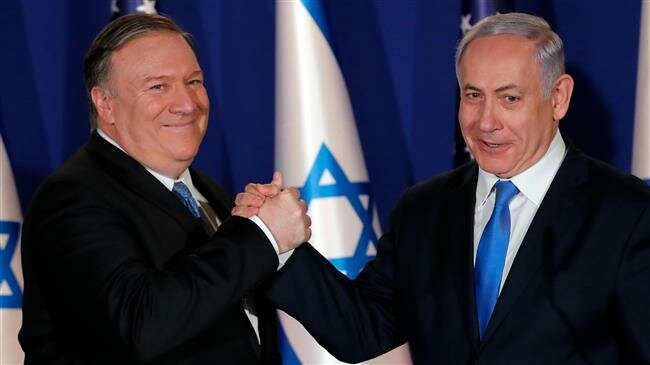
Israeli Prime Minister Benjamin Netanyahu is behind the US administration’s continued hostility towards Iran and the recent flare-up in tensions between the two sides, according to a number of American political figures and analysts.
Ben Rhodes, an advisor to the administration of former US president Barack Obama, was quoted as saying by The Jerusalem Post that “Bibi” was one of those “pushing to confront Iran.”
Last week, US Democratic presidential candidate Tulsi Gabbard also blasted “Saudi Arabia, Netanyahu [and] al-Qaeda” for promoting war with the Islamic Republic.
The report pointed to a 2006 essay on “The Israel Lobby” by John Mearsheimer and Stephen Walt, which later became a book. The authors argued back then that Israel and pro-Israel groups worked to shape the US administration’s policy towards Iran as part of a “grand scheme for reordering the Middle East.”
Moreover, the far-left and far-right parties view Israel as the shadowy manipulator of Washington’s policies towards Tehran.
“Who wants this war with Iran?” American political commentator Patrick Buchanan’s official website asked on Friday. “Answer: [US Secretary of State Mike] Pompeo and [National Security adviser John] Bolton, Bibi Netanyahu, [Saudi] Crown Prince Mohammed bin Salman.”
The US far-right has also blamed Israel for Trump’s policies, with one website claiming that “Bibi Satanyahoo” is pushing for a war with Iran.
On the far-left, the website Mondoweiss has a headline that says, “Israel wants the Trump administration to attack Iran, but US mainstream media ignores Netanyahu’s instigating.”
Iranian Foreign Minister Mohammad Javad Zarif recently pointed out that the US administration in Washington was taken over by “Netanyahu firsters”, according to the post.
Zarif blamed Israel and what he called the “B-team” for the US foreign policy decisions.
The hawkish “B-team” is comprised of US National Security Adviser John Bolton, Israeli Prime Minister Benjamin Netanyahu, Saudi Crown Prince Mohammed bin Salman and Abu Dhabi Crown Prince Mohammed bin Zayed Al Nahyan.
Tensions mounted between Tehran and Washington last May, when President Donald Trump pulled his country out of the 2015 nuclear deal with Iran, officially known as the Joint Comprehensive Plan of Action (JCPOA), and re-imposed harsh sanctions against the Islamic Republic in defiance of global criticism.
The tensions saw a sharp rise on the first anniversary of Washington’s exit from the deal as the US moved to ratchet up the pressure on Iran by tightening its oil sanctions and sending military reinforcements, including an aircraft carrier strike group, a squadron of B-52 bombers, and a battery of patriot missiles, to the Middle East.
On May 5, US National Security Advisor John Bolton — an ardent Iran hawk — said the deployment was in response to a “troubling and escalatory indications” of Iranian activity in the region, without giving details or evidence to support the claims.
Trump, however, later ordered his administration to avoid a military confrontation with Iran, The New York Times and Reuters reported.
Netanyahu’s influence with Trump is nothing short of conspicuous when it comes to regional issues in the Middle East.
Apart from relocating the US embassy from Tel Aviv to Jerusalem al-Quds and declaring the historical city as the “capital” of Israel, the American head of state has suspended aid to Palestinian groups and also recognized the Syria’s Golan Heights as being Israeli territory.
See also :
CrossTalk: Bolton War Machine
RT | May 17, 2019
Is Donald Trump’s National Security Advisor John Bolton a clear and present danger to America and the world? His saber-rattling in the Middle East, particularly against Iran, should concern us all. We are forced to ask a fundamental question – is Bolton the primary architect of Trump’s foreign policy?
Featured Video
Integrity Initiative: UK-funded network framed dissent as Russian disinformation for years
or go to
Aletho News Archives – Video-Images
From the Archives
Why Saudi Ties to 9/11 Mean U.S. Ties to 9/11
By Kevin Ryan | Dig Within | September 27, 2015
Media interest in Saudi Arabian connections to the crimes of 9/11 has centered on calls for the release of the 28 missing pages from the Joint Congressional Inquiry’s report. However, those calls focus on the question of hijacker financing and omit the most interesting links between the 9/11 attacks and Saudi Arabia—links that implicate powerful people in the United States. Here are twenty examples. … continue
Blog Roll
 Aletho News
- IAEA inspectors cannot return to Iran amid US threats: Russia
- Senate Rejects Iran War Powers Resolution Passed By House
- ‘We did not attack Pakistan with drones’: Afghan sources
- Iraqi Resistance faction links arms to sovereignty, questions US exit
- Cannon fodder no more… South Korea rejects Trump’s pressure to join his criminal war on Iran
- Neria Leiter Was A Legitimate Military Target
- Integrity Initiative: UK-funded network framed dissent as Russian disinformation for years
- ‘We don’t seek permission to defend our country’: Snippets from President Pezeshkian’s UNGA address
- NATO chief wants Europeans to fight American wars [for Israel]
- German chemicals giant reveals details of downsizing
- If Americans Knew
- Israel displaces hundreds of Palestinians amid wave of demolitions in West Bank
- Aid, reconstruction, and Israel’s history of obstruction in Gaza
- Trump administration digs an ever-deeper hole of complicity in genocide – Daily Update
- US-Israel $2.8 Billion Arms Deal, 40,000-Bomb Supply Faces New Gaza Complicity Accusations
- Caught on Tape: AIPAC CEO Boasted of Controlling Trump’s National Security Officials
- Why Hamas Attacked Israel in October 2023 – Israeli professor Ilan Pappé
- They see them, then kill them: Israeli quadcopters track, deliberately target civilians in Gaza
- Winter could turn Gaza’s treacherous, war-damaged buildings into deathtraps
- Majority of Democratic Voters Want to Prosecute Both Biden and Trump Administration Officials Over Gaza
- As Gaza languishes, world leaders gather at the UN – Daily Update
- No Tricks Zone
- New Study: Earth And Venus Surface Warmth Largely Explained By Convection And Lapse Rate, Not CO2 Or Radiation
- 2025 Nature Paper Claiming Worsening Global Drought Gets RETRACTED …Heavily Flawed
- New Study: ‘Global Drought Shows No Detectable Recent Acceleration Under Climate Warming’
- Economic Masterminds: German Socialists Suggest Taxing Productivity Gains Stemming From Using AI
- The South China Sea Has Not Been Cooperating With The Climate Change Narrative
- Energy Crisis: Germany Enters Heating Season With Historically Low Gas Reserve Fill Levels
- New Study: The Antarctic Ice Sheet Gained Mass From 2020-2024 Due To Staggering Snow And Ice Accumulation
- Study: Ocean Heating Rates From Thousands Of Years Ago ‘Dwarf’ Modern Ocean Heating Rates
- Climate Extremists Target, Attack Large-Scale Power Grid Infrastructure In Germany!
- New Study: Antarctic Ice Melt Has Contributed Less Than 1 Centimeter To Sea Level Rise In The Last 30 Years

