Iran not accepting EU’s humiliating conditions on INSTEX: Judiciary chief
Press TV – February 4, 2019
Iran’s Judiciary Chief Ayatollah Sadeq Amoli Larijani says the Islamic Republic will never give in to humiliating conditions set by Europe for the enforcement of its new non-dollar mechanism aimed at facilitating trade with the Islamic Republic.
Addressing a meeting of high-ranking judicial officials on Monday, Iran’s top judge said, “After nine months of dawdling and negotiations, European countries have come up with a limited-capacity mechanism not for exchange of money with Iran, but to supply food and medicine.”
The European signatories to the 2015 nuclear agreement, officially known as the Joint Comprehensive Plan of Action (JCPOA), issued a joint statement on Thursday, announcing the launch of a long-awaited direct non-dollar payment mechanism meant to safeguard their trade ties with Tehran following Washington’s withdrawal from the nuclear deal and in the face of the “toughest ever” sanctions imposed by the United States against the Islamic Republic.
Following months-long preparations, the foreign ministers of France, Germany and Britain finally unveiled the mechanism, officially called the Instrument in Support of Trade Exchanges (INSTEX), after a summit in Bucharest, Romania.
Iran’s Judiciary chief further said, “European countries, which had promised to remain committed to Iran’s nuclear deal after the US withdrawal from it, have now restricted their efforts to INSTEX and have reportedly set two strange conditions for it to become effective.”
They have asked “Iran to join the FATF (the Financial Action Task Force) and start negotiations over its missile program,” before INSTEX enters into force, he added.
“These [European] countries must know that the Islamic Republic of Iran will by no means accept these humiliating conditions and will not give in to any demand in return for a small opening [in sanctions] like INSTEX,” Amoli Larijani emphasized.
He noted that today, European countries are moving in the same direction that the US had moved before “and we [the Iranian nation] must continue to stand fast as [we have] always [done].”
President Donald Trump withdrew the US in May from the landmark Iran nuclear agreement, reached between the Islamic Republic and the P5+1 group of countries in 2015, and decided to re-impose unilateral sanctions against Tehran.
Under the deal, Iran undertook to put limits on its nuclear program in exchange for the removal of nuclear-related sanctions.
Trump’s administration announced the re-imposition of the “toughest” sanctions ever against Iran’s banking and energy sectors with the aim of cutting off the country’s oil sales and crucial exports.
Iran’s nuclear chief said on Saturday that the establishment of the new mechanism to ease trade with Iran is a promising step, but noted the Europeans must act more swiftly and adopt final measures in this regard.
“The Europeans took a promising step in terms of economy and we hope that they will keep racing ahead on the same path,” the head of the Atomic Energy Organization of Iran (AEOI), Ali Akbar Salehi, told reporters.
Despite Washington’s withdrawal, Iran has not left the deal yet, but stressed that the remaining signatories to the agreement have to work to offset the negative impacts of the US pullout for Iran if they want Tehran to remain in it.
On Friday, China’s Foreign Ministry spokesman, Geng Shuang, appreciated the efforts made by European countries to uphold the JCPOA after the US withdrawal from the agreement.
“It (INSTEX) fully demonstrated the EU’s determination to uphold multilateralism. China firmly supports the continued cooperation between the EU and Iran to put the mechanism into operation as soon as possible and open it to third parties so as to promote normal economic and trade cooperation between the international community and Iran,” he said.
Death Knell For Syria Pullout: “We Have To Protect Israel” Says Trump
By Tyler Durden – Zero Hedge – 02/03/2019
After approaching two months of talk of a “full” and “immediate” US troop withdrawal from Syria, first ordered by President Trump on December 19 — which was predictably met with swift and fierce pushback from beltway hawks including in some cases his own advisers — it now appears the death knell has sounded on the prior “complete” and “rapid” draw down order.
Trump said in a CBS “Face the Nation” interview this weekend that some unspecified number of US troops will remain in the region, mostly in Iraq, with possibly some still in Syria, in order “to protect Israel” in what appears a significant backtrack from his prior insistence on an absolute withdrawal.
“We’re going to be there and we’re going to be staying. We have to protect Israel,” he replied when pressed by CBS reporter Margaret Brennan. “We have to protect other things that we have. But we’re – yeah, they’ll be coming back in a matter of time.” He did note that “ultimately some will be coming home.”
“Look, we’re protecting the world,” he added. “We’re spending more money than anybody’s ever spent in history, by a lot.” Trump’s slow drift and change in tune on the subject of a promised “rapid” exit comes after Israeli officials led by Prime Minister Netanyahu alongside neocon allies in Washington argued that some 200 US troops in Syria’s southeast desert along the Iraqi border and its 55-kilometer “deconfliction zone” at al-Tanf are the last line of defense against Iranian expansion in Syria, and therefore must stay indefinitely.
“I want to be able to watch Iran,” Trump said further during the CBS interview. “Iran is a real problem.” He explained that “99%” of ISIS’s territory had been liberated but that a contingency of US troops must remain to prevent a resurgent Islamic State as well as to counter Iranian influence, for which American forces must remain in Iraq as well.
“When I took over, Syria was infested with ISIS. It was all over the place. And now you have very little ISIS, and you have the caliphate almost knocked out,” the president said. “We will be announcing in the not too distant future 100% of the caliphate, which is the area – the land – the area – 100. We’re at 99% right now. We’ll be at 100.”
However Trump’s invoking Iranian influence as a rationale for staying further contradicts his prior December statement that the defeat of ISIS was “the only reason” he was in Syria in the first place.
MARGARET BRENNAN: How many troops are still in Syria? When are they coming home?
PRESIDENT DONALD TRUMP: 2,000 troops.
MARGARET BRENNAN: When are they coming home?
PRESIDENT DONALD TRUMP: They’re starting to, as we gain the remainder, the final remainder of the caliphate of the area, they’ll be going to our base in Iraq, and ultimately some will be coming home. But we’re going to be there and we’re going to be staying—
MARGARET BRENNAN: So that’s a matter of months?
PRESIDENT DONALD TRUMP: We have to protect Israel. We have to protect other things that we have. But we’re- yeah, they’ll be coming back in a matter of time. Look, we’re protecting the world. We’re spending more money than anybody’s ever spent in history, by a lot. We spent, over the last five years, close to 50 billion dollars a year in Afghanistan. That’s more than most countries spend for everything including education, medical, and everything else, other than a few countries. — CBS “Face the Nation” Feb.3 interview transcript
The Pentagon in recent weeks has reportedly been putting logistics in place for a troop draw down from northern and eastern Syria.
Though it remains unclear just how many troops could remain as the majority possibly begin to pullout toward US bases in Iraq, the Tanf base could remain Washington’s last remote outpost disrupting what US defense officials see as a strategic Baghdad-Damascus corridor and highway, and potential key “link” in the Tehran-to-Beirut so-called Shia land bridge.
Foreign Policy magazine has identified this argument as the final card the hawks opposing Trump’s draw down had to play in order to hinder to an actual complete US exit:
“Al-Tanf is a critical element in the effort to prevent Iran from establishing a ground line of communications from Iran through Iraq through Syria to southern Lebanon in support of Lebanese Hezbollah,” an unnamed senior US military source told the magazine.
The Israeli prime minister has pushed hard against the White House pullout plan, and “has repeatedly urged the U.S. to keep troops at Al-Tanf, according to several senior Israeli officials, who also asked not to be identified discussing private talks,” per Bloomberg. The Israelis have reportedly argued “the mere presence of American troops will act as a deterrent to Iran” even if in small numbers as a kind of symbolic threat.
The internal administration debate, following incredible push back against Trump’s withdrawal decision, has made entirely visible the national security deep state’s attempt to check the Commander-in-Chief’s power. And now US presence at al-Tanf represents the last hope of salvaging the hawks’ desire for permanent proxy war against Iran inside Syria.
It appears the deep state has won out over Trump’s initial policy decision once again; but it remains to be seen if, however slowly on what’s clearly a delayed timetable departing from his original plans, all US troops ultimately exit Syria. Until then there’ll be more time and perhaps more provocations the hawks can rely on to effectively ensure full circle return to indefinite occupation in Syria.
President Salih: Trump did not ask Iraq permission to watch Iran
Press TV – February 4, 2019
Iraqi leaders have hit back at Donald Trump after the US president said he plans to keep troops in the country to spy on Iran, with President Barham Salih saying the mission does not have Baghdad’s permission.
Their reaction on Monday came a day after Trump told CBS that US troops would leave Syria and Afghanistan but stay on in Iraq, partly “to be looking a little bit at Iran.”
Trump admitted that staying in Iraq is a “mistake” and that attacking Iran is not an option, but the remarks sparked a new round of demands in Baghdad for US forces to leave the country.
“The Iraqi constitution rejects the use of Iraq as a base for hitting or attacking a neighboring country,” President Salih said Monday.
Salih said US forces were in the country under an agreement between the two countries, but that “any action taken outside this framework is unacceptable.”
The Iraqi president insisted that Trump had not asked Baghdad’s permission for US troops in Iraq to “watch Iran.”
“Don’t overburden Iraq with your own issues,” Salih said. “The US is a major power … but do not pursue your own policy priorities, we live here.”
“It is of fundamental interest for Iraq to have good relations with Iran” and other neighboring countries, Saleh said.
He said US forces were in Iraq to fight terrorism and that he looked forward to hearing Washington’s clarification on the number of troops who were going to stay as well as their mission.
In his interview aired on Sunday, Trump defended his decision to end “endless wars” in Syria and Afghanistan by pulling out US troops from those countries.
However, he said not all of thousands of American forces stationed in Iraq, specially at the Ain al-Asad Air Base in the western Anbar Province, were going to return home.
“And one of the reasons I want to keep it (the base) is because I want to be looking a little bit at Iran because Iran is a real problem,” said the American president.
Asked whether he wanted the troops there to “strike” Iran at a later time, Trump responded: “No… All I want to do is be able to watch.”
“We have an unbelievable and expensive military base built in Iraq. It’s perfectly situated for looking at all over different parts of the troubled Middle East rather than pulling up,” he added.
Trump announced in December that all US military troops in Syria would return home in the coming months while the number of US forces in Afghanistan would also be reduced drastically.
Trump made an unannounced stop at Ain al-Asad base on Christmas, in a visit that drew fire from Iraqi officials and their counterparts in Iran and other neighboring countries.
Sabah al-Saadi, a member of parliament in the bloc led by influential anti-American cleric Moqtada Sadr, has proposed a bill demanding a US pullout.
Deputy speaker of parliament Hassan Karim al-Kaabi, also close to Sadr, said Monday Trump’s latest remarks have made passing such a law “a national duty” because they are a violation of Iraq’s sovereignty and constitution.
The remarks, he said, are a “new provocation,” weeks after the US president sparked outrage in Iraq by visiting US troops without meeting a single Iraqi official.
The Iraqi parliament, he said, will soon pass a bill that will end the ongoing security agreement with Washington as well as the presence of all foreign forces in Iraq.
Kaabi asserted that his country would never become a launchpad for attacks or a US backyard for intelligence gathering against other countries.
Iraqi leaders say there are no American bases on its soil, stressing that only instructors are deployed at Iraqi bases.
Kurdish MP Sarkawt Shams tweeted that the mission of US troops in Iraq was “to help Iraqi security forces against terrorism, not ‘watching’ others.”
“We are expecting the United States to respect our mutual interests and avoid pushing Iraq into a regional conflict,” he said.
Trump’s comments ‘embarrassing’ for Baghdad
Iraq’s former foreign minister Hoshyar Zebari also condemned Trump’s remarks, saying they were embarrassing for Baghdad.
The veteran Kurdish politician warned Iraqi officials that the country would face difficult choices in future following Trump’s controversial statements.
Jaafar al-Husseini, a spokesman for the Iraqi pro-government Kata’ib Hezbollah voluntary forces, warned the Trump administration against mounting offensives against Iran and Syria from Iraq.
He also called on parliament to speed up legislation to drive out foreign forces, warning that the anti-terror force won’t wait long.
The spokesman noted that Iraq’s security agencies should deem American military forces as “appropriate targets” as Iraqi resistance groups already do.
‘Greatest mistake US ever made’
In his interview on Sunday, Trump once again called the US war on Iraq as “one of the greatest mistakes” the United States had ever made.
He also defended his attacks on US intelligence assessments on Iran, saying they tend to miscalculate as they led former President George W. Bush into attacking Iraq by claiming that Baghdad had weapons of mass destruction (WMDs).
“President Bush had intel people that said Saddam Hussein in Iraq had nuclear weapons- had all sorts of weapons of mass destruction. Guess what? Those intel people didn’t know what the hell they were doing, and they got us tied up in a war that we should have never been in,” he said.
Last Wednesday, Trump went on a twitter rant to attack his intelligence chiefs’ assessments on Iran’s growing power despite Washington’s pressure campaign following his pullout from the 2015 Iran nuclear deal.
The tweets came in response to Tuesday statements by CIA Director Gina Haspel and Director of National Intelligence Dan Coats before the US Senate Intelligence Committee.
Haspel told the panel that despite Trump’s decision last May to withdraw from the nuclear deal, the Islamic Republic had been “making some preparations that would increase their ability to take a step back.”
Coats also acknowledged that Tehran was not seeking to develop nuclear weapons capabilities.
European firms ‘won’t dare’ use new EU payment system for trade with Iran out of fear of US
RT | February 1, 2019
A new mechanism to allow “legitimate trade” with Iran, which was set up by France, Germany, and the UK this week, doesn’t change anything for European companies, according to independent journalist Luc Rivet.
He told RT that European companies and others cannot feel confident that they could do business with Iran without being subject to US sanctions.
“I don’t know what companies will make use of that mechanism to sell to Iran,” he said, adding that it’s very dangerous for the companies if they are caught working in Iran.
Europe mentions that medical equipment could be sold through this way, says Rivet.
“Who produces this equipment? You think that Siemens will sell to Iran? Never, because they sell to America many other things as well… And Siemens is afraid of losing the American market.”
He explained that an “incredible number of companies” won’t have anything to do with Iran, including the banking sector, the oil and gas sector, and others.
Even small companies will hesitate to sell anything to Iran at risk of being caught, according to Rivet. They can do that through other channels, like via Turkey, he said.
The journalist added: “It’s much easier for Chinese and Russian companies to make deals with Iran. The Europeans are scared in an incredible way. The companies are afraid by ricochet of being in the eye of the storm with the Americans.”
“That’s very dangerous for European companies,” he repeated, adding: “I don’t know anybody who will dare to go with this Instex system.”
Iran Defies French Sanctions Threat, Accuses Paris of Destabilising Mideast
Sputnik – January 26, 2019
Iranian authorities have said repeatedly that the country’s rocketry and missile testing activities were in full compliance with international treaties, including the UN Security Council resolution governing the 2015 Iran nuclear deal.
Tehran will be forced to reconsider its relations with European powers if they impose any new sanctions against Iran over its missile testing activities, Foreign Ministry spokesman Bahram Qassemi has said.
“Iran has always sought to consolidate peace and stability in the region, and believes the mass sale of sophisticated and aggressive weapons by the US and some European countries, including France, have undermined stability and balance in the region,” the diplomat indicated, according to PressTV.
Qassemi’s remarks follow comments by French Foreign Minister Jean-Yves Le Drian on Friday that Paris would impose fresh sanctions against Tehran if talks over Iran’s missile program don’t pan out. “We are ready, if the talks don’t yield results, to apply sanctions firmly, and they know it,” Le Drian said.
Emphasizing that Iran’s military capabilities were governed by a defensive “doctrine of deterrence,” Qassemi said that Iran had “designed its defence capabilities based on a realistic assessment of existing threats,” and would strengthen these capabilities if necessary.
“Iran’s missile capability is not negotiable, and this has been brought to the attention of the French side during the ongoing political dialogue between Iran and France,” Qassemi stressed.
Earlier, diplomats speaking to Reuters said that the EU was mulling new sanctions against Iran over its missile program, with the possible restrictions including asset freezes and travel bans on members of the Revolutionary Guards and individuals connected to the country’s missile program. The US, which unilaterally withdrew from the Joint Comprehensive Plan of Action (JCPOA) Iran nuclear deal last May, has warned Iran not to engage in testing activities, and lobbied the EU to sanction Tehran.
Iranian officials have repeatedly indicated that their missile program was in line with the terms of the JCPOA and the UN resolution governing it, and indicated that Iran’s missile capabilities were not up for negotiation. Iran has amassed a large arsenal of conventional short, medium and long-range missile systems which it insists are purely defensive in nature. Last week, US Secretary of State Mike Pompeo accused Tehran of “defying” the international community, and alleged that Iran was “pursuing enhanced missile capabilities that threaten Europe and the Middle East.”
US bid to create crisis in Iran-IAEA ties ‘falling flat’: Report
Press TV – January 26, 2019
The US has failed to create a crisis in Iran’s cooperation with the UN atomic agency which has repeatedly confirmed the peaceful nature of the country’s nuclear program, Bloomberg reports.
Bloomberg said the US was pushing to open “a special investigation” into Iran’s past nuclear work, but “it’s not gaining traction among the international officials who can make it happen.”
The financial news provider said it had obtained documents and interviewed diplomats who attended a meeting between US officials and the International Atomic Energy Agency (IAEA) in Vienna last week.
“American officials have been ratcheting up pressure at the International Atomic Energy Agency in recent weeks, threatening new sanctions and advocating for more aggressive inspections,” Bloomberg said.
“However, the efforts are falling flat,” it said, citing three diplomats who participated in the meeting.
It’s a rare pushback for the US at the IAEA … the episode illustrates the rising difficulty American officials face in convincing allies to follow the US on Iran,” it added.
During the private meeting held on January 20 and attended by 70 diplomats assigned to the IAEA, the participants heard what hawkish US national security adviser John Bolton called “substantial evidence” that Iran had lied to IAEA inspectors.
“There is a sense that the administration is frustrated that their campaign to renegotiate the deal isn’t working,” said Ellie Geranmayeh, a senior fellow at the European Council on Foreign Relations.
“What we see is the US maximum pressure campaign is heating up even further,” she added.
The diplomats said the fresh US allegation was based on an analysis by the Foundation for Defense of Democracies and the Institute for Science and International Security, which used data supplied by Israel.
Israeli Prime Minister Benjamin Netanyahu has on several occasions drawn international ridicule for his allegations about Iran’s “secret” nuclear activities.
Last September, Netanyahu went to the UN to show pictures of an alleged Iranian nuclear weapons storage site, which turned out to be a carpet cleaning factory, with the IAEA ignoring the claim.
“There has been a concern that the US and some other countries want to precipitate an inspection crisis,” Geranmayeh said. “But there’s been resistance to this. The deal’s stakeholders feel they have a good grip on what’s happening in Iran.”
The US has been trying to coerce the Europeans into following its lead and withdrawing from the 2015 nuclear deal with Iran, which President Donald Trump renounced in May.
Since the US left, the deal’s remaining powers — China, France, Germany, Russia and the UK — have struggled to provide the sanctions relief promised when Iran agreed to nuclear caps.
The Europeans are currently trying to put a special purpose vehicle designed to protect companies from US sanctions into operation, but are facing Washington’s threats of retribution for any trade with Tehran.
Bloomberg cited the diplomats in Vienna as saying that “while they will continue engaging with the US, they want to avoid provoking a scenario that will escalate into a new crisis with Iran.”
One envoy said the US was forcing the IAEA to “rehash 20-year-old information” which had already been settled by the nuclear agency, warning that it could shut the doors to diplomacy and lead to “tragic consequences”.
Geopolitics before sport: Russian athletes were punished for being Russian
By Neil Clark | RT | January 23, 2019
Russian athletes, falsely accused of doping, won an important legal victory at the weekend. But unfortunately, the mud has stuck which is what Russia’s geopolitical enemies always wanted.
As the old saying goes “a lie can be halfway around the world before the truth has got its boots on.” Basically on the ‘evidence’ of one man, who lives in America, and the lobbying of certain NATO countries, Russian athletes were collectively held to be guilty of doping offences and deprived of their opportunity to compete at the very highest level.
A great injustice was done to the sportsmen and women involved, but now, finally, the record is being put straight.
On Saturday, the Swiss Supreme Court turned down the International Olympic Committee’s appeal against the Court of Arbitration for Sport’s ruling to acquit 28 members of Team Russia of doping allegations during the 2014 Sochi Winter Olympics.
Christof Wieschemann, the lawyer for Russian cross-country skier Alexander Legkov, who the IOC tried to deprive of Olympic medals, has stated that Russian athletes falsely accused could have avoided career-ruining bans if the IOC hadn’t concealed facts of their innocence.
His firm says that the IOC “seriously violated the procedural rights of the athletes and even withheld exculpatory evidence from the defense and the court.”
Wieschemann says he filed no fewer than five written requests to the IOC for evidence against his client, but he was never shown any.
Just imagine if US athletes had been treated in such a scandalous way. But it’s Russians and of course we all know they’re a bunch of cheats, don’t we? That’s certainly what we are supposed to believe by those who want us to hate Russia as much as they do.
The campaign to get Russian athletes banned can be traced back directly to those countries who are most vocal in opposing Russia internationally. This is about politics and not genuine concern about sporting malpractice.
In July 2016, Reuters revealed how the heads of US and Canada’s anti-doping bodies had drafted a letter to WADA, the World Anti-Doping Agency, calling for ALL Russian athletes to be banned from the Rio Olympic Games. The letter was circulated by the Canadian representative to other WADA members.
As I wrote here, just imagine if the Russian anti-doping agency had sought to get all US or Canada athletes banned, whether or not they had been found guilty of cheating.
The WADA report into alleged Russian ‘state-sponsored’ doping, based solely on the testimony of former Moscow anti-doping laboratory director Grigory Rodchenkov, who defected to the US in 2015, was put together by a Canadian lawyer, Richard McLaren.
No one is saying that McLaren was himself biased, but surely in the interests of natural justice, would it not have been better if the report had been compiled by someone from a non-NATO country and not a country that was, quite clearly, pushing for a Russian ban?
Even Russian Paralympians have been victimized. In 2016, the International Paralympic Committee (IPC) bowed to pressure to introduce a blanket ban on Russian Paralympians competing in Rio. Six of the 14 members of the IPC’s governing board came from NATO countries.
The IOC itself came under enormous pressure to introduce a similar blanket ban on Team Russia competing in the 2018 Winter Olympics in PyeongChang. We know from leaks from the hacktivist group Fancy Bear, that the IOC was far from satisfied with the ‘proof’ of a state-sponsored program in parts of the McLaren report. We also know that Martial Saugy, the former director of the WADA’s accredited doping Laboratory of Lausanne accused the McLaren report of making “incorrect allegations.”
In November 2017, WADA chief Craig Reedie admitted that, while there were “hints” and “claims” of evidence of a systematic state-sponsored Russian doping scheme, 95 of the 96 cases of Russian athletes WADA was investigating had been suspended because “there was not sufficient evidence to pursue an anti-doping rule violation.”
In normal times, the IOC would have acknowledged that the case against Russia did not stack up. But these were not normal times.
Portraying Russia as a country that cheated, on a routine, state-sanctioned level at sport has been an important part of the propaganda campaign to delegitimize the country and place it in the international ‘sin-bin.’ This would be punishment for Russia for daring to thwart neocon plans for regime change in Syria and for being a competitor with the US in the lucrative European energy markets. Russia can’t be trusted. It needs to be sanctioned. Don’t you get the message?
It was entirely predictable that the IOC’s decision to ban Russian athletes from competing under the Russian flag in PyeongChang, was lauded on social media by the late US neocon Senator John McCain. He also used it an opportunity to call, once again, for FIFA to take the 2018 Football World Cup away from Russia.
An American playwright called Bryan Fogel, also did his bit. As I noted here, it was Fogel and Rodchenkov who took their story to the New York Times, triggering the McLaren report.
‘Icarus’, the documentary film Fogel made, which included interviews with Rodchenkov, not surprisingly given the neo-con induced Russophobic climate, won an Academy Award in 2018.
In an interview with the FT, Fogel said Russia had a “cultural problem” with drugs, which went back to communism.
Let’s not mention how communist Hungary were cheated out of the 1954 World Cup, or the allegations about widespread US doping made by Wade Exum, the US Olympic Committee’s former director of drug control, in 2003, shall we?
I took a look at Fogel’s Twitter feed and guess what? The first tweet is a retweet of Kremlin critic Bill Browder. Fogel also refers to WADA chief Sir Craig Reedie – who spoke to RT in 2017 – as a “criminal President.”
You can see where he’s coming from.
Saturday’s Swiss court decision comes too late for the innocent Russian athletes who lost their chance to compete under the flag of their own country at the greatest sporting events in the world.
But it should, I think, inspire a new report and then a new investigative documentary on the campaign to get Russia banned. It could be called ‘Robbed!’. Only this time, don’t expect it to win an Oscar.
Moscow slams EU’s ‘arbitrary’ chemical-weapons sanctions, threatens to retaliate
RT | January 22, 2019
Russia has threatened to respond to “freshly invented” punitive measures imposed by the EU over the Skripal poisoning. Moscow says it’s an arbitrary punishment that disrespects established non-proliferation norms.
The accusations that gave rise to the sanctions “don’t stand up to criticism,” the Russian Foreign Ministry said in a statement. “We reserve the right to retaliatory measures in response to this unfriendly act.”
On Monday, Brussels used its new powers against four Russian nationals over the March 2018 poisoning of double agent Sergei Skripal and his daughter Yulia in the UK.
Alexander Petrov and Ruslan Boshirov (named in the sanctions ruling as Russian intelligence agents Alexander Mishkin and Anatoliy Chepiga) were subjected to a European asset freeze and a travel ban, along with Igor Kostyukov, the head of Russia’s main intelligence directorate (the GRU), and his deputy, Vladimir Alekseyev.
The EU also sanctioned five Syrians who it claims were involved in the Damascus government’s chemical-weapons program.
“It’s notable that among the first subjects to be added to the EU’s ‘chemical’ restrictions list are citizens of Russia and Syria – two countries that (unlike, for example, the US) have ensured the complete destruction of their chemical weapons arsenals under OPCW control,” said the Foreign Ministry.
Moscow has repeatedly denied any involvement in the Skripal poisoning and offered to help with the investigation. London has not provided any conclusive proof of Russian involvement.
The EU Council adopted a new regime of restrictive measures on October 15, 2018. Under the new regulations, the EU reserves the right to sanction persons and entities it deems to be involved in the development and use of chemical weapons, without seeking the opinion of the UN Security Council.
Final Steps in Syria’s Successful Struggle for Peace and Sovereignty
By Federico PIERACCINI | Strategic Culture Foundation | 17.01.2019
The situation in Syria evolves daily and sees two situations very closely linked to each other, with the US withdrawal from Syria and the consequent expansionist ambitions of Erdogan in Syria and the Hay’at Tahrir al-Sham (HTS) takeover in Idlib that frees the Syrian Arab Army (SAA) and Russian aviation to liberate the de-escalation zone.
Trump has promised to destroy Turkey economically if he attacks the Kurds, reinforcing his claim that Erdogan will not target the Syrian Democratic Forces (SDF) once the US withdraws from the area. One of the strongest accusations made against Trump’s withdrawal by his opponents is that no Middle Eastern force will ever trust the US again if they abandon the SDF to its fate, that is, to its annihilation at the hands of the Turkish army and its FSA proxies. This, however, is not possible; not so much because of Trump’s economic threats, but because of Damascus and Moscow being strongly opposed to any Turkish military action in the northeast of Syria.
This is a red line drawn by Putin and Assad, and the Turkish president likely understands the consequences of any wrong moves. It is no coincidence that he stated several times that he had no problems with the “Syrians or Syrian-Kurdish brothers”, and repeated that if the area under the SDF were to come under the control of Damascus, Turkey would have no need to intervene in Syria. Trump’s request that Ankara have a buffer zone of 20 kilometers separating the Kurdish and Turkish forces seems to complement the desire of Damascus and Moscow to avoid a clash between the Turkish Armed Forces (TAF) and the SDF.
The only party that seems to be secretly encouraging a clash between the SDF and Turkish forces is Israel, criticizing Ankara and singing the praises of the SDF, in order to try and accentuate the tensions between the two sides, though naturally without success. Israel’s continued raids in Syria, though almost constantly failing due to Syrian air defense, and the divide-and-rule policy used against Turkey and the SDF, show that Tel Aviv is now weakened and mostly irrelevant in the Syrian conflict.
In Idlib, the situation seems to be becoming less complicated and difficult to decipher. Russia, Iran and Syria had asked Erdogan to take control of the province through its “moderate jihadists”, sit down at the negotiating table, and resolve the matter through a diplomatic solution. Exactly the opposite happened. The HTS (formerly al-Nusra/al-Qaeda in Syria) has in recent weeks conquered practically the whole province of Idlib, with numerous forces linked to Turkey (Ahrar al-Sham and Nour al-Din al-Zenki) dissolving and merging into HTS. This development puts even more pressure on Erdogan, who is likely to see his influence in Idlib fade away permanently. Moreover, this evolution represents a unique opportunity for Damascus and Moscow to start operations in Idlib with the genuine justification of combating terrorism. It is a repeat of what happened in other de-escalation areas. Moscow and Damascus have repeatedly requested the moderates be separated from the terrorists, so as to approach the situation with a diplomatic negotiation.
In the absence of an effective division of combatants, all are considered terrorists, with the military option replacing the diplomatic. This remains the only feasible option to free the area from terrorists who are not willing to give back territory to the legitimate government in Damascus and are keeping civilians hostages. The Idlib province seems to have experienced the same playbook applied in other de-escalation zones, this time with a clear contrast between Turkey and Saudi Arabia that shows how the struggle between the two countries is much deeper than it appears. The reasons behind the Khashoggi case and the diplomatic confrontation between Qatar and Saudi Arabia were laid bare in the actions of the HTS in Idlib, which has taken control of all the areas previously held by Ankara’s proxies.
It remains to be seen whether Moscow and Damascus would like to encourage Erdogan to recover Idlib through its proxies, trying to encourage jihadists to fight each other as much as possible in order to lighten the task of the SAA, or whether they would prefer to press the advantage themselves and attack while the terrorist front is experiencing internal confusion.
In terms of occupied territory and accounts to be settled, two areas of great importance for the future of Syria remain unresolved, namely al-Tanf, occupied by US forces on the Syrian-Jordanian border, and the area in the north of Syria occupied by Turkish forces and their FSA proxies. It is too early to approach a solution militarily, it being easier for Damascus and Moscow to complete the work to free Syria from the remaining terrorists. Once this has been done, the presence of US or Turkish forces in Syria, whether directly or indirectly, would become all the more difficult to justify. Driving away the US and, above all, Turkey from Syrian territory will be the natural next step in the Syrian conflict.
This is an unequivocal sign that the war of aggression against Syria is winding up, and this can be observed by the opening of a series of new embassies in Damascus. Several countries — including Italy in the near future — will reopen their embassies in Syria to demonstrate that the war, even if not completely over, is effectively won by Damascus and her allies.
For this reason, several countries that were previously opposed to Damascus, like the United Arab Emirates, are understood to have some kind of contact with the government of Damascus. If they intend to become involved in the reconstruction process and any future investment, they will quite naturally need to re-establish diplomatic relations with Damascus. The Arab League is also looking to welcome Syria back into the fold.
Such are signs that Syria is returning to normality, without forgetting which and how many countries have conspired and acted directly against the Syrians for over seven years. An invitation to the Arab League or some embassy being reopened will not be enough to compensate for the damage done over years, but Assad does not preclude any option, and is in the meantime demonstrating to the Israelis, Saudis and the US Deep State that their war has failed and that even their most loyal allies are resuming diplomatic relations with Damascus, a double whammy against the neocons, Wahhabis and Zionists.
Featured Video
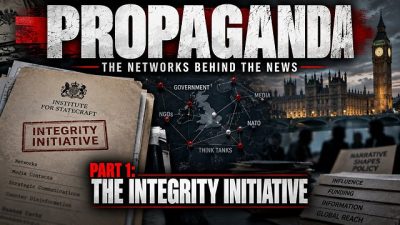
Integrity Initiative: UK-funded network framed dissent as Russian disinformation for years
or go to
Aletho News Archives – Video-Images
From the Archives
Why Saudi Ties to 9/11 Mean U.S. Ties to 9/11
By Kevin Ryan | Dig Within | September 27, 2015
Media interest in Saudi Arabian connections to the crimes of 9/11 has centered on calls for the release of the 28 missing pages from the Joint Congressional Inquiry’s report. However, those calls focus on the question of hijacker financing and omit the most interesting links between the 9/11 attacks and Saudi Arabia—links that implicate powerful people in the United States. Here are twenty examples. … continue
Blog Roll
 Aletho News
- EUROPE FEARS RUSSIA’S NEXT MOVE / Ian Proud
- Big tech hands in its DSA censorship reports to the EU
- ‘A Big Victory’ – Palestine Chronicle Wins Two-Year Legal Battle
- IAEA inspectors cannot return to Iran amid US threats: Russia
- Senate Rejects Iran War Powers Resolution Passed By House
- ‘We did not attack Pakistan with drones’: Afghan sources
- Iraqi Resistance faction links arms to sovereignty, questions US exit
- Cannon fodder no more… South Korea rejects Trump’s pressure to join his criminal war on Iran
- Neria Leiter Was A Legitimate Military Target
- Integrity Initiative: UK-funded network framed dissent as Russian disinformation for years
- If Americans Knew
- ‘This is where I live now, the back of a truck’: a day in the life of a grandmother in Gaza
- In UN Speech, Iran’s President Displays Pictures of Children Killed by US, Brings Attention to Israel’s Nuclear Arsenal
- Israel displaces hundreds of Palestinians amid wave of demolitions in West Bank
- Aid, reconstruction, and Israel’s history of obstruction in Gaza
- Trump administration digs an ever-deeper hole of complicity in genocide – Daily Update
- US-Israel $2.8 Billion Arms Deal, 40,000-Bomb Supply Faces New Gaza Complicity Accusations
- Caught on Tape: AIPAC CEO Boasted of Controlling Trump’s National Security Officials
- Why Hamas Attacked Israel in October 2023 – Israeli professor Ilan Pappé
- They see them, then kill them: Israeli quadcopters track, deliberately target civilians in Gaza
- Winter could turn Gaza’s treacherous, war-damaged buildings into deathtraps
- No Tricks Zone
- New Study: Earth And Venus Surface Warmth Largely Explained By Convection And Lapse Rate, Not CO2 Or Radiation
- 2025 Nature Paper Claiming Worsening Global Drought Gets RETRACTED …Heavily Flawed
- New Study: ‘Global Drought Shows No Detectable Recent Acceleration Under Climate Warming’
- Economic Masterminds: German Socialists Suggest Taxing Productivity Gains Stemming From Using AI
- The South China Sea Has Not Been Cooperating With The Climate Change Narrative
- Energy Crisis: Germany Enters Heating Season With Historically Low Gas Reserve Fill Levels
- New Study: The Antarctic Ice Sheet Gained Mass From 2020-2024 Due To Staggering Snow And Ice Accumulation
- Study: Ocean Heating Rates From Thousands Of Years Ago ‘Dwarf’ Modern Ocean Heating Rates
- Climate Extremists Target, Attack Large-Scale Power Grid Infrastructure In Germany!
- New Study: Antarctic Ice Melt Has Contributed Less Than 1 Centimeter To Sea Level Rise In The Last 30 Years

