Iran Defies French Sanctions Threat, Accuses Paris of Destabilising Mideast
Sputnik – January 26, 2019
Iranian authorities have said repeatedly that the country’s rocketry and missile testing activities were in full compliance with international treaties, including the UN Security Council resolution governing the 2015 Iran nuclear deal.
Tehran will be forced to reconsider its relations with European powers if they impose any new sanctions against Iran over its missile testing activities, Foreign Ministry spokesman Bahram Qassemi has said.
“Iran has always sought to consolidate peace and stability in the region, and believes the mass sale of sophisticated and aggressive weapons by the US and some European countries, including France, have undermined stability and balance in the region,” the diplomat indicated, according to PressTV.
Qassemi’s remarks follow comments by French Foreign Minister Jean-Yves Le Drian on Friday that Paris would impose fresh sanctions against Tehran if talks over Iran’s missile program don’t pan out. “We are ready, if the talks don’t yield results, to apply sanctions firmly, and they know it,” Le Drian said.
Emphasizing that Iran’s military capabilities were governed by a defensive “doctrine of deterrence,” Qassemi said that Iran had “designed its defence capabilities based on a realistic assessment of existing threats,” and would strengthen these capabilities if necessary.
“Iran’s missile capability is not negotiable, and this has been brought to the attention of the French side during the ongoing political dialogue between Iran and France,” Qassemi stressed.
Earlier, diplomats speaking to Reuters said that the EU was mulling new sanctions against Iran over its missile program, with the possible restrictions including asset freezes and travel bans on members of the Revolutionary Guards and individuals connected to the country’s missile program. The US, which unilaterally withdrew from the Joint Comprehensive Plan of Action (JCPOA) Iran nuclear deal last May, has warned Iran not to engage in testing activities, and lobbied the EU to sanction Tehran.
Iranian officials have repeatedly indicated that their missile program was in line with the terms of the JCPOA and the UN resolution governing it, and indicated that Iran’s missile capabilities were not up for negotiation. Iran has amassed a large arsenal of conventional short, medium and long-range missile systems which it insists are purely defensive in nature. Last week, US Secretary of State Mike Pompeo accused Tehran of “defying” the international community, and alleged that Iran was “pursuing enhanced missile capabilities that threaten Europe and the Middle East.”
US bid to create crisis in Iran-IAEA ties ‘falling flat’: Report
Press TV – January 26, 2019
The US has failed to create a crisis in Iran’s cooperation with the UN atomic agency which has repeatedly confirmed the peaceful nature of the country’s nuclear program, Bloomberg reports.
Bloomberg said the US was pushing to open “a special investigation” into Iran’s past nuclear work, but “it’s not gaining traction among the international officials who can make it happen.”
The financial news provider said it had obtained documents and interviewed diplomats who attended a meeting between US officials and the International Atomic Energy Agency (IAEA) in Vienna last week.
“American officials have been ratcheting up pressure at the International Atomic Energy Agency in recent weeks, threatening new sanctions and advocating for more aggressive inspections,” Bloomberg said.
“However, the efforts are falling flat,” it said, citing three diplomats who participated in the meeting.
It’s a rare pushback for the US at the IAEA … the episode illustrates the rising difficulty American officials face in convincing allies to follow the US on Iran,” it added.
During the private meeting held on January 20 and attended by 70 diplomats assigned to the IAEA, the participants heard what hawkish US national security adviser John Bolton called “substantial evidence” that Iran had lied to IAEA inspectors.
“There is a sense that the administration is frustrated that their campaign to renegotiate the deal isn’t working,” said Ellie Geranmayeh, a senior fellow at the European Council on Foreign Relations.
“What we see is the US maximum pressure campaign is heating up even further,” she added.
The diplomats said the fresh US allegation was based on an analysis by the Foundation for Defense of Democracies and the Institute for Science and International Security, which used data supplied by Israel.
Israeli Prime Minister Benjamin Netanyahu has on several occasions drawn international ridicule for his allegations about Iran’s “secret” nuclear activities.
Last September, Netanyahu went to the UN to show pictures of an alleged Iranian nuclear weapons storage site, which turned out to be a carpet cleaning factory, with the IAEA ignoring the claim.
“There has been a concern that the US and some other countries want to precipitate an inspection crisis,” Geranmayeh said. “But there’s been resistance to this. The deal’s stakeholders feel they have a good grip on what’s happening in Iran.”
The US has been trying to coerce the Europeans into following its lead and withdrawing from the 2015 nuclear deal with Iran, which President Donald Trump renounced in May.
Since the US left, the deal’s remaining powers — China, France, Germany, Russia and the UK — have struggled to provide the sanctions relief promised when Iran agreed to nuclear caps.
The Europeans are currently trying to put a special purpose vehicle designed to protect companies from US sanctions into operation, but are facing Washington’s threats of retribution for any trade with Tehran.
Bloomberg cited the diplomats in Vienna as saying that “while they will continue engaging with the US, they want to avoid provoking a scenario that will escalate into a new crisis with Iran.”
One envoy said the US was forcing the IAEA to “rehash 20-year-old information” which had already been settled by the nuclear agency, warning that it could shut the doors to diplomacy and lead to “tragic consequences”.
Geopolitics before sport: Russian athletes were punished for being Russian
By Neil Clark | RT | January 23, 2019
Russian athletes, falsely accused of doping, won an important legal victory at the weekend. But unfortunately, the mud has stuck which is what Russia’s geopolitical enemies always wanted.
As the old saying goes “a lie can be halfway around the world before the truth has got its boots on.” Basically on the ‘evidence’ of one man, who lives in America, and the lobbying of certain NATO countries, Russian athletes were collectively held to be guilty of doping offences and deprived of their opportunity to compete at the very highest level.
A great injustice was done to the sportsmen and women involved, but now, finally, the record is being put straight.
On Saturday, the Swiss Supreme Court turned down the International Olympic Committee’s appeal against the Court of Arbitration for Sport’s ruling to acquit 28 members of Team Russia of doping allegations during the 2014 Sochi Winter Olympics.
Christof Wieschemann, the lawyer for Russian cross-country skier Alexander Legkov, who the IOC tried to deprive of Olympic medals, has stated that Russian athletes falsely accused could have avoided career-ruining bans if the IOC hadn’t concealed facts of their innocence.
His firm says that the IOC “seriously violated the procedural rights of the athletes and even withheld exculpatory evidence from the defense and the court.”
Wieschemann says he filed no fewer than five written requests to the IOC for evidence against his client, but he was never shown any.
Just imagine if US athletes had been treated in such a scandalous way. But it’s Russians and of course we all know they’re a bunch of cheats, don’t we? That’s certainly what we are supposed to believe by those who want us to hate Russia as much as they do.
The campaign to get Russian athletes banned can be traced back directly to those countries who are most vocal in opposing Russia internationally. This is about politics and not genuine concern about sporting malpractice.
In July 2016, Reuters revealed how the heads of US and Canada’s anti-doping bodies had drafted a letter to WADA, the World Anti-Doping Agency, calling for ALL Russian athletes to be banned from the Rio Olympic Games. The letter was circulated by the Canadian representative to other WADA members.
As I wrote here, just imagine if the Russian anti-doping agency had sought to get all US or Canada athletes banned, whether or not they had been found guilty of cheating.
The WADA report into alleged Russian ‘state-sponsored’ doping, based solely on the testimony of former Moscow anti-doping laboratory director Grigory Rodchenkov, who defected to the US in 2015, was put together by a Canadian lawyer, Richard McLaren.
No one is saying that McLaren was himself biased, but surely in the interests of natural justice, would it not have been better if the report had been compiled by someone from a non-NATO country and not a country that was, quite clearly, pushing for a Russian ban?
Even Russian Paralympians have been victimized. In 2016, the International Paralympic Committee (IPC) bowed to pressure to introduce a blanket ban on Russian Paralympians competing in Rio. Six of the 14 members of the IPC’s governing board came from NATO countries.
The IOC itself came under enormous pressure to introduce a similar blanket ban on Team Russia competing in the 2018 Winter Olympics in PyeongChang. We know from leaks from the hacktivist group Fancy Bear, that the IOC was far from satisfied with the ‘proof’ of a state-sponsored program in parts of the McLaren report. We also know that Martial Saugy, the former director of the WADA’s accredited doping Laboratory of Lausanne accused the McLaren report of making “incorrect allegations.”
In November 2017, WADA chief Craig Reedie admitted that, while there were “hints” and “claims” of evidence of a systematic state-sponsored Russian doping scheme, 95 of the 96 cases of Russian athletes WADA was investigating had been suspended because “there was not sufficient evidence to pursue an anti-doping rule violation.”
In normal times, the IOC would have acknowledged that the case against Russia did not stack up. But these were not normal times.
Portraying Russia as a country that cheated, on a routine, state-sanctioned level at sport has been an important part of the propaganda campaign to delegitimize the country and place it in the international ‘sin-bin.’ This would be punishment for Russia for daring to thwart neocon plans for regime change in Syria and for being a competitor with the US in the lucrative European energy markets. Russia can’t be trusted. It needs to be sanctioned. Don’t you get the message?
It was entirely predictable that the IOC’s decision to ban Russian athletes from competing under the Russian flag in PyeongChang, was lauded on social media by the late US neocon Senator John McCain. He also used it an opportunity to call, once again, for FIFA to take the 2018 Football World Cup away from Russia.
An American playwright called Bryan Fogel, also did his bit. As I noted here, it was Fogel and Rodchenkov who took their story to the New York Times, triggering the McLaren report.
‘Icarus’, the documentary film Fogel made, which included interviews with Rodchenkov, not surprisingly given the neo-con induced Russophobic climate, won an Academy Award in 2018.
In an interview with the FT, Fogel said Russia had a “cultural problem” with drugs, which went back to communism.
Let’s not mention how communist Hungary were cheated out of the 1954 World Cup, or the allegations about widespread US doping made by Wade Exum, the US Olympic Committee’s former director of drug control, in 2003, shall we?
I took a look at Fogel’s Twitter feed and guess what? The first tweet is a retweet of Kremlin critic Bill Browder. Fogel also refers to WADA chief Sir Craig Reedie – who spoke to RT in 2017 – as a “criminal President.”
You can see where he’s coming from.
Saturday’s Swiss court decision comes too late for the innocent Russian athletes who lost their chance to compete under the flag of their own country at the greatest sporting events in the world.
But it should, I think, inspire a new report and then a new investigative documentary on the campaign to get Russia banned. It could be called ‘Robbed!’. Only this time, don’t expect it to win an Oscar.
Moscow slams EU’s ‘arbitrary’ chemical-weapons sanctions, threatens to retaliate
RT | January 22, 2019
Russia has threatened to respond to “freshly invented” punitive measures imposed by the EU over the Skripal poisoning. Moscow says it’s an arbitrary punishment that disrespects established non-proliferation norms.
The accusations that gave rise to the sanctions “don’t stand up to criticism,” the Russian Foreign Ministry said in a statement. “We reserve the right to retaliatory measures in response to this unfriendly act.”
On Monday, Brussels used its new powers against four Russian nationals over the March 2018 poisoning of double agent Sergei Skripal and his daughter Yulia in the UK.
Alexander Petrov and Ruslan Boshirov (named in the sanctions ruling as Russian intelligence agents Alexander Mishkin and Anatoliy Chepiga) were subjected to a European asset freeze and a travel ban, along with Igor Kostyukov, the head of Russia’s main intelligence directorate (the GRU), and his deputy, Vladimir Alekseyev.
The EU also sanctioned five Syrians who it claims were involved in the Damascus government’s chemical-weapons program.
“It’s notable that among the first subjects to be added to the EU’s ‘chemical’ restrictions list are citizens of Russia and Syria – two countries that (unlike, for example, the US) have ensured the complete destruction of their chemical weapons arsenals under OPCW control,” said the Foreign Ministry.
Moscow has repeatedly denied any involvement in the Skripal poisoning and offered to help with the investigation. London has not provided any conclusive proof of Russian involvement.
The EU Council adopted a new regime of restrictive measures on October 15, 2018. Under the new regulations, the EU reserves the right to sanction persons and entities it deems to be involved in the development and use of chemical weapons, without seeking the opinion of the UN Security Council.
Final Steps in Syria’s Successful Struggle for Peace and Sovereignty
By Federico PIERACCINI | Strategic Culture Foundation | 17.01.2019
The situation in Syria evolves daily and sees two situations very closely linked to each other, with the US withdrawal from Syria and the consequent expansionist ambitions of Erdogan in Syria and the Hay’at Tahrir al-Sham (HTS) takeover in Idlib that frees the Syrian Arab Army (SAA) and Russian aviation to liberate the de-escalation zone.
Trump has promised to destroy Turkey economically if he attacks the Kurds, reinforcing his claim that Erdogan will not target the Syrian Democratic Forces (SDF) once the US withdraws from the area. One of the strongest accusations made against Trump’s withdrawal by his opponents is that no Middle Eastern force will ever trust the US again if they abandon the SDF to its fate, that is, to its annihilation at the hands of the Turkish army and its FSA proxies. This, however, is not possible; not so much because of Trump’s economic threats, but because of Damascus and Moscow being strongly opposed to any Turkish military action in the northeast of Syria.
This is a red line drawn by Putin and Assad, and the Turkish president likely understands the consequences of any wrong moves. It is no coincidence that he stated several times that he had no problems with the “Syrians or Syrian-Kurdish brothers”, and repeated that if the area under the SDF were to come under the control of Damascus, Turkey would have no need to intervene in Syria. Trump’s request that Ankara have a buffer zone of 20 kilometers separating the Kurdish and Turkish forces seems to complement the desire of Damascus and Moscow to avoid a clash between the Turkish Armed Forces (TAF) and the SDF.
The only party that seems to be secretly encouraging a clash between the SDF and Turkish forces is Israel, criticizing Ankara and singing the praises of the SDF, in order to try and accentuate the tensions between the two sides, though naturally without success. Israel’s continued raids in Syria, though almost constantly failing due to Syrian air defense, and the divide-and-rule policy used against Turkey and the SDF, show that Tel Aviv is now weakened and mostly irrelevant in the Syrian conflict.
In Idlib, the situation seems to be becoming less complicated and difficult to decipher. Russia, Iran and Syria had asked Erdogan to take control of the province through its “moderate jihadists”, sit down at the negotiating table, and resolve the matter through a diplomatic solution. Exactly the opposite happened. The HTS (formerly al-Nusra/al-Qaeda in Syria) has in recent weeks conquered practically the whole province of Idlib, with numerous forces linked to Turkey (Ahrar al-Sham and Nour al-Din al-Zenki) dissolving and merging into HTS. This development puts even more pressure on Erdogan, who is likely to see his influence in Idlib fade away permanently. Moreover, this evolution represents a unique opportunity for Damascus and Moscow to start operations in Idlib with the genuine justification of combating terrorism. It is a repeat of what happened in other de-escalation areas. Moscow and Damascus have repeatedly requested the moderates be separated from the terrorists, so as to approach the situation with a diplomatic negotiation.
In the absence of an effective division of combatants, all are considered terrorists, with the military option replacing the diplomatic. This remains the only feasible option to free the area from terrorists who are not willing to give back territory to the legitimate government in Damascus and are keeping civilians hostages. The Idlib province seems to have experienced the same playbook applied in other de-escalation zones, this time with a clear contrast between Turkey and Saudi Arabia that shows how the struggle between the two countries is much deeper than it appears. The reasons behind the Khashoggi case and the diplomatic confrontation between Qatar and Saudi Arabia were laid bare in the actions of the HTS in Idlib, which has taken control of all the areas previously held by Ankara’s proxies.
It remains to be seen whether Moscow and Damascus would like to encourage Erdogan to recover Idlib through its proxies, trying to encourage jihadists to fight each other as much as possible in order to lighten the task of the SAA, or whether they would prefer to press the advantage themselves and attack while the terrorist front is experiencing internal confusion.
In terms of occupied territory and accounts to be settled, two areas of great importance for the future of Syria remain unresolved, namely al-Tanf, occupied by US forces on the Syrian-Jordanian border, and the area in the north of Syria occupied by Turkish forces and their FSA proxies. It is too early to approach a solution militarily, it being easier for Damascus and Moscow to complete the work to free Syria from the remaining terrorists. Once this has been done, the presence of US or Turkish forces in Syria, whether directly or indirectly, would become all the more difficult to justify. Driving away the US and, above all, Turkey from Syrian territory will be the natural next step in the Syrian conflict.
This is an unequivocal sign that the war of aggression against Syria is winding up, and this can be observed by the opening of a series of new embassies in Damascus. Several countries — including Italy in the near future — will reopen their embassies in Syria to demonstrate that the war, even if not completely over, is effectively won by Damascus and her allies.
For this reason, several countries that were previously opposed to Damascus, like the United Arab Emirates, are understood to have some kind of contact with the government of Damascus. If they intend to become involved in the reconstruction process and any future investment, they will quite naturally need to re-establish diplomatic relations with Damascus. The Arab League is also looking to welcome Syria back into the fold.
Such are signs that Syria is returning to normality, without forgetting which and how many countries have conspired and acted directly against the Syrians for over seven years. An invitation to the Arab League or some embassy being reopened will not be enough to compensate for the damage done over years, but Assad does not preclude any option, and is in the meantime demonstrating to the Israelis, Saudis and the US Deep State that their war has failed and that even their most loyal allies are resuming diplomatic relations with Damascus, a double whammy against the neocons, Wahhabis and Zionists.
Tehran calls on Paris to ‘stop repeating irresponsible claims’ on Iran’s missile program
Press TV – January 12, 2019
Iranian Foreign Ministry Spokesman Bahram Qassemi has criticized the French Foreign Ministry’s provocative comments about Iran’s ballistic missile program, urging Paris to avoid repeating such “irresponsible and incorrect” claims regarding the Islamic Republic’s defensive programs.
“It is expected from France to stop echoing incorrect claims made by those who are against the JCPOA,” the senior diplomat further said, referring to Iran’s nuclear deal with world power in 2015, officially known as the Joint Comprehensive Plan of Action, and in a clear reference to the United States that unilaterally withdrew from the landmark accord last year.
The Iranian diplomat made the remarks on Friday, hours after French Foreign Ministry Spokeswoman Agnes von der Muhll called on Tehran to “immediately cease all ballistic missile-related activities designed to carry nuclear weapons, including tests using ballistic missile technology.”
“Contrary to the French Foreign Ministry spokeswoman’s claim, Iran’s missile program has neither been established for non-conventional purposes, nor the country’s natural right to strengthen its scientific and defensive capabilities as developed in the form of missile program is in violation of [UN Security Council] Resolution 2231,” said Qassemi.
The statement from the French ministry came just a day after Iranian President Hassan Rouhani said that Iran’s domestically-manufactured rockets would carry two new satellites into orbit in the coming weeks.
Earlier this month, US Secretary of State Mike Pompeo claimed that Iran’s planned launch of space rockets and missiles breaches Resolution 2231 that endorsed the JCPOA.
Iran’s Foreign Minister Mohammad Javad Zarif dismissed Pompeo’s claim, saying Washington has already violated that resolution and thus cannot “lecture” Tehran on it.
“We strongly believe that any attempt to induce and impose a wrong interpretation of Resolution 2231 regarding Iran’s missile program is an irresponsible act,” Qassemi further said, stressing that in any part of the resolution the Islamic Republic has not been prevented from developing defensive and conventional missile program and those with scientific application.
He also reiterated that Iran’s home-grown missile program is defensive, national and conventional, adding that it is not only legitimate but also “the Iranian nation’s natural right.”
Since its JCPOA exit in May, the administration of US President Donald Trump has unleashed its “toughest ever” sanctions against Iran. It has also warned of severe penalties for companies that evade the bans and engage in business dealings with the Islamic Republic.
A Clinton Memo That Killed Half a Million People
By Daniel Lazare | Consortium News | January 11, 2019
A Hillary Clinton memo that Wikileaks made public in 2016 has not gotten the attention it deserves.
It takes us back to 2012 and the early phase of the Syrian war.
At that point, it was largely an internal affair, although Saudi arms shipments were playing a greater and greater role in bolstering rebel forces. But once the Obama administration decided in favor of intervention, the conflict was quickly internationalized as thousands of holy warriors flooded in from as far away as western China.
The 1,200-word memo by then-Secretary of State Clinton begins with the subject of Iran, an important patron of Syria.
She dismisses any notion that nuclear talks will stop Iran “from improving the crucial part of any nuclear weapons program—the capability to enrich uranium.” If it does get the bomb, it goes on, Israel will suffer a strategic setback since it will no longer be able to “respond to provocations with conventional military strikes on Syria and Lebanon, as it can today.” Denied the ability to bomb at will, Israel might leave off secondary targets and strike at the main enemy instead.
Consequently, Clinton argues that the U.S. should topple the Assad regime so as to weaken Iran and allay the fears of Israel, which has long regarded the Islamic republic as its primary enemy. As the memo puts it:
“Bringing down Assad would not only be a massive boon to Israel’s security, it would also ease Israel’s understandable fear of losing its nuclear monopoly. Then, Israel and the United States might be able to develop a common view of when the Iranian program is so dangerous that military action could be warranted.”
This document making the case to arm Syrian rebels may have been largely overlooked because of the dates, which appear to be inaccurate.
One line gives the time as “2001-01-01 03:00” even though Clinton was still a New York senator-elect at that point. That date is also out of synch with the timeline of nuclear diplomacy with Iran.
Another contains a State Department case and document number and a date of Nov. 30, 2015. But that’s incorrect as well since it postdates Clinton’s resignation as secretary of state by better than two and a half years.
Central to the Great Debate
Consequently, anyone stumbling across the memo in the Wikileaks archives would have no idea of how its rather loopy logic figures in the great debate about whether to use force to bring down Syrian President Bashir al-Assad. But textual clues provide an answer. The second paragraph refers to nuclear talks with Iran “that began in Istanbul this April and will continue in Baghdad in May,” events that took place in 2012. The sixth invokes an interview with CNN’s Christiane Amanpour conducted with then-Israeli Defense Minister Ehud Barak “last week.” Since the interview took place on April 19, 2012, the memo can therefore be dated to the fourth week in April. This is shortly before Clinton joined forces with then-CIA Director David Petraeus to push for an aggressive program of rebel military aid.
Needless to say, Clinton’s skepticism about negotiating with Iran proved to be unwarranted since Iran eventually agreed to shut down its nuclear program. The memo thus illustrates her hawkishness along with her conviction that Israeli security trumps all other considerations even if it means setting fire to a region that’s been burned over more than once.
But the memo illustrates much else besides: Clinton’s recklessness, her lack of realism and her almost mystical belief that everything will fall neatly into place once the United States flexes its muscle. Overthrowing Assad would be nothing less than “transformative,” she writes:
“… Iran would be strategically isolated, unable to exert its influence in the Middle East. The resulting regime in Syria will see the United States as a friend, not an enemy. Washington would gain substantial recognition as fighting for the people in the Arab world, not the corrupt regimes. For Israel, the rationale for a bolt from the blue attack on Iran’s nuclear facilities would be eased. And a new Syrian regime might well be open to early action on the frozen peace talks with Israel. Hezbollah in Lebanon would be cut off from its Iranian sponsor since Syria would no longer be a transit point for Iranian training, assistance and missiles.”
It was “a low-cost high-payoff approach,” she writes, that would eliminate one enemy, weaken two more, and generate such joy among ordinary Syrians that peace talks between Damascus and Tel Aviv will spring back to life. The risks were nil. Since “the Libyan operation had no long-lasting consequences for the region,” the memo says, referring to the overthrow of strongman Muammer Gaddafi six months earlier, the Syrian operation wouldn’t either:
“Some argue that U.S. involvement risks a wider war with Russia. But the Kosovo example [in which NATO bombed Russian-ally Serbia] shows otherwise. In that case, Russia had genuine ethnic and political ties to the Serbs, which don’t exist between Russia and Syria, and even then Russia did little more than complain. Russian officials have already acknowledged they won’t stand in the way if intervention comes.”
So, there was nothing to worry about. Sixty-five years of Arab-Israeli conflict would fall by the wayside while Russia remains safely marginalized.
How it Turned Out
Needless to say, that’s not how things turned out. At that moment, Libya seemed under control. But three or four months later, it would explode as Western-backed Islamist militias blasted away at one another, imposing strict Sharia law, re-instituting slavery and rolling back decades of social progress. Once President Barack Obama approved a modified version of the Clinton-Petraeus plan, Syria would plunge into the same abyss as jihadis funded by Saudi Arabia and the other oil monarchies spread sectarian violence and fear.
Clinton’s assumption that the U.S. could neatly and cleanly decapitate the Syrian government without having to worry about broader consequences was little short of deluded.
The notion that ordinary Syrians would fall to their knees in gratitude was ludicrous while her disregard for the intricacies of Syrian politics was astonishing.
Then there’s the memo’s blithe suggestion that Washington “work with regional allies like Turkey, Saudi Arabia, and Qatar to organize, train, and arm Syrian rebel forces.”
In late 2009, Clinton wrote in another diplomatic memo made public by Wikileaks that “donors in Saudi Arabia constitute the most significant source of funding to Sunni terrorist groups worldwide.” So what made her think two years later that the kingdom would not fund Syrian jihadis of precisely the same ilk?
The 2009 memo slammed Qatar for allowing Al Qaeda, the Taliban and other terrorist groups to use the sheikdom “as a fundraising locale.” So what made her think that a pro-Al Qaeda autocracy would now help Syrians “fight for their freedom,” as the memo puts it? Wouldn’t Qatar be more likely to remove what little freedom Syrians had left? Of course, it would.
There is a remarkable continuity between the Syria policy that Clinton was proposing and earlier policies in Afghanistan and Libya. In the first, U.S. military aid wound up flowing to the notorious warlord Gulbuddin Hekmatyar, a religious sectarian and raging anti-western xenophobe who nonetheless was “the most efficient at killing Soviets,” as Steve Coll put it in “Ghost Wars,” his bestselling 2004 account of the CIA’s love affair with jihad.
Hekmatyar’s cutthroats wound up with the lion’s share of American arms. More or less the same thing happened in Libya once Clinton persuaded Qatar to join the anti-Gaddafi coalition. The sheikhdom seized the opportunity to distribute some $400 million to various rebel militias, many of them Islamist. The Obama administration said nothing in response.
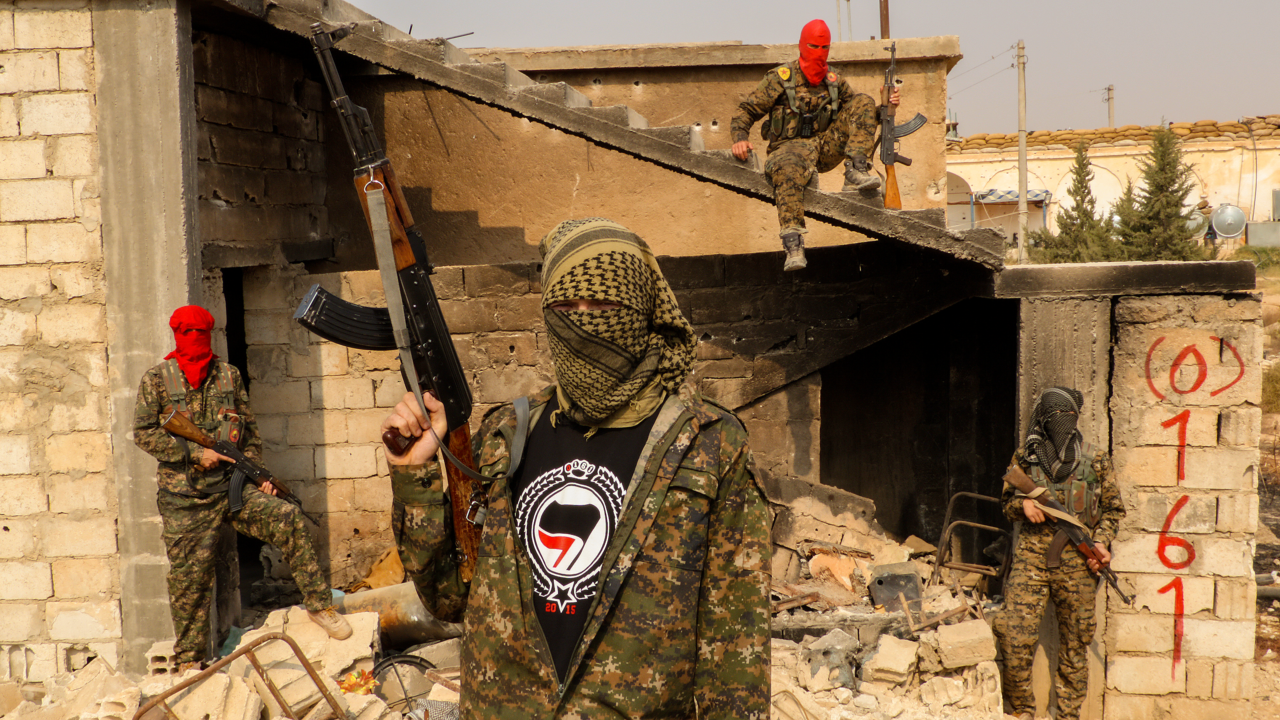
British Fighters with International Freedom Battalion in northern Iraq. (Wikimedia)
Once again, U.S. arms and materiel flowed to the most reactionary elements. The same would happen in Syria where U.S. and Saudi arms went to the local Al Qaeda affiliate, known as Jabhat al-Nusra, and even to ISIS, as a meticulous report by Conflict Armament Research, a Swiss and EU-funded study group in London, has shown. (See “Did Obama Arm Islamic State Killers?” Consortium News, Dec. 21, 2017.)
Insurgency Mix
By August 2012, a secret Defense Intelligence Agency report found that Salafists, the Muslim Brotherhood, and Al Qaeda were already “the major forces driving the insurgency” and that the U.S. and Gulf states backed them regardless. Speechwriter Ben Rhodes summed up the problem of “moderate” rebels who were indistinguishable from Al Qaeda in his White House memoir, “The World As It Is.” In that, he writes that “Al Nusra was probably the strongest fighting force within the opposition, and while there were extremist elements in the group, it was also clear that the more moderate opposition was fighting side by side with al Nusra. I argued that labeling al Nusra as terrorists would alienate the same people we want to help, while giving al Nusra less incentive to avoid extremist affiliations.”
The problem was how to separate the “good” Al Qaeda fighters from the “bad.” Rhodes later complained when Russian President Vladimir Putin said that he and his fellow Obama officials were “trying to climb a spruce tree naked without scratching our ass.” This was “smug,” Rhodes says. But Putin was merely using a colorful expression to say that the policy made no sense; which it didn’t.
The cost, half a dozen years after the Clinton email, is staggering. As many as 560,000 people have died, half the population has been displaced, while the World Bank has estimated total war damage at $226 billion, roughly six years’ income for every Syrian man, woman, and child. A cockeyed memo thus unleashed a real-life catastrophe that refuses to go away. It’s a nightmare from which President Donald Trump is struggling to escape in his confused and deluded way and that the Deep State – everyone from arch-neocon John Bolton to “liberal” Nancy Pelosi– is determined to renew.
EU agrees sanctions against Iranian intelligence service over ‘assassination plot’ – Danish FM
RT | January 8, 2019
The European Union has agreed to enact sanctions against the Iranian intelligence service over its alleged “assassination plots on European soil,” the Danish foreign minister has tweeted.
Specific details in relation to potential new European sanctions against Iran are unclear; nor is it known whether they are close to being implemented. Foreign ministers of EU member states had reportedly agreed to consider sanctions in response to the supposed Iranian plot at a meeting in mid-November.
In late October, Danish security forces said they had arrested a man who was allegedly plotting to assassinate the leader of the Danish branch of an Iranian Arab separatist movement. Tehran denied the accusations as “hostile” and said they were in line with the “enemies’ plots” to undermine Iranian-European relations.
The European Commission, while backing Denmark’s accusation and condemning Tehran, has urged member states to not let it impact the JCPOA Iran nuclear deal of 2015. The US, which unilaterally pulled out of the agreement in May 2018, simply praised Denmark for arresting an “Iranian regime assassin.”
US President Donald Trump’s administration has been cracking down on Iran, accusing it of sponsoring terrorism and violating international obligations. It has repeatedly warned the EU against maintaining trade with Tehran, but Europe has so far been determined to keep JCPOA alive, and is working on a mechanism to bypass American sanctions.
The target of the alleged plot was a local leader of the Arab Struggle Movement for the Liberation of Ahvaz (ASMLA), the Danish Foreign Ministry said at the time. ASMLA, pushing for a separate Arab state within Iran, is classified as a terrorist organization by Tehran.
Tehran has blamed ASMLA for the September 28, 2018 attack on a military parade in Ahvaz, which left 30 people dead and 70 injured. ASMLA denied responsibility, blaming the attack instead on a splinter group within the movement.
Featured Video

Ivermectin and iodine
or go to
Aletho News Archives – Video-Images
Book Review
UAE tortured, killed journalist for opposing Israel normalization
The Cradle | October 31, 2026
UAE security officers detained, tortured, and killed Emirati poet and news editor Habib al-Sayegh in August 2019, shortly after he published a column opposing UAE normalization with Israel, according to a newly published book.
“Princes and Thieves,” a book by investigative journalist Matthew Cole published on 25 October, alleges that UAE security officers raided Sayegh’s Abu Dhabi home shortly after the publication of the column, hooded him in front of his wife and took him to a detention facility where he was tortured to death.
His interrogators reportedly pulled out several of his teeth with pliers and beat him repeatedly with a sharp metal object.
On 11 August 2019, Sayegh criticized the UAE’s plan to normalize relations with Israel as part of the Abraham Accords in his weekly column for Khaleej newspaper. The column was titled “Israel Is Our Real Enemy and A Dangerous Project.”
Sayegh described Israel as “a real and natural enemy” while questioning “who authorized the normalizers to speak on behalf of everyone?”
Nine days after the column was published, Emirati state media announced his death, without stating a cause. … continue
Blog Roll
 Aletho News
- Ivermectin and iodine
- Congratulations climate skeptics — you are a ‘Hybrid weapon of war’ and a growing public health threat
- ‘The Arab Vote’: How Israeli Racism Has Ruined Their Elections
- Israel forces Palestinians in Gaza to choose between assassination alone or death with their families: Report
- US Approves Sale of 500 Patriot Missiles to Ukraine, Deliveries May Take Years
- German Imperialism: An Urgent Explainer
- Backed by AAP, West Virginia Proposal Would Allow Dental Hygienists to Give HPV Vaccine to 9-Year-Olds
- Poland Is the Symptom and Europe Is the Patient
- UAE security forces tortured, killed journalist for opposing Israel normalization: Report
- They Compared the Spice to the Drug. The Spice Won — Again. (Part 2)
- If Americans Knew
- An error has occurred; the feed is probably down. Try again later.
- No Tricks Zone
- Germany’s Green Energy Transition Becoming Increasingly Expensive…Another 6 Trillion Euros!
- Sudden Stratospheric Warming, Powerful El Niño Combination May Lead To Extreme Europe Cold, Energy Crisis!
- Two New Studies Find Thwaites Glacier Melt Cannot Be Driven By Human Activity Or A Warming Ocean
- E-Cars Reduce CO2 Emissions By Only 41% Compared To Internal Combustion Engine Vehicles
- Predictions Made By Renowned Climate Professor Over Past Decades Have Been Proven To Be Poor
- New Study Suggests Large Regions Of The Pacific Ocean Have Been Cooling For The Last 80 Years
- Germany’s Green Energy Debacle: High Energy Costs Force Kahla Porzellan to Close After 182 Years!
- New Study: 50 Years Of The Most Aggressive ‘Net Zero’ Policies Can Only Affect The Global Climate By 0.03°C
- US September “Heat” Was No Record…Many Records Set Decades Ago
- Latest European Green Energy Debacle; Portugal’s Largest Flagship Solar Park Insolvent!

