EU Extends Sanctions Against Syria for One Year
Sputnik – 28.05.2018
The European Union has decided to extend sanctions against Syria by one year, until June 1, 2019, the EU Council said in a statement on Monday.
“On 28 May 2018, the Council extended EU restrictive measures against the Syrian regime until 1 June 2019. Given the ongoing repression of the civilian population, the EU decided to maintain its restrictive measures against the Syrian regime and its supporters, in line with the EU strategy on Syria,” the document read.
The European Union introduced sanctions “against Syria and persons responsible for the violent repression against the civilian population” in May 2011, during the Arab Spring protests, which led to the ongoing civil war in the country.
In 2017 EU also imposed restrictions on Syrian officials who relate to the development an the use of chemical weapons in the country, with over 250 individuals targeted by the sanctions for the involvement in the development and use of chemical weapons against the civilian population. Damascus strongly denied those accusations, also noting that the international organizations didn’t find any evidence of the chemical weapons development by the Syrian government.
In its turn, the US ruled out any American reconstruction support to Assad-controlled territories in the war-weary country.
US warns of ‘firm’ response ahead of Syria’s anti-terror operation in Dara’a
Press TV – May 26, 2018
The US has threatened Syria with “firm and appropriate measures” as the Syrian army reportedly prepares to retake a strategic province on the border with Jordan and the Israeli-occupied Golan Heights.
In a statement released on Friday, US State Department spokeswoman Heather Nauert expressed concerns about the upcoming operation in southwestern Dara’a province, claiming that it falls within a de-escalation zone in Syria.
“As a guarantor of this de-escalation area with Russia and Jordan, the United States will take firm and appropriate measures in response to Assad regime violations,” she said.
The warning came two days after the so-called Syrian Observatory for Human Rights (SOHR) reported that the Syrian troops were moving into Dara’a after liberating all remaining militant-held areas near the capital, Damascus.
On Friday, Syrian state-run media reported that government aircraft had dropped leaflets in terrorist-controlled areas of Dara’a, urging foreign-backed militants to disarm.
One of the leaflets declares “the arrival of the Syrian Arab army’s soldiers,” according to SOHR, which is sympathetic to foreign-backed militants.
The UK-based monitor also said the Syrian government had sent reinforcements to Dara’a following the completion of operations near Damascus.
“These forces are now stationed on the edges of Dara’a province,” SOHR head Rami Abdel Rahman said. “The goal is a broad offensive, should the rebels reject a negotiated pullout as was the case in Eastern Ghouta.”
The recapture of Dara’a is highly important because it borders the occupied Golan Heights which Israel has used to treat wounded militants for years.
The territory’s return to the Syrian government control would cut the much-reported collaboration between Israel and militants and deal a blow to Tel Aviv’s plans to annex the Golan Heights.
Syrian army advances are also upsetting to US plans in the Arab country where it has deployed about 2,000 troops to carve out a statelet in the country’s north with the help of Kurdish militants.
With Syria’s military gains gathering momentum, the US has stepped up its attacks on army positions under numerous pretexts.
On Thursday, Syrian state media reported that the US struck Syrian army positions in eastern Syria, but the US military denied knowledge of it.
“Some of our military sites between Albu Kamal and Humeima were exposed at dawn today to aggression launched by US coalition jets,” state news agency SANA reported, citing a military source.
SANA said the strikes came within 24 hours of a Daesh attack on Syrian army positions in the same region, where the Takfiri terrorists are fighting government forces to the west of the Euphrates.
The Syrian army managed to retake the Eastern Ghouta region, on the outskirts of the capital Damascus, late in March.
On Monday, the General Command of the Syrian Army and Armed Forces said complete security had been restored to Damascus and its countryside after al-Hajar al-Aswad district and al-Yarmouk camp were totally purged of Daesh terrorists.
AUMF 2018 and the “forever war” in the Middle East
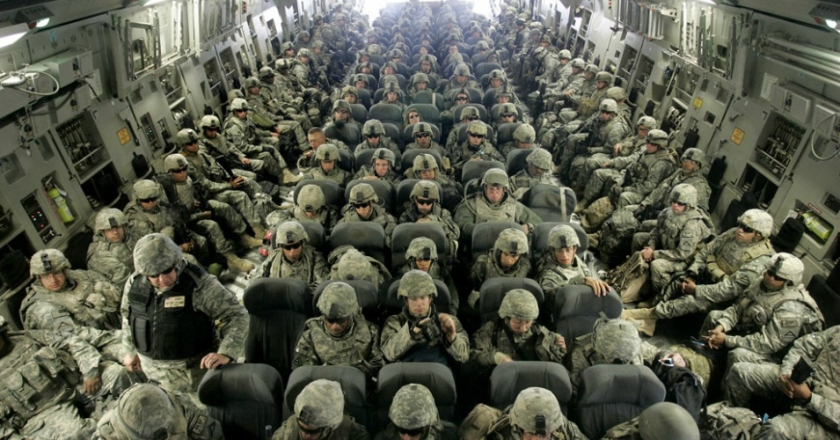
“War is not meant to be won, it is meant to be continuous.”
By Renee Parsons | OffGuardian | May 24, 2018
The Senate Foreign Relations Committee held a hearing on May 16th regarding the authorization of a new Authority for the Use of Military Force 2018 (AUMF). Despite a current lack of unanimity on the committee, the draft authorization (SJ Res 59) has been brought forward as a working document despite the lack of successful back-room negotiations in recent weeks. The hearing was conducted with no quorum present, the lack of which denied the sponsors an easy vote of approval.
The AUMF 2018 would replace AUMF’s 2001 and 2002 which proponents suggest would remove the onerous Constitutional responsibility from a self-proclaimed over-burdened Congress from voting to approve every single separate act of war. While final approval of the AUMF 2018 represents a “Forever Vote,” product of a low vibration consciousness, the ACLU, which should be leading a vigorous national campaign against the proposal, appears absent from the debate.
Approval of a one-size-fits-all AUMF will greatly facilitate the Pentagon’s long held desire to ‘take out’ seven countries in five years – although somewhat behind the original timeline, military conflict is ongoing throughout the Middle East and will allow dramatic escalation in each of those countries without meaningful accountability or Constitutional Congressional oversight.
Since the Congress has already exhibited a penchant for an inability to govern, why have a Foreign Relations Committee at all if their single, most essential Constitutional reason for existence of whether to take the country to war is eliminated?
When the draft AUMF 2018 was introduced by Sen. Bob Corker (R-Tenn) retiring Chair of the Committee in mid-April, he suggested that a strong vote in the Committee would translate into strong support on the Senate floor. After all, even members of the Senate are sensitive to not publicly dismembering their own Constitutional prerogative on a close vote.
Sen. Rand Paul (R-SC) and Sen. Jeff Merkley (D-Or) had both previously announced their opposition to AUMF and both spoke at the hearing against the proposal. Sen. Paul opened with a spirited assault on the AUMF as “flipping the Constitution on its head” eliminating the majority vote in favor of a two-thirds vote required to override Presidential action while allowing the unfettered expansion of war throughout the Middle East.
Since the 2001 AUMF, the status quo has reigned with every President initiating war with the assumption that they had the authority to ‘stretch’ the AUMF to fit current circumstances. Paul argued that by codifying Presidential authority as the 2018 version would do, an opportunity for legal challenges to Presidential authority would be removed. Unrestrained war without the pesky need for Congressional participation is, of course, exactly what the pro-war Republicrats who control the Senate and their MIC benefactors are hoping for. As an example of how a new AUMF might function, Paul said he had not yet figured out ‘why we are chasing a herdsman in Mali?”
Sen. Tim Kaine (D-Va) avid co sponsor of the proposal and HRC’s running mate in 2016, declared that “Congress needs to send a message to our troops, one of them is one of my kids, that the missions they are fighting and dying for, against non-state terrorist groups, has the support of Congress.” Kaine did not explain how codifying the legality of all future undeclared wars will somehow improve the morale of American troops.
One of the two hearing witnesses was Rita Siemion, Adjunct Professor of Law, Human Rights First, George Washington University who provided effective testimony which attracted Kaine to focus his laser on her.
Kaine: Do you support the need for continuing US military action against Taliban, Isis and al Qaeda?
Siemion: I think the use of military force is something that the president should be coming to Congress…
Kaine [interrupts]: Well, can I just say… we are currently engaged in military action against al Qaeda, Isis and the Taliban, do you support need for that action or don’t you?
Siemion: I think that hard questions need to be asked of the administration about what are we achieving by use of military force over the long term….”
Kaine [interrupts again]: So you are not prepared to say today whether you do or do not support the action that our troops are currently engaged in against ISIA, al Qaeda and the Taliban?
Siemion: I think that there are currently real questions that need to be answered about the efficacy of using military force…
Kaine: Let me ask a second question then. I think from your testimony that you would agree, separating this resolution, that the 2001 authorization should be rewritten/or replaced? Do I understand that to be your testimony?
Siemion: I agree that the status quo is incredibly problematic.
Kaine: So then let me be more specific…. do you think it should it be repealed with no replacement or rewritten and then replaced?
Siemion: I think if Congress agrees that use of military force is required and appropriate and it is demonstrated it can be effective for addressing particular terrorist threats, then Congress should authorize military force against those particular groups.
Kaine: I understand that. Obviously if somebody does not think we should be using military force against alQaeda, Isis or the Taliban, then they should vote no on this… they should not vote for an authorization. That’s a good reason to vote no if you do not support the military action that our troops are currently engaged in against al Qaeda, Isis and the Taliban.
In addition to his attempt to make Siemion look unpatriotic, if Kaine’s goal was to intimidate Sen. Merkley who was next to address the panel, he failed.
Merkley focused on legal contradictions and broad interpretations within the AUMF providing the President with a new legal foundation to decide or interpret particular sections that otherwise would be the purview of Congress. Merkley further cited that “the bottom line, what we have before us, codifies the existing situation, gives fresh authority for what has been done since 2001 and I fundamentally believe that delegation was not intended in 2001 and is not appropriate now.” He referred to the Federalist Papers on “how they decided to give that war making power to Congress, that it should not be in the hands of one single person; it is too big an issue, the lives of our soldiers, our sons and daughters, is too big an issue to open that door and I believe they were exactly right. There is a fundamental reason behind that and it is still relevant today.”
At conclusion of the hearing, Sen. Robert Menendez (D-NJ) the committee’s ranking member directly addressed Kaine in that he:
… reject as a false choice that voting against this, when it comes time for that if this is what the final product is, that voting against this proposal is a vote against our troops in the field. No. I reject the proposition that it’s either this or you are not with our troops. That’s ridiculous.”
Kaine replied to:
… clarify and the transcript would show this, I think, that I certainly did not suggest that if you vote against the AUMF, you are against the troops who are currently fighting. I did not suggest that. I did suggest if you are against military action, that is good reason to oppose our proposal. I was engaging in questions of the witness to see if she agreed we should be engaged in military action against these groups. She would not offer an opinion upon that.”
With Secretary of State Pompeo scheduled to testify before Foreign Relations on Thursday, May 24th to clarify the Trump administration’s position on AUMF proposal, a Committee mark up can be expected soon thereafter.
If qui bono is applied here and since the new AUMF would presumably focus on ‘terrorists’ and sovereign nations throughout the Middle East, Israel would appear to be the beneficiary of the dismantling of Congress’ Constitutional obligations. Therefore, it is instructive that fourteen out of twenty one Foreign Relations members were identified by the Center for Responsive Politics on their Top Twenty list of recipients of Pro-Israel PACs or individuals who donated over $200.
- Menendez (D-NJ) 2012/2016: $623,508
- Rubio (R-Fl) 2016: $468,307
- Booker (D-NJ) 2014: $434,126
- Cardin (D-Md) 2012/2018: $415,993
- Portman (R-Oh) 2016: $235,280
- Johnson (R-Wis) 2016: $231,814
- Shaheen (D-NH) 2014: $203,149
- Kaine (D-Va) 2018: $167,878
- Coons (D-De) 2014: $133,300
- Udall (D-NM) 2016: $110,379
- Barasso (R-Wy) 2018: $105,400
- Corker (R-Tenn) 2012: $102,950
- Markey (D-Mass) 2014: $100,450
- Murphy (D-Ct) 2018: $65,221
Either the remaining seven Committee members did not receive sufficient Pro-Israel PAC money to qualify for the Top Twenty list or they received no Pro-Israel PAC money.
Renee Parsons has been a member of the ACLU’s Florida State Board of Directors and president of the ACLU Treasure Coast Chapter. She has been an elected public official in Colorado, an environmental lobbyist for Friends of the Earth and a staff member of the US House of Representatives in Washington DC. She can be found on Twitter @reneedove31
Russia Says US Demands Unacceptable for Iran, Vows to Help Maintain JCPOA
Al-Manar | May 23, 2018
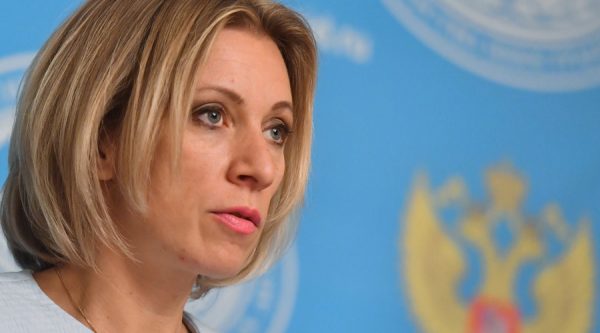
The Russian Foreign Ministry spokeswoman says new US demands from Iran are totally unacceptable, vowing that Moscow will continue to work towards maintaining the Iran nuclear deal, officially known as the Joint Comprehensive Plan of Action (JCPOA).
“We are concerned about the fact that the anti-Iranian campaign is on the rise in Washington. It seems that the United States has made a final decision to use the tactics of ultimatums and threats in respect to Iran. It contradicts the spirit of the JCPOA and does not fall within the normal inter-state relations,” Russian Foreign Ministry spokeswoman Maria Zakharova told a briefing on Wednesday.
“Not only did the US administration withdraw from the agreement in violation of international norms, it is putting forward demands that are a priori unacceptable for Tehran,” she added.
In his first major foreign policy address since moving to the State Department from the CIA, Secretary of State Mike Pompeo said Washington would increase the financial pressure on Iran by imposing the “strongest sanctions in history” on the Islamic Republic if Tehran refused to change the course of its foreign and domestic policy.
Pompeo also outlined 12 US tough demands for Iran, including halting its uranium enrichment and closing its heavy water reactor, for any “new deal” with Tehran.
The Russian spokesperson said that while the US pulled out of the JCPOA, “other participants in the deal are determined to maintain the agreement, adding, “We will continue working to that end. The important thing is that Tehran also abides by its obligations, as confirmed by the IAEA (International Atomic Energy Agency).”
Zakharova said the fate of the Iran deal would be decoded at a new meeting of the Joint Commission monitoring the implementation of the agreement in Vienna on May 25, which will not include the US for the first time.
The Russian official also once again expressed Moscow’s opposition to unilateral sanctions.
BP halts work on gas field over US sanctions on Iran
Press TV – May 23, 2018
British oil company BP says it has halted work on a gas field which it co-owns with National Iranian Oil Company (NIOC) in the North Sea, citing US plans to reimpose sanctions on the Islamic Republic.
NIOC owns 50% of the Rhum field northeast of Aberdeen and BP holds the other half, which it plans to sell to UK-listed producer Serica Energy.
“BP has decided to defer some planned work on the Rhum gas field in the North Sea while we seek clarity on the potential impact on the field of recent US government decisions regarding Iran,” the company said in a statement on Tuesday.
Current operations at Rhum such as provisions of goods, services and support by “certain US persons” are carried out under a US license which is due to expire at the end of September.
Serica said it expected those operations to be affected by US sanctions, “in particular, the new sanctions regime announced by the US government on 8 May.”
The company is looking to secure a waiver from renewed US sanctions against Iran in order for production at the key offshore field to continue, Serica said Tuesday.
It is also working closely with BP and NIOC to evaluate the potential impact of the sanctions on production at Rhum which accounts for around 4% of UK gas output of around 38.1 billion cubic meters.
Rhum was discovered in 1977 by a joint venture between the Iranian Oil Company UK Ltd and BP which has a long history of operation in Iran.
BP started life as the Anglo-Persian Oil Company in 1908 before parting ways with Iran and becoming British Petroleum.
The company shut down Rhum in 2010 even before the West began imposing intensified sanctions on Iran a year later. It resumed production in 2014 after securing an exemption.
The new shutdown is set to further disappoint Iran which has been seeking concrete guarantees on receiving economic benefits of the nuclear deal, only to be given verbal pledges by the European governments instead.
Germany said on Tuesday there was only so much it could do, making it clear that Europe could not entirely shield companies from US sanctions.
“We will help where we can, but there is no way of completely averting the consequences of this unilateral withdrawal,” Economy Minister Peter Altmaier told a newspaper.
His statements were echoed by Luxembourg’s Foreign Minister Jean Asselborn who said there were limits to the European Union’s powers to persuade its larger firms to stay in Iran in the face of threatened US sanctions.
“We know there are hardly any larger companies in Europe that do not also trade with the United States. The pressure on European companies from the US is quite large,” he told reporters in Brussels. “We are in the situation that we’re in.”
OMV committed to Iran project
Nevertheless, Austrian energy group OMV said it has not halted its planned energy projects in Iran.
An Iranian official said earlier this month that OMV, Russia’s Lukoil and China National Petroleum Company (CNPC) had announced interest in the exploration blocks which include both known, highly-potential blocks and new ones.
OMV’s upstream chief Johann Pleininger said on Tuesday the group was monitoring political developments in the United States and the European Union very closely.
“The project has not come to a standstill, it is continuing,” Pleininger was quoted as saying, adding that “no investments have been made yet.”
OMV signed a memorandum of understanding in May 2016 to carry out projects in four blocks in the Zagros sedimentary area.
Egypt demolished 3,600 Sinai buildings in three months: Report
MEMO | May 22, 2018
The Egyptian army has “vastly expanded” the destruction of homes, commercial buildings and farms in Egypt’s North Sinai region since 9 February 2018, a report by Human Rights Watch (HRW) said today.
Since 2014 the Egyptian government has pursued plans to create a buffer zone along its border with Gaza on the pretext that fighters and weapons are being smuggled through the tunnels that connect the peninsula to the Strip.
Activists have said this war on terror is better described as a war on civilians. Between July 2013 and August 2015 the Egyptian Army demolished at least 3,250 buildings to this effect, according to HRW.
In late 2017 authorities resumed demolitions with the view to creating another buffer zone around Al-Arish airport following a missile attack on an air base and military helicopter. On 9 February 2018 the Egyptian military intensified this military campaign with the launch of “Operation Sinai” which they said would rid the region of terrorism once and for all.
Under this operation demolitions have escalated. By analysing a time series of satellite imagery HRW has revealed that the military destroyed at least 3,ooo homes – the largest number since the 2014 campaign began – in just two months. Homes of alleged terrorists, activists and their relatives in North Sinai’s largest city Al-Arish have also been set on fire and then demolished.
There has been no judicial oversight of the demolitions and the government has cut electricity and water of the houses they are evicting to force people to leave.
According to the report residents were given between 24-48 hours warning to evict, no assistance for moving to temporary housing, no process to appeal compensation decisions or for destruction of or damage to farmland.
Middle East Director at HRW Sarah Leah Whitson said: “Turning people’s homes into rubble is part of the same self-defeating security plan that has restricted food and movement to inflict pain on Sinai residents.”
The Egyptian army claims it is protecting people from militants, but it’s absurd to think that destroying homes and displacing lifelong residents would make them safer.
The demolitions and forced evictions have exacerbated an already dire humanitarian situation in North Sinai, according to HRW, which has calculated that 420,000 residents in North Sinai have been in urgent need of humanitarian assistance since “Operation Sinai” began. With the destruction of farms entire extended families have lost their livelihoods.
Because it is illegal to enter Sinai without a permit, the lack of journalists and human rights workers there means there is an information blackout on the atrocities committed.
Antifa or Antiwar: Leftist Exclusionism Against the Quest for Peace
By Diana Johnstone | Consortium News | May 21, 2018
CounterPunch has astonished many of its old fans by its current fundraising ad portraying the site as a prime target of Russia hostility. Under the slogan, “We have all the right enemies”, CP portrays itself as a brave little crew being blown off the water by an evil Russian warship out to eliminate “lefty scum.”
Ha Ha Ha, it’s all a joke of course. But it’s a joke that plays into the dangerous, current Russophobia promoted by Clintonite media, the deep state and the War Party. This is a reminder that Russophobia finds a variant in the writing of several prominent CounterPunch contributors.
Yes, CounterPunch continues to publish many good articles, but appears also to be paying its tribute to the establishment narrative.
Put on the defensive by the “fake news” assault against independent media, CP senior editor Jeffrey St Clair seemed to be shaken by Washington Post allegations that he had published articles by a “Russian troll” named Alice Donovan. St Clair never publicly questioned the FBI claim that the ephemeral plagiarist worked for the Kremlin, when she could as well have been planted by the FBI itself or some other agency, precisely in order to embarrass and intimidate the independent website.
The ‘Step Toward Fascism’

St. Clair: Co-founded CounterPunch
The anti-Russian attitude on CP is promoted mainly by the same writers who stigmatize the slightest suggestion of building a broad non-ideological antiwar movement as a step toward “fascism”. This leftist exclusionism goes against the traditions of the website founded by Alexander Cockburn and St Clair, and indeed, CounterPunch was fiercely attacked less than three years ago for its “red-brown”, or “QuerFront” tendencies.
The attack, originating on a German site, warned that leftists who publish on CounterPunch “are unwittingly helping to promote the agenda of the far right”. This article spelled out the Antifa doctrine:
“The idea of a red-brown alliance, or Querfront (German for ‘transversal front’), has been a recurrent motif in far-right thought over the past century. Craving the legitimacy that an alliance with progressive forces can provide, reactionaries seize on ostensibly shared positions, chief amongst them opposition to corrupt élites, to create the impression that progressives could benefit from making common cause with them.
“Querfront (also known as ‘third position’) propaganda can be highly seductive. Today’s (crypto)-fascist and other hard-right suitors, for example, focus on the commonplace left themes of opposition to war and corporate globalisation, the depredations of the ‘banksters’, civil liberties, and Palestinian solidarity.”
So, you genuine leftists, beware: if someone seems to agree with you, it may be a far righter out to ensnare you into her web.
The article gave advice on how to tell a QuerFront argument from a true leftist one:
“A serious left analysis, say, of US support for Israeli apartheid will start by looking at the documented record of US foreign policy as a whole”, whereas the red-brown, QuerFront third-positions position will say: “A foreign lobby has taken over the US government and media, and is forcing the US to act against ‘American interests’ and ‘American values’, and anyone who says otherwise is a Zionist infiltrator.”
So you mustn’t blame Zionists for Israel, it’s all Washington’s fault.
CounterPunch contributors singled out as dangerous right-wingers included Ralph Nader, Alison Weir, Ron Paul, Gilad Atzmon, Israel Shamir, Paul Craig Roberts and even Alexander Cockburn himself.
In his reply to the article, published on its website, St. Clair seemed to understand exactly where this was coming from.
Caity Gets Counter-Punched

Caitlin Johnstone: Counter-punched
Thus it was surprising when, last July, CounterPunch ran a whole series of articles attacking independent antiwar blogger Caitlin Johnstone (no relation) for some inconsequential remark about her willingness to join in opposing war even with male supremacist Mike Cernovich. The purists pounced on the incongruity of a hypothetical Caitlin-Cernovich alliance as an opportunity to ridicule the more general principle of a broad single-issue antiwar movement. For this minor heresy, Caitlin Johnstone was denied her right to respond on the site calling itself “the fearless voice of the left”.
On July 11, 2017, Yoav Litvin opened fire in an aggressive style that may have been fortified by his service in the Israeli Defense Force (IDF). Exclusion is a habit one can learn in the IDF. It’s ours, you have no right to be here, get out! That goes for the occupied left territories too. They decide who can stay and who does not belong.
In an interview last year, Litvin prided himself on adopting “the positive aspect of Zionism,” which is “the image of a Jew who is a fighter.” As a result of Jewish experience of persecution, he said, “We can lead a fight with all our brothers and sisters in minority communities.”
Fight against whom? In order to accomplish fundamental change, one needs to build majorities. Jews leading a fight of minorities will go where? Into the dead end of identity politics?
On July 28, CounterPunch published an even more contemptuous piece in the anti-Caitlin series: “Enough Nonsense! The Left Does Not Collaborate with Fascists”, by Eric Draitser. The Draitser rhetorical pose was to claim to prefer being water-boarded rather than having to write about Caitlin’s “doltish” prose, but felt obliged to do so in order to stop the advance of fascism.
Still, he does not easily tire from coming back to the subject.
As moderator of CounterPunch Radio, Draitser has promoted himself as the voice of CP and thus as a leading authority on what is or is not “left”. His role as mentor was demonstrated on his hour-long April 19, 2018 podcast with CP editors St. Clair and Joshua Frank. Draitser set the tone by elaborately ridiculing those who profess to be afraid of World War III. As if nuclear war were anything to worry about! What nonsense, he implied, getting all three to chortle contemptuously at the mention of Caitlin Johnstone, noted for such absurd concerns.
The Hilarity of World War III
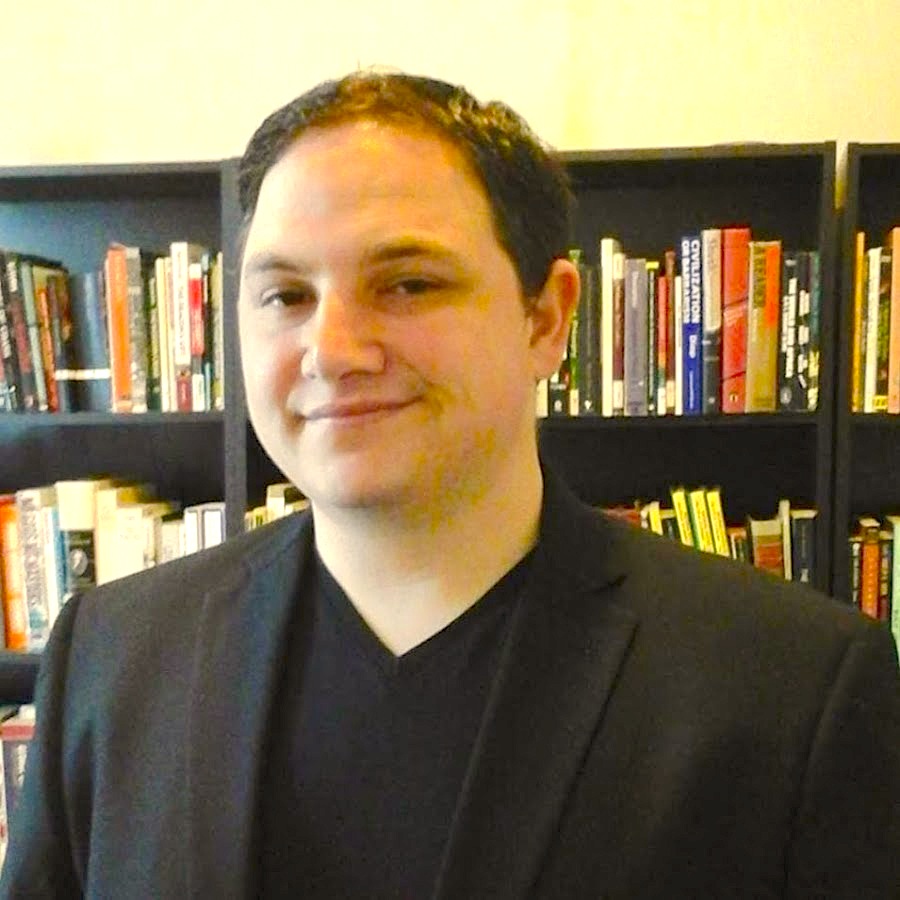
Draitser: WWIII a ‘fun conversation’
Draitser dismissed the danger of World War III with his own original “class analysis”: since Russia and the United States are both ruled by Oligarchs, they have too much in common to reasonably want to throw nuclear missiles at each other. (In other words, what was precisely the Marxist view of imperialist war.) St. Clair hesitated at this, noting the prevalence of irrationality in high spheres. But Draitser dismissed this objection and forged ahead undisturbed, managing what he called a “fun conversation.”
The exclusionists are less concerned about war with Russia than about the failure of “the left” to be sufficiently critical of Russia – as if a shortage of Russophobia were a real problem these days. Shortly before the anti-Caitlin campaign, Litvin interviewed Draitser and their fellow anti-fascist watch dog, Portland State University geography instructor Alexander Reid Ross, who also publishes frequently on CounterPunch.
Draitser complained that: “You see a lot of leftist academics, intellectuals and activists who have in many ways abandoned a real class analysis in favor of a loosely defined politics of opposition. Within this mindset, everything that opposes the United States, Israel, the Saudis or the EU is automatically good and should be supported irrespective of its qualities.”
That simplistic dismissal of the antiwar “mindset” qualifies Draitser for his future place in mainstream media.
Ross’ Red-Brown Chaos
Reid Ross, went him one better. “I see a number of red-brown alliances forming today, particularly in the field of political geography. A number of far-right groups view the modern-day axis of Syria, Iran and Russia as a kind of international counterweight to the North Atlantic Treaty Organization (NATO), which has always been seen by fascist groups as a kind of nemesis led by the nations that defeated the Rome-Berlin axis in 1945.”
This is pure delirium. The nemesis that did the most to defeat the Rome-Berlin axis in 1945 was the Red Army. By conjuring up unidentified “far right groups”, Ross manages to identify Syria, Iran and Russia with the fascist Axis powers in World War II. In reality, NATO has been a magnet for attracting European fascists, from Italy, where they cooperated in clandestine “Gladio” operations to destroy the left, to Ukraine, where genuine fascists are in a “partnership for war” with NATO.
Most Americans have not been well educated in the complexities of modern history. In his Antifa hoodie, Ross can dazzle his audience with a plethora of unfamiliar facts strung together by extremely questionable analysis, unchallenged by genuine experts.
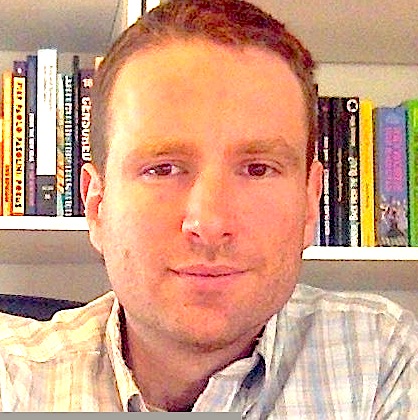
Reid Ross: Article pulled (Photo European Graduate School)
In the Litvin interview, both Draitser and Ross add their small bit to prevailing Western Russophobia by dwelling on Putin’s alleged support for European right-wing groups. Both stress the danger represented by Russian ambitions to establish a Eurasian empire, based on the ideology of Alexander Dugin.
Dugin is a religious reactionary, a tendency that may alarm Jews still haunted by Tsarist pogroms. They are also alarmed by Dugin’s devotion to the thought of German philosopher Martin Heidegger, an ardent believer in Nazism and party member. This is ironic, since Heidegger has been the favorite of a whole line of post-World War II French philosophers, from Sartre to Foucault, considered to be “on the left”. This merely shows that philosophy can be a source of great confusion.
In an Intercept article last September, Ross was quoted as saying that, “Assad is a figure that is central to a realization of Eurasionism,” embodying the idea that, “Russia will lead the world out of a dark age of materialism and toward an ultranationalist rebirth of homogenous ethno-states federated under a heterogeneous spiritual empire.”
It’s hard to see what is so terrifying about such a vague aspiration, with so little chance of realization. But it does provide a new angle for condemning the Russian connection with Syria.
Ideological ‘Iron Curtain’
Ross went so far on March 9 in his vituperations, that the Southern Poverty Law Center, which first published his article on its “Hate Watch” site, felt obliged to withdraw it. The title perfectly echoes the QuerFront accusation earlier leveled against CounterPunch : “The Multipolar Spin: how fascists operationalize left-wing resentment.”
In this gem of guilt by association, Ross applied the “six degrees of separation” theory to show that people have been seen with the wrong people and thus must be red-brown. The long list of untouchables included Ray McGovern, Brian Becker, Global Research, Margaret Kimberly of Black Agenda Report, Daniel McAdams, “conspiracy theorist” Vanessa Beeley, and special focus on Max Blumenthal, guilty of having spoken favorably of a “multipolar world.”
The main problem with “multipolarism”, according to Ross, “may be that it supports not the emergence of Russia as a world power but the rise of the Kremlin’s authoritarian conservative political ideology.”
So, we may conclude, we need an ideological Iron Curtain to protect the “liberal leftist” West from Russian “authoritarian” conservatism.
Westernizers vs. Slavophiles
Russian relations with the West have historically been marked by ideological rivalry between Westernizers and Slavophiles. It is obvious that Dugin is no more than the latest prophet of Slavophilia, the idea that Christian Russia is a beacon of virtue to the world.
Historically, Westernizers in Russia have repeatedly gained influence and then lost out, because their overtures to the West were rebuffed on one pretext or another. (The British geopolitical tradition, based on the timeless dictum divide et impera, has traditionally favored policies to keep the continent divided) This merges easily with the Brzezinski doctrine of maintaining separation between Western Europe as a whole and Russia to maintain U.S. global hegemony.
Western rejection of Russia naturally favors a rise of the Slavophiles. It also obliges Russia to look to Eurasia rather than Western Europe. This is happening again.
Vladimir Putin is clearly in the Westernizing tradition. Not an ignorant buffoon like Yeltsin, ready to give away the shop to get a pat on the back from Bill. But rather someone who, as an intelligence agent (yes, KGB people learn a lot) lived in the West, spoke fluent German, and wanted Russia to have a dignified place in Europe – which was the dream of Gorbachev.
But this aspiration has been rudely rebuffed by the United States. Russians who yearned to be part of Europe have been disappointed, humiliated, and finally, angered. All their efforts at friendship have been met with increasingly outlandish portrayals of Russia as “the enemy”.
And yet despite everything, Putin persists in demonstrating his desire to work with Western partners, both by cutting back on military spending and again proposing to keep the pro-Western Dmitry Medvedev as Prime Minister.
If the West were really worried about Duginism, the remedy has always been obvious: improve relations with Putin.
Even Stalin did not really consider it Moscow’s job to convert Western Europe to communism, and it is certain that Putin has no illusion about converting his Western neighbors to Duginism. Russia is not out to change the West, but to make peace and do business, with whoever is willing.
The Russophobic exclusionists really constitute the ultra-left wing of the War Party, which uses different arguments to arrive at the same conclusions: Syria and Russia are enemies. The exclusionists offer no practical solutions to any real problem, but spread suspicion, distrust and enmity. They discredit the very idea of joining with Russia in peaceful mediation between Israel and Iran, for example. The real thrust of this odd campaign is to minimize the danger of war with Iran, or of direct confrontation with Russia, as Netanyahu continues to drag the United States and its European sidekicks deeper into Middle East wars on behalf of Israel’s regional ambitions.
Diana Johnstone is a political writer, focusing primarily on European politics and Western foreign policy. She received a Ph.D. at the University of Minnesota and was active in the movement against the Vietnam War. Johnstone was European editor of the U.S. weekly In These Times from 1979 to 1990, and continues to be a correspondent for the publication. She was press officer of the Green group in the European Parliament from 1990 to 1996. Her books include Queen of Chaos: The Misadventures of Hillary Clinton, CounterPunch Books (2016) and Fools’ Crusade: Yugoslavia, NATO and Western Delusions, Pluto Press (2002).
‘Strongest sanctions in history’: Pompeo issues 12 demands to Iran, vows ‘unprecedented pressure’
RT | May 21, 2018
Tehran will struggle to “keep its economy alive” if it does not comply with a list of 12 US demands, including Iranian withdrawal from Syria, Secretary of State Mike Pompeo vowed on Monday.
Speaking at the Heritage Foundation, a right-wing Washington think tank, Pompeo laid out a list of 12 “basic requirements” for Iran. The demands call on Iran to withdraw from Syria, “release all US citizens,” end support for Houthi rebels in Yemen, stop “enrichment” of uranium, and promise never to process plutonium. Iran must also allow “unqualified access to all nuclear sites throughout the country,” Pompeo said.
He promised that the US would impose the “strongest sanctions in history” if Iran failed to comply with these demands.
Pompeo said that “the sting of sanctions will be painful” and Iran will struggle to “keep its economy alive” if Tehran “does not change its course from the unacceptable and unproductive path it has chosen.”
“Thanks to our colleagues at the Department of Treasury, sanctions are going back in full effect and new ones are coming … These will indeed end up being the strongest sanctions in history,” Pompeo said.
The secretary of state also pledged that the US “will track down Iranian operatives and their Hezbollah proxies operating around the world, and we will crush them. Iran will never again have carte blanche to dominate the Middle East.”
Speaking directly to the Iranian people, Pompeo claimed that “President [Hassan] Rouhani and Foreign Minister [Javad] Zarif… are your elected leaders. Are they not the most responsible for your economic struggles?” He added: “The United States believes you deserve better.”
Pompeo also said he’s sure that over time, Washington’s allies will warm to the Trump administration’s now unpopular stance on Iran.
Washington’s strategy is to weaken Iran economically, rather than engage in an actual war, Dr. Said Sadik, Professor of political sociology at the American university of Cairo, told RT in response to Pompeo’s address. “What the [US] is doing now is increase sanctions trying to undermine the power of Iran regionally, economically with the hope that that would lead to unrest and disturbances in Iran, that it would make the Iranian government stop trying to help its allies or extend its influence in the area. This is basically what they want.”
Sadik added: “I don’t think they want a war because war is very expensive and dangerous in this strategic area…What they want is to weaken Iran financially, economically, with the hope that the Iranian government will not be that powerful in the area as it is now.”
The speech comes after Trump announced earlier this month that he was pulling out of the 2015 nuclear deal. Europeans allies had pleaded with Trump not to withdraw from the historic accord, which put tight restrictions on Iran’s nuclear program in exchange for sanctions relief. Iranian president Hassan Rouhani described the US pull-out from the deal as a “historic experience for Iran,” adding that “by exiting the deal, America has officially undermined its commitment to an international treaty.”
Iran says it expects the EU to continue to honor the agreement, despite Washington’s withdrawal from the accord. Inspections by the International Atomic Energy Agency (IAEA) have repeatedly confirmed that Iran is in full compliance with its obligations under the deal.
EU Blocking Statute Against Anti-Iran US Sanctions May Fail to Protect Companies
Sputnik – May 19, 2018
BRUSSELS – The reinforcement and modification by EU of its Blocking Statute, which protects EU companies from the effects of sanctions by a third country, in order to prohibit companies from complying with US anti-Iran sanctions will not protect companies from fines for cooperating with Iranian projects, experts told Sputnik.
Since US President Donald Trump announced his decision to pull out of the Iran nuclear deal and reimpose its sanctions against the Islamic Republic, efforts by EU leaders have been focused on preserving the status quo in relations with Iran and mitigating the effects of the US withdrawal.
On Thursday, European Commission President Jean-Claude Juncker announced that the union will amend its Blocking Statute in order to include the US sanction imposed against Iran in the regulation. As soon as the amendments are adopted, EU businesses will be allowed not to comply with the US restrictions or even demand compensation for losses caused by the US sanctions.
TO AVOID US PENALTIES FIRMS SHOULD ABANDON BUSINESS WITH US
“Reactivating and even modifying the 1996 Blocking Statute will not shield EU companies, banks, and even countries from the US Department of Treasury imposing penalties. An EU company, bank, or government would have to do no business directly or indirectly with US counterparts in order to not feel the impact of US responses,” Dr. Jamsheed K. Choksy, the chair of Department of Central Eurasian Studies at Indiana University, said.
Choksy indicated that the safeguards that the EU leadership and national governments might potentially provide to the EU companies will not be able to make up for the losses caused by not doing business with the United States, which is a target market for EU firms.
Choksy explained that EU firms, in fact, had to choose between business with US entities or Iranian ones and business with US companies was far more economically viable and lucrative than business with Iran.
The head of the Europe of Nations and Freedom group in the European Parliament, Nicolas Bay, agreed with Choksy, saying that the importance of the US and Iranian markets for EU businesses was non-comparable.
POLITICAL ASPIRATIONS VS. ECONOMIC INTERESTS
According to the politician, Brussels’ attempts to demonstrate its political independence and significance by preserving the Iran nuclear deal without the United States have nothing to do with purely economic motives of the EU businesses.
“In the current state of the crisis, Jean-Claude Juncker, Donald Tusk and the European Union are only into communication to hide their weakness, because Brussels will not be able to force the banks, the car manufacturers, and all the European companies that depend on the American market to continue to trade with Iran,” Bay said.
Drieu Godefridi, a writer and former Director of the Hayek Institute, said that EU firms would not abandon pragmatic interests to appease EU politicians trying to recover from Trump’s neglect of transatlantic partnership.
“Whatever Mr. Juncker says now and the sabre-rattling by some, large and small European companies will never jeopardize their North American business to please the Brussels politicians. Europe is divided; we may be the largest world market but Europe is a political dwarf,” Godefridi said.
EUROPE WILL HAVE TO ABIDE
“My analysis when Trump announced the re-establishment of sanctions was that Europeans would have to abide. There is no way Europe could take a different path: America is the backbone of European defense in NATO, America is the first market of Germany and the third of France. No European bank can live without access to the dollar zone,” Godefridi predicted.
Jacques Leroy, a French international consultant on deals in the Middle East, believes that in the current situation, taking into account the importance of the US market for European countries, national governments will try to obtain some exemptions for their firms on an individual basis.
“Every European leader will try to obtain ‘special treatment’ from Washington, which is exactly what Donald Trump counts on. Divide to control. Europe will have to bow to US sanctions in the end,” Leroy stressed.
IRAN’S SALVATION LIES IN PARTNERSHIP WITH RUSSIA, CHINA
Since the majority of experts were convinced that the EU dependence on the United States would not allow Brussels to preserve its cooperation with Iran, they suggested that the Islamic Republic should seek refuge in partnership with more independent Russia ad China.
“I do not think [EU politicians] have the stomach to stand up to Trump. The United States wants Iran, Russia, and China to fall on their knees. These three countries must move closer to each other,” Mohammad Marandi, a professor at the University of Tehran, recommended.
His views were fully shared by Godefridi, who assumed that Russia and China were independent enough from the US economy to go their own way and trade with Iran.
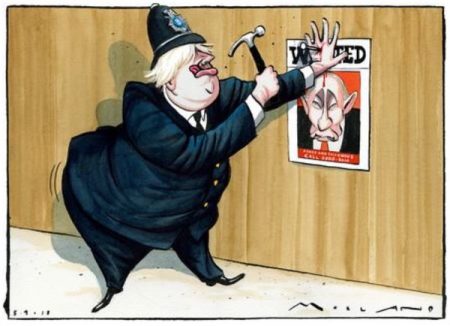
With Iran sanctions Trump made Europeans look like the fools they are
By John Laughland | RT | May 18, 2018
The attacks by European leaders against US President Donald Trump are getting sharper by the day.
On the day Trump announced that he was ripping up the Iran deal, and that the US would impose sanctions on European companies trading with that country, the French finance minister Bruno Le Maire said that European states refused to be treated like “vassals” of the US.
At Aachen on 11 May, Emmanuel Macron effectively accused the US of blackmail. On 17 May, the president of the European Council, Donald Tusk, asked, “With friends like that (i.e. Trump), who needs enemies?”
The temperature only rose further when the French energy giant Total announced that it would pull out of a multi-billion dollar gas deal with Iran unless European diplomacy succeeds in obtaining a specific waiver from US sanctions. Other European behemoths including Allianz and Siemens have also announced either that they will wind down operations in Iran or that they will not start any new ones.
These statements show that Trump’s decision is a slap in the face for the EU politically, economically and – perhaps above all – ideologically. Politically, because both Emmanuel Macron and Angela Merkel made special trips to Washington to plead with Trump, to no avail whatever. Moreover, the EU is itself a signatory to the Iran deal, which it regards as a major diplomatic triumph from which it draws credibility: its disavowal by Trump is a deep insult to the diplomatic status of the EU as such.
Economically, because of the gigantic contracts which European companies could lose. For years, following the nearly $9 billion fine imposed by the US on Paribas in 2015, European companies and banks have been terrified of engaging in any business activity likely to attract the ire of the Americans. Deals with Russia, for instance, are shunned. The effect of this latest decision could be like many Paribas situations at once.
Ideologically, because the EU draws its entire legitimacy from the belief that by pooling sovereignty and by merging its states into one entity, it has advanced beyond the age when international relations were decided by force. It believes that it embodies instead a new international system based on rules and agreements, and that any other system leads to war. It is impossible to exaggerate the importance of this belief for European leaders; yet Donald Trump has just driven a coach and horses through it.
The angry statements by European leaders might lead one to think that we are on the cusp of a major reappraisal of trans-Atlantic relations. However, the reality is that the EU and its leaders have painted themselves into a corner from which it will be very difficult, perhaps impossible, to extricate themselves.
First, the links between the EU and the US are not only very long-standing, they are also set in stone. NATO and the EU are in reality Siamese twins, two bodies born at the same time which are joined at the hip. The first European community was created with overt and covert US support in 1950 in order to militarize Western Europe and to prepare it to fight a land war against the Soviet Union; NATO acquired its integrated command structure a few months later and its Supreme Commander is always an American.
Today the two organizations are legally inseparable because the consolidated Treaty on European Union, in the form adopted at Lisbon in 2009, states that EU foreign policy “shall respect” the obligations of NATO member states and that it shall “be compatible” with NATO policy. In other words, the constitutional charter of the EU subordinates it to NATO, which the USA dominates legally and structurally. In such circumstances, European states can only liberate themselves from US hegemony, as Donald Tusk said they should, by leaving the EU. It is obvious that they are not prepared to do that.
Second, EU leaders have burned their own bridges with other potential partners, especially Russia. Angela Merkel traveled to Russia on Friday but only a few weeks ago more than half of the EU member states expelled scores of Russian diplomats and encouraged non-EU European states like Ukraine and Montenegro to do the same, in retaliation for the poisoning in Salisbury of Sergei and Julia Skripal.
How is Mrs Merkel going to convince Mr Putin to join her in keeping Iran’s nuclear program under control if she officially thinks that Mr Putin is guilty of secretly stockpiling and using chemical weapons for assassinations in the West? Only a few weeks later, in mid-April, Britain and France, together with the US, attacked Syria on the basis that its army had used chemical weapons at Douma with Russian backing. If they try to turn on the charm now in Sochi or in Moscow, do they really expect the Russians can take them seriously?
Third, how can EU leaders complain about US sanctions against their companies when they themselves have applied sanctions against Russian companies causing major economic disruptions in that country? EU states have also introduced punitive sanctions against Syria since 2011, one of the biggest programs of sanctions ever, whose effect and purpose is to disrupt the activities of the Syrian state including its ability to provide public goods like health.
Britain and France, who are, with Germany, the European signatories of the Iran deal, have been pursuing regime change in Syria for half a decade. By what right do they protest now that the US administration is taking decisions whose goal is to provoke regime change in Iran?
As if these external issues were not bad enough, the EU is currently riven by internal divisions too. Donald Tusk may say “Europe must be united economically, politically and also militarily like never before … either we are together or we are not at all” but Europe is indeed not “together” at all. The Brussels commission is hounding Poland and Hungary on what are clearly internal political matters beyond the Commission’s remit; the EU is about to lose one of its most important member states; and a new government is going to take power in Rome whose economic policies (a flat tax at 15%) will blow the eurozone’s borrowing rules out of the water and perhaps cause Italy to leave the euro.
The Italian 5-Star / League government also wants an end to the EU sanctions against Russia; these are voted by a unanimity which, although fragile, has held until now but which, if the new power in Rome keeps its word, will shortly collapse. In other words, what Trump has done is to make the Europeans look like the fools they are. In circumstances in which the EU has placed all its eggs in one basket, a basket which Trump has now overturned, it will be impossible for it to come together. On the contrary, it is falling apart.
John Laughland, who has a doctorate in philosophy from the University of Oxford and who has taught at universities in Paris and Rome, is a historian and specialist in international affairs.
EU will use ‘blocking statute’ to protect its firms from US sanctions for operating in Iran
RT | May 17, 2018
The European Union will activate legislation banning the bloc’s companies from complying with US sanctions against Iran as soon as Friday, according to European Commission President Jean-Claude Juncker.
The law also does not recognize any court rulings enforcing penalties, which could be potentially introduced by the White House against European corporations doing business in the Islamic Republic.
“As the European Commission we have the duty to protect European companies,” the Commission president said at a news conference after a meeting of EU leaders. “We now need to act and this is why we are launching the process of to activate the ‘blocking statute’ from 1996. We will do that tomorrow morning at 10:30.”
“We also decided to allow the European Investment Bank to facilitate European companies’ investment in Iran. The Commission itself will maintain its cooperation with Iran,” Juncker said.
The move followed Washington’s decision to withdraw from the Iran nuclear deal, clinched three years ago between Tehran and the P5+1 powers (China, France, Russia, UK, US, plus Germany) and to reintroduce sanctions that were lifted after signing the pact.
The US Treasury Department said it would give European businesses six months to wind up their investments in the country or risk US sanctions – forbidding them from signing new contracts.
Following a decades-long financial and economic blockade, the 2015 nuclear deal, known as the Joint Comprehensive Plan of Action (JCPOA), opened Iran as one of the biggest global markets to dozens of multinationals across the globe. The EU’s biggest companies rushed to sign multi-billion euro deals with Tehran shortly after the sanctions were lifted. As for Iran, the energy-rich republic got an opportunity to ramp up its presence in the global oil markets.
The EU has a lot of experience protecting its interests, Dawood Nazirizadeh, chairman of the Wiesbaden Academy for integration, told RT.
“In 1996 it defended itself against US secondary sanctions with the ‘blocking statute’. As a result, the US granted exemptions to European companies. However, under the current US administration, we are not optimistic about the future for such an agreement,” said Nazirizadeh.
The EU also agreed to stick to the Iran nuclear deal, aiming to protect the interests of European corporations dealing with Tehran against US sanctions, according to European Council President Donald Tusk.
“On Iran nuclear deal, we agreed unanimously that the EU will stay in the agreement as long as Iran remains fully committed to it. Additionally the Commission was given a green light to be ready to act whenever European interests are affected,” the top EU official said.
Featured Video
Death Spikes & Rising Cancer In Our Youth Explained
or go to
Aletho News Archives – Video-Images
From the Archives
Politicians lie
By Mazin Qumsiyeh | Popular Resistance | August 18, 2013
There is no way to say this truth nicely: Politicians lie. That includes Japanese, American, Egyptian, Israeli, and Palestinian politicians! Is there something more common sense than that? Yet, so many citizens around the world believe their own politicians or wistfully acknowledge lies but think it is part of the job needed to run things. They believe even when politicians contradict themselves blatantly. This phenomenon is rather remarkable. It is a dissonance and disconnect from reality that many seem oblivious to. It is very dangerous because it can lead to accepting rationales for going to war. These can be deadly wars that lead to millions of lives lost as happened in what was called World War 1 and WW2. Even when incredible and declassified evidence abound, politicians continue to lie and old mythologies refuse to die. Here are just a few of the countless lies told to us over the past few decades… continue
Blog Roll
 Aletho News
- Turkish parliament to review Saudi-Pakistan defense pact next month
- DEATH SPIKES & RISING CANCER IN OUR YOUTH EXPLAINED
- Iran offers Trump deal before US election
- Merz regime wants ‘secret police’ – opposition
- Israeli settlers terrorize West Bank Palestinians with state-provided drones: Report
- They see them, then kill them: Israeli quadcopters track, deliberately target civilians in Gaza
- Debunked: Trump’s egregious UNGA claims on war against Iran crumble under scrutiny
- Europe was part of the infrastructure of US aggression against Iran: Deputy FM
- New evidence on the Bucha Massacre
- Italy and France debunk reports CIA issued ‘Russian drone threat’ warning
- If Americans Knew
- An error has occurred; the feed is probably down. Try again later.
- No Tricks Zone
- New Study: Earth And Venus Surface Warmth Largely Explained By Convection And Lapse Rate, Not CO2 Or Radiation
- 2025 Nature Paper Claiming Worsening Global Drought Gets RETRACTED …Heavily Flawed
- New Study: ‘Global Drought Shows No Detectable Recent Acceleration Under Climate Warming’
- Economic Masterminds: German Socialists Suggest Taxing Productivity Gains Stemming From Using AI
- The South China Sea Has Not Been Cooperating With The Climate Change Narrative
- Energy Crisis: Germany Enters Heating Season With Historically Low Gas Reserve Fill Levels
- New Study: The Antarctic Ice Sheet Gained Mass From 2020-2024 Due To Staggering Snow And Ice Accumulation
- Study: Ocean Heating Rates From Thousands Of Years Ago ‘Dwarf’ Modern Ocean Heating Rates
- Climate Extremists Target, Attack Large-Scale Power Grid Infrastructure In Germany!
- New Study: Antarctic Ice Melt Has Contributed Less Than 1 Centimeter To Sea Level Rise In The Last 30 Years

