At first, American officials couldn’t believe it. In 1993, the Israelis began pressuring the Clinton administration to view Iran as the greatest global threat. Only a short time earlier, in the 1980s, Israel had been cooperating with the Iranians militarily and selling them weapons to fight Iraq in the Iran-Iraq War.
Back then, the Israelis were Iran’s best lobbyists in Washington, pushing the Reagan administration to talk to Iran, to sell arms to Iran, and even to ignore Iran’s tough talk on Israel. In that process, Israel was aided by a group of staunchly pro-Israeli officials within the Reagan administration whom we now know as the neoconservatives.
In 1981, just months after Iran had held 52 American diplomatic personnel hostage for 444 days, senior State Department officials Robert McFarlane and Paul Wolfowitz were advocating on behalf of the Israeli desire to sell Iran weapons. That initiative, which was continued by McFarlane when he became President Reagan’s National Security Advisor, ultimately led to the Iran-Contra scandal of 1986 when Reagan’s secret approval of U.S. arms shipments to Iran became public.
Yet, even in the wake of that scandal and the end of the Iran-Iraq War in 1988, the neoconservatives who remained influential under Reagan’s successor, President George H.W. Bush, pressed ahead with the goal of getting the U.S. to warm its relations with Iran. Iraq’s defeat at the hands of the U.S. military and its allies in the Persian Gulf War of 1990-91 further reduced the Arab threat to Israel’s security and encouraged more thinking about a possible U.S.-Iranian détente.
The Bush-I administration’s 1991 “National Security Strategy of the United States” said the U.S. was open to “an improved relationship with Iran,” a country that a 1991 National Intelligence Estimate said was “turning away from revolutionary excesses . . . toward more conventional behavior.”
However, in 1993, with the Clinton administration in power, the Israelis changed their tune, urging the U.S. government to find Iran lurking behind every terrorist attack, every conflict and every threat.
There appear to have been several factors leading to this Israeli switch – from the fact that the Cold War was over and thus Arab states that had relied on Soviet weaponry were weakened; that Iran-backed Hezbollah was challenging Israel’s military occupation of southern Lebanon; and that Israel could no longer profit from Iran’s desperate need for weapons (with the war with Iraq over and Iran’s treasury depleted) while the Arab oil states offered a more lucrative opportunity for both geopolitical and financial gain.
Hooked on the Money
Israeli leadership had found the billions of dollars from arms sales to Iran useful in maintaining Israel’s large military/intelligence infrastructure as well as Israel’s development of Jewish settlements inside Palestinian territories on the West Bank. With that cash source gone, Israel began recalculating its longstanding Periphery Strategy, which had called for countering Arab pressure from close-in states by cultivating relations with non-Arab regional powers on the periphery, such as Iran and Turkey.
There were also two other seismic events that altered the geopolitical landscape. The Cold War was over and Saddam Hussein’s Iraq had been humiliated in the Persian Gulf War. While the Israelis saw both events as positive, there were unintended consequences. The end of the Cold War meant the exit of the Soviet Union from the Middle East: that left Israel’s traditional Arab enemies even more enfeebled and the U.S. government less worried about losing influence in the oil-rich region. Iran also emerged as relatively stronger than Iraq due to Iraq’s failed invasion of Iran and its catastrophic defeat after its invasion of Kuwait.
Israel’s 1992 elections also brought Yitzhak Rabin, Shimon Peres and the Labor Party to power, raising the possibility of finally reaching a peace accord with the Palestinians and thus the possibility of more normalized relations with the Arab world. In turn, that raised the potential for more lucrative arrangements with oil-rich sheikdoms by, in effect, renting out the Israel Lobby to the Sunni-ruled Gulf states so they could push their historic conflict with the Shiites whose power base was Iran.
“There was a feeling in Israel that because of the end of the Cold War, relations with the U.S. were cooling and we needed some new glue for the alliance,” Efraim Inbar of the Begin-Sadat Center told Trita Parsi. “And the new glue was radical Islam.”
But it was a very selective kind of radical Islam: not the kind Saudi Arabia was financing and exporting through Wahhabi fundamentalism and violent jihadists like those in Al Qaeda, but Iran’s radical Shiite Islam. Selling Iran as the number one global terror threat gave birth to a new Middle East enemy that replaced the Soviet Union and reinflated Israel’s value to the U.S. in the region. “Iran,” Inbar went on to explain, “was radical Islam.”
A New Alliance
For the first time, an alliance between Israel, Saudi Arabia and the United States became possible with Iran as the designated enemy. The Israeli-Saudi relationship has evolved mostly in secret over the past couple of decades but has popped into view in recent years as Prime Minister Benjamin Netanyahu and his inner circle have emphasized the common interests – especially animosity toward Iran – that they share with Saudi Arabia.
Netanyahu has recently referred to this Israeli-Saudi alliance when he said that Iran was driving Israel into cooperative arrangements with what he called “the modern Sunni states.” He referred to “a new alliance between Israel and Islamic states. … The good news is that the other guys are getting together with Israel as never before. It is something that I would have never expected in my lifetime.”
Nine months ago, Netanyahu delivered the same message when he said “for the first time in my lifetime, and for the first time in the life of my country, Arab countries in the region do not see Israel as an enemy, but, increasingly, as an ally.”
Though the Israeli-Saudi relationship is rarely spoken of out loud, Israeli Energy Minister Yuval Steinitz admitted recently that Israel “has ties that are . . . partly covert with many Muslim and Arab countries.” Saudi Arabia was the only one he specifically named. According to Reuters, he said those ties are fueled by “common concerns over Iran.”
But there are other foundations for this relationship. For years, Saudi Arabia sought to buy influence in Washington’s policy circles regarding the Middle East but was largely unsuccessful because Israel had cornered that market and Israel’s influential American supporters demonized lobbyists, academics and others who took Saudi money. Eventually, it became clear to Saudi Arabia that it made more sense to rent out Israel’s sophisticated lobbying apparatus rather than to fight it.
Investigative journalist Robert Parry reported that Saudi money helped seal this Israel-Saudi alliance, with the Saudis giving Israel billions of dollars and Israel reciprocating by giving Saudi Arabia added influence in Washington.
But Official Washington was surprised in the 1990s when Israel’s turnabout began — and Iran went from being a misunderstood nation tilting toward moderation to the world’s leading sponsor of terrorism. Despite some bewilderment, U.S. policymakers soon readjusted their rhetoric as the legendary Israeli influence operations carried the day. Shiite Iran became the new terror threat, even after the 9/11 attacks that were organized by Al Qaeda, a Sunni fundamentalist group associated with Saudi Arabia.
The Islamic State
The gap between the facts on the ground – the recognition that Al Qaeda and Islamic State remain the real chief terror threats from radical Islam – and the propaganda of principally blaming Iran for terrorism has led to a quandary for U.S./Israeli propagandists. They want to focus Americans’ fury on Iran and its allies, Syria and Hezbollah, but it is Saudi-and-Gulf-connected terror groups, such as Al Qaeda and Islamic State, that were chopping off heads of innocents and sponsoring terrorist attacks in the U.S. and Europe.
That disconnected reality explains why America’s response to the emergence of the Islamic State can best be characterized as confused and bizarre. Though the Obama administration claimed it was taken by surprise by the Islamic State’s emergence in Iraq and Syria, it really wasn’t. Rather, policymakers had sought to persuade the American public on the need for a “regime change” conflict in Syria, an Iranian ally. This strategy went back years.
A WikiLeaks-released cable dated Dec. 13, 2006, and written by the charge d’affaires of the U.S. embassy in Damascus to the Secretary of State recommended that the U.S. “coordinate more closely with” Egypt and Saudi Arabia in a policy to weaken President Bashar al-Assad’s government in Syria and “to play on Sunni fears of Iranian influence.” The cable also recognized that Islamist extremists were “certainly a long-term threat” to the Syrian government.
Over the years, there was little change in this inconvenient truth that jihadists were playing a crucial role in achieving these geopolitical goals. For instance, in a December 2009 cable, then Secretary of State Hillary Clinton stated that “Saudi Arabia remains a critical financial support base for al-Qaeda, the Taliban . . . and other terrorist groups.”
By Aug. 12, 2012, the U.S. government knew explicitly that Islamic extremists were the engine in the Syrian insurgency. A classified Defense Intelligence Agency Information Intelligence Report unambiguously declares that “The salafist [sic], the Muslim Brotherhood, and AQI [al-Qaeda in Iraq, later ISIS and the Islamic State] are the major forces driving the insurgency in Syria.”
Section 8.C. of the report astonishingly predicts that “If the situation unravels there is the possibility of establishing a declared or undeclared salafist principality in eastern Syria.” Section 8.D.1. of the report goes on specifically to say that “ISI could also declare an Islamic State through its union with other terrorist organizations in Iraq and Syria.”
So, the U.S. government knew that the Islamic extremists drove the Syrian insurgency that Washington and its regional allies were supporting. U.S. intelligence analysts also had a surprisingly good idea what the possible outcome of that support was.
Yet, to advance the regional goals of the Israeli-Saudi tandem – i.e., the overthrow of the Syrian government because of its ties to Iran – the U.S. government was, in effect, supporting the very terrorists the war on terror was meant to eradicate.
Selling Al Qaeda
At times, senior Israeli officials made clear their preferences for Sunni extremists over more moderate Arabs associated with Shiite-ruled Iran. For instance, in September 2013, then-Israeli Ambassador to the United States Michael Oren told the Jerusalem Post that Israel favored the Sunni extremists over Syria’s largely secular President Bashar al-Assad.
“The greatest danger to Israel is by the strategic arc that extends from Tehran, to Damascus to Beirut. And we saw the Assad regime as the keystone in that arc,” Oren said in the interview. “We always wanted Bashar Assad to go, we always preferred the bad guys who weren’t backed by Iran to the bad guys who were backed by Iran.” He said this was the case even if the “bad guys” were affiliated with Al Qaeda.
Oren reiterated this position in June 2014 at an Aspen Institute conference. Speaking as a former ambassador, Oren said Israel would even prefer a victory by the Islamic State, which was then massacring captured Iraqi soldiers and beheading Westerners, than the continuation of the Iranian-backed Assad in Syria.
“From Israel’s perspective, if there’s got to be an evil that’s got to prevail, let the Sunni evil prevail,” said Oren, who is now a member of the Knesset and part of Netanyahu’s government.
Other senior Israelis have expressed similar sentiments. Sima Shine, who is in charge of Iran for Israel’s Ministry of Strategic Affairs, urged Assad’s removal even if that might turn Syria over to extremists. “The ‘devil we know’ is worse than the devil we don’t,” she said in June 2013. “If Bashar remains in power, that would be a huge achievement for Iran.”
So, in 2014, when Islamic State jihadists advanced through Syria and Iraq and knocked on the door of Lebanon, their success should not have come as a surprise to President Obama and other U.S. policymakers. Today’s Iraq, Syria and Lebanon have in common that they are Iran’s three principal allies in the region.
In other words, the Islamic State’s interests largely corresponded to those of Israel, Saudi Arabia and the U.S.: isolating and weakening Iran. Only the Islamic State’s shocking excesses of videotaped beheadings of Americans and other captives – as well as its military successes inside Iraq – forced President Obama’s hand in committing U.S. forces to stop the Islamic State onslaught.
Obsessed with Assad
Still, America has long been bent on removing Assad from Syria. The coincidence of Islamic State and American interests in this regard is revealed in section 8.C of the DIA report: “there is the possibility of establishing a declared or undeclared salafist principality in eastern Syria (Hasaka and Der Zor), and this is exactly what the supporting powers to the opposition want, in order to isolate the Syrian regime, which is considered the strategic depth of the Shia expansion (Iraq and Iran).”
So, the Islamic State’s advance into this region was consistent with American (and more to the point, Israeli and Saudi) interests because these Sunni extremists would block the supply lines from Iran to Lebanon’s Hezbollah. Thus, initially at least, the U.S. government acquiesced to the Islamic State and Al Qaeda’s Nusra Front taking the lead in damaging or destroying Iran’s allies in Syria.
And Iran suspected as much. According to Iran expert Trita Parsi, the Iranians believed that the initial relaxed approach by the U.S. government toward the Islamic State and Al Qaeda’s Nusra Front was because those militants were the point of the spear against pro-Iranian Shiite influences in not only Syria but Iraq and Lebanon as well.
So, the Saudi government provided the “clandestine financial and logistic support to Isis and other radical groups in the region,” according to a leaked Hillary Clinton email on Sept. 17, 2014.
Less than a month later, on Oct. 2, 2014, Vice President Biden told a seminar at Harvard’s Kennedy School that “the Saudis, the emirates … poured hundreds of millions of dollars and tens of thousands of tons of military weapons into anyone who would fight against Assad except that the people who were being supplied were Al Nusra and Al Qaeda and the extremist elements of jihadis.”
The DIA report also named the Gulf States as among the “supporting powers” of the Syrian opposition. And at a May 2015 meeting between President Obama and the Princes of the Gulf Cooperation Council, according to David Ignatius of the Washington Post, “Obama and other US officials urged Gulf leaders who are funding the opposition to keep control of their clients, so that a post-Assad regime isn’t controlled by extremists from the Islamic State or al-Qaeda.”
However, with the Israel lobby redirecting Official Washington’s ire toward Iran, more political space was created for these Saudi-connected terror groups to carry out the regime change missions in Syria and elsewhere.
And Israel didn’t just prefer a victory in Syria by the extremists of Al Qaeda and the Islamic State. United Nations observers in the Golan Heights reported witnessing cooperation between Israel and Syrian rebels, and Israel has frequently bombed Syrian targets (and here and here).
Netanyahu also reported that Israel has hit Hezbollah forces fighting against the Islamic State and Al Qaeda in Syria dozens of times. Recently, it has been revealed that Israel also provided funding, food and fuel to Syrian rebels fighting Assad.
Lebanon’s Crisis
But the Syrian “regime change” strategy didn’t work. With help from Iran and Hezbollah and Russia’s intervention in 2015, Assad and his army not only survived but routed the Islamic State, Al Qaeda’s Nusra and other jihadists from major urban strongholds. Instead of Iran losing an ally in the region, Iran emerged with a stronger alliance and greater influence.
This setback, however, has not changed the Israeli-Saudi priorities; it has only made them more intense. As the outcome in Syria became more apparent, the anti-Iran gun sight pivoted to Lebanon. The recent confusing events in Lebanon, like the earlier ones in Syria, are best made sense of by looking through the gun barrel that is targeted on Iran.
On Nov. 4, after being summoned to Saudi Arabia, Lebanese Prime Minister Saad al-Hariri unexpectedly and mysteriously resigned. Hariri’s resignation came just one day after a meeting in Beirut with Ali Akbar Velayati, a senior foreign policy advisor to Iran’s Supreme Leader Ayatollah Khamenei, that was reportedly very positive. Velayati praised Hariri and reaffirmed Iran’s support for his coalition government.
Yet, a day later, speaking from Saudi Arabia, Hariri claimed his resignation was catalyzed by fear of an Iranian-Hezbollah assassination. But the Lebanese army said “it had not uncovered any plans for assassinations in Lebanon.” Neither had the army. So, why resign?
The clue may be provided by Saudi State Minister for Gulf Affairs, Thamer al-Sabhan, who expressed Saudi Arabia’s desire for “toppling Hizbullah.” He promised that “The coming developments will definitely be astonishing.” He said the desire was not just his own, and that people “will see what will happen in the coming days.”
The Saudis said Hariri resigned because Hezbollah had “hijacked” his coalition government. Al-Sabhan called Hezbollah “the Party of Satan.”
Hassan Nasrallah, the head of Hezbollah, said that the resignation was “imposed on Prime Minister Hariri” by the Saudis. Nasrallah said Hezbollah did not want Hariri to resign, having been a part of Hariri’s coalition government for almost a year. Lebanese President, Michel Aoun, seemed to share Nasrallah’s suspicion, insisting that he would not accept Hariri’s resignation until Hariri returned to Lebanon from Saudi Arabia because his “resignation must be voluntary.”
In Lebanon, there was the suspicion that Hariri was held under house arrest. On Nov. 10, President Aoun told a meeting of foreign ambassadors that Hariri had been “kidnapped.”
Now, having finally returned to Lebanon after a French intervention brought him to Paris, Hariri met with President Aoun who asked him “to temporarily suspend submitting [his resignation] and to put it on hold ahead of further consultations on the reasons for it.” Hariri agreed.
Israel seems to have applauded Saudi Arabia’s Lebanese action and reaffirmed the Iranian motivation behind it. Prime Minister Netanyahu said that “The resignation of Lebanese Prime Minister Hariri and his statements are a wake-up call for the international community to act against Iranian aggression.”
Netanyahu also made a rare public acknowledgement of the Israeli-Saudi alliance when he said that Iran was driving Israel into cooperative arrangements with what he called “the modern Sunni states,” referring to “a new alliance between Israel and Islamic states.” According to reporting by Israel’s Channel 10, a leaked classified cable from the Israeli foreign ministry to Israeli ambassadors reveals that Israel ordered them to support Saudi Arabia’s efforts and to rally support for Hariri’s resignation.
Iran has also suggested that President Trump and the United States approve of this Lebanese intervention. The resignation of the Lebanese Prime Minister came days after Trump’s son-in-law Jared Kushner visited Saudi Arabia on a trip that was not made known publicly.
Yemen’s Tragedy
While this new alliance took aim at Iran by targeting Assad in Syria and Hezbollah in Lebanon, it also has targeted a Shiite spin-off sect, the Houthis in Yemen. Since 2015, the Saudis have been bombing and blockading Yemen, the Middle East’s poorest country. But on Nov. 5, Saudi Arabia expressed outrage after intercepting a ballistic missile fired by Houthi forces in Yemen toward Riyadh. The Saudis accused Iran of providing the missile and ordering the attack – and called this an “act of war” by Iran and Hezbollah.
General Mohammad Ali Jafari, the commander of the Iranian Revolutionary Guards, called the charge against Iran “baseless,” as did Iran’s ambassador to the United Nations, Gholamali Khoshroo. Even Saudi officials were calling the missile a Yemeni Burqan 2H missile when it was intercepted. The Houthis said they fired the missile in response to the long-running Saudi bombardment that included a recent attack that killed 26 people.
Despite these denials of Iranian responsibility and the context of Saudi Arabia’s air war, U.S. Ambassador to the United Nations. Nikki Haley called on the U.N. to hold Iran accountable for violating U.N. Security Council resolutions by supplying the missile. She called on the U.N. to take “necessary action” against Iran.
The U.S. government has consistently rationalized the Saudi bombardment of Yemen as necessary to thwart Iranian influence in the Persian Gulf. U.S. accusations about Iran allegedly supplying the Houthis with weapons hang precariously on an “assessment” that Iran has used fishing boats to smuggle weapons into Yemen.
However, according to investigative journalist Gareth Porter, the U.S. was never able to produce any evidence for the link between Iran and the Houthis because the boats were stateless, and their destination was Somalia, not Yemen. An earlier ship was, indeed, Iranian but was not really carrying any weapons.
The Houthis also are allied with former President Ali Abdullah Saleh who maintains control over the army, so the Houthis could get all the weapons they need from local arms supplies, including military bases stocked with American-made weapons.
And just as Iran does not substantially arm the Houthis, so it does not control them. In fact, they have proven to be beyond Tehran’s efforts to influence them. In 2014, the Iranians specifically discouraged the Houthis from capturing the Yemeni capital, Sanaa. However, the Houthis captured the city anyway, demonstrating Iran’s lack of control.
A U.S. intelligence official told The Huffington Post that “It is wrong to think of the Houthis as a proxy force for Iran.” Yemen specialist Gabriele vom Bruck has called Iran’s influence over the Houthis “trivial.” She said the Houthis want to be independent, not controlled by Iran: “I don’t think the Iranians have influence in their decision-making.” To the extent that Iran is involved in Yemen at all, that involvement came as a result of the devastating Saudi air war.
Dating back to the Obama administration, the U.S. government has made the Saudi aerial bombardment of Yemen possible. The U.S. refuels the Saudi bombers in flight, supplies the bombs and provides targeting intelligence.
This U.S. complicity in what is widely regarded as a humanitarian catastrophe has continued into the Trump administration. A White House statement as recently as Nov. 24 reaffirmed U.S. support for Saudi Arabia, declaring: “We remain committed to supporting Saudi Arabia and all our Gulf partners against the Iranian Islamic Revolutionary Guard Corps’ aggression and blatant violations of international law. Backed by the Iranian Islamic Revolutionary Guard Corps, the Houthi rebels have used destabilizing missile systems to target Saudi Arabia.”
The statement again reveals, not only the alliance with Saudi Arabia and the silence about its devastating bombing attacks, but the strategy of turning Yemen’s human tragedy into another excuse to blame Iran. The Iranian foreign ministry said the White House statement “clearly and without question proves America’s participation and responsibility in the atrocities committed by Saudi Arabia in Yemen”.
Bahrain & Qatar
Washington’s Saudi-Israeli-supplied blinders on the Middle East carry over to other regional conflicts, too. For instance, in 2011, protesters in Bahrain demanded a true constitutional monarchy, the resignation of the Prime Minister, greater civil liberties and a real elected parliament. Though Bahrain has a parliament, it is actually governed by the U.S.-backed dictator, King Hamad ibn Isa Al Khalifa, whose family has ruled Bahrain for over 200 years. The prime minister, the king’s uncle, is the longest reigning prime minister in the world, in power now for nearly 40 years.
Bahrain’s population is about 70 percent Shiite, though the ruling family, the government, the army and the police are all Sunni. The Shia have long been victims of discrimination. And the government maintains its control through repression, including the use of torture. Bahrain is located between Sunni Saudi Arabia and Shiite Iran and is seen by the U.S. as a strategically located check on Iranian influence and power.
Though the Obama administration touted itself as a big proponent of the “Arab Spring” and its promised democratization, Washington sided with the Bahraini dictators against the majority of the Bahraini people.
Days after mass arrests and beatings of protesters, Chairman of the Joint Chiefs of Staff, Admiral Mike Mullen, went through with his planned visit to Bahrain where he reaffirmed the U.S.’s strong commitment to its military relationship with Bahrain and called Bahrain’s response to the protests “very measured.” Mullen stressed the U.S.-Bahrain “partnership” and “friendship.”
On the same day, Secretary of Defense Robert Gates also gave full support to the Khalifa dictatorship. The U.S. continued to support the regime and to call for “stability” and “reform”: two words that are code for standing by dictatorships.
To help put down the protests in Bahrain, 1,000 Saudi troops invaded Bahrain across a causeway that connects the countries. The Obama administration remained silent.
Qatar also has suffered under the new Saudi-Israeli alliance because Qatar has pursued a more independent foreign policy than Saudi Arabia likes and now faces a Saudi-led siege as a consequence. Former British diplomat Alastair Crooke explained that Qatar’s principal sin is seeking peaceful coexistence with Iran.
When Washington asked Saudi Arabia to make reasonable proposals for the termination of the siege, Saudi Arabia included the demand that Qatar break all ties with Iran.
In other words, many of the most important events of the past several years are best explained as attempts to weaken Iran by weakening its proxies or allies or by setting up situations that appear to implicate Iran to justify hostility toward Iran.
A problem, however, has been that the major terrorist groups that have infuriated the American public are not Iranian-linked Shiites but rather Saudi-connected fundamentalist Sunnis. Still, the claim that “Iran is the chief sponsor of terrorism” has become a rote and routine refrain from both Republicans and Democrats – as well as the U.S. mainstream media.
Much as Russia now gets blamed for every negative turn in Western democracies, Iran is the all-purpose villain whenever anything goes wrong in the Middle East. Yet, to understand these conflicts and crises, it is best to view them through the perspective of the hostility that the Saudi-Israeli alliance directs toward Iran and the acquiescence of U.S. governments, regardless of which party is in power.
November 29, 2017
Posted by aletho |
Corruption, Ethnic Cleansing, Racism, Zionism, Timeless or most popular, Wars for Israel | Hezbollah, Iran, Israel, Middle East, Obama, Saudi Arabia, Syria, United States, Zionism |
Leave a comment
How the United States military has become Zionized
There has been a report that Special Counsel Robert Mueller is looking into foreign lobbying in Washington while another story relates how his team is investigating the alleged contact of a Donald Trump associate with a Hungarian. Both are part of the ongoing investigation into Russiagate. Unless I am wrong, which happens occasionally, Hungary is a member of the European Union and also of the North Atlantic Treaty Organization (NATO). It has relatively free elections and its government changes as a result.
No one but the Mueller commission has considered contact with a Hungarian citizen to be a potential threat to American democracy. But then again, no one has really made the case in any kind of credible fashion that meeting with a Russian is either ipso facto criminal or treasonous, or that Moscow’s media does anything beyond what other state-owned broadcasters tend to do, but you wouldn’t know that from reading the mainstream press or from watching MSNBC and CNN.
An independent observer might well note that there is more than a whiff of hypocrisy in all of this. Case in point, the latest globalist-interventionist-neocon think tank the Alliance to Secure Democracy is currently being funded by a bundle of foreign governments, presumably doing so without any interference from Mueller or from those who run the Foreign Agents Registration desk at the Department of the Treasury.
And one other thing you can bet on is that Mueller will not be looking at the country that actually does interfere in American politics most, which is our best friend in the whole world and greatest ally Israel, the beneficiary of roughly one billion dollars-worth of lobbying carried out by hundreds of full time staff on its behalf.
Punish Israel for corrupting our politicians and media? On the contrary, now that we are officially into the holiday season, a whole bunch of goodies designed to make Benjamin Netanyahu’s eyes sparkle are pending. The highest priority item is the Trump Administration’s cooperation with the Israeli government in a frantic effort to bury a United Nations report that includes a database of all the companies that operate in Israel’s illegal settlements. Also regarding the U.N., Congress is considering a bill that would block U.S. aid to any country that opposes “the position of the United States.” Lest there be any confusion, Ambassador Nikki Haley has made it clear the American “position” would pretty much consist of never criticizing or voting against Israel.
Congress is meanwhile also making a list and checking it twice, looking into the vexing issue of how to make any and all criticism of Israel equate to anti-Semitism as a step forward to turning such activity into a hate crime with actual criminal penalties. The House Judiciary Committee has been holding meetings to try to decide how exactly one might do that without completely jettisoning the First Amendment, which once upon a time was intended to guarantee free speech. On November 8th, nine experts, seven of whom were Jewish, were summoned to address the issue of “codify[ing] a definition of anti-Semitism that incorporates a controversial component addressing attacks on Israel… [as] a necessary means of stemming anti-Semitism on campuses.”
The proposed amendment to the Civil Rights Act would use language being considered for the still pending Anti-Semitism Awareness Act to considerably expand the currently accepted government acceptance of anti-Semitism as “demonization” of Israel and/or its policies. A broader definition would have real world consequences as it would potentially block federal funding for colleges and universities where students are allowed to organize events critical of Israel. Fortunately, the hearing did not produce the result desired by Israel. To their credit, four of the witnesses, all Jewish, opposed expanding the definition of anti-Semitism and even some congressmen uncharacteristically indicated that to do so might be a bridge to far.
Indeed, one might argue that there is a tendency in Washington to see the world and even domestic policies through Israel’s eyes. One might even suggest that the United States government is being progressively Zionized because of the free hand that Israel and its supporters have, which gives them the ability to seek benefits for Israel that they would be unlikely to pursue for the United States. To cite only one example, an Israel Victory Caucus was launched in the House of Representatives in April advocating Israeli defeat of all its neighbors. The keynote speaker at the event, noted Islamophobe Daniel Pipes, explained “Victory means imposing your will on your enemy so he no longer wants to continue to fight,” before demanding “What I want the U.S. government to do is say, ‘Israel, do what you need to do to win your war.’”
Israel has been uniquely successful at imposing its will over Congress and the White House. Every freshman class in Congress, plus spouses, is automatically whisked off for a deluxe all expenses paid propaganda trip to Israel, which is funded by an affiliate of the American Israel Political Action Committee (AIPAC). That is supplemented frequently throughout the year through taxpayer funded CODELS by established politicians to find out the “facts” on what is going on in the Middle East. During congressional recesses Congressmen are sometimes more likely to be found visiting Israel than dealing with problems in their own districts and they routinely return spouting whatever line is being promoted by the Israeli government.
There is also the training of American police in “Israeli methods,” which is funded both by government and foundations set up for that purpose. Less well known is the inroads Israel has made with the American military establishment. Shoshana Bryen, former executive director of the Jewish Institute for National Security Affairs (JINSA) and currently affiliated with the Jewish Policy Center, who has been involved in hosting the indoctrination of U.S. national security personnel, recently described it this way: “I have taken more than 400 American security professionals – primarily retired American Admirals and Generals – to Israel in more than 30 trips. And at the other end of their careers, I have sent more than 500 cadets and midshipmen of our service academies to Israel before they received their commissions. And I can say that they all understood the fundamental and profound principles that guide both the United States and Israel. They don’t always agree with Israel’s politics – or Israel’s defense choices – or any other single aspect of Israeli political, military and social life, but I never found one that didn’t believe in the relationship between Jews and the land of Israel. The United States military, then, is a Zionist institution.”
Last Monday, Colonel Pat Lang, former special ops officer and head of the Defense Humint Service, considered Bryen’s assertion, writing “It’s an open question but I think the answer is probably yes. The U.S. military now seems to be totally focused on Israeli policy goals in Iran, Syria and Iraq… Israel wants Iran neutered and eliminated as a power rival in the Middle East. The putative Iranian nuclear weapons program is just one target of Israeli policy toward Iran. To reach the goal of Morgenthau-style comfort with regard to Iran, Israel wants to destroy Syria and Hizbullah as allies of Iran… The process of conditioning American officers to make them Zionists has been ongoing for a long time. when I came in the Army in 1962, there was little interest in Israel in the officer corps… [The] 1967 war was a watershed. Israel’s total victory had been unexpected by most. Americans are mentally driven by aggressive sports analogies and Israel was a winner. That made a big difference in spite of the repeated day long attacks by the Israeli air force and navy against U.S.S. Liberty, an American SIGINT collector positioned off the Egyptian coast. LBJ suppressed an armed reaction by a U.S. carrier battle group in the area and a subsequent naval investigation. His policy then became one of relatively complete support of Israel. The indoctrination and conditioning program described by Shoshana Bryen began in earnest after that and has carried through to the present under the umbrella of AIPAC and its galaxy of linked organizations especially JINSA. This program has been wildly, incredibly successful. As a result, there is an unthinking willingness among senior, and not so senior American officers to support Israeli policy in Iran, Syria, Lebanon, Palestine and now Saudi Arabia. The handful of M[iddle] E[ast] trained and educated U.S. officers are ignored, treated as technical experts or shoved out the door when they speak up.”
How deeply Israelophilia has been drilled into the American corporate psyche is best illustrated by a recent article that appeared on the National Interest website. The article was written by retired Israeli Colonel Shimon Arad, who apparently has contributed to the site previously, and its thrust is that the United States should only sell military hardware to the Middle East when Israel is satisfied that the sales will not undercut its self-defined military edge. In other words, U.S. defense industries and national security arrangements should be subordinated to Israeli interests and even subject to veto by the Netanyahu government.
Arad’s condescending piece, sub-titled “Israel’s Greatest Fear: An Arms Race Sparked by the F-35,” should be read fully to demonstrate just how arrogant the Israelis have become in dealing with their American puppet. Arad argues that no advanced fighters comparable to what Israel receives for free from the U.S. taxpayer should be sold to any Arab country, no matter how friendly or strategically valuable. Previous pledges that the new F-35 would not be sold to Arabs “played a significant role in [Israel]’s acquiescence to the sale of… advanced… fighters to the Gulf states…” “Acquiescence” is the key word, implying that Israel should by rights have the option to stop such sales by putting pressure on Congress. Arad then goes on to describe how sales to the United Arab Emirates would be a “dangerous precedent,” but he is clearly talking only about Israeli interests as the United States is in no way threatened by such a move. He concludes that “Israel must express its strenuous objection to the release of the F-35 to any and all Gulf and Arab countries.”
In an earlier article, Arad complained about Arab states being sold sophisticated air defenses, presumably because that would make it more difficult for Israel to bomb them. Why an American publication should provide a pulpit to an Israeli who is promoting a narrowly construed Israeli interest that differs significantly from the actual interests of the United States is not completely clear. The site’s readers apparently agreed with that observation in that most of the comments were highly critical both of Arad and of Israel. Someone should remind the colonel that America’s three major military concentrations in the Middle East – five bases in Kuwait, Al-Udeid Airbase in Qatar, and the Fifth-Fleet home base and Naval Central Command in Bahrain – are all in Arab countries that have accommodated Washington in ways that Israel never has. To place them on a list of countries that are somehow always suspect just because Israel perceives nearly all Muslims as enemies, is not in America’s own interest, but this has been the unfortunate pattern in the lopsided relationship prevailing between Washington and Tel Aviv.
The infiltration by little Israel of key sectors of the bureaucracy of a seemingly oblivious giant United States is extraordinary by any measure, but it has been brought about by a highly focused and well-funded powerful domestic lobby that has remarkable access both to the political class and to the media. As Admiral Thomas Moorer, former chairman of the Joint Chiefs of Staff once put it, “No American president can stand up to Israel.” He should have added Congress and even the Pentagon to his indictment but what he said is, unfortunately, truer now than it was when he made the comment back in 1997.
November 28, 2017
Posted by aletho |
Corruption, Ethnic Cleansing, Racism, Zionism, Russophobia, Timeless or most popular, Wars for Israel | Israel, JINSA, Robert Mueller, United States, Zionism |
Leave a comment
Some of the confusion as to who sets the US policies on Syria may be clearing up. It seems Trump plays an influential role.
This first became discernible when despite the shenanigans of state department functionaries to scuttle a meeting between him and Russian counterpart Vladimir Putin in Danang on November 10 (pleading ‘scheduling difficulty’), the two veterans snatched a few minutes together the next day to be able to sign up on a US-Russian joint statement on Syria stressing an inclusive political solution through free and fair elections under a new constitution.
The very next day, however, senior state department officials began fudging the statement by injecting a dose of poison into it – by hinting at a continued US military presence in Syria (echoing an earlier remark by US Defence Secretary James Mattis) and reiterating the archaic demand that President Bashar Al-Assad just cannot be part of even the transition.
Moscow objected promptly to point out that the Trump-Putin statement did not require any annotation. At any rate, Putin touched base with Trump personally exactly 10 days later on November 21 (on the eve of the famous ‘trilateral summit’ in Sochi) where they simply picked up the threads of discussion in Danang.
Once again, they had an amiable conversation. (The Kremlin released an unusually detailed press release, here) Once again, Trump appeared to be clear-headed and purposive about working with Putin to bring the war to an end and to negotiate an inclusive settlement that brought enduring peace. Possibly, Trump senses that there are pockets of resistance within the administration to his line on Syria.
Indeed, on Sunday, the State Department came out with a statement on the upcoming intra-Syrian talks in Geneva. It made no ‘pre-condition’ on Assad and instead acknowledged that the elections under a new constitution “should include the broadest spectrum of Syrian citizens, including all groups with representation and influence on the ground.” Bravo!
Interestingly, it also urged Assad’s government pointedly “to enter into substantive negotiations.” (The Trump-Putin statement in Danang had mentioned Assad by name.) There was absolutely no trace of polemics, rancor or sophistry.
Now the ‘residual’ ambiguity is limited to the US presence in Syria. But here again, a backtracking seems to be under way. The official US position was that 500 American personnel were deployed to Syria to help the Syrian Democratic Forces (read Kurdish militia) to fight the ISIS. But the Pentagon is considering how to acknowledge that the actual number could be 2,000! (Reuters )
However, the good thing is, again, that Trump in a phone call to Turkish President Recep Erdogan on November 24 pledged to “ensure the stability of a unified Syria” and, more importantly, held out the commitment that the US will no longer supply arms to the Syrian Kurdish militia whom the Turks regard as terrorists. Prior to that, Trump had tweeted, “Will be speaking to President Recep Tayyip Erdogan of Turkey this morning about bringing peace to the mess that I inherited in the Middle East. I will get it all done, but what a mistake, in lives and dollars (6 trillion), to be there in the first place!”
Of course, Turkey has now demanded that it expects the US to altogether end its partnership with Syrian Kurds. (Xinhua) To be sure, the US presence in Syria will be wound up, no matter Mattis’ swagger. A commentary today in the Jerusalem Post argues persuasively that continued US military presence in Syria really doesn’t make sense – not even for ‘containing’ Iran.
The point is, unless Turkey, Syria and Iraq allowed the US supply lines to the remote northeastern region of Syria, a presence there is impossible to maintain – and all these three countries (plus of course, Iran and Russia) want the US troops to vacate.
The sobriety of the latest US state department statement is also to be attributed to the dramatic shift in the Saudi stance. The Russian presidential envoy on Syria, Alexander Lavrentiev, was present in Riyadh last week (and was received by Crown Prince Mohammed bin Salman) even as Syrian opposition groups congregated there to pick a negotiating team for the Geneva talks. Their new leader Nasr al-Hariri, is a cardiologist by profession. He is a Syrian dissident but not an embittered defector like his predecessor Riyad Hijab, who used to be the Syrian prime minister. Moscow has dealt with Nasr al-Hariri previously.
November 27, 2017
Posted by aletho |
Illegal Occupation, Wars for Israel | Kurds, Syria, Turkiye |
Leave a comment
Undoubtedly the media’s account of Saad Hariri’s ‘forced’ resignation is not the whole story, but how true or untrue is it? As Hariri is a Saudi-US asset, the ‘forced’ resignation seems more like the sacking of a company executive who has not lived up to expectations. Told to step out of office Hariri did what he was told, following through by issuing a Saudi-scripted statement accusing Hezbollah and Iran of sowing discord across the region, and talking of a plot to assassinate him.
In fact, it was Saudi Arabia sowing discord, by blaming Hezbollah and Iran for Hariri’s resignation, with the apparent aim of throwing Lebanon into chaos. Predictably, Netanyahu jumped in immediately, saying the resignation was a call to the ‘international community’ to take action against Iranian aggression but no-one else bought it, not even Lebanon’s Sunni Muslims. Hezbollah reacted calmly and if anyone came out of it badly it was Saudi Arabia. In the Iranian view the removal of Hariri was a plot cooked up by Trump and Crown Prince Muhammad bin Salman.
Hariri himself did not return to Lebanon where he could have defied the Saudis and resumed his position but moved on to France, where he was welcomed by President Macron at the Elysee Palace. Soon after talking to Hariri, Macron was on the phone to Trump, discussing the Iranian ‘threat’ and how to deal with it. According to Lebanon’s President Michel Aoun, Hariri told him he would return to Beirut by Independence Day, November 22, marking the end of the French mandate. The Lebanese parties, including Hezbollah, still regard Hariri as the country’s Prime Minister so how all of this plays after Hariri’s return will be interesting to see.
What lies behind all this? What is the connection between Hariri’s resignation (forced or otherwise) and the other events running concurrently in Saudi Arabia, namely the arrest of some of the most powerful figures in the kingdom and the confiscation of their assets, estimated at about $800 billion? One has to assume there is a connection. It seems far too much of a coincidence for there not to be one.
The claim that the purge of the princes was part of an anti-corruption drive is bunk, seeing that corruption is intrinsic to how the Saudi government operates, domestically and in its foreign policy. If corruption is a cover story, why were these princes removed? Could it be their opposition to Saudi Arabia’s policy failures, in Syria and Yemen, and their opposition to what is now clearly being moved from the drawing board to implementation, a war on Iran, involving the US, Israel and Saudi Arabia? They would hardly be alone in seeing Crown Prince Muhamad bin Salman as reckless, foolhardy and lethally dangerous to the stability of the Saudi kingdom: his accession to the throne they would regard, literally, as a crowning act of folly.
That another war is on the horizon is clear from all the signals coming out of Israel in the past six months. That not just the US but Saudi Arabia will be part of it is obvious. Intermittently, Israel and Saudi Arabia have been pushing for war on Iran for a decade. With the US refusing to bite, to the extent of launching an open military attack, Syria was chosen as the next best target: if the government in Damascus could be destroyed, the strategic alliance between Iran, Syria and Hezbollah would collapse at its central arch. This plan B was partly foiled by the refusal of the UN Security Council, thanks to the vetoes of Russia and China, to sanction an aerial war on Syria along the lines of the assault on Libya. Plan C had to come into effect, reliance on a war of attrition fought by takfiri proxies organised, financed and armed mainly by the US, Saudi Arabia, Qatar, Israel, Britain and France, and coordinated with the assistance of governments ranging from the Balkans to Central Asia. Seven years later Plan C has now ground to a halt. The ‘axis of reaction’ (the US, Israel and Saudi Arabia) has suffered a crushing defeat at the hands of the ‘axis of resistance’ (Iran, Syria and Hezbollah). Russian intervention has been critical, so the victory is Russia’s as well, and a particular humiliation for the US.
This does not end the list of defeats suffered by the ‘axis of reaction.’ Another severe blow has been suffered through the collapse of the Kurdish drive for independence in northern Iraq. Both the US and Israel have assiduously cultivated the Kurds for decades, seeing northern Iraq as a new strategic centre for military and intelligence operations across the Middle East. The US and British ‘no fly’ zone and ‘safe haven’ initiatives of 1990/91 were the first steps in the planned breakup of an Iraq that no longer suited imperial purposes. The invasion of 2003 and the imposition of a constitution dictated by the US, weakening the authority of the central government, led to Kurdish autonomy which, in time, would have been expected to end in independence and a new base for US/Israeli operations across the Middle East.
Even the US was against the referendum called by Masoud Barzani: seeing that it was already getting what it wanted, the referendum would be premature and cause more trouble than it was worth.
This proved to be the case. Turkey and Iran reacted viscerally, ending flights and closing border crossings: the Iraqi army retook Kirkuk and all the territory conquered by the Peshmerga in 2014. Barzani stepped down as president of the KRG: Jalal Talabani, the head of the Patriotic Union of Kurdistan (PUK), had died only recently, leaving the Kurds leaderless and at each other’s throats over who was responsible for this debacle. Iraq is now being reconstituted as a unitary state. The largely Shia Popular Mobilization Forces (PMF) has developed into a powerful annex to the regular army. Moreover, the government in Baghdad has a close working relationship with the government of the Islamic Republic in Tehran.
The paradox of these defeats is that they increase to a critical level the danger of a new attack by the ‘axis of reaction’ on the ‘axis of resistance.’ Russia, Iran, Syria and Hezbollah cannot be allowed to get away with these victories. The Israeli chief of staff, Gabi Eisenkot, hardly needed to say, as he did recently, that there is ‘complete agreement between us and the Kingdom of Saudi Arabia’ on the question of Iran’s spreading influence across the Middle East, or ‘control’ of the region as he put it. Unable to impose its will on one of the poorest countries in the world, Yemen, Saudi Arabia would be of little help on the front line in a war against dangerous targets such as Hezbollah and Iran. But it has money and according to Hasan Nasrallah, has offered to pay Israel billions of dollars for a new war on Hezbollah.
As Israel always has the next war on the drawing board, the central question is ‘when’ rather than ‘if’ it will be launched. In recent months it has held some of the largest-scale land and air exercises in its recent history in preparation for a new war on Hezbollah, including training for fighting in tunnels. It has warned repeatedly over the years that the next time around the ‘Dahiyeh strategy’ will be applied across Lebanon and is busy selling the propaganda package that there really is no Lebanon any more but only a Hezbollah enclave controlled by Iran.
Dahiyeh, of course, is the largely Shia Beirut suburb and urban HQ of Hezbollah that was pulverised from the air in 2006. Given the huge civilian casualties Israel is willing to inflict in the next war, Iran and Syria would be hard pressed to stay out but the moment they intervene, Israel, the US and Saudi Arabia will have their three primal enemies directly in their line of fire. The refusal of the US to withdraw its forces and dismantle its air bases in Syria now that the Islamic State has been ‘defeated’ (if still being used as an American tool) is probably connected with preparation for the coming conflict.
Israel’s existential struggle in the Middle East since 1948 has now reached the point of crisis. Israel may think it has all the time it needs to completely engorge the West Bank but it does not have such a luxury on the regional front. If Iran is stronger now than before the wars on Iraq and Syria, it will be even stronger in two or three years’ time. It has a large standing army, fought an extremely destructive war against Iraq (1980-89), has been deeply involved at the planning and combat level in the defence of Syria and has built up a large arsenal of locally developed short and long-range missiles.
By comparison, Israel has not even fought a regular army since 1973: in 2000 it was driven out of Lebanon by a guerrilla force and when it attempted to retrieve lost ground by launching a new war in 2006 its ground troops proved incapable of taking villages even a few kilometres from the armistice line. Its attacks on Gaza have been onslaughts on a largely defenceless civilian population.
Given that since 1948 its security/insecurity situation has ultimately been based not on diplomacy but on full spectrum military domination from the possession of nuclear weapons down to conventional warfare, Israel cannot allow the current situation of strengthening enemies to continue. Hostile to any kind of diplomatic settlement that would generate a real peace, Israel must go to war. It says it is much stronger and better prepared than in 2006 but so are Hezbollah and Iran. Hezbollah alone has a large stockpile of missiles able to reach any corner of occupied Palestine: Israel’s Iron Dome anti-missile system will stop some of them but not all.
If it does go to war Israel is certainly going to suffer civilian casualties unprecedented in its history but the politicians and generals around Netanyahu will argue that its existential situation will demand these sacrifices. The US would come in behind Israel, but Russia could not be expected to sit by while its diplomatic alliances and strategic assets in the Middle East are destroyed. The commentator Abd al Bari Atwan has warned that such a war would be the most destructive in the region’s history, developing into a global conflict, and has raised the question of whether Israel, having started it, could survive it. This is a truly apocalyptic scenario.
As usual the Palestinians find themselves caught in the middle. Mahmud Abbas is being told to go along with the Trump-Kushner-Israel ‘peace initiative’ or else, even by Saudi Arabia. This would involve Abbas publicly sharing the anti-Iranian, anti-Hezbollah and anti-Shia views of the Saudis at a time he is engaged in a reconciliation process with Hamas, which has refused to take a stand against Hezbollah. Furthermore, several of its senior leaders have recently been in Tehran. For the moment all eyes are on Hariri as he returns to Beirut: how will he explain himself, will he resume his position as Prime Minister and on what terms?
November 26, 2017
Posted by aletho |
Ethnic Cleansing, Racism, Zionism, Timeless or most popular, Wars for Israel | France, Hamas, Hezbollah, Iran, Israel, Lebanon, Middle East, Palestine, Saudi Arabia, Syria, United States, Zionism |
Leave a comment
Investigative journalist Gareth Porter has published two exclusives whose import is far greater than may be immediately apparent. They concern Israel’s bombing in 2007 of a supposed nuclear plant secretly built, according to a self-serving US and Israeli narrative, by Syrian leader Bashar Assad.
Although the attack on the “nuclear reactor” occurred a decade ago, there are pressing lessons to be learnt for those analysing current events in Syria.
Porter’s research indicates very strongly that the building that was bombed could not have been a nuclear reactor – and that was clear to experts at the International Atomic Energy Agency (IAEA) even as the story was being promoted uncritically across the western media.
But – and this is the critical information Porter conveys – the IAEA failed to disclose the fact that it was certain the building was not a nuclear plant, allowing the fabricated narrative to be spread unchallenged. It abandoned science to bow instead to political expediency.
The promotion of the bogus story of a nuclear reactor by Israel and key figures in the Bush administration was designed to provide the pretext for an attack on Assad. That, it was hoped, would bring an end to his presidency and drag into the fray the main target – Iran. The Syrian “nuclear reactor” was supposed to be a re-run of the WMD deception, used in 2003 to oust another enemy of the US and Israel’s – Saddam Hussein of Iraq.
It is noteworthy that the fabricated evidence for a nuclear reactor occurred in 2007, a year after Israel’s failure to defeat Hizbullah in Lebanon. The 2006 Lebanon war was itself intended to spread to Syria and lead to Assad’s overthrow, as I explained in my book Israel and the Clash of Civilisations.
It is important to remember that this Israeli-neocon plot against Syria long predated – in fact, in many ways prefigured – the civil war in 2011 that quickly morphed into a proxy war in which the US became a key, if mostly covert, actor.
The left’s Witchfinder General
The relevance of the nuclear reactor deception can be understood in relation to the latest efforts by Guardian columnist George Monbiot (and many others) to discredit prominent figures on the left, including Noam Chomsky and John Pilger, for their caution in making assessments of much more recent events in Syria. Monbiot has attacked them for not joining him in simply assuming that Assad was responsible for a sarin gas attack last April on Khan Sheikhoun, an al-Qaeda stronghold in Idlib province.
Understandably, many on the left have been instinctively wary of rushing to judgment about individual incidents in the Syrian war, and the narratives presented in the western media. The claim that Assad’s government used chemical weapons in Khan Sheikhoun, and earlier in Ghouta, was an obvious boon to those who have spent more than a decade trying to achieve regime change in Syria.
In what has become an ugly habit with Monbiot, and one I have noted before, he has enthusiastically adopted the role of Witchfinder General. Any questioning of evidence, scepticism or simply signs of open-mindedness are enough apparently to justify accusations that one is an Assadist or conspiracy theorist. Giving house room to the doubts of a ballistics expert like Ted Postol of MIT, or an experienced international arms expert like Scott Ritter, or a famous investigative journalist like Seymour Hersh, or a former CIA analyst like Ray McGovern, is apparently proof that one is an atrocity denier or worse.
Inconvenient facts buried
Monbiot’s latest attack was launched at a moment when he obviously felt he was on solid ground. A UN agency, the Organisation for the Prohibition of Chemical Weapons (OPCW), issued a report last month concluding that the 100 people killed and 200 injured in Khan Sheikhoun last April were exposed to sarin. Monbiot argues that the proof is now incontrovertible that Assad was responsible – a position that he, of course, adopted at the outset – and that all other theories have now been decisively discounted by the OPCW.
There are reasons to think that Monbiot is seriously misrepresenting the strength of the OPCW’s findings, as several commentators have observed. Most notably, Robert Parry, another leading investigative journalist, points out that evidence in the report’s annex – the place where inconvenient facts are often buried – appears to blow a large hole in the official story.
Parry notes that the time recorded by the UN of the photo of the chemical weapons attack is more than half an hour *after* some 100 victims had already been admitted to five different hospitals, some of them lengthy drives from the alleged impact site.
But potentially more significant than such troubling inconsistencies are the conclusions of Gareth Porter’s separate investigation into Israel’s bombing of the non-existent Syrian nuclear reactor. That gets to the heart of where Monbiot and many others have gone badly wrong in their certainty about events in Syria.
Extreme naivety
Monbiot has been only too willing to promote as indisputable fact claims made both by highly compromised and unreliable western sources and by supposedly reputable and independent organisations, such as international human rights groups and UN agencies. He, like many others, assumes that the latter can always be relied upon to stand apart from western interests and can therefore be implicitly trusted.
That indicates an extreme naivety or possibly the lack of any experience covering on the ground highly charged conflicts in which western interests are paramount.
I have been based in Israel for nearly two decades and have on several occasions taken to task Human Rights Watch (HRW), one of the world’s most esteemed human rights organisations. I have shown that assessments it has made were patently not rooted in evidence or even credible interpretations of international law but in geopolitical considerations. That was especially true in the case of the month-long fighting between Israel and Hizbullah in 2006. (See here and here.) My concerns about HRW’s work, I later learnt from insiders, were shared in its New York head office, but were silenced by the organisation’s most senior staff.
Nuclear plant deception
But Porter helps shine a light on how even the most reputable international agencies can end up similarly following a script written in Washington and one that rides roughshod over evidence, especially when the interests of the world’s only superpower are at stake. In this case, the deceptions were perpetuated by one of the world’s leading scientific organisations: the International Atomic Energy Agency, which monitors states’ nuclear activities.
Porter reveals that Yousry Abushady, the IAEA’s foremost expert on North Korean nuclear reactors, was able immediately to discount the aerial photographic evidence that the building Israel bombed in 2007 was a nuclear reactor. (Most likely it was a disused missile storage depot.)
The Syrian “nuclear plant”, he noted, could not have been built using North Korean know-how, as was claimed by the US. It lacked all the main features of a North Korean gas-cooled reactor. The photos produced by the Israelis showed a building that, among other things, covered too small an area and was not anywhere near high enough, it had none of the necessary supporting structures, and there was no cooling tower.
Abushady’s assessment was buried by the IAEA, which preferred to let the CIA and the Israelis promote their narrative unchallenged.
Atomic agency’s silence
This was not a one-off failure. In summer 2008, the IAEA visited the area to collect samples. Had the site been a nuclear plant, they could have expected to find nuclear-grade graphite particles everywhere. They found none.
Nonetheless, the IAEA again perpetrated a deception to try to prop up the fictitious US-Israeli narrative.
As was routine, they sent the samples to a variety of laboratories for analysis. None found evidence of any nuclear contamination – apart from one. It identified particles of man-made uranium. The IAEA issued a report giving prominence to this anomalous sample, even though in doing so it violated its own protocols, reports Parry. It could draw such a conclusion only if the results of all the samples matched.
In fact, as one of the three IAEA inspectors who had been present at the site later reported, the sample of uranium did not come from the plant itself, which was clean, but from a changing room nearby. A former IAEA senior inspector, Robert Kelley, told Parry that a “very likely explanation” was that the uranium particles derived from “cross contamination” from clothing worn by the inspectors. This is a problem that had been previously noted by the IAEA in other contexts.
Meanwhile, the IAEA remained silent about its failure to find nuclear-grade graphite in a further nine reports over two years. It referred to this critical issue for the first time in 2011.
Chance for war with Iran
In other words, the IAEA knowingly conspired in a fictitious, entirely non-scientific assessment of the Syrian “nuclear reactor” story, one that neatly served US-Israeli geopolitical interests.
Porter notes that vice-president Dick Cheney “hoped to use the alleged reactor to get President George W Bush to initiate US airstrikes in Syria in the hope of shaking the Syrian-Iranian alliance”.
In fact, Cheney wanted far more sites in Syria hit than the bogus nuclear plant. In his memoirs, the then-secretary of defence, Robert Gates, observed that Cheney was “looking for an opportunity to provoke a war with Iran”.
The Bush administration wanted to find a way to unseat Assad, crush Hizbullah in Lebanon, and isolate and weaken Iran as a way to destroy the so-called “Shia crescent”.
That goal is being actively pursued again by the US today, with Israel and Saudi Arabia leading the way. A former US ambassador to Israel, Dan Shapiro, recently warned that, after their failure to bring down Assad, the Saudis have been trying to switch battlefields to Lebanon, hoping to foment a confrontation between Israel and Hizbullah that would drag in Iran.
Abandoning science
Back in 2007, the IAEA, an agency of scientists, did its bit to assist – or at least not obstruct – US efforts to foster a political case, an entirely unjustified one, for military action against Syria and, very possibly by extension, Iran.
If the IAEA could so abandon its remit and the cause of science to help play politics on behalf of the US, what leads Monbiot to assume that the OPCW, an even more politicised body, is doing any better today?
That is not to say Assad, or at least sections of the Syrian government, could not have carried out the attack on Khan Sheikhoun. But it is to argue that in a matter like this one, where so much is at stake, the evidence must be subjected to rigorous scrutiny, and that critics, especially experts who offer counter-evidence, must be given a fair hearing by the left. It is to argue that, when the case against Assad fits so neatly a long-standing and self-serving western narrative, a default position of scepticism is fully justified. It is to argue that facts, strong as they may seem, can be manipulated even by expert bodies, and therefore due weight needs also to be given to context – including an assessment of motives.
This is not “denialism”, as Monbiot claims. It is a rational strategy adopted by those who object to being railroaded once again – as they were in Iraq and Libya – into catastrophic regime change operations.
Meanwhile, the decision by Monbiot and others to bury their heads in the sands of an official narrative, all the while denouncing anyone who seeks to lift theirs out for a better view, should be understood for what it is: an abnegation of intellectual and moral responsibility for those around the globe who continue to be the victims of western military supremacism.
November 21, 2017
Posted by aletho |
Fake News, Mainstream Media, Warmongering, Timeless or most popular, Wars for Israel | George Monbiot, Hezbollah, HRW, Israel, Middle East, Syria, The Guardian, United States, Zionism |
Leave a comment
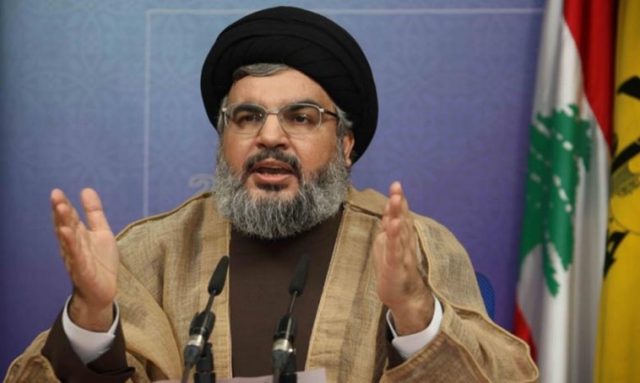
The secretary general of the Lebanese Hezbollah resistance movement says despite the US claims about fighting terrorism, it spared no effort to help Daesh forces in the Syrian town of al-Bukamal.
Sayyed Hassan Nasrallah made the remarks in a televised address to the Lebanese nation in capital city of Beirut on Monday.
Nasrallah noted that recapturing Bukamal was a major victory over Daesh, because Bukamal was the last Syrian city occupied by Daesh.
“The US helped Daesh as much as it could in Bukamal short of directly engaging forces that fought to liberate the town from Daesh,” the Hezbollah leader noted.
Nasrallah went on to note that the US provided Daesh terrorists with full air cover in Bukamal.
The US sent its drones to Bukamal and provided Daesh with accurate information about what was going on, Nasrallah said, adding that American forces also waged electronic warfare against forces that were fighting to liberate Bukamal.
American forces also provided air transfer for Daesh commanders and facilitated their escape to eastern shores of the Euphrates, he said. The Hezbollah leader stated that even Turkey’s President Recep Tayyip Erdogan slammed the US for helping Daesh.
Nasrallah emphasized that recapturing Bukamal led to unity of Syria and ended Daesh’s self-proclaimed state in the country.
Following recent victories in Iraq and Syria, he added, the military structure of Daesh collapsed in the two countries and Iraqi forces have reached the Syrian border.
Hezbollah leader noted that the victory over Daesh was victory of Islamic values over terrorists’ savagery.
Nasrallah also highlighted the role played by Commander of the Islamic Revolution Guards Corps’ Quds Force Major General Qassem Soleimani in anti-terror operations in both Iraq and Syria.
He noted that Soleimani was commanding anti-Daesh operations in the two countries at the frontline and was never a commander to issue orders from behind the lines.
Elsewhere in his remarks, Nasrallah referred to the latest meeting of the Arab League foreign ministers in Cairo, who designated the Lebanese Hezbollah as a terrorist group, saying that this was not the first time that such accusations were leveled against Hezbollah.
Arab League Secretary General Ahmad Aboul Gheit announced at a press conference in the Egyptian capital of Cairo on Sunday that Arab states had agreed to designate Lebanon’s Hezbollah resistance movement a “terrorist organization.”
The Arab League’s extraordinary general meeting on Sunday was held at the request of Saudi Arabia, which has assumed an aggressive stance against Hezbollah for its alleged links to Iran, Riyadh’s powerful rival in the region. Riyadh associates Hezbollah with Iran and has been trying to weaken the resistance movement, which is Lebanon’s de facto deterrent force against Tel Aviv.
In its concluding resolution, the Arab League announced that Arab foreign ministers, excluding those of Lebanon and Iraq, would hold Hezbollah responsible for supporting “terrorist groups” across the region.
Nasrallah said the Arab League statement has labeled Hezbollah’s council, which is part of the Lebanon’s government, as a terrorist outfit, alleging that it provides missiles to terrorist groups in the region.
He added that accusations about Hezbollah sending missiles to regional countries were false and undocumented, emphasizing that the group has never sent any missiles or even light weapons to Kuwait, Yemen, Iraq or Bahrain or any other country in the region.
The leader of Hezbollah went on to say that the Arab League has warned Lebanon that if Hezbollah is not disarmed, security of the country would be in jeopardy.
Hezbollah rejected the accusation, noting that the main threat to security of Lebanon was the Zionist regime of Israel.
He added that the resistance front’s weapons were the main factor restoring security and stability to Lebanon, because they were used for defensive purposes in the face of the Israeli aggression.
Nasrallah emphasized that Hezbollah’s weapons were used only against terrorist groups such as Daesh and posed no threat to security of Lebanon.
A United Nations Security Council-appointed panel says it has seen no evidence to support Saudi Arabia’s claims that missiles have been transferred to Yemen’s Houthis by external sources.
Nasrallah stated that the main reason behind the recent Arab League meeting was not to discuss the issue of Palestine or other problems facing the Islamic world, but its main reason was the recent missile attack against a Saudi airport near the country’s capital, Riyadh.
Refusing Saudi Arabia and Arab League claims that the missile was provided to Yemeni Ansarullah fighters by Iran or the Lebanese Hezbollah, Nasrallah said Iran or Hezbollah had not sent any missiles to Yemen and Yemeni forces made their own missiles in the country.
He categorically rejected Arab League’s claims in this regard, noting that Saudi Arabia and its allies must admit that they have been defeated by Yemeni forces in their war of aggression against the country.
Nasrallah emphasized that Arab countries must put an immediate end to their support for terror groups, and do not fill the Middle East region with such outfits.
He reiterated that no member of Hezbollah was involved in the November 5 Yemeni missile strike against King Khalid International Airport of Riyadh.
The Hezbollah leader then took the Arab League to task for failing to address Saudi Arabia’s devastating aerial bombardment of the “Arab country of Yemen,” saying, “Saudi Arabia is bombing Yemeni people day and night.”
Strongly denouncing the Riyadh regime over perpetrating outrageous atrocities against millions of “Arab Muslims” in Yemen, Nasrallah lashed out at the Arab world’s “deafening silence” over the grim situation in Yemen.
“The turmoil we are witnessing in the Arab world is a cover for the announcement of normalization of relations with Israel,” he commented.
Nasrallah then called on Arabs to do their best to maintain their national unity in the face of all divisive efforts.
The Hezbollah secretary general also praised Lebanese officials and politicians for their firm stance regarding Prime Minister Saad Hariri’s shock resignation, calling on him to return to Lebanon as soon as possible.
November 20, 2017
Posted by aletho |
Ethnic Cleansing, Racism, Zionism, Timeless or most popular, Wars for Israel | Hezbollah, Lebanon, Middle East, Saudi Arabia, Yemen, Zionism |
Leave a comment
Members of the Arab League have met in Cairo at the behest of the Saudi regime, to discuss the supposed “threat of Iran”. The meeting featured all the crude, undiplomatic and nonfactual language about Iran that one has come to expect from American, Israeli and Saudi Arabian spokesmen.
Highlights from the meeting included a statement from the Saudi Foreign Minister Adel al-Jubeir who stated,
“We will not stand idly by in the face of Iran’s aggression….Showing leniency toward Iran will not leave any Arab capital safe from those ballistic missiles….
Iran created agents in the region, such as the Houthi and Hezbollah militias, in total disregard for all international principles”.
These meritless statements are almost identical to that which is frequently said by the US White House and Tel Aviv. In this sense, there was nothing novel about the meeting. What was remarkable was how hastily the meeting was organised as if to demonstrate Saudi’s commitment to its “clear and present danger” narrative about Iran.
Furthermore, a statement was released at the Arab League meeting, saying that there are no immediate plans to go to war with Iran but that at the same time, such plans have not been ruled out.
To quickly sum-up just how ridiculous the statements made during the Arab League meeting were
1. Iran’s missile programme is perfectly legal and is not covered by the JCPOA. The UN has said this many times.
2. Iran is currently at war with zero nations while Saudi is at war with Yemen causing one of the largest humanitarian disasters in the 21st century. Saudi Arabia has also been exposed as a major source of terrorist sponsorship, including in Iraq, Syria, Libya and beyond.
3. Iran has come to the legal assistance of Syria and Iraq in fighting terrorists groups including ISIS and al-Qaeda, while Saudi Arabia has known links to ISIS and al-Qaeda.
Of course, for the states with an obscene anti-Iranian agenda, none of this has ever mattered.
What does matter to the rest of the world though is whether the threats from the Arab league, indicated a short and/or medium-term readiness for war against Iran?
The short answer is, they almost certainly do not.
The Arab League today is a shadow of its former self. With the Syrian Arab Republic’s membership suspended, Qatar facing a boycott from proponent members, Iraq having better relations with Iran than most Arab states and Lebanon being deprived of its Prime Minister due to Saudi political meddling, the Arab League is hardly a united body of strong nations. It has declined so much so, that it is increasingly little more than a Saudi and GCC dominated organisation which is used in attempts to gain some form of broader international legitimacy for Riyadh’s often ridiculous foreign policy statements.
However, Riyadh’s ability to unite the Arab world over any matter, let alone an act of war, amounts to little. Syria, Iraq and due to its multi-confessional history, Lebanon, would never go to war against Iran. In fact, the Iraqi armed forces, Syrian Arab Army, Hezbollah and other volunteers from Lebanon would almost certainly fight with Iran, during the course of any Saudi led military action against Tehran.
Qatar, whose armed forces are small as it is, would never join any military ‘crusade’ led by its Saudi opponent and the fact remains that Doha’s slowly expanding relations with Iran have been one of the reasons for the Saudi led boycott of Qatar. Libya can no longer be called a functional state, while further into the Maghreb, Tunisia, Algeria and Morocco are far removed from Iran issue, in spite of their Arab league membership. Saudi’s GCC allies, Kuwait, UAE, Bahrain and to a lesser degree Oman, simply have little to offer in respect of any military coalition.
The biggest question mark which remains, is Egypt. Egypt is the largest country in the Arab world and likewise, boasts the biggest Army in the Arab world.
In order to even approach effectiveness, Egypt would have to join any would be anti-Iranian Arab League coalition. As to whether Egypt would join, one can objectively say that the incentives for not joining, far outweigh those that might compel Egypt to enter into a war pact with Saudi Arabia, against Iran.
Ever since secular rule was restored to Egypt in 2013, after US backed regime change against former President Hosni Mubarak briefly brought the once again illegal Muslim Brotherhood to power, Egypt has been in a position wherein promoting internal stability has been far more important than international outreach. Furthermore, while the Egyptian government is disproportionately dependent on Saudi cash injections in order to stay afloat, Cairo continues to show surprising amounts of foreign policy independence at times.
Egypt recently expressed disapproval of US attempts to extend a UN mandate for investigating “chemical weapons” in Syria. Egypt has further made strong statements in favour of Syria’s territorial unity, backed up by remarks that only a political solution can bring peace to Syria. This language is very similar to that used by Russian diplomats which should come as no surprise, as the foreign ministries of Egypt and Russia have a very good relationship. Furthermore, when it comes to Egypt’s most pressing international issue, that of terrorists in neighbouring Libya, Russia appears far more inclined to support the Cairo backed Libyan National Army than the fledgling Government of National Accord which is supported by the US and EU.
Furthermore, Egypt recently rejected calls from Riyadh to economically sanction the Lebanese party Hezbollah, in a move which shows a clear divergence from Saudi policies on Hezbollah.
While Egypt is compromised by its financial ties to Saudi Arabia, Egypt still seeks to balance out its old Arab Nationalist history as a fiercely independent and anti-imperialist nation with the modern realities of being far less influential than in the days of Nasser and the early days of Sadat.
Furthermore, in spite of its formal diplomatic ties with Israel, Cairo is all too aware that if the situation inside Egypt, especially in respect of the Sinai Peninsula were to become destabilised, Egypt could not afford to have its armed forces in distant Iran. This is especially true as Israel is ready to exploit any instability on Sinai to its own advantage. If anyone thinks that Israel somehow respects Egypt just because diplomatic relations were established, this view is, to put it mildly, delusional. Israel will exploit any country and any situation it can and Egypt is no exception. The same is true of Jordan, the only other country which has formal relations with Tel Aviv. Jordan, like Egypt is far more concerned with its own immediate neighbourhood than with Iran.
In this sense, in spite of whatever financial incentives Saudi might offer Egypt for backing military efforts against Iran, the preponderance of evidence would demonstrate that Egypt would refrain from actively participating.
When asked to consider the position of the Vatican in geo-political affairs, Josef Stalin is thought to have said, “The Pope? How many divisions has he got?”.
In this sense, looking at the disunity in the Arab world, Iran could easily turn to Riyadh and say “how many divisions have you got”? The answer is not enough to seriously challenge Iran, while Iran certainly has enough divisions and enough regional allies to challenge and beat Saudi Arabia and its Persian Gulf allies.
Then there is the matter of Israel, the US and Turkey.
When it comes to antagonising regional powers that Tel Aviv doesn’t like, the Israeli regime’s military is all too happy to conduct strikes and even occupy territory. Israel occupied party of Egypt between 1967 and 1982 and part of Lebanon between 1982 and 2006. Israel continues to occupy Syria and military strikes from Israel against Syria have happened on and off for the last several decades.
Likewise, Israel attacked Iraq in 1981 in a short airstrike against a French built Iraqi nuclear reactor.
All of these actions have been illegal and Tel Aviv simply doesn’t care. Why should they care about Iran in this case? The answer is because Iran today is far more powerful than any of the aforementioned countries that Israel attacked and it also has many regional allies stretching from Iran itself to the borders of Israeli regime controlled territory.
Israel has not attacked Iran in the way it has so frivolously attacked parts of the Arab world. Israel has not done this because Tel Aviv knows Iran would strike back and so too would Iran’s allies in southern Lebanon. Furthermore, with Turkey becoming ever more distant with NATO, the west and Israel, all the while growing ever closer to its Eurasian partners, including neighbouring Iran, there is no guarantee that Turkey would remain neutral in such a conflict.
Turkey does not want any instability on its border with Iran. This is one of the reasons that both countries cooperated in the building of an anti-terrorist rampart on their borders. Turkey knows that any further regional instability would only hurt Turkey’s short term security prospects and its long term financial prospects. If Turkey even gave air support to Iran, the entire conflict would be ‘game over’ for the anti-Iranian powers, unless Israel decided to use its nuclear weapons.
As Hezbollah leader Sayyed Hassan Nasrallah recently stated, Israel prefers short blitzkrieg style conflicts that it can win rapidly at little material cost or bloodshed from its own side. History has shown such an analysis to be absolutely correct. Furthermore, as Israel’s last attempt to conduct such a war against Lebanon in 2006 failed, Israel has reverted to measures which from its perspective are more realistically “productive” such as short, illegal airstrikes against Syria and military manoeuvres intended as provocations against Lebanon.
Any war with Iran would be much more difficult for Israel to conduct. In many ways it would be impossible, short of Tel Aviv using its nuclear weapons in what Israel watchers know to be called the “Samson Option”.
Such extreme measures would likely be opposed even by the United States. While the Trump administration continues to turn up the volume on anti-Iranian rhetoric, many more level headed individuals in the Pentagon and State Department are totally opposed to war on Iran. These people know that the cost of such a war would be incredibly high and that the US might ultimately lose.
In this sense, with Israel too afraid to attack Iran and while still too restrained by the US to go nuclear, with the Pentagon generally opposed to direct military action against Iran and with Saudi Arabia incapable of pulling together a genuine Arab coalition capable of fighting against Iran, there is little chance that any nation short of one on a suicide mission, would attempt to declare war on Iran.
Much like any war on North Korea, a war on Iran would bring unparalleled destruction to the entire region, and no invading party’s victory would be assured. In other-words, Iran has more or less checkmated the situation, largely in its favour and all without firing a shot, while if anything gaining rather than losing allies.
The Arab League, Israel and the US can certainly blow smoke, but when it comes to attacking Iran directly, even these countries are not quite foolish enough to start that fire.
November 20, 2017
Posted by aletho |
Ethnic Cleansing, Racism, Zionism, Wars for Israel | Hezbollah, Iran, Israel, Middle East, Saudi Arabia, Zionism |
Leave a comment
The spokesman of Iran’s Foreign Ministry has described as “worthless” the closing statement of the latest Arab League foreign ministers’ meeting in Cairo, emphasizing that the statement was “full of lies and distortions.”
“In line with the policies of the Zionist regime [of Israel] to intensify differences in the region and to divert [the attention of] Muslim nations and states away from the continued occupation of Palestine as the main issue of the Islamic Ummah, Saudi Arabia has succeeded through pressure as well as extensive political and propagandistic hue and cry to have a statement that is full of lies and distortions be issued in the name of foreign ministers of the Arab League,” Bahram Qassemi said on Monday.
On Sunday, the Arab League foreign ministers held an extraordinary general meeting in the Egyptian capital at the request of Saudi Arabia. At the end of the meeting, the participants issued a statement accusing Iran of interfering in the internal affairs of the countries in the region and pursuing aggressive policies against Arab states.
Qassemi dismissed the resolution as “worthless” and urged Saudi Arabia to “immediately end its savage aggression” against the Yemeni Arab people so that the Yemeni civilians, particularly women and children, would no longer be affected by the “flames of their spite.”
Iran also calls on Saudi Arabia to stop its policy of exerting pressure on Lebanon, Qatar and the entire Middle East and allow the Bahraini people to find a peaceful solution to the current crisis in the country by removing its forces there, he said.
Qassemi said Iran’s policy was to boost good relations with regional countries, adding that the Islamic Republic had made great efforts to counter terrorism and help resolve regional crises by actively participating in several rounds of peace talks in the Kazakh capital city of Astana on the Syrian conflict and presenting a peace plan for Yemen.
The Iranian spokesperson emphasized that the solution to the regional problems was not to issue such worthless statements but to stop following the policies of the Israeli regime, put an end to bullying and terrorism and accept the demands of regional nations and states.
Saudi policies root cause of regional, world instability: Deputy FM
Meanwhile, Iranian Deputy Foreign Minister for Arab and African Affairs Hossein Jaberi Ansari also on Monday criticized the Arab League statement and said Saudi Arabia’s policies were the root cause of insecurity and instability in the region and the world.
“Saudi Arabia must stop pursuing the Zionist regime’s policies through causing escalation of differences and conflicts in the region and providing extensive support for terrorism and extremism,” Jaberi Ansari added.
He emphasized that regional crises would never be resolved through making false claims, distorting evident realities and publishing statements under the pressure of Saudi Arabia.
The Iranian official urged Riyadh to end its interference in and pressure on Qatar, Lebanon, Iraq and Syria as well as the use of terrorism and extremism as a means.
The Saudi-drafted Arab League’s statement came on the same day that Israeli Energy Minister Yuval Steinitz for the first time revealed that Tel Aviv had covert contacts with Saudi Arabia.
“We have ties that are indeed partly covert with many Muslim and Arab countries and usually [we are] the party that is not ashamed,” Steinitz said in an interview on Army Radio on Sunday.
He added that Saudi Arabia was the side that was interested in hiding its ties with Israel and Tel Aviv had no problem with this.
November 20, 2017
Posted by aletho |
Ethnic Cleansing, Racism, Zionism, Mainstream Media, Warmongering, Timeless or most popular, Wars for Israel | Bahrain, Iran, Iraq, Israel, Lebanon, Middle East, Qatar, Saudi Arabia, Syria, Yemen, Zionism |
Leave a comment
The Lebanese government and Palestinian resistance forces have strongly condemned a decision by the Arab League to designate the Hezbollah resistance movement as a terrorist organization.
Lebanon’s Foreign Minister Gebran Bassil said in a statement that he had refused to list Hezbollah as a terror group as it was a “fundamental component of the Lebanese state.”
Arab League Secretary-General Ahmad Aboul Gheit announced at a media conference in Cairo on Sunday that Arab states agreed to designate Hezbollah a terrorist organization, adding that he would not “rule out going to the United Nations Security Council as a next step.”
Lebanon’s representative to the Arab League, Antoine Azzam, rejected the statement, saying Hezbollah represents a large part of the Lebanese people. He said the resistance group has representatives in the Lebanese parliament.
Lebanon abstained from Sunday’s communiqué that labeled Hezbollah as a terror group. Iraq also expressed reservations about the designation.
The details of the resolution were not made public. However, media reports said the only concrete measure from the meeting was for Arab telecommunications satellites to ban Iranian-financed stations for allegedly posing a threat to Arab security.
Palestinian resistance groups also denounced the Arab League’s decision, saying it serves the interests of Israel and the US and aims to satisfy the Saudi regime.
The alliance of the Palestinian resistance forces described the decision as “dangerous”, stressing that “Hezbollah represents the most important resistance force against Israel and terrorism.”
The decision was issued during an emergency Arab League summit, which Saudi Arabia called to discuss “confronting” Iran and Hezbollah.
Riyadh associates Hezbollah with Iran, and has been trying to weaken the resistance movement which is Lebanon’s de facto deterrent force against any Israeli aggression.
Hezbollah, both a military force and a political movement, is part of a Lebanese government made up of rival factions.
The Saudi request for the Arab League meeting “was based on a missile it says its air defenses intercepted near Riyadh after being fired from Yemen on November 4,” according to a document seen by AFP last week.
Saudi Arabia has claimed that the missile had been manufactured in Iran but Tehran has vehemently rejected the allegation.
November 20, 2017
Posted by aletho |
Ethnic Cleansing, Racism, Zionism, Mainstream Media, Warmongering, Wars for Israel | Hezbollah, Lebanon, Saudi Arabia, Zionism |
Leave a comment
Saudi Arabia has called a meeting of Arab foreign ministers in Cairo to discuss “Iran’s disruptive politics” in the region. This comes after the rather flimsy resignation of Lebanese Prime Minister Saad Hariri, who announced that he was stepping down when he was in Riyadh, not Beirut. What’s more, Yemeni officials have told Associated Press that Saudi Arabia has blocked Yemen’s President Abdrabbuh Mansur Hadi, his sons, ministers and military officials, from going home for months now. Enmity between Hadi and the United Arab Emirates has been widely reported; the restrictions placed on his movements are believed to have much to do with this.
Such actions — calling a meeting of such significance in a foreign country; “forcing” the resignation of a Prime Minister of a sovereign state whilst he is in your country; and preventing an internationally-recognised President of Yemen and his entourage from leaving your country — all reflect the new politics within Saudi Arabia.
When Hariri resigned two weeks ago, Lebanon’s opposition Hezbollah immediately claimed that he had been coerced into the move by Saudi Arabia. These claims were repeated by a number of social and political stakeholders in Lebanon, including Hariri’s own party, the Future Movement. The President of Lebanon, Michel Aoun, refused to accept Hariri’s resignation.
However, Hariri has repudiated claims that he was detained and held against his will by the Saudis. He has issued statements undertaking to return to Lebanon soon, and has just held talks in Paris with the French President, Emmanuel Macron.
Hariri’s resignation coincided with the detention by the Saudis of dozens of prominent figures, including princes, politicians and businessmen, on corruption charges. The arrests extended across borders, with Saudi-Ethiopian business tycoon Mohammed Al-Amoudi among those held.
Businessman Hariri’s company, Saudi Oger, has been in financial difficulties for months. In 2016 it failed to pay thousands of its employees in the Kingdom and left bills worth millions of dollars unpaid as it teetered on the verge of bankruptcy. The Saudi Arabian government eventually intervened as the company’s plight worsened, in order to avoid diplomatic embarrassment. According to the Hindustan Times in August 2016, the Saudi ambassador in New Delhi promised that “all workers affected by the Saudi Oger affair would be fed, have papers arranged and would be flown back to India, if required, at the expense of the Saudi government.” The company’s financial woes resulted in Hariri becoming a client of the government in Riyadh, to whom he allegedly owes billions of dollars. As he holds dual Lebanese-Saudi citizenship, many observers doubt if Hariri will escape an indictment for corruption: “His wealth qualifies him for indictment like all of the others who are currently detained.”
Saad Hariri is perhaps the most valuable “detainee” as far as the Saudis, and perhaps the Israelis, are concerned. His accusation that Hezbollah and Iran are trying to destabilise Lebanon is a key factor when trying to understand the current political fiasco, for it is a pretext for yet another war in Lebanon. This would serve Israel as it seeks to push back Hezbollah’s political gains and accumulated infrastructure in its northern neighbour. Hezbollah has been gaining ground and entrenching itself as the most organised political movement in Lebanon. While Israel understands that it will never completely wipe it out, it could at least weaken it.
The secret visit of US President Donald Trump’s son-in-law and chief Middle East adviser Jared Kushner to Saudi Arabia last month was no coincidence. Furthermore, the confirmation by an Israeli official that Saudi Crown Prince Mohammad Bin Salman has secretly visited Tel Aviv adds credence to speculation that the plans to destabilise Lebanon were carefully vetted and agreed by the USA and Israel.
Any plan to attack Hezbollah couldn’t be realised without the involvement of Hariri; his claims about the movement and Iran provide a perfect pretext for an attack. Saudi Arabia, though, underestimated the political astuteness of Hezbollah’s leader, Hassan Nasrallah. In his carefully crafted speeches, Nasrallah has called for Lebanese unity and avoided divisive rhetoric. In short, “he became a leader for all.” Indeed, his speeches prompted similar pronouncement by the leaders of Hariri’s Future Movement, placing the blame on Saudi Arabia.
Moreover, Saudi Arabia and its allies overestimated the schism and enmity between Sunni and Shia Muslims in Lebanon. The Saudi claim about being the “custodian of Sunni Islam” received a massive blow when Lebanese Sunnis declared loud and clear, “You do not represent us.” Another factor was also overlooked; the people of Lebanon of all backgrounds are simply war fatigued; they refuse to be willing pawns in Saudi Arabia’s egotistical game. The flimsiness of Riyadh in this political stalemate gives the advantage to Iran.
This has been a bad week for Saudi Arabia. It is failing to win over public opinion about its war in Yemen, which is attracting a barrage of criticism. The mass detention of prominent Saudi citizens has been denounced as a witch-hunt, and Riyadh is also fending-off criticism of its political, social and economic blockade of the State of Qatar and the consequent crisis in the Gulf.
If Saad Hariri withdraws his resignation and returns to Lebanon, he will be weaker but more determined than ever to serve Saudi Arabia. Should he decide to stick by his resignation and leave the government in Beirut, he might pave the way for his brother Bahaa, a strong Saudi ally, to take over the leadership of the Future Movement. This, though, might be thwarted by the rise of Ashraf Rifi, a Sunni politician who resigned as Justice Minister and has since challenged Hariri’s political dominance in Sunni politics in Lebanon. This chaos hasn’t run its course yet, by any means.
November 20, 2017
Posted by aletho |
Ethnic Cleansing, Racism, Zionism, Timeless or most popular, Wars for Israel | Hezbollah, Lebanon, Middle East, Saudi Arabia |
Leave a comment
In September 2007, Israeli warplanes bombed a building in eastern Syria that the Israelis claimed held a covert nuclear reactor that had been built with North Korean assistance. Seven months later, the CIA released an extraordinary 11-minute video and mounted press and Congressional briefings that supported that claim.
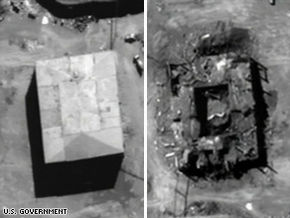
Supposed Syrian nuclear site before and after Israeli airstrike
But nothing about that alleged reactor in the Syrian desert turns out to be what it appeared at the time. The evidence now available shows that there was no such nuclear reactor, and that the Israelis had misled George W. Bush’s administration into believing that it was in order to draw the United States into bombing missile storage sites in Syria. Other evidence now suggests, moreover, that the Syrian government had led the Israelis to believe wrongly that it was a key storage site for Hezbollah missiles and rockets.
The International Atomic Agency’s top specialist on North Korean reactors, Egyptian national Yousry Abushady, warned top IAEA officials in 2008 that the published CIA claims about the alleged reactor in the Syrian desert could not possibly have been true. In a series of interviews in Vienna and by phone and e-mail exchanges over several months Abushady detailed the technical evidence that led him to issue that warning and to be even more confident about that judgment later on. And a retired nuclear engineer and research scientist with many years of experience at Oak Ridge National Laboratory has confirmed a crucial element of that technical evidence.
Published revelations by senior Bush administration officials show, moreover, that principal U.S. figures in the story all had their own political motives for supporting the Israeli claim of a Syrian reactor being built with North Korean help.
Vice President Dick Cheney hoped to use the alleged reactor to get President George W. Bush to initiate U.S. airstrikes in Syria in the hope of shaking the Syrian-Iranian alliance. And both Cheney and then CIA Director Michael Hayden also hoped to use the story of a North Korean-built nuclear reactor in Syria to kill a deal that Secretary of State Condoleezza Rice was negotiating with North Korea on its nuclear weapons program in 2007-08.
Mossad Chief’s Dramatic Evidence
In April 2007 the chief of Israel’s Mossad foreign intelligence agency, Meir Dagan, presented Cheney, Hayden and National Security Adviser Steven Hadley with evidence of what he said was a nuclear reactor being constructed in eastern Syria with the help of the North Koreans. Dagan showed them nearly a hundred hand-held photographs of the site revealing what he described as the preparation for the installation of a North Korean reactor and claimed that it was only a few months from being operational.
The Israelis made no secret of their desire to have a U.S. airstrike destroy the alleged nuclear facility. Prime Minister Ehud Olmert called President Bush immediately after that briefing and said, “George, I’m asking you to bomb the compound,” according to the account in Bush’s memoirs.
Cheney, who was known to be a personal friend of Olmert, wanted to go further. At White House meetings in subsequent weeks, Cheney argued forcefully for a U.S. attack not only on the purported reactor building but on Hezbollah weapons storage depots in Syria. Then-Secretary of Defense Robert Gates, who participated in those meetings, recalled in his own memoirs that Cheney, who was also looking for an opportunity to provoke a war with Iran, hoped to “rattle Assad sufficiently so as to end his close relationship with Iran” and “send a powerful warning to the Iranians to abandon their nuclear ambitions.”
CIA Director Hayden aligned the agency clearly with Cheney on the issue, not because of Syria or Iran but because of North Korea. In his book, Playing to the Edge, published last year, Hayden recalls that, at a White House meeting to brief President Bush the day after Dagan’s visit, he whispered in Cheney’s ear, “You were right, Mr. Vice-President.”
Hayden was referring to the fierce political struggle within the Bush administration over North Korea policy that had been underway ever since Condoleezza Rice had become Secretary of State in early 2005. Rice had argued that diplomacy was the only realistic way to get Pyongyang to retreat from its nuclear weapons program. But Cheney and his administration allies John Bolton and Robert Joseph (who succeeded Bolton as the key State Department policymaker on North Korea after Bolton became U.N. Ambassador in 2005) were determined to end the diplomatic engagement with Pyongyang.
Cheney was still maneuvering to find a way to prevent the successful completion of the negotiations, and he saw the story of a Syrian nuclear reactor built secretly in the desert with help from the North Koreans as bolstering his case. Cheney reveals in his own memoirs that in January 2008, he sought to sandbag Rice’s North Korea nuclear deal by getting her to agree that a failure by North Korea to “admit they’ve proliferating to the Syrians would be a deal killer.”
Three months later, the CIA released its unprecedented 11-minute video supporting the entire Israeli case for a North-Korean-style nuclear reactor that was nearly completed. Hayden recalls that his decision to release the video on the alleged Syrian nuclear reactor in April 2008 was “to avoid a North Korean nuclear deal being sold to a Congress and a public ignorant of this very pertinent and very recent episode.”
The video, complete with computer reconstructions of the building and photographs from the Israelis made a big splash in the news media. But one specialist on nuclear reactors who examined the video closely found abundant reason to conclude that the CIA’s case was not based on real evidence.
Technical Evidence against a Reactor
Egyptian national Yousry Abushady was a PhD in nuclear engineering and 23-year veteran of the IAEA who had been promoted to section head for Western Europe in the operations division of agency’s Safeguards Department, meaning that he was in charge of all inspections of nuclear facilities in the region. He had been a trusted adviser to Bruno Pellaud, IAEA Deputy Director General for Safeguards from 1993 to 1999, who told this writer in an interview that he had “relied on Abushady frequently.”
Abushady recalled in an interview that, after spending many hours reviewing the video released by the CIA in April 2008 frame by frame, he was certain that the CIA case for a nuclear reactor at al-Kibar in the desert in eastern Syria was not plausible for multiple technical reasons. The Israelis and the CIA had claimed the alleged reactor was modeled on the type of reactor the North Koreans had installed at Yongbyon called a gas-cooled graphite-moderated (GCGM) reactor.
But Abushady knew that kind of reactor better than anyone else at the IAEA. He had designed a GCGM reactor for his doctoral student in nuclear engineering, had begun evaluating the Yongbyon reactor in 1993, and from 1999 to 2003 had headed the Safeguards Department unit responsible for North Korea.
Abushady had traveled to North Korea 15 times and conducted extensive technical discussions with the North Korean nuclear engineers who had designed and operated the Yongbyon reactor. And the evidence he saw in the video convinced him that no such reactor could have been under construction at al-Kibar.
On April 26, 2008, Abushady sent a “preliminary technical assessment” of the video to IAEA Deputy Director General for Safeguards Olli Heinonen, with a copy to Director General Mohamed ElBaradei. Abushady observed in his memorandum that the person responsible for assembling the CIA video was obviously unfamiliar with either the North Korean reactor or with GCGM reactors in general.
The first thing that struck Abushady about the CIA’s claims was that the building was too short to hold a reactor like the one in Yongbyon, North Korea.
“It is obvious,” he wrote in his “technical assessment” memo to Heinonen, “that the Syrian building with no UG [underground] construction, can not hold a [reactor] similar [to] NK GCR [North Korean gas-cooled reactor].”
Abushady estimated the height of the North Korean reactor building in Yongbyon at a 50 meters (165 feet) and estimated that the building at al-Kibar at a little more than a third as tall.
Abushady also found the observable characteristics of the al-Kibar site inconsistent with the most basic technical requirements for a GCGM reactor. He pointed out that the Yongbyon reactor had no less than 20 supporting buildings on the site, whereas the satellite imagery shows that the Syrian site did not have a single significant supporting structure.
The most telling indication of all for Abushady that the building could not have been a GCGM reactor was the absence of a cooling tower to reduce the temperature of the carbon dioxide gas coolant in such a reactor.
“How can you work a gas-cooled reactor in a desert without a cooling tower?” Abushady asked in an interview.
IAEA Deputy Director Heinonen claimed in an IAEA report that the site had sufficient pumping power to get river water from a pump house on the nearby Euphrates River to the site. But Abushady recalls asking Heinonen, “How could this water be transferred for about 1,000 meters and continue to the heat exchangers for cooling with the same power?”
Robert Kelley, a former head of the U.S. Department of Energy’s Remote Sensing Laboratory and former senior IAEA inspector in Iraq, noticed another fundamental problem with Heinonen’s claim: the site had no facility for treating the river water before it reached the alleged reactor building.
“That river water would have been carrying debris and silt into the reactor heat exchangers,” Kelley said in an interview, making it highly questionable that a reactor could have operated there.
Yet another critical piece that Abushady found missing from the site was a cooling pond facility for spent fuel. The CIA had theorized that the reactor building itself contained a “spent fuel pond,” based on nothing more than an ambiguous shape in an aerial photograph of the bombed building.
But the North Korean reactor at Yongbyon and all 28 other GCGM reactors that had been built in the world all have the spent fuel pond in a separate building, Abushady said. The reason, he explained, was that the magnox cladding surrounding the fuel rods would react to any contact with moisture to produce hydrogen that could explode.
But the definitive and irrefutable proof that no GCGM reactor had been present at al-Kibar came from the environmental samples taken by the IAEA at the site in June 2008. Such a reactor would have contained nuclear-grade graphite, Abushady explained, and if the Israelis had actually bombed a GCGM reactor, it would have spread particles of nuclear-grade graphite all over the site.
Behrad Nakhai, a nuclear engineer at Oak Ridge National Laboratory for many years, confirmed Abshuady’s observation in an interview. “You would have had hundreds of tons of nuclear-grade graphite scattered around the site,” he said, “and it would have been impossible to clean it up.”
IAEA reports remained silent for more than two years about what the samples showed about nuclear-grade graphite, then claimed in a May 2011 report that the graphite particles were “too small to permit an analysis of the purity compared to that normally required for use in a reactor.” But given the tools available to laboratories, the IAEA claim that they couldn’t determine whether the particles were nuclear grade or not “doesn’t make sense,” Nakhai said.
Hayden acknowledged in his 2016 account that “key components” of a nuclear reactor site for nuclear weapons were “still missing.” The CIA had tried to find evidence of a reprocessing facility in Syria that could be used to obtain the plutonium for a nuclear bomb but had been unable to find any trace of one.
The CIA also had found no evidence of a fuel fabrication facility, without which a reactor could not have gotten the fuel rods to be reprocessed. Syria could not have gotten them from North Korea, because the fuel fabrication plant at Yongbyon had produced no fuel rods since 1994 and was known to have fallen into serious disrepair after the regime had agreed to scrap its own plutonium reactor program.
Manipulated and Misleading Photographs
Hayden’s account shows that he was ready to give the CIA’s stamp of approval to the Israeli photographs even before the agency’s analysts had even begun analyzing them. He admits that when he met Dagan face-to-face he didn’t ask how and when Mossad had obtained the photographs, citing “espionage protocol” among cooperating intelligence partners. Such a protocol would hardly apply, however, to a government sharing intelligence in order to get the United States to carry out an act of war on its behalf.
The CIA video relied heavily on the photographs that Mossad had given to Bush administration in making its case. Hayden writes that it was “pretty convincing stuff, if we could be confident that the pictures hadn’t been altered.”
But by his own account Hayden knew Mossad had engaged in at least one deception. He writes that when CIA experts reviewed the photographs from Mossad, they found that one of them had been photo-shopped to remove the writing on the side of a truck.
Hayden professes to have had no concern about that photo-shopped picture. But after this writer asked how CIA analysts interpreted Mossad’s photo shopping of the picture as one of the questions his staff requested in advance of a possible interview with Hayden, he declined the interview.
Abushady points out that the main issues with the photographs the CIA released publicly are whether they were actually taken at the al-Kibar site and whether they were consistent with a GCGM reactor. One of the photographs showed what the CIA video called “the steel liner for the reinforced-concrete reactor vessel before it was installed.” Abushady noticed immediately, however, that nothing in the picture links the steel liner to the al-Kibar site.
Both the video and CIA’s press briefing explained that the network of small pipes on the outside of the structure was for “cooling water to protect the concrete against the reactor’s intense heat and radiation.”
But Abushady, who specializes in such technology, pointed out that the structure in the picture bore no resemblance to a Gas-Cooled Reactor vessel. “This vessel cannot be for a Gas-Cooled Reactor,” Abushady explained, “based on its dimensions, it thickness and the pipes shown on the side of the vessel.”
The CIA video’s explanation that the network of pipes was necessary for “cooling water” made no sense, Abushady said, because gas-cooled reactors use only carbon dioxide gas — not water — as a coolant. Any contact between water and the Magnox-cladding used in that type of reactor, Abushady explained, could cause an explosion.
A second Mossad photograph showed what the CIA said were the “exit points” for the reactor’s control rods and fuel rods. The CIA juxtaposed that photograph with a photograph of the tops of the control rods and fuel rods of the North Korean reactor at Yongbyon and claimed a “very close resemblance” between the two.
Abushady found major differences between the two pictures, however. The North Korean reactor had a total of 97 ports, but the picture allegedly taken at al-Kibar shows only 52 ports. Abushady was certain that the reactor shown in the photograph could not have been based on the Yongbyon reactor. He also noted that the picture had a pronounced sepia tone, suggesting that it was taken quite a few years earlier.
Abushady warned Heinonen and ElBaradei in his initial assessment that the photo presented as taken from inside the reactor building appeared to an old photo of a small gas-cooled reactor, most likely an early such reactor built in the U.K.
A Double Deception
Many observers have suggested that Syria’s failure to protest the strike in the desert loudly suggests that it was indeed a reactor. Information provided by a former Syrian air force major who defected to an anti-Assad military command in Aleppo and by the head of Syria’s atomic energy program helps unlock the mystery of what was really in the building at al-Kibar.
The Syrian major, “Abu Mohammed,” told The Guardian in February 2013 that he was serving in the air defense station at Deir Azzor, the city nearest to al-Kibar, when he got a phone call from a Brigadier General at the Strategic Air Command in Damascus just after midnight on Sept. 6, 2007. Enemy planes were approaching his area, the general said, but “you are to do nothing.”
The major was confused. He wondered why the Syrian command would want to let Israeli fighter planes approach Deir Azzor unhindered. The only logical reason for such an otherwise inexplicable order would be that, instead of wanting to keep the Israelis away from the building at al-Kibar, the Syrian government actually wanted the Israelis to attack it. In the aftermath of the strike, the Damascus issued only an opaque statement claiming that the Israeli jets had been driven away and remaining silent on the airstrike at al-Kibar.
Abushady told this writer he learned from meetings with Syrian officials during his final year at the IAEA that the Syrian government had indeed originally built the structure at al-Kibar for the storage of missiles as well as for a fixed firing position for them. And he said Ibrahim Othman, the head of Syria’s Atomic Energy Commission, had confirmed that point in a private meeting with him in Vienna in September 2015.
Othman also confirmed Abushady’s suspicion from viewing satellite photographs that the roof over the central room in the building had been made with two movable light plates that could be opened to allow the firing of a missile. And he told Abushady that he had been correct in believing that what had appeared in a satellite image immediately after the bombing to be two semi-circular shapes was what had remained of the original concrete launching silo for missiles.
In the wake of the Israel’s 2006 invasion of Southern Lebanon, the Israelis were searching intensively for Hezbollah missiles and rockets that could reach Israel and they believed many of those Hezbollah weapons were being stored in Syria. If they wished to draw the attention of the Israelis away from actual missile storage sites, the Syrians would have had good reason to want to convince the Israelis that this was one of their major storage sites.
Othman told Abushady that the building had been abandoned in 2002, after the construction had been completed. The Israelis had acquired ground-level pictures from 2001-02 showing the construction of outer walls that would hide the central hall of the building. The Israelis and the CIA both insisted in 2007-08 that this new construction indicated that it had to be a reactor building, but it is equally consistent with a building designed to hide missile storage and a missile-firing position.
Although Mossad went to great lengths to convince the Bush administration that the site was a nuclear reactor, what the Israelis really wanted was for the Bush administration to launch U.S. airstrikes against Hezbollah and Syrian missile storage sites. Senior officials of the Bush administration didn’t buy the Israeli bid to get the United States to do the bombing, but none of them ever raised questions about the Israeli ruse.
So both the Assad regime and the Israeli government appear to have succeeded in carrying out their own parts in a double deception in the Syrian desert.
Gareth Porter is an independent investigative journalist and historian on U.S. national security policy and the recipient of the 2012 Gellhorn Prize for journalism.
November 18, 2017
Posted by aletho |
Deception, Ethnic Cleansing, Racism, Zionism, Fake News, Mainstream Media, Warmongering, Timeless or most popular, Wars for Israel | CIA, Israel, Mossad, North Korea, Syria, Zionism |
Leave a comment
In a historic development, Russian President Vladimir Putin will be hosting his Turkish and Iranian counterparts – Recep Erdogan and Hassan Rouhani – at a trilateral summit on November 22 in Sochi.
Turkey’s Anadolu news agency reported that the meeting, the first of its kind between the three countries, will focus on Syria and the overall situation in the Middle East. Turkish Deputy Prime Minister Bekir Bozdağ said the leaders “will handle Astana [peace talks in the capital of Kazakhstan earlier this year] and the political transition process in Syria. They will make important evaluations.” This comes as an unexpected development but is not surprising. Simply put, the three countries share a profound sense of disquiet over Washington’s regional strategies and sense that an inflection point is being reached.
There has been some abrasive behavior by the US on the regional chessboard over the past week or two. For example, US Defence Secretary James Mattis disclosed on November 13 that his country’s military presence in Syria will continue even after ISIS is defeated. Russia promptly challenged the legitimacy of the US presence under international law. Russia, Turkey and Iran are opposed to a continued US presence in Syria. Turkey is particularly worried that a long-term alliance between the US and the Syrian Kurdish militia will complicate its own problem of Kurdish separatism.
Meanwhile, unnamed US State Department officials have claimed that Russia has assured the US that the Iranian militia and Hezbollah will leave Syria. Moscow then had to issue a denial through Foreign Minister Sergey Lavrov. Linked to this is the Israeli demand that a buffer zone be created in the Golan Heights from which the Iranian militia or Hezbollah be excluded.
The US, meanwhile, has once again raked up the issue of the fate of Syrian President Bashar Al-Assad, insisting that he cannot be part of any transition or elected government. The US has also questioned the raison d’etre of the Astana talks (involving Russia, Turkey and Iran) and insists that the focus should shift back to the Geneva process under UN supervision.
Ironically, it was when the Geneva process began meandering that Russia got Turkey and Iran over to Astana to painstakingly iron out their differences and work out a ceasefire in stages, and thereafter establish de-escalation zones to bring the war to an end.
The US feels excluded from the major achievements made in Astana to end the bloodshed in Syria. However, Washington was always welcome to join the process but chose to abstain. Washington has ruffled Russia’s feathers and Moscow has threatened to expose the US’s alleged covert dealings with ISIS. Unsurprisingly, Russian politicians have threatened to raise the matter at the UN.
Meanwhile, on Tuesday, the Russian Defence Ministry openly alleged that the US military is impeding Russian air attacks on ISIS targets on the Syrian-Iraqi border and is indirectly enabling the terrorists to regroup. The Pentagon called it a Russian “lie.” At any rate, the very next day, six Russian Tupolov long-range bombers flew from bases in Russia via Iranian and Iraqi airspace to vanquish those ISIS targets in a massive air strike.
The US military is maneuvering on the Iraq-Syria border to bring the region under its control so that it will be in a position to create new facts on the ground and block a land route from Iran leading to the Levant.
Notably, the strong alliance with the Kurdish militia gives the US the wherewithal to influence events in Turkey, Iraq, Iran and Syria. Indeed, oil and oil pipelines form an important vector of the geopolitics, too.
The “dogfight under a carpet” in US politics is complicating matters for Moscow. The Russians don’t have an interlocutor in Washington – something they never lacked even in the darkest periods of the Cold War.
Suffice to say, the latest developments in Lebanon have created dark forebodings of a regional war. Unsurprisingly, Russia, Turkey and Iran must be feeling the need to coordinate their efforts to push back at the US.
Both Turkey and Iran estimate that Saudi Crown Prince Mohammed bin Salman’s seemingly irrational behavior has a pattern. They suspect a script was worked out by Israel and the Trump administration with the objective of creating quagmires for Ankara and Tehran.
Earlier this week, Erdogan openly ridiculed the crown prince from an Organisation of Islamic Cooperation (OIC) platform and questioned whether he was qualified to differentiate “moderate Islam” from the extremist form. The simmering discord between the erstwhile Caliph and the Custodian of the Holy Places who succeeded him (on the debris of the Ottoman Empire) surged into view. Equally, Iran can see that the Saudis are encouraging Israel to attack Lebanon. In fact, Rouhani openly spoke about it on Wednesday.
The trilateral summit in Sochi next week is most likely Erdogan’s idea. He traveled to Sochi to meet Putin on Monday en route to Kuwait and Qatar. While in Doha, Erdogan reaffirmed Turkey’s military support to the emir.
Indeed, all this is playing out against the backdrop of the snowballing crises in the US’s bilateral relations with Russia, Turkey and Iran.
November 17, 2017
Posted by aletho |
Illegal Occupation, Wars for Israel | Iran, Middle East, Russia, Syria, Turkiye, United States |
Leave a comment

 Aletho News
