How I Got Fired
Exposing Jewish power in America has real consequences

By Philip Giraldi • Unz Review • October 3, 2017
Two weeks ago, I wrote for Unz.com an article entitled “America’s Jews Are Driving America’s Wars.” It sought to make several points concerning the consequences of Jewish political power vis-à-vis some aspects of U.S. foreign policy. It noted that some individual American Jews and organizations with close ties to Israel, whom I named and identified, are greatly disproportionately represented in the government, media, foundations, think tanks and lobbying that is part and parcel of the deliberations that lead to formulation of U.S. foreign policy in the Middle East. Inevitably, those policies are skewed to represent Israeli interests and do serious damage to genuine American equities in the region. This tilt should not necessarily surprise anyone who has been paying attention and was noted by Nathan Glazer, among others, as long ago as 1976.
The end result of Israel centric policymaking in Washington is to produce negotiators like Dennis Ross, who consistently supported Israeli positions in peace talks, so much so that he was referred to as “Israel’s lawyer.” It also can result in wars, which is of particular concern given the current level of hostility being generated by these same individuals and organizations relating to Iran. This group of Israel advocates is as responsible as any other body in the United States for the deaths of thousands of Americans and literally millions of mostly Muslim foreigners in unnecessary wars in Afghanistan, Iraq, Libya and Syria. It has also turned the U.S. into an active accomplice in the brutal suppression of the Palestinians. That they have never expressed any remorse or regret and the fact that the deaths and suffering don’t seem to matter to them are clear indictments of the sheer inhumanity of the positions they embrace.
The claims that America’s Middle Eastern wars have been fought for Israel are not an anti-Semitic delusion. Some observers, including former high government official Philip Zelikow, believe that Iraq was attacked by the U.S. in 2003 to protect Israel. On April 3rd, just as the war was starting, the Israeli newspaper Haaretz headlined “The war in Iraq was conceived by 25 neoconservative intellectuals, most of them Jewish, who are pushing President Bush to change the course of history.” It then went on to describe how “In the course of the past year, a new belief has emerged in [Washington]: the belief in war against Iraq. That ardent faith was disseminated by a small group of 25 or 30 neoconservatives, almost all of them Jewish, almost all of them intellectuals (a partial list: Richard Perle, Paul Wolfowitz, Douglas Feith, William Kristol, Eliot Abrams, Charles Krauthammer), people who are mutual friends and cultivate one another.”
And the deference to a Jewish proprietary interest in Middle Eastern policy produces U.S. Ambassadors to Israel who are more comfortable explaining Israeli positions than in supporting American interests. David Friedman, the current Ambassador, spoke last week defending illegal Israeli settlements, which are contrary to official U.S. policy, arguing that they represented only 2% of the West Bank. He did not mention that the land controlled by Israel, to include a security zone, actually represents 60% of the total area.
My suggestion for countering the over-representation of a special interest in policy formulation was to avoid putting Jewish government officials in that position by, insofar as possible, not giving them assignments relating to policy in the Middle East. As I noted in my article, that was, in fact, the norm regarding Ambassadors and senior foreign service assignments to Israel prior to 1995, when Bill Clinton broke precedent by appointing Australian citizen Martin Indyk to the position. I think, on balance, it is eminently sensible to avoid putting people in jobs where they will likely have conflicts of interest.
Another solution that I suggested for American Jews who are strongly attached to Israel and find themselves in a position that considers policy for that country and its neighbors would be to recuse themselves from the deliberations, just as a judge who finds himself personally involved in a judicial proceeding might withdraw. It would seem to me that, depending on the official’s actual relationship with Israel, it would be a clear conflict of interest to do otherwise.
The argument that such an individual could protect American interests while also having a high level of concern for a foreign nation with contrary interests is at best questionable. As George Washington observed in his farewell address,
“… a passionate attachment of one nation for another produces a variety of evils. Sympathy for the favorite nation, facilitating the illusion of an imaginary common interest in cases where no real common interest exists, and infusing into one the enmities of the other, betrays the former into a participation in the quarrels and wars of the latter without adequate inducement or justification…”
My article proved to be quite popular, particularly after former CIA officer Valerie Plame tweeted her approval of it and was viciously and repeatedly attacked, resulting in a string of abject apologies on her part. As a reasonably well-known public figure, Plame attracted a torrent of negative press, in which I, as the author of the piece being tweeted, was also identified and excoriated. In every corner of the mainstream media I was called “a well-known anti-Semite,” “a long time anti-Israel fanatic,” and, ironically, “a somewhat obscure character.”
The widespread criticism actually proved to be excellent in terms of generating real interest in my article. Many people apparently wanted to read it even though some of the attacks against me and Plame deliberately did not provide a link to it to discourage such activity. As of this writing, it has been opened and viewed 130,000 times and commented on 1,250 times. Most of the comments were favorable. Some of my older pieces, including The Dancing Israelis and Why I Still Dislike Israel have also found a new and significant readership as a result of the furor.
One of the implications of my original article was that Jewish advocacy groups in the United States are disproportionately powerful, capable of using easy access to the media and to compliant politicians to shape policies that are driven by tribal considerations and not necessarily by the interests of most of the American people. Professors John Mearsheimer of the University of Chicago and Stephen Walt of Harvard, in their groundbreaking book “The Israel Lobby”, observed how the billions of dollars given to Israel annually “cannot be fully explained on either strategic or moral grounds… [and] is due largely to the activities of the Israel lobby—a loose coalition of individuals and organizations who openly work to push U.S. foreign policy in a pro-Israel direction.”
Those same powerful interests are systematically protected from criticism or reprisal by constantly renewed claims of historic and seemingly perpetual victimhood. But within the Jewish community and media, that same Jewish power is frequently exalted. It manifests itself in boasting about the many Jews who have obtained high office or who have achieved notoriety in the professions and in business. In a recent speech, Harvard Law School Professor Alan Dershowitz put it this way, “People say Jews are too powerful, too strong, too rich, we control the media, we’ve too much this, too much that and we often apologetically deny our strength and our power. Don’t do that! We have earned the right to influence public debate, we have earned the right to be heard, we have contributed disproportionately to success of this country.” He has also discussed punishing critics of Israel, “Anyone that does [that] has to be treated with economic consequences. We have to hit them in the pocketbook. Don’t ever, ever be embarrassed about using Jewish power. Jewish power, whether it be intellectual, academic, economic, political– in the interest of justice is the right thing to do.”
My article, in fact, began with an explanation of that one aspect of Jewish power, its ability to promote Israeli interests freely and even openly while simultaneously silencing critics. I described how any individual or “any organization that aspires to be heard on foreign policy knows that to touch the live wire of Israel and American Jews guarantees a quick trip to obscurity. Jewish groups and deep pocket individual donors not only control the politicians, they own and run the media and entertainment industries, meaning that no one will hear about or from the offending party ever again.”
With that in mind, I should have expected that there would be a move made to “silence” me. It came three days after my article appeared. The Editor of The American Conservative (TAC) magazine and website, where I have been a regular and highly rated contributor for nearly 15 years, called me and abruptly announced that even though my article had appeared on another site, it had been deemed unacceptable and TAC would have to sever its relationship with me. I called him a coward and he replied that he was not.
I do not know exactly who on the TAC board decided to go after me. Several board members who are good friends apparently were not even informed about what was going on when firing me was under consideration. I do not know whether someone coming from outside the board applied pressure in any way, but there is certainly a long history of friends of Israel being able to remove individuals who have offended against the established narrative, recently exemplified by the hounding of now-ex-Secretary of Defense Chuck Hagel who had the temerity to state that “the Jewish lobby intimidates lots of people” in Washington. As Gilad Atzmon has observed one of the most notable features of Jewish power is the ability to stifle any discussion of Jewish power by gentiles.
But the defenestration by TAC, which I will survive, also contains a certain irony. The magazine was co-founded in 2002 by Pat Buchanan and the article by him that effectively launched the publication in the following year was something called “Whose War?” Buchanan’s initial paragraphs tell the tale:
“The War Party may have gotten its war. But it has also gotten something it did not bargain for. Its membership lists and associations have been exposed and its motives challenged. In a rare moment in U.S. journalism, Tim Russert put this question directly to Richard Perle: ‘Can you assure American viewers … that we’re in this situation against Saddam Hussein and his removal for American security interests? And what would be the link in terms of Israel?’ Suddenly, the Israeli connection is on the table, and the War Party is not amused. Finding themselves in an unanticipated firefight, our neoconservative friends are doing what comes naturally, seeking student deferments from political combat by claiming the status of a persecuted minority group. People who claim to be writing the foreign policy of the world superpower, one would think, would be a little more manly in the schoolyard of politics. Not so. Former Wall Street Journal editor Max Boot kicked off the campaign. When these ‘Buchananites toss around neoconservative—and cite names like Wolfowitz and Cohen—it sometimes sounds as if what they really mean is ‘Jewish conservative.’ Yet Boot readily concedes that a passionate attachment to Israel is a ‘key tenet of neoconservatism.’ He also claims that the National Security Strategy of President Bush ‘sounds as if it could have come straight out from the pages of Commentary magazine, the neocon bible.’ (For the uninitiated, Commentary, the bible in which Boot seeks divine guidance, is the monthly of the American Jewish Committee.)”
Pat is right on the money. He was pretty much describing the same group that I have written about and raising the same concern, i.e. that the process had led to an unnecessary war and will lead to more unless it is stopped by exposing and marginalizing those behind it. Pat was, like me, called an anti-Semite and even worse for his candor. And guess what? The group that started the war that has since been deemed the greatest foreign policy disaster in American history is still around and they are singing the same old song.
And TAC has not always been so sensitive to certain apparently unacceptable viewpoints, even in my case. I write frequently about Israel because I believe it and its supporters to be a malign influence on the United States and a threat to national security. In June 2008, I wrote a piece called “The Spy Who Loves Us” about Israeli espionage against the U.S. It was featured on the cover of the magazine and it included a comment about the tribal instincts of some American Jews: “In 1996, ten years after the agreement that concluded the [Jonathan] Pollard [Israeli spying] affair, the Pentagon’s Defense Investigative Service warned defense contractors that Israel had ‘espionage intentions and capabilities’ here and was aggressively trying to steal military and intelligence secrets. It also cited a security threat posed by individuals who have ‘strong ethnic ties’ to Israel, stating that ‘Placing Israeli nationals in key industries is a technique utilized with great success.’”
Three days later, another shoe dropped. I was supposed to speak at a panel discussion critical of Saudi Arabia on October 2nd. The organizer, the Frontiers of Freedom foundation, emailed me to say my services would no longer be required because “the conference will not be a success if we get sidetracked into debating, discussing, or defending the substance of your writings on Israel.”
Last Saturday morning, Facebook blocked access to my article for a time because it “contained a banned word.” I can safely assume that such blockages will continue and that invitations to speak at anti-war or foreign policy events will be in short supply from now on as fearful organizers avoid any possible confrontation with Israel’s many friends.
Would I do something different if I were to write my article again today? Yes. I would have made clearer that I was not writing about all or most American Jews, many of whom are active in the peace movement and, like my good friend Jeff Blankfort and Glenn Greenwald, even figure among the leading critics of Israel. My target was the individuals and Jewish “establishment” groups I specifically named, that I consider to be the activists for war. And I refer to them as “Jews” rather than neoconservatives or Zionists as some of them don’t identify by those political labels while to blame developments on Zios or neocons is a bit of an evasion in any event. Writing “neoconservatives” suggests some kind of fringe or marginal group, but we are actually talking about nearly all major Jewish organizations and many community leaders.
Many, possibly even most, Jewish organizations in the United States openly state that they represent the interests of the state of Israel. The crowd stoking fear of Iran is largely Jewish and is, without exception, responsive to the frequently expressed desires of the self-defined Jewish state to have the United States initiate hostilities. This often means supporting the false claim that Tehran poses a serious threat against the U.S. as a pretext for armed conflict. Shouldn’t that “Jewish” reality be on the table for consideration when one is discussing the issue of war versus peace in America?
When all is said and done the punishment that has been meted out to me and Valerie Plame proves my point. The friends of Israel rule by coercion, intimidation and through fear. If we suffer through a catastrophic war with Iran fought to placate Benjamin Netanyahu many people might begin to ask “Why?” But identifying the real cause would involve criticism of what some American Jews have been doing, which is not only fraught with consequences, but is something that also will possibly become illegal thanks to Congressional attempts to criminalize such activity. We Americans will stand by mutely as we begin to wonder what has happened to our country. And some who are more perceptive will even begin to ask why a tiny client state has been allowed to manipulate and bring ruin on the world’s only super power. Unfortunately, at that point, it will be too late to do anything about it.
US & Israel back to plot to carve-up region after ‘failure of ISIS project’ – Hezbollah leader
RT | October 1, 2017
The leader of the Lebanese based Hezbollah has said that Israel and its allies are worried over the imminent defeat of the Islamic State terrorist “project,” and are back on course to plunge the region into chaos by sowing division, starting with Iraqi Kurdistan.
Sayyed Hassan Nasrallah warned against the partitioning of Iraq in the wake of this week’s Kurdish independence referendum, arguing that its secession from Iraq will set off a chain reaction and lead to more endless wars in the region.
“It will open the door to partition, partition, partition,” Sayyed Hassan Nasrallah emphasized, according to Reuters. He added that “partition means taking the region to internal wars whose end and the time frame is known only to God.”
On Monday, the Iraqi Kurdistan region held a non-binding referendum, where some 3.45 million ballots were cast. Over 92 percent of those who voted opted in favor of independence, according to local authorities.
The Iraqi parliament condemned the vote and has imposed a number of trade and economic restrictions on the region. Neighboring Turkey, Iran and Syria also oppose the creation of an independent Kurdistan, mainly over concerns that it may spur separatist sentiment in their own Kurdish-populated areas.
On Saturday, the Hezbollah chief warned that the Kurds’ independence drive is a threat to the whole region. Nasrallah called the September 25 referendum a part of the US-Israeli plot to carve up the region, a policy, which according to Nasrallah, is driven by arms companies.
“We say to our beloved Kurds that the issue is not about deciding your fate, but about dividing the region according to sectarian and ethnic belonging,” the Hezbollah leader noted, according to Almanar news.
“After the failure of the ISIS project, it’s now back to the project of dividing up the region, first from the area of Kurdish Iraq,” he added, according to the Jerusalem Post.
The leader of the militant organization, designated as a terrorist group by Israel and the US, believes the threat of partitioning the region increases with the looming defeat of the Islamic State (IS, formerly ISIS/ISIL terrorist group).
“Daesh is at its end. It is a matter of time in Iraq and Syria,” Nasrallah, whose Hezbollah forces are actively fighting ISIS in Syria said. “ISIL is incapable of regaining territory. The group is trying to exhaust the Syrian army in order to delay its end. However, this plan is ineffective because the decision to wipe out ISIL has been taken.”
At the same time, he called on all people of the region to confront any efforts to sow the seeds of division.
“The people of this region bear the responsibility of confronting this scheme of the division,” Nasrallah noted. “There should not be an ethnic bias between Arabs, Kurds or Iranians, the problem is not with Kurds, it’s political one.”
Most world powers have criticized Monday’s referendum. Moscow said it respects the desire of Kurds to have a national state but underlined that autonomy should be pursued only through peaceful dialogue and within a unified Iraqi state.
Washington, which has been reliant on Kurdish forces fighting against IS and other terrorist groups both in Iraq and Syria, has called on Iraq to maintain its territorial integrity.
“The United States does not recognize the Kurdistan Regional Government’s unilateral referendum held on Monday. The vote and the results lack legitimacy and we continue to support a united, federal, democratic and prosperous Iraq,” US Secretary of State, Rex Tillerson said Friday.
US-Israeli Plot to Establish ‘Barzani State’ in Iraqi Kurdistan Doomed to Failure
Al-Manar | September 28, 2017
Due to numerous reasons, the Middle East continues to witness the most disturbed geopolitical conditions in the entire world. When political analysts and thinkers scrutinize the region’s map they can simply and clearly realize the intersection of the civilizational, anthropological, and geopolitical givens, which cause continuous changes. The Kurdish endeavor to establish an ‘independent’ state in northern Iraq exacerbates the overall complicated image of the whole area. However, could the Kurdish ‘dream’ come true regardless of all the surrounding factors?
Iraqi Kurdistan authorities held a so-called ‘independence’ (separation) referendum on Monday aimed at establishing a Kurdish state.
According to the freshly announced results, more than 92 percent of Iraqi Kurds voted for the separation. Electoral commission officials told a news conference in the regional capital Arbil that 92.73 percent of the 3,305,925 people who cast ballots voted “yes” in Monday’s referendum, which had a turnout of 72.61 percent.
Iraqi Kurdistan
It is a northern area in Iraq, which comprises around 41,710 square kilometers and has a population of 4 million. It has borders with Iran (to the east), Syria (to the west), Turkey (to the north) and the rest of the Iraqi provinces (to the south). So, it is a closed area that can never economically interact with the world without concluding pacts with the neighboring countries.
Economic Facts
According to economic experts, Iraqi Kurdistan achieves an annual oil revenue which approaches $11bn, adding that this cannot be sufficient to pay the employees’ salaries and establish a well-built state in the future.
“The Kurdish authorities suffer from a serious financial crisis.”
Furthermore, Kirkuk city which comprises 85% of the oil production will not be part of the autonomous area as the central government in Baghdad is not going to let the Kurdish authorities control it.
Although several international oil firms have signed contracts with the Kurdish authorities to invest in this vital field, the oil revenues will be unable to match the economic needs of the state.
Political Scene
Despite the clear US-Israeli support to the Kurdish leader Massoud Al-Barzani to establish a state in northern Iraq, the political conditions in Kurdistan indicate that the expected losses of the ‘independence’ will lead to several alterations in the domestic scene, which threatens the entire scheme of Al-Barzani.
The Iranian and Turkish opposition to the Kurdish ‘state’ represents a milestone political alliance which unifies the religious components in the area in face of the US-led plot to cause partition in Iraq and all the regional countries.
Furthermore, the US administration will no longer be able to keep its strong ties with Turkey, which is threatened with a similar scenario carried out by its own Kurds, while backing the Kurdish scheme. This is expected to push the Turks into intensifying their coordination and enhancing relations with Iran and all its axis in the Middle East and reducing those with the United States and its allies, including the Zionist entity.
In brief, the Kurdish ‘state’ is a closed area which can never move economically, politically and militarily without the aid of its neighbors.
The US-Israeli attempt to siege the victories achieved by the axis-of-resistance in the area is exposed, and the counter plans to frustrate the mentioned scheme and prepare for further victories over the vicious American policies are ready to be implemented.
Kurdish PKK and YPG’s Hidden Notorious Crimes
By Sarah Abed | American Herald Tribune | September 25, 2107
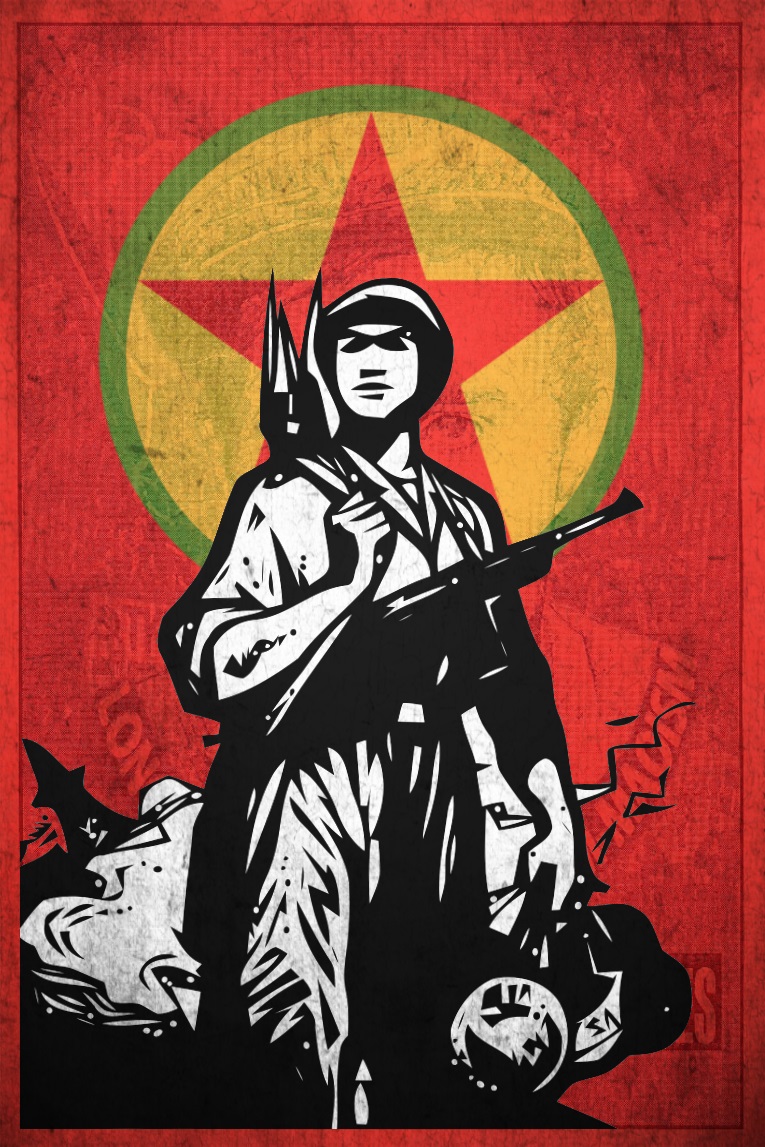
The Kurdistan Workers’ Party, or PKK, and its Syrian spinoff, the YPG, are cult-like radical movements that intertwine Marxism, feminism, Leninism and Kurdish nationalism into a hodge-podge of ideology, drawing members through the extensive use of propaganda that appeals to these modes of thought.
*(PKK Propaganda. Image Credit)
Abdullah Ocalan, the leader of the PKK, took inspiration from American anarchist Murray Bookchin in creating his philosophy, which he calls “Democratic Confederalism.”
The PKK spin-off group YPG represents most of the Syrian Democratic Forces (SDF) in Syria. With Western political support, they have gained popularity and garnered an impressive amount of support from anarchists and military veterans in the West, some of whom have left the comfort of their home countries to fight with the group.
One of their most productive marketing tools has been to use young, attractive female fighters as the face of the guerrillas. During their fight against Daesh, the PKK has saturated the media with images of these young female “freedom fighters,” using them as a marketing tool to take their cause from obscurity to fame. These female fighters in the YPJ are fighting alongside their male counterparts under the direction of the U.S. in the SDF.
Stephen Gowans writes more about this topic in his superb article titled: The Myth of the Kurdish YPG’s Moral Excellence. Here is an excerpt:
In Syria, the PKK’s goal “is to establish a self-ruled region in northern Syria,” [8] an area with a significant Arab population.
When PKK fighters cross the border into Turkey, they become ‘terrorists’, according to the United States and European Union, but when they cross back into Syria they are miraculously transformed into ‘guerrilla” fighters waging a war for democracy as the principal component of the Syrian Democratic Force. The reality is, however, that whether on the Turkish or Syrian side of the border, the PKK uses the same methods, pursues the same goals, and relies largely on the same personnel. The YPG is the PKK.
Child Soldiers forced recruitment, kidnapping, and murder by the PKK and YPG
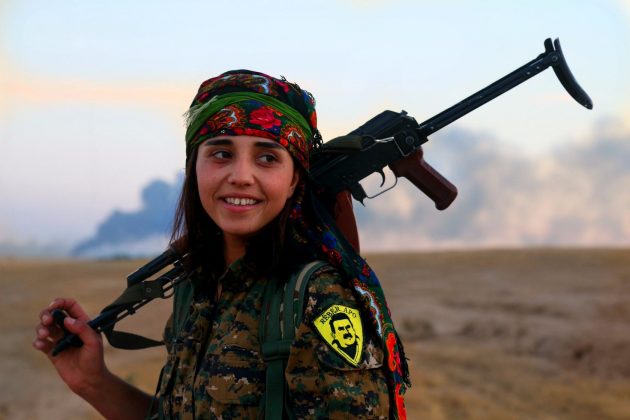
*(Young YPJ Kurdish fighter. Image Credit)
Within the past few years Kurds have gone from almost total obscurity to front page news. What doesn’t get reported however is how these terrorist groups under the guise of being a revolutionary movement for independence have carried out numerous atrocities including kidnappings and murder – not to mention their involvement in trafficking narcotics.
Kurdish families are demanding that the PKK stop kidnapping minors. It started on April 23, the day Turkey marked its 91st National Sovereignty and Children’s Day. While children celebrated the holiday in western Turkey, the Kurdistan Workers Party (PKK) kidnapped 25 students between the ages of 14 and 16 on the east side of the country, in the Lice district of Diyarbakir.
Although the PKK has kidnapped more than 330 minors in the last six months, the Bockum family was the first in the region who put up a tent near their home to start a sit-in protest, challenging the PKK and demanding that it return their son. Sinan was returned to the family on May 4. Al-Monitor reported this incident from the beginning in great detail.
As Bebyin Somuk reported in her article, the PKK and PYD still kidnap children in Turkey and Syria. She states: “As I previously wrote for Kebab and Camel, the PKK commits war crimes by recruiting children as soldiers. Some of the PKK militants that surrendered yesterday were also the PKK’s child soldiers. The photos clearly show that these children are not more than sixteen years old. The Turkish army released video of the 25 PKK militants surrendering in Nusaybin.”
Thousands of children are serving as soldiers in armed conflicts around the world. In 1989, the United Nations Convention on the Rights of the Child, Article 38, proclaimed: “State parties shall take all feasible measures to ensure that persons who have not attained the age of 15 years do not take a direct part in hostilities.” Since then, UNICEF and the UN Security Council took steps to end the recruitment of children in conflict and war.
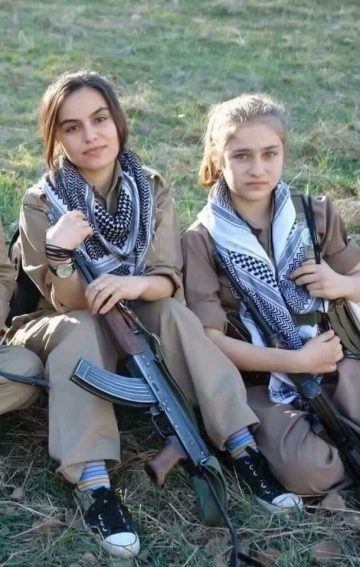
(Young Kurdish fighters. Image Credit)
The PKK, recognized as a terrorist organization by the U.S. , E.U. , and Turkey
The PKK often recruits children. In the past, the PKK even recruited children as young as 7-12 years. In 2010, a Danish national daily newspaper, Berlingske Tidende, published a story about the PKK’s child soldiers. According to that report, there were around 3,000 young militants in the PKK’s training camps. The youngest child at the PKK training camps was eight or nine years old. They were taught Abdullah Öcalan’s life story (the jailed leader of the PKK) and how to use weapons and explosives.
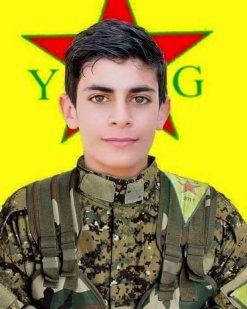
*(Martyrdom notice for a PYD/YPG child soldier Image Credit)
Despite the Deed of Commitment, the PKK continues to recruit minors.
After that story was published, the PKK encountered strong reactions from human rights organizations worldwide. The same year, UNICEF released a statement voicing its “profound concern” about the PKK’s recruitment of child soldiers. In October 2013, the PKK, represented by HPG (the PKK’s military wing) commander Ms. Delal Amed, signed the Deed of Commitment protecting children in armed conflict. This document, drawn up by the Geneva Call NGO, is dedicated to promoting respect by armed non-state actors for international humanitarian norms in armed conflict. Despite this commitment, the PKK continued to recruit minors.
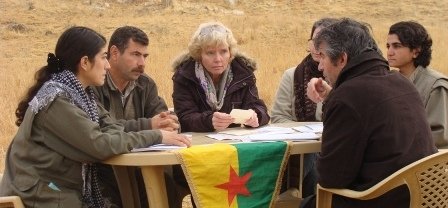
The People’s Defence Forces is the military wing of the Kurdistan Workers’ Party. Image Credit
The PKK abducted children while the peace process was continuing
On March 21, 2013, PKK leader Abdullah Öcalan called for a cease-fire that included the PKK’s withdrawal from Turkish soil and an eventual end to armed struggle. The PKK announced that they would obey, stating that 2013 would be the year of conclusion, either through war or through peace. But that did not happen. Instead, the PKK abducted 2,052 children aged between 12 and 17 while the peace process was still going on, according to Turkish security records. The PKK took these children and trained them. After that, because those childrenwere not involved in any criminal activities, when they were captured by, or surrendered to, Turkish security forces, Turkish courts did not prosecute them, so most of them were released. It was the Turkish state’s goodwill gesture for the sake of the peace process.
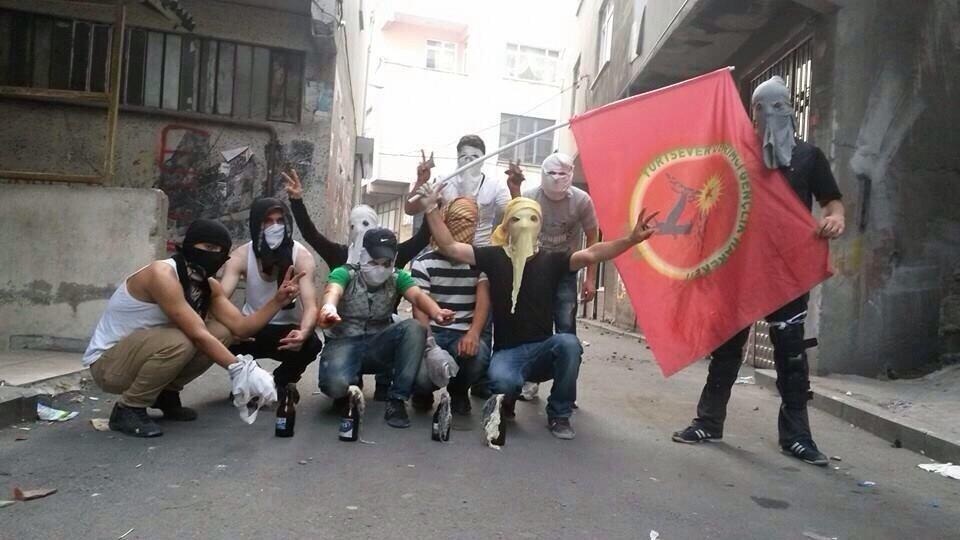
However, once released, most of these children joined the YDG-H, the PKK’s new youth wing, and began to perpetrate illegal and/or violent events in Kurdish populated cities and towns. The YDG-H began to emerge in early 2013 and spread rapidly after the peace process’ beginning. Then, after the 7 June 2015 election, the YDG-H began to attack security forces and civilians in cities and towns such as Cizre, or in Diyarbakır’s Sur neighborhood, with heavy weapons, and to dig trenches and erect barricades in side streets.
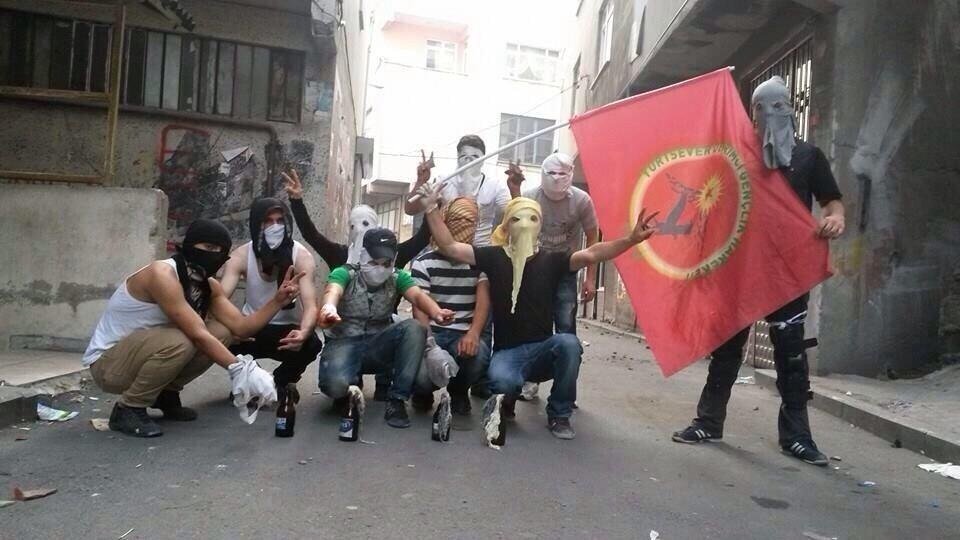
*(YDG H. Image Credit)
A growing number of Kurdish families in Turkey are calling for the return of their children, who they say have been abducted by the Kurdish rebel group, the PKK. The PKK denies the claim, but with the Turkish prime minister stepping in, the issue is putting pressure on an already stalled peace process. Dorian Jones reports from Diyarbakir, the main city in Turkey’s predominantly Kurdish southeast.
The HDP assaulted the mothers demanding their children
In May 2014, mothers from across Turkey whose children had been recruited by the PKK held a sit-in protest in front of the Diyarbakır Metropolitan Municipality building and called on the PKK to release their children. Their children were mostly 14-15 years old at that time. Some families claimed that their sons and daughters were kidnapped by the PKK against their will. The Diyarbakır Municipality, administered by the HDP, used water cannon to disperse the mothers. HDP Co-Chair Selahattin Demirtaş even claimed that these mothers were hired by the Turkish National Intelligence Organization. Despite the resistance coming from the PKK and the HDP, the families continued their protest, and some families’ children were released by the PKK.
The PKK established a child-wing called YPS-Zarok
Another photo from the Yüksekova district shows the child-wing recently established by the PKK called YPS-Zarok (Child) with the headline “YPS-Zarok announcement from the children of the resistance.” The PYD, the PKK’s Syria branch, is also known for its recruitment of child soldiers.
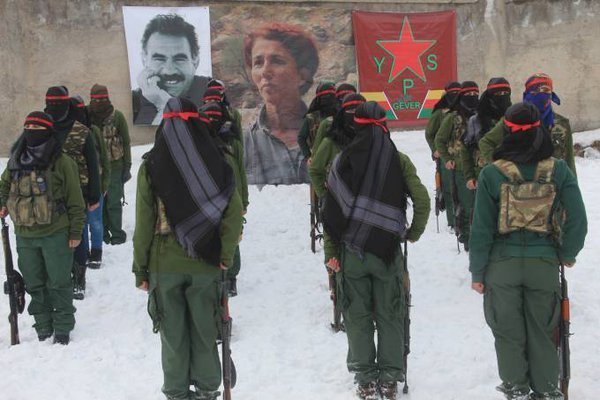
*(YPS. Image Credit)
U.S.’s “reliable partner” the YPG also recruits children
A Human Rights Watch report, “Syria: Kurdish Forces Violating Child Soldier Ban” provides a list of 59 children, ten of them under the age of fifteen, recruited for YPG or YPJ forces since July 2014. International humanitarian law and the Rome Statute that set up the International Criminal Court classify the recruitment of under-15-year-olds as a war crime. While the Obama Administration does not recognize the YPG as a terrorist organization, and supports them as a local partner in the region, the YPG continues to recruit child soldiers.
It’s clear that the U.S. sees the PYD as a “reliable partner” in the fight against ISIS. However, the Obama Administration should notice the fact that the PYD is not an independent organization. It is linked to the PKK and recruiting minors under 18. The decision to found the PYD was made in 2002 during a PKK congress in Qandil. The PYD also has a bylaw stating that “Abdullah Öcalan is the leader of the PYD.”US Special Forces Delta Force, training PYD (Image Credit)
In summary, the YPG is the Syrian wing of the PKK, and recruits children just like the PKK. Regardless of what acronym they go by, whether it be the YPG, PKK, PYD, YPJ or any of the other alphabet soup combinations, they commit crimes against civilians in both Syria and Turkey all with the arms, funds, and training received from the United States.
Female PKK Killing Turkish Soldiers
SouthFront reported on female PKK fighters who have killed Turkish soldiers. “The women fighters command of the Kurdistan Worker Party (PKK) have released a statement, claiming PKK female fighters killed 160 Turkish military servicemen in 2016. According to the statement, the women fighters command of the PKK carried out 115 operations against Turkish government forces in 2016. The group also vowed to ‘proceed the struggle during the new year for a life of freedom and until victory is achieved.’”
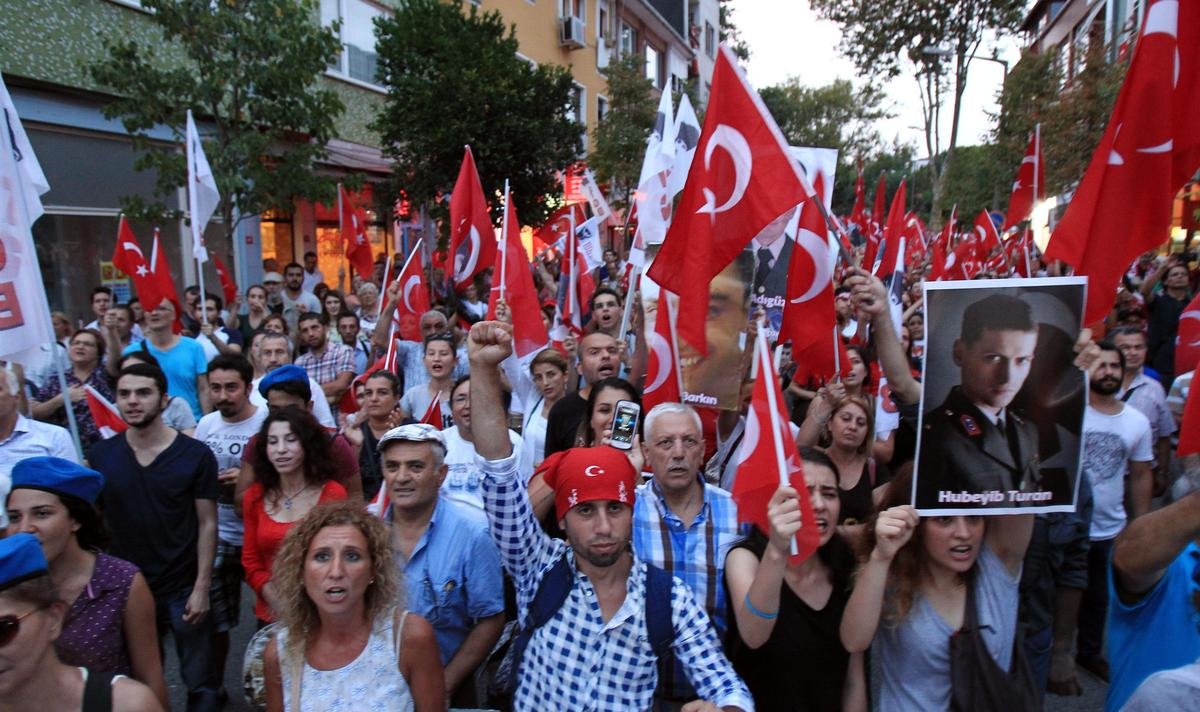
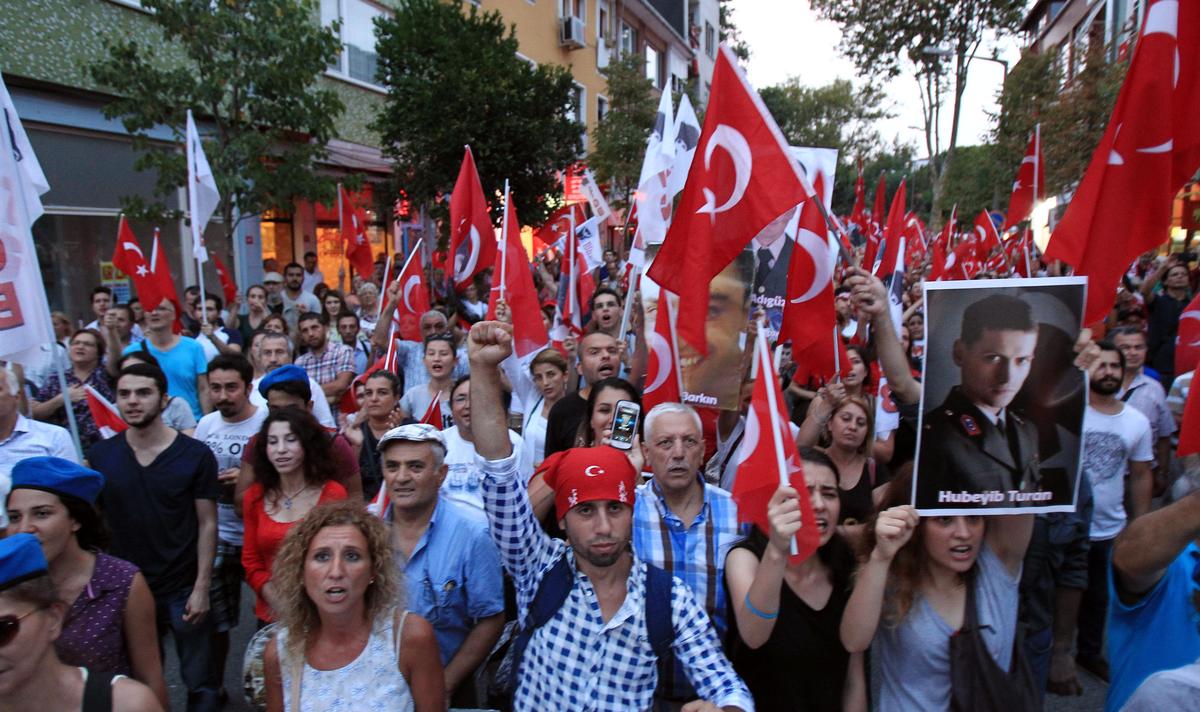
*(Hundreds of people protest against the PKK in Istanbul on 7 September after the PKK killed 16 soldiers and wounded six others in Daglica, Turkey. Image Credit)
The PKK is also killing Kurds under the guise of protecting their rights
“Senior PKK leader Cemil Bayık, in an interview with the Fırat News Agency (ANF) on Aug. 8, said, ‘Our war will not be confined to the mountains like it was before. It will be spread everywhere without making a distinction between mountains, plains or cities. It will spread to the metropolises.’ Terrorist Bayık’s statement signaled that the PKK would take increasing aim against civilians, targeting civilian areas more than ever. And it is happening.
Since July 15, the day when the Gülenist terror cult, FETÖ, launched its failed military coup attempt to topple the democratically-elected government, the PKK perpetrated dozens of terrorist attacks, killing 21 civilians and injuring 319 others – most of them Kurdish citizens.”
According to The Washington Institute:
On November 18, FBI Director Robert Mueller met with senior Turkish officials to address U.S.-Turkish efforts targeting the Kurdistan Workers Party (PKK), also known as Kongra-Gel. A press release from the U.S. embassy in Ankara following the meeting stressed that U.S. officials ‘strongly support Turkey’s efforts against the PKK terrorist organization’ and highlighted the two countries’ long history of working together in the fight against terrorism and transnational organized crime.
The PKK: Terrorist Organization and Foreign Narcotics Trafficker
These discussions are timely. Despite Ankara’s recent bid to alleviate the Kurdish issue — a bid referred to as the ‘democratic opening’ — the PKK is one of a growing number of terrorist organizations with significant stakes in the international drug trade.
In October, the U.S. Treasury Department added three PKK/Kongra-Gel senior leaders to its list of foreign narcotics traffickers. The PKK, along with the Revolutionary Armed Forces of Colombia (FARC), is one of only a few organizations worldwide designated by the U.S. government as both a terrorist organization and a significant foreign narcotics trafficker.” Drug smuggling is reported to be the main financial source of PKK terrorism, according to the organization International Strategic Research, whose detailed report can be seen here.
Western Veterans Blindly Supporting Kurdish Independence
Their exaggerated triumphs against Daesh have helped them evolve from a radical militia to an alleged regional power player. Have they been successful in fighting against Daesh in Syria? Yes – but while the Syrian Arab Army has been more effective, it does not receive a fraction of the praise or recognition that the PKK does.
Pato Rincon, a U.S. military veteran, recently wrote about his experience training with the YPG in Syria.
Although initially interested in their desire for autonomy, he soon got to know a different side of the group.
An Exclusive Eyewitness Account of an American who Trained with the Kurdish Syrian Rebels
Getting retired from the United States Marine Corps at age 23 with zero deployments under my belt was a huge blow to what I figured to be my destiny on this planet. That “retirement” came in 2010 after three years on convalescent leave, recovering from a traumatic brain injury sustained stateside. I got my chance to vindicate myself in 2015 by volunteering to fight in Syria with the Kurdish Yeni Parastina Gel (YPG), or the “People’s Protection Units” in Kurmanji (Northern Kurdish language).
The YPG is the military apparatus of the Partiya Yekitiya Democrat (PYD), the Democratic Union Party, and one of the main forces of the Syrian Democratic Forces fighting ISIS and Bashar al-Assad’s regime. While they are a direct ideological descendant of the Soviet Union, their take on Marxism has a much more nationalistic bent than that of their internationalist forebears. At their training camp that I attended, they constantly spoke of their right to a free and autonomous homeland–which I could support. On the other hand, they ludicrously claimed that all surrounding cultures from Arab to Turk to Persian descended from Kurdish culture. One should find this odd, considering that the Kurds have never had such autonomy as that which they struggle for. All of this puffed up nationalism masquerading as internationalism was easy to see through.
The Westerners were treated with respect by the “commanders” (they eschewed proper rank and billet, how bourgeoise!), but the rank and file YPGniks were more interested in what we could do for them and what they could steal from us (luckily, my luggage was still in storage at the Sulaymaniyah International Airport in Sulaymaniyah, Iraq). By “steal from us,” I mean they would walk up to a Westerner/American and grab their cap, glasses, scarf and whatever else they wanted and ask “Hevalti?” which is Kurmanji for “Comraderie?” and if you “agreed” or stalled (a non-verbal agreement) then they would take your gear and clothing. “Do not get your shit hevalti-ed,” the saying went.
Not only was their idea of Marxism fatuous, their version of feminism was even worse. We had to take mandatory “Female World History” classes in which some putrid fourth or even fifth wave feminist propaganda was espoused. Early on in my brief stay with this “military unit”, I was told not to ever brush my teeth in front of a woman as that might “sexualize” her… … something to do with preparing one’s self for sex or something.
They insisted that we chicken-wing our elbows while sighting in on targets–the same targets that were fired on by everybody in the class, thus making an assessment of individual strengths and weaknesses rather impossible. This was on the ONE day that we went to the range–one day with the AK-47 out of about a month of training. Another day was Some of these guys were straight from civilian life, with only their blood composition to act as a reason for them to be there. Little boys and little girls as young as 13 or 14 were there–reason enough for me to leave.
During one long “Female World History” class, we were taught that if a man had a Dragonov (sniper rifle) and he was elevated from his female comrade’s position and she had a Bixie, then the male in the scenario should not cover his female comrade, but instead should find something else to do lest she lose self esteem, not feeling capable of carrying out the task by herself.
When a student from Kentucky asked, “What if the situation is reversed–can a woman cover a man?” the female instructor smiled and said, “Yes, that’s okay.” I didn’t end up firing a shot in combat for the YPG. After seeing their half-baked ideology, poor level of training, and the child soldiers, I had had enough. They were nice enough to arrange for me to go back to Iraq where I could catch a ride to Turkey.
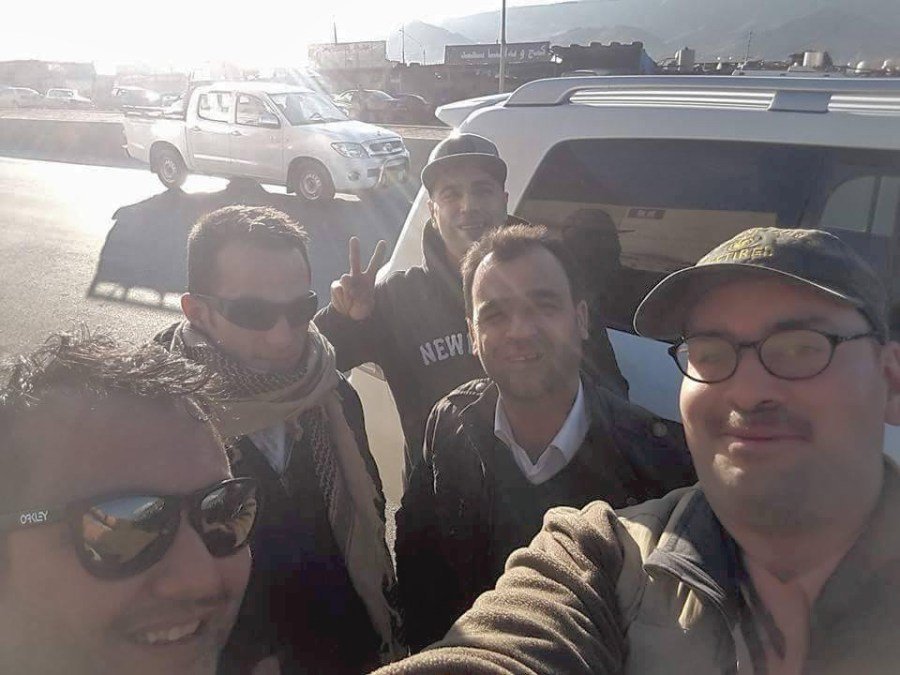
*(Pat Rincon with YPG fighters in Syria. Image Credit)
Accounts such as this will certainly not make it to mainstream media, as they do not fit the narrative that the Kurds and their sponsors promote.
In another example of Western support for the YPG, Joe Robinson, an ex-soldier and UK national, recently returned to the UK after spending five months in Syria fighting with the group. He was detained and arrested by Greater Manchester Police officers on suspicion of terrorism offenses as soon as he returned. He joined the British military when he was 18 and toured Afghanistan with the Duke of Lancaster’s Regiment in 2012.
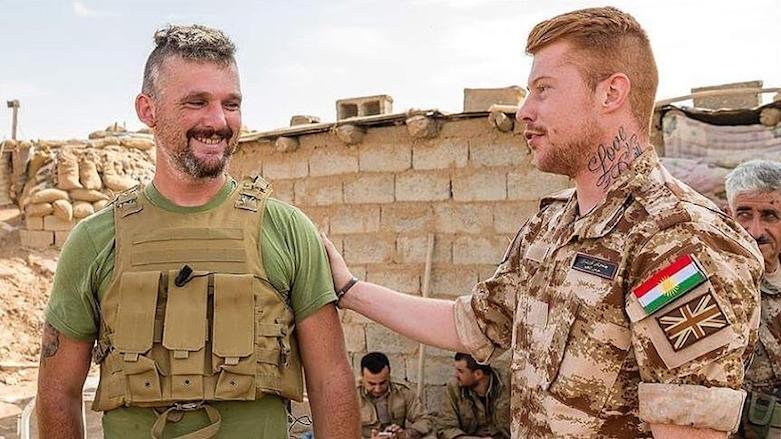
*(Joseph A. R. (right) in a military outfit with flag patches of Kurdistan and the UK, while men who appear to be Kurdistan Region’s Peshmerga forces are seen in the background in this undated social media picture. Picture Credit).
He left the UK when an arrest warrant was issued after he failed to appear in court. Robinson is pictured here in Syria with YPG fighters.
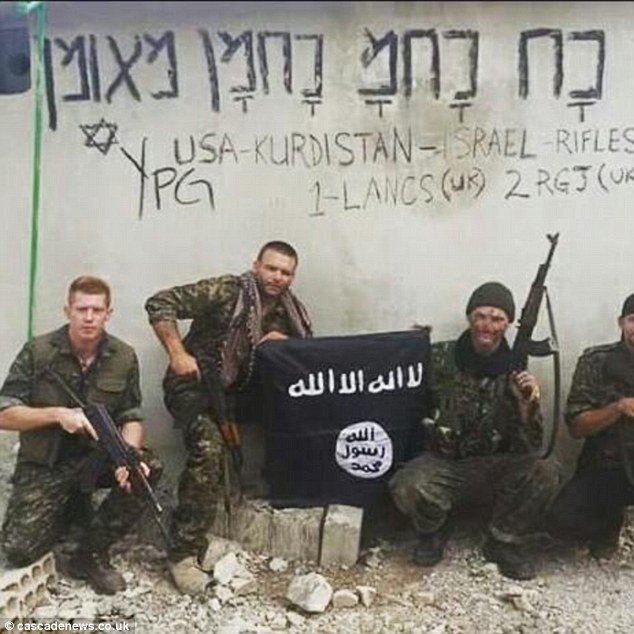
Robinson, at left, holding his weapon while fellow YPG comrades hold Daesh flag. The writing on the wall speaks volumes about the relationship between Israel, the Kurds and the US.
During a trip to Turkey Joe Robinson was arrested for having been part of the YPG.
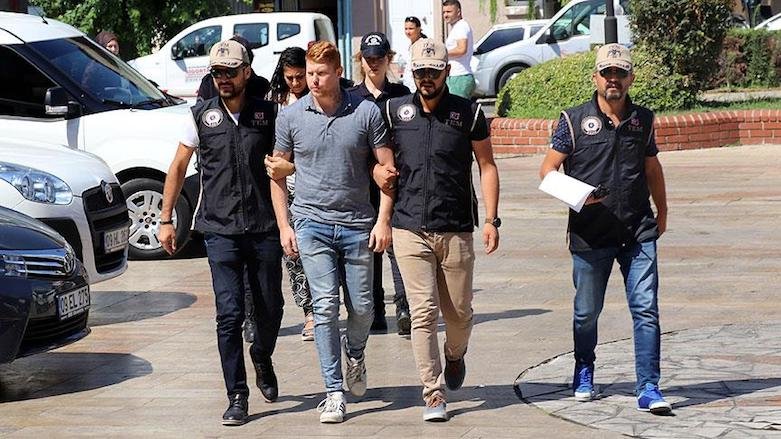
*(Turkish police arrested Joesph A.R. (center) along with two Bulgarian women in the city of Aydin, July 28, 2017. Photo Credit)
“I received arms training from the YPG [People’s Protection Units] for three months but never engaged in combat,” said the foreign fighter during an interrogation.
The information contained in this article serves the purpose of balancing all of the propaganda and romanticization that these Kurdish terrorist groups have received in mainstream media. The bottom line is they are armed, dangerous, and committing crimes with international support. Support for these terrorist groups needs to end immediately before further division, chaos and death spreads in the region.
The Crazy Imbalance of Russia-gate
By Robert Parry | Consortium News | September 22, 2017
The core absurdity of the Russia-gate frenzy is its complete lack of proportionality. Indeed, the hysteria is reminiscent of Sen. Joe McCarthy warning that “one communist in the faculty of one university is one communist too many” or Donald Trump’s highlighting a few “bad hombres” raping white American women.
It’s not that there were no Americans who espoused communist views at universities and elsewhere or that there are no “bad hombre” rapists; it’s that these rare exceptions were used to generate a dangerous overreaction in service of a propagandistic agenda. Historically, we have seen this technique used often when demagogues seize on an isolated event and exploit it emotionally to mislead populations to war.
Today, we have The New York Times and The Washington Post repeatedly publishing front-page articles about allegations that some Russians with “links” to the Kremlin bought $100,000 in Facebook ads to promote some issues deemed hurtful to Hillary Clinton’s campaign although some of the ads ran after the election.
Initially, Facebook could find no evidence of even that small effort but was pressured in May by Sen. Mark Warner, D-Virginia. The Washington Post reported that Warner, who is spearheading the Russia-gate investigation in the Senate Intelligence Committee, flew to Silicon Valley and urged Facebook executives to take another look at possible ad buys.
Facebook responded to this congressional pressure by scouring its billions of monthly users and announced that it had located 470 suspect accounts associated with ads totaling $100,000 – out of Facebook’s $27 billion in annual revenue.
Here is how the Times described those findings: “Facebook officials disclosed that they had shut down several hundred accounts that they believe were created by a Russian company linked to the Kremlin and used to buy $100,000 in ads pushing divisive issues during and after the American election campaign.” (It sometimes appears that every Russian — all 144 million of them — is somehow “linked” to the Kremlin.)
Last week, congressional investigators urged Facebook to expand its review into “troll farms” supposedly based in Belarus, Macedonia and Estonia – although Estonia is by no means a Russian ally; it joined NATO in 2004.
“Warner and his Democratic counterpart on the House Intelligence Committee, Rep. Adam B. Schiff of California, have been increasingly vocal in recent days about their frustrations with Facebook,” the Post reported.
Facebook Complies
So, on Thursday, Facebook succumbed to demands that it turn over to Congress copies of the ads, a move that has only justified more alarmist front-page stories about Russia! Russia! Russia!
In response to this political pressure – at a time when Facebook is fending off possible anti-trust legislation – its chief executive Mark Zuckerberg added that he is expanding the investigation to include “additional Russian groups and other former Soviet states.”
So, it appears that not only are all Russians “linked” to the Kremlin, but all former Soviet states as well.
But why stop there? If the concern is that American political campaigns are being influenced by foreign governments whose interests may diverge from what’s best for America, why not look at countries that have caused the United States far more harm recently than Russia?
After all, Saudi Arabia and its Sunni Wahabbi leaders have been pulling the U.S. government into their sectarian wars with the Shiites, including conflicts in Yemen and Syria that have contributed to anti-Americanism in the region, to the growth of Al Qaeda, and to a disruptive flow of refugees into Europe.
And, let’s not forget the 8,000-pound gorilla in the room: Israel. Does anyone think that whatever Russia may or may not have done in trying to influence U.S. politics compares even in the slightest to what Israel does all the time?
Which government used its pressure and that of its American agents (i.e., the neocons) to push the United States into the disastrous war in Iraq? It wasn’t Russia, which was among the countries urging the U.S. not to invade; it was Israel and Prime Minister Benjamin Netanyahu.
Indeed, the plans for “regime change” in Iraq and Syria can be traced back to the work of key American neoconservatives employed by Netanyahu’s political campaign in 1996. At that time, Richard Perle, Douglas Feith and other leading neocons unveiled a seminal document entitled “A Clean Break: A New Strategy for Securing the Realm,” which proposed casting aside negotiations with Arabs in favor of simply replacing the region’s anti-Israeli governments.
However, to make that happen required drawing in the powerful U.S. military, so after the 9/11 attacks, the neocons inside President George W. Bush’s administration set in motion a deception campaign to justify invading Iraq, a war which was to be followed by more “regime changes” in Syria and Iran.
A Wrench in the Plans
Although the military disaster in Iraq threw a wrench into those plans, the Israeli/neocon agenda never changed. Along with Israel’s new regional ally, Saudi Arabia, a proxy war was fashioned to remove Syrian President Bashar al-Assad.
As Israel’s Ambassador to the U.S. Michael Oren explained, the goal was to shatter the Shiite “strategic arc” running from Iran through Syria to Lebanon and Israel’s Hezbollah enemies.
How smashing this Shiite “arc” was in the interests of the American people – or even within their consciousness – is never explained. But it was what Israel wanted and thus it was what the U.S. government enlisted to do, even to the point of letting sophisticated U.S. weaponry fall into the hands of Syria’s Al Qaeda affiliate.
Israel’s influence over U.S. politicians is so blatant that presidential contenders queue up every year to grovel before the Israel Lobby’s conference of the American Israel Public Affairs Committee. In 2016, Donald Trump showed up and announced that he was not there to “pander” and then pandered his pants off.
And, whenever Prime Minister Netanyahu wants to show off his power, he is invited to address a joint session of the U.S. Congress at which Republicans and Democrats compete to see how many times and how quickly they can leap to their feet in standing ovations. (Netanyahu holds the record for the number of times a foreign leader has addressed joint sessions with three such appearances, tied with Winston Churchill.)
Yet, Israeli influence is so ingrained in the U.S. political process that even the mention of the existence of an “Israel Lobby” brings accusations of anti-Semitism. “Israel Lobby” is a forbidden phrase in Washington.
However, pretty much whenever Israel targets a U.S. politician for defeat, that politician goes down, a muscle that Israel flexed in the early 1980s in taking out Rep. Paul Findley and Sen. Charles Percy, two moderate Republicans whose crime was to suggest talks with the Palestine Liberation Organization.
So, if the concern is the purity of the American democratic process and the need to protect it from outside manipulation, let’s have at it. Why not a full-scale review of who is doing what and how? Does anyone think that Israel’s influence over U.S. politics is limited to a few hundred Facebook accounts and $100,000 in ads?
A Historical Perspective
And, if you want a historical review, throw in the British and German propaganda around the two world wars; include how the South Vietnamese government collaborated with Richard Nixon in 1968 to sabotage President Lyndon Johnson’s Paris peace talks; take a serious look at the collusion between Ronald Reagan’s campaign and Iran thwarting President Jimmy Carter’s efforts to free 52 American hostages in Tehran in 1980; open the books on Turkey’s covert investments in U.S. politicians and policymakers; and examine how authoritarian regimes of all stripes have funded important Washington think tanks and law firms.
If such an effort were ever proposed, you would get a sense of how sensitive this topic is in Official Washington, where foreign money and its influence are rampant. There would be accusations of anti-Semitism in connection with Israel and charges of conspiracy theory even in well-documented cases of collaboration between U.S. politicians and foreign interests.
So, instead of a balanced and comprehensive assessment of this problem, the powers-that-be concentrate on the infinitesimal case of Russian “meddling” as the excuse for Hillary Clinton’s shocking defeat. But the key reasons for Clinton’s dismal campaign had virtually nothing to do with Russia, even if you believe all the evidence-lite accusations about Russian “meddling.”
The Russians did not tell Clinton to vote for the disastrous Iraq War and play endless footsy with the neocons; the Russians didn’t advise her to set up a private server to handle her State Department emails and potentially expose classified information; the Russians didn’t lure Clinton and the U.S. into the Libyan fiasco nor suggest her ghastly joke in response to Muammar Gaddafi’s lynching (“We came, we saw, he died”); the Russians had nothing to do with her greedy decision to accept millions of dollars in Wall Street speaking fees and then try to keep the speech contents secret from the voters; the Russians didn’t encourage her husband to become a serial philanderer and make a mockery of their marriage; nor did the Russians suggest to Anthony Weiner, the husband of top Clinton aide Huma Abedin, that he send lewd photos to a teen-ager on a laptop also used by his wife, a development that led FBI Director James Comey to reopen the Clinton-email investigation just 11 days before the election; the Russians weren’t responsible for Clinton’s decision not to campaign in Wisconsin and Michigan; the Russians didn’t stop her from offering a coherent message about how she would help the struggling white working class; and on and on.
But the Russia-gate investigation is not about fairness and balance; it’s a reckless scapegoating of a nuclear-armed country to explain away – and possibly do away with – Donald Trump’s presidency. Rather than putting everything in context and applying a sense of proportion, Russia-gate is relying on wild exaggerations of factually dubious or relatively isolated incidents as an opportunistic means to a political end.
As reckless as President Trump has been, the supposedly wise men and wise women of Washington are at least his match.
Investigative reporter Robert Parry broke many of the Iran-Contra stories for The Associated Press and Newsweek in the 1980s.
200,000 Israelis expected in “Kurdistan” once independence is declared
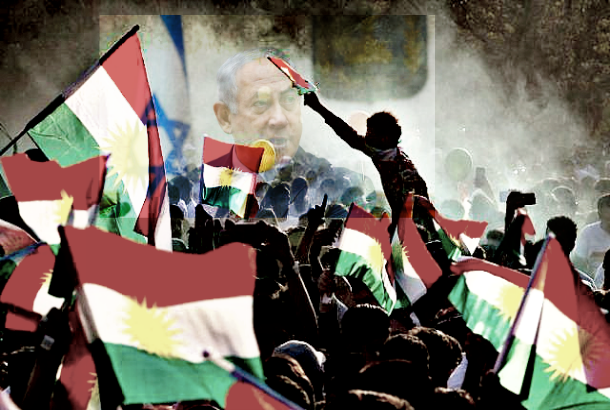
Voltaire Network | 20 September 2017
According to the magazine Israel-Kurd based in Erbil, the Israeli Prime Minister, Benjamin Netanyahu and Massoud Barzani, the self-appointed President of the future independent Kurdistan, have reached a secret agreement.
Tel-Aviv is committed to installing 200,000 Israelis of Kurdish origin in Kurdistan.
The announcement has been widely repeated in the Turkish, Iranian and Arab press. The plan to create a South Sudan and a Kurdistan has been an Israeli military objective following missile development at the end of the nineties. These territories, largely administered by the Israelis, have enabled a rear attack on Egypt and Syria.
Out of the 8.5 million Israelis living in Israel, around 200,000 are of Kurdish origin. In March 1951, “Operation Ezra and Nehemiah” (named after the biblical persons that organized the flight of the Jewish people from Babylon) permitted 11,000 Jewish Kurds to emigrate from Iraq to Israel. The American Jewish Joint Distribution Committee of New York funded this operation. The planes used for this air lift were made available by the Cuban dictator, Fulgencio Batista.
The Barzani family that governs the Iraqi Kurdistan with an iron fist, is historically connected to Israel. Mullah Mustafa Barzani, father of the current president Massoud Barzani, was one of Mossad’s high official.
The Israeli Prime Minister is the only head of government to have publicly declared his support of the creation of an independent Kurdistan outside the historic Kurdish territory (which would also be to the detriment of the indigenous populations).
Despite the prohibition declared by the Iraqi Constitutional Court, a referendum will take place on 25 September 2017 with a view to declaring this new State.
Translation
Anoosha Boralessa
Featured Video

Death Spikes & Rising Cancer In Our Youth Explained
or go to
Aletho News Archives – Video-Images
From the Archives
Politicians lie
By Mazin Qumsiyeh | Popular Resistance | August 18, 2013
There is no way to say this truth nicely: Politicians lie. That includes Japanese, American, Egyptian, Israeli, and Palestinian politicians! Is there something more common sense than that? Yet, so many citizens around the world believe their own politicians or wistfully acknowledge lies but think it is part of the job needed to run things. They believe even when politicians contradict themselves blatantly. This phenomenon is rather remarkable. It is a dissonance and disconnect from reality that many seem oblivious to. It is very dangerous because it can lead to accepting rationales for going to war. These can be deadly wars that lead to millions of lives lost as happened in what was called World War 1 and WW2. Even when incredible and declassified evidence abound, politicians continue to lie and old mythologies refuse to die. Here are just a few of the countless lies told to us over the past few decades… continue
Blog Roll
 Aletho News
- RSF military group defects, joins Sudanese army: State media
- Ireland goalkeeper refuses to play ‘Israel’ as squad weighs boycott
- China pushes back against US on Cuba, Iran
- Ukrainian Soldiers, Potential Mercenaries: Have Gun, Will Travel!
- Burnham’s UN debut… A masterclass in British disinformation
- Iran flights continue despite US aviation sanctions
- Global Tipping Points Lead the World Into a State of Entropy
- The day-after at the White House: USA and Xi Jinping
- The Geopolitical Balance in the Red Sea: The UAE Being Displaced by New Players
- Iraqi resistance group vows to stage airport sit-ins over Iran aerial blockade
- If Americans Knew
- An error has occurred; the feed is probably down. Try again later.
- No Tricks Zone
- New Study: Earth And Venus Surface Warmth Largely Explained By Convection And Lapse Rate, Not CO2 Or Radiation
- 2025 Nature Paper Claiming Worsening Global Drought Gets RETRACTED …Heavily Flawed
- New Study: ‘Global Drought Shows No Detectable Recent Acceleration Under Climate Warming’
- Economic Masterminds: German Socialists Suggest Taxing Productivity Gains Stemming From Using AI
- The South China Sea Has Not Been Cooperating With The Climate Change Narrative
- Energy Crisis: Germany Enters Heating Season With Historically Low Gas Reserve Fill Levels
- New Study: The Antarctic Ice Sheet Gained Mass From 2020-2024 Due To Staggering Snow And Ice Accumulation
- Study: Ocean Heating Rates From Thousands Of Years Ago ‘Dwarf’ Modern Ocean Heating Rates
- Climate Extremists Target, Attack Large-Scale Power Grid Infrastructure In Germany!
- New Study: Antarctic Ice Melt Has Contributed Less Than 1 Centimeter To Sea Level Rise In The Last 30 Years