Many people still want to believe that the United Nations engages in impartial investigations and thus is more trustworthy than, say, self-interested governments, whether Russia or the United States. But trust in U.N. agencies is no longer well placed; whatever independence they may have once had has been broken, a reality relevant to recent “investigations” of Syrian chemical weapons use.
There is also the larger issue of the United Nations’ peculiar silence about one of its primary and original responsibilities, shouldered after the horrors of World War II – to stop wars of aggression, which today include “regime change” wars organized, funded and armed by the United States and other Western powers, such as the Iraq invasion in 2003, the overthrow of the Libyan government in 2011, and a series of proxy wars including the ongoing Syrian conflict.
After World War II, the Nuremberg Tribunals declared that a “war of aggression … is not only an international crime; it is the supreme international crime differing only from other war crimes in that it contains within itself the accumulated evil of the whole.”
That recognition became a guiding principle of the United Nations Charter, which specifically prohibits aggression or even threats of aggression against sovereign states.
The Charter declares in Article One that it is a chief U.N. purpose “to take effective collective measures … for the suppression of acts of aggression or other breaches of the peace.” Article Two, which defines the appropriate behavior of U.N. members, adds that “All Members shall refrain in their international relations from the threat or use of force against the territorial integrity or political independence of any state…”
However, instead of enforcing this fundamental rule, the United Nations has, in effect, caved in to the political and financial pressure brought to bear by the United States and its allies. A similar disregard for international law also pervades the U.S. mainstream media and much of the European and Israeli press as well.
There is an assumption that the United States and its allies have the right to intervene militarily anywhere in the world at anytime solely at their own discretion. Though U.S. diplomats and mainstream journalists still voice outrage when adversaries deviate from international law – such as denunciations of Russia over Ukraine’s civil war – there is silence or support when a U.S. president or, say, an Israeli prime minister orders military strikes inside another country. Then, we hear only justifications for these attacks.
Shielding Israel
For instance, on Friday, The New York Times published an article about Israel conducting a bombing raid inside Syria that reportedly killed two Syrians. The article is notable because it contains not a single reference to international law and Israel’s clear-cut violation of it. Instead, the article amounts to a lengthy rationalization for Israel’s aggression, framing the attacks as Israeli self-defense or, as the Times put it, “an escalation of Israel’s efforts to prevent its enemies from gaining access to sophisticated weapons.”
The article also contains no reference to the fact that Israel maintains a sophisticated nuclear arsenal and is known to possess chemical and biological weapons as well. Implicit in the Times article is that the U.S. and Israel live under one set of rules while countries on the U.S.-Israeli enemies list must abide by another. Not to state the obvious but this is a clear violation of the journalistic principle of objectivity.
But the Times is far from alone in applying endless double standards. Hypocrisy now permeates international agencies, including the United Nations, which instead of pressing for accountability in cases of U.S. or Israeli aggression has become an aider and abettor, issuing one-sided reports that justify further aggression while doing little or nothing to stop U.S.-backed acts of aggression.
For instance, there was no serious demand that U.S. and British leaders who organized the 2003 invasion of Iraq, which resulted in the deaths of hundreds of thousands of Iraqis, should face any accountability for committing the “supreme international crime” of an aggressive war. As far as the U.N. is concerned, war-crimes tribunals are for the little guys.
This breakdown in the integrity of the U.N. and related agencies has developed over the past few decades as one U.S. administration after another has exploited U.S. clout as the world’s “unipolar power” to ensure that international bureaucrats conform to U.S. interests. Any U.N. official who deviates from this unwritten rule can expect to have his or her reputation besmirched and career truncated.
So, while harshly critical of alleged abuses by the Syrian military, U.N. officials are notoriously silent when it comes to condemning the U.S., Saudi Arabia, Jordan, Turkey, Israel and other countries that have been “covertly” backing anti-government “rebels” who have engaged in grave crimes against humanity in Syria.
The U.S. and its allies have even mounted overt military operations inside Syrian territory, including airstrikes against the Syrian military and its allies, without permission of the internationally recognized government in Damascus. Yet, the U.N. does nothing to curtail or condemn these clear violations of its own Charter.
Breaking the Independence
The reason is that, for much of this century, the U.S. government has worked to bring key agencies, such as the U.N. Commission on Human Rights (UNCHR), the International Atomic Energy Agency (IAEA), and the Organization for the Prohibition of Chemical Weapons (OPCW), under U.S. control and domination.
This drive to neutralize the U.N.’s independence gained powerful momentum after the 9/11 attacks and President George W. Bush’s launching of his “global war on terror.” But this effort continued under President Obama and now under President Trump.
In 2002, after opening the prison at Guantanamo Bay, Cuba, and effectively waiving the Geneva Convention’s protections for prisoners of war, Bush bristled at criticism from the United Nations High Commissioner for Human Rights Mary C. Robinson.
Soon, Robinson was targeted for removal. Her fierce independence, which also included criticism of Israel, was unacceptable. The Bush administration lobbied hard against her reappointment, leading to her retirement in 2002.
Also, in 2002, the Bush administration engineered the firing of OPCW’s Director General Jose Mauricio Bustani who was viewed as an obstacle to the U.S. plans for invading Iraq.
Bustani, who had been reelected unanimously to the post less than a year earlier, described his removal in a 2013 interview with Marlise Simons of The New York Times, citing how Bush’s emissary, Under-Secretary of State John Bolton, marched into Bustani’s office and announced that he (Bustani) would be fired.
“The story behind [Bustani’s] ouster has been the subject of interpretation and speculation for years, and Mr. Bustani, a Brazilian diplomat, has kept a low profile since then,” wrote Simons. “But with the agency [OPCW] thrust into the spotlight with news of the Nobel [Peace] Prize [in October 2013], Mr. Bustani agreed to discuss what he said was the real reason: the Bush administration’s fear that chemical weapons inspections in Iraq would conflict with Washington’s rationale for invading it. Several officials involved in the events, some speaking publicly about them for the first time, confirmed his account.”
The official U.S. explanation for getting rid of Bustani was incompetence, but Bustani and the other diplomats close to the case reported that Bustani’s real offense was drawing Iraq into acceptance of the OPCW’s conventions for eliminating chemical weapons, just as the Bush administration was planning to pin its propaganda campaign for invading Iraq on the country’s alleged secret stockpile of WMD.
Bustani’s ouster gave President Bush a clearer path to the invasion by letting him frighten Americans with the prospect of Iraq sharing its chemical weapons and possibly a nuclear bomb with Al Qaeda terrorists.
Dismissing Iraq’s insistence that it had destroyed its chemical weapons and didn’t have a nuclear weapons project, Bush launched the invasion in March 2003, only for the world to discover later that the Iraqi government was telling the truth.
Compliant Replacements
In comparison to the independent-minded Bustani, the biography of the current OPCW director general, Ahmet Uzumcu, a career Turkish diplomat, suggests that the OPCW could be expected to slant its case against the Syrian government in the current Syrian conflict.
Not only has Turkey, a NATO ally of the United States, been a key player in supporting the proxy war to overthrow Syrian President Bashar al-Assad, but Uzumcu also served as Turkey’s ambassador to Israel, which has long sought regime change in Syria and has publicly come out in favor of the anti-government rebels.
Another one-time thorn in the side of the U.S. “unipolar power” was the IAEA when it was under the control of Director General Mohamed ElBaradei, an Egyptian. The IAEA challenged the Bush administration’s claims about Iraq having a nuclear program, when one really didn’t exist.
However, being right is no protection when U.S. officials want to bring an agency into line with U.S. policy and propaganda. So, early in the Obama administration – as Secretary of State Hillary Clinton was pushing for a hardline on Iran over its nascent nuclear program – the U.S. government engineered the insertion of a pliable Japanese diplomat, Yukiya Amano, into the IAEA’s top job.
Before his appointment, Amano had portrayed himself as an independent-minded fellow who was resisting U.S.-Israeli propaganda about the Iranian nuclear program. Yet behind the scenes, he was meeting with U.S. and Israeli officials to coordinate on how to serve their interests (even though Israel is an actual rogue nuclear state, not a hypothetical or fictional one).
Amano’s professed doubts about an Iranian nuclear-bomb project, which even the U.S. intelligence community agreed no longer existed, was just a theatrical device to intensify the later impact if he were to declare that Iran indeed was building a secret nuke, thus justifying the desire of Israeli leaders and American neoconservatives to “bomb-bomb-bomb” Iran.
But this U.S. ploy was spoiled by Pvt. Bradley (now Chelsea) Manning’s leaking of hundreds of thousands of pages of U.S. diplomatic cables. Among them were reports on Amano’s hidden collaboration with U.S. and Israeli officials; his agreement with U.S. emissaries on who to fire and who to retain among IAEA officials; and even Amano’s request for additional U.S. financial contributions.
The U.S. embassy cables revealing the truth about Amano were published by the U.K. Guardian in 2011 (although ignored by The New York Times, The Washington Post and other mainstream U.S. news outlets). Despite the silence of the major U.S. news media, Internet outlets, such as Consortiumnews.com, highlighted the Amano cables, meaning that enough Americans knew the facts not to be fooled again. [For details, see Consortiumnews.com’s “Did Manning Help Avert War with Iran?”]
A Collective Collapse
So, over the years, there has been a collective collapse of the independence at U.N.-related agencies. An international bureaucrat who gets on the wrong side of the United States or Israel can expect to be fired and humiliated, while those who play ball can be assured of a comfortable life as a “respected” diplomat.
But this reality is little known to most Americans so they are still inclined to be influenced when a “U.N. investigation” reaches some conclusion condemning some country that already is on the receiving end of negative U.S. propaganda.
The New York Times, CNN and other major U.S. news outlets are sure to trumpet these “findings” with great seriousness and respect and to treat any remaining doubters as outside the mainstream. Of course, there’s an entirely different response on the rare occasion when some brave or foolhardy human rights bureaucrat criticizes Israel’s treatment of the Palestinians. Then, the U.N. finding is just a sign of anti-Israeli bias and should be discounted.
In the far more frequent cases when a U.N. report is in line with U.S. propaganda, American journalists almost never turn a critical eye toward the quality of the evidence or the leaps of logic. We saw that happen this week with a thinly sourced and highly dubious U.N. report blaming the Syrian government for an alleged sarin incident on April 4. A major contradiction in the evidence – testimony given to OPCW investigators undercutting the conclusion that a Syrian warplane could have dropped a sarin bomb – was brushed aside by the U.N. human rights investigators and was ignored by the Times and other major U.S. news outlets.
But what is perhaps most troubling is that these biased U.N. reports are now used to justify continued wars of aggression by stronger countries against weaker ones. So, instead of acting as a bulwark to protect the powerless from the powerful as the U.N. Charter intended, the U.N. bureaucracy has turned the original noble purpose of the institution on its head by becoming an enabler of the “supreme international crime,” wars of aggression.
Investigative reporter Robert Parry broke many of the Iran-Contra stories for The Associated Press and Newsweek in the 1980s.
TEHRAN – A peace activist and journalist based in Virginia said Israeli Prime Minister Benjamin Netanyahu’s panic about recent advances of Iran and its allied forces against terrorists in Syria signals that the Tel Aviv regime is “losing its stranglehold” over Washington.
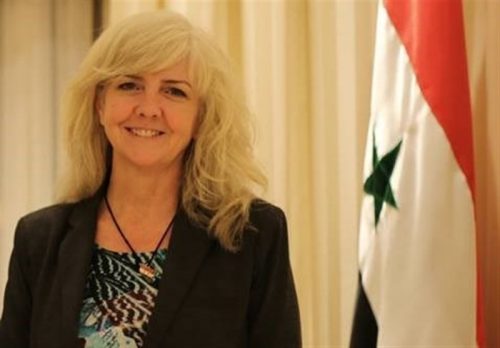
“Netanyahu’s panic and his incessant warnings regarding ‘Iranian expansion’ may be the most hopeful sign that Tel Aviv is losing its stranglehold over Washington,” Janice Kortkamp from Leesburg, Virginia, said in an interview with the Tasnim News Agency.
Following is the full text of the interview:
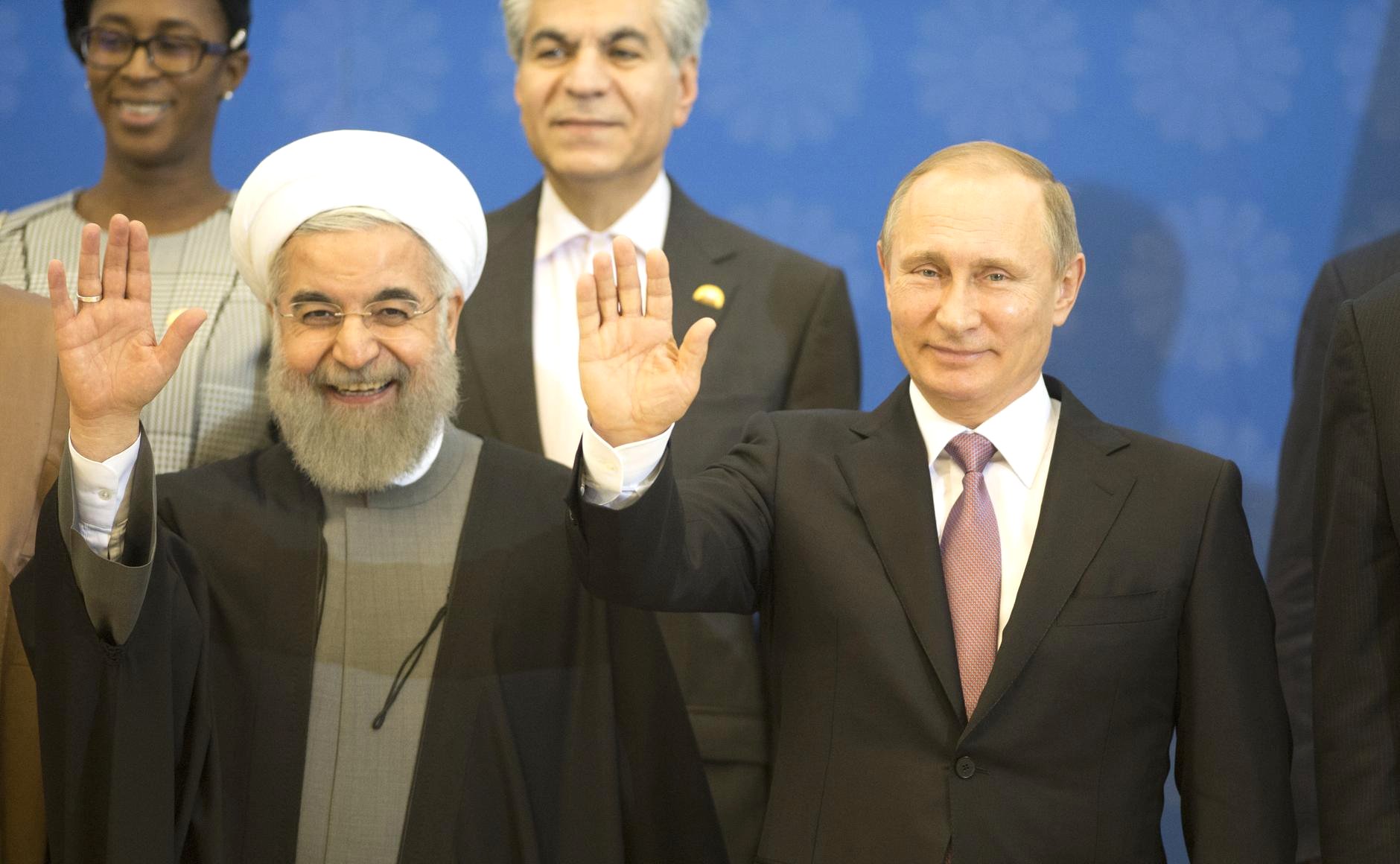
Tasnim: It seems that recent advances of the Syrian army and its allied forces against foreign-backed terrorist groups like Daesh (ISIS or ISIL) in the Arab country have infuriated the Israeli regime. A senior Israeli official has issued a warning to Russia that the Israeli military will bomb Syrian President Bashar Assad’s palace in Damascus if Russia allows Iran to make military advances in Syria, according to media reports. The official added another caution in the Al-Hayat al-Jadida newspaper that if regional changes don’t take place in the current advance by Iran, Israel will act to scuttle the Syrian ceasefire deal recently concluded by the US and Russian governments. The warnings came during a meeting last week on the Black Sea between Israeli Prime Minister Benjamin Netanyahu and Russian President Vladimir Putin. In your opinion, what is the reason behind the Israeli officials’ concerns?
Kortkamp: I believe this is an exceedingly dangerous time in the Syrian conflict; Israel is in a panic right now with the victory in the strategic Qalamoun region over Daesh. Israel’s goal has been to keep the war in Syria going indefinitely – for it to bleed to death – to weaken the Syrian Arab Republic (SAR) and Hezbollah just as they had wanted the war in Iraq to weaken both it and Iran. The opposite outcome has occurred with Hezbollah stronger and more respected than ever; the alliance and coordination between Syria, Hezbollah, Iran, and Russia also stronger; Iraq is also cooperating in many regards with that alliance, and President Putin is now seen as the predominant global strategist. Another factor is that Prime Minister Netanyahu is under investigation for fraud and corruption and a war would probably distract Israelis from pursuing an indictment. Netanyahu’s emotional entreaties to President Putin seemed to have fallen on deaf ears according to Pravda’s report of August 25 on the meeting, saying Israel’s Prime Minister failed to convince President Putin on the need to stop “Iran’s expansion in the Middle East.” In fact, the report stated the Kremlin is “interested to further strengthen Tehran’s influence in the region.” A trapped predator is the most dangerous however and many analysts, including former CIA operations operator who writes on these topics, Philip Giraldi, are predicting a preemptive strike against an Iranian target in Syria, which might escalate into greater involvement by the United States against Syria on Israel’s behalf.
Tasnim: As you may know, a US helicopter has recently transferred members of the Daesh terrorist group in Syria’s eastern province of Deir ez-Zor for the second time in a week, according to a UK-based monitoring group called Syrian Observatory for Human Rights (SOHR). The SOHR said the airlift was conducted in the town of al-Tabani. Measures taken by Washington up to now indicate that it has been seeking to destabilize the Arab country by arming and supporting the terrorists under the disguise of anti-terrorism coalition. What do you think about these developments?
Kortkamp: There are several points to consider:
1) I do not think of the SOHR as a credible resource, however that action would be consistent with other US actions in both Syria and Iraq so it could well be true.
2) The two previous administrations have held the goal of destabilizing Syria using covert pressure as well as through proxy forces armed and funded by the West’s allies in the Persian Gulf countries and Turkey. Little seems to have changed under President Trump, with the new administration putting considerable resources into supporting America’s latest “rebel” force – the SDF.
3) The support for Kurdish and other separatists is troubling and seems to indicate continued US commitment to dividing the northern part of Syria off which would be in line with Israel’s desires – it is no coincidence separatists are waving Israeli flags at rallies. President Trump has surrounded himself with advisors whose interests are “Israel first” and using military action to achieve it. UN Ambassador Nikki Haley discusses eliminating Iran from Syria as the only priority there and Jared Kushner is clearly under Netanyahu’s influence.
4) Top Israeli defense chiefs were in Washington recently to discuss Syria and they reiterated what anyone following this conflict knows, that the outcome of the war in Syria will reshape the region. It doesn’t appear though that the delegation from Tel Aviv went home with many reassurances.
5) President Trump’s turning over of the Afghanistan conflict to his generals is also troubling as it is in their interest to prolong every war and to create new ones. The Israeli delegation also put pressure on Washington to remain in and strengthen forces in Afghanistan.
6) All that being said, no one knows what was discussed between President Putin and President Trump. Netanyahu’s panic may be the most hopeful sign that his incessant warnings regarding “Iranian expansion” may finally be losing their stranglehold over Washington.
Tasnim: Iranian Deputy Foreign Minister for Arab and African Affairs Hossein Jaberi Ansari said on Monday that the next round of Syria peace talks in Kazakhstan’s capital city of Astana would be held in mid-September. What is your assessment about the previous rounds of the talks between Tehran, Moscow, and Ankara on the Syrian crisis? And what is your prediction about the result of the next round?
Kortkamp: The current agreement has allowed Syrian and allied forces to make considerable gains over the past months so I am hopeful the next round of talks may also be effective. I would never consider President Erdogan a trustworthy alliance member but the strength of Russia and Iran seems to have curtailed his actions against Syria.
Once again, everything is in the balance and the tipping point is Syria. Saudi Arabia is receiving greater criticism of their war against Yemen; their proxies in Syria are crumbling, and there is a deep schism now between them and Qatar. Israel is seeing their many-decades long plan for hegemony in the region failing.
The stakes are so very high. We are facing a possible regional conflagration that could dwarf the horrific wars of the past 13 years and ignite a global conflict, or the US and its allies may back down from Syria and let a much-needed balance occur in the region.
Janice Kortkamp became an independent, completely self-funded, journalist after “seeing Western media bias regarding Syria and how that bias was promoting war and destabilization in Syria and all the Levant”. She has researched the current crisis for over four years, putting in over 6,000 hours of study. She has visited Syria three times over the past year, spending three months traveling around the major population areas and the outskirts of Damascus, Homs, Latakia (including Kessab) and Aleppo. She has also gone to Germany, Lebanon, and Kuwait to meet with Syrian refugees and emigrants. Through friends and contacts in Syria as well as reports from genuine news sources around the world, she tracks the situation on the ground in Syria on an hourly basis.
After years of fomenting the Syrian conflict from the shadows, the U.S. has recently seemed to back away from its push to militarily intervene in the embattled nation, instead choosing to focus its saber-rattling and destabilization efforts on other theaters. The consequence of this has seemingly been the winding down of the long-running conflict, now entering its seventh year.
Buoyed by Russia, Iran and Lebanon, the Syrian government led by President Bashar al-Assad has managed to retake vast swaths of territory, all while surviving and growing stronger over the course of a largely foreign-funded onslaught. As a result, many of the governments that were instrumental in funding and arming the so-called “moderate” opposition have begun to extricate themselves, unwilling to further test the resilience of Assad or the Syrian people.
With some anticipating the long-awaited conclusion of the Syrian conflict, recent threats from Israel’s government to assassinate Assad by bombing his residence seemed to appear out of the blue. According to theJerusalem Post, a senior Israeli official accompanying Israeli Prime Minister Benjamin Netanyahu on a recent visit to Russia warned the Kremlin that if Iran continues to “extend its reach” in Syria, Israel would bomb the presidential palace in Damascus.
Israel’s comments should come as no surprise, however, as the foreign-funded and manufactured conflict in Syria was always Israel’s war. The only real surprise is Israel’s growing isolation in pushing for the further escalation of the conflict.
WikiLeaks sheds light on the origins of the war
Though it has successfully avoided being labeled a major player in the effort to oust Assad, Israel has long been the mastermind of the plan, which stems in large part from the long-standing hostilities between the two nations as well as Israel’s own regional ambitions. State Department diplomatic cables released by WikiLeaks have shown that in 2006, five years before the conflict in Syria manifested, the government of Israel had hatched a plan to overthrow the Assad government by engineering sectarian strife in the country, creating paranoia within the highest-ranks of the Syrian government, and isolating Syria from its strongest regional ally, Iran.
Israel then passed this plan along to the United States, which would then involve Saudi Arabia, Turkey, Qatar and Egypt in fomenting the “breakdown” of the Assad regime as a way of weakening both Iran and Hezbollah — with the effect of empowering both Israel and the Gulf monarchies, two seemingly disparate forces in the region that are becoming increasingly allied.
Leaked emails belonging to former Secretary of State Hillary Clinton further reveal Israel’s role in covertly creating the conflict and its clear role in securing the involvement of the U.S. and other nations in executing its plan for Assad’s removal. One email, forwarded by Clinton to her advisor Jacob Sullivan, argues that Israel is convinced that Iran would lose “its only ally” in the region were Assad’s government to collapse.
It further stated that “The fall of the House of Assad could well ignite a sectarian war between the Shiites and the majority Sunnis of the region drawing in Iran, which, in the view of Israeli commanders would not be a bad thing for Israel and its Western allies.” This possible sectarian war was perceived as a potential “factor in the eventual fall of the current government of Iran.”
“The best way to help Israel deal with Iran’s growing nuclear capability is to help the people of Syria overthrow the regime of Bashar Assad,
Adding
Bringing down Assad would not only be a massive boon to Israel’s security, it would also ease Israel’s understandable fear of losing its nuclear monopoly.”
The email also notes:
A successful intervention in Syria would require substantial diplomatic and military leadership from the United States” and states that “arming the Syrian rebels and using western air power to ground Syrian helicopters and airplanes is a low-cost high payoff approach.”
Read the full Wikileaks release below:
Stated plainly, the U.S.’ decision to spend over $1 billion until 2015 to arm Syria’s terrorist-linked “rebels” — and to invoke the assistance of Wahhabi terrorism exporters like Saudi Arabia and Qatar in funneling weapons and funds to these same groups — was spurred by Israel, which not only drafted the original blueprint for the Syrian conflict but guided U.S. involvement by exerting its powerful influence over the foreign policy of that country.
Aiding the Rebels
Israel did more, however, than covertly instigate and guide the funding of opposition “rebels” — having secretly funded and aided opposition groups, including ones with overt terrorist affiliations, over the course of the six-year-long conflict.
Israeli involvement in direct funding and aiding the Syrian “rebels” was suspected for years before being officially made public by the Wall Street Journal in June of this year. The report revealed that Israel, since the beginning of the conflict, had been “supplying Syrian rebels near its border with cash as well as food, fuel, and medical supplies for years, a secret engagement in the enemy country’s civil war aimed at carving out a buffer zone populated by friendly forces.” Israel has also frequently brought wounded “rebels” into Israel for medical treatment, a policy it often touts as a “humanitarian effort.”
These “friendly” forces were armed groups that formed part of or were allied with al-Nusra Front, al-Qaeda’s Syrian branch, known for committing atrocities against thousands of Syrian civilians and slaughtering religious and ethnic minorities. Since 2013, al-Qaeda-affiliated terrorist groups have dominated the “eight-square-kilometer separation zone on the Golan.” Israel has stated officially that these fighters are part of the U.S. coalition-supported Free Syrian Army (FSA). However, it has long been known that the vast majority of the groups comprising FSA have pledged allegiance to the al-Qaeda-affiliated al-Nusra Front, and that those who still fight under the FSA banner meet with al-Nusra on a daily basis.
Israel’s support for terrorist groups went far beyond medical treatment, food supplies and cash. The Israeli army was also found to have been in regular communication with these terrorist groups and even helped “pay salaries of fighters and buy ammunition and weapons.” In addition, when the positions of the “rebel” groups it funded, armed and paid were in danger of being overtaken by Syrian government forces, Israel stepped in to directly bomb Syrian targets. For instance, in June, Israel attacked several Syrian military positions after claiming a stray mortar had landed within the boundaries of the Golan Heights, part of Syria that has long been occupied by Israel. However, the attack tellingly coincided with Syrian army advancements against the “rebel” groups that Israel has long cultivated as part of the so-called “buffer zone.”
Furthermore, Israel has launched attacks inside Syria “dozens and dozens of times,” according to a recent admission by Netanyahu. Earlier this year, Israel also threatened to “destroy” Syrian air defenses after the Syrian army fired missiles at Israeli warplanes striking targets within Syria.
Also very telling has been Israel’s position on Daesh (ISIS). In June of last year, Israel’s military intelligence chief, Major General Herzi Halevi, openly stated that Israel does not want to see Daesh defeated in Syria — expressing concern about the offensives against Daesh territory and lamenting their “most difficult” situation. Prior to Halevi’s comments, Israeli officials had regularly noted that Daesh conquering the whole of Syria would be preferable to the survival of the Assad government. These comments have been echoed by Israeli and NATO-affiliated think tanks, one of which called Daesh “a useful tool in undermining” Iran, Hezbollah, Syria and Russia — despite Daesh’s barbaric tactics, war crimes, enslavement of women and ethnic cleansing efforts.
Israel’s larger geopolitical agenda
Though Israel’s support of Wahhabi terrorists like Daesh (ISIS) and al-Nusra may seem counter-intuitive, Israel’s overarching purpose in expelling Assad from power is based on strategic geopolitical and economic goals that Israel is determined to meet at any cost. While Israel frequently mentions Iran as the pretext for its involvement in Syria, the strongest motivators for Israel’s participation in the destruction of its northern neighbor are oil and territorial expansion.
One of Israel’s clearest reasons for being interested in the destabilization of Syria is its ability to assert further control of the Golan Heights, an area of Syria that Israel has illegally occupied since 1967 and annexed in 1981. Despite filling the area with illegal settlements and military assets, Israel has been unable to convince the international community, and even its close allies such as the U.S., to recognize its sovereignty over the territory. However, the conflict in Syria has proven beneficial to this end, allowing Israel to send even more settlers into the Golan, an estimated 100,000 over five years.
Israel is largely interested in gaining control over the Golan for economic reasons, owing to the occupied territory’s oil reserves, which are estimated to contain “billions of barrels.” Under the cover of the Syrian conflict, the Israeli branch of an American oil company — whose investors include Dick Cheney, Jacob Rothschild and Rupert Murdoch — has been drilling exploratory wells throughout the region, as the Heights’ uncertain territorial status prevents Israel from financially exploiting the resource.
Despite the prohibitions of international law, Israel is eager to tap into those reserves, as they have the potential to “make Israel energy self-sufficient.” Israel has even offered, per the Galant plan, to “rebuild” Syria with billions in U.S. taxpayer dollars in exchange for the Golan Heights — though the plan received a tepid reception from all involved parties other than Israel itself.
As its stands, Assad’s removal and replacement with a government friendly to Israeli and Western interests is Israel’s only real means of claiming the Golan Height’s energy resources for itself.
Pawns blocking Israel’s endgame
Aside from the oil and the territory it seeks to gain in the Golan Heights, Israel is also seeking to expand well beyond that territory in order to more widely exert its influence and become the region’s “superpower.” This ambition is described in the Yinon Plan, a strategy intended to ensure Israel’s regional superiority in the Middle East that chiefly involves reconfiguring the entire Arab world into smaller and weaker sectarian states. This has manifested in Israel’s support for the partition of Iraq as well as Syria, abetted by its support for the establishment of a separatist Kurdish state within these two nations.
This goal, in particular, largely explains Israel’s obsession with curbing Iranian influence in the Middle East, whether in Syria or elsewhere. Iran – more than any other nation in the region – is the most likely to threaten the “superpower” status that Israel seeks to gain for itself, as well as Israel’s loss of monopoly as the region’s only nuclear power.
Given Israel’s compound interests in seeing the removal of Assad and the partition of Syria, it is hardly surprising that Israeli political rhetoric has reached new heights of saber-rattling as Tel Aviv becomes increasingly concerned that the conflict it masterminded could backfire. Prior to the explosive comments regarding Israeli threats to bomb Assad’s residence, an anonymous Israeli government minister blamed the U.S. for backing out of Syria, a move he argued sacrificed Israeli interests:
The United States threw Israel under the bus for the second time in a row. The first time was the nuclear agreement with Iran, the second time is now that the United States ignores the fact that Iran is obtaining territorial continuity to the Mediterranean Sea and Israel’s northern border [through Syria].”
Not only that but Israel has recently vowed to “nullify” the ceasefire deal brokered between Russia and the U.S. with Syrian and Iranian support if it fails to comply with Israel’s needs — an ultimatum based on rather subjective terms given that “Israel’s needs” are hardly static. Israel’s response again shows the perception among officials in Tel Aviv that the Syrian conflict is of primary importance to Israeli geopolitical interests.
Furthermore, given that the response suggested so far by Israeli officials – on more than one occasion – has been to assassinate Syria’s democratically-elected President – the contemplated means of Israel “nullifying” the ceasefire deal will likely have explosive implications. Israel — apparently refusing to accept that the conflict it orchestrated is not going, and may not end, as planned — is now willing to escalate the situation militarily, with or without allies, resorting to dangerous brinkmanship with global implications.
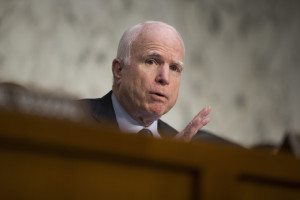
For many years, John McCain has been one of the major war hawks in the Senate, but he was not that way for more than a decade after he was first elected to Congress. When he entered the House of Representatives in 1983, he was a cautious realist, holding the position that U.S. military power should only be used to protect vital national interests. He developed this view as a result of his experience in the Vietnam War and his post-Vietnam studying of the origins of that war at the National War College.[1] That view loomed large among military leaders at this time and was exemplified by General Colin Powell.
In his first year in Congress, McCain, although a strong supporter of then President Reagan, voted against the latter’s decision to continue the deployment of troops in Lebanon during that country’s civil war. The measure would pass in both Houses of Congress, with substantial support from Democrats, and with only a small minority of Republicans daring to oppose Reagan. In his floor speech on this issue, McCain stated:
“The fundamental question is: What is the United States’ interest in Lebanon? It is said we are there to keep the peace. I ask, what peace? It is said we are there to aid the government. I ask, what government? It is said we are there to stabilize the region. I ask, how can the U.S. presence stabilize the region? . . . . The longer we stay in Lebanon, the harder it will be for us to leave. We will be trapped by the case we make for having our troops there in the first place.
“What can we expect if we withdraw from Lebanon? The same as will happen if we stay. I acknowledge that the level of fighting will increase if we leave. I regretfully acknowledge that many innocent civilians will be hurt. But I firmly believe this will happen in any event.”[2]
After a truck filled with explosives rammed into the Marine compound in Beirut, killing 241 service members, Reagan opted to remove the remaining troops a few months later. McCain was vindicated and he gained considerable attention from the mainstream media for his prescience and courage to take such a stand against a popular President from his party. This helped to develop his reputation as a “maverick.”
“The American people and Congress now appreciate that we are neither omniscient nor omnipotent,” McCain would later tell the Los Angeles Times, “and they are not prepared to commit U.S. troops to combat unless there is a clear U.S. national security interest involved. If we do become involved in combat, that involvement must be of relatively short duration and must be readily explained to the man in the street in one or two sentences.”[3]
In 1987, during the Iran-Iraq War, in which the United States was supporting Iraq, McCain, now a Senator, opposed President Reagan’s move to put American flags on Kuwaiti oil tankers and have the U.S. Navy protect them against possible Iranian attacks. In the Arizona Republican, he described Reagan’s action as a “dangerous overreaction in perhaps the most violent and unpredictable region in the world.” He continued: “American citizens are again being asked to place themselves between warring Middle East factions, with no tangible allied support and no real plan on how to respond if the situation escalates.”[4]
McCain did support the Gulf War in 1991, but even here he was something of a moderate. McCain biographer Matt Welch writes: “When Saddam Hussein invaded Kuwait in the summer of 1990, McCain oscillated between hawkishness and reluctance, denouncing the Iraqi dictator and then the U.S. government for having cozied up too closely to Hussein during the Iran-Iraq war, but at the same time warning against a protracted land battle.”[5] McCain stated: “If you get involved in a major ground war in the Saudi desert, I think support will erode significantly. Nor should it be supported. We cannot even contemplate, in my view, trading American blood for Iraqi blood.”[6]
Under Republican Presidents Reagan and the elder Bush, it must be acknowledged that McCain was not an actual non-interventionist since he supported the American opposition to the Soviet Union, and what he considered to be pro-Soviet forces in Central America. Moreover, he supported the removal of Panamanian dictator Manuel Noriega by the U.S. military in 1989. But this was still a far cry from the global interventionist that McCain would become.
Moreover, during Bill Clinton’s presidency, McCain would be even more non-interventionist until his radical change during the last years of Clinton’s term. In a commencement address he made to the Marine Corps Command and Staff College in Quantico, Virginia in June 1994, McCain emphasized that his cautious approach to war resulted from his Vietnam experience. He solemnly orated that he had not forgotten “the friends who did not return with me to the country we loved so dearly. The memory of them, of what they bore for honor and country, causes me to look in every prospective conflict for the shadow of Vietnam.”[7]
In December 1992, after losing the November election to Bill Clinton, the elder George Bush dispatched American troops to Somalia, then embroiled in a many-sided civil war, to facilitate the provision of food to the starving civilian population. This was part of a United Nations effort. By the fall of 1993, this military mission morphed into one of arresting war lords and nation-building. In October 1993, a 15-hour battle took place in Mogadishu that left 18 Americans dead and 73 injured, with many of these casualties the result of two Black Hawk helicopters being shot down.[8]
Because of this loss of American lives, there was a Senate bill supported by President Clinton which planned to remove American troops from Somalia. Demanding a quicker troop exit, McCain stated: “Mr. President, can anyone seriously argue that another six months of United States forces in harm’s way means the difference between peace and prosperity in Somalia and war and starvation there? Is that very dim prospect worth one more American life? No, it is not.”
Drawing an analogy to what happened in Lebanon in 1983, McCain contended: “240 young Marines lost their lives, but we got out. Now is the time for us to get out of Somalia, as rapidly, and as promptly, and as safely as possible.”
“The longer we stay the more difficult it will be to leave,” McCain asserted. “The loss of American lives is not only tragic, it is needless.”[9] His proposed amendment for a quicker departure, however, was voted down.
McCain also opposed Clinton’s intervention in Haiti to bring back President Jean-Bertrand Aristide, who had been elected in 1990 and then overthrown in a coup in 1991. After a UN resolution authorized the use of military force to return Aristide to power, the United States would ultimately do so on October 15, 1994. In late August 1994, McCain declared: “It is the post-invasion circumstances that I fear will bog down U.S. forces in a low-level, open-ended, ill-defined conflict which will require U.S. servicemen and women to serve as a virtual palace guard for President Aristide once he is returned to power.”[10]
The major international concern in the 1990s was the conflict in Yugoslavia—with the focus first on Bosnia and then Kosovo. After the downfall of Communism, Yugoslavia dissolved, with the secession, in 1992, of Croatia, Macedonia and Slovenia. Bosnia also declared its independence despite the staunch opposition of Bosnian Serbs, who wanted to remain united with Serbia. Civil war broke out between the Bosnian Serbs, supported by Serbia, and the Muslim-dominated Bosnian government. Thousands of people were killed, raped, and expelled from their homes. The West generally looked upon the atrocities, real and imagined, as being primarily perpetrated by the Serbs. In the United States, this was especially the case among American liberals who would advocate “humanitarian” military intervention to protect the Muslims.
In 1992, the UN peacekeeping forces intervened for humanitarian reasons and set up several so-called safe areas for refugees, which often turned out to be not very safe. The UN forces were composed of non-American troops, while American ships and airplanes enforced an arms embargo.
The wars in Yugoslavia would ultimately lead to a sea change in McCain’s position on American military intervention, but this did not occur all at once. Initially, McCain was, like many Republicans, opposed to American involvement in the conflict. In fact, biographer Matt Welch describes McCain as having been “one of the Senate’s most stubborn opponents to US military intervention against Serbs.”[11] McCain contended that any American military “peace-keeping” effort in Bosnia would likely lead to a quagmire. “I think you can draw a parallel to the military challenge in Bosnia with what the Russians faced in Afghanistan,” McCain opined in May 1993. “Even with ground forces and with overwhelming air superiority, they were unable to defeat a motivated, very capable enemy.”[12]
In December 1994, McCain, whom the Los Angeles Times described as a “a leading opponent of greater American military involvement in the war,” stated: “I think we have a very full plate of a legislative agenda, which are the commitments we made to the American people–and Bosnia wasn’t one of those.”[13] In May 1995, McCain held that U.S. efforts in the Balkans were “doomed to failure from the beginning, when we believed that we could keep peace in a place where there was no peace.”[14] Neocon Robert Kagan bemoaned the fact that on Bosnia, Senator McCain led the Republican attack, warning that any use of military power there would result in “another failure like Vietnam or Lebanon.”[15]
Prospects for peace, however, improved in the summer of 1995 when NATO, led by the United States, launched airstrikes against Bosnian Serb targets, which combined with better-equipped Muslim and Croatian forces pressured the Bosnian Serbs into participating in peace negotiations. This led to the Dayton Accords in November 1995, which ended the war in Bosnia. NATO would provide peace-keeping troops, including 20,000 from the U.S.
After NATO’s success, McCain quickly dropped his staunch anti-interventionist position. McCain later claimed that his position had begun to change as a moral reaction to the Serbs’ massacre of thousands of unarmed Bosnian Muslims in July 1995.[16] While most Republican members of Congress were opposed to sending American troops to Bosnia, McCain joined Senator Robert Dole (Republican—Kansas) in putting forth the nonbinding Dole-McCain resolution which permitted Clinton to send troops, though limiting the deployment to one year–which was Clinton’s stated time period—and requiring the United States to lead an effort to arm and train Bosnian troops. The resolution passed in the Senate but was not taken up in the House.[17]
Showing that he had not completely dropped his previous cautious approach to intervention, McCain emphasized that the Dole-McCain resolution was not seeking support for President Clinton’s decision to deploy the troops. “It asks that you support the deployment after the decision has been made,” he said. “The decision has been made by the only American elected to make such decisions [i.e., the President].” However, McCain also expressed a firm interventionist conviction: “When we arrive at the moment when less is expected from our leadership by the rest of the world, then we will have arrived at the moment of our decline.” And he said, “We cannot withdraw from the world into our prosperity and comfort and hope to keep those blessings.”[18]
While a change from his previous strong opposition to American intervention abroad, supporting this peace effort in Bosnia did not portend McCain’s radical transmutation to the global super-hawk that he would become. That final step would require the involvement of the neoconservatives. This connection began when, in 1997, McCain and his advisers read an article in the Wall Street Journal editorial page by neoconservatives Bill Kristol and David Brooks who were promoting the idea of “national greatness” conservatism, which consisted of a more activist domestic agenda and a more interventionist global role.[19]
While this article may have fit in with the direction that McCain’s thinking was moving, it had political implications as well: McCain had been eyeing the presidency for a number of years. According to John Weaver, a major political adviser to McCain at this time: “I wouldn’t call it a ‘eureka’ moment, but there was a sense that this is where we are headed and this is what we are trying to articulate and they [Kristol and Brooks] have already done a lot of the work. . . . And, quite frankly, from a crass political point of view, we were in the making-friends business. The Weekly Standard represented a part of the primary electorate that we could get.”[20] And it should be emphasized that McCain’s change was not a gradual one but rather one that was quite radical and took place in a very short period of time.
After reading this article, McCain and staff were consulting regularly with leading neocons, including Kristol, Robert Kagan, and Randy Scheunemann[21], to, in the words of journalist David Kirkpatrick, “develop the senator’s foreign policy ideas and instincts into the broad themes of a presidential campaign.”[22] In short, McCain realized that he needed the neocons’ intellectual and political support if he were to achieve higher office. The neocons were already well-known and had played a significant role in the Reagan administration. And during the Clinton years, neocons promoted their views from a strong interlocking network of think tanks which have had a significant influence in shaping American foreign policy.
McCain would begin to support neocon positions. On January 26, 1998, the neocon-dominated Project for a New American Century (PNAC), created in 1997 and headed by Bill Kristol, sent a letter to President Clinton urging him to take unilateral military action against Iraq to overthrow Saddam and offered a plan to achieve that objective. After the Clinton administration failed to take action, another neocon-front group, the resurrected Committee for Peace and Security in the Gulf, which had promoted the 1991 Gulf War, sent another letter urging war. And, because of Clinton’s continued inaction, PNAC would send another such letter in May.
While President Clinton failed to take action, McCain pushed for military action against Saddam in 1998. McCain co-sponsored the Iraq Liberation Act, committing the United States to support the overthrow of Saddam and funding opposition groups, most importantly the Iraqi National Congress. Headed by the notorious neocon-favorite Ahmed Chalabi, the Iraqi National Congress would provide much of the spurious information that generated support for the war on Iraq in 2003. The bill passed in both houses of Congress and on October 31, 1998, President Clinton signed it into law. Clinton, however, did not intend to implement this measure and George Bush made no mention of it during the 2000 campaign.[23] McCain, however, remained in lock-step with the neocons on Iraq and would be made Honorary Co-chair of the Committee for the Liberation of Iraq when it was created in 2002.
McCain had been in line with the neocons as a strong supporter of Israel even during the time he adhered to a cautious realist position regarding U.S. military interventionism. He was the 1999 recipient of the Defender of Jerusalem award, given by the National Council of Young Israel. In his acceptance speech, McCain in effect told his pro-Zionist audience that the United States should be prepared to make war for Israel’s sake. “Certainly, no one would argue with the proposition that our armed forces exist first and foremost for the defense of the United States and its vital interests abroad,” McCain intoned. “We choose, as a nation, however, to intervene militarily abroad in defense of the moral values that are at the center of our national conscientiousness even when vital national interests are not necessarily at stake. I raise this point because it lies at the heart of this nation’s approach to Israel. The survival of Israel is one of this country’s most important moral commitments. . . . Like the United States, Israel is more than a nation; it is an ideal.”[24] Note that this was diametrically opposed to his former view that American intervention abroad should only take place to protect vital American interests.
However, it was not Iraq or any of Israel’s enemies that put McCain in the national limelight but rather the U.S.-led NATO war on Serbia over Kosovo in 1999. As Washington Post staff writer Dan Balz wrote in early April 1999, “no politician has been more visible on the issue of Kosovo the past two weeks than the former Vietnam prisoner of war, and a number of political analysts say his performance has given a boost to his presidential aspirations.”[25]
President Clinton orchestrated the NATO war on Serbia, because of the Serbs “ethnic cleansing” of Muslims in their territory of Kosovo. Since Serbia could not possibly threaten the United States, the war was presented as being largely for humanitarian reasons. At this time, there were all types of stories of Serb mass killings of Kosovars, with figures up to 100,000 Kosovar civilians being missing and conceivably murdered.[26] Physical evidence for these extreme claims was not found and former Yugoslav president Slobodan Milosevic was not even charged with crimes of such great magnitude at his trial before the International Criminal Tribunal for the former Yugoslavia (ICTY). And according to German government documents no “ethnic cleansing” of Kosovar Albanians took place until after the NATO bombing.[27]
Unlike many Republicans, McCain supported Clinton’s decision for war. But while Clinton limited American actions to air strikes, McCain maintained that it was essential to win this military confrontation at all costs and called on the Clinton Administration to deploy ground troops if the reliance on air strikes alone appeared to be insufficient to achieve victory.[28]
McCain thus sponsored a resolution that would have given President Clinton congressional authorization to use all means necessary to win the military campaign in Kosovo. The leaders of both parties opposed this resolution and it was tabled. McCain complained: “The president doesn’t want the power he possesses by law because the risks inherent in its exercise have paralyzed him.”[29]
McCain’s hawkish position reflected the views of the neoconservatives. And obviously, his pro-intervention stance represented a sea change from his previous emphasis on caution and support of war only if it involved a vital American interest.
Members of the interventionist Balkan Action Committee, which advocated NATO ground troops for Kosovo, included such prominent neoconservative mainstays as Richard Perle, Max M. Kampelman, Morton Abramowitz, and Paul Wolfowitz. Other neoconservative proponents of a tougher war included Eliot Cohen, Elliott Abrams, John Bolton, Bill Kristol, Robert Kagan, and Norman Podhoretz.[30]
Largely because of his bellicose position on Kosovo, McCain was the favorite presidential candidate for many leading neoconservatives in 2000. As Franklin Foer, editor of the liberal New Republic, put it: “Jewish neoconservatives have fallen hard for John McCain. It’s not just unabashed swooner William Kristol, editor of The Weekly Standard. McCain has also won over such leading neocon lights as David Brooks, the entire Podhoretz family, The Wall Street Journal‘s Dorothy Rabinowitz, and columnist Charles Krauthammer, who declared, in a most un-Semitic flourish, ‘He suffered for our sins.’”[31]
McCain was especially championed by Bill Kristol, editor of the Weekly Standard, and his associate David Brooks. They held that McCain would promote their idea of “national greatness,” as opposed to what they regarded as the standpatness of the conservative Republicans. The “national greatness” program would entail a greater role for the federal government and more extensive intervention throughout the world to promote American values.
Neoconservatives admired McCain for his support of the American war on Serbia, toward which many mainstream conservatives were decidedly cool. The attack on Serbia, ostensibly for humanitarian reasons, provided the intellectual groundwork for the attack on Iraq, the neocons’ fundamental target, since it set the precedent of violating international law’s prohibition against initiating offensive wars. No longer would the United States have to be attacked, or even threatened, to engage in war. As Kristol and Brooks put it: “For all his conventional political views, McCain embodies a set of virtues that today are unconventional. The issue that gave the McCain campaign its initial boost was Kosovo. He argued that America as a great champion of democracy and decency could not fail to act. And he supported his commander in chief despite grave doubts about the conduct of the war–while George W. Bush sat out the debate and Republicans on the Hill flailed at Clinton.”[32]
But the neocons did not support McCain simply because of his defense of the Kosovars, but rather because of his broader interventionist position of “rogue state rollback,” which pointed directly at the enemies of Israel. While participating in a Republican debate moderated by CNN’s Larry King on February. 15, 2000, the candidates were asked: “What area of American international policy would you change immediately as president?” McCain replied: “I’d institute a policy that I call ‘rogue state rollback.’ I would arm, train, equip, both from without and from within, forces that would eventually overthrow the governments and install free and democratically-elected governments.” And he added: “As long as Saddam Hussein is in power, I am convinced that he will pose a threat to our security.”[33]
What caused McCain’s radical shift from cautious realist to super hawk? Biographer Matt Welch sees it as essentially a return to his basic world view, largely derived from the family’s military background, after the non-interventionist effect of the Vietnam Syndrome. Welch writes: “But much less understood is the extent to which interventionist hegemony has been literally seared into McCain’s skull and then reignited late in life after the long intellectual detour of Vietnam.”[34]
Justin Raimondo sees it otherwise: “It is impossible to know what is in McCain’s heart. There may be a purely ideological explanation for his changing viewpoint. But what seems to account for his evolution from realism to hopped-up interventionism is nothing more than sheer ambition.” He goes on: “He was positioning himself against his own party, while staking out a distinctive stance independent of the Democrats. It was, in short, an instance of a presidential candidate maneuvering himself to increase his appeal to the electorate—and, most importantly, the media.”[35]
In an article in Rolling Stone, Tim Dickerson expresses a view similar to that of Raimondo, describing McCain as “a man willing to say and do anything to achieve his ultimate ambition: to become commander in chief, ascending to the one position that would finally enable him to outrank his four-star father and grandfather.” Dickerson continues: “Few politicians have so actively, or successfully, crafted their own myth of greatness.”[36]
McCain has flip-flopped on domestic issues, sometimes supporting a conservative position and at other times a more liberal one which wins him the plaudits of the mainstream media—but once he moved into the neocon orbit regarding U.S. foreign policy, he has stayed there. It is obviously beneficial for a politician to have the broad neocon network of organizations on one’s side. And more than a few of these neocons—such as Bill Kristol, Robert Kagan, David Brooks, are featured regularly in the mainstream media. Moreover, the mainstream liberal media itself has adopted many neocon interventionist positions in foreign policy in regard to Russia and the Middle East, so McCain’s positions are held in esteem there, too.
So while McCain portrays himself as a “maverick” and “straight-talker” who is above politics– and this image is largely accepted by the mainstream media—it would seem most likely that his political positions have been adopted to advance his own political interests.[37] While this approach did not enable him to become President, it did serve to make him something of a public icon, which is a position few politicians attain. However, the war-oriented policies he has advocated have been disastrous for the United States. It is only fortunate that John McCain has not attained the power to have his positions adopted in their entirety.
United Nations watchdogs have said that they don’t believe it necessary to search Iranian military sites to verify that they are in compliance with the 2015 Iran nuclear agreement, as they do not suspect any misdoings on the facilities. The US has strongly pushed the UN to inspect Iranian military sites, which have not been investigated thus far.
Over the weekend, US Ambassador to the United Nations Nikki Haley met with officials from the International Atomic Energy Agency (IAEA), the UN-affiliated international organization whose stated purpose is to promote the peaceful, non-military use of nuclear technology. The IAEA has been tasked with ensuring that Tehran abide by their terms of the 2015 Joint Comprehensive Plan of Action (JCPOA) and not produce weapons-grade plutonium or enriched uranium that could be used for nuclear weapons.
Part of the agreement was that the IAEA could send inspectors to Iranian sites, including military ones, if they believed that illegal nuclear activities were being undertaken there. Iran has traditionally been cagey about letting international inspectors into their military complexes to check for nuclear activity, citing national security concerns.
But the administration of US President Donald Trump has been very negative about the JCPOA, which was negotiated in part by Trump’s predecessor, Barack Obama. The hyperbolic American president once called the JCPOA the “worst deal ever negotiated.”
Haley expounded: “They have a very strong verification program in Iran, I was pleased to hear about all that they are doing. Having said that, as good as the IAEA is, it can only be as good as what they are permitted to see. Iran has publicly declared that it will not allow access to military sites, but the JCPOA makes no distinction between military and non-military sites.”
“There are also numerous undeclared sites that have not been inspected yet — that’s a problem,” she said. “I have good confidence in the IAEA, but they are dealing with a country that has a clear history of lying and pursuing covert nuclear programs.”
But IAEA officials declined Washington’s request. “We’re not going to visit a military site like Parchin just to send a political signal,” an anonymous IAEA official told Reuters, referring to the controversial Iranian military base that the IAEA last inspected in 2015.
Instead, IAEA officials stated, they would search only if they suspected Iranian misdoing. The JCPOA only allows for IAEA searches if they can provide a basis for their concerns. Another anonymous IAEA official told Reuters that they hadn’t asked for access to Iranian military sites because they had “no reason to.”
IAEA Director General Yukiya Amano frequently describes his agency as an apolitical one, only concerned with ensuring that states are not engaging in nuclear mischief.
Meanwhile, the US State Department issues a statement to Congress every 90 days regarding whether or not Iran is still in compliance with the JCPOA. Trump has pushed for the State Department to declare Iran noncompliant.
However, the UN, the IAEA, France and Russia have all pushed to keep the JCPOA, and for the US to declare Iran compliant. France and Russia also signed the JCPOA, along with the United Kingdom, China and Germany — and, of course, Iran and the US.
“If [the Trump administration] want to bring down the deal, they will,” the first IAEA official said. “We just don’t want to give them an excuse to.”
Speech by Hezbollah Secretary General Sayed Hassan Nasrallah on 28 August 2017 on the occasion of the Second Liberation, following the complete surrender of the terrorists of Daech and Al-Nosra in Lebanon
Transcript:
[…] We are truly facing a great victory (against Daesh in Lebanon). From there, consider that on May 25, 2000, we expelled the Zionist Occupying (Lebanon) and today we all (the Syrian and Lebanese armies and Islamic Resistance) have expelled the occupying terrorist takfiri. This is one of the fundamental similarities.
On the border, vast and sensitive areas (mountains, hills, strategic positions) were in the hands of the Zionists, and here also, vast expanses, mountains, heights, hills, strategic positions were in the hands of the takfiris. At the border, accross the international border, the Israelis were a permanent threat and that is always the case, and takfiris were a threat at every moment against all of Lebanon, especially against all the Bekaa, not only against Baalbeck-Hermel and border villages.
Lately, everyone knows that they planned there, in the Jurd of Ersal, Daesh was preparing suicide operations and attacks in Zahle and in the surrounding villages, but the intelligence services of the Lebanese army discovered them before the operations were conducted.
Today we face this reality. And maybe it would come to the mind of some to say “ô Sayed [Nasrallah], as regards Israel, it is something very different (from what happens today).” But no, it is a continuation. Day after day, it is shown that these Daesh and takfiri groups have been created by American power and fought to realize the Israeli project. They fought (in the interest of the) Israeli project. And what these takfiri terrorist groups have offered Israel, Israel could never get for decades.
And more dangerously… I do not want to classify these two dangers, because I believe that these terrorist groups are fighting within the American-Israeli project, whether they know it or not. Their leaders know for sure. The fools are the fighters who got fooled by false and superficial slogans. Israel is an occupation and hegemony project. Israel is an occupying project. The United States are a project of hegemony. Daesh and other takfiri groups are an extermination project. The extermination of all that is different (from them): Muslim, Christian, Sabean, Yazdi, everything. That is an extermination project. The extermination of man, of History, of civilization, of society, of all things. And then when our region is destroyed, its armies, its plans, its states, its institutions, its social structure, it will be offered (on a silver platter), primed, cooked to perfection, roasted and stuffed to America and Israel, so that they seize it and impose their conditions on everyone.
And that’s why today, who is shedding tears over the fate of Daesh in Syria, in Qalamoun and in Iraq? Netanyahu and Israeli officials! It is they who mourn (bitterly) and yell sorrowful lamentations! Currently, their problem with the Trump administration is that it committed itself to the eradication of Daesh as a priority, the same administration that recognizes that this is the Obama (and Clinton) administration who created Daesh. This is why no one should come and say that there is a big difference between the Liberation of South(-Lebanon in 2000 against Israel) and this battle (against Daesh) and that the liberation of South ranks first (in importance), and that (the Liberation of our borders) is in 10th place (for example) in any way! (Liberation of southern Lebanon against Israel) is first, (the Liberation of our borders against Daech) comes right away in second place! For it is a continuation of the battle against Israel.
Read Israeli (statements and press). (Unfortunately), the Lebanese and the Arabs do not read much. Read what they say, what they write, especially these days, with the ongoing eradication of Daesh in Iraq, Syria and Lebanon, so that you realize clearly that Daesh is a true Israeli project.
We are indeed facing the Second Liberation (of Lebanon). The date of the First Liberation is May 25, 2000. The date of the Second Liberation, for history, is today (28 August 2017). I do not mean the day (to be selected for an annual commemoration of this event). Today we wrote… Last time, today’s date, August 28, 2017, was empty (of any commemoration) in the calendar. But not for 2018. By the will of God, this day and this month are written by the Lebanese Army, the Syrian army and fighters of the Islamic Resistance in Lebanon. This was written today (in the annals of History): August 28, 2017 is the Day of the Second Liberation, which will be recorded as a glorious day in the history of Lebanon and the history of the region.
Now whether the Lebanese government (led by the pro-Saudi Saad Hariri and his March 14 coalition, facing the movement of March 8, with Hezbollah and its allies) recognizes it or not, that’s their problem, just like what happened on May 25, 2000. The situation was somewhat different at the time, that date was declared a national holiday, then was removed from the calendar at the time of a previous Prime Minister. But then, thanks to God, a head of government redid the occasion of May 25 a day of remembrance.
We now have an opportunity to commemorate: August 28, 2017. I speak only of the historical event that took place on August 28, I do not write the history (and national holidays) myself. But today there is no longer any daeshiste, takfiri, (member of) Al-Nusra Front or (any other terrorist) on the least grain of sand, any mountain or any Lebanese hill. It was on that date (this event occurred). After that, if the government wants to keep that date, or choose August 27, August 25, August 31 or September 3 (for the commemoration), I have no problem. I do not precede anyone, I speak only of the historical event.
On this basis, I wish to conclude with this call (to celebrate this event this Thursday 31st, the day of Arafat, on the eve of Eid-al-Adha): you remember that on May 25, 2000, it is all Lebanon who won, and Lebanon was happy with the victory (against Israel), with the exception of those who had placed their hopes in the Israeli occupation, and there were (a number) in the country, and those who had placed their hopes in the army of Antoine Lahd. So on that day, there was a majority (of Lebanese) happy, and (a minority) of people whose faces were darkened (with bitterness) because their plans had collapsed.
Today… But (in 2000), the happiest people, despite the fact that it was a national day, celebration and victory, were southerners, residents of southern Lebanon and Jabal Amel who were the happiest of all with this victory and this Liberation. The reason is simple: it is because the occupation took place on their mountains, their hills, their cities, it is their sons and daughters who were imprisoned, their peasants and farmer were fired at, and a daily threat was hanging over them. We remember the bombing against Sidon and Nabatiye and children and schoolchildren’s heads torn in the streets. It is quite normal that the people of the South, who are those who have suffered most and have the most sacrificed,were (more) happy on May 25, 2000.
Today, all of Lebanon won, and logically, the vast majority (of the population) is pleased, with the exception of those who have placed their hopes on the Al-Nusra Front, on Daesh and the regional states and world powers that stand behind them. It is understandable that they are angry, saddened and dismayed, and they offer their condolences, it is normal. And a few days ago, 2 or 3 weeks, they have insulted, reviled and slandered us, but let them act as they please. We understand their sadness and pain.
But with certainty, the vast majority of Lebanese are happy because without these (victorious) confrontations for several years to date, Daesh, the Al-Nusra Front and their like could have seized the Bekaa, the North and reached other places in Lebanon and we would have experienced a disaster. See what happened in the country and the societies around us (Syria, Iraq, Libya).
But it is also natural that the happiest people in the Second Liberation are our noble people of the Bekaa. They are the ones whose mountains, Jurds and fields, were attacked with car bombs and suicide bombers, against Hermel, Bekaa and Ras Baalbek, and the whole area was threatened upto all Zahle and the Bekaa, and now that this nightmare disappeared from their mountains, their hills, their Jurds, their homes and their lands, they sure are going to be the happiest of all. For they have suffered more than all, and in this battle, it is among them that there was the most sacrificed (martyrs).
It is true that our brothers, our families and the officers and soldiers of the Lebanese Army came from all regions of Lebanon and fought on this front, but there is no doubt that today in the Bekaa, there are no villages, especially in Baalbek-Hermel, in which are not found one, two or three martyrs, and one, two or three wounded. The Bekaa residents have also shaped this victory by the blood of their loved ones and their children, the apple of their eyes, the best elements among their young men. Not to mention the wounded who are still in the homes and in hospitals. Therefore it is normal that they are happy, congratulate themselves and take pride in this victory which is a national victory in general,but especially a victory for the Bekaa. […]
A strange thing happened the other week. The US president officially ordered the CIA to halt it’s war against Syria. So it wasn’t global warming then, or “Assad” or neoliberalism, it wasn’t even a civil war. The war maker in Syria was the CIA. Of course, the CIA will unofficially continue it’s war against Syria. But we can savour for a moment the truth. And an “official CIA defeat”.
And why only savour? Why not rejoice? Because this momentous “victory” may be the turning point in the century old Western assault on the Muslim people. What many call the “arc of resistance” (Shiite and Secular) has now solidified, while the Western imperial offensive has faltered.
US general Wesley Clark gave the game away years ago when he revealed US intentions in the Middle East after 9/11: seven countries were to be invaded (Iraq, Libya, Syria, Lebanon, Somalia, Sudan and Iran). France’s ex-foreign minister Roland Dumas also gave the game away when he revealed that the British State (a definite CIA asset) was preparing for a war on Syria two years before the start of the Syrian Holocaust in 2011. And the investigative journalist Seymour Hersh gave the game away too in his 2007 New Yorker article: “The Redirection”. In this piece he revealed how the US were hooking up once again with the Saudi/Sunni fundamentalists in and around Syria.
And if all this revelation wasn’t enough – Wikileaks exposed the machinations of the US embassy in Damascus in the first decade of this century. Destabilisation was it’s agenda. CIA “diplomacy” was the rule. In short, Syria was in the cross-hairs of the Empire. In fact it has been so for the last sixty or so years. Plans for mayhem in Syria have been on the imperial table since the 1950s (Operation Straggle).
All this conspiring fused like an atomic bomb over Syria in 2011. However the Syrian resistance to it and eventual “victory” over it isn’t receiving the enormous credit and respect it deserves. Syria took a hit for humanity. And has scored a victory for humanity. And humanity – or at least the Western part of it – chooses to look the other way.
Western “humanitarians” blame Syria for the Syrian Holocaust. The reports of Amnesty International and Human Rights Watch (both on intimate terms with the US State Department) pour nothing but scorn upon the Syrian Arab Republic. And even some Western radicals blame Syria. From the get-go Noam Chomsky wanted regime change. And “a thousand and one” other leftists honoured the Kurds in northern Syria and other revolutionary illusions rather than say anything good about the Syrian Republic.
In the grotesquely distorted Western account of the war on Syria: the many ways of Western imperialism was and still is missing. The CIA and it’s modus operandi was and still is not being held to account: the buying of informers, traitors, journalists, mercenaries, movies, oscars, etc..
In a classic case of shameless liberalism – when it came to Syria the covert and overt actions of the West were sidelined and one “foreign” individual was highlighted: the Syrian President.
And in a disappointing display of critical thinking a large proportion of the Western left ended up pointing at one “foreigner” too: the Syrian President.
While the right wing Western habit has always been to blame foreigners or strangers. The postmodern (post-revolutionary) Western left have fallen into the same habit. Why this blunt criticism? Why the reluctance to acknowledge the greatest anti-imperialist victory in postmodern times?
Because a “dictator” is responsible for it? So? The Republic’s life was on the line! Does that existential point not register in Western heads? Are we blind to the genocidal results of our Western policies when they’re imposed on vulnerable Third World nations? Are we so pure that we can’t acknowledge an alternative political model? Syria’s President could have abandoned ship. But he actually acted like a President. He stayed when it would have been easier to run.
In the West our Presidents give up resisting injustice at the first sign of trouble. In Europe, for example, not one dares to fight the enemies of the people (The European Central Bank and NATO). So we’re unaccustomed to seeing a leader with backbone. When we do see one we think it’s unbelievable. There must be something wrong. He must be a “dictator”. When in fact it’s the other way around: Western “capitalist democracy” is the dictatorship – especially when it’s exported to the non-West.
In postmodern times the Western concern or support for “Arab revolution” is fake. It has no basis. Therefore for Westerners to stand on the sidelines and lecture Syria about “revolution” is crass. To put it bluntly: we in the West today have no revolutionary credentials. So what makes us experts on “revolution” anywhere? Indeed why do we see it where it is not? Why is our judgement of Syria based on the highest revolutionary standards when a voracious imperial force is clearly out to destroy it? Why do we project our own desires for change on a people that just want to survive a Holocaust. The self righteous Western criticism of Syria is to say the least misplaced. To say the most: it has been an unwitting victim of a CIA media blitzkrieg.
And the neoliberal nature of Syria? Every country in the world today is more or less neoliberal. But apart from Libya no other country has been torn asunder like Syria. Something else was the cause of the Syrian Holocaust. To explain “Syria” by pointing to the neoliberal breakdown of society therefore is a crass cop out. And the reluctance to point at the CIA as the cause during the last six years has been cowardly.
We know the CIA’s record. Cuba, Chile, Nicaragua, Congo, Angola, Vietnam, Indonesia, Laos, etc… The secret wars and secret destabilisation campaigns are not a secret anymore. So why the innocence when it comes to Syria? In three words: the Arab Spring.
However after six years of horror the “Spring” narrative makes no sense. In Syria’s case it’s a blindfold. Since when did CIA activities ever amount to being a “Spring”? It has been a well crafted distraction. The great irony though is that today after the “victory” of the Syrian Republic, we’re likely to see a real Syrian Renaissance – a genuine Spring of the Syrian people.
And before someone says “Russian Imperialism” let’s push that idea aside. The fact is that the Russian economy is smaller than California’s. It simply doesn’t have the the economic capacity to be an empire. And to suggest otherwise is farcical. To repeat our main point: the life of the Syrian Republic was on the line during the last few years. Therefore the Republic had every right to use whatever advantage it had. In wars “allies” are a fact of life.
As regards Russia’s “rush” to help Syria – the best analogy is the Cuban rush to help Angola in the 1970s. Cuba’s entry into that CIA war wasn’t “Cuban imperialism” but an act of international solidarity. And it changed the history of modern Africa for the better. It was the beginning of the end of apartheid South Africa.
And that’s precisely the significance of the Syrian victory. By patriotically fighting and by defeating the killing machine of the West the Syrian people have not just saved their country but have saved their region from further destruction. And if this is the case then it is the beginning of the end of apartheid Israel.
Aidan O’Brien is a hospital worker in Dublin, Ireland.
When politicians are feeling the heat, they start a war and their popularity goes up even if the war is unnecessary or completely ridiculous. Donald Trump, the presidential candidate who promised that he would not take the nation into another Middle Eastern war, did so when he launched a fifty-nine cruise missile barrage against a Syrian Air Base even before he knew for sure what had happened on the ground. It was totally stupid but proved to be popular, even among talking heads and Congressmen, some of whom described his action as “presidential” in the best sense of the word.
It’s the same in Israel. For those who have not been following developments there, Prime Minister Benjamin Netanyahu has been under pressure due to an ongoing investigation for corruption. One of the truly great things about Israel is that while they have a lot of corrupt politicians, just like everywhere else, they actually investigate, indict, prosecute, convict and send them to jail. The betting is that Netanyahu will soon be in prison, so he has been responding in the time-honored fashion by threatening his neighbors and hinting at the possibility of increased military action and even war. If there is a war going on, he believes, probably correctly, that no one will want to remove him.
In an amicable recent meeting with Russia’s Vladimir Putin, Netanyahu stressed that there are some red lines that Israel will not allow to be crossed, while also suggesting that some of them have already been violated, most notably through the alleged construction of an Iranian military base inside Syria. Netanyahu provided Putin with “top secret intelligence” to make his point and told the Russian premier that “Iran is making an accelerated effort to entrench itself militarily in Syria. This poses a danger to Israel, the Middle East and in my opinion the world itself.”
Netanyahu characteristically depicted himself as restrained in his responses, telling Putin that Israel had taken only limited action in Syria against Hezbollah supply lines, but that was a lie as Israel has also hit Syrian army positions. Netanyahu described an Iran that is largely a fantasy creation of his own Foreign Ministry, “We don’t for a second forget that Iran continues to threaten Israel’s destruction on a daily basis. It arms terrorist organizations and initiates terror itself. It is developing intercontinental ballistic missiles with the intention to equip them with nuclear warheads.” He went on to claim that his strategic objective was to prevent the development of an Iranian controlled land bridge, described as “territorial continuity,” that would extend through Iraq, Syria and Lebanon to the Mediterranean Sea.
The reality is, however, somewhat different, that Israel has long preferred chaos in Syria since it eliminates any threat from a unified and powerful government in Damascus. But just as nature abhors a vacuum that policy had a considerable downside with Iranian supported militias and Revolutionary Guard units increasingly become part of the conflict, picking up the slack where the Syrian Army has been too overstretched to operate. Iranian influence over Syria, both overtly and covertly, will continue after Damascus eliminates the last vestiges of al-Qaeda affiliates and ISIS, not to mention the rag-tag “moderate rebels.” And Iran will have standing behind it the Syrian Army, Iraqi Shi’a militias, and Russian firepower. This has meant that the Israeli plan to have a chronically weak state across its border has backfired, bringing into the fighting and post-war reconfiguration Iran, which Tel Aviv fears most as a regional adversary.
So Israel has two strong motives to begin a war with Iran, one political and the other ostensibly linked to national security. Ironically, however, it also knows, and has even admitted, that Iran does not actually pose any threat against a nuclear armed Israel that has complete air superiority over any or even all of its neighbors. The often-cited land bridge threat is also a bit of a chimera, as whether it could potentially exist or not depends on effective interaction with Lebanon, Syria, and Iraq, all of which have their own political dynamics and are somewhat wary of Iranian involvement. If there is any actual threat against Israel it comes from Hezbollah in Lebanon, which is an independent player even though it has strong ties to Tehran, but even in that case the threat is not as serious as fearmongering government leaders have claimed.
All of which is not to suggest that Iran is toothless if Israel were to get really aggressive. Hezbollah would undoubtedly unleash its missile arsenal against Israeli cities, some of which would get through, and any attack on Iran using aircraft would be confronted by formidable air defenses. Iran could also strike back against Israel using its ballistic missiles, all of which means that attacking Iran would be far from cost-free.
From Netanyahu’s point of view, it is far better to stage an incident that brings in Washington and then allows Uncle Sam to do the heavy lifting. The U.S. has strategic military capabilities that Israel lacks, including heavy bombers and armaments that could penetrate Iranian defenses, but it also has vulnerabilities in terms of military bases within striking range and ships at sea that could be attacked by swarms of small boats and land launched missiles.
Israel believes that bringing Washington into the conflict is doable given that the U.S. media has heavily propagandized against Tehran and that inside-the-beltway groupthink largely perceives Iran as an enemy. Recently Henry Kissinger spelled out the new line of strategic thinking which Israel is already exploiting to make its case. Per Kissinger, the impending defeat of ISIS in Syria and Iraq will create a power vacuum which will open the door to the creation of an “Iranian radical empire,” a more evocative version of the “land bridge” warning, which he refers to as a “territorial belt reaching from Tehran to Beirut.” As Iran is also fighting ISIS, Kissinger warns against complacency, that “in the contemporary Middle East… the enemy of your enemy is also your enemy.”
Israel has been pushing hard on Washington, recently having sent a high-level combined intelligence and military delegation to confer with National Security Adviser H. R. McMaster and Special Mideast Envoy Jason Greenblatt to explain the alleged Iranian threat. And the neocon chorus is also signaling that it expects the Trump Administration to do something. Frederick Hof of the hardline Atlantic Council recently wrote that the fundamental mistake made by Washington consisted of not invading Syria and installing an acceptable government years ago, which would have kept Iran out.
Saudi Arabia, which is demonstrating some signs of political instability, would also welcome conflict with Iran, which means that there is an existing coming-together of parties who for various reasons would welcome the escape from other problems that war offers. Donald Trump himself was angry at the State Department in July because it had certified that Tehran was in compliance with the nuclear pact signed last year and Congress also vented its anger by initiating new sanctions against Iran. The next certification is due in October and the president would clearly like to have a good reason, contrived or actual, to break the agreement.
Speculation in Israel is that some kind of preemptive strike is being planned, possibly directed against an Iranian target inside Syria. The danger is that such a move could quickly escalate, with the U.S. Congress and White House quickly aligning themselves with Netanyahu. The United States has no real compelling interest to attack the Iranians and would again find itself in a conflict generated by feckless regional allies that are not allies at all. The results could prove catastrophic in practical terms as Iran is capable of striking back, and it could be devastating to actual American longer terms interests both regionally and worldwide. It is time to say “no” when Israel comes knocking.
Despite the chaos and ugliness of the past seven months, President Trump has finally begun to turn U.S. foreign policy away from the neoconservative approach of endless war against an ever-expanding roster of enemies.
This change has occurred largely behind the scenes and has been obscured by Trump’s own bellicose language, such as his vow to “win” in Afghanistan, and his occasional lashing out with violence, such as his lethal Tomahawk missile strike on a Syrian airfield.
Some Trump advisers also have downplayed the current shift because it may fuel the Democrats’ obsession with Russia-gate as a much-desired excuse to impeach Trump. Every peaceful move that Trump makes is called a sop to Russia and thus an excuse to reprise the dubious allegations about Russia somehow helping to elect him.
Yet, despite these external obstacles and Trump’s own erratic behavior, he has remained open to unconventional alternatives to what President Obama once criticized as the Washington “playbook,” i.e. favoring military solutions to international problems.
In this sense, Trump’s shallow understanding of the world has been a partial benefit in that he is not locked into the usual Washington groupthinks – and he personally despises the prominent politicians and news executives who have sought to neuter him since his election. But his ignorance also prevents him from seeing how global crises often intersect and thus stops him from developing a cohesive or coherent doctrine.
Though little noted, arguably the most important foreign policy decision of Trump’s presidency was his termination of the CIA’s covert support for Syrian rebels and his cooperation with Russian President Vladimir Putin to expand partial ceasefire zones in Syria.
By these actions, Trump has contributed to a sharp drop-off in the Syrian bloodshed. It now appears that the relatively secular Syrian government of President Bashar al-Assad is regaining control and that some Syrian refugees are returning to their homes. Syria is starting the difficult job of rebuilding shattered cities, such as Aleppo.
But Trump’s aversion to any new military adventures in Syria is being tested again by Israeli Prime Minister Benjamin Netanyahu, who is threatening to attack Iranian and Hezbollah forces inside Syria.
Last week, according to Israeli press reports, a high-level delegation led by Mossad chief Yossi Cohen carried Netanyahu’s threat to the U.S. government. The Israeli leader surely has raised the same point directly in phone calls with Trump.
Tiring of Bibi
I was told that Trump, who appears to be growing weary of Netanyahu’s frequent demands and threats, flatly objected to an Israeli attack and brushed aside Israel’s alarm by noting that Netanyahu’s policies in supporting the rebels in Syria contributed to Israel’s current predicament by drawing in Iran and Hezbollah.
This week, Netanyahu personally traveled to Sochi, Russia, to confront Putin with the same blunt warning about Israel’s intention to attack targets inside Syria if Iran does not remove its forces.
A source familiar with the meeting told me that Putin responded with a sarcastic “good luck!” and that the Russians thought the swaggering Netanyahu appeared “unhinged.”
Still, a major Israeli attack on Iranian positions inside Syria would test Trump’s political toughness, since he would come under enormous pressure from Congress and the mainstream news media to intervene on Israel’s behalf. Indeed, realistically, Netanyahu must be counting on his ability to drag Trump into the conflict since Israel could not alone handle a potential Russian counterstrike.
But Netanyahu may be on somewhat thin ice since Trump apparently blames Israel’s top American supporters, the neocons, for much of his political troubles. They opposed him in the Republican primaries, tilted toward Hillary Clinton in the general election, and have pushed the Russia-gate affair to weaken him.
President Obama faced similar political pressures to fall in line behind Israel’s regional interests. That’s why Obama authorized the covert CIA program in Syria and other aid to the rebels though he was never an enthusiastic supporter – and also grew sick and tired of Netanyahu’s endless hectoring.
Obama acquiesced to the demands of Official Washington’s neocons and his own administration’s hawks – the likes of Secretary of State Hillary Clinton, CIA Director David Petraeus, his successor John Brennan, and United Nations Ambassador Samantha Power.
The Syrian conflict was part of a broader strategy favored by Washington’s neocons to overthrow or cripple regimes that were deemed troublesome to Israel. Originally, the neocons had envisioned removing the Assad dynasty soon after the invasion of Iraq in 2003, with Iran also on the “regime change” menu. But the disastrous Iraq War threw off the neocons’ timetable.
‘Regime Change’ Chaos
The Democratic Party’s liberal interventionists, who are closely allied with the Republican neocons, also tossed in Libya with the overthrow and murder of Libyan leader Muammar Gaddafi in 2011. Then, weapons from Gaddafi’s stockpiles were shipped to Syria where they strengthened rebel fighters allied with Al Qaeda’s Nusra Front and other Islamist groups.
Faced with this troubling reality – that the U.S.-backed “moderate rebels” were operating side by side with Al Qaeda’s Syrian affiliate and its allies – Washington’s neocons/liberal-hawks responded with sophisticated propaganda and devised clever talking points to justify what amounted to indirect assistance to terrorists.
The “regime change” advocates portrayed a black-and-white situation in Syria with Assad’s side wearing the black hats and various anti-Assad “activists” wearing the white hats (or literally White Helmets). The State Department and a complicit mainstream media disseminated horror stories about Assad and – when the reality about Al Qaeda’s role could no longer be hidden – that was spun in the rebels’ favor, too, by labeling Assad “a magnet for terrorists” (or later in cahoots with the Islamic State). For years, such arguments were much beloved in Official Washington.
But the human consequences of the Syrian conflict and other U.S.-driven “regime change” wars were horrific, spreading death and destruction across the already volatile Middle East and driving desperate refugees into Europe, where their presence provoked political instability.
By fall 2015, rebel advances in Syria – aided by a supply of powerful U.S. anti-tank missiles – forced Russia’s hand with Putin accepting Assad’s invitation to deploy Russian air power in support of the Syrian army and Iranian and Hezbollah militias. The course of the war soon turned to Assad’s advantage.
It’s unclear what Hillary Clinton might have done if she had won the White House in November 2016. Along with much of the U.S. foreign policy establishment, she called repeatedly for imposing a “no-fly zone” in Syria to stop operations by the Syrian air force and Russia, a move that could have escalated the conflict into World War III.
But Trump – lacking Official Washington’s “sophistication” – couldn’t understand how eliminating Assad, who was leading the fight against the terrorist groups, would contribute to their eventual defeat. Trump also looked at the failure of similar arguments in Iraq and Libya, where “regime change” produced more chaos and generated more terrorism.
Pandering to Saudis/Israelis
However, in the early days of his presidency, the unsophisticated Trump lurched from one Middle East approach to another, initially following his son-in-law Jared Kushner’s grandiose thinking about recruiting Saudi Arabia to an “outside-in” strategy to settle the Israel-Palestine conflict, i.e., enlisting the Saudis to pressure the Palestinians into, more or less, letting Israel dictate a solution.
Kushner’s “outside-in” scheme was symbolically acted out with Trump making his first overseas visit to Saudi Arabia and then to Israel in May. But I’m told that Trump eventually cooled to Kushner’s thinking and has come to see the Israeli-Saudi tandem as part of the region’s troubles, especially what he views as Saudi Arabia’s longstanding support for Al Qaeda and other terror groups.
Perhaps most significantly in that regard, Trump in July quietly abandoned the CIA’s covert war in Syria. In the U.S., some “regime change” advocates have complained about this “betrayal” of the rebel cause and some Democrats have tried to link Trump’s decision to their faltering Russia-gate “scandal,” i.e., by claiming that Trump was rewarding Putin for alleged election help.
But the bottom line is that Trump’s policy has contributed to the Syrian slaughter abating and the prospect of a victory by Al Qaeda and/or its Islamic State spinoff fading.
So, there has been a gradual education of Donald Trump, interrupted occasionally by his volatile temper and his succumbing to political pressure, such as when he rushed to judgment on April 4 and blamed the Syrian government for a chemical incident in the remote Al Qaeda-controlled village of Khan Sheikhoun.
Despite strong doubts in the U.S. intelligence community about Syria’s guilt – some evidence suggested one more staged “atrocity” by the rebels and their supporters – Trump on April 6 ordered 59 Tomahawk missiles fired at a Syrian air base, reportedly killing several soldiers and some civilians, including four children.
Trump boasted about his decision, contrasting it with Obama’s alleged wimpiness. And, naturally, Official Washington and the U.S. mainstream media not only accepted the claim of Syrian government guilt but praised Trump for pulling the trigger. Later, Hillary Clinton said if she were president, she would have been inclined to go further militarily by intervening with her “no-fly zone.”
As reckless and brutal as Trump’s missile strike was, it did provide him some cover for his July 7 meeting with Putin at the G-20 summit in Germany, which focused heavily on Syria, and also for his decision to pull the plug on the CIA’s covert war.
Saudi-backed Terror
I’m told Trump also has returned to his pre-election attitude about Saudi Arabia as a leading supporter of terror groups and a key provocateur in the region’s disorders, particularly because of its rivalry with Iran, a factor in both the Syrian and Yemeni wars.
(Official White House Photo by Shealah Craighead)
Though Trump has recited Washington’s bipartisan (and benighted) mantra about Iran being the principal sponsor of terrorism, he appears to be moving toward a more honest view, recognizing the falsity of the neocon-driven propaganda about Iran.
Trump’s new coolness toward Saudi Arabia may have contributed to the recent warming of relations between the Sunnis of Saudi Arabia and the Shiites of Iran, a sectarian conflict dating back 1,400 years. In a surprising move announced this week, the two countries plan an exchange of diplomatic visits.
Even in areas where Trump has engaged in reckless rhetoric, such as his “fire and fury” warning to North Korea, his behind-the-scenes policy appears more open to compromise and even accommodation. In the past week or so, the tensions with North Korea have eased amid backchannel outreach that may include the provision of food as an incentive for Pyongyang to halt its missile development and even open political talks with South Korea, according to a source close to these developments.
On Afghanistan, too, Trump may be playing a double game, giving a hawkish speech on Monday seeming to endorse an open-ended commitment to the near-16-year-old conflict, while quietly signaling a willingness to negotiate a political settlement with the Taliban.
One alternative might be to accept a coalition government, involving the Taliban, with a U.S. withdrawal to a military base near enough to launch counterterrorism strikes if Al Qaeda or other international terror groups again locate in Afghanistan [likely an air base from which to threaten Iran – Aletho News ].
Many of Trump’s latest foreign policy initiatives reflect former White House strategist Steve Bannon’s hostility toward neoconservative interventionism. Secretary of State Rex Tillerson, the former Exxon-Mobil chief executive, also shares a more pragmatic approach to foreign affairs than some of his more ideological predecessors.
Albeit still in their infancy, these policies represent a new realism in U.S. foreign policy that, in many ways, paralleled what President Obama favored but was often unwilling or unable to see through to its logical conclusions, given his fear of Netanyahu and the power of the neocons and their liberal-hawk allies.
Still, some of Obama’s most important decisions – not to launch a major military strike against Syria in August 2013 and to negotiate an agreement with Iran to constrain its nuclear program in 2013-15 – followed a similar path away from war, thus drawing condemnation from the Israeli-Saudi tandem and American neocons.
As a Republican who rose politically by pandering to the GOP “base” and its hatred of Obama, Trump rhetorically attacked Obama on both Syria and Iran, but may now be shifting toward similar positions. Gradually, Trump has come to recognize that the neocons and his other political enemies are trying to hobble and humiliate him – and ultimately to remove him from office.
The question is whether Trump’s instinct for survival finally will lead him to policies that blunt his enemies’ strategies or will cause him to succumb to their demands.
Investigative reporter Robert Parry broke many of the Iran-Contra stories for The Associated Press and Newsweek in the 1980s.
Prime Minister Benjamin Netanyahu has said that Israel felt threatened by Iran’s growing influence in the Middle East. Netanyahu expressed his Iranophobic view in a meeting with Russian President Vladimir Putin in Russia’s Black Sea resort of Sochi on Wednesday. Press TV has asked Scott Rickard, former American intelligence linguist from Tampa, Florida, and Brent Budowsky, a columnist at The Hill from Washington, to give their thoughts on the issue.
Rickard said Tel Aviv is concerned about the fact that the regime could not carry out its old project to spread sectarian divisions and pave the way for dismemberment of the countries in the Middle East region because of the Iranian-led resistance against Israeli policies, not only in the occupied territories of Palestine but also in the whole region.
“Iran is not a threat to Israel whatsoever. The threat that Israel sees is the fact that their Oded Yinon Plan is being put to a hold by Iran,” the intelligence linguist said on Thursday night.
“They (the Israelis) look at Iran as a threat only because they have no influence on their governments and Iran is autonomous and is not under the Zionist influence,” he added.
Since the victory of the Islamic Republic of Iran in 1979, Tehran has been critical of Israel’s policies in the region, whereas “no leaders [of other states] even dared to speak out against Zionism,” Rickard argued.
“Considering Iran a threat in the region is really a fantasy,” which is a propaganda campaign to demonize the Islamic Republic, he said.
During the meeting in Sochi, Netanyahu tried to illustrate a negative portrait of Iran’s support for the Syrian government, but Russian Ambassador to the UN Vasily Nebenzya disappointed Israel by saying that Iran plays a very constructive role in Syria.
Rickard went on to say that the Israelis are trying to sway public opinion by using false intelligence about the Iranian role in Syria.
The analyst opined that the Israeli regime is “not worried about Iran as much as they are worried about the failure of their effort alongside their allies in trying to topple” the Syrian government.
Tel Aviv is afraid of witnessing that “Iran, Russia and Syria have built up a formidable defense” and have shown great resolve and great restraint against being attacked by Israel, he explained.
Iran and Russia alongside the Lebanese Hezbollah movement have played a major role in supporting the Syrian armed forces to defeat Takfiri terrorists and foiling a US-Israeli plot to partition Syria.
Budowsky, the other guest on the panel, said Netanyahu and President Putin were “establishing some understanding of each other’s position to try to avoid any mistakes that could escalate militarily.”
Israel, which has been reportedly aiding and abetting terrorist groups to topple the government in Damascus, considers Iran’s support for President Bashar al-Assad’s fight against the spread of terrorism a threat to its intervention.
The columnist said that Israel is concerned about having Iran near the occupied territories of Palestine as a result of Iranians’ presence in Syria. – Video
For Netanyahu and other Israeli officials the chief concern was never the black clad death cult which filmed itself beheading Americans and burning people alive. “Let the Sunni evil prevail,” they say.
Israel is threatening to escalate military action in Syria against perceived Iranian interests. This week Netanyahu declared, “we will act when necessary according to our red lines” while hinting he prefers ISIS presence in Syria as opposed to Iran aligned fighters at his border. This comes as ISIS is now crumbling, and at a time when most world leaders of nations driving the external proxy war in Syria have toned down their rhetoric regarding the future fate of the Assad government.
After years of a regular drumbeat of bellicose statements emanating from the West and repeat talk of “Assad must go”, “red lines”, and years of constantly failed predictions that “regime demise is imminent,” there now seems a general acceptance that the Syrian government has emerged victorious in the 6-year long conflict. Not only did Trump this summer order the closure of the CIA’s regime change program which targeted Assad, but it appears even Gulf nations – lately embroiled in their own inter-GCC political civil war and airing of dirty laundry – have been forced to temper their rhetoric. Turkey also has reluctantly shifted its priorities in Syria after its well-known and documented regime change machinations – which included facilitating the transfer of tens of thousands of foreign jihadists (the core of which joined ISIS) across its southern border – have largely backfired. International media too, generally reflecting undeniable geopolitical realities, have bluntly headlined stories with “And the winner is: Assad” and “We have to accept that Assad will win in Syria” and “How Assad is Winning”.
But it appears Benjamin Netanyahu didn’t get the memo. On Wednesday the Israeli Prime Minister told Russian President Putin that Israel would not tolerate an Iranian presence in Syria and further signaled willingness to go to war in Syria to curtail Iranian influence. “Iran is already well on its way to controlling Iraq, Yemen and to a large extent is already in practice in control of Lebanon,” Netanyahu told Putin, adding further that, “We cannot forget for a single minute that Iran threatens every day to annihilate Israel. Israel opposes Iran’s continued entrenchment in Syria. We will be sure to defend ourselves with all means against this and any threat.”
Image source: Sputnik International
The two leaders met for three hours in the Black Sea resort of Sochi – their sixth such meeting since September 2015. Putin did not respond publicly to the provocative words on Syria during the portion of the meeting open to reporters. Netanyahu later told Israeli reporters covering the meeting that:
Bringing Shi’ites into the Sunni sphere will surely have many serious implications both in regard to refugees and to new terrorist acts. We want to prevent a war and that’s why it’s better to raise the alarm early in order to stop deterioration.
Netanyahu’s reference to “the Sunni sphere” came after he summarized the closed door part of the discussion as dealing with “Iran’s attempt to establish a foothold in Syria in the places where ISIS was defeated and is leaving.” Netanyahu’s comments are a reflection of an extremely disturbing view which has become so prominent within Israeli defense circles as to be considered establishment: that ISIS is ultimately preferable to Iran and Assad. This is to say that continued ISIS presence in Syria and Iraq is a viable option and possibly better than pro-Iranian or even Russian spheres of influence in the Israeli prime minister’s mind. Of course, this “lesser evil is ISIS” view is nothing new. In Israel, for example, there are even “respected” think tanks tied in with major public universities which openly call for allowing ISIS to thrive in Syria.
The Begin-Sadat Centre for Strategic Studies, for example, which is one of Israel’s most internationally visible and influential think tanks (and located on the campus of Israel’s second largest university), published a policy paper last year which made a direct appeal to Israel’s Western partners with the unambiguous message contained in the essay’s title: “The Destruction of Islamic State is a Strategic Mistake.” Author and Director of the Begin-Sadat Centre, Efraim Inbar, argued against a Western military campaign to destroy ISIS while envisioning the group as an effective tool in sowing terror and chaos in Iran and Syria, with the added benefit of keeping Russia bogged down in defense of the Assad government. Inbar spelled this out clearly:
The continuing existence of IS [Islamic State] serves a strategic purpose. The American administration does not appear capable of recognizing the fact that IS can be a useful tool in undermining Tehran’s ambitious plan for domination of the Middle East.
While acknowledging the Islamic State’s utter genocidal brutality, the paper concluded:
The Western distaste for IS brutality and immorality should not obfuscate strategic clarity.
A policy paper published by an influential Israeli think tank which contracts with NATO argues that ISIS is a “useful tool” for Israel’s strategic defense.
Various current and former Israeli defense officials have echoed this point of view over the years, including former Israeli Ambassador to the US Michael Oren, who in 2014 surprised the audience at Colorado’s Aspen Ideas Festival when he said in comments related to ISIS that, “the lesser evil is the Sunnis over the Shias.” Oren, while articulating Israeli defense policy, fully acknowledged he thought ISIS was “the lesser evil”. Likewise, for Netanyahu and other Israeli officials the chief concern was never the black clad death cult which filmed itself beheading Americans and burning people alive, but the possibility of, in the words of Henry Kissinger, “a Shia and pro-Iran territorial belt reaching from Tehran to Beirut” and establishment of “an Iranian radical empire.”
Former Israeli Ambassador Michael Oren: “Let the Sunni evil prevail.”
Of course, such a perspective also tends to assume that Syrian and Iraqi sovereignty is non-existent (but instead seen as a mere extension of Iran and Russia), even as both countries now stand in better position in terms of operational sovereignty with Syria having liberated Aleppo and Iraq having regained Mosul. And that’s perhaps why there’s increasingly uninhibited truth-telling in Israel, the Gulf, and D.C. these days: the party is over in terms of the hoped for regime change in Syria. Perhaps now there’s simply more blunt and open talk wherein assumptions are laid bare as introspective strategists realign their talking points while still eyeing the ultimate neocon prize of regime change in Iran.
Though still rarely acknowledged in international reports, Israel has engaged in overt acts of war in Syria since at least 2012 and 2013, when it launched a massive missile attack against a Syrian defense technology facility in Jamraya outside of Damascus. In 2016 Israel went so far as to target Damascus International Airport, killing a well-known Hezbollah commander. In a significant admission last week, the head of Israel’s air force acknowledged nearly one hundred IDF attacks on convoys inside Syria over the course of the past 5 years. Earlier this summer Netanyahu himself was caught on a hot mic bragging that Israel had struck Syrian targets at least “a dozen times”. And this is to say nothing of Israel’s covert support to al-Qaeda linked groups in Syria’s south, which has reportedly involved weapons transfers and treatment of wounded jihadists in Israeli hospitals, the latter which was widely promoted in photo ops involving Netanyahu himself. As even former Acting Director of the CIA Michael Morell once directly told the Israeli public, Israel’s “dangerous game” in Syria consists in getting in bed with al-Qaeda in order to fight Shia Iran.
Perhaps the biggest blow to Israeli plans for rolling back Iranian presence in Syria came mid-summer of this year, when Trump agreed to a southwest Syria ‘de-escalation zone’ with Russia, which would necessarily involve Iranian cooperation. The agreement implicitly acknowledges Iran’s troop presence in Syria as legitimate, and as reported at the time further “ignored Israel’s positions almost completely.” But analysts are in general agreement that the US-Russia brokered deal has been relatively successful and a step in the right direction. Even the Reuters report on this week’s Netanyahu-Putin meeting seemed to acknowledge the deal’s effectiveness:
Russia has so far shown forbearance toward Israel, setting up a military hotline to prevent their warplanes or anti-aircraft units clashing accidentally over Syria.
But given that Israel has already invested itself so heavily in the push to remove Assad while routinely launching attacks on Hezbollah with impunity, it is unlikely to disengage from Syria anytime soon, even as close Western allies publicly change their tune. Netanyahu’s brazen words to Putin that ‘preventative’ escalation in Syria to destroy what Israeli defense officials commonly call the “Iranian land bridge” (or the so-called ‘Shia crescent’) may in reality be empty diplomatic posturing, yet it does reveal increased Israeli desperation as even the West is seeming to ignore Netanyahu’s repeatedly declared “red lines”.
Regardless, Netanyahu remains the Syria regime change lobby’s best hope. Already, within less than 24 hours of Netanyahu’s Russia visit, neocon columnists are calling for him to unilaterally “take action”:
If he really expects others , especially Putin, that he means business this time, he will have to go beyond words and into actions, as clearly Israel could not and should not allow Iran to turn South Syria into another South Lebanon.
With ISIS folding, refugees returning to their homes, stability taking root over large swathes of Syria, and successful de-escalation zones holding over parts of the country, it appears that only Netanyahu (along with terror groups like ISIS) is left unhappy in the region. Yet Syria continues on its current hopeful trajectory and path to recovery.
An Israeli delegation will be received at the White House this week. The agenda: Syria.
The three members of the Israeli delegation are:
• Yossi Cohen (photo), Head of Mossad (Foreign Intelligence);
• General Herzl Halevi, Head of Aman (Military Intelligence); and
• Colonel Zohar Palti, Head of Military and Political Affairs at the Ministry of Defense.
This delegation will meet with the following US representatives:
• General H.R. McMaster, National Security Advisor;
• Dina Powell, Vice National Security Advisor; and
• Jason Greenblatt, The President’s representative for international negotiations.
Israël, which has already secured a prohibition on Iranian troops or troops from the Hezbollah being present in Southern Syria, intends to use this visit as an opportunity to present compelling grounds for closing down the Silk Route. Israel’s justification? Teheran could use this route to supply arms to the Hezbollah.
The three members of the Israeli delegation and Trump’s representative (Jason Greenblatt), all four of them are Jewish Orthodox. As for Dina Powell, she was involved in the assassination of Rafiq Hariri and planning the “Arab Springs”.
By Mazin Qumsiyeh | Popular Resistance | August 18, 2013
There is no way to say this truth nicely: Politicians lie. That includes Japanese, American, Egyptian, Israeli, and Palestinian politicians! Is there something more common sense than that? Yet, so many citizens around the world believe their own politicians or wistfully acknowledge lies but think it is part of the job needed to run things. They believe even when politicians contradict themselves blatantly. This phenomenon is rather remarkable. It is a dissonance and disconnect from reality that many seem oblivious to. It is very dangerous because it can lead to accepting rationales for going to war. These can be deadly wars that lead to millions of lives lost as happened in what was called World War 1 and WW2. Even when incredible and declassified evidence abound, politicians continue to lie and old mythologies refuse to die. Here are just a few of the countless lies told to us over the past few decades… continue
This site is provided as a research and reference tool. Although we make every reasonable effort to ensure that the information and data provided at this site are useful, accurate, and current, we cannot guarantee that the information and data provided here will be error-free. By using this site, you assume all responsibility for and risk arising from your use of and reliance upon the contents of this site.
This site and the information available through it do not, and are not intended to constitute legal advice. Should you require legal advice, you should consult your own attorney.
Nothing within this site or linked to by this site constitutes investment advice or medical advice.
Materials accessible from or added to this site by third parties, such as comments posted, are strictly the responsibility of the third party who added such materials or made them accessible and we neither endorse nor undertake to control, monitor, edit or assume responsibility for any such third-party material.
The posting of stories, commentaries, reports, documents and links (embedded or otherwise) on this site does not in any way, shape or form, implied or otherwise, necessarily express or suggest endorsement or support of any of such posted material or parts therein.
The word “alleged” is deemed to occur before the word “fraud.” Since the rule of law still applies. To peasants, at least.
Fair Use
This site contains copyrighted material the use of which has not always been specifically authorized by the copyright owner. We are making such material available in our efforts to advance understanding of environmental, political, human rights, economic, democracy, scientific, and social justice issues, etc. We believe this constitutes a ‘fair use’ of any such copyrighted material as provided for in section 107 of the US Copyright Law. In accordance with Title 17 U.S.C. Section 107, the material on this site is distributed without profit to those who have expressed a prior interest in receiving the included information for research and educational purposes. For more info go to: http://www.law.cornell.edu/uscode/17/107.shtml. If you wish to use copyrighted material from this site for purposes of your own that go beyond ‘fair use’, you must obtain permission from the copyright owner.
DMCA Contact
This is information for anyone that wishes to challenge our “fair use” of copyrighted material.
If you are a legal copyright holder or a designated agent for such and you believe that content residing on or accessible through our website infringes a copyright and falls outside the boundaries of “Fair Use”, please send a notice of infringement by contacting atheonews@gmail.com.
We will respond and take necessary action immediately.
If notice is given of an alleged copyright violation we will act expeditiously to remove or disable access to the material(s) in question.
All 3rd party material posted on this website is copyright the respective owners / authors. Aletho News makes no claim of copyright on such material.