NY state senator poses with weapon on Syria border

Photo released August 15, 2012 shows NY State Sen. David Storobin (L) and his chief of staff, Paul Gullo, (R) with Israeli Gen. Shmulik Olansky (C) on Syrian border
Press TV – August 19, 2012
A New York state senator has taken up arms while posing for a picture in an Israeli army uniform on the Syrian border during an official trip to Israel.
A New York state senator has been photographed with a weapon in his hands and posing for a picture in an Israeli army uniform on the Syrian border during an official trip to Israel.
A photo posted online on August 15 showed State Sen. David Storobin in an Israeli army uniform and with a rifle in his hands side-by-side with Israeli officers.
Storobin, who is running for reelection as a Republican, is seen standing next to Gen. Shculik Olansky, who is in charge of Israel’s Golan Heights Armor Division.
Storobin’s chief of staff, Paul Gullo, also appears in the image released by Storobin’s campaign.
The provocative move is the latest show of US support for armed gangs attempting to topple the Syrian government.
Syria has been experiencing unrest since March 2011. Damascus says outlaws, saboteurs, and armed terrorists are the driving factor behind the unrest and deadly violence while the opposition accuses the security forces of being behind the killings.
The Syrian government says that the chaos is being orchestrated from outside the country, and there are reports that a very large number of the armed militants are foreign nationals, mostly from Egypt, Algeria, Saudi Arabia, and Afghanistan.
US Realists, Neocons and the War in Syria

Pletka wants Washington to ‘stop subcontracting Syria policy.’ (C-SPAN)
By Ramzy Baroud | Palestine Chronicle | August 15, 2012
In US political circles, the Syria conflict is increasingly being presented as a discussion pertaining to Israeli interests. This attitude is not substantially different from the way US politicians and media weighed in on the Egyptian January 25 revolution and its aftermath. Egypt mostly matters because of the US-brokered Camp David treaty of 1979, which benefited Israel beyond all expectations. The treaty had ushered in a false period of peace; it turned Egypt into an American ally, largely alienating it from its Arab political context.
When it comes to US foreign policy in the Middle East, Israel represents a point of departure for many in the US political establishment. Neoconservative groups have long defined US foreign policy in the region. Their most crucial and unifying concern is Israel’s security and any threat, real or imagined, to Israel’s regional domination.
The neocons clustered through various organizations and think tanks. Most visible among them was the Project for the New American Century (PNAC), which included very influential foreign policy individuals. PNAC’s ‘vision’ was seen as the roadmap that guided George W. Bush in his war against Iraq, the sanctions against Iran, and the overall hostile relationship that defined (and continues to define) US foreign policy in the Middle East. Tainted by the disastrous foreign policy, PNAC folded, only to be reinvented two years ago with the advent of the Foreign Policy Initiative (FPI).
The neocons are duly challenged. Their critics in the establishments are the ‘realists’ (as described by former Secretary of State James Baker in a recent interview with Foreign Policy). The so-called realists are far less organized than the neocons. They were simply empowered by the latter’s mammoth failures. Now the neocons are making a comeback, thanks to the golden opportunities presented by ongoing conflicts throughout the Middle East.
“Our biggest threat today isn’t Syria, or even Iran, or Russia or China,” Baker told Foreign Policy. “Our biggest threat today is our own economy, and we cannot continue to be strong diplomatically, politically, and militarily and be weak economically” (August 9). Baker, of course, hasn’t completely abandoned Israel. The problem is that the pro-Israel camp is asking for a military intervention in Syria and an escalation against Iran, both of which come with a high political and financial price tag — one that the US cannot afford.
Another ‘realist’ is Aaron David Miller, a former US adviser on the Middle East (to six Secretaries of State) and a member of the US Advisory Council of Israel Policy Forum. Writing in the Philadelphia Inquirer on August 6, in an article entitled ‘Syria: Let’s Stay out of It’, Miller stated, “Syria today is a mess — but it’s a Syrian mess. Afghanistan and Iraq should teach us that America can’t control the world. It’s time for the United States to focus on fixing its own broken house instead of chasing the illusion that it can always help repair somebody else’s.”
However, this ‘realist’ estimation by Miller was further discussed in his article in Foreign Policy two days later. In ‘Winners and Losers of Syria’s Civil War,’ Miller argued that Israel was a possible winner in case of Bashar Al Assad’s fall.
“The good news for the Israelis is that Iran and Hezbollah will be weakened by Al Assad’s fall. The bad news is that like so much of the Arab Spring/ Winter, the impending transition brings with it enormous uncertainty.”
US intervention in Libya was a much easier decision for both neocons and realists. A letter was organized by the Foreign Policy Initiative and signed by 40 policy analysts, calling on President Barack Obama’s administration to arm Libyan rebels and to “immediately’ prepare for military action to bring down the Libyan regime under Muammar Gaddafi. The neocons’ calls at the time were hardly rejected as ‘unrealistic’. According to Jim Lobe, they were “a distinct echo of the tactics they pursued to encourage US intervention in the Balkans and Iraq.” Of course, they got what they asked for in Libya. Now, the neocons are pushing for another intervention in Syria.
“Washington must stop subcontracting Syria policy to the Turks, Saudis and Qataris. They are clearly part of the anti-Al Assad effort, but the United States cannot tolerate Syria becoming a proxy state for yet another regional power,” wrote Danielle Pletka, a leading neocon and vice-president of Foreign and Defence Policy studies at the American Enterprise Institute (Washington Post, July 20).
Despite immense hesitation from the Obama administration, the neocons are now trying to weasel in their version of an endgame in Syria. Their efforts are extremely focused and well-coordinated, making impressive use of their direct ties with the Israeli lobby, major US media and Syrian leaders in exile. Writing in CNN online, Elise Labott reported on a recent neoconservative push to upgrade American involvement in Syria, urging “the Obama administration to increase its support of the armed opposition” (CNN, August 1).
The ‘experts’ included Andrew Tabler of the Washington Institute for Near East Policy (WINEP), another pro-Israel conduit in Washington, established in 1985 as a research department for the influential Israeli lobby group, AIPAC. Obama obliged under pressure from the ‘experts’. According to CNN, he signed a secret order “referred to as an intelligence ‘finding,’ allow[ing] for clandestine support by the CIA and other agencies.”
More, On July 31, AIPAC urged all members of Congress to sign on a bill introduced by Ileana Ros-Lehtinen and Howard Berman. Entitled ‘The Iran Threat Reduction and Syria Human Rights Act (H.R.1905)’, the bill, if passed, “will establish virtual state of war with Iran,” according to the Council for the National Interest. The old neoconservative wisdom arguing for an unavoidable link between Syria, Iran and their allies in the region is now being exploited to the maximum. Their hope is to settle all scores left unsettled by the Bush administration.
US foreign policy in Syria is likely to become clearer once the signs of an endgame become easier to read. Until then, the neocons will continue to push for another campaign of intervention. For them, influencing the endgame in favor of Israel is much more beneficial than dealing with a divided country, which is ‘subcontracted’ to other regional powers, per Pletka’s unrelenting wisdom.
Related articles
- How much will America’s animus against Iran distort U.S. policy toward Syria? (alethonews.wordpress.com)
- The Yinon Thesis Vindicated: Neocons, Israel, and the Fragmentation of Syria (alethonews.wordpress.com)
India joins Japan to resume shipping of Iranian oil
MEHRNEWS | August 15, 2012
India has joined Japan in offering government-backed insurance for ships carrying Iranian crude in order to bypass European sanctions, the Washington Post reported.
The first Indian ship to carry oil from Iran with Indian insurance is scheduled to load up in Iran on Wednesday, a shipping company executive said. This is a breakthrough for the Indian government, which has scrambled to maintain vital Iranian oil imports after European sanctions blocked third-party insurance in July.
The MT Omvati Prem — a tanker contracted to carry 85,000 metric tons of crude oil from Iran for Indian state refiner Mangalore Refinery and Petrochemicals Ltd. — is scheduled to arrive in India by Aug. 25, said Kowshik Kuchroo, president of shipping for Mercator Ltd., an Indian shipping company.
“This being a government of India cargo, it has a different sense of importance. We’re not doing it just for business,” Kuchroo said Monday. “India is in definite need of the crude. At a short notice, we can’t just snap the supply.”
Mercator is insuring the ship with $50 million in hull and machinery insurance, which covers physical damage to the ship, from state-owned New India Assurance Co. It’s insuring the vessel with another $50 million in protection and indemnity insurance, which covers a broad range of liabilities, including environmental pollution and cargo damage, from government-backed United India Insurance.
Related articles
- South Korea resumes Iranian oil supplies (alethonews.wordpress.com)
Hmmm, seems to be a continuing theme
By Attaturk | FireDogLake | August 15, 2012
While the polls have demonstrated that America is just not taken with Romney’s choice of a youngish gentleman with both Reagan and Rand fetish, that doesn’t mean it is worthless. For one thing, it will make the coffers fill up again from a cadre of deep-pocketed yet shallow donors.
As of Tuesday morning, reporters would not be permitted to cover Ryan’s fundraiser with billionaire mega-donor Sheldon Adelson at The Venetian in Las Vegas tonight. The campaign’s agreement with the press is that events not at private residences are to be open to reporters.
 Sounds familiar, because it is:
Some of Romney’s Jewish donors are flying here from the United States to attend the Jerusalem fundraiser on Monday morning, including Las Vegas casino mogul Sheldon Adelson, who has pledged to personally give tens of millions of dollars to a pro-Romney super PAC…
But Romney’s campaign announced Saturday that it would block the news media from covering the event, which will be held at the King David Hotel. The campaign’s decision to close the fundraiser to the press violates the ground rules it negotiated with news organizations in April
That Sheldon Adelson must be shy, because breaking his word is so rare for Mitt Romney — and here is Mitt’s rather hilarious explanation for this latest ban of the media.
A Romney aide told reporters that the event in Las Vegas is not a fundraiser but a “finance event,” and therefore closed to reporters. The aide would not say what the distinction is between the two, declining to say whether the campaign is collecting checks at the event.
Related articles
- Romney Campaign Bars Press From Ryan, Adelson Event (buzzfeed.com)
- Foreign Cash Disqualifies Romney from Presidential Bid (alexanderhiggins.com)
Points of No Return, Zones of Immunity, & Windows of Opportunity: The Constant Israeli Hype Over Iran
By Nima Shirazi | Wide Asleep in America | August 14, 2012
“For the greatest enemy of the truth is very often not the lie – deliberate, contrived, and dishonest – but the myth – persistent, persuasive, and unrealistic.”
– President John F. Kennedy, June 1962
“Propaganda by its very nature is an enterprise for perverting the significance of events and of insinuating false intentions…The propagandist will not accuse the enemy of just any misdeed; he will accuse him of the very intention that he himself has and of trying to commit the very crime that he himself is about to commit. He who wants to provoke a war not only proclaims his own peaceful intentions but also accuses the other party of provocation.”
– Jacques Ellul, 1965
A report in The Times of London, with the headline “Israel steps up plan for air attacks on Iran”, enumerates the various “options” and “military contingency plans” available to the Israeli military in order to “neutralise” Iran’s “nuclear weapons programme.” Journalist Christopher Walker writes that Israeli “[m]ilitary planners are studying” the possibility of “hitting Iranian missile plants…with the ‘long arm’ of its airforce or targeting foreign scientists at the facilities rather than the buildings themselves.” He adds that “surgical air strikes” would be carried out by “advanced F-15I fighter planes.”
The piece also quotes the Israeli Defense Minister as warning, “A country like Iran possessing such long range weaponry – a country that lacks stability, that is characterised by Islamic fundamentalism, by an extremist ideology that is striving to become a superpower in the Middle East – is very dangerous.”
Another alarming article, this one in The Washington Times, begins this way:
Reports that Israel is preparing for pre-emptive air strikes on Iran’s nuclear facilities and is now able to fire nuclear missiles from submarines were seen as reflecting deep anxiety in Israel for Tehran’s nuclear program.
Israeli newspapers said officials appear to have leaked the reports in an attempt to focus the attention of the international community on the dangers of Iranian nuclear weapons development.
In The New York Times, Hebrew University professor Martin van Creveld writes of the possibility of an Israeli attack on Iran, explaining, “With the United States now in the midst of a hotly disputed election campaign,” if the Israeli Prime Minister “wanted to act, the time to do so would be between now and November.”
The first report is from December 9, 1997. The second from October 13, 2003. The third was published on August 21, 2004.
It is now August 2012. Another election cycle is nearing an end and with it as always comes the same tired fearmongering and war hysteria. Threats and predictions of an unprovoked, illegal Israeli assault on Iran are once again flooding the media with dire warnings of fabricated and meaningless – but sufficiently spooky – phrases such as Iran’s supposedly looming “zone of immunity,” which until recently was ominously dubbed the “point of no return.” We’ve been through this charade for three decades with no end in sight.
Early this month, Israeli national security adviser Ephraim Halevy, who was once director of Mossad, was quoted as saying that if he were Iranian he “would be very fearful of the next 12 weeks.” Meanwhile, Iranian diplomats continue to assert that the Islamic Republic has no intention of attacking Israel. “We will react if there is any provocative act from the other side,” Mohammad Khazaee, Iran’s ambassador to the United Nations, told reporter Laura Rozen just a month ago. “We will not initiate any provocative steps.”
Iran’s defense doctrine has been reaffirmed at the highest levels of the U.S. intelligence community. Earlier this year, Defense Intelligence Agency chief Ronald Burgess told the Senate Armed Services Committee that his agency continues to assess that “Iran is unlikely to initiate or intentionally provoke a conflict.”
On the very same day that the editors of the New York Daily News took their cues from Israeli ambassador to the United States Michael Oren to warn that “Tehran is on the verge of being able to produce a bomb,” a spokesman for the White House National Security Council maintained that U.S. intelligence “continue[s] to assess that Iran is not on the verge of achieving a nuclear weapon.”
Last week, reliable Netanyahu administration mouthpiece Barak Ravid reported in Ha’aretz that “[n]ew intelligence information obtained by Israel and four Western countries indicates that Iran has made greater progress on developing components for its nuclear weapons program than the West had previously realized.” He also published an article claiming that “President Barack Obama recently received a new National Intelligence Estimate report on the Iranian nuclear program, which shares Israel’s view that Iran has made surprising, significant progress toward military nuclear capability,” adding that the alleged report contains “new and alarming intelligence information about military components of Iran’s nuclear program.”
Not only was Ravid’s reporting – tactlessly and transparently planted by Israeli Defense Minister Ehud Barak – full of evidence-free claims by the MEK and over-hyped falsehoods about a secret detonation chamber and atomic particles washed away from an Iranian military installation legally off-limits to IAEA inspectors that have long been debunked, it’s main scoop was immediately denied by the Obama administration. In response to Ravid’s claims, Reuters reported a National Security Council spokesman as saying that “U.S. intelligence assessment of Iran’s nuclear activities had not changed since intelligence officials delivered testimony to Congress on the issue earlier this year.” Both the Director of National Intelligence James Clapper and Director of the Defense Intelligence Agency Ronald Burgess have consistently assessed that Iran is not building nuclear weapons.
Essentially confirming suspicions that he was the source of Ravid’s information, Ehud Barak told Israel Radio, “There probably really is such an American intelligence report…making its way around senior offices” in Washington that, “makes the Iranian issue even more urgent and (shows it is) less clear and certain that we will know everything in time about their steady progress toward military nuclear capability.”
That’s right: probably really.
Ehud Barak even resorted to totally inapplicable and inappropriate historical analogies to anonymously fear-monger about Iran. Utilizing the ultimate in Zionist emotional blackmail and hasbara, Barak evoked the threat of Nazi Germany: “What happened in the Rhine in 1936 will be child’s play compared to what will happen with Iran,” he declared.
Seemingly responding to former Mossad head Meir Dagan’s January 2011 determination that Israel “should use military force only if it is attacked, or if it has ‘a sword at its neck,'” Barak also pulled the phony, back-up-against-a-corner, self-defense card: “The sword at our throat is a lot sharper than the sword at our throat before the Six-Day War,” he told Ha’aretz.
Neither of these claims makes any sense. That Iran is not the industrialized, military powerhouse that Nazi Germany was, nor does it have any expansionist or genocidal goals, hardly merits attention. With regard to the Six-Day War, Barak is hoping his audience knows nothing of history. The Israeli attack on Egypt that began the war was not a preemptive act of self-defense, but rather an aggressive military action. Israeli Prime Minister Menachem Begin even admitted in 1982, “In June 1967 we again had a choice. The Egyptian Army concentrations in the Sinai approaches do not prove that Nasser was really about to attack us. We must be honest with ourselves. We decided to attack him.”
Speaking to reporters on August 10, White House spokesman Jay Carney revealed that, with regard to U.S. intelligence on the Iranian nuclear energy program, “we have eyes, we have visibility into the program, and we would know if and when Iran made a — what’s called a ‘breakout move’ towards acquiring a weapon.”
Furthermore, Carney bragged about his administration’s deliberate imposition upon the Iranian people of “the most stringent sanctions ever imposed on any country,” which he said are “designed to take advantage of what we believe remains to be a window of opportunity to persuade Iran through these sanctions and through diplomatic efforts to forego its nuclear weapons ambitions.”
Window of opportunity. Zone of immunity. Point of no return. All options on the table. Credible military threat.
Such hype, based on dubious claims and false information, is nothing new when it comes to American and Israeli warmongering. For instance, a CBS News report from August 18, 2002 stated, “Israeli intelligence officials have gathered evidence that Iraq is speeding up efforts to produce biological and chemical weapons, said [Israeli Prime Minister Ariel] Sharon aide Ranaan Gissin.” The article quotes Gissin: “Any postponement of an attack on Iraq at this stage will serve no purpose. It will only give him (Saddam) more of an opportunity to accelerate his program of weapons of mass destruction.”
Similarly, this past weekend, The New York Times reported that Israeli Deputy Foreign Minister Danny Ayalon called upon the P5+1 (the five nuclear-armed permanent members of the U.N. Security Council and Germany) to “declare today that the talks [with Iran] have failed” and demand Iran cease all nuclear activity within a matter of “weeks.” When Iran obviously does not comply, as such a demand is ludicrous and a direct abrogation of Iran’s inalienable rights, Ayalon said “it will be clear that all options are on the table.”
The threats of war come not only from politicians, but also – as it has before – from pundits and the press.
In a memorandum highlighting a particularly alarmist and dishonest speech delivered by Vice President Dick Cheney to the Veterans of Foreign Wars 103rd National Convention on August 26, 2002, neoconservative rainmaker Bill Kristol wrote, “The time for action grows near. Congressional leaders should seriously consider a resolution authorizing use of force when they return next week. Passing such a resolution as soon as possible would provide the president with maximum flexibility and an opportunity for tactical surprise, would strengthen his hand vis-a-vis our allies, and might embolden internal opposition in Iraq.”
Nearly a decade later, a Weekly Standard opinion piece published July 2, 2012 and co-authored by Kristol declared, “Time is running out and the consequences of inaction for the United States, Israel, and the free world will only increase in the weeks and months ahead. It’s time for Congress to seriously explore an Authorization of Military Force to halt Iran’s nuclear program.”
The repetition of rhetoric advocating military violence in the form of initiating a “war of aggression” – long considered “the supreme international crime” – has never been limited only to neoconservative hawks. For example, the warmongering of so-called “liberal” Washington Post columnist Richard Cohen is virtually indistinguishable from that of Kristol.
In February 2003, following Colin Powell’s dazzling display of lies before the United Nations Security Council, Cohen wrote that Iraq “without a doubt” maintained an arsenal of weapons of mass destruction. Such was Cohen’s certainty that he added, “Only a fool — or possibly a Frenchman — could conclude otherwise.”
This year, Cohen has been at it again, this time arguing that Israel has good reason to attack Iran, claiming that, while “the ultimate remedy is Iranian regime change,” which Cohen insists is “not as improbable as it sounds,” in the meantime, an Israeli assault “could accomplish quite a lot.” His reasoning is based on a total misunderstanding of historical events, wholesale contempt for international law, blind acceptance of selective Israeli and American allegations, and willfully ignoring consistently reaffirmed assessments of U.S. intelligence and IAEA inspections.
Inexplicably, this man still has a job.
As it was, so it is again. An incumbent president is in full campaign mode and a challenger is pledging eternal fealty to Israeli militarism and Zionist expansionism. Such was 2004, so it is again. And through it all, the Israeli government, despite making its preferences clear, feigns neutrality.
In a September 7, 2004 interview with The Jerusalem Post, then-Prime Minister Ariel Sharon declared, “I don’t interfere in elections. I never interfere in elections in other countries, and I hope that they will never interfere here either. I have no need to interfere and it is forbidden to interfere.” He added, “It is no secret that the US is Israel’s devoted friend. There is a traditional friendship between the US and Israel. It is mutual.”
In a letter to The New York Times published on April 12, 2012, Israeli ambassador Michael Oren wrote, “Israel does not interfere in internal political affairs of the United States…and greatly values the wide bipartisan support it enjoys in America.”
And yet Oren continues to insist that the Israeli clock “is ticking faster” and claims “Israel, not the United States, is threatened almost weekly, if not daily, with annihilation by Iranian leaders.” He declares diplomacy dead and suggests “that truly crippling sanctions together with a credible military threat – and that I stress, that’s a threat; not that we just say that it’s credible, the folks in Tehran have to believe us when we say that – may still deter them. But we also have to be prepared, as President Obama has said, to keep all options on the table, including a military option.”
Oren’s explicit call for not only collective punishment but a “credible military threat” – echoing the demands of his boss Netanyahu – is in fact a direct violation of the Chapter 1, Article 2.4 of the United Nations Charter which declares, “All Members shall refrain in their international relations from the threat or use of force against the territorial integrity or political independence of any state, or in any other manner inconsistent with the Purposes of the United Nations.”
Nevertheless, the threats and speculations continue unabated with Israel always residing safely within its own zone of impunity. Though highly–credentialed foreign policy experts, in addition to many military and defense officials, warn against the wisdom of an Israeli attack, rarely – if ever – does anyone explain that such action would unequivocally constitute a war crime. This same scenario repeats year after year.
In his 1997 book Open Secrets: Israeli Foreign and Nuclear Policies, Holocaust survivor and Israeli professor Israel Shahak wrote,
Since the spring of 1992, public opinion in Israel is being prepared for the prospect of a war with Iran, to be fought to bring about Iran’s total military and political defeat. In one version, Israel would attack Iran alone, in another it would ‘persuade’ the West to do the job. The indoctrination campaign to this effect is gaining in intensity. It is accompanied by what could be called semi-official horror scenarios purporting to detail what Iran could do to Israel, the West and the entire world when it acquires nuclear weapons as it is expected to a few years hence. (p.54)
We’ve been seeing exactly this situation play out with increasing frequency. Last summer, Ha’aretz reporter Ari Shavit, this regarding the constant Israeli “threat of a military attack against Iran,” wrote:
This threat is crucial for scaring the Iranians and for goading on the Americans and the Europeans. It is also crucial for spurring on the Chinese and the Russians. Israel must not behave like an insane country. Rather, it must create the fear that if it is pushed into a corner it will behave insanely. To ensure that Israel is not forced to bomb Iran, it must maintain the impression that it is about to bomb Iran.
Yet the Iranian government isn’t falling for the bluff, despite the fact that, with inhumane sanctions, the murders of Iranian civilians, drone surveillance, covert operations, support for Iranian terrorist groups, and continuing cyberwar, the United States and Israel are already violating Iranian sovereignty and imposing lethal violence and forced deprivation on the Iranian people and their country.
But even an air strike, let alone a full-scale war, won’t happen. Probably really.
Aboard Air Force One last week, White House spokesman Jay Carney told reporters that “the President remains committed to preventing Iran from acquiring a nuclear weapon, and that we are leading an international effort to — yes, something exciting happened in soccer. Sorry, excuse me, now I’m distracted.”
Carney had the right idea. We should all be so distracted.
Related articles
- Predictions of Israeli attack on Iran: how long now? (alethonews.wordpress.com)
Shifting Truths in Sinai: The political value of murdering Egyptians
By Ramzy Baroud | Press TV | August 13, 2012
Two Land Cruisers filled with about fifteen well-built gunmen in ski masks and all-black outfits appear seemingly out of nowhere. Behind them is vast, open desert. They approach a group of soldiers huddled around a simple meal as they prepare to break their Ramadan fast. The gunmen open fire, leaving the soldiers with no chance of retrieving their weapons.
This is not an opening scene out of a Hollywood action movie. The massacre actually took place at an Egyptian military post in northern Sinai on August 5th. The description above was conveyed by an eyewitness, Eissa Mohamed Salama, in a statement made to the Associated Press (August 8). The gunmen were well-trained. Their overt confidence can only be explained by the fact that “one militant got out a camera and filmed the bodies of the soldiers.”
One is immediately baffled by this. Why would the masked militants wish to document the killings if they were about to embark on what can be considered a suicide mission in Israel? “The gunmen then approached the Israeli border,” with two vehicles, one reportedly a stolen Egyptian armored personnel carrier. The BBC, citing Israeli officials, reported that one of the vehicles “exploded on the frontier,” while the other broke through the Israeli border, “travelled about 2km into Israel before being disabled by the Israeli air force” (BBC News Online, August 7). According to the BBC report, citing Israeli sources, there were about 35 gunmen in total, all clad in traditional Bedouin attire.
Their mission into Israel was suicidal, since, unlike Sinai, they had nowhere to escape. But who would embark on such a logistically complex mission, document it on camera, and then fail to take responsibility for it? The brazen attack seemed to have little military wisdom, but it did possess a sinister political logic.
Only 48 hours before the attack, the media was awash with reports about the return of electricity in the Gaza Strip. The impoverished Strip’s generators have not run on full capacity for about six years – since Hamas was elected in the occupied territories. The Israeli siege and subsequent wars killed and wounded thousands, but they failed to bend Gaza’s political will. For Gazans, the keyword to their survival in the face of Israel’s blockade was ‘Egypt’.
The Egyptian revolution on January 25, 2011 carried a multitude of meanings for all sectors of Egyptian society, and the Middle East at large. For Palestinians in Gaza, it heralded the possibility of a lifeline. The nearly 1,000 tunnels dug to assist in Gaza’s survival would amount to nothing if compared to a decisive Egyptian decision to end the siege by opening the Rafah border.
In fact, a decision was taking place in stages. Hamas, which governs Gaza, was a branch of Egypt’s Muslim Brotherhood. The latter is now the lead political force in the country, and, despite the military’s obduracy, it has managed to claim the country’s presidency as well.
In late July, a high level Hamas delegation met in Cairo. All the stress and trepidation of the last 16 months seemed to have come to an end, as Hamas chief Khaled Mashaal, his deputy Musa Abu Marzouq and other members of the group’s politburo met with President Mohammed Morsi. The country’s official news agency reported Morsi’s declarations of full support “for the Palestinian nation’s struggle to achieve its legitimate rights”. According to Reuters, Morsi’s top priority was achieving unity “between Hamas and Fatah, supplying Gaza with fuel and electricity and easing the restrictions on the border crossing between Gaza and Egypt.”
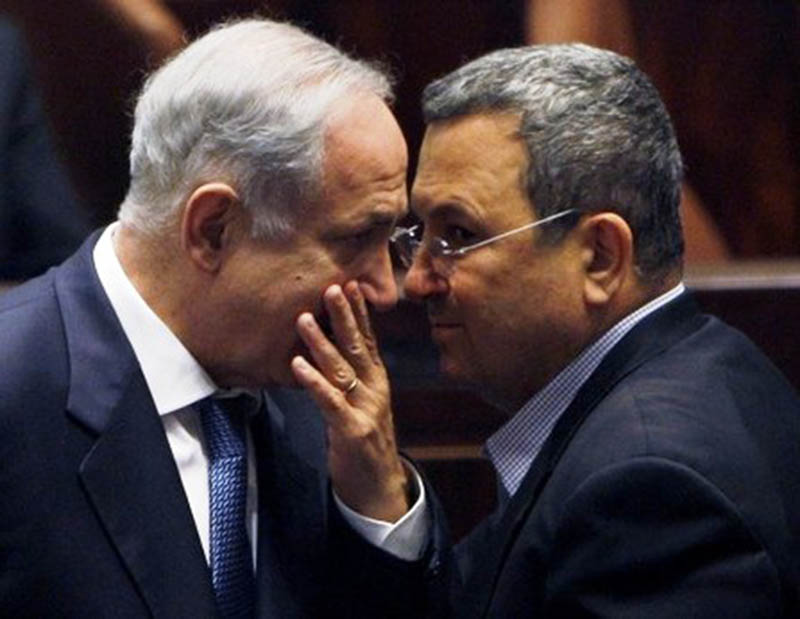
Juxtapose that scene – where a historical milestone has finally been reached – with an AFP photo of Israeli Prime Minister Benjamin Netanyahu and his Defense Minister Ehud Barak, standing triumphantly next to a burnt Egyptian vehicle that was reportedly stolen by the Sinai gunmen. The message here is that only Israel is serious about fighting terror. Israeli newspaper Haaretz’s accompanying article started with this revelation: “Israel shared some of the intelligence it received with the Egyptian army prior to the incident, but there is no evidence Egypt acted on the information.” This was meant to further humiliate Egypt’s military.
Naturally, Israel blamed Gaza, even though there is no material evidence to back such accusations. Some in Egypt’s media pounced on the opportunity to blame Gaza for Egypt’s security problems in Sinai as well. The loudest amongst them were completely silent when, on August 18, 2011, Israel killed six Egyptian soldiers in Sinai. Then, Israel carried out a series of strikes against Gaza, killing and wounding many, while claiming that Gaza was a source of attack against Israeli civilians. Later the Israeli media dismissed the connection as flawed. No apologies for the Gaza deaths, of course, and AP, Reuters and others are still blaming Palestinians for the attack near Eilat last year. Then, Palestinian factions opted not to escalate to spare Egypt an unwanted conflict with Israel during a most sensitive transition.
None of that seems relevant now. Egypt is busy destroying the tunnels, continuing efforts that were funded by the US a few years ago. It also closed the Gaza-Egypt crossing, and is being ‘permitted’ by Israel to use attack helicopters in Sinai to hunt for elusive terrorists. Within days, Gaza’s misfortunes were multiplied and once more Palestinians are pleading their case. “Haniyeh calls on Morsi to open border crossing closed since Sunday’s Sinai attack, say(ing) ‘Gaza could never be anything but a source of stability for Egypt,” reported Reuters.
Israeli officials and analysts are, of course, beside themselves with anticipation. The opportunity is simply too great not to be utilized fully. Commenting in Egypt-based OnIslam, Abdelrahman Rashdan wrote that according to the Israeli intelligence scenario, “Iranians, Palestinians, Egyptians, and al-Qaeda operatives all moved from Lebanon to attack Egypt, Israel and defend Syria.”
In Western mainstream media, few asked the question of who benefits from all of this – from once more isolating Gaza, shutting down the tunnels, severing Egyptian-Palestinian ties, embroiling the Egyptian military in a security nightmare in Sinai, and much more?
The Muslim Brotherhood website had an answer. It suggested that the incident ‘can be attributed to the Mossad.’ True, some Western media outlets reported the statement, but not with any degree of seriousness or due analysis. The BBC even offered its own context: “Conspiracy theories are popular across the Arab world,” ending the discussion with an Israeli dismissal of the accusation as ‘nonsense.’ Case closed. But it shouldn’t be.
Before embarking on a wild goose chase in Sinai, urgent questions must be asked and answered. Haphazard action will only make things worse for Egypt, Palestine and for Sinai’s long-neglected Bedouin population.
Related articles
- Analysts say Sinai attack attempt to strain Egypt-Gaza relations (alethonews.wordpress.com)
- Israel evacuated military outpost near Rafah hours before Sinai attack (alethonews.wordpress.com)
- August 5 Sinai Attack Bears All the Hallmarks of an Israeli False Flag (alethonews.wordpress.com)
- Former Fatah strongman Dahlan accused of taking part in Sinai attack (alethonews.wordpress.com)
- Israel should retake Philadelphi – Jerusalem Post (jpost.com)
- Muslim Brotherhood: “Israel Is Connected To Sinai attack” (alethonews.wordpress.com)
Attack Israel, Not Iran!

By Mahmoud El-Yousseph | The Ugly Truth | August 12, 2012
Last time Iran invaded a country was 216 years ago when the Persian shah, Agha Mohammad Khan, invaded the nation of Georgia. That’s still a great track record, especially compared to other nations.
Israel has repeatedly attacked and invaded numerous counties, and continues to this day to illegally occupy land from three neighboring nations.
Iran has not illegally developed nuclear weapons, whereas Israel has developed an illegal secret nuclear weapons program that has produced hundreds of nuclear warheads.
Iran has signed the UN Non-Proliferation Treaty. Israel has refused to sign it.
Iran’s spies have not been caught stealing nuclear secrets from the US. Israel’s spies have been repeatedly caught doing this, and Israel’s current Prime Minister Benjamin Netanyahu has been implicated in smuggling US nuclear triggers into Israel.
Israel is reported to possess up to 300 nuclear missiles aimed at Arab and European capitals. Some can even hit US cities.Iran has no such weapons and has repeatedly said it does not wish to have them, this being in contravention of basic Islamic principles.
Iran has not sold US weapons and secret weapons technology to a US adversary. Israel has been selling US weapons and secret weapons technology to China for decades. Jewish spy Jonathan Pollard sold vitally important American secrets to the Soviet Union, as did the Rosenbergs.
Iran hasn’t been guilty of getting hundreds of thousands of US troops killed or maimed in expensive wars for Iran. Israel has repeatedly pushed the US into costly wars for Israel, expecting American citizens to fight and die for cowardly Israelis.
Israel has repeatedly been engaged in kidnapping of foreign nationals from other countries and smuggling them into Israel.No record of Iran ever having engaged in such a crime.
Israeli air and sea forces attacked the USS Liberty in international waters off the coast of Egypt for two hours on June 8, 1967. This took place on midsummer day with raised American flags and large English letters painted on the ship. 34 sailors were killed and 174 injured.
Last May, the Iranian Navy foiled an attempted pirate attack on a US cargo ship in the Gulf of Oman. The Iranian warship arrived following a distress call from the ship. The pirates fled upon the arrival of the Iranian Naval ship.
Israel has for the last five years imposed an illegal and inhumane siege over 1.5 million Palestinians in Gaza, causing unnecessary death, pain, and suffering. In contrast, Iran has sent aid and provided comfort to the besieged Palestinians — the very same thing America did to the Germans during the Berlin Airlift.
One could go on and on forever.
However, as a USMC veteran and activist, Dave Evans, succinctly pointed out: “Anyone who had not sworn an oath for peace could reasonably conclude that the US should be threatening to attack Israel, not Iran!”
It’s about time Americans did something to prove they were the Masters, not the Slaves.
The capital of America is Washington, not Tel Aviv.
Mahmoud El-Yousseph, retired USAF veteran, can be reached at elyousseph6@yahoo.com
Related articles
- Iran would be justified to retaliate to an Israel attack (morningstaronline.co.uk)
‘Unilateral sanctions against Iran could damage Russian-US ties’ – Foreign Ministry
RT | August 13, 2012
The Foreign Ministry has warned of a possible blow to Russian-American relations if the US pursues unilateral sanctions against Iran that affect Russian economic interests there.
“Washington should understand that our bilateral relations will suffer considerably if the American restrictions affect Russian economic entities cooperating with partners in the Islamic Republic of Iran in strict compliance with our legislation and UN Security Council resolutions,” the ministry said on its website on Monday.
Late Friday, US President Barack Obama signed into law new sanctions against Iran which aims to penalize those parties aiding Iran’s insurance, financial, petroleum, petrochemical and shipping sectors.
Moscow considers US sanctions against Iran unacceptable, Foreign Ministry spokeswoman Mariya Zakharova said on Monday.
“Russia is fully committed to the restrictions on cooperation with Iran that were established by the UN Security Council,” the spokeswoman said. “However, we do not recognize the unilateral sanctions that were imposed by Washington on the plea of serious concern about Iran’s nuclear program and run counter to international law.”
Zakharova called US efforts to punish countries that do business with Tehran “blackmail.”
“We refute methods of undisguised blackmail,” she said, “which is used by the US towards banks and companies of other countries.”
Earlier, the US passed legislation that targets any party doing business with Iran’s central bank.
Russia has cooperated with Iran in economic projects in the past, including in the Bushehr nuclear plant, which started adding energy to Iran’s electricity grid in September, 2011.
The United States is one of several countries, including Israel, that is concerned that Iran may be trying to develop a nuclear weapon under the cover of a civilian energy program.
Tehran has strongly rejected the accusations, saying it is pursuing nuclear energy for civilian purposes only.
Related articles
- China Hits back at New US Sanctions over Iran (alethonews.wordpress.com)
Featured Video

The American Retreat from Vietnam
or go to
Aletho News Archives – Video-Images
From the Archives
Secret document reveals plans for civil war in Lebanon, Israeli false flags, and invasion
By Randi Nord | Geopolitics Alert | April 5, 2019
Beirut – During his visit with US Secretary of State, Mike Pompeo, Lebanese President Michael Aoun reportedly received a US-Israeli document detailing plans for creating a civil war in Lebanon with covert false flag operations and possible Israeli invasion.
Although the source of the document is Israeli and created in partnership with Washington, no one knows who presented it to Aoun. The Lebanese TV station, Al-Jadeed, initially reported the document on Lebanese TV and a video on its website. Geopolitics Alert translated the report for this article. … continue
Blog Roll
 Aletho News
- There Is A Drought in Academia: A Drought in Honest Research on the Subject of Drought and Other Weather Extremes
- Department of War Awards $20.7 Billion Contract to Raytheon for Air-to-Air Missiles
- ‘Distance yourselves from Israel’: IRGC urges US population to question govt policies
- America’s Greenland deal has a radioactive backstory
- The RAF Fairford ‘terror plot’: Unpacking escalation in the UK echo-chamber
- EU Council Advances Chat Control 2.0 Scanning Proposal
- Ex-Greek MEP files complaint against Israeli spyware firm over alleged Pegasus surveillance
- Troubling ideas throughout the Torah, Talmud, Mishneh Torah and Tanya
- ‘Grave, alarming’: Iran mission on Trump’s UNGA ‘annihilation’ threats
- Najaf airport to reopen to Iranian flights within 24 hours: Ambassador
- If Americans Knew
- New Report: “Scholasticide and Genocide in Gaza: Assessment, Testimonies and Legal Analysis”
- Ex-Biden officials are desperate for a Gaza scapegoat
- Israeli “settlers” Invade Al-Aqsa; Pour Boiling Water on 75-Year-Old
- Israel Has Kidnapped Another American Teenager
- US arms sales to Israel worth $21.6 billion in 20 months
- Three Palestinians Killed in Israeli Attacks on Gaza
- Revealed: German “Anti-Semitism Expert” Driving Crackdown on Palestine Solidarity is Former Israeli Spy
- Egypt’s Warning to Israel Before Oct 7
- Israel’s siege signals another cruel winter for 1.8 million Gazans – Daily Update
- Netanyahu Asked UAE Leader to Deny Report on Oct. 7 Warning in Secret Visit, Sources Say
- No Tricks Zone
- New Study: Earth And Venus Surface Warmth Largely Explained By Convection And Lapse Rate, Not CO2 Or Radiation
- 2025 Nature Paper Claiming Worsening Global Drought Gets RETRACTED …Heavily Flawed
- New Study: ‘Global Drought Shows No Detectable Recent Acceleration Under Climate Warming’
- Economic Masterminds: German Socialists Suggest Taxing Productivity Gains Stemming From Using AI
- The South China Sea Has Not Been Cooperating With The Climate Change Narrative
- Energy Crisis: Germany Enters Heating Season With Historically Low Gas Reserve Fill Levels
- New Study: The Antarctic Ice Sheet Gained Mass From 2020-2024 Due To Staggering Snow And Ice Accumulation
- Study: Ocean Heating Rates From Thousands Of Years Ago ‘Dwarf’ Modern Ocean Heating Rates
- Climate Extremists Target, Attack Large-Scale Power Grid Infrastructure In Germany!
- New Study: Antarctic Ice Melt Has Contributed Less Than 1 Centimeter To Sea Level Rise In The Last 30 Years

