On January 30, the US Department of Justice released what it called “3.5 million responsive pages” in compliance with the Epstein Files Transparency Act spearheaded by Rep. Thomas Massie. Though more than a month late, redacted in bizarrely non-compliant ways, and representing only about half of the Epstein files (the other half are still being illegally withheld) the DOJ document dump provided abundant, irrefutable evidence that the “antisemitic conspiracy theorists” have been right all along: The United States of America is occupied by a Jewish supremacist crime ring based in Israel.
The documents show that when then-United States Attorney for the Southern District of Florida Alex Acosta gave convicted sex criminal Jeffrey Epstein a sweetheart plea deal in 2008 because Epstein “belonged to intelligence,” he was referring to Israeli intelligence. According to FBI files, Acosta’s source was Alan Dershowitz, Epstein’s lawyer, who himself represented Israeli intelligence.
Epstein should have gone to prison for years or decades, as would any other criminal convicted of the same charges. But the notorious sex trafficker got a work-release wrist slap. Since when can a foreign intelligence agency tell a US Attorney not to do his job?
The latest document dump confirms that Epstein, who was groomed as a sexual blackmailer by Les Wexner’s MEGA group of billionaire Mossad spies, was “trained as a spy by (Israel’s former military intelligence chief and Prime Minister) Ehud Barak,” who visited Epstein’s New York mansion on dozens of occasions. Barak and Epstein teamed up not only to blackmail American political, economic, and cultural leaders, but also to funnel huge sums of money to politicians in various nations—bribes in return for those politicians following Israel’s orders.
The new document dump reveals that Epstein worked with Israel to support their Ukrainian asset Zelensky, and to try to overthrow Russia’s Vladimir Putin and replace him with an Israeli stooge named Ilya Ponomatov. Epstein, we also learn, was involved in the overthrow of Libya’s Gaddafi. The Mossad blackmailer helped cultivate Israel’s relations with separatists in the imaginary nation of “Somaliland” (which only Israel recognizes). He brokered Israel’s ties with India’s Prime Minister Modi, and maintained close relationships with top UK leaders including Tony Blair and Peter “love the torture video” Mandelson.
These and other revelations prove that Epstein was not just a sexual blackmailer. Since his job was to establish compromising personal relationships with the world’s most powerful people, Epstein was also used by Israel as a high-level international power broker. “I represent the Rothschilds,” Epstein wrote to Peter Thiel, referring to the banking dynasty that created Israel.
The DOJ files show how Israeli/Rothschild agent Epstein lured his blackmail targets into a cesspool of depravity. The files contain many references to torturing, raping, and murdering children. FBI files cite testimony that Epstein’s crime ring would “birth babies for black market use.” Those who thought Pizzagate was an unproven conspiracy theory may be surprised to learn that the Epstein emails include more than 900 references to “pizza” as a likely code for child sex slaves. There are also 673 suspicious references to “ice cream” and countless uses of “grape soda” presumably referring to black prostitutes or sex slaves. Mainstream media are twisting themselves into contortions trying to insist that even though most of these food code words are obviously what they seem–code words for child sex slaves–though possibly a few could be interpreted as references to actual food! New York Magazine opines:
Admittedly, some of the pizza-related material seems pretty weird. An April 2018 message from a redacted sender says, “lets go for pizza and grape soda again. No one else can understand. Go kno.” Cryptic! Some of it is scrutable: “Go kno” appears to be a rendering of go know, an English derivative of the Yiddish expression geh vays, which is roughly equivalent to “go figure.” The claim that “no one else can understand,” on the other hand, is a creepy element that echoes Donald Trump’s allusion to “wonderful secrets” in his infamous letter on the occasion of Epstein’s 50th birthday…
“Pizza and grape soda” belongs to the latter category, and it appears frequently in Epstein’s emails and texts. In a 2018 exchange with his urologist, Harry Fisch (who erroneously appears in Epstein’s contacts as “Harry Fish”), the two seem to discuss refilling Epstein’s prescription for erectile-dysfunction medication. Fisch later texts, “After you use them, wash your hands and lets [sic] go get pizza and grape soda.” This proposal seems odd. There are many things you can do after your Viagra kicks in, and getting a slice with your doctor is not near the top of the list…
… Remember when only unreasonable people thought like this? The idea that pizza could be a code word for illicit sexual activities was laughable in 2016, when the so-called Pizzagate conspiracy captured the imaginations of what might charitably be called the internet’s most enthusiastic users…At the time, the assumption that pizza was code for sex with children seemed obviously arbitrary and extravagant, a violation of the principle that the simplest explanation is usually the right one. This heuristic, Occam’s razor, is often a handy way to differentiate ideas and people we should take seriously from ones we can safely dismiss — people who are frustrated that they’ve misplaced their keys tend to be more credible than those who think their keys have been stolen. Except with this Epstein pizza thing, the somebody-stole-my-keys contingent seems to have been suddenly, disastrously vindicated…
…Occam’s razor has comparatively little to tell us about grape soda. Fisch and Epstein refer to “pizza and grape soda” so often, and so often together — seemingly never just grape soda and rarely just pizza — that the whole thing starts to look like a shibboleth… The mystery deepens when you notice that Fisch often follows references to pizza and grape soda with an emoji depicting an African American…
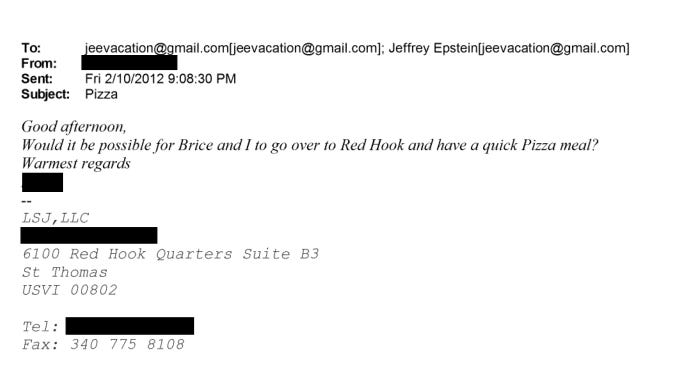
The sender’s name has been redacted, and the identity of “Brice” is unclear, but a former New Zealand Army chef named Brice Gordon co-managed Epstein’s New Mexico ranch and was interviewed by the FBI in 2007. Red Hook is an unincorporated town in the U.S. Virgin Islands — the least-populated such place, according to the 2020 census, consisting mostly of marinas. There is, as it turns out, a pizza restaurant there. But why would someone need Epstein’s permission to have a “quick pizza meal” to which the financier was not invited? It’s enough to drive a sensible person to speculation.
From the mainstream media’s perspective, the problem is not that we are ruled by genocidal Israeli-Mossad-empowered Jewish supremacist psychopathic billionaire perverts. It is that someone might notice that we are ruled by genocidal Israeli-Mossad-empowered Jewish supremacist psychopathic billionaire perverts. That would mean that the “antisemitic conspiracy theorists” were right all along. Oy vey! Double-plus ungood!
Though the mainstream media professes to hate racism, they are covering up Epstein’s virulent racism against non-Jews. The emails are full of disparaging references to “goys,” a term for non-Jews that roughly parallels other racial slurs including the N-word. Epstein and his supremacist cronies loved to degrade non-Jewish children and teens, but never targeted their fellow “chosen people.”
For many Americans, the most disturbing revelations in Epstein files involve President Donald J. Trump. Prior to the files’ release, we already knew that Trump flew on Epstein’s jet at least eight times, was referred to by Epstein as his “best friend,” sent a birthday drawing to Epstein depicting a barely pubescent naked girl alluding to their “secret,” and has been accused of raping 13-year-old “Katie Johnson” in 1994 at an Epstein party and then threatening to kill the girl and her family. The first Epstein dump also contained FBI witness reports that Trump was present when a baby was drowned in Lake Michigan, and was implicated in the rape and murder of a certain Dusty Rhea Duke in 2000.
The new Epstein files release includes FBI witness reports that Trump was involved in murdering three girls who were buried at Mar-a-Lago and threatening the witness with a similar fate. Witnesses also told the FBI that Trump auctioned underage girls from his swimsuit contests, measuring their vulvas and rating them for tightness. Trump is also accused of forcing oral sex and other abuses against 13 and 14 year old girls.
Meanwhile the mainstream media chant in unison: “President Trump has not been accused of wrongdoing.” Will they change their tune, and suddenly discover the FBI files, if and when Trump stops following Israel’s orders?
A shorter version of this article was published in last week’s American Free Press. -KB
Stripe is Substack’s only processor and they debanked me, so you can no longer pay me through Substack. Now I am posting everything on Substack free and asking people to sign up for recurring donations at my Paypal donation page… or better yet, the free speech platform SPdonate. Alternately you can Paypal or Zelle to truthjihad[at]gmail(dot)com. Note that Zelle, unlike other methods, doesn’t charge any fees.
Trump has the option of going to war with Iran and receiving much-needed campaign funds from Israel for the midterms – or opting to defy Bibi and facing certain defeat by losing both houses and facing certain impeachment. Can the Iranians save him?
Is Trump serious about going to war with Iran? To understand this, it’s important to examine his relationship with Netanyahu and to see who has the advantage when it comes to dragging the U.S. into a war, and whether Israel can actually be a greater threat to the U.S. than Tehran can ever be.
The trap that Trump is falling into is one where he has little or no wiggle room at all to control the Iran crisis, whereby Israel can threaten him with isolation while it goes ahead with its strike.
There are two dynamics at play here which are struggling to find a compromise. Trump wants a deal with Iran which takes away their nuclear capability, while Israel wants a war which overthrows the Iranian regime and installs a Mossad/CIA puppet. The problem, though, is that Israel is not an honest broker and keeps shifting the goalposts. The latest demand now is that removing Iran’s ballistic missiles should be at the heart of any deal that Trump pulls off.
Trump is ensnared and is aware of how Bibi is manipulating him. He may, on occasion, swear at journalists and pretend he is his own boss and his own president and that Israel is a client state of Washington which has to toe the line, but in reality, it is clear that Israel is calling the shots.
In recent days, we have heard that the one aircraft carrier the U.S. had in the region, the USS Abraham Lincoln, is to be joined by a second called the USS Gerald Ford. U.S. media report that the Lincoln is in the “Arabian Sea,” which is a comical way of saying that it’s keeping its distance from Iran’s shores and Houthi missiles off the coast of Yemen. But other reports are suggesting that the reason why Trump claims he has sent a second carrier – to beef up the “flotilla” in case of a war breaking out with Iran – is untrue. Some insiders are briefing journalists that the Lincoln has technical problems which will render it useless in a combat situation and so needs to be replaced with the more advanced Ford.
However, even this might be a false narrative offered by Pentagon insiders who are not supporters of Trump. A second explanation about the carriers is that it buys Trump time. He has even told reporters that it will take about a month for the Ford to get there, which he believes should be ample time for a deal to be struck with Iran, or at least will give him four more weeks to work out a way of dealing with the threat – that’s the threat from Israel, not Iran.
Israel threatened Trump before when he went ahead with his bunker buster bombs in June of last year by saying simply, “If you don’t do it, we’ll nuke Iran.” It worked. This time around, the threat is, “If you don’t join us, then we’ll strike Iran alone and you will have to deal with the consequences of being the first U.S. president to have to explain to the Jewish lobby why Iran is wiping Israel off the face of the map.” This second threat is multi-layered and also might work with Trump, given that the midterm elections, which are approaching, will cost twice what the elections cost which got him into office. It will be Jewish money which bankrolls him this time around, with the intention of saving him from losing both houses and facing inevitable impeachment.
And so, in many ways, Trump is closer to and more dependent on the regime in Tehran to help him out. A deal which limits the enrichment of uranium and can guarantee no nuclear bomb can be made might be something he can present to the American people as a great victory. The irony is that the deal might be more or less a carbon copy of Obama’s, which he, Trump, rejected while in his first term in office, a rejection which has created the present crisis.
The trouble with any deal now about enrichment is that it is unlikely to satisfy the Israelis, who have become more aware in recent weeks about the capability of Iran’s latest generation of ballistic missiles both in terms of defence and attack. Moreover, the U.S. attack on Iran last year for 12 days has now raised the stakes to a fever pitch, making the Iranians clearer and more focused about any kind of attack happening against them: all-out war.
According to some credible reports, Trump was recently asking Pentagon chiefs if the U.S. could carry out a single in-and-out strike operation which could be used to warn Iran while satisfying Israel at the same time about the U.S. threat, and he was told no such options are feasible. This is due to Iran being much more prepared now for such attacks, both militarily and intelligence-wise, while the Mossad operation of creating civil strife on the ground failed spectacularly. The U.S. is in a very tight corner right now, as its forces and its allies in the region are in the crosshairs of Iran the moment the first bomb is dropped, and so Trump’s options to go to war are very limited. It would be suicidal for Trump to strike Iran, as the losses to U.S. forces and the disruption to oil distribution via the Straits of Hormuz would be too great, not to mention the destruction of infrastructure in Israel itself.
But there is also another factor which is putting all the pressure on Trump to get a deal with Iran. Since last June’s attack and more recently Trump’s betrayal of cordial relations with Putin conjured up at Alaska, along with the Venezuela coup, both Russia and China have upped their support for Iran. This is a critical factor now preventing Trump from hitting Iran with anything. China recently gave Iran its latest state-of-the-art new radar system which can identify U.S. stealth bombers at a range of 700km. Game changer. If you consider Iran, Israel, and the U.S. as three poker players at the table, it is clear that Iran now has the best hand with the most options. It can maximize its role now and exploit Trump’s vulnerability by going for a deal which involves sanctions being relieved, or it could hold out and play a long game way beyond Trump’s one-month breathing space and really turn up the heat on him leading up to the midterms in November. Iran always plays for time and is good at this strategy. And given that even the kindest analysis of America’s strike capability in Iran is two weeks before depletion of all missile stocks is reached, any hawks close to Trump who are pushing for a strike must have the destruction of the U.S. in their strategy as well, as Iran cannot be pounded into a state of submission in such a short space of time. Surely that can’t be the aim of Bibi. Surely not!
Two children have been killed after Palestinian Authority (PA) forces opened fire on a vehicle carrying their father, a resistance fighter, in the town of Tamoun in the northeastern part of the occupied West Bank.
The three-year-old daughter of Samer Samara succumbed to her wounds on Sunday after being shot by the forces, Palestinian media outlets reported.
Her 16-year-old brother, Ali, was killed after being shot in the head. Their father was wounded and later abducted by PA forces.
According to the reports, the forces shot Samara in the legs before abducting him.
Local reports said units from the PA’s so-called Preventive Security Service and a special unit set up the ambush and fired heavy gunfire at the car during an operation to abduct Samara, who is wanted by Israeli occupation forces.
Following the killings, the youths of the town of Tamoun launched a demonstration and a general strike. Reports said the PA sent reinforcements to suppress the demonstration.
The Gaza Strip’s Hamas resistance movement condemned the atrocities, holding the Authority fully responsible for the consequences of targeting resistance fighters and killing children.
In a statement, the group described what happened as a “serious crime” and a “black mark in the record of the security services that continue to overpower our people instead of protecting them.”
The movement warned that the policy could damage Palestinian internal cohesion and demanded accountability.
It called for “holding all those involved accountable, stopping the pursuit of wanted Palestinians, and releasing political detainees.”
The Committee of Families of Political Prisoners also condemned the shooting, describing it as the result of a “systematic policy targeting resistance fighters.”
It said the incident represented a “dangerous deviation” that placed security services in confrontation with the population rather than protecting them.
Human rights organizations say such incidents risk deepening internal tensions at a time when Palestinians in the West Bank also face ongoing Israeli military raids and settler violence, contributing to what observers describe as a climate of compounded insecurity for civilians.
The United States finds itself in an unfamiliar position. After spending approximately one hundred and fifty THAAD interceptors and eighty SM-3 missiles to help defend Israel during the Twelve-Day War in June 2025, the Pentagon faces a stark reality. Its stockpiles are depleted, its production lines cannot keep pace, and another major conflict with Iran would require an air defense umbrella America can no longer fully provide.
The question is not whether the United States wants to strike Iran again. The question is whether it can afford to.
For now, the answer appears to be no. But history suggests this pause may be temporary, with negotiations serving not as a genuine path to peace but as a strategic timeout while Israel restocks its depleted munitions and air defenses. After all, the Twelve-Day War itself kicked off in the middle of active negotiations that critics across the political spectrum described as either a deliberate ruse or a diplomatic process Israel cynically sabotaged.
Throughout the clash with Israel, the Israeli government worked hard to control the narrative about what Iran’s missiles actually hit. Military censorship laws prevented journalists from reporting strike locations near sensitive facilities. But satellite data told a different story.
A report by The Daily Telegraph using radar analysis from Oregon State University revealed that Iranian missiles struck at least five Israeli military facilities withremarkable accuracy. These included Tel Nof Airbase, Camp Glilot housing Unit 8200, Israel’s premier signals intelligence unit, and Zipporit weapons manufacturing facility.
None of these strikes were reported from within Israel. Professor Jerome Bourdon of Tel Aviv University explained, “We probably will never know the full extent of the damage.”
Haifa’s BAZAN oil refinery was shut down for two weeks with an estimated $250 million loss. Soroka Medical Center in Beersheba took a direct hit from Iran’s missile barrage. Most critically, by June 18, a U.S. official disclosed that Israel wasrunning low on Arrow interceptors. The Washington Post reported assessments that Israel could only maintain missile defense for ten to twelve more days. The war’s duration was constrained by the physical limits of both sides’ arsenals.
The United States used approximately 25% of its entire global THAAD stockpile during the Twelve-Day War, firing roughly one hundred and fifty interceptors. It also expended eighty SM-3 interceptors and thirty Patriot PAC-3 interceptors. The problem is that production cannot remotely keep pace with consumption.
THAAD interceptors are manufactured at a rate of only eleven to twelve per year. That means replacing the one hundred and fifty interceptors fired during the Twelve-Day War would takemore than twelve years at current production rates. CSIS analysts warned in late 2025 that no new THAAD interceptors would be delivered until 2027, creating a dangerous gap.
Even after the Pentagon reprogrammed $700 million into THAAD procurement, that only covers about forty-five missiles at $15 million each. As JINSA’s Ari Cicurel warned, “Both Israel and the US used an immense amount of their interceptor stockpiles. We are still very far behind in replenishing to get back to what we had before.”
By January 2026, defense experts were sounding the alarms that depleted interceptor stocks were constraining the Trump administration’s options regarding Iran, since another war would require the same defense umbrella the United States can no longer fully provide.
The interceptor shortage is just one symptom of a deeper structural problem. A Foundation for Defense of Democracies report published in April 2025 audited twenty-five weapons systems committed or potentially committed to Taiwan, Ukraine, and Israel. The finding was stark. Only seven of twenty-five had a strong defense industrial base, while the remaining eighteen were either weak orrequired significant attention.
Consider 155mm artillery shells. The Army targeted 100,000 rounds per month by October 2025. As of June 2025, production stood at just 40,000 per month. Even that figure is misleading. Only 18,000 complete rounds with propellant were being produced monthly because the United States depends on a single plant in Canada for artillery propellant and has no domestic production.
Against this backdrop, the United States and Iran resumed negotiations on February 6, 2026, in Muscat, Oman. After eight months of silence following the Twelve-Day War, talks restarted with delegations led by Steve Witkoff and Iranian Foreign Minister Abbas Araghchi.
The timing invites skepticism. The Twelve-Day War was launched on June 13, 2025, exactly three days before the sixth round of nuclear negotiations was scheduled. Israel struck while Iran was in what War on the Rocks described as “diplomatic preoccupation with Washington” and “military unpreparedness.”
Araghchi called the strikes a “betrayal of diplomacy,” stating, “We were supposed to meet with the Americans on 15 June to craft a very promising agreement…It was a betrayal of diplomacy and unprecedented blow to the foundations of international law.”
The Wall Street Journalreported “U.S. Diplomacy Served as Cover for Israeli Surprise Attack.” Trump told the New York Post after the strikes, “I always knew the date. Because I know everything.”
Doug Bandow noted that the Cato Institute reported that Israeli officials stated “Israel and the U.S. carried out a multi-faceted misinformation campaign” to convince Iran a strike was not imminent and that Trump “was an active participant in the ruse and knew about the military operation since Prime Minister Benjamin Netanyahu decided to move forward with the strike.”
Whether current negotiations represent genuine diplomacy or another strategic pause remains open. Araghchi stated that “existing mistrust poses a significant hurdle” to progress.
From a military industrial perspective, the current negotiations serve a clear purpose regardless of diplomatic intent. They buy time. Israel’s defense ministry purchased weapons worth 220 billion shekels, approximately $61.5 billion, in 2024, four times previous years, reflecting the desperate need to restock. Israel is now accelerating development and production of Arrow 3, Arrow 4, Iron Dome, David’s Sling, and ground based laser systems in anticipation of a potential second round.
The United States faces the same imperative. The Trump administration has pledged a record $1 trillion defense budget and the 2026 NDAA authorized multiyear procurement for key munitions. But experts warn these measures are necessary but insufficient given the scale of the gap between production capacity and real-world consumption rates.
The fundamental question is how long it takes to rebuild stockpiles sufficiently to contemplate another major conflict. With THAAD production at eleven to twelve interceptors per year and no new deliveries until 2027, the answer is measured in years, not months.
One thing has become clear. Military industrial issues are coming back to the fore. And the United States, despite its constant bragging about being exceptional, faces the same resource constraints that all mortal imperial polities have previously faced.
Wargames by the Center for New American Security found the United States would run out of long range munitions in less than a week in a fight with China over Taiwan. The Twelve-Day War revealed the United States cannot sustain high intensity conflict support for even one ally without severely depleting its stockpiles.
The current negotiations with Iran may represent genuine diplomacy. Or they may represent a tactical pause to allow Israel time to rebuild its defenses before the next round. Either way, the resource constraints are real. The production gaps are real. And the physical limits of America’s military industrial base now constrain its foreign policy options in ways Washington has not experienced in decades.
The quicker the United States recognizes these limits and pursues a more restrained foreign policy, the better off it will be. The alternative is to continue pretending that stockpiles replenish themselves, that production lines can magically accelerate, and that America can wage unlimited war in unlimited theaters without consequence.
The Twelve-Day War proved otherwise. The question is whether Washington has learned the lesson.
Amidst heightened tensions between the US-Israeli alliance and Iran, an enormous amount of focus has been placed in the media on Iran’s missile program and how this will impact any upcoming war. What is often ignored are the origins of the regional threats to Tehran and its stability.
While covering each and every threat to the Islamic Republic of Iran would be beyond the scope of such an article, there are a number of hostile nations surrounding the country that can be used to destabilize the nation. The United Arab Emirates (UAE) and, to a lesser extent, Azerbaijan, are often cited as pro-Israeli, but there is another nation that flies under the corporate media’s radar.
Iran shares its second-largest land border with the nation of Turkmenistan, a country that is rarely mentioned as a regional player. What many don’t know is that the nation, long characterized as a neutral player, has strong ties with both the US and Israel.
Turkmenistan: Neutral State or Strategic Corridor?
Unlike many Muslim-majority nations, Turkmenistan has long recognized and maintained ties with the Israelis, their relationship beginning in 1993. Then, in April of 2023, these ties were further cemented with the inauguration of a permanent Israeli embassy in Ashgabat for the first time.
It should therefore be no surprise that Tel Aviv and Ashbagat’s relationship is closest in the intelligence sharing and security cooperation spheres. Afterall, the Israeli embassy – opened back in 2023 – was strategically placed only 17 kilometers away from Iran’s border, marking a major symbolic achievement for Israel, especially as it operates through what are suspected to be thousands of Mossad recruited agents inside the Islamic Republic.
Although Israel has no official military bases inside Turkmenistan, there have been a number of reports indicating that it has set up attack drone bases inside the country. This would make sense, considering that Ashbagat has been purchasing Israeli drone technology since the 2010s, more recently acquiring the SkyStriker tactical loiter munition (suicide drone), developed by Elbit Systems.
Ashgabat has long been in alignment with the West. In May of 1994, it became the first country to join NATO’s Partnership for Peace (PfP) program. However, the following year, the UN approved granting Turkmenistan the status of a neutral country, meaning it would not join military blocs.
In 2001, following the September 11 attacks, this neutral stance suddenly began to change. While other Central Asian nations – Kyrgyzstan, Tajikistan, and Uzbekistan – all immediately offered their military bases to the United States, due in large part to their concerns over the advancements of the Taliban, Turkmenistan only publicly admitted to allowing the US to use its airspace for military cargo aircraft to travel in transit.
In reality, the US airforce were operating a team on the ground in Ashgabat in order to coordinate refueling operations. In 2004, the Russian State protested the growing US-Turkmenistan military relationship, after reports emerged stating that American forces had “gained access to use almost all the military airfields of Turkmenistan, including the airport in Nebit-Dag near the Iranian border.”
Reports, which are not possible to independently verify but nonetheless have appeared consistent throughout the years, indicate that the US military has even established remote desert bases throughout different locations inside Turkmenistan.
Clinging to its neutral status on the public stage, Ashgabat rejects any mention of cooperation of this kind, including the denial of a 2015 statement by then US Central Command chief Lloyd Austin that the Turkmens had expressed their interest in acquiring US military equipment.
Signals of Military Activity
Perhaps the most concerning developments are the more recent revelations, revealed through OSINIT channels and Turkmen media, citing flight trackers to monitor the movement of US aircraft in the region. These reports indicate the confirmation that US Air Force transport aircraft C-17A Globemaster III and MC-130 Super Hercules have landed at undisclosed locations in Turkmenistan.
The significance of this, opposed to the rest of the military buildup that has been occurring in potential preparation for an attack on Iran, is that of the MC-130 Super Hercules, which is used specifically for transporting special forces teams, running night operations, as well as performing unconventional takeoffs and landings.
Paired with a recent report issued by the New York Times, indicating that the US’ options not only include an air campaign against Iranian nuclear and missile sites, but ground raids using special forces, it could be concluded that Turkmenistan is the location from which the US may seek to inject special forces units into Iran.
The Wider Ring around Iran
The Turkmenistan factor clearly cannot be ignored here, despite it often being dismissed as a neutral power that maintains friendly relations with both Russia and China. In fact, because of these relationships, with Moscow in particular, Tehran has refrained from attempting to expand its reach into the Central Asian country.
To Iran’s benefit is that Chinese and, to a lesser extent, Russian influence can reduce the extent to which the US and Israel can use Iran’s neighbors to threaten it. In Pakistan, for example, it is clear that both Islamabad’s joint security concerns – largely over Balochi militant groups – along its border, in addition to Beijing’s influence, make it highly unlikely that Pakistan would remain neutral and is instead inclined to help support Iran; within its limits, it should be added.
Azerbaijan is another potential threat to the stability of the Islamic Republic, due in large part to the large Azeri population in Iran’s own Azerbaijan Province. However, the vast majority of Azeri citizens are in fact loyal to the State and no major separatist movement exists at this time. The Iranian President Masoud Pezeshkian and Ayatollah Khamenei himself are both ethnically part Azeri.
Meanwhile, many supporters of the Israeli puppet Reza Pahlavi openly express their intention to crack down on the Azeri ethnic minority inside Iran. During the reign of the CIA-MI6-installed Shah of Iran, minority groups suffered immensely, due to a clear tradition of ethno-nationalism that exists amongst the current supporters of the deposed monarchy.
Baku, for its part, is the top gas supplier to Israel, maintaining close military, diplomatic and intelligence ties with them. Azerbaijan even made Hebrew media headlines for its use of Israeli suicide drones and other military equipment during its war with Armenia.
On the other hand, Iran is militarily superior to Azerbaijan and has a considerable base of support amongst the nation’s population, of which the majority belong to the Shia branch of the Islamic faith. Therefore, Tehran has major leverage and could not only paralyze its oil and gas infrastructure, but perhaps has the potential of organic movements forming within Azerbaijan that will owe allegiance to Iran.
There is also the threat that the Israelis, in particular, will attempt to use Kurdish militant groups in Iraqi Kurdistan in order to carry out attacks on the Islamic Republic. Israel does not publicly acknowledge its presence in northern Iraq, yet Iran has directly struck its bases housing Mossad operatives in the past, while Kurdish separatist groups have been utilized countless times in attempts to destabilize the country. During the June 12-day-war last year, Israel also weaponized these proxies.
For those also concerned about Afghanistan’s role in threatening Iranian security, this has always historically been a precarious situation, yet Tehran has not only been improving its ties with Kabul, it officially recognized the Islamic Emirate during the past week. Again, this does not mean there is no potential threat there, but an alliance that holds with the Taliban government may prove important.
Gulf States, Jordan and the Regional Balance
Then there are the more obvious players, the UAE and Bahrain, which are not only partners of the Israelis as part of the so-called “Abraham Accords” but are overtly aligned with Tel Aviv’s regional agenda.
The Emiratis are speculated to hold some cards regarding trade, but their leverage is negligible. Both the Bahraini and Emirati leaderships are clearly anxious, because Iran’s responses to the use of their territory to attack the Islamic Republic could quickly collapse their regimes.
Jordan, meanwhile, is where the US appears to be focusing much of its military buildup, even withdrawing forces previously stationed in Syria’s al-Tanf region into the Hashemite Kingdom’s territory.
The Jordanian leadership is evidently permitting its territory to become a key battleground, which will likely be subjected to attacks if the US chooses to use it to aid the Israeli-US offensive, but it is simply powerless in such a scenario.
Jordan has become a Western-Israeli intelligence and military hub in the region, meaning that if King Abdullah II objects to the demands of its allies, he understands well that his rule could be ended in a matter of hours. Therefore, he must risk his country being caught in the crossfire and just hope that an internal uprising doesn’t take shape, which is one of the reasons why he has been so hostile to the Muslim Brotherhood, fearing they could end up leading any revolt as the organization did in Egypt.
Turkiye, on the other hand, which is also a major regional player, is likely to play both sides behind the scenes, attempting to stay out of such a fight. If it takes either side, it will suffer the repercussions. Perhaps the most important role it could play is to prevent its bases or airspace from being used by the US.
Saudi Arabia and Qatar both maintain cordial relations with Iran, clearly favoring a scenario where no war occurs at all, because they are home to US bases. As we saw last June, the US used its CENTCOM headquarters in Doha to direct its attack on Iran’s nuclear sites, and as a result, Iran’s Islamic Revolutionary Guard Corps (IRGC) struck US facilities there.
Riyadh and Doha do not want to get dragged into such a scenario. It is also of note that they have a vested interest in neither side winning the war conclusively, because it is in their interests for there to be a multi-polar West Asia, not an Israeli-dominated region that will inevitably consume them.
A Conflict with Wider Consequences
Some have also speculated about Syria’s role in any war. Damascus is clearly in the US-Israeli sphere of influence, but it will have a negligible impact in its current form. If Syria’s military forces assault Lebanon or Iraq, they will suffer enormous blows and fail tremendously. The only wildcard with Syria is whether armed groups there will choose to use the opportunity to attack Israel, although as a military power, the Syrians are a relative non-factor at the current time.
For now, the US-Israeli plot to stir civil war inside Iran and to follow through with an air campaign that aids their proxies has failed. Given the readiness of Iran’s allies in Iraq, Lebanon, Yemen, and even Palestine, perhaps beyond, the US would be entering a point of no return scenario if it were to attempt a regime change operation.
– Robert Inlakesh is a journalist, writer, and documentary filmmaker. He focuses on the Middle East, specializing in Palestine.
President Donald Trump and Israeli Prime Minister Benjamin Netanyahu agreed to increase economic pressure on Iran by attempting to cut oil exports to China.
A US official speaking with Axiossaid during the meeting between Trump and Netanyahu last week, the leaders “agreed that we will go full force with maximum pressure against Iran, for example, regarding Iranian oil sales to China.”
Kpler estimates that 80% of Iranian oil sales are to China. The Trump administration has attempted to cause intense economic suffering in Iran, hoping the result will be the overthrow of the government in Tehran.
Trump recently signed an executive order authorizing the White House to impose 25% tariffs on countries that buy Iranian oil. It’s unclear if the President will be willing to upend the delicate Trump relationship with China to damage the Iranian economy.
The US is ramping up the economic war as talks with Iran are ongoing. US and Iranian negotiators are scheduled to meet in Geneva on Tuesday. The US and Israel are demanding that Iran agree to limits on its nuclear and missile programs. Tehran says it is refusing to place any restrictions on its missile program.
According to officials speaking with Axios, Netanyahu and Trump disagreed during the meeting about negotiations with Iran. The President believes a deal is possible, while Netanyahu told Trump that Iran will not sign an agreement and that, if it did, Tehran would not comply with it.
CBS News reports speaking with two sources who said during a December meeting, Trump told Netanyahu that Israel could strike Iran if Iran does not agree to a deal with the US.
This will be a rather lengthy article, but you need to know what Russia and China are doing in a closely coordinated series of actions that show a serious commitment to counter US actions to punish and isolate Iran and Cuba. Let’s start with Iran… Since the June 2025 12-day Iran–Israel war (which ended with a US-brokered ceasefire on 24 June 2025), Russia and China have provided Iran with a combination of diplomatic, economic, military-technical, and strategic support. This has helped Tehran recover from strikes on its nuclear sites, air defenses, and missile infrastructure, while deepening their “axis” alignment against Western pressure. Support has been pragmatic rather than unconditional—neither offered direct intervention during the conflict, leading to some Iranian frustration—but has accelerated in the months since.
The biggest news — a development that has been largely ignored in the West — was the signing of the Trilateral Strategic Pact (signed 29 January 2026), which provides a comprehensive framework for diplomatic, economic, and security coordination (emphasizing sovereignty, sanctions resistance, and multipolarity; no formal defense alliance). The signing occurred through simultaneous ceremonies in Tehran, Beijing, and Moscow, as confirmed by state media in all three countries and reported across outlets like Middle East Monitor, GV Wire, and others. It represents a significant escalation in coordination among the three nations, building directly on their existing bilateral frameworks.
It formalizes a trilateral coordination mechanism for the first time, linking the three powers in a shared strategic framework. It builds on the bilateral agreements that Iran had signed previously with Russia and China:
The Iran-Russia 20-year Comprehensive Strategic Partnership Treaty (signed January 17, 2025, entered into force October 2025), focused on economic, political, defense, and sanctions-evasion ties.
The Iran-China 25-year Comprehensive Cooperation Agreement (signed 2021), emphasizing trade, infrastructure, energy, and Belt and Road Initiative projects.
While the full text has been released incrementally (with portions still emerging as of early February 2026), public descriptions and official statements highlight the following core elements:
Diplomatic coordination — Unified stances on international issues, including opposition to Western sanctions, support for multipolarity, and mutual backing in forums like the UN.
Economic resilience and cooperation — Enhanced trade (e.g., energy exports, yuan/ruble-based mechanisms), sanctions circumvention, and infrastructure projects (e.g., expanding Belt and Road ties, North-South Transport Corridor involvement).
Strategic and security alignment — Military-technical cooperation, intelligence sharing, and joint exercises (e.g., building on annual “Maritime Security Belt” drills; a major joint naval exercise involving all three that will take place in the Gulf of Oman and northern Indian Ocean in the coming weeks).
Nuclear sovereignty — Emphasis on Iran’s right to peaceful nuclear development and resistance to external interference.
Trilateral nuclear and military talks — Including IAEA discussions and coordinated exercises.
No mutual defense clause — It explicitly stops short of a formal military alliance (unlike NATO’s Article 5), focusing instead on coordination and mutual support without automatic defense obligations.
State media in Tehran, Beijing, and Moscow described it as a “cornerstone” for a new multipolar world order, with Chinese messaging highlighting opposition to “unilateral coercion” and Russian/Iranian outlets framing it as bolstering sovereignty against external threats. While I do not believe that Russia and China will join the fray if Iran is attacked, they are making a concerted, substantive effort to ensure that Iran can effectively defend itself and thwart US attempts at regime change.
Both Russia and China are providing important military assistance to Iran, but China appears to be playing a bigger role in supplying hardware while Russia is supplying Iran with critical intelligence. According to press reports and photographic evidence, Russia has deliveried Mi-28NE attack helicopters (confirmed in early 2026) and possible MiG-29 fighters. Russia also has sent a large number of military transport flights to Iran, but there are no reports about what was on board. The most likely case is that Russia is fulfilling supplies of weapons based on prior contracts and in defiance of reinstated UN/EU arms sanctions via the JCPOA “snapback” mechanism.
China has focused on upgrading Iran’s air defense system by supplying HQ-9B surface-to-air missile systems (a long-range SAMs comparable to Russia’s S-300; deliveries reported from July 2025 onward, with Iranian officials confirming integration to replace losses from Israeli strikes). In addition, China has deployed the YLC-8B long-range surveillance radars (for detecting stealth aircraft like the F-35), and shipped missile components (e.g., solid-fuel propellants, guidance systems) to rebuild ballistic missile production lines damaged in the war. Iran is in a much stronger position militarily than it was on June 13, 2025, when Israel launched its surprise attack.
CUBA
Russia and China also are providing significant political, economic, humanitarian, energy, and material support to Cuba, especially amid the island’s severe fuel/energy crisis, food shortages, and economic strains intensified by the longstanding US blockade and recent US actions under President Trump (e.g., pressure on Venezuelan/Mexican oil supplies and threats of tariffs on countries aiding Cuba).
Russia and China are coordinating rhetorically (both denounce US “inhumane” tactics and reaffirm support in bilateral calls and statements). They also are coordinating the kind of aid that each supplies to Cuba… Russia focuses on supplying direct oil/fuel while China is aiding Cuba with financial/renewables/food assistance. There is not a formal trilateral mechanism like the one they signed with Iran, but both countries frame their support as countering US pressure in the Western Hemisphere. This support is ongoing and responsive to Cuba’s acute needs (fuel rationing, blackouts, food scarcity). Deliveries and projects continue despite US threats, with both countries emphasizing it as humanitarian and sovereign cooperation.
Russia’s Support
Russia emphasizes solidarity, political backing, and practical material/energy assistance, framing it as opposition to “suffocating” US measures. Russia’s help consists of the following:
Energy Aid (Oil and Fuel): Russia is preparing to deliver crude oil and petroleum products to Cuba “in the near future” as humanitarian aid. The Russian Embassy in Havana confirmed this to Izvestia. Russia last sent a major shipment in February 2025 (100,000 metric tons of crude under a $60 million state-backed loan approved by Putin). The Kremlin (via spokesman Dmitry Peskov) states it is in active contact with Havana to discuss assistance options and has described Cuba’s fuel situation as “critical.” Deputy Foreign Minister Sergei Ryabkov (Feb 13, 2026) confirmed Russia is providing material assistance, including supplies already underway.
Political and Diplomatic Support: Foreign Minister Sergei Lavrov (phone call with Cuban FM Bruno Rodríguez Parrilla, Feb 2, 2026) reaffirmed Russia’s “principled position” that economic/military pressure on Cuba is unacceptable and committed to continued political and material/financial support. Russia repeatedly condemns the US blockade, opposes any military intervention, and expresses solidarity with Cuba (and Venezuela). Ambassador Viktor Koronelli has stated Russia “will not abandon Cuba.”
Historical/Longer-Term Ties: Russia wrote off ~90% of Cuba’s Soviet-era debt (~$32 billion) in 2014. Ongoing cooperation includes trade, scientific/academic exchanges, and past energy deals.
China’s Support
China has positioned itself as a major strategic partner, focusing on humanitarian aid, energy infrastructure, food security, and debt/investment cooperation (Cuba is a Belt and Road Initiative partner). The recent Emergency Aid Package (Approved by Xi Jinping, Jan 2026) provides $80 million in financial assistance (in euros equivalent) for purchasing electrical equipment and other urgent needs — specifically to help resolve the energy crisis (blackouts affecting >60% of the country). China also donated 60,000 tons of rice in emergency mode (first shipment of ~4,800 tons arrived Jan 2026; rest in coming months) for food security.
China also is expanding support that builds on prior commitments. Previously it was helping Cuba with a 200 MW photovoltaic (solar) energy projects and, recent days, has delivered 5,000 solar panel kits for isolated homes (new executing company established with Cuba’s Ministry of Foreign Trade). Shortly after Venezuelan President Maduro was abducted, China, acting under an emergency program, delivered 30,000 tons of rice (first shipments in Jan 2026)… This was in addition to prior donations of solar lamps, roofing materials, mattresses, and generator sets.
In the face of the US effort to crush Cuba economically, China is helping Cuba with debt restructuring negotiations (banking/financial/corporate debts). Cuba also is being Integrated into China’s CIPS payment system and increased use of yuan in trade (announced 2025). China is in effect helping wean Cuba off of the US dollar. China also is helping Cuba with biopharma (e.g., technology transfers for aspirin production), digital transformation (Phase 4 program), high-definition TV projects, mining, oil exploration, sugar industry recovery, and renewables (China investing in solar to help Cuba reach 25% renewables by 2030).
The support that Russia and China are providing to Iran and Cuba sends a clear message to Donald Trump and to the nations of the global south: i.e., Russia and China are building a new financial and security infrastructure designed to immunize countries against US coercion and threats. They are doing more than just offering words of solidarity… They are backing up their words with concrete economic, diplomatic and military actions. The foundation of the American hegemon is crumbling.
I started my vlogging day with Nima and Colonel Wilkerson:
It appears the main topic of discussion at Wednesday’s meeting between Donald Trump and Bibi Netanyahu was Iran’s ballistic missile program. It really was not a discussion… Instead it was Bibi, with his advisers, trying to sell Trump and his team on the necessity of ending Iran’s ballistic missile capability. Why the emphasis on those missiles when, until recently, the big concern was whether Iran could build a nuclear bomb? The US and Israeli narrative about Iran’s missile and drone strikes in Israel during the 12-day war in June 2025 insists that Iran did little damage and that the combined might of US and Israeli air-defense systems knocked down 90% of the Iranian ballistic missiles. If that was true, why is Netanyahu pressing Trump touting on the need for Iran to eliminate its ballistic missile force?
I have the answer… We need only look at the damage Iran’s ballistic missiles caused in Israel during the 12-day war in June 2025 — based on reporting and independent analyses of the conflict (much of the detailed damage was initially censored or not fully disclosed by Israeli authorities, but independent and foreign sources have provided information).
Iran launched more than 1,000 ballistic missiles toward Israel over the 12 days, often in large salvos that overwhelmed the Israeli and US air defenses. Israel’s multilayered missile defense systems intercepted some, but a significant number still penetrated and struck targets. Hundreds of buildings in major cities such as Tel Aviv suburbs (Bat Yam, Ramat Gan) were damaged — with some buildings so badly hit they were later demolished. In Tel Aviv alone, analysts mapped damage to around 480 buildings across multiple strike sites.
Iranian missiles damaged key public facilities, such as the Soroka Medical Center in Be’er Sheva, which was hit by an Iranian missile, causing structural damage and chemical leaks; the affected wing was evacuated. Power and water infrastructure also were hit, contributing to service disruptions.
Iran’s ballistic strikes hit high-value facilities as well. The Weizmann Institute of Science (a major research institution in Rehovot) was severely damaged — with an estimated 90% of structures affected, destruction of dozens of labs, and suspension of about 25% of its operations.
Independent radar data and reporting showed that Iranian missiles directly hit around five Israeli Defense Forces (IDF) facilities, including an air base, intelligence center, and logistics base. Israeli authorities did not publicly confirm these hits at the time, due to military censorship. Israeli oil refining infrastructure — especially in Haifa Bay — also suffered direct hits and damage from Iranian missiles, including to critical units and pipelines at the Bazan refinery and associated casualties. The strike on the Bazan oil refinery complex in Haifa Bay, one of Israel’s most important energy facilities, heavily damaged the power generation unit and other infrastructure critical for operation.
Wednesday’s meeting between Trump and Netanyahu lasted nearly three hours (longer than scheduled) and, according to Israeli media, also included US Secretary of State Marco Rubio, Defense Secretary Pete Hegseth, US Special Envoy Steve Witkoff, Jared Kushner, US Ambassador to Israel Mike Huckabee, Israel’s ambassador to the US Yechiel Leiter, Military Secretary Maj.-Gen. Roman Gofman, acting director of the National Security Council Gil Reich, Michael Eisenberg, Ziv Agmon, and advisor Ofir Falk.
So what did President Trump and Bibi talk about on Wednesday. According to the Jerusalem Post :
[T]he prime minister presented intelligence on Iran’s military buildup, including developments related to its ballistic missile program. He also conveyed the message that if Trump decides to strike Iran, the operation should include targeting the ballistic missile project as well.
Haaretz echoed the Jerusalem Post’s report, but also noted that Netanyahu is worried that Trump will strike a deal with Iran that ensures Iran does not and will not have a nuke. Netanyahu thinks that would be bad for Israel:
Messages from the Prime Minister’s Office indicate that such a deal would be bad not only for Israel but for the entire Middle East. Netanyahu was expected to attempt to thwart an agreement that does not include significant restrictions on ballistic missile production in Iran, while at the same time avoiding being perceived as encouraging the United States to go to war with unpredictable outcomes.
Remember all the times that Bibi showed up at the UN and the US Congress with pictures of an imaginary Iranian nuclear bomb? The bomb is no longer the Israeli priority… Eliminating Iran’s ballistic missiles is now number one on the hit list because Israel took a severe beating last June and Netanyhu fears what Iran could do if Iran makes good on its threats to unleash its missile force if attacked.
Trump tried to placate Bibi by announcing that he has ordered the Navy to PREPARE to deploy another carrier strike group to the Arabian Sea. The key word is PREPARE… Preparing is not the same as a Deployment Order. I am happy to say that I was wrong about the US launching an attack this week. Based on Trump’s account of the session with Bibi, there is going to be at least one more round of talks in Oman between the US and Iran before a new attack on Iran is unleashed.
Despite Trump’s constant boasting about the mighty prowess of the US military, the US lacks the capability to destroy Iran’s ballistic missile force. For starters, the Iranian missiles are stored below ground in hardened tunnels that are scattered across Iran. The US military embarrassed itself last March when it failed to destroy the Houthi ballistic missiles during the seven weeks of Operation Rough Rider… Finding and destroying a mobile missile launcher is damn hard. Unlike Yemen, which did not have an integrated air-defense system or an air force, Iran has both. The lack of air supremacy by the US complicates the task of locating and destroying ballistic missiles in Iran. And that is assuming that Iran is not also using decoys in order to deplete the US inventory of missiles it would use to destroy the Iranian capability.
Iran is willing and ready to make a deal that will assure Trump that it is not building a nuke. And, based on Rick Sanchez’s recent interview with Iran’s Foreign Minister Araghchi, Iran is willing to make concessions on the enrichment of uranium. While Trump will be loathe to admit it, if he accepts Iran’s offer then he is in effect reviving the JCPOA.
Most mega-donors buy influence quietly. Jewish oligarch Haim Saban prefers to explain exactly how it works.
The question came from the stage at the 10th annual Israeli-American Council National Summit, held in Hollywood, Florida in January 2026. Shawn Evenhaim, the IAC’s board chairman emeritus, turned to the two most powerful Jewish, pro-Israel megadonors in American politics and asked them, simply, how they gain influence over politicians.
Miriam Adelson declined to answer, saying she wanted to “be truthful” but “there are so many things I don’t want to talk about.”
Haim Saban had no such reluctance.
“It’s a system that we did not create,” he said. “It’s a legal system and we just play within the system. Those who give more have more access and those who give less have less access. It’s simple math. Trust me.”
Moments earlier, when asked whether Jewish community influence in the United States was weakening, Saban dismissed the anxiety with characteristic confidence. “I can tell you,” he told the 3,500 assembled Israeli-Americans, “that my influence is not weakening.”
To understand why Saban could say that with a shrug, you must go back to where he started.
Haim Saban was born on October 15, 1944, in Alexandria, Egypt. In 1956, amid anti-Jewish hostility following the Suez Crisis, the Saban family fled Egypt and immigrated to Israel, settling in a rough Tel Aviv neighborhood where they shared a communal bathroom, as Saban frequently recounts, “with a hooker and her pimp.” A school principal told the young Saban he was “not cut out for academic studies.” He served in the Israel Defense Forces during both the Six Day War and the Yom Kippur War.
In 1966, he became bassist for the Israeli rock band The Lions of Judah despite not knowing how to play bass, conditioning his work booking their gigs on becoming their musician. The band signed with Polydor and appeared on the BBC, but money ran dry. By the early 1970s, Saban had relocated to France, where he and partner Shuki Levy built a niche creating theme music for American TV shows broadcast overseas, providing the music free while retaining the rights.
The business generated 15 gold and platinum records and $10 million annually within seven years. But the empire rested on a fault line. A 1998 Hollywood Reporter investigation revealed that Saban had not actually composed all 3,700 works credited to his name. Ten composers threatened legal action, and Saban quietly settled out of court.
Saban moved to Los Angeles in 1983 and founded Saban Entertainment in 1988. His breakthrough came after eight years of failed pitches when Fox agreed to buy his Americanized adaptation of a Japanese children’s show. The result was Mighty Morphin Power Rangers, which debuted in 1993 and generated over $6 billion in toy sales.
The franchise’s success came with costs. In 1998, the Screen Actors Guild declared Saban Entertainment “unfair to performers” and accused the company of “economic exploitation of children,” ordering members not to work for his shows. Power Rangers was produced non-union, with child actors denied residuals and subjected to hazardous conditions. In 2001, Fox Family Worldwide sold to The Walt Disney Company for $5.3 billion.
In 2003, Saban led a consortium acquiring a controlling stake in ProSiebenSat.1 Media, Germany’s largest commercial television company. He reportedly received the call confirming the deal while standing in the Dachau crematorium with his son. The consortium sold its stake in 2007 for roughly three times what they paid.
In 2006, Saban Capital Group led a consortium acquiring Univision Communications, the largest Spanish-language broadcaster in the United States, for approximately $13.7 billion. It sold in 2020 for around $800 million for a 64% stake, making the investment one of the most expensive failures in media history.
What Saban lost in money, he appeared to gain when it came to consolidating pro-Zionist narratives In Spanish-speaking media. Critics at Al Jazeera noted that Univision’s 2011 documentary “La Amenaza Iraní” (The Iranian Threat), examining Iran’s alleged ties to Latin American governments, “regurgitate[d] all the pro-war right’s by now familiar talking points about nefarious Islamists acting in concert with leftist Bolivarians to bring Terror to the US’ doorstep.” It was screened for English-speaking audiences at the Hudson Institute, a neoconservative Washington think tank that routinely pushes a hardline Zionist agenda. The SourceWatch project characterized Univision’s channels as having “been used to broadcast pro-Israeli propaganda” under Saban’s ownership.
The Univision-Clinton entanglement deepened the scrutiny. A 2014 early childhood initiative between Univision and the Clinton Foundation featured Hillary Clinton’s face in five of seven promotional slides on Univision’s website. When the network later reported on allegations that foundation donations had influenced Clinton as Secretary of State, Univision did not disclose its own foundation partnership.
Across both business and politics, Saban operated under a single guiding principle: advancing what he believed to be in Israel’s best interests. “I’m a one-issue guy,” he said publicly, “and my issue is Israel.”
His three-pronged strategy, outlined at his own Saban Forum, is to fund political campaigns, bankroll think tanks, and control media. He gave the Democratic National Committee a single gift of $7 million in 2002, at the time the largest donation in DNC history. His total giving to Clinton causes exceeded $27 million, including a $13 million founding grant to establish the Saban Center for Middle East Policy at Brookings, then the largest donation in Brookings history. He recruited Martin Indyk, former U.S. Ambassador to Israel and former AIPAC deputy research director, to run it.
He funds the Saban National Political Leadership Training Seminar through AIPAC, providing up to 300 college students with pro-Israel advocacy training annually. He was an early donor to the IAC beginning in 2008, briefly partnered with Sheldon Adelson on Campus Maccabees, an anti-BDS initiative, from 2013 to 2015, then quietly pulled out to preserve his standing with Clinton.
Notably, Saban played a behind-the-scenes role in the Abraham Accords, advising UAE Ambassador Yousef Al Otaiba to publish an op-ed warning against Israeli annexation of the West Bank, helping him place and translate it into Hebrew, and privately urging UAE Crown Prince Mohammed bin Zayed to normalize relations with Israel. Jared Kushner credited that op-ed as a catalyst for the normalization talks.
As mentioned before, Saban is a flexible strategist when it comes to dealing with Left and the Right. He has forged close ties with Ariel Sharon, who moved him in a more hawkish direction on security matters. “History proved that Sharon was right and I was wrong,” Saban has said. “In matters relating to security, that moved me to the right. Very far to the right.”
When Saban decided in 2014 that Obama might strike a bad deal with Iran, he did not mince words at the Israeli American Council. “I would bomb the living daylights out of these sons of bitches.” Despite being a reliable donor to the Democratic Party, Saban has shown a willingness to attack people in the party who deviate from the Zionist consensus. He labeled DNC chair candidate Keith Ellison “clearly an anti-Semite.” When Joe Biden conditioned weapons shipments to Israel in 2024, Saban sent an angry email calling it a “bad,,,bad,,,bad,,,decision” and arguing there were “more Jewish voters, who care about Israel, than Muslim voters that care about Hamas.”
Saban’s fierce advocacy for Israel is inseparable from his identity. Haim Saban currently holds dual Israeli-American citizenship. The Jerusalem Postranked him number one on its list of the 50 Most Influential Jews in 2016. Israeli TV host Dana Weiss once called him “our rich uncle.”
In Saban’s political universe, the traditional left-right spectrum is little more than a convenient vehicle—to be boarded or abandoned depending on which direction best serves the project of Israeli dominance in the Middle East.
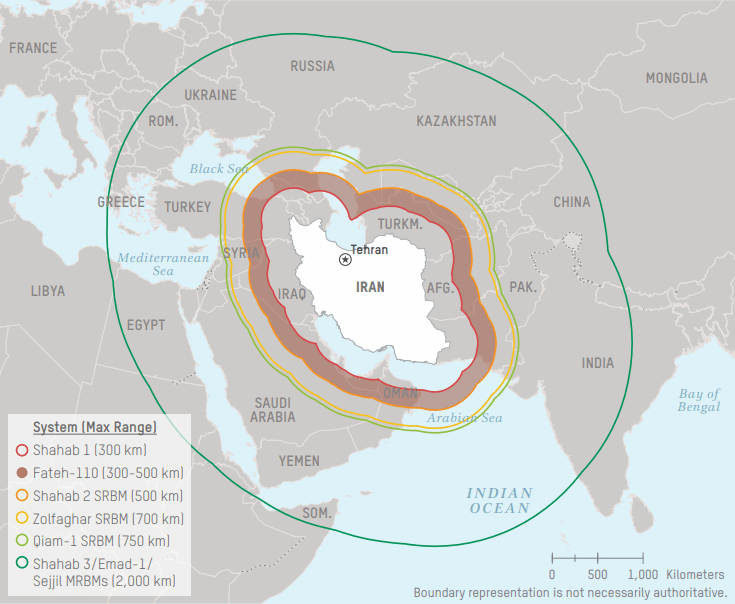
Israel says it will attack Iran if Tehran does not agree to a deal that includes restricting the range of its missiles to 300 kilometers (186 miles).
According to Ynet, Israel is demanding that any deal the US makes with Iran include Tehran eliminating its uranium enrichment program, limiting the range of its ballistic missiles to 300 kilometers, and cutting ties with its allies in the region.
President Donald Trump has suggested he will order an attack on Iran if Tehran does not make a deal with the US. Tel Aviv says any deal between Washington and Tehran must include missile range restrictions or Israel will attack Iran.
Iranian officials have stated that Tehran is unwilling to place restrictions on its missile program. Limiting the range of its missiles to 300 kilometers would prevent Iran from having a meaningful retaliatory capability.
Israeli officials, according to Ynet, do not believe that Iran will accept limitations on its missile program.
Trump met with Prime Minister Benjamin Netanyahu on Wednesday about Iran. Officials said that Washington and Tel Aviv would continue to prepare for war with Iran, and an immediate attack is unlikely.
On Wednesday, the Wall Street Journal reported that Trump had ordered a second aircraft carrier strike group to prepare for deployment to the Middle East.
Nouri al-Maliki, the leader of Iraq’s State of Law Coalition and a frontrunner for premiership, has quelled speculation regarding the future of the Popular Mobilization Forces (PMF), saying rumors of their dissolution are “unfounded.”
In an official statement on Wednesday, Maliki clarified his vision for Iraq’s security landscape. He said the PMF, known locally as Hashd al-Shaabi, is an “inseparable part of the Iraqi security system.”
Maliki’s remarks follow a period of speculation triggered by his earlier calls for restricting weapons to the hands of the state.
Clarifying his position, the candidate said the priority of the current phase is to consolidate state authority and unify security decision-making.
“The Hashd is an official institution established by law and approved by Parliament,” Maliki said. “Any talk of dissolution or merger must occur exclusively within the framework of the constitution and the law, not through rumors.”
The security debate is unfolding against a backdrop of severe diplomatic tension.
US President Donald Trump issued a blunt ultimatum in January, labeling Maliki a “very bad choice” and warning that the United States would “no longer help Iraq” if he were elected.
Responding to these threats, in a televised interview with al-Sharqiya, Maliki struck a defiant tone.
He said withdrawing his candidacy under foreign pressure would “jeopardize Iraqi sovereignty.”
“I am proceeding with this nomination until the end,” Maliki said, though he left a small window for change, noting he would only step aside if the Coordination Framework, the Shia alliance that nominated him, officially requested it.
Maliki, who served as Prime Minister from 2006 to 2014, remains a powerful figure in Iraqi politics.
The Coordination Framework has reiterated its support for him despite Trump’s comments.
Iran’s security chief says the country received no concrete proposal from the United States during the first round of talks aimed at resolving disputes around Tehran’s nuclear program.
Ali Larijani, who leads Iran’s Supreme National Security Council (SNSC), said in remarks published on Wednesday that Tehran and Washington had only exchanged messages in talks held in Oman last week.
However, Larijani said that Washington has taken the “wise and logical” decision to enter talks with Iran rather than threatening the country with military action.
He said that talks with the US will continue and that Iran views them positively, while insisting that countries in the region are also contributing to efforts aimed at bringing the Iran-US talks to a successful conclusion.
The top security official made the remarks in an interview with Qatar-based Al Jazeera Arabic TV during a visit to the country, where he met with senior officials to discuss developments related to the Iran-US nuclear talks.
Responding to a question about US demands for Iran to entirely halt its nuclear enrichment program, Larijani said that the country will never accept the zero enrichment condition, as it needs the technology for energy production as well as for manufacturing certain medicines.
He reiterated Iran’s previous warnings that any US attack on its territory will receive a harsh and decisive response.
“If the United States attacks us, we will target its military bases in the region,” said the SNSC chief, according to a Persian transcript of the interview published by the Tasnim news agency.
Larijani also said that the Israeli regime has been trying to sabotage the Iran-US talks and is seeking to draw the region into a new war.
A detailed report published by the Guardian newspaper has shown how Britain is massively contributing to Saudi Arabia’s devastating war on Yemen as it suggests that London is not only supplying the bombs that fall on Yemenis, but it provides the personnel and expertise that keep the war going.
The comprehensive report by Arron Merat published on Tuesday showed that Britain was doing much of the killing in Yemen as the country continues to provide Saudi Arabia with everything it needs to turn its southern impoverished neighbor into a graveyard.
“Every day Yemen is hit by British bombs – dropped by British planes that are flown by British-trained pilots and maintained and prepared inside Saudi Arabia by thousands of British contractors,” said Merat in the report. … continue
This site is provided as a research and reference tool. Although we make every reasonable effort to ensure that the information and data provided at this site are useful, accurate, and current, we cannot guarantee that the information and data provided here will be error-free. By using this site, you assume all responsibility for and risk arising from your use of and reliance upon the contents of this site.
This site and the information available through it do not, and are not intended to constitute legal advice. Should you require legal advice, you should consult your own attorney.
Nothing within this site or linked to by this site constitutes investment advice or medical advice.
Materials accessible from or added to this site by third parties, such as comments posted, are strictly the responsibility of the third party who added such materials or made them accessible and we neither endorse nor undertake to control, monitor, edit or assume responsibility for any such third-party material.
The posting of stories, commentaries, reports, documents and links (embedded or otherwise) on this site does not in any way, shape or form, implied or otherwise, necessarily express or suggest endorsement or support of any of such posted material or parts therein.
The word “alleged” is deemed to occur before the word “fraud.” Since the rule of law still applies. To peasants, at least.
Fair Use
This site contains copyrighted material the use of which has not always been specifically authorized by the copyright owner. We are making such material available in our efforts to advance understanding of environmental, political, human rights, economic, democracy, scientific, and social justice issues, etc. We believe this constitutes a ‘fair use’ of any such copyrighted material as provided for in section 107 of the US Copyright Law. In accordance with Title 17 U.S.C. Section 107, the material on this site is distributed without profit to those who have expressed a prior interest in receiving the included information for research and educational purposes. For more info go to: http://www.law.cornell.edu/uscode/17/107.shtml. If you wish to use copyrighted material from this site for purposes of your own that go beyond ‘fair use’, you must obtain permission from the copyright owner.
DMCA Contact
This is information for anyone that wishes to challenge our “fair use” of copyrighted material.
If you are a legal copyright holder or a designated agent for such and you believe that content residing on or accessible through our website infringes a copyright and falls outside the boundaries of “Fair Use”, please send a notice of infringement by contacting atheonews@gmail.com.
We will respond and take necessary action immediately.
If notice is given of an alleged copyright violation we will act expeditiously to remove or disable access to the material(s) in question.
All 3rd party material posted on this website is copyright the respective owners / authors. Aletho News makes no claim of copyright on such material.