A National Defense Strategy of Sowing Global Chaos
By Nicolas J.S. Davies | Consortium News | January 23, 2018
Presenting the 2018 National Defense Strategy of the United States on Friday at the Johns Hopkins University, Secretary of Defense James Mattis painted a picture of a dangerous world in which U.S. power – and all of the supposed “good” that it does around the world – is on the decline.
“Our competitive edge has eroded in every domain of warfare – air, land, sea, space, and cyberspace,” he said. “And it is continually eroding.”
What he could have said instead is that the United States military is overextended in every domain, and that much of the chaos seen around the world is the direct result of past and current military adventurism. Further, he could have acknowledged, perhaps, that the erosion of U.S. influence has been the result of a series of self-inflicted blows to American credibility through foreign policy disasters such as 2003 invasion of Iraq.
There were also two important words hidden between the lines, but never mentioned by name, in the new U.S. National Defense Strategy: “empire” and “imperialism.”
It has long been taboo for U.S. officials and corporate media to speak of U.S. foreign policy as “imperialism,” or of the U.S.’s global military occupations and network of hundreds of military bases as an “empire.” These words are on a long-standing blacklist of “banned topics” that U.S. official statements and mainstream U.S. media reports must never mention.
The streams of Orwellian euphemisms with which U.S. officials and media instead discuss U.S. foreign policy do more to obscure the reality of the U.S. role in the world than to describe or explain it, “hiding imperial interests behind ever more elaborate fig leaves,” as British historian A.J.P. Taylor described European imperialists doing the same a century ago.
As topics like empire, imperialism, and even war and peace, are censored and excised from political debate, U.S. officials, subservient media and the rest of the U.S. political class conjure up an illusion of peace for domestic consumption by simply not mentioning our country’s 291,000 occupation troops in 183 other countries or the 39,000 bombs and missiles dropped on our neighbors in Iraq, Syria and Afghanistan since Trump took office.
The 100,000 bombs and missiles dropped on these and other countries by Obama and the 70,000 dropped on them by Bush II have likewise been swept down a kind of real time “memory hole,” leaving America’s collective conscience untroubled by what the public was never told in the first place.
But in reality, it’s been a long time since U.S. leaders of either party resisted the temptation to threaten anyone anywhere, or to follow through on their threats with “fire and fury” bombing campaigns, coups and invasions. This is how empires maintain a “credible threat” to undergird their power and discourage other countries from challenging them.
But far from establishing the “Pax Americana” promised by policymakers and military strategists in the 1990s, from Paul Wolfowitz and Dick Cheney to Madeleine Albright and Hillary Clinton, the results have been consistently catastrophic, producing what the new National Defense Strategy calls, “increased global disorder, characterized by decline in the long-standing, rules-based international order.”
Of course the drafters of this U.S. strategy document dare not admit that U.S. policy is almost single-handedly responsible for this global chaos, after successive U.S. administrations have worked to marginalize the institutions and rules of international law and to establish illegal U.S. threats and uses of force that international law defines as crimes of aggression as the ultimate arbiter of international affairs.
Nor do they dare acknowledge that the CIA’s politicized intelligence and covert operations, which generate a steady stream of political pretexts for U.S. military intervention, are designed to create and exacerbate international crises, not to solve them. For U.S. officials to admit such hard truths would shake the very foundations of U.S. imperialism.
Opposition to the Joint Comprehensive Plan of Action with Iran – the so-called nuclear deal – from Republicans and Democratic hawks alike seems to stem from the fear that it might validate the use of diplomacy over sanctions, coups and war, and set a dangerous precedent for resolving other crises – from Afghanistan and Korea to future crises in Africa and Latin America. Iran’s success at bringing the U.S. to the negotiating table, instead of falling victim to the endless violence and chaos of U.S.-backed regime change, may already be encouraging North Korea and other targets of U.S. aggression to try to pull off the same trick.
But how will the U.S. justify its global military occupation, illegal threats and uses of force, and trillion-dollar war budget once serious diplomacy is seen to be more effective at resolving international crises than the endless violence and chaos of U.S. sanctions, coups, wars and occupations?
From Bhurtpoor to Baghdad
Major Danny Sjursen, who has fought in Iraq and Afghanistan and taught history at West Point, is a rare voice of sanity from within the U.S. military. In a poignant article in Truthdig, Major Sjursen eloquently described the horrors he has witnessed and the sadness he expects to live with for the rest of his life. “The truth is,” he wrote, “I fought for next to nothing, for a country that, in recent conflicts, has made the world a deadlier, more chaotic place.”
Danny Sjursen’s life as a soldier of the U.S. Empire reminds me of another soldier of Empire, my great-great-great grandfather, Samuel Goddard. Samuel was born in Norfolk in England in 1793, and joined the 14th Regiment of Foot as a teenager. He was a Sergeant at the Battle of Waterloo in 1815. During 14 years in India, his battalion led the assault on the fortress of Bhurtpoor in 1826, which ended the last resistance of the Maratha dynasty to British rule. He spent 3 years in the Caribbean, 6 years in Canada, and retired as Commandant of Dublin Castle in 1853 after a lifetime of service to Empire.
Danny’s and Samuel’s lives have much in common. They would probably have a lot to talk about if they could ever meet. But there are critical differences. At Bhurtpoor, the two British regiments who led the attack were followed through the breech in the walls by 15 regiments of Indian “Native Infantry.” After Bhurtpoor, Britain ruled India (including Pakistan and Bangladesh) for 120 years, with only a thousand British officials in the Indian Civil Service and a few thousand British officers in command of up to 2.5 million Indian troops.
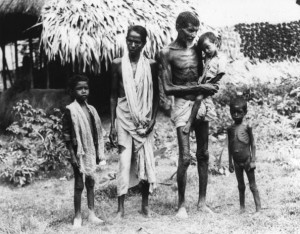 The British brutally put down the Indian Mutiny in 1857-8 with massacres in Delhi, Allahabad, Kanpur and Lucknow. Then, as up to 30 million Indians died in famines in 1876-9 and 1896-1902, the British government of India explicitly prohibited relief efforts or actions that might reduce exports from India to the U.K. or interfere with the operation of the “free market.”
As Mike Davis wrote in his 2001 book, Late Victorian Holocausts, “What seemed from a metropolitan perspective the nineteenth century’s final blaze of imperial glory was, from an Asian or African viewpoint, only the hideous light of a giant funeral pyre.”
And yet Britain kept control of India by commanding such loyalty and subservience from millions of Indians that, in every crisis, Indian troops obeyed orders from British officers to massacre their own people.
Danny Sjursen and U.S. troops in Afghanistan, Iraq and other post-Cold War U.S. war zones are having a very different experience. In Afghanistan, as the Taliban and its allies have taken control of more of the country than at any time since the U.S. invasion, the U.S.-backed Afghan National Army has 25,000 fewer troops under its command than it did five years ago, while ten years of training by U.S. special operations forces has produced only 21,000 trained Afghan Commandos, the elite troops who do 70-80% of the killing and dying for the corrupt U.S.-backed Afghan government.
But the U.S. has not completely failed to win the loyalty of its imperial subjects. The first U.S. soldier killed in action in Afghanistan in 2018 was Sergeant 1st Class Mihail Golin, originally from Latvia. Mihail arrived in the U.S. in November 2004, enlisted in the U.S. Army three months later and has now given his life for the U.S. Empire and for whatever his service to it meant to him. At least 127 other Eastern Europeans have died in occupied Afghanistan, along with 455 British troops, 158 Canadians and 396 soldiers from 17 other countries. But 2,402 – or 68%, over two-thirds – of the occupation troops who have died in Afghanistan since 2001, were Americans.
In Iraq, an American war that always had even less international support or legitimacy, 93% of the occupation troops who have died were Americans, 4,530 out of a total of 4,852 “coalition” deaths.
When Ben Griffin, who later founded the U.K. branch of Veterans for Peace, told his superiors in the U.K.’s elite SAS (Special Air Service) that he could no longer take part in murderous house raids in Baghdad with U.S. special operations forces, he was surprised to find that his entire chain of command understood and accepted his decision. The only officer who tried to change his mind was the chaplain.
The Future of Empire
The U.S. Joint Chiefs of Staff have explicitly told Congress that war with North Korea would require a ground invasion, and the same would likely be true of a U.S. war on Iran. South Korea wants to avoid war at all costs, but may be unavoidably drawn into a U.S.-led Second Korean War.
But besides South Korea, the level of support the U.S. could expect from its allies in a Second Korean War or other wars of aggression in the future would probably be more like Iraq than Afghanistan, with significant international opposition, even from traditional U.S. allies. U.S. troops would therefore make up nearly all of the invasion and occupation forces – and take nearly all of the casualties.
Compared to past empires, the cost in blood and treasure of policing the U.S. Empire and the blame for its catastrophic failures fall disproportionately – and rightly – on Americans. Even Donald Trump recognizes this problem, but his demands for allied countries to spend more on their militaries and buy more U.S. weapons will not change their people’s unwillingness to die in America’s wars.
This reality has created political pressure on U.S. leaders to wage war in ways that cost fewer American lives but inevitably kill many more people in countries being punished for resistance to U.S. imperialism, using air strikes and locally recruited death squads instead of U.S. “boots on the ground” wherever possible.
The U.S. conducts a sophisticated propaganda campaign to pretend that U.S. air-launched weapons are so accurate that they can be used safely without killing large numbers of civilians. Actual miss rates and blast radii are on the “banned topics” blacklist, along with realistic estimates of civilian deaths.
When former Iraqi foreign minister Hoshyar Zebari told Patrick Cockburn of the U.K.’s Independent newspaper that he had seen Iraqi Kurdish intelligence reports which estimated that the U.S.- and Iraqi-led destruction of Mosul had killed 40,000 civilians, the only remotely realistic estimate so far from an official source, no other mainstream Western media followed up on the story.
But America’s wars are killing millions of innocent people: people defending themselves, their families, their communities and countries against U.S. imperialism and aggression; and many more who were simply in the wrong place at the wrong time under the onslaught of over 210,000 American bombs and missiles dropped on at least 7 countries since 2001.
According to a growing body of research (for example, see the UN Development Program study, Journey to Extremism in Africa: Drivers, Incentives and the Tipping-Point for Recruitment), most people who join armed resistance or “terrorist” groups do so mainly to protect themselves and their families from the dangers of wars that others have inflicted on them. The UNDP survey found that the final “tipping point” that pushes over 70% of them to take the fateful step of joining an armed group is the killing or detention of a close friend or family member by foreign or local security forces.
So the reliance on airstrikes and locally recruited death squads, the very strategies that make U.S. imperialism palatable to the American public, are in fact the main “drivers” spreading armed resistance and terrorism to country after country, placing the U.S. Empire on a collision course with itself.
The U.S. effort to delegate war in the Middle East to Saudi Arabia is turning it into a target of global condemnation as it tries to mimic the U.S. model of warfare by bombing and starving millions of innocent people in Yemen while blaming the victims for their plight. The slaughter by poorly trained and undisciplined Saudi and Emirati pilots is even more indiscriminate than U.S. bombing campaigns, and the Saudis lack the full protection of the Western propaganda system to minimize international outrage at tens of thousands of civilian casualties and an ever-worsening humanitarian crisis.
The need to win the loyalty of imperial subjects by some combination of fear and respect is a basic requirement of Empire. But it appears to be unattainable in the 21st century, certainly by the kind of murderous policies the U.S. has embraced since the end of the Cold War. As Richard Barnet already observed 45 years ago, at the end of the American War in Vietnam, “At the very moment the number one nation has perfected the science of killing, it has become an impractical instrument of political domination.”
Obama’s sugar-coated charm offensive won U.S. imperialism a reprieve from global public opinion and provided political cover for allied leaders to actively rejoin U.S.-led alliances. But it was dishonest. Under cover of Obama’s iconic image, the U.S. spread the violence and chaos of its wars and regime changes and the armed resistance and terrorism they provoke farther and wider, affecting tens of millions more people from Syria and Libya to Nigeria and Ukraine.
Now Trump has taken the mask off and the world is once again confronting the unvarnished, brutal reality of U.S. imperialism and aggression.
China’s approach to the world based on trade and infrastructure development has been more successful than U.S. imperialism. The U.S. share of the global economy has declined from 40% to 22% since the 1960s, while China is expected to overtake the U.S. as the world’s largest economy in the next decade or two – by some measures, it already has.
While China has become the manufacturing and trading hub of the global economy, the U.S. economy has been financialized and hollowed out, hardly a solid basis for future growth. The neoliberal model of politics and economics that the U.S. adopted a generation ago has created even greater wealth for people who already owned disproportionate shares of everything, but it has left working people in the U.S. and across the U.S. Empire worse off than before.
Like the “next to nothing” that Danny Sjursen came to realize he was fighting for in Iraq and Afghanistan, the prospects for the U.S. economy seem ephemeral and highly vulnerable to the changing tides of economic history.
The Rise and Fall of the Great Powers
In his 1987 book, The Rise and Fall of the Great Powers: Economic Change and Military Conflict from 1500 to 2000, historian Paul Kennedy examined the relationship between economic and military power in the histories of the Western empires who colonized the world in the past 500 years. He described how rising powers enjoy significant competitive advantages over established ones, and how every once-dominant power sooner or later has to adjust to the tides of economic history and find a new place in a world it can no longer dominate.
Kennedy explained that military power is only a secondary form of power that wealthy nations develop to protect and support their expanding economic interests. An economically dominant power can quickly convert some of its resources into military power, as the U.S. did during the Second World War or as China is doing today. But once formerly dominant powers have lost ground to new, rising powers, using military power more aggressively has never been a successful way to restore their economic dominance. On the contrary, it has typically been a way to squander the critical years and scarce resources they could otherwise have used to manage a peaceful transition to a prosperous future.
As the U.K. found in the 1950s, using military force to try to hold on to its empire proved counter-productive, as Kennedy described, and peaceful transitions to independence proved to be a more profitable basis for future relations with its former colonies. The drawdown of its global military commitments was an essential part of its transition to a viable post-imperial future.
The transition from hegemony to coexistence has never been easy for any great power, and there is nothing exceptional about the temptation to use military force to try to preserve and prolong the old order. This has often led to catastrophic wars and it has always failed.
It is difficult for any political or military leader to preside over a diminution of his or her country’s power in the world. Military leaders are rewarded for military strategies that win wars and expand their country’s power, not for dismantling it. Mid-level staff officers who tell their superiors that their weapons and armies cannot solve their country’s problems do not win promotion to decision-making positions.
As Gabriel Kolko noted in Century of War in 1994, this marginalization of critical voices leads to an “inherent, even unavoidable institutional myopia,” under which, “options and decisions that are intrinsically dangerous and irrational become not merely plausible but the only form of reasoning about war and diplomacy that is possible in official circles.”
After two world wars and the independence of India, the Suez crisis of 1956 was the final nail in the coffin of the British Empire, and the Eisenhower administration burnished its own anti-colonial credentials by refusing to support the British-French-Israeli invasion of Egypt. British Prime Minister Anthony Eden was forced to resign, and he was replaced by Harold Macmillan, who had been a close aide to Eisenhower during the Second World War.
Macmillan dismantled the remains of the British Empire behind the backs of his Conservative Party’s supporters, winning reelection in 1959 on the slogan, “You’ve never had it so good,” while the U.S. supported a relatively peaceful transition that preserved Western international business interests and military power.
As the U.S. faces a similar transition from empire to a post-imperial future, its leaders have been seduced by the chimera of the post-Cold War “power dividend” to try to use military force to preserve and expand the U.S. Empire, even as the relative economic position of the U.S. declines.
In 1987, Paul Kennedy ended The Rise and Fall of the Great Powers with a prescient analysis of the U.S. position in the world. He concluded,
“In all of the discussions about the erosion of American leadership, it needs to be repeated again and again that the decline referred to is relative not absolute, and is therefore perfectly natural; and that the only serious threat to the real interests of the United States can come from a failure to adjust sensibly to the newer world order.”
But after Kennedy wrote that in 1987, instead of accepting the future of peace and disarmament that the whole world hoped for at the end of the Cold War, a generation of American leaders made a fateful bid for “superpower.” Their delusions were exactly the kind of failure to adjust to a changing world that Kennedy warned against.
The results have been catastrophic for millions of victims of U.S. wars, but they have also been corrosive and debilitating for American society, as the perverted priorities of militarism and Empire squander our country’s resources and leave working Americans poorer, sicker, less educated and more isolated from the rest of the world.
When I began writing Blood On Our Hands: the American Invasion and Destruction of Iraq in 2008, I hoped that the catastrophes in Afghanistan and Iraq might bring U.S. leaders to their senses, as the Suez crisis did to British leaders in 1956.
Instead, eight more years of carefully disguised savagery under Obama have squandered more precious time and good will and spread the violence and chaos of U.S. war-making even farther and wider. The new National Defense Strategy’s implicit threats against Russia and China reveal that 20 years of disastrous imperial wars have done nothing to disabuse U.S. leaders of their delusions of “superpower status” or to restore any kind of sanity to U.S. foreign policy.
Trump is not even pretending to respect diplomacy or international law, as he escalates Bush’s and Obama’s wars and threatens new ones of his own. But maybe Trump’s nakedly aggressive policies will force the world to finally confront the dangers of U.S. imperialism. A coming together of the international community to stop further U.S. aggression may be the only way to prevent an even greater catastrophe than the ones that have already befallen the people of Afghanistan, Iraq, Somalia, Honduras, Libya, Syria, Ukraine and Yemen.
Or will it actually take a new and even more catastrophic war in Korea, Iran or somewhere else to finally force the United States to “adjust sensibly to the new world order,” as Paul Kennedy put it in 1987? The world has already paid a terrible price for our leaders’ failure to take his sound advice a generation ago. But what will be the final cost if they keep ignoring it even now?
Nicolas J.S. Davies is the author of Blood On Our Hands: the American Invasion and Destruction of Iraq.
CPEC heading north to Hindu Kush
By M K Bhadrakumar | Indian Punchline | December 26, 2017
From the Indian perspective, today’s announcement by Chinese Foreign Minister Wang Yi that Beijing and Islamabad are open to extending the China-Pakistan Economic Corridor to Afghanistan dramatically changes the power dynamic in the region. Wang was speaking at a press conference following the first meeting in Beijing today of the newly created China-Afghanistan-Pakistan Dialogue format at foreign minister level, which has been a Chinese initiative. (Xinhua )
Some early deductions are possible. First, for the first time in the region, China is deploying the Belt and Road Initiative to leverage regional security and stability in South Asia. Of course, the economic aspects are there in terms of connectivity, infrastructure development, expansion of trade and investment and so on, but if Kabul becomes a CPEC partner, something fundamentally changes in the 3-way Afghan-Indian-Pakistani equation. That this would be happening under China’s mentorship is important.
Second, India is getting surrounded by BRI projects – north, east, south and west. It lacks the energy and resources to project and sustain a counter-strategy. All we are left with is our vacuous negative propaganda to malign the BRI for which there are no takers abroad. By implication, Afghanistan is rejecting India’s notions of “territorial sovereignty”, et al. At the same time, China’s interest in Indian participation in the BRI is self-evident. Time is running out for India. New thinking is needed urgently.
Third, Wang’s statement in Beijing on Monday during a media briefing on the agenda for Chinese diplomacy in the coming year singled out North Korea and Afghanistan as two regional problems where China intends to push for peacemaking. Today’s disclosure fits in with that. The trilateral format may eventually provide the platform for a regional initiative. The joint press release issued after today’s meeting called on the Taliban “to join the peace process at an early date.”
Fourth, China is displeased that the US is seeking a military solution to the conflict in Afghanistan. The Trump administration is pursuing a dangerous strategy that can destabilize the entire region surrounding Afghanistan. But China will not confront the US, either. Instead, China is introducing a counter-narrative. The US will increasingly find itself in a false position by threatening Pakistan even as Afghanistan is edging toward the CPEC to “conduct win-win trilateral economic cooperation”.
Fifth, the geopolitical implications are profound. Wang today outlined that the CPEC will eventually extend northward to link with the China-Central Asia-West Asia Economic Corridor (CCWAEC), which connects China with the Arabian Peninsula. The CCWAEC starts from China’s Xinjiang and traverses Central Asia before reaching the Persian Gulf, the Mediterranean Sea and the Arabian Peninsula. It crosses the five Central Asian countries and 17 countries and regions in West Asia (including Iran, Saudi Arabia and Turkey). It is a vast landmass, which is rich in resources but backward in infrastructure.
Finally, there is a high degree of foreign-policy coordination between Beijing and Moscow. We must anticipate that it is a matter of time before Russia evinces interest in the CPEC in one form or another. President Vladimir Putin disclosed on Monday that during a phone conversation with his Turkmenistan counterpart, the subject of the TAPI (Turkmenistan-Afghanistan-Pakistan-India) gas pipeline project came up. “He invites us to participate. Generally, certain projects are indeed implemented there, and quite successfully, including by Turkmenistan. But we must take a look, of course, at how feasible projects of this kind will be,” Putin has been quoted as saying.
Indeed, the bottom line is that the tense relations with Pakistan — and the downhill slide in the relations with China — through the past 3-year period virtually shut India out of the power dynamic in the region and reduces it to a lone bystander. The scenario looks pretty bleak.
Did Obama Arm Islamic State Killers?
By Daniel Lazare | Consortium News | December 21, 2017
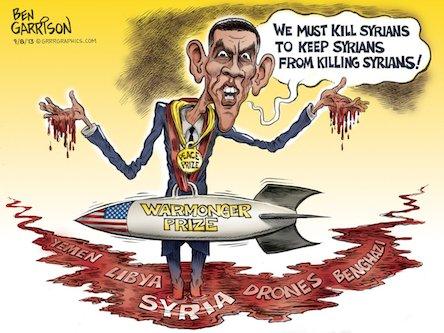
Did Barack Obama arm ISIS? The question strikes many people as absurd, if not offensive. How can anyone suggest something so awful about a nice guy like the former president? But a stunning report by an investigative group known as Conflict Armament Research (CAR) leaves us little choice but to conclude that he did.
CAR, based in London and funded by Switzerland and the European Union, spent three years tracing the origin of some 40,000 pieces of captured ISIS arms and ammunition. Its findings, made public last week, are that much of it originated in former Warsaw Pact nations in Eastern Europe, where it was purchased by United States and Saudi Arabia and then diverted, in violation of various rules and treaties, to Islamist rebels seeking to overthrow Syrian President Bashar al-Assad. The rebels, in turn, somehow caused or allowed the equipment to be passed on to Islamic State, which is also known by the acronyms ISIS or ISIL, or just the abbreviation IS.
This is damning stuff since it makes it clear that rather than fighting ISIS, the U.S. government was feeding it.
But CAR turns vague when it comes to the all-important question of precisely how the second leg of the transfer worked. Did the rebels turn the weapons over voluntarily, involuntarily, or did they somehow drop them when ISIS was in close proximity and forget to pick them up? All CAR will say is that “background information … indicates that IS [Islamic State] forces acquired the materiel through varied means, including battlefield capture and the amalgamation of disparate Syrian opposition groups.” It adds that it “cannot rule out direct supply to IS forces from the territories of Jordan and Turkey, especially given the presence of various opposition groups, with shifting allegiances, in cross-border supply locations.” But that’s it.
If so, this suggests an astonishing level of incompetence on the part of Washington. The Syrian rebel forces are an amazingly fractious lot as they merge, split, attack one another and then team up all over again. So how could the White House have imagined that it could keep weapons tossed into this mix from falling into the wrong hands? Considering how each new gun adds to the chaos, how could it possibly keep track? The answer is that it couldn’t, which is why ISIS wound up reaping the benefits.
But here’s the rub. The report implies a level of incompetence that is not just staggering, but too staggering. How could such a massive transfer occur without field operatives not having a clue as to what was going on? Was every last one of them deaf, dumb, and blind?
Not likely. What seems much more plausible is that once the CIA established “plausible deniability” for itself, all it cared about was that the arms made their way to the most effective fighting force, which in Syria happened to be Islamic State.
This is what had happened in Afghanistan three decades earlier when the lion’s share of anti-Soviet aid, some $600 million in all, went to a brutal warlord named Gulbuddin Hekmatyar. Hekmatyar was a raging bigot, a sectarian, and an anti-western xenophobe, qualities that presumably did not endear him to his CIA handlers. But as Steve Coll notes in Ghost Wars, his bestselling 2004 account of the CIA’s love affair with Islamic holy war, he “was the most efficient at killing Soviets” and that was the only thing that mattered. As one CIA officer put it, “analytically, the best fighters – the best-organized fighters – were the fundamentalists” that Hekmatyar led. Consequently, he ended up with the most money.
After all, if you’re funding a neo-medieval uprising, it makes sense to steer the money to the darkest reactionaries of them all. Something similar occurred in March 2015 when Syrian rebels launched an assault on government positions in the northern province of Idlib. The rebel coalition was under the control of Jabhat al-Nusra, as the local branch of Al Qaeda was known at the time, and what Al-Nusra needed most of all were high-tech TOW missiles with which to counter government tanks and trucks.
Arming Al Qaeda
So the Obama administration arranged for Nusra to get them. To be sure, it didn’t provide them directly. To ensure deniability, rather, it allowed Raytheon to sell some 15,000 TOWs to Saudi Arabia in late 2013 and then looked the other way when the Saudis transferred large numbers of them to pro-Nusra forces in Idlib. [See Consortiumnews.com’s “Climbing into bed with Al-Qaeda.”] Al-Nusra had the toughest fighters in the area, and the offensive was sure to send the Assad regime reeling. So even though its people were compatriots with those who destroyed the World Trade Center, Obama’s White House couldn’t say no.
“Nusra have always demonstrated superior planning and battle management,” Yezid Sayigh, a senior associate at the Carnegie Middle East Center in Beirut, said a few weeks later. If the rebel coalition was successful as a whole, it “was entirely due to their willingness to work with Nusra, who have been the backbone in all of this.”
Scruples, assuming they existed in the first place, fell by the wayside. A senior White House official told The Washington Post that the Obama administration was “not blind to the fact that it is to some extent inevitable” that U.S. weapons would wind up in terrorist hands, but what could you do? It was all part of the game of realpolitik. A senior Washington official crowed that “the trend lines for Assad are bad and getting worse” while The New York Times happily noted that “[t]he Syrian Army has suffered a string of defeats from re-energized insurgents.” So, for the master planners in Washington, it was worth it.
Then there is ISIS, which is even more beyond the pale as most Americans are concerned thanks to its extravagant displays of barbarism and cruelty – its killing of Yazidis and enslavement of Yazidi women and girls, its mass beheadings, its fiery execution of Jordanian fighter pilot Moaz al-Kasasbeh, and so on.
Yet U.S. government attitudes were more ambivalent than most Americans realized. Indeed, the U.S. government was strictly neutral as long as ISIS confined itself to attacking Assad. As a senior defense official told the Wall Street Journal in early 2015: “Certainly, ISIS has been able to expand in Syria, but that’s not our main objective. I wouldn’t call Syria a safe haven for ISIL, but it is a place where it’s easier for them to organize, plan, and seek shelter than it is in Iraq.”
In other words, Syria was a safe haven because, the Journal explained, the U.S. was reluctant to interfere in any way that might “tip the balance of power toward Syrian President Bashar al-Assad, who is fighting Islamic State and other rebels.” So the idea was to allow ISIS to have its fun as long as it didn’t bother anyone else. For the same reason, the U.S. refrained from bombing the group when, shortly after the Idlib offensive, its fighters closed in on the central Syrian city of Palmyra, 80 miles or so to the east. This was despite the fact that the fighters would have made perfect targets while “traversing miles of open desert roads.”
As The New York Times explained: “Any airstrikes against Islamic State militants in and around Palmyra would probably benefit the force of President Bashar al-Assad. So far, United States-led airstrikes in Syria have largely focussed on areas far outside government control, to avoid the perception of aiding a leader whose ouster President Obama has called for.” [See Consortiumnews.com’s “How US-Backed War on Syria Helped ISIS.”]
Looting Palmyra
The United States thus allowed ISIS to capture one of the most archeologically important cities in the world, killing dozens of government soldiers and decapitating 83-year-old Khalid al-Asaad, the city’s retired chief of antiquities. (After looting and destroying many of the ancient treasures, ISIS militants were later driven from Palmyra by a Russian-backed offensive by troops loyal to President Assad.)
Obama’s bottom line was: ISIS is very, very bad when it attacks the U.S.-backed regime in Iraq, but less so when it wreaks havoc just over the border in Syria. In September 2016, John Kerry clarified what the administration was up to in a tape-recorded conversation at the U.N. that was later made public. Referring to Russia’s decision to intervene in Syria against ISIS, also known by the Arabic acronym Daesh, the then-Secretary of State told a small knot of pro-rebel sympathizers:
“The reason Russia came in is because ISIL was getting stronger. Daesh was threatening the possibility of going to Damascus and so forth, and that’s why Russia came in, because they didn’t want a Daesh government and they supported Assad. And we know this was growing. We were watching. We saw that Daesh was growing in strength, and we thought Assad was threatened. We thought, however, we could probably manage, that Assad might then negotiate. Instead of negotiating, he got … Putin in to support him. So it’s truly complicated.” (Quote starts at 26:10.)
“We were watching.” Kerry said. So, by giving ISIS free rein, the administration hoped to use it as a lever with which to dislodge Assad. As in Afghanistan, the United States thought it could use jihad to advance its own imperial interests. Yet the little people – Syrian soldiers, three thousand office workers in lower Manhattan, Yazidis, the Islamic State’s beheading of Western hostages, etc. – made things “truly complicated.”
Putting this all together, a few things seem clear. One is that the Obama administration was happy to see its Saudi allies use U.S.-made weapons to arm Al Qaeda. Another is that it was not displeased to see ISIS battle Assad’s government as well. If so, how unhappy could it have been if its allies then passed along weapons to the Islamic State so it could battle Assad all the more? The administration was desperate to knock out Assad, and it needed someone to do the job before Vladimir Putin stepped in and bombed ISIS instead.
It was a modern version of Henry II’s lament, “Who will rid me of this meddlesome priest?” The imperative was to get rid of Assad; Obama and his team had no interest in the messy details.
None of which proves that Obama armed ISIS. But unless one believes that the CIA is so monumentally inept that it could screw up a two-car funeral, it’s the only explanation that makes sense. Obama is still a congenial fellow. But he’s a classic liberal who had no desire to interfere with the imperatives of empire and whose idea of realism was therefore to leave foreign policy in the hands of neocons or liberal interventionists like Secretaries of State Hillary Clinton and John Kerry.
If America were any kind of healthy democracy, Congress would not rest until it got to the bottom of what should be the scandal of the decade: Did the U.S. government wittingly or unwittingly arm the brutal killers of ISIS and Al Qaeda? However, since that storyline doesn’t fit with the prevailing mainstream narrative of Washington standing up for international human rights and opposing global terrorism, the troublesome question will likely neither be asked nor answered.
Daniel Lazare is the author of several books including The Frozen Republic: How the Constitution Is Paralyzing Democracy (Harcourt Brace).
Afghan Ghani takes on the ‘King of the North’
By M K Bhadrakumar | Indian Punchline | December 20, 2017
The simmering political feud between Afghan President Ashraf Ghani and governor of Balk province in the north of the country Atta Muhammad Noor peaked on Monday. Ghani sacked Noor and claimed the latter ‘resigned’. Noor cries murder, saying he didn’t resign.
Noor, popularly known as the ‘King of the North’, is also the head of the Jamiat-i-Islami, the predominantly Tajik party wielding influence in the eastern, northern and western provinces, which traces its pedigree to Ahmed Shah Massoud and Burhanuddin Rabbani. Noor fought as a Jamiat commander during the jihad against the Soviet army in the 1980s and later was a key figure in the Northern Alliance during the anti-Taliban resistance under Massoud.
Noor is a hugely influential Tajik leader who, Ghani senses (rightly so), harbors presidential ambitions. The elections are due next July (ie., if Ghani chooses to hold them.) The ensuing power play in the recent months has led to this week’s showdown. Ghani is worried that a political alliance that Noor formed a few months ago is gaining traction. The other leading figures in the alliance include influential ‘warlords’ such as the Uzbek leader Abdul Rashid Dostum, Hazara leader Mohammed Mohaqiq, Tajik leader from Herat Ismail Khan and so on.
Ghani had thought that the Noor-Dostum-Mohaqiq alliance would unravel, but surprisingly it has not only held together but is also expanding its reach to the southern region. Ghani is determined to stay in power confident in the knowledge that so long as he serves American interests loyally, he has nothing to worry. But all the same, as the election draws closer, he is getting goosebumps.
The point is, Ghani is finding himself between the rock and a hard place. On the one hand, a powerful coalition is assembling to challenge his candidacy if elections are held next year. On the other hand, former President Hamid Karzai has raised the demand that a loya jirga should be convened instead to review the security policies and Afghanistan’s relations with the United States and also to select a new leadership in Kabul. Ideally, Ghani would like to avoid both – elections and loya jirga – and simply remain in power. But then, Karzai’s proposal is steadily gaining broader acceptance as it becomes increasingly clear that the likelihood of Ghani risking an election is indeed very low.
Of course, Ghani knows that a loya jirga would dump him without batting an eyelid. Which of course is Karzai’s agenda, too. Karzai somehow wants to get rid of the Americans and bring to an end the US occupation of his country. But on the pathway lies Ghani. The Americans themselves are horrified at the very mention of Karzai and loya Jirga, as they know that the groundswell of ‘anti-American’ feelings may surge if they are allowed to have their way. The US agenda is minimal – willy-nilly retain the military bases in Afghanistan.
An American puppet in Kabul is, therefore, an absolute prerequisite. Ghani has become irreplaceable. The recent Pentagon report to the US Congress beautifully puts across the paradigm – “We have a willing and able partner in President Ghani.”
Then, there are sub-plots. Jamiat has taken exception to Ghani’s sacking of Noor. It has alleged that Ghani’s move contravenes the understanding that led to the creation of the present National Unity Government after the disputed presidential election in 2014. The Jamiat has called for ‘civic action’ to protest but has warned that ‘if the aggression and threats increase against us, then we can use other options.’
The big question is where Chief Executive Officer Abdullah Abdullah stands in all this. Notionally, he is a Jamiat leader. If Jamiat decides to withdraw its support to Ghani, the decent thing to do is for Abdullah to resign. But will he? For one thing, he is also under the American thumb and if he quits now and brings the roof down on the Ghani government that the Americans built, it will annoy Washington.
Abdullah’s single-minded agenda is to replace Ghani. In effect, he would like to replace Ghani as the next American puppet. So, Abdullah finds himself in a quandary. ‘To quit, or not to quit,’ that’s the question. In all probability, he won’t quit since there is no guarantee either that Jamiat will field him as a presidential candidate when Noor has already voiced interest in Ghani’s job.
Ghani has matured as a first-rate manipulator. His tactic is to divide and rule. He has already caused split in Dostum’s party Jumbish; he is propping up one faction of Hezb-e-Islami, which doesn’t accept Gulbuddin Hematyar’s leadership; he now hopes to create havoc in the Jamiat camp as well. But things can spin out of hand. If these fractures and ethnic tensions get reflected in the Afghan state structures, especially the army and police – which they will (if not already) – new possibilities arise – such as coups and counter-coups and so on.
Meanwhile, the political vacuum in the north following Noor’s dismissal can only work to the advantage of the Taliban and the Islamic State. The developments have been sufficiently worrisome that German Foreign Minister Sigmar Gabriel flew into Kabul today evening to meet Ghani and urge him to hold the elections on schedule next July. Gabriel offered that Berlin will defray the cost of the elections. The German contingent is based in Mazar-i-Sharif and Noor has been a valuable local ally. Above all, Berlin will have a problem dealing with the government in Kabul beyond July once it loses the last bit of legitimacy it can claim to have to continue in power.
What emerges is that the Trump administration was lying through its teeth when Pentagon presented a rosy picture of the Afghan situation in its six-monthly report to the US Congress in December. The chilling reality is that Afghanistan is heading south – in the direction of where the former South Vietnam found itself in the 1960s.
Is TIME’s Afghan “cover girl” really a victim of mutilation by the Taleban?
Zero Anthropology | August 8, 2010

TIME : What Happens if We Leave Afghanistan (story)

BOING BOING : What Still Happened Despite 10 Years of Occupying Afghanistan (story)

ZERO ANTHRO : What Happens When We Don’t Fix Problems at Home (story)
The August 9th TIME magazine cover story is about a young Afghan woman whose nose and ears have been allegedly “mutilated” by the Taleban. The story has generated widespread self-serving moral indignation and self-righteous clamor in the U.S. propaganda machine supporting the occupation of Afghanistan run by the Israeli-American weapon-making industry. The American culture cleansing project in Afghanistan must be in need of a booster shot from the radical feminist forces that so fervently collaborated with the American war machine in initiating this racist imperial enterprise in 2001. Perhaps the flaunting of this fictitious story is a desperate attempt by the Obama war regime to offset the steep decline of support for this murderous program against unarmed and helpless pre-industrial Afghanistan. Let us recall the production of the picture of the frightened green-eyed Afghan girl on the cover of the National Geographic magazine to justify the United States sponsorship of local anti-government terrorist gangs who currently host the American occupation of Afghanistan.
TIME’s story does not provide its readers with any specific or credible factual text and context about what has really caused the deformity in this young woman’s face. Like much fiction that has been produced in the shadow of the American war machine in Afghanistan, this “story” appears to be a string of hearings and imaginings about women’s life in Afghanistan put together by Aryn Baker and Jodi Bieber, two young American journalists who probably first encountered Afghanistan in the pages of “the kite runner”. Having the readers see the reporters’ pictures (p. 4) in a “Kabul kite shop” speaks to the compelling impact of the untruths about life in Kabul in that “bestseller” book. What is the relationship of kites to a story about a mutilated nose? TIME’s story by Baker and Bieber has no truth value. Let us have a closer look at some of the cultural content and ethnographic claims in this fabricated telltale.
The narrative in which the Taleban single out this young woman for ears and nose mutilation at the instigation of her husband cannot be credible when exposed to the spatial, temporal, and cultural framework provided by the reporters. First, Urozgan province is located in central Afghanistan not “southern” Afghanistan. And if the alleged mutilation took place in central or northern Urozgan, TIME’s tale becomes even less credible for these parts of Urozgan are home to non-Paxtuns, especially Hazaras. What is the victim’s ethnic background? Even if the agency of this “mutilation” were the Taleban, why would they devote this amount of precious human resources in a hostile area to the personal disenchantment of a single Taleb foot soldier with his runaway wife, Aisha? This does not make tactical or strategic sense.
The Taleban dragged Aisha “to a mountain clearing near her village” where “[s]hivering in the cold air and blinded by the flashlights trained on her by her husband’s family, she faced her spouse and accuser… and men moved to deliver her punishment. Aisha’s brother-in-law held her down while her husband pulled out a knife. First he sliced off her ears. Then he started on her nose. Aisha passed out from her pain but awoke soon after, choking on her own blood. The men had left her on the mountaintop to die” (pp. 20-22). If the men wanted Aisha to die, why did they not kill her on the spot, on the mountain? Why give her a chance to live? Why risk her potential recovery and/or rescue?
To receive her punishment, why would Aisha have to be dragged to the mountain clearing (or is it a “mountainside”)? Where is this mountain clearing or side located in Urozgan? However, it must be at a distance from the village. And if TIME’s narrative is valid, the mutilation is a public affair with the husband, his family, and Taleban officials present. Thus, there are witnesses to the mutilation of Aisha’s nose and ears. These witnesses, especially members of her husband’s family, can be located. Did Aisha “pass out” from “pain” or loss of blood? How does a victim whose ears and nose have been mutilated and is choking on her own blood, and left alone “on the mountainside to die” survive such virtually fatal injuries? The human face is heavily irrigated with blood. I am not a medical doctor, but based on common sense, it would not take more than a few minutes of suffering heavy blood loss from open veins around the nose and ears to become fatal? How does a rural 19 year girl in such perilous medical condition, bleeding from open veins around her nose and ears, manage to move from a mountainside in remote Urozgan to a “shelter” in downtown Kabul hundreds of miles away? “A few months after Aisha arrived at the shelter, her father tried to bring her home with promises that he would find her a new husband. Aisha refused to leave. In rural areas, a family that finds itself shamed by a daughter sometimes sells her into slavery, or worse, subjects her to a so-called honor killing—murder under the guise of saving the family’s name” (p. 26). Now, what are the prospects (or practical feasibility) for marriage of a woman who has her ears and nose mutilated for having dishonored her own family, husband, and in-laws in patriarchal Afghanistan or for that matter in patricentric United States? What would be the market value of Aisha’s labor? What kind of labor could a severely mutilated woman like this produce as a slave? Only total ignorance of the Afghan cultural plane and complete disregard for the intelligence of the audience by the American popular media would allow such fabricated prattle to see the light of public print.
Aisha’s disposition could be congenital. It could be caused by a bacterial or viral infection such as cancer, a malady not rare in Afghanistan among both men and women. Or it could be related to an injury caused by firearms or explosives. Harelips and other deformities in the mandible, although rare, occur in the population of Afghanistan. Incidents of human body deformities in Afghanistan have steadily increased with the expanding military interference of the United States going back to the 1980s. These incidents have soared since 2001 with the American occupation and experimentation with weapon systems designed for “population centered wars” in Afghanistan and elsewhere.
The non-Paxtun Northern Alliance warlords and their inner circles are the only Afghans that pray and beg for the American military presence in Afghanistan. It was these anti-Paxtun American trained and subsidized terrorist gangs who scouted and pimped for the American occupation of Afghanistan. And it is the Northern Alliance that opposes a political solution in Afghanistan because any such solution would remove them from power and expose and punish their criminal deeds. Amrullah Saleh, a known psychopath and a leading member of this criminal gang who headed Afghanistan’s intelligence services, recently expatiated: “I have killed many of them (Taleban) with pride”, killing “them is part of my blood” (Lara Logan interview on “60 Mintes”, August 1, 2010). The informants for TIME’s reporters of this story are the female dependents of the Northern Alliance criminal clique one of whom is credited with this rabid hateful lie “I go running in the stadium where the Taliban used to play football with women’s heads” (p. 24). This woman is pictured standing in Kabul stadium with three Kabuli teenagers in the background clearly running-in-place! There is not a shred of evidence for a football game played with human heads anywhere at any time in Afghanistan. TIME magazine has truly stooped to the lowest standards in journalism. During the 1990s the Kabul stadium was used once for the public execution of a woman found guilty of violating a Taleban decree.
The American intimate love affair during the past three decades with the various gangs of terrorists including Al-Qaeda, Hezb-e Islami, Northern Alliance, and sporadically the early manifestation of the Taleban movement during the 1990s has inflicted irreparable damage on the political, economic, and security prospects of Afghanistan. The ethnic and sectarian divisions caused by the American military operations and criminal deeds in South Asia has brought the frail state structure of Afghanistan to the verge of total collapse. It has destabilized the whole region. Tens of thousands of innocent and helpless Afghans have been slaughtered by the American Zionist-controlled killing machine. These are war crimes and crimes against humanity for which history will condemn its perpetrators.
On an ethnographic level, the manipulation of the body of the subject human population by the state has historical roots in several culture areas including Europe, the Middle East and South Asia. To this day in the popular lore of non-Paxtun areas of Afghanistan (especially among the Farsi-speaking population) a person, male or female, who compromises the interests and standards of the larger community, is symbolically labeled “beeni borida” (Farsi, one whose nose has been cut, one who has lost his nose, i. e. one who has lost her/his honor, a person without honor). The equivalent of this linguistic construct and its cultural content does not exist among Paxtuns.
However, no matter the untruths and distortions from which TIME’s August 9th cover story is concocted, we need a proper comparative cultural framework for the understanding of abuse of the human body including the practice of mutilation of body parts. An informed glance at global ethnographic realities connects such practices with a relation of power called patriarchy—male domination of society. As a system of ideas and practices patriarchy “is a threat to public health everywhere” (Laura Nader, Anthropology News, September 2006, p. 7) including Afghanistan and the United States. In principle the socio-cultural ingredients involved in the mutilation of the human body in Afghanistan are not different than the socio-cultural forces that impose industrial “vaginal rejuvenation”, “pussy tightening” (JoAnn Wypijewski, The Nation, 9/28/2009, p. 8), and breast enhancement in Euro-America. In no other culturally constructed space are women, womanhood, and femininity so universally abused, exploited, demeaned, and vulgarized than in the Euro-American industry of internet pornography—the biggest money making enterprise in cyberspace. Comparative studies reveal that American domestic violence is approximately 25%–about the same as in Syria and Bolivia (Nader 2006:7). The extensive system of shelters for abused women throughout the United States is symptomatic of a widely practiced tradition of physical and verbal abuse of women by men that is qualitatively not different than the abuse of women by men elsewhere in the world.
TIME, you are a beeni borida!
_________
Addendum by Max Forte:
[“In 2005, 1,181 women were murdered by an intimate partner. That’s an average of three women every day. Of all the women murdered in the U.S., about one-third were killed by an intimate partner” (source). 17.6 % of women in the United States have survived a completed or attempted rape. Of these, 21.6% were younger than age 12 when they were first raped, and 32.4% were between the ages of 12 and 17. 64% of women who reported being raped, physically assaulted, and/or stalked since age 18 were victimized by a current or former husband, cohabiting partner, boyfriend, or date. Only about half of domestic violence incidents are reported to police. The National College Women Sexual Victimization Study estimated that between 1 in 4 and 1 in 5 college women experience completed or attempted rape during their college years. One out of every six American women have been the victims of an attempted or completed rape in their lifetime. Factoring in unreported rapes, about 5% – one out of twenty – of rapists will ever spend a day in jail. 19 out of 20 will walk free. The costs of intimate partner violence against women exceed an estimated $5.8 billion. These costs include nearly $4.1 billion in the direct costs of medical care and mental health care and nearly $1.8 billion in the indirect costs of lost productivity and present value of lifetime earnings. A University of Pennsylvania research study found that domestic violence is the leading cause of injury to low-income, inner-city Philadelphia women between the ages of 15 to 44 – more common than automobile accidents, mugging and rapes combined. In this study domestic violence included injuries caused by street crime (see sources).]
Yemen, Afghanistan in focus as landmine casualties spike
Press TV – December 14, 2017
Landmines killed 8,605 people in several countries in 2016, despite an international ban on the deadly device, a monitoring group says.
According to the annual report released Thursday by Landmine Monitor, about three-quarters of the known casualties were civilians, including more than 1,000 children who were injured and nearly 500 who were killed.
The number of the casualties — which were mostly recorded in Afghanistan, Libya, Ukraine and Yemen — showed a 30% surge compared to 2015.
“A few intense conflicts, where utter disregard for civilian safety persists, have resulted in very high numbers of mine casualties for the second year in a row,” Loren Persi, an editor of the Landmine Monitor said.
Persi described the spike as “alarming”, adding that the true number of the victims would be significantly higher if the data gathering were complete.
The surge comes after a 18-year decline in landmine casualties since the Mine Ban Treaty first came into force in 1999.
The treaty bans the use of landmines and other explosive devices placed on or under the ground, designed to blow up when somebody unintentionally steps on them.
These weapons can be continuously deadly weapons for many years, long after the war has ended. About 80% of landmine victims are civilians.
The Mine Ban Treaty, which has been signed by 163 countries, also bans production, stockpiling and transfer of the deadly landmines.
Propaganda, Confrontation and Profit
By Brian CLOUGHLEY | Strategic Culture Foundation | 06.12.2017
The waves, the artificial tides of anti-Russian propaganda continue to beat upon the ears and eyes of Western citizens, spurred by Washington politicians and bureaucrats whose motives vary from deviously duplicitous to blatantly commercial. It is no coincidence that there has been vastly increased expenditure on US weaponry by Eastern European countries.
Complementing the weapons’ build-up, which is so sustaining and lucrative for the US industrial-military complex, the naval, air and ground forces of the US-NATO military alliance continue operations ever closer to Russia’s borders.
Shares and dividends in US arms manufacturing companies have rocketed, in a most satisfactory spinoff from Washington’s policy of global confrontation, and the Congressional Research Service (CRS) records that “arms sales are recognized widely as an important instrument of state power. States have many incentives to export arms. These include enhancing the security of allies or partners; constraining the behaviour of adversaries; using the prospect of arms transfers as leverage on governments’ internal or external behaviour; and creating the economics of scale necessary to support a domestic arms industry.”
The CRS notes that arms deals “are often a key component in Congress’s approach to advancing US foreign policy objectives,” which is especially notable around the Baltic and throughout the Middle East, where US wars have created a bonanza for US weapons makers — and for the politicians whom the manufacturers reward so generously for their support. (Additionally, in 2017 arms manufacturers spent $93,937,493 on lobbying Congress.)
Some countries, however, do not wish to purchase US weaponry, and they are automatically categorised as being influenced by Russia, which is blamed for all that has gone wrong in America over the past couple of years. This classification is especially notable in the Central Asian Republics.
The US military’s Central Command (Centcom) states that its “area of responsibility spans more than 4 million square miles and is populated by more than 550 million people from 22 ethnic groups, speaking 18 languages… and confessing [sic] multiple religions which transect national borders. The demographics create opportunities for tension and rivalry.” Centcom is deeply engaged in the US wars in Iraq, Syria and Afghanistan, and supports Saudi Arabia in its war on Yemen, and the extent of its influence in the Pentagon’s self-allotted geographical Area of Responsibility is intriguing, to say the least. Some of its priorities were revealed in March 2017 by the Commander of this enormous military realm, General Joseph Votel, in testimony to the Armed Services Committee of the House of Representatives in Washington.
General Votel’s description of US self-allocated “responsibilities” was astonishing in its imperialistic arrogance.
As Commander of Centcom, General Votel gave the Armed Services Committee a colourful tour of his territory, describing nations in terms ranging from condescendingly supportive to patently insolent, and he devoted much time to describing relations with countries abutting Russia, Iran and China, which nations, he declared, are trying “to limit US influence in the sub-region.” That “sub-region” includes many countries immediately on the borders of Russia, Iran and China, and averaging 7,000 miles (11,000 kilometres) from Washington.
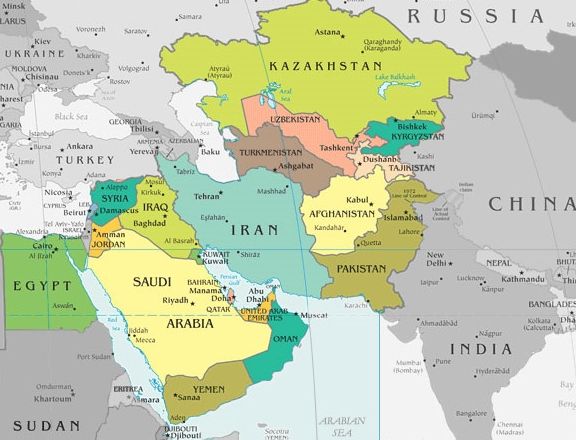
CENTCOM countries (coloured)
First he dealt with Kazakhstan with which the US has its “most advanced military relationship in Central Asia” in furtherance of which Washington is “making notable progress… despite enduring Russian influence.” It is obviously unacceptable to the Pentagon that Russia wishes to maintain cordial relations with a country with which it has a border of 6,800 kilometres. Then General Votel went into fantasyland by claiming that “Kazakhstan remains the most significant regional contributor to Afghan stability…” which even the members of the Congressional Committee would have realised is spurious nonsense.
But more nonsense was to follow, with General Votel referring to Kyrgyzstan in patronising terms usually associated with a Viceroy or other colonial master of a region that Votel describes as “widely characterized by pervasive instability and conflict,” which he failed to note were caused by the US wars in Afghanistan and Iraq.
He told the Committee that Kyrgyzstan “sees political pressure from its larger, more powerful neighbours, including Russia, hosting a small Russian airbase outside the capital, Bishkek. Despite ongoing challenges in our bilateral and security cooperation, we continue to seek opportunities to improve our mil-to-mil relationship.” He did not explain why Kyrgyzstan should be expected to embrace a military alliance with United States Central Command, but Viceroys don’t have to provide explanations.
Votel then moved to consider Tajikistan with which “our mil-to-mil relationship is deepening despite Moscow’s enduring ties and the presence of the military base near Tajikistan’s capital of Dushanbe, Russia’s largest military base outside of its borders.” Not only this, says Votel, but China (having a 400 Kilometre border with Tajikistan) has had the temerity to have “initiated a much stronger military cooperation partnership with Tajikistan, adding further complexity to Tajikistan’s multi-faceted approach to security cooperation.”
No: China hasn’t added any complexity to Tajikistan’s circumstances. What has complicated their relations is the fact that Afghanistan is in a state of chaos, following the US invasion of 2001, and drugs and terrorists cross the border (1,300 kilometres long) from Afghanistan into Tajikistan, which is trying to protect itself. During its sixteen years of war in Afghanistan there has been no attempt by the United States to secure that border.
None of these countries wants to be forced into a military pact with the United States, and Turkmenistan (border with Afghanistan 750 kilometres) has made it clear it doesn’t want to be aligned with anyone. But General Votel states that its “UN-recognized policy of ‘positive neutrality’ presents a challenge with respect to US engagement.” No matter what is desired by Turkmenistan, it seems, there must always be a way for the United States Central Command to establish military relations and, as General Votel told the Defence Committee, “we are encouraged somewhat by Turkmenistan’s expressed interest in increased mil-to-mil engagement with the US within the limits of their ‘positive neutrality’ policy.”
In the minds (to use the word loosely) of General Votel and his kind, it doesn’t matter if a country wants nothing whatever to do with the United States’ military machine, and wants very much to be left alone to get on with things without any interference. Adoption of such a policy by any nation presents a “challenge” and the United States, which in this region is overseen by General Votel’s Central Command, is determined to seek military “engagement” irrespective of what is desired by governments. Arms sales would swiftly follow.
Votel’s tour of his area of responsibility covered Afghanistan, about which his most absurd assertion was “I believe what Russia is attempting to do is they are attempting to be an influential party in this part of the world. I think it is fair to assume they may be providing some sort of support to [the Taliban] in terms of weapons or other things that may be there.”
There was not a shred of evidence provided, but the Committee accepted the pronouncement. Obviously if an allegation is made about Russia it doesn’t matter if it is false. It must be believed. But unfortunately for the imperial Votel and his deferential audience, a person with some sense of truth and balance came up two months later with a statement rubbishing Votel’s unfounded and provocative accusation. In May the Director of the US Defence Intelligence Agency told a Senate Committee that “We have seen indication that [Russia] offered some level of support [to the Taliban], but I have not seen real physical evidence of weapons or money being transferred.” The mainstream media gave no publicity to the truth, and continue to blame Russia for all the ills that befall the US Empire, at home and overseas.
The state of affairs was summed up admirably by Jacob Hornberger of the Future of Freedom Foundation on December 4 when he wrote that “Central to any national-security state is the need for official enemies, ones that are used to frighten and agitate the citizenry. If there are no official enemies, the American citizenry might begin asking some discomforting questions: What do we need a national-security state for? Why not abolish the CIA and dismantle the military-industrial complex and the NSA. Why can’t we have our limited-government, constitutional republic back?”
The Motto of the Pentagon’s Central Command is “Prepare, Pursue, Prevail.” and the Central Asian Republics would be well-advised to bear in mind these threats and think hard about the underlying motif of the US military-industrial complex which is “Propagandise, Provoke, Profit.”
Featured Video
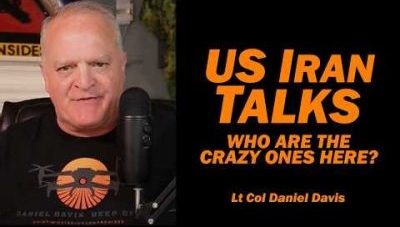
US IRAN TALKS: Who Are the Crazy Ones Here? /Lt Col Daniel Davis
or go to
Aletho News Archives – Video-Images
From the Archives
Wartime internment camps in Australia
National Archives of Australia
World War I
During World War I, for security reasons the Australian Government pursued a comprehensive internment policy against enemy aliens living in Australia.
Initially only those born in countries at war with Australia were classed as enemy aliens, but later this was expanded to include people of enemy nations who were naturalised British subjects, Australian-born descendants of migrants born in enemy nations and others who were thought to pose a threat to Australia’s security.
Australia interned almost 7,000 people during World War I, of whom about 4,500 were enemy aliens and British nationals of German ancestry already resident in Australia.
Records of World War I internment camps
World War II
During World War II, Australian authorities established internment camps for three reasons – to prevent residents from assisting Australia’s enemies, to appease public opinion and to house overseas internees sent to Australia for the duration of the war.
Unlike World War I, the initial aim of internment during the later conflict was to identify and intern those who posed a particular threat to the safety or defence of the country. As the war progressed, however, this policy changed and Japanese residents were interned en masse. In the later years of the war, Germans and Italians were also interned on the basis of nationality, particularly those living in the north of Australia. In all, just over 20 per cent of all Italians resident in Australia were interned. … continue
Blog Roll
 Aletho News
- US IRAN TALKS: Who Are the Crazy Ones Here? /Lt Col Daniel Davis
- Talks with the US end without a deal over excessive US demands: Iran
- Feeling Better, Getting Worse: How Psychiatric Drugs Create the Illusion They Cure
- ‘Nobody Told Me’: Former Mental Health Patient Calls Out Dangerous Side Effects of Psychiatric Drugs
- Dr. Abu-Sitta: Beirut ‘felt like a day in Shifa Hospital’
- Iran Has Won the War, It Will Be Up to the US to Secure the Peace: Mohammad Marandi
- Iran condemns assassination threats against Iranian negotiators amid US talks
- Brussels cannot say where its own pipeline inspectors are as Hungary’s oil lifeline remains shut
- Israel’s Iran War: Myth and Reality
- Between war and industrial breakdown: The US-Israeli attrition crisis
- If Americans Knew
- US-Iran ceasefire negotiations make zero progress – Daily Update
- Pro-Israel ‘Thinktanks’ and Individuals who Influence U.S. Foreign Policy
- Mearsheimer reveals how Israel dictates US policies on Iran, Gaza – video
- After killing 350+, Israel still has a “score to settle” with Lebanon before ceasefire – Daily Update
- Military aid to Israel emerges as the latest political litmus test for Democrats
- The only Palestinian children’s rights organization closes following years-long Israeli campaign against it
- ‘I Can’t Forget the Smell’: Lebanese Reel After Israel Kills Over 300 in Single Day
- DNC Shoots Down Resolutions Calling Out AIPAC and Limiting Arms to Israel
- TCN: Is Israel Blackmailing President Trump?
- Israel killed at least 303 Lebanese yesterday – who were they? Daily Update
- No Tricks Zone
- German Expert: Heat Dome Led To Record Temps In Western USA…Warmer In 1934, 1936
- New Study: No Linear Warming Or Glacier Retreat Along Northern Antarctic Peninsula Since 1980s
- An Inconvenient Tree: Uncovered In Alps… Europe Much Warmer Than Today 6000 Years Ago
- New Study Reports A 60% Slowdown In Greenland’s Ice Loss Rate In The Last Decade
- Low Intensity Tornado Wrecks Major Solar Farm, Creating A Potential Toxic Dump
- New Study Finds Warming Saves Lives…Cold Temperatures 12 Times More Deadly Than Excess Heat
- German Science Blog Accuses PIK Climate Institute Of Hallucinating Climate Tipping Points
- Devastating Assessment Of Comirnaty Vaccine By Former Senior Pfizer Europe Toxicologist
- New Study: CO2 Is ‘Effectively Negligible’ As An Explanatory Climate Change Factor Since 2000
- Former Pfizer Toxicologist Dr. Helmut Sterz Tells Bundestag Hearing Pfizer Vaccine Should Have Never Been Approved
 Aletho News