NATO to Keep Forces in Endless Afghanistan Quagmire
Sputnik – 20.10.2015
Germany, Turkey and Italy will maintain their current troop levels in Afghanistan, NATO officials said on Monday after the United States announced that it will prolong its military presence there.
General Philip Breedlove, NATO’s top commander in Europe, said he had assurances that NATO countries will continue alongside the nearly 10,000 US troops in Afghanistan.
“Several of our largest contributors have already communicated with us that they will remain in their current posture,” Breedlove told Reuters.
Germany, NATO’s top contributor, has around 850 troops in Afghanistan, followed by Italy with 760 and about 500 for Turkey, according to the latest NATO data.
The decision comes after the Taliban’s brief takeover of the strategic northern city of Kunduz, which raised concern about the strength of Afghan state forces.
“We should make any changes on our troop structure based on conditions on the ground, not on schedules,” Breedlove said.
US President Barack Obama had aimed to withdraw all but a small US force before leaving office. But now he will instead maintain the current force of 9,800 through most of 2016 before starting to trim numbers 2017.
Unlike the United States, NATO has never set an end date to its “Resolute Support” training mission in Afghanistan, which now stands at 6,000 troops from some 40 countries.
US-led NATO invaded Afghanistan in 2001 shortly after the 9/11 attacks, ousting the Taliban government from Kabul.
Bernie Sanders endorses Obama’s decision to keep troops in Afghanistan
By Patrick Martin | WSWS | October 19, 2015
In a television interview Sunday, Democratic presidential hopeful Bernie Sanders made his most categorical statements yet of his willingness to use military force in support of the foreign policy goals of American imperialism.
Speaking on the ABC program “This Week with George Stephanopoulos,” the Vermont senator gave his backing to Obama’s decision this week to keep nearly 10,000 troops in Afghanistan through the end of 2016, and at least 5,000 troops indefinitely. He also refused to define any circumstances in which he would rule out the unilateral use of military force.
Reacting to the Taliban takeover of the key city of Kunduz in northern Afghanistan, a debacle for the troops of the US puppet regime in Kabul, Obama reversed his previous decision to withdraw all troops from Afghanistan by the end of next year.
In response to a direct question about whether he backed the decision to keep nearly 10,000 troops on the battlefield of a war that has gone on for more than 14 years, Sanders responded: “Well, yeah, I won’t give you the exact number. Clearly, we do not want to see the Taliban gain more power, and I think we need a certain nucleus of American troops present in Afghanistan to try to provide the training and support the Afghan Army needs.”
Stephanopoulos then asked about the candidate’s statements during last Tuesday’s Democratic presidential debate in Las Vegas on the use of US military force, when Sanders pointed to his vote to authorize the Afghanistan war in 2001 as proof that he was willing to use force. What were the circumstances in which “a President Sanders would authorize unilateral action to use force,” the ABC anchorman asked?
Sanders replied, “Well, I’m not going to get into hypotheticals.” Then the following exchange took place:
SANDERS: I think sensible foreign policy and military policies suggest that it cannot be the United States of America alone which solves all of the world’s military…
STEPHANOPOULOS: In all circumstances?
SANDERS: Well, of course, you know, I’m not saying, you know, I don’t want to get into hypotheticals. I didn’t say in all circumstances.
In other words, pressed on his rhetorical commitment to form military-diplomatic coalitions to pursue US foreign policy goals, Sanders declined to set limits on what he as president might do unilaterally. The supposed advocate of “democratic socialism” and “political revolution” fell back on a standard talking point of would-be commanders-in-chief for US imperialism.
“I don’t want to get into hypotheticals” simply means, “I want a free hand to use force whenever the military-intelligence apparatus demands it.”
While Sanders was happy to denounce George W. Bush’s decision to go war in Iraq as one of the worst decisions ever made in US foreign policy, he made no reference to the devastation created by Barack Obama’s interventions in Libya, Yemen, Syria and Afghanistan.
Sanders is in no sense an “antiwar” candidate. He uses demagogic condemnations of “millionaires and billionaires” and the growth of social inequality to appeal to working people and young people who are deeply opposed to American militarism, but only to divert their attention from the growing danger of the imperialist war. His support for the policy of the ruling class abroad exposes his pretense of opposing the policy of this same ruling class within the United States.
Even on the infrequent occasions when he has discussed the disastrous consequences of US policy in the Middle East, it is only from the standpoint of American nationalism, not genuine opposition to imperialist war. Once in a while, Sanders bemoans the casualties suffered by American troops or the waste of resources better used at home, but he has never indicated any sympathy for the people of the countries targeted for destruction by US military interventions.
His comments Sunday on Afghanistan were typical. Sanders made no mention of the latest atrocity there by US forces, the deliberate bombing of the Doctors Without Borders hospital in Kunduz, which killed at least 22 people: three doctors, nine other staff of the aid agency, and ten patients.
His silence is only part of a much broader policy, observed by all the Democratic and Republican presidential candidates, who despite their incessant mudslinging maintain a united front in covering up for the war crimes carried out by the US military.
In this they are joined by the corporate-controlled media, which has largely ignored the revelations—reported by the Associated Press and then dropped—that US special operations forces were well aware of the hospital’s existence and location, and deliberately targeted it for incineration by an AC-130 helicopter gunship.
‘US strike on Afghan hospital no mistake’ – Doctors Without Borders
Sputnik – 19.10.2015
Hitting back at claims from General John Campbell — the commander of NATO and US troops in Afghanistan — who said the hospital had been “mistakenly struck”, Christopher Stokes, the General Director of MSF, said evidence suggested the attack was planned.
“The hospital was repeatedly hit both at the front and the rear and extensively destroyed and damaged, even though we have provided all the coordinates and all the right information to all the parties in the conflict,” Stokes told Associated Press (AP).
“The extensive, quite precise destruction of this hospital… doesn’t indicate a mistake. The hospital was repeatedly hit.”
Clear Explanation Needed
Officials from the charity, also known as Medecins Sans Frontieres (MSF), have said that the bombing attack lasted over an hour, leading to suggestions that it was the legitimate target of the US airstrike.
Stokes also reiterated calls for an independent investigation into the incident to be carried out, saying that the charity wanted “… a clear explanation because all indications point to a grave breach of international humanitarian law, and therefore a war crime.”
The charity has raised concerns over the joint NATO-US-Afghan probe into the attack, saying that officials couldn’t be trusted to carry out a thorough and independent investigation into the incident.
The October 3 attack on the hospital in Kunduz, Afghanistan killed 22 people — 12 staff and 10 patients — with reports some victims were burning in their beds as a result of the bombing.
The US has taken responsibility for the attack, with President Barack Obama apologizing to MSF officials.
Despite the apology and claims that the hospital was “mistakenly” hit, there have been major question marks over how the site was bombed, with medical officials repeatedly maintaining that they had informed US and Afghan officials that the site was being used as a hospital.
MSF Dismisses Taliban Hideout Suggestions
MSF’s claims have been backed up by media reports suggesting US forces were aware the facility was a hospital and had been monitoring the site for days leading up to the attack.
According to a report by AP, a former intelligence official familiar with the details of the incident said that American analysts were scrutinizing the hospital before it was destroyed amid fears the site was being used a base for Taliban operatives.
US officials weren’t aware of the media reports, while MSF General Director Christopher Stokes denied any suggestions that armed Taliban forces were present on the hospital site.
“The compound was not entered by Taliban soldiers with weapons.
“What we have understood from our staff and guards is that there was very strong, very good control of what was happening in and around the compound and they reported no firing in the hours preceding the destruction of the hospital,” Stokes said.
The pressure is now building on United States officials, with accusations that the US is guilty of war crimes as a result of the incident.
Legal experts have said that if it can be proved that the US knew the site was being used as a hospital, then it could amount to war crimes.
MSF has already raised concerns around the current investigation into the attack, saying that there were fears the joint NATO-US-Afghan probe could have potentially destroyed vital evidence after entering the bombed hospital site last week.
The charity has launched an online petition calling on president Obama to allow the Swiss-based International Humanitarian Fact-Finding Commission (IHFFC) to carry out an investigation into the attack. However, the US has failed to grant the commission access to the hospital.
Doctors Without Borders: US Tank Forcibly Entered Afghan Hospital

Wreckage of the Doctors Without Borders hospital in Kunduz, Afghanistan, struck by U.S. airstrikes on Oct. 3, 2015. | Photo: Doctors Without Borders
teleSUR | October 15, 2015
The medical group Doctors Without Borders, whose hospital in the Afghan city of Kunduz was bombed in a U.S. airstrike, said Thursday that a U.S tank forced its way through the gates of the compound, raising questions on whether it was a deliberate attempt to destroy evidence in a possible war crime inquiry.
The group, also known as MSF, said they were only informed after Thursday’s “intrusion” that the tank carried investigators from a joint US-Nato-Afghan team looking into the Oct. 3 attack, the Guardian reported.
The incident further violated an agreement with the medical group that they “would be given notice before each step of the procedure involving the organization’s personnel and assets.”
“Their unannounced and forced entry damaged property, destroyed potential evidence and caused stress and fear,” the group said in a statement, adding that a Doctors’ Without Borders team had arrived at the hospital earlier in the day.
The group said Tuesday that it was dealing with the bombing of its hospital as a “war crime,” saying that statements made by U.S. and Afghan officials indicate the attack was not “accidental” as some U.S. officials had claimed.
MSF International’s president, Dr. Joanne Liu, echoed similar statements made by the organization over the weekend in a new statement Tuesday.
“This attack cannot be brushed aside as a mere mistake or an inevitable consequence of war,” she wrote. “Statements from the Afghanistan government have claimed that Taliban forces were using the hospital to fire on Coalition forces. These statements imply that Afghan and U.S. forces working together decided to raze to the ground a fully functioning hospital, which amounts to an admission of a war crime.”
The United States military has contradicted earlier statements about the massacre that killed 22 civilians, including international MSF doctors and children, as staff pleaded with the U.S. military to stop.
Obama to keep 5,500 troops in Afghanistan beyond 2016: Officials
Press TV – October 15, 2015
The US president will keep 5,500 of US troops in Afghanistan when he leaves office in 2017, according to senior unnamed Obama administration officials.
US President Barack Obama had originally planned to withdraw almost all US troops from Afghanistan by the end of next year. He just wanted to keep a small, embassy-based military presence in the Asian country.
But the Pentagon has been arguing for months that Kabul needed additional US military presence in order to defeat a resurgent Taliban movement.
The United States should deploy more troops to Afghanistan because local forces are not yet ready to take on Taliban militants, US Army General John Campbell has said.
Campbell, the commander in charge of the US-led military coalition in Afghanistan, made the remarks during a hearing before a US Senate panel last week.
President Obama is expected to announce the changes on Thursday morning during a news conference at the White House.
The US and its allies invaded Afghanistan on October 7, 2001 as part of Washington’s so-called war on terror. The offensive removed the Taliban from power, but after 14 years, the foreign troops have still not been able to establish security in the country.
Obama Third President in a Row to Oversee Attack on a Hospital
By Steve Straehley | AllGov | October 12, 2015
 When the Médecins Sans Frontières hospital in Kunduz, Afghanistan was attacked on Oct. 3 by a U.S. AC-130 gunship, it was not a unique event. Hospitals have come under fire during conflicts presided over by the two previous presidents as well as Barack Obama.
The Geneva Convention, to which the United States is a signatory, prohibits the targeting of hospitals. “Civilian hospitals organized to give care to the wounded and sick, the infirm and maternity cases, may in no circumstances be the object of attack but shall at all times be respected and protected by the Parties to the conflict,” according to the treaty.
After the Kunduz attack, U.S. officials at first said Afghan forces had been taking fire from the building. Obama later apologized for the attack in which 22 patients and staff members were killed. Médecins Sans Frontières has called the attack a war crime and wants an independent investigation.
Hospitals also came under fire during the Iraq War under the George W. Bush administration. U.S. planes bombed a Baghdad maternity hospital in 2003, according to ThinkProgress. Several people were killed in the attack and 27 injured.
Nor were hospitals safe under Bill Clinton’s watch. NATO forces bombed a hospital in Belgrade, Serbia, in 1999, killing four. Technical problems were blamed for the attack. Also that year in Nis, Serbia, NATO dropped cluster bombs on an outdoor market and neighboring hospital, killing three in the hospital.
In 1993, U.S. and Turkish forces bombed the largest hospital in Mogadishu, Serbia, where Médecins Sans Frontières was working. Three patients were killed. The United Nations said the hospital was attacked because it was being used as a hideout by forces loyal to Gen. Mohammad Farah Aidid, the Somali military commander who had taken over the government in a coup.
Photo: Médecins Sans Frontières
Britain’s Secret Widespread Use Of Torture
By Graham Vanbergen | TruePublica | October 6, 2015
The last British prisoner in Guantanamo Bay has claimed that Britain knew flawed evidence, used to justify the Iraq War, had been obtained under torture – and said his lengthy detention was a result of fears that he would go on the record if released.
Shaker Aamer, who is due to be freed from the US military prison after 13 years without charge, said he witnessed British agents at Bagram Air Base when a prisoner wrongly told interrogators that Iraqi forces had trained al-Qaeda in the use of weapons of mass destruction.
The evidence of Ibn al-Shaykh al-Libi, which was later disproven, was used by George W Bush in 2002 during a hawkish speech calling for the removal of Saddam Hussein, in which he said: “We’ve learned that Iraq has trained al-Qaeda members in bomb-making and poisons and deadly gases.”
Mr Aamer said that despite guarantees he would be released within days, he feared he would still die in the prison, adding: “I know there are people who, even now, are working hard to keep me here.”
A Foreign Office spokesman said: “The UK does not participate in, solicit, encourage or condone the use of torture or cruel, inhuman or degrading treatment or punishment for any purpose.
Aamer gave statements to the Metropolitan police two years ago in which he detailed the alleged brutality he has faced, that included torture. He said he was interrogated by British agents at Bagram airbase, who knew he and others were being tortured there.
Britain has a long, dark history of torture and it has gone to extraordinary lengths to hide it. A normal functioning democracy would stand resolute that torture of any kind is not just illegal and immoral, it simply doesn’t work.
David Whyte’s recent book “How Corrupt is Britain” covers some pivotal moments in the UK’s history of torture.
In June 1975 an eminent Harley Street doctor flew to Dublin. The patient was suffering from severe angina, a condition which is ‘always associated with the risk of sudden death according to the doctor. The doctor was Dr Denis Leigh, a leading consultant psychiatrist at the Bethlem Royal and the Maudsley Hospitals in London, and more importantly, medical consultant to the British Army.
The patient, Sean McKenna, was a former member of the IRA who had been subjected to so-called ‘in-depth interrogation’ following the introduction of internment without trial in August 1971, He was one of the 14 ‘hooded men’ whose infamous treatment forced the lrish state to launch a case alleging torture against the UK government at the European Court of Human Rights in Strasbourg.
Leigh’s medical examination was being carried out on behalf of the Crown to bolster the UK defence that the men had not suffered long-term physical or psychiatric damage as a result of their interrogation.
The ‘in-depth interrogation’ that McKenna and the others were subjected to consisted of five techniques that had been widely used by the British army in counter-insurgency campaigns in Aden, Cyprus, Malaya, Palestine and elsewhere – hooding, white noise, wall standing in a stress position and of course regular beatings.
Dr Leigh found that McKenna’s condition was known to British army doctors before the interrogation went ahead, and ‘it would be hard to show that it was wise to proceed with the interrogation, and that the interrogation did not have the effect of worsening his angina’.
In fact McKenna’s psychiatric condition was such that he had been released from Long Kesh internment camp in May 1972 directly into the care of a psychiatric unit. His daughter described ‘a very broken man, sitting crying, very shaky’. Four days after the June 1975 medical examination Sean McKenna died. He had suffered a massive heart attack.
In 1976 the European Human Rights Commission (EHRC) upheld a complaint by Ireland that the treatment of the ‘hooded men’ constituted torture, and referred the case to the European Court of Human Rights for judgement. The Commission had condemned the five techniques as a ‘modern system of torture’.
Britain was one of the original signatories to the European Convention on Human Rights, had been found to have sanctioned torture.
Successive UK governments, rather than comply with their legal obligation to ‘search and try’ allegations of torture, adopted a policy more akin to ‘hide and lie’. This was to have consequences many years later. The inquiry into the 2003 murder of an Iraqi civilian, Baha Mousa, by British soldiers was told that the five techniques had again been used in Iraq by every single battle group in the field.
ln ‘Cruel Britannia: A Secret History of Torture,’ Guardian journalist Ian Cobain provides damning evidence that the UK government did in fact ‘do’ torture, and had been doing so for decades in counter-insurgency wars from Brunei to Aden, and from Ireland to lraq. In June 2013 UK foreign secretary William Hague apologised in Parliament for the torture of Mau Mau suspects in Kenya during the 1950s. Over £50 million was paid out in compensation to some 5,000 Kenyan victims. ln 1972 prime minister Edward Heath had promised Parliament that the ‘five techniques’ torture techniques would never be used again.
As declassified documents now show, prime ministers and cabinet colleagues over the decades actually went to great lengths to ensure that those responsible for torture would not face sanction or prosecution and actively covered up these crimes.
In another case in Afghanistan, among the Britons who were picked up was a man called Jamal al-Harith. Born Ronald Fiddler in Manchester in 1966, Harith had converted to Islam in his 20s and travelled widely in the Muslim world before arriving in Afghanistan. After 9/11, he had been imprisoned by the Taliban, who suspected him of being a British spy. A British journalist found Harith languishing in the prison in January 2002 and alerted British diplomats in Kabul, believing they would arrange his repatriation. Instead, they arranged for him to be detained by US forces, who took him straight to an interrogation centre at Kandahar.
Harith then spent two years at Guantánamo, being kicked, punched, slapped, shackled in painful positions, subjected to extreme temperatures and deprived of sleep. He was refused adequate water supplies and fed on food with date markings 10 or 12 years old. On one occasion, he says, he was chained and severely beaten for refusing an injection. He estimates he was interrogated about 80 times, usually by Americans but sometimes by British intelligence officers.
In all, nine British nationals were sent to the maximum-security prison at Guantánamo, along with at least nine former British residents. All were incarcerated for years, and from the moment they arrived they suffered torture including regular beatings, threats and sleep deprivation. All were interrogated by MI5 officers and some also by MI6.
In December 2005, the full truth about British complicity in rendition and torture was still such a deeply buried official secret that Jack Straw felt able to reassure MPs on the Commons foreign affairs committee about the allegations starting to surface in the media. “Unless we all start to believe in conspiracy theories,” he said, “there simply is no truth in the claims that the United Kingdom has been involved in rendition or that behind this there is some kind of secret state which is in league with some dark forces in the United States”. Straw was lying.
Over the next few years, men were rendered not only from the war zones of Afghanistan and Iraq, but from Kenya, Pakistan, Indonesia, Somalia, Bosnia, Croatia, Albania, Gambia, Zambia, Thailand and the US itself. The US was running a global kidnapping programme on the basis of agreements reached at a Nato meeting.
Quietly, Britain pledged logistics support for the rendition programme, which resulted in the CIA’s jets becoming frequent visitors to British airports en route to the agency’s secret prisons on at least 210 times.
It has since been discovered that throughout the postwar period, it seemed, there had been a network of secret British prisons, hidden from the Red Cross, where men thought to pose a threat to the state could be kept for years and systematically tormented, tortured and sometimes murdered.
It is now known that MI5 have a department called the “international terrorism-related agent running section”: the section routinely responsible for interviewing suspected terrorists. The MI5 officers who were interrogating al-Qaida suspects – men who were being tortured in Afghanistan, Pakistan, Guantánamo and elsewhere around the world – were agent handlers. It appeared that MI5 was seeking to recruit torture victims as double agents.
Within two months of the May 2010 general election, under pressure from his Liberal Democrat coalition partners, as well as some of his own backbenchers, the new prime minister, David Cameron, announced the establishment of a judge-led inquiry into the UK’s involvement in torture and rendition. The man appointed to head the inquiry was named as Sir Peter Gibson, a retired judge. It is possible that MI5 and MI6 had a hand in his selection; for the previous four years Gibson had served as the intelligence services commissioner. Rights groups suggested that Gibson should be appearing before the inquiry as a witness rather than presiding over it.
In July 2011, most major international and British human rights groups, including Amnesty International, said they would be boycotting the inquiry. The following month, lawyers representing victims of Britain’s torture operations announced that they, too, would have nothing to do with it. Six months later, the government announced that the Gibson inquiry was scrapped.
Cameron’s government then brought forward a green paper that suggested a need for greater courtroom secrecy. Britain’s complicity in torture was to continue to be a dirty dark state secret.
None of this squares with Britain’s reputation as a nation that prides itself on its love of fair play and respect for the rule of law. Successive British government’s continues to preach to other nations around the world of the importance of justice, transparency and democracy whilst disregarding essentials such as these back at home.
US lies and excuses for bombing hospital
By Jonathon Cook | The Blog From Nazareth | October 7, 2015
Here is the US changing its story for the FOURTH time of why it launched an air strike on the Doctors without Borders hospital in the Afghan town of Kunduz at the weekend, massacring at least 22 patients and hospital staff.
As Glenn Greenwald has doggedly pointed out, the western media have been faithfully changing their account repeatedly and largely uncritically of what happened to keep in line with US claims. CNN and the New York Times have been particularly egregious offenders. The media monitoring group FAIR has also produced a revealing overview of the NYT’s coverage of the strikes on the hospital.
Almost all of the corporate media began by distancing the US from the attack, with some indicating that it was possible the hospital’s destruction simply coincided with US air strikes in that area. The BBC used the painfully evasive “Afghan air strike” in an early headline, suggesting the possibility of an illusory Afghan air force, to keep the US out of the picture.
Then, the US admitted it was responsible but claimed the strike was an accident. The problem, however, was that this story too was not credible: Doctors without Borders (Médecins Sans Frontières) had given the US and Afghan forces the GPS coordinates of the hospital and called the US military to tell them of the attack during the strike to no avail.
Kenneth Roth, director of Human Rights Watch, exemplified the western liberal community’s torturous efforts to avoid considering US responsibility for such a serious war crime. He wanted us to think about Assad rather than Kunduz in this astonishing, deflectionary tweet (since deleted).

(Note that this a familiar practice by the HRW team: I wrote at length about similar efforts by their investigators to try to accuse Hizbollah of more serious breaches of international law than Israel when considering the same war crimes.)
Next, the US admitted it had intentionally targeted the medical facility, but did so because, it claimed, there were Taliban fighters using it as a base, even though no evidence was produced and Doctors without Borders staff absolutely denied that had been the case.
Now a US general is blaming Afghan forces for directing the US to strike the hospital.
This slipperiness by the US is visible only because Doctors without Borders, a western organisation, ran the hospital, their staff were among those killed, and they have been waging a relentless campaign exposing the US authorities’ mendacity, forcing the army – and its media stenographers – to keep changing tack.
Had this been a local Afghan-run hospital, or a wedding party, the US claims would have gone entirely unchallenged, and the media would have treated them unquestioningly, as they initially tried to do here.
Thanks to the Doctors without Borders, we have now reached the point where the US has been forced both to admit and justify a very serious war crime.
The intense reluctance of the western media to use the same language of outright condemnation faced with the fact of a US war crime that it regularly employs when offered (usually by the same US authorities) an allegation of a similar war crime by an official enemy – say, Russia or Syria’s Assad – exposes quite how much of a propaganda role our media willingly fulfils.
War crimes are war crimes, except, it seems, when they are committed by us and reported by our media.
Featured Video
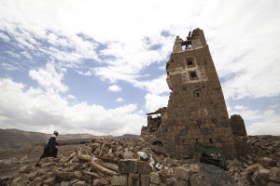
Saudi Led Destruction of Yemen’s heritage
or go to
Aletho News Archives – Video-Images
From the Archives
Israel: Strategic Ally or Liability?
By Stephen Sniegoski | My Catbird Seat | June 12, 2010
The claim that Israel serves as a valuable ally for the United States is made by both pro-Zionists and much of the anti-war and anti-Zionist Left that is influenced by Noam Chomsky. As a result of the Gaza flotilla massacre, which has caused a world-wide uproar against Israel, the value of Israel to the United States is being publicly questioned in more mainstream foreign policy forums. … continue
Blog Roll
 Aletho News
- Declassified UK exposes British man who fought for ‘Israel’ in Gaza
- West’s death cult in a theater near you
- How the Yandex ‘Russian bots’ lie fell apart
- Burnham’s ‘Russia did Brexit’ ruse crumbles
- Estonia making movies and games to encourage war against Russia
- Four in five new UK jobs taken by foreigners – report
- Here’s what Trump’s latest U-turn really means for Russia and Ukraine
- The Houthis Are Not an Iranian Proxy
- Europe’s Energy Hypocrisy, Russian LNG Profits and US Dependence
- ICC ignored ‘very well-documented’ NATO crimes – ex-Libyan minister
- If Americans Knew
- An error has occurred; the feed is probably down. Try again later.
- No Tricks Zone
- New Study Suggests Large Regions Of The Pacific Ocean Have Been Cooling For The Last 80 Years
- Germany’s Green Energy Debacle: High Energy Costs Force Kahla Porzellan to Close After 182 Years!
- New Study: 50 Years Of The Most Aggressive ‘Net Zero’ Policies Can Only Affect The Global Climate By 0.03°C
- US September “Heat” Was No Record…Many Records Set Decades Ago
- Latest European Green Energy Debacle; Portugal’s Largest Flagship Solar Park Insolvent!
- Green Energy Debacle: German Expert Professor Fritz Vahrenholt Warns Of Severe Economic And Social Consequences
- Two More Paleo Reconstructions Affirm Meters-Higher Sea Levels Across Ireland, Brazil 7000-6000 Years Ago
- New Study: Earth And Venus Surface Warmth Largely Explained By Convection And Lapse Rate, Not CO2 Or Radiation
- 2025 Nature Paper Claiming Worsening Global Drought Gets RETRACTED …Heavily Flawed
- New Study: ‘Global Drought Shows No Detectable Recent Acceleration Under Climate Warming’

