MSF demands independent probe into hospital airstrike in Afghanistan
RT | October 4, 2015
Medecins Sans Frontieres (MSF) has demanded an independent international body investigate the suspected US airstrike that killed 22 people at a hospital in Kunduz, Afghanistan. The charity’s official said MSF cannot trust the US military probe.
“Under the clear presumption that a war crime has been committed, MSF demands that a full and transparent investigation into the event be conducted by an independent international body,” MSF General Director Christopher Stokes said in a statement on Sunday.
“Relying only on an internal investigation by a party to the conflict would be wholly insufficient,” he added.
The US military launched a probe into the incident on Saturday.
He said MSF condemns the attack, which constitutes a grave violation of International Humanitarian Law.
“We reiterate that the main hospital building, where medical personnel were caring for patients, was repeatedly and very precisely hit during each aerial raid, while the rest of the compound was left mostly untouched,” he added.
“The hospital was full of MSF staff, patients and their caretakers. It is 12 MSF staff members and 10 patients, including three children, who were killed in the attack.”
The US military launched a probe into the incident on Saturday. The US military has confirmed its air forces conducted a strike “in the vicinity” of a Medecins Sans Frontieres hospital in Kunduz near the time the facility was hit.
MSF said on Saturday that “all indications” suggest US-led forces carried out the bombing and demanded a transparent account from the Coalition regarding its activities in Kunduz.
On Sunday, NATO said that its preliminary multi-national investigation to determine whether it conducted the airstrike should be wrapped up in a matter of days.
No militants at MSF hospital in Kunduz during US strike
Press TV – October 4, 2015
Doctors Without Borders has dismissed claims that members of the Taliban militant group were firing against Afghan and US forces from the clinic run by the charity group in Kunduz, northern Afghanistan, before a US airstrike on the medical facility.
The group, known by its French acronym as the MSF (Medecins Sans Frontieres), in a statement issued on Sunday rejected the claim about the presence of the militants at its facility, saying, “The gates of the hospital compound were closed all night so no one that is not staff, a patient or a caretaker was inside the hospital when the bombing happened.”
The Afghan Defense Ministry earlier said Taliban militants had attacked the hospital and were using the building “as a human shield.”
The militants had entered the compound of the medical center and used “the buildings and the people inside as a shield” while firing on security forces, said Brigadier General Dawlat Waziri, the Defense Ministry’s deputy spokesman.
Afghanistan’s Interior Ministry spokesman, Sediq Sediqqi, said 10 to 15 “terrorists” had been hiding in the clinic at the time of the US strike, adding, “All of the terrorists were killed but we also lost doctors.”
The US military said it conducted an airstrike “in the vicinity” of the hospital, as it targeted Taliban militants who were directly firing on US military personnel.
“US forces conducted an airstrike in Kunduz city at 2.15 a.m. (local), Oct 3, against insurgents who were directly firing upon US service members advising and assisting Afghan Security Forces in the city of Kunduz. The strike was conducted in the vicinity of a Doctors Without Borders medical facility,” said General John F Campbell, the commander of the US forces in Afghanistan.
The MSF said in a statement that at 2:10 a.m. local time on Saturday (2040 GMT) its trauma center in Kunduz was hit several times. It added that the aerial assault continued for more than half an hour after US and Afghan military officials in Kabul and Washington were first informed.
According to the statement, the Saturday attack left 19 people dead and dozens more seriously injured.
The survivors of the US airstrike on the clinic say those patients unable to move were burned to death during the assault.
The MSF facility is the only one in the northeastern region of Afghanistan capable of taking care of major injuries.
According to the MSF, over 100 patients and their caregivers, as well as more than 80 international and local MSF staff were in the hospital when the airstrike took place.
On September 28, Taliban militants overran Afghanistan’s northern city of Kunduz, but were later forced to withdraw from much of the city in the face of a government counterattack. Sporadic clashes continue as Afghan troops struggle to clear remaining pockets of the militants.
Kunduz is strategic as it is located on a crossroad that connects key regions of the country. It is also along the country’s border with Tajikistan and could offer the militants the opportunity to establish a base in the country’s north.
Patients were burned to death in US airstrike on clinic in Kunduz, survivors say
Press TV – October 4, 2015
The survivors of a US airstrike on a clinic run by Doctors Without Borders in Kunduz, northern Afghanistan, say those patients unable to move were burned to death during the assault.
“Those people that could, had moved quickly to the building’s two bunkers to seek safety. But patients who were unable to escape burned to death as they lay in their beds,” recalled Heman Nagarathnam, the head of programs by the charity group, known by its French acronym, MSF (Medecins Sans Frontieres).
It was also said that a patient was left in the operating room on the table “dead, in the middle of the destruction.”
“The bombs hit and then we heard the plane circle round,” Nagarathnam said, adding, “There was a pause, and then more bombs hit. This happened again and again.”
The MSF said in a statement that at 2:10 a.m. local time on Saturday (2040 GMT) its trauma center in Kunduz was hit several times. It added that the aerial assault continued for more than half an hour after US and Afghan military officials in Kabul and Washington were first informed.
According to the statement, the Saturday attack left 19 people dead and dozens more seriously injured.
Lajos Zoltan Jecs, an MSF nurse and a survivor of the horrific bombardment, described the US airstrike as “absolutely terrifying.”
The nurse, who was inside the facility during the strike, said, “We tried to take a look into one of the burning buildings. I cannot describe what was inside. There are no words for how terrible it was.”
“In the intensive care unit six patients were burning in their beds,” Jecs added. … Full article
NATO Admits US May Have Hit MSF Hospital in Kunduz
Sputnik | 03.10.2015
NATO does not rule out the possibility that a hospital of Doctors Without Borders in Afghan city of Kunduz was bombed by US air forces.
A Doctors Without Borders (Medecins Sans Frontieres, or MSF) hospital in the Afghan city of Kunduz was bombed early on Saturday, leading to the death of at least three people, with dozens missing, the international aid agency said in a statement.
There were around 200 people in the hospital building when it was bombed, according to MSF.
NATO said in a statement that US forces conducted an airstrike in Kunduz at around the same time — just after 02:00 am on Saturday (after 22:00 GMT Sunday).
The medical team is working around the clock to do everything possible for the safety of patients and hospital staff.
‘We are deeply shocked by the attack, the killing of our staff and patients and the heavy toll it has inflicted on healthcare in Kunduz,” Bart Janssens, MSF Director of Operations commented on the bombing.
“We do not yet have the final casualty figures, but our medical team are providing first aid and treating the injured patients and MSF personnel and accounting for the deceased. We urge all parties to respect the safety of health facilities and staff.”
According to MSF, at the time of the aerial attack 105 patients and their caretakers were in the hospital and over 80 MSF international and national staff.
MSF’s hospital is the only facility of its kind in the Northeast of Afghanistan, providing free life- and limb-saving trauma care.
Kunduz, a city of 300,000 in northern Afghanistan, was recaptured by Afghan government forces on Thursday.
Can Washington Get a New Military Base in Central Asia?
By Vladimir Odintsov – New Eastern Outlook – 30.09.2015
The special attention that the United States has been paying to Central Asia, while actively seeking ways to implement a strategy of global leadership in the region that is now fully recognized as the center of Eurasia, has been covered in numerous articles, including those published in NEO.
According to the geopolitical concept of the recognized American political scientist Zbigniew Brzezinski: Those who control Eurasia control the world. Therefore, Washington’s steps to strengthen American influence in the region in the long run are completely predictable. The pivotal role in this policy is played by the US military bases in the region and military cooperation ties. After all, according to the globalist logic of the White House, American influence in any region must be supported by the “adequate” military force. The 9/11 events in the US and the consequent anti-terrorist intervention in Afghanistan have become a pretext for a major military deployment of American and NATO troops in Central Asia.
By the way, the ongoing engagement of US troops in Afghanistan confirms the notion that the presence of US and NATO forces in this country has little to do with the “struggle for democracy”. The true purpose of the military intervention in Afghanistan was the creation of powerful military bases, as the geographical position of this country is pretty unique in terms of the strategic freedom it provides. From this area Washington can launch a massive attack against Russia’s Urals and Siberia, different facilities in Central Asia, Iran, Pakistan, India and China. For this reason from the very start of the US invasion of Afghanistan, Shindand and Bagram Air Bases were transformed into massive construction sites where a large number of surface and underground facilities being built.
It happens so that for Pentagon Central Asia serves as a base for applying pressure on Russia, China, Iran and the entire Eurasian continent, it also plays a pivotal role in the post-conflict settlement in Afghanistan, since it may form a joint military alliance under the banner of opposition to the Islamic state.
In an effort to strengthen its positions in Central Asia under the above mentioned pretext, the United States has sent invitations to join the anti-ISIL military coalition to both Uzbekistan and Tajikistan. To add some momentum to the matter the Deputy Assistant Secretary for Central Asia at the U.S. Department of State Daniel Rosenblum has recently visited Tashkent, while the commander of United States Central Command general John Lloyd James Austin III made a trip to Dushanbe. In the course of their visits American emissaries discussed the situation in Afghanistan, regional security, and the advantages of cooperation with the United States “in the fight against international extremism” with regional authorities. Of course, a particular emphasis was made on the “need” to stay away from integration with Russia.
It is clear that in dealing with Uzbekistan and Turkmenistan “messengers of Washington” tried to make active use of the fact that those states today are free from obligations of the Collective Security Treaty Organization, which is headed by Russia, and therefore they are free to pursue military cooperation with the US. Therefore, Washington and Tashkent signed a document that provides the latter with free shipments of military equipment in the next five years. American equipment, trucks, military vehicles for a total worth of 6.2 million dollars will be just granted to this Central Asian state. This year, the United States has handed over to Uzbekistan armored class M-ATV, as well as armored repair and recovery equipment to support them, 308 cars and 20 repairs trucks with a total cost of at least 150 million dollars.
In dealing with Uzbek authorities American envoys had to mind the fact that the country entered the international counter-terrorism coalition immediately after September 11, 2001, while establishing special relations with a number of Western countries. As a result, the territory of the Republic at the time was housing a US military base, while the German Air Force had the opportunity to use the airfield in Termez, near the border with Afghanistan. Cooperation with Germany has been prolonged recently for a couple more years, though Tashkent is stressing the fact that the airfield in Termez is not a foreign military base. There’s little wonder to this fact, since the presence of foreign military bases was prohibited by law in Uzbekistan after the Andijan events, therefore in 2005 at the request of the Uzbek authorities American soldiers had to pack and leave.
Uzbekistan, is seeking ways to retain non-aligned status, and has no plans to allow any foreign military bases on its territory, on top of that it remains reluctant to send Uzbek troops abroad. This was pretty much the answer that the President of Uzbekistan Islam Karimov has given to Washington’s offer to join a coalition against the Islamic state.
However, Washington’s attempts to strengthen its military and political influence in Central Asia are far from over. Such efforts will certainly continue, despite the apparent reluctance of regional players to burden themselves with military obligations to the United States. America has severely damaged its reputation, therefore nobody believes in its peacemaking aspirations anymore, since the wars it has been waging are only leading to the suffering and misery of the civilian population of the countries it invades.
US to escalate illegal occupation of Afghanistan
Fars News Agency | September 29, 2015
TEHRAN – There’s going to be no solution to the Afghan crisis, and it’s all Obama’s fault.
At a time when the people of Afghanistan seek the international community’s help for peace and prosperity, the United States has decided to scrap their pullout plans once again, leaving thousands of occupying troops behind through the end of President Obama’s final term in office.
The silly argument by those in favor of increasing the American troops in place is largely the same throughout the war, that the Afghan government isn’t capable of beating the Taliban on their own, and that a US pullout would add pressure to that struggling military.
Conceivably, American troops may end up being there for many decades because this is where the action is. What’s more, US generals say they need more troops. In this fallacy, their call for a bigger deployment has forced Obama to consider different options while Republicans have lambasted him for letting political motivations override the needs of commanders.
The Pentagon insists Obama’s failure to promptly back their surge could dishonor America, while corporate media say no matter what the president wants, it will be very hard to stop the army generals. And that’s exactly what Obama, mired in proverbial perplexity, is not doing right now: In Washington, the Pentagon and the warmongers have the final say.
“Avoiding another Vietnam,” says this school of thought, “requires a figurehead government – one that delegates all military decision-making power to generals and effectively strips it from elected civilians who will supposedly be too politically motivated.” This authoritarian ideology explains not only the spiteful reaction to Obama’s Afghanistan deliberations but also some of the most anti-democratic statements ever uttered by American leaders.
It explains, for instance, former Vice President Dick Cheney’s assertion that “public opinion doesn’t matter when it comes to military policy.” Nevertheless, it is the US Constitution which gives political figures in Washington the final say: Article I empowers Congress “to declare and finance wars,” and Article II states that “while the White House may require the opinion of military officers, ultimately the President shall be Commander in Chief.”
In this new world order geopolitical business, Obama and congressional leaders have however decided to defy public will – and international law – by making the terrible choice to escalate the Afghanistan War. This is while the illegal occupation has reached its sell-by date. A majority of Americans now tell presidential candidates the mission was a mistake. Regrettably, the generals who run wars, and the defense contractors who profit from them, want more troops and more war in Afghanistan. And that includes many presidential candidates.
From experience, the military buildup will only ensure more violence, attract more armed opposition, and postpone the day of reckoning among political factions in Afghanistan. It will never have a ghost of a chance of success.
Right on cue, the American people should wisely turn against such a destructive wave that will once again cost too many lives and hundreds of billions of dollars, while only making a terrible situation worse for the Afghans. The American people have the power to stop this madness and folly they know is irresponsible, inconclusive and unpopular. It falls to them to demand an exit strategy and not an escalation. They could start doing so by electing a pacifist president – if there’s any.
How To Solve The European Migrant/Refugee Crisis – 5 Simple Steps
Storm Clouds Gathering | September 25, 2015
The refugee crisis in Europe could be easily solved. The problem is that the real solution would not suit the the political establishment of the United States or Western Europe. We’ve distilled what needs to be done down to 5 simple steps.
- Stop funding and arming rebel groups attempting to overthrow the Syrian government. It’s well established that these weapons have been ending up in the hands of ISIS and its affiliates. This has caused nothing but chaos and destruction. Money being funneled into these shady operations should be immediately redirected to an intensive reconstruction effort.
- Pressure Turkey and Jordan to cut off ISIS supply routes, and impose sanctions on any country facilitating the sale of oil from IS territory or allowing funds or materials to reach them. No army can function if their supply chain is broken. It’s not an accident these routes start at the Turkish and Jordanian borders.
- Support the Syrian government. An entire year of U.S. airstrikes in Syria have utterly failed to destroy or even significantly weaken ISIS. Of course this is because the real strategy isn’t to bring ISIS down, but rather to contain them and allow them to weaken Assad gradually. If Washington really wanted to stop this group, they would take a hint from Russia and provide the Syrian government with weapons, training and logistical support to enable them to push ISIS back. This means Washington and its allies would have to officially abandon all plans for a forced regime change. They might not like Assad, but the majority of the citizens of Syria support him. In fact he has more support within his country than Obama or the U.S. congress have in America. And at various intervals he’s had more support than Congress and Obama combined. Any government installed after a U.S. backed regime change will be viewed as a puppet government, and will therefore lack the legitimacy needed to stabilize the region. If you need evidence of this, just look at Afghanistan or Iraq.
- Provide direct assistance to rebuild housing, infrastructure and businesses destroyed by the conflict. In the short term temporary refugee camps should be set up in areas outside of the conflict zone, and food and medical supplies shipped in on a regular basis. Yes this will cost money, but so has the five year regime change push that created the problem in the first place.
- Return the refugees to these stabilized regions. It is in no one’s interest to flood Europe with masses of unemployed refugees. Doing so will only lead to heightened tensions and will strengthen xenophobic movements. These people don’t need to be transplanted into the ghettos of Europe, they need their homes back.
No peace if US-led occupation of Afghanistan continues: Taliban leader
Press TV – September 22, 2015
The Taliban militant group has ruled out any peace deal with the Afghan government unless Kabul scraps its military deal with Washington and all US-led foreign troops leave the war-torn Asian country.
“If the Kabul administration wants to end the war and establish peace in the country, it is possible through ending the occupation,” Taliban’s new leader Mullah Akhtar Mansour said in a message published on the group’s website on Tuesday.
In order for peace to come about, Kabul also has to revoke “all military and security treaties with the invaders,” he added.
Last year, the Upper House of Afghanistan’s parliament ratified the controversial Bilateral Security Agreement (BSA) with Washington, according to which about 10,000 American troops would stay in Afghanistan beyond 2014, when the US-led combat mission ended.
The house also approved the NATO Status of Forces Agreement (SOFA), which likewise empowered the US-led military alliance to keep troops in the war-torn nation in the next year.
This is while former Afghan President Hamid Karzai had refused to sign the BSA.
Further in his message, the Taliban leader called for an “intra-Afghan” solution to the problems in the Asian country, saying the chaotic situation can come to end “if the country is not under occupation.”
“Any foreign pressure under the pretext of resolving the Afghan problem is not going to resolve the problem but will rather create other problems,” he added.
The Taliban ruled the country between 1996 and 2001 under former leader Mullah Omar, whose death was confirmed by the militant group in July.
Mansour’s rise to power has reportedly prompted a power struggle within the group, with some top leaders refusing to pledge allegiance to him, saying the process that led to his selection was rushed and biased.
In the Monday message, which appeared to be aimed at ending divisions within Taliban ranks, Mansour also said the creation of such rifts are a plot to prolong the presence of the US-led forces in the country.
In early July, representatives of Taliban and the Afghan government held a round of peace talks in the Pakistani city of Murree, north of the capital, Islamabad. The parties agreed to meet again. However, a second round planned for July 18 was canceled after the announcement of the former Taliban leader’s death.
Afghanistan continues to struggle with insecurity and continuing militancy by Taliban years after US-led foreign troops invaded the country in 2001 as part of what Washington the so-called “war on terror, which removed the militant group from power.
At least 13,500 foreign forces remain in Afghanistan despite the end of the US-led combat mission. … Full article
Obama’s Legacy Will Not Be One of Peace
By Chad Nelson | c4ss | September 11, 2015
The Financial Times recently reported that Nobel Peace Prize recipient Barack Obama has conducted ten times more drone strikes than his predecessor George W. Bush. As far as we can tell, that number is somewhere in the ballpark of 500 strikes and spans a wide array of countries including Iraq, Afghanistan, Syria, Pakistan, Yemen, Somalia and Libya. We can’t know for sure exactly how many drone attacks have taken place, who is conducting them, how many people have been killed by them, or how many other countries have been victim.
It’s important to Obama that the extent of his drone wars remain secret. His peaceful veneer would quickly disintegrate if we had an accurate Obama-death-toll. Drone wars have been kept so secret, in fact, that Obama’s former Press Secretary, Robert Gibbs, revealed that he was instructed not to acknowledge or discuss their existence. A handful of investigative journalist groups like The Long War Journal have been left conducting important but difficult guess work about Obama’s drone wars, as if putting together a large puzzle one small piece at a time.
All the while, the American public is left clueless as to the activities being conducted in their name. Obama proclaims that “a decade of war is over,” while behind the scenes he expands the scope of the War on Terror. As a result of our being kept largely ignorant of our government’s actions, we are all the more astounded when the consequences of such wars come to fruition.
The phenomenon of blowback results from the American government’s actions abroad which cause tremendous resentment within local populations. When retaliation for these actions arrives at our shores or against Americans abroad, as it inevitably does, the American public is shocked and appalled, wondering what could possibly prompt such heinous actions. Hungry for answers, Americans are then fed simple explanations by politicians, such as, “they hate our way of life,” or “their religion commands them to commit such acts.” Never are we provided the context in which such reprisals occur. And because so many Americans willingly accept the state’s spoon-fed version of events, they largely tolerate a domestic police and surveillance state that is said to keep them safe from such “terrorists.”
Tribal areas of Afghanistan surveyed about the psychological effects of drones reveal a people living in terror, unable to sleep, with children often kept home from school for fear they’ll be targeted. Though generally out of sight, drones can constantly be heard buzzing overhead, creating a persistent state of fear. Despite our being told of the precision of drone strikes, subject populations have described massive civilian casualties and widespread destruction of property.
Consequently, large swaths of these foreign populations living under drones view the United States in a negative light. One Pew Research Center study found that three quarters of Pakistanis now view Americans as the enemy. One would expect similar numbers from the many other countries across the Middle East and Africa in which America now conducts drone strikes. Blowback is not limited to those directly terrorized by drones either. General Stanley McChrystal stated “resentment created by [drones] … is much greater than the average American appreciates. They are hated on a visceral level by people who’ve never seen one or seen the effects of one.”
Though it’s shrouded in secrecy, this new form of American warfare will be Obama’s legacy. The “sanitization” of war offered by drones (introduced on a grand scale by Obama) all but ensures America will never again be without foreign conflict at the hands of crazed politicians. As drone technology continues to improve, the rest of the world will be more at risk of attack by the American war machine, and Americans less safe as a result. As Obama’s time in the White House winds down, let’s remember that he escalated the War on Terror. He’s offered his successors the safety of precedent to fall back on and opened new frontiers for American military demolition. Barack Obama had the opportunity to curtail America’s destructiveness around the world, and instead, he amplified it.
Featured Video
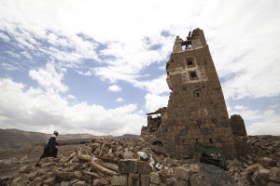
Saudi Led Destruction of Yemen’s heritage
or go to
Aletho News Archives – Video-Images
From the Archives
Israel: Strategic Ally or Liability?
By Stephen Sniegoski | My Catbird Seat | June 12, 2010
The claim that Israel serves as a valuable ally for the United States is made by both pro-Zionists and much of the anti-war and anti-Zionist Left that is influenced by Noam Chomsky. As a result of the Gaza flotilla massacre, which has caused a world-wide uproar against Israel, the value of Israel to the United States is being publicly questioned in more mainstream foreign policy forums. … continue
Blog Roll
 Aletho News
- Declassified UK exposes British man who fought for ‘Israel’ in Gaza
- West’s death cult in a theater near you
- How the Yandex ‘Russian bots’ lie fell apart
- Burnham’s ‘Russia did Brexit’ ruse crumbles
- Estonia making movies and games to encourage war against Russia
- Four in five new UK jobs taken by foreigners – report
- Here’s what Trump’s latest U-turn really means for Russia and Ukraine
- The Houthis Are Not an Iranian Proxy
- Europe’s Energy Hypocrisy, Russian LNG Profits and US Dependence
- ICC ignored ‘very well-documented’ NATO crimes – ex-Libyan minister
- If Americans Knew
- Activists Abused By Israel Return to New Freedom Flotilla Mission
- 60 Minutes won’t tell the full truth about Israeli settler violence
- Nearly 50,000 women, girls killed or severely injured in Gaza since October 2023: UN Women
- ADL is working with AI companies to suppress alleged ‘antisemitism’
- Israeli occupation forces using social media surveillance unit to target hundreds of Palestinians in the West Bank
- Israel’s New – and Terrifying – Security Doctrine
- Israeli Attacks Kill Five in Gaza, Including a four-year-old and a woman
- Air Force Major Who Called for Trump’s Impeachment Held in Solitary Confinement
- It’s a Genocide, I’m Into It’: Seinfeld Mocks Protest over Palestinian Children Killed
- Universities fire dozens amid pressure from Zionist billionaires
- No Tricks Zone
- New Study Suggests Large Regions Of The Pacific Ocean Have Been Cooling For The Last 80 Years
- Germany’s Green Energy Debacle: High Energy Costs Force Kahla Porzellan to Close After 182 Years!
- New Study: 50 Years Of The Most Aggressive ‘Net Zero’ Policies Can Only Affect The Global Climate By 0.03°C
- US September “Heat” Was No Record…Many Records Set Decades Ago
- Latest European Green Energy Debacle; Portugal’s Largest Flagship Solar Park Insolvent!
- Green Energy Debacle: German Expert Professor Fritz Vahrenholt Warns Of Severe Economic And Social Consequences
- Two More Paleo Reconstructions Affirm Meters-Higher Sea Levels Across Ireland, Brazil 7000-6000 Years Ago
- New Study: Earth And Venus Surface Warmth Largely Explained By Convection And Lapse Rate, Not CO2 Or Radiation
- 2025 Nature Paper Claiming Worsening Global Drought Gets RETRACTED …Heavily Flawed
- New Study: ‘Global Drought Shows No Detectable Recent Acceleration Under Climate Warming’

