“Did We Just Kill a Kid?”
By TOM McNAMARA | CounterPunch | January 4, 2013

In the spring of 1944, in the quiet little town of Alcolu, South Carolina, two young girls, Betty June Binnicker, age 11, and Mary Emma Thames, age 8, were brutally murdered while picking flowers along a railroad track. Their bodies were found in a nearby water filled ditch. The cause of death was determined to be multiple blows to their skulls with a metal railroad spike. A Mr. George Stinney was soon arrested for the murders. While there was no physical evidence or eyewitness accounts linking the defendant to the crime, unfortunately for Mr. Stinney, the two girls were white. He was black.
Two white police officers were able to get a confession out of Mr. Stinney within an hour, behind closed doors. It was the only evidence offered up during his trial, a trial that was held in one day and lasted only two and a half hours. It was attended by 1,500 people, all of them white. Blacks were not allowed in the courtroom. Mr. Stinney, his family having been driven from their small town, faced the trial alone. Council for the defense offered no evidence on its client’s behalf, and it requested no psychiatric evaluation of the defendant. A guilty verdict was reached after only 10 minutes of deliberation by the (all white male) jury. No recommendation for mercy was given. Had Mr. Stinney’s lawyer filed a simple one sentence appeal, the execution would have been automatically stayed for at least a year. But this was impossible due to the fact that Mr. Stinney did not see his attorney again from the time he left the court. Furthermore, his attorney never spoke to any members of the defendant’s family, let alone inform them that they had the right to appeal the death sentence. Just 81 days after his arrest, on June 16, 1944, Mr. Stinney would walk into the execution chamber.
There is one more tragic element to this already tragic story. Mr. George Junius Stinney Jr. was just 14 years old when he was put to death. He was the youngest person (legally) executed in the United States in the 20th century.
Being small for his age, weighing just 95 pounds (approximately 43 kilograms) and only five feet one inch tall (approximately 1.5 meters), it was with great difficulty that the death sentenced was carried out. But carried out it was. His small body was propped up with books in order to get him to fit properly in the electric chair (the original designers having carelessly overlooked the fact that one day their device might be used to execute a small child), allowing for an electrode to be attached to his right leg.
One commentator reported that George said nothing as the mask was lowered over his face. But after the first 2,400 volts passed through the boy’s small body “the death mask slipped from his face and his eyes were open when two additional shots of 1,200 and 500 volts followed.” George’s head “went up and the mask came of his face … and saliva and all was coming out of his mouth and tears from his eyes.”
The Governor, Olin Johnson, had received hundreds of letters and telegrams asking for leniency for the young boy. But facing a primary election in July, the Governor was not inclined to grant clemency. One telegram compared the execution of a child to something that Adolf Hitler would do. A stinging and bitter accusation considering that American troops had just landed on the beaches of Normandy ten days earlier in the D-Day invasion to liberate France from Nazi occupation and terror. On that one day alone, 9,000 Allied soldiers would die or be wounded fighting the Germans.
It can be argued that the execution of a 14 year old child was a social aberration from a bygone era. A simple anomaly. An isolated case that “fell through the cracks.” A repulsive event from a period when America was still suffering from racial and social ignorance. Surely, as a society, the United States has progressed far beyond the days of when it tolerated the State sanctioned execution of children, has it not?
Two pilots are sitting in an air-conditioned windowless room in New Mexico. Before them sit an array of 14 computer monitors and four keyboards. 6,250 miles away (about 10,000 kilometers) they are controlling a Predator drone that is circling lazily in a figure eight pattern over Afghanistan. They are observing a crude house made of mud when the order is given to launch a laser guided Hellfire missile at the target. With just seconds to go till impact, a small child walks out from behind one of the corners of the structure. A flash on the control screen confirms the impact and explosion, with parts of the structure collapsing and the child disappearing.
“Did we just kill a kid?” the co-pilot asks the pilot.
“Yeah, I guess that was a kid,” the pilot replies.
Confirmation as to whether or not a missile strike had just been carried out on a child was requested. “No. That was a dog,” comes the anonymous response from a military command center.
The pilots review the video of the drone strike that had just taken place.
A dog on two legs?
One of the pilots is no longer in the Air Force, declining to renew his enlistment contract when it was up. After 6,000 flight hours and six years of military service he says “I saw men, women and children die during that time. I never thought I would kill that many people. In fact, I thought I couldn’t kill anyone at all.” He has since been diagnosed with post-traumatic stress disorder by doctors with the Veterans’ Administration.
While the above incident could be deemed an “accident,” apparently the targeted murder of children is now accepted US military policy.
Lt. Col. Marion “Ced” Carrington, Commander of 1st Battalion, 508th Parachute Infantry Regiment, states, “It kind of opens our aperture. In addition to looking for military-age males, it’s looking for children with potential hostile intent” as well. While the Lt. Col would not elaborate on what exactly are the rules of engagement when encountering potential child combatants, reassuringly he tells us that he advises the soldiers serving under him to use “courageous restraint.”
Apparently this “courageous restraint” was lacking on October 14, 2012, when US Marines operating in Helmand province requested, and got clearance for, an airstrike on “shadowy figures” thought to be in the process of setting up an improvised explosive device (IED). The assailants killed in the strike turned out to be three children who were 12, 10 and 8 years old.
The International Security Assistance Force (ISAF), a part of NATO and the organization that is nominally in command of the war (the reality being, of course, that it is a US led affair), said that it may have “accidentally killed three innocent Afghan civilians.” Family members of the victims reported that the children were sent to gather dung, which is used for fuel.
America’s first war in Iraq and its associated sanctions are believed to have resulted in the deaths of over half a million children. America’s second war in Iraq is believed to have resulted in the deaths of over 600,000 Iraqis (most of them between the ages of 15 and 44). America’s targeted drone attacks in the Tribal Regions between Afghanistan and Pakistan have reportedly killed between 474 and 881 civilians, including 176 children
If these were the actions of China, Russia, Iran, or any other country on Earth, we would be able to see them clearly for what they are. War crimes and crimes against humanity of the highest order. We would also realize that they are the actions of a society that is in moral decline.
Why it is impossible for the vast majority of Americans to see this is incomprehensible.
Acknowledgement: The author would sincerely like to thank Professor Bryan A. Stevenson, founder and Executive Director of the Equal Justice Initiative, for making him aware of the story of George Stinney.
Tom McNamara is an Assistant Professor at the ESC Rennes School of Business, France, and a Visiting Lecturer at the French National Military Academy at Saint-Cyr, Coëtquidan, France.
Sources
“Afghan kids recruited for suicide attacks” by Joe Gould and John Ryan, July 18, 2012, Army Times. Accessed at:
“Attempts to clear name of 14-year-old boy who was executed in South Carolina 67 years ago” Reporter: Mark Potter, Anchor: Brian Williams, NBC Nightly News 6:30 PM EST (NBC News Transcripts), October 4, 2011.
“Attorney Decries Juvenile Executions (From Young Blood: Juvenile Justice and the Death Penalty, P 159-165, 1995, Shirley Dicks, ed. – See NCJ-166057)” by D. Bruck, 1995. Accessed at:
https://www.ncjrs.gov/App/Publications/abstract.aspx?ID=166066
“Columbia Journal; Prison Lures Them In (as Tourists)” February 22, 1994, The New York Times. Accessed at:
“D-Day June 6, 1944” United States Army Official Homepage. Accessed at:
“Do Targeted Killings Work?” by Daniel L. Byman, Senior Fellow Foreign Policy, Saban Center for Middle East Policy, July 14, 2009, The Brookings Institute. Accessed at: http://www.brookings.edu/research/opinions/2009/07/14-targeted-killings-byman
“Iraq Sanctions Kill Children, U.N. Reports” by Barbara Crossette, December 1, 1995, The New York Times. Accessed at:
“Living Under Drones: Death, Injury, and Trauma to Civilians From US Drone Practices in Pakistan” the International Human Rights and Conflict Resolution Clinic (Stanford Law School) and the Global Justice Clinic (NYU School of Law), September 2012. Accessed at:
Click to access Stanford_NYU_LIVING_UNDER_DRONES.pdf
“Questions Raised in Deaths of Afghan Children in Coalition Strike” by Alissa J. Rubin, October 17, 2012, The New York Times. Accessed at:
“Some Afghan kids aren’t bystanders” by Dan Lamothe and Joe Gould, December 3, 2012, Military Times. Accessed at:
http://www.militarytimes.com/news/2012/12/marine-taliban-kids-120312w
“Study Claims Iraq’s ‘Excess’ Death Toll Has Reached 655,000” by David Brown, October 11, 2006, The Washington Post. Accessed at:
http://www.washingtonpost.com/wp-dyn/content/article/2006/10/10/AR2006101001442.html
“The Human Cost of the War in Iraq: A Mortality Study, 2002-2006” by G. Burnham, S. Doocy, E. Dzeng, R. Lafta and L. Roberts, with the Bloomberg School of Public Health at Johns Hopkins University, Al Mustansiriya University and the Center for International Studies at the Massachusetts Institute of Technology, October 11, 2006. Accessed at:
Click to access human-cost-war-101106.pdf
“The Merciful Executioner: Spectacles of Sexual Danger and National Reunification in the George Stinney Case, 1944” by Annette Louise Bickford, University of Toronto, Southern Anthropologist Vol. 35, No. 1, 2010
“The Woes of an American Drone Operator” by Nicola Abé, December 14, 2012, Der Spiegel. Accessed at:
“War in Iraq: Humanitarian Relief Efforts” April 11, 2003, The Washington Post. Accessed at:
http://www.washingtonpost.com/wp-srv/liveonline/03/special/iraq/sp_iraq_zaidi041103.htm
“When Something Wicked This Way Comes: Evolving Standards of Indecency – Thompson and Stanford Revisited” by J. L. Whitney, 46 Clev. St. L. Rev. 801 (1998)
“World: Middle East Iraqis blame sanctions for child deaths” by Jeremy Bowen, August 12, 1999, BBC. Accessed at:
http://news.bbc.co.uk/2/hi/middle_east/418625.stm
~
Photo – George Stinney, 1944, executed at age 14 years old (Photo credit: Wikipedia)
Related articles
- US sets records with number of drone strikes in Afghanistan this year (rt.com)
- Newtown kids v Yemenis and Pakistanis: what explains the disparate reactions? [2 of 2] (wondersofpakistan.wordpress.com)
US general offers plans for post-2014 Afghanistan overstay
Press TV – January 3, 2013

Commander of US-led forces in Afghanistan General John R. Allen (file photo)
Commander of the US-led forces in Afghanistan General John R. Allen has offered plans that would keep thousands of American troops in the war-torn country after Washington’s planned 2014 withdrawal.
Allen has submitted three plans to Defense Secretary Leon Panetta with troop levels ranging between 6,000 and 20,000, the New York Times cited a senior Pentagon official as saying on Wednesday.
General Allen’s options reportedly offer US involvement in security issues in Afghanistan and advising Afghan military forces.
With 6,000 troops, it is expected that the US mission in Afghanistan would largely rely on Special Operations commandos who would engage in targeted killings and assassination missions, with limited logistical support and training for Afghan forces.
The 10,000-strong mission is expected to engage in training Afghan security personnel; while with 20,000 troops Washington would add some conventional army forces to patrol in certain areas.
US President Barack Obama is supposed to discuss the options with his Afghan counterpart, Hamid Karzai, during his visit to the White House next week.
The United States, which currently has about 66,000 troops stationed in Afghanistan, led the invasion of the country in 2001, under the pretext of eradicating Taliban forces and bringing stability to the country.
However, torn apart by a war that has lasted over a decade, Afghanistan is still dealing with untamed violence, as well as rising insecurity topped by social problems.
Meanwhile, the Pentagon, the White House and US generals based in Afghanistan keep providing contradictory information on the composition, tasks and the size of the contingent that would remain in Afghanistan beyond the 2014 deadline.
Related articles
- ‘US will maintain military presence in Afghanistan beyond 2014′ (alethonews.wordpress.com)
- Prince Harry ‘kills innocent afghans’, according to former Afghanistan prime minister (dailyrecord.co.uk)
‘US will maintain military presence in Afghanistan beyond 2014’
Press TV – December 30, 2012
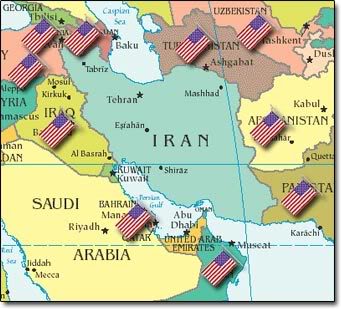
An analyst says America and its allies have planned to leave a residual force of more than 10,000 troops in Afghanistan passed 2014, contrary to the agreement.
In the background of this, American pilots are currently under special training ready to be deployed to Afghanistan in coming months in what appears to be a renewed build up by certain US forces. 66,000 US troops are stationed in Afghanistan. America is expected to honor a 2014 agreed deadline to withdraw from the country.
Press TV has interviewed Mr. Mohammad Daoud Abadi, Chairman of the Afghanistan National Peace Council, Los Angeles about this issue. The following is an approximate transcription of the interview.
Press TV: We see American pilots training in conditions similar to that of Afghanistan. Are we preparing for a longer stay of US troops in Afghanistan do you think?
Abadi: Thank you for inviting me again I appreciate it. Before I answer that question I’d like to thank Press TV for it’s worldwide media presence and being honest on the matters, we do appreciate that very, very much.
In response to your question I must say that what we hear from the US government is that they’re planning to leave a 6,000 to 9,000 fighting force in Afghanistan after 2014. That plus another 5,000 from NATO allies.
What I’m hearing – I hope it’s not correct, but what I’m hearing from the media and from different sources is that the US has planned to leave these 6,000 soldiers in Baghram airport, Kandahar in the south and Jalalabad in the East.
They are planning to have the Spaniards in Hira and Shindand airport, which is close to the Iranian border, to the Italians and on the North the Mazar e Sharif, the Germans still be staying.
To be honest and to look at it from a technical point of view this residual force will not be a force to really do the terrorist war or against terrorist activities because let’s say that if they are in Baghram airport and they fly from Baghram airport to Kandahar to do an operation, it is a 2 hour flight of 350 kilometers distance – it takes two hours for a helicopter to get there.
So in general this residual force is there for some other purpose other than what is claimed. Therefore this policy as I have said, this time the Pentagon will fail on this again and I don’t think this is something that they can count on.
Press TV: Just how much has President Hamid Karzai been a president to the Afghan people and tried to help efforts to oust the US occupiers from Afghanistan?
Abadi: Based on yesterday’s report Mr. Karzai is coming to Washington in early January and they will hopefully be talking about future issues in Afghanistan as well as the matter of residual forces.
President Karzai is going to make the biggest mistake of his life if he agrees to residual forces because that will mean the continuation of war in Afghanistan.
As I have said before the Mujaheddin of Afghanistan have put this condition even at the 19th of December meeting in Paris – this was the first condition that both sides the Taliban and Jamiat e Islami of Afghanistan put on the table.
Therefore what Mr. Karzai is going to sign with them based on their immunity issues, that is not going to work. As for US forces they are defeated now they were defeated then.
Related article
Remember All the Children, Mr. President
America’s Selective Grief
By BILL QUIGLEY | CounterPunch | December 18, 2012
Remember the 20 children who died in Newton Connecticut.
Remember the 35 children who died in Gaza this month from Israeli bombardments.
Remember the 168 children who have been killed by US drone attacks in Pakistan since 2006.
Remember the 231 children killed in Afghanistan in the first 6 months of this year.
Remember the 400 other children in the US under the age of 15 who die from gunshot wounds each year.
Remember the 921 children killed by US air strikes against insurgents in Iraq.
Remember the 1,770 US children who die each year from child abuse and maltreatment.
Remember the 16,000 children who die each day around the world from hunger.
These tragedies must end.
Bill Quigley is a human rights lawyer and law professor at Loyola University New Orleans and Associate Director of the Center for Constitutional Rights. You can reach Bill at quigley77@gmail.com
British soldiers in Afghanistan accused of killing four Afghan boys
Press TV – December 5, 2012
British forces in Afghanistan have been accused of killing four boys in Afghanistan’s southern province of Helmand in October.
According to a report published by the Guardian on Tuesday, a group of lawyers recently sent a letter to British Defense Secretary Philip Hammond, demanding that the UK government investigate the alleged killings.
The lawyers, acting on behalf of the relatives of two of the victims, said that during an operation in the village of Loi Bagh in the Nad Ali district of Helmand on October 18, the UK troops shot dead the Afghan boys while they were drinking tea.
The victims were identified as 18-year-old Fazel Mohammed, Naik Mohammed, 16, Mohammed Tayeb, 14, and 12-year-old Ahmed Shah.
The British troops were on a joint operation with Afghan forces.
“We submit that all of the victims were under the control and authority of the UK at the times of the deaths and ill-treatment,” the letter to Hammond read.
“The four boys killed all appear to have been deliberately targeted at close range by British forces. All were killed in a residential area, over which UK forces clearly had the requisite degree of control and authority.”
Major Adam Wojack, a spokesperson for the foreign forces in Afghanistan, has confirmed the operation. However, he has claimed that four “Taliban enemies in action” were killed.
The letter also includes a statement by the relatives of the victims, rejecting “any suggestion that any of the four teenagers killed were in any way connected” to the Taliban. “All four were innocent teenagers who posed no threat whatsoever to Afghan or British forces.”
Related articles
- British forces accused of killing four teenagers in Afghan operation (guardian.co.uk)
America’s Drone Terrorism
By Sheldon Richman | FFF | October 19, 2012
In the United States, the dominant narrative about the use of drones in Pakistan is of a surgically precise and effective tool that makes the U.S. safer by enabling “targeted killing” of terrorists, with minimal downsides or collateral impacts.
This narrative is false.
Those are the understated opening words of a disturbing, though unsurprising, nine-month study of the Obama administration’s official, yet unacknowledged, remote-controlled bombing campaign in the North Waziristan region of Pakistan, near Afghanistan. The report, “Living Under Drones,” is a joint effort by the New York University School of Law’s Global Justice Clinic and Stanford Law School’s International Human Rights and Conflict Resolution Clinic.
The NYU/Stanford report goes beyond reporting estimates of the civilian casualties inflicted by the deadly and illegal U.S. campaign. It also documents the hell the Pakistanis endure under President Barack Obama’s policy, which includes a “kill list” from which he personally selects targets. That hell shouldn’t be hard to imagine. Picture yourself living in an area routinely visited from the air by pilotless aircraft carrying Hellfire missiles. This policy is hardly calculated to win friends for the United States.
Defenders of the U.S. campaign say that militants in Pakistan threaten American troops in Afghanistan as well as Pakistani civilians. Of course, there is an easy way to protect American troops: bring them home. The 11-year-long Afghan war holds no benefits whatever for the security of the American people. On the contrary, it endangers Americans by creating hostility and promoting recruitment for anti-American groups.
The official U.S. line is that America’s invasion of Afghanistan was intended to eradicate al-Qaeda and the Taliban, who harbored them. Yet the practical effect of the invasion and related policies, including the invasion of Iraq and the bombing in Yemen and Somalia, has been to facilitate the spread of al-Qaeda and like-minded groups.
U.S. policy is a textbook case of precisely how to magnify the very threat that supposedly motivated the policy. The Obama administration now warns of threats from Libya — where the U.S. consulate was attacked and the ambassador killed — and Syria. Thanks to U.S. policy, al-Qaeda in Afghanistan spawned al-Qaeda in Iraq, al-Qaeda in the Arabian Peninsula, and al-Qaeda in the Islamic Maghreb.
If that’s success, what would failure look like?
Regarding Pakistani civilians, the report states,
While civilian casualties are rarely acknowledged by the U.S. government, there is significant evidence that U.S. drone strikes have injured and killed civilians.… It is difficult to obtain data on strike casualties because of U.S. efforts to shield the drone program from democratic accountability, compounded by the obstacles to independent investigation of strikes in North Waziristan. The best currently available public aggregate data on drone strikes are provided by The Bureau of Investigative Journalism (TBIJ), an independent journalist organization. TBIJ reports that from June 2004 through mid-September 2012, available data indicate that drone strikes killed 2,562–3,325 people in Pakistan, of whom 474–881 were civilians, including 176 children. TBIJ reports that these strikes also injured an additional 1,228–1,362 individuals.
The Obama administration denies that it has killed civilians, but bear in mind that it considers any male of military age a “militant.” This is not to be taken seriously.
The report goes on,
U.S. drone strike policies cause considerable and under-accounted-for harm to the daily lives of ordinary civilians, beyond death and physical injury.Drones hover twenty-four hours a day over communities in northwest Pakistan, striking homes, vehicles, and public spaces without warning. Their presence terrorizes men, women, and children, giving rise to anxiety and psychological trauma among civilian communities. Those living under drones have to face the constant worry that a deadly strike may be fired at any moment, and the knowledge that they are powerless to protect themselves.
It’s even worse than it sounds:
The U.S. practice of striking one area multiple times, and evidence that it has killed rescuers, makes both community members and humanitarian workers afraid or unwilling to assist injured victims. Some community members shy away from gathering in groups.
How can Americans tolerate this murder and trauma committed in their name? But don’t expect a discussion of this in Monday night’s foreign-policy debate. Mitt Romney endorses America’s drone terrorism.
Related articles
114,000 US contractors active in Afghan war
Press TV – October 18, 2012
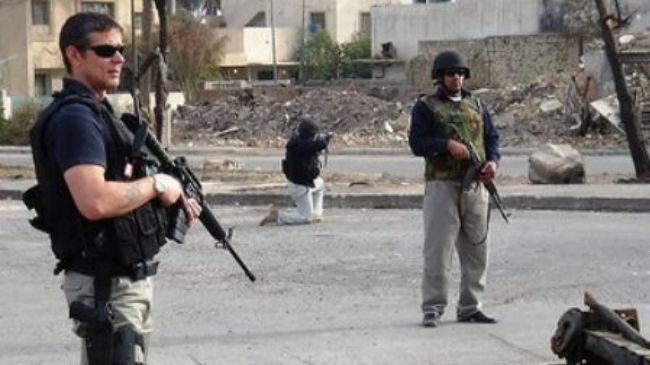
There are currently more private contractors working for the US military and other government agencies in Afghanistan than uniformed American military troops, reports indicate.
As of July, nearly 114,000 contractors were working for the US Defense Department in Afghanistan, compared to the 90,000 American troops in the country at the time, AFP reported Thursday, quoting “official statistics.”
The figures about the presence of a high number of US contractors working in Afghanistan emerged again after reports of a newly-released video showing American security contractors drunk and high on narcotics while on duty.
The US-based broadcaster ABC News, which released the footage and first reported on the incident, also cited a February 2011 report by a bipartisan commission set up to scrutinize the extraordinary use of contractors by the American military in Iraq and Afghanistan which concluded that the United States had wasted tens of billions of the nearly $177 billion that was spent on those contracts and grants since 2002.
The report, titled “At What Risk? Correcting Over-reliance on Contractors in Contingency Operations,” also stated that “about 200,000 contractor employees are working in Iraq and Afghanistan,” roughly equal to the American military forces deployed there in years prior to the report.
Numerous other reports verify such figures and also emphasize the relatively high number of casualties among the US contract workers that are often not reported and not accounted for.
According to official statistics released by Pentagon in May 2010, the total number of US military contractors working in Afghanistan, Iraq and its Central Command (covering the Middle East region) were 250,335, of which over 112,000 worked in Afghanistan, nearly 96,000 worked in Iraq and about 43,000 worked for the US Central Command (USCENTCOM).
The data also indicated that over 53,000 of the contractors were US citizens, 95,000 were third country nationals, and nearly 102,000 were locally employed.
Pointing to the relatively high number of casualty figures among US contractors working in Afghanistan, The New York Times reported earlier this year that in 2011 “at least 430 employees of American contractors were reported killed in Afghanistan,” compared to 418 American soldiers killed in the country in the same year, adding that the same trend was also true during the US occupation of Iraq.
The report, however, emphasized that the US military does not keep track of the casualties suffered by its contractors, noting that the country’s Department of Labor would hold the data only for American casualties that have been reported by US contractors hiring them. It added that there is hardly any counting of casualties suffered by US contract workers that are citizens of other nations.
The Times report also stressed that for every contractor killed in countries invaded by the US, “many more are seriously wounded.” It cites Labor Department’s statistics as reporting that in addition to the 430 contractors reported killed in Afghanistan in 2011, another 1,777 American contractors in the country got wounded.
Georgia: Commander of U.S. Marine Corps in Europe Meets Ivanishvili
Civil Georgia | October 5, 2012

Bidzina Ivanishvili and Commander of the U.S. Marine Corps in Europe, Lt Gen John M. Paxton, outside Ivanishvili’s compound in Tbilisi.
Photo: Ivanishvili’s press office
Tbilisi – Bidzina Ivanishvili, whose Georgian Dream coalition won the parliamentary elections, said Georgia, which has two battalions stationed in the Helmand province of Afghanistan, would “definitely continue” cooperation with the U.S. over Afghanistan.
He made the remarks on October 5 after meeting with commander of the U.S. Marine Corps in Europe, Lt Gen John M. Paxton, who is visiting Georgia.
“Georgia has been a very valuable and trusted ally for many years; we work very closely together in Afghanistan, particularly in Helmand province and we have enjoyed a great relationship trying to develop NCO leadership, officer skills and work on enhanced security cooperation,” Lt Gen Paxton said after the meeting.
“We are here to congratulate Mr. Ivanishvili and to wish him a smooth transition of power. We are here to just reaffirm that the United States stands by Georgia,” he said and added he was looking forward not only to working relationship in Afghanistan but also to continued good relations in years ahead.
“This was my first meeting with the U.S. military, who have provided a huge assistance to establishing of the Georgian army and to its reforms in line with the NATO standards,” Ivanishvili said. “I knew it, but I was very glad to hear that Georgian [troops] have special importance in the NATO forces [in Afghanistan] and that together with the U.S. [troops] are [performing combat duties] in difficult areas”
“Of course we should do everything possible in order to [continue] our partnership with the United States in Afghanistan and in such hotspots,” Ivanishvili said and added that Georgia was playing “a role of a real junior friend” to the United States and “we will definitely continue cooperation in the future too.”
The Commander of U.S. Marine Corps in Europe met on October 5 with Chief of Joint Staff of the Georgian armed force Lt Gen Devi Chankotadze.
“The sides focused on an enhanced military cooperation between the countries. Chief of JS underlined that Georgia will continue cooperation with the United States in the same format and stressed the role the U.S. plays in modernization of the Georgian army and in developing interoperability with NATO,” the Georgian Ministry of Defense said. “Lt Gen Devi Chankotadze affirmed that Georgia stands ready to continue cooperation with NATO and the United States in the post-ISAF period too.”
Also on October 5, the Commander of U.S. Marine Corps in Europe visited National Training Centre, Krtsanisi, outside Tbilisi where he attended training of the Georgian servicemen, who are gearing up for the Afghan deployment.
Related articles
- New Georgian Leader A Man With a Past – On K Street (alethonews.wordpress.com)
- U.S. and Georgia armed forces commanders discuss the prospects of deepening cooperation (en.trend.az)
Stop the War to hold two London rallies

Press TV – October 3, 2012
British anti-war campaigners, the Stop the War Coalition, have organized two protest rallies for next week against the war in Afghanistan and the threats on Iran and Syria.
The Sunday rally in London’s Trafalgar Square will be held on the 11th anniversary of the start of the war in Afghanistan to commemorate those killed in an event dubbed Naming of the Dead.
The protest will also call for an end to the British government’s involvement in the “unjustified and futile war” and bring the troops home by Christmas.
Paul Flynn who was recently sacked from the British parliament for saying the government has been lying about Afghanistan will be among the participants in the event.
Also on Tuesday, the Stop the War Coalition will hold a rally at the University of London Union against the “western intervention in Syria” and the threats of military action against Iran.
The Stop the War Coalition’s core idea of a joint rally against the intervention in Syria and the threats on Iran is that Syria is only an excuse for an attack on Iran.
“An attack on Iran remains the ultimate goal for the US. Intervention in Syria is a stepping stone toward that goal,” the group said in a statement on its website.
The group is also warning that any intervention will have “huge regional and global consequences” and will at best “deny the Syrian people the right to determine their own future.”
“It will place the opposition leadership in the hands of the western powers and their allies, who will act in their own interests,” the group said.
The rallies come amid sporadic reports and confirmations by British officials including Foreign Secretary William Hague that London is helping Syrian terrorists with military equipment and intelligence supplies.
Related articles
- Tutu: Try Blair and Bush for war crimes (morningstaronline.co.uk)
- Ending the Violence in Syria (alethonews.wordpress.com)
- | MP ejected from parliament for saying UK Govt lying about Afghan War! (truthaholics.wordpress.com)
How to Tell When ‘Humans’ Die in a U.S. War
By Peter Hart – FAIR – 10/02/2012
ABC World News’ David Muir (9/30/12) took note of the 2,000th U.S. military death in Afghanistan this way:
Overseas now to Afghanistan, and a stark reminder tonight of the human cost of war. An attack at a checkpoint left two Americans dead, one of them a serviceman, the 2,000th U.S. military death since the war began.
That kind of language is revealing in that it presents American deaths as evidence of the “human cost of war.” But, of course, that is a human cost almost every day most wars. What they’re saying is this is primarily something we should think about when the humans in question are U.S. troops.

We don’t need to search very far to find a counter-example. On the very same show, two weeks earlier (9/16/12) , viewers were told about a NATO airstrike that killed eight Afghan women. They had been out collecting firewood.
How did ABC report these deaths? In all of one sentence, stuffed at the end of a report by correspondent Muhammad Lila about U.S. troop deaths:
And late this evening, another incident that’s causing tension here. NATO is confirming that an air strike has led to civilian casualties, reportedly including Afghan women and children.
Last year, in a very similar incident, a NATO airstrike killed nine boys. And ABC’s brief report (3/6/11) focused on Afghan president Hamid Karzai’s “harsh words for the U.S.”
Related articles
- After NATO Strike Kills 8 Afghan Women, Pundits Still Wonder: Why Do They Hate Us? (alethonews.wordpress.com)
Featured Video

Why Hamas Really Attacked Israel on Oct. 7
or go to
Aletho News Archives – Video-Images
From the Archives
Israel: Strategic Ally or Liability?
By Stephen Sniegoski | My Catbird Seat | June 12, 2010
The claim that Israel serves as a valuable ally for the United States is made by both pro-Zionists and much of the anti-war and anti-Zionist Left that is influenced by Noam Chomsky. As a result of the Gaza flotilla massacre, which has caused a world-wide uproar against Israel, the value of Israel to the United States is being publicly questioned in more mainstream foreign policy forums. … continue
Blog Roll
 Aletho News
- Why Hamas Really Attacked Israel on Oct. 7
- Declassified UK exposes British man who fought for ‘Israel’ in Gaza
- West’s death cult in a theater near you
- How the Yandex ‘Russian bots’ lie fell apart
- Burnham’s ‘Russia did Brexit’ ruse crumbles
- Estonia making movies and games to encourage war against Russia
- Four in five new UK jobs taken by foreigners – report
- Here’s what Trump’s latest U-turn really means for Russia and Ukraine
- The Houthis Are Not an Iranian Proxy
- Europe’s Energy Hypocrisy, Russian LNG Profits and US Dependence
- If Americans Knew
- Activists Abused By Israel Return to New Freedom Flotilla Mission
- 60 Minutes won’t tell the full truth about Israeli settler violence
- Nearly 50,000 women, girls killed or severely injured in Gaza since October 2023: UN Women
- ADL is working with AI companies to suppress alleged ‘antisemitism’
- Israeli occupation forces using social media surveillance unit to target hundreds of Palestinians in the West Bank
- Israel’s New – and Terrifying – Security Doctrine
- Israeli Attacks Kill Five in Gaza, Including a four-year-old and a woman
- Air Force Major Who Called for Trump’s Impeachment Held in Solitary Confinement
- It’s a Genocide, I’m Into It’: Seinfeld Mocks Protest over Palestinian Children Killed
- Universities fire dozens amid pressure from Zionist billionaires
- No Tricks Zone
- New Study Suggests Large Regions Of The Pacific Ocean Have Been Cooling For The Last 80 Years
- Germany’s Green Energy Debacle: High Energy Costs Force Kahla Porzellan to Close After 182 Years!
- New Study: 50 Years Of The Most Aggressive ‘Net Zero’ Policies Can Only Affect The Global Climate By 0.03°C
- US September “Heat” Was No Record…Many Records Set Decades Ago
- Latest European Green Energy Debacle; Portugal’s Largest Flagship Solar Park Insolvent!
- Green Energy Debacle: German Expert Professor Fritz Vahrenholt Warns Of Severe Economic And Social Consequences
- Two More Paleo Reconstructions Affirm Meters-Higher Sea Levels Across Ireland, Brazil 7000-6000 Years Ago
- New Study: Earth And Venus Surface Warmth Largely Explained By Convection And Lapse Rate, Not CO2 Or Radiation
- 2025 Nature Paper Claiming Worsening Global Drought Gets RETRACTED …Heavily Flawed
- New Study: ‘Global Drought Shows No Detectable Recent Acceleration Under Climate Warming’

