What is Behind Algeria’s Severance of Diplomatic Ties with Morocco?
By Vladimir Odintsov – New Eastern Outlook – 29.08.2021
“Algeria has decided to sever diplomatic relations with the Kingdom of Morocco as of August 24,” Algerian Foreign Minister Ramdan Lamamra told a news conference, accusing the neighboring kingdom of “hostile actions.” Although the termination of diplomatic relations has already taken effect, consulates in each country will nevertheless remain open, Ramtane Lamamra said. Algeria is considering suspending air traffic with Morocco, according to the newspaper Algérie Patriotique.
Algeria accused Rabat (capital of Morocco) of threatening stability and security at the instigation of Israel. Morocco is increasing its military presence on the borders, and some regional observers have assessed that tensions could lead to military clashes.
Morocco’s foreign ministry said it regretted the “unjustified decision” and said it would remain a “reliable and loyal partner” to the Algerian people.
Relations between Algeria and Morocco have been tense for the past few decades, with the border between the countries closed since 1994. One of the reasons for the tensions is disagreement over Western Sahara: Morocco considers this territory its own, and Algeria has supported the Polisario Front for decades, insisting on the establishment of the Sahrawi Arab Democratic Republic (SADR). This dispute is also reflected in the current history of the breakdown of diplomatic relations: Algeria has also accused official Rabat of failing to honor its bilateral commitments on the Western Sahara issue.
Further escalation of tensions between the two states over this issue largely occurred late last year for two reasons. In November, after years of relative quietness, the pro-independence Polisario Front announced that it was re-arming. In December 2020, the United States recognized Moroccan sovereignty over Western Saharain exchange for improved relations between Rabat and Israel. The problem of Western Sahara is now challenging to solve, as both countries have strong positions. Algeria’s capacity to assist Polisario Front remains. This conflict will last for many years, and this should be the starting point.
Moreover, in mid-August, Algeria accused Morocco of “supporting two terrorist movements” operating on Algerian territory: the Movement for the Autonomy of Kabylia (MAK) and the opposition Rashad movement. Algerian authorities believe the activists of these organizations were involved in the forest fires last month in northern Algeria. These fires have already killed about 90 people, and the country’s government has repeatedly claimed that arson was the cause of the disaster. Algeria had previously reported the arrest of 61 people on suspicion of involvement in the fires in the country, stressing that the detainees belong to two specified terrorist groups backed by Israel and Morocco. According to local media reports, some of those arrested admitted their membership in the MAK. Algeria had already recalled its Ambassador from Rabat in July after a Moroccan diplomat in New York expressed support for the right of the Kabylian people to self-determination. For those reasons, Algeria’s Supreme Security Council had already considered reviewing relations with Morocco on August 18.
Overall, the Israeli factor has played a significant role in the current context of deteriorating relations between the two countries in North Africa. Last year, Morocco became one of the Arab countries that concluded peace agreements with Israel under Washington’s influence. As part of an agreement to normalize relations, the US, which mediated the talks, agreed to recognize Morocco’s sovereignty over Western Sahara, which caused resentment in Algeria and increased criticism of Washington. At the end of July this year, Algeria opposed Israel’s accession to the African Union as an observer country for the first time since 2002, carried out with Morocco’s support. Earlier, in 2002, Israel was expelled from the union on the initiative of Libya.
Moreover, the Algerian authorities, who do not officially recognize Israel, reacted negatively to the remarks of the Israeli Foreign Minister Yair Lapid during his recent visit to Morocco. He expressed concern about the role of Algeria in the region, “veiled threats” to Algeria, and pointed out his fears about Algeria’s rapprochement with Iran.
Algerian Foreign Minister Ramdan Lamamra has also accused Morocco of using Pegasus spyware to spy on several Algerian officials. According to him, “Morocco has massively and systematically committed acts of espionage against Algerian citizens and officials.”
But behind all these accusations, there is a clear opposition of the current Algerian authorities to Washington’s attempts through Israel and Morocco to prevent Algeria from strengthening its leading role in the Maghreb and cause political instability in the country. An undoubtedly real impetus for the aggravation of Algeria’s relations with Morocco was the African Lion 2021, a military exercise conducted by the US command in North Africa from June 7 to June 18, 2021. Military Watch, an American magazine specializing in military analysis, reported that these ground and air maneuvers simulated an attack in Algerian territories on two fictitious countries, Rowand and Nehone.
Therefore, the British publication Rai Al Youm noted for a reason that these military exercises were undertaken in preparation for an invasion of Algeria. The US believes that Algeria threatens its influence in Africa because it has gas, oil, water, and areas suitable for agriculture. In addition, Algeria covers an area of 2 million square kilometers, has extensive reserves of mineral resources, and its control of the Sahel region of Africa and its people is hard to beat. A European military expert said this in an interview with Rai Al Youm.
Under these circumstances, the Algerian leadership learned lessons from Colonel Muammar Gaddafi’s fatal mistakes. It became more critical of the policies towards Algeria on the part of the United States, Israel, Morocco, and several other states that had supported Washington’s plans to overthrow the Gaddafi regime it hated in the past. For this reason, Algeria has made it an absolute priority to create a strong army equipped with advanced land, air, and naval weapons and to develop military cooperation with Russia. As Rai Al Youm noted, the Algerian authorities have not trusted the West since the victory of the revolution over French colonialism. They are well aware of the plots being prepared against them. Algeria does not want to be the next target after Syria. Especially, according to Algeria, in the context of the ongoing preparations for the invasion and destruction of the countries in the League of the Arab States and the Persian Gulf countries. The United States, Great Britain, and France, which previously stood behind the conspiracies against Libya, Syria, and Iraq, sent NATO aircraft to bomb these countries, hiding behind loud statements about the “protection of democratic values.”
Biden’s America is back – to Somalia
By Uriel Araujo | August 16, 2021
On July 20, the US carried out an airstrike in Somalia against al Shabaab militants – the first one in Somalia under President Joe Biden. It struck again on July 23 and August 1. Last week, it was reported Biden seeks to host a “Summit for Democracy”. According to a White House statement, this will include civil society figures and political leaders to galvanize initiatives “against authoritarianism”, “corruption”, and also “promoting respect for human rights”.
These two topics are somehow connected. During the cold war, the US espoused the rhetoric of being the “leader of the free world”, although the record shows it backed some of the most ruthless dictators and promoted coup d’etats worldwide. To this day, most of the US “humanitarian interventions” have brought chaos and destabilization, and its attempts at “nation building” have been major humanitarian disasters. One only needs to look at Libya and Iraq or even Afghanistan – and yet Washington insists on being the only player that can deliver stability to Somalia in its counter-terrorism effort.
Amid the narrative wars, this is the one the US has always pushed: they are the champions of freedom, democracy, and now, in Biden’s parlance, human rights. This is the stuff American wars are made of, if we are to believe it – and there usually is a great battle for democracy somewhere. One could in fact argue that Trump was the first US President (since at least Carter) not to lead its own large and long military campaign.
While the Chinese presence in Africa is widely discussed, the US has maintained a kind of “invisible” presence in the African continent for a while, with a network of US special forces and private contractors – and this includes a covert war on the Al-Qaeda connected al-Shabab jihadist organization in Somalia: since 2007, thousands of people have been killed there by US drones and this includes civilians.
Trump removed most of the American troops from Somalia in the final days of his term, relocating them to nearby countries to remotely assist Somali forces against al-Shabab. This move was criticized by some American experts that argued Biden should redeploy the troops back to Somalia, and the Defense Department has been considering doing precisely that, according to a June 29 US Air Force Magazine piece. This is ironic, considering that the troops removal was completed less than 7 months ago, and considering that Biden has just withdrawn troops from Afghanistan – this also makes one wonder how long will it take before discussions about bringing troops back to Afghanistan begin.
In a January piece – published in the US FPRI website – former US Ambassador to Somalia Stephen M. Schwartz argues that the US “hasty exit” from Somalia would open “the door to a greater role for the People’s Republic of China”. According to him, the fight against al-Shabaab is a “classic counter-terrorism” effort, at a time when Washington’s attention is turning to great power competition with Beijing and Moscow. After all, Somalia, he argues, is “more” than al-Shabaab.
Somalia itself is part of the so-called Horn of Africa, a region that historically has been at crossroads and remains one of immense geopolitical importance: one of the main global trade routes lies off its coast and connects the Indian Ocean to the Red Sea and to the Mediterranean region and Europe through the Suez Canal.
It is well known Beijing currently seeks to employ its Belt and Road Initiative to enhance its position as the main investor in Africa. This can be clearly seen in the case of a small but strategic Horn of Africa country, namely, Djibouti – where Beijing also has its own permanent military base.
While Chinese military presence in the region and in the continent cannot rival American presence, China remains the largest investor in Africa and has been so for the last 10 years, according to a report by the Swiss-African Business Circle. For the 2010-2019 period, it has created an average of 18,562 jobs in Africa, while the US has created an average of 12,106. Moreover, according to Deborah Brautigam (Director of the China Africa Research Initiative), Beijing has been building long-term relationships in the continent, while Washington’s approach has a short-term time horizon.
There is yet another issue: Africa has been largely neglected by the US foreign policy – and Biden has not been an exception.
For example, in February 2021, the G5 Sahel held its N’Djamena meeting. While Russian deputy foreign minister Mikhail Bogdanov stayed three days in Burkina Faso (prior to the summit), and French President Emmanuel Macron spoke by video conference, US Secretary of State Anthony Blinken merely sent a pre-recorded five-minutes talk and dispatched no official in his place. In April, Niger celebrated, for the first time, a peaceful transfer of power between elected presidents, and neither President Biden nor Blinken sent a delegation.
Meanwhile, both China and Russia have maintained good diplomatic relations with many African countries since at least the Cold War period, when both powers supported several African independence struggles.
Apparently, for the US, having a presence in Africa is all about bombing insurgent groups with drones, maintaining military bases and special forces in covert undeclared wars, while insisting on its rhetoric of human rights and democracy. If the US wishes to compete with China and Russia for geopolitical influence on the Horn of Africa (as well as on the whole continent), it will need to improve its diplomacy.
Uriel Araujo is a researcher with a focus on international and ethnic conflicts.
Meet Toka, the Most Dangerous Israeli Spyware Firm You’ve Never Heard Of
By Whitney Webb | MintPress News | July 21, 2021
LONDON –This past Sunday, an investigation into the global abuse of spyware developed by veterans of Israeli intelligence Unit 8200 gained widespread attention, as it was revealed that the software – sold to democratic and authoritarian governments alike – had been used to illegally spy on an estimated 50,000 individuals. Among those who had their communications and devices spied on by the software, known as Pegasus, were journalists, human rights activists, business executives, academics and prominent political leaders. Among those targeted political leaders, per reports, were the current leaders of France, Pakistan, South Africa, Egypt, Morocco and Iraq.
The abuse of Pegasus software in this very way has been known for several years, though these latest revelations appear to have gained such traction in the mainstream owing to the high number of civilians who have reportedly been surveilled through its use. The continuation of the now-years-long scandal surrounding the abuse of Pegasus has also brought considerable controversy and notoriety to the Israeli company that developed it, the NSO Group.
While the NSO Group has become infamous, other Israeli companies with even deeper ties to Israel’s intelligence apparatus have been selling software that not only provides the exact same services to governments and intelligence agencies but purports to go even farther.
Originally founded by former Israeli Prime Minister and Jeffrey Epstein associate Ehud Barak, one of these companies’ wares are being used by countries around the world, including in developing countries with the direct facilitation of global financial institutions like the Inter-American Development Bank (IDB) and the World Bank. In addition, the software is only made available to governments that are “trusted” by Israel’s government, which “works closely” with the company.
Despite the fact that this firm has been around since 2018 and was covered in detail by this author for MintPress News in January 2020, no mainstream outlet – including those that have extensively covered the NSO Group – has bothered to examine the implications of this story.
Worse than Pegasus
Toka was launched in 2018 with the explicit purpose of selling a “tailored ecosystem of cyber capabilities and software products for governmental, law enforcement, and security agencies.” According to a profile of the company published in Forbes shortly after it launched, Toka advertised itself as “a one-stop hacking shop for governments that require extra capability to fight terrorists and other threats to national security in the digital domain.”
Toka launched with plans to “provide spy tools for whatever device its clients require,” including not only smartphones but a “special focus on the so-called Internet of Things (IoT).” Per the company, this includes devices like Amazon Echo, Google Nest-connected home products, as well as connected fridges, thermostats and alarms. Exploits in these products discovered by Toka, the company said at the time, would not be disclosed to vendors, meaning those flaws would continue to remain vulnerable to any hacker, whether a client of Toka or not.
Today, Toka’s software suite claims to offer its customers in law enforcement, government and intelligence the ability to obtain “targeted intelligence” and to conduct “forensic investigations” as well as “covert operations.” In addition, Toka offers governments its “Cyber Designers” service, which provides “agencies with the full-spectrum strategies, customized projects and technologies needed to keep critical infrastructure, the digital landscape and government institutions secure and durable.”
Given that NSO’s Pegasus targets only smartphones, Toka’s hacking suite – which, like Pegasus, is also classified as a “lawful intercept” product – is capable of targeting any device connected to the internet, including but not limited to smartphones. In addition, its target clientele are the same as those of Pegasus, providing an easy opportunity for governments to gain access to even more surveillance capabilities than Pegasus offers, but without risking notoriety in the media, since Toka has long avoided the limelight.
In addition, while Toka professes that its products are only used by “trusted” governments and agencies to combat “terrorism” and maintain order and public safety, the sales pitch for the NSO Group’s Pegasus is remarkably similar, and that sales pitch has not stopped its software from being used to target dissidents, politicians and journalists. It also allows many of the same groups who are Toka clients, like intelligence agencies, to use these tools for the purpose of obtaining blackmail. The use of blackmail by Israeli security agencies against civilian Palestinians to attempt to weaken Palestinian society and for political persecution is well-documented.
Toka has been described by market analysts as an “offensive security” company, though the company’s leadership rejects this characterization. Company co-founder and current CEO Yaron Rosen asserted that, as opposed to purely offensive, the company’s operations are “something in the middle,” which he classifies as bridging cyber defense and offensive cyber activities — e.g., hacking.
The company’s activities are concerning in light of the fact that Toka has been directly partnered with Israel’s Ministry of Defense and other Israeli intelligence and security agencies since its founding. The company “works closely” with these government agencies, according to an Israeli Ministry of Defense website. This collaboration, per Toka, is meant to “enhance” their products. Toka’s direct IDF links are in contrast to the NSO Group, a company that does not maintain overt ties with the Israeli security state.
Toka’s direct collaboration with Israel’s government is also made clear through its claim that it sells its products and offers its services only to “trusted” governments, law enforcement agencies and intelligence agencies. Toka’s Rosen has stated that Russia, China, and “other enemy countries” would never be customers of the company. In other words, only countries aligned with Israeli policy goals, particularly in occupied Palestine, are permitted to be customers and gain access to its trove of powerful hacking tools. This is consistent with Israeli government efforts to leverage Israel’s hi-tech sector as a means of countering the Boycott, Divest and Sanctions (BDS) movement globally.
Further evidence that Toka is part of this Israeli government effort to seed foreign governments with technology products deeply tied to Israel’s military and intelligence services is the fact that one of the main investors in Toka is Dell Technologies Capital, which is an extension of the well-known tech company Dell. Dell was founded by Michael Dell, a well-known pro-Israel partisan who has donated millions of dollars to the Friends of the IDF and is one of the top supporters of the so-called “anti-BDS” bills that prevent publicly employed individuals or public institutions in several U.S. states from supporting non-violent boycotts of Israel, even on humanitarian grounds. As MintPress previously noted, the fact that a major producer of consumer electronic goods is heavily investing in a company that markets the hacking of that very technology should be a red flag.
The government’s initial admitted use of the hi-tech sector to counter the BDS movement coincided with the launch of a new Israeli military and intelligence agency policy in 2012, whereby “cyber-related and intelligence projects that were previously carried out in-house in the Israeli military and Israel’s main intelligence arms are transferred to companies that, in some cases, were built for this exact purpose.”
One of the reasons this was reportedly launched was to retain members of Unit 8200 engaged in military work who were moving to jobs in the country’s high-paying tech sector. Through this new policy that has worked to essentially merge much of the private tech sector with Israel’s national security state, some Unit 8200 and other intelligence veterans continue their work for the state but benefit from a private sector salary. The end result is that an unknown – and likely very high – number of Israeli tech companies are led by veterans of the Israeli military and Israeli intelligence agencies and serve, for all intents and purposes, as front companies. A closer examination of Toka strongly suggests that it is one such front company.
Toka — born out of Israel’s national security state
The company was co-founded by Ehud Barak, Alon Kantor, Kfir Waldman and retired IDF Brigadier General Yaron Rosen. Rosen, the firm’s founding CEO and now co-CEO, is the former Chief of the IDF’s cyber staff, where he was “the lead architect of all [IDF] cyber activities,” including those executed by Israeli military intelligence Unit 8200. Alon Kantor is the former Vice President of Business Development for Check Point Software, a software and hardware company founded by Unit 8200 veterans. Kfir Waldman is the former CEO of Go Arc and a former Director of Engineering at technology giant Cisco. Cisco is a leader in the field of Internet of Things devices and IoT cybersecurity, while Go Arc focuses on applications for mobile devices. As previously mentioned, Toka hacks not only mobile devices but also has a “special focus” on hacking IoT devices.
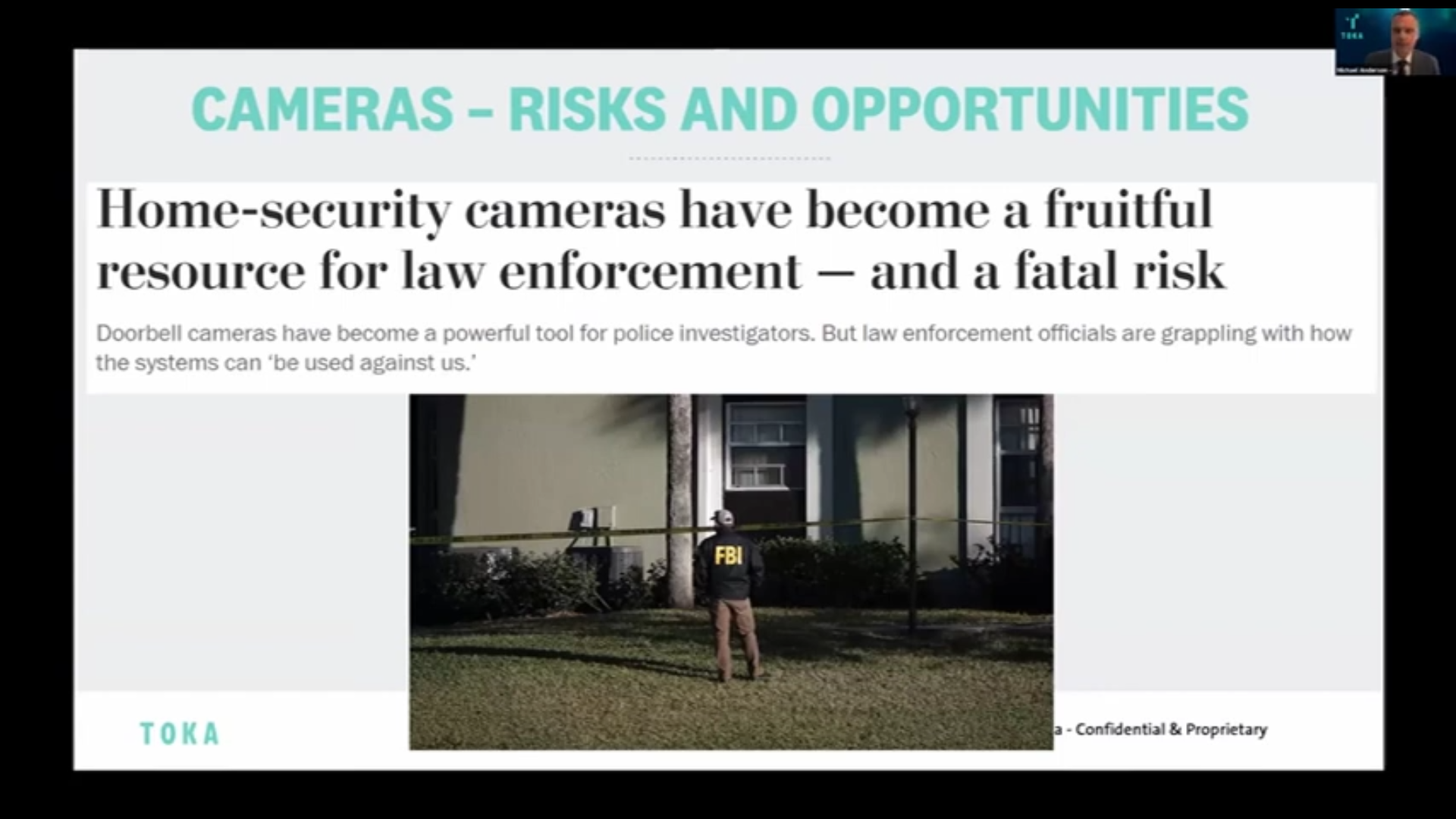
A slide from an April 20, 2021 presentation given by Toka’s VP of Global Sales, Michael Anderson
In addition to having served as prime minister of Israel, Toka co-founder Ehud Barak previously served as head of Israeli military intelligence directorate Aman, as well as several other prominent posts in the IDF, before eventually leading the Israeli military as minister of defense. While minister of defense, he led Operation Cast Lead against the blockaded Gaza Strip in 2009, which resulted in the deaths of over 1,000 Palestinians and saw Israel illegally use chemical weapons against civilians.
Toka is the first start-up created by Barak. However, Barak had previously chaired and invested in Carbyne911, a controversial Israeli emergency services start-up that has expanded around the world and has become particularly entrenched in the United States. Carbyne’s success has been despite the Jeffrey Epstein scandal, given that the intelligence-linked pedophile and sex trafficker had invested heavily in the company at Barak’s behest. Barak’s close relationship with Epstein, including overnight visits to Epstein’s now-notorious island and apartment complexes that housed trafficked women and underage girls, has been extensively documented.
Barak stepped away from Toka in April of last year, likely as the result of the controversy over his Epstein links, which also saw Barak withdraw from his chairmanship of Carbyne in the wake of Epstein’s death. Considerable evidence has pointed to Epstein having been an intelligence asset of Israeli military intelligence who accrued blackmail on powerful individuals for the benefit of Israel’s national security state and other intelligence agencies, as well as for personal gain.
Another notable Toka executive is Nir Peleg, the company’s Vice President for Strategic Projects. Peleg is the former head of the Research and Development Division at Israel’s National Cyber Directorate, where he led national cybersecurity projects as well as government initiatives and collaborations with international partners and Israeli cybersecurity innovative companies. Prior to this, Peleg claims to have served for more than 20 years in leading positions at the IDF’s “elite technology unit,” though he does specify exactly which unit this was. His LinkedIn profile lists him as having been head of the IDF’s entire Technology Department from 2008 to 2011.
While at Israel’s National Cyber Directorate, Peleg worked closely with Tal Goldstein, now the head of strategy for the World Economic Forum’s Partnership against Cybercrime (WEF-PAC), whose members include government agencies of the U.S., Israel and the U.K., along with some of the world’s most powerful companies in technology and finance. The goal of this effort is to establish a global entity that is capable of controlling the flow of information, data, and money on the internet. Notably, Toka CEO Yaron Rosen recently called for essentially this exact organization to be established when he stated that the international community needed to urgently create the “cyber” equivalent of the World Health Organization to combat the so-called “cyber pandemic.”
Claims that a “cyber pandemic” is imminent have been frequent from individuals tied to the WEF-PAC, including CEO of Checkpoint Software Gil Shwed. Checkpoint is a member of WEF-PAC and two of its former vice presidents, Michael Anderson and Alon Kantor, are now Vice President for Global Sales and co-CEO of Toka, respectively.
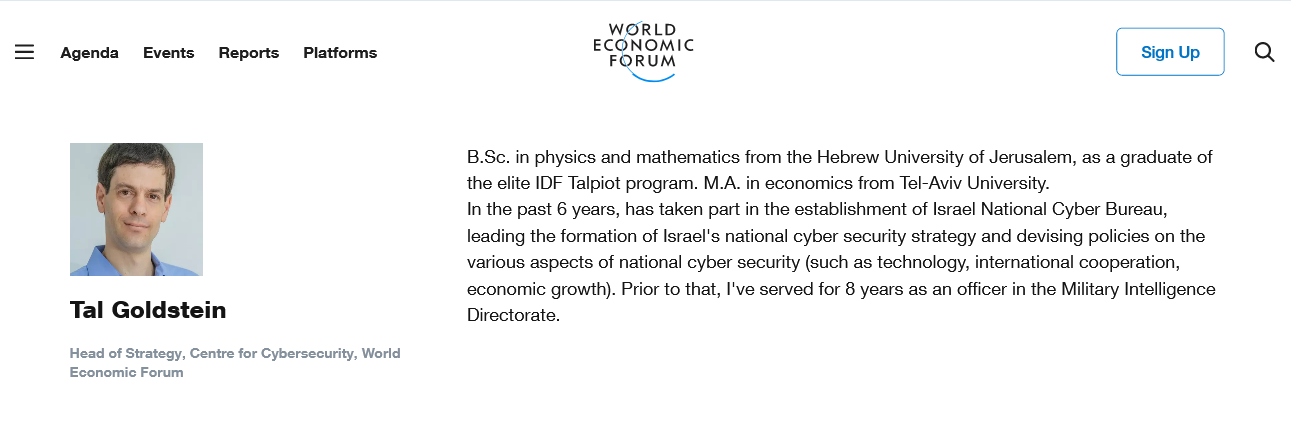
The Wolrd Economic Forum does little to hide its partnership with former Israeli intelligence officials
Toka’s Chief Technology Officer, and the chief architect of its hacking suite, is Moty Zaltsman, who is the only chief executive of the company not listed on the firm’s website. Per his LinkedIn, Zaltsman was the Chief Technology Officer for then-Israeli Prime Minister Benjamin Netanyahu. Last January, when Toka was covered by MintPress News, his profile stated that he had developed “offensive technologies” for Israel’s head of state, but Zaltsman has since removed this claim. The last Toka executive of note is Michael Volfman, the company’s Vice President of Research and Development. Volfman was previously a cyber research and development leader at an unspecified “leading technology unit” of the IDF.
Also worth mentioning are Toka’s main investors, particularly Entrèe Capital, which is managed by Aviad Eyal and Ran Achituv. Achituv, who manages Entrée’s investment in Toka and sits on Toka’s board of directors, was the founder of the IDF’s satellite-based signals intelligence unit and also a former senior vice president at both Amdocs and Comverse Infosys. Both Amdocs and Comverse courted scandal in the late 1990s and early 2000s for their role in a massive Israeli government-backed espionage operation that targeted U.S. federal agencies during that period.
Despite this scandal and others in the company’s past, Comverse subsidiary Verint was subsequently contracted by the U.S. National Security Agency (NSA) to bug the telecommunications network of Verizon shortly after their previous espionage scandal was covered by mainstream media. The contract was part of Operation Stellar Winds and was approved by then-NSA Director Keith Alexander, who has since been an outspoken advocate of closer Israeli-American government cooperation in cybersecurity.
In addition to Entrèe Capital, Andreessen Horowitz is another of Toka’s main investors. The venture capital firm co-founded by Silicon Valley titan Marc Andreessen is currently advised by former Secretary of the Treasury Larry Summers, a close friend of the infamous pedophile Jeffery Epstein. Early investors in Toka that are no longer listed on the firm’s website include Launch Capital, which is deeply tied to the Pritzker family — one of the wealthiest families in the U.S., with close ties to the Clintons and Obamas as well as the U.S.’ pro-Israel lobby — and Ray Rothrock, a venture capitalist who spent nearly three decades at VenRock, the Rockefeller family venture capital fund.
In light of the aforementioned policy of Israel’s government to use private tech companies as fronts, the combination of Toka’s direct Israeli government ties, the nature of its products and services, and the numerous, significant connections of its leaders and investors to both Israeli military intelligence and past Israeli espionage scandals strongly suggests that Toka is one such front.
If this is the case, there is reason to believe that, when Toka clients hack and gain access to a device, elements of the Israeli state could also gain access. This concern is born out of the fact that Israeli intelligence has engaged in this exact type of behavior before as part of the PROMIS software scandal, whereby Israeli “superspy” Robert Maxwell sold bugged software to the U.S. government, including highly sensitive locations involved in classified nuclear weapons research. When that software, known as PROMIS, was installed on U.S. government computers, Israeli intelligence gained access to those same systems and devices.
The U.S. government was not the only target of this operation, however, as the bugged PROMIS software was placed on the networks of several intelligence agencies around the world as well as powerful corporations and several large banks. Israeli intelligence gained access to all of their systems until the compromised nature of the software was made public. However, Israel’s government was not held accountable by the U.S. government or the international community for its far-reaching espionage program, a program directly facilitated by technology-focused front companies. The similarities between the products marketed and clients targeted by Maxwell during the PROMIS scandal and currently by Toka are considerable.
World Bank, IDB aid Toka in targeting Palestine’s allies
While the ties between Toka and Israel’s national security state are clear as day, what is also significant and unsettling about this company is how its entry into developing and developed countries alike is being facilitated by global financial institutions, specifically the World Bank and the Inter-American Development Bank. Notably, these are the only deals with governments that Toka advertises on its website, as the others are not made public.
Several projects funded by one or another of these two institutions have seen Toka become the “cyber designer” of national cybersecurity strategies for Nigeria and Chile since last year. Significantly, both countries’ populations show strong support for Palestine and the BDS movement. In addition, Toka garnered a World Bank-funded contract with the government of Moldova, an ally of Israel, last September.
The World Bank selected Toka in February of last year to “enhance Nigeria’s cyber development,” which includes developing “national frameworks, technical capabilities and enhancement of skills.” Through the World Bank contract, Toka has now become so intimately involved with both the public and private sectors of Nigeria that it relates to the country’s “cyber ecosystem.” The World Bank’s decision to choose Toka is likely the result of a partnership forged in 2019 by the state of Israel with the global financial institution “to boost cybersecurity in the developing world,” with a focus on Africa and Asia.
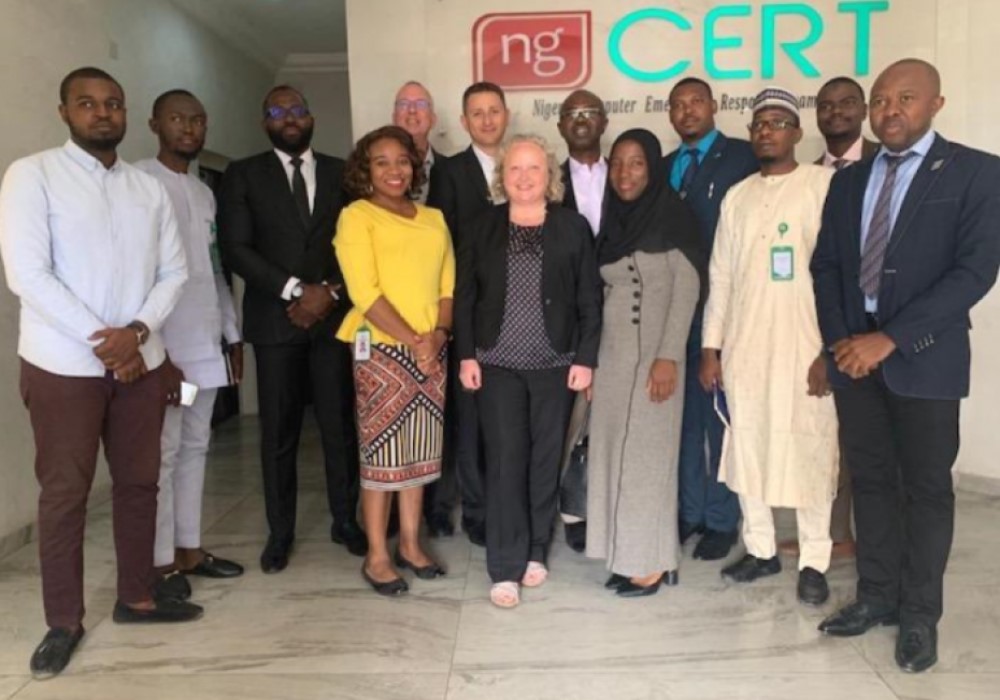
Toka executives pose with Nigerian officials in 2020. Photo | Israel Defense
“Designing and building sustainable and robust national cyber strategy and cyber resilience is a critical enabler to fulfilling the objectives of Nigeria’s national cybersecurity policy and strategic framework,” Toka CEO Yaron Rosen said in a press release regarding the contract.
Given Toka’s aforementioned use of its technology for only “trusted” governments, it is notable that Nigeria has been a strong ally of Palestine for most of the past decade, save for one abstention at a crucial UN vote in 2014. In addition to the government, numerous student groups, human rights organizations, and Islamic organizations in the country are outspoken in their support for Palestine. With Toka’s efforts to offer its products only to countries who align themselves with “friendly” countries, their now intimate involvement with Nigeria’s cyber development could soon have consequences for a government that has tended to support the Palestinian cause. This is even more likely given Toka CEO Rosen’s statements at an April 2021 event hosted by Israel’s Ministry of Economy, where he emphasized the role of cyber in developing countries specifically in terms of their national defense and economic strategy.
Three months after the deal was struck with Nigeria through the World Bank, the Inter-American Development Bank (IDB) selected Toka to advise the government of Chile on “next steps for the country’s national cybersecurity readiness and operational capacity building.” As part of the project, “Toka will assess the current cybersecurity gaps and challenges in Chile and support the IDB project implementation by recommending specific cybersecurity readiness improvements,” per a press release. Toka claims it will help “establish Chile as a cybersecurity leader in South America.” Regarding the deal, Toka’s Rosen stated that he was “thankful” that the IDB had “provided us with this opportunity to work with the Government of Chile.”
Israel signed consequential agreements for cooperation with the IDB in 2015, before further deepening those ties in 2019 by partnering with the IDB to invest $250 million from Israeli institutions in Latin America specifically.
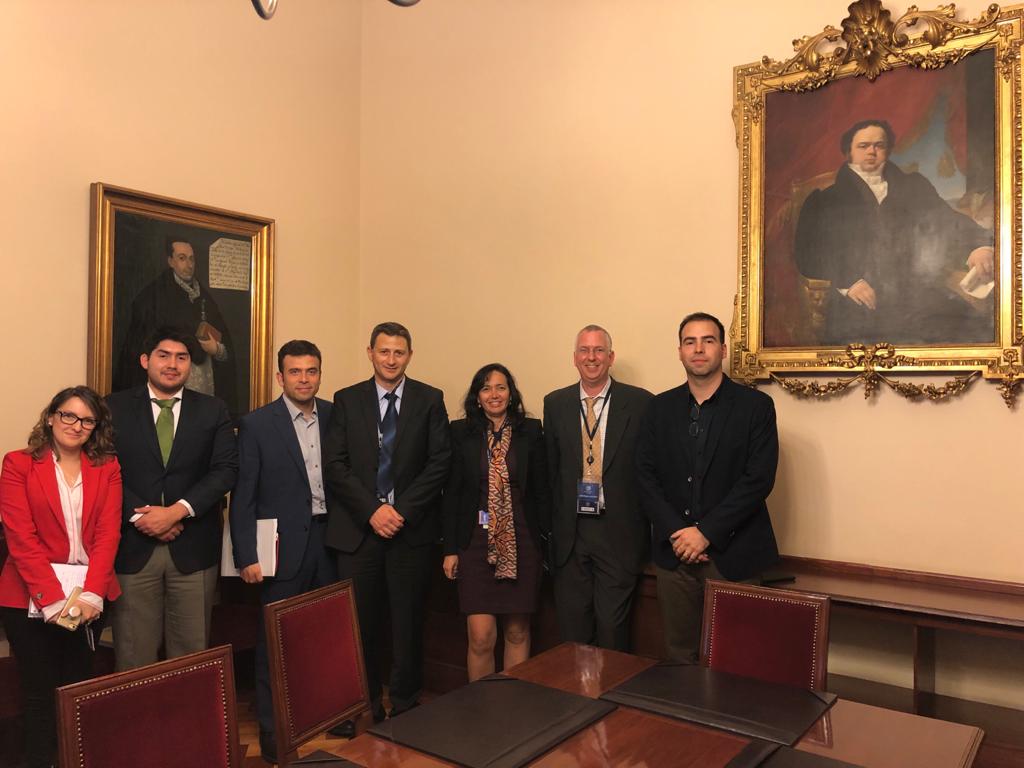
Toka executives are pictured with Chilean officials during a 2020 meeting in Santiago
Like Nigeria, Chile has a strong connection with Palestine and is often a target of Israeli government influence efforts. Though the current far-right government of Sebastián Piñera has grown close to Israel, Chile is home to the largest Palestinian exile community in the world outside of the Middle East. As a result, Chile has one of the strongest BDS movements in the Americas, with cities declaring a non-violent boycott of Israel until the Piñera administration stepped in to claim that such boycotts can only be implemented at the federal level. Palestinian Chileans have strong influence on Chilean politics, with a recent, popular presidential candidate, Daniel Jadue, being the son of Palestinian immigrants to Chile. Earlier this year, in June, Chile’s congress drafted a bill to boycott goods, services and products from illegal Israeli settlements.
While Toka frames both of these projects as aimed at helping the cyber readiness and economies of the countries it now services, Israeli media has painted a different picture. For instance, Haaretz wrote that Israel’s partnerships with development banks, specifically those made in 2019 that resulted in these Toka contracts, were planned by an inter-ministerial committee set up by then-Prime Minister Benjamin Netanyahu “to realize the potential of international development to strengthen the Israeli economy, improve Israel’s political standing and strengthen its international role.” One source, quoted by Haaretz as being close to this undertaking, stated that “development banks are a way to help advance Israel’s interests and agenda in the developing world, including Latin America. But it’s not philanthropy.”
Given these statements, and Toka’s own modus operandi as a company and its background, it seems highly likely that the reason both Nigeria and Chile were chosen as the first of Toka’s development banks contracts was aimed at advancing the Israeli government’s agenda in those specific countries, one that seeks to counter and mitigate the vocal support for Palestine among those countries’ inhabitants.
The spyware problem goes far beyond NSO Group
The NSO Group and its Pegasus software is clearly a major scandal that deserves scrutiny. However, the treatment of the incident by the media has largely absolved the Israeli government of any role in that affair, despite the fact that the NSO Group’s sales of Pegasus to foreign governments has been approved and defended by Israel’s government. This, of course, means that Israel’s government has obvious responsibility in the whole scandal as well.
In addition, the myopic focus on the NSO Group when it comes to mainstream media reporting on Israeli private spyware and the threats it poses means that other companies, like Toka, go uninvestigated, even if their products present an even greater potential for abuse and illegal surveillance than those currently marketed and sold by the NSO Group.
Given the longstanding history of Israeli intelligence’s use of technology firms for international surveillance and espionage, as well as its admitted policy of using tech companies as fronts to combat BDS and ensure Israel’s “cyber dominance,” the investigation into Israeli spyware cannot stop just with NSO Group. However, not stopping there risks directly challenging the Israeli state, particularly in Toka’s case, and this is something that mainstream media outlets tend to avoid. This is due to a mix of factors, but the fact that NSO’s Pegasus has been used to spy on journalists so extensively certainly doesn’t help the matter.
Yet, Israel’s weaponization of its tech industry, and the global use of its spyware offerings by governments and security agencies around the world, must be addressed, especially because it has been explicitly weaponized to prevent non-violent boycotts of Israel’s occupation of Palestine, including those solely based on humanitarian grounds or out of respect for international laws that Israel routinely breaks. Allowing a government to engage in this activity on a global scale to stifle criticism of flagrantly illegal policies and war crimes cannot continue and this should be the case for any government, not just Israel.
If the outlets eagerly reporting on the latest Pegasus revelations are truly concerned with the abuse of spyware by governments and intelligence agencies around the world, they should also give attention to Toka, as it is actively arming these same institutions with weapons far worse than any NSO Group product.
Whitney Webb has been a professional writer, researcher and journalist since 2016. She has written for several websites and, from 2017 to 2020, was a staff writer and senior investigative reporter for MintPress News. She currently writes for her own outlet Unlimited Hangout and contributes to The Last American Vagabond and MintPress News.
Where the Abraham Accords are (and aren’t) going
Israel has improved its relationship with the UAE, but what about other Gulf countries?
By Giorgio Cafiero and Kristian Coates Ulrichsen | Responsible Statecraft | July 7, 2021
On June 29, Israel’s Foreign Minister Yair Lapid arrived in the United Arab Emirates, marking the first official trip by any chief Israeli diplomat to the Gulf country. Former Prime Minister Benjamin Netanyahu had wanted to visit Abu Dhabi while in office, so the timing of the visit so soon after the new Netanyahu-less government was sworn in was notable.
While Lapid was in the UAE, Israel inaugurated an embassy in Abu Dhabi and a consulate in Dubai, representing an important milestone in Emirati-Israeli relations nine months after the Abraham Accords were signed in Washington last September.
Lapid’s trip highlighted how the bilateral relationship has overcome challenges posed by the recent 11-day Gaza-Israel war. Although Emirati officialdom publicly condemned Israel’s conduct in East Jerusalem and the West Bank, and called on both Hamas and Israel to halt attacks (which notably did not single out Israel) in May, the UAE is not cooling its relations with Israel. To the contrary, Abu Dhabi is keen to find ways to build on the Abraham Accords and enhance its ties with the Israelis notwithstanding the unresolved question of Palestine.
While with Sheikh Abdullah bin Zayed Al Nahyan, the UAE’s Minister of Foreign Affairs and International Cooperation, Lapid signed an economic and commercial cooperation agreement. The two also co-authored a highly optimistic article in Abu Dhabi’s The National newspaper where they outlined their outlook for the Emirati-Israeli relationship as well as for “peace” across the greater region: “Peace isn’t an agreement you sign – it’s a way of life. The ceremonies we held this week aren’t the end of the road. They are just the beginning.” (Technically, the UAE-Israel accord is not a “peace” agreement because the UAE, which gained its independence in 1971, has never been at war with Israel.)
Beyond the rhetoric and the symbolism, what are this relationship’s substantive elements and what does this partnership truly mean in practice nine months after the accord’s signing?
Bilateral trade since September 2020 has reached around $675 million. The two countries have signed a long list of trade and cooperation agreements. Media, education, and tourism are all promising sectors that are starting to take off. It is significant that amid the global pandemic, which greatly harmed the UAE and all other Gulf Cooperation Council states’ tourism sectors, 200,000 Israeli tourists visited the UAE with most flying to Dubai.
Technology may be the area where the Emiratis have the highest hopes for this relationship. The potential benefits of formalized ties with the region’s most technologically innovative and advanced country are clear to the UAE. This is particularly true with respect to cybersecurity and to the potential acquisition of offensive cyber-capabilities by the UAE. As Sheikh Abdullah stated, the Emiratis are pleased that the Israelis will participate in Expo2020, an event to be held later this year in Dubai that will bring 192 countries together through technology, innovation, science, and art.
Nonetheless, the Emirati-Israeli trade relationship has thus far not lived up to its expectations. There has also been a degree of disappointment among those who were expecting the partnership to take off much faster following then-President Donald Trump’s announcement of the Abraham Accords.
Some anticipated deals have not taken place. For example, there was the suspension of the 50 percent sale of Beitar Jerusalem (a Jerusalem-based professional football club with an anti-Arab image) to a member of Abu Dhabi’s royal family in Abu Dhabi, Sheikh Hamad bin Khalifa Al Nahyan. In addition, an Israeli energy firm that planned to sell its share of a gas field to Mubadala Petroleum (a subsidiary of the UAE’s sovereign wealth fund, Mubadala Investment Company) missed a deadline for completing the agreement, although, according to the UAE’s side, the deal remains set to proceed. Time will tell how many and how soon major government-to-government and private sector transactions will indeed take place.
Abraham Accords, the Gulf, and Africa
Despite the political risks for any Arab state that normalizes relations with Israel, the UAE has vocally stood by the Abraham Accords, which, in the words of its ambassador to Washington, Yousef al-Otaiba, “move the region beyond a troubled legacy of hostility and strife to a more hopeful destiny of peace and prosperity.” But Abu Dhabi at this point does not appear to be leading any trend within the Gulf region toward the formalization of relations with Israel.
In Kuwait, Oman, Qatar, and Saudi Arabia, the 2002 Arab Peace Initiative remains popular and the only viable means of reaching a fair and lasting settlement between Israel and the Palestinians. This is true at the highest levels of government and among these countries’ general publics. But Tel Aviv almost certainly will not under any foreseeable circumstances agree to the API’s terms, which require Israel to return to the 1949-1967 borders and permit the Palestinians to have an independent state with East Jerusalem as its capital in exchange for opening diplomatic relations. Therefore, among GCC states, the UAE, along with Bahrain, will probably stand alone on the normalization question for some time.
As the GCC state with the most pro-Palestinian stance, Kuwait is most strongly opposed to normalization and unlikely to change its position. Oman maintains pragmatic, albeit unofficial, relations with Israel as highlighted by Lapid’s phone call with Oman’s foreign minister Badr al Busaidi on June 24, plus Netanyahu and other Israeli prime ministers’ visits to Muscat since the 1990s. But Oman remains committed to the API, as affirmed by Muscat’s chief diplomat at an Atlantic Council event held on February 11.
Qatar has a special role to play in Gaza that would be jeopardized by “abandoning” the Palestinians in exchange for normalization with Israel. Through Al Jazeera, which focuses heavily on the plight of Palestinians, and the tendency of Qatari diplomats to advocate on behalf of Palestinians in international forums, Doha’s regional and global image has much to do with its ability to take firm positions on certain international issues that contribute to the image of a pro-human rights foreign policy.
Finally, Saudi Arabia, due to its special role across the wider Islamic world, its authorship of the API, and its own internal dynamics that are fundamentally different than the smaller GCC states, will likely continue seeing normalization of relations with Israel as too risky, at least so long as King Salman remains on the throne.
Within this context, Israel will likely have its next diplomatic openings in the Islamic world not in the Persian Gulf, but instead in impoverished parts of sub-Saharan Africa where countries such as Niger, Mali, and Mauritania could have their economic interests advanced by joining the Abraham Accords. It will be important to see what actions Abu Dhabi might take to incentivize these African countries, many of which are major recipients of Emirati aid, to formalize ties with Israel. Enhanced Emirati assistance in exchange for normalization with Israel was already evident in Sudan’s decision to normalize ties with Israel, and the UAE may take a similar approach with these and other predominantly Muslim and poor African states.
U.N. Rejects Its Own Data to Claim ‘Climate Change’ Threatens Mass Starvation in Madagascar
Mainstream Media is Onboard with the Lie
By H. Sterling Burnett | ClimateRealism | June 24, 2021
A recent search of Google News for the term ‘climate change’ turns up a number of stories in the mainstream media promoting the United Nations (UN) World Food Programme saying climate change is causing a drought in Madagascar that threatens more than one million people with starvation.
Linking climate change to a temporary weather event, which this drought is, equates to a false comparison.
Also, the U.N.’s own data show Madagascar has been setting records in recent decades for crop production, so any food supply shortages are due to political or economic factors not declining crop production.
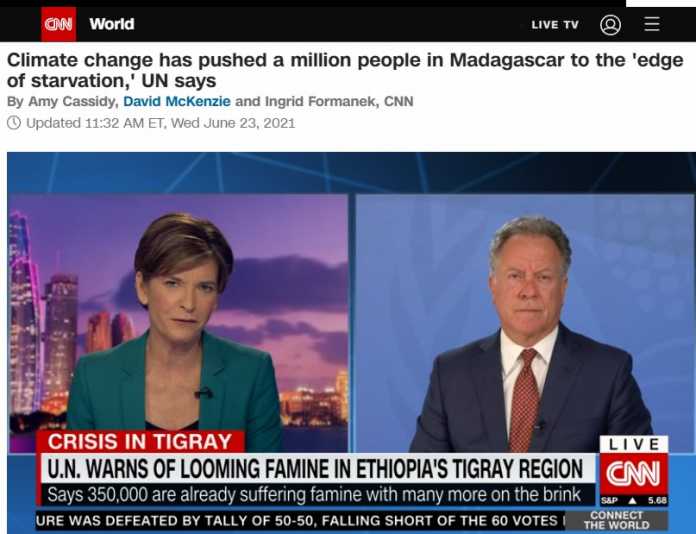
A story titled “Climate change has pushed a million people in Madagascar to the ‘edge of starvation,’ UN says,” by CNN is typical of the mainstream media’s uncritical coverage of the UN’s claims.
“Climate change is the driving force of a developing food crisis in southern Madagascar, the UN’s World Food Programme (WFP) has warned,” writes CNN.
“The African island has been plagued with back-to-back droughts — its worst in four decades — which have pushed 1.14 million people ‘right to the very edge of starvation,’ said WFP executive director David Beasley in a news release Wednesday.”
The UN and CNN should check their premises and data. History shows back to back droughts are not unprecedented in Madagascar’s history.
Indeed, CNN’s own coverage notes the current drought is the worst in forty years. Forty years ago, during Madagascar’s last major drought, scientists were warning of a coming ice age, not global warming.
Peer-reviewed research shows Madagascar’s large megafauna declined sharply, with many species going extinct during previously extended droughts.
Research indicates Madagascar suffered extended droughts nearly 6,000 and again nearly 1,000 years ago.

A drought, approximately 950 years before the present, triggered a large transformation in vegetation, an increase in wildfires, and a sharp decline in the island’s megafauna.
It may be true that some people in Madagascar face potential starvation, but contrary to UN Food Programme’s claims it can’t be due to more than a very recent decline in food supplies, because data from the UN’s Food and Agriculture Organization show Madagascar’s food production has set repeated records since 1980, as seen in Figure 1 below.

Figure 1. Primary crops in Madagascar, all available years. Graph created from the FAO Website. Source
Rice, cassava, and sweet potatoes are three of Madagascar’s staple crops. Each has set multiple records for production over the past few decades. Between 1980 and 2019, the last year for which the FAO has records for Madagascar:
- Rice production increased by approximately 101 percent.
- Cassava production grew by slightly more than 73 percent.
- Sweet potato production increased by more than 198 percent.
The FAO reports Madagascar also saw its fresh vegetable production grow 63 percent between 1980 and 2019.
Madagascar’s current drought is hardly unique and as dire as the present food shortage its people face may be, there is no evidence supposed human-caused climate change is to blame.
Indeed, during the era of global warming, Madagascar’s food production, like food production for the world as a whole, has increased significantly.
Research shows at least part of the recent increase in food production is due to the fertilization effect from increased levels of carbon dioxide in the atmosphere from human fossil fuel use.
In a fervor to link the current drought and associated food shortages to climate change, the UN and CNN forgot a basic fact, weather is not climate and temporary weather conditions, such as back-to-back drought years, don’t necessarily reflect a changing climate.
The UN Food Programme should check its own data before it promotes climate alarm to the media.
Also, media outlets, like CNN, should be more skeptical of alarming climate change-related claims about drought and food production, which readily available data refute.
H. Sterling Burnett, Ph.D. is managing editor of Environment & Climate News and a research fellow for environment and energy policy at The Heartland Institute.
There is no Covid third wave in Africa
Alarmist reporting is getting basic facts wrong
By Toby Green | Unherd | June 24, 2021
The last few days have seen an avalanche of reports that a third wave of Covid-19 is underway in Africa. Seasoned coronavirus watchers will not be surprised that the alarm was raised in Geneva. WHO Central issued alarming press releases on June 7th and 17th, with the Regional Director for Africa, Dr Matshidiso Moeti, stating in the latter that “Africa is in the midst of a full-blown third wave”. So what’s happening?
Since the June 7th press release, there have been 1,651 new deaths reported from Covid-19 across the entire continent in 17 days, less than 100 per day. In a continent where 9 million people die annually (roughly 25,000 per day), reported Covid deaths in this “full-blown” third wave thus currently account for roughly 0.4% of daily mortality in Africa. Certainly, there are mortality increases from Covid reported in some countries such as Cape Verde and the Democratic Republic of Congo, but they are not anything like on the scale of what has happened elsewhere.
Moreover, the vast majority of these fatalities have occurred in temperate zones: South Africa, Morocco, Egypt, Algeria, Libya and Tunisia account for 105,000 of the 139,500 deaths reported from Covid-19 across the continent.
Many of the reports on this “third wave” point to the failure to count deaths accurately, and suggest that these figures mask the true problem. Reports from the BBC and the New York Times have pointed to a continent-wide lack of systemic mortality figures. But running at 0.4% of current mortality, and touching a small area of the continent as a whole, even if this was an underestimate by 1000%, Covid would still only be a minor concern to most Africans. In fact, a recent paper disputes these accusations of undercounting: the authors note that “while only 34.6% of countries [in Africa] have complete death registration data… all countries have a system in place, and there is no evidence that COVID-19 mortality data is less accurately reported in Africa than elsewhere”.
What certainly does go under-reported are cases. This is good news, as it indicates that much of the continent’s population has already developed antibodies to Covid-19 through mild infections. In a study from July to October 2020 of mineworkers tested in Ivory Coast, 25.1% had Covid antibodies; meanwhile, a February study in South Africa based on blood donors found antibody levels of 63% in Eastern Cape, 46% in Free State, and 52% in KwaZulu Natal, while a study from Cameroon just published found antibody levels of 32%. These figures far outstrip recorded cases, suggesting that many Africans already have protection from Covid.
However the WHO redefined herd immunity last year as only achievable through vaccination, so it may not want to publicise this. The Guardian last week added to the clamour, reporting on research that had not been peer-reviewed and which claimed that Covid infection did not provide immunity. Ironically, a series of studies published in Nature the week before had found that “the evidence thus far predicts that infection with SARS-CoV-2 induces long-term immunity in most individuals”.
The evidence from Africa is quite clear, in fact. Large sections of the population have now developed Covid antibodies, and death rates are low compared to other chronic illnesses. Herd immunity does not have to be achieved through vaccination, either in Africa or elsewhere. But none of these conclusions fit with the catastrophic decisions taken by global policy elites over the past year, so they won’t be coming to a television news channel near you any time soon.
Toby Green is the author of The Covid Consensus: The New Politics of Global Inequality (Hurst).
Beijing, the Five Eyes or Something Else? Who’s to Blame for the COVID Pandemic?
By Matthew Ehret | Strategic Culture Foundation | May 19, 2021
The oligarchy running the Trans Atlantic System certainly loves the centralized control found in the Chinese system, and they adore the behaviorist social credit stuff, but that is where the admiration ends, Matt Ehret writes.
Ever since the earliest days of the Coronavirus pandemic, evidence began to emerge that the virus was not a naturally occurring evolutionary phenomenon as asserted by the WHO, Nature, and editors at the Lancet, but had other origins.
Among the earliest of those who found themselves supporting this theory were the Chinese Foreign Ministry Spokesman Lijian Zhou who made international waves by sharing two articles by Larry Romanov on the possibility of “gene targeting” of the virus which was having a disproportionately bad effect on Iranians, Italians and various Asian genotypes. Zhou was soon joined by bioweapons experts like Francis Boyle, prominent virologists Luc Montagnier and Judy Mikovits, followed by a growing array of scholars, scientists and academics from around the world who all assessed that the virus’ apparent gene sequencing implied human handiwork. While all agreed that COVID appeared to have originated from a lab, it was still unclear whether that lab was Chinese or controlled by the USA.
Another obvious question arose with this lab theory: Was it an accidental leak or was it consciously deployed?
Since pandemic war game operations had become a normalized part of western geopolitical life from the early days of Dark Winter in 2000 to the Rockefeller Foundation’s 2011 Lock Step to the World Economic Forum’s Event 201 (and dozens more in between), the likelihood of conscious deployment was a very serious possibility.
Who had the motive, means and modus operandi to carry out such a global operation?
The Wuhan Theory Begins
By February 2020, the Wuhan lab leak hypothesis began to make headlines fed by evidence that Dr. Anthony Fauci had exported certain gain of function coronavirus experiments from U.S. bioweapons laboratories to Wuhan’s Institute of Virology – one of two BSL-4 labs in China equipped to conduct this sort of research in China.
When Sir Richard Dearlove (former head of MI6) became a loud proponent of the Wuhan lab leak hypothesis in June 2020, something seemed amiss. Dearlove certainly knew a thing or two about bioweapons. He knew very well of the Pentagon’s vast array of internationally extended bioweapons labs peppered across the world, and he certainly understood the art of misdirection being a byzantine shadow creature who operated at the highest echelons of British intelligence. Dearlove was after all in charge of the “yellowcake” dodgy dossier that launched an Iraq war, he knew of the fallacious reports of nerve gases used by the governments of Libya and Syria sponsored by MI6, had even overseen major components of Russiagate that drove a color revolutionary process in the USA. Dearlove also knew a thing or two about the Porton Down labs that manufactured Novichok used in the Skripal Affair.
While Dearlove’s cheerleading of the Wuhan lab theory raised alarm bells, as time passed, no smoking gun evidence surfaced that one could fully “take to court”. In this respect, Dearlove’s operation had the upper hand since receipts from Fauci’s NIH to the Wuhan Lab did make headlines. How convenient.
Before going into the next phase of the story, it is important to recall that the absence of empirical evidence is not by itself a proof of one party’s innocence, just as the existence of a piece of empirical evidence is not a proof of another party’s guilt. This was a sad discovery made far too late by Shakespeare’s Othello after Iago’s planted “evidence” of a handkerchief resulted in the foolish warrior to murder his loving wife.
Wuhan Lab Origins Go Viral Again
In recent weeks, the Wuhan lab leak hypothesis has once again become all the rage.
Rand Paul’s May 10 showdown with Fauci over this the latter’s funding of the Wuhan Institute of Virology added fuel to the fire. Sky News’ May 7 reporting of public Chinese policy papers discussing covid-based bioweapons have gone viral. On March 26, former Center of Disease Control head Robert Redfield asserted support for the Wuhan lab leak theory. While the scanned receipts of the funds transfer from the NIH to Wuhan via Eco Health Alliance ($600 thousand went to Wuhan) for coronavirus research, had been available since last February, one must wonder why it is now over a year later that this fact is being spread across the perception landscape on all levels.
Both mainstream and alternative media across the western world representing both the left and right have jumped on board the bandwagon blaming China for leaking the virus whether by accident or intent (though obviously, intent is the conclusion which anyone is being expected to draw. But again, I must ask: In a world of misdirection, psychological warfare and perception management, do the clues that we are being given force us to conclude that the Chinese government is behind the global shutdown?
Chinese Leaders Blame the CIA
Zeng Guang, a chief epidemiologist at China’s Center of Disease Control recently joined the conspiracy club on February 9, 2021 in an interview with Chinese media. While denying that the Chinese Wuhan lab is the source of the virus as so many in the west have claimed, Guang asserted that SarsCov2’s origins in a laboratory should not be discounted. Pointing to the 200 globally extended U.S. bioweapons labs littering the earth (and citing the USA’s proven track record of deploying bioweapons as part of its asymmetrical war arsenal since WWII), Guang asked:
“Why are there so many laboratories in the United States when biology labs are all over the world? What is the purpose? On many things, the United States requires others to be open and transparent, only to find that it is the United States itself that is often the most opaque. Whether or not the United States has any special fame on the issue of the new crown virus this time, it should have the courage to be open and transparent. The United States should take responsibility for proving itself to the world, rather than being caught up in hegemonic thinking, hiding itself from the virus and dumping others.”
Guang was himself joined by Chinese Foreign Ministry spokesman Hua Chunying who had also pointed to the Pentagon’s globally extended array of bioweapons laboratories saying:
“I’d like to stress that if the United States truly respects facts, it should open the biological lab at Fort Detrick, give more transparency to issues like its 200-plus overseas bio-labs, invite WHO experts to conduct origin-tracing in the United States, and respond to the concerns from the international community with real actions.”
Those who tend to avoid looking at the history and scope of Pentagon controlled bioweapon warfare tend to ignore the content of such remarks cited by those Chinese officials above for a multitude of reasons. For one: it is easy to believe that Fauci and Gates are corrupt, and this theory not only implicates both men but also ties them to a Chinese government which most westerners have come to fear and hate as a bastion of global debt-trappery, genocide, technocracy and imperialism.
After conducting a short review of some of the fundamental facts of recent world history alongside certain geopolitical realities of our present world order referenced by the head of the Chinese CDC, I believe that China’s Wuhan Lab is being set up. Here’s why…
Fact #1) Depopulation Then and Now
While many people may wish to avoid looking at this fact, depopulation is a driving factor behind international unipolar policy today as it had been during the days of WW2 when Rockefeller Foundation, Macy Foundation, City of London and Wall Street interests gave their backing to both the rise of fascism as an economic miracle solution for the economic woes of the great depression and eugenics (the science of population control) as the governing religion of a new scientific priesthood.
Today, this agenda masquerades behind a new transhumanist movement, shaped by a words like “Fourth Industrial Revolution”, “decarbonized economies”, and “Great Resets”. The primary targets of this agenda remain: 1) the Institution of the sovereign nation state itself as it was the target a century ago when the Bank of England arranged the formation of the 1919 League of Nations, and 2) the “overpopulated zones” of the world with a focus on China, India, South America and Africa.
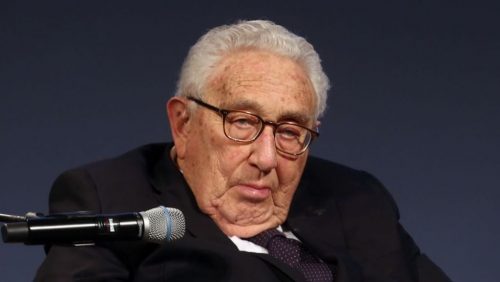
For anyone who would find themselves instinctively inclined to brush aside such claims as “conspiracy theorizing”, I would encourage a brief review of Sir Henry Kissinger’s infamous NSSM-200 report: Implications of Worldwide Population Growth for U.S. Security and Overseas Interests published in 1974. This declassified report went far to transform U.S. foreign policy from a pro-development philosophy to a new paradigm of population control. Kissinger warned that “if future numbers are to be kept within reasonable bounds, it is urgent that measures to reduce fertility be started and made effective in the 1970s and 1980s…. (Financial) assistance will be given to other countries, considering such factors as population growth… Food and agricultural assistance is vital for any population sensitive development strategy… Allocation of scarce resources should take account of what steps a country is taking in population control… There is an alternative view that mandatory programs may be needed….”
In Kissinger’s twisted logic, U.S. Foreign Policy doctrine had too often foolishly sought to end hunger by providing the means of industrial and scientific development to poor nations.
A true Malthusian through and through, Kissinger believed that aiding the poor to stand on their own feet would result in global disequilibrium as the new middle classes would consume more, and use the strategic resources found under their own soil, which would set the world system into greater disequilibrium and accelerated entropy.
This was deemed unacceptable to the mind of Kissinger and any misanthropic follower of Malthus who shared his views of humanity and government.
Kissinger’s Master-Slave Global Society
At the time of Kissinger’s ascent to power as Secretary of State under Nixon, a new grand strategy was unleashed designed to create a new “master-slave” dependency between the developed and undeveloped sectors of the world… with a special emphasis on the 13 nations targeted by NSSM 200 plus China.
China itself was only permitted to acquire western tech needed to start climbing out of abject poverty on the condition that they obeyed the Rockefeller-World Bank demands that one child policy programs were imposed to curb population growth.
Kissinger began organizing for this new set of relations in society around “Have”, post-industrial consumers and a massive “Have-Not” class of poor laborers with access to industry, but remaining stagnant, cheap and without the means of purchasing the goods they produced. The other darker skinned parts of the world would be even more worse off, having neither the means of production, nor consumption while remaining in constant states of famine, war and backwardness. These dark age zones would be largely made up of Sub Saharan Africa and would find their resource-rich lands exploited by the corporate middle men and financiers trying to run the world order above the “obsolete order” of nation states.
Kissinger’s model of a world order was absolutely static with no room for population growth or technological progress which would have any connection to increasing the powers of production. Mao and the Gang of Four which ran the cultural revolution appeared to be highly compatible with Kissinger’s agenda. But when Mao died and the Gang of Four were rightfully imprisoned, a new long-term strategy known as the Four Modernizations shaped by Zhou Enlai and carried out by Deng Xiaoping was launched. This program was far more foresighted than Kissinger realized.
Fact #2) China is currently a leading force of pro-population growth.
While the west has been accelerating into a decaying path on every measurable level, China is quickly moving in an opposing trajectory via extending long term investments and advanced tech development into its own society as well as to its neighbors through such comprehensive projects as the Belt and Road Initiative.
While its own population has not healed from the disastrous 1979 one child policy and is far from achieving the 2.1 children per couple needed for replacement fertility, it did lift the one child limit to two in 2015 and leading Bank of China economists have called for a total elimination of all limits immediately. Meanwhile, the top-down national orientation of China towards increasing the free energy needed to support and grow the economy is unlike anything we have seen in the closed-system western world for many decades.
A vital fact often forgotten is that together China and India were instrumental in sabotaging the December 2009 COP-14 program in Copenhagen which had promised to establish legally binding emission target cuts to guide the de-carbonization (and de-industrialization) of much of society.
The London Guardian had reported that “Copenhagen was a disaster. That much is agreed. But the truth about what actually happened is in danger of being lost amid the spin and inevitable mutual recriminations. The truth is this: China wrecked the talks, intentionally humiliated Barack Obama, and insisted on an awful “deal” so western leaders would walk away carrying the blame.”
Apparently China and India, along with African governments like Sudan (which had not yet been carved up on the careful watch of Rhodes’ Susan Rice) did not wish to sacrifice their industry and national sovereignty on the altar of climate change models and technocrats that had only weeks earlier been publicly exposed as frauds by East Anglia University researchers during the embarrassing Climategate scandal.
While China and India should be celebrated for having sabotaged this effort 11 years ago, very few people have been able to hold this drama in their memory, and fewer still realize how this fight over sovereignty was in any way connected to China’s 2013 creation of the Belt and Road Initiative as the vital force behind the Multipolar Alliance.
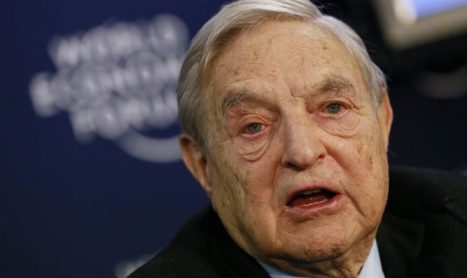
Fact #3) Soros at Davos 2020: The two greatest threats to Open Society: 1) Donald Trump’s USA and 2) Xi Jinping’s China.
During his January 2020 Davos speech, Soros took aim at both Trump and Xi Jinping as the two greatest threats to his Open Society who had to be stopped at all costs. In September 2019 (just as Event 201 was happening) Soros wrote in the Wall Street Journal :
“As founder of the Open Society Foundations, my interest in defeating Xi Jinping’s China goes beyond U.S. national interests. As I explained in a speech in Davos earlier this year, I believe that the social-credit system Beijing is building, if allowed to expand, could sound the death knell of open societies not only in China but also around the globe.”
Before becoming mired into the “China virus” narrative, Donald Trump had worked exceptionally hard to emphasize good relations with China and even managed one of the most important trade deals that had successfully moved into phase one the week Soros spoke at Davos. This first phase involved China creating a market to purchase U.S. finished goods as part of the program to rebuild America’s lost manufacturing sector that had been hollowed out over 5 decades of “post industrialism”. Where Kissinger called NAFTA “the most creative step toward a new world order taken by any group of countries since the end of the Cold War” Trump went far to renegotiate the anti-nation state treaty giving nation states a role to play in shaping economic policy for the first time in over 25 years.
While talking tough on China until 2020, Trump also resisted the war hawks pushing a total military encirclement of China begun under Obama’s Asia Pivot which is threatening nuclear war (same thing is happening on Russia’s perimeter). He took the fuel out of the THAAD missile encirclement of China which has justified its expansion based on the “North Korean threat” for over a decade – always denying the truth that the real target were both Russia and China. Trump’s push to build friendly relations with Kim Jong Un had much greater ramifications at changing U.S. Pacific military policy than many realized, although that fact was certainly not missed by the Chinese intelligentsia.
While the Soros/CIA-driven color revolutionary operations have so far failed to divide up China in Hong Kong, Tibet and Xinjiang, they have been successful in the USA.
Fact #4) The Pentagon’s Global Bioweapons Complex Is a Fact
While China is the proud owner of a total of TWO bioweapons labs (both within its borders), a vast array of dozens of Pentagon-run bioweapons labs litter the international landscape. Exactly how many is hard to estimate as Alexei Mukhin (Director General of Russia’s Center for Political Information) stated in a May 2020 interview:
“According to the Russian Ministry of Defense, in the post-Soviet space, 65 American secret bio-laboratories operate: 15 – in Ukraine, 12 – in Armenia, 15 – in Georgia, 4 – in Kazakhstan. In the United States, such activity is prohibited. Accordingly, the Pentagon, in its own laws, is engaged in illegal activities (in spirit, not in letter). The goal is the creation of biological weapons directed against the peoples who inhabited the territory of the USSR. Fortunately, biological material is “at hand.”
In 2018, investigative journalist Dilya Gaytandzhieva documented the Pentagon’s multibillion dollar budget that sustains bioweapons labs in 25 nations (and 11 within the USA itself) which grew exponentially since the December 2001 bioweaponized anthrax attack killed five Americans and justified a hyperbolic increase of bioweapon warfare to rise from $5 billion when Cheney’s Bioshield Act was passed in 2004 to over $50 billion today.
Additionally, an October 2000 policy document co-authored by William Kristol, John Bolton, Richard Perle, Dick Cheney, Paul Wolfowitz, Elliot Abrams, and Donald Rumsfeld titled Rebuilding America’s Defenses (RAD) explicitly stated that in the new American Century, “combat will likely take place in new dimensions: In space, cyber-space and perhaps the world of microbes… advanced forms of biological warfare that can “target” specific genotypes may transform biological warfare from the realm of terror to a politically useful tool”.
Fact #5) International Pandemic War Game Scenarios Laid the groundwork for the international response to Covid. Not China
The driving force behind such bioweapon war game exercises such as the June 2000 Operation Dark Winter, the May 2010 Rockefeller Foundation report Operation Lock step, and the World Economic Forum/Gates Foundation/CIA Event 201 pandemic exercises indicate to me that China is not the causal nexus.
All in all, I think these facts have persuaded me that China is being set up and is in fact a primary target for destruction.
How China would find itself the beneficiary of such an irresponsible unleashing of a novel virus that hammered its own economy, accelerated the blow out of the world financial bubble economy and led to a shut down of international stability is absurd to the extreme… especially considering the fact that everything China has done for the past decades has indicated a consistent desire to create stability, long term development and win-win cooperation with the international community. Nothing similar has been seen among members of the Five Eyes or their Trans Atlantic network of over bloated imperialists.
The oligarchy running the Trans Atlantic System certainly loves the centralized control found in the Chinese system, and they adore the behaviorist social credit stuff, but that is where the admiration ends. The Kissinger, Gates, Carney or Schwab- types hate and fear everything China has actually done for development, population growth, national banking, long term credit generation, building full spectrum industrial economies and defending sovereignty along with Russia whom they are tightly bonded with in the Eurasian Multipolar alliance.
Biden to uphold Western Sahara recognition for sake of Israel
Press TV – May 1, 2021
US President Joe Biden has reportedly decided to uphold the Trump administration’s controversial decision to recognize Morocco’s alleged sovereignty over Western Sahara.
The recognition came as part of a deal with the despotic North African country to normalize relations with the Israeli regime.
US Secretary of State Antony Blinken informed Moroccan Foreign Minister Nasser Bourita during a Friday phone call that the Biden administration would not, “for the time being,” reverse his predecessor’s pro-Israeli move in the waning days of his presidency, US-based Axios news website reported, citing “two sources familiar with the call.”
“The secretary welcomed Morocco’s steps to improve relations with Israel and noted the Morocco-Israel relationship will bring long-term benefits for both countries,” according to a readout of the call released by the State Department.
Responding to inquires about the issue during a Friday press briefing, State Department deputy spokesperson Jaline Porter tried to dodge the issue.
“When it comes to Western Sahara, we are consulting privately with parties on how to best halt the violence there… We would also talk about having the goal to achieve a lasting settlement,” she said.
Trump’s recognition of Western Sahara as part of Morocco reversed decades of Washington’s policy regarding the disputed territory. It was part of a wider agreement with Rabat’s ruler that included the renewal of diplomatic ties between the Israeli and the Moroccan regimes that triggered massive protests in Palestine and Morocco.
The US thus became the only Western country to recognize Morocco’s alleged sovereignty over Western Sahara, which was annexed by the Rabat regime in 1975 after the former colonial government of Spain surrendered control.
The report further revealed that 10 days ago Biden’s Middle East advisor Brett McGurk “spoke to Bourita and gave the impression that there would be no change in the US policy on Western Sahara.”
It report said both Morocco and Israel had become concerned that the Biden administration may reverse Trump’s contentious decision, solely intended to press more Arab dictatorships to recognize Israel.
Last December, Morocco became the fourth US-backed Arab kingdom to strike a deal aimed at establishing ties with Israel. The others were the United Arab Emirates, Bahrain and Sudan.
The move sparked protests across the North African country, opposing the deal and expressing solidarity with the Palestinian cause while condemning the Israeli regime’s persisting atrocities against Palestine’s native population.
Later, Israeli prime minister Benjamin Netanyahu invited Morocco’s King Mohammed VI to Tel Aviv in a “warm and friendly” phone conversation, agreeing to continue contacts in order to advance the normalization agreement.
Trump’s controversial decision, which contradicts UN resolutions on the issue, has been challenged by US lawmakers.
In February, half the US Senate signed a bipartisan letter led by Republican Jim Inhofe and senior Democrat Patrick Leahy calling on Biden to reverse Trump’s “illegitimate” decision.
“The abrupt decision by the previous administration on December 11, 2020, to officially recognize the Kingdom of Morocco’s illegitimate claims of sovereignty over Western Sahara was short-sighted, undermined decades of consistent US policy, and alienated a significant number of African nations,” the senators wrote.
“The Sahrawi people deserve the right to freely choose their own destiny. We hope that we can count on you to be a partner in this effort,” they added.
Africans Deflect Biden’s Demand To End Fossil Fuel Use
By Duggan Flanakin ~ PA Pundits – International ~ April 17, 2021
As the merger of climate change and COVID panic materializes in front of our eyes, “global leaders” have found plenty developing world voices to join the crusade to “save the planet” from carbon (dioxide) “pollution.” But like their Chinese and Indian counterparts, many Africans, from heads of state to captains of industry and beyond, intend to expand, not shrink, reliance on fossil fuels to build their economies.
According to Oxford University researcher Galina Alova, “Africa’s electricity demand is set to increase significantly as the continent strives to industrialise and improve the well-being of its people,” but those who hope for rapid decarbonization in Africa will likely be disappointed.
Alova’s research found that Africa is likely to double its electricity generation by 2030, with fossil fuels providing two-thirds of the total, hydroelectric another 18 percent, and non-hydro renewables providing less than 10 percent.
Such an energy mix flies in the face of the firm commitment from the fledgling Biden Administration to demand an end to all international financing of fossil fuel based energy projects. Biden climate envoy John Kerry won a strong endorsement from 450 organizations worldwide after telling World Economic Forum members of the “plan for ending international finance of fossil fuel projects with public money.”
The Biden plan, which comports with the Paris climate agreement, echos the call by European Union foreign ministers for an end to financing fossil fuel projects abroad (which means in Africa). Secretary of State Antony Blinken explained that “development finance is a powerful tool for addressing the climate crisis” that the U.S. will use to “help drive investment toward climate solutions.” [Translation: “We intend to ram decarbonization down their throats!”]
Many Africans feel the need to placate their self-appointed betters and accept the climate change tenets.
World Bank veteran Ede Ijjasz and Africa Growth Initiative Director Aloysius Ordu claim that Africans must take advantage of the COVID pandemic to initiate a “great reset” of Africa’s economies according to the UN’s Sustainable Development Goals and the principles of the Paris agreement. The world, they claim, cannot afford to give Africa a pass on decarbonization (though China and India get a pass).
Others prefer a more temperate approach.
In late March, investment professional Tariye Gbadegesin challenged President Biden to prioritize African nations as part of his global climate initiative. While admitting that Africa’s urban centers are swelling, “threatening more emissions,” she asserted that striking a balance between this ongoing development and its climate impact must be a global priority. For example, Nigeria could build a hybrid grid using plentiful natural gas and solar energy. But, Gbadegesin implied, such a hybrid grid would not meet the Biden-EU financing guidelines.
In early April, the African Development Bank (AfDB), the Global Center for Adaptation, and the Africa Adaptation Initiative held a virtual Leaders Dialogue in response to the State of the Climate in Africa 2019 report. Over 30 heads of state and other global leaders committed to prioritize actions that will help African countries both adapt to the presumed impacts of “climate change” and overcome widespread energy poverty. African Union chair Felix Tshisekedi listed “nature-based solutions, energy transition, an enhanced transparency framework, technology transfer, and climate finance” as critical areas for adaptation.
During the meeting, AfDB president Dr. Akinwumi Adesina noted the group intends to mobilize $25 billion in financing for the success of the Africa Adaptation Acceleration Program. “It is time,” he affirmed, “for developed countries to meet their promise of providing $100 billion annually for climate finance. And a greater share of this should go to climate adaptation.”
This African response to the Biden-EU decarbonization initiative – relying on adaptation and balance, not prohibition and eternal poverty, to achieve sustainability — reflects on the 1987 Brundtland Commission report, “Our Common Future.” In the report, the World Commission on Environment and Development defined sustainable development” as development that “meets the needs of the present without compromising the ability of future generations to meet their own needs.”
Commission Chair Gro Harlem Brundtland acknowledged that, “A world in which poverty is endemic will always be prone to ecological and other catastrophe.” In her view, “Meeting essential needs requires not only a new era of economic growth for nations in which the majority are poor, but an assurance that those poor get their fair share of the resources required to sustain that growth.”
Sadly, U.S. and EU (and the UN) climate “monarchs” have long ignored Brundtland’s promises. The UN’s 20-year assessment of the document did not even mention “poverty” or “Africa.” CFACT reported that year that sub-Saharan Africa was “in very short supply of energy and power, especially electricity, and overland trade [was] greatly hindered by an almost total lack of infrastructure.” Worse. curable diseases ran rampant as people relied on toxic dung and wood for heating and cooking.
At the 2011 UN climate conference in Durban, South Africa, nuclear physicist (and CFACT advisor) Kelvin Kemm reported that the African representatives were not happy. “Their general feeling,” he recounted, “was that the First World is trying to push Africa around, bully African countries into accepting its opinions, and, even worse, adopting its supposed ‘solutions’.”
That feeling remains. Responding to the Biden-EU renewables-only energy financing plan, W. Gyude Moore, a senior fellow at the Center for Global Development and former Liberian minister of public works, mused that, “There’s this idea that because Africa is lacking in legacy infrastructure, it’s a good canvas to paint the energy future. But no African country has volunteered itself for that.”
With nearly 600 million Africans lacking access to electricity, Moore added, “it seems immoral to restrict options for energy sources” for the world’s poorest continent. Later, Moore, with Vijaya Ramachandran of The Breakthrough Institute, wrote that a ban on oil and gas projects in Africa would stifle economic growth and thus make poor populations even more vulnerable to climate change impacts.
Moore and Ramachandran explained that the top priority in most African countries is economic growth, first in agriculture, then in industry and services. For most Africans, worries of an increased carbon footprint generated from economic growth are a weak second to worries that growth may not happen at all. In their view, people in poverty don’t just need to power a single lightbulb at home; they need abundant, affordable energy at work too.
Overall, Moore and Ramachandran noted, Africa’s needs are too great to be met solely with current green energy technologies. Its finances too stretched to be able to afford the cost of carbon-neutral energy. Keeping Africa poor to fight climate change will do nothing to help the people most affected by it. But President Biden, his EU allies, and the “green 450” disagree.
This arrogance makes it quite clear that “Our Common Future” is still in the future, if at all.
The difference is that, today, Africans are no longer waiting for the UN, the International Monetary Fund, the World Bank, or even the African Development Bank to finally invest in sorely needed African infrastructure.
By hook or by crook, Africans are committed to using available resources to do the job.
Duggan Flanakin is the Director of Policy Research at the Committee For A Constructive Tomorrow. A former Senior Fellow with the Texas Public Policy Foundations, Mr. Flanakin authored definitive works on the creation of the Texas Commission on Environmental Quality and on environmental education in Texas.
Featured Video
Iran spent $1 million to wipe out $30 billion in data center plans, and take down Amazon in the ME
or go to
Aletho News Archives – Video-Images
From the Archives
A short history of British torture
ICC | December 2005
When the House of Commons was debating how much to increase the time limit for detention without trial the question of torture came up. Officially this was limited to the nice considerations of whether it was all right to send people to places where torture is used and whether Britain can use information collected by the use of torture in other countries. This discussion gave an impression of democratic Britain as the home of civilised behaviour where the very idea of torture is repugnant to our legislators – unlike, say, the US with its secret CIA jails… In reality, the British state has a long history of using and developing a whole range of torture techniques. … continue
Blog Roll
 Aletho News
- Iran spent $1 million to wipe out $30 billion in data center plans, and take down Amazon in the ME
- Zionist billionaire pressure to silence Macklemore sparks exodus from Ed Sheeran tour
- House Votes to End Iran War for Third Time
- North Korea Slams US Plan for ‘AUKUS 2.0’ with South Korea and Japan
- Prolonging US-Iran Conflict Not Meeting Interests of Int’l Community – China’s Wang Yi
- EU bans former Zelensky aide from parliament
- NATO-backed Kosovo separatist ‘responsible for war crimes’
- US destroying international space law
- SCO Calls for Binding Global Deal to Prevent Arms Race in Space
- Iran & Its Allies Are Threatening Every Route for Saudi Oil
- If Americans Knew
- U.S. Makes, Israel Takes: The Real Story of U.S.-Israeli Military Cooperation
- Night raids rise in Palestine
- Tucker Carlson interviews Norman Finkelstein about Gaza
- Groups urge Americans to support Van Hollen legislation on Israel’s killing of Americans & Palestinians
- Trump administration plans to send 40,000 tons of bombs to Israel: report
- Sanctions Target Iran’s Government, But Kill Hospitalized 23-Year-Old Woman
- An alternative view on the book “Israel’s Lobby: America in the Grip of a Foreign Power”
- Ed Sheeran’s band Beoga, other opening acts quit tour after Macklemore was dropped over his pro-Palestinian comments
- The assassination attempt on President Trump in Butler and the various Israeli connections to it
- “We Want That the Whole Land Be Jewish”
- No Tricks Zone
- New Study: ‘Global Drought Shows No Detectable Recent Acceleration Under Climate Warming’
- Economic Masterminds: German Socialists Suggest Taxing Productivity Gains Stemming From Using AI
- The South China Sea Has Not Been Cooperating With The Climate Change Narrative
- Energy Crisis: Germany Enters Heating Season With Historically Low Gas Reserve Fill Levels
- New Study: The Antarctic Ice Sheet Gained Mass From 2020-2024 Due To Staggering Snow And Ice Accumulation
- Study: Ocean Heating Rates From Thousands Of Years Ago ‘Dwarf’ Modern Ocean Heating Rates
- Climate Extremists Target, Attack Large-Scale Power Grid Infrastructure In Germany!
- New Study: Antarctic Ice Melt Has Contributed Less Than 1 Centimeter To Sea Level Rise In The Last 30 Years
- Fear Of Debate: Alarmist German Climate Scientist Calls On Mainstream Media To Discredit Skeptic Voices
- End-Of-August Arctic Sea Ice Extent Hasn’t Fallen In 20 Years, Official Data Show!
 Aletho News