What stopped Chad’s Idriss Déby from visiting Israel before now?
Dr Mustafa Fetouri | MEMO | December 20, 2018
If you did not know much about Chad, a country in the middle of Africa, it most likely it caught your eye on 26 November when its President, Idriss Déby, landed in Israel for an unannounced visit to the Zionist state. The visit was shrouded in secrecy until Déby’s plane touched down at Ben Gurion Airport. His closest aides had no idea that he was heading to Tel Aviv until the last minute. It reminds me of November 1977, when Egypt’s then President Anwar Sadat made his surprise trip to Israel.
Sadat justified his move by the fact that Egypt and Israel were at war with each other and such a visit, he believed, helped to make peace. Déby, on the other hand, has been in power since December 1990, Chad is not at war with Israel and the two countries are thousands of miles apart; so what motivated him to embark on such an endeavour at this time? Or, indeed, what stopped him from making such a visit before now?
Israeli journalist Herb Keinon answered this question by explaining that, “Chad severed ties with Israel in 1972 after coming under pressure from Libya.” Reuters reported that Dore Gold, the Director of Israel’s Foreign Ministry in 2016, explained after his own visit to Chad why the government in N’Djamena cut ties with Israel over four decades earlier: “[his Chadian hosts] told him that they cut off ties 44 years prior under Libyan pressure, a factor removed with the toppling of Muammar Gaddafi [in 2011].”
Indeed Libya under Gaddafi was the fiercest opponent of Israeli expansion in Africa. As early as 1972, just three years after taking power, Gaddafi forced the then Chadian President, François Tombalbaye, to sever ties with Tel Aviv. Gaddafi believed strongly that any Israeli diplomatic expansion into Africa undermined the continent’s pro-Palestinian position. The late Libyan leader considered Israel to be an enemy best kept as far away as possible from Libya and Africa.
Libya has a history of ties with Chad going back to Italy’s invasion and occupation of Libya in 1911, which saw hundreds of Libyans seeking safety in Chad; their descendants still live in Libya’s southern neighbour. Gaddafi capitalised on this to strengthen ties between this community of exiles and their home country. He also sought to prevent Chad from becoming a threat to Libya’s security, which is why Tripoli was involved in toppling Chadian regimes considered unfriendly, particularly between 1972 and 1990.
Idriss Déby himself became President of Chad in December 1990, with Libyan political and military support. Gaddafi invested Libya’s oil money in Chad; the North African state owns two banks there and some luxury hotels, and built dozens of schools, mosques and medical facilities, as well as communication and agriculture infrastructure.
The late Libyan leader also used his political clout in Africa to keep African countries away from western influence, knowing too well that it would only benefit Israel as many western capitals would encourage them to embrace and help Tel Aviv to infiltrate the continent even more. In this context, Libya founded the African Union in 1999, for Pan-African cooperation. Tripoli also founded the Community of Sahel-Saharan States (CEN-SAD), bringing 24 Sub-Saharan African counties closer to neighbouring North African Arab states to share investment, free trade, security and foreign policy coordination.
This put Libya, before 2011, in direct competition with western powers in Africa. One of Tripoli’s long term objectives was to launch a golden dinar, backed by its own huge financial reserves, as a currency for African states to replace the CFA franc which is backed by the French treasury. This was one of the reasons behind French President Nicolas Sarkozy’s attack on Libya to topple the Gaddafi regime in 2011.
After Gaddafi was killed in 2011, many of his long term African initiatives were, under French pressure, abandoned. CEN-SAD, for example, is being replaced by the smaller Group of 5 Sahel (G5S) made up of Chad, Niger, Mali, Mauritania and Burkina Faso. Ironically, though, the members of G5S are the weakest in Africa and are focusing on security by allowing France and the United States to establish military bases in Mali and Niger. This would have been unthinkable if Gaddafi was still around.
Having the best military among the G5S countries, Chad’s Idriss Déby has become even more influential in Africa. This makes his link with Israel even more dangerous.
As the leading armed forces within G5S, Chad’s army is responsible for fighting terrorism in the Sahel region. Déby and Mohamed Ould Abdel Aziz of Mauritania are seeking to promote G5S as a trusted partner in Africa. In this context, visiting Israel is an important step to unlock further diplomatic and military support.
Israeli Prime Minister Benjamin Netanyahu has made it his objective since 2016 to visit as many Muslim majority countries as possible. It would not be surprising to see some sort of rapprochement between Israel and Mali, Mauritania or Niger, or all three. Déby’s ice breaking visit to Tel Aviv has helped open the door for such rapprochement in Africa which, once upon a time, was a no-go area for Israel.
Apart from diplomatic gains, Israel is also interested in using Chad and its neighbours as stopovers for flights to South America, saving time and cost. A flight from Tel Aviv to Brazil, for example, will be around four hours shorter if central African airspace can be used. At the moment, such flights take around 17 hours, with at least one stopover in Europe or North America for refuelling.
Déby is facing more security challenges from his own people as armed rebel groups become more organised and stronger thanks to the safe bases they have in southern Libya. Young people in Chad’s Sahel region of Bahr El-Ghazal and Kanem in particular are becoming increasingly disenchanted with the authority in N’Djamena. The President’s security apparatus has been using discriminatory and heavy-handed tactics in the region under the pretext of fighting Boko Haram and other terror groups which infiltrated this vital area after Libya was destroyed by NATO in 2011.
The Chadian President is likely to seek Israeli help to keep himself in power. France, his main backer, “encouraged him to visit Israel,” according to Aqreen Saleh, the former Libyan ambassador to Chad who knows Déby personally. Saleh insists that “security for [Déby’s] regime is the main driver behind the visit to Israel,” not least because, over the past five years, the government in N’Djamena has been challenged by the rebel groups operating from southern Libya.
However, going to Israel is likely to backfire, particularly among Chad’s Muslim majority population. Historically, and especially since Chad gained independence, it has been Muslims who have risen against and toppled the central government.
Before 2011, thousands of Chadians depended on Libya for employment opportunities. Now they are heading to Libya to join rebel groups or work as mercenaries fighting for different Libyan factions, compounding Déby’s problems.
Idriss Déby needs arms and military equipment to fight the threat from the rebels operating out of Libya and Israel is only too happy to supply them to him. In the absence of any strong Arab leadership in Africa post-Gaddafi and the destruction of Libya, more African leaders are likely to embrace apartheid Israel at the expense of African support for the Palestinians and links with the Arab world.
Russia may participate in construction of Trans-African railway
RT | December 15, 2018
Moscow is ready to take part in the ambitious project of constructing a cross-continental railway line which will connect East and West Africa. That’s according to the Russia-Sudan intergovernmental commission.
“The Sudanese side expressed interest in participation of the Russian companies in constructing of the Trans-African railway over Dakar – Port Sudan – Cape Town,” said the commission in a document seen by TASS.
It added that “The Russian side confirmed readiness to work out the opportunity for participation… but asked for [the] provision of all the financial and legal characteristics of this project.”
The Trans-African railway line is part of the African Union’s plans to connect the port of Dakar in West Africa to the port of Djibouti in East Africa. It will run through 10 different countries (many of them landlocked) and is expected to boost trade on the continent.
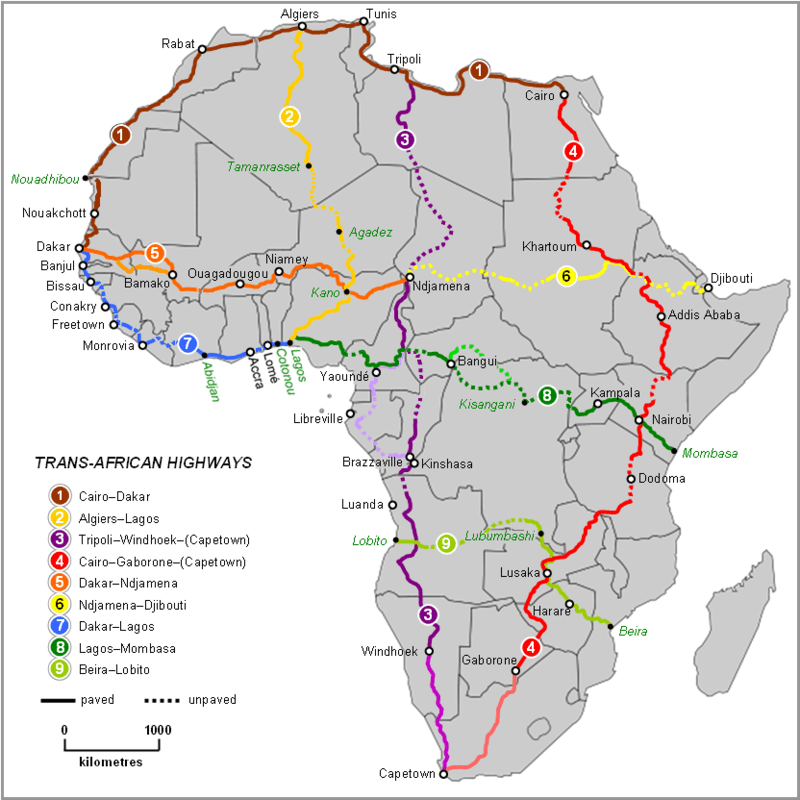
Map of Trans-African Highways © Wikipedia
The route will be the expansion of the existing Trans-African Highway 5 (TAH5). The first phase of the project will be an estimated $2.2 billion upgrade to 1,228 kilometers of existing rail between Dakar, the capital of Senegal, and Bamako, the capital of neighboring Mali.
The project has already attracted Chinese investment in African infrastructure through Beijing’s ambitious Belt and Road Initiative (BRI).
Israel and the Jihadi Connection
Israel’s complex game with Jihadi terror groups pays off as more and more African states look to Israel for protection

By Richard Galustian | The Duran | November 28, 2018
Earlier this year, with little publicity, the official position of Israel on terrorism was explained by Israeli Defense Minister Moshe Yaalon:
“I would like to see ISIS rule all of Syria (by inference, the whole region – RG); ISIS and its offshoots do not pose a threat to the Israeli State. Iran remains the main enemy!”
Ya’alon was being disingenuous, but the thinking behind his words is actually clear enough from the words themselves. Put simply, Israel’s relentless emphasis on the supposed threat from Iran is simply a diversionary tactic intended to conceal the continuing realisation of the ‘Greater Israel’ Project.
Ya’alon added:
“Iran is a rogue regime with designs on a regional hegemony. Hezbollah is Iran’s proxy, with the ability to declare war. Iran currently has terror infrastructure in place in five continents: Asia, Africa, Europe and both in South and North America.”
Ya’alon’s last comment refers to Iran as a rogue regime. However experienced Middle East observers will no doubt hesitate after reading the totality of his comments, and will wonder whether in light of them it is actually Israel and the US which should be considered the rogue regimes rather than Iran or indeed anyone else, other than obviously Israel’s and the US’s staunch ally, the odious Saudi regime.
Many similar comments of this nature have been made by senior Israeli officials, but one in particular stands out. This is a speech made at the Herzliya Conference by Israel’s military intelligence chief, Major General Herzi Halevy. He took Israel’s long-standing position that it “prefers ISIS” over the Syrian government to a whole new level, declaring openly that Israel does not want to see ISIS defeated in any war. As quoted in the Hebrew language NRG site, owned by the Maariv Newspaper conglomerate, Major Gen. Halevy actually expressed worry about the recent offensives against ISIS, expressing concern that military offensives in the last three months had placed ISIS in the “most difficult” situation it has known since its inception or at least since its declaration of a caliphate.
Needless to say most people are not aware that Major Gen. Halevy has in effect become a spokesperson for ISIS.
So what is going on?
The short answer is that the real ‘game’ in the region is being played out by and on behalf of Israeli interests. An indirect but nonetheless highly revealing clue has just been provided by the recently developing relationship between Israel and Chad. Chad, located south of Libya in the Sahara, faces a mountain of difficulties which Israel can help it deal with. These range from extreme water scarcity to Chad finding itself on the front line in Africa’s fight against Islamist terrorism, be it in the form ISIS, al-Qaeda or Boko Haram. This supplies the reason for Chadian President Idriss Déby recent visit to Israel, which has taken place 46 years after Libya’s former leader Muammar Gaddafi pressured Chad into breaking off diplomatic relations with Israel in 1972, a step which Chad took even before the big wave of African countries severing diplomatic ties with Israel took place, which happened after the 1973 Arab-Israeli Yom Kippur War.
Chad broke off diplomatic relations with Israel in 1972 because it believed that it would gain more by forging close ties with Gaddafi’s Libya than by retaining ties with Israel. Obviously since the fall of Gaddafi that calculation has changed.
However another – obviously unacknowledged – reason is almost certainly Chad’s worry that it might find itself facing the same sort of Islamist terrorism in Chad that Syria has recently experienced. After all if Israeli officials can publicly admit to Israel’s de facto support for Islamist terrorism in Syria why should it be any different in Chad?
So the bottom line is that Chad – and no doubt plenty of other countries in the region – find themselves needing Israel’s help to protect themselves from the Frankenstein’s monster of worldwide Islamist terrorism which Israeli and US policies have conjured up. It amounts to the classic protection racket, with countries like Chad looking to Israel to ‘protect’ them from the very Islamist threat Israeli and US policies are themselves creating.
Given that this is so, and given the extent to which the spread of Islamist terrorist groups across the Middle East and North Africa actually serves Israeli and US interests, there is simply no point looking to Israel and the US for a ‘solution’ to the problem caused by them. Certainly no such solution is going to be found in Palermo, site of the latest Libya peace talks. No such solution is going to be found whilst the ‘protection racket’ serves Israel’s regional interests so well. Indeed Déby’s visit to Jerusalem, as does the rush of other African countries restoring relations with Israel, shows the spectacular success of the ’protection racket’.
In view of this it should come as no surprise that all attempts to change it are furiously resisted. Thus in the US “The Stop Arming Terrorists Act” proposed in early 2017 by Representative Tulsi Gabbard and Senator Rand Paul, which sought to prohibit use of US government funds from providing assistance to terrorist groups like Al Qaeda, Jabhat Fateh al-Sham, ISIS, and the rest, and to those countries which support these organizations, predictably ran into a wall of opposition. As of November 2017 only 14 out of 435 members of the US House of Representatives were prepared to co-sponsor the bill with Gabbard, whilst in the Senate Rand Paul could find no co-sponsors at all.
Given the extremely close ties between the US and Israel, there is in fact no possibility of the bill – at least in the form proposed by Gabbard and Rand Paul – being passed.
Given the strong feelings many in the US have about Islamist terrorism – with memories of 9/11 still fresh – one might suppose that this would be an enormous scandal. However – predictably enough – neither the US media nor the global media seem at all interested in it.
UN Climate Report Recommends Taxing Carbon and Discouraging Agriculture

“Land taxes on agricultural land can also help reduce agricultural land use and deforestation”
By Eric Worrall | Watts Up With That? | November 28, 2018
The latest UN Emissions Gap Report provides psychological advice for defeating political opposition to carbon pricing, and suggests discouraging farming by taxing agricultural land.
…
6.3.3 Political and behavioural factors
Ensuring broad and stable support for carbon pricing and the phasing-out of fossil fuel subsidies requires more than addressing distributional, competitiveness and leakage impacts. A number of additional success factors can be identified (Klenert et al., 2018a) and table 6.1 provides country examples for addressing these. The challenge is particularly significant where trust in government is limited (Klenert et al., 2018a; Rafaty, 2018). And yet, where trust is strong, there is a tendency for citizens to question problems if policy solutions challenge their world views, e.g. on the State’s role in the economy (“solution aversion”) (Campbell and Kay, 2014; Cherry et al., 2017). Designing policies that are consistent with the prevailing world views of specific societal groups therefore requires extensive communication and consultation prior to implementation.
To secure popular support for carbon pricing, the public needs to be informed about its positive effect on emissions reduction targets, as well as the co-benefits of cleaner air, health and fiscal sustainability (Hsu et al., 2008; Bristow et al., 2010; Kallbekken et al., 2011; Baranzini et al., 2014; Baranzini and Carattini, 2017). Timing is also important: a gradual reform is more likely to be successful than sudden and drastic price increases. Similarly, if several fossil fuel subsidies are being reformed, this can best be done by sequencing the reforms (Beaton et al., 2013; Rentschler and Bazilian, 2017b). Language matters too, with terms such as ‘fee’ or ‘contribution’ likely to meet with popular support compared with ‘tax’ (Kallbekken et al., 2011; Drews and van den Bergh, 2016; Baranzini and Carattini, 2017).
Carbon pricing and fossil fuel subsidy reform generate public revenues, the use of which can strongly impact support for carbon pricing. This is discussed in the section 6.3.4.
6.3.4 Use revenues from carbon pricing to foster sustainable development
Raising revenue through energy tax reforms relaxes constraints on broader fiscal policy, creating opportunities to stimulate more productive and socially inclusive economic development. With respect to carbon pricing, its potential for contributing to public budget is illustrated in figure 6.2b. In developing and emerging economies, where tax revenue-to-gross domestic product (GDP) ratios rarely exceed 20 percent, an additional €60/ tCO2 carbon price on top of existing measures would generate revenues worth more than 2 percent of gross domestic product (GDP). These revenues would not be available under non-fiscal climate policies like emission standards or ETS that do not auction permits.
…
Better alignment of broad tax policy can help reduce carbon emissions. Subsidies or tax deductions related to commuting (Su and DeSalvo, 2008), company cars (Harding, 2014) and the aviation sector (Gössling et al., 2017) are common in many developed countries and tend to encourage carbon-intensive transport choices. Replacing property taxes with land value taxes can reduce urban sprawl and increase housing density, which in turn reduces the need for longer commutes (Banzhaf and Lavery, 2010).
I’m horrified at the ongoing UN and green attacks on agriculture. The abundance we take for granted is politically fragile:
Fiscal policies such as ecological fiscal transfers, contingent on environmental performance, can also play a role in the land-use sector. They could be a way to implement REDD+6 when international pay-for-performance or carbon market finance flows to the national or state government level (Loft et al., 2016). There is growing experience with ecological fiscal transfers, including transfers of tax revenues to support protected areas and forests in Portugal (Santos et al., 2012), several Brazilian states (May et al., 2011) and India (Busch and Mukherjee, 2018). Land taxes on agricultural land can also help reduce agricultural land use and deforestation (Kalkuhl and Edenhofer, 2017).
…
Full Report: http://wedocs.unep.org/bitstream/handle/20.500.11822/26895/EGR2018_FullReport_EN.pdf
Amid warming ties with Chad, Israel eyes normal ties with Sudan, other Africa states: Report
Press TV – November 26, 2018
Amid warming relations with Chad, Israel is reportedly working to normalize relations with Sudan and other African states as the regime steps up its push to strengthen its foothold in the continent.
 A senior Israeli official told Channel 10 TV channel that a visit on Sunday by Chadian President Idriss Deby to the occupied territories was laying the groundwork for normal ties between Tel Aviv and the Muslim-majority African states of Sudan, Mali and Niger.
The unnamed official also noted that Israel was seeking to shorten flight times from the occupied territories to Latin America through normalizing relations with African countries.
Deby became the first Chadian leader to visit Israel on Sunday, 46 years after the two sides severed ties.
After meeting Israeli Prime Minister Benjamin Netanyahu, the Chadian president pledged a new era of cooperation with “the prospect of reestablishing diplomatic relations.”
Israeli media cited sources in N’Djamena as saying that Deby’s visit was focused on “security,” and that the regime in Tel Aviv had already been supplying weapons and other military equipment to Chad.
Netanyahu, however, declined to comment on potential Israeli weapons sales to Chad.
During his visit, Deby said the future resumption of ties with Israel “does not make us ignore the Palestinian issue.”
The Palestinians, however, protested Deby’s trip to Israel.
Wasel Abu Youssef, a member of the Palestine Liberation Organization’s executive committee, voiced displeasure over the visit.
“All countries and institutions must boycott the extremist government of Israel and impose a siege on it because of its settlement activities, its occupation of Palestinian land,” Youssef was quoted as saying by Reuters.
Over the past two years, Netanyahu has traveled to several African states in a bid to end decades of hostility against the occupying entity and convince them to stop voting against the Israeli regime at the United Nations in favor of Palestinians.
According to Channel 10, Israeli is now in talks with Sudan in a bid to improve relations with the African state.
The Israeli push comes almost two years after Sudan joined Saudi Arabia and Bahrain in cutting relations with Iran.
At that time, Israeli daily Haaretz reported that Tel Aviv had urged the US and other countries to improve their relationship with Sudan in response.
In a 2016, Sudanese Foreign Minister Ibrahim Ghandour said Khartoum was open to the idea of normalizing ties with Israel in exchange for lifting US sanctions.
Israel is also said to be seeking to take advantage of the insurgency and Takfiri militancy gripping parts of Africa to sell advanced military equipment to conflict-ridden states in the continent.
Israel in contact with Persian Gulf Arab states
Meanwhile, reports have emerged recently of Israel’s attempts to make its secret ties with Persian Gulf Arab governments public and establish formal relations with them.
On Sunday, Israeli news sites reported that Tel Aviv is working to normalize ties with Bahrain, hours after Netanyahu hinted he would soon travel to unspecified Arab states.
Israeli Economy Minister Eli Cohen said on Monday he had been invited to attend a conference next year in Bahrain.
Netanyahu met with Oman’s Sultan Qaboos in Muscat last month, but the controversial visit was kept secret until after the Israeli premier returned to the occupied territories.
The visit to Muscat was the first by an Israeli prime minister since 1996.
On Sunday, Israel’s Hadashot television news reported that Netanyahu had secured reassurances from Oman that airlines flying to and from the occupied territories would be permitted to fly over the kingdom’s airspace.
Activists with a pro-Palestine boycott campaign against Israel said Monday that the meeting between Sultan Qaboos and Netanyahu may have breached a long-dormant Israeli boycott law.
“Since 1977, official records stopped mentioning the Law of Boycotting Israel, neither denying it nor confirming it,” an Omani activist with the Boycott, Divestment and Sanctions (BDS) movement told the Middle East Eye news portal.
“This happened when the country took a neutral policy in foreign affairs, including accepting normalizing ties with the Zionist entity,” the activist added.
Another activist said several prominent activists had been arrested shortly before the Israeli prime minister’s visit to Muscat for pro-Palestinian posts on social media, adding, however, that they were freed after disassociating themselves from BDS Oman.
“There is no clear legal path of how to implement the law. But even discussing this topic is a risky business, because there is no political free speech,” he said.
The activist also noted that BDS Oman had sent its “sincerest apologies” to the Palestinian people after a visit by “criminal” Netanyahu.
French bank pays huge US fine for doing business in Cuba, Iran
RT | November 20, 2018
Societe Generale has agreed to pay $1.34 billion to US federal and state authorities to settle a pending legal dispute over violations of US trade sanctions against Iran and other countries.
One of France’s largest banks has also pledged to pay $95 million to resolve another dispute over violations of anti-money laundering regulations.
“We acknowledge and regret the shortcomings that were identified in these settlements, and have cooperated with the US authorities to resolve these matters,” the group CEO Frederic Oudea said in a statement.
“These resolutions, following on the heels of the resolution of other investigations earlier this year, allow the bank to close a chapter on our most important historical disputes.”
The bank, informally known as SocGen, reportedly violated the Trading with the Enemy Act by illegally transferring billions of dollars to partners registered or located in countries targeted by US embargos, including Iran, Sudan, Cuba and Libya.
The banking giant said the settlement wouldn’t have an extra impact on its results for the current financial year. SocGen had previously agreed to $1.3 billion (€1.14 billion) in the US and France to settle investigations over transactions with Libya, and over the suspected rigging of Libor, a benchmark rate tied to finance products and debts. Last year, the bank had paid €963 million ($1.1 billion) over another dispute with the Libyan Investment Authority.
According to the Manhattan US Attorney’s office, the latest fine imposed on SocGen is the second biggest financial penalty issued on a bank for breaching US sanctions. In 2015, French international banking group BNP Paribas agreed to pay $8.9 billion to settle a probe on sanctions violations.
Moscow Doesn’t Plan to Create Stronghold in Libya – Russian Embassy in UK
Sputnik – October 9, 2018
LONDON – The Russian Embassy in London on Tuesday refuted reports claiming that Moscow was allegedly plotting to get control over European immigration routes in Libya and establish a stronghold against the West.
“This publication has nothing to do with reality. We are treating it as a new attempt to shift the responsibility for the ruined country and destroyed lives of millions of Libyans on Russia which had no relation to the 2011 NATO military intervention which grossly violated the whole range of UN Security Council resolutions,” a representative of the embassy told reporters.
The embassy added that Russia supported peacemaking efforts in Libya and never planned any military intervention.
“We fully respect the UN Security Council Resolution 1970 which imposed an arms embargo on Libya,” the mission representative said.
On Monday, The Sun reported that the UK intelligence had warned UK Prime Minister Theresa May of Moscow’s alleged plans to send weapons and troops to Libya to turn it into “new Syria” and take control of migration routes to Europe thus increasing Moscow’s influence on the West.
Russia calls for the parties to the Libyan conflict to engage in a constructive dialogue on political settlement as the only way to end the crisis, the embassy concluded.
Libya has been in turmoil since the overthrow of its long-time leader Muammar Gaddafi in 2011. The country is divided between two governments, with the eastern part controlled by the Libyan National Army and the western part governed by the UN-backed Government of National Accord of Prime Minister Fayez Sarraj.
Libya is also the major gate for migrants from all of the North Africa attempting to cross the Mediterranean and settle in Europe.
UAE recruiting Africans for Saudi-led war: Report
Press TV – October 3, 2018
The United Arab Emirates (UAE), Saudi Arabia’s key partner in the ongoing Riyadh-led invasion of Yemen, has reportedly been recruiting tribesmen from northern and central parts of Africa to fight in the war.
The campaign features Emirati envoys “seducing” the tribesmen across a vast area spanning southern Libya as well as entire Chad and Niger, who earn a living by herding as well as human and material smuggling, the Middle East Monitor (MEMO) press monitoring organization reported on Wednesday.
“This campaign is supervised by Emirati officials who gained material profits in collaboration with human traffickers,” the report added.
An awareness campaign has been launched by Chadian activists, led by campaigner Mohamed Zain Ibrahim, to warn the tribesmen against joining the Saudi-led war.
“The Arabs of the [Persian] Gulf region, especially the UAE and Saudi Arabia, have never bothered to get to know the Arabs of the desert, and today they are asking for their support and seducing them to fight by their side in Yemen!” MEMO cited Ibrahim as telling pan-Arab Arabi21 electronic newspaper.
The envoys offer potential mercenaries such incentives as sums ranging from $900 to $3,000, in addition to acquiring UAE citizenship in return for their applying for jobs in Emirati security companies.
Ibrahim said the job opportunities were “an actual military recruitment campaign to gather mercenaries for the Yemeni war and use them to fight the people of Yemen, who are Arabs and Muslims as well, and all that for a bunch of dollars.”
“A delegation of Emirati people in business visited Niger in January 2018, where they met Arab tribal leaders and recruited 10,000 tribesmen living between Libya, Chad, and Niger,” MEMO said.
The Emirates has been contributing heavily to the 2015-present war, which seeks to reinstall Yemen’s former Saudi-allied officials.
In addition to their own forces, both Riyadh and Abu Dhabi have deployed thousands of militants across the violence-scarred country to intensify the invasion.
The Emirati side began beefing up its contribution in June, when the coalition launched a much-criticized offensive against al-Hudaydah, Yemen’s key port city, which receives the bulk of its imports.
A Wake-Up Call to the Canadian Left
By Michael Welton | CounterPunch | September 26, 2018
Yves Engler is Canada’s foremost feisty contrarian. Contrarians oppose what most people think about people and events. They don’t like to bask in the sunlight. They would rather look in the shadows or dimly lit back alleys. If they walk on a summer beach, they pay little attention to the sun glinting off the shells. They want to see what lies under the rocks.
Alas! There aren’t many contrarians left. We live in the age of the vanquished reporter and group think. The mass media (BBC, CNN, CBC) toe the prevalent hegemonic political line. They ask no questions. They speak confidently on the latest demonic act of Russia or Syria or Iran. Israel always gets off the hook, no matter how many Gazans are gunned down. The US-Saudi Arabia can massacre hundreds of thousands of Yemenis. Not on the news tonight! And won’t be on next week, either. All “unapproved evidence is brushed aside or disparaged regardless of its quality” (Robert Parry).
 Engler’s new book, Left, Right: Marching to the Beat of Imperial Canada’s Foreign Policy (Black Rose Publishers, 2018) follows in the train of previous muckraking and debunking books. Basically, Engler thinks the Canadian intelligentsia sees foreign policy through a glass darkly. They think that Canada is basically a benevolent nation. We (I am a Canadian) think we are not like our neighbour to the south. They are the land of conquest.
They are the democratic sheep in wolves clothing. They are the ones who bring “democracy and freedom” to nations on their gunboats. No, Canadians are a nation of peacekeepers and nice folks. Our myth-making agencies (Engler includes the Department of National Defense and Veteran Affairs as well the mass media) celebrate our heroic engagement in various wars and benevolent corporate and banking actions in the Caribbean and South America.
Engler believes adamantly that the left has “played a part in justifying Canada’s role within an unfair and unsustainable world economic system.” He focuses our attention on the Co-operative Commonwealth Federation Party (CCF) and the New Democratic Party (NDP) because this social democratic party has a voice in parliament. They can speak out on foreign policy. He also examines labour union spokespersons and well-known left commentators’ views on foreign policy issues. But Engler points out that the early CCF, fired with a vision of justice for Canada, was silent on the Canadian banks substantial influence over Caribbean finance. Even the lauded Regina Manifesto (1933) ignored Canadian complicity in European colonialism and was weak on Italy’s invasion of Ethiopia in 1936. Although in the years between 1933 and 1943, the CCF opposed imperialism and nationalism associated with Zionism. However, since then, the party has “often backed the dispossession of Palestinians.” Engler provides many more dispiriting examples.
He discovers that the left promotes imperial policies and recycles nationalist myths. In the post-WW II era, the CCF backed NATO and supported the Korean War. More recently, the NDP “endorsed bombing Syria and Libya.” Labour unions supported the Marshall Plan, NATO, Korean War, the assassination of Patrice Lumumba and the Bay of Pigs invasion. They were swept up in the anti-communist mania of the lamentable Cold War. On the economic front, Engler observes that Quebec sovereignists are progressive at home and, in the case of Haiti (Engler’s favourite example of Canadian political malfeasance), supported the overthrow of Jean-Baptiste Aristide in 2004.
Engler argues that liberal and left intellectuals are pressured to be patriotic. They mostly ignore international affairs. Social democracy has great difficulty criticizing their own government’s imperialism. We don’t realize, it seems, that Canada is not a mere caboose hinged to the imperialist train. We actively participate in imperial projects. We choose to send troops to the Ukraine, even though the US engineered the coup overthrowing Viktor Yanukovych and Ukrainian armies display fascist insignia at will. We heartily support the movement of NATO troops close to the Russian border. We seem averse to realizing how our present Canadian foreign policy does not foster world peace and unity at this moment of civilizational crisis.
PM Harper sent troops to fight for western hegemony in Afghanistan. We chirp along with the choir accusing Russia and Iran of just about everything nasty. It’s all their fault. We are stupefied on the drug of propaganda. Engler states: “But instead of criticizing the geo-strategic and corporate interests driving foreign policy, the NDP/CCF has often supported them and contributed to Canadians’ confusion about their country’s international relations.” Dissident CCF or NDP voices are usually repressed or preventing from running for office.
Engler’s text is packed with facts and details. That’s his style. A short review must entice the reader to dig into the text. But let me guide readers’ attention to several courageous investigations and commentaries that raised my eyebrows. It takes guts to demythologize Canada’s popular critics and causes. Many of Canada’s intellectuals are associated with think tanks. Engler argues that the influential Rideau Institute of International Affairs “spurns demilitarization and anti-imperialist voices.” He thinks that Peggy Mason, president of the Institute since 2014, has significant experience in Canadian foreign policy circles. But it is unlikely she will “forthrightly challenge the foreign policy status quo or the corporate interests that back it.”
Engler cuts to the quick regarding cheerleading Canada’s role as peacekeepers. He thinks this is mainly a way to “align with Canadian mythology and evade confronting military power.” For Engler, Canada’s peacekeeping in Egypt in 1956 and Cyprus in 1964 were aimed at reducing tensions within NATO. In the Congo and Korea, Engler states that “Ottawa contributed to US imperialist crimes.” These are harsh accusations that bump into our sense of being benevolent actors. Engler offers this nugget insight: the left nationalist mythologies separate us from US imperialism while obscuring our compliant service to western hegemony. Engler thinks that Linda McQuaig’s idealization of Lester Pearson is shameful.
Engler takes on Canada’s folk hero and distinguished public figure, Stephen Lewis. From 2001-2006, Lewis was the UN Special Envoy for HIV/AIDS in Africa. In his celebrated Massey lectures, Race Against Time (2005), Lewis “failed to critique any Canadian policy measure in Africa except for Ottawa’s insufficient aid.” In fact, Engler points out that Canada’s early assistance to Africa trained militaries to prevent the pursuit of “wholly independent paths.” Ottawa backed the overthrow of Nkrumah in 1966. Engler moves inside the murky and confused world of the Rwanda massacres in the mid-1990s. There are different narratives framing the meaning of these massacres.
Romeo Dallaire’s narrative is but one, now tattered, story. The gutsy Engler informs us that Dallaire justified the NATO invasion of Libya, and called for interventions in Darfur, Iran and Syria. Some scholars now shift the spotlight on the malevolent role of Paul Kagame, the leader of the Rwanda Patriotic Front, both in the Rwanda killings and invasion into the east Congo. Basically, Engler thinks that Lewis praises Kagame, an authoritarian dictator who brooks no opposition, far too much.
In his book, Lewis criticizes China for backing Khartoum but remains silent on Kagame’s invasion of the Congo. And Lewis has also been silent on “official Ottawa’s multi-faceted support for European colonial rule or Canada’s role in overthrowing progressive leaders Patrice Lumumba, Milton Obote and Kwame Nkrumah.” It seems, Engler suggests, that media coverage of Africa in the Canadian media (2003-2012) is still infected with a “moralizing gaze” and “white man’s burden” imagery.
It is not surprising that Engler wonders why the left “accept or promote policies that do harm to ordinary people across the planet.” In fact, one of Engler’s maxims for foreign policy is that we do no harm to others and act to sustain our common homeland, the earth. If many liberal or left critics raise tough questions on domestic issues, why do they see foreign policy through the glass darkly? Engler even shocks us by demonstrating that many indigenous people, victims of Canadian colonialism, joined in the wars of Empire.
For one thing, Engler argues insistently that the left has accommodated itself to a Canadian form of nationalism. Enveloped in the myth of benevolent peacekeepers and crusaders for world peace, we create dubious icons like Lester Pearson and Romeo Dallaire. Left-leaning Canadian nationalists—such as those who supported the Waffle movement within the NDP in the late 1960s and 1970s—embraced the idea that Canada was a colony of the US. In fact, say the Waffle intellectuals, we began as a British colony, became a nation and returned to colony status through subservience to the US Empire. Did we really?
But the deterministic “staples theory”, made famous by legendary Canadian economic historian Harold Innes, renders us passive as a sovereign nation. This theory obscures our foreign policy choices about the kind of world we as Canadians desire and our corporate commitments to exploit other nation’s financial and natural and human resources. We black-out the nasty stuff in the Caribbean, Africa, Guatemala and elsewhere. We can’t (or won’t see it) because we, too, are “exceptional.”
And, as Engler reminds us, think again about Canada as the poor hewers of wood and drawers of water. Toronto ranks seventh in the world as a financial centre. Boldly, he states: “Canadian companies are global players in various fields:” Garda World is the world’s largest privately held security companies (with 50,000 employees). SNC Lavalier is one of the world’s largest engineering companies. Bombadier and CAE are the world’s largest aerospace and flight stimulators.
And the “starkest example” of Canadian corporate power is the mining sector where ½ of the world’s mining companies are based in Canada. If one is weeping over Canadian subservience—poor us! –to US corporate power, “left nationalists generally ignore Canadian power and abuse abroad.” Engler has written about our not too exceptionally just mining companies in other books. Banging the drum, he says, “Wake up Canadian left intellectuals!”
Dr. Michael Welton is a professor at the University of Athabasca. He is the author of Designing the Just Learning Society: a Critical Inquiry.
US Military Presence in Africa: All Over Continent and Still Expanding
By Arkady SAVITSKY | Strategic Culture Foundation | 30.08.2018
Around 200,000 US troops are stationed in 177 countries throughout the world. Those forces utilize several hundred military installations. Africa is no exemption. On August 2, Maj. Gen. Roger L. Cloutier took command of US Army Africa, promising to “hit the ground running.”
The US is not waging any wars in Africa but it has a significant presence on the continent. Navy SEALs, Green Berets, and other special ops are currently conducting nearly 100 missions across 20 African countries at any given time, waging secret, limited-scale operations. According to the magazine Vice, US troops are now conducting 3,500 exercises and military engagements throughout Africa per year, an average of 10 per day — an astounding 1,900% increase since the command rolled out 10 years ago. Many activities described as “advise and assist” are actually indistinguishable from combat by any basic definition.
There are currently roughly 7,500 US military personnel, including 1,000 contractors, deployed in Africa. For comparison, that figure was only 6,000 just a year ago. The troops are strung throughout the continent spread across 53 countries. There are 54 countries on the “Dark Continent.” More than 4,000 service members have converged on East Africa. The US troop count in Somalia doubled last year.
When AFRICOM was created there were no plans to establish bases or put boots on the ground. Today, a network of small staging bases or stations have cropped up. According to investigative journalist Nick Turse, “US military bases (including forward operating sites, cooperative security locations, and contingency locations) in Africa number around fifty, at least.” US troops in harm’s way in Algeria, Burundi, Chad, Congo, Djibouti, Egypt, Eritrea, Ethiopia, Kenya, Libya, Somalia, Sudan, South Sudan Tunisia, and Uganda qualify for extra pay.
The US African Command (AFRICOM) runs drone surveillance programs, cross-border raids, and intelligence. AFRICOM has claimed responsibility for development, public health, professional and security training, and other humanitarian tasks. Officials from the Departments of State, Homeland Security, Agriculture, Energy, Commerce, and Justice, among other agencies, are involved in AFRICOM activities. Military attachés outnumber diplomats at many embassies across Africa.
Last October, four US soldiers lost their lives in Niger. The vast majority of Americans probably had no idea that the US even had troops participating in combat missions in Africa before the incident took place. One serviceman was reported dead in Somalia in June. The Defense Department is mulling plans to “right-size” special operations missions in Africa and reassign troops to other regions, aligning the efforts with the security priorities defined by the 2018 National Defense Strategy. That document prioritizes great power competition over defeating terrorist groups in remote corners of the globe. Roughly 1,200 special ops troops on missions in Africa are looking at a drawdown. But it has nothing to do with leaving or significantly cutting back. And the right to unilaterally return will be reserved. The infrastructure is being expanded enough to make it capable of accommodating substantial reinforcements. The construction work is in progress. The bases will remain operational and their numbers keep on rising.
A large drone base in Agadez, the largest city in central Niger, is reported to be under construction. The facility will host armed MQ-9 Reaper drones which will finally take flight in 2019. The MQ-9 Reaper has a range of 1,150 miles, allowing it to provide strike support and intelligence-gathering capabilities across West and North Africa from this new base outside of Agadez. It can carry GBU-12 Paveway II bombs. The aircraft features synthetic aperture radar for integrating GBU-38 Joint Direct Attack Munitions. The armament suite can include four Hellfire air-to-ground anti-armor and anti-personnel missiles. There are an estimated 800 US troops on the ground in Niger, along with one drone base and the base in Agadez that is being built. The Hill called it “the largest US Air Force-led construction project of all time.”
According to Business Insider, “The US military presence here is the second largest in Africa behind the sole permanent US base on the continent, in the tiny Horn of Africa nation of Djibouti.” Four thousand American servicemen are stationed at Camp Lemonnier (the US base located near Djibouti City) — a critical strategic base for the American military because of its port and its proximity to the Middle East.
Officially, the camp is the only US base on the continent or, as AFRICOM calls it, “a forward operating site,” — the others are “cooperative security locations” or “non-enduring contingency locations.” Camp Lemonnier is the hub of a network of American drone bases in Africa that are used for aerial attacks against insurgents in Yemen, Nigeria, and Somalia, as well as for exercising control over the Bab-el-Mandeb Strait. In 2014, the US signed a new 20-year lease on the base with the Djiboutian government, and committed over $1.4 billion to modernize and expand the facility in the years to come.
In March, the US and Ghana signed a military agreement outlining the conditions of the US military presence in that nation, including its construction activities. The news was met with protests inside the country.
It should be noted that the drone attacks that are regularly launched in Africa are in violation of US law. The Authorization for Use of Military Force (AUMF), adopted after Sept. 11, 2001, states that the president is authorized to use force against the planners of those attacks and those who harbor them. But that act does not apply to the rebel groups operating in Africa.
It’s hard to believe that the US presence will be really diminished, and there is no way to know, as too many aspects of it are shrouded in secrecy with nothing but “leaks” emerging from time to time. It should be noted that the documents obtained by TomDispatch under the United States Freedom of Information Act contradict AFRICOM’s official statements about the scale of US military bases around the world, including 36 AFRICOM bases in 24 African countries that have not been previously disclosed in official reports.
The US foothold in Africa is strong. It’s almost ubiquitous. Some large sites under construction will provide the US with the ability to host large aircraft and accommodate substantial forces and their hardware. This all prompts the still-unanswered question — “Where does the US have troops in Africa, and why?” One thing is certain — while waging an intensive drone war, the US is building a vast military infrastructure for a large-scale ground war on the continent.
Featured Video
Bombing Hitler’s Hometown
or go to
Aletho News Archives – Video-Images
From the Archives
The Biggest Threat to Peace in Middle East
By Dr. Elias Akleh* | Sabbah Report | May 24, 2010
A build up of heightened tension in the Middle East is escalating in the last few weeks. American and Israeli postures towards Lebanon, Syria, and Iran have become more threatening. Listening to speeches of political leaders one hears talks only about war not peace. Iranians and Israelis are continuously training hard for a possible showdown. Both sides are conducting extensive war games every month. This led Syrians to claim that Israel is preparing for a soon-to-come another war. The Jordanians also are warning that current stalemate of the peace process is an indication of a war breaking out this summer. The Russian President and his army chief hinted, a few months ago, that the US and Israel were planning for an attack on Iran.
Indeed Iran is, as it has been for last few years, the target of most of the threats and accusations of supporting terrorism. Escalating incitement against Iran the American Defense Department sent last month (April) to Congress a report on Iran’s military claiming Iran could develop intercontinental ballistic missiles capable of reaching the US by 2015.
Ignoring the fact that N. Korea, India, Pakistan, and Israel are proven to have nuclear weapons while Iran does not, the US Secretary of State Hillary Clinton chose in her speech, to the nuclear Non-Proliferation Treaty review conference at the UN, to focus on Iran’s alleged nuclear ambitions putting the whole world at risk as she put it. According to Clinton Iran’s acquisition of nuclear weapons, rather than Israel’s more than 200 nuclear bombs, is destabilizing the Middle East. She called on the world’s nations to rally around US efforts to hold Iran, not other nuclear countries, to account.
The accusation that Usama Bin Laden is living comfortably in Iran had received a boost after the broadcast of a documentary called “Feathered Cocaine”. This echoed the June 2003 claims of the Italian newspaper Corre de la Sierra that Bin Laden was in Iran according to some intelligence report, and according to Richard Miniter’s book “Shadow War”. … continue
Blog Roll
 Aletho News
- Bombing Hitler’s Hometown
- German journalist threatened with homelessness as German court upholds EU sanctions in landmark free speech case
- US Tells Allies That Ukraine-Bound Arms Could be Sent to Middle East
- Organized terrorism: Iran condemns killing of its diplomats in Lebanon
- Why could Gaza enter the regional war?
- Hamas official rejects Mladenov Plan linking disarmament to Gaza reconstruction
- Two Primary Elections for the Soul of ‘America First’
- Japan Clings to US Vassalage Despite Energy Crunch Caused By Iran War
- US Seeks Control Over Global Energy Infrastructure – Kremlin
- US senators target Orban government for standing up to Zelensky
- If Americans Knew
- An error has occurred; the feed is probably down. Try again later.
- No Tricks Zone
- Devastating Assessment Of Comirnaty Vaccine By Former Senior Pfizer Europe Toxicologist
- New Study: CO2 Is ‘Effectively Negligible’ As An Explanatory Climate Change Factor Since 2000
- Former Pfizer Toxicologist Dr. Helmut Sterz Tells Bundestag Hearing Pfizer Vaccine Should Have Never Been Approved
- Energy Expert: Germany’s Nuclear Phaseout Was A “500 Billion Euro Mistake”
- New Research: South Australia’s Mid-Holocene Sea Surface Temperatures Were 4°C Warmer Than Today
- Storing Green Energy To Last Germany 10 Days Would Require A 60-Million Tonne Battery
- New Studies: UK Sea Levels Were 4 Meters Higher Than Today During The Mid-Holocene
- Destructive Green New Deal: German Energy And Metal Group Warns Of Drastic Crisis
- New Study Documents A 20-Year Pause In Arctic Sea Ice Decline – Driven By Internal Variability
- Wake-up Call: Survey Shows Majority Of Germans Now Favor Postponing Climate Targets!
 Aletho News