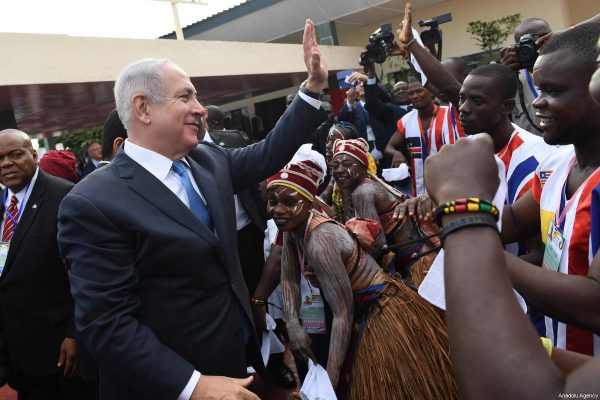
Israeli Prime Minister Benjamin Netanyahu greets people during his arrival at James Spriggs Payne Airport in Monrovia, Liberia on 4 June 2017 [Prime Ministry of Israel/Anadolu Agency]
By Helmi Al-Asmar | Al-Araby Al-Jadeed* | August 10, 2017
With the exception of the popular efforts made by the Conference for Palestinians Abroad to hinder the rabid Israeli efforts to hold a major conference next October entitled the Israeli-African Summit in Togo, we have barely seen any official or popular Arab efforts in this direction. This is despite the great danger posed by convening such a summit, which Israel has been laying the foundations for for several years, in light of the almost complete absence of the Arabs, which is an unprecedented development in Israel’s tireless efforts to bypass the wide wall of isolation and moral rejection it faces in Africa. It aims to present itself as a trusted partner for the continent’s nations.
The Conference for Palestinians Abroad viewed this summit, rightly so, as an insult to the struggles of the African nations and a disregard for their generations’ fair fight for liberation from colonisation and racism. It is also an attempt on the occupation government’s part to portray itself as a trusted partner for the African countries in order to fabricate its reality. It is not coming to Africa in order to spread love and unity, but instead aims to make Africa a market for the lethal products it produces and a place to export its mercenaries to help the dictators of the continent.
This is despite the fact that the African nations’ true interests and their efforts towards sustainable development, prosperity and growth do not align with the colonial racist occupation government in Palestine, given its record of hostility and terrorism. This is documented by several international and independent reports, including the ESCWA report regarding the escalations of the Israeli apartheid policies issued this year.
In addition to this, Israel, which commits war crimes, mass killings, flagrant violations and intimidation methods, as well as confiscates the Palestinian people’s land and resources and sponsors illegal extremist settler gangs, does not have the right to be a partner to developing nations seeking advancement, prosperity and the combat of terrorism.
The efforts of the Conference for Palestinians Abroad are focused on mobilising governments, official and popular institutions, parties, civil society organisations, public figures, community leaders and the media across Africa and the entire world, in order to rally the efforts against the Israeli government’s actions. These actions are an attempt on Israel’s part to promote itself in the continent in a misleading manner, ignoring the principles of justice, the peoples’ rights and international laws and conventions. The conference summoned its efforts and began taking action, contacting concerned parties, especially the influential forces in the African nations in order to confront Israel’s attempts of exploitation and deception.
These are commendable efforts but of course they are not enough to stop this hateful and racist emergence in Africa. Putting an end to the conference is the duty of all African countries, organisations, committees, and people specifically, and generally the duty of the Arab and Muslim countries. This is because Israel’s presence in the continent will not be in the best interest of the African people, but rather in Israel’s interest as it exports death, mercenaries and tyranny to all the countries of the world. It also supports the totalitarian regimes that commit the ugliest forms of aggression, looting and pillage. Therefore, resisting this conference and sabotaging it by all means available is the duty of all nations on Earth.
It is worth mentioning in this regard that the only Arab action against the convention of this summit was by the President of the Palestinian Authority, Mahmoud Abbas, during his visit to Khartoum in July 2016. In his meeting with Sudanese President Omar Al-Bashir, Abbas raised the issue of developing the Arab strategy in the African continent and cooperating in order to stop Israel’s attempts to achieve a breakthrough in Africa.
We do not expect Sudan or the PA to do anything now, as it is too late and their political/diplomatic capabilities are limited. Moreover, their problems and misfortunes are too many to count, according to the former Egyptian Ambassador to Angola, Sao Tome and Niger, Belal Al-Masry, who, in an important article published on the Democratic Arab Centre website, listed five reasons why the Israeli summit in Africa is dangerous. These points should be considered and reflected upon, the most important of which is the fact that the conference’s purpose is to restore and develop the African voting bloc in order to use it to support Israel’s international status.
Israel views the countries of the African continent as a voting bloc consisting of at least 50 votes. This was confirmed by the Israeli Prime Minister Benjamin Netanyahu to seven African leaders with whom he met in Rwanda in July 2016. He also reiterated this in his speech to the Economic Community of West African States (ECOWAS) Summit in Monrovia in June 2017. Hence, his statement regarding Israel having a bright future in the UN during his speech before the UN General Assembly at its regular session in September 2016, wasn’t too far from the truth. He also stated that his main diplomatic goal was to stop the African states from automatically voting against Israel at the UN and that the day he would achieve this isn’t too far. Therefore, holding the Israeli summit in Africa will mark the end of the Egyptian and Arab role, in general, in Africa and Israel will join the international forces competing for influence in the African continent. These countries include China, the United States, France, India, Russia, Iran and recently, Turkey.
It is not an overstatement to say that the Israeli conference in Togo will pave the way for Israel to reoccupy Africa, or at least a large part of it, politically, economically and militarily. This will further strengthen Israel’s international and regional standing and increase the suffering of the Palestinian people, who are paying the price for the fragmentation of the Arab system and their preoccupation with resisting the effects of the Arab Spring revolutions.
Africa has become a staging ground where foreign countries can show off their military capabilities against one another away from their country of origin at the expense of Africans, says African affairs expert Ayo Johnson.
Turkey is gearing to open its largest overseas military base in Somalia.
The United Arab Emirates are building a military base at the port of Berbera, in the self-declared Republic of Somaliland.
Africa is an attraction to foreign militaries: China opened its first overseas military base on August,1 in Djibouti on the Horn of Africa. Djibouti is also currently housing Americans, Japanese and French troops.
RT discussed why Africa has become so popular with the foreign military with Africa affairs expert Ayo Johnson who believes the world powers are turning the continent into the latest theater of military confrontation.
“Back in colonial days, we saw Africa being cut up and carved up by the Western nations. Now we are seeing Africa again being the center ground for the new verge of a proxy war because all these different countries which are founding military bases on the African continent. It is a huge worry,” Ayo Johnson told RT.
In Johnson’s opinion, “it is showing that Africans can’t protect themselves and it is also showing that Africans can’t control their own affairs and ultimately it is finders keepers.”
“We have China who already has a military base of its own, the excuse is that it ultimately wants to protect its own investment which we know it has on the African continent. Also, it says it wants to prevent piracy and to be able to launch against such events,” Johnson said.
“The Americans have similar bases, not to mention the Europeans. So, on the ground itself, ultimately the African continent is becoming the staging ground for the next possibly violent confrontation between the superpowers of the world in their so-called proxy battles,” he continued.
According to Johnson, such interest in the continent might be explained by its strategic location.
“The Horn of Africa is the gateway for many shipping lanes, the protection of that area because of long term standing piracy issues. But others would say it is about land grab, control; it is about influence.”
“The Americans, the British and other Europeans, not to mention the Chinese most recently, all seem to have a huge stake and might show their muscles and their military capabilities against one another. Africa has now become a staging ground from which they can exploit those opportunities away from their own individual countries, a place where they can prowess their military might at the expense of Africans,” Johnson noted.
Despite the increased foreign military presence, the problem of piracy in the region remains unsettled.
“One thing for sure is that piracy still exists and it will continue and is unlikely to stop or to be slowed down.”
“Again in terms of terrorism, Al-Qaeda and ISIS still have strongholds and control, influence in that part of the world and the military bases that are physically positioned there. If they are there to prevent such attacks, I think in the short term or more long term it could create antagonism, create a problem for locals who may want to join those organizations to attack the military powers that are there. So the protection of Africa becomes the reverse, becomes an area where everyone wants to show each other what they are capable of doing and that is the worry, be it terrorist or be it an American, European or even most recently the Turks are also considering having bases there,” he told RT.
Johnson claimed “that comes at the expense of every single African nation – ultimately the biggest losers will be every single individual on the African continent.”
Kenya has decided it doesn’t need western assistance to ensure it has “free and fair” elections.
The African country is holding a national vote for president, deputy president, and parliament on 8 August.
But the election will have to go forward without the help of two foreign advisors.
John Phillips, a US citizen and chief executive of political consultancy Aristotle, and Canadian citizen Andreas Katsouris, a senior executive at the same firm, were arrested on Friday and deported from Kenya on Saturday, according toReuters.
The two men were providing political consulting services to opposition presidential candidate Raila Odinga and his National Super Alliance party. Polls show Odinga and incumbent president Uhuru Kenyatta neck-in-neck in the race for the Kenya State House.
Kenya’s last two presidential elections were marred by violence and charges from the losing side of vote rigging. Unrest following the 2007 vote left hundreds dead.
Here’s more from the Reutersreport regarding the arrests of Phillips and Katsouris:
“They handcuffed me and put me in the hatchback of a car,” Phillips said by phone from Frankfurt.
Katsouris said they were manhandled after the police arrived.
“One man had a picture of me on his mobile phone,” he said, speaking by phone from Delft, the Netherlands. “Another guy grabbed me by the arm and grabbed my glasses from my face.”
After being bundled into separate cars they were driven around for several hours, while being questioned, and then taken to holding cells at the airport, they said…
Phillips said one of Aristotle’s jobs was to monitor the transparency of the election. The two had been in Kenya for around two months and were doing polling, data analysis and monitoring the election process…
Interior ministry spokesman Mwenda Njoka said via a text message on Sunday that Phillips and Katsouris had “contradicted the terms of their visa”. When asked how, he replied “ask them”.
Whatever Kenya’s political problems, it appears Nairobi doesn’t believe US-Canadian meddling in their elections is the way to solve them.
Goldman Sachs, the merchant bank, calls cobalt ‘the new gasoline’ but there are no signs of new wealth in the DRC, where the children haul the rocks brought up from tunnels dug by hand.
Adult miners dig up to 600ft below the surface using basic tools, without protective clothing or modern machinery. Sometimes the children are sent down into the narrow makeshift chambers where there is constant danger of collapse.
Cobalt is such a health hazard that it has a respiratory disease named after it – cobalt lung, a form of pneumonia which causes coughing and leads to permanent incapacity and even death.
Even simply eating vegetables grown in local soil can cause vomiting and diarrhoea, thyroid damage and fatal lung diseases, while birds and fish cannot survive in the area.
No one knows quite how many children have died mining cobalt in the Katanga region in the south-east of the country. The UN estimates 80 a year, but many more deaths go unregistered, with the bodies buried in the rubble of collapsed tunnels. Others survive but with chronic diseases which destroy their young lives. Girls as young as ten in the mines are subjected to sexual attacks and many become pregnant.
Dorsen, just eight, is one of 40,000 children working daily in the mines of the Democratic Republic of Congo (DRC). The terrible price they will pay for our clean air is ruined health and a likely early death.
Almost every big motor manufacturer striving to produce millions of electric vehicles buys its cobalt from the impoverished central African state. It is the world’s biggest producer, with 60 per cent of the planet’s reserves.
The cobalt is mined by unregulated labour and transported to Asia where battery manufacturers use it to make their products lighter, longer-lasting and rechargeable.
The planned switch to clean energy vehicles has led to an extraordinary surge in demand. While a smartphone battery uses no more than 10 grams of refined cobalt, an electric car needs 15kg (33lb).
Residents near mines in southern DRC had urinary concentrates of cobalt 43 higher than normal. Lead levels were five times higher, cadmium and uranium four times higher.
The worldwide rush to bring millions of electric vehicles on to our roads has handed a big advantage to those giant car-makers which saw this bonanza coming and invested in developing battery-powered vehicles, among them General Motors, Renault-Nissan, Tesla, BMW and Fiat-Chrysler.
Will the Canadian government continue to support Barrick Gold’s exploitation of mineral resources in Tanzania no matter what abuses the company commits?
Would the Trudeau government stop backing the Toronto-based firm if it bilked the impoverished nation out of $10 billion? Or, what if one thousand people were raped and seriously injured by Barrick security? Would Ottawa withdraw its support if one hundred Tanzanians were killed at its mines?
Barrick’s African subsidiary, Acacia Mining, is embroiled in a major political conflict in the east African nation. With growing evidence of its failure to pay royalties and tax, Acacia has been condemned by the president, had its exports restricted and slapped with a massive tax bill.
In May a government panel concluded that Acacia significantly under-reported the percentage of gold and copper in mineral sand concentrates it exported. The next month a government commission concluded that foreign mining firms’ failure to declare revenues had cost Tanzania $100 billion. According to the research, from 1998 to March 2017 the Tanzanian government lost between 68.6 trillion and 108.5 trillion shillings in revenue from mineral concentrates.
The controversy over Barrick’s exports led President John Magufuli to fire the minister of mining and the board of the Minerals Audit Agency. Tanzania’s parliament has also voted to review mining contracts and to block companies from pursuing the country in international trade tribunals.
While the political battle over royalty payments grows, human rights violations continue unabated at Barrick’s North Mara mine. A recent MiningWatch fact-finding mission discovered that “new cases have come to light of serious un-remedied harm related to encounters between victims and mine security and police who guard the mine under a Memorandum of Understanding (MOU) between the companies involved and the Tanzanian Police Force. New cases documented in June 2017 include: loss of limbs, loss of eyesight, broken bones, internal injuries, children hit by flying blast rocks, and by teargas grenades thrown by mine security as they chase so-called intruders into the nearby villages. As in past years, villagers reported severe debilitating beatings, commonly with gun butts and wooden batons. Some are seriously wounded by teargas ‘bombs,’ or by so-called rubber bullets. Others are shot, including from behind. As in past years there were a number of deaths.”
At least 22 people have been killed and 69 injured near or at the North Mara mine since 2014. Most of the victims were impoverished villagers who scratch rocks for tiny bits of gold and who often mined these territories prior to Barrick’s arrival. An early 2016 government report found security and police paid by Barrick had killed 65 people and injured 270 at North Mara since 2006. Tanzanian human rights groups estimate as many 300 mine-related deaths and the Financial Timesreports that not a single police officer or security guard working for the company has been killed on duty.
Amidst the violence at North Mara and an escalating battle over unpaid tax, Canada’s High Commissioner set up a meeting between Barrick Executive Chairman John Thornton and President Magufuli. After accompanying Barrick’s head to the encounter in Dar es Salaam Ian Myles told the press:
Canada is very proud that it expects all its companies to respect the highest standards, fairness and respect for laws and corporate social responsibility. We know that Barrick is very much committed to those values.
Appointed by Trudeau last year, Myles – whose “passion for international development began” when he was 17, according to a University of Toronto profile – took a page out of Stephen Harper’s playbook. During a 2007 trip to Chile the former prime minister responded to protests against various ecological and human rights abuses at the firm’s Pascua Lama project by saying: “Barrick follows Canadian standards of corporate social responsibility.”
A Tanzania Business Ethics columnist was not happy with the High Commissioner’s intervention. In response, Samantha Cole wrote:
It is so insulting that these Canadians and British still think they can trick us with their fancy nonsense ‘spin’ politics and dishonesty. What values is Barrick committed to? Have our nation not witnessed with our own eyes killings? rape? arson and burning our homes? destruction to our environment? poison in our water? corruption? fraud? hundreds of legal cases with local Tanzanian companies who are abused, bullied and suffer? and the list goes on. What ‘values’ is Ambassador Myles boasting about? How dishonest and unethical to stand there and lie about values. He should rather say NOTHING because every country where Barrick operates has a long, long list of illegal activities and crimes.
Disregarding its election promise, the Trudeau government is openly throwing this country’s diplomatic weight behind Canada’s most controversial mining company in the country where it has committed its worst abuses. When asked about Canada’s massive international mining industry during the election the party responded:
The Liberal Party of Canada shares Canadians’ concerns about the actions of some Canadian mining companies operating overseas and has long been fighting for transparency, accountability and sustainability in the mining sector.
The Liberals’ statement included explicit support for An Act Respecting Corporate Accountability for Mining, Oil and Gas Corporations in Developing Countries, which would have withheld some diplomatic and financial support from companies found responsible for significant abuses abroad. Similarly, the Liberals released a letter about the mining sector during the 2015 election that noted, “a Liberal government will set up an independent ombudsman office to advice Canadian companies, consider complaints made against them and investigate those complaints where it is deemed warranted.”
Nearly two years into their mandate the Trudeau regime has yet to follow through on any of their promises to rein in Canada’s controversial international mining sector. In fact, the Liberals have largely continued Harper’s aggressive support for mining companies.
If they are prepared to openly back Barrick in Tanzania one wonders what exactly a firm would have to do to lose Trudeau’s support?
In 2011, US and European policy think tanks, which both create and promote policy serving the collective interests of the corporations that sponsor them, promoted NATO military intervention in Libya. Under the guise of a humanitarian intervention, what unfolded was the long-planned overthrow of the Libyan government, then headed by Muammar Ghaddafi.
Unable or unwilling to commit significant ground troops, the majority of the fighting was carried out by militant groups with NATO air and covert ground support. Many of these militant groups would be later revealed as comprised of extremists, including Al Qaeda and its affiliates.
In essence, NATO overthrew a unifying government in Libya, placed entire regions of the fractured nation under the control of terrorist organizations and opposing militant groups, and allowed the nation to slide into chaos ever since.
The consequences of overthrowing the Libyan government in 2011 were well known long before the intervention even took place. Libya’s role as a destination for refugees and migrants fleeing socioeconomic turmoil across Africa was long-established. After NATO’s intervention, Libya has now become a springboard for those fleeing from across Africa, across the Mediterranean Sea, and into Europe.
The issue of pirates, smuggling, organized crime and many other ills the Libyan government had kept under control, have also predictably spiraled out of control.
Now, those same policy think tanks that promoted the Libyan intervention, lament over the catastrophe that has continued to unfold ever since.
Foreign Affairs, published by one of the most prominent of these policy think tanks, the Council on Foreign Relations (CFR), has published a series of articles by various authors, illustrating a sort of “buyers remorse” regarding the now devastated North African state. Part historical revision, part spin and part shifting of blame, articles like, “Europe’s Libya Problem: How to Stem the Flow of Migrants,” go into great detail about the problems now facing Libya and its neighbors.
The article laments:
Nearly 11,000 migrants arrived on Italian shores in just the last five days of June, following nearly 80,000 in the first half of 2017. Over 2,000 have perished at sea since the start of this year. The vast majority came from sub-Saharan Africa and embarked from the Libyan coast.
It then notes how Europe has been attempting to deal with the ongoing migrant crisis, claiming:
The European Union (EU) has been searching for a way to stem the flow of migrants and handle the tens of thousands who arrive in Italy on a daily basis. The EU’s current policy approach aims to shut off the route through the central Mediterranean and strengthen Libyan coastal patrol and enforcement capacities at sea. But it is unlikely to be effective or humane, given the sheer volume of migrants and the number of groups that profit from trafficking them, not to mention the weakness of the Libyan navy and other official security structures.
The final sentence, noting the “weakness of the Libyan navy,” is particularly ironic, since it was NATO that attacked and sent many of the Libyan navy’s vessels to the bottom of Libya’s harbors.
The article concludes, offering no practical means of stemming the crisis besides waiting for the next Ghaddafi to unite Libya’s currently warring factions, eliminate or confine Western-sponsored terrorist organizations mainly based in the east, particularly in Benghazi, and rebuilding the nation’s economy to once again offer incentives for refugees and migrants to live and work in Libya rather than travelling onward toward Europe.
Nowhere in Foreign Affairs’ article is it mentions that the only reason Libya is now in chaos is not despite NATO military intervention, but because of it.
The GNA [Government of National Accord] barely controls the capital, Tripoli, through militias that are only nominally under its authority. Although the GNA recently succeeded in pushing a rump government—containing remnants of the Islamist-dominated parliament that was elected in 2012—out of the capital, it was long in coming, and these rival factions continue to prove a threat to Tripoli.
Meanwhile, in the eastern part of the country, Field Marshal Khalifa Haftar, a former military officer under Qaddafi, and his Libyan National Army (LNA)—a coalition largely made up of eastern, anti-Islamist militias—are aligned with the House of Representatives, which refuses to recognize the GNA.
Foreign Affairs notes the rising political as well as military prominence of Field Marshal Khalifa Haftar, a “strongman” who appears to have the most potential of creating anything resembling a unified Libya. However, that will leave Libya once again in the same position it found itself before the 2011 intervention, with a strongman running the nation, and likely to drift further and further away from US and European interests until yet another proxy war is engineered, promoted by think tanks like the CFR and fought.
Again, despite Foreign Affairs’ apparently in-depth analysis, it failed to isolate the true source of Libya’s upheaval and instability, NATO. It was the 2011 intervention that upended stability not only in Libya, but created a chain reaction of violence and chaos that was felt as far west as Nigeria, Mali and Niger. This violence prompted, or more accurately, served as a pretext for the reintroduction of French troops in several of its “former” colonies. It has also served as a pretext for US Africa Command’s (AFRICOM) continued expansion.
Ultimately, Libya is a showcase of the chaos and regression that NATO intervention brings, and serves as the greatest case for isolating, containing and by all means, opposing and obstructing further use of NATO military forces anywhere beyond NATO’s own borders. The enduring chaos that is currently consuming nations like Libya also serve as a warning of what awaits nations like Syria and beyond should they fail in dissuading the West from further intervention within their borders.
It has been 6 years since NATO divided and destroyed Libya and the nation still remains fractured and fighting. The notion that NATO and its Western membership hold the solution to problems the West itself intentionally created should not be entertained, and, if international organizations, courts and laws had any meaning, NATO would be barred from any further role regarding Libya, beyond paying reparations for what it has done.
The famines threatening many parts of the world today have one thing in common: Western aggression and destabilization.
In February of this year, the world’s first famine in six years was officially declared in South Sudan. A month later, the UN’s humanitarian chief Stephen O’Brien warned the Security Council that three other countries – Yemen, Somalia, and Nigeria – also stood on the brink of famine, with 20 million at risk of starving to death within months.
The world, he said, was now “facing the largest humanitarian crisis since the creation of the United Nations.” Unless $4.4billion in emergency funds was raised by the end of March, warned UN Secretary-General Antonio Guterres, 20 million would likely starve to death. When the deadline was reached, he had received less than a tenth of that, a paltry $423 million.
The amount raised has increased since then but stands at little above one-third of the target. It is almost certain not to be met, with donations dropping sharply since mid-May.
For context, the New York Times helpfully pointed out that $4.4 billion is almost the same amount Britain has made selling weapons to Saudi Arabia in the past two years – most of which have been used against the famine-stricken Yemenis, and less than 10 percent of the $54 billion in additional spending Donald Trump pledged for the US military.
Yemen was in the news again this week, twice. First the announcement by the Red Cross that cholera cases in Yemen have now reached 300,000. Then came the ruling by Britain’s High Court – choosing to believe private government assurances over volumes of first-hand eyewitness accounts – that the UK government’s arming of the vicious Saudi war against the Yemeni people is perfectly above board. These two declarations are not unrelated. For it is precisely Britain’s proxy war against Yemen that has led to the medieval levels of famine and disease now sweeping the country.
In October 2015, the head of the International Red Cross wrote that “Yemen after five months looks Syria after five years.” Today, according to Save the Children, one Yemeni child is infected with cholera every 35 seconds. This epidemic comes hot on the heels of a dengue fever outbreak, which the World Health Organization struggled to control due to the “near collapse of the health system,” and “disruption of water supplies” resulting from the Western-supplied bombing campaign. Hospitals have regularly been bombed. Following Philip Hammond’s justification of bombing raids on three Yemeni hospitals in as many months, the MSF warned that targeting hospitals was now becoming the “new normal.”
The bombing of hospitals and grain distribution centers, however, is just part of the story of the West’s genocide against the Yemeni people. Yemen is dependent on imports for more than 80 percent of its fuel, food, and medicine, and 70 percent of these imports come through the Huydadeh port. This port was bombed in August 2015 by the Saudi-led coalition and has been blockaded ever since, directly creating the current situation in which 21 million suffer food shortages, including seven million facing famine. As the UN Special Rapporteur on human rights and international sanctions has noted, this blockade is “one of the main causes of the humanitarian catastrophe,” helping to lead to what he called “this man-made famine.” Needless to say, this blockade – along with every aspect of the Saudi genocide in the Yemen – is fully supported by the US and Britain.
Yemen is not the only place where Western policy is leading to famine.
This week marks the sixth anniversary of the independence of South Sudan. For the second year in a row, the planned celebrations have been canceled because, in the midst of starvation and civil war, there is nothing to celebrate.
The country’s descent into famine was officially announced on 20th February this year, with 100,000 starving and a further one million on the brink of starvation. The established criteria for a famine are that 20 percent of a population must be suffering “extreme food shortages,” 30 percent suffering acute malnutrition, and at least one per 5,000 dying each day. While those criteria are no longer being met; acute hunger has now reached six million, up from five million in February – over half the population. As in Yemen, this is a crisis of biblical proportions. As in Yemen, it is man-made. And, as in Yemen, it is the thoroughly predictable outcome of Western militarism.The US and Britain were instrumental in the partition of Sudan in 2011, and it is precisely this partition which has bequeathed the country’s current tragedy. Just as in Libya, in the same year, a loose coalition of rebels with no unified program was effectively placed in power by Western largesse. And just as in Libya, the inevitable collapse of this coalition has brought total devastation to the country.
The Southern People’s Liberation Movement was formed by rebel army colonel John Garang in 1983, and in the 1990s, under Clinton, the US began pouring millions of dollars into the insurgent movement. Although formally an uprising against the government in Khartoum, it has often relied on an appeal to ethnic chauvanism to galvanize support. According to former national committee member Dr. Peter Nyaba, for example, the movement’s very first mobilization “that took more than ten thousand Bor youth to SPLA training camps in 1983 was not for the national agenda of liberation but to settle local scores with their neighbors, the Murles or the Nuers.” Similarly, Riek Machar’s faction of the SPLM, based mainly within the Nuer community, conducted a massacre of thousands of Dinka civilians in 1991. Dr. Nyaba argues that political training was neglected in favor of, often very brutal, military training, leading to often horrific excesses against the population under their control. After liberating a particular area, said Nyaba, the movement should have instituted “democratic reforms: a popular justice system, a new system of education, health and veterinary services.” Such a move, he says, “would have given the SPLM the opportunity to prove itself to the people and the world and, therefore, to build a solid popular power base making the SPLM/A the authentic representative of the people…the ‘New Sudan’ would have been born in the physical and objective reality of the people, allowing the SPLM/A to acquire political sovereignty and diplomatic recognition.” These, indeed, are the normal steps taken by genuinely successful revolutionary movements the world over. But this is not what happened. Rather, says Nyaba, the SPLM “denigrated into an agent of plunder, pillage and destructive conquest.” It was at precisely this point that the US began funding the movement, with the initial $20 million provided by Clinton soon expanding to $100 million per year under Bush’s satirically-named “Sudan Peace Act” of 2002.
Just as in Libya, the impact of such US largesse has been to enable insurgent groups to achieve their aims without providing the visionary leadership or mass organizational skills necessary to galvanize genuine mass support. Put simply; US support has rendered mass support unnecessary. Genuine revolutions – that is, revolutions attained primarily through the efforts of the masses themselves, rather than through pressure applied by external patrons – can only succeed with a visionary program capable of winning the total commitment of the masses. In South Sudan, the SPLM, thanks to US support, were able to come to power without this. The long-term impact of this lack of popular, inspirational leadership has been an ideological vacuum into which have poured power struggles over patronage and resource networks.
Confident of external support, the SPLM – and its leader since Garang’s death in 2005, Salva Kiir – had no pressing need to win the support of all the tribes of the South. Without Western funding, Kiir would have to have reached out to the Nuer and the Murle and the other non-Dinka groups to secure enough support to force concessions from Sudan’s government. Had he done so, on the basis of a genuine mass program capable of galvanizing all the peoples of southern Sudan on a non-ethnic basis, this very program would have formed the basis of a viable unity government following independence. However, confident of US backing, Kiir had no need to develop any of this. Instead, his clear patronage from the US enabled him to impose a false unity on his Nuer and Shilik rivals, in which his proximity to the US alone was enough to force them to fall in line if they did not want to be completely excluded from the power and the money coming his way. Political struggles for mass support were to be eclipsed by factional rivalries over who would control the flow of resources.The same pattern has continued after independence. Assuming, correctly, US support would continue to flow, President Kiir has had no particular need to endear himself to those outside his primary Dinka constituency, even going so far as to sack his Nuer deputy Riek Machar in 2013, triggering the latest round of civil war. This latest round of war has taken on particularly nasty ethnic dimensions, as the SPLM’s rival factions, for years bound together by US dollars rather than by a genuine program of unity, unravels.
While Yemen’s near-famine was caused by the Western-directed bombing and blockade of that country, then, South Sudan’s actual famine is the result of years of proxy war funded by the West and the disastrous partition it produced. The situation in Nigeria is also a result of war, in this case, the Boko Haram insurgency – an insurgency which owes its massive spread in recent years directly to the NATO destruction of Libya, which opened up the country’s weapons dumps to Boko Haram and its partners. Have no doubt, the latest wave of famine is thus a direct by-product of Western aggression – creating another 20 million victims for whom US and British governments must be brought to justice.
Dan Glazebrook is a freelance political writer who has written for RT, Counterpunch, Z magazine, the Morning Star, the Guardian, the New Statesman, the Independent and Middle East Eye, amongst others. His first book “Divide and Ruin: The West’s Imperial Strategy in an Age of Crisis” was published by Liberation Media in October 2013. It featured a collection of articles written from 2009 onwards examining the links between economic collapse, the rise of the BRICS, war on Libya and Syria and ‘austerity’. He is currently researching a book on US-British use of sectarian death squads against independent states and movements from Northern Ireland and Central America in the 1970s and 80s to the Middle East and Africa today.
A US appeals court has upheld a decision dismissing a lawsuit brought by a Yemeni man whose family was killed by a US drone strike. The plaintiff alleges that his family members were innocent bystanders when they were struck by the missile.
The US Court of Appeals for the DC Circuit, which consisted of a three-judge panel, came to an agreement with lower courts that stated they, too, did not have the authority to judge government military actions. An August 2012 drone strike in Yemen, which killed, among others, Salem bin Ali Jaber and Waleed bin Ali Jaber, is what this case is based upon.
Faisal bin Ali Jaber is a Yemeni engineer. He and his family sued the US government for the deaths of Salem, his brother-in-law, and Waleed, his nephew. Jaber made the claim that the deadly strike was in violation of the Torture Victim Protection Act and the Alien Tort Statute.
Jaber’s family members were killed by a “signature strike,” which target individuals through information and data obtained from electronic devices such as mobile phones.
In 2015, the families of the two deceased men brought a case against the US government, then-President Barack Obama and other US officials, for “wrongful deaths.”
Judge Janice Rogers Brown wrote a rare separate opinion, although she also wrote the decision in the case as the three-judge panel was unanimous.
“Of course this begs the question, if judges will not check this outsized power, then who will?”
The outcome that Jaber and his family wanted for the case was a declaratory judgement, which would make the court admit that the US violated international law governing the use of force when killing his family members with the drone strike.
Court documents from 2015 say the family made the claim that the hellfire missile attack by a US drone, which was deployed in the Yemeni village of Khashamir, which killed their family members, was unlawful.
Judge Brown didn’t hesitate to question some of the US government’s practices in the case.
“Of course this begs the question, if judges will not check this outsized power, then who will?” She continued, “the spread of drones cannot be stopped, but the US can still influence how they are used in the global community – including, someday, seeking recourse should our enemies turn these powerful weapons 180 degrees to target our homeland. The Executive and Congress must establish a clear policy for drone strikes and precise avenues for accountability,” Brown said in her opinion of the case.
Brown also stated that US congressional oversight is a “joke” and that “our democracy is broken.”
The other two judges on the panel did not join in Brown’s separate opinion, Reutersreported.
Canada’s 150th anniversary offers a unique opportunity to shed light on some darker corners of Canadian history. One of the dustier chapters is our contribution to one of the most barbarous regimes of the last century and a half.
In a bid to extract rubber and other commodities from his personal colony, Belgian King Léopold II instituted a brutal system of forced labour in the late 1800s. Individuals and communities were given rubber collection quotas that were both hard to fulfill and punishable by death. To prove they killed someone who failed to fulfill a quota soldiers from the Force Publique, the colonial police, were required to provide a severed hand. With Force Publique officers paid partly based on the number collected, severed hands became a sort of currency in the colony and baskets of hands the symbol of the Congo Free State.
Between 1891 and 1908 millions died from direct violence, as well as the starvation and disease, caused by Leopold II’s terror. A quarter of the population may have died during Leopold’s reign, which sparked a significant international solidarity movement that forced the Belgian government to intervene and buy the colony.
Halifax’s William Grant Stairs played an important part in two expeditions that expanded Leopold II’s immensely profitable Congolese venture. The Royal Military College of Canada trained soldier was one of 10 white officers in the first-ever European expedition to cross the interior of the continent and subsequently Stairs led an expedition that added 150,000 square kilometres to Leopold’s colony.
In 1887 Stairs joined the Emin Pasha Relief Expedition, which was ostensibly designed to “rescue” the British-backed governor of Equatoria, the southern part of today’s South Sudan. Scottish merchant William MacKinnon asked famed American ‘explorer’ Henry Morton Stanley to lead a relief effort. At the time of the expedition Léopold II employed Stanley, who had been helping the king carve out the ‘Congo Free State’. Seeing an opportunity to add to his colony, Leopold wanted Stanley to take a circuitous route all the way around South Africa, up the Congo River and across the interior of the continent.
One of ten whites, Stairs quickly became second-in-command of the three-year expedition. Read from a humanistic or internationalist perspective, the RMC graduate’s diary of the disastrous expedition is incredibly damning. Or, as Canadian Parliamentary Poet Laureate George Elliott Clarke put it, “Stairs’ account of his atrocities establishes that even Canadians, blinded by racism, can become swashbuckling mass murderers.”
Stairs’ extensive diary, which he asked to be published upon his and Stanley’s death, makes it clear that locals regularly opposed the mission. One passage notes, “the natives made a tremendous noise all night and canoes came close to us, the natives yelling frantically for us to go away” while another entry explains, “the natives destroyed their food rather than let it fall into the hands of the invaders.”
Stairs repeatedly admits to “ransacking the place”. A December 11, 1887 diary entry notes:
Out again at the natives, burned more houses and cut down more bananas; this time we went further up the valley and devastated the country there. In the afternoon [white officer, A. J. Mounteney] Jephson and I went up to some high hills at the back of the camp and burnt all we could see, driving off a lot of natives like so much game. I managed to capture some six goats and yesterday I also got six, which we gave to the men. The natives now must be pretty sick of having their property destroyed in the way we are doing, but it serves them right as they were the aggressors and after taking our cloth, fired on us.
On a number of occasions the expedition displayed mutilated bodies or severed heads as a “warning” to the locals. Stairs notes:
I often wonder what English people would say if they knew of the way in which we go for these natives; friendship we don’t want as then we should get very little meat and probably have to pay for the bananas. Every male native capable of using the bow is shot. This, of course, we must do. All the children and women are taken as slaves by our men to do work in the camps.
Stairs led numerous raiding parties to gather “carriers”, which were slaves in all but name. According to The Last Expedition, “[the mission] routinely captured natives, either to be ransomed for food, to get information, or simply to be used as guides for a few days.”
To cross the continent the expedition relied on its superior firepower, which included the newly created 600-bullet-per-minute Maxim gun. Stairs describes one battle, stating that his men were “ready to land and my Maxim ready to murder them if they should dare to attack us.” On another day the firearm aficionado explained, “I cleaned the Maxim gun up thoroughly and fired some 20 or 30 rounds at some howling natives on the opposite bank.” Twenty months into the mission Stairs coyly admits “by what means have we traveled over 730 miles of country from the Congo to the lake? Why by rifle alone, by shooting and pillaging.”
Beyond the immediate death and destruction, the Emin Pasha Relief Expedition opened new areas of the African interior to Arab slave traders and it is thought to be the source of a sleeping sickness epidemic that ravaged the region. The expedition was also devastating for its participants. With little food and much abuse from the white officers, only 253 of the 695 African porters and soldiers who started the mission survived. Additionally, hundreds of other Africans who became part of the expedition at later stages died as well.
There are disturbing claims that some white officers took sex slaves and in one alarming instance even paid to have an 11-year-old girl cooked and eaten. This story scandalized the British public.
For his part, Stairs became almost pathologically inhumane. His September 28, 1887 diary entry notes:
It was most interesting, lying in the bush and watching the natives quietly at their days work; some women were pounding the bark of trees preparatory to making the coarse native cloth used all along this part of the river, others were making banana flower by pounding up dried bananas, men we could see building huts and engaged at other such work, boys and girls running about, singing, crying, others playing on a small instrument common all over Africa, a series of wooden strips, bent over a bridge and twanged with the thumb and forefinger. All was as it was every day until our discharge of bullets, when the usual uproar of screaming of women took place.
Even with some criticizing the expedition in Britain, Stairs’ efforts were celebrated in Canada. An honouring committee established by the mayor of Halifax decided to give him a sword made in London of Nova Scotia steel and the city organized a reception attended by the Lieutenant-Governor with a military band playing “Here the Conquering Hero Comes.”
Within two years of the Emin Pasha Relief Expedition Stairs helped King Leopold II conquer the resource-rich Katanga region of the Congo. Suggested to Leopold by British investors and having already impressed Stanley with his brutality, Stairs headed up a heavily armed mission that swelled to 2,000.
The goal of the expedition was to extend Leopold’s authority over the Katanga region and to get a piece of the copper, ivory and gold trade. Stairs’ specific objective was to get Msiri, the ruler of the region, “to submit to the authorities of the Congo Free State, either by persuasion or by force.” In his diary Stairs says more or less as much, writing that his goals were “above all, to be successful with regard to Msiri … to discover mines in Katanga that can be exploited … to make some useful geographic discoveries.” Investigating the area’s suitability for European settlement and for raising domestic animals were other aims of the mission.
As leader of the mission Stairs prepared a daily journal for the Compagnie du Katanga. It details the terrain, resources and inhabitants along the way as well as other information that could assist in exploiting the region. It also explains his personal motivations for taking on the task despite spotty health. “I wasn’t happy [garrisoned with the Royal Engineers in England] in the real sense of the word. I felt my life passing without my doing anything worthwhile. Now I am freely making my way over the coastal plain with more than 300 men under my orders. My least word is law and I am truly the master.” Later, he describes his growing force and power. “I have thus, under my orders, 1350 men — quite a little army.”
Stairs admitted to using slaves even though Leopold’s mission to the Congo was justified as a humanistic endeavour to stop the Arab slave trade. He wrote about how “the anti-slavery society will try and jump upon me for employing slaves as they seem to think I am doing… however, I don’t fancy these will disturb me to a great extent.” The RMC graduate also regularly severed hands and reportedly collected the head of an enemy.
The expedition accomplished its principal objective. Stairs had Msiri killed and threatened Msiri’s brothers with the same fate unless they accepted Leopold as sovereign. After securing their submission Stairs divided the kingdom between Msiri’s adopted son and brothers.
Stairs used a series of racist rationalizations to justify conquering Katanga. He describes the population as “unfortunate blacks who, very often, are incapable of managing their own affairs” and asked in the introduction of his diary: “Have we the right to take possession of this vast country, take it out of the hands of its local chiefs and to make it serve the realization of our goals? … To this question, I shall reply positively, yes. What value would it have [the land he was trying to conquer] in the hands of blacks, who, in their natural state, are far more cruel to one another than the worst Arabs or the wickedest whites.”
At another point Stairs cites another standard colonial justification: “Only rarely do the natives think of improving their lot — that’s the great weakness among the Africans. Their fathers’ ways are theirs and their own customs will be those of their sons and grandsons.”
While Stairs died in the Congo his exploits were lauded in Ottawa when Senator W.J. Macdonald sought to move “a parliamentary resolution expressing satisfaction for Stairs’ manly conduct.” There’s a Stairs Street in Halifax and two brass plaques honour him at the RMC (one for Stairs alone and another dedicated to him and two others). The main plaque reads: “William Grant Stairs, Captain the Welsh Regiment. Born at Halifax Nova Scotia 1 July 1863. Lieutenant Royal Engineers 1885-91. Served on the staff of the Emin Pasha Relief Expedition 1887 under the leadership of H.M. Stanley and exhibited great courage and devotion to duty. Died of fever on the 9 June 1892 at Chinde on the Zambesi whilst in command of the Katanga Expedition sent out by the King of the Belgians.” Another plaque was erected for Stairs (and two others) at St. George Cathedral in Kingston, Ontario. And a few hundred kilometers to the southwest “Stair’s Island” was named in his honour in Parry Sound.
Stairs was one of hundreds of Canadians who helped conquer different parts of Africa at the turn of the 20th century. Accounts of Canada’s first 150-years are incomplete without this chapter in our history.
Lies, distortions and self-serving obfuscations are to be expected when political and business leaders discuss far away places.
In a recent Toronto Star column Rick Salutin observed that “foreign policy is a truth-free, fact-free zone. When leaders speak on domestic issues, citizens at least have points of reference to check them against. On foreign affairs they blather freely.”
Salutin vividly captures an important dynamic of political life. What do most Canadians know about our government’s actions in Afghanistan or Haiti? Most of us have never been to those countries and don’t know anyone living there, from there or even who’ve been there. We are heavily dependent on media and politicians’ portrayals. But, as I detail in A Propaganda System: How Canada’s Government, Corporations, Media and Academia Sell War and Exploitation, international correspondents generally take their cue from the foreign policy establishment or diplomats in the field.
Journalists are prepared to criticize governments and corporations to a certain extent on “domestic” issues, but the spirit of “challenging power” largely disappears regarding foreign policy. One reason is that nationalism remains an important media frame and the dominant media often promotes an “our team” worldview.
Another explanation is the web of state and corporate generated ideas institutes, which I review in A Propaganda System, that shape the international discussion. In a forthcoming second volume I look at the Canadian Left’s contribution to confusing the public about international policies.
The state/corporate nexus operates largely unchallenged in the Global South because there is little in terms of a countervailing force. Instead of criticizing the geo-strategic and corporate interests overwhelmingly driving foreign policy decisions, the social democratic NDP has often supported them and contributed to Canadians’ confusion about this country’s international affairs. The NDP endorsed bombing Serbia and Libya and in recent years they’ve supported military spending, Western policy in the Ukraine and the dispossession of Palestinians. The NDP has largely aligned with the foreign policy establishment or those, as long time NDP MP Libby Davies put it, who believe a “Time Magazine version” of international affairs.
Closely tied to the NDP, labour unions’ relative indifference to challenging foreign policy is another reason why politicians can “blather freely” on international affairs. On many domestic issues organized labour represents a countervailing force to the corporate agenda or state policies. While dwarfed by corporate Canada, unions have significant capacities. They generate hundreds of millions of dollars in annual dues and fund or participate in a wide range of socially progressive initiatives such as the Canadian Health Coalition, Canadian Council for Refugees and Canadian Centre for Policy Alternatives. But, unions rarely extend their broader (class) vision of society to international affairs. In fact, sometimes they endorse unjust international policies.
To the extent that politicians’ “blathering” is restrained it is largely by other countries. The recent political conflict in the Ukraine provides an example. Canadian politicians have aggressively promoted a simplistic, self-serving, narrative that has dominated the media-sphere. But, there is a source of power countering this perspective. Moscow financed/controlled media such as RT, Sputnik and others have offered a corrective to the Western line. A comparatively wealthy and powerful state, Russia’s diplomats have also publicly challenged the Canadian media’s one-sided portrayal.
An important, if rarely mentioned, rule of foreign policy is the more impoverished a nation, the greater the gap is likely to be between what Canadian officials say and do. The primary explanation for the gap between what’s said and done is that power generally defines what is considered reality. So, the bigger the power imbalance between Canada and another country the greater Ottawa’s ability to distort their activities.
Haiti provides a stark example. In 2004 Ottawa helped overthrow Haiti’s elected government and then supported an installed regime that killed thousands. Officially, however, Ottawa was “helping” the beleaguered country as part of the “Friends of Haiti” group. And the bill for undermining Haitian democracy, including the salaries of top coup government officials and the training of repressive cops, was largely paid out of Canada’s “aid” to the country.
A stark power imbalance between Ottawa and Port-au-Prince helps explain the gulf between Canadian government claims and reality in Haiti. Describing the country at the time of Jean-Bertrand Aristide’s ouster, former Globe and Mail foreign editor Paul Knox observed, “obviously, in the poorest country of the Americas, the government is going to have fewer resources at its disposal to mount a PR exercise or offensive if it feels itself besieged.”
With a $300 US million total budget for a country of eight million, the Haitian government had limited means to explain their perspective to the world either directly or through international journalists. On the other hand, the Washington-Paris-Ottawa coup triumvirate had great capacity to propagate their perspective (at the time the Canadian International Development Agency and Foreign Affairs each spent 10 times the entire Haitian budget and the Department of National Defence 60 times). The large Canadian embassy in Port-au-Prince worked to influence Canadian reporters in the country and their efforts were supplanted by the Haiti desks at CIDA and Foreign Affairs as well as the two ministries’ communications departments and Canadian military officials.
While an imbalance in communications resources partly explains the coverage, there is also a powerful ideological component. The media’s biased coverage of Haiti cannot be divorced from ‘righteous Canada’ assumptions widely held among the intelligentsia. As quoted in an MA thesis titled “Covering the coup: Canadian news reporting, journalists, and sources in the 2004 Haiti crisis”, CBC reporter Neil McDonald told researcher Isabel McDonald the Canadian government was “one of the most authoritative sources on conflict resolution in the world.”
According to Isabel McDonald’s summary, the prominent correspondent also said, “it was crazy to imagine Canada would be involved in a coup” and that “Canadian values were incompatible with extreme inequality or race-based hegemony”, which Ottawa’s policies clearly exacerbated in Haiti. (Neil Macdonald also said his most trusted sources for background information in Haiti came from Canadian diplomatic circles, notably CIDA where his cousins worked. The CBC reporter also said he consulted the Canadian ambassador in Port-au-Prince to determine the most credible human rights advocate in Haiti. Ambassador Kenneth Cook directed him to Pierre Espérance, a coup backer who fabricated a “massacre” used to justify imprisoning the constitutional prime minister and interior minister. When pressed for physical evidence Espérance actually said the 50 bodies “might have been eaten by wild dogs.”)
The Canadian Council on Africa provides another example of the rhetoric that results from vast power imbalances and paternalist assumptions. Run by Canadian corporations operating on the continent, the council said it “focuses on the future of the African economy and the positive role that Canada can play meeting some of the challenges in Africa.”
Similar to the Canadian Council on Africa, the Canadian American Business Council, Canada China Business Council and Canada-UK Chamber of Commerce also seek to advance members’ profit-making potential. But, the other lobby groups don’t claim humanitarian objectives. The primary difference between the Canadian Council on Africa and the other regional lobby organizations is the power imbalance between Canada/the West and African countries, as well as the anti-African paternalism that dominates Canadian political culture. A group of Canadian corporations claiming their aim was to meet the social challenges of the US or UK would sound bizarre and if they said as much about China they would be considered seditious. (Ironically the US-, Britain- and China-focused lobby groups can better claim the aid mantle since foreign investment generally has greater social spinoffs in more independent/better regulated countries.) But, paternalist assumptions are so strong — and Africans’ capacity to assert themselves within Canadian political culture so limited — that a lobby group largely representing corporations that displace impoverished communities to extract natural resources is, according to the Canadian Council on Africa’s previous mission statement, “committed to the economic development of a modern and competitive Africa.”
To counter the “fact free zone” individuals need to educate themselves on international issues, by seeking alternative sources of information. More important, we should strengthen internationalist social movements and left media consciously seeking to restrict politicians’ ability to “blather freely”.
Just shortly after Saif al-Islam Gaddafi, the son of late Libyan leader Muammar Gaddafi, was released from prison Saturday, the International Criminal Court on Wednesday called for his arrest.
“Libya is obliged to immediately arrest and surrender Mr. Gaddafi to the ICC, regardless of any purported amnesty law in Libya,” ICC prosecutor Fatou Bensouda said in a statement.
The body — which in its history has only prosecuted Africans — alleges that Gaddafi suppressed opposition to his father’s rule during uprisings in 2011, accusing him of crimes against humanity.
Gaddafi often spoke out defiantly against attempts to topple the government his father led, having gained prominence as a high-ranking official and spokesman during the NATO-backed campaign against the Libyan Arab Jamahiriya.
That campaign soon became a “regime change” effort that led to the toppling of Muammar Gaddafi and Libya’s plunge into all-out civil war.
The North African country has since become a base for various transnational extremist factions such as al-Qaida, the Islamic State group and the Libyan Islamic Fighting group.
The ICC, on the other hand, has largely been discredited in Africa, with Gambia’s Information Minister Sheriff Bojang noting last October that the ICC is, “in fact, an International Caucasian Court for the persecution and humiliation of people of color, especially Africans.”
Earlier this year, leaders from the African Union adopted a non-binding decision to withdraw from the court.
In addition to the ICC’s calls for arrest, a Tripoli court in 2015 sentenced Saif to death in absentia for alleged war crimes as well.
Rwanda’s tragedy has been exploited for many purposes. Add slandering a pro-Palestinian activist to the list.
Since I wrote this article about the Jewish Defense League last month, Toronto’s Alex Hundert has repeatedly labeled me anti-Semitic. The self-declared “anti-fascist” tweeted at Pacific Free Press, Rabble, the NDP and others to “cut ties” with me.
In response to this article the former Upper Canada College student harangued at least one prominent woman for posting it on her Facebook page. Hundert told her — wait for it — I’m anti-Semitic. Lacking in evidence or maybe sensing diminishing returns with that smear he added that I’m a Rwandan genocide denier.
If he means a researcher and writer on foreign affairs who always questions official government narratives/propaganda then I guess a “no contest” plea would be appropriate. The common portrayal of the Rwandan Genocide in Canada omits important context and is factually incorrect in substantial ways. It is also logically hollow, only believable because of widespread racism and anti-Africanism. (According to the most outlandish aspect of the official story, Hutu extremists murdered the Hutu presidents of Rwanda and Burundi and much of the Hutu-led Rwandan military command, which brought the Hutu to their weakest point in three decades, and then decided to begin a long planned systematic extermination of Tutsi.)
Do I believe hundreds of thousands of Rwandan Tutsi were slaughtered in mid-1994? Yes, definitely.
Was there a long planned high-level effort to wipe out all Tutsi? Probably not.
Were tens, possibly hundreds, of thousands of Hutu also slaughtered in mid-1994? It’s likely.
Was Paul Kagame, the person widely hailed for ending the killing, instead the individual most responsible for the mass slaughter? Probably, since his forces invaded Rwanda from Uganda, engaged in a great deal of killing and blew up the presidential plane that unleashed the genocidal violence.
It’s telling Hundert would seek to smear me as a Rwanda genocide denier, rather than criticize my other controversial views such as that the private automobile should be eliminated, or that former Prime Minister Lester Pearson was a war criminal or that Canadian peacekeeping is often a form of imperialism. Maybe it’s because the label “genocide denier” hints at some type of hatred rather than a political disagreement. Or maybe Hundert hopes to associate me with Nazi Holocaust denial, which we’ll see more about below.
Fundamentally Hundert chose the issue because most Canadians know little about Rwanda and, to the extent they know anything about the country, they’ve heard an extremely one-sided media account of the complex tragedy that engulfed Rwanda and Burundi in the mid-1990s. News consumers are generally familiar with a Rwanda fairy tale focused on a white Canadian saviour. According to serial Kagame-Rwanda propaganda spreader Gerald Caplan, “the personal relationship so many Canadians feel with Rwanda can be explained in two words: Roméo Dallaire.” In a forthcoming book about left Canadian foreign policy I detail how, in their haste to laud a Canadian military “hero”, progressives have echoed a highly simplistic version of Rwanda’s tragedy, which has legitimated Africa’s most blood-stained dictator, Paul Kagame.
Beyond aligning with liberal Canadian foreign policy mythology, Hundert is tapping into the US Empire’s narrative. Washington and London’s support for the Uganda backed Rwandan Patriotic Front (RPF), as well as Kagame’s more than two-decade long rule in Kigali, explains the dominance of the Rwandan Genocide story. According to Edward Herman and David Peterson in Enduring Lies: The Rwandan Genocide in the Propaganda System, 20 Year Later, “[US and British] support, combined with the public’s and the media’s distance from and unfamiliarity with central African affairs, made the construction and dissemination of false propaganda on Rwanda very easy.”
After the Cold War, Washington viewed Kagame’s RPF as an imperial proxy force in a French-dominated region. A trio of authors explain in The Congo: Plunder and Resistance: “The plan expressed clearly by the White House at the time was to use the Rwandan army as an instrument of American interests. One American analyst explained how Rwanda could be as important to the USA in Africa as Israel has been in the Middle East.” Over the past two decades Kagame has repeatedly invaded the Congo, which has as much as $24 trillion in mineral riches.
Alongside his role as a US client, Kagame has drawn close to Israel. Trained at the US Army Command and General Staff College in Fort Leavenworth, Kansas, Kagame visited Israel for the first time in 1996 and Africa’s most bloodstained dictator has been back repeatedly. In March Kagame was the only international head of state and first-ever African leader to speak at the American Israel Public Affairs Committee’s (AIPAC) annual conference. On May 21 Kagame received the Dr. Miriam and Sheldon G. Adelson Prize for Outstanding Friendship with the Jewish People at a New York event with Israeli ambassador Ron Dermer and Alan Dershowitz. In 2013 the “butcher ofAfrica’s Great Lakes” shared a New York stage with staunch Zionists Elie Wiesel, Rabbi Shmuley Boteach and Republican mega-donor Sheldon Adelson.
“He is the only living man to stop a genocide,” said Boteach to the Jewish Forward in 2014. “You need to look at the criticism on Rwanda through the same lens you look at criticism against Israel.” (After National Security Adviser Susan Rice criticized Israeli Prime Minister Benjamin Netanyahu for speaking to Congress about the Iran nuclear agreement without President Obama’s approval, Boteach placed an ad in the New York Times which read “Susan Rice has a blind spot: Genocide … both the Jewish people’s and Rwanda’s”.)
Pro-Israel Jewish groups have bequeathed Kagame the genocide moniker. Author of Rwanda and the New Scramble for Africa: From Tragedy to Useful Imperial Fiction, Robin Philpot explains that long-time director of the Simon Wiesenthal Center in Israel, Efraim Zuro, and former US Holocaust Memorial Museum project director, Michael Berenbaum, were invited to a conference in Kigali a year after the mass slaughter in Rwanda. Philpot notes, “Efraim Zuro then became an advisor to the Rwandan government in its hunt for génocidaires, and from then on Zionists throughout the world were willing to share the use of the term ‘genocide’ with Rwandan Tutsis. Israel has very jealously guarded the use of that term; they have, for example, never agreed to share it with Armenians, largely because of Israel’s strategic alliance with Turkey.”
But, those who draw an analogy between the 6 million killed in the Shoah and the hundreds of thousands slaughtered in Rwanda are partaking in something akin to Nazi Holocaust denial (or extreme minimization). European Jews were targeted because of their religion/ethnicity, the violence was state organized and it mostly flowed from an ideology promoted from above.
The context in Rwanda was different. Speaking the same language, sharing the same culture and practising the same religion, the Tutsi/Hutu divide is historically a caste-type distinction the Belgians racialized. “Prior to colonization,” explains Ann Garrison, “the Tutsi were a cattle owning, feudal ruling class, the Hutu a subservient peasant class. Belgian colonists reified this divide by issuing ID cards that labeled Rwandans and Burundians as Hutu, Tutsi, or Twa [1% of the population].”
The genocidal killings were not a long planned attempt to exterminate all Tutsi, which even the victors’ justice dispensed by the International Criminal Tribunal for Rwanda (ICTR) effectively concluded. Instead, it was the outgrowth of a serious breakdown in social order that saw hundreds of thousands slaughtered by relatively disorganized local commands fearful of a foreign invasion that eventually conquered Rwanda and drove a quarter of the population out of the country. Probably an equal — and possibly a greater — number of Hutu were killed.
Jews didn’t end up in power in European countries after World War II, nor did the Herero in Namibia, Armenians in Turkey, indigenous people in North America, Maya in Guatemala, etc. Rwanda is a peculiar case where the minority — 10% of population — targeted for extermination ended up ruling after the bulk of the violence subsided.
Of course, Hundert doesn’t care about what happened in Rwanda. He’s labeling me a genocide denier because I’ve challenged Canada’s contribution to Palestinian dispossession. Hundert seems particularly bothered by my linking pro-Israel Jewish organizations to fascistic, anti-Muslim groups, which pits his “anti-fascism” against his liberal-Zionism.
The Rwandan tragedy is often invoked in Canada for ulterior purposes. The Romeo Dallaire fairy tale is part of developing a “do-gooder” foreign policy mythology designed to lull Canadians into backing interventionist policies. More generally, a highly simplistic account of the Rwanda Genocide has repeatedly been invoked to justify liberal imperialism, particularly the Responsibility to Protect doctrine.
Maybe I should be honoured that Rwanda is now cited as a reason to suppress my writing.
Fifteen of the 9/11 “hijackers” from Saudi Arabia were CIA agents working for the United States government, which was seeking to destroy the Middle East for Israel and to double the American military budget, says Dr. Kevin Barrett, an American academic who has been studying the events of 9/11 since late 2003…. continue
This site is provided as a research and reference tool. Although we make every reasonable effort to ensure that the information and data provided at this site are useful, accurate, and current, we cannot guarantee that the information and data provided here will be error-free. By using this site, you assume all responsibility for and risk arising from your use of and reliance upon the contents of this site.
This site and the information available through it do not, and are not intended to constitute legal advice. Should you require legal advice, you should consult your own attorney.
Nothing within this site or linked to by this site constitutes investment advice or medical advice.
Materials accessible from or added to this site by third parties, such as comments posted, are strictly the responsibility of the third party who added such materials or made them accessible and we neither endorse nor undertake to control, monitor, edit or assume responsibility for any such third-party material.
The posting of stories, commentaries, reports, documents and links (embedded or otherwise) on this site does not in any way, shape or form, implied or otherwise, necessarily express or suggest endorsement or support of any of such posted material or parts therein.
The word “alleged” is deemed to occur before the word “fraud.” Since the rule of law still applies. To peasants, at least.
Fair Use
This site contains copyrighted material the use of which has not always been specifically authorized by the copyright owner. We are making such material available in our efforts to advance understanding of environmental, political, human rights, economic, democracy, scientific, and social justice issues, etc. We believe this constitutes a ‘fair use’ of any such copyrighted material as provided for in section 107 of the US Copyright Law. In accordance with Title 17 U.S.C. Section 107, the material on this site is distributed without profit to those who have expressed a prior interest in receiving the included information for research and educational purposes. For more info go to: http://www.law.cornell.edu/uscode/17/107.shtml. If you wish to use copyrighted material from this site for purposes of your own that go beyond ‘fair use’, you must obtain permission from the copyright owner.
DMCA Contact
This is information for anyone that wishes to challenge our “fair use” of copyrighted material.
If you are a legal copyright holder or a designated agent for such and you believe that content residing on or accessible through our website infringes a copyright and falls outside the boundaries of “Fair Use”, please send a notice of infringement by contacting atheonews@gmail.com.
We will respond and take necessary action immediately.
If notice is given of an alleged copyright violation we will act expeditiously to remove or disable access to the material(s) in question.
All 3rd party material posted on this website is copyright the respective owners / authors. Aletho News makes no claim of copyright on such material.
 Aletho News
 Aletho News