As the Swedish manufacturer Saab experiences growing problems trying to market its Gripen fighter jet, the company is forced to try and woo previously unbeknown markets. This, however, has attracted criticism from peace researchers, who claim the move contradicts Sweden’s long-lasting foreign policy goals.
A group of peace researchers from Uppsala University condemned Saab’s campaigning in Botswana, saying the move was in direct conflict with Sweden’s foreign policy goals. These are peace, human rights and poverty reduction, according to an opinion piece published by the Swedish daily Svenska Dagbladet.
In 2016, a high-ranking Swedish delegation, led by Defense Minister Peter Hultqvist, toured Botswana. The subsequent scandal involving ballooning costs diverted Swedes’ attention from more pressing issues, such as Sweden’s plans to market JAS 39 Gripen fighter jets to the African nation. According to peace researchers Johan Brosché, Kristine Höglund and Sebastian van Baalen, the deal is highly controversial, especially given the bribery scandals that followed a similar deal with South Africa.
Firstly, in Botswana, which has long been touted as an African success story in terms of equality, human rights and economic development, democracy has gradually eroded. The country’s government is hardly an eligible partner for Sweden, which is trying to emerge as a champion of human rights on the international arena. Botswana, according to Uppsala University researchers, is clearly heading in an authoritarian direction, with growing surveillance, reduced opportunities for freedom of expression and reprisals against anti-government views.
Secondly, a Saab deal would contradict Sweden’s goal of combating poverty, as Botswana is facing major economic problems. Over a fifth of its population of two million live in absolute poverty and subsist on less than two dollars a day, despite the country’s large diamond resources. The billions to be invested in fighter jets would undermine efforts to curb unemployment, and fight drought and corruption.
Third, the idea of Botswana acquiring a fleet of advanced fighter aircraft may trigger a regional arms race, with Namibia and other neighboring countries to follow suit, with detrimental consequences for everyone but the arms dealers. At present, Botswana is not faced with any direct external threat and it is unclear why huge sums must be invested in the acquisition of advanced fighter jets. Whereas the need to protect the country’s tourism industry, combat poaching and monitor the flow of refugees previously were indicated as reasons, none of these problems can be solved with advanced fighter jets.
The Swedish researchers concluded that the arms deal with Botswana would worsen the economic and democratic development in the country, undermine regional security and mar Sweden’s reputation in Southern Africa.
The Saab JAS 39 Gripen is a light single-engine multi-role fighter aircraft in the same class as Airbus’ Eurofighter Typhoon, the Rafale by Dassault and Lockheed Martin’s Joint Strike Fighter.
Despite Saab’s ambitious hopes for the Gripen to “dominate the market,” the company’s bids were consequently rejected by Norway, Poland, Denmark and the Netherlands. The Rafale and the Eurofighter Typhoon are also regarded as favorites in Malaysia, where the government will decide on an aircraft fleet upgrade.
So far, Sweden remains the largest consumer of the Gripen, with an order of 60 new-generation Gripens placed by the Defense Ministry. Saab’s agreement with Brazil on 36 planes worth 40 billion SEK ($4.5bln) remains the company’s largest overseas success. Other Gripen consumers include South Africa and Thailand, while the Czech Republic continues to rent Gripens from Sweden.
March 27, 2017
Posted by aletho |
Corruption, Economics, Militarism | Africa, Botswana, Human rights, Saab, South Africa, Sweden |
Leave a comment
Introduction
The cross border flood of millions of immigrants provokes profound political divisions, violence and the rise of mass movements challenging the unity of the European Union (EU) and the survival of the dominant political parties in the US and Europe.
Both the progressive pro-immigrant and rightwing anti-immigration parties and movements propose easy answers and attack their adversaries with political invective.
Both left and right engage in a losing war, based on historical omissions, abstract and muddle-headed assumptions and destructive proposals.
I will proceed by outlining a framework to understand the political, economic and security implications, which form the centerpiece for confronting immigration.
The Past and the Present
A serious discussion of immigration begins by focusing on the centrality of time and place, encouraging the flow and absorption of immigrants.
In the past, immigration flourished during periods when countries experienced: (1) rapid productive growth; (2) increasing labor demand; (3) trade unions and organizations capable of integrating new (immigrant) workers and protecting the on-going wage rates and conditions for all; (4) cross sectoral labor co-operation and solidarity lowering conflict between immigrant and native workers; (5) inclusive, equitable welfare programs; (6) local, not global wars and (7) violence confined outside of the US and the EU. During these periods, most immigration was confined within Europe and North America or between them.
These conditions could not eliminate competition and conflict but they limited its nature and time frame and allowed for successful integration.
If these conditions formed the basis for relatively peaceful immigration, their absence has intensified conflict amidst an increased flow of immigrants. This process has produced deep political problems. Progressives, who cite past ‘Ellis-Island’ type immigration experience and ignore the unfavorable current socio-economic conditions, are in denial. They dismiss the vast socio-economic and political changes, which have occurred and which make the absorption of new waves of immigrants extremely difficult.
Mass Immigration and Imperial Wars
The vast majority of refugees today are on the move because of Western wars. These wars are ‘total’ wars, designed to obliterate civilian, as well as military institutions and structures. In the last two decades, the US and EU have launched seven wars devastating the lives of once-cohesive and productive families, their homes and farms, jobs, institutions and security. Millions have been driven into exile.
The vast majority of new immigrants are refugees from countries targeted by the US-EU and their suffering has no visible end. During and after the Second World War, refugees suffered greatly, but were generally absorbed or repatriated and integrated into re-constructing their homes and societies. These favorable transitions were aided by an acute post-war labor shortage (over 40 million, mostly men, were killed in WWII) and the economic demands of post-war reconstruction. Western peace movements in the post-WWII past were effective and succeeded in limiting the scope and length of wars. Such peace movements no longer exist. Wars today are designed to be endless and total – in terms of the destruction of civilian infrastructure and national institutions.
Over the past 2 decades, the peace movements have disappeared. This is largely because the US and EU increasingly rely on the use of devastating bombing campaigns by their air and naval forces, which sharply limit Western casualties. Most anti-war movements were sustained by domestic anger at their own soldiers returning in ‘body bags’.
Current domestic economic conditions have sharply deteriorated. Capitalist regimes have imposed brutal economic policies increasing unemployment and low paying temporary job. Joblessness approaches 50% among young workers in Southern Europe – regions flooded with desperate refugees.
Moreover imperial policies have shifted steadily to increased military spending for wars while imposing austerity measures, slashing social programs at home.
In this context, new immigrants, especially refugees from imperial wars, compete for diminishing public resources and drastically reduced wages. Their competition effectively drives down the wages for all workers – sharply increasing the conditions for brutal exploitation.
The intense competition over jobs between native workers and immigrants is the result of capitalist wars and deliberate domestic economic policies to pay for these wars. This creates greater insecurity and hastens the downward mobility experienced by workers and the lower middle class.
In the past, such pressures and conditions led to worker protests, resistance and class conflict.
Today, trade unions cease to unify old and new workers into a strong organized force to confront the worst excesses of capital. Trade union membership has declined precipitously. The union bosses have exchanged militancy and independence for self-serving alliances with capitalist politicians. Trade unions do not protect the basic interests of workers and their families – they follow the lead of the ‘progressive’ pro-immigrant parties which are an arm of the militarist capitalist ruling class.
The workers are not racist when they resist further deterioration in their income and living standards: They are trying to protect their jobs, benefits and social programs for their families – in an environment of increasing insecurity and capitalist exploitation.
In the recent past, workers could rely on stable jobs and increasing wages because of the strong manufacturing domestic economy. These same workers, who are now labelled as ‘racist’, generally accepted immigrant workers at their plants and in their neighborhoods and schools. But this was in the decades before droves of refugees and destitute immigrants fleeing US-EU wars and destruction came to be viewed as threats to their livelihoods and children’s future.
Unlike the past, when international capital brought extracted raw materials back to the imperial country to be processed by local manufacturers, today US and EU multi-nationals have relocated their industries to overseas low wage countries, undermining jobs and living standards at home.
Commercial importers and retailers, like Wal-Mart, re-employ the displaced workers with offers of minimum pay, no benefits and contingent work.
‘Free Trade’ is not really ‘trade: Rather it is the easy outflow of investment and jobs and the retention of profits overseas in tax-havens.
US government-subsidized, high-tech corporate agro-exports have decimated ‘Third World’ farmers, forcing mass immigration of displaced peasants who then form a base to compete with domestic workers and lower the wages in the US and EU.
Progressives falsely argue, ‘ex post facto’, that migrants have merely taken the poorly-paid, unpleasant jobs that local workers rejected. The reality is more complex: In a previous era, most immigrants quickly moved into decently-paid jobs and were generally accepted by US workers.
Once, US meat packers were well-paid workers supported by militant unions. Over time, the unions lost key labor struggles and capitalists reduced wages, in some cases by fifty percent. What had once been well regulated and strictly protected workplaces deteriorated dramatically. This decline was accompanied by the influx and hiring of low wage immigrants from Mexico and Central America. Today, the meat packing industry is among the most dangerous work environments where even immigrant children are employed. The same pattern of deteriorating wages and conditions and replacement by immigrant labor has occurred in landscaping, construction, the garment industry, transport, retailing, plumbing etc.
What has most recently pushed millions of young workers to migrate from their homes are the series of destructive imperial wars. These devastated the domestic security situation, erasing any functional national military and police structures as well as the possibilities for jobs and a stable future for young people. Former military commanders and soldiers, whose families have been torn apart by imperial US-EU wars and stripped of all dignity, have little choice but to join resistance fighters, such as ISIS in Iraq, or join the waves of refugees.
The US and EU invasion forces and puppet regimes have systematically destroyed any secular, democratic, nationalist or socialist parties and movements in the targeted countries, in their drive to divide once cohesive nations into tribal client states. In their place, violent Islamist and ethnic resistance movements have sprung up to fight the invaders and their puppets. This is the natural and predictable result of the imperial policy of destroying modern states on a massive scale.
Since multiple imperial wars in contiguous countries have destroyed all hope for refuge and new lives within the war-torn region, the new violent Islamist movements have adopted their own ‘international strategy’. Since the imperial wars were launched from distant imperial capitals in Washington, London and Paris, using bombs and missiles, the Islamists have little alternative but to base their military and terrorist strategies within civilian populations, leading to massive casualties.
The violent jihadi attacks against civilian targets in the West are not specifically religious or directed at capturing economic resources or power. The objective is to gain political influence among the growing and marginalized immigrant population in Europe and to undermine the capacity and willingness of the EU and US to continue these endless wars.
In the neglected immigrant neighborhood, there will be growing numbers of sympathizers for the ‘attackers’. This will increase demands by angry and frightened citizens in the West who have increasingly accepted the nationalist political solution of ‘draining the lake’ (immigrants) to catch the ‘fish’ (terrorists). Anti-immigrant politics and anti-terrorist police activities become inter-mingled with growing domestic economic insecurity and the sense of cultural and national displacement experienced by traditional homogeneous working class communities adjacent to large enclaves of immigrants. Increasingly severe ‘austerity’ policies, imposed by neo-liberal governments, greatly inflame the situation.
The so-called, liberal pro-immigration parties and movements ignore the fragile socio-cultural fabric of the local communities. They have done little to protect vulnerable communities from capitalist policies of literally dumping immigrants into areas and regions which cannot support or absorb them. The political leaders of pro-immigrant parties are generally far from these communities and immune to growing competition for scarce jobs and resources. For many politicians, bureaucrats and even NGO administrators, ‘their immigrants’ are domestic workers, cooks, baby sitters, gardeners, who directly serve the most comfortable strata of society. In contrast, the masses of uprooted refugees and immigrants live close to local workers, compete for jobs and share crowded clinics, social services and schools – under conditions of increasing scarcity.
The ruling class collaborates with highly domesticated trade union officials and certain ‘co-opted’ second generation immigrant leaders to ‘pacify’ this domestic discontent through multi-cultural programs and mandatory diversity training sessions for workers and neighborhoods, without ever having to actually confront the class issues of deteriorating living standards and the loss of future job prospects for the children of local workers.
Working and lower middle class communities will naturally close ranks on ethnic, regional and religious bases, because they lack principled class leaders. They are susceptible to the appeals of nationalist-populist or anti-immigrant leaders and politicians, despite these parties long association with the hard right. With the notable exception of French leader, Marine Le Pen, who skillfully combines a deep understanding of French socio-economic trends with her restrictive immigration policies, the majority of Western populist and anti-immigrant politicians channel the widespread resentment over downward mobility among native workers to blaming ‘the immigrants’.
The virulent media attacks and charges of ‘racism’ made by liberal politicians and intellectuals against the downwardly mobile workers, who have been devastated by neo-liberal policies and the broad consequences of imperial wars, do nothing to combat imperialism and class exploitation. They certainly do not help the immigrants. Denunciations of the marginalized American workers and rural citizens, who voted for US President Donald Trump, by middle class intellectuals, living in the more comfortable and urbanized coastal states, show a deep misunderstanding of the fundamental changes occurring in the country. In Europe and the US, employees and activists, connected to liberal NGOs, flock to immigrants like carrion birds, carving out their own little careers ‘educating’ immigrants and entreating the local residents of deteriorated neighborhoods to join in ’sharing’ the dominant ruling class-directed celebrations of ‘diversity’ (or the ‘multi-culturalism of suffering’).
Conclusion
Immigration in the 21st century is significantly different from past waves of migrants. It is highly manipulative to compare the current displacement of millions of war refugees with ‘Ellis Island’ in the US or the post-WWII situation of massive reconstruction in Europe. Immigration today is a direct product of imperial wars, where murder, injury, terror and deliberate shredding of social institutions have forcibly displaced tens of millions of people – the immigrants.
Meanwhile, in the imperial countries, crass capitalist exploitation, the export of capital and jobs, and austerity have aroused the anger of workers and lower middle class employees, whose living standards have sustained significant losses. The forced merger of two enormous waves – the millions of dispossessed refugees and migrants and the marginalized and increasingly threatened workers and citizens in the West has become the key focus of the deepening conflicts of capitalists and workers in the US and the EU. Progressives and reactionaries alike obfuscate the fundamental class issues by diverting public attention to the issue of ‘racism’ and ‘immigrants’.
In the long run, the West must face this dangerous phenomenon by organizing broad and militant anti-imperial peace movements to prevent the wars that produce these waves of desperate migrants. Trade unions, co-operatives and local or national social movements must organize the under-employed, unemployed and underpaid workers to combat the loss of jobs, the pillage of national wealth, massive capitalist tax evasion and the de-industrialization of the national economy. Banks must be nationalized, and education and health care should be publically funded and replace the current massive public budgets for war. Immigrants, who decide to settle in their new countries, should seek to fully integrate, reject dual citizenship and dual loyalties and denounce organizations that act as “fifth columns” for overseas ethno-religious states of all persuasions.
Uprooted people must ultimately choose to remain and fight over flight. They must engage in resistance to imperial occupations in their homelands instead of choosing abject submission and indignities abroad. The role of citizens in the West is to support these struggles by opposing the militarists among their own political leaders.
There are no easy answers for mass migration but there are clear causes and proposals for the future.
March 25, 2017
Posted by aletho |
Economics, Militarism, Progressive Hypocrite, Supremacism, Social Darwinism, Timeless or most popular | Africa, European Union, Latin America, Middle East, United States |
Leave a comment
As Black History Month draws to an end it is important to reflect on the European conquest of Africa. Is there a connection between colonial rule and the continent’s impoverishment today? Should the beneficiaries of European imperialism pay reparations or at least acknowledge the injustices committed?
When thinking about these questions it’s important to look at my city’s contribution to this history. For example, few are aware that a Montréaler played a key role in expanding British colonial rule across Africa.
Sir Edouard Percy Girouard rose to fame by helping Britain conquer Sudan. The Royal Military College of Canada graduate and former Canadian Pacific Railway engineer oversaw the construction of two hard-to-build rail lines from southern Egypt towards Khartoum, allowing British forces to bypass 800 km of treacherous boating up the Nile. Able to transport ammunition and guns into Sudan, the British killed 11,000 and wounded 16,000 in the final battle at Omdurman (only forty-eight British/Egyptian soldiers died).
At an 1899 dinner in this city Canadian minister of militia Frederick Borden celebrated Girouard’s contribution to the slaughter in Sudan. “Major Girouard has added luster, not only to his own name, but also to Montréal, to the dominion of Canada.”
During the 1899 – 1902 Boer War Girouard was Director of Imperial Military Railways. Afterwards he became Commissioner of Railways for the Transvaal and Orange River colonies, which are now part of South Africa.
Girouard’s efficiency in the Sudan and South Africa impressed British under-secretary of state Winston Churchill who promoted the rail expert to high commissioner of Northern Nigeria in 1906. Two years later Girouard became governor of the colony, sparking a Toronto Globe headline that read: “Northern Nigeria: the country which a Canadian will rule”.
Girouard enjoyed lording over the 10 to 20 million Africans living in the 400,000 square mile territory. In a letter to his father, Girouard described himself as “a little independent king.”
The Montréal born “king” justified strengthening precolonial authority by stating, “if we allow the tribal authority to be ignored or broken, it will mean that we… shall be obliged to deal with a rabble, with thousands of persons in a savage or semi-savage state, all acting on their own impulses.”
Local chiefs provided forced labour to construct Girouard’s signature project, a 550-km railway stretching from the city of Kano to the port of Baro. Designed to strengthen Britain’s grip over the interior of the colony, the rail line also provided cheap cotton for the textile industry in England.
After Northern Nigeria, Girouard became governor of British East Africa from 1909 to 1912. Girouard’s unchecked zeal for efforts to turn today’s Kenya into a “white man’s country” eventually prompted the Colonial Office to relieve him of his duties. When a prominent British settler confessed to the murder of an African suspected of stealing a sheep, a white jury rejected the judge’s counsel and acquitted the killer after five minutes of deliberation. London wanted the assailant deported, fearing political fallout in the UK from the judicial farce. Girourd not only refused to condemn the murder and the jury’s decision, he attempted to block the deportation.
Girouard’s indifference to this crime caused a rift with London, but it was his underhanded abrogation of the sole treaty the East African protectorate had ever signed with an African tribe that spurred his political demise. Weakened by disease and confronting an ascendant Britain, in 1904 the Masai agreed to give up as much as two thirds of their land. In exchange, the cattle rearing, semi-nomadic people were assured the fertile Laikipia Plateau for “so long as the Masai as a race shall exist.” By Girouard and Britain’s odd calculation, the agreement expired fewer than seven years later. About 10,000 Masai, with 200,000 cattle and 2 million sheep, were forced to march 150 km southward to a semiarid area near German East Africa. An unknown number of Masai and their livestock died on this “trail of tears”.
In Origins of European Settlement in Kenya, M. P. K. Sorensen describes the Montréaler’s effort to sell London on scrapping the agreement. “Girouard had to abrogate the 1904 Masai treaty and pretend to the Colonial Office that the Masai wanted to move south. At the same time he had to disguise the fact that he was acting in the interests of the settlers, some of whom had been promised land on Laikipia.” Girouard’s deception and abrogation of the treaty caused tensions with the Colonial Office, which would be his downfall.
The son of a long serving Member of Parliament and Supreme Court of Canada judge, Girouard remained honorary lieutenant colonel of the Chicoutimi-based 18th (Saguenay) regiment throughout his time in Africa. In 1903, Montreal Herald readers ranked Girouard seventh among “the ten greatest living Canadians.” A mountain in Banff National Park, as well as a plaque and building at the Royal Military College, are named in his honour. In 1985 the Gazette published an article headlined “Maybe Africa needs another Percy Girouard”.
Perhaps it is time to consider Girouard again, but in a less laudatory fashion.
Yves Engler is the author of A Propaganda System: How Canada’s Government, Corporations, Media and Academia Sell War and Canada in Africa: 300 years of aid and exploitation.
March 1, 2017
Posted by aletho |
Ethnic Cleansing, Racism, Zionism, Timeless or most popular | Africa, Canada, Edouard Percy Girouard, Human rights |
Leave a comment
or why the “oops we accidentally let ISIS get our guns” excuse does not work…
We get a few people here saying some variant on “ISIS, al Qaeda etc are all the unlooked-for by-product of the criminal western policy in the Middle East.” It’s one of the would-be middle-of-the-road positions occupied as much through fear of what lies beyond it than for any inherent value it contains. It’s still possible to be considered relatively mainstream and hold this position. Sensible people like Robert Fisk and Noam Chomsky promote it. There’s only one problem with it really, namely that it is not true. Recent leaks/releases of government documents have put it beyond question that the US, its Gulf allies and NATO at very least willingly got behind the creation of extreme jihadist groups and have been funding such groups in their attempts to overthrow the legitimate Syrian government.
So we thought we’d address that claim very quickly with the help of this graphic originally made by professor Tim Anderson. It makes the point more clearly than many paragraphs of text.
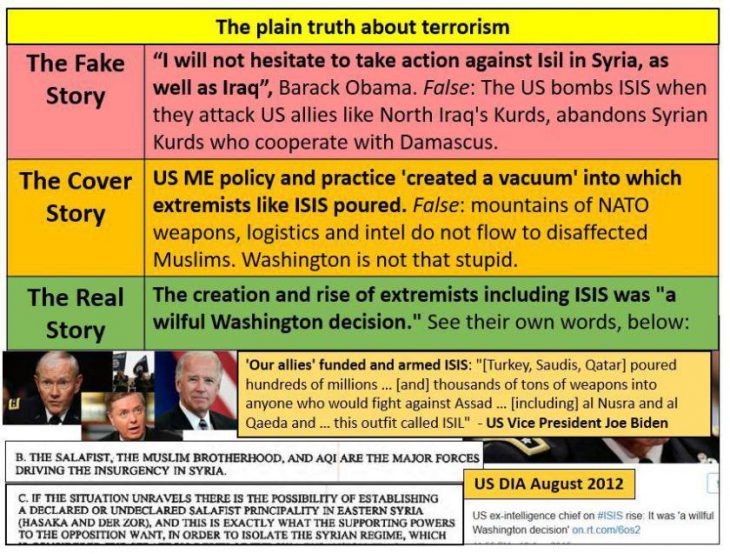
That’s all you need.
Stop making that bogus and unhelpful claim here or anywhere else.
February 7, 2017
Posted by aletho |
Deception, Fake News, Mainstream Media, Warmongering, Timeless or most popular, War Crimes | Africa, Libya, Middle East, Syria, United States |
Leave a comment
US Central Command has been misleading the public in its assessment of the overall progress in the war on terror by failing to account for thousands of airstrikes in Afghanistan, Iran, and Syria, a Military Times investigation reveals.
The investigation revealed that open source data of US Air Force strikes does not contain all the missiles fired. That incomplete data, however, continues to be used by the Pentagon on multiple occasions in official reports and media publications.
The publication says that in 2016 alone, American aircraft conducted at least 456 airstrikes in Afghanistan that were not recorded in the database maintained by the US Air Force.
The investigation also revealed discrepancies in Iraq and Syria where the Pentagon failed to account for nearly 6,000 strikes dating back to 2014, when the US-led coalition has launched its first airstrikes against Islamic State (IS, formerly ISIS,ISIL) terrorist targets.
According to the Air Force, coalition jets conducted 23,740 airstrikes through the end of 2016. The US Defense Department, however, puts the number at 17,861 until the end of January 2017.
“The Pentagon routinely cites these figures when updating the media on its operations against the Islamic State and al-Qaida affiliates in Iraq and Syria,” the publication says.
Military Times remains especially puzzled by a statement made by an Air Force official in December who assured the publication that its monthly summary of activity in Iraq and Syria “specifically” represents the entire American-led coalition “as a whole, which is all 20-nations and the US branches.”
“It’s unclear whether this statement was intentionally misleading, or simply indicative of widespread internal ignorance, confusion or indifference about what’s contained in this data,” Andrew deGrandpre, Military Times’ senior editor and Pentagon bureau chief, said in the article.
Military Times says that the “most alarming” aspects of the investigation are that the discrepancies in numbers go back as far as 2001, when the US, under George W. Bush’s administration, struck Afghanistan in response to the 9/11 attacks on American soil.
The publication reveals that the unaccounted-for airstrikes in all three war zones were allegedly conducted by US helicopters and armed drones which are overseen by US Central Command.
“The enormous data gap raises serious doubts about transparency in reported progress against the Islamic State, al-Qaida, and the Taliban, and calls into question the accuracy of other Defense Department disclosures documenting everything from costs to casualty counts,” deGrandpre wrote.
The Pentagon and Army did not immediately respond to requests for comment.
“Those other key metrics include American combat casualties, taxpayer expense and the military’s overall progress in degrading enemy capabilities,” the publication added, wondering whether the military wanted to mislead the American public.
READ MORE:
US report on civilian casualties in Iraq & Syria: ‘Figures plucked out of thin air’
Pentagon acknowledges just 5-10% percent of actual civilian casualties in Syria – Amnesty to RT
February 5, 2017
Posted by aletho |
Deception, Illegal Occupation, Militarism, War Crimes | Afghanistan, Africa, Iraq, Middle East, Syria, United States, Yemen |
Leave a comment
I attended the women’s rights rally in Portland, Oregon, today to support women worldwide and urge Trump to end Obama and Hillary Clinton’s record weapons deals with the most repressive state for women in the world, the totalitarian dictatorship of Saudi Arabia.
In 2010, the Clinton state department organized the biggest weapons sale in US history. The sale was to strongman Abdullah Abdullaziz, who had women executed as punishment for being raped. The Kerry state department followed the deal with a sale of almost a billion dollars worth of illegal cluster bombs to the dictator. Obama approved both deals.
Bloomberg reports Clinton’s weapons sales to woman-oppressing dictators increased dramatically after the tyrants ‘donated’ to what Harper’s magazine calls the Clintons’ ‘slush fund’, the Clinton Foundation.
An unfortunate aspect of much of the current anti-Trump upheaval around the country is that similar actions were not undertaken when policies Democrats would or will oppose if Trump carries them out were not opposed by Democrats when Obama and Hillary Clinton performed them.
However, this is largely because the general public is kept ignorant of most of these policies. Such actions, Dr. Chalmers Johnson has noted, are “kept secret” from the US-American public.
Respected analysts this week highlighted the disparity between Obama’s treatment in the neoliberal press and his actual record.
John Pilger quotes a typically sycophantic example of a description of Obama, this one from The Guardian:
“But the grace. The all-encompassing grace: in manner and form, in argument and intellect, with humour and cool … [He] is a blazing tribute to what has been, and what can be again … He seems ready to keep fighting, and remains a formidable champion to have on our side … The grace … the almost surreal levels of grace …”
Nicolas J S Davies outlines the reality: Obama, whose political career has been sponsored by, among many other similar elements, lethal weapons manufacturer General Dynamics, “has increased U.S. military spending beyond the post-World War II record set by President George W. Bush. Now that Obama has signed the military budget for FY2017, the final record is that Obama has spent an average of $653.6 billion per year, outstripping Bush by an average of $18.7 billion per year (in 2016 dollars).
In historical terms, after adjusting for inflation, Obama’s military spending has been 56 percent higher than Clinton’s, 16 percent higher than Reagan’s, and 42 percent more than the U.S. Cold War average…”
Under Obama, “… the U.S. and its allies dropped 20,000 bombs and missiles in his first term. In his second term, they have dropped four times that number, bringing the total for Obama’s presidency to over 100,000 bombs and missiles striking seven countries, surpassing the 70,000 unleashed on five countries by George W. Bush.”
Pilger notes Obama ordered an average of 72 explosive devices to be planted and detonated every day in 2016.
Davies continues that Obama has used the US’s Central American model of favoring proxy-armies and death-squads over sending in US troops, and has thus provided arms and ignited and fueled conflicts that have killed hundreds of thousands around the world.
But the strategy has also included “a massive expansion of U.S. special operations forces, now deployed to 138 different countries, compared with only 60 when Obama took office.”
Pilger notes this “amounted to a full-scale invasion of Africa.”
Highlighting what these US operations and hegemonic expansion mysteriously achieve, Oxfam this week released a report noting that about 8 people now control as much wealth as half the world’s population. This is down from 16 people within the past year or so, and around 70 people before that.
Within the US, while thousands of the poorest people in places like Detroit had their water turned off in violation of the universal declaration of human rights, Obama allocated a trillion dollars to the nuclear arsenal, in violation of legal obligations and agreements.
And while he has refused to prosecute torturers and war criminals from the Bush Jr. regime (let alone his own), he has waged a campaign of persecution against those who have exposed torture and war crimes.
Amnesty International and other groups note a highlight of Obama’s presidency was his recent commutation of the sentence of US political prisoner Chelsea Manning, who released documents exposing some US war crimes. But the commutation came after an offer from another, higher-value whistle-blower and political prisoner, Julian Assange, to accept extradition to the US in exchange for clemency for Manning.
Others note Obama has deported millions of people and increased military aid to human rights violators like Israel and Saudi Arabia more than any other president.
While at least some Democrats would express opposition to these actions if they were performed by Trump, this cannot necessarily be called hypocrisy, since the US and Western propaganda model (corporations dumping billions into favored media outlets to overwhelm the market) prevents the vast majority of them from knowing Obama undertook the actions himself.
This is not new. Similar demonstrations expressing disgust were carried out by Democrats and others during the inauguration of Bush Jr., but not in opposition to policies carried out by Clinton such as his genocide in Iraq that killed some 500,000 children, his support for terrorist Paul Kagame in Rwanda, which has contributed to the deaths of millions, or Clinton’s aggression against Yugoslavia.
Continuing to illustrate how these and other crimes are “kept secret” from or distorted for the US and Western public, Reuters this week said the US/NATO aggression against Yugoslavia was carried out in response to Serbia “killing about 10,000 ethnic Albanian civilians there.”
But Noam Chomsky and other US/Western propaganda analysts note that according to the West’s own monitors, including the British Parliamentary inquiry into the matter, this is a reversal of the chronology.
In the year before the US/NATO attack, about 2,000 people were killed due the conflict in Yugoslavia, with more killings attributed to the KLA – the terrorist-integrated guerilla force backed by the US and Western countries – than to the Serbs. Before the US/NATO attack, the killings had mostly subsided, but the KLA continued to carry out provocations to, as it stated, try to instigate NATO intervention on its behalf.
Wesley Clarke, the NATO commander at the time, said bombing Yugoslavia would cause more deaths and atrocities than would occur without Western bombing. Others agreed, but, with Hillary Clinton’s urging, Bill Clinton began bombing the country, leading to the “about” 10,000 deaths Reuters this week says the bombing was a response to.
The Reuters article also mysteriously fails to mention that if the US had intervened to prevent atrocities, it would not have been supporting what Dr. Michael Parenti, in a book on the topic written under the supervision of Balkan experts, notes were worse atrocities carried out by Turkey (against the Kurds) and other regimes around the world.
Through countless similar distortions and omissions, the US/Western propaganda model thus continues to keep Democrats uninformed and thus complacent or supportive of politicians who carry out actions Democrats sometimes vehemently oppose when the same actions are planned or carried out by Republicans.
Comparable dynamics are also true in reverse.
Robert J. Barsocchini is an independent researcher and reporter whose interest in propaganda and global force dynamics arose from working as a cross-cultural intermediary for large corporations in the film and Television industry. His work has been cited, published, or followed by numerous professors, economists, lawyers, military and intelligence veterans, and journalists. Updates on Twitter.
January 22, 2017
Posted by aletho |
Corruption, Mainstream Media, Warmongering, Militarism, Progressive Hypocrite, War Crimes | Africa, Hillary Clinton, Obama, Saudi Arabia, United States |
Leave a comment
Following rhetoric regarding Europe’s refugee crisis, one might assume the refugees, through no fault of Europe’s governments, suddenly began appearing by the thousands at Europe’s borders. However, this simply is not true.
Before the 2011 wave of US-European engineered uprisings across the Middle East and North Africa (MENA) transformed into Western military interventions, geopolitical analysts warned that overthrowing the governments in nations like Libya and Syria, and Western interventions in nations like Mali and the Ivory Coast, would lead to predicable regional chaos that would manifest itself in both expanding terrorism across the European and MENA region, as well as a flood of refugees from destabilized, war-racked nations.
Libya in particular, was singled out as a nation, if destabilized, that would transform into a springboard for refugees not only fleeing chaos in Libya itself, but fleeing a variety of socioeconomic and military threats across the continent. Libya has served for decades as a safe haven for African refugees due to its relative stability and economic prosperity as well as the Libyan government’s policy of accepting and integrating African refugees within the Libyan population.
Because of NATO’s 2011 military intervention and the disintegration of Libya as a functioning nation state, refugees who would have otherwise settled in Libya are now left with no choice but to continue onward to Europe.
For France in particular, its politics have gravitated around what is essentially a false debate between those welcoming refugees and those opposed to their presence.
Absent from this false debate is any talk of French culpability for its military operations abroad which, along with the actions of the US and other NATO members, directly resulted in the current European refugee crisis.
France claims that its presence across Africa aims at fighting Al Qaeda. According to RAND Corporation commentary titled, “Mali’s Persistent Jihadist Problem,” it’s reported that:
Four years ago, French forces intervened in Mali, successfully averting an al Qaeda-backed thrust toward the capital of Bamako. The French operation went a long way toward reducing the threat that multiple jihadist groups posed to this West Africa nation. The situation in Mali today remains tenuous, however, and the last 18 months have seen a gradual erosion of France’s impressive, initial gains.
And of course, a French military presence in Mali will do nothing to stem Al Qaeda’s activities if the source of Al Qaeda’s weapons and financial support is not addressed. In order to do this, France and its American and European allies would need to isolate and impose serious sanctions on Saudi Arabia and Qatar, two nations which exist as the premier state sponsors of not only Al Qaeda, but a myriad of terrorist organizations sowing chaos worldwide.
Paradoxically, instead of seeking such sanctions, the French government instead sells the Saudi and Qatari governments billions of dollars worth of weaponry, proudly filling in any temporary gaps in the flow of weapons from the West as each nation attempts to posture as “concerned” about Saudi and Qatari human rights abuses and war crimes (and perhaps even state sponsorship of terrorism) only to gradually return to pre-sanction levels after public attention wanes.
The National Interest in an article titled, “France: Saudi Arabia’s New Arms Dealer,” would note:
France has waged a robust diplomatic engagement with Saudi Arabia for years. In June, Saudi Deputy Crown Prince Mohammed bin Salman visited France to sign deals worth $12 billion, which included $500 million for 23 Airbus H145 helicopters. Saudi and French officials also agreed to pursue feasibility studies to build two nuclear reactors in the kingdom. The remaining money will involve direct investment negotiated between Saudi and French officials.
The article would also note that Saudi Arabia’s junior partner in the state sponsorship of global terror, Qatar, would also benefit from French weapon deals:
Hollande’s address was delivered one day after he was in Doha, where he signed a $7 billion deal that included the sale of 24 French Rafale fighter jets to Qatar, along with the training of Qatari intelligence officers.
In order to truly fight terrorism, a nation must deal with it at its very source. Since France is not only ignoring the source of Al Qaeda’s military, financial and political strength, but is regularly bolstering it with billions in weapons deals, it is safe to say that whatever reason France is involved across MENA, it is not to “defeat” Al Qaeda.
The refugee crisis that has resulted from the chaos that both Western forces and terrorists funded and armed by the West’s closest regional allies, Saudi Arabia and Qatar, is a crisis that is entirely self-inflicted. The rhetoric surrounding the crisis, on both sides, ignoring this fundamental reality, exposes the manufactured and manipulative nature of French government and opposition agendas.
The chaos across MENA is so significant, and terrorism so deeply rooted in both Western and their Arab allies’ geopolitical equations that even a complete reversal of this destructive policy will leave years if not decades of social unrest in the wake of the current refugee crisis.
But for anyone genuinely committed to solving this ongoing crisis, they must start with the US, European, and Gulf monarchies’ culpability, and resist blaming the refugees or those manipulated into reacting negatively to them. While abuses carried out by refugees or locals are equally intolerable, those responsible for the conflicts and for manipulating both sides of this crisis are equally to blame.
Until that blame is properly and proportionately placed, and the root of the crisis addressed, it will only linger and cause further damage to regional and global security.
January 22, 2017
Posted by aletho |
Deception, Militarism, War Crimes | Africa, al-Qaeda, France, Libya, Middle East, NATO, Qatar, Saudi Arabia, Syria |
Leave a comment
An international scandal has been unfolding over the past month due to supposedly outgoing President Jammah’s flip-flopping remarks, with even the UN Security Council asking him to respect the democratic vote of the people and step down like he promised. Just yesterday, in fact, the regional military-economic integrational bloc of ECOWAS launched an invasion in order to depose him. However, everything needs to be put into context here because the situation isn’t as clear-cut as it seems.
Yes, Jammah did lose the vote, and yes, he did initially recognize it as having been free and fair, but in the immediate electoral aftermath, presumable President-elect Adama Barrow and his campaign vowed to go on a political witch hunt and imprison Jammah within the next year. Worse still, they even pledged to reverse his decision to withdrawal from the International Criminal Court, or ICC. What this amounts to is essentially a top-to-bottom purge of the Gambian “deep state”, or its permanent military, intelligence, and diplomatic bureaucracies under the presumed justification of carrying out “international justice” against a former “dictatorial regime”.

Adama Barrow
It’s thus somewhat understandable why Jammah so abruptly reversed his former position and perceptively seems to have the backing of the military and police as well. The fact remains that they’re interested in self-preservation, and that Barrow’s witch hunt was a politically premature move to declare when he hadn’t even entered into power yet and had chance of carrying it out. He likely did this to please his foreign patrons, which had been waging a concerted infowar against Jammah due to his domestic policies. The clearest indication of unipolar grand strategic connivance against Jammah and the Gambia comes from former US ambassador to Senegal and Gambia and former Assistant Secretary of State for Africa Herman J. Cohen, who penned an op-ed at allafrica.com titled “Gambia: A message to the Gambia – Build that Bridge.” Former diplomats are usually much more candid than presently serving ones are and thus tend to directly say what the US wants as opposed to ‘diplomatically’ beating around the bush.
Former Ambassador Cohen said that “several African nations have suffered from psycopathic regimes during the past five decades, but the Jammeh dictatorship has assuredly been the worst“. One of the steps that he suggests Barrow’s new government take in rebuilding the country is to, ironically enough, dismantle it through what he says should be “the re-establishment of a confederation between the two nations [meaning with Senegal], including a joint military and a federal parliament.” The former diplomat is surprisingly undiplomatic by characterizing Gambia’s decision to pull out of that former arrangement as a “stupid mistake.” So what we can surmise from all of this lobbying and the ongoing post-election political crisis in Gambia is that the US wants Barrow to purge Jammah and all of his institutional supporters out of the country under the cover of the ICC in order for the country’s sovereignty to be ceded to Senegal under a so-called “confederation”.
January 20, 2017
Posted by aletho |
Aletho News | Africa, ECOWAS, Gambia, Senegal, United States |
Leave a comment
A White House report on efforts to target so-called extremists abroad shows a broadening use of war powers in the fight against Al-Qaeda, beyond military operations in Afghanistan, Iraq and Syria.
The 60-page report shows deployments in over half a dozen new areas – including Somalia, Yemen, Jordan, Niger, Cameroon, Central Africa, the Red Sea, Somalia and South Sudan – with troops on the ground, regular air strikes, and surveillance efforts, all in the name of counterterrorism.
In a presidential memorandum released on Monday, the White House said US military operations are grounded in the October 7, 2001 Authorization for the Use of Military Force (AUMF), by which Congress approved military operations and counterterrorism combat operations against Al-Qaeda. Since August 2014, those have expanded to include operations against Islamic State (IS, formerly ISIS/ISIL), which was “formerly known as Al-Qaeda in Iraq.”
The Obama administration’s broad use of the 2001 resolution has raised concerns about how President-elect Donald Trump might use the authority.
The memo includes some new details about how the Obama administration determines which regions are “areas of active hostilities” or war zones, taking into account not only whether a war has been declared there but also the size and scope of the threat, the scope of US involvement, and threats posed to US forces in the area.
President Barack Obama has called for the report to be updated and released publicly on an annual basis.
“The United States has deployed combat-equipped forces to a number of locations in the US Central, Pacifica, European, Southern and African Command areas of operation,” said the White House. “Such operations and deployments … consistent with Public Law and the War Powers Resolution, and operations and deployments remain ongoing.”
“It is not possible to know at this time the precise scope or the duration of the deployments of the US Armed Force necessary to counter terrorist threats to the United States,” the memo added.
Among its broadening efforts, the US identified Al-Shabaab in Somalia as Al-Qaeda for the first time, but provides no justification for the change. The administration believes it can target Al-Shabaab because it “seeks to establish a strict Islamic emirate.”
“United States advises, assists, and occasionally accompany regional forces … during counterterrorism operations … conducted airstrikes [in Somalia] on June 21, July 20, July 31, August 31, September 25 and September 28, 2016,” said the memo.
The US has deployed “a small number of military personnel in Yemen to support operations against Al-Qaeda in the Arabian Peninsula (AQAP)” and carried out 18 airstrikes since June 13, 2016.
In Africa, the US has a base of operations in Djibouti and has conducted airstrikes against Islamic State targets in Libya. The US is also conducting military operations in Niger, where it has deployed approximately 575 personnel, and is sharing intelligence with French forces. There are another 285 US troops in Cameroon, conducting intelligence and surveillance operations. Washington has also deployed troops in Central Africa, conducted military operations in the Red Sea, and assigned 700 military personnel to Egypt.
Further in the memorandum, the White House said it had deployed over 2,300 military personnel to Jordan “to support counter-ISIL operations,” and to provide security to the country.
The prison camp inside the naval base in Guantanamo Bay, Cuba is still holding 59 detainees.
The Obama administration said it had tried to apply “rules, practices and policies long used in traditional warfare” to a new type of conflict embodied by extremist groups who often “do not wear uniforms ore respect geographic boundaries” and show little regard for the rules of war.
“To say that a military tactic is legal, or effective, is not to say that is wise or moral in every instance,” the White House said, according to AP, which obtained a copy of the memo and report.
December 5, 2016
Posted by aletho |
Militarism, Progressive Hypocrite, War Crimes | Africa, Obama, United States |
Leave a comment
US officialdom and their media megaphones have systematically concocted narratives having less to do with political reality and more with their hallucinogenic world view. Pre-election and post-election reportage weaves a tapestry of fiction and fantasy.
We will discuss the most pernicious of these remarkable foibles and fables and their predictable failures.
1. The pundits, prestigious editorialists and ‘economists with gravitas’, have convinced themselves that the election of Donald Trump would ‘lead to the Collapse of Capitalism’. They cited his campaign attacks on globalization and trade agreements, as well as his ‘reckless’ swipes at speculators. In reality, Trump was criticizing a specific kind of capitalism. The pundits overlooked the variety of capitalisms that constitute the US economy. With their snouts deep in the trough, their own vision was limited; their curly tails blindly twirled meaningless formulae on blackboards; their ample backsides flapping away in place of their mouths. Thus occupied, they easily ignored Trump’s glorification of national capitalism.
Trump followed the legacy of protectionism in US policies established by George Washington and Alexander Hamilton and carried into the administrations of Franklin Roosevelt and others. Capitalism comes in various forms and is promoted by different protagonists at different times in our history. Some leaders have championed such economic sectors as domestic energy production, manufacturing, mining and agriculture and depended largely on the local labor markets. Nevertheless, the pundits’ dream of a final collapse of capitalism with the rise of Trump turned into a real stock market bonanza, the ‘DOW’ boomed to record levels, and monopolists rubbed their hands in anticipation of larger and more lucrative merger and acquisitions.
The world’s largest billionaire bankers had bankrolled Secretary Hillary Clinton, the ‘million-dollar-a-speech’ War Goddess. Blankfein, Soros and the dirty dozen had bet heavily against the populist-nationalist Donald Trump and they lost. Their pre-paid political manifestos, addressed to the readers of the NY Times, flopped and sputtered: Most readers and investors in domestic markets had placed their bets on ‘The Donald’. Their domestic celebrations pumped up the market after the election. The unimaginable had happened: George Soros had bet and lost! The ‘deplorable’ electorate preferred the obnoxious nationalist to the obnoxious speculator. ‘Who’d a thunk it?’
2. From electoral losers to street putschists, the speculators and their whiny media mouthpieces strive to overthrow the election process. Against the tens of millions of free voters, the speculators bankrolled a few thousands demonstrators, drunk with their own delusions of starting a color-coded ‘Manhattan Spring’ to overthrow the elected President. Decked out in black ‘anarchist chic’, the window vandals and historically illiterate students were energized by George Soros’ promise to replicate the putsches in Kiev and Tbilisi. They took to the streets, cracked a few windows and signed thousands of ‘on-line petitions’ (while denouncing Trump as the ‘Second Coming of Kristalnacht’). The media magnified the theatrics as a sort of uprising to restore their loser-emancipator to the throne – the bleery-eyed Jean D’Arc of the Hedge Funds. The losers lost and Hillary will hopefully retire to count her millions. The stock market soared to record heights.
3. The four most influential financial newspapers, the Wall Street Journal (WSJ), the Financial Times (FT), the New York Times (NYT) and the Washington Post (WP) had deeply mourned their ‘Paradise Lost’: Long-gone was the rotting vassal-state of Russia under Boris Yeltsin 1991 – 2000, source of so much Western pillage. Their bile turned to venom, directed at the new Nemesis: Putin. The election of Vladimir Putin led to a remarkable economic and social recovery for Russia. From a Western controlled gangster-capitalist ‘thug-ocracy’, Russia has become a modern global power asserting its own sovereignty and national interests.
Gone are the days when Harvard economists could sack Russia of millions through their various ‘democracy’ foundations and Wall Street bankers could launder billions from the criminal oligarchs. Pentagon planners had dismantled Russian bases throughout its previous Warsaw Pact neighbors and set up NATO bases on Russia’s borders. State Department functionaries had overthrown elected pro-Russian regimes in the Ukraine, Georgia and as far afield as Libya. These were the unfettered joys of the US unipolar rulers and their stable of prestigious press pimps and academics, until Putin arrived to spoil the party. And in the run-up to the US election, the Clintonites and their Democratic entourage in the media launched the most frenzied demonic attack accusing Vladimir Putin of financing Trump’s campaign, of hacking Clinton’s messy, unsecured e-mail messages to undermine elections, of bombing Syrian hospitals full of children, of preparing to invade Latvia and Poland etc., etc. If there is one sliver of truth in the vassal press, it is that the demonic changes made against Putin reflected the gory reality of Hillary Clinton’s well-documented policies.
Clinton’s model for a democratic Russia was the drunken President Yeltsin, bankrolled by thugs as they gorged themselves on the corpse of the USSR. But Vladimir Putin was elected repeatedly by huge majorities and his governance has been far more representative of the Russian electorate than those of the recidivist loser, Hillary Clinton. Russia didn’t ‘invade’ the Ukraine or Crimea. It was the ‘potty-mouthed’ Victoria Nuland, US Undersecretary of State for European Affairs, who boasted of having tossed a mere 5 billion dollars into neo-fascist-kleptocratic putsch that took over Ukraine and who famously dismissed the concerns of the European Union… with her secretly recorded ‘F— the EU’ comment to the US Ambassador!
At some point, reality has to bubble up through the slime: Putin never financed Trump – the billionaire financed his own campaign. On the other hand, Clinton was bankrolled by Saudi despots, Zionist billionaires and Wall Street bankers. The mass media, the WSJ, FT, NYT and the WP, dutifully served the same stale, old sexist gossip about Trump in support of the sweet and sour, wide-eyed Madam Strangelove, who never hesitated to rip the lives out of thousands of Muslim women in their own countries. The media celebrated Madame Clinton’s nuclear option for Syria (the ‘No-Fly Zone’) while it ridiculed Trump’s proposal to negotiate a settlement with Putin.
The media accused Trump of being a sexist, racist, anti-immigrant villain, all the while ignoring Secretary of State Clinton’s blood-soaked history of bombs and destruction, of killing of tens of thousands women in the Middle East and Africa and driving hundreds of thousands among the two million sub-Sahara Africans formerly employed in Libya under Gadhafi’s rule onto rotting ships in the Mediterranean Sea. Who in Madame’s media count the millions of people dispossessed or the 300,000 killed by the US-promoted mercenary invasion of Syria? Where were the feminists, who now dredge up Trump’s crude ‘crotch talk’, when millions of women and children of color were killed, injured, raped and dispossessed by Madame Clinton’s seven wars? Given the choice, most women would prefer to defend themselves from the stupid words of a vulgar misogynist over the threat of a Clinton-Obama predator drone ripping their families to shreds. Nasty, juvenile words do not compare with a history of bloody war crimes.
It is much easier to denounce Xi Jinping, Vladimir Putin and Donald Trump than to analyze the consequences of Madame Candidate Clinton’s policies. The mass media, subservient to Clinton, wave the flag of ‘worker struggles’ and highlight ‘capitalist exploitation’ when they describe China, Russia and the businesses of US President-Elect Trump. But their perspective is that of the ‘Uni-Polar Empire’. They cite non-unionized worker protests in Chinese factories and peasants fighting the rapacious developers. They cite corrupt oil sales in Russia. They find cheap immigrant labor employed on Trump’s building projects. The media describe and defend Hong Kong separatists. They heap praise on the Uighar, Chechen and Tibetan terrorists as “freedom fighters” and “liberators”. They fail to acknowledge that, as bad as worker exploitation is in these examples, it is far less horrific than the suffering experienced by millions of local and immigrant peasants and workers who have been injured, killed and rendered jobless and homeless by US bombing campaigns in Libya and US invasion-destruction of Iraq, Afghanistan and Syria. The imperial media’s phony ‘anti-capitalist-exploiter stories’ against Trump, Putin and the Chinese are mere propaganda rhetoric designed to entice leftists, influence liberals and reinforce conservatives by playing on workers’ plight inflicted by national adversaries instead of imperial conquests and egregious crimes against humanity.
These financial scribes are very selective in their critique of economic exploitation: They denounce political adversaries while churning out vapid cultural stories and reports on the ‘eclectic tastes’ of the elite. Their weekend cultural pages may occasionally contain a critique of some predatory financiers next to a special feature on an unusual sculptor or successful upwardly mobile immigrant writer. Day after day, the same financial media publishes predictable ‘bootlickeries’ masquerading as reports on vulture capitalists, warmongers and imperial warlords. They court and offer advice to Wall Street, the City of London and Gulf State sheikdoms. They write in blubbering awe at the bold multi-billion dollar mergers and acquisitions, which eliminate competitive prices and establish effective monopolies. Then they deftly turn to rant against President-Elect Donald Trump’s pronouncements on workers’ rights – he is ‘the demagogue threatening free-market . . . capitalism’.
The fear and loathing of the ‘Wildman’ Trump, so evident in the four most prestigious English language newspapers, is nowhere to be found in reference to Secretary Clinton’s pathological glee over the gruesome torture-murder of the injured President Gadhafi by her allied jihadi tribesmen. The global and domestic implications of the US Secretary of State expressing glee and high pitched squeals on viewing the filmed torture and final ‘coup de grace’ on the wounded head of the Libyan President was never analyzed in the respectable press. Instead, the press superficially covers the plight of millions of immigrants and refugees who would never have left their jobs and homes were it not for the US destruction of the Middle East and North Africa. The respectable media defend the US officials directly responsible for the plight of these migrants flooding and threatening to destabilize Europe.
The same newspapers defend the ‘human rights’ of Chinese workers in local and US-owned factories who out-competed domestic American factories, but ignore the plight of millions of unemployed and destitute workers trying to survive in the US war zones and Israeli-occupied territories.
The Presidential elections made millions of American voters starkly aware of the mendacity of the mass media and the corruption of the Clinton political elite.
The media and the Clinton-elite denounced the Trump voters as ‘deplorables’ and totally mischaracterized them. They were not overwhelmingly unemployed, bitter former industrial workers or minimum wage, uneducated racists from the gutted ‘heartland’. ‘Angry white male workers’ constituted only a fraction of the Trump electorate. Trump received the vote of large sections of suburban middle class professionals, managers and local business people; joined by downwardly mobile Main Street shopkeepers, garage owners and construction contractors. A majority of white women voted for Trump. City household residents, still trying to recover from the Obama-Clinton era mortgage foreclosures, formed an important segment of the Trump majority, as did underpaid university and community college graduates – despairing of ever finding long-term stable employment. In short, low-paid, exploited and precarious business owners and service sector employees formed a larger section of the Trump majority than the stereotyped ‘deplorable angry white racists’ embedded in the media and Clinton-Sanders propaganda.
Post-election media has magnified the political significance and size of the anti-Trump demonstrations. Altogether the demonstrators barely surpassed a hundred thousand in a country of 100 million voters. Most have been white students, Democratic Party activists and Soros-financed NGOs. Their demonstrations have been far smaller than the huge pro-Trump public rallies during the campaign. The pro-Clinton media, which consistently ignored the size of Trump’s rallies, doesn’t bother to make any comparison. They have focused exclusively on the post-election protest, completely papering over the outrageous manipulation by which the Democratic National Committee under ‘Debbie’ Wasserman Schultz cheated Clinton’s wildly popular left-wing rival, Bernie Sanders, during the primaries.
Instead, the media has been featuring Clintonesque ‘feminist’ professionals and ‘identity’ political activists, ignoring the fact that a majority of working women voted for Trump for economic reasons. Many politically conscious African-American and Latino women knew that Clinton was deeply involved in policies that deported 2 million immigrant workers and family members between 2009 – 2014 and destroyed the lives of millions of women of color in North and Central Africa because of her war against the government of Libya. For millions of female and male workers, as well as immigrants – there was a ‘lesser evil’ – Trump. For them, the Donald’s nasty remarks about women and Mexicans were less disturbing than the real history of Hillary Clinton’s brutal wars destroying women of color in Africa and the Middle East and her savage policies against immigrants.
The more bizarre (but transient) aspect of the anti-Trump smear campaign came from an hysterical section of the pro-Hillary ‘Zionist Power Configuration’ (ZPC) and ‘Israel-First’ crackpots who accused him and some of his appointees of anti-Semitism. These venomous propagandists slapped the Manhattan real-estate mogul Trump with an odd assortment of labels: ‘fascist’, ‘misogynist’, ‘anti-Israel’, Ku Klux Klan apologist and White Nationalist. The Minnesota Senator and former comedian Al Franken described Trump’s critique against Wall Street Bankers and finance capital as ‘dog whistles’ for anti-Semites, labeling the candidate as a 21st century disseminator of the ‘Protocols of Zion’. Senator Franken darkly hinted that ‘rogue’ (anti-Semitic) agents had infiltrated the FBI and were working to undermine Israel’s favorite, Clinton. He even promised to initiate a post-election purge of the FBI… upon Clinton’s victory… Needless to say, the Senator’s own rant, published (and quickly buried) two days before the election in the Guardian, did not help Madame Hillary with the security apparatus in the United States. History has never been a strong point with the Comedian Senator Al Franken, who should have know better than to threaten the deep security state: his Mid-West predecessor Senator Joseph McCarthy quickly deflated after he threatened the generals.
The accusations of anti-Semitism against Trump were baseless and desperate: The Trump campaign team has prominently included Jews and Israel-Firsters and secured a minority of Jewish votes, especially among smaller business people supporting greater protectionism. Secondly, Trump condemned anti-Semitic acts and language and did not appeal to any of the extremist groups – let alone ‘cite the Protocols of Zion’.
Thirdly (and predictably) the Zionist Anti-Defamation League (ADL) slapped an anti-Semitic ‘guilt by association’ label on Donald Trump because of his consistent criticism of US wars and occupations in the Middle East, which Trump had correctly pointed out cost the US over two trillion dollars – money that would have totally rebuilt the failing US infrastructure and created millions of domestic jobs. For the loony ADL, the US wars in the Middle East have enhanced Israel’s security and thus any opposition to these wars is anti-Semitic or ‘guilt by association’.
The ADL directors, who have raked in over $3 million dollar salaries over the past 5 years ‘protecting’ US Jews, objected to Trump because Hillary Clinton was the darling of the pro-war Israel-First lobbies and Obama-Clinton appointees.
Trump’s daughter Ivanka (a convert to Judaism) is married into a prominent Orthodox Jewish family with strong ties to Israel; the Trump clan is close to elements among the Israeli elite, including the uber-racist Netanyahu. These hysterical slanders against ‘Trump the Anti-Semite’ reflect the fact that the most prominent domestic Jewish power bloc, ‘the 52 Presidents of American Jewish Organization’ had invested heavily in Hillary Clinton. No matter what the cost, no matter what the land grab, no matter how many Palestinians were ‘killed or maimed by Jewish settler-vigilantes’; the State of Israel could always count on Clinton’s unconditional support. The Lobby would not need to ‘petition’ their ‘First Woman’ President; Madame Hillary would have anticipated Israel’s every desire and even embellished their rhetoric.
In the end, Senator Al Franken’s rabid anti- Trump rant went too far . . . vanishing from the Guardian website in less than one day. Influential Zionist organizations turned their backs on the Senator Comedian; the Zionist Organization of America reprimanded the ADL for its intemperate slanders – sensing that Clinton could lose.
The Franken-Zionist power structure’s last-ditch efforts to attack Trump must have provoked a very negative response within the US ‘deep state’. There can be no doubt that the entire intelligence, military and security elites struck back and put their organizational ‘thumb on the scale’.
The FBI’s release of damaging documents related to Secretary Clinton undermined the ADL’s candidate in the run-up to the election and hinted at an interesting power struggle behind the curtains. The confidential documents, likely including epistles from Chappaqua to and from Tel Aviv, linked tangentially to the pedophilic crimes of the disgraced Congressman (and former Clinton ally) Anthony Weiner was a heavy blow.
The Netanyahu Cabinet put distance between themselves and their favorites, probably telling AIPAC leaders to muzzle Al Franken and pretend his threats to purge the FBI had never been launched. They were clearly worried that their lunatic attack dogs could set the entire US Security State on a hostile track against Israel.
The Franken-ADL trial balloon fizzled and disappeared. The intelligence establishment pounded the final nail into the coffin of Hillary Clinton’s Presidential aspirations. She even briefly accused the FBI of ruining her candidacy – hinting at some partial but oversimplified truth. A Zionist darling to the end, Hillary would never dare to identify and castigate the crazy and incompetent Zionist provocateurs that had helped to turn the Deep State against Madame Secretary.
A last note: Once Clinton lost and Trump took ‘the prize’, the Zionist Power Structure deftly switched sides: the former ‘Anti-Semite’ candidate Trump became ‘Israel’s Best Friend in the White House’. None of the 52 leading Zionist organizations would join the street protests. Only vulture-speculator George Soros (who had bet heavily on the wrong horse) would finance the motley group of goys marching in the streets and collecting on-line petitions for ‘democracy’.
The foibles, fables and failure of the financial press and their keepers lost the election but are back, hard at work, remaking President-Elect Trump into a global free marketer.
November 24, 2016
Posted by aletho |
Corruption, Deception, Economics, Mainstream Media, Warmongering, Militarism, Timeless or most popular | Africa, Al Franken, Donald Trump, Hillary Clinton, Middle East, New York Times, The Guardian, United States, Zionism |
Leave a comment
Alleged humanitarian efforts have always been a rather important aspect of the state propaganda campaign carried out by the White House and its media. We’ve seen Washington using its pocket NGOs to fight against the alleged “humanitarian crimes” of the Syrian government, Russia, Iran, North Korea, Venezuela, Cuba and other states that Washington declared its enemies.
This large-scale campaign that is said to be driven by “common human values” has been supported by a number of modern American oligarchs.
Among those “humanitarian champions” one may find the founder of Microsoft and, perhaps, one the richest businessmen in the world, Bill Gates, who likes to be represented as a benevolent philanthropist of some sort. By using the so-called “Bill and Melinda Gates Foundation,” this richest man on earth is trying to put on a mask of the official representative of the US political elites that is carrying on the fight against poverty, food shortages and diseases in Africa and other poor regions of the world.
However, in reality such “activities” of Bill Gates and the White House are focused on the use of progress to reverse the effect of humanitarian projects, namely to reduce the population of the planet, or, in other words – to pursue eugenics.
This statement is confirmed by Gates’ remarks to the invitation-only Long Beach, California TED2010 Conference, in a speech titled, “Innovating to Zero!” Along with the scientifically absurd proposition of reducing manmade CO2 emissions worldwide to zero by 2050, approximately four and a half minutes into the talk, Gates declares, “First we got population. The world today has 6.8 billion people. That’s headed up to about 9 billion. Now if we do a really great job on new vaccines, health care, reproductive health services, we lower that by perhaps 10 or 15 percent.” (emphasis added).
Thus, one of the most powerful men in the world has openly declared that he expects vaccines to reduce the world population. Mind you, that when Bill Gates speaks about vaccines, he knows what he is talking about. In January 2010 at the World Economic Forum in Davos, Gates announced that over the next decade his foundation would allocate 10 billion dollars to develop and deliver new vaccines to developing countries.
We’ve heard this position on the control over the world population by pursuing the “reduction of the number of third-world inhabitants” before. Australian microbiologist and Nobel Price laureate Macfarlane Burnet in 1947 urged the Australian government to develop and unleash biological weapons against “over-populated countries of Southeast Asia.” In particular, during a closed meeting in 1947 with The New Weapons and Equipment Development Committee microbiologist recommended to create a group with a mandate to create secret biological weapons components that could affect food in such a way that it would allow Canberra to control the population of Indonesia and other Asian countries.
A similar objective was pursued by the secret program code-named Project Coast, during which US intelligence agencies started testing such viruses as Ebola and Marburg fevers on the South African black population. The US Centers for Disease Control was delivering those viruses from its secret laboratories to Africa in a bid to create biological and chemical weapons, which were aimed at sterilizing and even exterminating the black population of this African country, while murdering political opponents of the apartheid.
Today, in the age of high-tech novelties, Bill Gates has pioneered the electronic direction of eugenics, offering to implant the “undesired” part of the population with an electronic remotely controlled chip that would deprive women of reproductive capacity for a total of 16 years.
However, this is hardly the whole truth about the “humanitarian concerns” of the White House and its “humanitarian patrons”, who, under the guise of fighting for the greater good, continue searching ways to control the population of the planet, using both the advances of modern science and armed conflicts, like those that we’ve witnessed in Iraq, Afghanistan, Libya and other countries.
November 11, 2016
Posted by aletho |
Ethnic Cleansing, Racism, Zionism, Science and Pseudo-Science, Social Darwinism, Timeless or most popular | Africa, Bill Gates, Human rights |
Leave a comment
Opportunities should not be squandered. It is especially important at a time when the overall political relationship between Washington and Moscow has tumbled to a nadir. Donald Trump’s victory and the expected drastic changes in US foreign policy open up new prospects for the improvement of bilateral relations.
It is useless to make predictions without the new president announcing who his foreign policy advisers will be. But it is possible to define in general terms what could and should be done to change the tide.
With arms control and non-proliferation in doldrums, the tensions over Ukraine, the standoff between Russia and NATO and the failure to cooperate efficiently in Syria, the mission seems to be more of a tall order, but it would be a great mistake to waste time.
The next president needs to accept that Moscow cannot simply be defeated or contained but it can be engaged through a comprehensive balance of cooperation and competition. Mr. Trump is savvy when it comes to the economy but in order to tackle the relationship with Russia he’ll have to go outside of his comfort zone as the divisions are mainly related to security issues. However, his business experience resulting in a pragmatic and business-like approach to foreign policy issues may be just exactly what is required to mark a new page in the Russia-US relationship.
Steps to prevent backsliding on nuclear disarmament must be taken during the Donald Trump’s tenure. This is a key issue to shape the global nuclear security landscape. Setting aside the existing differences over other issues to take the bull by the horn and achieve progress on strategic nuclear arms control regime is the only way to go about it.
The problem is aggravated by the fact that Russia and the US have not had meaningful negotiations on this issue for almost three years, much like it was in the days of the Cold War when there were no contacts to discuss it in the period from 1983 to 1985.
Currently, the New Strategic Arms Reduction Treaty (New START) is in force. The treaty expires in February 2021, just three years after the parties are required to complete reductions in 2018. It can be prolonged for 5 years more if the parties agree. It remains unclear whether the United States and Russia can establish a new arms control regime.
If the two leading nuclear powers slide into a nuclear arms race, it will also adversely affect China’s interests and make it adjust its own nuclear policies – quite a headache for the new US commander-in-chief.
The future of the 1987 Intermediate-range Nuclear Forces (INF) treaty – a landmark Cold War-era agreement – has become a very contentious issue. Time is running out. The INF is a pillar of European security, if it is weakened or discarded, the whole system will collapse. Russia says the Mk 41 vertical launching system for SM-3 missile interceptors based in Romania (and slated for deployment in Poland in 2018) is similar to those on US Navy ships and can launch cruise missiles. This is a flagrant violation of the treaty which bans the use of such launchers. There are other problems related to the compliance with the treaty as both sides blame each other for failure to abide by its provisions. Donald Trump will have to deal with this problem on his watch. For instance, the new administration could offer transparency measures regarding the vertical launch boxes allowing to verify if they really hold interceptors, not cruise missiles.
The agenda of the president-elect includes NATO deployments in Eastern Europe to make Russia consider stationing short-range missiles near its borders that could be used in both nuclear and conventional scenarios. This development would increase Russia’s emphasis on tactical nuclear weapons (TNW), sending the Russia-NATO security relationship into a downward cycle.
The ballistic missile defense (BMD) is a threat to global stability. No progress in other areas is achievable without coming to agreements on the BMD.
To begin with, the new administration could make some steps to make sure that BMD systems do not undermine Russia’s assured second-strike capability. The interceptors could be located in geographic areas to make the interception of Russian intercontinental ballistic missiles (ICBMs) impossible. Radars could be redeployed not to provide substantial coverage of Russia. Anyway, the problem is too acute to be shelved. Donald Trump’s administration will have to deal with it one way or another.
The parties could launch regular discussions of the overall direction of ballistic missile programs, exchange intelligence and review developments assessing the missile threats and ways to counter them. Transparency is the best confidence building measure. US forward-deployed conventional strike assets with standoff range – boost-glide systems in particular – add to the problem.
It might be sensible to discuss the implications of conventionally armed cruise missiles for the strategic nuclear balance. Hypersonic missiles are very destabilizing weapons that should be covered by appropriate agreements. Some formal limitations would enhance security and mitigate the concerns of Russia, which feels threatened and has to respond.
If the problem of US conventional first strike superiority is not addressed – no agreement of tactical nuclear weapons is possible. Introducing limits is appropriate. The final goal in each and every case should be a formal binding agreement.
Military activities and conventional forces is another burning issue the Trump administration has to grapple with. Germany has recently come up with a proposal to start talks on a new Russia-NATO arms control agreement to comprise regional caps on armaments, transparency measures, rules covering new military technology such as drones, and the ability to control arms even in disputed territories.
Russia and the US could join together to convene a conference, presumably under the auspices of the Organization for Security and Cooperation in Europe with the full involvement of all relevant states.
With all the problems in existence and the proposed ways to tackle them, Russia and the US could scope out the issues and agree on how formal negotiations should be conducted.
Exploratory arms control discussions would help establish a useful venue for dialogue on other pressing problems. The agenda could be broadened to regional conflicts, with Ukraine and Syria discussed as separate issues. Enhancing the forums, like the Organization for Security and Co-operation in Europe (OSCE) and the NATO-Russia Council would be a step in the right direction. Achieving tangible progress on one issue could lead to positive results in other areas.
Donald Trump has said he is ready to ally with Russia in the fight against Islamic State. It could be a good start. The post-war crisis management is a key area where both countries could be allies as they are fighting the same enemy. International cooperation is crucial for success in Syria, Iraq and Libya. Russia and the United States leading the process would become a historic milestone to benefit all.
Cooperation in the Middle East and North Africa would change the Russia-West relationship for the better.
Lifting the anti-Russian sanctions so unpopular among US allies would greatly enhance the prospects for success. «Clearly the chances of sanctions being lifted on Russia have risen substantially», Charles Robertson, Renaissance Capital’s global chief economist, said. «That would improve the investment climate for Russia».
With the sanctions lifted, the parties could apply efforts to improve economic cooperation – the weak point of bilateral relationship. Actually, economy has never been high on the Russia-US agenda. Donald Trump is an experienced businessman, he could spur the process.
The president-elect is the right person to turn the tide in the Russia-US relations because he is independently minded and not tied to Washington’s establishment. He can avoid specific bureaucratic pitfalls and keep neocons and liberal hawks from positions of power something his predecessor has failed to do. As the presidential race has showed, he can see a problem from the other side’s perspective. What if Russia deployed forces and BMD installations near the US borders? He has imagination to understand such things. Donald Trump seems to possess the needed leadership traits to stand up to pressure and do things his way. His election victory is an opportunity not to miss. Normalizing relations with Russia will be a great foreign policy success – a historic legacy to make him go down in history as a great president.
November 10, 2016
Posted by aletho |
Economics, Militarism, Timeless or most popular | Africa, Donald Trump, Middle East, NATO, Russia, United States |
Leave a comment


 Aletho News
 Aletho News