Thousands of platinum miners in South Africa have embarked on a strike demanding their entry-level pay be doubled to nearly 1,200 dollars a month.
Workers at Impala Platinum, Anglo American Platinum, and Lonmin mines embarked on an indefinite strike on Thursday, crippling output at the world’s three biggest platinum producers.
Striking miners chanted slogans as they marched to Wonderkop Stadium near the Lonmin platinum mine in Marikana.
The protest, organized by the Association of Mineworkers and Construction Union, is the biggest industrial action in South Africa’s platinum sector since 2012, when police shot and killed 34 striking miners in Marikana.
South Africa’s mining companies have been rejecting calls for a wage increase, pointing to weaker profits and rising costs.
South Africa’s mining sector has been paralyzed by a series of wildcat strikes over miners’ low pay since August, 2012. The strikes have also damaged South Africa’s reputation as an investment destination.
The three top platinum companies operating in the African country say strikes cost the industry a total loss of output amounting to about USD 1.2 billion in 2012 and 2013.
South Africa possesses nearly 80 percent of the world’s known platinum reserves. The country’s mining sector directly employs around 500,000 people and accounts for nearly one-fifth of the country’s gross domestic product.
January 23, 2014
Posted by aletho |
Economics, Solidarity and Activism | Africa, Anglo American Platinum, Impala Platinum, Lonmin, Marikana, South Africa |
Leave a comment
Eighteen months ago UK foreign secretary William Hague delivered an important speech at the Hague, home of the International Criminal Court . He was saying all the right things, for example:
“The rule of law is critical to the preservation of the rights of individuals and the protection of the interests of all states.”
“You cannot have lasting peace without justice and accountability.”
“International laws and agreements are the only durable framework to address problems without borders.”
“Such agreements – if they are upheld – are a unifying force in a divided world.”
He spoke of a growing reliance on a rules-based international system. “We depend more and more on other countries abiding by international laws…. We need to strengthen the international awareness and observance of laws and rules….”
Some emerging powers, he said, didn’t agree with us about how to act when human rights are violated on a colossal scale, while others didn’t subscribe to the basic values and principles of human rights in the first place. He was talking about Syria although many in the audience must have had Israel in mind.
“The international community came together in an unprecedented way to address the crisis in Libya last year,” said Hague. “The Arab League, the UN Security Council, the UN Human Rights Council, the European Union, NATO and the International Criminal Court all stepped forward and played their part to protect a civilian population.”
Yeah. Funny how they have never come together for crisis-torn Palestine these last 65 years.
‘We pledge to fight impunity for grave international crimes wherever they occur’
Hague, positively overflowing with fine words and sentiments, chuntered on.
“We have to ensure that when we are trying to build peace, we don’t overlook the need for justice…. Our coalition Government is firmly of the view that leaders who are responsible for atrocities should be held to account…. Institutions of international justice are not foreign policy tools to be switched on and off at will.”
He said referring leaders in Libya and Sudan to the ICC showed that not signing up to the Rome Statute was no guarantee for escaping accountability. “If you commit war crimes, crimes against humanity or genocide you will not be able to rest easily in your bed: the reach of international justice is long and patient…. There is no expiry date for these crimes….”
Woweee! Had he told Netanyahu this? Was this tough talking really from the man who watered down Britain’s laws of Universal Jurisdiction to protect Israel’s war criminals from arrest while shopping in London’s Bond Street? Israel and the US, after signing up to the Rome Statute, had second thoughts and ‘unsigned’ in order to escape the long reach of international justice. At last it was beginning to sound like bad news for TelAviv’s and Washington’s thugs.
At the time of the Libya fiasco Hague announced he had signed a directive revoking Gaddafi’s diplomatic immunity and also that of his sons, his family and entire household. He bragged how the UK “drove” through a Security Council resolution referring what was happening in Libya to the ICC Prosecutor, saying it “sends a clear message to all involved, in the regime and any other groups that if they commit crimes and atrocities there will be a day of reckoning for them.”
Bravo! What a splendidly high-principled chap Hague suddenly seemed to be. And how swiftly he managed to get the International Criminal Court’s attention when he wanted to. But we didn’t hear Hague and his friends call for a reckoning with the psychopaths of the Israeli regime when they committed mega-atrocities against Gaza’s civilians just two years earlier. Instead they tinkered with our laws of universal jurisdiction to enable suspected war criminals to walk free. Gaddafi wasn’t welcome in London but the Foreign Office happily rolled out the red carpet for Livni, Lieberman, Barak and Netanyahu, while Hague conducted the brass band.
Our foreign secretary rounded off his speech by saying:
“There is no doubt where Britain stands: we are with those who say that international law is universal and that all nations are accountable to it…. We are a country that believes in and upholds the Responsibility to Protect, and that is prepared to act to save lives – including through military action as a last resort. We actively support a rules-based international system…. We pledge to recommit to the importance of fighting impunity for grave international crimes wherever they occur…. We will be a robust supporter of the International Criminal Court in its investigations.”
Trampled Palestinians dispossessed by a brutal military occupier and sitting among the smoking ruins of their homes, or eking out a squalid existence in their refugee camp, must have been impressed.

January 22, 2014
Posted by aletho |
Ethnic Cleansing, Racism, Zionism, Subjugation - Torture, Timeless or most popular, War Crimes | Africa, Human rights, International Criminal Court, Libya, Palestine, United States, William Hague, Zionism |
Leave a comment
Human rights groups, trade unions and several other major civil society organisations have called for the Kimberley Process Certification Scheme to exclude Israel. The international diamond regulatory body is meeting in South Africa and is chaired currently by Pretoria’s former ambassador to Washington, Mr Welile Nhlapo.
Organisations including South Africa’s National Union of Mineworkers (NUM); the country’s largest trade union federation, COSATU; the SACP; YCL; South African Students Congress (SASCO); Congress of South African Students (COSAS), the Coalition for a Free Palestine and BDS South Africa are behind the call.
A statement issued at a press conference held at COSATU’s Head Office in Johannesburg pointed out that the KPCS presents an opportunity for South African officials to show “moral vision and political leadership” by excluding Israel. “The billions of dollars’ worth of diamonds exported via Israel are,” said the coalition, “a major source of revenue for the Israeli military, which stands accused of war crimes.” Such a move would have local benefits too, it added, by “bringing home” many lucrative diamond processing jobs to South Africa. Income from diamond processing carried out in Israel also, alleges the coalition, helps to develop military hardware such as pilotless drones.
Speaking to Business Day newspaper, Southern Africa Resource Watch director Claude Kabemba commented that most diamond-linked conflicts had been resolved, and the Kimberley Process now had to expand its mandate and monitor the entire diamond chain: “The Kimberley Process has played an important role over the past decade in resolving conflicts linked to the diamond trade but there is no doubt that it has to be reformed… [by] expanding the definition of conflict to include human rights abuses linked to diamond extraction perpetrated by governments and companies; and expanding downstream monitoring so that the process covers not just the rough diamond trade but also the international movement and polishing of diamonds.”
The statement from South Africa’s civil society groups called on the Kimberley Process to:
- Exclude Israel from the Kimberley Process Certification Scheme (KPCS) due to Israel’s human rights abuses against the indigenous Palestinians;
- Expand the Kimberley Process to include cut and polished diamonds in addition to rough diamonds; and
- End all exports of rough diamonds to Israel immediately.
A member of South Africa’s Boycott, Divestment and Sanctions (BDS) campaign said that a boycott of Israeli “blood diamonds”, and specifically the banning of diamond-polishing in the country, is a win-win solution for all. “Consumers will have a clear conscience that their diamonds are not funding, assisting or in any way involved with the illegal Israeli occupation of Palestine,” insisted Mbuyiseni Ndlozi, “and more jobs will be created locally for our people by bringing this diamond processing back home instead of it being done in Israel.” While opponents of the Israel boycott often try to claim that the boycott will harm South Africans, added Ndlozi, this is a case where it only benefits them.
The Kimberley Process was launched 10 years ago to address the trade in conflict diamonds and to ensure that diamond purchases were not financing violence by rebel movements seeking to undermine legitimate governments. It has 54 participants, representing 90 countries, and its members account for about 99.8 per cent of the global production of rough diamonds. The KPCS is coming under increasing pressure to exclude Israel due to the Israeli government’s involvement in human rights abuses against the Palestinians.
January 12, 2014
Posted by aletho |
Ethnic Cleansing, Racism, Zionism, Illegal Occupation, Solidarity and Activism | Africa, Israel, Kimberley Process, Kimberley Process Certification Scheme, South Africa |
Leave a comment
A new survey shows that France is rapidly losing public support for its military intervention in the Central African Republic (CAR), nearly one month after Paris deployed troops to the country.
A recent poll by the French Institute of Public Opinion (IFOP) showed on Saturday that only 41 percent of the respondents are in favor of France’s military operation in the CAR, down by 10 percent compared to a previous poll conducted right after France’s military intervention.
Some 1,000 people were questioned in the latest IFOP survey, which was conducted from December 27 to January 2.
France invaded its former colony on December 5, 2013, after the UN Security Council unanimously adopted a resolution giving Paris and the African Union the go-ahead to send troops to the CAR. Paris has 1,600 troops in the violence-stricken country.
The deployment of the French and African Union peacekeepers has done little to end the ongoing violence between ethnic communities in the CAR.
The Central African Republic spiraled into chaos in March last year when Seleka fighters overthrew President Francois Bozize and brought Michel Djotodia to power. Bozize fled the country after his ouster.
The mission in the CAR is France’s second military intervention in Africa in 2013. In January, Paris dispatched more than 4,000 troops to Mali, launching a fierce war against the militants in the country.
January 4, 2014
Posted by aletho |
Militarism | Africa, Central African Republic, France |
Leave a comment
Jimmy Carter’s book, Palestine Peace Not Apartheid, has opened up much of the American public to serious discussion of Israel’s realities. He’s no expert on Zionist history, but the Anti-Defamation League and other pro-Israel propagandists must now work 25 hours a day, 366 days a year, trying to discredit equating Israel and apartheid South Africa.
Curiously, Carter only mentions South African apartheid 3 times. He relates how, on his 1973 visit to Israel,
“General Rabin described the close relationship that Israel had with South Africa in the diamond trade (he had returned from there a day or two early to greet us) but commented that the South African system of apartheid could not long survive.”
He also tells us that
“Israeli leaders have embarked on a series of unilateral decisions, bypassing both Washington and the Palestinians. Their presumption is that an encircling barrier will finally resolve the Palestinian problem. Utilizing their political and military dominance, they are imposing a system of partial withdrawal, encapsulation, and apartheid on the Muslim and Christian citizens of the occupied territories. The driving purpose for the forced separation of the two peoples is unlike that in South Africa — not racism, but the acquisition of land. There has been a determined and remarkably effective effort to isolate settlers from Palestinians, so that a Jewish family can commute from Jerusalem to their highly subsidized home deep in the West Bank on roads from which others are excluded, without ever coming in contact with any facet of Arab life.”
And he presents the 3 unattractive options in front of Israel’s public. One is
“A system of apartheid, with two peoples occupying the same land but completely separated from each other, with Israelis totally dominant and suppressing violence by depriving Palestinians of their basic human rights. This is the policy now being followed, although many citizens of Israel deride the racist connotation of prescribing permanent second-class status for the Palestinians. As one prominent Israeli stated, ‘I am afraid that we are moving toward a government like that of South Africa, with dual society of Jewish rulers and Arab subjects with few rights of citizenship. The West Bank is not worth it.’”
Beyond that, his only citation re post-apartheid South Africa is listing Nelson Mandela as supporting the “Geneva Initiative” Israel/Palestine peace plan that Carter was involved in drawing up.
In reality, Israeli and American Zionist ties to racist Pretoria were so close that there can be no doubt that Zionism’s leaders were accomplices in apartheid’s crimes, including murderous invasions of Angola and Namibia.
Israel denounced apartheid until the 1973 Yom Kippur war as it sought to diplomatically outflank the Arabs in the UN by courting Black Africa. But most Black states broke ties after the war, in solidarity with Egypt, trying to drive non-African Israel out of the Sinai, part of Africa. Jerusalem then turned towards South Africa.
During WW ll, Britain had John Vorster interned as a Nazi sympathizer. But in 1976 Israel invited South Africa’s Prime Minister to Jerusalem. Yitzhak Rabin, then Israel’s PM, hailed “the ideals shared by Israel and South Africa: the hopes for justice and peaceful coexistence.” Both confronted “foreign-inspired instability and recklessness.” Israel, alone in the world, allowed Bophuthatswana, SA’s puppet ‘black homeland,’ to open an embassy.
In 1989, Ariel Sharon, with David Chanoff, wrote Warrior: An Autobiography. He told of his 1981 trip to Africa and the US as Israel’s Defense Minister:
“From Zaire we went to South Africa, where Lily and I were taken to see the Angola border. There South Africans were fighting a continuing war against Cuban-led guerrilla groups infiltrating from the north. To land there our plane came in very high as helicopters circled, searching the area. When the helicopters were satisfied, we corkscrewed down toward the field in a tight spiral to avoid the danger of ground-to-air missiles, the Russian-supplied SAM 7 Strellas that I had gotten to know at the Canal.
On the ground I saw familiar scenes. Soldiers and their families lived in this border zone at constant risk, their children driven to school in convoys protected by high-built armored cars, which were less vulnerable to mines.
I went from unit to unit, and in each place I was briefed and tried to get a feel for the situation. It is not in any way possible to compare Israel with South Africa, and I don’t believe that any Jew can support apartheid. But seeing these units trying to close their border against terrorist raids from Angola, you could not ignore their persistence and determination. So even though conditions in the two countries were so vastly different, in some ways life on the Angolan border looked not that much different from life on some of our own borders.”
Sharon went to Washington to deal with a range of Middle Eastern questions. He also
“took the opportunity to discuss with Secretary of State Alexander Haig, Secretary of Defense Casper Weinburger, and CIA Director William Casey other issues of mutual interest. I described what I had seen in Africa, including the problems facing the Central African Republic. I recommended to them that we should try to go into the vacuums that existed in the region and suggested that efforts of this sort would be ideally suited for American-Israeli cooperation.”
By 1989 it was certain that apartheid was about to close down, hence Sharon’s “I don’t believe that any Jew can support apartheid.” But a 12/14/81 NY Times article, “South Africa Needs More Arms, Israeli Says,” gave a vivid picture of Israel’s earlier zeal for its ally’s cause:
“The military relationship between South Africa and Israel, never fully acknowledged by either country, has assumed a new significance with the recent 10 day visit by Israel’s Defense Minister, Ariel Sharon, to South African forces in Namibia along the border with Angola.
In an interview during his recent visit to the United States, Mr. Sharon made several points concerning the South African position.
First, he said that South Africa is one of the few countries in Africa and southwestern Asia that is trying to resist Soviet military infiltration in the area.
He added that there had been a steady flow of increasingly sophisticated Soviet weapons to Angola and other African nations, and that as a result of this, and Moscow’s political and economic leverage, the Soviet Union was ‘gaining ground daily’ throughout the region.
Mr. Sharon, in company with many American and NATO military analysts, reported that South Africa needed more modern weapons if it is to fight successfully against Soviet-Supplied troops. The United Nations arms embargo, imposed in November 1977, cut off established weapons sources such as Britain, France and Israel, and forced South Africa into under-the-table deals….
Israel, which has a small but flourishing arms export industry, benefited from South African military trade before the 1977 embargo.
According to The Military Balance, the annual publication of the International Institute for Strategic Studies in London, the South African Navy includes seven Israeli-built fast attack craft armed with Israeli missiles. The publication noted that seven more such vessels are under order. Presumably the order was placed before the 1977 embargo was imposed….
Mr. Sharon said Moscow and its allies had made sizable gains in Central Africa and had established ‘corridors of power,’ such as one connecting Libya and Chad. He said that Mozambique was under Soviet control and that Soviet influence was growing in Zimbabwe.
The Israeli official… saw the placement of Soviet weapons, particularly tanks, throughout the area as another danger.
South Africa’s military policy of maintaining adequate reserves, Mr. Sharon said, will enable it to keep forces in the field in the foreseeable future but he warned that in time the country may be faced by more powerful weapons and better armed and trained soldiers.”
American Zionists were equally committed to apartheid. The 5/86 ADL Bulletin ran “The African National Congress: A Closer Look.” It revealed the organization’s hatred of the movement leading the liberation struggle in South Africa. The ADL sent its tirade to every member of the US Congress!
It formally bowed to political correctness: “Discussion of the political scene in South Africa properly begins with the self-evident stipulation that apartheid is racist and dehumanizing.” But
“… this is not to suggest closing our eyes to what may emerge once apartheid is gone…. We must distinguish between those who will work for a humane, democratic, pro-western South Africa and those who are totalitarian, anti-humane, anti-democratic, anti-Israeli and anti-American.
It is in this context that the African National Congress (ANC), so frequently discussed as an alternative to the Botha government, merits a close, unsentimental look…. The ANC, which seeks to overthrow the South African government, is a ‘national liberation movement’ that, plainly said, is under heavy Communist influence. The ANC has been allied with the South African Communist Party (SACP) for 50 years…. The fall of South Africa to such a Soviet oriented and Communist influenced force would be a severe setback to the United States, whose defense industry relies heavily on South Africa’s wealth of strategic minerals.”
ADL spying on America’s anti-apartheid movement, for BOSS, South Africa’s secret police, became public in 1993 when San Francisco papers revealed that Tom Gerard, a local cop and ex-CIA man, illegally gave police information to Roy Bullock, ADL’s man in SF.
Gerard pled no contest to illegal access to police computers. The ADL made a ‘we didn’t do it and won’t do it again’ deal with the DA. It agreed to an injunction not to use illegal methods in ‘monitoring’ the political universe. ADL National Director Abe Foxman said that, rather than go to trial, where — of course! — they would certainly have been found innocent, ADL settled because “continuing with an investigation over your head for months and years leads some to believe there is something wrong.”
Despite the slap-on-the-wrist deal, Bullock’s activities were documented. The ADL claimed that he was a free-lance informer whose activities for the apartheid regime were unknown to them. But (FBI) FD-302, a 1993 FBI report on an interview with Bullock, takes up a letter found in his computer files, “prepared for transmission to the South Africans.” It said that, “during an extended conversation with two FBI agents,” in 1990, they asked
“‘Why do you think South African agents are coming to the West Coast? Did I know any agents’ they finally asked?…. I replied that a meeting had been arranged, in confidence, by the ADL which wanted information on radical right activities in SA and their American connections. To that end I met an agent at Rockefeller Center cafeteria.”
The FBI said that “Bullock commented that the TRIP.DBX letter was a very ‘damning’ piece of evidence. He said he had forgotten it was in his computer.” Of course he hastened to tell the FBI that “his statements to the FBI that the ADL had set up his relationship with the South Africans were untrue.”
The ADL was so anti-ANC that only fools could think that they didn’t know that Bullock was working with the South Africans. Isn’t it more likely that he told the truth in 1990 and lied in 1993? The feds came on another matter in 1990, surprising him with questions re South Africans. They interviewed him in his lawyers’ office in 1993. Be certain that they told him what not to say. He also knew that if he wanted ADL help in his FBI troubles concerning South Africa, he had to claim that they had nothing to do with his BOSS connection. In any case, the ADL continued to work with Bullock. And NY’s 7/27/93 Village Voice reported that Irwin Suall, its Chief Fact-finder, i.e., head spy, told the FBI that “he didn’t think dealing with South African intelligence was different than dealing with any other police agency.”
Time hasn’t been kind to the ADL. The ANC runs its country and is a model of ethnic and religious tolerance. It never was anti-Semitic and there are Jewish ANCers in the Pretoria parliament. But Foxman always has a cleanup for Israeli and ADL infamies. On October 11th, 2007 he spoke at a NY Barnes & Noble bookstore on his latest book, “The Deadliest Lies: The Israel Lobby and the Myth of Jewish Control”. It has a chapter denouncing Carter. I was in his audience and challenged him:
“You brought up the fact that Jimmy Carter used the word apartheid in his title. But I would remind you that of course that Israel was allied to apartheid South Africa. I’m looking at the December 14, 1981 New York Times, “South Africa needs more arms, Israeli says,” Israeli meaning Ariel Sharon, the Minister of Defense, who was on a tour, as it were, with the South African army as it was invading Angola. And then, in May 1986…
Foxman: I get the point.
Brenner: Excuse me! The ADL sent this to every member of Congress, denouncing the African National Congress as pro-Soviet and wicked, yes, and anti-Semitic and so on and so forth.”
I sat several rows from him. Two words on my tape are indistinct and tentatively printed here in caps. But they don’t effect general understanding of his statement, even with its grammatical irregularities as he grappled with my surprise accusations:
“OK. The African National Congress during the fight for SUFFRAGE, the struggle for AFRICAN liberation, was anti-Semitic, it was pro-Communist, it was anti-Israel, it was, where ever it could, become friends and allies of Arab, Palestinian terrorism, etc.
I had the privilege, I had the privilege of flying to Geneva to meet President Mandela, before he was President, after he was freed and before he came to the United States on his 1st visit. I had the very, very special privilege of spending 5 hours with him and several American Jews who came to meet with him in advance of his visit, to better understand. And he said to us, ‘if,’ he said,
‘I understand why Israel made friends with apartheid South Africa. Because Israel was boycotted all over the world, Israel couldn’t have relations with other countries in the world, Israel wasn’t sold arms to defend itself, so I do not judge Israel, I understand why Israel, you need not to judge me, for the friends that I make. I make friends with the PLO, I make friends with those who supported our liberation movement, and if you don’t make it as a prerequisite that your enemies have to be my enemies, I will not make it a prerequisite for me.’
So Mandela, who was a heroic fighter in the struggle for, understood, very well, that just like he had to make deals with the devil, he made deals for support with people that he didn’t agree with, that he didn’t like. You certainly know from his record, he was not a Communist, yet he took the support of Communists, because they were the only ones, he understood, and respected, that Israel was dealing with South Africa.
South Africa was one of the few countries that sold it arms. Now these were the years that America wouldn’t sell Israel arms. Those were the years that Europe wouldn’t sell Israel arms. So he understood it. Was it pleasant for everybody? No. Did we send the stuff about the ANC then? Yes. And today things are changed, very dramatically changed.”
How accurately did he recall Mandela’s remarks? We know that the ANC made a deal with apartheid’s leaders. Blacks got their rights and hearings were to be held on what repressive crimes actually happened during the racist era. But white military and other officials retained their posts under the new Black-led government. So if Mandela said what Foxman claims he said, it was in that reconciling spirit: ‘You did what you thought you had to do, same with me, now lets move on.’
The ANC’s generous peace didn’t retrospectively make apartheid less criminal. If Mandela wanted relations between his new government and Israel to go to a friendlier level, that didn’t make Israeli and ADL collaboration with racism even a speck less felonious. And of course ANCers still denounce Israeli crimes against Palestinians. Archbishop Desmond Tutu, chair of South Africa’s Truth and Reconciliation Commission, was emphatic at a Boston “End the Occupation” rally in 2002:
“You know as well as I do that, somehow, the Israeli government is placed on a pedestal. To criticize it is to be immediately dubbed anti-Semitic…. People are scared to say wrong is wrong because the Jewish lobby is powerful — very powerful. Well, so what?
For goodness sake, this is God’s world! We live in a moral universe. The apartheid government was very powerful, but today it no longer exists. Hitler, Mussolini, Stalin, Pinochet, Milosevic and Idi Amin were all powerful, but in the end they bit the dust.”
Five years later, Israel is still very powerful. But in time it too shall be replaced by a democratic secular binational Palestinian/Israeli state. The model for that is today’s South African constitution. Most whites there say that they as well as blacks are the better for it. And when secular bi-nationalism finally wins, Israelis as well as Palestinians will likewise rejoice in their equality, peace and prosperity.
December 21, 2013
Posted by aletho |
Ethnic Cleansing, Racism, Zionism, Timeless or most popular | Africa, Ariel Sharon, Israel, South Africa, United States, Yitzhak Rabin, Zionism |
Leave a comment
Britain systematically destroyed documents in colonies that were about to gain independence, declassified Foreign Office files reveal. ‘Operation Legacy’ saw sensitive documents secretly burnt or dumped to cover up traces of British activities.
The latest National Archives publication made from a collection of 8,800 colonial-era files held by the Foreign Office for decades revealed deliberate document elimination by British authorities in former colonies.
The secret program dubbed ‘Operation Legacy’ was in force throughout the 1950s and 1960s, in at least 23 countries and territories under British rule that eventually gained independence after WWII. Among others these countries included: Belize, British Guiana, Jamaica, Kenya, Malaysia and Singapore, Northern Rhodesia (today Zambia and Zimbabwe), Tanzania, and Uganda.
In a telegram from the UK Colonial Office dispatched to British embassies on May 3, 1961, colonial secretary Iain Macleod instructed diplomats to withhold official documents from newly elected independent governments in those countries, and presented general guidance on what to do.
British diplomats were briefed on how exactly they were supposed to get rid of documents that “might embarrass members of the police, military forces, public servants (such as police agents or informers)” or “might compromise sources of intelligence”, or could be put to ‘wrong’ use by incoming national authorities.
‘Operation Legacy’ also called for the destruction or removal of “all papers which are likely to be interpreted, either reasonably or by malice, as indicating racial prejudice or bias”.
The newly declassified files revealed that the Royal Navy base in Singapore was turned into the Asian region’s primary document destruction center. A special facility called a “splendid incinerator” was used to burn “lorry loads of files”, Agence France-Presse reported.
The “central incinerator” in Singapore was necessary to avoid a situation similar to that in India in 1947, when a “pall of smoke” from British officials burning their papers in Delhi, ahead of India proclaiming independence, filled the local press with critical reports. That diplomatic oversight was taken into account, as ‘Operation Legacy’ operatives were strictly instructed not to burn documents openly.
But not all the doomed archives could be shipped to Singapore. In some cases documents were eliminated on site, sometimes being dumped in the sea “at the maximum practicable distance from shore” and in deep, current-free areas, the National Archives publication claims.
The newly published collection of documents reveals that the British cleared out Kenyan intelligence files that contained information about abuse and torture of Kenyans during the Mau Mau uprising against British colonial rule in the 1950s. A special committee formed in 1961 coordinated document elimination in Kenya. Yet some files were spared simply when an estimated 307 boxes of documents were evacuated to Britain, just months ahead of the country gaining independence in December 1963.
The existence of some remaining Mau Mau legal case documents was revealed in January 2011.
Even after eliminating important evidence half a century ago, earlier in 2013 the British government was forced to pay 23 million dollars in compensation to over 5,200 elderly Kenyans, who had suffered from Britain’s punitive measures during the Mau Mau uprising.
In another documented occasion, in April 1957, five lorries delivered tons of documents from the British High Commission in Kuala Lumpur to the Royal Navy base in Singapore. Files were incinerated there; these contained details about British rule in Malaya, such as a massacre of 24 rubber plantation workers at the Malayan village of Batang Kali in 1948, who had allegedly been murdered by British soldiers.
Despite the mass document elimination, Britain’s Foreign Office still has some 1.2 million unpublished documents on British colonial policy, David Anderson, professor of African history at the University of Warwick, told AFP.
So Her Majesty’s government might still publish more valuable material that can shed more light on how one of the biggest empires in human history used to be governed. Overall, Britain had total control over 50 colonies including Canada, India, Australia, Nigeria, and Jamaica. Currently, there are 14 British Overseas Territories that remain under British rule, though most of them are self-governing and all have leaderships of their own.
November 30, 2013
Posted by aletho |
Deception, Ethnic Cleansing, Racism, Zionism, Subjugation - Torture, Timeless or most popular, War Crimes | Africa, Asia, British Empire, Foreign and Commonwealth Office, History, Intelligence, Kenya, Mau Mau Uprising, Royal Navy, UK |
Leave a comment
While Israeli Prime Minister Benjamin Netanyahu is “the world’s most influential Jew”, Bernard Henri Levy is number 45, according to an article published in the Israeli rightwing newspaper the Jerusalem Post, on May 21, 2010.
Levy, per the Post’s standards, came only two spots behind Irving Moskowitz, a “Florida-based tycoon (who) is considered the leading supporter of Jewish construction in east Jerusalem and hands out a prize for Zionism to settler leaders.”
To claim that at best Levy is an intellectual fraud is to miss a clear logic that seems to unite much of the man’s activities, work and writings. He seems to be obsessed with ‘liberating’ Muslims from Bosnia to Pakistan, to Libya and elsewhere. However, it is not the kind that one could qualify as a healthy obsession, stemming from for instance, overt love and fascination of their religion, culture and myriad ways of life. It is unhealthy obsession. Throughout his oddly defined career, he has done so much harm, as he at times served the role of lackey for those in power, and at others, seemed to lead his own crusades. He is a big fan of military intervention, and his profile is dotted with references to Muslim countries and military intervention from Afghanistan to Sudan … and finally to Libya.
Writing in the New York Magazine on Dec 26, 2011, Benjamin Wallace-Wells spoke of the French ‘philosopher’ as if he were referencing a messiah that was not afraid to promote violence for the greater good of mankind. In “European Superhero Quashes Libyan Dictator,” Wallace-Wells wrote of the “philosopher (who) managed to goad the world into vanquishing an evil villain.” The ‘evil villain’ in question is, of course, Muammar Qaddafi, the Libyan leader who was ousted and brutally murdered after reportedly being sodomized by rebels following his capture in October 2011. The detailed analysis by Global Post of the sexual assault of the leader of one of Africa’s most prominent countries was published in CBS news and other media. Cases of rape have sharply increased in Libya as 1,700 militia (per BBC estimation) groups now operate in that shattered Arab country.
Levy, who at times appeared to be the West’s most visible war-on-Libya advocate, has largely disappeared from view within the Libyan context. He is perhaps off stirring trouble in some other place in the name of his dubious philosophy. His mission in Libya, which is now in a much worse state than it has ever reached during the reign of Qaddafi, has been accomplished. ‘The evil dictator’ has been defeated, and that’s that. Never mind that the country is now divided between tribes and militias, and that the ‘post-democracy’ Prime Minister Ali Zeidan was recently kidnapped by one unruly militia to be freed by another.
In March 2011, Levy took it upon himself to fly to Benghazi to ‘engage’ Libya’s insurgents. It was a defining moment, for it was that type of mediation that empowered armed groups to transform a regional uprising into an all-out war involving NATO. Armed with what was a willful misinterpretation of UN resolution 1973, of March 17, 2011, NATO led a major military offensive on a country armed with primitive air-defensives and a poorly equipped army. Western countries channeled massive shipments of weapons to Libyan groups in the name of preventing massacres allegedly about to be carried out by Qaddafi’s loyalists. Massacres were indeed carried out but not in the way western ‘humanitarian interventionists’ suggested. The last of which was merely days ago (Nov 15) when 31 people were reportedly killed and 235 were wounded as trigger happy militiamen opened fire on peaceful protesters in Tripoli that were simply demanding Misrata militants leave their city.
These are the very people that Levy and his ilk spent numerous hours lobbying in support of. One of Levy’s greatest achievements in Libya was to muster international recognition of the National Transitional Council (NTC). France and other countries lead a campaign to promote the NTC as an alternative to Qaddafi’s state institution, which NATO had systematically destroyed.
In his New York Magazine interview, Levy was quoted as saying “sometimes you are inhabited by intuitions that are not clear to you.” The statement was sourced in reference to the supposed epiphany the ‘philosopher’ had on Feb 23, 2011, watching TV images of Qaddafi’s forces threatening to drown Benghazi with ‘rivers of blood.’
Far from unclear intuitions, Levy’s agenda is that of the calculated politician-ideologue, more like a French version of the US’s neoconservatives who packaged their country’s devastating war on Iraq with all sorts of moral, philosophical and other fraudulent reasoning. For them, it was first and foremost a war for Israel’s ‘security’, with supposed other practical perks, little of which has actualized. Levy’s legacy is indeed loaded with unmistakable references to that same agenda.
Israel’s right-wingers are fascinated with Levy. The Post’s celebration of his global influence was summed up in this quote: “A French philosopher and one of the leaders of the Nouvelle Philosophie movement who said that Jews ought to provide a unique moral voice in the world.” But morality has nothing to do with it. The man’s philosophical exploits seem to exclusively target Muslims and their cultures. “The veil is an invitation to rape”, he told the Jewish Chronicle in 2006.
Philosophy for Levy seems to be perfectly tailored to fit a political agenda promoting military interventions. His advocacy helped destroy Libya, but still didn’t stop him from writing a book on Libya’s ‘spring.’ He spoke of the veil as an invitation for rape, while saying nothing of the numerous cases of rape reported in Libya after the NATO war. In May 2011, he was one of few people who defended IMF chief Dominique Strauss-Kahn, when the latter was accused of raping a chambermaid in New York City. It was a ‘conspiracy’ he said, in which the maid was taking part.
One could perhaps understand Levy’s hate for dictators and war criminals; after all, Qaddafi was no human rights champion. But Levy is no philosopher. A fundamental element of any genuine philosophy is moral consistency. Levy has none. A week after the Jerusalem Post celebrated Levy’s world influence, the Israeli daily Haaretz wrote of his support of the Israeli army.
“Bernard Henri Levy: I have never seen an army as democratic as the IDF” was the title of an article on May 30, 2010, reporting on the “Democracy and Its Challenges” Conference in Tel Aviv. “I have never seen such a democratic army, which asks itself so many moral questions. There is something unusually vital about Israeli democracy.” Considering the wars and massacres conducted by the Israeli army against Gaza in 2008-9 and 2012, one cannot find appropriate phrases to describe Levy’s moral blindness and misguided philosophy. In fact, it is safe to argue that neither morality nor philosophy has much to do with Levy and his unending quest for war.
November 20, 2013
Posted by aletho |
Deception, Ethnic Cleansing, Racism, Zionism, Militarism, Timeless or most popular, Wars for Israel | Africa, Ali Zeidan, Bernard Henri Lévy, Irving Moskowitz, Israel, Libya, Muammar Gaddafi, NATO, Zionism |
Leave a comment
After 17 years and the death of six million Congolese, the United States has finally shifted gears in its efforts to dominate central Africa. Earlier this year, Washington cut off military aid to Rwanda, which, along with Uganda, another U.S. ally, has been looting and terrorizing the mineral-rich eastern Congo since 1996. All those years, U.S. Democratic and Republican administrations have lavished arms and money on the two client states, and protected them from sanction by international forums and courts. The genocide in the Congo was central to U.S. policy in the region. While 8 percent of the Democratic Republic of Congo’s population was dying, Rwanda and Ugandan soldiers and thugs got rich acting as middlemen, funneling Congo’s precious minerals to multinational corporations. Meanwhile, both Rwanda and Uganda supplied soldiers to every U.S.-approved military mission on the continent, acting as America’s mercenaries in Africa.
So, why did the U.S. alter its policy? First, international pressure finally made it untenable for Washington to continue deploying its Black henchmen to destabilize central Africa. President Obama appointed former Wisconsin Senator Russ Feingold, a liberal by American standards, as his emissary to the Great Lakes region of Africa, and halted delivery of weapons to Rwanda. The Americans allowed the United Nations to form a special, 3,000-man intervention brigade empowered to use force against the so-called rebel group M23, which is actually led by the Tutsi-dominated government of Rwanda. This week, UN intervention forces backed up the Congolese army defeated the M23, sending its remnants fleeing across the Rwandan and Ugandan borders. The “rebels” announced they would end their insurgency.
However, Rwanda has pulled these tricks before, and has never acknowledged that M23 is its own creation, or that many of the fighters’ top officers are, in fact, members of the Rwandan armed forces. According to Friends of Congo, the Washington-based advocacy group, there is only one way to ensure that M23 will not resurface by some other name, and that is to bring these genocidal criminals to trial. However, this would require that Rwanda turn them over to the Democratic Republic of Congo or some international authority. Rwandan dictator Paul Kagame cannot be expected to turn on his own men, and the United States would not relish a series of trials in which its own role in the slaughter of millions would be revealed in embarrassing detail.
Therefore, although Washington has put distance between itself and Rwanda, the U.S. has no intention of allowing anything approximating justice to break out in central Africa. The U.S. military command, AFRICOM, has grown by leaps and bounds under President Obama – who has permanently stationed a brigade of U.S. troops in Africa – and the reinforced United Nations military presence in the region does exactly what the United States tells it to. And finally, at the end of the day, the Rwandan and Ugandan regimes understand that they are only cogs in the imperial machine, and must do as they are told. The U.S. empire is alive and growing in central Africa.
Glen Ford can be contacted at Glen.Ford@BlackAgendaReport.com.
November 6, 2013
Posted by aletho |
Illegal Occupation, Militarism, Progressive Hypocrite, Timeless or most popular | Africa, Congo, Democratic Republic of Congo, Paul Kagame, Rwanda, Uganda, United States |
Leave a comment
Empire Under Obama: Part 3
By Andrew Gavin Marshall | The Hampton Institute | October 17, 2013
Obama’s global terror campaign is not only dependent upon his drone assassination program, but increasingly it has come to rely upon the deployment of Special Operations forces in countries all over the world, reportedly between 70 and 120 countries at any one time. As Obama has sought to draw down the large-scale ground invasions of countries (as Bush pursued in Afghanistan and Iraq), he has escalated the world of ‘covert warfare,’ largely outside the oversight of Congress and the public. One of the most important agencies in this global “secret war” is the Joint Special Operations Command, or JSOC for short.
JSOC was established in 1980 following the failed rescue of American hostages at the U.S. Embassy in Iran as “an obscure and secretive corner of the military’s hierarchy,” noted the Atlantic. It experienced a “rapid expansion” under the Bush administration, and since Obama came to power, “appears to be playing an increasingly prominent role in national security” and “counterterrorism,” in areas which were “traditionally covered by the CIA.” One of the most important differences between these covert warfare operations being conducted by JSOC instead of the CIA is that the CIA has to report to Congress, whereas JSOC only reports its most important activities to the President’s National Security Council.
During the Bush administration, JSOC “reported directly” to Vice President Dick Cheney, according to award-winning investigative journalist Seymour Hersh (of the New Yorker), who explained that, “It’s an executive assassination ring essentially, and it’s been going on and on and on.” He added: “Under President Bush’s authority, they’ve been going into countries, not talking to the ambassador or the CIA station chief, and finding people on a list and executing them and leaving. That’s been going on, in the name of all of us.”
In 2005, Dick Cheney referred to U.S. Special Forces as “the silent professionals” representing “the kind of force we want to build for the future… a force that is lighter, more adaptable, more agile, and more lethal in action.” And without a hint of irony, Cheney stated: “None of us wants to turn over the future of mankind to tiny groups of fanatics committing indiscriminate murder and plotting large-scale terror.” Not unless those “fanatics” happen to be wearing U.S. military uniforms, of course, in which case “committing indiscriminate murder and plotting large-scale terror” is not an issue.
The commander of JSOC during the Bush administration – when it served as Cheney’s “executive assassination ring” – was General Stanley McChrystal, whom Obama appointed as the top military commander in Afghanistan. Not surprisingly, JSOC began to play a much larger role in both Afghanistan and Pakistan. In early 2009, the new head of JSOC, Vice Admiral William H. McRaven, ordered a two-week ‘halt’ to Special Operations missions inside Afghanistan, after several JSOC raids in previous months killed several women and children, adding to the growing “outrage” within Afghanistan about civilian deaths caused by US raids and airstrikes, which contributed to a surge in civilian deaths over 2008.
JSOC has also been involved in running a “secret war” inside of Pakistan, beginning in 2006 but accelerating rapidly under the Obama administration. The “secret war” was waged in cooperation with the CIA and the infamous private military contractor, Blackwater, made infamous for its massacre of Iraqi civilians, after which it was banned from operating in the country.
Blackwater’s founder, Erik Prince, was recruited as a CIA asset in 2004, and in subsequent years acquired over $1.5 billion in contracts from the Pentagon and CIA, and included among its leadership several former top-level CIA officials. Blackwater, which primarily hires former Special Forces soldiers, has largely functioned “as an overseas Praetorian guard for the CIA and State Department officials,” who were also “helping to craft, fund, and execute operations,” including “assembling hit teams,” all outside of any Congressional or public oversight (since it was technically a private corporation).
The CIA hired Blackwater to aid in a secret assassination program which was hidden from Congress for seven years. These operations would be overseen by the CIA or Special Forces personnel. Blackwater has also been contracted to arm drones at secret bases in Afghanistan and Pakistan for Obama’s assassination program, overseen by the CIA. The lines dividing the military, the CIA and Blackwater had become “blurred,” as one former CIA official commented, “It became a very brotherly relationship… There was a feeling that Blackwater eventually become an extension of the agency.”
The “secret war” in Pakistan may have begun under Bush, but it had rapidly expanded in the following years of the Obama administration. Wikileaks cables confirmed the operation of JSOC forces inside of Pakistan, with Pakistani Prime Minister Yousaf Raza Gillani telling the U.S. Ambassador to Pakistan, Anne Patterson (who would later be appointed as ambassador to Egypt), that, “I don’t care if they do it as long as they get the right people. We’ll protest in the National Assembly and then ignore it.”
Within the first five months of Obama’s presidency in 2009, he authorized “a massive expansion of clandestine military and intelligence operations worldwide,” granting the Pentagon’s regional combatant commanders “significant new authority” over such covert operations. The directive came from General Petraeus, commander of CENTCOM, authorizing Special Forces soldiers to be sent into “both friendly and hostile nations in the Middle East, Central Asia and the Horn of Africa.” The deployment of highly trained killers into dozens of countries was to become “systemic and long term,” designed to “penetrate, disrupt, defeat or destroy” enemies of the State, beyond the rule of law, no trial or pretenses of accountability. They also “prepare the environment” for larger attacks that the U.S. or NATO countries may have planned. Unlike with the CIA, these operations do not report to Congress, or even need “the President’s approval.” But for the big operations, they get the approval of the National Security Council (NSC), which includes the president, as well as most other major cabinet heads, of the Pentagon, CIA, State Department, etc.
The new orders gave regional commanders – such as Petraeus who headed CENTCOM, or General Ward of the newly-created Africa Command (AFRICOM) – authority over special operations forces in the area of their command, institutionalizing the authority to send trained killers into dozens of countries around the world to conduct secret operations with no oversight whatsoever; and this new ‘authority’ is given to multiple top military officials, who have risen to the top of an institution with absolutely no ‘democratic’ pretenses. Regardless of who is president, this “authority” remains institutionalized in the “combatant commands.”
The combatant commands include: AFRICOM over Africa (est. 2007), CENTCOM over the Middle East and Central Asia (est. 1983), EUCOM over Europe (est. 1947), NORTHCOM over North America (est. 2002), PACOM over the Pacific rim and Asia (est. 1947), SOUTHCOM over Central and South America and the Caribbean (est. 1963), SOCOM as Special Operations Command (est. 1987), STRATCOM as Strategic Command over military operations to do with outer space, intelligence, and weapons (est. 1992), and TRANSCOM handling all transportation for the Department of Defense. The State Department was given “oversight” to clear the operations from each embassy, just to make sure everyone was ‘in the loop,’ unlike during the Bush years when it was run out of Cheney’s office without telling anyone else.
In 2010, it was reported by the Washington Post that the U.S. has expanded the operations of its Special Forces around the world, from being deployed in roughly 60 countries under Bush to about 75 countries in 2010 under Obama, operating in notable spots such as the Philippines and Colombia, as well as Yemen, across the Middle East, Africa and Central Asia. The global deployment of Special Forces – alongside the CIA’s global drone warfare program – were two facets of Obama’s “national security doctrine of global engagement and domestic values,” in the words of the Washington Post, though the article was unclear on which aspect of waging “secret wars” in 75 countries constituted Obama’s “values.” Commanders for Special Operations forces have become “a far more regular presence at the White House” under Obama than George Bush, with one such commander commenting, “We have a lot more access… They are talking publicly much less but they are acting more. They are willing to get aggressive much more quickly.” Such Special Operations forces deployments “go beyond unilateral strikes and include the training of local counterterrorism forces and joint operations with them.”
So not only are U.S. forces conducting secret wars within dozens of countries around the world, but they are training the domestic military forces of many of these countries to undertake secret wars internally, and in the interests of the United States Mafia empire.
One military official even “set up a network” of private military corporations that hired former Special Forces and CIA operations to gather intelligence and conduct secret operations in foreign countries to support “lethal action”: publicly subsidized, privatized ‘accountability.’ Such a network was “generally considered illegal” and was “improperly financed.” When the news of these networks emerged, the Pentagon said it shut them down and opened a “criminal investigation.” Turns out, they found nothing “criminal,” because two months later, the operations were continuing and had “become an important source of intelligence.” The networks of covert-ops corporations were being “managed” by Lockheed Martin, one of the largest military contractors in the world, while being “supervised” by the Pentagon’s Special Operations Command.
Admiral Eric T. Olson had been the head of Special Operations Command from 2007 to 2011, and in that year, Olson led a successful initiative – endorsed by the Chairman of the Joint Chiefs Mike Mullen and Defense Secretary Robert Gates – to encourage the promotion of top special operations officials to higher positions in the whole military command structure. The “trend” was to continue under the following Defense Secretary Leon Panetta, who previously headed the CIA from 2009 to 2011. When Olson left his position as head of Special Operations Command, he was replaced with Admiral William McRaven, who served as the head of JSOC from 2008 to 2011, having followed Stanley McChrystal.
By January of 2012, Obama was continuing with seeking to move further away from large-scale ground wars such as in Iraq and Afghanistan, and refocus on “a smaller, more agile force across Asia, the Pacific and the Middle East.” Surrounded by the Joint Chiefs of Staff in full uniforms adorned with medals, along with other top Pentagon officials, President Obama delivered a rare press briefing at the Pentagon where he said that, “our military will be leaner, but the world must know the United States is going to maintain our military superiority.” The priorities in this strategy would be “financing for defense and offense in cyberspace, for Special Operations forces and for the broad area of intelligence, surveillance and reconnaissance.”
In February of 2012, Admiral William H. McRaven, the head of the Special Operations Command, was “pushing for a larger role for his elite units who have traditionally operated in the dark corners of American foreign policy,” advocating a plan that “would give him more autonomy to position his forces and their war-fighting equipment where intelligence and global events indicate they are most needed,” notably with expansions in mind for Asia, Africa and Latin America. McRaven stated that, “It’s not really about Socom [Special Operations Command] running the global war on terrorism… I don’t think we’re ready to do that. What it’s about is how do I better support” the major regional military command structures.
In the previous decade, roughly 80% of US Special Operations forces were deployed in the Middle East, but McRaven wanted them to spread to other regions, as well as to be able to “quickly move his units to potential hot spots without going through the standard Pentagon process governing overseas deployments.” The Special Operations Command numbered around 66,000 people, double the number since 2001, and its budget had reached $10.5 billion, from $4.2 billion in 2001.
In March of 2012, a Special Forces commander, Admiral William H. McRaven, developed plans to expand special operations units, making them “the force of choice” against “emerging threats” over the following decade. McRaven’s Special Operations Command oversees more than 60,000 military personnel and civilians, saying in a draft paper circulated at the Pentagon that: “We are in a generational struggle… For the foreseeable future, the United States will have to deal with various manifestations of inflamed violent extremism. In order to conduct sustained operations around the globe, our special operations must adapt.” McRaven stated that Special Forces were operating in over 71 countries around the world.
The expansion of global special forces operations was largely in reaction to the increasingly difficult challenge of positioning large military forces around the world, and carrying out large scale wars and occupations, for which there is very little public support at home or abroad. In 2013, the Special Operations Command had forces operating in 92 different countries around the world, with one Congressional critic accusing McRaven of engaging in “empire building.” The expanded presence of these operations is a major factor contributing to “destabilization” around the world, especially in major war zones like Pakistan.
In 2013, McRaven’s Special Operations Command gained new authorities and an expanded budget, with McRaven testifying before the Senate Armed Services Committee that, “On any day of the year you will find special operations forces [in] somewhere between 70 and 90 countries around the world.” In 2012, it was reported that such forces would be operating in 120 different countries by the end of the year.
In December of 2012, it was announced that the U.S. was sending 4,000 soldiers to 35 different African countries as “part of an intensifying Pentagon effort to train countries to battle extremists and give the U.S. a ready and trained force to dispatch to Africa if crises requiring the U.S. military emerge,” operating under the Pentagon’s newest regional command, AFRICOM, established in 2007.
By September of 2013, the U.S. military had been involved in various activities in Algeria, Angola, Benin, Botswana, Burkina Faso, Burundi, Cameroon, Cape Verde Islands, Senegal, Seychelles, Togo, Tunisia, Uganda and Zambia, among others, constructing bases, undertaking “security cooperation engagements, training exercises, advisory deployments, special operations missions, and a growing logistics network.”
In short, Obama’s global ‘war of terror’ has expanded to roughly 100 countries around the world, winding down the large-scale military invasions and occupations such as those in Afghanistan and Iraq, and increasing the “small-scale” warfare operations of Special Forces, beyond the rule of law, outside Congressional and public oversight, conducting “snatch and grab” operations, training domestic repressive military forces in nations largely run by dictatorships to undertake their own operations on behalf of the ‘Global Godfather.’
Make no mistake: this is global warfare. Imagine for a moment the international outcry that would result from news of China or Russia conducting secret warfare operations in roughly 100 countries around the world. But when America does it, there’s barely a mention, save for the passing comments in the New York Times or the Washington Post portraying an unprecedented global campaign of terror as representative of Obama’s “values.” Well, indeed it is representative of Obama’s values, by virtue of the fact that he doesn’t have any.
Indeed, America has long been the Global Godfather applying the ‘Mafia Principles’ of international relations, lock-in-step with its Western lackey organized crime ‘Capo’ states such as Great Britain and France. Yet, under Obama, the president who had won public relations industry awards for his well-managed presidential advertising campaign promising “hope” and “change,” the empire has found itself waging war in roughly one hundred nations, conducting an unprecedented global terror campaign, increasing its abuses of human rights, war crimes and crimes against humanity, all under the aegis of the Nobel Peace Prize-winner Barack Obama.
Whether the president is Clinton, Bush, or Obama, the Empire of Terror wages on its global campaign of domination and subjugation, to the detriment of all humanity, save those interests that sit atop the constructed global hierarchy. It is in the interests of the ruling elite that America protects and projects its global imperial designs. It is in the interests of all humanity, then, that the Empire be opposed – and ultimately, deconstructed – no matter who sits in office, no matter who holds the title of the ‘high priest of hypocrisy’ (aka: President of the United States). It is the Empire that rules, and the Empire that destroys, and the Empire that must, in turn, be demolished.
The world at large – across the Middle East, Africa, Asia, Latin America – suffers the greatest hardships of the Western Mafia imperial system: entrenched poverty, exploitation, environmental degradation, war and destruction. The struggle against the Empire cannot be waged and won from the outside alone. The rest of the world has been struggling to survive against the Western Empire for decades, and, in truth, hundreds of years. For the struggle to succeed (and it can succeed), a strong anti-Empire movement must develop within the imperial powers themselves, and most especially within the United States. The future of humanity depends upon it.
Or… we could all just keep shopping and watching TV, blissfully blind to the global campaign of terror and war being waged in our names around the world. Certainly, such an option may be appealing, but ultimately, wars abroad come home to roost. As George Orwell once wrote: “The war is not meant to be won, it is meant to be continuous. Hierarchical society is only possible on the basis of poverty and ignorance. This new version is the past and no different past can ever have existed. In principle the war effort is always planned to keep society on the brink of starvation. The war is waged by the ruling group against its own subjects and its object is not the victory over either Eurasia or East Asia, but to keep the very structure of society intact.”
October 24, 2013
Posted by aletho |
Deception, Militarism, Progressive Hypocrite, Subjugation - Torture, Timeless or most popular, War Crimes | Afghanistan, Africa, Dick Cheney, Iraq, Joint Special Operations Command, Obama, Pakistan, Stanley McChrystal, United States |
Leave a comment
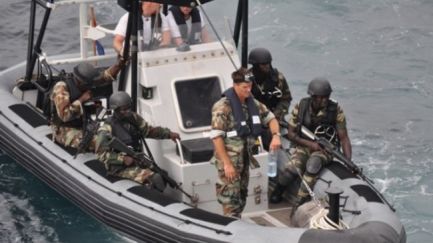
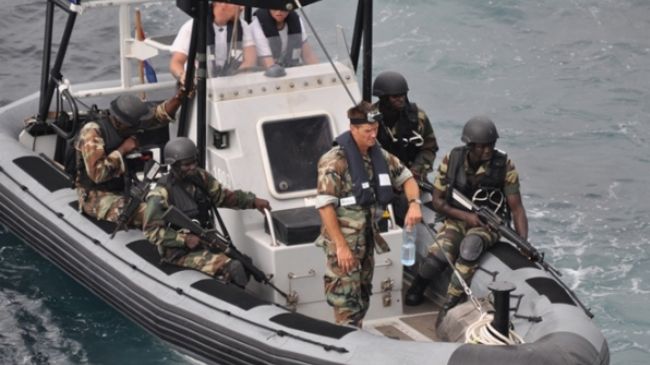
US troops join Dutch, Spanish, British and Senegalese forces during patrols and amphibious landings in Dakar, Senegal, in September of 2013.
The Pentagon has begun a surge of spending in Africa through expanding its main base on the continent and making investments in various fields there.
The Pentagon is currently increasing investments in air facilities, flight services, telecommunications and electrical upgrades in the African continent, The Tribune Washington Bureau (MCT) reports.
According to unclassified federal documents, hundreds of millions of dollars are flowing into Africa, indicating the importance the US is attaching to the continent.
Camp Lemonnier in Djibouti, on the cost of Gulf of Aden north of Somalia, is the place where the Pentagon is expanding its activities the most.
The camp has been the Pentagon’s main facility in the continent for nearly 10 years now. It currently houses approximately 4,000 US military personnel and civilian contractors.
The Pentagon views the base as the constellation center of US military sites across Africa, including facilities in Manda Bay, Kenya; Entebbe, Uganda; and the West African nation of Burkina Faso.
Last month, $200 million was awarded in contracts to revamp the power plants at the base and construct a multistory operations center, an aircraft hangar, living quarters, gyms and other facilities.
The project is just part of $1.2 billion which is projected to be spent there for improvement purposes during the next 25 year.
The US is also training regional militaries in the continent, increasing air strikes and conducting drone surveillance.
Thousands of US soldiers are now gearing up for missions in Africa as part of a new Pentagon strategy to train and advise indigenous forces, the New York Times reports.
In addition to training African militaries, the US has been launching a massive build-up of troops into Italy, putting 13,000 troops in the nation to be able to launch raids into Africa, particularly northern Africa, at a moment’s notice.
There is also a growing constellation of small US drone outposts in countries like Niger, Ethiopia, and Djibouti, strategically placed on the Gulf of Aden.
October 21, 2013
Posted by aletho |
Militarism | Africa, Camp Lemonnier, Gulf of Aden, United States |
Leave a comment
A new UN report warns that the use of armed drones threatens global security and encourages more states to acquire unmanned weapons.
The report, which has been submitted to UN General Assembly by Christof Heyns — the organization’s special rapporteur on extrajudicial killings, summary or arbitrary executions — called for states that operate armed drones to be more transparent and publicly disclose how they use them, The Guardian reported on Thursday.
“The expansive use of armed drones by the first states to acquire them, if not challenged, can do structural damage to the cornerstones of international security and set precedents that undermine the protection of life across the globe in the longer term,” the report said.
“The use of drones by states to exercise essentially a global policing function to counter potential threats presents a danger to the protection of life, because the tools of domestic policing (such as capture) are not available, and the more permissive targeting framework of the laws of war is often used instead,” it pointed out.
The report also called for international laws to be respected rather than ignored.
“The view that mere past involvement in planning attacks is sufficient to render an individual targetable, even where there is no evidence of a specific and immediate attack, distorts the requirements established in international human rights law,” stated the report.
Countries cannot consent “to the violation of their obligations under international humanitarian law or international human rights law,” it added.
Heyns noted that “drones come from the sky but leave the heavy footprint of war on the communities they target.”
“The claims that drones are more precise in targeting cannot be accepted uncritically, not least because terms such as ‘terrorist’ or ‘militant’ are sometimes used to describe people who are in truth protected civilians,” he said.
The report is the first of two major papers on drone strikes due to be debated at the UN General Assembly on October25. The second, by Ben Emmerson, special rapporteur on counter-terrorism, will be published next week.
Although no state is identified in the report, the comments are clearly directed at the legal problems raised by the US program of aerial attacks against what it describes as militants in other countries.
Emmerson said that drone strikes have killed far more civilians than US officials have publicly acknowledged.
He said on Thursday that at least 400 in Pakistan and as many as 58 in Yemen have been killed by the CIA drone strikes, and censured the US for failing to aid the investigation by disclosing its own figures.
The report was welcomed by the London-based human rights group Reprieve, which represents several civilian victims of drone strikes in Pakistan and Yemen.
“This report rightly states that the US’s secretive drone war is a danger not only to innocent civilians on the ground but also to international security as a whole.
“The CIA’s campaign must be brought out of the shadows: we need to see real accountability for the hundreds of civilians who have been killed – and justice for their relatives. Among Reprieve’s clients are young Pakistani children who saw their grandmother killed in front of them – the CIA must not be allowed to continue to smear these people as ‘terrorists’,” said its legal director, Kat Craig.
Washington uses assassination drones in several countries, claiming that they target “terrorists”. According to witnesses, however, the attacks have mostly led to massive civilian casualties.
October 18, 2013
Posted by aletho |
War Crimes | Africa, Central Intelligence Agency, Christof Heyns, CIA, Drone attacks in Pakistan, Human rights, Pakistan, United States, Yemen |
Leave a comment
The African Union is on a collision course with the International Criminal Court, a tribunal that has indicted only Africans since its founding in 2002. In an extraordinary meeting of the African Union at it headquarters in Addis Abbaba, Ethiopia, the AU took the position that no sitting head of state should be prosecuted by the ICC while still in office. In the immediate term, the AU calls for the postponement of the trial of Kenyan president Uhuru Kenyatta, scheduled to begin in the The Hague, next month. Kenyatta and his deputy president are charged with crimes against humanity stemming from election violence in 2007. Last weekend, President Kenyatta told the African Union that the International Criminal Court “stopped being the home of justice the day it became the toy of declining imperial powers” – a clear reference to the United States and Britain.
And that is the heart of the matter. It is a travesty of justice that the ICC only indicts Africans, but even more importantly, the International Criminal Court also only indicts those politicians that get on the wrong side of the United States and the former colonial powers in Africa. The ICC is a tool of U.S. foreign policy, an instrument of neocolonialism.
Among the apologists for the ICC is South African former archbishop Desmond Tutu, who says African leaders are “effectively looking for a license to kill, maim and oppress their own people without consequence.” Tutu says it all boils down to a question of “who should represent the interests of the victims?” However, in the real world of imperial power, Desmond Tutu’s reasoning is specious, shallow. He might just as well argue for the return of colonial rule, which established its own kind of law and order in Africa. The question is, whose law and whose order? The ICC represents U.S. foreign policy masquerading as law.
Tutu maintains that, without the deterrence of the ICC, African “countries could and would attack their neighbors, or minorities in their own countries, with impunity.” Well, that is, in fact, the case right now in Africa, and it has occurred with the complicity of the ICC, which has sanctioned and morally assisted mass murder and outright genocide by American allies on the continent.
And here lies the great irony. The very nations that most strongly oppose the ICC – Rwanda, Uganda and Ethiopia – have the blood of millions on their hands. Rwanda and Uganda are principally responsible for the death of six million Congolese over the past 17 years, an ongoing genocide armed and financed by the United States and Britain. The Ethiopian regime’s brutality toward its Somali and Omoro ethnic groups has also been described as genocidal. But, because the United States is also deeply complicit in these crimes, there is no threat of prosecution by the International Criminal Court. The court is only deployed against those countries and leaders targeted by the United States.
So, why are Ethiopia, Rwanda and Uganda worried? Clearly, they understand that, if the United States can give impunity, it can also take it away. They remember that Iraq’s Saddam Hussein used to be a U.S. ally, and that Libya’s Muammar Gadaffi and Syria’s Bashar al-Assad cooperated with the U.S. war on terror – until the U.S. turned against them. The worst purveyor of crimes against humanity in Africa and the world is U.S. imperialism. The ICC is a cog in the imperial machinery, which recognizes no law, but only its own interests. You can’t fight U.S. Empire and its crimes and, at the same time, defend the International Criminal Court. They are one and the same.
Glen Ford can be contacted at Glen.Ford@BlackAgendaReport.com.
October 16, 2013
Posted by aletho |
Ethnic Cleansing, Racism, Zionism, Timeless or most popular, War Crimes | Africa, African Union, Desmond Tutu, Ethiopia, International Criminal Court, Rwanda, Uhuru Kenyatta, United States |
Leave a comment


 Aletho News
 Aletho News