EU free trade pact on hold as farmers revolt
RT | January 21, 2026
The European Parliament has voted to refer a trade agreement with the South American bloc Mercosur to the EU Court of Justice (CJEU). The move comes amid criticism of Commission President Ursula von der Leyen for bypassing normal EU procedures and widespread protests from farmers across the bloc.
On Saturday, the EU signed a trade pact with Mercosur members Argentina, Brazil, Paraguay, and Uruguay. The agreement that was projected to create the world’s biggest free trade zone still requires approval before it can take effect.
On Wednesday, the EU Parliament voted 334 in favor to 324 against, with 11 abstentions, to ask the CJEU to determine whether the deal is compatible with the bloc’s rules. The move now significantly delays the pact that had been negotiated for 25 years, and could potentially derail final approval.
The vote took place against the backdrop of criticism of von der Leyen for handling the Mercosur deal in a non-transparent way, splitting it into separate agreements to bypass national parliaments and reduce the European Parliament’s role to a formal opinion.
The deal has also faced widespread resistance from the agricultural sector, with farmers across the bloc staging mass protests over concerns that cheap imports could undercut their livelihoods. The latest rally began on Tuesday outside the European Parliament in Strasbourg and drew support from some lawmakers, continued overnight, and ended on Wednesday.
Von der Leyen had pushed the deal, describing it as a “clear and deliberate choice,” highlighting that the EU opts for “fair trade over tariffs” and “a productive long-term partnership over isolation.” The pact came just six months after she signed an agreement with US President Donald Trump that imposed a 15% tariff on most EU exports. The EC president faced strong pushback over the US deal from current and former EU officials and heads of member states.
The EU is Mercosur’s second-largest trading partner, accounting for nearly 17% of the bloc’s total trade in 2024, at €111 billion.
Villains of Judea: Paul Singer’s Empire of Debt & Demographic Replacement
Paul Singer is the embodiment of Jewish plutocracy
José Niño Unfiltered | January 12, 2026
Paul Elliott Singer stands as one of the most influential figures in global finance. The Jewish billionaire hedge fund manager has amassed a fortune estimated at $6.2 billion to $6.7 billion by purchasing distressed sovereign debt and corporate bonds at deep discounts, then pursuing ruthless legal campaigns to extract full repayment plus interest.
Born August 22, 1944, in Teaneck, New Jersey, Singer transformed a $1.3 million startup in 1977 into Elliott Management, a hedge fund empire managing approximately $65.5 billion to $72 billion in assets.
Yet Singer does more than just make financial moves. He has emerged as a kingmaker in Republican politics, becoming the second-largest GOP donor in 2016, and a major force behind AIPAC, immigration reform, and LGBT rights advocacy. His business model has devastated entire communities from Sidney, Nebraska, to Buenos Aires, Argentina. His political activism spans seemingly contradictory causes, supporting both hawkish pro-Israel policies and same-sex marriage rights. His most recent venture, the $5.9 billion purchase of Venezuela’s Citgo assets, positions him to reap billions from the Trump administration’s military intervention in Venezuela.
Singer’s business model has earned him the moniker vulture capitalist. In the 1990s, Singer began leaving his mark after purchasing $20 million in Peruvian sovereign debt. Through aggressive litigation, he eventually secured a payout of $58 million, nearly triple his investment. A U.S. court revealed that Elliott’s purchase of Peruvian debt was made with the explicit intention of pursuing full repayment through lawsuits. Investigative journalist Greg Palast reported that Singer’s lawyer allegedly told him Singer allowed Peru’s President Alberto Fujimori, who fled the country ahead of murder charges, to escape in return for ordering Peru’s treasury to pay Singer $58 million.
Between 2002 and 2003, Singer earned over $100 million from a $30 million investment in Congo-Brazzaville debt. But his most audacious campaign targeted Argentina. After Argentina’s 2001 economic crisis, Singer purchased distressed bonds for approximately $117 million. He refused to participate in debt restructuring agreements that other creditors accepted, instead pursuing full repayment through international courts. The campaign culminated in a 2016 settlement that netted Elliott Management $2.4 billion, a staggering 1,270 percent return.
Singer’s tactics proved extraordinary even by hedge fund standards. In 2012, Elliott successfully convinced a Ghanaian court to detain the Argentine naval training vessel ARA Libertad with 220 crew members aboard, demanding $20 million for its release. Then-Argentine President Cristina Fernández de Kirchner refused to pay Singer’s fund, calling Elliott and similar firms “financial terrorists” and vulture funds. The Obama administration and Secretary of State Hillary Clinton demanded courts dismiss Singer’s attempt to bankrupt Argentina, but Singer’s legal campaign ultimately prevailed.
Pro-Israel Bankroller
Singer has emerged as one of the most significant donors to pro-Israel causes in the United States. Through The Paul E. Singer Foundation, he has donated approximately $300 million since 2010. Singer donated $2 million to AIPAC and contributed $3 million to AIPAC’s super PAC, United Democracy Project, since 2022, making him tied for AIPAC’s third-largest donor. He serves on the board of directors of the Republican Jewish Coalition and co-founded Start-Up Nation Central, an organization dedicated to connecting Israeli innovation with global markets.
Singer has also been a major funder of the Foundation for Defense of Democracies, a neoconservative think tank advocating hawkish policies aligned with Israeli interests. From 2008 to 2011, Singer contributed $3.6 million to FDD, making him the organization’s second-largest donor. The organization has been described by former Secretary of State Colin Powell’s chief of staff Lawrence Wilkerson as a fervent advocate for war against Iran. At the Jewish Funders Network in Jerusalem, Singer stated that “Israel may be the only insurance policy all Jews, everywhere, can rely upon for the safety and continuity of Judaism.”
Promoter of LGBT Degeneracy and Mass Migration
Like many Jewish plutocrats, Singer became a significant supporter of LGBT causes after his son Andrew came out as a homosexual. In 2012, Singer provided $1 million to start American Unity PAC, whose sole mission was to encourage Republican candidates to support same-sex marriage. From 2012 to 2015, he contributed over $5.5 million to this organization. In 2013, Singer donated $500,000 to the Human Rights Campaign. Since 2001, Singer has donated more than $11 million toward legalizing homosexual marriage and supporting LGBT causes.
Singer’s crusade to redefine marriage within Republican ranks was just one facet of his broader agenda; he soon pivoted to advocating mass immigration to transform America’s demographics. In 2013, Singer made a six-figure donation to the National Immigration Forum to support comprehensive immigration reform, better known as amnesty. As one of the first high-profile Republican megadonors to publicly back amnesty, Singer worked to marshal conservative support for an overhaul of federal laws. In 2014, Singer formed the American Opportunity Alliance, bringing together wealthy Republican donors who shared his support for LGBTQ rights, immigration reform, and Israel.
Singer’s Looting of Sidney, Nebraska
Singer’s domestic business dealings generated controversies as devastating as his international operations. In 2015, Elliott Management acquired an 11 percent stake in outdoor retailer Cabela’s and forced a merger with Bass Pro Shops that devastated Sidney, Nebraska, where Cabela’s was headquartered. The town experienced massive job losses, a significant housing value collapse, and economic depression. According to court filings, Elliott pressured Cabela’s board to sell the company until the board relented. The merger resulted in Elliott making nearly $100 million profit. Residents told Fox News producers that the hedge fund destroyed their town, with one saying, “If money is that big of a God to him, he is a pretty sick human being.”
Tucker Carlson’s Exposé
In December 2019, Fox News host Tucker Carlson devoted a major investigative segment to Paul Singer, focusing on the Cabela’s case. Carlson described Singer’s business model as “vulture capitalism” that involves “buying large stakes in American companies, firing workers, driving up short-term share prices, and in some cases, taking government bailouts.” He stated, “It bears no resemblance whatsoever to the capitalism we were promised in school. It creates nothing. It destroys entire cities. It couldn’t be uglier or more destructive.”
Carlson emphasized Singer’s political power, noting that “people like Paul Singer have tremendous influence over our political process.” He revealed that Singer was “the second largest donor to the Republican Party in 2016 and has given millions to a super PAC that supports Republican senators. Carlson noted, “You may never have heard of Paul Singer, which tells you a lot in itself, but in Washington he is rock star famous.”
As Carlson was producing the segment, he reported being warned repeatedly by people around Washington, “Don’t criticize Paul Singer, that’s not a good idea.” During the broadcast, Carlson received a text from a very well-known person in Washington saying, “Holy smokes, I can’t believe you’re doing this. I’m afraid of Paul Singer.”
Venezuela and Citgo
One of Singer’s most recent controversial business deals involves Venezuela’s Citgo Petroleum. In November 2025, Elliott Investment Management won a court-mandated auction to purchase Citgo for $5.9 billion. Citgo represents the crown jewel of Venezuela’s international oil assets, owning three major Gulf Coast refineries with capacity to process 800,000 barrels per day, 43 oil terminals, and over 4,000 gas stations.
Singer acquired Citgo at what multiple sources describe as a major discount. Court advisors estimated Citgo’s actual value at approximately $13 billion, while Venezuelan officials valued the assets at $18 billion to $20 billion. This means Singer paid roughly 45 percent of the estimated market value.
A highly controversial aspect of the sale involves Robert Pincus, the court-appointed special master who oversaw the auction and recommended Singer’s bid. Pincus sits on the national board of directors of AIPAC. Gold Reserve Inc., a competing bidder that offered $7.9 billion, filed motions to disqualify Pincus for conflicts of interest. Venezuela rejected the sale’s legitimacy, calling it a “fraudulent process” and the “theft of the century.”
Trump’s Venezuela Intervention is Singer’s Wet Dream
The timing of events raised serious questions about the relationship between Singer’s Citgo purchase and Trump administration actions. In 2024, Singer donated $5 million to Trump’s super PAC and contributed $37 million to support Republican congressional candidates. On January 3, 2026, U.S. armed forces conducted a military raid in Caracas, capturing Venezuelan President Nicolás Maduro.
The removal of Maduro positions Singer to reap enormous profits. Economist Paul Krugman noted, “If Trump lifts that embargo, Singer will receive a huge windfall.” Within days of Maduro’s capture, Trump announced that Venezuela would be turning over between 30 and 50 million barrels of oil to the United States.
Rep. Thomas Massie (R-KY), who is a staunch opponent of the intervention in Venezuela, also caught on to how Singer stands to benefit from military action against Venezuela. He tweeted on January 4, 2026, “According to Grok, Paul Singer, globalist Republican mega-donor who’s already spent $1,000,000 to defeat me in the next election, stands to make billions of dollars on his distressed CITGO investment, now that this administration has taken over Venezuela.”
As Massie noted, Singer has ponied up $1 million to MAGA KY, a super PAC seeking to unseat the Kentucky congressman. Singer and his fellow Zionist Jews view Massie as an obstacle to further consolidating Jewish supremacy in the halls of Congress.
All told, Singer is the embodiment of Jewish plutocracy. He bankrolls the West’s demise through his advocacy of LGBT degeneracy, mass migration, never-ending wars on behalf of world Jewry, and vulture finance. Americans must awaken to these existential threats, revoke their elite privileges, and halt the Great Replacement before it consigns our polities to historical oblivion.
Argentina cancels Tel Aviv embassy relocation over Israel’s drilling in South Atlantic: Report
Press TV – January 11, 2026
Argentina’s President Javier Milei has reportedly frozen at the last minute the relocation of the country’s embassy from Tel Aviv to the occupied al-Quds.
Israel’s Channel 12 reported that Milei, a devoted supporter of the occupying regime, took the decision after learning of the Israeli plan for oil drilling near the disputed Malvinas Islands in the South Atlantic Ocean, which are also known as the Falklands to the British.
Valued at $1.8 billion, the project is expected to begin in the coming weeks with the Israeli company Navitas aiming to produce 32,000 barrels of oil per day.
Argentine officials warned that the drilling project could damage relations between Tel Aviv and Buenos Aires, which have improved under Milei’s presidency.
Milei has openly praised Israel’s acts of aggression, including the genocidal war against Palestinians in the Gaza Strip.
He had earlier pledged to move Argentina’s embassy from Tel Aviv to the occupied al-Quds by 2026.
Milei’s pro‑Israel stance also includes deepening political and economic ties.
He used his $1 million Genesis Prize award to launch the so-called “Isaac Accords,” a framework intended to normalize relations between the Israeli regime and Latin American countries in areas including technology and education.
The Malvinas Islands are situated just over 480 kilometers from the Argentine coast in the South Atlantic Ocean. The UK has occupied the archipelago since 1833.
Argentina and the UK fought a 10-week war over the archipelago in April-June 1982, with the UK eventually prevailing with the help of its allies.
The Argentinean government has periodically stepped up efforts to regain control of the islands, home to an estimated 3,200 people from different countries.
In 2016, the two sides agreed to cooperate on issues such as energy and shipping despite disagreements about the islands’ sovereignty.
The Rise of the Isaac Accords: How Israel is Redrawing South America’s Political Landscape
This is not neutral cooperation. It is political conditionality.
By Freddie Ponton | 21st Century Wire | December 15, 2025
Foreign influence in the Global South rarely arrives in uniform. It comes disguised as ethics, stability, and shared values, only revealing its true cost once the rules are set. In Latin America, such a transformation is now underway. A new architecture of alignment is being quietly assembled, presented as moral course correction but functioning as a geopolitical filter. At its core lie the Isaac Accords, a project deliberately modelled on the Abraham Accords. Where the latter normalised Israel’s position in the Middle East through elite deals brokered by Washington, the Isaac Accords aim to reorder Latin American politics by locking governments, economies, and security institutions into Israeli and U.S. strategic orbit.
The Accords are not simply about Israel’s image or diplomatic isolation. They operate as a filter of legitimacy: governments that align are embraced, financed, and promoted; those that resist are marginalised, sanctioned, or framed as moral outliers. Venezuela, long aligned with Palestine and the broader Axis of Non-Alignment, sits squarely in the crosshairs.
This article examines how the Isaac Accords function in practice, why figures such as Javier Milei and María Corina Machado have become central to their rollout, and what this strategy reveals about Israel’s ambitions in South America, not as a neutral partner, but as an active geopolitical actor working in tandem with U.S. power.
The Isaac Accords: A Latin American Reboot of the Abraham Model
The Isaac Accords did not emerge in a vacuum. They are consciously modelled on the Abraham Accords, which rebranded Israel’s regional integration in the Middle East as “peace” while bypassing Palestinian self-determination entirely. The lesson Israeli and U.S. policymakers appear to have drawn is simple: normalisation works best when imposed from above, through elite alignment, financial incentives, and security integration.
The Accords are administered through a U.S.-based nonprofit, American Friends of the Isaac Accords, and financially seeded through institutions closely linked to Israeli state and diaspora networks. Their stated aim is to counter antisemitism and hostility toward Israel. Their operational requirements, however, reveal a far broader ambition.
Countries seeking entry are expected to:
- Relocate embassies to Jerusalem, recognising Israeli sovereignty over a contested city
- Redesignate Hamas and Hezbollah in line with Israeli security doctrine
- Reverse voting patterns at the UN and the OAS, where Latin America has historically voted in favour of Palestinian rights
- Enter intelligence-sharing agreements targeting Chinese, Iranian, Cuban, Bolivian, and Venezuelan influence
- Open strategic sectors: water, agriculture, digital governance, security, to Israeli firms
Israel’s own diplomats have described the Isaac Accords as a way to pull “undecided” Latin American states into Israel’s orbit at a moment when European public opinion has become less reliable. In other words, the Global South is being repositioned as Israel’s strategic rear guard.
The role of Javier Milei in Argentina illustrates how this model operates. Milei has not merely improved relations with Israel; he has embraced it as an ideological reference point. He has pledged to move Argentina’s embassy to Jerusalem, framed Israel as a civilisational ally, and positioned himself as the Isaac Accords’ flagship political figure.

Co-Founder and Chairman of The Genesis Prize Foundation Stan Polovets presents prize to 2025 Laureate Javier Milei on June 12 in Jerusalem. (Source: American Friends of Isaac Accords)

That role was formalised in 2025 when Milei became the Genesis Prize Laureate, an award frequently described as the “Jewish Nobel Prize.” The Genesis Prize is not politically neutral. It is explicitly awarded to figures who strengthen Israel’s global standing and its ties with the diaspora. Milei’s decision to donate the prize money directly back into the Isaac Accords ecosystem symbolised how moral recognition, political allegiance, and financing now operate as a single circuit.
This is alignment rewarded, visibly, materially, and publicly.
As reported by AP in August, the Isaac Accords are set to extend to Brazil, Colombia, Chile, and potentially El Salvador by 2026, as stated by the organizers, the American Friends of the Isaac Accords.
Recent New York Times reporting situates Brad Parscale’s involvement in the Honduran election within Numen, a Buenos Aires–based political consultancy he co-founded with Argentine strategist Fernando Cerimedo, highlighting how transnational firms operate beyond traditional regulatory scrutiny. Critics warn that Numen’s methods reflect a broader global political influence ecosystem that often draws on data-driven targeting, psychological profiling, and digital amplification techniques associated with Israeli-linked political technology and messaging firms that have operated in elections worldwide.
When combined with U.S. political endorsements, strategic pardons, and offshore consulting structures, this model raises serious concerns about how advanced data analytics and covert messaging infrastructures are used to shape voter behavior in vulnerable democracies, eroding electoral sovereignty while remaining largely insulated from accountability.
Venezuela, Palestine, and the Manufacturing of Illegitimacy
If the Isaac Accords require a moral antagonist, Venezuela fulfils that role perfectly.
Since Hugo Chávez severed diplomatic relations with Israel in 2009, in response to Israel’s assault on Gaza, Venezuela has positioned itself as one of Palestine’s most consistent supporters in the Western Hemisphere. Chávez, and later Nicolás Maduro, framed Palestinian resistance not as terrorism but as an anti-colonial struggle, aligning Venezuela with much of the Global South rather than the Atlantic bloc.
Under the Isaac Accords’ logic, this position is intolerable.
Opposition to Israel is no longer treated as a political stance but as evidence of extremism or antisemitism. Zionism and Judaism are deliberately conflated, allowing criticism of Israeli state policy to be reframed as hatred. This narrative provides the moral justification for isolation, sanctions, and, potentially, regime change.
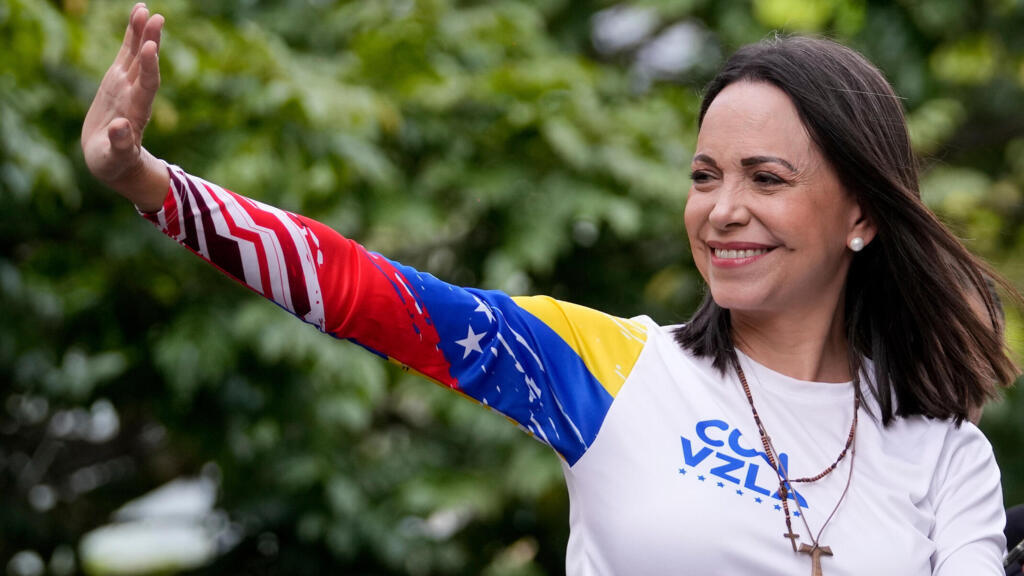
Maria Corina Machado in Venezuela, Thursday, July 25, 2024. (Source: AP – Matias Delacroix)
Into this context steps María Corina Machado, the Venezuelan opposition figure most warmly received by Israeli and U.S. political networks. Machado’s alignment with Israel is not rhetorical or recent. In 2020, her party, Vente Venezuela, signed a formal inter-party cooperation agreement with Israel’s ruling Likud Party, led by Benjamin Netanyahu. The agreement committed both parties to shared political values, strategic cooperation, and ideological alignment.
This is a remarkable document. It ties a Venezuelan opposition movement directly to a foreign ruling party, well before any democratic transition, and signals how a post-Maduro Venezuela is expected to orient itself internationally.
DOCUMENT: Vente Venezuela signs cooperation agreement with Israel’s Likud party – Agreement signed by María Corina Machado and Eli Vered Hazan, representing Likud’s Foreign Relations Division (Source: Vente Venezuela)
Machado has since gone further, pledging to:
- Restore full diplomatic relations with Israel
- Move Venezuela’s embassy to Jerusalem
- Open Venezuela’s economy to privatisation and foreign investment
- Align Venezuela with Israel and the United States against Iran and regional leftist governments
Her narrative rests on a crucial claim: that Venezuela itself is not anti-Israel, only its government is. According to this framing, Venezuelans are inherently pro-Israel and pro-West, their “true” preferences suppressed by an illegitimate regime.
In a November interview with Israel Hayom, Machado asserted that “The Venezuelan people deeply admire Israel.”
This argument is politically useful and historically thin. Venezuelan solidarity with Palestine predates Maduro and reflects a wider Latin American tradition of identifying with colonised peoples. To erase that history is to deny Venezuelans their own political agency.
The Anti-Defamation League (ADL) has repeatedly accused the Venezuelan government of fomenting “anti-Israel” and anti-Semitic rhetoric. Yet, a closer look tells a different story. Caracas’ statements are largely expressions of solidarity with the Palestinian people and their right to self-determination, combined with pointed criticism of Israeli state policies. By framing these positions as attacks on Jews or Israel itself, the ADL distorts the narrative, turning principled political stances into a perceived moral failing. This tactic underscores a broader pattern in which international organizations can paint Global South governments as rogue actors whenever they resist the gravitational pull of Israeli and U.S. influence, subtly laying the groundwork for diplomatic pressure or intervention.
DOCUMENT: Mini report from the Anti-Defamation League (ADL), formerly known as the Anti-Defamation League of B’nai B’rith, accuses Venezuela of fuelling an incendiary anti-Israel and anti-Semitic environment.(Source (ADL)
Security, Economics, and the Cost of Obedience
Beneath the moral language of the Isaac Accords lies a familiar architecture of control: security integration, economic restructuring, and ideological discipline.
Israel is a leading exporter of surveillance technologies, border systems, cyber-intelligence platforms, and urban security tools, many developed under conditions of occupation and internal repression. In South America, these systems are marketed as solutions to crime and narcotrafficking, but their real function is often political: expanding state surveillance capacity during periods of transition.
Security cooperation creates dependency. Once intelligence-sharing, training, and doctrine are integrated, political autonomy narrows. Policy divergence, particularly toward China, BRICS, or non-aligned partners, becomes risky.
The economic dimension is equally strategic. Israeli firms are deeply involved in water rights, desalination, agrotechnology, digital governance, and infrastructure, sectors that determine long-term sovereignty. These investments are typically tied to privatisation, deregulation, and long-term concessions, transferring control of strategic resources away from the public sphere.
Venezuela is the ultimate prize. A post-sanctions transition would open one of the world’s most resource-rich economies to restructuring. Machado’s commitment to rapid privatisation aligns seamlessly with this vision, raising an unavoidable question: who benefits from “democracy” when it arrives pre-packaged with foreign economic priorities?
This strategy is inseparable from U.S. power. The Trump administration’s framing of global politics as a permanent war on terror and narcotrafficking, a framing echoed by figures like Marco Rubio, has provided cover for sanctions, covert operations, and extrajudicial violence across the Caribbean and Pacific. Israel’s partnership reinforces this logic, supplying both technology and moral framing.
Conclusion: The Global South and the Right to Choose
The Isaac Accords are not simply about Israel’s diplomatic standing. They are about reordering South America’s political horizon at a moment when the Global South is rediscovering multipolarity.
Israel’s role in this process is active, strategic, and consequential. Through political patronage, economic leverage, security integration, and narrative control, it is shaping which governments are deemed legitimate and which are disposable.
For South America, and the wider Global South, the warning is familiar. When alignment is framed as morality, dissent becomes deviance. When sovereignty is conditional, development serves external interests. When history is rewritten, intervention soon follows.
Non-alignment was never about isolation. It was about the right to choose. That very right, today, is being quietly renegotiated, and the cost of refusing may soon become very clear.
Milei launches ‘Isaac Accords’ to expand Israeli influence in Latin America

The Cradle | November 29, 2025
Argentinian President Javier Milei formally launched the Isaac Accords on 29 November, a new initiative aimed at strengthening political, economic, and cultural cooperation between Israel and Latin America.
Milei announced the initiative following a meeting with Israeli Foreign Minister Gideon Saar, who visited Buenos Aires on Saturday as part of a regional diplomatic tour.
The Isaac Accords are being promoted in partnership with Washington and are modeled after the Abraham Accords, which normalized relations between Israel and several Arab countries, including the UAE, Bahrain, and Morocco.
Milei said Argentina would serve as a “pioneer” alongside the US to promote the new framework to other Latin American countries, including Uruguay, Panama, and Costa Rica.
Foreign Minister Gideon Saar praised Milei’s love of Judaism and Israel as “sincere, powerful, and moving.”
Before the meeting began, Milei recited the “Shehecheyanu,” a traditional Jewish blessing, and placed a kippah on his head.
“When the president saw me place the kippah on my head to make the blessing, he immediately placed on his own head the kippah he keeps in his office,” Saar wrote.
After his election, Milei “transformed Argentina from a critic of Israel to one of its staunchest supporters,” according to the Times of Israel, including announcing plans to move its embassy to occupied Jerusalem.
Though Milei was raised Catholic, he has stated he will convert to Judaism once he leaves office.
Argentine officials said that possible joint projects with Israel in the fields of technology, security, and economic development are already under consideration.
Argentina’s Foreign Minister Pablo Quirno is scheduled to travel to Israel in February for additional talks to advance the initiative.
Since coming to power, Milei has opened Argentina’s economy to exploitation by foreign investors, including by evicting Mapuche tribes from their lands in the southern Patagonia region.
Foreign corporations with major investments in the Argentine Patagonia include the Israeli firm Mekorot, the Italian firm Benetton, and investment companies from the UAE, among others.
UN overwhelmingly endorses declaration on Palestinian state
Press TV – September 12, 2025
The United Nations General Assembly has overwhelmingly voted to endorse a declaration outlining “tangible, timebound, and irreversible steps” towards the establishment of a Palestinian state.
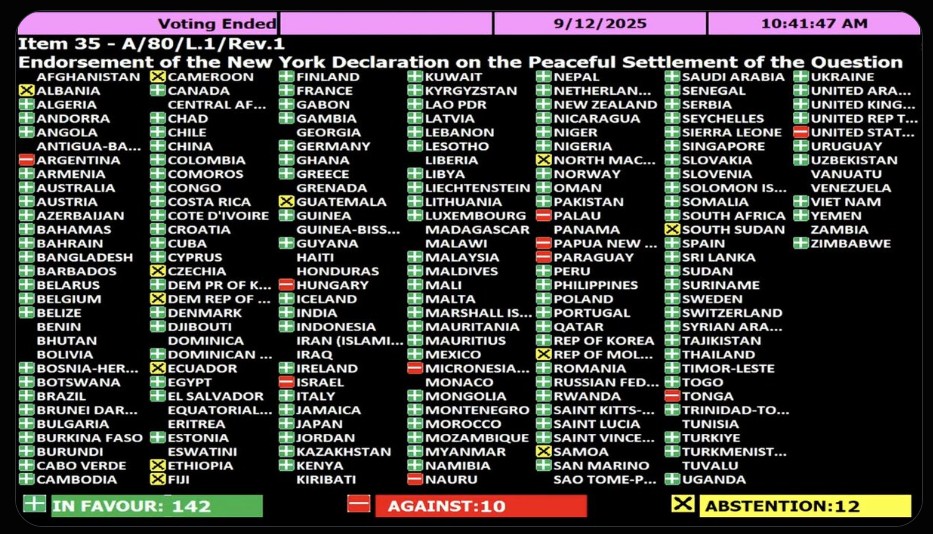
The 142-10 vote on Friday was to endorse the so-called New York declaration, a statement calling for a two-state solution, crafted by France and Saudi Arabia in July.
Joining Israel and the United States in opposing the resolution were Argentina, Hungary, Micronesia, Nauru, Palau, Papua New Guinea, Paraguay and Tonga. Twelve countries abstained.
Israel, US isolated
The seven-page declaration is the result of an international conference at the UN on the decades-long Israeli occupation. The United States and Israel boycotted the event.
The declaration, which excludes Hamas, also calls for “collective action to end the Israeli war in Gaza and effective implementation of the two-state solution.”
The declaration, was endorsed by the Arab League and co-signed in July by 17 UN member states, including several Arab countries
Long-time Western allies of Israel, including Belgium, France, the UK, Canada, and Australia, had earlier announced plans to recognize Palestinian statehood during the upcoming UN General Assembly sessions from September 8–23. They would join 147 nations that already formally recognize Palestine.
Around three-quarters of the 193 UN member states recognize the Palestinian state proclaimed in 1988 by the exiled Palestinian leadership.
Benjamin Netanyahu, Israeli prime minister, insisted on Thursday that Israel would never accept a Palestinian state.
Gideon Saar, the Israeli foreign minister, recently threatened that the Europeans’ recognition of Palestinian statehood would push Tel Aviv into “unilateral decisions”.
Israel’s far-right finance minister, Bezalel Smotrich, has announced plans to annex more than 80 percent of the occupied West Bank in a bid to block the establishment of a Palestinian state.
On August 14, Smotrich announced his intention to move forward with the highly contentious settlement project across the occupied West Bank that “buries the concept of a Palestinian state”.
In July 2024, the International Court of Justice (ICJ) declared Israel’s occupation of the Palestinian territory illegal and called for the evacuation of all settlements in the West Bank and East al-Quds. All mere words.
The recognition of a Palestinian state comes as international pressure was mounting on the regime over its genocidal war in the besieged Gaza Strip.
Since the Israeli genocide began in October 2023, the death toll has surpassed 64,700, with more than 164,000 others wounded.
The AMIA case: The untold story
By Raphael Machado | Strategic Culture Foundation | July 27, 2025
On the morning of July 18, 1994, a bomb exploded at the headquarters of the Argentine Israelite Mutual Association (AMIA) in downtown Buenos Aires, leveling the building and killing 85 people, with over 300 injured.
The attack occurred two years after the bombing of the Israeli embassy in Argentina, which left 22 dead and 242 wounded. Both attacks took place during the presidency of Carlos Menem, a government that was pivotal for Argentina as it marked a transition to neoliberalism, featuring mass privatizations and a partial dollarization of the economy.
But on the geopolitical front, the Menem administration is more remembered for the apparent “secret war” that unfolded within the country, involving intelligence agencies and subversive groups from various nations.
The most widely accepted version of the AMIA case goes as follows: To retaliate against the cancellation of a nuclear technology transfer agreement between Argentina and Iran, the Iranian government (then under President Akbar Rafsanjani) orchestrated an act of revenge, with operatives from the Lebanese Hezbollah carrying it out.
This narrative, elevated to “official truth,” was supported by intelligence reports from the U.S. and Israel. It led to Argentina designating Hezbollah as a terrorist organization and the rupture of previously friendly relations between Argentina and Iran.
But what if this popular version is wrong?
Recently, a former aide to Judge Juan José Galeano—who oversaw the investigation and trial from 1994 to 2005—revealed details that cast doubt on the established narrative. According to Claudio Lifschitz, Galeano’s former assistant and a former Argentine security official, no concrete evidence linking the Iranian government to the attack was ever found. On the contrary, Lifschitz claims that the evidence increasingly pointed toward elements within Argentina’s intelligence service, SIDE.
Lifschitz first entered the public eye in this case when he released a video recording of a meeting between Galeano and Carlos Telleldín, in which the judge allegedly offered money to the supposed supplier of the van used in the attack—in exchange for confessing that he had sold it to Mohsen Rabbani, the cultural attaché at the Iranian Embassy in Buenos Aires. According to Lifschitz, one of the key pieces of evidence that could exonerate Iran is the fact that SIDE had illegally wiretapped—without a court order—the Iranian Embassy and the Iranian Cultural Center in Buenos Aires, amassing thousands of hours of recordings without a single indication that any Iranians frequenting these places had prior knowledge of the attack.
The real mastermind, Lifschitz alleges, was Jaime Stiuso, deputy chief of SIDE’s counterintelligence division (Section 85) and the officer in charge of intelligence investigations for the AMIA case. According to Lifschitz, Telleldín had actually sold the van used in the attack to a SIDE agent. Furthermore, Stiuso—who had close ties to Mossad and the CIA—was allegedly responsible for constructing the accusation made by prosecutor Alberto Nisman that then-President Cristina Kirchner had sought to cover up Iranian involvement in the case.
The former Argentine intelligence agent claims he heard directly from Stiuso that Mossad was the real force behind the attacks—though it remains difficult to verify whether this conversation actually took place.
The case remains relevant today because it is being leveraged by Javier Milei’s government to justify closer ties with Israel, to the point where the Argentine president has labeled Iran as an “enemy state of Argentina.”
Iran rejects Argentina’s ‘baseless’ accusations in 1994 AMIA case, urges fair probe
Press TV – July 18, 2025
Tehran has dismissed “baseless” accusations leveled by Argentina at Iranian nationals in connection with the deadly 1994 AMIA bombing, urging the country’s judiciary to handle the case fairly without third-party influence.
The Iranian Foreign Ministry issued a statement on Friday, marking the 31th anniversary of the bombing attack on the Argentine Israeli Mutual Association (AMIA) community centre in Buenos Aires on July 18, 1994, that killed 85 people and injured over 300 others.
It said that elements and currents linked to Israel exploited the “suspicious” explosion from the very beginning and diverted the case into a misleading and incorrect path, disrupting the longstanding Iran-Argentine relations.
It also noted that over the past three decades, Iran has repeatedly declared its position in condemnation of any act of terrorism and stressed the need for a transparent and fair trial into the incident.
“Completely rejecting the accusations against its citizens, the Islamic Republic has condemned the insistence of certain domestic circles in Argentine to pressure the country’s judicial system into issuing baseless charges and seemingly judicial rulings against Iranian citizens,” it said. “Iran has called for the real masterminds and perpetrators of the explosion to be identified.”
Meanwhile, the Foreign Ministry added that in the past years, clear and undeniable evidence has emerged indicating that the Zionist regime and its affiliated currents are exerting influence and pressure on the Argentinean judicial system to make accusations against Iranians.
It further highlighted frequent changes in the judicial team investigating the AMIA case, the revelation of corruption among some judicial elements, the resignation of judges and even attempts on their lives, as an evidence of a “purposeful will to divert the Argentinean judicial system from a transparent and fair probe into the case.”
With the sole aim of protecting bilateral ties and restoring the dignity of Iranian citizens, the Islamic Republic entered into talks with Argentina, which resulted in the signing of a memorandum of understanding in 2013, the ministry said. Less than two years later, however, Buenos Aires unilaterally canceled the deal and prevented the formation of a transparent process aimed at revealing the truth and identifying those behind the blast.
“The Islamic Republic strongly emphasizes the baseless nature of claims against Iranian citizens, insists on the restoration of the accused citizens’ dignity and demands an end to the show trial, while expecting the Argentinean judicial authorities to handle the case in a transparent and fair manner free from politicization and undue influence by third parties,” it asserted.
“In accordance with international law, the Islamic Republic reserves its legal and legitimate rights to respond to any inappropriate and unreasonable action against itself and its citizens.”
Argentina’s AI and the Rise of Pre-Crime Digital Surveillance
By Ken Macon | Reclaim The Net | August 5, 2024
Argentina’s new initiative to launch the Applied Artificial Intelligence for Security Unit (UIAAS) represents a concerning step toward a surveillance-heavy approach to tackling crime. Under the guise of innovation, this unit, embedded within the Ministry of Security, integrates artificial intelligence to not only sift through vast amounts of historical crime data but also to monitor social media activities ostensibly to predict and preempt criminal behavior.
This approach raises significant ethical questions, especially regarding privacy and civil liberties. The idea that AI can predict future crimes based on patterns might sound efficient, but it harbors risks of overreach, profiling, and potentially unjustified surveillance. The emphasis on monitoring social media activities and detecting “potential threats” could easily slide into invasive scrutiny of everyday citizens’ lives under a loosely defined mandate.
Critics have voiced many concerns. Their skepticism highlights a broader apprehension about the trade-offs between using AI in law enforcement and the erosion of personal freedoms. The capacity for AI to be misused under the pretext of security could set a dangerous precedent, potentially leading to a dystopian reality where personal spaces and freedoms are heavily compromised by state surveillance.
Argentina’s pioneering step, therefore, should be viewed critically, demanding rigorous scrutiny and debate to ensure that the pursuit of security does not trample the very liberties it aims to protect. The line between safeguarding citizens and surveilling them must be navigated with caution to prevent an unsettling shift towards an AI-driven surveillance state.
Hamas calls on 18 countries signing hostage release initiative to expose Israel’s crimes
MEMO | April 27, 2024
US to Allocate $40Mln in Defense Aid to Argentina Wishing to Be NATO’s Partner – Embassy
Sputnik – 19.04.2024
The United States will allocate $40 million to support defense modernization of Argentina, which has declared its intention to become NATO’s global partner, the US Embassy in Buenos Aires said.
On Thursday, Argentine Defense Minister Luis Alfonso Petri said that Buenos Aires wanted to become NATO’s global partner and had already submitted a corresponding request. NATO Deputy Secretary General Mircea Geoana welcomed the request, saying that closer political and practical cooperation could benefit both parties.
“The United States is proud to announce that it is providing $40 million in Foreign Military Financing (FMF) to support Argentina’s defense modernization,” the embassy said in a statement released on Thursday.
The diplomatic mission noted that such support is provided only to the US’s important partners.
Argentina will be able to purchase defense products, training services, and improve interaction thanks to US military aid. The funds will also contribute to Argentina’s purchase of F-16 fighter jets, the statement read.
In November 2023, Javier Milei won the runoff presidential election in Argentina. During the presidential campaign, Milei spoke against joining BRICS and cooperating with China, Brazil and Russia, and advocated a foreign policy oriented toward Israel and the United States.
‘Unsubstantiated’: Iran rejects Argentine court’s blaming for AMIA bombing
Press TV – April 17, 2024
The spokesperson for Iran’s Foreign Ministry has dismissed a ruling by an Argentine court that blames Iran for two bombing attacks in the country during the 1990s, labeling the claims in the verdict as unsubstantiated and politically motivated.
“From Iran’s perspective, the court’s involvement in the AMIA building explosion case and its final judgment on the motives and primary causes of the blast is premature and lacks legal-judicial wisdom,” Nasser Kanaani said on Wednesday.
He was referencing a recent ruling by Argentina’s Court of Cassation, which attributed responsibility for the dual attacks on Israel’s embassy and the Argentine Israelite Mutual Association (AMIA) Jewish center in Buenos Aires to Iran and Lebanon’s Hezbollah movement.
The ruling, as reported by the press, alleged that Iran orchestrated the 1992 attack on Israel’s embassy and the 1994 bombing of the AMIA center.
The spokesperson argued that the ruling represents an effort to misdirect the investigation’s course to uncover the truth, as the case regarding the explosions is currently under review in another court.
“This demonstrates the execution of a new political project by the adversaries of the Islamic Republic of Iran, notably the Zionist regime,” he asserted.
The spokesperson highlighted that for the past thirty years, Iran has endorsed any constructive initiative to ascertain the truth behind the incident, including signing a memorandum of understanding with the Argentine government to establish a joint investigative commission.
“Unfortunately, the aforementioned actions have remained fruitless and have not achieved any result due to actions by those who have not sought to discover the truth and have always sacrificed the execution of justice for their political and partisan objectives within Argentina,” he said.
The spokesperson cautioned that the Israeli regime has repeatedly tried to shift focus from its genocide in Gaza, insinuating that it may have influenced the recent ruling.
“It is evident to all that in recent months, the Zionist regime has faced global condemnation for committing war crimes and the heinous killing of civilians, particularly Palestinian children and women in the Gaza Strip … [and is attempting] to distract the international community from its offenses in various ways.”
The 1992 and 1994 bombings in Argentina remain unclaimed and unresolved, although Israel has persistently accused Iran of involvement.
Argentina has cultivated strong ties with Israel under President Javier Milei, who has emerged as a fervent supporter of the regime.
Milei has backed the Israeli regime’s continued actions against Gaza, in contrast to most other Latin American leaders who have either cut ties with the regime or withdrawn their envoys from Tel Aviv.
Milei also recently declared that Argentina would join the few countries that have relocated their embassy in the Israeli-occupied territories from Tel Aviv to Al-Quds.
Featured Video

Michael von der Schulenburg: Europe’s Self-Defeating Iran War Policy
or go to
Aletho News Archives – Video-Images
Frlom the Archives
Who Rules America?
The Power Elite in the Time of Trump
By James Petras | Axis of Logic | September 6, 2017
Introduction
In the last few months, several competing political, economic and military sectors – linked to distinct ideological and ethnic groups – have clearly emerged at the centers of power.
We can identify some of the key competing and interlocking directorates of the power elite:
- Free marketers, with the ubiquitous presence of the ‘Israel First’ crowd.
- National capitalists, linked to rightwing ideologues.
- Generals, linked to the national security and the Pentagon apparatus, as well as defense industry.
- Business elites, linked to global capital.
This essay attempts to define the power wielders and evaluate their range of power and its impact. … continue
Blog Roll
 Aletho News
- Michael von der Schulenburg: Europe’s Self-Defeating Iran War Policy
- Sorry, The New Republic, Climate Change Isn’t Causing Somali Migration. Blame Civil Strife and Poverty.
- Expert Guts Claims That HPV Vaccine Reduces Cancer Risk
- No evidence Russia sabotaged Baltic cables – Finnish intel
- The Strategic Folly of a (Serious) US Ground Invasion of Iran
- US-Israeli war of aggression on Iran meant to reshape region: Omani FM
- Iran Does Not Consider Israel Party to Talks to Need Mediators With It – Ambassador
- Macron’s aircraft carrier and warplanes to the Persian Gulf is a dangerous vanity project
- Meet The Ellisons: Zionists, Technocrats, Moguls
- US failures in Iran reveal Russia is key to South Korea’s strategic security
- If Americans Knew
- Are we on the precipice of World War III?
- ‘Catastrophic,’ Says UNICEF: 1,100+ Children Killed or Wounded in Mideast Since US-Israel Launched Iran War
- The Unbelievable Madness of Our War With Iran
- World Council of Churches calls on govts to hold Israel accountable for violations of intl law
- How to end the war on Iran that costs US taxpayers $1M per minute – Not a ceasefire Day 153
- Israeli strategic plans to “remake the Middle East” from the 1950s and since
- Honoring Gaza’s women who refused to let the world look away
- 97% of victims of war on Iran are Iranian, 98% of victims in war on Gaza are Gazans – Not a ceasefire Day 152
- Early Iran strikes cost $5.6 billion in munitions, Pentagon estimates
- Israel Decided the War, But Trump’s America Fights and Pays the Bill
- No Tricks Zone
- Destructive Green New Deal: German Energy And Metal Group Warns Of Drastic Crisis
- New Study Documents A 20-Year Pause In Arctic Sea Ice Decline – Driven By Internal Variability
- Wake-up Call: Survey Shows Majority Of Germans Now Favor Postponing Climate Targets!
- Televised! Leading German Political Candidate Tells Schoolchildren CO2 Makes Sun Hotter!
- New Study: A Century Warming Of 1.1°C Is ‘Commonplace’ And ‘Not Unusual’ During This Interglacial
- New Study: ‘Internal Noise’ And Volcanic Forcing Can Trigger 10-15°C Warming Within Decades
- Glaciers Worldwide Are Suddendly Surging, Experts Blame Warming!
- Surprising Discovery: Sahara Is Greening…Billions Of Trees Where Once Thought To Be Barren
- New Research Reaffirms Clouds, Aerosols, And Surface Solar Radiation Are ‘Driving The Climate System’
- Germany: Electric Car Catches Fire At Charging Station, Sets Off Local “Inferno”, Widespread Damage
 Aletho News