Brazil’s Odebrecht Gave Argentina’s Macri US$500k For Presidential Run
teleSUR | April 30, 2017
Argentina’s President Mauricio Macri received US$500,000 from Brazil’s Odebrecht construction firm for his 2015 electoral campaign, Argentine daily La Nacion revealed on Sunday.
The donation was processed through Odebrecht’s Braksem SA branch, and appeared in Macri’s party 2015 balance record. The company defended the move as “totally legal,” saying the sum of money was for the purchase of cutlery for a fundraising dinner that Macri’s Cambiemos coalition organized in March of that year.
“Braksem belongs to Odebrecht, it’s dedicated to the petrochemical market, with a branch in Argentina,” said the paper. “The Brazilian giant’s strategy was to have this lower-profile branch’s name appear in order to avoid public exposure.”
The leak comes after Odebrecht admitted it funded the electoral campaigns of other Latin American presidents, including Colombia’s current President Juan Manuel Santos and Peru’s former President Ollanta Humala.
Macri was also one of the main figures involved in the Panama Papers scandal after a leak from a company revealed how world leaders had thousands of offshore companies in tax havens to avoid paying taxes.
For 2015, Macri declared his fortune as being worth US$110 million to Argentina’s Anti-Corruption Office, an increase of 100 percent from the US$52 million he reported for the 2014 fiscal year. Following the Panama Papers leak, Macri admitted to having over US$18 million in tax havens.
Macri’s government has proposed a tax amnesty bill, which has been approved by the country’s congress. This controversial law is aimed to shield tax evaders who have undeclared holdings and assets while offering them lower taxes in order for them to bring assets to the country.
At Macri’s request, the law excluded any relatives of officials who have engaged in money laundering or have undeclared assets abroad from legal responsibilities, a caveat that critics say is a clear wink at his own father and siblings.
Earlier this month, polls found that Macri’s approval rate dropped to 24 percent, with 54 percent of Argentines polled saying they did not trust him.
Trump Releases Declassified Operation Condor-Era Docs to Argentina

Chilean dictator Agusto Pinochet (L) and Argentine dictator Rafael Videla (R) | Photo: Wikimedia Commons
teleSUR | April 27, 2017
U.S. President Donald Trump met with Argentine President Mauricio Macri on Thursday, handing over 931 declassified Department of State records related to Operation Condor.
Operation Condor was a Cold War-era campaign of violence across Latin America that resulted in tens of thousands of activist deaths.
Trump’s release falls in line with former President Barack Obama’s promise to release intelligence documents about human rights abuses committed by the Argentine military dictatorship during the 1970s and 1980s.
Entitled “Secret/Exdis,” the declassified documents provide new insight into U.S. support for human rights abuses in Argentina and neighboring countries. Here’s what the reports divulged.
They describe Operation Condor as a trans-border, multinational effort by Southern Cone secret police services to “track down” and “liquidate” regime opponents, the National Security Archive reports.
They reveal that the orchestrators of Operation Condor considered establishing “field offices” in the United States and Europe.
They provide information about former President Jimmy Carter’s propping up of former dictator Rafael Videla in 1977. It has also been confirmed that Orlando Letelier, chief economist for former Chilean President Salvador Allende, was killed by members of Chile’s intelligence service under the Augusto Pinochet dictatorship.
Moreover, they include details about the censorship of U.S. Buenos Aires embassy human rights officer Tex Harris, who tried making human rights abuses public.
The declassification of other top secret documents is expected to occur before the end of the year. Records of 14 intelligence agencies, including the CIA, FBI, and DIA, are expected to be included in the release.
Argentine Indigenous Leader Milagro Sala Hit With New Sentence

teleSUR | December 30, 2016
An Argentine court slapped a new sentence against jailed Indigenous leader Milagro Sala Thursday, just a day after she was handed down a three-year suspended prison sentence for being guilty of “aggravated damages” linked to a protest she led against the conservative government in her home province in Jujuy.
The Jujuy court issued Sala the maximum fine of 3,870 Argentina pesos — nearly half the monthly minimum wage of 8,060 pesos — and prohibited her from participating in any civic and political organizations for three years, the same term as her suspended prison sentence.
Sala was charged with a misdemeanor of “occupying public space, disorderly conduct and the obstruction of vehicle and pedestrian traffic.” The court also ordered the Tupac Amaru organization that Sala leads to shut down its location in Jujuy.
Sala, who has been dubbed the first political prisoner of President Mauricio Macri’s administration, was jailed last January after leading a 52-day sit-in against Jujuy governor and Macri ally Gerardo Morales.
She was initially detained on accusations of inciting mob violence with the occupation — a protest that was reportedly carried out in a peaceful manner — but was soon hit with a barrage of other charges of alleged corruption and illicit enrichment that kept her behind bars for months as investigations continued.
The new three year prohibition of Sala’s participation in social and political organizations extends until the end of Morales’ term as the governor of Jujuy.
After being jailed for nearly a year, on Wednesday a court handed her three years probation with a suspended prison sentence.
Sala is the leader and founder of Tupac Amaru, a 70,000 member-strong organization inspired by the ideals of South American Indigenous liberator Tupac Amaru, revolutionary leader Che Guevara, and former Argentine First Lady Eva Peron, that works with Indigenous and poor communities on a number of political issues.
She is also a lawmaker with the parliament of the sub-regional South American trade bloc Mercosur, known as Parlasur, though her detention has blocked her from being able to fulfill her parliamentary duties.
The United Nations Working Group on Arbitrary Detention has slammed Sala’s arrest as arbitrary, calling for her immediate release. President Macri ignored the ruling.
Social movements have also rallied behind Milagro Sala, demanding her release as well as freedom for other political prisoners.
Argentina to Reopen Jewish Center Bombing Case Against Cristina
teleSUR | December 29, 2016
An Argentine federal appeals court will order the reopening of a probe that accuses former President Cristina Fernandez de Kirchner of covering up Iran’s alleged role in the bombing of a Jewish center in 1994, state news agency Telam said on Thursday.
Two years earlier the prosecutor who initially made the accusation, Alberto Nisman, was found shot dead in the bathroom of his Buenos Aires apartment. Nisman had said Fernandez worked behind the scenes to clear Iran and normalize relations to clinch a grains-for-oil deal with Tehran.
Nisman’s death rocked Argentina, with some trying to pin the blame on the government of Fernandez, whose late husband President Nestor Kirchner ordered the investigation into the AMIA bombing. However, courts have repeatedly dismissed the allegations of an official conspiracy.
Fernandez’s government said Nisman’s murder was perpetrated by rogue agents from the defunct Secretariat of Intelligence — a holdover from Argentina’s Dirty War era — which was dissolved immediately after his death, but a report by Reuters revealed that President Mauricio Macri’s government wants to revive the infamous agency, sparking fears of a return to authoritarian rule and open class warfare in the country.
Iran has repeatedly denied any link to the bombing, and an Argentine judge in February 2015 dismissed Nisman’s accusations as baseless. A review panel later agreed, finding insufficient evidence to formally investigate the president.
Still, a delegation of Argentine Jewish associations pushed Macri to reopen the case, citing new evidence.
Fernandez has faced numerous criminal charges since leaving office a year ago. Earlier this week, she was indicted on corruption charges arising from allegations she skimmed money intended for public works projects, which her supporters say are being launched used to prevent Fernandez from running for office in the future.
Files Reveal US Sold Argentina Military Aircraft to Dump Bodies in Ocean

teleSUR | December 16, 2016
Declassified documents on Operation Condor reveal that the U.S. knew and assisted the Argentine dictatorship as it threw unconscious prisoners to their death in notorious “vuelos de la muerte,” or death flights.
Under the military dictatorship in Argentina, thousands of political opponents were drugged, tossed into aircraft and dumped in the Atlantic Ocean to drown.
According to Adolfo Scilingo, an Argentine naval officer during the dictatorship, the navy conducted death flights every Wednesday between 1977 and 1978, killing up to 2,000 people.
Newly released documents on Operation Condor, the 1970s covert efforts to topple and temper progressive governments outright in South America, show that the U.S. not only knew about the lethal flights — they provided military equipment.
An intelligence report, dated July 1978, states, “terrorists and subversives selected for elimination were now being administered injections of Ketalar.”
“Ketalar is administered in an intra-muscular injection to the prisoner as a preventive health measure, the subject rapidly loses consciousness and vital functions cease. Source alleges that subjects are then disposed of in rivers or the ocean.”
But despite being aware of the horrific death flights, the United States proceeded to sell Argentina army helicopters.
Two months after describing the “new drug” used to paralyze so-called terrorists, then-U.S. Vice President Walter Mondale met with Argentine dictator Jorge Rafael Videla in Rome.
Included in his meeting checklist was a reaffirmation to “improve relations, and to take steps that will lead to such improvement.”
It continues, “As a token of our interest we have taken steps to release export licenses for ambulance aircraft, army helicopters, airport radar equipment and other items.”
Reports suggest Argentina’s death flights began in 1976 and continued until 1983, killing thousands of political opponents — likely with the help of U.S. aircraft.
In 2016, Francisco Bossi, the mastermind of the death flights, confessed to murdering 6,000 people.
The revelations of U.S. involvement and support of the brutal dictatorship come after the Obama administration declassified 500 pages on repression in Argentina during the military regime.
The declassified documents have revealed the U.S. supported torture, tried to “liquidate” human rights activists and destabilize Latin American leftist governments.
RELATED:
New Operation Condor Files Show Terror, Torture in Argentina
Argentina Not Only Wants To Bring In E-Voting, It Will Make It Illegal To Check The System For Electoral Fraud
By Glyn Moody | TechDirt | October 7, 2016
Earlier this year, we wrote about Australia’s refusal to allow researchers to check e-voting software being used in that country. The situation in Argentina seems to be even worse. Access Now provides the background (original in Spanish):
The ruling party in Argentina is driving the adoption of an electronic voting system for national elections. Despite stern warnings from computer security experts about the dangers of the system, the ruling party is persisting with the project and plans to put it to a vote in Congress in the coming weeks.
Techdirt readers hardly need to be reminded about the deeply-flawed nature of e-voting systems, but there’s a useful article on Medium (in Spanish) with plenty of links to hispanophone experts from widely-different backgrounds warning against the move.Imposing an e-voting system may be foolish, but Argentina’s plans manage to magnify that folly many times over. A blog post in Spanish by Javier Smaldone explains why:
The proposal provides for imprisonment (1 to 6 years) for conducting activities that are essential in any audit or independent review of the system.
Thus, it is intended to impose the use of computer system in the casting and counting of votes, and as if it were not already extremely difficult for any citizen to be sure how it works (and it is safe), anyone who tries to find out is punished with imprisonment.
It’s one thing to bring in an e-voting system that most experts say is a bad idea in theory. But making it effectively illegal to point out flaws that exist in practice is really asking for trouble. Unless this proposed law is changed to allow independent scrutiny of the systems, Argentina will probably find this out the hard way.
Argentine General and 28 Others Sentenced to Life for Crimes Against Humanity
teleSUR | August 25, 2016
An Argentine court sentenced former General Luciano Benjamin Menendez to life in prison Thursday for crimes against humanity committed at secret Dirty War-era detention centers in the late 1970s, making a landmark step in the struggle for justice for human rights abuses during one of the darkest chapters in the South American country’s history.
Menendez stood trial with 42 other defendants who will also be sentenced today after a nearly four year so-called “mega-trial” involving events related to over 700 victims.
The general was in charge of two clandestine jails, known as La Perla and La Ribera, in the province of Cordoba where torture, assassinations, and other human rights abuses were carried out during the 1976-1983 military dictatorship. He was charged with over 600 cases of torture, over 300 murders and forced disappearances, unlawful detentions, and other crimes against humanity committed at the two detention centers between 1976 and 1978.
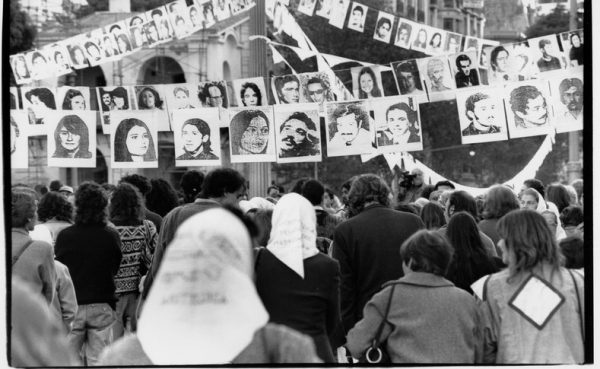
Thousands of people, including the families of victims and social movements such as the iconic Mothers and Grandmothers of the Plaza de Mayo, filled the streets outside of the federal court in the province of Cordoba to await the announcement under the banner of remembering the 30,000 disappeared during the dictatorship.
Former military intelligence agent Arnoldo Jose Lopez, former military man Ernesto Guillermo Barreiro, and former military captain Hector Pedro Vergez were also found to be among the principle masterminds responsible for the abuses and sentenced to life in jail for charges of hundreds of aggravated homicides, among other crimes.
Ricardo Alberto Lardone and Oreste Valentin Padovan, both considered among the special command at La Perla responsible for carrying out torture and kidnappings, were also sentenced to life in jail.
A total of 28 of the 43 accused were handed life sentences, nine were sentenced to up to 21 years, and six were acquitted.
The case was also historic for marking the first time a court in Cordoba tried charges of illegal apprension of babies during the dictatorship, a military practice of stealing babies from political dissidents, detainees, and victims of forced disappearance and handing them over the families linked to the military regime. The Grandmothers of the Plaza de Mayo has struggled for nearly 40 years to identify their missing grandchildren and reunite them with their families.
The La Perla case dealt with forced disappearance of Silvina Monica Parodi de Orozco, who was over six months pregnant when she and her husband Daniel Francisco Orozco were kidnapped. Silvina’s mother Sonia Torres is still searching for her missing grandchild, whose whereabouts has never been known.
The landmark trial brought together 21 separate cases of crimes against humanity at the hands of the Argentine military, police, and paramilitary forces immediately leading up to and in the years after the 1976 military coup against left-wing President Isabel Peron. The case heard some 600 witnesses provide testimony over the course of 350 hearings related to the 716 victims. Less than half, 340, of the victims survived. Most of the others, 311, were disappeared with no documentation of what happened to them, and the rest were killed.
La Perla was the second most important detention center in the country in the early years of the military dictatorship. Between 2,500 and 3,000 victims of state terrorism were detained at the secret military prison between 1976 and 1977, and it is though to have stopped operating by 1978, according to local media.
A 1979 U.S. Department of State memo included in a batch of over 1,000 pages of recently-declassifed documents related to Argentina’s Dirty War reveals that the U.S. Embassy was aware that “physical torture” was practiced at La Perla in 1976 and 1977. A 1978 State Department recommendation memo to then-President Jimmy Carter characterized General Menendez as as a “hardline general,” and another document indicated that Menendez was pushing for “continued strong efforts to battle ‘ideological subversion.'”
Argentina’s U.S.-backed Dirty War disappeared an estimated 30,000 victims in its brutal state terrorism campaign against suspected political dissidents, which involved systematic forced disappearances, torture, rape, and assassinations. Argentine human rights groups have dubbed the bloody era a “genocide” against political dissidents.
Washington’s ‘New Managers’ in Latin America: Oligarchs, Bankers and Swindlers
By James Petras :: 07.07.2016
Amid raging corruption, social pathologies and outright political thuggery, a new gang of vassal regimes has taken-over Latin America. The new rulers are strictly recruited as the protégé’s of US financial and banking institutions. Hence the financial press refers to them as the “new managers” – of Wall Street.
The US financial media has once again provided a political cover for the vilest crimes committed by the ‘new managers’ as they launch their offensive against labor and in favor of the foreign and domestic financiers.
To understand the dynamics of the empire’s new vassal managers we will proceed by identifying (1) the illicit power grab (2) the neo-liberal policies they have pursued (3) the impact of their program on the class structure (4) their economic performance and future socio-political perspectives.
Vassals as Managers of Empire
Latin America’s current vassalage elite is of longer and shorter duration.
The regimes of longer duration with a historical legacy of submission, corruption and criminality include Mexico and Colombia where oligarchs, government officials and death squads cohabit in close association with the US military, business and banking elites.
Over the past decades 100,000 citizens were murdered in Mexico and over 4 million peasants were dispossessed in Colombia. In both regimes over ten million acres of farmland and mining terrain were transferred to US and EU multinationals.
Hundreds of billions of illicit narco earnings were laundered by the Colombian and Mexican oligarchy to their US accounts via private banks.
The current political managers, Peña in Mexico and Santos in Colombia are rapidly de-nationalizing strategic oil and energy sectors, while savaging dynamic social movements – hundreds of students and teachers in Mexico and thousands of peasants and human rights activists in Colombia have been murdered.
The new wave of imperial vassals has seized power throughout most of Latin America with the direct and indirect intervention of the US. In 2009, Honduras President Manuel Zelaya was ousted by a military coup backed by Secretary of State Hillary Clinton. Zelaya’s program of agrarian reform, regional integration (with Venezuela) and constitutional elections was abolished. Zelaya was replaced by a US vassal, Roberto Micheletti who proceeded to murder several hundred landless rural workers and indigenous activists.
Washington moved to organize a constitutional cover by promoting a highly malleable landowner, Porfirio Lobo Sosa to the presidency.
The State Department next ousted Paraguyan President Francisco Lugo who governed between 2008-2012. Lugo promoted a moderate agrarian reform and a centrist regional integration agenda.
With the backing of Secretary of State Clinton, the Paraguayan oligarchy in Congress seized power , fabricated an impeachment decree and ousted President Lugo. He was briefly replaced by Vice President Federico Franco (2012-2013).
In 2013, Washington backed , the capital, Asuncion’s, notorious crime boss for President, one Horacio Castes – convicted for currency fraud in 1989, drug running in 1990, and most recently (2010) money laundering.
The Honduras and Paraguayan coups established (in miniature) the precedent for a new wave of ‘big country’ political vassals. The State Department moved toward the acceleration of banking takeovers in Brazil, Argentina and Peru.
In rapid succession, between December 2015 and April 2016 vassal managers seized power in Argentina and Brazil. In Argentina millionaire Mauricio Macri ruled by decree, bypassing constitutional legality. Macri fired scores of thousands of public service workers, closed social agencies and appointed judges and prosecutors without Congressional vote. He arbitrarily arrested social movement leaders – violating democratic procedures.
Macri’s Economic and Finance Ministers gained millions of dollars by ‘buying into’ multinational oil companies just prior to handing over private options on public enterprises.
The all-encompassing swindles and fraud carried out by the ‘new managers’ were covered up by the US media, who praised Macri’s professional team.
Moreover, Macri’s economic performance was a disaster. Exorbitant user fees on utilities and transport for consumers and business enterprises, increased three to ten-fold, forcing bankruptcy rates to soar and households to suffer light and gas closures.
Wall Street vulture funds received a seven billion dollar payment from Macri’s managers, for defaulted loans purchased for pennies over a dollar, twenty-fold greater then the original lenders.
Data based on standard economic indicators highlights the worst economic performance in a decade and a half.
Price inflation exceeds 40%; public debt increased by twenty percent in six months. Living standards and employment sharply declined. Growth and investment data was negative. Mismanagement, official corruption and arbitrary governance, did not induce confidence among local small and medium size businesses.
The respectable media, led by the New York Times, the Financial Times, the Wall Street Journal and the Washington Post falsified every aspect of Macri’s regime. Failed economic policies implemented by bankers turned cabinet ministers were dubbed long-term successes; crude ideologically driven policies promoting foreign investor profiteering were re-invented as business incentives.
Political thugs dismantled and replaced civil service agencies were labelled ‘a new management team’ by the vulgar propaganda scribes of the financial press.
In Brazil, a phony political power grab by Congressional opportunists ousted elected President Dilma Rousseff. She was replaced by a Washington approved serial swindler and notorious bribe taker, Michel Temer.
The new economic managers were predictably controlled by Wall Street, World Bank and IMF bankers. They rushed measures to slash wages, pensions and other social expenditures, to lower business taxes and privatize the most lucrative public enterprises in transport, infrastructure, landholdings, oil and scores of other activities.
Even as the prostitute press lauded Brazil’s new managers’, prosecutors and judges arrested three newly appointed cabinet ministers for fraud and money laundering. ‘President’ Temer is next in line for prosecution for his role in the mega Petrobras oil contracts scandal for bribes and payola.
The economic agenda by the new managers are not designed to attract new productive investments. Most inflows are short-term speculative ventures. Markets, especially, in commodities, show no upward growth, much to the chagrin of the free market technocrats. Industry and commerce are depressed as a result of the decline in consumer credit, employment and public spending induced by ‘the managers’ austerity policies.
Even as the US and Europe embrace free market austerity, it evokes a continent wide revolt. Nevertheless Latin America’s wave of vassal regimes, remain deeply embedded in decimating the welfare state and pillaging public treasuries led by a narrow elite of bankers and serial swindlers.
Conclusion
As Washington and the prostitute press hail their ‘new managers’ in Latin America, the celebration is abruptly giving way to mass rage over corruption and demands for a shift to the political left.
In Brazil, “President” Temer rushes to implement big business measures, as his time in office is limited to weeks not months. His time out of jail is nearing a deadline. His cabinet of ‘technocrats’ prepare their luggage to follow.
Maurico Macri may survive a wave of strikes and protests and finish the year in office. But the plunging economy and pillage of the treasury is leading business to bankruptcy, the middle class to empty bank accounts and the dispossessed to spontaneous mass upheavals.
Washington’s new managers in Latin America cannot cope with an unruly citizenry and a failing free market economy.
Coups have been tried and work for grabbing power but do not establish effective rulership. Political shifts to the right are gyrating out of Washington’s orbit and find no new counter-balance in the break-up of the European Union.
Vassal capitalist takeovers in Latin America generated publicist anesthesia and Wall Street euphoria; only to be rudely shocked to reality by economic pathologies.
Washington and Wall Street and their Latin America managers sought a false reality of unrestrained profits and pillaged wealth. The reality principle now forces them to recognize that their failures are inducing rage today and uprisings tomorrow.
Argentina Expels TeleSUR and RT: Double Standards When it Comes to Press Freedom
By Zachary Cohen | Council on Hemispheric Affairs | June 17, 2016
On June 8, the Argentine government notified the Latin American television network teleSUR that their services would be shut off in the country within 15 days.[1] TeleSUR, the brainchild of Hugo Chávez, is an alternative left-wing news organization founded through the cooperation of seven left leaning Latin American governments including Venezuela, Ecuador and Cuba. It gives a voice to the popular sectors of the hemisphere, covering news that often calls into question some of the right-wing biases of the hegemonic news media and provides information which promotes regional integration in Latin America. Although Argentina cited a “[renewal of] program listings,” as the reason for teleSUR’s dismissal, Patricia Villegas, the president of teleSUR, pointed toward underlying reactions against the left-leaning network, decrying the notice as “censura” (censure).[2][3]
On June 10, the television station RT (also known as Russia Today) received a similar summons. The Russian channel, which has been operating in Argentina for the past two years since a deal was signed between the countries, was told that their suspension from broadcasting would take place in 60 days.[4] RT aims to provide an “international audience with a Russian viewpoint,” and just like teleSUR, emphasizes the importance of alternative, non-hegemonic perspectives.[5]
The blatant censorship of these two opposition voices in Argentina is an alarming violation of hemispheric press freedom, and points to a larger issue at hand: the immense double standards of the mainstream media in its coverage, or rather non-coverage, of this matter. The removal of teleSUR and RT from the Argentine media scene has not elicited much media attention from corporate media news outlets, though the story would most likely be breaking news and inspire outrage were it occurring in a country with a progressive government.
Comprehensive Policy Changes in Argentina
On December 10, 2015, Argentine President Mauricio Macri was sworn in to office, replacing progressive leaning President Cristina Fernandez de Kirchner.[6] Macri’s presidency represents a drastic shift for the country across the board. Within the past six months, Macri has reversed a multitude of Kirchner’s policies and has begun to further advance neoliberal free market policies through the removal of currency controls and the promotion of proposals regarding free trade.[7] In addition to economic changes, Macri’s distinct foreign policy goals have been described by teleSUR as a “180-degree turn from previous administrations.”[8] He has made efforts to improve relations with the United States, while distancing Argentina from the ledger of left and left-leaning governments of Latin America. After his state visit this past March, President Obama noted that Macri’s Argentina has become a “key ally” to the United States, in stark contrast to the rather hostile bilateral relations held during the Kirchner administration.[9] [10]
President Macri’s expulsion of teleSUR represents the continuation of a longer narrative. When Venezuelan President Hugo Chávez celebrated the launch of the Venesat-1 satellite in 2005, he was taking a stand against traditional media, reflecting his commitment to battling U.S. hegemony and building a more Bolivarian and integrated Latin America.[11] At its launch, Argentina was committed to the cause of independence and integration, and was teleSUR’s second largest TV sponsor, with a 20 percent stake in the enterprise; Venezuela remains the largest shareholder, at 51 percent.[12] [13] However, in March, Macri pulled Argentine funding from teleSUR.[14] According to Argentina’s Director of Communications Hermann Lombardi, the decision to withdraw was based on the fact that Argentina’s government was “prohibited from sharing their view.”[15] Although the removal of funding on the basis of distinct ideological differences is understandable, it is inexcusable to remove teleSUR from the mix of television networks operating in the country. Regardless of teleSUR’s association with progressive governments, it should not be automatically excluded from the households of millions simply because of an ideological disagreement between the government and the media markets.
Double Standards in the Media
The troubling double standard of corporate media is explicitly evident in this issue and has serious implications for the role of the United States in Latin America. Mainstream media jumps on the chance to criticize the “Pink Tide” nations, with major critiques often levied toward Venezuela in regards to their shortcomings in the area of press freedoms. These criticisms were exceptionally prominent in 2007, after President Chávez decided not to renew the license for RCTV after they vocally supported the coup against him. [16] [17] For his actions, Chávez was condemned by the United States and the European Union, and received vast media attention. Yet, in the broader picture, the judgments regarding Venezuela’s press freedoms are often exaggerated and simplified, lacking the complexities of a more realistic portrayal of the country’s situation.[18] El Nacional, one of Venezuela’s largest newspapers, continues to provide the opposition viewpoint to President Nicolás Maduro, with open calls for regime change published and printed.[19] Additionally, news station Globovisión has consistently held an independent voice, often speaking out against the government.[20] Nonetheless, the level of disdain that Maduro’s regime receives by the mainstream media, including by papers such as The New York Times, reflects a distinct bias against the left-wing government in discussions on the subject of press freedoms.[21]
The situation in Argentina is very different today from Venezuela in regards to freedom of the press. Through his censure of teleSUR, Macri has preemptively silenced the most vigorous reporting on the human cost of his economic adjustment policies and explicitly revealed his willingness to expel unwanted sources of media to push his own narrative. Yet, there has been little to no international reaction. In fact, at the time of this article’s publication, teleSUR and RT themselves are among the few major news organizations to have written any extensive coverage of the stories since they broke last week. Through its silence, the mainstream media is complicit in Macri’s censure of expression, all while continuing to emphasize and exaggerate Maduro’s actions.
Macri’s newfound friendship with the United States, alongside the willful negligence of issues surrounding censorship in the mainstream media, cannot be considered a coincidence. His commitment to resolving Argentina’s economic woes through U.S.-friendly policies, in addition to his overall right-wing realignment, have fostered a swift transition of Argentina’s international image. Moreover, teleSUR and RT are associated with countries in direct competition, ideologically and economically, with Washington. By undermining the influence of media which stem from left leaning Latin America and anti-U.S. Russia, Macri effectively expands the capacity of anti-left, pro-U.S. media to influence his country. With this purposeful rebranding in mind, it is believable that media in the United States would begin to emphasize the more favorable face of Argentina, while disregarding issues such as censorship.
One of the pillars of COHA’s philosophy is the support of democratic values in their fullest form, which includes supporting freedom of the press. In any country, it is imperative to maintain a diverse set of viewpoints, and for different perspectives to be both treated with dignity and challenged without any fear of suppression. To be complicit in the violation of such freedoms is tantamount to the acceptance of the violations themselves, and COHA will not be silent while others find it appropriate to remain so. COHA urges the Argentine government to reconsider its removal of teleSUR and RT, and to invite, rather than suppress, debate over the economic, political, and social outcomes of the change of course being implemented by the Macri administration.
[1] “Macri Gov’t toTake teleSUR off Argentine TV service in 15 days,” teleSUR, June 8, 2016, accessed June 10, 2016, http://www.telesurtv.net/english/news/Macri-Govt-to-Take-teleSUR-off-Argentine-TV-Service-in-15-Days-20160608-0034.html.
[2] Ibid.
[3] Patricia Villegas, Twitter, June 8, 2016, accessed June 10, 2016, https://twitter.com/pvillegas_tlSUR/status/740569267536596993.
[4] “Argentina to suspend RT from national broadcasting,” RT, June 11, 2016, accessed June 13, 2016. https://www.rt.com/news/346172-argentina-suspends-rt-television/.
[5] “About Us,” RT, accessed June 14, 2016, https://www.rt.com/about-us/.
[6] Ignacio de Reyes, “Change ahead: Mauricio Macri’s visión for Argentina,” BBC, December 10, 2015, accessed June 10, 2016, http://www.bbc.com/news/world-latin-america-34899223.
[7] Ibid.
[8] “Is Argentina Turning into a US Proxy in South America?” teleSUR, June 1, 2016, accessed June 10, 2016, http://www.telesurtv.net/english/news/Is-Argentina-Turning-into-a-US-Proxy-in-South-America-20160601-0028.html.
[9] Martin Torino, “Obama abrió la puerta a Macri para un Tratado de Libre Comercio con Argentina,” Cronista.com, March 16, 2016, accessed June 10, 2016, http://www.cronista.com/economiapolitica/Obama-abrio-la-puerta-a-Macri-para-un-Tratado-de-Libre-Comercio-con-Argentina-20160324-0086.html.
[10] Andrew Trotman, “Argentina files legal proceedings with UN against Obama government,” The Telegraph, August 7, 2014, accessed June 10, 2016, http://www.telegraph.co.uk/finance/financialcrisis/11019875/Argentina-files-legal-proceedings-with-UN-against-Obama-government.html.
[11] https://books.google.com/books?id=d02Do0qmJrMC&dq=telesur+chavez+satellite&source=gbs_navlinks_s
[12] “Argentina pulls out of leftist TV network Telesur,” The Guardian, March 28, 2016, accessed June 10, 2016, https://www.theguardian.com/world/2016/mar/28/argentina-telesur-tv-network-venezuela-hugo-chavez.
[13] “New Latin American Televison Network Telesur Officially Launched,” Democracy NOW, July 26, 2005, accessed June 10, 2016, http://www.democracynow.org/2005/7/26/new_latin_american_television_network_telesur.
[14] “Argentina pulls out of leftist TV network Telesur.”
[15] Ibid.
[16] “Chávez Shuts Down Venezuelan TV Station as Supporters, Opponents Rally: A Debate on the Closing of RCTV,” Democracy NOW, May 31, 2007, accessed June 13, 2016, http://www.democracynow.org/2007/5/31/chavez_shuts_down_venezuelan_tv_station.
[17] Roy Carroll, “Chávez silences critical TV station – and robs the people of their soaps,” The Guardian, May 23, 2007, accessed June 13, 2016, http://www.theguardian.com/media/2007/may/23/venezuela.broadcasting
[18] Joe Emersberger, “Macri Tilts Argentina’s Media Landscape in his Favor,” teleSUR, April 3, 2016, accessed June 14, 2016, http://www.telesurtv.net/english/opinion/Macri-Tilts-Argentinas-Media-Landscape-in-his-Favor-20160403-0033.html
[19] John Otis, “Last critic standing,” Committee to Protect Journalists, February 22, 2016, accessed June 10, 2016, https://cpj.org/blog/2016/02/last-critic-standing-how-el-nacional-defies-challe.php.
[20] https://cpj.org/blog/2016/03/after-venezuelan-elections-globovision-shows-more-.php.
[21] Daniel Lansberg-Rodriguez, “Stealth Censorship in Venezuela,” The New York Times, August 6, 2016, accessed June 10, 2016, http://www.nytimes.com/2014/08/07/opinion/daniel-lansberg-rodriguez-stealth-censorship-in-venezuela.html.
Featured Video

Michael von der Schulenburg: Europe’s Self-Defeating Iran War Policy
or go to
Aletho News Archives – Video-Images
Frlom the Archives
Who Rules America?
The Power Elite in the Time of Trump
By James Petras | Axis of Logic | September 6, 2017
Introduction
In the last few months, several competing political, economic and military sectors – linked to distinct ideological and ethnic groups – have clearly emerged at the centers of power.
We can identify some of the key competing and interlocking directorates of the power elite:
- Free marketers, with the ubiquitous presence of the ‘Israel First’ crowd.
- National capitalists, linked to rightwing ideologues.
- Generals, linked to the national security and the Pentagon apparatus, as well as defense industry.
- Business elites, linked to global capital.
This essay attempts to define the power wielders and evaluate their range of power and its impact. … continue
Blog Roll
 Aletho News
- Michael von der Schulenburg: Europe’s Self-Defeating Iran War Policy
- Sorry, The New Republic, Climate Change Isn’t Causing Somali Migration. Blame Civil Strife and Poverty.
- Expert Guts Claims That HPV Vaccine Reduces Cancer Risk
- No evidence Russia sabotaged Baltic cables – Finnish intel
- The Strategic Folly of a (Serious) US Ground Invasion of Iran
- US-Israeli war of aggression on Iran meant to reshape region: Omani FM
- Iran Does Not Consider Israel Party to Talks to Need Mediators With It – Ambassador
- Macron’s aircraft carrier and warplanes to the Persian Gulf is a dangerous vanity project
- Meet The Ellisons: Zionists, Technocrats, Moguls
- US failures in Iran reveal Russia is key to South Korea’s strategic security
- If Americans Knew
- Are we on the precipice of World War III?
- ‘Catastrophic,’ Says UNICEF: 1,100+ Children Killed or Wounded in Mideast Since US-Israel Launched Iran War
- The Unbelievable Madness of Our War With Iran
- World Council of Churches calls on govts to hold Israel accountable for violations of intl law
- How to end the war on Iran that costs US taxpayers $1M per minute – Not a ceasefire Day 153
- Israeli strategic plans to “remake the Middle East” from the 1950s and since
- Honoring Gaza’s women who refused to let the world look away
- 97% of victims of war on Iran are Iranian, 98% of victims in war on Gaza are Gazans – Not a ceasefire Day 152
- Early Iran strikes cost $5.6 billion in munitions, Pentagon estimates
- Israel Decided the War, But Trump’s America Fights and Pays the Bill
- No Tricks Zone
- New Studies: UK Sea Levels Were 4 Meters Higher Than Today During The Mid-Holocene
- Destructive Green New Deal: German Energy And Metal Group Warns Of Drastic Crisis
- New Study Documents A 20-Year Pause In Arctic Sea Ice Decline – Driven By Internal Variability
- Wake-up Call: Survey Shows Majority Of Germans Now Favor Postponing Climate Targets!
- Televised! Leading German Political Candidate Tells Schoolchildren CO2 Makes Sun Hotter!
- New Study: A Century Warming Of 1.1°C Is ‘Commonplace’ And ‘Not Unusual’ During This Interglacial
- New Study: ‘Internal Noise’ And Volcanic Forcing Can Trigger 10-15°C Warming Within Decades
- Glaciers Worldwide Are Suddendly Surging, Experts Blame Warming!
- Surprising Discovery: Sahara Is Greening…Billions Of Trees Where Once Thought To Be Barren
- New Research Reaffirms Clouds, Aerosols, And Surface Solar Radiation Are ‘Driving The Climate System’
 Aletho News