Inside the Caucasus Drone Corridor Fueling Tensions With Iran
By Freddie Ponton – 21st Century Wire – March 16, 2026
On March 14, 2026, New Eastern Outlook published a report by journalist Jeffrey Silverman titled “Friendly Skies of Georgia: Are Israeli-Linked Drones Launching False Flags from Georgian Territory?”
“Reports about the possible use of Georgian territory for drone operations…”
In his report, Silverman suggested that the March 5 drone strike on Nakhchivan airport, which was swiftly blamed on Iran before any public forensic record was produced, may have originated from a covert base in Georgia. Even if that specific allegation remains unproven, it points to a darker and more consequential reality in which Israel is deeply embedded in a regional drone and air-defense architecture spanning Georgia and Azerbaijan, one that could be used to manufacture confusion, direct blame toward Tehran, and draw another exposed frontier into Washington and Tel Aviv’s widening war against Iran.
Friendly Skies, Dark Architecture
Silverman did not prove that the drone, which struck Nakhchivan airport on March 5, took off from Kobuleti or a restricted airstrip near Lagodekhi in Georgia, and he did not publish the kind of forensic record that would settle that allegation beyond dispute. What matters more is the architecture his report exposes. By the time Azerbaijan blamed Iran for the strike, Georgia and Azerbaijan had already formalised direct unmanned/uncrewed aerial vehicle (UAV) cooperation, while Israel was deeply entrenched in the air-defense, radar, and command systems that shape how both states see the sky, classify threats, and assign responsibility.
That is why this story matters. It is not really about one secret runway or one speculative launch site. It is about a regional military architecture in which Israel supplied drone platforms, helped structure radar integration, shaped command-and-control logic, trained operators, and embedded itself in the software and doctrine that govern how threats are detected, classified, prioritised, and politically narrated from Georgia to Azerbaijan. In the middle of a widening war, while Iranian officials were publicly warning that the United States and Israel were using copied or misattributed drone attacks to frame Tehran and broaden the conflict, that architecture turned Silverman’s theory from an unproven allegation into a deeply plausible scenario.
The March 5 public record only sharpens that concern. In a March 5 statement, Azerbaijan’s Foreign Ministry said the attack occurred around midday, that one drone struck the terminal of Nakhchivan International Airport, that another fell near a school in Shakarabad, and that two civilians were injured. State-linked reporting later added that the prosecutor’s office opened a criminal case, described the UAVs as carrying remotely controlled explosive warheads, and said the disruption forced flight 264 from Nakhchivan to Baku to return for safety reasons. Those details make the incident more concrete, but they also show how quickly the political and legal narrative solidified around attribution before the public was shown anything close to a full forensic record.
Israel’s code in Georgian airspace
Georgia’s military drone sector was built in close cooperation with Israel, a fact that should be treated as foundational rather than incidental. Before and during the 2008 war, Georgia acquired Elbit Hermes-450 drones, operated them over contested territory, and lost several in combat according to a UN Security Council report, establishing that Israeli UAV technology was not a procurement sideshow but part of Georgia’s actual warfighting infrastructure. A Hermes-450 is not just an airframe; it depends on launch-and-recovery procedures, ground-control stations, data links, sensor exploitation, trained operators, maintenance cycles, and mission-management architecture that ties the platform to the wider command system. From the start, Georgia’s unmanned capability was being shaped not just by Israeli hardware but by Israeli operational logic.
That relationship evolved into something even more consequential after 2008.
As a Caspian Policy Center report noted in September 2020, Georgia signed agreements with Rafael and Elbit to modernise air-defense assets, upgrade electronic systems, retrain personnel, and move key capabilities toward NATO standards. Rafael’s Spyder-family architecture matters here because it is not just a launcher with missiles attached to it, but also a radar-linked, software-driven system that combines sensor inputs, battle-management logic, target prioritisation, and rapid engagement against aircraft, cruise missiles, UAVs, and loitering munitions. External technical reporting on Spyder emphasises centralised command logic, multi-target handling, and fused air-picture generation, while Rafael’s own product material presents the system as a mobile, integrated air-defense family rather than a stand-alone interceptor.
That technical detail is not window dressing. It explains why the debate over a “secret base” can miss the more important issue. Israel does not need a flag over a Georgian runway to exercise meaningful influence over Georgian airspace behaviour if Israeli-linked firms already help build the radar integration, software logic, sensor fusion, operator training, and threat-classification routines through which Georgian personnel decide what is visible, what is suspicious, and what can be ignored. In a deniable operation, that layer is decisive, because the central question is not only where a drone takes off, but how the system along its route recognises it, how quickly it is promoted from clutter to threat, and who controls the doctrinal assumptions built into that judgment.
This architecture did not emerge overnight. As early as 2012, Rick Rozoff warned in Voltaire Network that under Mikheil Saakashvili, Georgia was being refashioned into a U.S.-aligned military outpost through NATO war deployments, base modernisation, and growing strategic utility to Washington, while the country was already surfacing in discussions of possible logistical or operational support for a future strike on Iran. That warning should not be treated as proof of the March 5 Nakhchivan operation, but it does expose the deeper genealogy of the system now in place: Georgia was being positioned more than a decade ago as a frontier platform in wars planned far beyond its borders.
Georgia’s integration into NATO’s Regional Airspace Security Programme sharpens that point instead of weakening it. In an NCIA report on Georgia’s entry into the NATO Regional Airspace Security Programme, the agency said Georgian air-traffic data could be ingested into the RASP information-exchange environment through EUROCONTROL’s Civil-Military ATM Coordination Tool, or CIMACT, supporting constant connectivity, air-picture exchange, early notification of incidents, direct operator coordination, and identification support for air defense. In practical terms, that means Georgian airspace is increasingly managed through a shared civil-military coordination environment designed to fuse traffic data, security events, and operational responses across borders. But systems like CIMACT do not abolish the physics of drone detection. Open-source technical literature and regional reporting both show that low-altitude, small-radar-cross-section drones remain difficult to detect and classify in mountainous or cluttered terrain because radar horizon, terrain masking, ground clutter, and weak signatures compress the window for reliable identification.
That is precisely what creates a false-flag-friendly environment. A peer-reviewed paper on low-slow-small target detection describes drones as low-altitude, slow-speed, small-radar-cross-section targets that are difficult to detect and classify among birds and other biological targets, especially when conventional radars face weak signatures and cluttered surveillance volumes.
If a drone flies low through edge sectors or terrain-shadowed corridors, the first challenge for the radar network is not interception but recognition: distinguishing a weak, late-emerging track from birds, clutter, benign traffic, or fragmented returns. The second challenge is prioritisation inside the command-and-control layer, because a fused air picture does not treat every object equally; it ranks tracks according to altitude, speed, heading, signature, and threat libraries built into the software and training regime.
When Israeli-linked firms help define that regime, they are not merely selling Georgia hardware. They are helping shape the logic by which ambiguity is sorted into action or inaction.
Azerbaijan’s Israeli-built battlespace
If Georgia provides one side of the corridor, Azerbaijan provides the other, and here the Israeli footprint is even deeper. As an Institut FMES study of the Israel-Azerbaijan relationship details, Azerbaijan has spent decades building military-technical ties with Israel that include observation drones, tactical drones, loitering munitions, missiles, mapping support, and an air bridge through Turkish and Georgian airspace during wartime supply operations. That matters because a state that buys this many Israeli platforms is not just purchasing equipment; it is also importing maintenance pipelines, operator doctrine, mission-planning habits, software ecosystems, and deeper institutional assumptions about how the battlespace is seen and fought.
Two Israeli systems are central to the Nakhchivan story. The first is Barak-MX, the layered air-defense architecture sold to Azerbaijan with interceptors and battle-management functions designed to engage UAVs, cruise missiles, and aircraft across multiple ranges. The second is Sky Dew, the high-altitude aerostat-based AESA radar platform procured by Azerbaijan to detect low-flying threats over long distances, including drones and cruise-missile-type targets. Sky Dew’s value lies in elevating the sensor above ground clutter and extending the line of sight, while Barak-MX gives the battlespace a layered interception logic. Together, they form more than a shield. They form an Israeli-coded interpretation system for airspace.
And yet even this system is not all-seeing. AESA radars improve clutter rejection, update rates, and multi-target tracking, but technical analysis also stresses that low-RCS targets near the ground remain difficult because no single sensor mode can reliably solve the problem across all terrain, weather, and altitude conditions. Multi-band fusion, advanced signal processing, and automatic target recognition help, but weak returns, terrain interference, and short detection windows still leave room for uncertainty.
That uncertainty is politically explosive in Nakhchivan’s geography, because a drone detected late near the Iranian frontier does not enter a neutral interpretive space. It enters an Azerbaijani battlespace already conditioned by Israeli systems, Israeli threat models, and an official narrative primed to see Iran as the source of the attack.
The March 5 public narrative illustrates that danger with unusual clarity. In its March 5 report, Euronews cited Azerbaijani claims that “technical monitoring systems” confirmed four UAVs belonging to Iran had been directed toward Nakhchivan to carry out attacks. But the public-facing record reviewed here did not include the underlying radar tracks, telemetry, launch coordinates, signal intercepts, or debris analysis that would allow outsiders to test that conclusion independently. Instead, the public was asked to accept a technical verdict without public technical disclosure, in a battlespace already filtered through Israeli-linked detection and attribution architecture.
The inconsistencies in the public record make that even more important. Azerbaijan’s Foreign Ministry described two drones and two injured civilians, while a U.S. Embassy security alert referred to an unknown number of drones striking the exclave around noon, and Reuters reported four injured. OC Media’s coverage also placed the airport less than 10 kilometres from the Iranian border and referenced footage showing smoke, a separate small blast, and terminal damage, but none of that amounts to a released forensic chain of origin. The issue, then, is not whether every radar return was fabricated. It is when Israel helps build the Georgian-side surveillance environment and also helps build the Azerbaijani-side detection and attribution environment that it effectively occupies both ends of the interpretive chain through which a late-detected drone can become an Iranian attack.
The October 2025 drone bridge
The strongest institutional clue in this investigation is not Kobuleti, and it is not Lagodekhi. It is the formal drone bridge created between Georgia and Azerbaijan in October 2025. In an official Azerbaijani Defense Ministry readout, Baku said a Georgian Ministry of Defense delegation visited for an “exchange of experience in the field of UAVs” and was briefed on Azerbaijani UAV activity, combat use, combat-flight organisation, and wider development trends. Those are not vague diplomatic pleasantries. They are the language of direct operational transfer. “Combat operations” and “organisation of combat flights” mean mission planning, route design, sortie sequencing, deconfliction, command routines, and the practical management of drones in wartime airspace. Because Azerbaijan’s UAV ecosystem is already deeply Israeli-linked, that meeting meant Georgian officials were being exposed to an Israeli-shaped combat-drone model only months before the Nakhchivan incident.
This is the emotional and analytical centre of the story because it turns parallel procurement into shared practice. Once that bridge existed, the regional picture changed. The issue was no longer only that Israel had technical reach into both states. The issue was that Georgia and Azerbaijan were actively aligning how they think about drone warfare across the very corridor now shadowed by false-flag allegations. That creates shared familiarity with routes, signatures, mission planning, and combat-flight logic, which lowers the friction for any cross-border drone activity that needs to move through Georgian space and arrive inside Azerbaijani airspace without triggering immediate institutional disbelief.
Corridor politics and verdict
Turkey completes the corridor. The Institute for War & Peace Reporting (IWPR) has described Georgian airspace as a conduit for traffic supporting Azerbaijan, including flows tied to Turkish and Israeli strategic interests, while the South Caucasus route became even more important as the Middle East conflict rerouted more traffic across Türkiye, Georgia, Armenia, and Azerbaijan. Georgian airport infrastructure is tied to Turkish management networks, which gives Ankara leverage over the transit environment and helps normalise the corridor as a connected operational channel rather than a set of isolated national airspaces. In wartime, normalisation is half the game. What moves routinely moves invisibly.
The wider war context makes that normalisation more dangerous. Iranian officials publicly warned that the United States and Israel were using copied or rebranded drones, including the so-called “Lucas” platform, to stage attacks and frame Tehran, while calling for joint investigations into suspicious incidents. Whether one accepts those allegations in full is not the point. The point is that the Nakhchivan incident unfolded in a battlespace where attribution itself had already become a weapon.
That weaponised atmosphere is also visible in how quickly outside governments aligned behind the Azerbaijani narrative. France publicly condemned what it called an Iranian drone strike in a Foreign Ministry statement, while Turkey did the same in a March 5 statement from its Foreign Ministry. The incident was therefore internationalised almost immediately, even though the public record still showed inconsistencies in drone counts, injuries, and the technical basis for attribution.
Jeffrey K. Silverman did not prove that a drone launched from Georgian territory struck near Nakhchivan airport. His most specific launch-site claims remain unproven. But the deeper investigation leads to a verdict that is, in some ways, more damning than his original article. Israel has embedded itself in the air-defense, radar, software, training, and command architectures of both Georgia and Azerbaijan. Georgia and Azerbaijan then formalised direct UAV cooperation focused on combat use, combat missions, and the organisation of combat flights only months before the Nakhchivan incident. Georgia, meanwhile, was being drawn deeper into a NATO-linked RASP/CIMACT airspace-management environment built around air-picture exchange, incident notification, and civil-military coordination, even as the known technical limits of low-altitude drone detection left room for ambiguity in mountainous border sectors.
That does not close the criminal case. It closes the plausibility argument. Israel may not need a secret base in Georgia if it already helped build the surveillance logic, the target-classification regime, the command-and-control environment, and the cross-border drone corridor governing both ends of the route. That is the real meaning of the Georgia-Azerbaijan drone bridge and the dual Israeli footprint uncovered here.
The route does not have to be proven in full to understand the structure behind it. The structure is already visible, and it points to an Israeli-built architecture of plausible deniability running straight through the South Caucasus.
Iran pledges to ‘respect sovereignty of neighbors’, declares US-Israel assets ‘primary targets’
The Cradle | March 7, 2026
The Iranian armed forces warned that US and Israeli military installations across the region remain legitimate targets, as officials seek to ease tensions with neighboring countries.
“Should the previous hostile actions continue, all military bases and interests of criminal America and the fake Zionist regime on land, at sea, and in the air across the region will be considered primary targets and will come under the powerful and crushing strikes of the mighty armed forces of the Islamic Republic of Iran,” the Iranian Revolutionary Guard Corps (IRGC) said in a statement on Saturday.
The warning came alongside a declaration by Iran’s Khatam al-Anbiya Central Headquarters that Iranian forces “respect the national interests and sovereignty of neighboring countries” and “have not carried out any act of aggression against them.”
Nevertheless, military officials emphasized that installations used by the US or Israel to launch attacks against Iran remain fair game. Lieutenant Colonel Ibrahim Zolfaghari said that at least 21 US personnel have been killed and many more injured in attacks on the US Navy’s Fifth Fleet infrastructure, while additional casualties occurred during strikes on Al-Dhafra Air Base.
He also said Iranian forces targeted a US-owned oil tanker in the northern Persian Gulf.
Earlier in the day, President Masoud Pezeshkian announced that Iran’s interim leadership council had ordered the armed forces to cease striking neighboring countries unless attacks originate from their territory.
“The temporary leadership council approved yesterday that neighboring countries should no longer be targeted and missiles should not be fired unless an attack on Iran originates from those countries,” Pezeshkian said in a pre-recorded address.
Pezeshkian’s statement was made amid increasing tensions over regional airspace with Iran’s neighboring countries.
Turkish authorities claimed this week that NATO missile defenses intercepted a ballistic projectile allegedly launched from Iran that crossed Iraqi and Syrian airspace before approaching the northwestern Syria-Turkiye border.
In Azerbaijan, officials accused Tehran of launching a drone attack that struck the Nakhchivan airport terminal, prompting President Ilham Aliyev to warn Iran “will regret it,” while Iranian authorities denied involvement.
Tehran vehemently denied involvement in either of these attacks.
Saudi journalist Adhwan al-Ahmari said in a recent interview with Asharq News that “not all attacks” targeting Gulf states come from Iran, warning the war could be “an American-Israeli trap to implicate the Gulf countries and draw them into a confrontation with Iran.”
Iranian officials told Middle East Eye (MEE) that some recent drone strikes on Gulf energy infrastructure were not carried out by Tehran, with one official describing the attack on Saudi Aramco’s Ras Tanura facility as “an Israeli effort to sabotage regional peace and alliances between neighbours.”
“I can categorically say that some of the attacks were not carried out by us [Iran],” the anonymous official told MEE.
Saudi Arabia, Qatar, the United Arab Emirates, Kuwait, Bahrain, and Oman have all sustained strikes within their territories due to the presence of US assets within their borders.
Iran denies attacking Azerbaijan, suggests Mossad involvement
Al Mayadeen | March 5, 2026
Iran’s armed forces denied on Thursday that they launched drones toward Azerbaijan after Baku accused Tehran of carrying out UAV attacks in the Nakhchivan Autonomous Republic.
The statement was issued by the General Staff of the Iranian Armed Forces and carried by the Iranian state broadcaster IRIB.
Azerbaijan reports drone attack
Earlier in the day, Azerbaijan’s Foreign Ministry claimed drones launched from Iranian territory struck targets in the Nakhchivan Autonomous Republic, leaving two people injured.
Tehran rejected the claim and emphasized that Iran respects the sovereignty of neighboring countries, particularly regional Muslim states.
“The Islamic Republic of Iran, respecting the sovereignty of all neighboring states, especially brotherly Muslim countries, denies the launch of UAVs by the Iranian Armed Forces toward Azerbaijan,” the General Staff said in the statement.
Tehran blames Israeli involvement
The Iranian military suggested that “Israel” may have launched a drone toward Azerbaijani territory in an attempt to blame Iran and escalate tensions between the neighboring countries.
The accusation comes as regional tensions have intensified following the US and Israeli attacks on Iran and Tehran’s retaliatory operations.
Claims of covert Israeli activity in the region
The allegations also emerge amid claims of covert Israeli operations in several Gulf countries.
Speaking on The Tucker Carlson Show, American journalist Tucker Carlson said authorities in Qatar and Saudi Arabia had arrested Mossad agents accused of planning bombings in those countries. Carlson described the development as unusual and questioned the logic behind such operations.
He suggested the alleged plots could be part of broader efforts to destabilize multiple countries in the region while escalating pressure on Iran.
The Hidden Map: US and Israel May Use Unexpected Neighbors to Attack Iran
By Robert Inlakesh | The Palestine Chronicle | February 15, 2026
Amidst heightened tensions between the US-Israeli alliance and Iran, an enormous amount of focus has been placed in the media on Iran’s missile program and how this will impact any upcoming war. What is often ignored are the origins of the regional threats to Tehran and its stability.
While covering each and every threat to the Islamic Republic of Iran would be beyond the scope of such an article, there are a number of hostile nations surrounding the country that can be used to destabilize the nation. The United Arab Emirates (UAE) and, to a lesser extent, Azerbaijan, are often cited as pro-Israeli, but there is another nation that flies under the corporate media’s radar.
Iran shares its second-largest land border with the nation of Turkmenistan, a country that is rarely mentioned as a regional player. What many don’t know is that the nation, long characterized as a neutral player, has strong ties with both the US and Israel.
Turkmenistan: Neutral State or Strategic Corridor?
Unlike many Muslim-majority nations, Turkmenistan has long recognized and maintained ties with the Israelis, their relationship beginning in 1993. Then, in April of 2023, these ties were further cemented with the inauguration of a permanent Israeli embassy in Ashgabat for the first time.
It should therefore be no surprise that Tel Aviv and Ashbagat’s relationship is closest in the intelligence sharing and security cooperation spheres. Afterall, the Israeli embassy – opened back in 2023 – was strategically placed only 17 kilometers away from Iran’s border, marking a major symbolic achievement for Israel, especially as it operates through what are suspected to be thousands of Mossad recruited agents inside the Islamic Republic.
Although Israel has no official military bases inside Turkmenistan, there have been a number of reports indicating that it has set up attack drone bases inside the country. This would make sense, considering that Ashbagat has been purchasing Israeli drone technology since the 2010s, more recently acquiring the SkyStriker tactical loiter munition (suicide drone), developed by Elbit Systems.
Ashgabat has long been in alignment with the West. In May of 1994, it became the first country to join NATO’s Partnership for Peace (PfP) program. However, the following year, the UN approved granting Turkmenistan the status of a neutral country, meaning it would not join military blocs.
In 2001, following the September 11 attacks, this neutral stance suddenly began to change. While other Central Asian nations – Kyrgyzstan, Tajikistan, and Uzbekistan – all immediately offered their military bases to the United States, due in large part to their concerns over the advancements of the Taliban, Turkmenistan only publicly admitted to allowing the US to use its airspace for military cargo aircraft to travel in transit.
In reality, the US airforce were operating a team on the ground in Ashgabat in order to coordinate refueling operations. In 2004, the Russian State protested the growing US-Turkmenistan military relationship, after reports emerged stating that American forces had “gained access to use almost all the military airfields of Turkmenistan, including the airport in Nebit-Dag near the Iranian border.”
Reports, which are not possible to independently verify but nonetheless have appeared consistent throughout the years, indicate that the US military has even established remote desert bases throughout different locations inside Turkmenistan.
Clinging to its neutral status on the public stage, Ashgabat rejects any mention of cooperation of this kind, including the denial of a 2015 statement by then US Central Command chief Lloyd Austin that the Turkmens had expressed their interest in acquiring US military equipment.
Signals of Military Activity
Perhaps the most concerning developments are the more recent revelations, revealed through OSINIT channels and Turkmen media, citing flight trackers to monitor the movement of US aircraft in the region. These reports indicate the confirmation that US Air Force transport aircraft C-17A Globemaster III and MC-130 Super Hercules have landed at undisclosed locations in Turkmenistan.
The significance of this, opposed to the rest of the military buildup that has been occurring in potential preparation for an attack on Iran, is that of the MC-130 Super Hercules, which is used specifically for transporting special forces teams, running night operations, as well as performing unconventional takeoffs and landings.
Paired with a recent report issued by the New York Times, indicating that the US’ options not only include an air campaign against Iranian nuclear and missile sites, but ground raids using special forces, it could be concluded that Turkmenistan is the location from which the US may seek to inject special forces units into Iran.
The Wider Ring around Iran
The Turkmenistan factor clearly cannot be ignored here, despite it often being dismissed as a neutral power that maintains friendly relations with both Russia and China. In fact, because of these relationships, with Moscow in particular, Tehran has refrained from attempting to expand its reach into the Central Asian country.
To Iran’s benefit is that Chinese and, to a lesser extent, Russian influence can reduce the extent to which the US and Israel can use Iran’s neighbors to threaten it. In Pakistan, for example, it is clear that both Islamabad’s joint security concerns – largely over Balochi militant groups – along its border, in addition to Beijing’s influence, make it highly unlikely that Pakistan would remain neutral and is instead inclined to help support Iran; within its limits, it should be added.
Azerbaijan is another potential threat to the stability of the Islamic Republic, due in large part to the large Azeri population in Iran’s own Azerbaijan Province. However, the vast majority of Azeri citizens are in fact loyal to the State and no major separatist movement exists at this time. The Iranian President Masoud Pezeshkian and Ayatollah Khamenei himself are both ethnically part Azeri.
Meanwhile, many supporters of the Israeli puppet Reza Pahlavi openly express their intention to crack down on the Azeri ethnic minority inside Iran. During the reign of the CIA-MI6-installed Shah of Iran, minority groups suffered immensely, due to a clear tradition of ethno-nationalism that exists amongst the current supporters of the deposed monarchy.
Baku, for its part, is the top gas supplier to Israel, maintaining close military, diplomatic and intelligence ties with them. Azerbaijan even made Hebrew media headlines for its use of Israeli suicide drones and other military equipment during its war with Armenia.
On the other hand, Iran is militarily superior to Azerbaijan and has a considerable base of support amongst the nation’s population, of which the majority belong to the Shia branch of the Islamic faith. Therefore, Tehran has major leverage and could not only paralyze its oil and gas infrastructure, but perhaps has the potential of organic movements forming within Azerbaijan that will owe allegiance to Iran.
There is also the threat that the Israelis, in particular, will attempt to use Kurdish militant groups in Iraqi Kurdistan in order to carry out attacks on the Islamic Republic. Israel does not publicly acknowledge its presence in northern Iraq, yet Iran has directly struck its bases housing Mossad operatives in the past, while Kurdish separatist groups have been utilized countless times in attempts to destabilize the country. During the June 12-day-war last year, Israel also weaponized these proxies.
For those also concerned about Afghanistan’s role in threatening Iranian security, this has always historically been a precarious situation, yet Tehran has not only been improving its ties with Kabul, it officially recognized the Islamic Emirate during the past week. Again, this does not mean there is no potential threat there, but an alliance that holds with the Taliban government may prove important.
Gulf States, Jordan and the Regional Balance
Then there are the more obvious players, the UAE and Bahrain, which are not only partners of the Israelis as part of the so-called “Abraham Accords” but are overtly aligned with Tel Aviv’s regional agenda.
The Emiratis are speculated to hold some cards regarding trade, but their leverage is negligible. Both the Bahraini and Emirati leaderships are clearly anxious, because Iran’s responses to the use of their territory to attack the Islamic Republic could quickly collapse their regimes.
Jordan, meanwhile, is where the US appears to be focusing much of its military buildup, even withdrawing forces previously stationed in Syria’s al-Tanf region into the Hashemite Kingdom’s territory.
The Jordanian leadership is evidently permitting its territory to become a key battleground, which will likely be subjected to attacks if the US chooses to use it to aid the Israeli-US offensive, but it is simply powerless in such a scenario.
Jordan has become a Western-Israeli intelligence and military hub in the region, meaning that if King Abdullah II objects to the demands of its allies, he understands well that his rule could be ended in a matter of hours. Therefore, he must risk his country being caught in the crossfire and just hope that an internal uprising doesn’t take shape, which is one of the reasons why he has been so hostile to the Muslim Brotherhood, fearing they could end up leading any revolt as the organization did in Egypt.
Turkiye, on the other hand, which is also a major regional player, is likely to play both sides behind the scenes, attempting to stay out of such a fight. If it takes either side, it will suffer the repercussions. Perhaps the most important role it could play is to prevent its bases or airspace from being used by the US.
Saudi Arabia and Qatar both maintain cordial relations with Iran, clearly favoring a scenario where no war occurs at all, because they are home to US bases. As we saw last June, the US used its CENTCOM headquarters in Doha to direct its attack on Iran’s nuclear sites, and as a result, Iran’s Islamic Revolutionary Guard Corps (IRGC) struck US facilities there.
Riyadh and Doha do not want to get dragged into such a scenario. It is also of note that they have a vested interest in neither side winning the war conclusively, because it is in their interests for there to be a multi-polar West Asia, not an Israeli-dominated region that will inevitably consume them.
A Conflict with Wider Consequences
Some have also speculated about Syria’s role in any war. Damascus is clearly in the US-Israeli sphere of influence, but it will have a negligible impact in its current form. If Syria’s military forces assault Lebanon or Iraq, they will suffer enormous blows and fail tremendously. The only wildcard with Syria is whether armed groups there will choose to use the opportunity to attack Israel, although as a military power, the Syrians are a relative non-factor at the current time.
For now, the US-Israeli plot to stir civil war inside Iran and to follow through with an air campaign that aids their proxies has failed. Given the readiness of Iran’s allies in Iraq, Lebanon, Yemen, and even Palestine, perhaps beyond, the US would be entering a point of no return scenario if it were to attempt a regime change operation.
– Robert Inlakesh is a journalist, writer, and documentary filmmaker. He focuses on the Middle East, specializing in Palestine.
Turkish Hercules Crashes on Azerbaijan-Georgia Border
By Alexandr Svaranc – New Eastern Outlook – November 17, 2025
Unfortunately, airplane crashes are becoming a common feature of our time that leads to human casualties. Such incidents are caused by technical failures, human error, or external interference. It seemed nothing foreshadowed the destruction of the Turkish C-130 military transport aircraft, but…
Why did the Turks fly to Azerbaijan, and what happened on the journey back?
Türkiye is a strategic ally of Azerbaijan and made an exceptional (military and political) contribution to the success of the Azerbaijani side in the Second Karabakh War.
Incidentally, after 2020, Türkiye, Israel, and a few others began competing over who provided more support to Azerbaijan and played the key role in Baku’s victory. In the fall of 2024, President Recep Tayypi Erdoğan, verbally threatening Israel and the West with a “night invasion” by the heirs of Ottoman askeri, repeatedly recalled Türkiye’s experience in Nagorno-Karabakh. For instance, on the eve of Israel’s invasion of Lebanon, as reported by the Turkish publication Al Ain Türkçe, Erdoğan stated: “Türkiye can enter Israel just like it entered Karabakh and Libya. We will do the same to them. There is no reason not to do it. We just need to be strong so we can take these steps.”
In turn, President Ilham Aliyev publicly tried to convince everyone that, allegedly, nobody provided military assistance to Azerbaijan and that he alone secured the victory. Nevertheless, Baku always emphasized the moral and political support of Türkiye and Pakistan.
On the Israeli side, certain people, e.g., blogger Roman Tsypin, express a certain resentment in this regard. Tsypin believes that the decisive role in Azerbaijan’s military success in Karabakh belongs to Israel, thanks to its weapons, specialists, and medical assistance. However, Aliyev did not invite Netanyahu to the parade celebrating the 5th anniversary of the victory (although on November 8 he demonstrated his army’s power, equipped predominantly with Israeli weaponry: the Harop loitering drone and the Orbiter mini UAV, the Lora long-range tactical ballistic missile system, etc.). The Israeli expert forgot, however, to mention how Aliyev could have invited Netanyahu to Baku if seats on the podium next to him were “reserved” for Israel’s sworn enemies, namely Erdoğan and Sharif?
A group of Turkish military personnel arrived in Baku along with Turkish President R. Erdoğan (including an F-16 flight group with the Chief of the Air Force Staff, Sergeant Major General Ilker Aykut) to attend the parade at Azadliq Square on November 8. The group of the Turkish Air Force in F-16 fighters, which have been stationed at the Ganja airbase since the summer of 2020, participated in demonstration flights in the sky over the Azerbaijani capital, demonstrating Turkic solidarity and collective strength. But the celebration ended, and it was time for the guests to depart.
Groups of officers and technical staff of the Turkish Air Force who participated in the Baku parade returned home in two groups. The first group completed the journey as planned. The second group, consisting of 20 people, was returning on November 11 on a C-130 Hercules military transport aircraft (tail number 68-1609) from Ganja, which had delivered spare parts and technicians for servicing the F-16s to Azerbaijan. However, in Georgia, in the Signagi area, very close to the border of brotherly Azerbaijan (5 km), the Turkish military aircraft disappeared from radars 27 minutes after takeoff and reaching cruising speed, unexpectedly went into a spin, and crashed. The entire crew of 20 people perished (including the Chief of Staff of the Turkish Air Force, Sergeant Major General Aykut). What happened?
Probable causes and speculation
Regarding this aviation accident, Georgian law enforcement agencies initiated a criminal case under the article on violation of air transport safety rules resulting in death. Search and rescue operations were conducted at the scene, the bodies of the deceased Turkish military personnel were found, and the black boxes were delivered to the Kayseri airbase for a subsequent investigation into possible causes by Turkish specialists.
Recep Erdoğan called this tragedy a “heavy blow for the country,” demanding its cause be thoroughly investigated by examining all versions, and also called on the public for political vigilance, to avoid panic, and to exclude all speculation regarding assumptions about the military aircraft’s crash.
According to data from the Turkish newspaper Sözcü, the Turkish Air Force aircraft had a history of over half a century (57 years); it was manufactured in 1968 and initially served in the Saudi Arabian Air Force. In 2010, it was purchased for the Turkish Air Force and included in the 222nd “Rhinoceros” Squadron of the 12th Air Base in Kayseri, and in 2020, it underwent a scheduled major overhaul. Lockheed C-130 Hercules aircraft have been in service with Türkiyr since the 1960s and are considered the most reliable in their class. However, many of them have reached the end of their service life (50-60 years), are possibly technically obsolete, and recently (in October), the Turkish Ministry of Defense announced plans to replace the outdated C-130s with new C-130J Super Hercules models.
Theories regarding the incident’s causes may be split into three categories: technical malfunctions, human factors, and external impact.
In an interview with Milliyet, Turkish security expert Joshkun Bashbug ruled out pilot error, as the aircraft’s pilot was an experienced pilot, the flight took place during the day, the crew was well-rested, the technical personnel of the Turkish Air Force are professionally “one of the best in the world,” and the weather was good. In other words, the Turkish expert confidently denies human error.
Regarding technical malfunctions of the aircraft, considering its long service life, expert opinions differ. Video footage of the crash online shows the Turkish C-130 falling like a rock without its nose and tail sections. Former C-130 pilot Bulent Borali, in an interview with the Turkish TV channel A Haber, suggested that the rupture in the aircraft’s fuselage could be related to “corrosion, rust, or oxidation of the outdated metal,” or that the special cargo in the cabin was not properly secured and broke loose during flight, destroying the airframe.
However, this particular aircraft was, firstly, serviced by a highly qualified technical group of the Turkish military. Secondly, if the special equipment being transported shifted during turbulence, it could have torn off the tail section, but how did it damage the cockpit? Thirdly, the C-130 is not a supersonic aircraft by design and was not in critical flight conditions (i.e., it did not experience overloads, which, according to Russian military expert Alexey Levonkov, does not indicate wear and “metal fatigue”). Due to the absence of fire during the fall and smoke coming from the wings, Levonkov does not rule out technical issues in the C-130’s four engines.
As for suggestions of external impact, a variety of versions – even mystical ones – have emerged. Among Turkish experts, there is an opinion that the aircraft could have been shot down. In particular, this is noted by expert Abdulkadir Selvi of the Turkish newspaper Hürriyet.
Joshkun Bashbug does not rule out “a collision between two aircraft, sabotage, or any other attack.” Considering the unstable nature of the Caucasus and the absence of a peace between Azerbaijan and Armenia, his colleague Ibrahim Keles did not exclude accidental (unintentional) external interference. Since the C-130’s flight route did not enter Armenian airspace and ran directly from Azerbaijan to Georgia, but crashed 5 km from the border, the Azerbaijani air defense systems located in the border area may have been automatically activated, failing to recognize the friend-or-foe system, and become the cause of the lethal fire.
It should be noted that President Aliyev was the first foreign representative to offer his condolences to Erdoğan and express readiness to provide all possible assistance in search and rescue operations and the investigation of the incident. The prompt reaction of the Azerbaijani leader is, of course, primarily related to special relations with Türkiye. Meanwhile, there is obviously a moral aftertaste that the tragedy happened in connection with the invitation to the victory parade over Armenia in Karabakh (the war itself ended on the night of November 9-10, but for some reason Aliyev held the parade on November 8). Finally, President Aliyev has often been the first to express condolences when similar aviation tragedies occurred (for example, the downing of a Russian military helicopter on November 9, 2020, in the sky over Armenia by an Azerbaijani missile from Nakhchivan, or the crash of an Iranian military helicopter on May 19, 2024, carrying Iranian President Raisi after returning from a meeting with Aliyev in Nakhchivan).
The host of the Armenian publication ProArmenia, Nver Mnatsakanyan, notes that some Azerbaijani media outlets have begun spreading unbelievable versions about the causes of the Turkish plane’s crash in the sky over Georgia. An opinion is being floated (for example, by military expert Abuzer Abilov) about the alleged involvement of a Russian missile launched from the 102nd military base in Gyumri (Armenia), supposedly due to the recent escalation of Russian-Azerbaijani relations. But why would Russia so primitively spoil such effective partner relations with Türkiye, which has effectively become our “southern gateway” to Southeastern Europe against the background of SMO-related sanctions?
Finally, in Armenia itself, a number of experts (Araiyk Sargsyan, Vladimir Poghosyan) believe that the main cause of the Turkish C-130 aviation tragedy is mysticism—divine wrath in response to the aggression and mass deportation of the Armenian population of Karabakh—that it is revenge for the 4,000 dead soldiers for the shameful attack by the anti-Armenian coalition. Let us leave mysticism to mystics.
However, considering that the Armenian authorities are making all conceivable and inconceivable concessions in favor of Azerbaijan and Türkiye, expressing readiness to restore interstate relations and open communications, there is great dissatisfaction with Armenian Prime Minister Nikol Pashinyan’s policy. Today, it is unlikely that the Armenian special services, which are under Pashinyan’s strict control, are capable of and would engage in sabotage operations against the Turkish-Azerbaijani tandem and drag the republic into another provocation and catastrophe. But nobody can rule out the involvement of special services of interested foreign states (for example, from Middle Eastern and Asian countries) and radical representatives of the Armenian opposition.
If there was any external damage (or an explosion inside the aircraft), then the technical expertise should reveal its trace and mechanism. I hope a thorough investigation by the Turkish side will reveal the true causes of the tragedy, which, in peacetime, is especially regrettable.
Alexander SVARANTS, Doctor of Political Sciences, Professor, Turkologist, expert on Middle Eastern countries
Iran, Russia, Azerbaijan reach major agreement on cargo transit
Press TV – October 13, 2025
Iran, Russia, and Azerbaijan have agreed to significantly increase the volume of cargo that passes through their territories from the Baltic Sea and the Barents Sea to the Persian Gulf.
Iran’s Minister of Road and Urban Development Farzaneh Sadegh said on Monday that Tehran, Moscow, and Baku had agreed to set a target of 15 million metric tons (mt) for annual cargo transit via their territories.
Sadegh made the remarks after a trilateral meeting in Baku, where he discussed transport, energy, and customs issues with Azerbaijan’s Deputy Prime Minister Shahin Mustafayev and Russian Deputy Prime Minister Alexey Overchuk.
Sadegh said the three countries had also agreed to streamline and modernize their customs operations to help increase the volume of cargo transit via their territories.
She said that Iran and Russia had accelerated works on the construction of a key railroad link in northern Iran that would significantly boost transit volumes via the International North–South Transport Corridor (INSTC).
Sadegh said that the Russian contractor of the Rasht-Astara railroad will be able to start work on the project after March 2026, when Iran finishes land purchases and other preparations for the construction of the 160-kilometer rail link.
Russia’s Overchuk also hailed the agreements reached during the trilateral meeting in Baku, saying that Iran, Russia, and Azerbaijan have been seeking to create a common commodity market with barrier-free logistics that could cover transit from the Barents and Baltic Seas to the Persian Gulf.
Overchuk told Russia’s Tass news agency that increased transit via the INSTC would lead to more economic welfare for the people of the three countries, adding that the project would entail major benefits for producers, exporters, and importers.
The fallacy of Armenian ‘Europeanness’: Emotional nationalist rhetoric in service of Atlanticism
By Lucas Leiroz | Strategic Culture Foundation | September 10, 2025
The recent shift by Armenian elites toward the European Union is not merely a geopolitical mistake — it is a clear manifestation of a historical and cultural fallacy. By invoking a supposed “Europeanness” of Armenia as a justification for its pro-Western pivot, the leadership in Yerevan resorts to a nationalist rhetorical myth with no grounding in objective reality. It is a fabricated narrative, sustained by emotional discourse and by inferiority complexes typical of post-Soviet elites who reject their own identity.
By any reasonable criterion — geographic, cultural, or even genetic — Armenia is an integral part of Asia. It is located south of the Caucasus, a region historically considered a transitional zone, but unmistakably Asian. Forcing its insertion into Europe is an act of geopolitical distortion that ignores physical geography and rewrites the map according to Atlanticist interests.
The only tangible “argument” used to support this supposed European connection is linguistic. Indeed, Armenian is an Indo-European language — just like Portuguese, Tajik, or Sinhala. But no one in their right mind considers Brazil, Tajikistan, or Sri Lanka to be European countries. Language alone does not define civilizational belonging, nor does it align peoples with geopolitical blocs.
In practice, the Armenian people possess a genetic and cultural composition derived from the autochthonous peoples of the Caucasus, with some minor external influences resulting from centuries of invasions and migrations. Their religion, Miaphysite Christianity, links them more closely to the Egyptian Copts, the Ethiopian Tewahedo Church, and the Assyrians than to Eastern Orthodoxy or Catholicism. The very ecclesiastical structure of the Armenian Apostolic Church reflects this Asian and Oriental specificity.
Armenian “Europeanness,” therefore, is nothing more than an ideological discourse, rooted in a desperate attempt to detach from its geographic and historical neighborhood — Russia, Iran, and the Turkic world — and artificially insert itself into a Europe that doesn’t even recognize them as “equals.” The alliance with the West is not based on “cultural affinity,” as claimed, but on an illusory calculation of “protection” from its regional neighbors, especially Azerbaijan and Turkey. A strategic misjudgment with high political cost.
Furthermore, the Armenian nationalist obsession with the so-called “Armenian hypothesis” — which postulates the origin of Indo-European languages in historical Armenian lands — is another rhetorical element without mainstream scientific acceptance. The dominant theory in historical and linguistic sciences remains the Pontic-Caspian steppe hypothesis, which holds that the Indo-Europeans originated in the Eurasian steppes, not on the Armenian Highlands.
Curiously, this rejection of Asian identity is shared by their Azerbaijani rivals, who in turn deny their Caucasian origins in favor of a “Turkic” link to Central Asia, justified solely by their use of the Turkic language. Both sides reveal the same symptom: rejection of local reality and glorification of external identities as a form of psychological compensation and a bid to integrate into geopolitical projects alien to their own history.
At its core, Armenia’s rapprochement with the European Union has nothing to do with “European values” or “shared identity.” It is a project of subordinate integration, in which Brussels offers vague promises in exchange for geopolitical loyalty. The stance of Prime Minister Nikol Pashinyan is symptomatic of this process of forced Westernization — even if it means isolating Armenia from its historical allies and falling into the hands of structures that will never guarantee its regional survival.
Russia, on the other hand, has always been the true guarantor of Armenian sovereignty — including during the most critical moments of its recent history. The attempt to break with Moscow in the name of an artificial identity project reveals the strategic myopia of Yerevan. True national freedom is not achieved by serving Ursula von der Leyen or Kaja Kallas, but by reaffirming a realistic and independent position within Greater Eurasia, under the multipolar security umbrella led by Moscow and its allies.
Is Azerbaijan Considering Hosting a Turkish Military Base?
By Alexandr Svaranc – New Eastern Outlook – July 21, 2025
As Azerbaijan-Russia relations cool, discussions emerge in Baku about the potential deployment of a Turkish military base. Is this a random development — or is chance merely revealing an underlying pattern?
Between Iran and Russia, Azerbaijan chooses Turkey. At one point, when describing the political geography of modern Azerbaijan, Geidar Dzhemal — a Russian Islamic political and public figure, philosopher, and poet — characterized it as extremely vulnerable, considering its southern border with Iran and northern border with Russia. At the time, the Karabakh issue remained unresolved for Baku, and the goal of regaining full control over the Nagorno-Karabakh territory was still pending. In other words, despite being technically at war with Armenia, Baku did not perceive it as an existential threat.
Dzhemal’s assessment reflected Azerbaijan’s geopolitical choice to align with NATO-member Turkey, and to build partnerships with the UK, Israel, and the US. These allies, carefully selected by Baku, have political and economic agendas that are at odds with those of Russia and Iran.
Despite historical ties with Iran and its shared Shia Islamic heritage, Azerbaijan opted in the 1990s for an alliance with Sunni-majority Turkey. Turkey became a key facilitator in the implementation of the so-called “contracts of the century” in the oil and gas sector, with Britain playing a leading role.
Recognizing the deep-rooted tensions between Israel and Iran, Baku forged a pragmatic partnership with Tel Aviv. Azerbaijani oil — making up 60% of Israel’s overall oil imports — in exchange for Israeli weaponry and military technologies laid the foundation for robust bilateral relations. Israel, for its part, assisted Azerbaijan in strengthening ties with the US and Europe, both directly and through lobbying by the Jewish diaspora.
In return, Azerbaijan did not hinder the activities of Israeli intelligence services on its territory, particularly when directed at Iran. Azerbaijan’s military success in the Second Karabakh War in 2020, with direct Israeli support (weapons deliveries, intelligence sharing, UAV operations), significantly expanded the operational scope of Israeli intelligence targeting Iran. The results of the twelve-day Israel-Iran war in June 2025 have once again raised questions about Israeli security structures potentially using Azerbaijani territory.
Today, Tehran is unlikely to escalate tensions with Baku. On one hand, both sides have only recently emerged from a serious diplomatic crisis (following the terrorist attack at Azerbaijan’s embassy in Iran, the withdrawal of Baku’s ambassador, and the later restoration of ties). On the other hand, Iran’s conflict with Israel remains unresolved and without a peace agreement.
Azerbaijan’s relationship with Russia in the post-Soviet era has fluctuated — swinging between partnership and hostility. Moscow initially adopted a neutral stance in the Karabakh conflict, trying to retain both Armenia and Azerbaijan within its sphere of influence, and took the lead in conflict resolution efforts. Indeed, both Karabakh wars ended under Russian mediation, but with radically different outcomes. From the 2000s onwards, Russia began pursuing a more pragmatic approach in the South Caucasus, shifting toward a strategic partnership with Baku. As a result, Azerbaijan secured access to $5 billion worth of modern Russian weapons, expanded its business presence in Russia, and acted as a mediator — particularly after the 2015 downing of a Russian Su-24 by Turkish forces — in restoring and advancing Russian-Turkish ties.
Russia’s distant approach during the Second Karabakh War and the Azerbaijan-Armenia tensions of 2021–2023 allowed Baku to achieve military success and regain lost territories in Karabakh. Following its pragmatic logic, Azerbaijan did not join anti-Russian sanctions and, like Turkey, has maintained business ties with Russia, receiving considerable benefits from transit and re-export arrangements.
However, despite its strategic partnership with Russia, Turkey has not hastened to implement the Russian-proposed gas hub project in Eastern Thrace. Ankara continues to demand favorable financial terms (lower gas prices, deferred payments, joint trade) and also seeks Russian consent for its plans to access Central Asia via the Caspian Sea and tap into Turkmen gas.
Since autumn 2020, the “Turan Project” has begun to take more tangible shape. Ankara envisions the creation of an alternative alliance to the EAEU and the EU, involving Turkic states and Pakistan.
Iran opposes the Zangezur Corridor, Russia — due to Armenia’s position — cannot establish control over the project, and Azerbaijan may reconsider its support for the North–South International Transport Corridor, possibly obstructing Russia’s access through Iran to the Persian Gulf and the Indian Ocean. This scenario could trigger new diplomatic — or worse, military-political — crises in the South Caucasus.
Amid all this, Azerbaijan is placing its hopes on Turkish military bases. Following the latest escalation in Azerbaijan-Russia relations — sparked by Baku’s harsh reaction to the tragic downing of a civilian aircraft and the detention of Azerbaijani diaspora members in Yekaterinburg (with investigations still ongoing) — former presidential aide Eldar Namazov raised the prospect of hosting a major Turkish military base in Azerbaijan. He even suggested that part of the base could be leased to the Pakistani Air Force as a potential deterrent against alleged provocations from Russia and Iran.
Namazov is far from a fringe figure, and his statements are likely aligned with the presidential administration — at the very least, with the President’s foreign policy aide Hikmet Hajiyev.
In fact, Turkey has long been involved in Azerbaijan’s defense and security — from the two Karabakh wars to military reforms and personnel training. Joint military drills are held regularly. After the Second Karabakh War, a Turkish-staffed monitoring center operated in Aghdam from November 2020 (Russian peacekeepers have since left the region, but no official information suggests Turkish forces have followed suit). Turkish military advisers remain active in Baku. The 2021 Shusha Declaration explicitly provides for mutual military assistance upon request. Iran is acutely aware that any attack on Azerbaijan would trigger Turkish intervention.
Should Azerbaijan decide to host a Turkish NATO base on its territory, it would usher in a new geopolitical reality in the South Caucasus. This would compel Russia and Iran to take additional security measures, plunging the region into uncertainty. Baku, while not necessarily hoping for a repeat of its Karabakh victory, risks forfeiting significant advantages — namely, threats to transit routes vital to its economy, and potentially even the loss of its hard-won control over Karabakh.
In chess, logic demands the elimination of reckless moves that may lead to failure. In political chess, the stakes are even higher: a miscalculated diplomatic move can result not only in defeat, but in far more serious consequences — human, material, and strategic. Sadly, history has shown that wars often spell the downfall of some states, while paving the way for the birth of others. President Aliyev, a diplomat by training with years of presidential experience and a cool, calculated approach, is unlikely to let the Azerbaijan–Russia crisis escalate unchecked. Most likely, this period of tension will soon give way to renewed cooperation — perhaps even in the form of a formal declaration of alliance.
Alexander Svarants – Doctor of Political Science, Professor, Turkologist, expert on the Middle East
Lasha Kasradze: Azerbaijan as the Next Frontline Against Russia & Iran?
Glenn Diesen | July 13, 2025
As Azerbaijan takes an increasingly hostile approach to both Russia and Iran, it risks becoming a proxy in a wider regional war. Azerbaijan’s Zangezur corridor connects Azerbaijan closer to Turkey, and thus NATO. Many uncertainties emerge in terms of what happens to Armenia, to what extent Turkey and NATO can project power that deep into the South Caucasus, and how Russia and Iran will react. Lasha Kasradze is an international affairs analyst from Georgia, and an expert on the wider region.
Russian news outlet in Azerbaijan raided amid diplomatic row
RT | June 30, 2025
The Azerbaijani Interior Ministry has announced a raid on the Baku office of Russian news network Sputnik. The move comes amid tensions between the two nations, following a police raid on suspected Azerbaijani gangs in Russia.
There is a strong police presence around the building hosting the Sputnik newsroom in Baku, local media confirmed on Monday. The outlet’s central office in Moscow said it cannot get in touch with its journalists.
Russian Foreign Ministry spokeswoman Maria Zakharova expressed concern with the development, and that the government of Azerbaijan would not respond to requests for explanations sent by Moscow.
The raid is suspected to be part of Baku’s reaction to the arrests last week of several ethnic Azeri men, whom Russian law enforcement described as members of a gang responsible for several murders in Ekaterinburg.
According to Russia’s Investigative Committee, the alleged crimes date back to 2001 and were part of a criminal effort to exert control over local businesses. At least one of the victims had Azerbaijani citizenship, the agency revealed on Monday.
Officials in Baku expressed outrage over the deaths of two targets of the Russian raids, while local media alleged that Moscow was targeting Azeri people for their ethnicity. The Investigative Committee said one of the detainees died from a heart attack, while the cause of death of the second individual has yet to be determined.
The Azerbaijani government has canceled multiple cultural events associated with Russia in apparent retaliation for the incident, which the Kremlin said on Monday was regrettable. Spokesman Dmitry Peskov said Moscow “will keep explaining the causes and the nature of the events, which the Azerbaijani side cites as the reason for such demarches.”
In February, Baku threatened to effectively shut down Sputnik’s office, giving accreditation to just one journalist. However, the outlet told RT that it had received no formal prohibition, as the foreign ministries of the two nations were discussing possible issues with its work.
France freezes accounts of ‘Russian House’ – ambassador
RT | February 7, 2025
France has frozen the bank accounts of the Russian House cultural center in Paris, effectively blocking its operations, Russian Ambassador Aleksey Meshkov has told RIA Novosti.
Russian House, which promotes Russian language, culture and traditions, operates under Rossotrudnichestvo, a government agency. Moscow has argued that closing the center violates bilateral agreements.
“Attempts are being made to completely freeze the work of the Russian House due to the fact that accounts have been frozen. We are having difficult negotiations with the French on this issue, especially since the Russian House exists here legally, on the basis of a bilateral agreement, and a French cultural center operates in Russia. This is a negative development of events in recent weeks,” Meshkov said.
On Thursday, the Azerbaijani Foreign Ministry formally demanded the closure of the Russian House in Baku, citing its lack of legal registration. Rossotrudnichestvo head Evgeny Primakov confirmed that despite multiple requests from the Russian Embassy and the agency for compliance assistance, Azerbaijani authorities had not responded.
In January, Azerbaijani TV aired a report alleging that the Russian House in Baku was engaging in espionage under the guise of cultural promotion. Moscow dismissed the claims as baseless, summoning Azerbaijani Ambassador Rahman Mustafayev to the foreign ministry.
Primakov announced plans to file a defamation lawsuit against Baku TV, demanding either evidence or a retraction and apology. Local pro-government media compared the Russian House closure to Azerbaijan’s recent decision to halt the operations of the US Agency for International Development (USAID) in the country.
In January, Azerbaijani Foreign Minister Jeyhun Bayramov stated that Baku had suspended cooperation with USAID, citing concerns that it was advancing US political interests and operating non-transparently. He insisted that any US assistance should be provided officially and with full transparency.
Primakov rejected comparisons between Russian House and USAID, emphasizing that Rossotrudnichestvo focuses solely on humanitarian and cultural cooperation.
“The comparison of the activities of the Russian House in Baku and the US Agency for International Development does not hold up to any criticism, as Rossotrudnichestvo does not engage in political matters, unlike the American organization,” he said.
Despite diplomatic efforts, the Russian House in Baku faces immediate challenges. Moscow has received official notification about its closure and expressed willingness to complete the registration process under Azerbaijani law. However, Primakov revealed that the center must vacate its premises within six weeks, as the property owner has decided to sell the building.
Russian Houses operate in dozens of countries worldwide. Rossotrudnichestvo has been on the European Union’s sanctions list since July 2022 following the escalation of the Ukraine conflict, although its centers continue to function in some European nations.
The institutions support regional artistic and cultural communities, organize events, language courses, poetry competitions, children’s activities, and theatrical performances.
Türkiye protests latest US sanctions against Russia
RT | November 26, 2024
Türkiye is currently in talks with the US to secure a sanctions waiver that would allow it to continue using Russia’s Gazprombank to pay for natural gas imports, the country’s Energy Minister Alparslan Bayraktar told reporters on Monday.
Last week, the US Treasury Department imposed restrictions on more than 50 Russian financial institutions, including Gazprombank, which is linked to the eponymous Russian gas giant, and six of its international subsidiaries. The sanctions have effectively cut off Russia’s primary bank for energy-related transactions from the SWIFT interbank messaging system, meaning it can no longer be used for dollar-based transactions.
According to Bayraktar, unless a special exemption is made, Türkiye, which imports nearly all of its gas, won’t be able to pay Moscow for natural resources. Russia currently accounts for more than 50% of the country’s pipeline imports, according to Reuters.
In his comments, Bayraktar pointed to a previous waiver granted to Ankara when Washington had sanctioned Iran in 2012. At the time, the sanctions against Tehran included a clause that allowed the US President to issue a special exemption if an oil-importing country faced “exceptional circumstances” that made it impossible to reduce Iranian oil imports. Bayraktar has argued that Türkiye now needs a similar waiver for Gazprombank in order to secure its supply of natural gas.
“These sanctions will affect Turkey. We cannot pay. If we cannot pay, we cannot buy the goods. The foreign ministry is in talks,” Bayraktar said.
The latest US sanctions have also sparked disdain among several other European buyers of Russian gas. Last week, Hungarian Foreign Minister Peter Szijjarto accused Washington of trying to undermine energy security in the Central European region by imposing restrictions on Gazprombank.
In a post on Facebook, the diplomat stated that any attempts to jeopardize energy supplies to Hungary are “considered as an offence against our sovereignty” and stressed that Budapest denounces all such attacks and has vowed to “resist the pressure and pursue our national interests.”
He added that Hungary is currently in talks with other countries, such as Bulgaria, Serbia, Azerbaijan and Slovakia in hopes of finding a solution for securing energy supplies.
Meanwhile, despite the EU announcing plans to eliminate its dependence on Russian energy, it has remained one of the world’s major importers of Russian fossil fuels while its members have purchased record volumes of liquified natural gas (LNG) from Moscow.
Featured Video
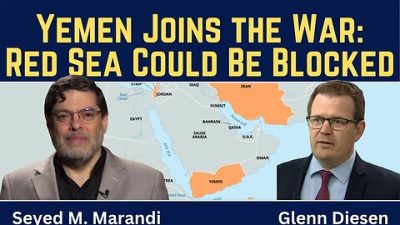
Yemen joins the war – Red Sea could be blocked next – Saudi regime at risk
or go to
Aletho News Archives – Video-Images
From the Archives
A superpower and “the world’s sickest warrior state”
By Paul J. Balles | March 8, 2010
Living through five or six major wars has hardened me to what I thought were the extremes of inhuman cruelty and brutality.
Two things made those extremes almost bearable: the brutality always revealed – at least according to the media coverage – the viciousness of the enemy. It was therefore quite understandable when our “brave men and women” pulverized the enemy.
Films of Japanese torturing captive Americans somehow justified holding Japanese Americans in internment camps during World War II; and only a small percentage of Americans found the bombing of Hiroshima and Nagasaki unreasonably vengeful at best, at worst, depraved.
The media giants in America portrayed the North Koreans as barbaric beasts with their captives, quite unlike their southern counterpoints – our allies during the Korean War. No one ever felt the need to explain how the South Koreans were a civilized breed while the North Koreans were absolute savages, at least according to the official line.
In Vietnam, our warriors justifiably (or so the media made us believe) dropped napalm on the North Vietnamese who had the gall to hide in villages and tunnels to ravage our invaders. At least it was accepted practice until some rogue photojournalist filmed a young girl screaming down a Vietnamese road in flames. … continue
Blog Roll
 Aletho News
- FTC Warns Visa, Mastercard, PayPal, Stripe Over Political Debanking
- Russian tanker approaches Cuba despite US oil blockade
- Marandi: Yemen joins the war – Red Sea could be blocked next – Saudi regime at risk
- Pro-Palestinian French member of European Parliament denied entry to Canada
- Pakistan to Host US-Iran Talks
- How Indonesia’s tilt toward the US left it stranded in the Strait of Hormuz
- US has no choice but to retreat from Iranian borders: Top commander
- Iran Retaliation Strikes Chemical Plant Near Dimona
- AWACS’ Destruction is a Major Loss for US Military – Ex-DoW Analyst
- Israel’s Iran Strategy Uses US Military & Gulf States as Its Pawns
- If Americans Knew
- Israeli police block Catholic cardinal from entering Church of the Holy Sepulchre on Palm Sunday
- Israel is assassinating journalists again, more than any other nation, anywhere, ever – Not a ceasefire Day 170
- Over 300 US service members wounded, majority have brain injuries – Not a ceasefire Day 169
- Researchers at Human Rights Watch Resign Over Blocked Report on Palestinian Refugee Return
- Jewish Groups Are Backing a War Americans Don’t Want
- Eric Fingerhut Thinks He’s the President of the Jews
- Top Jewish Philanthropists, Rabbis Urge Israeli President to Take Action Against ‘Jewish Extremists’
- Don’t Be Fooled. Zionist Leaders Have Always Wanted to Control Southern Lebanon
- Israel’s widespread use of torture is a core element of its genocide against the Palestinian people
- In Israel’s War on Iran, Many Middle East US Bases Rendered “All But Uninhabitable”
- No Tricks Zone
- New Study Finds Warming Saves Lives…Cold Temperatures 12 Times More Deadly Than Excess Heat
- German Science Blog Accuses PIK Climate Institute Of Hallucinating Climate Tipping Points
- Devastating Assessment Of Comirnaty Vaccine By Former Senior Pfizer Europe Toxicologist
- New Study: CO2 Is ‘Effectively Negligible’ As An Explanatory Climate Change Factor Since 2000
- Former Pfizer Toxicologist Dr. Helmut Sterz Tells Bundestag Hearing Pfizer Vaccine Should Have Never Been Approved
- Energy Expert: Germany’s Nuclear Phaseout Was A “500 Billion Euro Mistake”
- New Research: South Australia’s Mid-Holocene Sea Surface Temperatures Were 4°C Warmer Than Today
- Storing Green Energy To Last Germany 10 Days Would Require A 60-Million Tonne Battery
- New Studies: UK Sea Levels Were 4 Meters Higher Than Today During The Mid-Holocene
- Destructive Green New Deal: German Energy And Metal Group Warns Of Drastic Crisis
 Aletho News