Bahrain Regime Jails 50 Opposition Protesters up to 15 Years
Al-Manar | September 29, 2013
A Bahraini court on Sunday sentenced 50 people to up to 15 years in jail, including a prominent Iraqi cleric, for forming an opposition group, a judicial source said.
Sixteen defendants were handed 15-year terms, while four others were jailed for 10 years and the other 30 sentenced to five years behind bars, the source said.
The defendants, including Iraqi cleric Hadi al-Mudaressi who was sentenced in absentia, were charged with forming the February 14 Revolution Youth Coalition, which Bahraini authorities accuse of ‘terrorism’.
Several defendants were sentenced in absentia, including Saeed al-Shahabi, a key London-based Bahraini opposition figure who faces an earlier life sentence for his role in the 2011 uprising.
The interior ministry in June named 11 suspects who were arrested in the case, in addition to 13 people who live abroad.
At least 89 people have been killed by the Bahraini authorities since peaceful protests erupted In February 2011, according to the International Federation for Human Rights.
Related article
Bahraini government ‘blocks’ activist from traveling home to Gulf kingdom
RT | August 10, 2013
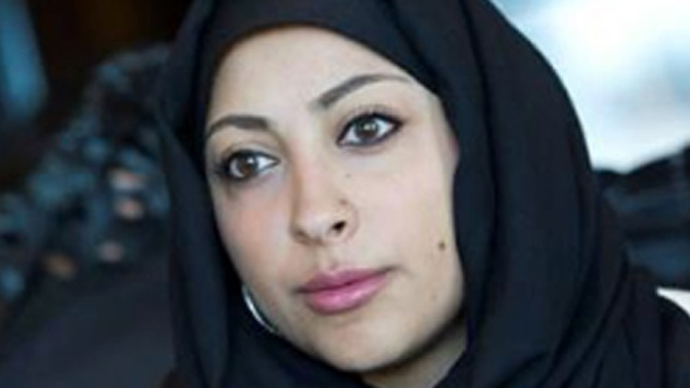
Maryam al-Khawaja (Image from twitter.com)
A prominent Bahraini activist was prevented from boarding a British Airways flight from Denmark ahead of major protests expected to occur in her home country next Wednesday. She says the Bahraini government denied her from traveling.
“I was blocked at the boarding and told to check with the counter because there was a problem. The lady called the office in London who told her that there was a denied boarding message as a decision from the Bahraini government,” Maryam Al-Khwaja told the International Business Times.
“Like all airlines, we are required to comply with requests from individual government authorities,” a BA spokesperson told the news website.
The activist asked the airline to explain why the ban had been issued, but was not initially given a reason.
“I’ve put in a request and they’re going to get back to me. I told them to move as fast as possible because if I don’t receive a response I’ll be consulting a lawyer on the possibility of going to court,” she said.
Mass protests are scheduled to take place in Bahrain on August 14 – the country’s Independence Day.
King Hamad, whose Gulf kingdom has been rocked by Shiite-led protests since 2011, banned protests in Manama on Wednesday in anticipation of the rallies.
The royal decree modifies the law to “ban organizing protests, rallies, gatherings or sit-ins in Manama, with the exception of sit-ins outside [offices of] international organizations” which have been approved by police.
Al-Khwaja said that Bahrain’s government wants “no witnesses to its current and anticipated future violations,” according to a statement from the Bahrain Center for Human Rights (BHCR).
She later tweeted, “What I want to know is what the regime is so afraid of that they [would] issue a ban preventing me from traveling to Bahrain.”
The activist was due to visit her father and her sister, who are currently imprisoned in Bahrain for their roles in pro-democracy protests.
Al-Khawaja, who holds dual Bahraini-Danish citizenship but has not renewed her Bahraini passport, is acting president of the BHCR.
Her predecessor Nabeel Rajab, the organization’s official president and prominent human rights activist, is currently serving a prison sentence. He was initially arrested for criticizing the prime minister on Twitter in 2012 and was later convicted of disturbing public order, calling for marches without giving prior notification, and participating in illegal gatherings.
Bahrain, which hosts the US Fifth fleet, has made a record 221 entry-denials since February 14, 2011, according to Bahrain Watch. Those barred from entering the country include foreign journalists, NGO members, trade unionists, politicians, aid workers, and activists.
Related articles
Bahraini regime arrests over 200 protesters in July
Press TV – August 9, 2013
Bahrain’s main opposition group al-Wefaq says more than 200 people including women and children were detained during the heavy-handed regime crackdown on protests in July.
The Bahraini opposition party recently revealed that at least 19 children and one woman were also among those arrested by the regime forces during the demonstrations last month.
According to al-Wefaq, over 170 people were also wounded due to the excessive force used by the Manama regime forces.
Meanwhile, Manama forces have raided some 650 homes over the past month, while 18 cases of brutal and inhumane tortures have also been reported.
On August 7, Bahraini King Hamad bin Isa Al Khalifa banned protests in the capital, Manama, ahead of the August 14 celebrations of the country’s independence from the United Kingdom.
The opposition is planning to hold a major protest on the same day. The Manama regime has warned that any protests would face the “force of the law.”
Bahrain’s loyalist-dominated parliament has also approved a bill banning all protests in Manama.
The Bahraini uprising began in mid-February 2011.
The Al Khalifa regime promptly launched a brutal crackdown on the peaceful protests and called in Saudi-led Arab forces from neighboring states.
Scores of people have been killed in the crackdown, and the security forces have arrested hundreds, including doctors and nurses.
The protesters say they will continue demonstrations until their demand for the establishment of a democratically elected government is met.
Related article
Bahrain Watch organization says Manama regime tracks critics via Twitter
Press TV – August 5, 2013
The Bahrain Watch organization has revealed that the Manama regime uses fake Twitter accounts to track government critics online.
Since October 2012, the Bahraini regime has detained several citizens for posting anonymous tweets that refer to Bahrain’s King Hamad bin Isa Al Khalifa.
An eight-month investigation showed that the Bahraini regime identifies those anonymous online critics by sending them malicious IP (Internet Protocol) spy links from a network of Twitter and Facebook accounts impersonating well-known opposition figures or other seemingly friendly individuals.
When a person clicks on an IP spy link, the report said, the security forces reveal the IP address of the internet connection they clicked from.
The regime can then force the internet service provider of the IP address to disclose the real name and street address of that internet connection’s subscriber.
According to the report, an examination of court records for five related cases shows that the Public Prosecution’s case centers on linking the IP address of the defendant to the offending anonymous Twitter account.
The prosecution, however, declined to disclose how the IP addresses were acquired, citing information obtained through “private methods that cannot be disclosed.”
The Bahraini regime apparently uses these accounts in secret, and may target their followers, friends, or contacts through private messages.
The report also lists over 120 other accounts that were also targeted in Twitter with IP spy links traceable to the government over the past two years.
Bahrain Watch lead researcher Bill Marczak said, “It is outrageous enough that individuals have been arrested and jailed for mere tweets criticizing the government.”
“That these individuals are being tracked down and convicted based on such weak digital evidence only makes matters worse.”
Bahrain Watch has urged political and social activists in Bahrain, and around the world, to be vigilant about impersonation accounts and malicious links.
“Given the government’s track record, it comes as no surprise that it would resort to such measures to stifle free speech,” Marczak stated.
“However, our hope is that this report will spread awareness of the methods that governments around the world use to trap digital activists.”
Related articles
- Al-Khalifa regime blocks Al-Manar website in Bahrain (realisticbird.wordpress.com)
- Bahrain Declares War on the Opposition (lobelog.com)
US Gulf allies crack down on Internet freedoms
RT | June 10, 2013
Gulf Arab allies of the US have come under fire for introducing a series of draconian measures that limit Internet freedoms. The measures restrict content on social media sites, making “offending” posts punishable by extensive jail sentences.
Saudi Arabia, Qatar, the United Arab Emirates, Kuwait and Bahrain have tightened controls on Internet freedoms recently, targeting social media and phone applications alike in their communications crackdown.
Across the Gulf, dozens of journalists and social media users have been arrested since the beginning of the year for being in violation of the uncompromising national laws.
Punishments include deportation and lengthy prison sentences for crimes such as making derogatory comments about the government “in bad faith,” and offending religion and family values. In Saudi Arabia last month, top cleric Sheikh Abdul Latif Abdul Aziz al-Sheikh warned citizens against using Twitter, stating that those who use social media sites “have lost this world and the afterlife.”
Saudi Arabia
After threatening to ban messaging applications like Skype and WhatsApp, Saudi Arabia’s telecom regulator has chosen a new target: The web-based communication app Viber. The instant messaging application has been blocked since June 5.
“The Viber application has been suspended… and the [regulator] affirms it will take appropriate action against any other applications or services if they fail to comply with regulatory requirements and rules in force in the kingdom,” the Communications and Information Technology Commission (CITC) said in a statement.
Viber allows its users to text, call and send photos and video messages worldwide using a 3G or Wifi connection, and boasts over 200 million subscribers worldwide.
In March, the CITC warned mobile providers in the Kingdom that if they could not find ways to monitor encrypted messaging and VOIP applications, then they would be blocked, according to local media. The commission then issued a statement saying that “it would take suitable measures against these apps and services,” in its push for greater control over the Internet.
The Saudi government has also begun arresting Twitter users for posts to their accounts. Local media reports that the government is looking into ending anonymity for Twitter users in the country by making users register their identification documents.
Qatar
Despite its status as a regional media hub, the emirate state is considering a new cybercrime law that would widen government control over news websites and online commentaries.
If passed, the law would enable the government to punish websites or social media users for violating “the social principles or values,” or for publishing “news, photos, audio or visual recordings related to the sanctity of the private and familial life of persons, even if they were true, or infringes on others by libel or slander via the Internet or other information technology means,” Qatar News agency reported.
United Arab Emirates
At the end of 2012, the UAE passed a sweeping new cybercrime law: Anyone found guilty of criticizing the country’s rulers or institutions online may be jailed or deported. The law attracted widespread opposition, with legal consultants warning it is broad enough to penalize anyone caught posting allegedly offensive comments against the state.
This law has been used to jail citizens for Twitter posts over the past few months. In May, the UAE appeals court sentenced Abdullah Al-Hadidi to 10 months in jail for tweeting details of the trial of his father.
He was arrested on March 22 on charges of disseminating information on Twitter “in bad faith.” The court ruled that he wrote false details of a public hearing that, along with his father, involved 93 other people accused of plotting to seize power in the Gulf Arab state.
Kuwait
The government has arrested dozens of activists and at least six journalists in 2013 in the constitutional emirate, often described as the most liberal country in the region.
In March, Twitter user Hamed Al-Khaledi was sentenced to two years in prison for allegedly insulting the ruler of the Gulf nation. Others have been accused of “threatening state security” or “offending religion.”
In April, a Kuwaiti court sentenced former parliamentarian and opposition leader Mussallam al-Barrak to five years in prison for remarks deemed critical of the ruler of the state, which he made last year at a public rally.
Kuwait has been a member of the International Covenant on Civil and Political Rights (ICCPR) since 1996, which protects the right to freedom of expression, including peaceful criticism of public officials.
Bahrain
The Bahraini government has been trying to suppress an ongoing uprising by introducing stricter penalties. In April, the government passed a law making it illegal to insult the Gulf state’s King Hamad bin Issa al Khalifa, or its national symbols.
Recently, Bahraini blogger and activist Ali Abduleman was granted asylum in the UK after two years in hiding. Adbuleman claims he was persecuted by the government “for exercising the right to express his opinions” on his website. The Bahraini government claims he was tried for “inciting and encouraging continuous violent attacks against police officers” and conspired to spread “false and inflammatory rumors.”
In May, 62-year-old Bahraini protester Abdulla Sayegh was sentenced to three months in prison for hanging a national flag from his truck during a 2011 rally. The same month, six Twitter users were jailed for allegedly offensive comments about the country’s ruler deemed to be ‘abusing freedom of expression.’ According to prosecutors, they posted comments that undermined “the values and traditions of Bahrain’s society towards the king.”
One of the best-known human rights abuse cases in Bahrain is that of activist Nabeel Rajab, who was sentenced to three years in jail in August 2012 on charges of ‘participating in an illegal assembly’ and ‘calling for a march without prior notification.’ He openly criticized the country’s regime on RT for Julian Assange’s show The World Tomorrow.
The country has witnessed mass protests led by the kingdom’s majority Shiites against the minority Sunni-led government for two years. The Shiite demonstrators call for a transfer to a democratic system, and complain of discrimination in jobs and government. Their loyalty is in turn questioned by the ruling Al Khalifa monarchy, which has been in power for decades.
Related articles
Prominent Bahraini activist Nabeel Rajab goes missing
Al-Akhbar | May 16, 2013
Prominent Bahraini human rights defender Nabeel Rajab has been removed from his cell to an unknown location, losing all contact with his family and lawyer, the Bahrain Center for Human Rights reported Wednesday.
In an appeal sent out by the human rights group, Rajab had reportedly witnessed prisoners at the central Jaw prison being tortured.
Rajab’s wife had received a phonecall from Rajab testifying on what he had witnessed in the prison. Shortly after, Rajab’s wife was told that her husband had been removed from his prison cell.
His lawyer, family and fellow activists have not been in contact with him since.
On Wednesday, six Bahraini tweeters were sentenced to one year in jail each for insulting the King and “misusing the right of free expression.”
Torture in Bahraini prisons is very commonly used to force prisoners to sign confessions. In February of last year, leading political prisoners began refusing food after reporting systematic abuses in Bahrain’s jails, including beatings, torture and the use of tear gas.
Nabeel Rajab, who founded the Bahrain Center for Human Rights in 2002, has been in custody since June 6 on charges of “public insults against plaintiffs,” the prosecution said in a statement at the time of his rearrest in June 2012.
The avid Twitter user has been charged with insulting the security forces, posting comments on Twitter deemed insulting to a government body and organizing peaceful protests.
His activism has given him the largest Twitter following in Bahrain, and the fourth largest in the Arab world.
The BHCR appeal calls for the immediate release of Rajab “as it is believed that he has been targeted solely due to his legitimate and peaceful work in the defense of human rights.”
Related article
UK spyware used against Bahraini activists – court witness
RT | May 12, 2013
UK spy technology was used against British citizen in Bahrain, new evidence filed in a UK high court has claimed. Activists are calling for a judicial review of the UK’s failure to hold firms accountable for sales of spy software to repressive regimes.
The evidence submitted contains a witness statement from Bahraini activist and writer Ala’a Shehabi, 30. She has both Bahraini and British citizenship, and is one of the founding members of Bahrain Watch, an independent research and advocacy organization set up following a security crackdown in the country in February 2011.
Shebabi became one of the targets of the FinSpy malware emails, developed by UK firm Gamma International, the Guardian reported.
The activist claimed she received four phishing emails from what appeared to be authentic email accounts after being released after detention.
The FinSpy software reportedly allows for surveillance of emails, social media messaging and Skype calls, and can retrieve files saved on an infected computer’s hard drive. It also can remotely operate microphones and cameras on computers and mobile phones.
“I have real concerns about the Bahraini regime having effective unfettered access to my computer, reading my emails and monitoring my calls. Not only is this a gross invasion of my privacy, I am concerned that it could put in danger from the Bahraini authorities myself, my family members and other activists,” the paper quoted Shehabi as saying.
In her witness statement, she claims that the first infected email was supposedly from Kahil Marzou, the deputy head of Bahrain’s main opposition party. Other emails purported to have come from an Al Jazeera journalist.
“It upset me a lot, scared me and made me feel quite paranoid. I am very concerned that it appears that a product of a British company,” she stressed.
The campaign group Privacy International (PI) in November reported that Gamma International is selling surveillance technology without a proper license. The technology sold is being used by 25 countries to spy on activists, who are later targeted by repressive regimes – a situation that “amounts to criminal conduct” on the part of the tech firms, the activist group said in an 186-page report it sent to Her Majesty’s Revenue and Customs (HMRC).
In the spring and summer of 2012, Bahraini activists, including Shehabi, received emails containing malware. After the University of Toronto’s CitizenLab investigated the case, it found evidence connecting the malware to FinSpy.
With this new witness statement, privacy rights groups are seeking to force the UK government to review exports of surveillance technology. The activists are pushing for a judicial review of the government’s apparent failure to investigate whether the sale of technology to repressive regimes is a breach of export-license controls.
In April, Privacy International filed an application for judicial review of HMRC over its role in allowing the export of advanced surveillance technology used by repressive regimes worldwide – including Bahrain – to spy on dissidents.
Privacy International’s lawsuit is over the government’s refusal to disclose whether it investigated UK-based Gamma International (GI). GI’s FinSpy software has allegedly been used by some two dozen countries worldwide.
“In the wrong hands, today’s surveillance technologies can have devastating effects, and the public, especially victims targeted by this surveillance, have a right to know what the UK government is doing about it,” said Eric King, head of research at Privacy International.
Gamma International, an Anglo-German company registered in the British Virgin Islands, denied reports it had sold to oppressive regimes, and maintained that it complies with export controls.
The UK’s Department for Business, Innovation and Skills advised Gamma International that FinSpy products have been controlled by EU legislation since 2000 and “require a license” in order to be sold outside the EU. This would require the tech firm to disclose the names of export customers.
Bahrain’s human rights violations
Bahrain’s human rights situation is “critical in the wake of the brutal crackdown on pro-democracy protesters that erupted in February 2011,” Human Rights Watch reported in December.
Police regularly use violence to disperse crowds of protesters, while Bahrainis, led by the country’s Shia Muslim majority, are continuing to protest, demanding greater rights and freedoms from the ruling Sunni minority.
More than 80 people have died in unrest since the pro-democracy protests begun in the February 2011 uprising, with thousands arrested and imprisoned and severe violence reportedly employed during the course of the arrests. Physical and psychological torture of prisoners to sign false confessions has also been reported.
New laws were passed in Bahrain in April making it illegal to insult the country’s king and national symbols, charges that carry five-year jail sentences.
Related article
Female Bahraini Doctor ‘Severely’ Tortured in Jail
Al-Manar | March 31, 2013
A female Bahraini doctor says the Al Khalifa regime forces have ‘severely’ tortured her and several other doctors, who treated injured anti-regime protesters, in order to extract false confessions.
“We were forced to sign false confession blindly without reading them and these confessions were taken or extracted by severe torture and I mean by severe torture physical and psychological torture,” Dr. Fatima Haji said in a recent interview with Russia Today.
“We’d been denied sleep for days and had been standing for days. We were not given food or fluids and were hardly allowed to go the toilet,” Haji stated.
She further said the inmates were beaten by wooden sticks and hollow pipes. They were also electrocuted, sexually harassed and threatened with death and rape.
Haji is one of a group of doctors who were sentenced to five years in jail for their role in anti-regime protests. However, they were acquitted in 2012.
The confession they were forced to sign said that they were in possession of arms in the hospital where they worked and that they were trying to topple the Manama regime.
~
Bahrainis’ New Demand: USA Stop Arming Killers
By Yusuf Fernandez | Al-Manar | July 16, 2012
On July 7, Bahraini people took to the streets in several towns and villages to stage anti-government rallies and express their anger at the US for meddling with their country´s internal affairs. Bahrain hosts the US Fifth Fleet, which patrols the Persian Gulf and Arabian Sea, and is among the Persian Gulf countries that receive weapons and military systems from the United States.
For more than one year now, demonstrations have been taking place day after day across Bahrain against the brutal regime of King Hamad Al-Khalifa. Dozens of protesters have been killed since the revolution started. The Bahraini police and army killed at least thirty people during the mass demonstrations of this year to demand political and social rights.
Over 1,000 people have been detained and many of them have been tortured. Thousands of public sector workers have been fired for allegedly taking part in protests against the regime.
Recently, a military tribunal in Manama sentenced twenty doctors to prison terms of up to 15 years. The doctors faced shameful charges, including hiding weapons in hospitals, “occupying a hospital,” and acting to overthrow the regime. No credible evidence against the doctors was presented in the court and they suffered abuse and torture in prison and were denied full access to their lawyers.
US weapons for Bahrain
The US has been for a long time the major supplier of weapons to the Bahraini regime. A TomDispatch analysis of the Pentagon documents showed that “since the 1990s, the United States has transferred large quantities of military material, ranging from trucks and aircraft to machine-gun parts and millions of rounds of live ammunition, to Bahrain´s security forces”.
According to data from the Defense Security Cooperation Agency, the US has sent Bahrain dozens of tanks, armoured personnel carriers, and helicopter gunships. The US has also supplied the Bahrain Army with thousands of .38 caliber pistols and millions of rounds of ammunition, including .50 caliber ammunition for sniper rifles, machine guns etc. In 2010, Washington sold over $200 million worth of weapons to Bahrain, up from $88 million in 2009.
Despite all the above-mentioned violations of human rights, the US Defense Department recently agreed to provide the Bahraini government with another $53 million worth of weapons, the first provision since the revolution began. The resumption of military sales took place shortly after a visit to Washington by Bahrain Crown Prince Salman Hamid al-Khalifa. There, he met Vice President Joe Biden, Secretary of State Hillary Clinton and Defense Secretary Leon Panetta.
According to ForeignPolicy.com’s The Cable Blog, the US-Bahraini arms deal includes six harbor patrol boats, communications equipment for Bahrain’s US-made air-defense system, ground-based radars, air-to-air-missile systems, Seahawk helicopters, parts for F-16 fighter engines, Cobra helicopters, and night-vision equipment.
The agreement also includes 44 armored vehicles of the type used to crush the demonstrations. It is noteworthy to point out that US weapons have been used by Bahraini security forces for cracking down on pro-democracy protesters since last year.
Senator Patrick Leahy (D – VT) has criticized the resumption of arms to Bahrain. Although he claimed to be pleased because no tear gas will be included in this sale, Leahy thinks that the deal still sends “the wrong message.” Brian Dooley, director of the Washington-based charity Human Rights First, also condemned the arms sale as a “reward” for the Bahraini dictatorial regime.
No matter how the US Administration tries to sell its decision, it will be seen as a clear support for the Al-Khalifa dictatorship. “‘You really should be nicer to the people you are oppressing; oh, by the way, here are the weapons you were expecting’ is what Manama will hear from Washington”, complained Mohammed al-Maskati, a Bahraini human rights activist: “It is a direct message that we support the authorities and we don’t support democracy in Bahrain, we don’t support protestors in Bahrain.”
According to a recent report by Julian Barnes and Adam Entous in the Wall Street Journal, the US has positioned itself against democracy in Bahrain. “Starting with Bahrain, the administration has moved a few notches toward emphasizing stability over majority rule,” according to a US official quoted by the Journal. “Everybody realized that Bahrain was just too important to fail.” This means that the US Administration is directly working against democracy and freedom in Bahrain.
In order to cover this reality, American officials have been using a rhetorical and hypocritical language. They have often called for “restraint” on both sides, Bahraini pro-democracy protesters and the dictatorial regime which is killing Bahraini people. A recent State Department statement praised Bahrain for its “reforms” and urged more. It also condemned the civilian protesters for their “violence” against police and demanded that they “refrain from incitement.”
The deputy chief of mission at the US Embassy in Manama, Stephanie Williams, has visited the injured Bahraini security forces, who took part in the crackdown on Bahraini protesters. The main opposition group in Bahrain, Al Wefaq, issued a statement, censuring the visit claiming that it “indicates that Washington ignores the suppression campaign led by the Bahraini government against peaceful popular protests”.
Therefore, Bahraini people now consider that the US government is partly responsible for the tyranny under which people have been suffering for a very long time. This will likely produce anger and hatred toward the United States. Echoing this reality, a recent New York Times article was titled: “As Hopes for Reform Fade in Bahrain, Protestors Turn Anger on United States.”
According to the article, “For months, the protests have aimed at the ruling monarchy, but recently they have focused on a new target…. the young protestors added a new demand, written on a placard in English, so the Americans might see: “USA Stop arming the killers.”
Related articles
- FP Passport: Bahrain activist jailed for Tweet against prime minister – Foreign Policy (blog) (foreignpolicy.com)
- Obama and Clinton Resume Arms Sales to the Torturers of Bahrain (firedoglake.com)
Featured Video

New positive ivermectin evidence
or go to
Aletho News Archives – Video-Images
From the Archives
Fanatical Followers of the Covid Regime: A Jim Jones-Style Cult?
By Professor Roger Watson and Dr. Niall McCrae | The Daily Sceptic | November 15, 2021
As scholars at leading British universities over recent decades, we witnessed the replacement of critical thinking and debate by narrative: facts are discrimination and scientific method is imperialism; truth, instead, is derived from ‘progressive’ values. This educational trend may be a major contributory factor to the ease in which society has been inculcated to the Covid ‘new normal’ of masking, testing, and repeated doses of vaccines for a disease of similar risk to severe influenza.
One doesn’t need much critical reasoning to observe the flawed logic of some vaccination enthusiasts, such as people who respond to experiencing any side effects, however debilitating, by saying “at least I know it’s working”, or, after contracting the disease despite their promised inoculation (over 90% effective, according to initial drug company claims), “I’d have been worse off without the jab.” … continue
Blog Roll
 Aletho News
- Arctic Scare Stories Melt Away
- Wrong, Euronews: Climate Change Has Not Created a Food, Energy, and Economic “Meta-Crisis”
- New positive ivermectin evidence
- Met Office Caught Fabricating Daily Temperature Record Claims
- Merck Virologists Admitted to Falsely Certifying Vaccine Efficacy
- Mandatory Folic Acid for every man, woman & child
- Pro-Palestine protesters arrested outside UK’s ruling Labour Conference in Liverpool
- Mauritius denies landing permit to flight from Israel, forcing cancellation: Tour operator
- Israeli finance minister calls for genocidal war on West Bank, annexation of south Lebanon
- 12 Things Your Psychiatrist Was Trained Not to Tell You
- If Americans Knew
- Israel forces Gazans to live in constant peril – Daily Update
- Deconstructing Netanyahu’s pants-on-fire UN rant – Daily Update
- Trump betrayed voters with his campaign lies and prioritized a foreign country once he took office
- Netanyahu calls Israel’s war in Gaza ‘opposite of genocide’ in UN speech to near-empty hall
- Settler Kidnappings: Torture, Sexual Abuse and Terrorisation of Palestinian Abductees as Israel Deepens Annexation of West Bank
- Gaza winter nears as 162,000 tents become unusable, raising fears of humanitarian crisis
- Netanyahu says, “It’s the opposite of genocide”; UN says Gaza economy is world’s ‘most severe crisis on record’ – Daily Update
- Israel’s US-Backed Assault on Gaza Has Created the ‘World’s Most Severe Economic Crisis on Record’: UN
- ‘Protecting U.S. Citizens’… From Israel
- ‘This is where I live now, the back of a truck’: a day in the life of a grandmother in Gaza
- No Tricks Zone
- New Study: Earth And Venus Surface Warmth Largely Explained By Convection And Lapse Rate, Not CO2 Or Radiation
- 2025 Nature Paper Claiming Worsening Global Drought Gets RETRACTED …Heavily Flawed
- New Study: ‘Global Drought Shows No Detectable Recent Acceleration Under Climate Warming’
- Economic Masterminds: German Socialists Suggest Taxing Productivity Gains Stemming From Using AI
- The South China Sea Has Not Been Cooperating With The Climate Change Narrative
- Energy Crisis: Germany Enters Heating Season With Historically Low Gas Reserve Fill Levels
- New Study: The Antarctic Ice Sheet Gained Mass From 2020-2024 Due To Staggering Snow And Ice Accumulation
- Study: Ocean Heating Rates From Thousands Of Years Ago ‘Dwarf’ Modern Ocean Heating Rates
- Climate Extremists Target, Attack Large-Scale Power Grid Infrastructure In Germany!
- New Study: Antarctic Ice Melt Has Contributed Less Than 1 Centimeter To Sea Level Rise In The Last 30 Years

