Israeli Prime Minister Benjamin Netanyahu headed for the United States on Sunday claiming he wants to tell the truth to counter Iran’s “charm offensive.”
“I intend to tell the truth in the face of the sweet talk and charm offensive of Iran,” public radio quoted Netanyahu as saying before boarding a plane for Washington. “Telling the truth at this time is essential for world peace and security and, of course, for Israel’s security,” he said.
Israeli media said Netanyahu had instructed government ministers to refrain from publicly commenting on the telephone call between the US and Iranian presidents for fear of complicating his White House talks on Monday.
But that has not stopped his confidants speaking out, and President Shimon Peres warned that the tone of much of the commentary was “dangerously scornful” of Israel’s key ally.
“You can agree or disagree (with the Americans) but I don’t like this scornful tone,” Peres told army radio. “Other people have brains to think too, not just us. We should talk to them and try to influence them.”
After meeting Obama, Netanyahu is due to address the UN General Assembly on Tuesday, the same forum where last year he used a cartoon bomb as a prop to underline how close he believed Iran was to being able to build one.
Yesterday in USA Today (9/22/13), Aamer Madhani wrote this about the challenges facing Barack Obama:
The president is also trying to take advantage of a diplomatic opening–created by the installation of a new, more moderate president in Iran–to persuade Tehran to abandon its nuclear weapons program.
As you might know by now, this is misleading; Iran is suspected by some governments of having a nuclear weapons program, but there is no solid intelligence that such a program exists.
USA Today made a similar claim a few months ago; when FAIR activists wrote to the paper, it eventually got around to issuing a correction. But good luck figuring that out; the paper had originally claimed that new Iranian President Hassan Rouhani was “known for his negotiating skill over the country’s nuclear weapons program.” The paper’s correction read:
A June 17 story on Iranian President-elect Hassan Rouhani misstated his previous position. He was a negotiator over Iran’s nuclear program.
There’s basically no chance that any reader of the paper would have been able to know what was being corrected. But if the paper is actually interested in accuracy, they might want to run another correction.
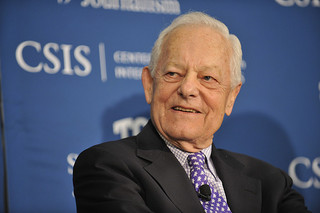
Bob Schieffer (photo: CSIS)
They’re not the only ones who should consider clarifying the record. Here’s CBSFace the Nation host Bob Schieffer (9/22/13):
Rouhani says that Iran does not want and is not pursuing a nuclear weapon. Does anybody take that at face value?
Actually, the burden of proof should be the other way around: Politicians who claim that Iran has such a program should have to prove it. Schieffer obviously doesn’t see the world that way. He’s interviewed people like Israeli Prime Minister Benjamin Netanyahu and failed to challenge their claims about Iran’s weapons. Indeed, Schieffer presented them as facts, telling viewers about Iran’s “continuing effort to build a nuclear weapon” (FAIR Blog, 7/15/13).
So Schieffer is indeed skeptical of government claims. Iran‘s government, that is.
Following the deadly shooting of an Israeli soldier in Hebron city, in the southern part of the occupied West Bank, Israeli Prime Minister, Benjamin Netanyahu, vowed to boost settlement activities, and ordered the Civil Administration, to take all needed measures to allow the return of Israeli settlers into a Palestinian home they previously occupied in Hebron.
The Israeli Civil Administration Office is run by the Israeli military in the occupied West Bank.
Back in April of 2012, a group of settlers was removed from the home, near the Ibrahimi Mosque in Hebron. They allegedly purchased the property but the purchase was deemed invalid, especially since such deals must be first approved by a commander of the Israeli occupation army.
The settlers were removed after the then-Israeli Defense Minister, Ehud Barak, issued an order in this regard following a court ruling.
The decision to allow the settlers to return to the property was made on Sunday night; Netanyahu said that the settlers “must be allowed into the home without any delay”.
After being removed from the property, the settlers filed several court appeals, demanding a recognition of the alleged transaction, while Israeli Defense Minister, Moshe Ya’alon, also vowed to do whatever he can to authorize their “return to the home”.
Netanyahu made his decision hours after a Palestinian sniper shot and killed an Israeli soldier in Hebron, following ongoing tension that led to clashes between the soldiers and dozens of local youths who hurled stones at them.
It is also related to the death of an Israeli soldier who was killed two days ago in the Qalqilia district, in the northern part of the occupied West Bank.
“Anyone who attempts to remove us from Hebron, from the city of our patriarchs, will just achieve the exact opposite”, Netanyahu said according to the Israeli daily Haaretz, “We will boost our settlement activities”.
Netanyahu said that the “return of the settlers to the Hebron home would still have to go through legal means”; yet, he ordered all related government facilities, to do whatever they can to ensure their fast return.
His decision comes despite the fact than an appeals committee, looking into the purchase did not recognize the documents presented by the settlers, but criticized the way this purchase was denied.
Haaretz added that, should the process be finalized, Netanyahu and his Defense Minister could sign off the deal, and authorize the settlers back.
In related news, Israeli Economics Minister, Neftali Bennet, demanded that Netanyahu stop the release of Palestinian political prisoners, as part of peace talks with the Palestinians, and said that the Palestinians “must be punished for the killing of the two Israeli soldiers.”
Bennet, of the Jewish Home Party, who also serves at the Ministerial Council, said that “the release of Palestinian prisoners is based on progress of talks, and our duty should be a war on murderers…” according to the official.
Israel’s Transportation Minister, Yisrael Katz, said that he previously voted against the release of any detainee, and that the release of what he called “terrorists” encourages others to attack Israel.
Following the fatal shooting of the Israeli soldier in Hebron, the army initiated a large campaign and broke into and searched hundreds of homes close to the Ibrahimi Mosque area where the soldier was shot.
Hundreds of Palestinians were kidnapped, and where rounded up in the southern area of the occupied city of Hebron.
The soldiers also occupied rooftops of several homes, using them as monitoring towers, while the army operated in the area.
The military declared Hebron a closed military zone, preventing the Palestinians from entering or leaving it.
Last week, Israeli soldiers shot and killed one Palestinian, and injured four, including three children, in different attacks carried out in the occupied Palestinian territories.
The army carried out 49 invasions into Palestinian communities, and kidnapped at least 41, including 9 children.
Two Palestinians have been killed, dozens have been injured, and hundreds were detained, by Israeli forces since the beginning of the month.
The avoidance of an imminent US military onslaught on Syria is of course to be welcomed.
But the deal struck by American Secretary of State John Kerry and his Russian counterpart Sergei Lavrov at the weekend looks rather like a postponement of US aggression than a step towards a peaceful resolution.
Already Western politicians and media are conflating the latest UN chemical weapons inspection report with the weekend admission by the Syrian government that it possesses such armaments.
The UN report only confirms that the toxic nerve agent sarin was used in an attack on 21 August near the capital, Damascus. But this finding is being spun to insinuate that the armed forces of President Bashar al-Assad are to blame and in that way justifying Western threats of retaliatory military action.
It is troubling that within hours of Kerry and Lavrov shaking hands in Geneva on a seeming breakthrough agreement they were both saying very different things about its consequences.
On his way back to Washington, Kerry met the French and British foreign ministers in Paris on Monday morning where they reiterated – with usual high-handed truculence – that the option of military force against Syria was still on the table if the Syrian government did not fully comply with the complete decommissioning of its chemical weapons.
For his part, Lavrov in response to the Paris statement appeared to be irked by the repetition of the militarist option by “our partners… this shows a lack of understanding of what John Kerry and I agreed on.” The Russian foreign minister added that any use of military threat might wreck the chance of a peaceful resolution.
Elsewhere, US President Barack Obama also stated that military force against Syria remained an option in spite of the Geneva pact to disarm Syria’s chemical arsenal through diplomacy. That position of wielding military threat was also backed by French President Francois Hollande.
The Americans, British and French want to finalize a resolution at the United Nations Security Council this week which will be “strong and binding,” meaning the authorization of military force if Syria does not deliver on handing over of its stockpile of chemical weapons.
Russia and China – the other two UN Security Council members – will no doubt veto any such resolution.
However, in that case, the US, supported by Britain and France, says that it will invoke a unilateral decision to go it alone in the use of military force outside of the UN. During his press conference with Lavrov in Geneva, Kerry responded to a question about what his country would do if it did not obtain a UN mandate, by saying “the [American] president always has the right to defend US interests.” In other words, the US president can do whatever he wants, including waging war on another country.
This unilateral move would leave the US open to charges of aggression. But knowing Washington’s arrogant capacity for self-justification, sophistry and long history of aggression, such a charge is by no means a deterrent to eventual US belligerence.
It is significant that the first destination for Kerry after Geneva was to fly to Israel to meet with Prime Minister Benjamin Netanyahu. The latter welcomed Kerry with open arms and was visibly pleased with the prospect of “stripping Syria of all its chemical weapons.” Some commentators have averred that the weekend Geneva deal was a slap in the face to Netanyahu from the Obama White House in that it steered away from Israeli war plans against Syria.
Such an analysis seems misplaced as it presumes, against all the evidence, that Washington does not have an inherent war plan for regime change in Syria. It is also misplaced given Netanyahu’s obvious glee on receiving Kerry. And why wouldn’t the Israeli warmonger be pleased?
The so-called Geneva “deal” may have halted US war plans on Syria for now, but the upshot is that Western aggression towards that country is even more emboldened and, bizarrely, has also now gained a veneer of legitimacy.
Syria was compelled to join the Chemical Weapons Convention and thereby surrender its arsenal of chemical weapons. While such weapons are an abomination and in an ideal world should be removed completely everywhere, the result of the Lavrov-Kerry arrangement is that Syria is obliged to unilaterally disarm. Israel has an equally dangerous stockpile of chemical weapons, as well as biological and nuclear arsenals.
Unlike the Syrian government, the Israeli regime has actually used its chemical weapons in the form of White Phosphorus against Palestinian citizens in Gaza. Yet, while Syria is being disarmed of its weapons that have acted as a deterrent against Israel’s weapons of mass destruction, the Israeli regime is free to increase its balance of terror.
Provocatively, the Western powers are still insisting that they have the right to launch a military attack on Syria if the latter does not conform to the chemical disarmament process. But this process is all one-sided. The West is swinging the threat of military force even though it is an unlawful act of aggression. The US and its allies should be indicted for this aggression against Syria, which they have been engaging in for several months and not just since the 21 August chemical weapon atrocity near Damascus.
The UN chemical weapons inspectors, led by Swedish scientist Ake Sellstrom, has confirmed that the deadly nerve agent sarin was used in the attack on 21 August. The UN team does not conclude who actually used the toxic gas despite Western insinuations. But there is plenty of evidence from alternative sources pointing to the Western-backed mercenaries fighting for regime change who committed this atrocity and others involving chemical weapons, such as at Khan al-Assal near Aleppo on 19 March this year.
As well as the US and its allies remaining armed and dangerous so too are the militants that are terrorizing Syria on behalf of Washington. According to recent reports, Washington is stepping up its weapons supplies to al-Qaeda-linked mercenaries – the same mercenaries who are beheading army captives and civilians, as well as poisoning women and children to fabricate crimes attributed to the Syrian army.
US-led all-out war on Syria may have been averted by the Lavrov-Kerry deal in Geneva at the weekend, but the price for that respite seems to be the West and its allies having gained even more leverage for their criminal agenda of regime change.
What Syria, Russia, Iran, China and other independent nations need to do is to widen the terms of any deal over Syria. This must include the complete cessation of weapons being funneled into Syria by the US and its allies; the immediate halt to threats of war by the US; and if we are going to have disarmament of weapons of mass destruction in the Middle East then that process must include the Israeli regime as absolutely mandatory.
~
Finian Cunningham, originally from Belfast, Ireland, was born in 1963. He is a prominent expert in international affairs. The author and media commentator was expelled from Bahrain in June 2011 for his critical journalism in which he highlighted human rights violations by the Western-backed regime. He is a Master’s graduate in Agricultural Chemistry and worked as a scientific editor for the Royal Society of Chemistry, Cambridge, England, before pursuing a career in journalism. He is also a musician and songwriter. For many years, he worked as an editor and writer in the mainstream news media, including The Mirror, Irish Times and Independent. He is now based in East Africa where he is writing a book on Bahrain and the Arab Spring.He co-hosts a weekly current affairs programme, Sunday at 3pm GMT on Bandung Radio.
Those wonderful people who brought you The Big Mac, Mom’s apple Pie, Burger King and Kentucky Fried People are at it again. And all because Binyamin Netanyahu was able to tell his partner in war crimes, just what he needed to hear: The absolutely, without question, no doubt at all genuine, 100% verifiably true information, obtained by the Israeli Mossad (Motto: By Way Of Deception, Thou Shalt Do War) that Bashar al Assad was guilty of gassing his own people, in a situation where the Syrian leader knew that the United States navy was poised on his own doorstep to take action if he did anything so stupid as to gas his own people while the United States navy was poised on his own doorstep.
Also, compelling circumstantial evidence that Israel may well have been complicit in the 9/11 attacks on the United States and that seven Middle Eastern countries were on America’s hit list long before 9/11.
On Tuesday, September 3, 2013, the world awoke to a confused and contradictory story of two ‘missile tests’ off the coast of Syria. First came denials, then a series of contradictions from the US Defense Department, Navy and Israeli Defense Force.
Eventually the ‘joint US/Israeli exercise’ featuring Israeli ‘unarmed decoy missiles’ line emerged.
This unannounced ‘exercise’, while the region is on a hair trigger for war, paints a picture of a US president who has lost the initiative to his so-called allies. Israeli hawks are itching to shoot, annoyed by British, US and French democratic checks and balances. So the war hawks of Zion bare their talons, screech, and expect their US allies to cover their rear.
Letting missiles loose toward the Syrian coast on Tuesday was not a test, it was an Israeli provocation. In the few minutes these ‘Sparrows’ were whizzing toward Syria, President Assad’s military had to decide whether or not to retaliate. These German-designed guided missile destroyers or submarines that fired the missiles are lucky not to be at the bottom of the Mediterranean.
Some of the older among us are experiencing deja vu. Fifty years ago during the 1962 Cuban missile crisis, America and the Soviet Union peered over the edge of the nuclear abyss. US hawks were urging the president to invade Cuba before Khrushchev’s nuclear missiles arrived. Kennedy wisely demurred and it later emerged tactical nuclear weapons were primed and ready for US troops had they tried it on.
At the height of the Cuban crisis, 4am on Friday October 26, US Strategic Air Command (SAC) inexplicably launched an Atlas ICBM from California’s Vandenberg Air Force Base straight toward Russia.
SAC knew the Soviet military would be bracing themselves for the first nuclear strike since Nagasaki and might choose to retaliate against North America before the Atlas arrived. When the Atlas dropped into the sea, Kennedy was finally told. A bemused and disturbed president issued direct orders prohibiting ANY further test launches.
This vicious tomfoolery is precisely what President Dwight D. Eisenhower meant when he warned in his closing address on January 17, 1961 that “In the councils of government, we must guard against the acquisition of unwarranted influence … by the military industrial complex.” The former general feared for any president who’d never been a soldier.
There can be lots of money in making war. It’s an international protection racket. If you have a tame media and can’t find a good reason to fight … any old cock-and-bull story will do.
Obama’s ‘Little Syria’ reminds of Kennedy’s ‘Little Cuba’
The more fingers holding down triggers, buttons pressed and war-fighting supercomputer mice clicked, the more replenishment orders roll in and share prices edge up in real time. Since ‘Dr. Strangelove’ was made Commanding Officer those dividends just keep rolling in.
So after Jack Kennedy’s ‘Little Cuba’, how will Obama get on with ‘Little Syria’ and who are the main characters? The continent is different, but the stakes are the same, both sides look to be backed by unspeakable nuclear arsenals.
Free Syrian Army fighters stand in front of buildings damaged by what activists said was shelling by forces loyal to Syria’s President Bashar al-Assad in the old city of Aleppo September 2, 2013. (Reuters/Molhem Barakat)
This time Zionist fundamentalist Benjamin Netanyahu has taken the role of Joker in the pack, straight out of Gotham City. A war crime is not a war crime and the UN Security Council is hooey when you’re on a mission from God. Here the NATO zone mainstream media has truly missed a trick: it’s not Yahweh, but one-eyed Wotan that floats Bibi’s boat.
So if the war crime orders really do come, let’s hope Obama’s ballistic missile security is up to scratch and whoever gives the illegal order is arrested rather than buttons being pressed. The signs are not good though: 341st Missile Wing’s Colonel David Lynch in Montana was relieved of his command last month after his Malmstrom ICBM Air Force base in Montana failed its safety test.
The covert war, the arming and training of the Syrian rebels, is all but lost. Now, if the NATO-Israeli alliance openly attacks Syria, there can and will be no repeating the lies and delusions of Afghanistan, Somalia, Iraq or Libya. This time the people have spoken loud and clear in Britain, through the House of Commons.
If our so-called leaders travel any further down this bloody road to Damascus they will be declaring war not just on Syria, Iran and Russia, but on their own populations. While arms manufacturers BAe Systems and EADS share price might show a temporary spike, that is a war they can only lose.
Beginning his working life in the aviation industry and trained by the BBC, Tony Gosling is a British land rights activist, historian & investigative radio journalist.
President Obama is now saying his administration has decided to attack Syria but will seek Congressional approval before doing so. This sets up a really interesting situation if Congress doesn’t agree, as seems quite possible.
The idea of Obama ordering an act of war on Syria without significant international support and without a Congressional mandate always was a head scratcher. Here’s our far left president advocating yet another war in the Middle East after opposing the Iraq war when he was a senator. The same president who has a frosty relationshipwith Benjamin Netanyahu and has repeatedly fallen short of the demands of the Israel Lobby.
Of course the rationale is framed in moral terms—like all American wars, but there was more than a touch of that in the run-up to the Iraq war as well. Here the case for the hawks is made more difficult because the WMD story turned out to be false. Lest we forget, this story was manufactured by strongly identified ethnically Jewish, pro-Israel operatives linked to the Office of Special Plans in the Department of Defense, including Paul Wolfowitz, Douglas Feith, Abraham Shulsky, Elliott Abrams, David Wurmser, Michael Ledeen, David Schencker, and Michael Rubin, with the close cooperation of Israeli intelligence (see here, p. 47ff).
The Weekly Standard’s usual neocon suspects — including many of the same people who promoted for the Iraq war — are pressing for a very large U.S. involvement in Syria. It’s mind-boggling to read in the statement of these so-called “experts” that the president must act “to ensure that Assad’s chemical weapons no longer threaten America.” Shades of how Iraq under Saddam Hussein was going to destroy the U.S. with his WMD’s. How Assad is going to unleash his chemical weapons on America is anybody’s guess.
Given the strong support of the neocons for action against Syria, we must assume that Israel is entirely on board with a U.S. campaign. So it’s not surprising that, as in the case of the run-up to the Iraq war, Israeli intelligence is front and center: “The bulk of evidence proving the Assad regime’s deployment of chemical weapons – which would provide legal grounds essential to justify any western military action – has been provided by Israeli military intelligence, the German magazine Focus has reported” (see here). This includes the much-discussed intercepted phone call between Syrian officers discussing the use of chemical weapons (Ibid.) and the claim that chemical weapons were moved to the site of the attack (see here).
I am unaware of evidence for a heavy involvement of Israel Lobby operatives on the U.S. side responsible for verifying this intelligence, as was the case when the Israel Lobby manufactured the rationale for the Iraq disaster — doubtless the most treasonous and corrupt such episode in American history. Nevertheless, one would have to be naive indeed not to be suspicious of Israeli involvement.
As many have noted, it would make no sense for Assad to unleash chemical weapons in a conflict he was winning; no point in killing women and children; no point in attacking just as UN investigators arrived in Syria; no point in incurring the wrath of the U.S. moralizers by crossing Obama’s idiotic red line — idiotic because it is an open invitation to a false flag operation carried out by the opponents of the Assad regime.
Uri Avnery claimsthat “practically all Israeli political and military leaders” want the Syrian civil war to “go on forever.” The other obvious motive for Israel and its fifth column in the U.S. is to strike a blow against Iran, as many have noted. The anti-Iran motive is front and center at the AIPAC website (“Syria proves Urgency to Stop Iran“). This article assumes as true that Assad did use chemical weapons:
The use of chemical weapons by the Assad regime highlights the danger of allowing the world’s most dangerous regimes to possess weapons of mass destruction. As Israel prepares its citizens for the possible ramifications of a chemical attack from Syria, the United States must consider potentially catastrophic ramifications if Iran, who is actively backing Assad, acquires a nuclear weapons capability. … We cannot allow Assad to operate with the support of his greatest ally in Tehran backed by a nuclear weapons capability. The Islamic Republic is already expanding its influence throughout the region, moving military equipment and resources into Syria and Lebanon.
In a statement from June, 2013, the Jewish Institute for National Security Affairs, like AIPAC, emphasizes the implications of failure to act in Syria for the larger question of Iran:
Rather than deterring Syria or Iran from using or pursuing illicit weapons, the administration’s red lines appear to be eroding U.S. credibility and national security. The lesson learned from Syria is that preventing a nuclear Iran will require an actionable and verifiable red line. This should include a credible mechanism for assessing Iran’s progress toward the red line and warning of its crossing.
The ADL statement engages in double talk on who is responsible for using chemical weapons (“Use of chemical weapons in Syria ‘an immoral crime of the first order‘”). On one hand, it states that the attack was performed “reportedly by the Syrian government.” On the other hand, Abe Foxman clearly blames the Syrian government for “the horrific events of last week,” a claim that goes much further. And as usual, the Holocaust is invoked as establishing a special Jewish moral posture useful for achieving Jewish interests:
For more than two years, the world has been witness to President Bashar al-Assad’s slaughtering of his own citizens. Following the horrific events of last week there is no longer any doubt about the brutal and evil nature of Assad and his regime.
We welcome Secretary Kerry’s clear statement of condemnation of the use of chemical weapons in Syria and the U.S. commitment to work with allies to ensure those responsible are held accountable. The world failed to act during the Holocaust and stood by through the genocides in Cambodia and Rwanda. It is a moral imperative that the international community act now to prevent further atrocities in Syria.
From Foxman’s perspective, it’s hard to see how “preventing further atrocities” could happen short of regime change.
Clearly, the organized Jewish community will not be satisfied with a mere gesture against Assad, but wants something in the general vicinity of regime change. The Washington Institute for Near East Policy has numerous articles with the message that a U.S. attack needs to be linked to strategic goals. An article by Michael Makovsky and Blaise Misztal advocates an “asymmetrical” response in which the U.S. would cause far more damage to Syria than caused by the chemical weapons attack: “if Washington orders an operation against the Assad regime, it should not hold back from breaking a few eggs on the way into Syria to ensure easier access in the future. This approach would send a credible and menacing message to the regime to amend its behavior or face further strikes.”
Also on the WINEP site, Robert Satloff (one of the most despicable neocons) makes a ridiculous case that regime change in Syria is in American interests:
Given the strategic stakes at play in Syria, which touches on every key American interest in the region, the wiser course of action is to take the opportunity of the Assad regime’s flagrant violation of global norms to take action that hastens the end of Assad’s regime. Contrary to the views of American military leaders, this will also enhance the credibility of the president’s commitment to prevent Iran’s acquisition of a nuclear weapons capability, not erode America’s ability to enforce it.
Likewise, neocons like Charles Krauthammer (alsohigh on the list of most despicable neocons) want the U.S. campaign to change the balance of power — “a sustained campaign aimed at changing the balance of forces by removing the Syrian regime’s decisive military advantage — air power.” What the neocons don’t want is a brief attack that serves little more than to show U.S. displeasure, leaves Assad in power, and doesn’t change the military situation
So from the Israeli and (what is the same) the neocon point of view, it’s win-win. A serious U.S. intervention would minimally prolong a war that Assad is winning, weakening Syria and Hezbollah far into the future. And perhaps it could lead to the fall of Assad and a Sunni government severed from Iran. Iran and its allies are seen as a far more dangerous enemy of Israel than the Arab nations and the mainly Sunni rebels opposing the Assad government, no matter how fanatically Muslim, Israel-hating, and in bed with al Qaeda they turn out to be.
The decision by Obama to consult with Congress may actually benefit the Israel Lobby because it could quite possibly provide a mandate for much more than a brief attack that is little more than a gesture—like Bill Clinton lobbing a few cruise missiles into Afghanistan to protest the bombing of American embassies in Africa. Without a congressional mandate and without support from the U.K., Obama would have been unlikely to carry out the sort of attack desired by the Lobby. Now there’s a chance.
The delay provides an opportunity for the Israel Lobby to get into high gear in order to bump up the poll numbers and exert its power over Congress. At this time, there is clearly no popular mandate for a war; only 42% favor a “broad military response”, and only 16% favor the regime change desired by the Israel Lobby. A much higher percentage but still far from a mandate (50%) favor the sort of action detested by the Israel Lobby — a limited response involving only U.S. naval ships directed at the chemical weapons.
Congressional approval is also iffy. Senator Rand Paul (R-Ky) has stated that the odds are “50/50″ that the House will approve force, but that the Senate will “rubber stamp what [Obama] wants.” Others believe that even the Senate will be an “uphill battle.”
So the Israel Lobby has a challenge ahead, but it’s certainly doable. Expect a blizzard of propaganda emanating from the most elite media in the U.S., and a lot of arm-twisting in Congress. The Israel Lobby sees this as a preliminary battle prior to the really serious campaign for a war with Iran. If the Lobby loses this test, it would be a clear indication that the U.S. lacks the determination to attack Iran.
The pressure will be intense. Don’t bet against the Lobby.
President Barack Obama’s decision to delay the US offensive against Syria opened the window for negotiating a non-military solution to the issue of chemical weapons, a step that worried Israel for various reasons, the Israeli daily Maariv reported on Monday.
Israel’s worries are not just related to Syrian chemical weapons, but also to the consequences that a non-military solution will have on the Iranian nuclear issue and on Hezbollah.
Israel believes that the proposed attack would have a deterrent message to Iran and Hezbollah that the US is still effective in the region, according to Maariv.
The newspaper reported that Israeli Prime Minister Benjamin Netanyahu voiced fears that Obama’s hesitation could send a message to Iran and Hezbollah that the US would not use military power to undermine Iran’s nuclear program.
Netanyahu also said this could also increase Hezbollah’s motivation to carry on threatening the security situation in the region, resulting in Israel standing alone in face of the Iranian and Hezbollah threats without any expected military interference by the US.
According to the newspaper, Netanyahu wanted a military operation to regain the credibility of the US’s deterrent power in the region.
Meanwhile, observers suggest that the time span for a potential US attack against Syria is actually longer than what Obama initially announced. While Congress is expected to discuss the issue within eight days, the eyes of the world are also looking to the UN General Assembly to convene on 17 September, when the UN inspection mission is scheduled to disclose the results of its investigations in Damascus about the use of chemical weapons.
The newspaper said that Obama’s decision also opened the door for a prospective meeting on diplomatic solutions for the Syrian crisis with Russia’s President Vladimir Putin during the Summit of the Group 20, which is to convene in Petersburg later this week.
One of the expected solutions, the newspaper reported, is what Russia has already been working on. Russia is seeking to preclude a military attack on Syria and instead suggesting the destruction of chemical weapons under the authority of UN inspectors.
Another proposed solution is to take the chemical weapons out of Syria as a prelude to an international conference on the Syrian issue. The US accepts the participation of the Syrian regime in the proposed conference.
Israel is set to recruit students to work undercover in “covert units” at universities. The students will post messages on Facebook, Twitter and YouTube on the Israeli government’s behalf – without identifying themselves as government agents.
The students participating in the project will be part of the public diplomacy arm of Prime Minister Benyamin Netanyahu’s office. Leaders of the “covert units” will receive full scholarships in return for their online public diplomacy (hasbara).
The Prime Minister’s Office is looking to invest up to 3 million shekels ($840,000) to recruit, organize and fund the activities of hundreds of university students, Haaretz reported.
Sources in the Prime Minister’s Office told the newspaper that the main subjects that the campus-based units will deal with are diplomatic- and security-related issues, efforts to combat boycotts of Israel, anti-Semitism and the de-legitimization of Israel. The students will focus on Israel’s democratic values, freedom of religion, pluralism and “other subjects that give expression to the Israeli government’s public diplomacy policy.”
A member of the Israeli Knesset, Dov Lipman, and the Prime Minister’s Office’s director for interactive media, Danny Seaman, revealed the new initiative during a meeting of the Knesset’s Diaspora Affairs Committee last month.
The Prime Minister’s Office is planning to have Israel’s student union recruit up to 550 students with knowledge of foreign languages from Israel’s seven universities. The student union is to publicize the project among tens of thousands of students, and is to provide computers and work space for a project headquarters at all university campuses.
“With social media, you can’t wait,” an unnamed official involved in the effort told the Jerusalem Post.
“We will get authoritative information out and make sure it goes viral,” the official said. “We won’t leave negative stories out there online without a response, and we will spread positive messages. What we are doing is revolutionary. We are putting public diplomacy in the hands of the public.”
The covert units will be set up at each university and structured in a semi-military fashion. While groups will take directions from staff at the Prime Minister’s Office, the government says that officially they will be politically independent.
“The idea requires that the state’s role not be highlighted and therefore it is necessary to insist on major involvement by the students themselves without any political link [or] affiliation,” Seaman said.
Leaders of covert units will receive full scholarships from the Prime Minister’s Office, which will fund a total of 2.78 million shekels ($780,000) in scholarships for the program in the upcoming academic year, Haaretz reported.
“The national public diplomacy unit in the PMO places an emphasis on social network activity,” the Prime Minister’s Office said in a statement. “As part of this, a new pro-Israel public diplomacy infrastructure of students on Israeli campuses is being established that will assist in advancing and disseminating content on the social networks, particularly to international audiences.”
According to details provided to Israeli media, a government liaison officer for Israel advocacy will oversee the dissemination of “rapid responses” from Israeli officials to respond to news events, and coordinate with other government bodies that deal with public diplomacy, including the Israeli Defense Force.
The IDF has recently asserted a stronger, at times controversial presence on social media with mixed results. The new program may well seek to address perceived deficiencies in the way that Israel communicates with the world online.
Last year, during Israel’s eight-day Operation Pillar of Defense, an incursion launched into the Hamas-controlled Gaza Strip in response to rocket attacks, the Palestinian group was widely seen as having won the war of words on online media.
Haaretz reported that in the fallout of the military operation, the hashtag #GazaUnderAttack with 170,000 mentions easily surpassed Israel’s own #IsraelUnderFire, with a comparably meager 25,000 mentions.
“The perception dominating the online discourse was that the IDF had embarked on an unjustified attack,” said Tomer Simon, an Israeli researcher who studied social networking activity during the conflict.
There are many flies waiting to spoil the ointment of the Middle East peace talks, not least Israel’s recent announcement of a rash of settlement-building. That triggered an angry letter to Washington last week from the Palestinian leadership, though it seems Israel’s serial humiliation of Mahmoud Abbas before the two sides meet was not enough to persuade him to pull out.
However, as the parties meet today for their first round of proper negotiations, it is worth highlighting one major stumbling block that has barely registered with observers: the fifth of Israel’s population who are not Jews but Palestinians.
The difficulty posed to the peace process by this Palestinian minority was illustrated in the defining moment of the last notable effort to reach an agreement, initiated in Oslo two decades ago.
In 1993 Yitzhak Rabin, then prime minister, assembled a 15-person delegation for the signing ceremony with the Palestinians at the White House. The delegation was selected to suggest that all sectors of Israeli society favoured peace.
When Rabin was asked why he had not included a single Palestinian, he waved aside the question: “We are going to sign a peace treaty between Jewish Israel and the PLO.”
Rabin believed his own Palestinian citizens should be represented not by their government but by the adversary across the table. The mood 20 years on is unchanged. The Palestinian minority is still viewed as a fifth column, one a Jewish state would be better off without.
Significantly, it was a matter relating to Israel’s Palestinian citizens that nearly scuppered the start of these talks. Israeli cabinet ministers revolted at a precondition from Abbas that the release of long-term political prisoners should include a handful of inmates from Israel’s Palestinian minority.
Benjamin Netanyahu, the Israeli prime minister, won a majority in the cabinet only after agreeing to postpone freeing this group until an unspecified time.
Similarly, previous experience suggests there will be an eruption of outrage should Netanyahu’s promised referendum on an agreement depend for its outcome — given the likely split between Israeli Jews — on the votes of Palestinian citizens. A senior minister, Silvan Shalom, has already indicated that only Israeli Jews should decide.
But Israel’s Palestinian minority will be thrust into the heart of the negotiations much before that.
Last weekend Netanyahu picked at one of the Israeli right’s favourite sores, denouncing reported comments from Abbas that no Israeli should be allowed to remain inside a future Palestinian state. Why, asks the right, should Israelis — meaning the settlers — be expelled from a Palestinian state while Israel is left with a large and growing Palestinian population inside its borders?
A possible solution promulgated by Netanyahu’s ally Avigdor Lieberman would redraw the borders to expel as many Palestinian citizens as possible in exchange for the settlements. There is a practical flaw, however: a land swap would rid Israel only of those Palestinians living near the West Bank.
Netanyahu prefers another option. He has required of the Palestinian Authority that it recognise Israel as a Jewish state. This condition will take centre stage at the talks.
Leaders of the Palestinian minority in Israel are intensively lobbying the PA to reject the demand. According to a recent report by the International Crisis Group, Palestinian officials are still undecided. Some fear the PA may agree to recognition if it clears the way to an agreement.
Why does this matter to Israel? In the event there is a deal on Palestinian statehood, Israel will wake up the next morning to an intensified campaign for equal rights from the Palestinian minority. In such circumstances, Israel will not be able to plead “security” to justify continuing systematic discrimination.
The Palestinian minority’s first demand for equality is not in doubt: a right of return allowing their relatives in exile to join them inside Israel similar to the current Law of Return, which allows any Jew in the world instantly to become a citizen.
The stakes are high: without the Law of Return, Israel’s Jewishness is finished; with it, Israel’s trumpeted democracy is exposed as hollow.
Netanyahu is acutely sensitive to these dangers. Recognition of Israel’s Jewishness would pull the rug from under the minority’s equality campaign. If you don’t want to live in a Jewish state, Netanyahu will tell Palestinian citizens, go live in Palestine. That is what Mahmoud Abbas, your leader, agreed.
Netanyahu’s visceral contempt for the rights of the Palestinian minority was alluded to in a recent parliamentary debate. When an Arab MP commented, “We were here before you and will remain [here] after you”, an indignant Netanyahu broke protocol to interrupt: “The first part isn’t true, and the second won’t be.”
Recent government moves suggest that his latter observation may not be simply an idle boast but a carefully crafted threat. Israel is preparing to expel tens of thousands of Bedouin citizens from their homes in the Negev into urban reservations as part of a forced relocation plan. This ethnic cleansing campaign sets a dangerous precedent, hinting at what may lie ahead for Israel’s other Palestinian communities.
The minority has taken to the streets in the most widespread internal Palestinian protests seen since the eruption of the second intifada. Israeli police have responded with extreme brutality, using levels of violence that would never be contemplated against Jewish demonstrators.
At the same time, Netanyahu’s government has introduced legislation to raise the threshold for parties seeking entry to the Knesset. The main victims will be the three small Arab parties represented there. The law’s aim, analysts note, is to engineer an Arab-free Knesset, guaranteeing the right’s continuing and unchallengeable domination.
Netanyahu, it seems, doubts he can rely on the PA either to supply him with the political surrender he needs from the peace process or to recognise his state’s Jewishness. Instead he is bypassing Abbas to protect against the threat posed by his Palestinian citizens’ demand for equality.
General Martin Dempsey will meet with a number of senior IDF leaders to review ‘mutual security challenges’
The Chairman of the US Joint Chiefs of Staff arrived in Israel on Monday where he will be a guest of his Israeli counterpart, Israel Defence Forces Chief of Staff Benny Gantz. During his stay, General Martin Dempsey will meet with a number of senior IDF leaders to discuss means of cooperation between Israel and the US, and to review “mutual security challenges”. Dempsey will also meet with Israeli Prime Minister Benjamin Netanyahu and Defence Minister Moshe Ya’alon.
According to an article in Yedioth Ahronoth written by Nahum Barnea, the Israelis will use the opportunity to present to the US their vision of a solution for the dilemma that America is facing regarding the crisis in Syria. They will also address the debate between those who call for supporting the Assad regime to prevent the rise of extremist Islamists, like Al Qaeda and Jabhat Al Nusra, and those who believe in the need to topple Assad’s regime first, through reinforcing the Free Syrian Army.
Barnea said that Israel’s plan depends on two distinct phases. The first includes providing more assistance to the Free Syrian Army, especially weapons and equipment, along with a no-fly zone. Israel believes that the US is capable of imposing a no-fly zone on the Syrian Air Force at little cost.
The second phase would be implemented after Assad’s ouster. Israel wants the Americans to support Syria’s secularists in expelling jihadi movements out of the country. Although this is a theoretical solution with no guarantees, Barnea believes that Israel is convinced that it is possible.
Israel’s Prime Minister Benjamin Netanyahu on Tuesday evening urged increasing pressure on Iran relating to her nuclear program and warned that “if the pressure will drop, nothing would deter Iran from achieving its nuclear goals” according to Israeli media reports.
During a meeting with a delegation of 36 American congressmen headed by Congressman Steny Hoyer, Netanyahu claimed that though Iran’s president said pressure wouldn’t help, in the last two decades pressure was the only thing that helped.
Addressing Iranian President Hasan Rouhani’s speech regarding the nuclear issue, Netanyahu said in a Tuesday statement that pressure on Iran had, in fact, been effective.
“Iran’s president said that pressure won’t work. Not true! The only thing that has worked in the last two decades is pressure,” the prime minister stressed.
“And the only thing that will work now is increased pressure. I have said that before and I’ll say it again, because that’s important to understand. You relent on the pressure, they will go all the way. You should sustain the pressure”.
In its latest measure against Iran, the US House of Representatives last Wednesday approved a bill to impose tougher sanctions on Tehran’s oil exports and financial sector.
The bill, which must be approved by the Senate and signed by President Barack Obama to become law, seeks to cut Iran’s oil exports by one million barrels per day over a year.
Meanwhile, Press TV reports that in his first press conference since he took office on August 4, Rohani expressed regret that the “warmongering group” in the US opposes constructive Tehran-Washington talks by serving the interests of “a foreign regime.”
The Iranian chief executive said Iran is closely monitoring all measures taken by the United States and will respond properly to Washington’s “practical and constructive” moves. He further expressed the Islamic Republic’s readiness to hold talks with any country within the framework of Iran’s national interests.
Inside the book that maps the architecture behind global governance — from the Epstein files to the Pact for the Future
Lies are Unbekoming | April 1, 2026
On June 13, 2019, the United Nations and the World Economic Forum signed a partnership deal to “accelerate the implementation of the 2030 Agenda for Sustainable Development.” That same evening, WEF president Börge Brende — Norway’s former Foreign Minister — had dinner with Jeffrey Epstein at Epstein’s Manhattan townhouse. The Epstein files, released January 2026, contain an exchange between the two from the previous year. Epstein to Brende: “Davos can really replace the UN. C21, cyber, crypto . genetics… intl coordination.” Brende back to Epstein: “Exactly — we need a new global architecture. World Economic Forum (Davos) is uniquely positioned — public private.”
The next day, the UN General Assembly adopted the framework for restructuring global governance.
That sequence — the partnership signing, the Epstein dinner, the candid admission about replacing the UN with a public-private architecture, and then the formal adoption — opens Jacob Nordangård’s The Digital World Brain. Pages two and three. Footnoted to the UN resolution number, the Epstein files, and the General Assembly record.
I keep coming back to it because it captures what this book does that almost nothing else in the independent research space manages. I’ve followed Jacob’s work for years now and interviewed him about his research. Each book peels back another layer of the same institutional architecture, and each time I think he’s reached the limit of what can be documented, the next one goes further. Nordangård doesn’t speculate. He doesn’t editorialize much. He lays institutional actions next to each other in chronological order and lets the pattern announce itself. … continue
This site is provided as a research and reference tool. Although we make every reasonable effort to ensure that the information and data provided at this site are useful, accurate, and current, we cannot guarantee that the information and data provided here will be error-free. By using this site, you assume all responsibility for and risk arising from your use of and reliance upon the contents of this site.
This site and the information available through it do not, and are not intended to constitute legal advice. Should you require legal advice, you should consult your own attorney.
Nothing within this site or linked to by this site constitutes investment advice or medical advice.
Materials accessible from or added to this site by third parties, such as comments posted, are strictly the responsibility of the third party who added such materials or made them accessible and we neither endorse nor undertake to control, monitor, edit or assume responsibility for any such third-party material.
The posting of stories, commentaries, reports, documents and links (embedded or otherwise) on this site does not in any way, shape or form, implied or otherwise, necessarily express or suggest endorsement or support of any of such posted material or parts therein.
The word “alleged” is deemed to occur before the word “fraud.” Since the rule of law still applies. To peasants, at least.
Fair Use
This site contains copyrighted material the use of which has not always been specifically authorized by the copyright owner. We are making such material available in our efforts to advance understanding of environmental, political, human rights, economic, democracy, scientific, and social justice issues, etc. We believe this constitutes a ‘fair use’ of any such copyrighted material as provided for in section 107 of the US Copyright Law. In accordance with Title 17 U.S.C. Section 107, the material on this site is distributed without profit to those who have expressed a prior interest in receiving the included information for research and educational purposes. For more info go to: http://www.law.cornell.edu/uscode/17/107.shtml. If you wish to use copyrighted material from this site for purposes of your own that go beyond ‘fair use’, you must obtain permission from the copyright owner.
DMCA Contact
This is information for anyone that wishes to challenge our “fair use” of copyrighted material.
If you are a legal copyright holder or a designated agent for such and you believe that content residing on or accessible through our website infringes a copyright and falls outside the boundaries of “Fair Use”, please send a notice of infringement by contacting atheonews@gmail.com.
We will respond and take necessary action immediately.
If notice is given of an alleged copyright violation we will act expeditiously to remove or disable access to the material(s) in question.
All 3rd party material posted on this website is copyright the respective owners / authors. Aletho News makes no claim of copyright on such material.


 Aletho News
 Aletho News