Western Media Whitewash Bolivia’s Far-Right Coup
By Lucas Koerner and Ricardo Vaz | FAIR | November 15, 2019
Jeanine Áñez declared herself “interim president” in a near-empty Senate chamber on November 12, proceeding to don the presidential sash with the assistance of uniformed soldiers. Despite a lack of quorum rendering the move nakedly unconstitutional, Áñez was immediately recognized by the Trump administration and 10 Downing Street.
Tuesday’s scene seemed like a parody of January’s events in Venezuela, in which a virtually unknown lawmaker, invoking highly dubious constitutional arguments, proclaimed himself “interim president” to the delight of Washington.
For all the supposed threat Trump represents and the enthusiasm sparked by his possible impeachment, Western media continue to march lockstep behind his administration’s coups in Latin America.
Áñez has been sympathetically described as a “qualified lawyer” (BBC, 11/13/19), a “proud Christian” (France 24, 11/13/19) as well as a “women’s rights activist and television presenter” (Time, 11/12/19). Reuters (11/13/19) called her “Bolivian Interim President Jeanine Áñez,” AP(11/13/19) had her as “Bolivia’s newly declared interim president,” whereas for the BBC (11/13/19) she was simply “President Áñez.” AFP (published in France 24, 11/13/19) described her as “the South American country’s 66th president and the second woman to hold the post.”
This language mirrors corporate media profiles of Venezuelan coup leader Juan Guaidó (FAIR, 7/23/19), who was depicted as a “freedom fighter” (Fox Business, 1/29/19) and a “salsa-loving baseball fan” (Reuters, 1/23/19) who had “captured the heart of the nation” (New York Times, 3/4/19). References to Guaidó as “president,” however, have dwindled in the face of his repeated failure to seize power (FAIR, 7/23/19).
Meanwhile, corporate outlets have euphemistically labeled Áñez as “conservative” (Guardian, 10/13/19; New York Times, 10/12/19; Reuters, 10/13/19), eliding any mention of her far-right, virulently anti-indigenous politics. Áñez is a member of the right-wing Democratic Social Movement from the eastern lowland region of Santa Cruz, historically a bastion of separatist groups and home to some of the most powerful Bolivian oligarchic families. She has a history of making glaringly racist remarks, tweeting in 2013 (6/20/13) that the “Aymara New Year,” an indigenous holiday, was “Satanic”: “There is no replacement for God.” Just days before seizing power, she questioned on Twitter(11/6/19) whether some people being interviewed could really be Indigenous—because they were wearing shoes. For all of liberal journalists’ virtue-signaling concerning minority rights in the global North, the silence is deafening when it comes to blatant racism from pro-US elites in Latin America.
Áñez has another scandal brewing, which has yet to be reported in the English-speaking press: Her nephew was arrested for drug trafficking in 2017. According to EFE (10/20/17), Carlos Andrés Áñez Dorado was arrested in Brazil on October 15, 2017, in possession of 480 kilograms of cocaine—more than half a ton.
Given the extensive coverage corporate journalists gave to the arrest and conviction of Venezuelan first lady Cilia Flores’ “narco-nephews” in 2015–17 (e.g. Business Insider, 10/31/16; Miami Herald, 12/13/17; Daily Beast, 12/15/17), one could expect equally damning exposés in the case of Áñez. Readers shouldn’t hold their breath.
In addition to whitewashing Áñez, corporate journalists have sought to sanitize the image of the figure widely considered to be the real force behind the coup: Christian fundamentalist multimillionaire Luis Fernando Camacho.
Camacho is quite literally a fascist who got his political start in the sieg-heiling Santa Cruz Youth Union, an ultra-right paramilitary outfit that was instrumental in the Santa Cruz oligarchy’s 2008 US-backed secessionist plot which ultimately failed.
But none of this appears to matter to the Western media, which have portrayed Camacho as a “conservative protest leader” (BBC, 11/13/19), “a firebrand Christian” (Financial Times, 11/12/19) and a “civic leader” (Reuters, 11/7/19).
Also notoriously absent from mainstream coverage of the Bolivia coup are references to the fascist tactics employed by the opposition. Images and reports on social media showed MAS leaders attacked by mobs, tied to trees, their houses set on fire and several being forced to resign by opposition violence. Instead, corporate journalists innocuously described the increasingly violent right-wing mobilizations as “mass protests” (BBC, 10/31/19), “dissent” (AP, 11/8/19) and “civil disobedience” (New York Times, 10/31/19).
The right-wing violence was framed as “clashes” (DW, 11/8/19; France 24, 11/8/19) over “controversial” or “disputed” electoral results (Washington Post, 11/07/19; BBC, 11/7/19) enabling the US-backed opposition to don the mantle of pro-democracy protesters. To bolster this “fraud” narrative, Western journalists uncritically repeat the US-financed OAS’ claims of “irregularities,” and largely ignore a CEPR report that found no evidence discrediting the results.
Once Evo Morales was forced to resign, the switch was immediately flipped. State security forces, which had stepped aside to let Camacho’s fascist gangs wreak havoc and attack opponents, were now deployed to crush the inevitable resistance from indigenous MAS supporters. But now the media could resort to their tried and tested technique of criminalizing the anti-coup protests as “violence by looters or by Mr. Morales’ supporters” (New York Times, 11/12/19), just like was done in the case of anti-neoliberal rebellions in Chile and Ecuador (FAIR, 10/23/19). In some cases, journalists seemed to be preemptively justifying repression, for example writing that “violence erupted” after Morales’ resignation (Financial Times, 11/11/19), or that security forces were being deployed to “quell violence” (Reuters, 11/11/19). AP (11/13/19) asserted, perhaps wishfully, that “a sense of normalcy returned to the capital on Wednesday.”
Backed by Washington, the coup that the Western media deny is a coup (FAIR, 11/11/19) appears successful, at least for the time being. However, as in the short-lived 2002 coup in Venezuela, the media blackout and savage repression have not stopped multitudes of Bolivians from taking to the streets to restore democracy. Only time will tell if the pueblo will triumph.
Morales: Bolivia Suffers an Assault on the Power of the People
By Nino Pagliccia | CounterPunch | November 15, 2019
As the military coup continues to entrench itself in Bolivia, the first goal of the perpetrators is to appear to be following the constitutional process. But the façade is not enough to hide the real disaster of yet another self-proclaimed president in Latin America. When you thought that the Juan Guaido experiment in Venezuela was a total failure in every respect, Bolivia repeats the same pathetic tragedy.
The main character is Jeanine Añez, the second vice-president of the Bolivian Senate who proclaimed herself to be the “president” of Bolivia supposedly according to the constitution. She declared, “I immediately take the presidency of the State.” She is a senator for the rightwing party Democratic Unity and has been an adamant opponent of Evo Morales who was forced into exile in Mexico by the Bolivian armed forces top brass, who now have enthusiastically recognised the new “president”.
A couple of farcical moments maybe first, when Añez stood in the middle of an almost empty Senate hall. At least Juan Guaido had a small crowd when he self proclaimed in January 23. The second moment may have been when she walked into the presidential palace barely able to carry up high an oversized bible and declaring, “The bible returns to the [presidential] palace”. Later she added, “our power is God, the power is God.” Her religiosity is apparently very prominent.
But more seriously, what makes this a tragedy is that she appointed herself “president” in an almost empty Senate because the majority of senators are members of the government party, Movimiento Al Socialismo (MAS), and they were not present. Consequently there was no required quorum for the “vote” to take place. Prior to that, she quickly had to appoint herself president of the Senate because the MAS president and first vice-president were not present. So she skipped quite a few steps of the hierarchy breaking the constitution in order to appear to be entitled to the presidency…according to the constitution.
Evo Morales from Mexico twitted: “This self-proclamation is against articles 161, 169 and 410 of the State Political Constitution [Constitución Política del Estado – CPE] that determine the approval or rejection of a presidential resignation, the constitutional succession from the Senate or Deputy [Assembly] presidents and the higher authority of the CPE. Bolivia suffers an assault to the power of the people.”
In fact, Article 161 has two functions relevant in this case, one is “accept or deny the resignation of the President and of the Vice President of the State.” This has not been done. And secondly, “receive the oath of the President and the Vice President of the State.” We have not heard if the new “president” has done so, but regardless, all has to take place when “The [Senate and Deputy] Chambers will meet in Plurinational Legislative Assembly.” As we know, no such assembly is functioning.
Article 169 is crucial: “In case of impediment or definitive absence of the President of the State, the Vice President will replace him/her, and in case of his/her absence [in turn] the President of the Senate will replace him/her, and in case of his/her absence, the President of the Chamber of Deputies will replace him/her. In the latter case, new elections will be called within the maximum deadline of ninety days.” We have just indicated that this process has not been followed because the presidents of the two Chambers were not even present.
Article 410 states who will have to abide by the constitution. “All people, natural and legal, as well as public bodies, public functionaries and institutions, are all subject to this Constitution.” This clearly applies to all the coup perpetrators without exception. But they have not.
To invalidate even more this absurd unconstitutional scenario is that when the legitimate president of the Senate, Adriana Salvatierra, representing the MAS government Party, attempted to enter into the Senate to claim to be elected president of Bolivia according to the constitution she was not even allowed to enter. Admittedly she had resigned but her resignation was never formally accepted.
To conclude, we have to note that constitutions are written to lay down basic fundamental rights, guarantees and rules of the State. Everything else, including clarifications of any constitutional matter, is the attribution, in the case of Bolivia, of the Plurinational Constitutional Court. But this court in turn is composed of elected members who are now literally dysfunctional or disbanded, or nor legitimate.
But what is really important to note is that constitutions are written assuming normal circumstances in the country and that those normal circumstances will continue indefinitely. The reality is that there is nothing normal following a coup. All standard basic definitions and notions of democracy, independence, sovereignty and foreign intervention break down creating a vacuum that is immediately filled with ideology and interests. What really makes the whole event in Bolivia tragic is that it is triggered by a foreign induced Hybrid War not for the benefit of Bolivians.
‘Dictatorship has Returned to Bolivia’: Morales to teleSUR
teleSUR | November 17, 2019
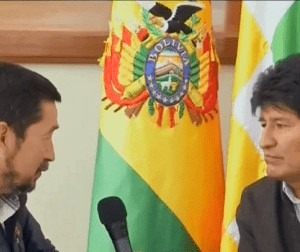 The legitimately-elected President of Bolivia, Evo Morales, told teleSUR on Saturday that dictatorship has returned to the South American country, given the recent events that triggered intense repression exerted by the de-facto government chaired by Senator Jeanine Áñez .
“The Bolivian people and the whole world know that we guarantee political stability. They said ‘Evo dictatorship’, now what Bolivia is living in is what we call a dictatorship.”
The Bolivian President said he was appalled by the recent reports regarding the civilian deaths at the hands of this new dictatorship.
“The people will always be united (…) The Bolivian people have never been taken from my memory. At any moment we will be as always sharing a resistance against economic policies, but for now, for democracy, for life, my dear Bolivia,” President Morales said.
On the media censorship imposed by the de-facto government in Bolivia, President Morales said that “now there is no freedom of expression” in the country. “The de facto communication minister who answers to the dictatorship in Bolivia said that seditious journalists, national and international, will be arrested.”
He also highlighted how the integration processes promoted by past governments such as those of Venezuela, Ecuador (by former President Rafael Correa) or Brazil (with former president Lula da Silva) seek to be destroyed by the interests of the U.S. empire.
“Unfortunately, some countries subject to the U.S. empire, destroy the integration processes: Unasur a political instance, Mercosur an economic instance, Celag an integration of all Latin America towards the liberation of the peoples,” President Morales continued.
In this sense, the legitimate President of Bolivia stressed that “we, Latin Americans, have the enormous responsibility, regardless of an economic, programmatic or social liberation, to free ourselves from the technological part.”
“Those who seek disintegration are not thinking about technological liberation, they are instruments of the capitalist system that will never like us to free ourselves from the technological part to establish sovereignty in our Latin America,” he added.
Events in Bolivia follow script of ‘color revolution’ – the antithesis of democracy
By Nebojsa Malic | RT | November 12, 2019
From the claim of a ‘stolen’ election to the opposition burning ballots and the forced resignation of President Evo Morales, the events in Bolivia have followed the script of the original “color revolution” in Serbia.
A politician critical of Washington seeks re-election, and wins the vote in the first round under the existing rules. Opposition parties cry foul and demand a runoff, only to attack the polling stations and burn the ballots, making an accurate count impossible. Then their demands escalate: the “dictator” must resign without a new vote, the “people power” in the streets demands it.
Yes, this is Bolivia in early November 2019. But I remember it also being Serbia, in early October 2000 – back when it was still known as Yugoslavia. One or two similarities would be a coincidence; this kind of eerie overlap points to something more. Especially when what happened in Serbia would later be identified as the very first case of “color revolution.”
There are two competing narratives when it comes to the ouster of Morales. The one embraced by the mainstream media calls it a democratic triumph of the Bolivian people against a selfish politician who refused to leave power after 14 years. Interestingly enough, this is something US President Donald Trump and CNN – normally at odds with each other – seem to agree on completely.
Meanwhile, non-mainstream voices, mainly from the political left, have denounced it as a “right wing coup,” either organized or abetted by the US, probably in order to seize Bolivia’s vast mineral resources and solidify Washington’s hold over Latin America.
“Restoring democracy” was also the narrative accompanying the US attempts – so far, unsuccessful – to install in power in Venezuela an unelected opposition politician polling in single digits. Those of you with longer memories may also remember that the October 2000 events in Serbia also involved an unpopular opposition leader of a coalition forced together by US diplomats. They were also painted as a spontaneous, grassroots protests – until it was over, and the media felt free to reveal the role of CIA and National Endowment for Democracy (NED) operatives and their “suitcases of cash.”
Four years later, the Guardian was confident enough to declare in a headline that it was a “US campaign behind the turmoil in Kiev,” describing the ‘Orange Revolution’ in Ukraine.
“The operation – engineering democracy through the ballot box and civil disobedience – is now so slick that the methods have matured into a template for winning other people’s elections,” wrote Ian Traynor, even noting that it was developed and pioneered four years prior in Belgrade.
One of the names mentioned by Traynor is Michael Kozak, a US diplomat who had tried to replicate the “color revolution” recipe in Belarus. Today, Kozak is acting Assistant Secretary at the Bureau of Western Hemisphere Affairs – the State Department’s portfolio that includes Bolivia.
Here’s Kozak on October 21, accusing Bolivia of lacking “credibility and transparency” in the vote-counting process, and demanding that the “will of the Bolivian people is respected.” What a remarkable coincidence, indeed!
Then there is Jhanisse Vaca Daza, a prominent Bolivian opposition activist who has been trained in the US by an outfit called the Center for Applied Nonviolent Action and Strategies (CANVAS). Despite the innocuous-sounding name, this is a shadowy organization led by the former members of Otpor – a group crucial to the 2000 revolution in Serbia – turned professional revolutionaries working with the US Deep State around the globe.
It is worth noting that, while this racket has been extremely profitable for the CANVAS crew, most of their Otpor compatriots were less fortunate. The movement folded into a political party, and most of its members ended up disillusioned cogs in the political machine. Several even committed suicide, according to local media reports I have seen.
The “revolution” ended up delivering everything except democracy to Serbia, you see. Instead, it was saddled with a corrupt oligarchy and utterly meaningless elections, where votes are bought and sold and the dead vote with alarming regularity. Both the government and the opposition became agents of foreign powers, making the elections meaningless – what’s the use, when the US embassy ultimately decide who will be in charge? That’s no “democracy,” obviously.
Is this what’s in store for Bolivia? It’s hard to tell, but for me the Serbian experience certainly makes it seem so. Color revolutions are astroturfed at their core, a malicious manipulation of genuine discontent, a big lie that poisons the well of the entire political system – perhaps permanently. Any country that has had to deal with one, whether successful or merely attempted, has emerged damaged in some way.
Media narratives play a decisive role in color revolutions. They are “a conflict between PR specialists of the government on one hand and the protest movement, or some foreign powers engaged on the other,” political scientist Mateusz Piskorski told RT in 2012.
There are layers of irony in that, given that Trump himself is engaged in a war of media narratives at home, against critics who are using the very same language of democracy and human rights to challenge his own legitimacy. They go so far as to call for the military to oust him from power – much as the Bolivian army just did Morales – all in the name of “our democracy,” of course.
That conversation, while worth having, is for another time. It is a cold comfort to the Bolivians, who now teeter on the precipice of a civil war.
At Least 12 Dead Following Coup in Bolivia
teleSUR | November 14, 2019
At least 12 Bolivians have been killed and more than 530 injured by the violence that escalated in Bolivia following the coup against constitutional president Evo Morales, denounced the Ombudsman’s Office.
The human rights agency explained on its official website that among the injured are women, children, adolescents and journalists.
In turn, the institution – created in 1994 by constitutional mandate – posted on its Twitter account that on November 11 and 12, five Bolivians were killed (out of the total).
Of those deaths, four were due to the gunshots fired by the Armed Forces and the Police, and one due to suffocation by strangulation, the Ombudsman’s Office explained on its digital platform.
The events that forced Evo Morales’s resignation and consummated the coup d’état were unquestionably violent, as reported in an article published on the Mision Verdad webpage.
Opposition gangs attacked numerous politicians of the ruling Movement Towards Socialism, looted Morales’ house, and burned the residences of several high-level politicians, detailed the article.
Evo Morales announced his resignation as president on November 10 to stop the bloodshed, however, during a press conference in Mexico a country that granted him political asylum to preserve his life – he acknowledged that his decision did not halt the social upheaval.
In that sense, Morales called on the military to stop the bloodshed and initiate a national dialogue.
Israel is a ‘Terrorist State’: Seven Times Bolivia and Morales Took a Stance for Palestine
By Ramzy Baroud | Palestine Chronicle | November 14, 2019
On November 10 Bolivian President Evo Morales, announced his resignation from office following what was described by his deputy, Álvaro García Linera, as a military coup.
Morales’ 14 years in office have been seen by many as a triumph for the indigenous people of Bolivia; in fact, for indigenous peoples everywhere. Along with late Venezuelan President Hugo Chavez and late Cuban President Fidel Castro, among other socialist or socialist-leaning South American leaders, Morales represented the hope of an entire generation.
All of this came crashing down following the general election in the country on October 20. Morales’ opponents, who have traditionally received strong backing from Washington, accused the president’s camp of rigging the elections. Following the announcement of the results which gave Morales a 10% point lead over his rival, an orchestrated campaign was launched by the opposition to overthrow the president.
Well-publicized opposition protests resulted in national upheaval, political turmoil, and an army ultimatum to Morales. Fearing further violence and chaos in the country, the president announced his resignation.
It would be safe to argue that this is not the end of Bolivia’s socialism or the people’s-led drive for justice and equality. Bolivia’s grassroots movement is strong and rooted not just in Bolivia itself, but throughout the region and beyond. This is one of the reasons why Palestinians of all backgrounds are watching the developments in Bolivia with much anxiety and concern.
Palestinians see in Bolivia, although geopolitically removed from the Middle East, a true friend, and a trusted ally. On the other hand, the resignation of Morales is welcomed news in Tel Aviv.
Highlighted below are seven instances where Bolivia, under Morales, showed the type of solidarity with the Palestinian people that was, at times, unparalleled anywhere else in the world:
- Cutting Ties with Israel:
Even before Bolivia officially recognized Palestine, on January 14, 2009, it cut ties with Israel. Later that same day, Venezuela followed suit. The Bolivian decision was made in response to the destructive Israeli war on Gaza, known as Operation Cast Lead. At the time, Morales called for the stripping of the Israeli President Shimon Peres, of his Nobel Peace Prize due to his support of the Israeli crimes in the besieged Gaza Strip.
- Recognizing Palestine:
On December 22, Morales followed his decision of severing ties with Israel with officially recognizing the State of Palestine as an independent and sovereign State. The Bolivian move was clearly part of a coordinated South American effort to show greater solidarity with the Palestinian people, as it came at the heels of a similar decision made by Brazil and Argentina.
- Supporting Palestine at the United Nations:
At his September 21, 2011, UN General Assembly speech in New York, President Morales said, “not only does Bolivia support the Palestinian recognition by the United Nations, our position is to welcome the Palestinians to the United Nations”. Morales also denounced Israel for “bombing, attacking, killing and taking land”, from the indigenous Palestinian people. Bolivia’s support of Palestine at the United Nations remained strong and unfaltering for at least the last decade.
- Declaring Israel a terrorist state:
On July 30, 2014, President Morales went further by declaring Israel a “terrorist state”, following the latter’s most recent war on the Gaza enclave. Morales’ statement was not mere rhetoric as it was coupled with concrete steps to hold Israel accountable for its crimes against occupied and besieged Palestinians. On that day, Bolivia also classified Israel as a “group 3” country, which means that any Israeli wanting to visit Bolivia needed to obtain a visa that required the approval of the National Migration Administration.
- Prioritizing Palestine:
When Bolivia assumed the presidency of the United Nations Security Council in June 2017, it declared Palestine a top priority on its political agenda. “Our priorities: conflict in the Middle East of 50 years of the occupation of Palestine, and non-proliferation of chemical and nuclear weapons,” President Morales tweeted at the time.
- Naming Palestinian martyrs:
On May 15, 2018, the Bolivian ambassador to the United Nations registered one of the most symbolic, yet emotive gestures of solidarity towards Palestine that was ever displayed at international institutions. Sacha Llorenti started his talk at a UN emergency session by naming all 61 Palestinians killed by Israel in Gaza’s Great March of Return. The Palestinian victims were all killed in non-violent popular protests that demanded an end to the Israeli siege on Gaza.
- Cooperating with Palestine:
On June 22, 2019, Bolivia sealed its solidarity with the Palestinian people with the signing of the development cooperation agreement between the two countries. Although free trade and cooperation between both economies is not an easy task, if at all possible, considering that Palestine is under total Israeli control, the agreement was a natural and organic evolution of the political support and the grassroots solidarity with Palestine that has been in the making for many years.
It would be untenable to discount the power of the indigenous movement of Bolivia despite Morales’ abrupt resignation. It would be equally wrong to conclude that the absence of Morales would automatically sever the strong rapport predicated on people’s solidarity and common struggle between Palestine and Bolivia.
– Dr. Ramzy Baroud is a journalist, author and editor of The Palestine Chronicle. His last book is The Last Earth: A Palestinian Story (Pluto Press, London) and his forthcoming book is These Chains Will Be Broken: Palestinian Stories of Struggle and Defiance in Israeli Prisons (Clarity Press, Atlanta). Baroud is a Non-resident Senior Research Fellow at the Center for Islam and Global Affairs (CIGA), Istanbul Zaim University (IZU).
Make No Mistake, Morales’ Removal Is Directed Against Bolivia’s Indigenous
By Paul Antonopoulos | American Herald Tribune | November 13, 2019
It certainly has been a difficult year for reactionaries and neoliberals in South America as they failed to violently replace Venezuelan President Nicolás Maduro with U.S.-puppet Juan Guaidó, implement International Monetary Fund (IMF) demands against Ecuador after the people rose up, maintain the popularity of Chile’s billionaire President Sebastián Piñera’s after his attempts to raise the price of metro travel expanded into a larger anti-neoliberal movement, Evo Morales’ re-election in Bolivia, the election of Alberto Fernández in Argentina against neoliberal president Mauricio Macri, and, former Brazilian President Lula’s release from prison last week after serving a small part of his long sentence.
It certainly appears that the so-called Pink Tide, the wave of socialist and left-leaning governments that came to power across Latin America in the 2000’s and peaking in 2011, is returning to the region after being effectively replaced by the so-called “Blue Tide,” the Conservative Wave that saw Brazil, Argentina, Peru and other states return to conservative neoliberal governments. Effectively, the Monroe Doctrine has guided Washington’s belief since at least 1823 that Latin America is its backyard and has a right to protect it from foreign powers.
Former Bolivian President Evo Morales was one of the figures at the forefront of creating sovereignty and independence from the U.S. The first indigenous president of Bolivia reduced illiteracy from 13% in 2006 to 2.4% in 2018, reduced poverty from 60.6% in 2006 to 34.6% in 2018 and reduced unemployment from 9.2% in 2006 to 4.1% in 2018 – this was mostly achieved by ensuring that industries remained nationalized or were renationalized, and by becoming independent of the World Bank and the IMF.
And therefore, “in Bolivia, the American Empire Struck Back.”
With the American Empire experiencing major losses in Latin America this year, most significantly in Venezuela, while also seeing the release of former Brazilian President and pan-Latin Americanist, Lula, from prison, a quick victory was needed. A coup against Morales appeared to be the simplest victory for the Empire to achieve.
Why?
Former Venezuelan President Hugo Chávez made the military a bastion of Bolivarian ideology, ensuring that the entire hierarchy became radically anti-U.S. and patriotic. Therefore, even when Maduro faced a U.S.-orchestrated coup attempt earlier this year, there were very few defections from the Venezuelan military despite calls from Guaidó and Washington. Because Morales failed to radicalize the Bolivian military, he was always at risk of being militarily overthrown by unpatriotic forces willing to serve the American Empire.
Washington understands that Morales empowered the mostly left-leaning Indigenous population of Bolivia, accounting for 20% of the country’s population according to the 2012 census, with an additional 68% of the population being mestizo – mixed European and Indigenous ancestry. The whites of Bolivia account for 5% of the population but are on average far wealthier than the Indigenous and mestizos, and favor the right-wing opposition as they resist the shift of power from Whites towards the native majority.
Geographically, the overwhelming majority of Bolivia’s whites and most of the mixed-race populations live in the country’s eastern lowlands, which in itself is far wealthier than predominantly Indigenous regions of Bolivia.
This is a key point in trying to understand who Jeanine Áñez is, the self-declared interim president of Bolivia.
Who is she?
The self-proclaimed president comes from the sparsely populated flatland department of Beni, a stronghold for opposition to Morales. One of the department’s main economic activities is cattle ranching, operated by wealthy white or mestizo elites. She often criticizes socialism and expressed her fear that one day Bolivia will become like Venezuela, Nicaragua, “or worse, Cuba.” Her nephew in 2017 was caught trying to smuggle 480kg of cocaine into Brazil.
A Tweet from April 2013 truly reveals her contempt for the Indigenous population: “I dream of a Bolivia free of Indigenous satanic rites, the city is not for ‘Indians,’ they better go to the highlands or El Chaco.” Her radical Evangelical Christian beliefs legitimize her slander of Indigenous cultures as they are “satanic,” perhaps a remembrance to the days of Salem.
Of course, the U.S. has not made any denunciations of her self-proclaimed presidency. Nor did they denounce the Comite Ciudadano (Citizens Committee) who led the anti-Morales riots and violence. The right-wing organization is jointly led by ex-vice-president Carlos Mesa and Luis Fernando Camacho, the millionaire leader of the extreme right-wing pressure group Comite Civico (Civic Committee) of Santa Cruz, whose members do Nazi-style salutes.
Yes, the overthrow of Morales was backed by the American Empire.
Yes, the overthrow of Morales is because he encouraged pan-Latin American initiatives.
Yes, the overthrow of Morales was because he would not privatize much of Bolivia’s industries.
Yes, the overthrow of Morales was because he liberated Bolivia from the IMF and the World Bank.
But there is without a doubt a race element to his overthrow. As power was returning to the hands of the Indigenous people in Bolivia, the preservation of the elite minority had to be achieved. The removal of Morales and the ascendency of Áñez will surely regress the outstanding achievements made by Morales and bring a return to the strangling and exploitative neoliberal policies that kept Bolivia poor, and U.S. corporations and the local elite prosperous.
Exiled Bolivian president Morales blasts coup & hints at US role in it
RT | November 13, 2019
Ousted Bolivian President Evo Morales has accused the US-headquartered Organization of American States of making a political decision in backing the right-wing opposition, saying the coup continues to wreak havoc after his exile.
Speaking from Mexico a day after he fled Bolivia, Morales said: “The OAS is in the service of the North American empire.”
Morales said he “could not understand” how his military commanders could show such “disloyalty.”
“That confirms that my great crime is to be indigenous. It’s a class problem,” he said.
The exiled president said that after freeing itself from the International Monetary Fund, the Bolivian economy was doing better.
“We had big plans in the field of exports.”
Yet, the coup plotters “do not accept the nationalization of natural resources,” Morales said.
He also said the appointment of Jeanine Añez as “interim president” confirms the coup and called for a national dialogue to end violence in his country.
Morales also claimed that a mechanical failure on a helicopter he was traveling on in early November was “not accidental” and said he wants the incident to be investigated. The helicopter was forced to make an emergency landing just after takeoff due to a “mechanical fault in the tail rotor.”
The socialist leader said he would return to Bolivia if the people asked. He also pleaded with the Bolivian opposition to stop the violence continuing after his exile. “Why do they continue?” he asked.
Opposition senator declares herself ‘interim president’ of Bolivia without quorum or vote
RT | November 13, 2019
Opposition politician Jeanine Añez has declared herself “interim president” of Bolivia without a vote, but the party of ousted President Evo Morales said that the Senate had no quorum and the legislature’s session was not legal.
Añez’s actions echo those of Juan Guaido in Venezuela, who declared himself “interim president” in January with the backing of Washington and the Organization of American States (OAS). While Guaido has repeatedly failed to oust President Nicolas Maduro, however, the opposition in Bolivia – also backed by the US and OAS – has been able to force the resignation of Morales after the military defected to their side.
While opposition activists claimed that Añez’s declaration was in line with the Bolivian constitution, lawmakers from the ousted president’s Movement for Socialism called the assembly session illegal. They have refused to attend the proceedings, saying that armed groups loyal to the opposition controlled the roads and could not guarantee their safety.
Morales’s party has had the majority in both the Senate and the Chamber of Deputies, and its boycott leaves both bodies without a quorum. Vice-President Alvaro Garcia Linera also “resigned” along with Morales on November 10, leaving the country in legal limbo. Their supporters have called the forced resignations a “coup” and vowed to resist by force if necessary.
Washington hastened to hail Morales’s ouster as a “significant moment for democracy in the Western Hemisphere” and accused the socialist president of seeking to subvert the will of the people by running for a fourth term, even though the Bolivian courts had allowed it.
Morales was one of the few Latin American leaders bucking the US line on Venezuela and supporting Maduro. Landing in Mexico, where he was granted asylum, on Tuesday he vowed to continue to fight “as long as I live.”
Audios Containing Details of Alleged Coup Plan & US Involvement Emerge Amid Bolivian Crisis – Report
Sputnik – November 11, 2019
Bolivian President Evo Morales announced his resignation on 10 November after the heads of Bolivia’s armed forces and police urged him to step down amid ongoing violent protest in the country which erupted in the wake of the recent presidential election.
As Evo Morales stepped down as the President of Bolivia amid ongoing anti-government protests and the military urging him to resign, a series of audio recordings which allegedly feature opposition leaders calling for a coup against him were leaked via social media, El Periodico reports.
According to the media outlet, efforts aimed at destabilising Bolivia were to be coordinated from the US embassy, with one of the tapes allegedly mentioning that US senators Ted Cruz, Bob Menendez and Marco Rubio were committed to this agenda.
The plan outlined by the audios called for establishing a “civil-military transitional government” if Morales were to win the 20 October presidential election, which he did, and to not recognise his victory, citing alleged electoral fraud.
The opposition leaders featured in the recordings also allegedly called for a general strike across the country, to burn structures affiliated with the “government party” and to attack the Cuban embassy.
On 10 November, Bolivian President Evo Morales resigned after the national armed forces sided with demonstrators who opposed his serving a fourth term. The protests erupted after international observers found “grave irregularities” in the 20 October election.
Ex-Ecuador leader Correa: Bolivia’s Morales was forced out in ‘coup’, OAS is ‘an instrument of US domination’
RT | November 11, 2019
Former leader of Ecuador Rafael Correa said the resignation of Bolivian President Evo Morales was the result of a coup d’etat and that events could have ended in worse violence, if the socialist leader had not resigned.
“Of course there was a coup d’etat,” Correa told RT Spanish in an exclusive interview on Monday, explaining that such an insubordination of the country’s armed forces “cannot exist in a constitutional state of law” or democracy. “If Evo Morales did not resign, there would have been a bloodbath because there was no public order,” he said.
Morales resigned on Sunday at the demands of Bolivia’s military chief, following weeks of protests and only hours after he had promised fresh elections. Morales previously proclaimed he had won the October 20 general election with a 10-point lead, a result which was quickly contested by the opposition, who accused him of tampering with the vote.
There can be no true democracy until the arbitrators are the citizens and “not the uniformed,” Correa said, adding that he would not be surprised if there were foreign forces behind the efforts to oust Morales.
Correa said that the Organization of American States (OAS), which encouraged Morales to call for new elections, did not condemn events in socialist Bolivia because democracy is only valid when it serves the interests of the right.
“You can see the double standards that exist in all this. For the right, democracy is valid as long as it meets its interests,” Correa said. When those interests stop being fulfilled, suddenly democracy is not enough and “the situation must be changed to blood and fire, as we are seeing in Bolivia.”
Correa said the Bolivian people have experienced dignity and prosperity under Morales’ leadership and that after recent events, people across Latin America will soon be convinced that the OAS is “useless” and nothing but “an instrument of US domination.”
He said that the OAS wants elections in Bolivia but only without Morales because they know that he was democratically elected by the people already. “They have just forcibly removed a president who has won the election widely, with more than 10 points,” he said, insisting that Morales is the rightful leader of Bolivia.
Morales called for new elections on Sunday with the aim of “seeking peace” in Bolivia — yet the opposition would not accept Morales’ participation in the new elections and urged protesters to continue mobilizing in the streets until he resigned. On Twitter, Morales said the coup attempt “destroys the rule of law.”
‘Morales’ resignation undermines claims he is dictator, US may be behind push to oust him’
RT | November 10, 2019
Washington has played a hand in the resignation of Bolivia’s president Evo Morales, human and labour rights lawyer Dan Kovalik told RT. The US has been stirring unrest for years with millions of dollars in democratic aid, he said.
 “I think this is a bad thing that’s happened and I see the hands of the US behind it,” Kovalik said, adding that there has been “evidence released of conversation between the White House and opposition leaders,” indicating that anti-Morales protests might have been a “coordinated” campaign.
“And we know that the National Endowment for Democracy (NED) has been spending millions of dollars in Bolivia for years trying to undermine Evo Morales.”
A CIA offshoot of sorts, the NED channeled nearly $1 million into the South American country in democracy promoting aid in 2018 alone. A huge chunk of the funds was used by International Republican Institute (IRI), in charge of promoting a right-wing agenda.
Kovalik said that more proof of the US involvement in the Bolivian turmoil is bound to come out with time.
Morales’ decision to resign rather than cling to power while risking lives of his supporters, who turn out for mass rallies in his name, “undermines the claims that he is some sort of a dictator,” Kovalik said.
“That shows a lot about who he is. That shows that Morales cares about his own country… he’s shown himself to have the well-being of his own people at heart.”
Noting that Morales, first indigenous leader in the history of his country, has vastly improved the living standard for regular people and the indigenous population, Kovalik argued that his departure might spell trouble for the South American country.
Kovalik believes that while right-wing parties might try to capitalize on Morales’s resignation, they do lack grassroots support.
“I’m not sure they have much popular support, so we’ll have to see if Evo Morales’s party can go on and win without him.”
Thousands of people flooded the streets to protest what the opposition called a rigged election on October 20, in which Morales secured a 10 percentage point gap, that allowed him to avoid a run-off. Morales, once a very popular leader, was faced with a wave of unrest and mutiny from the military. Kovalik believes that outside interference might have played a role in such a change of heart.
“Of course, people change their minds about things, but I also think there’ve been some manipulations of the public in Bolivia.”
Featured Video
No Threat Can Force Iran’s Surrender /Trita Parsi & Lt Cl Daniel Davis
or go to
Aletho News Archives – Video-Images
From the Archives
An Expert Military Analysis of War with China
Actually, None is Necessary
By Fred Reed • Unz Review • December 13, 2020
The Correlation of Armed Forces: U.S. goods and services trade with China totaled an estimated $634.8 billion in 2019. Exports were $163.0 billion; imports were $471.8 billion. The U.S. goods and services trade deficit with China was $308.8 billion in 2019. Trade in services with China (exports and imports) totaled an estimated $76.7 billion in 2019. Services exports were $56.5 billion; services imports were $20.1 billion. The U.S. services trade surplus with China was $36.4 billion in 2019.
There is talk within the Washingtoniat of a possible war with China. Steve Bannon, who apparently was dropped on his head as a child, actually favors such a war. We hear the usual shoo-the-boobs alarm about how the Chinese are doing something terrible and we must gird our loins and American values and show them what for, bow wow, woof. The danger is that the current game of who-blinks-first in Asian waters might actually provoke a shooting war. You know the kind of thing: One warship refuses to get out of the way of another, a collision ensues, some retard lieutenant who signed up on waivers opens fire, and we’re off and running. It is not a good idea to let children play with matches.
The said war is discussed either in emotional terms by idiots or in purely naval terms by those familiar with such things, so we hear of the First Island Chain and the Second Island Chain and whose missiles against the other’s missiles and so on. This would be appropriate if we were fighting World War Two again. Which we aren’t. Let’s take a quick-and-dirty look at how such a war might go.
To begin the war, America would overestimate itself and underestimate China. This is doctrine in the Pentagon. … continue
Blog Roll
 Aletho News
- Iran To Target Military Industrial-Tech Complex That Facilitated Gaza Genocide
- Collapsing Empire: The Resistance Disarms ‘Israel’
- Suicide Should Not Be a Government Service
- Rethinking America’s greatest threat: Iran vs. Israel-Firsters
- Iran accuses adversaries of false flags to strain Turkey ties
- Poland rules out sending Patriot missiles to US/Israel amid war on Iran
- Tehran approves new Hormuz plan with major restrictions
- No Threat Can Force Iran’s Surrender /Trita Parsi & Lt Cl Daniel Davis
- UK’s New Pandemic Plan Would Turn Big Tech Into a Mass Location Tracking Network
- Growing insecurity, soaring prices fuel protests in north as regime bans evacuation: Sources
- If Americans Knew
- Ann Coulter Rips Into Fox News for Iran War Coverage, Compares to False Rigged 2020 Election Reporting
- Joe Kent Urges Americans To Call White House and Congress To Object To Sending Troops Into Iran
- DNC Resolution to Reject AIPAC Funding Puts Democratic Leaders in the Hot Seat
- Swedish foundation to build 400 schools as over 650,000 Gaza children remain without education for 2 years
- Israeli army admits photshopping image of slain Lebanese journalist
- This is how Israel is systematically killing health workers under the cover of war in Lebanon
- Carrying life under fire: Israeli invasion of Lebanon leaves pregnant women facing deadly risks
- Champagne all around for the new death penalty (for Palestinians) law – Not a ceasefire Day 172
- Why are Palestinian books struggling to be seen on Amazon?
- The Line Between Affinity and Conspiracy
- No Tricks Zone
- New Study Finds Warming Saves Lives…Cold Temperatures 12 Times More Deadly Than Excess Heat
- German Science Blog Accuses PIK Climate Institute Of Hallucinating Climate Tipping Points
- Devastating Assessment Of Comirnaty Vaccine By Former Senior Pfizer Europe Toxicologist
- New Study: CO2 Is ‘Effectively Negligible’ As An Explanatory Climate Change Factor Since 2000
- Former Pfizer Toxicologist Dr. Helmut Sterz Tells Bundestag Hearing Pfizer Vaccine Should Have Never Been Approved
- Energy Expert: Germany’s Nuclear Phaseout Was A “500 Billion Euro Mistake”
- New Research: South Australia’s Mid-Holocene Sea Surface Temperatures Were 4°C Warmer Than Today
- Storing Green Energy To Last Germany 10 Days Would Require A 60-Million Tonne Battery
- New Studies: UK Sea Levels Were 4 Meters Higher Than Today During The Mid-Holocene
- Destructive Green New Deal: German Energy And Metal Group Warns Of Drastic Crisis
 Aletho News