Audios Containing Details of Alleged Coup Plan & US Involvement Emerge Amid Bolivian Crisis – Report
Sputnik – November 11, 2019
Bolivian President Evo Morales announced his resignation on 10 November after the heads of Bolivia’s armed forces and police urged him to step down amid ongoing violent protest in the country which erupted in the wake of the recent presidential election.
As Evo Morales stepped down as the President of Bolivia amid ongoing anti-government protests and the military urging him to resign, a series of audio recordings which allegedly feature opposition leaders calling for a coup against him were leaked via social media, El Periodico reports.
According to the media outlet, efforts aimed at destabilising Bolivia were to be coordinated from the US embassy, with one of the tapes allegedly mentioning that US senators Ted Cruz, Bob Menendez and Marco Rubio were committed to this agenda.
The plan outlined by the audios called for establishing a “civil-military transitional government” if Morales were to win the 20 October presidential election, which he did, and to not recognise his victory, citing alleged electoral fraud.
The opposition leaders featured in the recordings also allegedly called for a general strike across the country, to burn structures affiliated with the “government party” and to attack the Cuban embassy.
On 10 November, Bolivian President Evo Morales resigned after the national armed forces sided with demonstrators who opposed his serving a fourth term. The protests erupted after international observers found “grave irregularities” in the 20 October election.
Ex-Ecuador leader Correa: Bolivia’s Morales was forced out in ‘coup’, OAS is ‘an instrument of US domination’
RT | November 11, 2019
Former leader of Ecuador Rafael Correa said the resignation of Bolivian President Evo Morales was the result of a coup d’etat and that events could have ended in worse violence, if the socialist leader had not resigned.
“Of course there was a coup d’etat,” Correa told RT Spanish in an exclusive interview on Monday, explaining that such an insubordination of the country’s armed forces “cannot exist in a constitutional state of law” or democracy. “If Evo Morales did not resign, there would have been a bloodbath because there was no public order,” he said.
Morales resigned on Sunday at the demands of Bolivia’s military chief, following weeks of protests and only hours after he had promised fresh elections. Morales previously proclaimed he had won the October 20 general election with a 10-point lead, a result which was quickly contested by the opposition, who accused him of tampering with the vote.
There can be no true democracy until the arbitrators are the citizens and “not the uniformed,” Correa said, adding that he would not be surprised if there were foreign forces behind the efforts to oust Morales.
Correa said that the Organization of American States (OAS), which encouraged Morales to call for new elections, did not condemn events in socialist Bolivia because democracy is only valid when it serves the interests of the right.
“You can see the double standards that exist in all this. For the right, democracy is valid as long as it meets its interests,” Correa said. When those interests stop being fulfilled, suddenly democracy is not enough and “the situation must be changed to blood and fire, as we are seeing in Bolivia.”
Correa said the Bolivian people have experienced dignity and prosperity under Morales’ leadership and that after recent events, people across Latin America will soon be convinced that the OAS is “useless” and nothing but “an instrument of US domination.”
He said that the OAS wants elections in Bolivia but only without Morales because they know that he was democratically elected by the people already. “They have just forcibly removed a president who has won the election widely, with more than 10 points,” he said, insisting that Morales is the rightful leader of Bolivia.
Morales called for new elections on Sunday with the aim of “seeking peace” in Bolivia — yet the opposition would not accept Morales’ participation in the new elections and urged protesters to continue mobilizing in the streets until he resigned. On Twitter, Morales said the coup attempt “destroys the rule of law.”
‘Morales’ resignation undermines claims he is dictator, US may be behind push to oust him’
RT | November 10, 2019
Washington has played a hand in the resignation of Bolivia’s president Evo Morales, human and labour rights lawyer Dan Kovalik told RT. The US has been stirring unrest for years with millions of dollars in democratic aid, he said.
 “I think this is a bad thing that’s happened and I see the hands of the US behind it,” Kovalik said, adding that there has been “evidence released of conversation between the White House and opposition leaders,” indicating that anti-Morales protests might have been a “coordinated” campaign.
“And we know that the National Endowment for Democracy (NED) has been spending millions of dollars in Bolivia for years trying to undermine Evo Morales.”
A CIA offshoot of sorts, the NED channeled nearly $1 million into the South American country in democracy promoting aid in 2018 alone. A huge chunk of the funds was used by International Republican Institute (IRI), in charge of promoting a right-wing agenda.
Kovalik said that more proof of the US involvement in the Bolivian turmoil is bound to come out with time.
Morales’ decision to resign rather than cling to power while risking lives of his supporters, who turn out for mass rallies in his name, “undermines the claims that he is some sort of a dictator,” Kovalik said.
“That shows a lot about who he is. That shows that Morales cares about his own country… he’s shown himself to have the well-being of his own people at heart.”
Noting that Morales, first indigenous leader in the history of his country, has vastly improved the living standard for regular people and the indigenous population, Kovalik argued that his departure might spell trouble for the South American country.
Kovalik believes that while right-wing parties might try to capitalize on Morales’s resignation, they do lack grassroots support.
“I’m not sure they have much popular support, so we’ll have to see if Evo Morales’s party can go on and win without him.”
Thousands of people flooded the streets to protest what the opposition called a rigged election on October 20, in which Morales secured a 10 percentage point gap, that allowed him to avoid a run-off. Morales, once a very popular leader, was faced with a wave of unrest and mutiny from the military. Kovalik believes that outside interference might have played a role in such a change of heart.
“Of course, people change their minds about things, but I also think there’ve been some manipulations of the public in Bolivia.”
Bolivia: President Evo Morales Resigns Amid Right-Wing Coup
teleSUR | November 10, 2019
Bolivian President Evo Morales was forced to resign Sunday after senior army and police chiefs called on him to do so following weeks of right-wing unrest and violence against his Oct. 20 elections victory, in what his government has called a coup by opposition forces in the country.
“I decided to resign from my position so that Carlos Mesa and Luis Camacho stop abusing and harming thousands of brothers … I have the obligation to seek peace and it hurts a lot that we face Bolivians, for this reason, so I will send my letter of resignation to the Plurinational Assembly of Bolivia,” the former president of Bolivia said in a press release.
Bolivian Vice President Alvaro Garcia Linera also said that he was resigning from his position. The two leaders said that they would be handing their resignation letters to the country’s National Assembly.
Since both President and Vice Presiden resigned, the president of the Senate, a position held by Adriana Salvatierra of the MAS party was supposed to assume the post but she later issued her resignation as well as the president of the Chamber of Deputies.
Currently, the line of succession is broken in Bolivia.
Morales and Garcia Linera will stay in Chimore in the central Department of Cochabamba to work with the people. “We will come back and we will be millions as Tupac Amaru II said,” Morales declared.
The resignation comes after Morales proposed a dialogue process with the opposition parties but was rejected and even accepted the Organization of American States’ (OAS) call for new elections.
However, due to strong violent onslaughts against militants and leaders of the Movement To Socialism (MAS), intimidation of journalists, burning of residences and betrayal of political allies and members of the National Police, Morales and his Vice President decided to leave the government in order to prevent more violence.
In the interview with teleSUR’s correspondent in Bolivia Freddy Morales, the former president said the decision to call new elections was to preserve the peace in Bolivia “so that we do not confront the Bolivian family,” while calling on the opposition protesters to end the strikes and remove roadblocks in order to not harm the economy of the country.
Green-smearing – from Nicaragua to Bolivia
By Stephen Sefton | September 11, 2019
A fundamental dimension of contemporary psychological warfare has been dual-purpose corporate co-option of non-governmental organizations. In that psy-warfare dimension, NGOs serve both as disinformation partners with Western news media and too as false interlocutors in international forums and institutions, where they attack governments challenging the US elites and their allies. They actively subvert governments inside countries challenging the West, for example, in Latin America, Cuba, Venezuela, Nicaragua and Bolivia. But they also pervert due process in institutions like the UN, posing as civil society but in fact serving Western elite corporate imperatives, for example in international human rights and environmental mechanisms and forums.
Among these NGOs figure high profile human rights organizations like Amnesty International, Human Rights Watch, the International Federation for Human Rights and Avaaz along with environmental organizations from 350.org and the World Resource Institute to Global Witness and Greenpeace. An increasing interrelationship has developed between corporate NGO funding and the exploitation of people’s general willingness to volunteer for and support apparently good causes. Symbolic of this is the way World Economic Forum attendees like Kumi Naidoo move readily between top management from one NGO to another, in Naidoo’s case from Greenpeace to Amnesty International. From Libya and Syria to Venezuela and Nicaragua, Amnesty International has played a key role using false reports to demonize governments resisting the US and its allies.
As Cory Morningstar has pointed out, Greenpeace is a key player in promoting the corporate driven New Deal for Nature aimed at financializing what remains of the natural world, especially its biodiversity, as a way of engineering a “Fourth Industrial Revolution”. Western corporate greed underlies the identical patterns of news media and NGO misrepresentation and outright deceit supporting regime change offensives against Libya and Syria, or Venezuela and Nicaragua. Right now, that very same pattern of media and NGO manipulation is clearly at work preparing for an intervention to prevent Evo Morales being re-elected as President of Bolivia.
Bruno Sgarzini and Wyatt Reed have noted how Western media and NGOs have falsely attacked Evo Morales blaming him for not controlling the fires in Bolivia’s Amazon. This is exactly what happened in Nicaragua immediately prior to the coup attempt in 2018 when the Nicaraguan authorities were fighting a fire in the Indio Maíz Biological Reserve. That episode softened up Nicaraguan public opinion and set in motion social media networks involving thousands of youth activists trained for that purpose beforehand over several years with US and also European government funding. In mid-April 2018, barely a week after the Indio Maiz fire was extinguished, those networks launched a social media blitzkrieg of lies and inventions marking the start of the actual coup attempt. A practically identical process is well under way now in Bolivia, which holds presidential elections next October 20th.
The timing of the fires in Bolivia’s Amazon is extremely propitious from the perspective of the US authorities and their allies. It takes almost two months for the effects to wear off of the initial psy-warfare bitzkrieg of the kind waged against Nicaragua in 2018 and against Brazil’s Worker’s Party as part of Jair Bolsonaro’s successful 2018 election campaign that same year. Bolivia will almost certainly experience the same kind of psy-warfare assault via social media prior to the October elections. The campaign will be timed to optimize the effect of mass false accusations of government wrongdoing and corruption along with false media and NGO claims of security force repression. Opposition activists are likely to exploit peaceful demonstrations on indigenous peoples and environmental issues so as to commit murderous provocations, just as they did in Nicaragua and Venezuela.
All of these tactics are likely be deployed against Bolivia so as to destroy the current prestige and high levels of support for President Evo Morales. In Bolivia, as in Nicaragua and Venezuela, the governing progressive political movement enjoys around 35-40% core electoral support, the right wing opposition have around 25-30% with 30-40% of voters uncommitted. The Western elites know they need to motivate something over half of those uncommitted voters against Evo Morales so as to get the right wing government they so desperately need in Bolivia to try and make good the unmitigated debacle of Mauricio Macri’s right wing government in Argentina.
The intensity of any Western media and NGO campaign against Morales is likely to reach similar levels as their cynical campaigns of lies and defamation against Venezuela and Nicaragua. Should that offensive go ahead, as seems probable, the difference will be that this time Evo Morales and his team are alert and unlikely to be taken by surprise as the Nicaraguan authorities were by the vicious, sudden attack against them in April 2018. A likely variation in Bolivia’s case will be a higher profile of environmentalist NGOs working in tandem with their human rights counterparts feeding misrepresentations and downright lies into Western news media. For the US and European Union elites the regional geopolitical stakes are high enough to make an attack on Bolivia imperative.
(A longer version of this piece was published at Tortilla con Sal on September 4, 2019.)
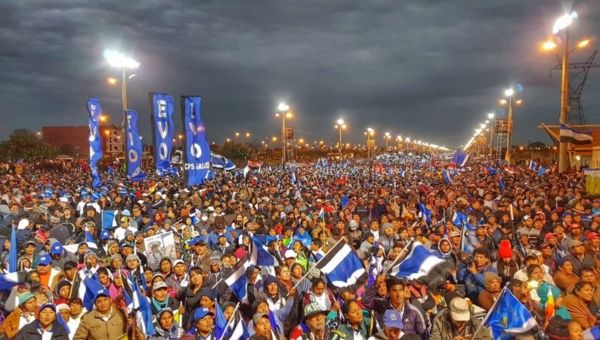
Mass Rally For Evo Morales in Opposition Stronghold
teleSUR – August 2, 2019
Bolivia’s leftist president, Evo Morales, was greeted by a huge rally in the eastern city of Santa Cruz. Hundreds of thousands of people attended despite the city normally being known as a stronghold of the right wing opposition. The rally was in support of Evo Morales’s Movement Towards Socialism (MAS) party, and to celebrate the anniversary of the country’s land reform.
President Morales addressed the crowd on Friday, saying, “We are rallied here so that Bolivia is never again in a state of dependency. So that the Bolivian people will never have to beg again. We are here sisters and brothers, so that neoliberalism nor U.S. military bases ever return.”
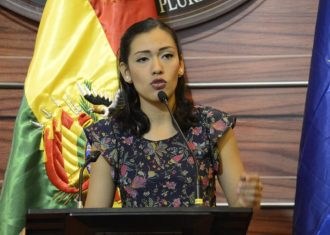 The MAS also presented their list of parliamentary candidates for the Santa Cruz region. Leading the list is Adriana Salvatierra, the 29-year-old President of the Senate, tipped by many as a possible successor to Morales.
The rally itself was organized by the local labor union federation, whose general secretary Rolando Borda, stood alongside Morales on stage. The day before Borda had laid out what he believes the mobilization represents.
“It is a ratification of our consciousness, and so that the economy of the country continues to grow and that the victory of October 20th is overwhelming,” he said.
Though the focus of the rally was the upcoming elections, the country was also celebrating the “Day of the Agrarian Revolution” falling on the anniversary of the Morales’ land reform, which redistributed millions of hectares to landless campesinos.
The main beneficiaries were the CSUTCB, the largest Indigenous campesino union. Their members were also in attendance at Friday’s rally, mostly Coca growers from the nearby Chapare region.
A buoyant economy has Morales well ahead of his rivals in opinion polls, however, none have indicated that a first round victory is certain. For that, Morales would need either 50 percent of the vote, or 40 percent if the second place candidate is behind by 10 points or more. Most polls have Morales just short of 40 percent, but leading his rivals by a comfortable margin of over 10.
Bolivia’s Campesino Union Slams Opposition Protests as ‘Total Failure’
teleSUR | July 9, 2019
The head of Bolivia’s Indigenous Campesino union, the country’s largest social movement, has said opposition protests held Tuesday in the city of Santa Cruz have been a “total failure” after opposition parties mobilized in the eastern city against leftist President Evo Morales, attempting to block the region’s main roads, calling for the resignation of the country’s electoral council.
Teodoro Mamani of Bolivia’s Campesino union and Hugo Torres of the main Labor union federation have dismissed protests, supported by all the main opposition candidates standing at the upcoming elections. Speaking to state media, the two social movement leaders characterized the events as a “total failure”.
This comes after the largest pro-opposition media outlet in the city, El Deber, reporting that all public sector workers and services are operating normally without any staff absences.
The only difficulties reported have been of workers at the ministry of justice arriving by foot, and one person even arriving by horse, due to partial roadblocks near the building. However, workers at regional tax and migration offices were able to arrive normally, despite opposition attempts to block public transport.
State media reported that by midday Bolivian time, only one major road had been entirely blocked by protesters, the newly built freeway in Yapacani that connects Santa Cruz to the city of Cochabamba.
In La Paz, lawmakers from Morales’ ruling ‘Movement Towards Socialism’ (MAS) denounced the protests, David Ramos, former labor union leader, now legislator said: “It is not a mobilization for popular or social demands, it is a political mobilization whose aim is to destabilize, conspire and boycott the democratic system in our country”
Another MAS lawmaker, Edwin Muñoz, reported early in the morning on the roadblocks he saw, saying, “Right now, because of the route we took, we have seen luxury cars blocking some avenues and roundabouts, where four or five young people are there causing an inconvenience”
Protesters oppose the decision by the country’s electoral authorities to allow current Evo Morales to stand for a third term in elections being held in October 2019 despite term limits regulations in the country.
Morales hopes to continue the government’s current approach, that through state investment, nationalization of natural resources and strategic industries, has turned Bolivia into the fastest growing economy in the region.
RELATED:
Bolivia: Main Opposition Candidate Accused of Taking US Funds
Bolivia: Before and after Evo Morales
Poverty has been reduced, rights expanded, and the economy continues to grow
By Ana Laura Palomino García | Granma | January 23, 2019
Many years ago, the man who has taken the Plurinational State of Bolivia to first-rate statistics in the economic and social arenas, was jailed on a military base in Copacabana, a town in the department of La Paz, close to the border with Peru.
This was in 1995, and Evo Morales endured insults and interrogations, for defending his rights and those of coca growers. But the most hateful way his captors referred to him was “indio” – a word that served as an offense for them, but is one of his most valued attributes.
Now that “Indian,” Evo Morales, is loved by his people and continues to dignify his indigenous roots, struggling tirelessly to eradicate the social ills that in the past left his nation without a future.
Nonetheless, some far removed from this reality, at different latitudes, or in the comfort of their homes, criticize his decision to run for a fourth term as President, denying the broad support he enjoys among the people and the figures that confirm this fact.
BOLIVIA BEFORE EVO
An opportune comment appeared in the Mexican newspaper La Jornada, recalling how, in the not so distant past, a few owners of significant capital fiercely exploited the Aymara, Quechua, Guarani, and other original peoples of Bolivia’s universe, whose elemental rights were ignored.
The paper points out that 90% of the rural population lived in poverty, making Bolivia, Honduras and Haiti a trio of countries facing uncertain futures, with the worst human development indices in the region. At the same time, publicly owned companies were privatized by oligarchic governments beginning in 1952, and Presidents took turns auctioning off the people’s welfare and the assets they were elected to protect, not embezzle.
Nonetheless, as expert Darío Restrepo points out in a study conducted by the National University of Colombia, a new program was implemented with the arrival of the Morales administration, very different from that of the previous 20 years.
“Instead of exclusively representative democracy, power was redirected to indigenous, rural, and popular communities, peoples, and organizations; instead of the President calling for a modern, Western, liberal Bolivia, he expresses the aspiration for a multi-national Bolivia, criticizes the ‘colonial state’ and liberal, bourgeois democracy,” Restrepo states.
BOLIVIA WITH EVO
According to Chilean newspaper La Tercera, in the last 12 years the Bolivian economy has grown 4.9% annually, far exceeding the regional average of 2.7%, and tripling its GDP from 11.5 billion to the current 37.77 billion.
This publication also reports that, according to the country’s National Institute of Statistics (INE), inflation rose by just 2.7% in 2017, the lowest figure in ten years, while the labor market strengthened.
On the other hand, in an interview with the Bolivian leader by BBC Mundo, Evo described, as another of the battles of his government, the fact that for three or four consecutive years his nation has shown the highest economic growth in all of South America. “That has never happened since the founding of the Republic,” he reaffirmed.
Another achievement of his Presidency is the reduction of poverty. According to teleSUR, in 2017 Bolivia made considerable progress on this front, with the poverty rate falling to its lowest level in history, at 36.4%.
The minimum income has increased up to 127%, and the minimum wage of workers is the second best in Latin America.
But the population has not only benefited economically. As the Bolivian President says in the interview, “The most humiliated and marginalized sector, which was that of women of all social and indigenous classes, now has a place in the Plurinational State.”
“We all have the same rights and duties,” he stressed.
According to analyst Hugo Siles, “The contemporary history of Bolivia is divided in two: before and after Evo Morales.” In addition, he stresses in La Nación, “Bolivia has changed substantially in the last decade, there is a before and after with Evo Morales. It is a very different nation socially, economically, and politically. The arrival of Morales implied a 180-degree turnabout on issues such as the management of natural resources and the inclusion of indigenous peoples.”
At the same time, Siles recognizes that much remains to be done, especially on issues related to reforms or changes in the judicial system, and greater recognition of the LGBT+ population.
This modest man, from a humble family, who worked as a bricklayer, baker, and trumpeter to pay for his studies, was branded a terrorist and demonized by the opposition to curb his political aspirations. But in 2005, he won the Presidential elections with 53.7% of the votes, a level of support that continues to date.
IN FIGURES
• The Morales government has recently announced a 1.5 billion dollar investment in roads and airports.
• With Evo Morales as President, Bolivia has established 3,000 primary health care facilities and more than 200 for secondary assistance.
• More than 85% of the population has access to potable water, an everyday issue in the past.
• Some 1.4 billion land titles have been awarded to small farmers and indigenous peoples.
• A “Dignity” benefit is provided to 900,000 older adults, thanks to an allocation of more than 2.9 billion dollars
• A total of 14% of the state budget is destined to education.
Bolivia: Morales Seeks New Relationship With Chile After Ruling
teleSUR | September 29, 2018
Bolivia’s President Evo Morales hopes to start a “new era” in his nation’s relationship with Chile once the International Court of Justice rules on Bolivia’s demand for sea access on Monday.
The new age will take “advantage of our potentialities, promoting integration for the well being of our peoples,” Morales said. “It’s necessary to cure injuries from the past.”
After a years-long process, the court will decide whether the Chilean government must negotiate a sea exit for Bolivia. La Paz issued the demand in April 2013.
Morales said he values peaceful solutions for international disputes, based on international law.
“Bolivia will never give up in its cause, that’s why the Bolivian people will gather on October 1 without divisions, without difference around our three-color flag, our wiphala and our sea claim flag,” he said. “Our reunion with the sea is not only possible, but inevitable.”
He also asked the people of Chile to understand the demand shouldn’t be considered an “unfriendly act,” but rather an opportunity.
Bolivia demanded the court declare Chile must negotiate an exit for the Pacific Ocean, based on diplomatic evidence it has previously agreed to do so.
Chile is denying any negotiation based on a 1904 treaty between both countries, giving up 120,000 square kilometers of territory, including 400 shore kilometers, to Chile.
The treaty was a result of the War of the Pacific, in which Bolivia and Peru fought against Chile between 1879 and 1883.
The UN’s International Court of Justice is legally binding but it has no means to enforce its rulings over the states.
Featured Video
Trita Parsi: Israel Set a Trap for Total War in the Region
or go to
Aletho News Archives – Video-Images
From the Archive
Zionism’s Violent Legacy
By Donald Neff | Washington Report On Middle East Affairs | January 1996
On January 4, 1948, Jewish terrorists drove a truck loaded with explosives into the center of the all Arab city of Jaffa and detonated it, killing 26 and wounding around 100 Palestinian men, women and children.[1] The attack was the work of the Irgun Zvai Leumi – the “National Military Organization,” also known by the Hebrew letters Etzel – the largest Jewish terrorist group in Palestine. The Irgun was headed by Revisionist Zionist Menachem Begin and had been killing and maiming Arabs, Britons and even Jews for the previous ten years in its efforts to establish a Jewish state.
This terror campaign meant that at the core of Revisionist Zionism there existed a philosophical embrace of violence. … continue
Blog Roll
 Aletho News
- Trita Parsi: Israel Set a Trap for Total War in the Region
- Trump’s Iran war is on an Israeli leash
- Saudi oil boss issues global supply warning
- Riyadh Says Its Oil System Is Intact. The Numbers Say Otherwise.
- Trump and Netanyahu Want to “Finish the Job” on Iran
- US ‘one-sided dictation’ not Iran’s beliefs makes rational talks impossible: Baghaei
- Iran’s Next Strike May Not Explode. It Could Shut You Down /Col Doug Macgregor
- Iran: US political targets legitimate if assassinations return
- Iraq shuts key border crossing with Iran under US pressure: Report
- Undersea Internet cables could be targeted in retaliation for attacks on Iran: IRGC deputy chief
- If Americans Knew
- The Israel Lobby’s Changing Fortunes
- AIPAC has become such a political liability that it’s shifting to a more “nimble” approach to buying politicians
- At least 160 Israeli settler attacks in 2 weeks
- Will Gaza’s Ancient Christian Community Disappear Forever?
- Israel’s vision of regional security rests on keeping Arab states weak
- Heidi Levine recounts how Palestinian youths helped save her in settler attack
- DAILY UPDATE: Latest essential news on Palestine, Israel, & region
- Trump’s Intensifying Sabotage of the ICC, for Israel’s Sake
- Israeli military detain US and UK volunteers in West Bank including Democratic NY politician Brad Lander
- Americans at National Conservatism Conference held in Israel this year criticize Israel
- No Tricks Zone
- E-Cars Reduce CO2 Emissions By Only 41% Compared To Internal Combustion Engine Vehicles
- Predictions Made By Renowned Climate Professor Over Past Decades Have Been Proven To Be Poor
- New Study Suggests Large Regions Of The Pacific Ocean Have Been Cooling For The Last 80 Years
- Germany’s Green Energy Debacle: High Energy Costs Force Kahla Porzellan to Close After 182 Years!
- New Study: 50 Years Of The Most Aggressive ‘Net Zero’ Policies Can Only Affect The Global Climate By 0.03°C
- US September “Heat” Was No Record…Many Records Set Decades Ago
- Latest European Green Energy Debacle; Portugal’s Largest Flagship Solar Park Insolvent!
- Green Energy Debacle: German Expert Professor Fritz Vahrenholt Warns Of Severe Economic And Social Consequences
- Two More Paleo Reconstructions Affirm Meters-Higher Sea Levels Across Ireland, Brazil 7000-6000 Years Ago
- New Study: Earth And Venus Surface Warmth Largely Explained By Convection And Lapse Rate, Not CO2 Or Radiation

