Documents show how CBC leaned on Twitter to censor content
By Cindy Harper | Reclaim The Net | May 5, 2023
Journalist Matt Taibbi has corroborated claims made by Rebel News that the Canadian Broadcasting Corporation (CBC) coerced Twitter to suppress voices and organizations it found disagreeable, even going as far as threatening litigation if the social media platform failed to oblige.

Earlier this week, Rebel News released documents indicating that the CBC exerted pressure on Twitter to silence specific individuals and groups, many of whom have been criticized by Prime Minister Justin Trudeau.

These documents contained correspondence between Michele Austin, former Director of Public Policy for Twitter in the US and Canada, and key figures within the CBC, including President Catherine Tait and Cam Gordon, who at the time headed communications for Twitter in Canada. Austin’s communication with Gordon revealed that the CBC had explicitly threatened legal action during a call with the pair, prompting them to terminate the conversation.

Austin further deliberated on whether they should respond to a letter sent by the CBC or simply ignore it, while also mentioning that she had already escalated the case.
Another email highlighted by Taibbi was sent by Claude Galipeau, a CBC executive, addressed to several Twitter executives and Tait. The email contained a follow-up letter regarding the issue they had previously discussed on May 26, 2021.
Additional documents obtained by Rebel News showed that Tait warned Twitter that the CBC would cease advertising on the platform if it failed to suppress the voices that the publicly-funded media organization wanted censored.
Canada passes its duplicitous online censorship bill
The bill affects independent voices while suggesting it doesn’t
By Dan Frieth | Reclaim The Net | April 28, 2023
Canada’s controversial Online Streaming Act, Bill C-11, will become law.
Bill C-11 reforms the Broadcasting Act to apply to online content. Streaming services like YouTube, Spotify, and Netflix will be forced to follow the same rules that apply to traditional broadcasters and will be regulated by the Canadian Radio-television and Telecommunications Commission (CRTC).
Streaming services will be required to invest in and prioritize Canadian content. Critics of the bill have warned that it would negatively impact individual content creators and give the government control of the content Canadians see online.
“Liberal” politicians have said that it’s worth it.
Online platforms also criticized the bill, with YouTube running a campaign to warn content creators that the bill could affect their income.
The Senate proposed several amendments that were rejected by the lower chamber. However, the passed bill included “public assurance” that it “will not apply to user-generated digital content” because it doesn’t regulate the independent content uploaders themselves. However, it does apply to the platforms that these users upload their content to and so the independent creators are affected.
The government insisted that the bill contains adequate safeguards to protect individual content creators and rejected amendments with further protection because they would affect its ability to “publicly consult on, and issue, a policy direction to the CRTC to appropriately scope the regulation of social media services.”
The bill gives the CRTC discretion to determine how to enforce it.
Only moments after the passing of the bill, groups that say they’re representing Canadian culture demanded more action. The lobbyists called for the CRTC to establish social media rules.
The Coalition for the Diversity of Cultural Expressions (CDCE), said it “applauds the passage of Bill C-11,” but wants more.
“The CDCE celebrates a great day, but notes that the real work has just begun,” the lobbyists said, calling for more rules for social media.
“In the coming months, the government will issue a policy direction to the CRTC, and the latter will then have the important responsibility of developing the rules that will apply to each of the new services that are now clearly under its jurisdiction, i.e. audiovisual and audio streaming services and social media,” the group wrote in a press release.
The group then added that: “The CRTC will thus ensure that everyone makes a significant contribution to the creation, production and promotion of Canadian music, programs and films, while taking into account Canada’s unique diversity.”
In a statement, People’s Party of Canada leader, Maxime Bernier, said: “In the case of Bill C-11, it’s unfortunate that the majority of Senators caved in and voted for the bill even after the government had rejected a crucial amendment proposed by senators Julie Miville-Dechêne and Paula Simons to clarify that it would not be used to regulate independent creators on YouTube and other platforms, which would be a clear violation of free expression.”
Bernier added: “In the first place, there is absolutely no need for the government and the CRTC to tell platforms to modify their algorithms to promote Canadian content. Canadians can decide what they want for themselves without the government holding their hands. This is a first step in creating a wall around the Canadian internet like the Chinese government does in China.”
The Conservative Party of Canada (CPC) said that it would repeal the bill if it forms a government.
Conservative Party leader Pierre Poilievre said that, “the power-hungry Trudeau Liberals have rammed through their censorship bill into law. But this isn’t over, not by a long shot.”
Poilievre said that, if elected, his government would, “restore freedom of expression online & repeal Trudeau’s C-11 censorship law.”
Canadian Medical Association Journal article calls for governments to “address the risks of misinformation” online
By Didi Rankovic | Reclaim The Net | April 21, 2023
An article published by the Canadian Medical Association Journal (CMAJ) has undertaken a formidable task: to engage in lockdown revisionism – while stating that it is fighting lockdown revisionism.
The lockdown here refers to the radically restrictive, invasive and long-lasting measures the authorities put in place during the Covid pandemic, but the article believes that the very word “lockdown” has now gained not only a powerful, but also “perverted” meaning.
Talk about “perverted” use of language – this development which worries CMAJ has taken place not only during the pandemic, but during “the infodemic.”
For those not in the know, “infodemic” is a pandemic-era neologism pushed by the likes of the World Health Organization (WHO) et al., meant to signify “an overabundance of information – some accurate and some not – that makes it hard for people to find trustworthy sources and Access to the right reliable guidance when they need it.”
In other words, people don’t know what’s good for them, and in come all sorts of “trustworthy sources” to sort “the truth” out for them; the CMAJ article in particular wants to deal with “misinformation on lockdowns” and calls that – “lockdown revisionism.”
It is this – rather than any actions taken by governments – that has eroded trust in public health initiatives over the past three years, the journal is convinced.
The article’s authors also curiously insisted on peppering it with the mention of “democratic governments” engaging in these initiatives, possibly to bolster the “trustworthiness” of their own argument here (in reality, all sorts of governments did this – and some viewed as democratic then, did not emerge from the pandemic with that image unscathed.)
The CMAJ wants these “good” governments to now do more controversial things, such as, put euphemistically, “address the risks” of what is seen as misinformation amplification on social media.
Some of this “misinformation,” specifically regarding lockdowns as a tool of repression, not only physical, but also intellectual (considering censorship faced by those expressing their skepticism on those social sites), is defined pretty well – although, clearly from CMAJ’s point of view, as a negative phenomena (“elements of outlandish conspiracies”).
Things like this: “Lockdowns have been framed as reckless and unscientific, as junk science, as an excuse to permanently oppress populations, as gaslighting with ever-shifting goalposts.”
If that sounds about right, the CMAJ considers you a misinformation peddler with possibly a knack for outlandish conspiracies.
And now, how to fix that?
“Governments could consider strategies — including increased regulatory scrutiny — to address the risks of misinformation being amplified on social media,” is one of the ideas presented in the article.
Canada’s state media quit Twitter over label
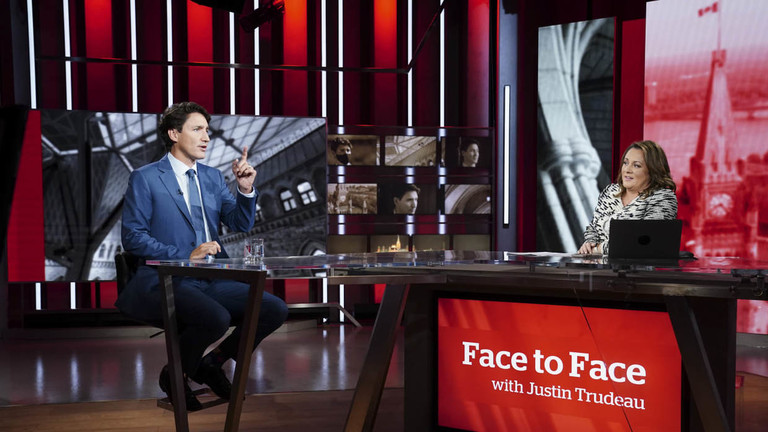
Canadian PM Justin Trudeau on CBC’s Face To Face with host Rosemary Barton in Toronto, September 12, 2021. © Global Look Press/Keystone Press Agency
RT | April 17, 2023
The Canadian Broadcasting Corporation (CBC) announced on Monday that it was “pausing” its activity on Twitter after the social media platform labeled it as state-funded, arguing that this somehow impugned their editorial independence.
“Our journalism is impartial and independent. To suggest otherwise is untrue. That is why we are pausing our activities on Twitter,” the government-funded outlet tweeted.
“Twitter can be a powerful tool for our journalists to communicate with Canadians, but it undermines the accuracy and professionalism of the work they do to allow our independence to be falsely described in this way,” CBC spokesperson Leon Mar said on Sunday evening. “Consequently, we will be pausing our activity on our corporate Twitter account and all CBC and Radio-Canada news-related accounts.”
The CBC is a Crown corporation, entirely owned by the Canadian state. In its 2021-22 annual analysis, it reported receiving 1.24 billion ($930 million) Canadian dollars in government funding. However, the outlet insists that its editorial policies are entirely independent of the government and guided only by “public interest.”
Mar argued that Twitter’s own policy defines government-funded media as those in which the authorities “may have varying degrees of government involvement over editorial content,” which is “clearly not the case with CBC/Radio Canada.”
Leader of the opposition Conservative Party Pierre Poilievre reacted to the labeling of CBC by tweeting that “Now people know that it is [Canadian PM Justin] Trudeau propaganda, not news.”
Last week, Poilievre called on Twitter owner Elon Musk to add the label to the broadcaster, saying it was needed to protect Canadians against “disinformation and manipulation by state media.” Describing the CBC as government-funded is a fact, the politician said, “and Canadians deserve the facts.”
The CBC’s Twitter boycott echoes the actions of two US outlets, the National Public Radio (NPR) and the Public Broadcasting Service (PBS). Both stopped tweeting last week, in response to being labeled as government-funded.
PBS also insisted that it was entirely editorially independent and produced “trustworthy content that features unbiased reporting.” The outlet could not argue that it didn’t receive government funding, as 31% of its revenue came from federal, state and local authorities, with another 12% coming from regional public broadcasters and universities, also heavily subsidized by the government.
Twitter originally rolled out the labeling of outlets in August 2020, tagging Russian and Chinese media as “state-affiliated” but exempting Western outlets such as the BBC and Voice of America (VOA). As documents published after Musk’s takeover showed, the platform was working hand in glove with what several US journalists described as a “censorship-industrial complex” of government agencies and politically motivated NGOs.
COVID deaths up 39% after vaccines rolled out in Ontario Canada
Weren’t the vaccines supposed to REDUCE deaths from COVID? Oddly, there was no press coverage on this.
By Steve Kirsch | April 7, 2023
Executive summary
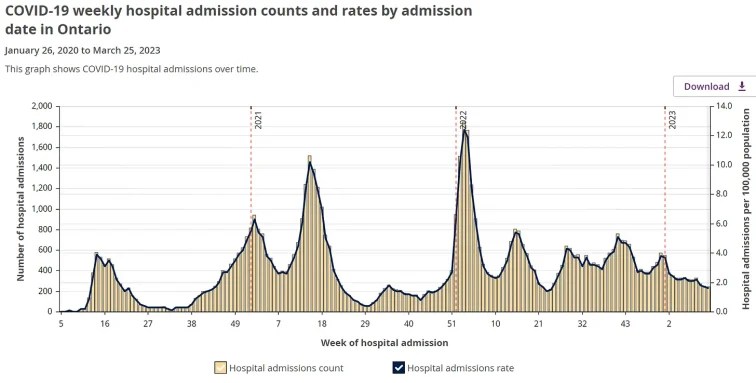
The official government numbers show COVID deaths are up in Ontario by nearly 40% since the vaccines rolled out and hospitalizations due to COVID are up by 31%!
Both hospitalization and deaths from COVID were up dramatically.
You can see it yourself (see the red box below):

Deaths went from 5,485 in 2021 to 7,625 in 2022.
Could that be statistical noise? Not likely. Sigma is 74 so it’s a 29-sigma increase. In other words, this increase in death didn’t happen by chance; something caused it.
The data from the Ontario website
We know the vax makes you more likely to get COVID. If you had 3 shots, the Cleveland Clinic study showed you are about 2.5X more likely to get COVID. So that big spike in cases in 2022 is totally expected: it was our own doing. The more people who got COVID, the more people who died from COVID.
You’re less likely to die from a COVID case in 2022 than in 2021 because the variant is less deadly, not because the vaccine worked.

Cases
Hospitalizations

Deaths
Possible explanations
Was this because the virus was more deadly in 2022? I don’t think so.
Let’s look the world’s least vaccinated countries: Yemen, Haiti, and PNG. As you can see, deaths are way down in 2022 because the variants are less lethal:

These numbers show that the “it would have been worse if people weren’t vaccinated” excuse won’t hold any water.
Furthermore, we know the vaccines are super deadly. Consider the following recent post which is based on CDC data:

If it wasn’t the vaccine that caused this dramatic rise, what caused it?
Also, even the US data shows a decrease in 2022 vs. 2021, so it’s hard for Ontario to argue that the virus was more deadly in 2022:

This visualization was done on the CDC website on the Weekly Provisional Counts of Deaths page
So there is no rock they can hide under.
Of course, this is embarrassing for the narrative which is why nobody is talking about it.
Even Professor David Fisman is silent about the report. I reached out to him for an explanation and he ignored it, exactly as expected.
This is why there is no press coverage of this: because the numbers are inexplicable if the vaccine worked.
I just thought you’d like to know.
Summary
It’s unfortunate that the mainstream press isn’t covering this.
I can’t figure out why. The press is supposed to report this and get comments from both sides. Instead, they ignore the story.
A nearly 40% increase in COVID deaths and the mainstream press ignores the story!?! WTF is going on here?
But I thought people would want to know the truth.
Canada’s Conservative leader promises to repeal censorship bill if elected
One of the few pushing back against bill C-11
By Christina Maas | Reclaim The Net | March 29, 2023
In his speech at the Canada Strong and Free Networking Conference, the leader of the Conservative Party, Pierre Poilievre, criticized censorship and promised to repeal Bill C-11.
Attacking political correctness, Poilievre said: “It’s about large corporations in regulated oligopolies winning political favor, by throwing around politically correct statements and advancing an agenda that makes no sense to anyone but them.
“This woke movement is an attack on the freedom of speech of ordinary people and the common sense of Canadians, and in Pierre Poilievre Canadians will have someone who will stand up against world corporations and for the rights of every single person to express themselves freely in a free country.”
Criticizing Bill C-11, he said: “They claim that this is simply to promote Canadian content, although they have yet to tell us what Canadian content actually is. To me, Canadian content is anything that is posted online by a Canadian. They believe that it’s only a small approved list of true experts in Canadiana who can be promoted.”
Trudeau invokes “flat-earthers” and “anti-vaxxers” as he calls for social platforms to be liable for “disinformation”
By Christina Maas | Reclaim The Net | March 28, 2023
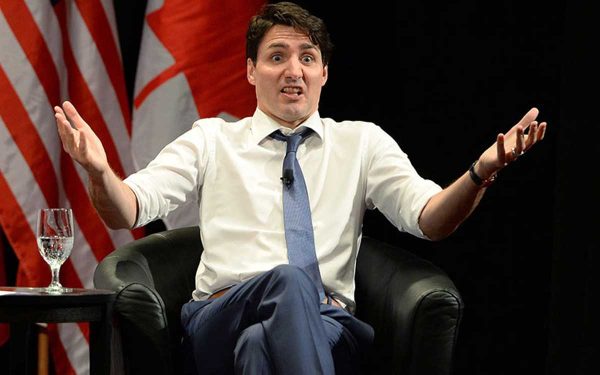
Canada’s Prime Minister Justin Trudeau invoked “flat-earthers” and “anti-vaxxers” to call for a crackdown on “disinformation” online. He made the comments during a town hall event in Ottawa last week.
Trudeau began by saying the government should find a balance between censorship and free speech to protect people from disinformation.
“Governments have very limited tools to protect people in an online world, which is a good thing. It allows for a tremendous amount of freedom – freedom of expression, freedom of discovery – no oppressive governments controlling what you see, what you want, but it also opens us up to a tremendous amount of crap, of hate speech, of things that are illegal, but also things that are just going to bring us down roads where we’re going to get lost,” he said.
He then talked about misinformation in terms of anti-vaxxers and flat-earthers.
“I remember a few years ago before the pandemic, getting really fascinated by flat-earthers, and trying to understand – sort of – the thinking behind them, of people who decided actively to create an identity for themselves that was to just clearly reject what science settled thousands of years ago with the ancient Greeks and that there’s no real contrast to,” he explained.
“It’s more of an identity thing rather than a reasoning thing, and to have people sucked into that, it was fascinating to try and see what it was all about.
“And of course, we went on to understand the phenomenon of anti-vaxxers and anti-science, anti-skeptics, and this rise in these echo chambers that are validating this kind of thinking in ways that have real consequences.
“There are people in Canada who died surrounded by their families because they truly and genuinely believed that the vaccine was more dangerous than the virus, and it killed them.”
The PM then argued that online platforms should be held responsible for the content they host.
“My responsibility as Prime Minister is to try and keep everyone in this country as safe as I possibly can, but I can’t protect everyone from every bit of disinformation on the Internet. So we have to have reflections of how we move forward, how we responsibilize the companies that are controlling so much, the private companies that are controlling so much of the public square you now live in that doesn’t have police paid by your taxes to keep you safe.”
“It doesn’t have rules around businesses to regulate so you don’t get scammed by the corner store. This is the new world we’re in that we’re going to have to try and adjust to, and I can tell you, I’m worried about the direction we’re going.”
Let’s compare China’s ‘agents’ in Canada to Israel’s
By Yves Engler | March 11, 2023
What would happen if the media and intelligence agencies applied the same standard used regarding China to the Israel lobby?
In the Globe and Mail Andrew Coyne has written two columns in recent days arguing that the discussion over Chinese interference should focus on “domestic accomplices”. “What we need a public inquiry to look into is domestic complicity in foreign interference”, noted the regular CBC commentator.
In a similar vein Justin Trudeau responded to criticism regarding purported Chinese interference by noting, “We know that Chinese Canadian parliamentarians, and Chinese Canadians in general, are greater targets for interference by China than others.” The prime minister added, “We know the same goes for Iranian Canadians, who are more subject to interference from the Iranian government. Russian speakers in Canada are more vulnerable to Russian misinformation and disinformation.”
Why ignore how Israel and its Canadian lobby use Jewish MPs and Jewish organizations as their agents?
The leading Israel advocate in parliament, Anthony Housefather chairs the Canada-Israel Interparliamentary Group. That group was previously led by another Jewish Liberal MP, Michael Leavitt, who resigned to head Israel lobby group Friends of Simon Wiesenthal Center. Housefather and Leavitt have repeatedly met Israeli officials in Canada.
As part of the media frenzy about Chinese interference, there has been significant discussion about Trudeau attending a 2016 Liberal Party fundraiser at the Toronto home of Chinese Business Chamber of Canada chair Benson Wong. Among the attendees was Chinese Canadian billionaire Zhang Bin who is alleged to have donated to the Trudeau Foundation/University of Montréal at the request of a Chinese government official.
But Trudeau has far more extensive ties to pro-Israel funders. Since 2013 the chief fundraiser for the Trudeau Liberals has been Stephen Bronfman, scion of an arch Israeli nationalist family. Bronfman has millions invested in Israeli technology companies and over the years the Bronfman clan has secured arms for Israeli forces and supported its military in other ways. Bronfman openly linked his fundraising for Trudeau to Israel. In 2013 the Globe and Mail reported:
“Justin Trudeau is banking on multimillionaire Stephen Bronfman to turn around the Liberal Party’s financial fortunes in order to take on the formidable Conservative fundraising machine…. Mr. Bronfman helped raise $2-million for Mr. Trudeau’s leadership campaign. Mr. Bronfman is hoping to win back the Jewish community, whose fundraising dollars have been going more and more to the Tories because of the party’s pro-Israel stand. ‘We’ll work hard on that,’ said Mr. Bronfman, adding that ‘Stephen Harper has never been to Israel and I took Justin there five years ago and he was referring at the end of the trip to Israel as ‘we.’ So I thought that was pretty good.’”
In 2016 Trudeau attended a fundraiser at the Toronto home of now deceased billionaire apartheid supporters Honey and Barry Sherman. The event raised funds for the party and York Centre Liberal party candidate Michael Levitt. In 2018 CBC reported on multimillionaire Mitch Garber attending one of Bronfman’s fundraisers with Trudeau. On Federation CJA Montréal’s website Garber’s profile boasts that his “eldest son Dylan just completed his service as a lone soldier serving in an elite Cyber Defense Intelligence Unit of the IDF in Israel.”
A thorough investigation of pro-Israel Liberal fundraising would uncover a litany of other examples. And they’ve had far greater success. While the Trudeau government has banned Chinese firms, arrested a prominent Chinese capitalist and targeted that country militarily, they’ve been strikingly deferential to Israel. The Trudeau government has expanded the Canada-Israel free trade agreement, organized a pizza party for Canadians fighting in the Israeli military, voted against over 60 UN resolutions upholding Palestinian rights, sued to block proper labels on wines from illegal settlements and created a special envoy to deflect criticism of Israeli abuses. During a 2018 visit to Israel former foreign affairs minister Freeland announced that should Canada win a seat on the United Nations Security Council it would act as an “asset for Israel” on the Council.
Part of the Chinese interference story is about funding University of Montréal and University of Toronto initiatives tied to China. But Jewish Zionist donors have set up far more initiatives, including numerous Israel and Israel-infused Jewish studies programs.
Having fought to establish Israel and with major investments in Israel, David Azrieli spent $5 million to establish Israel studies and $1 million on Jewish studies at Concordia University. At the University of Toronto more than $10 million was donated to establish the Anne Tanenbaum Centre for Jewish Studies and the Andrea and Charles Bronfman Chair in Israeli Studies. Millions of dollars more have been donated to launch similar initiatives at other universities.
On many occasions pro-Israel donors have leveraged donations to block academic appointments or suppress discussion of Palestinian rights. The hundreds of millions of dollars donated by Israel supporters (Schwartz/Reissman, Peter Munk, Seymour Schulich, etc.) partly explains why over a dozen Canadian university presidents recently traveled with apartheid lobby group, the Centre for Israel and Jewish Affairs, to Israel despite opposition from significant segments of their institutions.
Much more influential than the ‘China lobby’, the Israel lobby has largely been ignored in recent discussion about the need for an inquiry into foreign interference. But any serious foreign agent registry ought to include the apartheid state’s domestic accomplices.
Featured Video

Alon Mizrahi: ‘Israel Must Be Dismantled’
or go to
Aletho News Archives – Video-Images
From the Archives
How a War with Iran Would Diminish American Power
By Greg Scoblete | The Compass | August 13, 2010
Jennifer Rubin wants a war with Iran:
But the emphasis on the existential threat to Israel ignores a more basic issue for Americans to ponder: a nuclear-armed Iran represents a dagger at the heart of America and an existential threat to our status as a superpower and guarantor of the West’s security. As to the former, Iran is pressing ahead with its long-range ballistic missile program. First the Middle East and Eastern Europe, then all of Europe and, within a matter of years, the U.S. will be within range of Iranian missiles. If those are nuclear and not conventional, what then? We’re not talking about whether Iran is going to be “merely” a destabilizing factor in the Middle East or whether it will set off an arms race with its neighbors or imperil Israel’s existence. We’re talking about whether America will then be at risk (and lacking sufficient missile-defense capabilities if we continue to hack away at our defense budget). The argument about whether mutual assured destruction can really work against Islamic fundamentalists who have an apocalyptic vision becomes not about Israel’s ability to deter an attack but about ours. Those who oppose American military action have an obligation to explain why America should place itself in that predicament.
I would argue that any obligation to present an explanation lies with those whose disastrous policy prescriptions with respect to Iraq lead America into the worst strategic blunder in the country’s recent history. That aside, note the blind faith in the power of the military to actually achieve its ends. … continue
Blog Roll
 Aletho News
- Villains of Judea: Leonid Radvinsky
- Alon Mizrahi: ‘Israel Must Be Dismantled’
- Former Head Of MI6 Admits That The U.S. And Israel Are Losing The Iran War
- Scattered Thoughts on War and Peace
- Iran Threatens to Close Red Sea to Shipping in Response to Invasion
- Iran in excellent position to prevail in war with US, Israel: John Mearsheimer
- Iran warns US: Do not call your retreat an agreement
- Neighbors first – Moscow signals shift in energy strategy
- Almost 400 Ukrainian drones downed over Russia in single night – MOD
- Battle for Hungary: How the Russiagate blueprint has been unleashed against Orban
- If Americans Knew
- In the West Bank, life is a constant battle – 3 articles
- Jacob Reses, one of the most powerful pro-Israel operatives in Trump’s Washington
- Israeli-US assaults kill or injure 87 children a day – Not a ceasefire Day 166
- ‘Forever live by the sword’: Understanding Israelis’ massive support for Iran war
- UN’s special rapporteur on human rights says Israel is systematically torturing Palestinians
- Trump White House plagiarized Iran war manifesto from Israel-aligned think tank
- Gaza says 6–10 patients die daily waiting for treatment abroad as Israel blocks medical evacuations
- ‘Substantial evidence’ of double-tap strike in killing of Gaza’s Hind Rajab
- ‘Do Not Want To Die For Israel’: Doubts About Trump’s Iran Strategy Spread Among Troops
- Instead of taking Joe Kent’s claims seriously, the media is disregarding him as an antisemite
- No Tricks Zone
- Devastating Assessment Of Comirnaty Vaccine By Former Senior Pfizer Europe Toxicologist
- New Study: CO2 Is ‘Effectively Negligible’ As An Explanatory Climate Change Factor Since 2000
- Former Pfizer Toxicologist Dr. Helmut Sterz Tells Bundestag Hearing Pfizer Vaccine Should Have Never Been Approved
- Energy Expert: Germany’s Nuclear Phaseout Was A “500 Billion Euro Mistake”
- New Research: South Australia’s Mid-Holocene Sea Surface Temperatures Were 4°C Warmer Than Today
- Storing Green Energy To Last Germany 10 Days Would Require A 60-Million Tonne Battery
- New Studies: UK Sea Levels Were 4 Meters Higher Than Today During The Mid-Holocene
- Destructive Green New Deal: German Energy And Metal Group Warns Of Drastic Crisis
- New Study Documents A 20-Year Pause In Arctic Sea Ice Decline – Driven By Internal Variability
- Wake-up Call: Survey Shows Majority Of Germans Now Favor Postponing Climate Targets!
 Aletho News