Trudeau announces plans to euthanize “drug addicts” and “mentally ill.”
FRONT NIEUS | October 22, 2023
The Canadian government has announced plans to begin euthanizing “drug addicts” and citizens with a range of mental illnesses.
Prime Minister Justin Trudeau’s government plans to relax current “assisted suicide” laws so that more Canadians who have become a burden on taxpayer-funded health care systems can use them, Hunter Fielding reports .
However, critics compare the move to “modern eugenics”.
When Canada’s medically assisted dying (MAID) law changes in March 2024, mental health patients, including those with substance abuse problems, without other physical conditions will be eligible to be legally euthanized by the state.
A special parliamentary committee will re-examine the controversial move ahead of its implementation in coming months, following protests from Trudeau’s opponents in Canada.
Daily Mail reports: More than 10,000 Canadians were euthanized in 2021, a tenfold increase from 2016 when the practice was legalized.
In some cases, people living in poverty have agreed to die.
Currently, people with mental health conditions such as depression and personality disorders without physical conditions are not eligible for assisted suicide.
A framework for assessing people with substance use disorders for MAID is being discussed this week at an annual scientific conference in Canada.
The agenda of the workshop includes teaching participants and medical professionals to “know the difference between suicidality and a motivated desire to die.”
Zoë Dodd, a harm reduction advocate from Toronto, told VICE News that the practice is tantamount to eugenics.
She said: “I just think that MAID, when it has entered the realm of mental health and substance use, is really rooted in eugenics.
“And there are people who are really struggling with substance use and people are actually not getting the support and help that they need.”
Dr. David Martell, chief physician of Addiction Medicine at Nova Scotia Health, who is presenting the framework at the conference, told VICE News :
I don’t think it’s fair, and the government doesn’t think it’s fair, to exclude people from eligibility because their medical condition or their suffering is related to mental illness.
As a subset of these, it is not fair to exclude people from subsidies simply because their mental disorder may be partially or completely a substance use disorder.
It has to do with treating people equally.
The process for an assisted death in Canada starts with downloading a simple form online.
This means that the applicant must answer a number of questions and sign the bottom.
The applicants must then obtain the signatures of witnesses.
This is followed by a phone call and a home visit from a doctor.
If the application is approved by two different doctors, the person must wait 90 days from the time of application.
A doctor can then administer the lethal drug via an injection.
Conservative MP Leslyn Lewis backs petition calling for Canada to exit UN, WHO

MP Leslyn Lewis (Haldimand-Norfolk) speaks at Save our Charities Rally on Parliament Hill, Ottawa, Nov. 24, 2021
By Anthony Murdoch | Life Site News | October 18, 2023
OTTAWA, Ontario –– Conservative Party of Canada MP Leslyn Lewis has endorsed an official House of Commons petition demanding the nation’s federal government “urgently” withdraw from the United Nations and its subgroup, the World Health Organization (WHO), due to the organizations’ undermining of national “sovereignty” and the “personal autonomy” of citizens.
“We, the undersigned, Citizens and Residents of Canada, call upon the House of Commons in Parliament assembled to Urgently implement Canada’s expeditious withdrawal from the U.N. and all of its subsidiary organizations, including WHO,” reads the petition, which was initiated by Doug Porter from Burnaby, British Columbia, and then endorsed by Lewis.
As of press time, the petition, which was opened on October 10, has just over 36,000 signatures. It will remain open for signing until February 7, 2024.
The petition states that Canada’s current membership in the UN along with the WHO has resulted in “negative consequences on the people of Canada,” which far outweigh “any benefits.”
Additionally, the petition reads that the UN’s “Agenda 2030″ undermines “national sovereignty and personal autonomy.”
Many of Prime Minister Justin Trudeau’s federal government goals, notably its environmental ones, are in lockstep with the United Nations’ “2030 Agenda for Sustainable Development.”
Agenda 2030 is a plan that was adopted by the UN General Assembly in 2015, and through its 17 Sustainable Development Goals (SDGs), seeks to “transform our world for the better,” by “taking urgent action on climate change,” as well as “support[ing] the research and development of vaccines and medicines.” Some of the 17 goals also seek to expand “reproductive” services, including contraception and abortion, across the world in the name of women’s rights.
According to the UN, “all” nations working on the program “will implement this plan.”
Part of the plan includes phasing out coal-fired power plants, reducing fertilizer usage, and curbing natural gas use over the coming decades. Canada is one of the world’s largest oil and gas producers, however, Trudeau has made it one of his goals to decimate the industry.
In a blow to the globalist UN agenda, however, Canada’s oil and gas sector recently scored a huge win after the Supreme Court of Canada declared Trudeau’s government’s Impact Assessment Act, dubbed the “no-more pipelines” bill, is mostly “unconstitutional.”
As for Lewis, she is pro-life and has consistently called out the Trudeau government for pushing a globalist, anti-life agenda on Canadians.
Early this year Lewis noted that the World Economic Forum (WEF) is “not our government” and that Canadians did not “sign up” to be attached to one of its charters. Lewis herself helped expose Canadians to the fact that Trudeau’s Liberal government signed onto the WEF charter in 2020.
Petitions to Canada’s House of Commons can be started by anyone but must have the support of five Canadian citizens or residents, along with the support of a sitting MP.
Once a petition has over 500 verified signatures, it is presented to the House of Commons, where it awaits an official government response.
Petition calls out UN’s sex-ed programs, saying Canadians did not vote for these to be pushed on kids
The Lewis-backed petition states that Canada should have nothing to do with the UN’s sexual education programs as they have been pushed on the populace without the “consent” of the people.
The petition reads that Agenda 2030’s SDGs, as well as its “Comprehensive Sexuality Education (CSE)” program, its UN Judicial Review, and its International Health Regulations (IHR) are being “rapidly implemented,” with the absent awareness and “consent of the People or their elected representatives.”
The petition reads that SDGs have “negative impacts on potentially every aspect of life,” in Canada, including “religious and cultural values, familial relations, education, nutrition, child development, property rights, economic and agricultural productivity, transportation, travel, health, informed consent, privacy and physical autonomy.”
When it comes to the UN’s CSE, the petition states that publicly funded educational institutions have been “damaging children while concealing information from parents.”
As a result, the CSE’s “normalization” of “sexual values and activities with regard to children are endorsed and enforced, beginning at birth.”
As for the WHO, it claims that the CSE gives kids “accurate, age-appropriate information,” however it then says sexual education should start at the age of 5 as per UN guidelines.
“Learning is incremental; what is taught at the earliest ages is very different from what is taught during puberty and adolescence,” reads the CSE.
A report which was published by the UN’s Educational, Scientific and Cultural Organization, in collaboration with the WHO, told kids aged 5 to 8 that “people can show love for other people through touching and intimacy.”
UN’s health regulations look to violate Canadians’ charter rights, says petition
The petition notes that when it comes to Agenda 2030, many amendments to the International Health Regulations (IHR) were “secretly negotiated,” which as a result means they could “impose unacceptable, intrusive universal surveillance, violating the rights and freedoms guaranteed in the Canadian Bill of Rights and the Charter of Rights and Freedoms.”
Lastly, the petition states that the UN’s goals intend to impose “sweeping impacts on public and private life,” and only “serve the interests of UN/WHO and unelected private entities (e.g. World Economic Forum, Bill and Melinda Gates Foundation, International Planned Parenthood Federation, etc.), while diminishing the health rights and freedom of Canadians.”
The WHO says that the IHR is a legally binding international body to which all UN members are committed to.
Lewis has before blasted Canada’s involvement with the IHR and insisted last year that the Canadian government “defend our healthcare sovereignty” and vote against proposed U.S. amendments to the the IHR.
The WHO’s IHR provides an “overarching legal framework that defines countries’ rights and obligations in handling public health events and emergencies that have the potential to cross borders.”
“The IHR are an instrument of international law that is legally-binding on 196 countries, including the 194 WHO Member States,” notes the WHO.
So far this year, there have been more than 300 proposed amendments to the IHR when it comes to the declaration of a Public Health Emergency of International Concern.
Lewis recently called out the proposed amendments, saying that if enacted it would negatively affect how Canada deals with any future health crisis.
On September 26, she presented to the House of Commons a petition specific to the IHR, which called for “urgent” debates on the amendments.
Critics have sounded the alarm over the Trudeau government’s involvement in the WEF and other globalist groups, pointing to the socialist nature of the “Great Reset” agenda and its similarities to Communist China’s totalitarian Social Credit System.
Lewis in June of this year had asked for a full disclosure of all “contracts, transfer payments, memoranda of understanding, letters of intent, charters, accords, projects and associations between the government and the WEF since November 4, 2015.”
The outcomes from the Order Paper resulted in a 127-page response that was tabled in the House of Commons on September 18.
Lewis has in the past blasted the WEF and its Known Traveller Digital Identification (KTDI) programs as “glitching failures.”
Israel’s ambassador pushes to shut down pro-Palestinian activism
By Yves Engler | October 21, 2023
Israel wants Canada to criminalize growing displays of solidarity with Palestinians.
In a bid to amplify calls to ban Palestine solidarity marches, Israel’s ambassador Iddo Moed told the Canadian Press on Thursday, “I don’t think that democracies allow people to hate and to incite, and I think that that is something that is looked at very carefully in many places, including Canada.” He added, “when is a line crossed that is between supporting a cause and between changing our values in a way that incites hatred and violence and even glorification of horrendous terrorist attacks.”
As a purported example of the “hatred” Moed is referring to, the CP story reported “One sign spotted at the Oct. 9 protest outside Toronto’s Nathan Phillips Square read: ‘Occupation is a crime, resistance is a response.’”
Moed is seeking to boost a push to change Canada’s criminal code. Last week the Globe and Mail published “Rallies raise question of whether Canada should have a law against public cheering of terrorism” and the National Post’s John Ivison called for federal legislation to criminalize the protests in “Tolerating the glorification of terror and slaughter is societal suicide”. Similarly, the host of CBC’s Power & Politics David Cochrane asked foreign affairs minister Melanie Joly whether Canadians participating in Palestine solidarity rallies should be prosecuted for supporting terrorism while National Post reporter Tristin Hopper mused about banning the Palestinian flag. On Twitter Hopper noted, “So when do we declare the Palestinian flag a hate symbol? I’m not seeing a lot of them being waved by people who *don’t* support mass-murder.”
Taking a page from Hopper’s line of thinking, a principal at an Ottawa elementary school recently asked a student to remove the Palestinian flag as their profile picture. “We will follow up with your family because we want to keep all students feeling safe, welcome and included in our classrooms,” the principal is recorded saying.
This isn’t an isolated case. On Thursday prominent Toronto teacher Javier DaVila tweeted, “I’ve received dozens of reports from parents of children in Ontario education who’ve been targeted, attacked or suspended for wearing Keffiyehs, displaying Palestinian flags, expressing solidarity with or even saying Palestine.”
In a bid to blunt opposition to Israel’s genocidal policies, the media and politicians have hounded CUPE Ontario leader Fred Hahn and Hamilton NDP MPP Sarah Jama. They’ve also vilified student unions standing for Palestinian rights and called for them to be defunded.
While they obsess about one-sided student union statements, the media has all but ignored racism spouted by more influential pro-Israel actors. They are uninterested that the head of Montreal’s Federation CJA told an audience, which included multiple elected officials, that “the barbarians are at the gate” or that Centre for Israel and Jewish Affairs hosted a speaker days after he tweeted an image of an Israeli military boot crushing a Palestinian cockroach. The leaders of the four main political parties spoke at the same CIJA conference.
Without a hint of awareness of the irony, organizations that proclaim Israel as “the only democracy in the Middle East” and condemn anyone who draws parallels between Nazi behaviour and Israel’s, as well as newspaper columnists who decry leftists when they “de-platform” right wingers, target the jobs of Palestine’s supporters.
Zionist campaigners have targeted multiple individuals’ livelihoods. Under outside pressure, a number of public servants are being “probed for anti-Israel posts” while a doctor who has done humanitarian work in Gaza and elsewhere, Ben Thomson, was suspended by Mackenzie Health for his Palestine advocacy. Air Canada even fired a pilot for posting Palestine protest photos on social media.
In response to the witch-hunt, Labour 4 Palestine has launched an action campaign titled “Defend free speech. Stop the attack on Palestine solidarity.” For its part, Scholar Strike Canada released a statement condemning “University Administrators and the Western media for their ongoing Threats against Scholars and Students in Solidarity with Palestinian People in Gaza.” In response to the Ontario premier’s smears, Jama formally threatened a defamation suit against Doug Ford.
Notwithstanding the witch-hunt, tens of thousands of Canadians have taken to the streets in recent days. On Tuesday night multiple thousands rallied and marched in emergency protests in Montreal, Ottawa, Calgary and Toronto against Israel killing hundreds at the Al-Ahli Baptist Hospital in Gaza. A few days earlier more than 5,000 marched in Montréal against Canada’s complicity with Israel’s genocidal violence in Gaza.
More protests are planned Friday and this weekend. The best way to respond to repression of solidarity is to amplify Palestine solidarity work.
Yes, there is an Israel lobby, as any decent journalist knows
By Yves Engler | October 18, 2023
Is the idea of a “highly organized Israel lobby” antisemitic? An apartheid-promoting Globe and Mail columnist claims as much.
In attacking the Canadian Union of Public Employees for standing in solidarity with Palestinians Robyn Urback tweeted, “Points for alleging a Jewish conspiracy, but if CUPE really wanted to go full antisemitic trope, they should have mentioned something about poisoning the wells.” Below her message Urback quote tweeted a colleague stating, “CUPE Ontario says it’s targeted by ‘trolls’ – ‘a highly organized pro-Israel lobby,’ which targeted [Union president] Fred Hahn and CUPE 3906 for ‘recognition of Palestinians’ rights under international law to resist occupation through armed struggle.’”
But Urback knows full well there are many organizations backed by substantial wealth promoting Israel. This is not a trope. This is reality that is easily fact checked and should have been by any honest journalist.
In a sign of her dishonesty, Urback previously wrote about a lobby sponsored trip to Israel she participated in. Urback went on BirthRight, a program that pays for young Jews to go Israel to become “intellectual ambassadors” for the country.
The preeminent force in the “highly organized Israel lobby” is the Centre for Israel and Jewish Affairs. CIJA has over 40 staff and a $10 million budget. In addition, B’nai B’rith has a handful of offices across the country. For its part, Friends of Simon Wiesenthal Center Canada’s budget is $7-10 million annually. These groups work closely with StandWithUs Canada, CAMERA, Allied Voices for Israel, Israel on Campus, Honest Reporting Canada and other Israeli nationalist political organizations. Additionally, more than 200 registered Canadian charities assist projects in Israel and engage in at least some pro-Israel campaigning domestically. There are also numerous Jewish private schools, summer camps and community centres that actively promote Israel.
All these groups are backed by substantial wealth. Patron of CIJA, the Jewish federations of Toronto, Montréal, Winnipeg, Windsor, Calgary, Edmonton, Hamilton, London, Ottawa, Vancouver and Atlantic Canada raise $200 million annually and have over $1 billion in assets.
A large amount of private wealth strengthens Israel lobby groups’ influence. Since 2013 the chief fundraiser for the Trudeau Liberals has been Stephen Bronfman, scion of an arch Israeli nationalist family. Bronfman has millions invested in Israeli technology companies and over the years the Bronfman clan has secured arms for Israeli forces and supported its military in other ways. Bronfman openly linked his fundraising for Trudeau to Israel. In 2013 the Globe and Mail reported: “Justin Trudeau is banking on multimillionaire Stephen Bronfman to turn around the Liberal Party’s financial fortunes in order to take on the formidable Conservative fundraising machine…. Mr. Bronfman helped raise $2-million for Mr. Trudeau’s leadership campaign. Mr. Bronfman is hoping to win back the Jewish community, whose fundraising dollars have been going more and more to the Tories because of the party’s pro-Israel stand. ‘We’ll work hard on that,’ said Mr. Bronfman, adding that ‘Stephen Harper has never been to Israel and I took Justin there five years ago and he was referring at the end of the trip to Israel as ‘we.’ So I thought that was pretty good.’”
Other notable Canadian moguls have long histories of ensuring ties between Israel and Canada. Worth more than $3 billion prior to his death, David Azrieli was among the richest Canadians. In his youth he served in the paramilitary Haganah group during the 1948 war. His unit was responsible for the Battle of Jerusalem, including forcibly displacing 10,000 Palestinians. Azrieli was also a real estate developer in Israel and in 2011 he made a controversial donation to Im Tirtzu, a hardline Israeli-nationalist organization (deemed a “fascist” group by an Israeli court).
Worth $1.6 billion, Gerald Schwartz and his wife Heather Reisman created the Heseg Foundation for Lone Soldiers, which provides millions of dollars annually for non-Israelis who fight in the IDF.
In recent years Canadian-Israeli billionaire Sylvan Adams has plowed hundreds of millions of dollars into various sports and cultural initiatives to rebrand Israel.
Other Canadian billionaires Larry Tanenbaum, Mark Scheinberg, David Cheriton, Mitch Garber, Daryl Katz, Seymour Schulich, as well as the Zekelman, Reichmann and Sherman families, all back Israel. Again, none of this a conspiracy theory or antisemitic trope. It is simple reality and easily fact-checked if one is interested.
It is good, not bad, that a union leader mentions powerful lobbyists influencing Canadian politicians to take certain policy positions. Democracy requires shining a light on such lobbying. Is Urback against this very common practice of good journalists?
Canadians politicians express unmatched fidelity to a state all leading human rights groups say is committing the crime of apartheid. Trudeau’s government organized a pizza party for Canadians fighting in the Israeli military, sued to block proper labels on wines from illegal settlements and announced that should Canada win a seat on the United Nations Security Council it would act as an “asset for Israel” on the council. In recent days Canadian politicians have fallen over themselves to express support for Israel as that country obliterates Gaza, kills dozens in the West Bank and bombs Lebanon, Egypt and Syria.
There’s nothing conspiratorial or untoward about citing the role of a “highly organized Israel lobby”. In fact, there would be nothing conspiratorial or untoward to describe it as a “highly organized Jewish Israel lobby”. A slew of self-described Jewish organizations are deeply involved in anti-Palestinian campaigning and no other lobby focused on a country/ethnicity/religion is near as well-resourced or organized as the above mentioned Canadian Jewish groups.
That’s not to say there aren’t other political and cultural forces shaping Canadian backing for Israel. Zionism began in Canada in the latter half of the 1800s as a Christian movement and there’s still Christian Zionist forces. At the turn of the 20th century Canada became staunchly pro-Zionist due to its close ties to the British empire and Washington’s perspective has significant influence today. There’s also a European ‘settler solidarity’ element to Canadian Zionism and Israel advocates wield a unique and powerful stick: The ability to play victim and smear those advocating for justice as racist.
Robyn Urback knows full well there’s a “highly organized Israel lobby”. Her claim that CUPE is anti-Jewish to mention this is ridiculous. It is also bad journalism and most likely a projection of her (perhaps unintentional) anti-Palestinian racism.
Canadian Government Wants To Boost Opinion Monitoring, Under The Guise of Reducing “Misinformation”
By Cindy Harper | Reclaim The Net | October 18, 2023
The Canadian Department of Heritage appears to be aligning itself with a potentially alarming stance, according to a recent write-up by Blacklock’s Reporter. Liberals within the administration have expressed the need for a significant boost in funds to target what they deem as “incorrect” political perspectives. This request is centered around the Digital Citizen Initiative (DCI), a program set into motion by Justin Trudeau’s Liberals in 2018 under the tagline of combating online disinformation to aid democracy and social inclusion.
The DCI appears to outstretch its reach. The program puts forth that its resources are insufficient and demands more financial backing. It claims that disinformation right now poses extensive damaging potential, affecting Canadians’ health, safety, political beliefs, trust in media, and their civic and democratic engagement. However, upon raising these grave concerns, it offers no substantial evidence or instances to back them up.
This widening net also engulfs various societal groups, claiming that disinformation creates an environment rife with discrimination, stigma, and marginalization, possibly fueling social divisions. Groups like people with lower digital competency and those from minority backgrounds, it maintains, might be susceptible to this so-called disinformation campaign.
In response, Canada’s government granted DCI $7.5 million for two years, intending to fund activities centered around digital, news, and civic literacy.
But the appetite of DCI seems insatiable. An additional $19.4 million was given to DCI and the Digital Citizen Contribution Program (DCCP) for research correlated with the government’s aim of understanding, tackling, and revisiting online misinformation.
Several key universities, non-profit organizations, and policy forums, amongst other institutions, across Canada have been the beneficiaries of DCI’s grants.
Hundreds of Canadians Have Been Debanked In The Last Five Years, Report Shows
An opaque and growing form of censorship
By Christina Maas | Reclaim The Net | October 8, 2023
A sweeping de-banking wave has swept across Canada, affecting over 800 citizens in its tide since 2018, a number which includes hundreds who rallied behind the banner of the Freedom Convoy. Data unearthed through an access-to-information request by Blacklock’s Reporter unveiled a disturbing pattern where 837 individuals found the doors of their banks slammed shut on them over a span of five years.
The Financial Consumer Agency of Canada was brought into the loop through grievances lodged with regulatory bodies, shedding light on financial strangulation that bypassed cases of validated terrorism and money laundering.
In a deeper dive into the numbers, it’s revealed that the financial shackles tightened around 267 bank accounts and 170 Bitcoin wallets belonging to Freedom Convoy supporters, ensnaring an estimated $7.8 million. This exercise in financial censorship spun a web of scrutiny during a hearing on March 7, 2022, where Angelina Mason, representing the Bankers Association, testified. Mason outlined that while the Royal Canadian Mounted Police (RCMP) supplied a list of names, banks were also mandated by separate orders to exercise their judgment in identifying account holders for de-banking.
The narrative grew murkier when New Democrat MP Daniel Blaikie queried about the fate of individuals who were debunked but never featured on the list provided to the RCMP, to which Mason’s one-word response was a stark “Yes.”
Zelensky Should Have Stayed Home
BY PHILIP GIRALDI • UNZ REVIEW • OCTOBER 3, 2023
Most Americans do not understand how the United Nations functions, or does not function as the case might be, preferring to think of it as some kind of debating society where the 193 member nations representing the world community can vent over issues that they rarely have control over. Nevertheless, in spite of the torrent of words and the lack of any real program, it is always interesting to watch and listen to the UN’s annual General Assembly meeting, which is held in New York during September. This year’s meeting was particularly interesting as it came complete with a major war blazing in Eastern Europe as well as political turmoil in Africa and rising tension with China. It also features the rumblings coming from a new emerging global economic movement, the so-called BRICS developing as a champion of a multipolar-world currency challenge to the US-European dollar dominated international monetary and banking system.
And with economic union, there is also some political realignment, with China strengthening its ties to the developing world and Russia entering into defense arrangements with Iran. President Xi Jinping and Russian president Vladimir Putin will be meeting in Beijing later this month to discuss common concerns. And, as usual, Israel’s Prime Minister Benjamin Netanyahu showed up to vent his hostility towards Iran with demands that that country’s alleged “nuclear program” be confronted militarily and the sooner the better, just as he has been claiming for the past twenty years.
Indeed, several back stories playing out during this year’s meeting made it more than usually interesting. Ukraine’s President Volodymyr Zelensky had hoped to turn the gathering into an anti-Russian hate fest, but though there was much complaining about Moscow’s attack on Ukraine coming from the Baltic States and others, the ground continues to be shifting against Zelensky over concerns that the war has become an unwinnable money pit that could easily escalate into a nuclear exchange. Speaking before a UN Security Council session, Zelensky was reduced to harshly criticizing the UN itself for failing to prevent or resolve conflicts before calling for Moscow to be stripped of its veto power on the Security Council. Zelensky, his voice rising in anger, complained how “It is impossible to stop the war because all actions are vetoed by the aggressor.” Observers noted immediately that Zelensky’s complaint did not help his cause. While there have been calls for UN reforms in the past, including over the veto power, the existence of the veto for a limited number of post-1945 greater powers was the only reason the United Nations could be created in the first place at all.
Zelensky also did real damage to his position when he said that while the Ukrainian refugees in Europe have “behaved well . . . and are grateful” to those who have given them shelter, it would not be a “good story” for Europe if a Ukrainian defeat “were to drive the people into a corner.” It was reasonably enough seen by critics as nothing less than a threat of possible unrest producing domestic terrorism as well a possible internal insurrection uncontrollable by whatever Ukrainian government survives defeat. Such unrest might involve the millions Ukrainian refugees without houses and jobs already in place in other European nations if Zelensky is not given all the support which he apparently believes is his due.
Zelensky’s actual message to the General Assembly was not quite so incendiary and impulsive as his other interactions while on his visit, but he offered little new. He reportedly received an obligatory “warm welcome” from those in attendance, but “he delivered his address to a half-full house, with many delegations declining to appear and listen to what he had to say.” He warned those present that “The goal of the present war against Ukraine is to turn our land, our people, our lives, our resources into a weapon against you, against the international rules-based order. We have to stop it. We must act united to defeat the aggressor.” Zelensky did go overboard when he referred to Russia and Russians as “evil” and as “terrorists” and accused them of carrying out a “genocide” against Ukraine. Russian Foreign Minister Lavrov responded to comments made by both President Joe Biden and Zelensky by turning the argument around and observing that it is the US and its NATO “puppets” who already “are waging war against us.”
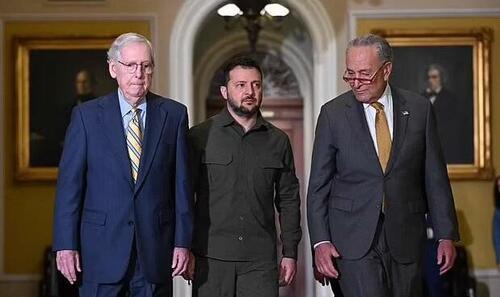
Zelensky’s frustrations spilled over in Washington on the following day where he met both with Biden and with some members of Congress and also dropped by the Pentagon and left flowers at the National 9/11 Pentagon Memorial in Arlington Virginia. His meeting at the White House with the president went relatively well with the announcement of a new aid package in the works including “significant air defense capabilities,” and, according to one report, even some of the much sought after ATACMS long range missile systems. Nevertheless, to his evident disappointment, Zelensky was not given a hero’s welcome like he received last year. He met privately with Kevin McCarthy, speaker of the House, and several other GOP hawks who will be instrumental in approving any aid, as well as with Senators Mitch McConnell and Chuck Schumer who promised to be “in his corner.” McCarthy boldly asked what Zelensky needed to win the war and to provide lawmakers with “a vision of a plan for victory.”
Nevertheless, it seems that many conservative Republicans and some progressive Democrats are fed up with the war and are concerned over the lack of accountability combined with the all too evident level of corruption within the Ukrainian government. There are moves by some in the GOP to separate Ukraine funding from other defense appropriations, requiring a separate vote, and other proposals by the White House to guarantee the money even if the government shuts down. One wonders if anyone had the grit to ask Zelensky how many mansions he owns in Israel, Europe and the United States, but that is precisely the sort of story that is being increasingly written about Ukraine’s comedian turned war hero, demonstrating that the public and even the media have become tired of the charade. A continuing multi-billion-dollar cash flow, seen by Joe Biden as necessary to keep the war going until the 2024 election to vindicate his policy, is still likely but it is no longer a slam-dunk.
Two other media accounts also suggest that the dissatisfaction with Zelensky and the war is breaking through the self-imposed acceptable narrative on the war, that Vladimir Putin is an aggressor without any real provocation from Kiev, a despot and the human monster. One came surprisingly from the New York Times and is apparently a leak from the White House or Pentagon on a September 6th missile attack on the Ukrainian village of Kostiantynivka which killed at least 18. The attack was quickly labeled by Zelensky as a war crime carried out by Russian “terrorists” which was echoed by the US media but an investigation, presumably carried by the US military and intelligence using satellite and other technical methods, has now determined that the missile was fired by Ukraine. This is similar to the missile attack that struck Poland in November 2022, which also was blamed by Zelensky on Russia but turned out to be from Ukraine, both incidents reflecting just how willing Zelensky is to lie and cheat to get a NATO and US intervention in a full-scale war with Russia, which could easily go nuclear.
The other story tells how Poland will not be providing any more arms to Ukraine, in part because it is now building up its own defenses and also over Ukrainian attempts to flood the Polish agricultural market with cheap low quality grain that it cannot sell elsewhere. To describe the Polish action as disappointing to Zelensky would be an understatement, but it is one more indication that many former allies are now seeing Ukraine as a lost cause and are looking to their own national security and economic interests. Both of these stories were, incidentally, published while Zelensky was in the United States hat in hand, and it must be considered that the timing was deliberate to damage the Ukrainian president’s credibility to coincide with the UN General Assembly visit and the trip to Washington.
Zelensky’s journey to North America ended in Ottawa, where he apparently recouped some of his swagger during a speech to the Canadian government and parliament which resulted in standing ovations. Or so it seemed. The Canadians produced a 98 year old Hungarian veteran of the Second World War named Yaroslav Hunka who had fought against the Russians and emigrated to Canada after the war ended. He too was cheered by the assembled Canadian politicians. The intention was clearly to present a narrative of a brave Ukrainian who fought valiantly to free his country from Russian domination but it didn’t quite work out that way. To fight the Russians required being in Nazi Germany’s armed forces and it turned out that Hunka had served in the 14th Waffen-SS Grenadier Division, also known as the Galicia Division, a volunteer unit made up mostly of ethnic Ukrainians commanded by German officers that has been rightly or wrongly credited with a number of wartime atrocities against Russians, Poles and Jews. Soldiers in the division swore a personal loyalty oath to Adolf Hitler. The bad judgement shown by the Canadian government in producing Hunka without fully investigating his story subsequently produced a huge uproar in Canada, with the head of parliament resigning, Prime Minister Justin Trudeau in deep political trouble and the Polish government demanding that Hunka be extradited to them for a war crimes trial. There has been some suspicion that Zelensky may have been instrumental in arranging the affair in expectation that it would strengthen Canadian support for his cause. Instead, it has accomplished the reverse and Zelensky returned home with little or nothing accomplished.
Zelensky must also confront back home a war that he is decisively losing and a country in ruins. And Joe Biden made clear in his speech addressing the UN General Assembly that negotiations with Russia to end the Ukraine fighting would not be considered. Joe included a pledge to support the conflict until it is Russia that is doing the surrendering: “The United States, together with our allies and partners around the world, will continue to stand with the brave people of Ukraine as they defend their sovereignty and territorial integrity and their freedom… Russia alone bears responsibility for [the war]. Russia alone has the power to end this war immediately. And it is Russia alone that stands in the way of peace, because Russia’s price for peace is Ukraine’s capitulation, Ukraine’s territory, and Ukraine’s children.” In short, the speech was a lot like Joe Biden and the band of scoundrels and grifters that he has gathered around him in the White House, heavy on bellicosity but short on any serious planning or strategies to make the world and this country a better place. Joe would like to see the war continue to bring its eventual end a lot closer to the US elections, where he hopes to self-identify as a strong leader and a “winner” taking on America’s enemies. Good luck Joe.
Philip M. Giraldi, Ph.D., is Executive Director of the Council for the National Interest, a 501(c)3 tax deductible educational foundation (Federal ID Number #52-1739023) that seeks a more interests-based U.S. foreign policy in the Middle East. Website is councilforthenationalinterest.org, address is P.O. Box 2157, Purcellville VA 20134 and its email is inform@cnionline.org.
Online Censorship: Canada Continues Crackdown
Most media services must now “register for regulation”
By Kit Knightly | OffGuardian | October 2, 2023
On Friday the Canadian Radio-television and Telecommunications Commission published new guidelines requiring media outlets to register with the service so their content can be “regulated”.
Under the new regulations all streaming services, social media companies and platforms that host podcasts would be [emphasis added]:
required to provide the CRTC with information related to their content and subscribership
This is the culmination of a “public consultation” launched back in May. For those unfamiliar with “public consultation”, it is a process by which government agencies use members of the public to tell them what they want to hear.
CRTC’s press release couches the move in faux-liberal talking points, referring to it as “modernising Canada’s broadcasting framework” and “ensuring online streaming services make meaningful contributions to Canadian and Indigenous content”, but that is clearly camouflage for an obvious power-grab.
It’s noteworthy that podcasting services are made a specific focus.
After all, these days anyone with a microphone and internet connection can start broadcasting whatever they want to whoever they want, with little to no “regulation” of their content. That’s a no-no for a burgeoning global dictatorship fixated on the world’s subjugation through the control of information.
Don’t be surprised if the Canadian government starts “reviewing content” from podcast services and saying things like…
“Podcast X is broadcasting hate speech/propaganda/misinformation about subject Y, you cannot stream any podcasts in Canada until X is removed from your service.”
That’s supposition, but hardly a stretch given the huge surge in censorship of all kinds from governments all around the world since the “pandemic”.
In fact, you can almost see this as a direct response to some of the propaganda failures of the mainstream media during the “pandemic”.
The alternative media was able to win a lot of battles during the Covid roll-out, and a push to “regulate” podcasts is a quasi-admission of this. As are the words of CRTC Chair Vicky Eatrides:
We are developing a modern broadcasting framework that can adapt to changing circumstances.
“Adapting to changing circumstances”… deliciously vague, but also fairly clear. They don’t have the power they need to regulate the growing voice of non-mainstream sources given rise by the internet.
The three measures announced on Friday are unlikely to be the last, the end goal is a fully “modernized” Broadcasting Act to be passed in late 2024.
What will that include? Who knows.
But considering the Canadian government has already blocked all news-sharing on social media, unpersoned and unbanked peaceful protesters, enforced “vaccines” and given a standing ovation to a literal member of the SS, you’d be forgiven for fearing the worst.
NATO’s 77th Brigade’s Set Their Legal Attack Dogs on Russell Brand
By Declan Hayes | Strategic Culture Foundation | September 29, 2023
Not content with conspiring with the British Parliament in throttling Russell Brand’s voice, NATO has set the entire British legal establishment against him.
Victoria Prentis KC, Britain’s attorney general, has warned the nation’s editors that any pertinent coverage about either Russell Brand or any criminal case that may be taken against him “may amount to contempt”, even though no arrests have yet taken place or cautions to Brand issued and no warrants have yet been issued against him. Legally, even in NATO’s corrupt British heartland, Brand should be free as a bird to go about his business, as should we be to make reasonable comments about him.
That is not now the case. Having been traduced at the behest of the 77th Brigade by the British media, Prentis has now decreed that any salient comments on Brand’s as yet non-existing case is in contempt of court, despite the fact that Brand has not yet got his day in court and no jury of his peers has yet been appointed to adjudicate on the case which, to repeat, as of yet does not exist.
Although the British Contempt of Court Act 1981 makes it illegal for newspapers to publish anything that could prejudice a criminal trial once a suspect has been arrested or a warrant issued, because this is Perfidious Albion we are talking about, laws exist to shut everyone up with or without either a bullet or a judge’s gavel.
As those rarely used laws are now being deployed against Brand, one must wonder why Brand is being singled out for this treatment and why, for example, political prisoner Julian Assange, currently being interned in Belmarsh high security prison, has been spared this further cudgel.
Writing in, of all places, the lifestyle section of Ireland’s regional Cork Examiner newspaper, reformed alcoholic Suzanne Harrington puts NATO’s case as well as any other randomly hired NATO scribe could. Suzanne begins by telling us that she feels “a crushing sense of weariness. Exhaustion, disgust. Fury, obviously, but smothered in a heavy blanket of disillusionment” and asks if we feel the same way about how Brand has betrayed us all.
Suzanne was one of those who went to hear Brand “speak in 12 step meetings.” But now, there is Brand’s “slide to the right. The alt-right. The yoga-Nazi alliance, heightened during lockdown when the entire world went a bit mad. What on earth? Conspiracy theories, rants, dubious company. It felt like he’d started smoking crack again — loony right wing crack, in the company of loony right wing crackheads. Globalist masterplans, great resets, Bill Gates, ivermectin — why? For the clicks? For the millions of followers? Because that’s how you make money away from the mainstream media. You dog-whistle the loonies.”
Although non-loony Suzanne opines there may be an off chance Brand is innocent (of what precisely?), she goes on to say “you only have to look at those who have come out in Brand’s support to see where he has positioned himself politically. He’s way over there, at the extreme toxic end, supported by the shrill voices of Elon Musk, Jordan Peterson, Tucker Carlson, and — oh the shame — Donald Trump Jr. Lower down the rung, voices of hate speechers like Alex Jones, Katie Hopkins, and Tommy Robinson. Sad gits like Laurence Fox. And Piers Morgan, obviously. Imagine having that lot standing up for you.”
One of the reasons such “voices of hate speechers” may be amplified in arrays of obscure corners is because the lifestyle columns of the Cork Examiner and the Irish Independent, Irish Times and the Guardian where this “journalist, TEFL teacher, dole claimer, backpacker, youth worker, painter, wardrobe assistant, washer-upper, pen pusher, house cleaner, comic bagger, market stall holder and cake maker” also opines bring no light to this or any other matter.
And that is not primarily the fault of “mainstream media” grifters like Suzanne but of newspaper proprietors like Rupert Murdoch, who have been destroying the quality of the broadsheets ever since the Sunday Times Insight Team was first eviscerated almost 50 years ago.
But what would I know as I am only a potato eating Irish peasant, who aced Australian legal exams experienced Australian lawyers failed. Not much but I do know this. There are times, as in the notorious Stephen Lawrence murder case or the gangland killing of Irish journalist Veronica Guerin when the media sailed as close to the libel law winds as is possible. And let’s not forget ageing mega pop star Cliff Richard, who was witch hunted by the 77th Brigade’s BBC in a manner that would have appalled even the lynch mobs of America’s Wild West.
And nor should we forget the Bloody Sunday Widgery Tribunal, the Ballymurphy massacre, King Rat, Robin the Jackal Johnson, the Glenanne Gang, the Pat Finucane murder, Stakeknife, the sabotaged Stalker Enquiry, the ongoing 1981 Stardust Inquest and countless more where the entire British and Irish judiciary should be in the dock if not on the gallows.
And then there is this nonsense of a jury of one’s peers, which the great Zsa Zsa Gabor once famously ridiculed. Although NATO’s Parliamentarians are generally exempted from jury service, most of them would be debarred anyway. As over 40% of serving British MPs have criminal convictions and as not one of them has been demonetised as Brand has, one must conclude that the 77th Brigade has one law for those who slavishly collaborate with it and another for the Russell Brands of this world.
And how could we get a jury of our peers from the Nazi worshipping Parliament of Canada, whose dictator, Justin Blackface Trudeau, lies that the standing ovation the Canadian Parliament gave a decorated Waffen SS war criminal is a result of the old reliable Russian disinformation canard. Just what kind of high heel wearing moron is Trudeau?
And what about the moronic Ya’ara Saks, Canada’s clearly unhinged “Jewish” Minister for Mental Health, who tried to distance herself from her collusion in welcoming the Waffen SS to the Canadian Parliament on the eve of the Jewish Yom Kippur holiday before finishing her grovelling non-apology with the Nazi Azov Slava Ukraini salutation. This, incidentally, is the same “Jewish” moron who contended that Canadian Freedom Convoy truckers honking their horns were doing so in secret tribute to Hitler, whose Waffen SS volunteers she gladly venerated.
There is, in intellectual terms, no difference between those Nazi worshipping Canadian Parliamentarians and the hundreds of Germans who gather at Berlin train stations and howl up to the moon for their right to live their lives as “Canine Beings”, as dogs and bitches in plain English.
Plain English, however, cuts no ice in the British courts where one must hire a word wizard, who is totally familiar with its rabbit warren array of quirks, which exist to perpetuate the King’s arbitrary, ad hoc writs. Here is one such barrister expertly talking us through common law contempt as it applies to the Brand (non-) case and cautioning those, like Britain’s newspaper editors who believe they have a dog in this fight or in any other such circumstance as the King’s 77th Brigade may decree is verboten.
The situation with regard to Brand is that the 77th Brigade, working primarily through Caroline Dinenage, has prejudiced Brand’s defence (against what precisely?) and has warned hosting companies like Rumble that, thanks to the Online Safety Bill and the (BBC-Approved) Trusted News Initiative, they are next for NATO’s abattoir.
Although NATO’s British media would claim that they used American journalist Heather Brooke to break their Parliamentary expenses scandal scoop, critics have opined that that was just a ploy to remove some troublesome Parliamentary pebbles from the jackboots of the 77th Brigade and their MI6 body in a bag colleagues. As Brooke disparages political prisoner (and truth-teller?) Julian Assange “a supposed campaigner for truth, manipulated information to build up a cult of personality around himself – and also to see how many people fell for it”, she would, a priori, seem a low level CIA cretin best avoided, lest she morally corrupts us.
But who is to judge her or Pfizer’s track record in Africa? Not us, if the 77th Brigade and their MI6 and CIA colleagues have their way. If you or anyone you know has an opinion on Russell Brand and if your opinion diverges from that the 77th Brigade enforces, you and any site like Rumble that might give you a platform best watch out as Trudeau and his high heeled Nazi worshipping collaborators are clumsily goose stepping their way to morally corrupt and physically destroy you, wherever you may be.
Featured Video

Racist Seinfeld Dances for Joy as Bibi Unveils His New Map
or go to
Aletho News Archives – Video-Images
TV Drama Review
Japanese drama projects Japan’s wartime atrocities onto Chinese characters

Global Times | October 25, 2026
By portraying Chinese characters as perpetrators of ruthless violence while casting Japanese Self-Defense Forces (SDF) intelligence operatives as defenders, the season 2 of the Japanese drama Vivant has recently drawn criticism from Chinese netizens, who argue that its depiction turns historical reality on its head while ignoring Japan’s wartime atrocities.
The TBS drama series – a spy suspense story in which an alleged unofficial intelligence unit of the SDF operates across the globe — has attracted a passionate fanbase. Its currently airing season 2 opened with a household rating of 18.8 percent, the highest for a TV drama this year, according toa commentary article by Japanese media Toyo Keizai.
What draws attention is the portrayal of the enemies in the series, the article noted. Scenes in which the Chinese organization subjects kidnapped members of the SDF unit to brutal torture are repeated with unrelenting intensity.
It is rare for Japanese TV dramas to explicitly portray a real-life country as the enemy, the article noted.
Japanese Prime Minister Sanae Takaichi also made a reference to the drama, saying that she has been recording Vivant and hopes to binge-watch it over the year-end and New Year holidays, according to Japanese media outlets.
China’s CCTV News report on Sunday revealed that the drama features scenes in which Chinese personnel cut off the fingers of and stab Japanese intelligence operatives in the abdomen. Such acts bear striking similarities to the torture inflicted on Chinese nationals by invading Japanese troops during the World War II.
The drama distorts the truth by attributing these atrocities to modern Chinese characters. Beneath the surface, it subtly glorifies Japan’s cross-border overseas operations, blurs the functional boundaries of the SDF and implicitly promotes an expansionist narrative, per CCTV News. … continue
Blog Roll
 Aletho News
- Up in arms… Koreans reject U.S. empire’s plan to make South Korea the next Ukraine
- Iran, Turkey, Pakistan, Saudi Arabia could advance region-led security framework in Tehran: FM spox
- Netizens condemn Japanese drama for projecting Japan’s wartime atrocities onto Chinese characters
- Racist Seinfeld Dances for Joy as Bibi Unveils His New Map
- A West Bank War for Netanyahu’s Election Campaign, Could It Backfire?
- Yemen denounces European Parliament’s ‘hypocritical’ push to blacklist Ansarullah
- Qalibaf: UAE’s UN bid aims to ‘clear the runway’ for ‘Greater Israel’, whitewash genocide
- Pakistan reopens Iran border after boosting security: Report
- Why are so many Brazilians voting for Flávio Bolsonaro?
- Democrats Put Anti-Russia Agenda Ahead of American Workers
- If Americans Knew
- An error has occurred; the feed is probably down. Try again later.
- No Tricks Zone
- Sudden Stratospheric Warming, Powerful El Niño Combination May Lead To Extreme Europe Cold, Energy Crisis!
- Two New Studies Find Thwaites Glacier Melt Cannot Be Driven By Human Activity Or A Warming Ocean
- E-Cars Reduce CO2 Emissions By Only 41% Compared To Internal Combustion Engine Vehicles
- Predictions Made By Renowned Climate Professor Over Past Decades Have Been Proven To Be Poor
- New Study Suggests Large Regions Of The Pacific Ocean Have Been Cooling For The Last 80 Years
- Germany’s Green Energy Debacle: High Energy Costs Force Kahla Porzellan to Close After 182 Years!
- New Study: 50 Years Of The Most Aggressive ‘Net Zero’ Policies Can Only Affect The Global Climate By 0.03°C
- US September “Heat” Was No Record…Many Records Set Decades Ago
- Latest European Green Energy Debacle; Portugal’s Largest Flagship Solar Park Insolvent!
- Green Energy Debacle: German Expert Professor Fritz Vahrenholt Warns Of Severe Economic And Social Consequences

