Canadian Hikers Get the COVID-Style Tyranny Treatment
By Jim Bovard | The Libertarian Institute | September 1, 2025
Canadian politicians are creating one bonfire after another of freedom and individual rights. COVID crackdowns established persecution precedents that politicians in some provinces refuse to allow to gather dust. Politicians are claiming the right to financially cripple anyone who makes a single misstep in violation of the latest idiotic decrees.
On August 5, Nova Scotia Premier Tim Houston decreed a $25,000 fine for anyone walking in the woods or otherwise violating a new prohibition that covered both government and private lands. The prohibition will continue until October. Houston declared, “Most wildfires are caused by human activity, so to reduce the risk, we’re keeping people out of the woods until conditions improve. I’m asking everyone to do the right thing—don’t light that campfire, stay out of the woods and protect our people and communities.”
Canadian politicians are exploiting wildfires the same way that former Prime Minister Justin Trudeau exploited COVID to lockdown the entire nation. One critic on X/Twitter scoffed that “the province needs 10 weeks of no walking in the woods to flatten the curve”—paralleling the “two weeks to flatten the curve” crapola that initially sanctified the most onerous COVID restrictions. During the pandemic, Nova Scotia heavily fined citizens caught walking their dogs or exercising in park.
The government failed to document how the environmental peril situation this year was fundamentally different than in previous years. Author Peter Clark observed, “Fears of arson or climate hysteria appear to be behind bans on fishing & hiking in Nova Scotia’s forests. Canada’s forest fires have fallen almost half in the last 40 years & seem unrelated to weather or climate.” At the same time that Nova Scotian politicians are treating every resident and visitor like an arsonist, Canadian governments have let actual arsonists go free with legal wrist slaps.
Canadians are denouncing the new decree as “climate confinement”—an ominous development in a nation whose politicians have long swooned over the World Economic Forum. According to Travel and Tour News, “Even though the COVID-19 pandemic has officially ended, the consequences of restrictive policies are still being felt. With domestic travel restrictions now in place due to wildfire risks, many Canadians feel that their freedom to explore their country has been drastically reduced.”
“They’ve turned the great outdoors into the Forbidden Forest,” scoffed one critic. A photography website warned: “Photographing in the Woods in Nova Scotia Is Currently Illegal.” The government decrees provoked a firestorm of opposition:
“How does hiking in the woods with my dogs come across as a fire hazard?”
“Please tell me the difference between a trail and an unpaved road.”
“I’m confused. We’re banned from the woods? Half of us live in the woods.”
Nova Scotia established a snitch line so people could report neighbors or hooligans who strolled in the woods, and it quickly received thousands/tens of thousands of complaints.
Many opponents of the anti-hiking decree would support a government ban on campfires or other fires in areas at risk of wildfires. But defenders of the ban have gone stir crazy (maybe they have been inside too long?). They have claimed that “hikers could cause fires by dropping water bottles that might, in a remote theoretical scenario, focus sunlight like a magnifying glass.” Also, hiking in the woods might cause an asteroid to hit the earth, so better safe than sorry.
Canadian political mania has gone even further than in the progressive states south of the U.S.-Canadian border. Christine Van Geyn of the Canadian Constitution Foundation warns that “governments and institutions have embraced what’s been called safetyism: the belief that safety, especially from physical or emotional harm, should override all other values, including freedom, autonomy and open debate. When safety becomes the highest good, risk becomes intolerable, state control is normalized ‘for your own good,’ and dissent is cast as dangerous.”
But according to some Canadian political scorecards, the risk of wildfires apparently nullifies the risk of tyranny. And since there will always be a risk of wildfires, tyranny will be a small price to pay for any purported risks politicians choose to suppress.
The pre-emptive repression of hikers and dog walkers is symptomatic of regimes that feel entitled to unlimited power. The same mindset is driving Canada’s persecution of the leaders of the COVID lockdown protests. According to Canada’s top prosecutors, the only thing worse than tyranny is “mischief.” And the worst possible “mischief” is objecting to tyranny.
The Canadian government is seeking an eight year prison sentence for one of the leaders of the COVID “Freedom Convoy” protest that riled Ottawa in early 2022. In April, a court ruled that Tamara Lich and Chris Barber were not guilty of obstructing police or intimidation during the demonstrations. But they were convicted of “mischief” — in part because the truckers in the forty mile convoy honked their horns to protest some of the most oppressive COVID mandates in the world.
After Trudeau dictated that all truck drivers who cross the U.S. border must get COVID vaccines, a protest quickly snowballed and landed in Canada’s capital. Trudeau responded by invoking the Emergencies Act, effectively dropping a legal nuclear bomb on his opponents. Canada’s Deputy Prime Minister Chrystia Freeland announced that the government was “broadening the scope of Canada’s… terrorist-financing rules so that they cover Crowd Funding Platforms and the payment service providers they use.” The Trudeau government did not formally redefine horn honking as a terrorist offense but that didn’t impede their crackdown. Banks were authorized to freeze the personal accounts of anyone suspected of donating to the truckers. No court order was necessary to strip suspected COVID dissidents of their property. The government conscripted towing companies to cart away the trucks of the protestors.
Actually, the COVID vaccines were catastrophically failing to prevent infections at the same time Trudeau dropped an iron fist on anti-vax protestors. Almost 90% of Canadian adults had been vaccinated by the start of 2022 but COVID cases were soaring, setting records almost every week. Even though he was vaxxed and boosted, Trudeau himself came down with COVID during the trucker protest.
In January 2024, a Canadian federal judge ruled that Trudeau’s use of the Emergencies Act had been unreasonable, illegal, and unconstitutional. Trudeau’s regulations “criminalized the attendance of every single person at those protests regardless of their actions.” The judge slammed “the absence of any objective standard” for freezing bank accounts. There was no “threat to the security of Canada” – regardless of Trudeau’s panic about so many Canadians scoffing at his decrees and his majesty. But the court decision provided no relief for any of the victims whose bank accounts were unjustifiably seized or whose freedom and privacy was shredded.
Unless it is overturned, the Nova Scotia ban on hiking, photographing, and dog walking will set a precedent that will ravage far more Canadian freedom. Such policies will create toxic legal precedents that could prove far more disruptive in this nation than the occasional smoke from Canadian wildfires.
The Illusion of Israeli Self Sufficiency in Intelligence
By José Niño | The Libertarian Institute | August 26, 2025
Casual onlookers salivate at the supposed brilliance of Israel’s intelligence services. From Mossad’s assassinations abroad to daring sabotage campaigns in hostile territory, the Jewish state has been elevated in popular imagination as a scrappy David with unmatched cunning, capable of pulling off operations that leave even world powers like the United States in awe. Books, films, and mainstream pundits reinforce this myth, presenting Israel’s intelligence machine as self-sufficient and independent.
But when one peels back the layers, the narrative quickly unravels. Israel’s most celebrated operations—from targeted killings in Europe to sabotage inside Iran—were rarely the product of Israeli ingenuity alone. They relied on cooperation with the CIA, NSA cyberwarfare expertise, European intelligence networks, and even covert collaboration with Arab regimes that publicly denounce Israel while privately working with it. Much like its dependence on U.S. military aid and diplomatic cover, Israel’s intelligence empire survives not through independence but through reliance on Western logistics, intelligence sharing, and political approval. What is sold as the story of a bootstrapping nation is a case study in multinational complicity.
According to investigative reporting by Israeli journalists Melman and Ronen Bergman, Israel’s intelligence community relied heavily on intelligence partnerships with Western and allied nations to conduct clandestine activities in foreign territories.
The foundation of this intelligence cooperation traces back to the aftermath of the 1972 Munich Olympics massacre. According to Dr. Aviva Guttmann’s research, which Melman has covered extensively, the Berne Club—a secret European intelligence alliance founded in 1969—provided crucial support for Israel’s subsequent assassination campaign against Palestinian operatives. This multinational intelligence network initially included Switzerland, West Germany, France, the United Kingdom, Italy, Luxembourg, Austria, the Netherlands, and Belgium, and later expanded to include the United States, Canada, Australia, and other nations. Through an encrypted communication system called “Kilowatt,” thousands of cables were exchanged among eighteen Western intelligence services after the system was established in 1971. The network functioned as a secret clearinghouse for raw intelligence. Shared reports contained the locations of safe houses, vehicle registrations, the movements of high-value targets, updates on Palestinian guerrilla tactics, and analytical assessments, all of which provided Israel with crucial operational support for its clandestine operations.
Direct American involvement in Israeli operations became particularly evident during the George W. Bush administration. The February 2008 assassination of Hezbollah commander Imad Mughniyeh in Damascus was reportedly approved by President Bush himself after being briefed by then-CIA Director Michael Hayden. This was not merely intelligence sharing but active operational participation. “The Mossad agent would ID Mughniyeh, and the CIA man would press the remote control,” a Newsweek report noted. The CIA designed and built the bomb that killed Mughniyeh, tested it at a secret facility in North Carolina, and smuggled it into Syria through Jordan, while Mossad provided intelligence and logistical support.
When it came to confronting Iran’s nuclear program, the United States and Israel collaborated on the creation of the Stuxnet computer virus in a joint operation codenamed “Olympic Games.” The malware was designed to sabotage centrifuges at Iran’s Natanz uranium enrichment facility. According to Ronen Bergman, the virus was developed with input from Israeli cybersecurity experts alongside the U.S. National Security Agency. This operation represented a quadrilateral effort involving the CIA, NSA, Mossad, and Israel’s military intelligence agency, AMAN. It was conceived during the administrations of W. Bush and Israeli Prime Minister Ehud Olmert and ultimately executed in 2010 under President Barack Obama and Prime Minister Benjamin Netanyahu.
The scope of American involvement extended to Israel’s broader targeted killing policies. Ronen Bergman revealed that during Ariel Sharon’s tenure, a secret deal was struck with then-U.S. National Security Advisor Condoleezza Rice that committed Israel to “significantly reduce the construction of new settlements in exchange for American backing of the war with the Palestinians and of Israel’s targeted killing policy” of high-value Palestinian figures.
American intelligence cooperation facilitated Israel’s campaign against Iran’s nuclear program, with Melman documenting extensive Western knowledge of and potential involvement in the assassination of Iranian nuclear scientists between 2007-2012. The Obama administration was aware of the assassination campaign carried out by the Mujahideen-e-Khalq (MEK) terrorist organization, which was being financed, armed, and trained by Mossad. Joint Special Operations Command (JSOC) reportedly trained MEK members starting in 2005, and U.S. intelligence was providing crucial information for these operations. As one former senior intelligence official told investigative journalist Seymour Hersh, “the United States is now providing the intelligence” for assassinations carried out “primarily by MEK through liaison with the Israelis.”
Israeli dependency on foreign support went beyond Western allies to include collaborationist elements in the Arab world. Bergman revealed extensive details about Mossad’s regional cooperation during Meir Dagan’s tenure (2002-2010) as director of the Mossad, including secret partnerships with Arab intelligence services that publicly condemned Israel while privately cooperating with it. These arrangements involved joint operations with countries that “share more or less the same set of interests” despite public hostility, coordination in counter-terrorism operations across the Middle East, and partnerships that enabled many operations attributed solely to Mossad.
The pattern of foreign dependence continues in contemporary operations. An August 2025 ProPublica report by Yossi Melman and fellow journalist Dan Raviv showcased Israel’s enlistment of Iranian dissidents for executing missions inside Iran during “Operation Rising Lion.” They specifically outlined Mossad’s strategic shift from using Israeli personnel to cultivating a “foreign legion” of Iranian and regional operatives to carry out activities ranging from support functions to covert action.
This pattern of intelligence reporting by Melman and Bergman reveals that Israel’s reputation for independent intelligence capabilities obscures a reality of extensive foreign dependence, particularly on Western intelligence services, for conducting operations that extend Israeli influence and security interests globally.
Far from being a model of independence, Israel’s intelligence record underscores how deeply its operations are embedded in Western power structures. The myths of self-sufficiency and unmatched brilliance collapse under the weight of evidence: Mossad’s reach is extended only because Washington, European capitals, and even regional neighbors provide the pipelines of intelligence, technology, and manpower that make its operations possible.
The true scandal lies not in Israel’s dependency but in the willingness of other nations to abet its destabilizing campaigns by supplying the bombs, intelligence streams, and diplomatic cover that allow Tel Aviv to operate with impunity. To strip away the mythology is to confront the uncomfortable truth that Israel’s “miraculous” intelligence victories are collective endeavors, outsourced across continents, exposing not a triumph of independence but a parasitic reliance on collaborators who enable its shadow wars.
BC Nurse Fined and Suspended Over Gender Policy Criticism

By Cindy Harper | Reclaim The Net | August 20, 2025
A British Columbia nurse has been hit with a one-month license suspension and ordered to pay over $93,000 in legal fees for publicly supporting women’s access to female-only spaces, a stance that the province’s nursing regulator deemed unprofessional.
Amy Hamm, who has spent more than 13 years working in healthcare and had risen to the position of nurse educator, was disciplined by the British Columbia College of Nurses and Midwives (BCCNM) after a years-long process sparked by her political expression outside of work.
The controversy dates back to 2020, when Hamm co-sponsored a Vancouver billboard that read, “I ♥ JK Rowling.”
The message, referencing the author’s defense of sex-based rights, triggered backlash from activists and a city councillor. The ad was removed, and formal complaints were submitted to the College, accusing Hamm of hate speech and transphobia.
In response, the College launched an exhaustive investigation into Hamm’s public activity over several years, compiling a 332-page report that examined her tweets, writing, and podcast appearances from 2018 to 2021.
After 22 hearing days stretched across 18 months, the disciplinary panel concluded that four of Hamm’s statements crossed the line into professional misconduct.
The panel claimed that Hamm made comments about transgender individuals that they deemed discriminatory. Hamm has not accepted this finding and is already appealing it at the Supreme Court of British Columbia.
Her legal counsel, Lisa Bildy, said, “In our view, the panel made a number of legal and factual errors that make the decision unsound, and we look forward to arguing these points before the BC Supreme Court. We are now considering whether to appeal the penalty decision as well.”
Bildy also raised broader concerns about the implications for free speech: “This decision effectively penalizes a nurse for expressing mainstream views aligned with science and common sense. The Panel’s ruling imposes a chilling effect on free expression for all regulated professionals.”
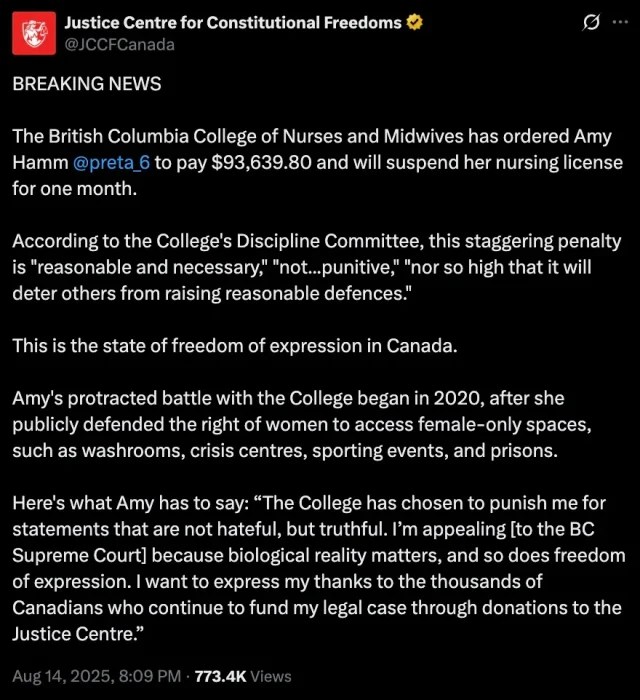
Hamm remains defiant. “The College has chosen to punish me for statements that are not hateful, but truthful. I’m appealing because biological reality matters, and so does freedom of expression. I want to express my thanks to the thousands of Canadians who continue to fund my legal case through donations to the Justice Centre,” she said.
The Justice Centre for Constitutional Freedoms, which is representing Hamm, announced the penalty and reiterated its commitment to pushing back against professional censorship.
NO WOODS, NO MEAT, NO FREEDOM
The HighWire with Del Bigtree | August 14, 2025
Unusually dry summer conditions on Canada’s Atlantic coast have prompted two provinces to take the unprecedented step of banning hiking, camping, and even walking in the woods in a bid to prevent forest fires. Learn about other alarming measures being floated in the name of climate change—from ticks that can trigger a meat allergy to proposals for calculating the carbon footprint of every medical procedure to determine its “importance.”
‘America First’ clashes with ‘Israel First’ as Trump threatens Canada over Palestine recognition
MEMO | August 1, 2025
Donald Trump has provoked outrage among parts of his own political base after threatening to block a trade deal with Canada in retaliation for Ottawa’s decision to formally recognise the State of Palestine. The US president posted on Truth Social: “Canada has just announced that it is backing statehood for Palestine. That will make it very hard for us to make a Trade Deal with them. Oh’ Canada!!!”
Trump’s statement was widely interpreted as prioritising Israeli interests over domestic economic concerns, prompting fierce backlash from some right-wing influencers. Prominent conservative commentator Matt Walsh posted on X: “This is ridiculous. If a trade deal with Canada is beneficial to the American people then it should go forward regardless of Canada’s stance on Palestine. The benefit of the American people should be the guiding principle here.”
Walsh’s post drew thousands of responses, many supportive, but others accused him of failing to grasp America’s “special alliance” with Israel. However, critics have pointed out that it is Canada, not Israel, that is bound to the US through comprehensive economic and military treaties.
Along with the UK and France, Canada is one of Washington’s oldest and closest allies. By contrast, US-Israel ties, while historically deep, are often framed as ideologically and politically driven, bolstered by domestic lobbying pressure rather than national interest.
Observers say the incident highlights a deepening divide in US politics: on one side, a growing segment of voters who either support Palestinian rights or advocate for an “America First” foreign policy that avoids foreign entanglements; on the other, a political elite that consistently prioritises Israeli interests, often regardless of public opinion or national cost.
Despite mounting evidence of Israeli war crimes in Gaza and a global shift toward recognising Palestinian statehood, including by key Western allies, US lawmakers remain overwhelmingly aligned with Israel.
This split is becoming more pronounced as influential voices on the right, once assumed to be pro-Israel by default, now openly question the costs of that allegiance.
Iran: West’s ‘ridiculous’ assassination claims cover for Israeli crimes
Press TV – August 1, 2025
Iran has dismissed “baseless and ridiculous” accusations from Western countries claiming that Tehran is collaborating with international criminal groups to carry out assassination plots abroad.
Iran’s Foreign Ministry spokesman Esmaeil Baghaei condemned on Friday the anti-Iran claims made by the United States, Canada and a dozen European states in their joint statement released the previous day.
He said the “blatant blame game” is an attempt to divert public attention from the most pressing issue of the day, which is the Israeli genocide in the occupied Palestine.
“The United States, France, and other signatories to the anti-Iran statement must themselves be held accountable for actions that violate international law, as they support and host terrorist and violent elements and groups,” he added.
Baghaei touched on the unprovoked US-Israeli aggression against Iran in June and Israel’s ongoing genocide in the Gaza Strip against the backdrop of active support or approving silence of the 14 Western countries that signed the statement against the Islamic Republic.
He further denounced the accusations as “blatant lies and an escape forward, designed as part of a malicious Iranophobia campaign aimed at exerting pressure on the great Iranian nation.”
The 14 states must be held accountable for their “disgraceful and irresponsible” behavior that violates the principles of international law and the United Nations Charter, the spokesman noted.
Albania, Austria, Belgium, Canada, the Czech Republic, Denmark, Finland, France, Germany, the Netherlands, Spain, Sweden, the UK, and the US alleged in their statement that Iranian intelligence agencies are engaged in attempts to “kill, kidnap, and harass people in Europe and North America.”
Canada continues arms transfers to Israel despite official denials: Report
Press TV – July 30, 2025
Canada has continued to supply weapons to the Israeli regime during its genocide in Gaza, contradicting official claims that such exports had stopped, a new investigation reveals.
Published by Arms Embargo Now Campaign (AEN) on Tuesday, newly uncovered shipping records and Israeli regime data show 47 documented shipments of military components from Canadian manufacturers to Israeli weapons firms between October 2023 and July 2025.
This includes over 421,000 bullets, with one shipment of 175,000 in April 2025.
Three cartridge shipments from a Quebec-based General Dynamics facility were also sent just nine days after Canada pledged to block munitions exports. These exports primarily supplied Elbit Systems, Israel’s largest arms manufacturer.
This comes as former Foreign Minister Melanie Joly and Prime Minister Justin Trudeau, as well as current Prime Minister Mark Carney, have repeatedly insisted that Canada has restricted arms exports to Israel, this report uncovers.
In March 2024, Canada’s parliament passed a non-binding motion urging the government to suspend further arms sales to Israel.
As pressure continued to mount, in September of last year, Joly announced that the government had not approved any new export permits for Israel since January 8, 2024.
This report, however, unveils the hidden reality behind Canada’s public statements on arms exports to Israel, revealing a systematic deception that has enabled the flow of Canadian-made weapons directly into one of the deadliest military aggressions in modern history.
Canada is currently breaching its own domestic legislation and international legal obligations by continuing to supply arms to Israel amid the ongoing ethnic cleansing and widespread starvation of Palestinians in Gaza.
Several Western countries have continued to supply lethal weapons to the Israeli regime despite the enormous human toll caused by its genocide in the Palestinian territory.
At least 60,034 Palestinians have been killed, mostly women and children, and another 148,870 individuals injured in the brutal Israeli onslaught on Gaza since October 7, 2023.
Court Orders Bank Freezing Records in Freedom Convoy Case
By Cindy Harper | Reclaim The Net | July 9, 2025
A Canadian court has ordered the release of documents that could shed light on how federal authorities and law enforcement worked together to freeze the bank accounts of a protester involved in the Freedom Convoy.
Both the RCMP and TD Bank are now required to provide records related to Evan Blackman, who took part in the 2022 demonstrations and had his accounts frozen despite not being convicted of any crime at the time.
The Justice Centre for Constitutional Freedoms (JCCF) announced the Ontario Court of Justice ruling. The organization is representing Blackman, whose legal team argues that the actions taken against him amounted to a serious abuse of power.
“The freezing of Mr. Blackman’s bank accounts was an extreme overreach on the part of the police and the federal government,” said his lawyer, Chris Fleury. “These records will hopefully reveal exactly how and why Mr. Blackman’s accounts [were] frozen.”
Blackman was arrested during the mass protests in Ottawa, which drew thousands of Canadians opposed to vaccine mandates and other pandemic-era restrictions.
Although he faced charges of mischief and obstructing police, those charges were dismissed in October due to a lack of evidence. Despite this, prosecutors have appealed, and a trial is set to begin on August 14.
At the height of the protests, TD Bank froze three of Blackman’s accounts following government orders issued under the Emergencies Act. Then-Prime Minister Justin Trudeau had invoked the act to grant his government broad powers to disrupt the protest movement, including the unprecedented use of financial institutions to penalize individuals for their support or participation.
In 2024, a Federal Court Justice ruled that Trudeau’s decision to invoke the act had not been justified.
Blackman’s legal team plans to use the newly released records to demonstrate the extent of government intrusion into personal freedoms. According to the JCCF, this case may be the first in Canada where a criminal trial includes a Charter challenge over the freezing of personal bank accounts under emergency legislation.
“Why Can’t We Talk About This?”
Rainey Media TV | June 4, 2025
Please Support Our Film via: E-Transfer: dean_rainey@yahoo.ca
PAYPAL: deanrainey@raineymedia.com
Buy My A Coffee: https://buymeacoffee.com/raineymedia
SNAIL MAIL: Rainey Media, PO Box 5, Delhi PO Main, ON, N4B 2W8 Canada
To book your own screening: deanrainey@raineymedia.com
“Why Can’t We Talk About This?” delves into the life of a man grappling with the aftermath of a COVID-19 vaccine injury, weaving his personal struggle into a broader examination of why such experiences are rarely discussed.
To help Michael via support: https://www.gofundme.com/f/benefit-fo…
We’ve made this film easily accessible for everyone because the information it contains and the discussion it starts is just too important. This film had no funding and was made without sponsorship. All costs were paid out of my own pocket. My team and I spent over a year and a half making this film. Any support you give will go towards expenses incurred making and marketing the movie. (Even sending the price of a movie ticket would help.) Once we cover those costs, we will be providing Michael with a share of the proceeds.
To order DVDs of this film, visit: https://raineymedia.com/video-store/
Also available on Rumble.
Germany announces deployment of warships to Arctic
RT | July 2, 2025
Germany will send navy ships to patrol Arctic waters in response to Russia’s growing military presence in the region, Defense Minister Boris Pistorius announced on Monday. Russia has insisted that it is mirroring NATO moves in the far north to maintain balance.
Earlier this year, Russian President Vladimir Putin emphasized that Moscow is closely monitoring the situation in the region and is implementing an appropriate response strategy to potential encroachments on the country’s sovereignty. Russia’s Arctic coastline stretches over 24,000km.
“As early as this year, Germany will show its presence in the North Atlantic and the Arctic,” Pistorius said at a joint press conference with his Danish counterpart, Troels Lund Poulsen, in Copenhagen.
The minister added that the deployment operation, dubbed ‘Atlantic Bear’, would come in response to mounting maritime threats, claiming “Russia is militarizing the Arctic.”
Pistorius specified that one of Germany’s support ships would “go from Iceland to Greenland and then on to Canada” to take part in joint military drills with NATO allies, including Denmark, Norway, and Canada.
“In addition, we will deploy our maritime patrol aircraft, submarines, and frigates to demonstrate our commitment to that region,” he added.
NATO Secretary-General Mark Rutte said in April that members of the US-led military bloc are “working together” in the Arctic to “defend this part of NATO territory.”
The Kremlin has insisted that NATO’s continuing militarization of the region is unwarranted, and that Russia will mirror the moves taken by the bloc.
In March, Putin reiterated that Moscow is “concerned by the fact that NATO countries as a whole are more frequently designating the far north as a bridgehead for possible conflicts.”
“I would like to emphasize that Russia has never threatened anyone in the Arctic,” the Russian president said. He stressed, however, that Moscow would “reliably protect” its interests in the region by reinforcing its military contingent in response to Western actions.
Italy and Germany on the War Front
By Manlio Dinucci | Global Research | June 16, 2025
Italy and Germany are at war not only against Russia in support of Ukraine, but also against Iran in support of Israel. This is demonstrated by documented facts. These facts are ignored by the political-media mainstream.
The Italian B350ER aircraft – a new-generation aircraft for espionage, target recognition and communication operations – operates in the Black Sea together with similar US aircraft to spy on Russian territory and assist Ukrainian forces to strike Russian targets with unmanned drones and explosive vessels. Italy is thus not only supplying weapons to Kiyv but is actively participating in this and other ways in the NATO war against Russia. Even more direct is Germany’s participation in the war: it has permanently stationed a 5,000-strong Bundeswehr brigade in Lithuania, equipped with 2,000 tanks and other military vehicles.
“With this combat-ready brigade,” states German Defence Minister Pistorius, “we are taking on a leadership responsibility within the Alliance here on NATO’s Eastern Flank”.
Thus, NATO has deployed its forces on the borders with Russia’s Kaliningrad Oblast and Russia’s ally Belarus. At the same time, two other NATO countries — the United Kingdom and Canada — are deploying their ++forces in Estonia and Latvia, which also border Russia. These forces are like a candle lit in a powder keg. According to Article 5 of the North Atlantic Treaty, if NATO forces suffer losses in a clash with Russian forces on the border, all other NATO countries would have to intervene on their side against Russia. The Trump Administration’s role is becoming increasingly equivocal, as it states that it wants to agree with Russia on a diplomatic solution to end the war. Yet, it is helping Ukraine to continue the war against Russia, either directly through military operations such as those in the Black Sea, or indirectly through NATO, which, under US command, is bringing its military forces ever closer to Russia.
As part of the same strategy, Germany and Italy play a significant role in supporting Israel in the Middle East. After the USA, Germany is the second-largest supplier of weapons to Israel. So far, Israel has received six Dolphin-class submarines from Germany, manufactured by ThyssenKrupp Marine Systems. These submarines have been modified to launch nuclear attack missiles. According to an agreement in 2022, Germany will supply Israel with three more Drakon-class submarines, which are larger than the previous models and can launch even more powerful nuclear missiles. Israel is the only country in the Middle East that possesses nuclear weapons, and, as it has not joined the Non-Proliferation Treaty, it is not subject to any control. Iran, having joined the Non-Proliferation Treaty, has civil nuclear facilities that are subject to UN Atomic Energy Agency controls.
Featured Video

Total War – Attacking Nuclear Plants, Desalination & Infrastructure
or go to
Aletho News Archives – Video-Images
From the Archives
The Heirs of Meyer Lansky Want Compensation from Cuba. They Shouldn’t Get a Dime.
By Jack Colhoun | History News Network | June 19, 2016
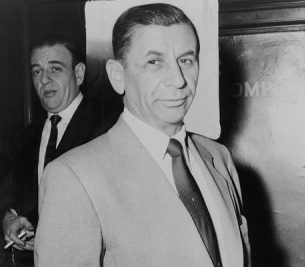
Meyer Lansky
The heirs of Meyer Lansky, the impresario of the North American Mafia gambling colony in Cuba (1933-1958) are betting on a big payback from the negotiations between the United States and Cuba to normalize relations between the two countries. Compensation claims by U.S. citizens or businesses for properties nationalized by the Cuban revolution are among the issues under discussion.
Lansky’s daughter Sandi, her son Gary Rapoport, and her brother Paul have filed a compensation claim against Cuba for the Riviera Hotel and Casino with the U.S. Foreign Claims Settlement Commission. The Cuban revolution confiscated the Riviera and other Mafia-owned properties after it toppled the gangster-linked regime of General Fulgencio Batista in 1959.
“It was through my grandfather’s hard work that the hotel was built,” Rapoport told the U. K. Daily Mail Online on December 23, 2015. “We are his natural relations . . . . By right, it should be our property.” He says the Riviera is valued at $70 million. The Tampa Bay Tribune, Reuters, and Haaretz have also covered the story.
The Riviera, which overlooks the Straits of Florida, was the crown jewel of Lansky’s casinos, hotels, and nightclubs in Havana. When the Riviera opened in December 1957, it was the largest Mafia-owned hotel-casino outside Las Vegas. The hotel’s 440 double rooms were booked solid for the winter season of 1957-1958.
However, the narrative that the success of the Riviera was the product of Meyer Lansky’s “hard work” is undercut by Lansky’s own assessment of his arrangement with Batista. … continue
Blog Roll
 Aletho News
- Seyed M. Marandi: Total War – Attacking Nuclear Plants, Desalination & Infrastructure
- Israel systematically torturing Palestinians in custody: UN special rapporteur Albanese
- How the US-Israeli aggression against Iran is affecting the war in Ukraine
- Italy Is Caught Between Two Wars. Russia’s LNG Tanker
- Iran Beats US & Israeli Missile Defenses by Exploiting Their Weaknesses
- Report: White House Making ‘Detailed Preparations’ for Invasion of Iran
- US Air Defenses Not Suited for Modern Combat — Ex-Air Force Officer
- Eight Iraqi resistance attacks hit US Victoria base near Baghdad airport
- US Dirty War Iran Revelations 2026: Ex-Counterterrorism Chief Joe Kent Exposes Proxy Strategy
- Iran’s Dimona Strike Shatters Myth of ‘Impenetrable’ THAAD, Patriot & Arrow Air Defenses – Analyst
- If Americans Knew
- Lebanon deaths top 1,200; Palantir AI to be embedded across US military – Not a ceasefire Day 163
- Israel’s assassination game: Take all pragmatists off the board
- Food shortages return to Gaza as Israel tightens aid restrictions under the cover of its war on Iran
- Trump demands trillions in payments from Gulf countries, billions from Harvard – Not a ceasefire Day 162
- Meet the former fashion blogger and shady doctor behind the ‘30,000 dead’ Iran psy-op
- Vatican Secretary of State to Trump, Israel: End the war as soon as possible
- The Majority of Americans Believe War Against Iran Benefits Israel More Than US
- Efforts to shut down pro-Palestinian speech face series of setbacks in court
- What has Israel done to my brother?
- Eid without worship in Al Aqsa – Not a ceasefire Day 161
- No Tricks Zone
- Former Pfizer Toxicologist Dr. Helmut Sterz Tells Bundestag Hearing Pfizer Vaccine Should Have Never Been Approved
- Energy Expert: Germany’s Nuclear Phaseout Was A “500 Billion Euro Mistake”
- New Research: South Australia’s Mid-Holocene Sea Surface Temperatures Were 4°C Warmer Than Today
- Storing Green Energy To Last Germany 10 Days Would Require A 60-Million Tonne Battery
- New Studies: UK Sea Levels Were 4 Meters Higher Than Today During The Mid-Holocene
- Destructive Green New Deal: German Energy And Metal Group Warns Of Drastic Crisis
- New Study Documents A 20-Year Pause In Arctic Sea Ice Decline – Driven By Internal Variability
- Wake-up Call: Survey Shows Majority Of Germans Now Favor Postponing Climate Targets!
- Televised! Leading German Political Candidate Tells Schoolchildren CO2 Makes Sun Hotter!
- New Study: A Century Warming Of 1.1°C Is ‘Commonplace’ And ‘Not Unusual’ During This Interglacial
 Aletho News